BREAKING
⚡ #3541 JPMorgan, Visa, and Mastercard Breaches Expose Third-Party Vulnerabilities⚡ #3540 Fannie Mae IPO Could Have Serious Side Effects on Mortgage Rates⚡ #3539 Industry News: BASIS Opens First-Round Applications for Card Offering Cashback in the Asset Spent⚡ #3538 Risk, Friction, and Fraud: When Should You Trust, Verify, or Intervene?⚡ #3537 Buyer’s Remorse: What It Is and How to Avoid It⚡ #3536 Industry News: GBP/AUD Forecast: Golden Cross Pattern Forms Ahead of BoE and RBA Hikes⚡ #3541 JPMorgan, Visa, and Mastercard Breaches Expose Third-Party Vulnerabilities⚡ #3540 Fannie Mae IPO Could Have Serious Side Effects on Mortgage Rates⚡ #3539 Industry News: BASIS Opens First-Round Applications for Card Offering Cashback in the Asset Spent⚡ #3538 Risk, Friction, and Fraud: When Should You Trust, Verify, or Intervene?⚡ #3537 Buyer’s Remorse: What It Is and How to Avoid It⚡ #3536 Industry News: GBP/AUD Forecast: Golden Cross Pattern Forms Ahead of BoE and RBA Hikes
🔥 Streak: 1 Days
📡 RSS
Interactive News & Article Catalog - Page 31 (News Archive)
Page 31 of 48 • Total 9541 articles available in the daily news directory.
POPULAR TAGS:

General
⚖️ Neutral
🌐 Paymentsjournal
#3541. JPMorgan, Visa, and Mastercard Breaches Expose Third-Party Vulnerabilities
📅 20 Nov 2026 • ⏱️ 1m • ⚡ Quick Read (18 w)
JPMorgan, Visa, and Mastercard Breaches Expose Third-Party Vulnerabilities
📅 20 Nov 2026 | ⏱️ 1 min read (18 words, ⚡ Quick Read) | Source: Paymentsjournal
⏱️ ~1 mins left to finish
📖 0% read

General
⚖️ Neutral
🌐 Biggerpockets
#3540. Fannie Mae IPO Could Have Serious Side Effects on Mortgage Rates
📅 30 Jul 2026 • ⏱️ 28m • 📚 Deep Dive (5645 w)
Fannie Mae IPO Could Have Serious Side Effects on Mortgage Rates
📅 30 Jul 2026 | ⏱️ 28 min read (5645 words, 📚 Deep Dive) | Source: Biggerpockets
⏱️ ~28 mins left to finish
📖 0% read
💡 Key Takeaways
- Industry observers note that nearly 50% of mortgages in the U.S.
- Sources indicate that fannie Mae and Freddie Mac alone take up about half of the mortgage market.
- Today, we’re getting into the major consequences from a sale of Fannie and Freddie—currently owned almost entirely by the government.
Industry observers note that nearly 50% of mortgages in the U.S. flow through Fannie Mae or Freddie Mac—but a push from the Trump Administration could sell shares of these government enterprises and put them in the hands of the public. The side effects could be significant to those getting or refinancing a mortgage—from interest rates to regulations.
Sources indicate that fannie Mae and Freddie Mac alone take up about half of the mortgage market. The reason you can get a 30-year loan, a lower interest rate, and do it all with standardized regulations is largely thanks to Fannie Mae and Freddie Mac. So, if these enterprises are sold on the private market with Freddie Mac and Fannie Mae IPO-ing, would it put so much privatized pressure on the mortgage market that it could begin to break?
Today, we’re getting into the major consequences from a sale of Fannie and Freddie—currently owned almost entirely by the government. With a $250B payday sitting in limbo, the government could be pushed to sell off the enterprises that enabled average Americans to buy houses. The question is, should it even happen?
Click here to listen on Apple Podcasts.
Recent findings suggest that dave: Two thirds of every single mortgage in the United States flow through just three massive government entities, Fannie Mae, Jennie Mae, and Freddie Mac. These companies operate behind the scenes. You may not often think of them, but they are a massive part of the infrastructure that makes the housing market actually run. And the Trump administration is proposing changes that could radically shape how they work. He’s talking about taking Fannie Mae and Freddie Mac public, and this would not be a normal IPO. Changing the ownership structure and the government’s role in these companies wouldn’t just make them subject to public market scrutiny. It could also impact loan availability, housing policy, and yes, even mortgage rates and probably not in the way you’d like them to go. So today on the show, we’re digging into the concern of taking Fannie Mae and Freddie Mac private. We’ll start by talking about what these companies are, why they have such a unique structure as a public-private entity, how they wound up in government hands during the great financial crisis, why there’s talk of taking them public, and how an IPO would impact the housing market and real estate investors alike. This is On the Market. Let’s get to it. Everyone, welcome to On the Market. I’m Dave Meyer. Today, we are talking about a issue that has been making news a lot during President Trump’s second term, and that is taking Mortgage Giants, Fannie Mae and Freddie Mac public. When I say public, that just means listing them on the stock exchange through an IPO, an initial public offering. So basically listing them on the stock exchange. And there is a big debate raging in the industry about whether this is a good idea, what would happen if it actually goes public. And of course, investors, homeowners are all wondering what would this mean for them if this actually happens? So today in the show, we’re digging into it. We’re going to talk all about what these companies are in the first place because they play a very unique and very important role in the housing market. We’ll also talk about the government’s role in these companies and this very weird, unique structure that they have. We’ll talk about the prospects of an IPO, the pros and cons, and what you should be watching as this all unfolds. Let’s get to it. We’re going to start with just the basics here. What are Fannie Mae and Freddie Mac? Fannie Mae, it’s not actually, it’s just kind of a nickname for the organization. It’s the Federal National Mortgage Association. It was created way back during the Depression in 1938. The whole goal of it was to create cheaper housing and to get more loans flowing. Freddie Mac is a very similar company. It was created in 1970. It stands for the Federal Home Loan Mortgage Corporation. It was basically created in 1970 to create some competition for Fannie Mae. Now, you probably have heard of these companies, but they are not traditional banks. They don’t actually lend to consumers. What they do is more on the backend. They actually go out and buy mortgages from banks and lenders. They bundle them together into mortgage-backed securities, also known as MBS, and sell those to investors worldwide. So what does that mean? Let’s just break this down. If you go out and get a loan from a bank, whether that’s a local bank, a credit union, even sometimes if it’s from Chase or Wells Fargo or some of these big companies, those banks don’t hold on to the mortgages that they originate. If they did, that would limit how many loans that they could create. They only have a certain amount of deposits. And so at a certain point, they would just give away all the money that they had and then they couldn’t originate any more mortgages. That is not good for their business model. And the government has taken the position that that is also not good for the housing market because it would limit transactions and it would limit availability to the housing market. And so what happens most of the time, this is more common than not, is that that bank, let’s just say it’s Chase, let’s say it’s Rocket Mortgage. They go out and once they’ve originated that loan, they collect the origination fees so they make money. But then they go sell that loan to Fannie Mae and Freddie Mac. And so that goes off the bank’s books and then they get money back that they can go out and lend again. Now what Fannie Mae and Freddie Mac do once they’ve purchased this loan is they bundle them together. Let’s just call it a group of a hundred mortgages, and then they’ll go out and sell that mortgage to a pension fund or to a sovereign wealth fund or any sort of investor who wants to service that mortgage. Because there are investors out there who want to collect the five, six, 7% interest that they can get off of a mortgage. It’s sort of another way that you can get fixed income different than bonds. It’s a little bit riskier than bonds, but investors do this. They go out and buy mortgages. And Fannie Mae are an enormous part of that. They create so much of the liquidity in the mortgage market that allows credit to flow. And because, and we’ll talk about this more in a little bit, there is an implicit guarantee that the government will backstop these mortgages. It lowers mortgage rates. By and large, people who study these things believe that the existence of Fannie Mae and Freddie Mac lower mortgage rates. So big picture here, they are super important. Now, they are not private companies in the traditional way that Walmart or Amazon are. They are actually called a government sponsored enterprise. I’m going to call them GSEs, that’s kind of what they’re known as. And they’re sort of this hybrid kinds of organization because they’re actually chartered by Congress. They have a public mission, so that’s the public side, but they operate historically at least as a shareholder-owned company. That is the private side. So it’s kind of weird. It’s kind of both a government entity and a private entity. Now, the idea at least behind this structure is that it should be operated by the private markets because it’s more efficient and we have a capitalist market-based economy. But the government side, the fact that the government has this quote unquote implied government guarantee allows people like you and me who borrow money in mortgages that are sold through Fannie Mae and Freddie Mac, that allows us to borrow at a cheaper rate. It is also, in my opinion, basically the only reason that a 30-year fixed rate mortgage exists at all in the United States and anywhere in the world because a 30-year fix is basically an American loan that doesn’t really exist anywhere else. And I want to be clear because this will come up later when we talk about the IPO, but the idea that the government guarantees these mortgages and their performance is not actually real. It’s not explicit. It is not written down. It is not legal. It is what they call an implicit guarantee that people believe that the government will back up these mortgages. And as we know in 2008, they did step in in a big way to shore up the mortgage market. But just remember, that is not a guarantee. It is an implicit guarantee, not the same thing. So that’s what they are. And I think one thing everyone should know here is that this is totally unique to the United States. There is no other major economy in the world, at least that I know of, that structures its housing finance this way. And people will have different opinions on whether that is good or bad, but the whole reason our housing market is basically built upon the back of a 30-year fixed rate mortgage that’s prepayable, which is awesome, that is a uniquely American thing. The rates that we get on those 30-year fixed are sort of artificially low or can be that low because of Fannie Mae and Freddie Mac. And to just further emphasize this here, because like I mentioned, the whole housing market sort of built on the back of these entities. Let me just demonstrate that to you in a couple of numbers here. At the end of 2025, according to a Columbia business school analysis, the total US residential mortgage market was about $15 trillion. Fannie Mae and Freddie Mac combined were 6.8 trillion of that. That is just under half of the total mortgage market. Now, we’re not talking about Ginnie Mae here too. That is another government-backed entity. Ginnie Mae is a little bit different. It’s a similar mission, but they do FHA and VA loans. That’s about 20% of the market. So actually, if you look at those three entities combined, Ginnie Mae, Fannie Mae, Freddie Mac, two-thirds of every mortgage originated in the housing market goes through these entities. So when I say they’re important, they are incredibly important. When you compare that to banks that just hold onto those loans, remember I say most of them go off and sell them. When they keep them, that is often called a portfolio loan, portfolio loans are only about 22% of the market. So about a third of the size of the government-backed mortgages that we are all using. So they’re huge in terms of volume, but they do more because the only way that Fannie Mae and Freddie Mac are able to bundle and sell these mortgages as efficiently as they do is by standardizing the mortgages. If you’ve applied for a mortgage, this is why you have to check all those boxes, why they have all of these weird rules, why there is so much paperwork and seemingly nonsensical rules. It’s so that every mortgage, once they reach Fannie Mae and Freddie Mac to be resold, looks relatively similar. And so that when investors go and buy those mortgages, they know roughly what they’re getting. Because when they go and bundle these mortgages and sell them off, these investors, a pension fund is not going to go look through a thousand different mortgages and underwrite them. They are trusting Fannie Mae and Freddie Mac to group them together appropriately. And in order to do that, they have some rigid rules. So that being said, Fannie Mae and Freddie Mac, they set the rules around the majority of mortgages. They set conforming loan limits. They set debt to income ratios. They set down payment standards. These are hugely important elements of who gets loans and how easily the housing market is achievable or affordable or accessible to the average American. So they’re also important in that way. The other thing I should mention that they’ve done in the past that is also, I’m getting tired of saying this, hugely important, is that they are countercyclical. In the past or in other countries that don’t have things like this, when the economy turns south and private capital flees the market, banks don’t want to lend as much or pension funds don’t really want to buy mortgages as much as they might. GSEs keep buying. They are government-backed entities with a public mission. And so they continue to help the plumbing and the infrastructure of the housing market work even when private capital is not as interested. Super important backstop for the housing market. So regardless of what you think about privatization, and we’re going to get to that in just a minute, these companies matter a lot to a housing market. This is just an indisputable fact. So if they’re doing their job, what’s the issue? Why is there talk of taking these companies public? We’ll get to that right after this break. Stick with us. Welcome back to On the Market. I am Dave Meyer. We’re here talking about how government sponsored entities, GSEs like Fannie Mae and Freddie Mac, how fundamental they are to the housing market and why is their talk of IPOing these companies? Why now are we talking about listing these on the stock market? To understand that issue, we briefly have to talk about their history. So I mentioned earlier, Fannie Mae started in 1938. In 1968, it actually privatized. It became a public company. So this is super important. It actually has been a public company in the past starting in 1968. Then Freddie came around in 1970 as I mentioned, but it wasn’t really until the 1990s and 2000s until they really just became these massive financial institutions, huge, huge companies, because they have a big advantage in the market. They could offer lower rates. They’re very competitive compared to other lenders that don’t use conforming mortgages. And so in the ’90s and 2000s, they got huge. But I’m guessing you can see where this goes. In the mid – 2000s, they really started piling into buying, selling subprime mortgages, trying to get bigger and to compete. And partially, I will say, under political pressure to expand homeownership. And we all know what happened from there. The subprime mortgages they bought and guaranteed, they got bad. They were basically giving out loans to people who couldn’t pay, and those started to go belly up. And the whole institution was essentially falling apart, becoming insolvent. So in September 2008, 40 years after Fannie Mae went private for the first time, the FHFA, a government entity, the Federal Housing Financing Authority, placed both Fannie Mae and Freddie Mac, both of these entities into conservatorship. This is basically what has been called, or at the time was built as a temporary federal takeover. It was never meant to last forever, but it was basically to save the companies. The US Treasury at the time injected $187 billion to keep these companies solvent. It was a bailout. They bailed them out to the tune of $187 billion. In exchange for that though, the treasury got some shares in the company, about 80% of the common stock in the company. So the vast majority of all the stock the US Treasury now owned. Basically, government took over these companies, saved them, got some stock in exchange. And in 2012, last thing you need to know is they did something called a net worth sweep. Doesn’t really matter what it means, but it’s just kind of the treasury started taking all the profits for itself as part of getting paid back for the bailout, as being the largest shareholder of these companies. It was taking all of their profits. And that has become, since 2012, since they started doing that, a big legal and political flashpoint for shareholders. So that’s going to come up in this IPO conversation. So you should just know that happened. So basically that is where things stand today. The two companies, Fannie Mae, Freddie Mac, still in conservatorship, 17 years and counting. They have repaid the treasury well in excess of the original bailout. So they’ve repaid it more than that 187 billion. And I guess what’s been going on in the background, because to you and me, to most homeowners, nothing’s really changed. It’s been fine. I don’t know. I’ve been investing for basically all that time, and I haven’t really thought very much about whether Fannie Mae and Freddie Mac are private or in conservativeship. It’s just been operating fine. But common shareholders, people who had invested in these companies prior to 2008 have been trying for years to regain some of the money that they claim that they are owed because it shouldn’t be a government entity. So that’s basically what’s been happening for the last 17 years. But recently, there has been renewed conversation around privatization. Again, when I say privatization, same thing as an IPO, same thing as going public, just listing it on the stock market. President Trump did push for this sort of lightly in his first term. It didn’t happen, but in a second term, he has talked about it a lot more. Back in August of 2025, Trump administration actually met with six of the largest banks to lay the groundwork for an IPO. And their idea, what they floated out there was to sell up to $50 billion in preferred shares. We’ve seen support within the administration. The FHFA director, Bill Polte’s been a very vocal supporter. And so it looked like this was happening. And actually as of late 2025, analysts were projecting that by middle of 2026 around now, an IPO would happen. Now that momentum did slow, has been slow as the administration seems to have turned its attention to the Middle East, but there is still a good chance this happens or at least a push to make it happen. If you look at MBS investors, like people who follow this stuff carefully, everyone bets on everything now. You can look at public markets for anything. It’s about a fifty fifty shot. About 50% of people believe the privatization will happen by 2028. But why? Why now? If it’s been fine for 17 years, what’s the case to actually do this? The reasons proponents are saying this should actually happen are as follows. First, reduce taxpayer exposure to the seven, $8 trillion in mortgage guarantees that Fannie Mae and Freddie Mack have. Taxpayers are ostensibly on the hook for that because the government is so involved in these companies. So that’s one. The other is to generate substantial profit for the government from selling the treasury warrants. They were saying up to $30 billion, but analysts say that the government could earn up to $250 billion by selling this stock. Proponents also say it should be a private company. Let private capital and risk pricing do its job and get the government out of what these people say should be a private entity. And the last thing we should mention, because this is a big thing, is pressure from the common shareholders who own stock in this company have been waiting since 2008 to get some liquidity out of this company. Personally, I actually think this is probably the biggest one. They haven’t been able to monetize their investments and they’ve been vocal about wanting the companies to go private again and to end the conservativeship. But they’ve been saying this for a long time. So the reason why now specifically people are talking about it is because there’s a Republican trifecta in Washington. Republicans have the House, Republicans have the Senate, Republican has the presidency. So it’s politically just easier now than under split government. The other reasons are the housing market, despite being really slow, it is sort of stabilized post-pandemic. There’s not really much evidence that a crash is imminent. So in a stable housing market, it’d be easier to do this. And it also just goes along with a lot of President Trump’s economic agenda, which is to deregulate. And this would be deregulation, getting the government out of a major part of the economy while returning capital to taxpayers. So those are the reasons why it’s being talked about now. But there are pros and cons to this. I think there are important trade-offs in whether or not this should be done. We’re going to get to those pros and cons, but we got to take one more quick break. We’ll be right back. Welcome back to On the Market. I’m Dave Meyer. Today we’re talking about the GSEs, Fannie Mae, Freddie Mac, and going public. Before we talked about what proponents say, and I’ll just summarize again the benefits to the companies going public, and then I’ll talk about some of the cons. So number one, removes taxpayer backstops. So they’re saying government’s guaranteeing these mortgages. So that would go away if it went public. It could attract more private capital into the housing market if rates went up and it was more attractive. Forces some clear pricing. If you are letting the proper amount of risk price mortgages, that might have some benefits. It ends this weird arrangement that the government has, and there could be money up to $250 billion for the US Treasury. So those are some of the reasons, and they’re real reasons to do this. Now, there are some cons to this. So first and foremost, let’s talk about that implicit guarantee. Because the argument that a lot of people make is that if the companies go private, taxpayers are no longer on the hook for guaranteeing these mortgages. And I’ll be honest, I’m sorry, I do not buy that. I do not buy that at all because the companies were private in 2008 and the government bailed them out. And even if they go private, every investor who invests in these companies is going to expect the government to bail out Fannie Mae and Freddie Mac if they do something that screws up again. Even if they go and take risky loans like they did from 2000 to 2006 or whatever, the government bailed them out because they’re “too big to fail.” And so that part of the argument, I just don’t really buy. I just don’t really think that makes sense because I think the government is going to still, at a minimum, implicitly guarantee, remember the difference, implicitly guarantee these mortgages. The second thing, and this is huge for our audience, for anyone who’s an investor here, this is the thing that I think is going to matter to you most. One of the cons, a big one is higher mortgage rates. Like I said at the beginning, the whole reason these things exist is to lower mortgage rates, and they still will if they’re private. I’m not saying that they’re going to go back to what they actually would be without Fannie Mae and Freddie Mac. But because right now there is such a implicit guarantee that the government will back these loans, we, you and me, get mortgage rates as lower at lower cost. And JP Morgan actually looked into this and they estimate that if the government does not switch from an implicit guarantee to a explicit guarantee, explicit guarantee on paper guaranteeing these mortgages so it goes private. If they don’t do that, mortgage rates will go up 45 basis points. That’s what JP Morgan indicates. So not crazy crazy, but that’s half a percentage point at a time when we don’t need that in the housing market. So something to think about. Maybe it’s better in the long run. I don’t know about that, but in the short run, that could hurt the housing market. That’s something everyone should know. So again, this is another reason I just don’t buy that idea that privatization will get taxpayers off the hook. JP Morgan’s saying not only will they not be off the hook to keep mortgage rates where they are, the government will need to go from an implicit non-legally binding guarantee to an actually explicit legally binding guarantee to keep mortgage rates where they are. So people will have different opinions about that, but the government will still be very involved. And whether you believe that the government should be guaranteeing the performance of a private company or not, I’m not sure I believe in that. Now we’re just getting into my opinion, but if companies are going to go public and they want to earn the benefits and the profits that public companies deserve to make, then the government should not be backstopping them so that they can go out and take risk and do all these things knowing that if they fall and if they screw up and if they push too hard into risk, the government’s going to be there to catch them. Personally not a fan. Or at least if the government has to step in again, there needs to be serious punitive damages. It’s not just repay us the bailout, it’s repay us and we take your profits for the next 40 years. I don’t know, it’s just something like that. But I just don’t like the idea.That’s not a free market if the government’s backing you up. So anyway, I find that whole thing personally kind of weird. The other thing, the other argument against taking these companies private is tighter credit standards. You could start to see, because the government’s not involved, some tighter standards around affordable housing programs, first-time buyer programs, and lending to underserved communities. Those are likely to get scaled back because they’re riskier and the public markets might not have the appetite for those types of loans. We’ve actually already seen the current FHAFA director Bill Pulte pull back on some of these equitable lending programs already. All right, a couple more just arguments against privatization. One is that it could cause another crisis.That’s a big one. I’m not saying this would necessarily happen, but one argument is that these companies were private in the 2000s and they took on extra risk. They did a bad job. They went belly up. If the government didn’t step in, they would’ve been bankrupt. And if the government steps out of this without guardrails, then that could happen again. Not saying it necessarily will, but it could. We’re sort of taking away one of the protections in the housing market that we have. So that’s important to remember. The last thing that people say is really the people who benefit from this are hedge funds. The main people who benefit from this are hedge funds like Bill Ackman, Pershing Square, giant hedge fund. He’s been very adamant about it. He’s probably the most vocal voice here. He stands to gain billions of dollars from this happening. And taxpayers will get some, but they could also get higher mortgage rates, probably still on the hook for all the money these private companies take. And I will just say $250 billion to the treasury, that is good. It’s not really going to change anything. I was doing the math before, and that could pay off 0.6% of the national debt if we raise that amount of money. Not exactly the most exciting. I mean, maybe it can help pay for something, but we’ve got bigger fiscal problems in this country. This is not going to solve them. So where I come out on this is not necessarily one way or another it should happen or it should not. I think the devil is really in the details here. Is there going to be an implicit guarantee kind of what we’ve had? If so, and they go private, rates will probably go up. Is there going to be an explicit guarantee? Then we’re not really getting the benefit of getting taxpayers off the hook for private company behavior, but we’ll keep mortgages lower. What actually happens here? And do we do it all quickly? That is one thing Bill Ackman of Pershing Square, he has pushed for a slow rollout. So not selling all of the treasury shares all at once and instead doing it sort of dripping it out so the market can adjust and credit markets can adjust and doing it slowly. And so I personally feel I would like to reserve judgment until I understand exactly how it might be done. But I will just say in general, I think that private companies should be on the hook for their own behavior. They reap enormous profits and enormous rewards for what they do. And that’s how our economy works. But you don’t get capitalism on the way up and socialism on the way down. I’m not a fan of that. And they got bailed out once, and I actually agree with that bailout. It made sense. Given what happened in 2008, the housing market already collapsed. It wouldn’t have recovered yet probably if the government did not bail out Fannie Mae and Freddie Mac and some of the banks in the way that they did. But I just don’t think that should be last resort. And although I’m not always a fan of government intervention and government taking over private businesses, but this one kind of worked. A lot of times it doesn’t, but this one did sort of work. And so I personally would be a fan of if they’re going to unwind the way it works, unwinding it slowly and doing it a way to make sure that access to loans, access to home ownership remain the same, and that rates stay low in some way and doing that ideally without taxpayers being indefinitely on the hook for the behavior of these two private companies.That doesn’t make sense to me. So hopefully they can figure out a way to do that if they’re going to take them private at all. Those are the kind of things that I would like to see. But as of now, we actually don’t know if these things are even going to happen. So there’s a lot of strong political will. The groundwork has already been laid with banks. Treasury has authority to act on this stuff without Congress. So there’s some momentum towards these things, but we still have to see if and how it’s actually going to happen. So what does this mean for you? One, you don’t need to panic. This is nothing that you need to worry about right now. I got a lot of questions about this, so this is why we made this episode. But even if privatization happens, it’s not going to happen overnight, I don’t think. I think it’s most likely that they phase it in so the markets don’t go crazy, but what you’re going to want to watch out for is this implicit versus explicit guarantee. If there’s an implicit guarantee in a privatization, I think rates will go up a little bit. If there’s an explicit guarantee, rates will probably stay the same. So these are the kinds of things that you should be watching for when you’re planning your own decisions around going out and getting a mortgage. I guess the only thing I would say is that if you are a first time home buyer or if you are looking to take advantage of some of the programs that they have, like HomeReady or Home Possible, that expand home ownership or access to loans to promote home ownership, I should say, those might go away. So if you’re thinking about using those, might want to speed up that timeline. Now, I don’t think this is happening in the next month or two, but by the end of the year, before the midterms, it’s possible. So if you were thinking about using those programs, might want to look at that now. But the real things that will matter is this implicit, explicit guarantee. And if rates start to go up, that will matter in the short run. And long run, I think it does matter if the government’s guaranteeing these mortgages, but that might take 10 years to play out, 20 years to see if that’s a good decision or not. We don’t know, right? The rate thing will hit the market immediately. If they do this now and rates go up, man, that wouldn’t be good for the market. We already seen what’s happened since the war in Iran started when rates were at six, they’ve gone to six and a half now. It’s slowed down the market. If they go to seven, it’s not going to crash, but man, just makes the recovery take even longer. It’s going to push prices down a little bit more. So this is the thing that we need to watch and see if this privatization happens in the near term. That’s our show for today. Thank you all so much for listening to this episode of On the Market. I’m Dave Meyer, and I’ll see you all next time.
Help us reach fresh listeners on iTunes by leaving us a rating and review! It takes just 30 seconds and instructions can be found here. Thanks! We really appreciate it!
Interested in learning more about today’s sponsors or becoming a BiggerPockets partner yourself? Email [email protected].

General
⚖️ Neutral
🌐 Cryptopotato
#3539. Industry News: BASIS Opens First-Round Applications for Card Offering Cashback in the Asset Spent
📅 27 Nov 2026 • ⏱️ 4m • 📚 Deep Dive (855 w)
Industry News: BASIS Opens First-Round Applications for Card Offering Cashback in the Asset Spent
📅 27 Nov 2026 | ⏱️ 4 min read (855 words, 📚 Deep Dive) | Source: Cryptopotato
⏱️ ~4 mins left to finish
📖 0% read
💡 Key Takeaways
- [PRESS RELEASE – Victoria, Seychelles, November 27th, 2026].
- Available in Standard and Platinum editions, the BASIS Card offers up to 10% cashback, with applicants selecting their preferred tier subject to staking eligibility.
- Industry observers note that the BASIS Card returns money differently.
[PRESS RELEASE – Victoria, Seychelles, November 27th, 2026].
Available in Standard and Platinum editions, the BASIS Card offers up to 10% cashback, with applicants selecting their preferred tier subject to staking eligibility.
Industry observers note that the BASIS Card returns money differently. Declared today by BASIS DIGITAL INFRASTRUCTURE LTD, the payment card credits cashback in the asset used for each eligible purchase, with Platinum cardholders qualifying for 10% cashback during the introductory Launch Boost period.
For digital asset holders, the principle is straightforward. Spend Bitcoin and receive Bitcoin back. Pay with Ethereum and receive Ethereum back. There are no reward points to redeem or proprietary platform tokens to manage. Cashback is credited in an asset the cardholder already uses, giving everyday spending a direct connection to their digital asset holdings.
Industry observers note that the opening of first-round applications marks an expansion of BASIS’s existing digital asset infrastructure into everyday payments. Applications are submitted at https://basis.pro/card and close on December 31, 2026, at 23:59 UTC.
Two Card Editions With Different Levels of Benefits.
Sources indicate that the BASIS Card is available in Standard, finished in matte black composite, and Platinum, produced in metal. Applicants select their preferred edition when submitting their waitlist application, with qualification determined by their active staking position.
Recent findings suggest that each edition has a separate staking eligibility threshold, as detailed below. BASIS measures the value of the applicant’s active staking position against the requirement for their selected tier. The position is assessed at submission and re-checked at the close of the application period.
It has been revealed that participants can therefore review the benefits of each edition alongside its staking requirements before deciding which card to apply for. Final issuance remains subject to the issuing partner’s independent review.
Card Fees, Cashback, and Launch Boost Benefits.
Both editions feature an introductory Launch Boost period, beginning on the date of card issuance. During this period, cardholders receive enhanced cashback rates, higher monthly reward caps, and additional subscription benefits.
*All monetary figures are expressed in USD. Physical card issuance fees include applicable shipping charges.
Recent findings suggest that launch Boost runs for three months following issuance, after which each card returns to its respective base benefits. Standard and Platinum also feature rate-lock periods of 12 and 24 months, respectively, subject to the applicable program terms.
Along with cashback, the card program brings together subscription rebates of 50% or 100%, depending on the edition and benefit period, across a catalog of over 80 subscriptions. Travel and additional card benefits include two annual airport lounge visits, a 3 GB eSIM, and one additional card, subject to tier eligibility and applicable terms. Standard cardholders benefit from a 2% FX fee, while Platinum cardholders pay no FX fee during Launch Boost. Both editions provide immediate access to a virtual card upon activation, with Platinum participants also receiving priority and dedicated support.
Paid Back in the Asset You Spent.
The defining feature of the BASIS Card is what happens after a purchase. Where conventional reward programs may require cardholders to accumulate points or convert rewards into their preferred currency, BASIS keeps the cashback denomination consistent with the asset spent.
Industry observers note that cashback on eligible settled purchases is credited directly to the cardholder’s Funding Wallet. A purchase made using BTC returns BTC, leaving the recipient free to decide how to use the reward.
Cardholders who wish to stake their cashback can do so separately under the platform’s ordinary conversion rules. Cashback does not automatically enter an existing staking position, and card rewards remain independent of staking yield.
Submitting a card application also leaves existing staking positions, lock-up periods, Dynamic Reward Rates, boosters, and stToken balances unchanged.
First-Round Applications and Card Issuance.
It has been revealed that applications are free and limited to one per account during Round 01. Participants must hold at least USD 1,000 in eligible BASIS wallet value at submission, maintain an account in good standing, and satisfy the staking requirements for their selected card edition.
Once BASIS approves a waitlist application, the applicant receives further instructions and a secure Know Your Customer (KYC) verification link. The issuing partner then conducts its own review, covering identity verification, residency, regional eligibility, sanctions screening, and supporting documentation.
Waitlist approval permits applicants to proceed to the next stage and does not constitute final card approval, activation, or issuance.
Further information on card eligibility, benefits, fees, and application requirements is available in the official BASIS Card Program documentation.
BASIS DIGITAL INFRASTRUCTURE LTD is a Seychelles international business organization (LEI: 254900IX2F2KCWNSSS64) operating market-neutral yield infrastructure, including execution, risk-management, and settlement systems for digital asset staking.
The tech giant holds ISO/IEC 27001:2022 and ISO/IEC 20000-1:2018 certification, both verifiable through IAF CertSearch.
Technical documentation is available at docs.basis.pro.
Base cashback rates are fixed for 12 months on Standard and 24 months on Platinum. Launch Boost rates may be adjusted after the boost period with 30 days’ notice. Both are separate from platform staking rewards, which vary with market conditions.
Card inquiries: cardservices@basis.pro.
Chainwire is a specialized crypto newswire service providing high-impact distribution for the cryptocurrency and blockchain industry.
🔗 Related Articles
📰 #3017. Industry News: BASIS Opens First-Round Applications for Card Offering Cashback in the Asset Spent 📰 #5161. BASIS Opens First-Round Applications for Card Offering Cashback in the Asset Spent 📰 #8959. Industry News: Check Ikea’s As-Is Section First – Floor Models Cost Less, but Sales Are Final
General
⚠️ Warning
🌐 Paymentsjournal
#3538. Risk, Friction, and Fraud: When Should You Trust, Verify, or Intervene?
📅 20 Nov 2026 • ⏱️ 1m • 📖 Standard (158 w)
Risk, Friction, and Fraud: When Should You Trust, Verify, or Intervene?
📅 20 Nov 2026 | ⏱️ 1 min read (158 words, 📖 Standard) | Source: Paymentsjournal
⏱️ ~1 mins left to finish
📖 0% read
💡 Key Takeaways
- WEBINAR Risk, Friction, and Fraud: When Should You Trust, Verify, or Intervene?
- According to recent reports, WEBINAR Risk, Friction, and Fraud: When Should You Trust, Verify, or Intervene?
- Industry observers note that the post Risk, Friction, and Fraud: When Should You Trust, Verify, or Intervene?
WEBINAR Risk, Friction, and Fraud: When Should You Trust, Verify, or Intervene? December 15, 2026 1:00 pm EDT Detecting Risk Earlier with Smarter Fraud Signals Fraud, payment failures, and first-party risk rarely emerge without warning. Yet many organizations still rely on isolated checks and static controls that create friction for legitimate customers while failing to […] The post Risk, Friction, and Fraud: When Should You Trust, Verify, or Intervene? appeared first on PaymentsJournal.
According to recent reports, WEBINAR Risk, Friction, and Fraud: When Should You Trust, Verify, or Intervene? December 15, 2026 1:00 pm EDT Detecting Risk Earlier with Smarter Fraud Signals Fraud, payment failures, and first-party risk rarely emerge without warning. Yet many organizations still rely on isolated checks and static controls that create friction for legitimate customers while failing to […].
Industry observers note that the post Risk, Friction, and Fraud: When Should You Trust, Verify, or Intervene? appeared first on PaymentsJournal.

General
⚖️ Neutral
🌐 Ramseysolutions
#3537. Buyer’s Remorse: What It Is and How to Avoid It
📅 13 Jan 2022 • ⏱️ 11m • 📚 Deep Dive (2271 w)
Buyer’s Remorse: What It Is and How to Avoid It
📅 13 Jan 2022 | ⏱️ 11 min read (2271 words, 📚 Deep Dive) | Source: Ramseysolutions
⏱️ ~11 mins left to finish
📖 0% read
💡 Key Takeaways
- According to recent reports, unable to copy link.
- Recent findings suggest that when it comes to money, youâre either a spender or a saver, a free spirit or a nerd, an experience junkie or a lover of things .
- You might feel buyerâs remorse every year after the holidays (and all the holiday spending).
According to recent reports, unable to copy link. Please try again.
Recent findings suggest that when it comes to money, youâre either a spender or a saver, a free spirit or a nerd, an experience junkie or a lover of things . . . these are all tendencies that show up in the way we deal with our money. And while it helps to know why you handle money the way you do, thereâs one thing that affects everyone no matter what your money tendencies or money habits areâand that buyerâs remorse.
You might feel buyerâs remorse every year after the holidays (and all the holiday spending). As you know, Black Friday and Cyber Monday are part of one of the biggest holiday shopping seasons of the year. People love to shop the sales and stock up on gifts for themselves and others. But the word âsaleâ can be a siren song to so many (myself included) that leads straight to the pit of buyerâs remorse.
Buyerâs remorse is the awful feeling of regret that can sometimes happen after you make a purchaseâno matter how big or small. And it can happen when you least expect it. For some people, it can even hit just by stepping into a store!
Recent findings suggest that crazy, right? Well, not really. Itâs all part of something psychologists call cognitive dissonance. Thatâs a $10-dollar term to describe the conflict you experience when your actions and beliefs donât match up. It can happen in any aspect of life, but especially in the area of money (aka buyerâs remorse).
It has been revealed that as a free spirit and a spender, Iâve felt the sting of buyerâs remorse too many times to count. One of my money tendencies is âstatus,â which means I can have a taste for the finer things in life. If I have the money in my budget, I'm drawn to spend it on name brands. And Jimmy Choo is one of those names in fashion I've always wanted to try.
One day, I was shopping at a department store, and there they were: a gorgeous, sleek pair of Jimmy Choo heels. They were calling my name! Better yet, they were on sale. I couldn't resist the pumps I'd been pining forâor the great deal. So, I scooped them right up. But here's the thing: Once I got them home and wore them for a while, I realized how uncomfortable they really were. There was no amount of breaking them in that helpedâinstead, they were breaking my feet!
Even though I got those beautiful heels on sale, I couldnât help but feel the weight of regret for spending so much money on a brand name for a pair of shoes I couldnât even wear!
Buyerâs remorse feels like regret, guilt and even disappointment. Often, you go into a purchase with a ton of excitementâthe hope that whatever it is youâre about to buy will change your life, be the highest quality, or fill some sort of need you have. But when that purchase doesnât do any of those things, buyerâs remorse can set inâand fast.
According to recent reports, iâve said it before and Iâll say it again: Itâs okay to have nice stuff, but donât let your stuff have you. Itâs true. When your stuff owns you, it doesnât feel good. And if you go into debt for it, that feels even worse.
Recent findings suggest that buyerâs remorse can happen the instant you pay for something, or it can creep up on you a little slower and set in a few days (or even years) after you make your purchase. And thereâs no set time frame for how long it might last.
Industry observers note that letâs say you bought a really expensive coat, just because you liked it. Nothing wrong with that, right? But after you get the coat home, you open up your closet and realize you have another perfectly good coat hanging right next to it (making your purchase seem frivolous). Your buyerâs remorse sets in because youâve always believed that you shouldnât live in excess. And owning two perfectly good coats that will keep you warm in the winter doesnât really make sense. If you decide to keep both, you might experience buyerâs remorse every single time you open up your closet. But if you decide to give away your old coat or return the newly introduced one, your buyerâs remorse will disappear because youâve fixed the root of the problem.
Sources indicate that like I said before, thereâs really no time frame for how long it will last. Itâs up to you to decide how long to let it plague you until you do something about it.
Have you ever heard the saying âbuyer bewareâ? Itâs a law principle that reminds people to be smart with their moneyâto know what youâre getting before you buy. The idea isnât just for contracts and significant purchases like a home or a car. It rings true in every area of life. We have to be smart with our money decisions. But itâs hard! With so many products out there, how do you know for sure youâre going to love your purchase? Sorry to say it, but you donât!
Industry observers note that but donât worry, Iâve got some tips on how to avoid buyerâs remorse before it hits. Remember, it all stems from conflict between your beliefs and your actions! So, when it comes to your money, you have to get on the same pageâwith your spouse, if youâre married, and even with your own actions and beliefs!
So, here are my favorite five ways to avoid buyerâs remorse (so you donât have to deal with all that regret):.
If you know me, you know I love a good budget (although I didnât always). Thatâs rightâeven a free-spirited spender like me can grow to love the budget. Can you hear all the nerds cheering right now, or is that just me?
Industry observers note that A budget is the most notable thing you can do for the health of your finances. When you budget, youâre telling your money whoâs boss by giving every single dollar a job to do instead of wondering where it went. When you do a budget, you reduce your risk of buyerâs remorse. Why? Because a budget makes you think through every single purchase youâll make for an entire month. Every single dollar is accounted for. Now, you just have to stick to it! Download EveryDollar (the worldâs best budgeting app) and make your first budget for free.
It has been revealed that I love a good list almost as much as I love a good budget. Especially when it comes to grocery shopping. It gives me a game plan for buying just the things I need. It also helps me stay on track when I get caught in the Dollar Spot at Targetâagain. (Everything is just so useful and cute!).
Recent findings suggest that A list truly helps you shop for only what you need. But just like with a budget, youâve got to do your part and stick to it!
This one is a doozy. Havenât you ever felt that twinge of comparison when youâre scrolling social media? Before you logged in, you were perfectly fine with your hand-me-down kitchen table. But a few scrolls later, youâre drooling over that handmade barnwood table your friend bought that costs more than you want to think about. Thatâs a buyerâs remorse trap! (I know because Iâve been there!).
According to recent reports, contentment is the answer, friends. When youâre grateful for the things you have (and not pining over the things you donât), buyerâs remorse wonât be an issue.
In a recent development, we all have unique ways of handling moneyâI like to call those money tendencies. And after talking with thousands of people about money, I noticed a pattern. There are seven different tendencies weâre wired with. Knowing where you fall on the scale of each tendency will help you learn where you need to set boundaries in your spending or even your thinking when it comes to money. Getting to know your money tendencies will help you avoid buyerâs remorse too!
Want to dig deeper? Check out my book Know Yourself, Know Your Money to understand why you handle money the way you doâand how to make better decisions with that knowledge.
No matter how much you think youâll love that upcoming Peloton, give it time before you swipe your card. Wait a day or two (or even a month if itâs a big purchase like this one). If you wake up thinking about it (and it doesnât break the budget), itâs probably a good buy! The key here is to imagine yourself with the item. Do you really need it? Do you think youâll use it enough to justify the price? Or will it sit somewhere in your house collecting dust after those New Yearâs resolutions are forgotten?
The great thing about time is that it gives you space to trick yourself into getting buyerâs remorse before you ever make a purchase. If you feel a sense of regret just thinking about making the purchase, itâs not a good buy.
Sources indicate that if youâre really feeling remorse about a purchase you just made, donât worry. There are ways to deal with it so you can move on with your life (and get back to the budget).
Sources indicate that can you return the item? If you bought a new sweaterâas long as the tags are still on and you have the receiptâconsider that as good as returned! Make sure you check the storeâs return policy. Most stores have a very specific time frame for returns. And if youâre past that, many stores will still take your return in exchange for store credit. But if youâre trying to return a service or even a car for that matter, you might have a bit more trouble getting your money back. Like I noted, your best bet is to check the return policy. And if all else fails, it never hurts to ask!
It has been revealed that maybe you have buyerâs remorse because you donât normally spend money on yourself and you splurged a little (pandemic purchase, anyone?) In that case, you may want to spend some time working through the why. Get to the root of why you feel guilty for spending money. Once you do, youâll feel that remorse fade awayâespecially when you come up with ways to help you work through those feelings in the future.
Recent findings suggest that maybe you bought it on final sale or maybe youâve been wrestling with your buyerâs remorse well past the return policy date. No matter what the reason, you could always try selling your item for what you purchased it for (or a little less). And if you canât sell it, why not pay it forward and give it away to someone who might get good use out of it?
Turns out, the government actually has a rule in place to help you with buyerâs remorse. Itâs called The Cooling Off Rule, and it helps consumers who may have been pushed into purchasing something they regretted later on. Often, these situations happen in one-on-one sales settings or door-to-door sales. Timeshare, anyone?
Yepâthose people know how to get you to sign your name on the dotted line. And unless you want to spend your lifetime (and all your money) on a condo you canât get rid of, buyerâs remorse will work in your favor. The FTCâs Cooling Off Rule gives you three days to cancel certain sales made in your home, a temporary place (like a hotel, restaurant or convention center), or even your dorm if youâre in college. Once you cancel, the seller has 10 days to cancel the sale or refund your money.
Recent findings suggest that you guys, you donât have to be burdened with the weight of buyerâs remorse every time you spend money. Who wants to live like that? Not me! Spending is a necessary part of our livesâyou just need to know how to do it wisely.
Recent findings suggest that that's where Financial Peace University (FPU) comes in! This course walks you through everything you need to know about managing your money well (from paying off debt to saving for the future). Plus, in Lesson 5: Buyer Beware, I teach you how to be on the lookout for marketing tactics that threaten to bust your budget. Go ahead and start watching FPU now!
Recent findings suggest that and if you really want to have more power over your purchases, you need to get on a budget. Download the EveryDollar app to start creating this monthâs budget (and avoid next monthâs buyerâs remorse)!
Sources indicate that rachel Cruze is a #1 Latest York Times bestselling author, financial expert and co-host of The Ramsey Show and Smart Money Happy Hour. Rachel writes and speaks on personal finance, budgeting, investing and money trends. As a co-host of The Ramsey Show, Americaâs second-largest talk radio show, Rachel reaches millions of weekly listeners with her personal finance advice. Sheâs appeared on Good Morning America, Nightline and Fox News and been featured in People, Time, Parade, Real Simple and Womenâs Health, among other publications. Through her highlights, books, syndicated columns and speaking events, Rachel shares fun, practical ways to take control of your money and create a life you love. Learn More.
Get proven Ramsey answers fast.

General
⚖️ Neutral
🌐 Investingcube
#3536. Industry News: GBP/AUD Forecast: Golden Cross Pattern Forms Ahead of BoE and RBA Hikes
📅 26 Nov 2026 • ⏱️ 2m • 📖 Standard (454 w)
Industry News: GBP/AUD Forecast: Golden Cross Pattern Forms Ahead of BoE and RBA Hikes
📅 26 Nov 2026 | ⏱️ 2 min read (454 words, 📖 Standard) | Source: Investingcube
⏱️ ~2 mins left to finish
📖 0% read
💡 Key Takeaways
- In a recent development, the GBP/AUD exchange rate extended its upward trend, reaching its highest point since January 20th this year.
- The GBP to AUD exchange rate has formed a highly bullish pattern, a sign that it has more upside to go in the coming days or weeks.
- The pair formed a golden cross pattern, which happens when the 50-day and 200-day Exponential Moving Average (EMA) cross each other.
In a recent development, the GBP/AUD exchange rate extended its upward trend, reaching its highest point since January 20th this year. It has soared by 6.50% from its lowest level in May, and has formed a golden cross pattern, pointing to more gains in the near term.
The GBP to AUD exchange rate has formed a highly bullish pattern, a sign that it has more upside to go in the coming days or weeks.
The pair formed a golden cross pattern, which happens when the 50-day and 200-day Exponential Moving Average (EMA) cross each other. This pattern formed on November 23rd, suggesting that the upward momentum is gaining momentum.
The pair has jumped above the vital resistance level of 1.9371, its highest point in July. Moving above that level confirmed the bullish outlook.
READ MORE: Nikkei 225 Rebounds as Kioxia Soars 12.6%. Why Investors Aren’t Out of Danger Yet.
It has been revealed that the pair has moved above the Supertrend and the Ichimoku cloud indicators. Therefore, the pair will likely continue rising in the near term as bulls target the key psychological level of 2.0. On the other hand, a drop below the key support level of 1.95 will invalidate the bullish outlook.
GBP/AUD chart | Source: TradingView.
The main driver for the ongoing GBP/AUD pair will be the upcoming interest rate decisions by the Bank of England and the Reserve Bank of Australia.
Sources indicate that australia published strong consumer inflation data this week. According to the Australian Bureau of Statistics, the headline, trimmed mean, and weighted mean consumer inflation continued rising last month. They have moved further away from the RBA’s target of between 2% and 3%.
Recent findings suggest that the challenge, however, is that the Australian labor market is showing signs of cracking, with the unemployment rate rising and the number of jobs falling last month. As such, the RBA may decide to pause its interest rate hikes next month. The RBA has already hiked interest rates four times this year, bringing the benchmark rate to 4.85%, the highest level in years.
It has been revealed that meanwhile, the Bank of England is expected to continue hiking rates, especially after the headline and core inflation numbers continued rising last month. The headline CPI rose 3.6% in October from 3.5% a month earlier. Inflation will likely continue rising in the coming months as crude oil continues rising. If a rate hike happens, the benchmark rate will climb to 4.25%.
READ MORE: USD/KRW Range-Bound Trading And Why BoK Hike And Chips Strength Is the New Focus.
What is your outlook on GBP/AUD?
Anonymous · no sign-up · results from the last 30 days · not investment advice.

General
⚖️ Neutral
🌐 Biggerpockets
#3535. Where Should You Park Cash Between Real Estate Deals?
📅 30 Jul 2026 • ⏱️ 5m • 📚 Deep Dive (1044 w)
Where Should You Park Cash Between Real Estate Deals?
📅 30 Jul 2026 | ⏱️ 5 min read (1044 words, 📚 Deep Dive) | Source: Biggerpockets
⏱️ ~5 mins left to finish
📖 0% read
💡 Key Takeaways
- If you’ve ever gone in as an LP on a syndication, you already know this trade.
- Notes ask you to make a similar trade on the debt side.
- That trade buys you three things a single mortgage note can’t: diversification across a portfolio of loans instead of one borrower, a known exit date you pick up front (six, 12, or 24 months), and a $500 minimum that doesn’t require $40,000 sitting around just to get started.
If you’ve ever gone in as an LP on a syndication, you already know this trade. The GP does the underwriting, manages the asset, and handles the three a.m. phone calls. You get distributions and upside, but you’re not the one on title, and you’re not the one running the deal.
Notes ask you to make a similar trade on the debt side. Connect Invest sources the loans, underwrites them, holds the paper, and manages what happens if a borrower stops paying. You get a fixed, contracted rate—paid monthly—without ever touching a title company, a BPO, or a delinquent borrower.
That trade buys you three things a single mortgage note can’t: diversification across a portfolio of loans instead of one borrower, a known exit date you pick up front (six, 12, or 24 months), and a $500 minimum that doesn’t require $40,000 sitting around just to get started.
Sources indicate that worth naming plainly, since I’d rather you hear it from me than find it in the fine print: what you’re holding is a note issued by Connect Invest, not a lien with your name on a property—the same way an LP interest doesn’t put you on a deed. You’re trusting Connect Invest’s underwriting and balance sheet instead of your own. In exchange, you get diversification, zero servicing work, and a fixed payment that doesn’t move with the market.
That doesn’t make it the right home for every dollar. It makes it worth knowing where it fits—and that starts with being honest about which pile of cash you’re actually working with.
If you’re actively buying, you’ve got cash sitting in one of three places:.
In a recent development, none of that means you’re undisciplined. Deals are lumpy. You can’t time an acquisition to the week your reserve number changes, and anybody who tells you they can is selling a course.
The mistake is treating all three piles like they’ve got the same job.
If you’re inside a 1031 exchange window, your proceeds are with a qualified intermediary, and you cannot touch them. The second you take constructive receipt, the exchange is dead, and you owe the tax.
Recent findings suggest that so if you ever see somebody suggest parking exchange money in an investment during the identification period, close the tab. That’s not a strategy; that’s a lawsuit.
What is fair game is all the money orbiting the exchange:.
That money is yours; it’s idle, and it lands in a savings account by default because nobody ever tells you where else to put it.
Industry observers note that you’d never underwrite an STR and a long-term rental the same way. They involve different jobs, math—everything. Cash is no different.
Here’s a look at the kinds of cash you’re saving:.
Recent findings suggest that this entire article is about Tier 2. That’s where the leak is, and it’s a bigger leak than you think.
According to recent reports, technically, you’re buying a note issued by Connect Invest under a Regulation A offering, and the money funds a portfolio of private residential and commercial real estate loans secured by first-position liens. You’re not holding a lien with your name on it. Most sponsored posts blur that line, and I’d rather just tell you.
In a recent development, here’s why the structure fits Tier 2 specifically: You know the exit date going in. Right now it’s a six-month note at 7.5%, a six-month rollover at 7.75%, a 12-month at 8%, and a 24-month at 9%. Pick your term, know your date. That is a wildly different animal than a syndication telling you it hopes to return capital in three to five years.
The income is fixed and monthly. Payments start the month after the note activates, and the rate doesn’t move. If it’s a bad week in the market, you get the same payment.
According to recent reports, the minimum is $500, and they opened to non-accredited investors in 2022. You can put in $500 to see how the mechanics feel before you decide anything.
It has been revealed that no one is looking to compare 8% to 0.38% and act like they’ve discovered fire. If your money is sitting at the national average, go open a high-yield account this afternoon, and you’ve fixed most of this for free. That’s not a sponsored tip; that’s just true.
The real question is what you do with Tier 2 money that’s already earning 4%. That’s where notes get interesting.
If you have $50,000 in Tier 2 money and you’re not buying for at least a year, here’s a comparison:.
The $1,925 return between the high-yield account and the note is the number to actually think about. That’s what you’re getting paid for giving up liquidity and taking credit risk instead of holding FDIC insurance.
It has been revealed that it might be worth it to you, and it might not. But $333 a month covers the insurance premium on a couple of my units, and it covers a full cleaning cycle plus consumables on the Bastrop side, so I know what it’s worth to me.
Recent findings suggest that if the money might move in the next six months, stop reading. A six-month note is locked for six months. Tier 1 stays Tier 1, no exceptions; I don’t care how good the rate looks.
Sources indicate that and if you need FDIC insurance to sleep, stay in the high-yield account and don’t feel bad about it. A Note is an unsecured claim on Connect Invest, not a federal backstop and not a lien in your name, and borrowers do default.
It has been revealed that connect Invest reports a historical default rate under 0.22%, and Ignite Funding has been writing these loans since 2011, which is a real track record. But past performance doesn’t promise anybody anything. The offering circular has the whole picture. Read it before you move money around.
Everybody else: This is the part of your cash stack that’s been asleep.
Diversification for an active investor isn’t “own some index funds too.” It’s refusing to let a dollar in your business sit around doing nothing.
Your properties and reserves each have a job. The money in between deals should have one too.

General
⚖️ Neutral
🌐 Paymentsjournal
#3534. Fraudsters Aren’t Just Stealing Identities Anymore. They’re Creating Them.
📅 23 Nov 2026 • ⏱️ 1m • ⚡ Quick Read (18 w)
Fraudsters Aren’t Just Stealing Identities Anymore. They’re Creating Them.
📅 23 Nov 2026 | ⏱️ 1 min read (18 words, ⚡ Quick Read) | Source: Paymentsjournal
⏱️ ~1 mins left to finish
📖 0% read
How Banks Can Turn the Life of a Loan Into a Lifelong Customer Relationship
🔗 Related Articles
📰 #9066. I'm struggling to afford to pay my employees what they're worth - how can I stop them leaving? 📰 #5235. AI Math Proofs Aren't Knowledge Until Someone Explains Them 📰 #3802. Industry News: When Passive Income Becomes a Massive Headache: The Major Mistakes Landlords Have Made and What They Did to Correct Them
Hardware & Chips
⚖️ Neutral
🌐 Dlnews
#3533. Securitize shares slide 38% since it put Apple and Nvidia stock on Solana
📅 22 Oct 2026 • ⏱️ 3m • 📚 Deep Dive (676 w)
Securitize shares slide 38% since it put Apple and Nvidia stock on Solana
📅 22 Oct 2026 | ⏱️ 3 min read (676 words, 📚 Deep Dive) | Source: Dlnews
⏱️ ~3 mins left to finish
📖 0% read
💡 Key Takeaways
- Shares in Securitize have fallen sharply in the two weeks since the tokenisation firm began offering blockchain versions of Apple, Nvidia and Tesla stock.
- In a recent development, SECZ was trading at $7.81 at 1:13pm ET on Thursday, down 15% on the day, according to Yahoo Finance data.
- In a recent development, the stock jumped 11% on launch day and a further 9% the next session.
Shares in Securitize have fallen sharply in the two weeks since the tokenisation firm began offering blockchain versions of Apple, Nvidia and Tesla stock.
In a recent development, SECZ was trading at $7.81 at 1:13pm ET on Thursday, down 15% on the day, according to Yahoo Finance data. That is 38% below its $12.66 close on 8 October, the day Securitize revealed Securitize Stocks, and 43% below its $13.82 close the next day.
In a recent development, the stock jumped 11% on launch day and a further 9% the next session. It then gave up those gains, including drops of 14% on 12 October and 13% on 16 October.
Citi downgraded the stock to neutral from buy on 13 October, citing questions over how much revenue Securitize can earn from tokenisation and the risk of lock-up expiries adding shares to the market, CoinDesk reported.
The launch put 12 US stocks onchain, among them Apple, Microsoft, Nvidia, Alphabet, Tesla, Meta, Amazon, Netflix, Circle, Strategy and Palantir.
"Eligible investors can hold tokenized positions backed 1:1 by actual shares, with shareholder rights intact," Securitize said on X.
According to recent reports, securitize has not published trading volumes or holder counts for the tokens. Solana Compass, which tracks tokens on the network, mentioned they did "not yet appear" in its data.
The release did not define which investors are eligible, beyond saying access is subject to KYC checks and "jurisdictional eligibility".
The tokens trade on Securitize's own broker-dealer platform on Solana, with Jump Trading as market maker and settlement in USDC. Trading runs in extended hours for now. Securitize claims it plans to move to 24/7 trading.
Securitize did not immediately respond to a request for comment.
In a recent development, securitize is not first. Wallets holding the xStocks Apple token on Solana rose from about 15,400 in July to about 43,000 on 8 October, Solana Compass data demonstrates.
Solana handled 34% of tokenised-stock trading over the past week, about $120 million a day, according to Stakecake.
It has been revealed that securitize argues its model differs. Each token is a security entitlement backed by a real share, with dividends and, where they apply, voting rights. Investors may be able to convert the tokens into registered shares if the issuing manufacturer adopts tokenisation.
That structure matters under the SEC's Innovation Exemption, issued on 17 September. It lets new venues trade tokenised stocks only if they carry the same rights as the underlying shares. Synthetic products are excluded.
Robinhood's stock tokens are debt securities and are not offered in the US. Its crypto chief, Johann Kerbrat, told The Block that the exemption's volume caps would bite.
Sources indicate that securitize expects the tokens to trade on OKXICE, a venue jointly owned by NYSE parent ICE and OKX. It also expects them on the NYSE's planned 24/7 platform.
OKXICE first published its public notice on 4 October and has updated it since, most recently on 19 October. Trading will run through permissioned Uniswap v4 pools on OKX's XLayer network, open only to verified wallets.
Under the SEC exemption, issuers get 30 days to object before a venue can trade their stock, CoinDesk reported. Counted from the 4 October notice, that means OKXICE could not start trading before 3 November. It has not given a launch date.
In a recent development, its volume will be capped. For the most heavily traded stocks, each token's trading cannot exceed 0.25% of the underlying stock's average daily volume in the prior month, according to the notice.
Recent findings suggest that some issuers are pushing back. Microsoft and Alphabet, two of the companies in Securitize's line-up, are among the firms that have objected to having their shares tokenised under the SEC framework, The Wall Street Journal reported on 20 October.
The NYSE has not given a launch date for its platform.
Securitize, which listed on the NYSE in July, reports third-quarter results in November.
Industry observers note that kyle Pare is a reporter for DL News. Have a tip? Contact Kyle at kyle@dlnews.com.
🔗 Related Articles
📰 #9137. Tech Report: How Will Nvidia Stock React as Jensen Huang Faces Congress This Week? 📰 #9129. See what £10,000 invested in Nvidia shares 10 years ago is worth after last week’s madness 📰 #9010. Nvidia Stock Fell Below $150 Again, Even With Jensen Huang Back. Is It a Bargain Buy?
General
⚖️ Neutral
🌐 Ramseysolutions
#3532. 8 Types of Insurance You Can't Go Without
📅 19 Jan 2022 • ⏱️ 12m • 📚 Deep Dive (2313 w)
8 Types of Insurance You Can't Go Without
📅 19 Jan 2022 | ⏱️ 12 min read (2313 words, 📚 Deep Dive) | Source: Ramseysolutions
⏱️ ~12 mins left to finish
📖 0% read
💡 Key Takeaways
- It has been revealed that unable to copy link.
- it can feel complicated and confusing.
- In a recent development, it can all be a little bit overwhelming, huh?
It has been revealed that unable to copy link. Please try again.
Sources indicate that insurance . . . it can feel complicated and confusing. You just want to make sure your family is taken care of, but then you start running into a bunch of insurance jargonâand all the options start running together. It seems like the insurance companies make it as difficult as possible to make sure you have the right coverage without paying more than you need to. Oh, and donât forget all the insurance gimmicks and rip-offs you have to watch out for!
In a recent development, it can all be a little bit overwhelming, huh? But donât worry. Even though insurance can be hard to understand, you can still make smart, informed decisions. You just need to know which types of policies you need.
So, letâs go over the eight types of insurance you canât go without. That way, youâll be prepared to make the best choices for you and your family. And donât worry, weâll break everything down and make it all easy to understand!
Here are the eight types of insurance coverage you need:.
Recent findings suggest that before we break down all those different types of insurance, hereâs something important to remember: The purpose of insurance is to transfer financial risk you canât handle yourself to an insurance provider. It should only serve as shield for when something bad happens that, without a good insurance policy, could wipe you out financiallyâlike a hospital stay, a house fire or getting sued after a car accident.
Learn which insurance fits your life and what it protects.
Industry observers note that that means you should not use insurance as a savings initiative or an investment strategy. It also means you donât need insurance for smaller expenses you can handle yourself, like routine visits to the dentist or eye doctor.
Alright, now letâs dive into the list!
Recent findings suggest that you probably didnât need us to tell you how important it is to get auto insuranceâchances are, your state requires it anyway. But there are a lot of different types of protection in the auto insurance world, and you need to know which ones to include in your policy. These are the three big ones you need:.
Recent findings suggest that you should also consider adding these three areas of protection to your auto policy if theyâre available in your state. (The extra costs are minimal in most cases.).
Yes, health insurance is confusing. Yes, itâs expensive. But you need it. Why? Take it from Shannon B., a member of our Ramsey Baby Steps Community on Facebook:.
According to recent reports, âMy dad, when he was in his mid-40s, had a very minor heart attack. Come to find out he needed quintuple bypass, because our family is âblessedâ with the high cholesterol gene. His bill after the surgery, after the hospital stayâand he was only in the hospital for about five daysâwas over $100,000.â Woah!
Recent findings suggest that luckily, Shannonâs father had a good health insurance policy in place. And because of it, he only wound up paying about $800 for the surgery.
Industry observers note that thatâs the reason you get health insurance. See, you donât get it to cover every little dinky thing that happens in your life. You donât need coverage for hangnails or the snifflesâyou can handle those costs on your own. But what about if you have a heart attack, even a minor one? Or you have to get your appendix out and spend a weekend in the hospital? Or, heaven forbid, you get diagnosed with cancer and need seven weeks of treatment that costs $400,000? Yep, thatâs what you need health insurance for.
It's sad, but a lot of people get caught in one of those situations with no medical policy in place. Itâs why 67% of bankruptcies are at least partially caused by medical debt.1 Donât let that be you! Make sure your health insurance policy provides the coverage your family needs.
If youâre worried about the cost of health insurance, there are several things you can do to make it more affordableâlike using an employer-sponsored plan, raising your deductible or taking advantage of discounts your insurance company offers. And here's one more: participating in a health share plan (which technically speaking, is not a form of health insurance). The thing is, health share prepares tend to be far more affordable than typical health insurance. In fact, there's a health share plan we loveâChristian Healthcare Ministries (CHM)! Theyâre a RamseyTrusted partner serving thousands of people nationwide.
If you want to save some money on premiums (and you have a fully funded emergency fund), look at a blueprint with a higher deductible. A high-deductible health insurance policy will have lower premiums and give you access to a health savings account (HSA), which is a super sweet deal.
There are a lot of myths out there about life insurance, so letâs set the record straight. Life insurance has one job: to replace your income if you die. (Doesnât that make it death insurance?).
Recent findings suggest that like we talked about earlier, insurance should never be an investment product or a savings blueprint. But that wonât stop tons of life insurance companies from offering you terrible whole life policies (sometimes called âcash valueâ) that come with super expensive monthly premiums. They combine a life insurance policy with a savings or investment plan that grows at the rate paint driesâcertainly nowhere close to a good mutual fund or index fund. Thatâs a terrible deal!
Sources indicate that so, while you do need life insurance if someone relies on your incomeâlike children or a spouseâyou donât need a whole life initiative. Instead, take out a term life policy for 10â12 times your annual income. With term life insurance, there are no smoke and mirrors or confusing financial maneuvers. Itâs simply a life insurance policy that provides a payout if you die while the policy is active.
Now, unlike whole life insurance, term life policies are only active for a set term, usually 10â20 years. But if you spend those 10â20 years working hard to get out of debt, pay off your house early, and build wealth through investing, you wonât have to worry about life insurance anymore when the term ends. Why? Because, at that point, your family will be in good shape financially even if something happens to youâyouâll be self-insured thanks to your hard work.
Recent findings suggest that homeowners insurance provides financial protection for your home and personal belongings. Itâs really notable to have the right amount of coverage since losing your home without a backup blueprint would mean taking a massive financial blowâone you canât handle on your own.
A good homeowners insurance policy will include the following types of coverage:.
Youâll also want to make sure you add a flood or earthquake insurance rider (or a separate policy) if you live in an area where either of those are commonâalmost no homeowners insurance policies cover floods or earthquakes.
If youâre renting, that doesnât mean you donât need insurance! Your landlordâs insurance policy only protects the apartment, house or condo itselfâthey canât legally insure your personal belongings. Thatâs why you need to have renters insurance. A $20,000 policy is enough coverage for most people.
Sources indicate that just like a good homeowners insurance policy, your renters insurance should include personal property, liability and additional living expenses coverages. Your landlordâs policy will cover the extended dwelling.
According to recent reports, the value of your homeowners insurance policy will not automatically increase as your homeâs value goes up. Make sure you go back to your insurance agent and increase your policyâs coverage amount anytime the value of your home increases.
In a recent development, the best way to be financially prepared for a short-term disability is to save an emergency fund significant enough to cover 3â6 months of your typical expenses. If you ever get sick or injured and have to take time off work for a few months, those savings can fill in the gaps until you get back on your feet.
But when it comes to disabilities that keep you from working for more than just a few weeks or months, the best way to be financially prepared is to get a long-term disability insurance policy. And since 1 in 4 of todayâs 20-year-olds will become disabled at some point before their 67th birthday, thatâs a protection you canât live without.2.
It has been revealed that the price of a long-term disability policy is typically around 1â3% of your annual income, though the cost will largely depend on the physical risk associated with your job. If you work in an office and sit at a desk all day, youâll pay less for disability insurance than, say, a high-rise window washer or a logging worker who uses dangerous heavy machinery every day.
Industry observers note that you want a policy thatâll cover 60â70% of your annual income. These days, most policies are set up to pay you for five years after youâre declared disabled.
Recent findings suggest that good long-term care insurance coverage will take care of expenses for assisted living, in-home care and nursing home care if you canât look after yourself. And no, Medicare doesnât cover the costs of long-term care. Thatâs why getting your own coverage is an absolute must for anyone over 60.
Why? Because 70% of Americans over 65 will wind up needing long-term care and the average annual cost for a private room at a nursing home is nearly $110,000.3,4 Holy smokes! For lots of folks, those insane costs wind up coming out of their retirement accounts or other personal savingsâmeaning they wipe out a huge portion of their net worth. If youâre married and your spouse outlives you, thatâs a recipe for disaster.
According to recent reports, instead of leaving yourself vulnerable to a situation like that, purchase a long-term care insurance policy when you turn 60. It's not cheap, but it is worth the cost in the long run mathematically.
According to recent reports, never bundle long-term care insurance with life insurance. Chances are, the insurance organization will add a whole bunch of junk on the edges of the proposal thatâll cost you more. Itâs a rip-off!
While identity theft protection isnât technically an insurance product, itâs still really important to have in place. Why? Because identity theft is becoming more common each year (the Federal Trade Commission got 1.1 million reports of ID theft in 2022), and youâll have a major mess on your hands if it happens to you.5.
Even though you arenât responsible for money thatâs fraudulently spent or taken out in your name, you will have to clean up the damageâwhich means fixing your credit report, dealing with banks, and jumping through legal hoops. But if you have a good ID theft protection policy, your provider will assign a counselor to your case to clean up the damage for you.
So, make sure you get a policy that offers restoration services, not just credit report monitoringâsomething you should be doing yourself anyway.
When you work with a RamseyTrusted pro, you can feel confident knowing theyâre going to find the best policy for you at the best price.
In a recent development, an umbrella policy stacks on top of your homeowners and auto insurance policies to add an extra layer of liability protection for you and your assets. Getting one is a good idea for anyone with a net worth of at least $500,000.
Why? Because, when you build wealth, you put a target on your butt. Yep, itâs true. Some folks will see your financial success as an opportunity to get something from you. And in the lawsuit-happy world we live in, you need to be cautious about that.
Imagine this scenario: You gently bump into the car in front of you on the highway and, though the accident was your fault, neither car was damaged beyond a few scratches and scuffs. But then the other guy, seeing this as their opportunity to cash in, gets out of the car and starts acting like they have a major back injury. Then they turn around and sue you for more money than your auto liability policy will cover. Bad news.
Industry observers note that that scenario may seem farfetched, but itâs more common than you may think. Getting an umbrella policy is the best way to play defense against it and other kinds of situations that put your wealth in jeopardy. Especially since theyâre so affordableâtypically just $200â300 annually for $1 million in coverageâumbrella policies are 100% worth the investment.
Short-Term Disability Insurance.
In a recent development, now you know exactly what kinds of insurance coverage you needâand which traps you should avoid. So, what should you do if you donât have one of the policies on this list? Get connected with one of our RamseyTrusted insurance providers.
Theyâre independent agents and brokers who arenât tied to a single insurance tech giant. That means they can shop a bunch of different companies to get you the best deal on the market. Plus, weâve vetted them to make sure theyâll serve you with excellence and help you make the best decisions for you and your family.
Ramsey Solutions has been committed to helping people regain control of their money, build wealth, grow their leadership skills, and enhance their lives through personal development since 1992. Millions of people have used our financial advice through 22 books (including 12 national bestsellers) published by Ramsey Press, as well as two syndicated radio shows and 10 podcasts, which have over 17 million weekly listeners. Learn More.
Get proven Ramsey answers fast.
Learn which insurance fits your life and what it protects.

General
⚖️ Neutral
🌐 Cryptopotato
#3531. Industry News: Ethereum’s Much-Awaited Glamsterdam Upgrade Finally Gets a December Test Date
📅 27 Nov 2026 • ⏱️ 2m • 📖 Standard (444 w)
Industry News: Ethereum’s Much-Awaited Glamsterdam Upgrade Finally Gets a December Test Date
📅 27 Nov 2026 | ⏱️ 2 min read (444 words, 📖 Standard) | Source: Cryptopotato
⏱️ ~2 mins left to finish
📖 0% read
💡 Key Takeaways
- Ethereum developers have set December 16 as the date for Glamsterdam’s Hoodi testnet activation, after canceling an earlier test in October over concerns that the upgrade could break existing smart contracts.
- The activation is scheduled for December 15 in UTC (19:12 UTC) at Epoch 143616.
- The October 26 test was called off after security firm ChainSecurity flagged that Glamsterdam’s proposed changes could affect how contracts already deployed on Ethereum behave.
Ethereum developers have set December 16 as the date for Glamsterdam’s Hoodi testnet activation, after canceling an earlier test in October over concerns that the upgrade could break existing smart contracts.
The activation is scheduled for December 15 in UTC (19:12 UTC) at Epoch 143616.
The October 26 test was called off after security firm ChainSecurity flagged that Glamsterdam’s proposed changes could affect how contracts already deployed on Ethereum behave. Despite those concerns, developers agreed during ACDC #192 to retain EIP-8037 without major changes.
Recent findings suggest that the proposal increases the storage gas cost of creating new contracts from 32,000 to 183,600 units. This excludes additional transaction fees. Contracts built around the existing fee structure could run out of gas during execution following the change, and potentially end up causing transactions to fail.
Ethereum Foundation developer Marius van der Wijden estimates that around 15,000 contracts could be affected, while auditors and Foundation researchers have identified approximately 200 potential trouble spots. Developers have set December 15 as the deadline for teams to address critical issues, and remaining fixes are due by January 10. Glamsterdam’s mainnet rollout is expected in late January or early February, rather than earlier in January.
Developers also confirmed the execution payload verification mechanism during Thursday’s meeting.
What remains unsolved is the discussion over FOCIL. The transaction inclusion mechanism is proposed for Hegotá, the upgrade following Glamsterdam, and is designed to prevent block builders from excluding transactions. Opposition to its inclusion has grown, and a decision has now been deferred to the next developer meeting.
According to Caspar Schwarz-Schilling of EthLabs, FOCIL should be dropped to give developers more time to work on post-quantum signatures. He added,.
In a recent development, “I don’t say this lightly. I deeply care about FOCIL and have strongly advocated for it myself, including for shipping it as early as Glamsterdam. I want FOCIL, or a variant of it, on Ethereum, and I’ll be among the first to push for it once we are pqai.”.
According to recent reports, ethLabs has been pushing for Ethereum to accelerate its quantum-resistance efforts, and has even targeted 2027, ahead of the timeline previously discussed by the researchers of the foundation. The lab has also shelved its proposal to shorten Ethereum’s block times from 12 seconds to 10 seconds, while arguing that quantum security should take precedence.
Developers are separately evaluating Keccak-256 as a potential universal hash function for future cryptographic protections.
Chayanika has been working as a financial journalist for seven years. A graduate in Political Science and Journalism, her interest lies in regulatory implications with a focus on technological evolution in the crypto realm.
🔗 Related Articles
📰 #2658. Breaking: Ethereum's much-awaited Glamsterdam upgrade cleared for December test. Here's what to know 📰 #2805. Breaking: Ethereum Sets December 15 Date for Delayed Glamsterdam Testnet Upgrade 📰 #4320. Industry News: Google Unveils December 2026 Core Upgrade Ahead Of Rollout via @sejournal, @MattGSouthern
General
⚖️ Neutral
🌐 Fintech
#3530. Breaking: Luminor teams up with Plumery to speed up digital banking
📅 27 Nov 2026 • ⏱️ 1m • 📖 Standard (247 w)
Breaking: Luminor teams up with Plumery to speed up digital banking
📅 27 Nov 2026 | ⏱️ 1 min read (247 words, 📖 Standard) | Source: Fintech
⏱️ ~1 mins left to finish
📖 0% read
💡 Key Takeaways
- Luminor has joined forces with FinTech firm Plumery to speed up the rollout of a range of digital banking services in the Baltic region.
- Recent findings suggest that through the agreement, Luminor will draw on Plumery’s headless, API-first technology to build and launch digital banking experiences, combining it with its own applications, customer journeys and integrations.
- The first product to emerge from the tie-up is Luminor Bloom, which runs on the bank’s newly built cloud-based banking platform.
Luminor has joined forces with FinTech firm Plumery to speed up the rollout of a range of digital banking services in the Baltic region.
Recent findings suggest that through the agreement, Luminor will draw on Plumery’s headless, API-first technology to build and launch digital banking experiences, combining it with its own applications, customer journeys and integrations. This lets the bank bring upcoming features to market more rapidly while keeping full ownership over how its digital offering is shaped and connected.
The first product to emerge from the tie-up is Luminor Bloom, which runs on the bank’s newly built cloud-based banking platform. Plumery supplies the digital banking interface behind Luminor Bloom, and Luminor layers this with its in-house technology and capabilities to shape the end-to-end customer experience. Because the architecture is modular, the bank can reshape its digital services as the needs of its customers change over time.
Luminor CIO Enkelejd Zotaj stated, “We are building a scalable cloud banking platform, and this cooperation helps us shorten the path from ideas to value for our customers.”.
Plumery CEO Ben Goldin mentioned, “Digital banking transformation should not require banks to compromise on control. Luminor’s approach shows how banks can combine proven digital banking technology with their own technology, engineering and market expertise to build experiences around their customers’ needs. This provides a flexible foundation that allows Luminor to continue evolving its digital services as customer expectations change.”.
The following investor(s) were tagged in this article.

General
⚖️ Neutral
🌐 Investinglive
#3529. What are the main events for today?
📅 27 Nov 2026 • ⏱️ 1m • 📖 Standard (254 w)
What are the main events for today?
📅 27 Nov 2026 | ⏱️ 1 min read (254 words, 📖 Standard) | Source: Investinglive
⏱️ ~1 mins left to finish
📖 0% read
💡 Key Takeaways
- It has been revealed that in the European session, we get the preliminary inflation reports from France and Spain.
- It has been revealed that the data is unlikely to change much at this point as the market is already fully expecting an ECB rate hike in December and another one in June 2027.
- In the American session, we don't have much on the agenda other than a couple of low-tier releases like the US wholesales inventories and trade balance.
It has been revealed that in the European session, we get the preliminary inflation reports from France and Spain. The French HICP Y/Y is expected at 3.6% vs 3.7% prior, while the Spanish HICP Y/Y is seen at 4.7% vs 4.9% prior. Headline inflation is expected to ease for everyone in November after the significant commodities' selloff, so this wouldn't be a surprise at all.
It has been revealed that the data is unlikely to change much at this point as the market is already fully expecting an ECB rate hike in December and another one in June 2027. Moreover, oil prices have been rising pretty quickly since Wednesday as the easing in growth concerns and the prolonged US-Iran stalemate provided a tailwind. Therefore, I wouldn't focus on headline inflation in November, but more on core inflation.
In the American session, we don't have much on the agenda other than a couple of low-tier releases like the US wholesales inventories and trade balance. The data won't change anything for the Fed, so the market reaction will likely be muted.
Sources indicate that the focus has now shifted to the FOMC meeting and the next set of key data in December. Also, remember that US markets are opened for a shortened period today, with the stock market closing early at 13:00 ET and the bond market at 14:00 ET.
It has been revealed that your market education doesn't end here. Discover more insights and practical lessons in our investingLive video collection.

Business & Policy
⚠️ Warning
🌐 Investingcube
#3528. Latest Update: Micron Stock is Highly Undervalued: Why a Crash to $500 is Possible
📅 26 Nov 2026 • ⏱️ 2m • 📖 Standard (456 w)
Latest Update: Micron Stock is Highly Undervalued: Why a Crash to $500 is Possible
📅 26 Nov 2026 | ⏱️ 2 min read (456 words, 📖 Standard) | Source: Investingcube
⏱️ ~2 mins left to finish
📖 0% read
💡 Key Takeaways
- Sources indicate that micron stock has plunged into a bear market after falling from a record high of $1,253 in June to the current level of $601.
- According to recent reports, MU has become one of the cheapest companies in the United States.
- More data highlights that the organization trades with a forward price-to-earnings-to-growth (PEG) ratio of 0.01, which is also much lower than the sector median of 0.50.
Sources indicate that micron stock has plunged into a bear market after falling from a record high of $1,253 in June to the current level of $601. It is now nearing forming a death cross pattern, even as the valuation metrics plunge to the lowest level in years.
According to recent reports, MU has become one of the cheapest companies in the United States. Data demonstrates that the company has a forward price-to-earnings ratio of 3.43, much lower than the five-year average of 74. It has remained below the technology median of 18.20.
More data highlights that the organization trades with a forward price-to-earnings-to-growth (PEG) ratio of 0.01, which is also much lower than the sector median of 0.50.
According to recent reports, READ MORE: Nikkei 225 Rebounds as Kioxia Soars 12.6%. Why Investors Aren’t Out of Danger Yet.
Micron has one of the biggest rule of 50 multiple, which is calculated by adding its revenue growth and its profit margin. A figure of 40 and above is a sign that the organization is highly undervalued.
Sources indicate that these metrics are coming at a time when Micron’s revenue and profitability growth is gaining momentum. Its revenue jumped by 379% to $54.2 billion, bringing the annual figure to over $133 billion.
Yahoo Finance data shows that analysts expect the annual revenue to jump to $275 billion this fiscal year followed by $316 billion next year. It has one of the highest margins.
Therefore, the crash is happening as investors predict that the AI bubble is bursting. If this happens, there is a risk that the prices of memory products will start to fall. Historically, these products tend to be highly cyclical, with periods of booms usually followed by bursts. This also explains why top companies like SanDisk, Marvell Technology, and Lumentum have plunged.
Micron stock chart | Source: TradingView.
The daily chart highlights that the Micron stock extended its strong downward trend and is now hovering near its lowest level in months. It has dropped below the 50% Fibonacci Retracement level. It also dropped below the key support level of $734, the neckline of the double-top pattern.
Industry observers note that the stock has dropped below the Ichimoku and Supertrend indicators. Therefore, there is a likelihood that Micron shares will likely continue falling as sellers target the key support level of $500. A move above the key resistance level of $700 will invalidate the bearish outlook.
READ MORE: USD/KRW Range-Bound Trading And Why BoK Hike And Chips Strength Is the Fresh Focus.
What is your outlook on Micron Technology Inc Units Thailand Depositery Receipts Repr 0.01 Sh?
Anonymous · no sign-up · results from the last 30 days · not investment advice.

AI & Tech
⚠️ Warning
🌐 Paymentsjournal
#3527. CrowdStrike Acquires Zscaler as AI Cybersecurity Threats Mount
📅 23 Nov 2026 • ⏱️ 1m • ⚡ Quick Read (18 w)
CrowdStrike Acquires Zscaler as AI Cybersecurity Threats Mount
📅 23 Nov 2026 | ⏱️ 1 min read (18 words, ⚡ Quick Read) | Source: Paymentsjournal
⏱️ ~1 mins left to finish
📖 0% read
How Banks Can Turn the Life of a Loan Into a Lifelong Customer Relationship

Business & Policy
⚖️ Neutral
🌐 Ramseysolutions
#3526. Navient $1.85 Billion Student Loan Settlement: What Does It Mean for You?
📅 24 Jan 2022 • ⏱️ 7m • 📚 Deep Dive (1305 w)
Navient $1.85 Billion Student Loan Settlement: What Does It Mean for You?
📅 24 Jan 2022 | ⏱️ 7 min read (1305 words, 📚 Deep Dive) | Source: Ramseysolutions
⏱️ ~7 mins left to finish
📖 0% read
💡 Key Takeaways
- It has been revealed that unable to copy link.
- According to recent reports, hey, have you heard?
- Industry observers note that if youâre wondering, Will Navient cancel my student loans?
It has been revealed that unable to copy link. Please try again.
According to recent reports, hey, have you heard? Navient is canceling a bunch of student loans! But donât blast that celebration playlist just yet. Not everyone gets a piece of this pie.
Industry observers note that if youâre wondering, Will Navient cancel my student loans? keep reading. Weâre breaking down exactly whatâs happening with the latest Navient student loan situationâand what that means for you.
On January 13 of this year, Navient (one of the biggest student loan companies in America) declared they agreed to a $1.85 billion settlement with more than 35 states.1,2 A settlement for what exactly? Long story short, a group of attorneys general from multiple states sued Navient for predatory student loan practices (aka for doing some real shady stuff to put students in debt and keep them in debt).3.
The lawsuit claimed that Navient pushed borrowers to apply for student loan forbearance, which let them postpone payments but still charged them interest. Navient was also accused of convincing students to take out subprime private loans (loans with super-high interest for people with bad credit), even though Navient (which was Sallie Mae at the time) knew those students were unlikely to be able to make their loan payments later. These loans were mostly offered to students who were attending for-profit colleges (like ITT Technical Institutes and the Art Institutes) that have lower graduation rates.4.
It has been revealed that yeah, itâs all as scummy as it sounds. Sallie Mae/Navient was basically setting students up to fail and burying them even deeper in debt.
"Navient repeatedly and deliberately put profits ahead of its borrowersâit engaged in deceptive and abusive practices, targeted students who it knew would struggle to pay loans back, and placed an unfair burden on people trying to improve their lives through education," said Pennsylvania Attorney General Josh Shapiro, one of the people who championed the lawsuit.5.
Navient wonât admit they broke any laws, but they agreed to a settlement to avoid dragging the issue out in court any longer (so they say).6 As part of the settlement, Navient will be canceling $1.7 billion in private student loans and paying $95 million in restitution to borrowers who were victim to their predatory tactics, plus another $145 million to the states involved.7 It seems that what goes around comes around, Navient.
Recent findings suggest that you may also remember that in the fall of 2021, Navient tapped out of the federal student loan game, passing on their 5.6 million federal student loans to a new companyâAidvantage.8 It could be that Navient was trying to wash their hands of some of the mess while they still could. But theyâre definitely having to pay for their crooked actions now.
Time to take charge of your money! Letâs make a game plan in a few simple steps.
While itâs good news that Navient is being forced to cancel some student loans, donât get your hopes up just yet. Only about 66,000 borrowers are actually going to reap the benefits of the Navient settlementâspecifically, those who took out private student loans through Sallie Mae from 2002 to 2010 to attend certain for-profit schools.9 (In 2014, Navient took on most of Sallie Maeâs student loans, which means theyâre now legally liable for what happened.) The borrowers also must have defaulted on these loans before June 30, 2021, and live in one of the 38 states (plus Washington, D.C.) that are part of the lawsuit.10.
Here are the states that are part of the Navient student loan settlement:11.
Recent findings suggest that yep, thatâs a lot of very specific hoops you have to jump through to qualify. But if you are indeed one of the 66,000, you should be getting a notice from Navient verifying your student loans are canceled by July of this year.12.
Where are you really at with money?
It has been revealed that but waitâthose of you who have federal student loans may still be able to get something out of this deal. Navient is also having to pay $95 million in restitution to borrowers who placed their federal student loans in long-term forbearance because a Navient agent told them to. If you spread $95 million over an estimated 350,000 affected borrowers, youâre looking at around $260 for each person.13 Not a lot, but itâs something!
According to recent reports, again, youâll be told if you get anything. So make sure your contact information is up to date for both Navient and your studentaid.gov accounts. But whatever you do, donât bank on this deal until you get it in writing!
Industry observers note that listen, $1.7 billion is a lot of money. But thatâs less than 1% of the nearly $1.6 trillion of national student loan debt!14 The truth is, the amount of debts Navient was forced to cancel is only a tiny slice of the money student loan companies have managed to steal from borrowers over the last several decades. (Watch the Borrowed Future documentary and see for yourself just how toxic and out of control the student loan crisis really is.).
Still, the Navient student loan settlement is a huge winânot just for the borrowers involved, but for anyone who has student loans. The fact that politicians from both parties banded together against a student loan tech giant proves just how big of a problem this is for Americans. The Navient settlement sets a solid example for possible future lawsuits against other private student loan companies.
It has been revealed that but Navient is still in business, which means theyâre still able to lure the next generation into taking out loans. And they arenât the only lender out there toeing the legal line. Weâve got a long way to go before the student loan industry no longer has the power to trap kids in a cycle of crippling debt.
So, what if you arenât one of the chosen 66,000 to have your student loans canceled by Navient? Sorry, but nothingâs changed for you. As of right now, collections for federal student loans are still on hold until January 2023 (thanks to the CARES Act), and President Biden's forgiveness plan only affects those with federal student loan debt.
But private student loans are a whole other beast. Sallie Mae, College Ave, SoFiâtheyâre still going to expect that monthly payment from you on time.
Industry observers note that if youâve got student loans, the best thing you can do is keep paying toward them, even if you donât technically have to right now. The faster you pay off your student loan debt, the sooner you can stop stressing about those payments!
Yes, massive settlements like the Navient one give us hope. But thatâs a rare case. And if youâre waiting on your lender to get sued or go out of business, you could be waiting a very long time. Never leave your financial future up to chanceâunless you want to be majorly disappointed.
In a recent development, forget waiting on the government to come to the rescue. Here are some action steps you (yes, you!) can take to pay off your student loans:.
Industry observers note that okay, so now you have a plan! No more letting companies like Navient steal from you. Itâs time to take back control.
Ramsey Solutions has been committed to helping people regain control of their money, build wealth, grow their leadership skills, and enhance their lives through personal development since 1992. Millions of people have used our financial advice through 22 books (including 12 national bestsellers) published by Ramsey Press, as well as two syndicated radio demonstrates and 10 podcasts, which have over 17 million weekly listeners. Learn More.
Get proven Ramsey answers fast.
Where are you really at with money?

General
⚖️ Neutral
🌐 Cryptopotato
#3525. Pi Network’s Upcoming Events, a Potential BTC Buying Opportunity, and More: Bits Recap Nov. 27
📅 27 Nov 2026 • ⏱️ 3m • 📚 Deep Dive (550 w)
Pi Network’s Upcoming Events, a Potential BTC Buying Opportunity, and More: Bits Recap Nov. 27
📅 27 Nov 2026 | ⏱️ 3 min read (550 words, 📚 Deep Dive) | Source: Cryptopotato
⏱️ ~3 mins left to finish
📖 0% read
💡 Key Takeaways
- The controversial crypto project Pi Network unveiled several upcoming initiatives, but the announcements have done little to boost PI, which continues to underperform.
- One popular analyst suggested that Bitcoin’s best buying opportunity may come as early as this week, while Hyperliquid’s HYPE rebounded after briefly tumbling below $60.
- After wrapping up its first Ecosystem Summit on November 19, the Core Team invited developers, startups, and innovators worldwide to join Pi Next: Pi Network’s fresh hackathon.
The controversial crypto project Pi Network unveiled several upcoming initiatives, but the announcements have done little to boost PI, which continues to underperform.
One popular analyst suggested that Bitcoin’s best buying opportunity may come as early as this week, while Hyperliquid’s HYPE rebounded after briefly tumbling below $60.
After wrapping up its first Ecosystem Summit on November 19, the Core Team invited developers, startups, and innovators worldwide to join Pi Next: Pi Network’s fresh hackathon.
Recent findings suggest that developers who want to participate must register through the Developer Web Console and use the platform’s AI coding tools to build Pi-integrated applications. They can also publish SoloHost apps for Pi Desktop, which serves more than 420,000 consumers and nodes.
“Build your application on Pi’s Developer Web Console and launch into Pi’s 60+ million Engaged User ecosystem to compete for a prize pool of 200,000 USDT,” the official message reads.
Industry observers note that in addition, Pi Network revealed that Pi Launchpad, decentralized exchange (DEX), and automated market maker (AMM) functionality are scheduled to reach Mainnet in Q1 next year. The team also unveiled a newly introduced Developer Web Console and MCP integration, making it easier for developers to build apps and add Pi authentication and payments.
Recent findings suggest that despite these announcements, PI remains 30% down for the month, trading at just north of $0.05. This represents a massive 98% collapse from the all-time high of nearly $3 witnessed in early 2025.
It has been revealed that the primary cryptocurrency is also deep in the red on a monthly scale, though the X user CryptoGoos pointed to November 28 as a potential buying opportunity. The analyst based their outlook on Bitcoin’s halving cycles, suggesting that buying BTC 500 days before the event (tomorrow) and selling 500 days after could be a strong strategy.
The model has performed remarkably well in the past and has so far resulted in massive rallies for the asset. We have yet to see whether this pattern will play out again.
Meanwhile, CryptoQuant’s CEO Ki Young Ju argued that the bigger risk lies to the upside, noting that nearly $16 billion in short positions could be liquidated if BTC continues to recover.
In his view, a strong rally might trigger a massive short squeeze, forcing bearish traders to close their bets and potentially accelerating the asset’s advance.
Earlier this week, Hyperliquid’s native token experienced a substantial pullback driven by the broader market weakness and Abraxas Capital’s decision to fully close its position in the asset.
Some analysts, like Ali Martinez, warned that HYPE has yet to reach its local bottom, hinting at a possible collapse to around $50. However, the asset has recovered and currently trades near $66 (per CoinGecko) after posting a 7% daily increase.
“It’s on my shortlist of assets that I’d like to have in my altcoin portfolio, but not yet receiving triggers. Due to these types of strong bounces, it won’t take long for it to happen,” he added.
Dimitar got interested in cryptocurrencies back in 2018 amid the prolonged bear market. His biggest passion in the field is Bitcoin and he was fascinated with its journey. With a flair for producing high-quality content, he started covering the cryptocurrency space in late 2018. His hobby is football.
🔗 Related Articles
📰 #8937. Latest Update: A Once-in-a-Generation Opportunity: Here's Why I'm Buying Nvidia Stock Now 📰 #3489. BTC Struggles at $60K, Ethereum Sets Glamsterdam Date, Jensen Huang Reinstated as Nvidia CEO: Weekly Recap 📰 #3029. Tech Report: Hyperliquid (HYPE), Zcash (ZEC) and Near Protocol (NEAR) Price Analysis for November 26: Buying Opportunity or Bearish Dominance?
General
📈 Bullish
🌐 Paymentsjournal
#3524. How Smaller Banks Are Growing Alongside Their Small Business Customers
📅 24 Nov 2026 • ⏱️ 1m • ⚡ Quick Read (18 w)
How Smaller Banks Are Growing Alongside Their Small Business Customers
📅 24 Nov 2026 | ⏱️ 1 min read (18 words, ⚡ Quick Read) | Source: Paymentsjournal
⏱️ ~1 mins left to finish
📖 0% read
How Banks Can Turn the Life of a Loan Into a Lifelong Customer Relationship

General
⚖️ Neutral
🌐 Ramseysolutions
#3523. Retail Therapy: Are Emotions Draining Your Wallet?
📅 25 Jan 2022 • ⏱️ 15m • 📚 Deep Dive (2995 w)
Retail Therapy: Are Emotions Draining Your Wallet?
📅 25 Jan 2022 | ⏱️ 15 min read (2995 words, 📚 Deep Dive) | Source: Ramseysolutions
⏱️ ~15 mins left to finish
📖 0% read
💡 Key Takeaways
- Recent findings suggest that unable to copy link.
- I want to talk about the kind of shopping you donât talk about with your friends.
- Itâs called retail therapy, and it might be costing you more than you know.
Recent findings suggest that unable to copy link. Please try again.
I want to talk about the kind of shopping you donât talk about with your friends. Itâs a type of spending thatâs especially dangerous because it makes you feel better in the momentâbut causes shame and regret later on.
Itâs called retail therapy, and it might be costing you more than you know.
Now, let me just say that Iâm a natural spender. Spending money comes easily to me, and I love shopping. Iâm not ashamed of that. But when shopping is how you deal with stress, sadness or even fear, then itâs a major problem.
Sources indicate that you may turn to retail therapy without even realizing why you made that purchase. But once the fun of shopping fades and all youâre left with is your busted budget, you experience even more heartache.
Retail therapy is spending money to make yourself feel better. Itâs emotional spending, and a lot of people use it as a way to escape their problems or relieve stress. In fact, our own research at Ramsey has found that a third of Americans (34%) are more likely to spend money when theyâre stressed or emotional.
Where are you really at with money?
Sources indicate that but retail therapy doesnât fix your problems. It just distracts you from them for a bit. (And then it leads to even more problems in the end.).
We all have different money mindsets, so some people are more prone to this than others. Whether you only deal with this occasionally or itâs a bigger pattern in your life, it always winds up costing more than you bargained for.
You guys, I know buying a fresh outfit or gadget can temporarily relieve the weight of our emotions, but that hit of happiness never lasts. Retail therapy hangovers feel like a lot of guilt, shame, worry and anxiety. I donât want that for you! I want you to feel secure in your finances without an ounce of remorse.
Industry observers note that âI am an emotional spender. I do well for a while and then I binge spend . . . like $3,000-for-Christmas-gifts (no kids) kind of binge spending. Sometimes itâs just nickel-and-diming myself with stupid spending and no self-discipline.â.
So, that âfixâ you get from retail therapy? Youâre not just imagining itâthereâs actually science behind it. Shopping really does make you feel better in the moment. Take a look at why retail therapy makes us feel so good.
When life seems to be spinning out of control, deciding what to buy and where weâll shop makes it feel like weâre back in the driverâs seat. But are you really in control, or are your emotions calling the shots?
When we shop, the body releases âhappy hormonesâ like dopamine, or what Psychology Today calls âthe feel-good neurotransmitter.â1 Ironically, most of the blissful feeling happens while weâre anticipating buying that shiny new toy, not during the actual purchase. And before we know it, the bliss is gone.
Advertisers totally take advantage of this. They know which days and at what times youâre most likely to feel vulnerable, and they send out their emails, targeted ads and text notifications during those times.
In a recent development, so, if that dress youâve been eyeing on Instagram just happens to go on sale when youâre feeling insecure, donât assume itâs meant to be. In the moment, you feel like buying that dress will solve all your problems. Youâll look so great in it. But just like we talked about, that high will likely wear off by the time it arrives on your doorstep.
It has been revealed that okay, I admit it. Iâm totally guilty of this. Retailers are always working hard to appeal to our inner deal-lover so we spend money to âsaveâ money.
Recent findings suggest that whether itâs buy one, get one free for something we never wanted to begin with or 70% off something weâll never use again, retailers arenât giving us what seems like a great deal out of the goodness of their hearts. Theyâre trying to make a profit on us.
When weâre shopping, itâs easy to think about the futureâthe game weâll be watching on that big-screen TV, the date weâll go on in that gorgeous designer dress, or all those ducks youâll bag in that new duck blind (love ya, Winston).
Advertisers know this too. They paint a picture of the latest life you can have if you just buy their product. And when youâre deep in your own emotions, that new life seems like the perfect way to avoid your feelings and your problems.
According to recent reports, okay, weâre going to get a little more serious for a second. While retail therapy can be a temporary emotional escape, a shopping compulsion (or compulsive buying) is a deeper, ongoing struggle. Itâs when shopping becomes less about pleasure and more about pressureâan uncontrollable urge to buy, even when it leads to serious financial or emotional consequences.
It has been revealed that âWith healthy shopping, we purchase in a calm and planned manner of the things that we need,â noted Dr. Susan Albers, a psychologist for Cleveland Clinic. âCompulsive shopping, in contrast, is done with a sense of urgency. There is an emotional trigger, and it often results in emotional or financial distress.â2.
Compulsion despite consequences.
Long-term emotional and financial harm.
Is retail therapy really such a bad thing if it seems to be saving our sanity?
Here are some areas of our lives that both researchers and shopaholics agree can suffer at the hands of retail therapy if we donât shop responsibly.
It has been revealed that there are two problems with this. First, saying, âI deserve itâ and splurging on massive-ticket items is a quick way to get upside down with your money. You arenât getting rid of your emotions. Youâre just adding money stress and strained finances to the mix.
In a recent development, second, those daily or weekly smaller purchases really add up too. If youâre constantly hitting Add to Cart every time work gets overwhelming, youâre slowly but surely eating away at your financial security.
Hoping to get out of debt, buy a house, save up for your kidâs college tuition, or even pay for in-home care for your elderly parents? Hey, those are awesome financial goals! But when you satisfy short-term desires without factoring in the future, that comes at a costânot only to us but also to those around us.
Thanks to the rush of dopamine released when we shop, retail therapy can easily become addictive and taxing on our self-control. For those who are already prone to addictive behaviors, not practicing self-control on what may seem like small things could lead us to chase that dopamine release through other addictions.
Letâs have some real talk: Retail therapy might work in the short term, but it can never cure whatâs driving us to shop in the first placeâit just numbs the pain for a moment.
Pile a load of guilt, anxiety and buyer's remorse from all that money we just spent on top of the pain that drove us to shop, and weâve got a royal mess of stress on our hands when the dopamine fades.
So, next time retail therapy calls your name, do your health a favor and make the wise choiceâfor your wellness and your wallet.
If weâre using retail therapy as a coping mechanism to deal with lifeâs ups and downs, the relationships that are most key to us can easily feel the sting of neglect while we chase the next thing thatâs sure to make us happy.
But as Derek Thompson humorously wrote, âShopping bags arenât a great replacement for friendships.â3 Do we really want our legacy to be that we invested our time in things, rather than in those we love?
So, remember the âhappy hormoneâ hits we get whenever we go shopping? If we keep up the retail therapy over a long time, our brains begin to link shopping with general emotional relief, making it harder to stop even when the consequences pile up. And thatâs the real danger with retail therapy.
In a recent development, when emotional spending becomes a full-blown addictionâfrequent, impulsive and hard to controlâit can damage your mental health and your relationships even more. We might start doing things like lying to the people we love to hide our shopping addiction, or worse . . . stealing to satisfy the urge to both buy things and avoid financial problems.
Thatâs when retail therapy becomes a shopping compulsion, and thatâs not a road you want to go down.
Sources indicate that âFor me, 99% of my temptation is Amazon. So Iâll freely add stuff to my cart and then make myself wait to see if I still want it the next day. Most of the time, I donât.â.
In a recent development, "If you fail to plan, youâre planning to fail." Ever heard that saying? You need a plan to keep those roller-coaster emotions far, far away from your shopping cart.
Here are some simple steps to help you shop responsibly and avoid buyerâs remorse:.
Make a budgetâand stick to it.
You can enjoy spending without guilt when itâs already planned.
Youâll get that dopamine hit without draining your wallet.
Time helps separate feelings from real needs.
Meet the urge to shop by buying what youâll actually use.
Compare prices and wait for sales instead of impulse buying.
Fewer ads and comparison traps mean fewer temptations.
Skip the stores or delete the apps that lead you to overspend.
Giving meets emotional needs in a lasting way.
Sources indicate that imagine waking up the morning after a significant purchase or after treating yourself to something fun and breathing easy becauseâbeing the financially savvy person you areâyou already made room in your budget to splurge. Now that would be a good way to start a new day!
Sources indicate that so, first things first. You need a budget. There are lots of ways to do this, but my personal favorite is with Ramseyâs budgeting tool, EveryDollar. And you can start for free right now, so jump on that!
And hey, I know what people say about budgeting. But listen: Your budget is the path to freedom and fun. Trust me.
As youâre planning your budget for the upcoming month, decide how much of your income will go toward your essentials (like rent and utilities), how much will go toward giving, and how much will go toward your money goals (like paying off debt or building your emergency fund).
According to recent reports, if youâre out of debt and have an emergency fund in place, be sure to include things you enjoy in the budget, like adding newly introduced pieces to this seasonâs wardrobe, splurging on a new set of tools, or taking a date night out with your spouse. But if you want to make a purchase and thereâs no room in the budgetâsorry!
Sources indicate that believe it or not, even window shopping can release a surge of dopamine, giving your brain that fix it craves. But this way, it doesnât cost you a thing!
I have a friend who actually does this with online shopping. She browses her favorite websites, reads the reviews, and saves items to her cart. And then . . . she just leaves them there. That whole process makes her feel some of the shopping buzz without any of the retail therapy burn.
If youâre about to click Purchase Now, wait a moment and ask yourself these three questions:.
If it checks all the boxes, you can play it one step safer by waiting it out. My rule of thumb is, when you find yourself wanting to impulse buy, think about it at least overnight. If you donât want the thing in the morning, this waiting out trick helped you stop spending money! If youâre still excited about that âmust-haveâ purchase tomorrow, itâll be there when you get back.
It has been revealed that remember my friend who fills her online cart and leaves it there? Sometimes sheâll check back to see if any of those items went on sale, and if itâs in the budget, sheâll place the order! But you see, this way sheâs given it some time, so she knows itâs not an emotional purchase. Itâs a thoughtful one.
Instead of buying your 15th pair of running shoes because theyâre just the right shade of navy blue, funnel your need to shop into buying necessities like food, toiletries or household cleaners.
According to recent reports, you can still get a little jolt of excitement buying the snacks your kids need for school online. Then when that package shows up at your door, instead of a box of regrets, you can open up the feeling of being a parent whoâs on top of things.
In a recent development, stretch your pennies by shopping smart. Use coupons, wait for sales, and always compare prices. Instead of snap-decision shopping, use a little patience, research and planningâyou could get twice as much for your money!
Sources indicate that the always-perfect, forever-polished, we-really-are-a-flawless-family lives presented on social media are enough to make even the most accomplished person feel like theyâre not measuring up. Follow the people who inspire you to be a better youânot the ones who make you feel like you need more to make you happy.
I can tell you this from experience: Itâs almost impossible to be satisfied with your own life if youâre constantly looking at what someone else has. You wonât find real contentment in shopping or in scrolling.
If you know you canât be trusted in certain stores when emotions are high, do your best to avoid them. Delete those shopping apps off your phone so it isnât so easy to mindlessly click your way to a purchase.
You can always go online or come back to the stores you love when you feel like shopping for the right reasons and have room in the budget to buy something!
Still itching to shop? Try putting that budget to good use! Giving is a key character trait of people who win with money. So purchase a pair of slacks for a veteran so he can nail that job interview, or deliver diapers to your sleep-deprived neighbors who have a newborn and are struggling to make ends meet.
It has been revealed that donât know of anyone in need? Check with your local church or rescue mission to find out how you can make an impact by giving back in your community.
Okay, guys. Iâm glad we had this talk. Now, I want you to ask yourself, do you really want to spend your life hauling your retail therapy purchases to Goodwill, with a broken budget and a future shaped by choices that came at a cost you never intended to pay?
No one wants that to be their story. And it doesnât have to be! Half the battle is knowing yourself and knowing how to help yourself. You can enjoy shopping without the pain of regret by making choices that are right for youânot only for today but also for the days ahead.
Thereâs a big difference between âIâve failedâ and âIâm a failure.â Listen, no matter how many times you feel like youâve messed up, you are not a failure. If youâre struggling with this, youâve got to remember that mistakes do not define you. We all make mistakes. Itâs part of being human! But when you internalize those mistakes as your identity rather than giving yourself grace, youâll never be able to create a life you love.
Itâs normal to feel guilt or shame after giving in to retail therapy. And guilt can be helpfulâit can move us to make a better decision next time. But shaming yourself will only bring unnecessary pain.
If you think your past mistakes with moneyâretail therapy or any other financial decisions youâre not proud ofâare too substantial to overcome, remember who you are and whose you are.
John 1:12 (NIV) claims, âYet to all who did receive him, to those who believed in his name, he gave the right to become children of God.â.
Sources indicate that youâre not a failure. Youâre not meant to just get by. You were not born to just sleepwalk through life.
Industry observers note that if retail therapy is something you tend to fall victim to, you have a choice today to learn from your mistakes, clean up the mess, and move forward. My book Know Yourself, Know Your Money will help you overcome shame and embarrassment around money so you can feel confident in your money decisions.
Youâre more than your past, your income and even your purchases. Believe that you can do and be better! And start working on doing just that.
And if you feel like your spending habits are beyond your control, know that youâre not aloneâand thereâs help. Talking to a trusted friend, financial coach or professional therapist can help you unpack the emotions behind the habit and take real steps toward healing.
Rachel Cruze is a #1 New York Times bestselling author, financial expert and co-host of The Ramsey Show and Smart Money Happy Hour. Rachel writes and speaks on personal finance, budgeting, investing and money trends. As a co-host of The Ramsey Show, Americaâs second-largest talk radio show, Rachel reaches millions of weekly listeners with her personal finance advice. Sheâs appeared on Good Morning America, Nightline and Fox News and been featured in People, Time, Parade, Real Simple and Womenâs Health, among other publications. Through her shows, books, syndicated columns and speaking events, Rachel shares fun, practical ways to take control of your money and create a life you love. Learn More.
Get proven Ramsey answers fast.
Where are you really at with money?
🔗 Related Articles
📰 #9237. From SpaceX to Jersey Mike’s, companies are finally taking retail investors seriously 📰 #9196. UniCredit Introduces Capital Protected Bitcoin (BTC) Linked Certificate for Italian Retail Customers 📰 #9162. Why Bitcoin Core customers need a fresh backup after first-time wallet encryption
General
⚖️ Neutral
🌐 Investingcube
#3522. ETO Markets Marks 13th Anniversary With “Race Beyond Limits” Global Brand Strategy
📅 27 Nov 2026 • ⏱️ 2m • 📖 Standard (376 w)
ETO Markets Marks 13th Anniversary With “Race Beyond Limits” Global Brand Strategy
📅 27 Nov 2026 | ⏱️ 2 min read (376 words, 📖 Standard) | Source: Investingcube
⏱️ ~2 mins left to finish
📖 0% read
💡 Key Takeaways
- Sydney, Australia, November 26th, 2026, FinanceWire.
- In a recent development, ETO Markets has unveiled its global brand strategy, “Race Beyond Limits,” to mark its 13th anniversary.
- Recent findings suggest that founded in Australia in 2013 as a forex provider, ETO Markets now serves more than 500,000 active clients across over 120 countries and regions.
Sydney, Australia, November 26th, 2026, FinanceWire.
In a recent development, ETO Markets has unveiled its global brand strategy, “Race Beyond Limits,” to mark its 13th anniversary. Drawing on its involvement in international endurance racing, the company is applying the same emphasis on precision and reliability to order execution, risk management and client service.
Recent findings suggest that founded in Australia in 2013 as a forex provider, ETO Markets now serves more than 500,000 active clients across over 120 countries and regions. The manufacturer reports average monthly trading volume exceeding US$50 billion.
Expanding Access to Global Markets.
Recent findings suggest that ETO Markets offers more than 300 contracts for difference (CFDs) across forex, precious metals, energy, indices, stocks and cryptocurrencies. On November 17, it announced the launch of US stock CFDs, giving clients access to companies including Apple and NVIDIA through their existing accounts. With zero trading commissions, a minimum trade size of 0.1 lots and nearly 24 hours of weekday trading, clients can adjust positions when companies report earnings outside regular US market hours.
Investing in Trading Technology and Local Support.
According to recent reports, ETO Markets continues to invest in its server network and liquidity connections to reduce execution times and improve pricing stability. ETO CopyTrading now connects MetaTrader 4 and MetaTrader 5, allowing clients to set copy ratios and risk parameters across both platforms.
The group operates through licensed entities in Australia, Seychelles and Mauritius. It segregates client funds from operating funds, and clients can consult their account documents to identify their service provider and applicable protections.
According to recent reports, local partners receive trading tools, compliance training and operational support. Clients have access to multilingual support around the clock, alongside market analysis and educational materials covering trading mechanics and risk management.
Founded in Australia in 2013, ETO Markets is a global multi-asset broker serving traders and partners across more than 120 countries and regions, empowering access to global financial markets. The platform offers a diverse range of trading instruments, including forex, precious metals, energies, indices, stock CFDs, and cryptocurrencies, powered by MetaTrader and ETO CopyTrading. Regulated by three authorities (ASIC, FSA, and FSC), ETO Markets upholds compliant, transparent operations, delivering a professional, efficient trading ecosystem built for long-term sustainability.

General
⚠️ Warning
🌐 Cryptopotato
#3521. XRP Investors Face a Major Warning as Binance Deposit Activity Hits a 7-Year High
📅 27 Nov 2026 • ⏱️ 2m • 📖 Standard (471 w)
XRP Investors Face a Major Warning as Binance Deposit Activity Hits a 7-Year High
📅 27 Nov 2026 | ⏱️ 2 min read (471 words, 📖 Standard) | Source: Cryptopotato
⏱️ ~2 mins left to finish
📖 0% read
💡 Key Takeaways
- Binance is recording a significant imbalance between XRP deposits and withdrawals.
- It has been revealed that but withdrawals accounted for just 8%.
- According to CryptoQuant, the broader exchange market presents a different picture, as deposits rose from 44% to 49% over the past month and withdrawals eased from 55% to 50%.
Binance is recording a significant imbalance between XRP deposits and withdrawals. On November 26, when the Ripple token was trading around $0.95, the exchange’s seven-day deposit transaction share climbed to 91.4%, its highest level since 2019.
It has been revealed that but withdrawals accounted for just 8%. This means deposit transactions occurred approximately 11.4 times more frequently than withdrawals, which considerably exceeds the imbalance recorded in May 2019.
According to CryptoQuant, the broader exchange market presents a different picture, as deposits rose from 44% to 49% over the past month and withdrawals eased from 55% to 50%. Binance and KuCoin appear to have bucked the trend and instead went on to post deposit shares of roughly 91% and 74%, respectively.
It has been revealed that another notable finding is the recovery in Binance’s XRP spot-to-futures volume ratio, which improved from September’s 19.4% and reached 21.8% on November 26. Despite this progress, futures trading volume remains 4.59 times higher than that of spot.
“The deposit imbalance makes spot activity particularly worth monitoring, should deposited XRP translate into selling.”.
Industry observers note that meanwhile, estimated liquidation data place the largest long and short liquidation clusters around $0.85 and $1.05, respectively. It is still important to note that, with changing exchange behavior, deposit transaction counts do not necessarily indicate the amount of XRP transferred or confirm actual selling.
Industry observers note that EGRAG CRYPTO, on the other hand, believes the asset could be preparing for a major upside move. The crypto analyst identified $1.37 as the critical confirmation level. According to the analysis of the monthly inverted chart, XRP is forming a multi-year symmetrical triangle, followed by a “textbook breakdown” and a potential retest before the next major move.
It has been revealed that A confirmed breakdown on the inverted chart would actually signal massive upside for XRP, rather than a price crash. EGRAG CRYPTO explained that several macro confluence targets include $6.43, $8.88, $9.57, $15.93, $33.09, and potentially $60.43.
Earlier this week, X user Celal Kucuker also said that the token has “one of the best-looking charts in the market.”.
It has been revealed that in what appears to be a positive development after weeks of outflows, spot XRP ETFs have recorded a return of investor inflows for the first time in November. On the 25th, these investment products attracted $4.07 million in net inflows in their first positive daily reading since October 29, according to data compiled by SoSoValue.
However, despite this recovery, November’s overall performance remains negative, as XRP ETFs are still facing cumulative net outflows of $29.18 million.
According to recent reports, chayanika has been working as a financial journalist for seven years. A graduate in Political Science and Journalism, her interest lies in regulatory implications with a focus on technological evolution in the crypto realm.

General
⚖️ Neutral
🌐 Investinglive
#3520. France inflation undershoots estimates in November as energy and services price pressures ease
📅 27 Nov 2026 • ⏱️ 2m • 📖 Standard (302 w)
France inflation undershoots estimates in November as energy and services price pressures ease
📅 27 Nov 2026 | ⏱️ 2 min read (302 words, 📖 Standard) | Source: Investinglive
⏱️ ~2 mins left to finish
📖 0% read
💡 Key Takeaways
- According to recent reports, well, that's some good news for the French economy as inflation pressures are seen cooling back a little in November.
- According to recent reports, looking at the details, energy inflation falling off is a key factor driving that development.
- Sources indicate that that being remarked, core prices are also likely to come off the boil as services inflation cooled as well.
According to recent reports, well, that's some good news for the French economy as inflation pressures are seen cooling back a little in November. The drop here is even below analyst estimates, with headline annual inflation dropping back below 3%. The monthly reading also indicates that French inflation should ease by 0.7% in November, after having risen by 0.4% in October.
According to recent reports, looking at the details, energy inflation falling off is a key factor driving that development. Of note, energy prices are seen rising by 19.2% in November compared to the 24.1% increase in October.
Sources indicate that that being remarked, core prices are also likely to come off the boil as services inflation cooled as well. Services prices were seen down to 2.3% in November compared to 2.6% in the month before.
In a recent development, all in all, the ECB can take some comfort in that as this will reduce stagflationary risks in Europe's second-largest economy. But even then, price pressures are admittedly still on the higher side and policymakers cannot rest on their laurels just yet.
For now, all of this still supports the argument that they may perhaps get away with another rate hike. But after, they will have to seriously consider the balance of risks between overtightening monetary policy and the necessity to tame the inflation monster amid potential second-round effects.
It has been revealed that in other words, they will still be in a tough spot in trying to decide on policy so as to risk sending the economy off the ledge or allowing inflation pressures to grow to be too overwhelming. That will be the key challenge for policymakers next year.
Your market education doesn't end here. Discover more insights and practical lessons in our investingLive video collection.
🔗 Related Articles
📰 #9290. FLNC UPCOMING DEADLINE: Faruqi & Faruqi, LLP Reminds Fluence Energy (NASDAQ: FLNC) Investors of Securities Class Action Lawsuit Deadline on November 30, 2026 📰 #8713. Zcash 4200% Price Rally Faces Reality Check as November Selloff Erases Major Gains 📰 #3497. Spanish inflation comes off the boil in November, offering some respite for the ECB
General
⚖️ Neutral
🌐 Com
#3519. Compare AMP Home Loans & Interest Rates
📅 10 Nov 2026 • ⏱️ 8m • 📚 Deep Dive (1517 w)
Compare AMP Home Loans & Interest Rates
📅 10 Nov 2026 | ⏱️ 8 min read (1517 words, 📚 Deep Dive) | Source: Com
⏱️ ~8 mins left to finish
📖 0% read
💡 Key Takeaways
- Founded in 1849, AMP has a long history of providing Australians with an extensive range of financial solutions and services.
- Besides home loans, AMP Bank also offers a range of other financial products including savings accounts, transaction accounts, term deposits, and superannuation/retirement products.
- Loan purposeRefinancing Loan amount Update resultsUpdateCompareFilters LenderHome LoanInterest Rate Comparison Rate* Monthly Repayment Repayment type Rate Type Offset Redraw Ongoing Fees Upfront Fees Max LVR Lump Sum Repayment Extra Repayments Split Loan Option TagsFeaturesLinkComparePromoted ProductDisclosure AMP AMP Essential Home Loan (Owner Occupied, Principal and Interest, $750,000+, <= LVR 80%) 6.58% p.a.6.61% p.a.$3,187Principal & InterestVariable$0$84580% Owner OccupierVariablePrincipal & Interest20% Min DepositOffsetRedrawExtra RepaymentsMore details More details Compare AMP AMP Professional Package Variable Rate Loan ($1,000,000+, <=60% LVR, OO,PI) 6.78% p.a.7.18% p.a.$3,253Principal & InterestVariable$415$29560% Owner OccupierVariablePrincipal & Interest40% Min DepositOffsetRedrawExtra RepaymentsMore details More details Compare AMP AMP Professional Package Variable Rate Loan ($500,000+, <=60% LVR, Owner Occupied, Principal and Interest) 6.79% p.a.7.19% p.a.$3,256Principal & InterestVariable$415$29560% Owner OccupierVariablePrincipal & Interest40% Min DepositOffsetRedrawExtra RepaymentsMore details More details Compare AMP AMP Essential Home Loan (Owner Occupied, Principal and Interest, $750,000+, <= LVR 90%) 6.79% p.a.6.82% p.a.$3,256Principal & InterestVariable$0$84590% Owner OccupierVariablePrincipal & Interest10% Min DepositOffsetRedrawExtra RepaymentsMore details More details Compare AMP AMP Professional Package Variable Rate Loan ($500,000+, <=60% LVR, Investment, Interest Only) 6.89% p.a.7.27% p.a.$2,871Interest-onlyVariable$415$29560% InvestorVariableInterest-only40% Min DepositOffsetRedrawExtra RepaymentsMore details More details Compare AMP AMP Professional Package Variable Rate Loan ($500,000+, <=60% LVR, Investment, Principal and Interest) 6.89% p.a.7.29% p.a.$3,290Principal & InterestVariable$415$29560% InvestorVariablePrincipal & Interest40% Min DepositOffsetRedrawExtra RepaymentsMore details More details Compare loans.com.au loans.com.au Bare Home Loan (Basic OO P&I <90%) 6.44% p.a.6.48% p.a.$3,141Principal & InterestVariable$0$53090% Owner OccupierVariablePrincipal & Interest10% Min DepositRedrawExtra RepaymentsMore details Go to site Compare Disclosure AMP AMP Essential Home Loan (Investment, Principal and Interest, $750,000+, <= LVR 90%) 6.89% p.a.6.92% p.a.$3,290Principal & InterestVariable$0$84590% InvestorVariablePrincipal & Interest10% Min DepositOffsetRedrawExtra RepaymentsMore details More details Compare AMP AMP Professional Package Variable Rate Loan ($500,000+, <=80% LVR, Owner Occupied, Interest Only) 6.99% p.a.7.25% p.a.$2,913Interest-onlyVariable$415$29580% Owner OccupierVariableInterest-only20% Min DepositOffsetRedrawExtra RepaymentsMore details More details Compare AMP AMP Professional Package Variable Rate Loan ($500,000+, <=80% LVR, Investment, Principal and Interest) 6.99% p.a.7.39% p.a.$3,323Principal & InterestVariable$415$29580% InvestorVariablePrincipal & Interest20% Min DepositOffsetRedrawExtra RepaymentsMore details More details Compare AMP AMP Professional Package Variable Rate Loan ($500,000+, <=60% LVR, OO,IO up to 10 yrs) 6.99% p.a.7.26% p.a.$2,913Interest-onlyVariable$415$29560% Owner OccupierVariableInterest-only40% Min DepositOffsetRedrawExtra RepaymentsMore details More details Compare AMP AMP Professional Package Variable Rate Loan ($1,000,000+, <=60% LVR, INV,IO up to 10 yrs) 6.99% p.a.7.28% p.a.$2,913Interest-onlyVariable$415$29560% InvestorVariableInterest-only40% Min DepositOffsetRedrawExtra RepaymentsMore details More details Compare AMP AMP Essential Home Loan (Owner Occupied, Principal and Interest, $250,000+ <= LVR 90%) 6.89% p.a.6.92% p.a.$3,290Principal & InterestVariable$0$84590% Owner OccupierVariablePrincipal & Interest10% Min DepositOffsetRedrawExtra RepaymentsMore details More details Compare AMP AMP Professional Package Variable Rate Loan ($500,000+, <=80% LVR, OO,IO up to 10 yrs) 7.04% p.a.7.30% p.a.$2,933Interest-onlyVariable$349$29580% Owner OccupierVariableInterest-only20% Min DepositOffsetRedrawExtra RepaymentsMore details More details Compare AMP AMP Professional Package Variable Rate Loan ($1,000,000+, <=80% LVR, INV,IO up to 10 yrs) 7.04% p.a.7.33% p.a.$2,933Interest-onlyVariable$415$29580% InvestorVariableInterest-only20% Min DepositOffsetRedrawExtra RepaymentsMore details More details Compare AMP AMP Essential Home Loan (Investment, Principal and Interest, $250,000+ <= LVR 60%) 6.69% p.a.6.72% p.a.$3,223Principal & InterestVariable$0$84560% InvestorVariablePrincipal & Interest40% Min DepositOffsetRedrawExtra RepaymentsMore details More details Compare AMP AMP Professional Package Line of Credit ($500,000+, <=80% LVR, Owner Occupied) 7.19% p.a.7.43% p.a.$2,996Interest-onlyVariable$415$29580% Owner OccupierVariableInterest-only20% Min DepositRedrawExtra RepaymentsMore details More details Compare AMP AMP Essential Home Loan (Investment, Principal and Interest, $250,000+ <= LVR 90%) 7.04% p.a.7.07% p.a.$3,340Principal & InterestVariable$0$84590% InvestorVariablePrincipal & Interest10% Min DepositOffsetRedrawExtra RepaymentsMore details More details Compare AMP AMP Professional Package Variable Rate Loan ($100,000 - $499,999, <=60% LVR, Investment, Interest Only) 7.39% p.a.7.79% p.a.$3,079Interest-onlyVariable$415$29560% InvestorVariableInterest-only40% Min DepositOffsetRedrawExtra RepaymentsMore details More details Compare AMP AMP Professional Package Variable Rate Loan ($100,000 - $499,999, <=60% LVR, Owner Occupied, Principal and Interest) 7.44% p.a.7.84% p.a.$3,476Principal & InterestVariable$415$29560% Owner OccupierVariablePrincipal & Interest40% Min DepositOffsetRedrawExtra RepaymentsMore details More details Compare AMP AMP Professional Package Variable Rate Loan ($100,000 - $499,999, <=60% LVR, Investment, Principal and Interest) 7.44% p.a.7.84% p.a.$3,476Principal & InterestVariable$415$29560% InvestorVariablePrincipal & Interest40% Min DepositOffsetRedrawExtra RepaymentsMore details More details Compare More home loans Important Information and Comparison Rate Warning Important Information and Comparison Rate Warning.
Founded in 1849, AMP has a long history of providing Australians with an extensive range of financial solutions and services. AMP Bank provides an array of home loan products for both owner-occupiers and property investors.
Besides home loans, AMP Bank also offers a range of other financial products including savings accounts, transaction accounts, term deposits, and superannuation/retirement products.
Loan purposeRefinancing Loan amount Update resultsUpdateCompareFilters LenderHome LoanInterest Rate Comparison Rate* Monthly Repayment Repayment type Rate Type Offset Redraw Ongoing Fees Upfront Fees Max LVR Lump Sum Repayment Extra Repayments Split Loan Option TagsFeaturesLinkComparePromoted ProductDisclosure AMP AMP Essential Home Loan (Owner Occupied, Principal and Interest, $750,000+, <= LVR 80%) 6.58% p.a.6.61% p.a.$3,187Principal & InterestVariable$0$84580% Owner OccupierVariablePrincipal & Interest20% Min DepositOffsetRedrawExtra RepaymentsMore details More details Compare AMP AMP Professional Package Variable Rate Loan ($1,000,000+, <=60% LVR, OO,PI) 6.78% p.a.7.18% p.a.$3,253Principal & InterestVariable$415$29560% Owner OccupierVariablePrincipal & Interest40% Min DepositOffsetRedrawExtra RepaymentsMore details More details Compare AMP AMP Professional Package Variable Rate Loan ($500,000+, <=60% LVR, Owner Occupied, Principal and Interest) 6.79% p.a.7.19% p.a.$3,256Principal & InterestVariable$415$29560% Owner OccupierVariablePrincipal & Interest40% Min DepositOffsetRedrawExtra RepaymentsMore details More details Compare AMP AMP Essential Home Loan (Owner Occupied, Principal and Interest, $750,000+, <= LVR 90%) 6.79% p.a.6.82% p.a.$3,256Principal & InterestVariable$0$84590% Owner OccupierVariablePrincipal & Interest10% Min DepositOffsetRedrawExtra RepaymentsMore details More details Compare AMP AMP Professional Package Variable Rate Loan ($500,000+, <=60% LVR, Investment, Interest Only) 6.89% p.a.7.27% p.a.$2,871Interest-onlyVariable$415$29560% InvestorVariableInterest-only40% Min DepositOffsetRedrawExtra RepaymentsMore details More details Compare AMP AMP Professional Package Variable Rate Loan ($500,000+, <=60% LVR, Investment, Principal and Interest) 6.89% p.a.7.29% p.a.$3,290Principal & InterestVariable$415$29560% InvestorVariablePrincipal & Interest40% Min DepositOffsetRedrawExtra RepaymentsMore details More details Compare loans.com.au loans.com.au Bare Home Loan (Basic OO P&I <90%) 6.44% p.a.6.48% p.a.$3,141Principal & InterestVariable$0$53090% Owner OccupierVariablePrincipal & Interest10% Min DepositRedrawExtra RepaymentsMore details Go to site Compare Disclosure AMP AMP Essential Home Loan (Investment, Principal and Interest, $750,000+, <= LVR 90%) 6.89% p.a.6.92% p.a.$3,290Principal & InterestVariable$0$84590% InvestorVariablePrincipal & Interest10% Min DepositOffsetRedrawExtra RepaymentsMore details More details Compare AMP AMP Professional Package Variable Rate Loan ($500,000+, <=80% LVR, Owner Occupied, Interest Only) 6.99% p.a.7.25% p.a.$2,913Interest-onlyVariable$415$29580% Owner OccupierVariableInterest-only20% Min DepositOffsetRedrawExtra RepaymentsMore details More details Compare AMP AMP Professional Package Variable Rate Loan ($500,000+, <=80% LVR, Investment, Principal and Interest) 6.99% p.a.7.39% p.a.$3,323Principal & InterestVariable$415$29580% InvestorVariablePrincipal & Interest20% Min DepositOffsetRedrawExtra RepaymentsMore details More details Compare AMP AMP Professional Package Variable Rate Loan ($500,000+, <=60% LVR, OO,IO up to 10 yrs) 6.99% p.a.7.26% p.a.$2,913Interest-onlyVariable$415$29560% Owner OccupierVariableInterest-only40% Min DepositOffsetRedrawExtra RepaymentsMore details More details Compare AMP AMP Professional Package Variable Rate Loan ($1,000,000+, <=60% LVR, INV,IO up to 10 yrs) 6.99% p.a.7.28% p.a.$2,913Interest-onlyVariable$415$29560% InvestorVariableInterest-only40% Min DepositOffsetRedrawExtra RepaymentsMore details More details Compare AMP AMP Essential Home Loan (Owner Occupied, Principal and Interest, $250,000+ <= LVR 90%) 6.89% p.a.6.92% p.a.$3,290Principal & InterestVariable$0$84590% Owner OccupierVariablePrincipal & Interest10% Min DepositOffsetRedrawExtra RepaymentsMore details More details Compare AMP AMP Professional Package Variable Rate Loan ($500,000+, <=80% LVR, OO,IO up to 10 yrs) 7.04% p.a.7.30% p.a.$2,933Interest-onlyVariable$349$29580% Owner OccupierVariableInterest-only20% Min DepositOffsetRedrawExtra RepaymentsMore details More details Compare AMP AMP Professional Package Variable Rate Loan ($1,000,000+, <=80% LVR, INV,IO up to 10 yrs) 7.04% p.a.7.33% p.a.$2,933Interest-onlyVariable$415$29580% InvestorVariableInterest-only20% Min DepositOffsetRedrawExtra RepaymentsMore details More details Compare AMP AMP Essential Home Loan (Investment, Principal and Interest, $250,000+ <= LVR 60%) 6.69% p.a.6.72% p.a.$3,223Principal & InterestVariable$0$84560% InvestorVariablePrincipal & Interest40% Min DepositOffsetRedrawExtra RepaymentsMore details More details Compare AMP AMP Professional Package Line of Credit ($500,000+, <=80% LVR, Owner Occupied) 7.19% p.a.7.43% p.a.$2,996Interest-onlyVariable$415$29580% Owner OccupierVariableInterest-only20% Min DepositRedrawExtra RepaymentsMore details More details Compare AMP AMP Essential Home Loan (Investment, Principal and Interest, $250,000+ <= LVR 90%) 7.04% p.a.7.07% p.a.$3,340Principal & InterestVariable$0$84590% InvestorVariablePrincipal & Interest10% Min DepositOffsetRedrawExtra RepaymentsMore details More details Compare AMP AMP Professional Package Variable Rate Loan ($100,000 - $499,999, <=60% LVR, Investment, Interest Only) 7.39% p.a.7.79% p.a.$3,079Interest-onlyVariable$415$29560% InvestorVariableInterest-only40% Min DepositOffsetRedrawExtra RepaymentsMore details More details Compare AMP AMP Professional Package Variable Rate Loan ($100,000 - $499,999, <=60% LVR, Owner Occupied, Principal and Interest) 7.44% p.a.7.84% p.a.$3,476Principal & InterestVariable$415$29560% Owner OccupierVariablePrincipal & Interest40% Min DepositOffsetRedrawExtra RepaymentsMore details More details Compare AMP AMP Professional Package Variable Rate Loan ($100,000 - $499,999, <=60% LVR, Investment, Principal and Interest) 7.44% p.a.7.84% p.a.$3,476Principal & InterestVariable$415$29560% InvestorVariablePrincipal & Interest40% Min DepositOffsetRedrawExtra RepaymentsMore details More details Compare More home loans Important Information and Comparison Rate Warning Important Information and Comparison Rate Warning.
According to recent reports, AMP Bank offers home loans to meet the needs of a wide variety of customers, whether that’s first home buyers, owner occupiers, refinancers or investors. Its key home loan products include:.
AMP’s Essential Home Loan is a variable home loan option that forgoes an offset account in exchange for a simpler feature set:.
Unlimited additional repayments and redraw.
Recent findings suggest that for borrowers seeking greater flexibility, AMP’s Offset Home Loan is available in fixed, variable and line of credit formats, with offset facilities attached to variable-rate loans. Key features include:.
Unlimited additional repayments and redraw for variable and line of credit.
100% offset accounts with variable rate loans.
Up to $10,000 in extra repayments each year on fixed-rate loans.
Interest-only repayments available during the construction phase.
Pre-approved lending limit to borrow against equity.
Industry observers note that A home loan designed for building or major renovations. Key features include:.
Option to pay off your loan faster.
Construction must be completed within 12 months of loan approval.
Fixed-rate options are not available during the construction phase.
A variable-rate loan designed for purchasing vacant land before you build, offering flexible borrowing secured against the property, but without an offset account. Key features include:.
Loan terms of up to 30 years with a variable interest rate.
Interest-only repayments available for up to five years.
Convenient access to extra funds through a redraw facility.
Flexible repayment frequencies, including weekly, fortnightly and monthly options on P&I only.
AMP’s longstanding Professional Package series of home loans is a suite of packaged home loans for both investors and owner occupiers.
With the package, borrowers are able to:.
Access an offset account on variable loans.
Split the home loan between fixed and variable rates.
Make unlimited additional repayments on variable rate loans, $10,000 per year on fixed rate loans, or $10,000 per year on each fixed rate portion of a split loan.
Get a pre-approved lending limit to borrow against equity in the property.
Request a redraw above your minimum repayments with variable rate loans, depending on loan type.
Investors are also able to access a line of credit up to $500,000 - some restrictions apply. Across all Professional Package home loans, an annual package fee applies.
Below are some of the features that come with select AMP home loan products:.
Redraw facility: Some AMP home loans let you redraw any extra funds you’ve deposited with no withdrawal fees.
Additional repayments: You have the option to make additional repayments anytime at no extra cost.
Offset account: 100% offset accounts are available with eligible loan accounts.
Split loan: You will have the ability to split your loan between a fixed rate and a variable rate.
In a recent development, interest-only loans: Interest-only payment options are available with a land loan or construction loan. AMP is one of the few lenders to offer a 10-year IO period for investors. Most cap theirs at five.
Below is a rundown of typical fees that customers might face when settling on and maintaining an AMP home loan:.
Certain products or scenarios may also have to pay additional fees including: settlement, solicitor, valuation, and other costs.
AMP notes the majority of its digital applications can be approved within 24 to 48 hours.
According to recent reports, this is fast becoming industry standard; however, it emphasises the importance of having the correct documentation ready to go. This limits back-and-forth with the credit assessment team to approve your mortgage.
Sources indicate that further, this is likely for simple applications only. More complex scenarios might take longer.
Sources indicate that while AMP has generally competitive interest rates - especially among publicly-listed banks - and a suite of interesting products, it may not suit everyone. Certain limitations may include:.
To be eligible for an AMP home loan, you generally need to:.
Be an Australian citizen or permanent resident.
Have a regular source of income.
Demonstrate your ability to service the loan.
If you meet the criteria, you can apply for an AMP home loan through:.
An AMP-aligned financial adviser.
To ensure that your home loan application goes smoothly, you generally need to have the following documents handy:.
Identification documents such as your driver’s licence, passport, birth certificate etc.
Proof of income like your most recent payslips or most recent tax returns if you’re self-employed.
Your most recent tax returns showing your ownership of the rental property, if you earn a rental income.
Monthly living expenses, including your food expenses, transport, utilities, health care etc.
Asset and liability documents, such as credit card debts.
The latest three to six months of transaction statements from your bank.
If you own an existing property, you’ll need to show your current building insurance policy or contract of sale as proof.
Simply click this button to tell Google you want to see more of us in your Google Search Results, AI Overviews and AI Mode answers.

AI & Tech
⚖️ Neutral
🌐 Paymentsjournal
#3518. Google Wallet Taps AI to Help Users Maximize Credit Card Rewards
📅 24 Nov 2026 • ⏱️ 1m • ⚡ Quick Read (18 w)
Google Wallet Taps AI to Help Users Maximize Credit Card Rewards
📅 24 Nov 2026 | ⏱️ 1 min read (18 words, ⚡ Quick Read) | Source: Paymentsjournal
⏱️ ~1 mins left to finish
📖 0% read
How Banks Can Turn the Life of a Loan Into a Lifelong Customer Relationship

General
⚖️ Neutral
🌐 Ramseysolutions
#3517. Latest Update: Tax Debt Relief: How to Handle Back Taxes
📅 01 Feb 2022 • ⏱️ 11m • 📚 Deep Dive (2105 w)
Latest Update: Tax Debt Relief: How to Handle Back Taxes
📅 01 Feb 2022 | ⏱️ 11 min read (2105 words, 📚 Deep Dive) | Source: Ramseysolutions
⏱️ ~11 mins left to finish
📖 0% read
💡 Key Takeaways
- Sources indicate that unable to copy link.
- Sources indicate that doing the dishes, making doctorâs appointments, taking out the trash.
- In a recent development, tax debt is no fun.
Sources indicate that unable to copy link. Please try again.
Sources indicate that doing the dishes, making doctorâs appointments, taking out the trash. These are just some things you have to do as an adultâand taxes fall in that have-to category. If you fall behind on your taxes, it doesnât take long for the IRS to start breathing down your neck. Yeah, itâs as uncomfortable as it sounds.
In a recent development, tax debt is no fun. But what do you do when the government is hounding you to pay? First, take a deep breath. It wonât be easy, but you can get back on your feet and get the IRS off your back. Weâre going to talk through the different types of tax debt relief out there and which is best for you.
In case you havenât heard, you have to file taxes every year on what youâve earned the previous year. And if you donât? Well, that doesnât just go away. It becomes debt. Tax debt (often called back taxes) is any money you owe the government in unpaid taxes. Whether you didnât pay last year or you havenât paid for the last five years, the IRS wonât let that slide.
Weâre not going to lieâtax debt is scary. The IRS has government power backing them, which means they can really screw up your life if you donât pay them their share. Some examples include charging you outrageously high interest rates and penalty fees, placing liens on your property or taking money straight out of your paycheck or bank account. Bottom line: The IRS will come after you harder than Liam Neeson in Taken (theyâve got a special set of skills).
It has been revealed that if youâve got tax debt, you need to take care of it ASAP. But if you donât have the money to cover your back taxes right now, there are several tax relief options out there. Some are more helpful than others, so letâs dive into how each one worksâand what your best option is.
Recent findings suggest that if youâre constantly getting calls, emails and letters from the IRS about your tax debt but you donât have any money to give them, one option is to apply for Currently Not Collectible status. If the IRS decides you arenât able to pay your tax debt right now, theyâll temporarily stop trying to collect from you. But that doesnât mean your tax debt goes away!
Recent findings suggest that even if your account is Currently Not Collectible, youâre still on the hook for your back taxesâand the IRS will continue to check up on you to see if your financial situation has changed. Plus, the longer you donât pay, the more interest and fees pile up and the larger your debt grows. Applying for Currently Not Collectible status might help get collectors off your heels temporarily, but it isnât a real solution to your tax debt problem.
The most common way to get rid of your tax debt is with an IRS payment blueprint. This lets you pay back what you owe over time. The IRS offers two options: a short-term payment plan and a long-term payment plan.
The benefit of a payment plan is that you have more time to pay back your tax debt. The downside is that youâll still be collecting interest and fees until itâs paid in full. But if you canât pay off your back taxes in one lump sum, applying for a payment plan will at least help you start making progress.
Where are you really at with money?
In a recent development, another option is to apply for an offer in compromise (OIC). This is a type of tax relief that lets you settle your tax debt for less than you actually owe. Think of it like debt settlement for your back taxes. When you apply for an offer in compromise, youâre basically offering the IRS an amount you can pay in the hopes they will accept the lower amount and settle your tax debt. The IRS looks at your ability to pay, your income, your expenses and how much your stuff is worth to decide if your offer really is all theyâll be able to get from you.
But you should know that the odds of qualifying for an offer in compromise are pretty low. OIC applications are rarely approved, and you usually have to be in a really bad financial situation to get this kind of tax relief.
In order to qualify for an offer in compromise, you need to make sure youâve filed tax returns for every year you owe and be up to date on your tax payments for the current year. You also have to prove that paying what you owe the IRS would be a financial hardship for you. Weâre not talking about having to give up your Starbucks habit or not being able to buy a upcoming dishwasher. In this case, financial hardship means youâre so broke, you wouldnât be able to pay rent or eat if you paid your back taxes.
If it looks like you have a decent enough income (or even the potential for a decent income) or if youâve got money tied up in expensive assets (like cars or limited-edition action figures), the IRS probably wonât accept your offer. Itâs also worth mentioning that youâre not eligible for an OIC if youâre in the middle of a bankruptcy. (And sorry, but tax debt canât be erased through bankruptcy, so youâll still need to take care of those back taxes at some point.).
Still not sure if you qualify for an offer in compromise? The IRS has an Offer in Compromise Pre-Qualifier tool with questions to help you determine if youâre eligible.
After youâve filed your returns and made sure youâre up to date on this yearâs tax payments, the next step is to submit your OIC application. You also need to include the $205 application fee and your initial payment toward the offer (both are nonrefundable). (Side note: You donât have to include any money with your application if you qualify as a low income tax payer). Youâll also need to provide a bunch of info about your income, expenses and assets. The process can be complicated, so itâs best to work with a tax advisor to make sure youâre doing it right.
When it comes to your initial payment for an offer in compromise, youâve got two options: lump sum cash or periodic payment.
After that, you just have to wait and see if the IRS will accept your offer. But like weâve said before, itâs not likely that it will be approved, and the process invades your privacy almost as much as a bankruptcy. Trust usâyouâre better off assuming you owe the full amount and making plans to aggressively pay it off.
So, whatâs your best option to get rid of your tax debt (and all the stress that comes with it)? The answer: Get on a payment plan and get serious about paying it off. We know thatâs not the quick fix or magical solution youâre probably hoping for. But if thereâs one debt you truly canât hide from, itâs tax debt. Dealing with it head on and paying it off as fast as you can is the surest way to get tax debt out of your life without it coming back to haunt you later.
In a recent development, and donât worryâweâre not just going to tell you to pay it all off without explaining how. Hereâs your step-by-step game plan to get rid of your back taxes:.
Sources indicate that there are a lot of tax debt relief companies out there that promise to help you clean up the mess. But any time youâre dealing with the IRS, you want to be sure youâve got a real tax professional in your cornerânot someone who will take advantage of your situation.
In a recent development, tax relief can get real complicated real fast, and how much you hand over to the IRS is going to depend a lot on how well you file your back taxes and fill out relief forms. When that much is on the line, itâs best to work with someone who knows their stuff and has your best interest in mind. So, before you do anything else, do yourself a huge favor and find a tax pro you can trust.
In a recent development, get the tax man off your back by putting a pro in your corner. They can help you find a clear path through the chaos.
Even if you owe the IRS for back taxes, you still need to actually file your taxes. Youâre probably thinking, But thatâs the problem. I canât pay my taxes. Yes, but filing your taxes and paying your taxes are two different things. In fact, failing to file taxes is a literal crime.
So, make sure you file for every year you oweâeven if you havenât paid your taxes in five years. This will also let you know exactly how much you owe for each year. Otherwise, youâre just going by what the IRS billed you (which is usually an overestimate of what you actually oweâno surprise there). Remember that tax pro we mentioned? Yeah, this is where they can really help!
And donât forget: You still need to file your taxes for this year (even if youâre worried you wonât have enough to pay by the deadline).
If you havenât already, go ahead and apply for an IRS payment strategy. If youâre not sure whether to go with a short-term or long-term payment plan, it all comes down to your income and how soon you think you can knock out your debt. But work with your tax advisor to figure out your best option. Even if you decide to pay long-term monthly installments, you can always revise your current plan to pay more each month (and get it done sooner!).
Industry observers note that donât let off the gas just yet! Once you get approved for a payment blueprint, thatâs when the real work begins. Remember, even with a payment plan, interest and fees are still stacking up by the day! The best way to stop your debt from growing is to attack it with everything youâve got. Even if you have other debt, IRS debt automatically goes at the top of your list.
Go ahead and set aside as much of your next paycheck as possible to throw at your tax debt. This is the time to cut your budget way back and focus on just covering the Four Walls: food, utilities, shelter and transportation. And while youâre at it, find yourself a part-time job to help fuel the fire. This is an all-hands-on-deck situation, people! Then just keep paying big chunks as fast as you can until itâs gone. Yes, itâs intense, but so is tax debt. The more serious you get about paying it off, the sooner you can get your life back.
In a recent development, phew! If you havenât realized by now, tax debt (and debt in general) really weighs on youânot just financially, but also mentally and emotionally. It doesnât help that the financial industry and everyone around us has made it seem like debt is the only option. The good news is, thereâs another way.
If you want to learn how to make confident money decisions (without taking on the burden of debt), Financial Peace University will show you how. This course has helped millions of people learn how to budget, save, pay off debt, build wealth, and more. Itâs everything you need to start taking control of your money!
In a recent development, you can watch Financial Peace University (and other awesome money courses) with a Financial Peace All Access membership. And bonus: When you get All Access, you can also file your federal taxes for free with Ramsey SmartTax. Say goodbye to your debt and stay on top of your taxesâall with one membership! Try Financial Peace All Access today to get started.
Ramsey Solutions has been committed to helping people regain control of their money, build wealth, grow their leadership skills, and enhance their lives through personal development since 1992. Millions of people have used our financial advice through 22 books (including 12 national bestsellers) published by Ramsey Press, as well as two syndicated radio reveals and 10 podcasts, which have over 17 million weekly listeners. Learn More.
Get proven Ramsey answers fast.
Where are you really at with money?
🔗 Related Articles
📰 #8679. AT&T: 9.67 Times Earnings And A Debt Load The FCF Can Handle 📰 #9283. The three rules to live by if you’re using debt to build wealth 📰 #9233. States are taxing prediction markets as the legal fight deepens—but whether those taxes survive could depend on how they’re written
AI & Tech
⚖️ Neutral
🌐 Cryptopotato
#3516. HedgerX Debuts on CoinMarketCap With AI Trading and Bitcoin Treasury Prepares
📅 27 Nov 2026 • ⏱️ 6m • 📚 Deep Dive (1234 w)
HedgerX Debuts on CoinMarketCap With AI Trading and Bitcoin Treasury Prepares
📅 27 Nov 2026 | ⏱️ 6 min read (1234 words, 📚 Deep Dive) | Source: Cryptopotato
⏱️ ~6 mins left to finish
📖 0% read
💡 Key Takeaways
- The cryptocurrency exchange continues to expand its AI trading tools, strengthen compliance standards, and partner with trading communities worldwide.
- The entity was recently listed on CoinMarketCap (CMC), allowing traders, industry researchers, and prospective partners to access a public source of information about the exchange.
- HedgerX has set two main priorities for its 2027 roadmap.
The cryptocurrency exchange continues to expand its AI trading tools, strengthen compliance standards, and partner with trading communities worldwide.
The entity was recently listed on CoinMarketCap (CMC), allowing traders, industry researchers, and prospective partners to access a public source of information about the exchange.
HedgerX has set two main priorities for its 2027 roadmap. In January, it intends to launch Piggy Bank, a feature for recurring BTC and ETH purchases, while in July, it intends to begin building a corporate Bitcoin treasury. Other initiatives will proceed in phases, including quarterly HEX buybacks, standardized staking products, developer collaborations, AI trading research, and engagement with regional markets.
The exchange’s CoinMarketCap page provides an overview of the platform and data on its spot and perpetual futures markets, including trading pairs, prices, and trading volumes. It also links to HedgerX’s official channels.
HedgerX considered the initiative a step toward making its market data more accessible and prepares to keep its product and business information up to date so customers and partners in different regions can follow its development.
In a recent development, hedgerX offers both spot trading and USDT-margined perpetual futures. In the perpetual futures market, users can take long or short positions based on their market outlook and use leverage, margin, and position management tools to develop their trading strategies.
The trading interface displays prices, charts, order books, recent trades, and transaction histories so clients can follow market activity and manage their trades. Available trading pairs, leverage settings, fees, and access to services are subject to the platform’s current rules and official announcements.
According to recent reports, it is key to note that futures and leveraged trading can magnify potential losses. Users should understand margin requirements, funding rates, and how liquidation works, and carefully assess their own risk tolerance.
It has been revealed that AI Trade is one area of product development the company focuses on. Linked directly to HedgerX accounts, HedgerAI powers new AI capabilities across trading tools, data analysis, and platform services.
Under the roadmap, research and development in 2027 will focus on tools for AI copy trading and autonomous trading for retail traders. HedgerX intends to evaluate strategies and their execution using reviewable records of simulated trades, drawdowns, and risk controls. Testing focuses on user permissions, position limits, and manual trading pauses. The exact timing and scope of the rollout will depend on development milestones and risk-control validation.
According to the HedgerX team, the platform has registered as a Money Services Business (MSB) with the U.S. Financial Crimes Enforcement Network (FinCEN). It has published its know-your-customer (KYC) and anti-money laundering (AML) policies and continues to conduct risk assessments, customer due diligence, and transaction monitoring.
The team is also working toward compliance in Canada, and as the business develops, it plans to assess and pursue the registrations or licenses required in other markets. Official announcements and records from the relevant authorities will provide details on the entities involved, the scope of their activities, and further developments.
In a recent development, hedgerX says its consumers come from Asia, Europe, North America, and other markets it supports. Through multilingual communication, local communities and regional partnerships, the exchange connects traders across regions and gathers feedback on their experience with its products.
In-person industry events are also part of this agenda. In November 2026, HedgerX served as a Supporting Partner of Unchained Summit India in Mumbai, India, and as a drinks sponsor for London Calling, organized by CryptoMondays London. Working with regional partners, the exchange plans to continue engaging with domestic communities and publishing content that introduces HedgerX and reveals users how to use its trading tools.
HedgerX and HedgerAI are set to host a global launch conference in Dubai on January 20, 2027, to present their annual roadmap and business priorities and meet with distribution partners and institutions in the Middle East.
Recent findings suggest that the roadmap features Piggy Bank, an automated recurring-purchase tool for BTC and ETH. In the proposed setup, a portion of a user’s profits automatically flows into Piggy Bank to fund regular buys and build holdings over time. Upcoming announcements will outline participation criteria, user authorization, and trade execution rules.
In a recent development, during the same period, HedgerX intends to begin quarterly HEX buybacks and introduce standardized staking products. The program will specify funding sources, the scale of the buybacks, and disclosure arrangements. The proposed staking products will present eligibility requirements, terms, reward calculations, and redemption rules in a consistent format so users can compare them.
In March 2027, HedgerX intends to host the Crypto + AI Trade Hackathon, a trading competition for developers and quantitative trading teams. Participants will be invited to submit strategies for evaluation in a common simulation environment, enabling the exchange to compare performance, drawdowns, and trading costs. Strategies that pass the evaluation will move on to further research and testing.
In the second quarter, HedgerX plans to continue developing AI copy trading and autonomous trading tools. The team will analyze simulated trade data, stress-test risk controls, and verify execution stability before deciding when and how to release the tools.
In addition, HedgerX aims to host a Global Consensus Conference in Istanbul, Türkiye, in May 2027. It will invite venture capital firms, crypto media, and multilingual communities to explore partnerships in the country and neighboring markets through presentations, roundtable discussions, and targeted meetings.
Starting in July 2027, the exchange plans to put all platform profits into BTC for its long-term corporate treasury, with upcoming announcements detailing profit definitions, execution, and disclosures.
Recent findings suggest that in Q3, HedgerX intends to discuss fundraising with investment firms focused on internet technology and crypto. The team will also arrange institutional meetings and coordinate due diligence discussions, focusing on exchange infrastructure, AI trading research and development, and global market expansion.
It has been revealed that at the September 2027 HedgerAI anniversary event, the tech giant will present product updates, risk-control validation results, and AI trading test progress, inviting existing consumers to try the updated tools. The pace of any further rollout will depend on development results, risk-control validation, and client feedback.
Last but not least, HedgerX will continue to publish updates through its official channels on trading products, AI research and development, compliance, its global community, and progress against the annual roadmap.
This is a crypto platform offering spot and USDT-margined perpetual futures trading, with product development centered on HedgerAI and ecosystem trading tools.
It serves eligible customers and prioritizes regulatory compliance, multilingual community growth, and regional partnerships.
Official website: https://www.hedgerx.com/en.
CoinMarketCap: https://coinmarketcap.com/exchanges/hedgerx/.
According to recent reports, disclaimer: The above article is sponsored content; it’s written by a third party. CryptoPotato doesn’t endorse or assume responsibility for the content, advertising, products, quality, accuracy, or other materials on this page. Nothing in it should be construed as financial advice. Readers are strongly advised to verify the information independently and carefully before engaging with any firm or project mentioned and to do their own research. Investing in cryptocurrencies carries a risk of capital loss, and readers are also advised to consult a professional before making any decisions that may or may not be based on the above-sponsored content.
Readers are also advised to read CryptoPotato’s full disclaimer.
Bridgit Murphy is a blockchain technology engineer specializing in integrated online services, smart contracts, fork development, and quality assurance. An open-source enthusiast, Murphy recently relocated from her hometown of Dublin to Hong Kong.

General
⚖️ Neutral
🌐 Investingcube
#3515. PrimeXBT Celebrates 8 Years of Trading Innovation with 50% Deposit Bonus
📅 27 Nov 2026 • ⏱️ 4m • 📚 Deep Dive (835 w)
PrimeXBT Celebrates 8 Years of Trading Innovation with 50% Deposit Bonus
📅 27 Nov 2026 | ⏱️ 4 min read (835 words, 📚 Deep Dive) | Source: Investingcube
⏱️ ~4 mins left to finish
📖 0% read
💡 Key Takeaways
- Castries, Saint Lucia, November 26th, 2026, FinanceWire.
- Recent findings suggest that primeXBT celebrates its 8th anniversary, reflecting eight years of growth from crypto margin trading to a leading multi-asset broker.
- Sources indicate that to celebrate the milestone and thank its clients for their continued trust and support, PrimeXBT now offers a 50% Deposit Bonus* (T&Cs apply).
Castries, Saint Lucia, November 26th, 2026, FinanceWire.
Recent findings suggest that primeXBT celebrates its 8th anniversary, reflecting eight years of growth from crypto margin trading to a leading multi-asset broker. Since its founding in 2018, the organization has expanded its offering across traditional and digital financial markets, building a global community of over one million traders across more than 150 countries.
Sources indicate that to celebrate the milestone and thank its clients for their continued trust and support, PrimeXBT now offers a 50% Deposit Bonus* (T&Cs apply). Available on both MT5 and PXTrader 2.0 platforms, the bonus can be activated through the Rewards Center under My Promo, giving users additional trading margin and greater flexibility to manage their positions and trading strategies.
Sources indicate that over the past 8 years, PrimeXBT has built an innovative multi-asset ecosystem, bringing over 350 trading instruments across Forex, commodities, indices, shares and cryptocurrencies together through its PXTrader 2.0 and MetaTrader 5 platforms, alongside an integrated crypto exchange. With accounts denominated in USD, USDT, USDC, BTC and ETH and a wide range of local payment methods, clients can access global financial markets using either fiat or crypto as trading capital.
Industry observers note that in 2026, PrimeXBT further expanded its offering and trading technology, introducing 24/7 Gold trading, Tokenised Stock Crypto Futures and Pre-IPO Trading. Its integration with the TradingView platform combined professional-grade charting and market analysis with direct trade execution, while the launch of Model Context Protocol (MCP) connectivity and a Trading API opened new possibilities for AI-assisted account interaction and trading automation.
PrimeXBT has also focused on delivering top-tier trading conditions and greater value to clients, introducing lower spreads, Swap-Free options and additional cost savings through its VIP Tiers Program and Rewards Center, reflecting its continued commitment to putting traders first.
According to recent reports, jonatan Randin, CMT – Senior Market Analyst at PrimeXBT, commented: “Eight years ago, we set out to challenge the way people access and trade financial markets. Since then, we’ve continuously pushed forward with upcoming technology, improved trading conditions and solutions designed around traders’ needs. Our growth reflects that focus, but we’re not standing still. As the industry evolves, our ambition is to stay ahead of the curve, keep raising standards and deliver a superior trading experience for clients worldwide.”.
Recent findings suggest that primeXBT’s journey has been supported by continued international expansion and a growing regulatory footprint, including regulation by South Africa’s Financial Sector Conduct Authority (FSCA). The firm has also strengthened its presence through local partnerships, educational initiatives and community engagement across Africa, Asia and Latin America, while earning over 30 industry awards for its trading platforms, conditions and services.
Recent findings suggest that as PrimeXBT enters its ninth year, it remains focused on expanding market access, advancing its trading technology and strengthening the connection between crypto and traditional finance. With AI-assisted trading and upcoming market opportunities becoming part of its ecosystem, the firm continues to build on its progress, driving innovation and shaping the future of trading.
*The 50% Deposit Bonus is subject to applicable terms and conditions and country restrictions.
In a recent development, primeXBT is a global multi-asset broker and crypto asset service provider trusted by traders in more than 150 countries. The platform bridges traditional and digital markets within one integrated environment, redefining versatility and innovation in online trading. Clients can access Forex, CFDs on indices, commodities, shares, crypto, and Crypto Futures, as well as buy, store and exchange cryptocurrencies. This unified experience extends across the native PXTrader 2.0 platform, MetaTrader 5, and the TradingView platform, supported by advanced risk-management tools and a wide range of funding options in crypto, fiat and local payment methods. Since 2018, PrimeXBT has focused on empowering traders through broad multi-asset access, fair and transparent conditions, professional-grade technology and dedicated human support. By combining expertise, trust and a client-first approach, PrimeXBT sets a benchmark of excellence in the financial industry and provides traders with the tools they need to trade, grow and succeed with confidence.
Disclaimer: The content provided here is for informational purposes only and is not intended as personal investment advice and does not constitute a solicitation or invitation to engage in any financial transactions, investments, or related activities. Past performance is not a reliable indicator of future results. The financial products offered by the Tech giant are complex and come with a high risk of losing money rapidly due to leverage. These products may not be suitable for all investors. Before engaging, you should consider whether you understand how these leveraged products work and whether you can afford the high risk of losing your money. The Company does not accept clients from the Restricted Jurisdictions as indicated on its website / T&Cs. Some products and services, including MT5, may not be available in your jurisdiction. The applicable legal entity and its respective products and services depend on the client’s country of residence and the entity with which the client has established a contractual relationship during registration.
🔗 Related Articles
📰 #3610. Breaking: PrimeXBT Celebrates 8 Years of Redefining Crypto Trading with 50% Deposit Bonus 📰 #3148. PrimeXBT Celebrates 8 Years of Redefining Crypto Trading with 50% Deposit Bonus 📰 #3629. Industry News: PrimeXBT Becomes a Verified TradingView Broker, Bringing Direct Trading to TradingView Platform
General
⚖️ Neutral
🌐 Paymentsjournal
#3514. Breaking: How Banks Can Turn the Life of a Loan Into a Lifelong Customer Relationship
📅 25 Nov 2026 • ⏱️ 1m • ⚡ Quick Read (18 w)
Breaking: How Banks Can Turn the Life of a Loan Into a Lifelong Customer Relationship
📅 25 Nov 2026 | ⏱️ 1 min read (18 words, ⚡ Quick Read) | Source: Paymentsjournal
⏱️ ~1 mins left to finish
📖 0% read
How Banks Can Turn the Life of a Loan Into a Lifelong Customer Relationship

General
⚖️ Neutral
🌐 Ramseysolutions
#3513. Insurance for Beginners: What You Need to Know
📅 11 Feb 2022 • ⏱️ 9m • 📚 Deep Dive (1744 w)
Insurance for Beginners: What You Need to Know
📅 11 Feb 2022 | ⏱️ 9 min read (1744 words, 📚 Deep Dive) | Source: Ramseysolutions
⏱️ ~9 mins left to finish
📖 0% read
💡 Key Takeaways
- Industry observers note that unable to copy link.
- If insurance has you scratching your head, maybe even pulling out your hair (donât do that), youâre not alone.
- It has been revealed that everyone needs some kind of insurance.
Industry observers note that unable to copy link. Please try again.
If insurance has you scratching your head, maybe even pulling out your hair (donât do that), youâre not alone. The world of insurance is complicated, tricky, confusingâall the adjectives. But donât sweat it. Weâll strip down this sticky subject to the bare bones so you can actually understand what you need.
It has been revealed that everyone needs some kind of insurance. Itâs a crucial part of your defensive strategy since it protects your finances from all the bad (and expensive) things that can come up. And whether youâre just striking out on your own after finishing college or youâre married with kids, a dog and a house with a white picket fence, insurance gives you peace of mind knowing youâre covered.
You can get insurance to cover your car, home, apartment, condo, business, pet, health and more. (And if you really want to dig into the places you might have insurance gaps, check out our free Coverage Checkup. It includes a personalized action blueprint that breaks down what to keep, add or nix so you can take control of your insurance with confidence.).
Before we unpack the basic insurance policies everyone should know about, letâs knock out some Merriam-Webster stuff first:.
Premium: The insurance premium is the amount of money you pay an insurance company (usually monthly) to keep your insurance active.
Deductible: Your deductible is the amount of money you have to pay out of pocket before your insurance tech giant pitches in. For example, letâs say your car insurance has a $1,000 deductible and you get into a car accident that causes $2,000 worth of damage to your car. Youâll have to pay $1,000 toward the repair before your insurance will cover the rest.Pro tip: You can generally pay a lower premium by getting a higher-than-normal deductible. (But do this only if you have a solid emergency fund in place.).
Industry observers note that copay/copayment: A copay has to do with health insurance and is the amount you pay every time you need a specific type of serviceâlike a doctorâs visit. Usually, your copayments donât count toward your deductible.
In a recent development, liability: This is the part of your insurance that covers other peopleâs costs if youâre at fault for an incident that caused them injury or damage to their property. Letâs say youâre renting an apartment and you accidentally start a kitchen fire that destroys your neighborâs property (okay, who set the microwave for 20 minutes?). It would be up to you to replace their stuff (not your landlord). But youâd be covered with a renters insurance policy that has $500,000 in liability. You're almost always required to get this if you drive a car as well.
Recent findings suggest that declarations page: The declarations page is your formal proof of insurance. Also called a certificate of insurance, this document contains information such as effective dates of the policy, premium and deductible amounts, liability limits and the amount of coverage.
Sources indicate that claim: A claim is the request you make to the insurer for payment or reimbursement after an incident. To file a claim, youâll have to provide information about yourself, details about the incident and personal contacts of everyone involved. Your insurance tech giant will process the information, and if they accept the claim, youâll receive reimbursement for any damages.
It has been revealed that okay, so now that weâve covered those definitionsâInsurance 101âyouâre well on your way to becoming an insurance expert. Letâs dig into Insurance 202: the basic types of insurance.
According to recent reports, one of the most popular types of insurance is car insurance. This is partly because itâs required by law, so you really donât have a choice on this one. The average auto insurance premium is about $1,529 a year for full coverage, which is about $127 per month.1,2 But premiums vary based on your deductible, your age, the make and age of your car, your driving history, the state you live in, and the type of insurance you purchase.
Learn which insurance fits your life and what it protects.
Recent findings suggest that you should choose your type based on how much car insurance you need. The three most basic types of auto insurance are liability, comprehensive and collision coverage.
Auto insurance liability covers another personâs expenses if an incident is your fault. You should choose at least $500,000 worth of liability coverage, and it should be split evenly between two coverages: $250,000 for property damage and $250,000 for bodily injury. That amount of coverage will save you from bankruptcy in the case of an accident.
Sources indicate that your coverage limits may look a little confusing when they show up on your insurance statement as $250,000/$500,000/$250,000 or 250/500/250. When you see this, it simply means:.
Comprehensive coverage kicks in to repair or replace your car if it gets stolen or damaged by a fire, storm, falling tree branches or other natural disasters.
Collision coverage repairs or replaces your car if youâre in an accident with another vehicle, object or even yourselfâno matter whoâs at fault. Keep in mind that someone elseâs liability coverage will only cover your expenses if the other driver is at fault. And thatâs only if they have enough liability insurance to cover you.
In a recent development, if youâre renting an apartment or house, renters insurance covers your stuff in the case of a fire or theft. Many people (mistakenly) assume their landlordâs insurance will cover their belongings. It wonât. A landlordâs insurance will only pay to rebuild what belongs to themâthe building.
It has been revealed that bottom line? Donât go without renters insurance. Plus, itâs super cheap! Renters insurance only costs around $15 per month or $180 per year on average.3.
It has been revealed that so, what if you own a home? Well, then you need homeowners insuranceâand you should have enough to cover the replacement of your home and belongings. The average homeowners insurance annual premium is $1,249 or about $104 a month.4.
Renters and homeowners insurance usually provide these three types of coverage:.
And hereâs another pro tip: Before you buy renters or homeowners insurance, check with an insurance advisor to see if you can save money by bundling it with your car insurance. One of our RamseyTrusted pros can help you check your policies to see if you could save.
Everyone needs health insurance. Even if you think youâre healthy and fit, medical emergencies can happen out of nowhere and send your finances spiraling out of control. The average American pays $452 per month for marketplace health insurance.5.
While that might seem high, it pales in comparison to the many thousands of dollars a medical emergency could cost you. To give you an idea of what this could look like, healthcare.gov claims that the average cost of a three-day hospital stay is around $30,000.6.
Using a Health Savings Account (HSA) can be a great way to save money on health insurance if itâs available to you. An HSA is a savings account dedicated to health care costs. It allows you to contribute and withdraw money tax-free and qualifies you for a tax deduction! You can use the money to pay for all qualifying medical expenses, from Band-Aids to doctor bills. And if you donât spend all your HSA funds, you can carry them over from year to year and even invest them so they grow over the long term! HSAs work best for folks who are generally healthy, because the accounts are combined with high-deductible health plans that usually have lower monthly premiums.
When a RamseyTrusted pro is in your corner, you have an insurance guide you can trust who will give you confidence in your coverage.
Industry observers note that term life insurance is another basic insurance policy you should know about. The purpose of life insurance is to replace your income when you die. But why should you care about replacing your income in the first place? Well, if you have a family that depends on your income, theyâll lose it after youâre gone. If youâre single, youâll need at least a basic amount to cover your burial costs or any remaining debts so the burden doesnât fall on your family.
Recent findings suggest that life insurance prevents financial chaos from adding to your loved onesâ grief after you die. Since the goal is to replace your income, you should get coverage equal to 10â12 times your income.
According to recent reports, one final note on life insurance: Never get whole life (also known as cash value insurance). Itâs a complete rip-off. If you compare term life and whole life insurance, youâll find that whole life has a more expensive monthly price tag for a much smaller payout.
Donât waste money on insurance for phones, tablets, technology, etc. You can cover the cost of replacing or repairing smaller items that offer warranties by practicing what we teach and having an emergency fund.
In a recent development, but what about items like fine jewelry and engagement rings? While covering your engagement ring can be smart, jewelry can often be included in your renters and homeowners insurance.
Take the Coverage Checkup to get a personalized action strategy that breaks down what to keep, add or nix so you can take control of your insurance with confidence.
According to recent reports, this was just a quick breakdown of how insurance works, but now you should be a whole lot more prepared to get the right coverage. And if youâre looking for help figuring out exactly what you need, our RamseyTrusted pros can check your situation and shop for you. They're vetted agents who understand what it means to live the Ramsey way, so youâll be working with some of the best in the business.
Connect with a RamseyTrusted pro today!
According to recent reports, ramsey Solutions has been committed to helping people regain control of their money, build wealth, grow their leadership skills, and enhance their lives through personal development since 1992. Millions of people have used our financial advice through 22 books (including 12 national bestsellers) published by Ramsey Press, as well as two syndicated radio shows and 10 podcasts, which have over 17 million weekly listeners. Learn More.
Get proven Ramsey answers fast.
Learn which insurance fits your life and what it protects.

General
⚖️ Neutral
🌐 Fintech
#3512. Block Scholes brings 24/7 RWA pricing to on-chain options
📅 27 Nov 2026 • ⏱️ 2m • 📖 Standard (332 w)
Block Scholes brings 24/7 RWA pricing to on-chain options
📅 27 Nov 2026 | ⏱️ 2 min read (332 words, 📖 Standard) | Source: Fintech
⏱️ ~2 mins left to finish
📖 0% read
💡 Key Takeaways
- Block Scholes, a provider of institutional digital asset derivatives data and analytics, has extended its offering to supply continuous, round-the-clock market data covering pre-IPO firms, equities, indices, commodities and digital assets.
- Recent findings suggest that because the feeds never pause, on-chain trading venues are now able to price, margin and settle options even while traditional markets are shut.
- The company states its data underpins more than 90% of on-chain options volume, which has positioned it as a benchmark source of real-world asset (RWA) option data.
Block Scholes, a provider of institutional digital asset derivatives data and analytics, has extended its offering to supply continuous, round-the-clock market data covering pre-IPO firms, equities, indices, commodities and digital assets.
Recent findings suggest that because the feeds never pause, on-chain trading venues are now able to price, margin and settle options even while traditional markets are shut. This means positions can be valued at any point in the day or week, rather than depending on the price set when markets close on a Friday.
The company states its data underpins more than 90% of on-chain options volume, which has positioned it as a benchmark source of real-world asset (RWA) option data. Its client base spans traditional financial services groups as well as digital asset-native businesses.
According to recent reports, all of the major on-chain options platforms offering RWA options rely on Block Scholes data, including Derive, Hypercall and Paradex, it claimed. The firm also operates its own oracle, allowing venues to draw index prices, volatility surfaces and option marks from a single independent provider instead of combining multiple separate feeds.
Block Scholes offers continuous pricing now spans every asset class it covers, with seventeen underlying RWAs available at present. These include equities such as Apple, Nvidia and SpaceX, commodities such as oil, and pre-IPO names including Anthropic and OpenAI.
Recent findings suggest that block Scholes CEO and founder Eamonn Gashier stated, “With 24/7 trading becoming an increasing reality, Block Scholes is at the forefront of providing market participants with the ability to trade around the clock. This allows them to manage exposure and risk during weekends and public holidays, meaning investors and traders can react to market movements at any time of day.
“With clients ranging from data providers and traditional finance firms to digital asset exchanges and asset managers, we are seeing a rapid growing demand for our pricing and data feeds, making us the industry standard setters.”.
The following investor(s) were tagged in this article.

General
⚖️ Neutral
🌐 Investinglive
#3511. Industry News: France Q3 GDP revised lower as economic woes deepen
📅 27 Nov 2026 • ⏱️ 1m • 📖 Standard (183 w)
Industry News: France Q3 GDP revised lower as economic woes deepen
📅 27 Nov 2026 | ⏱️ 1 min read (183 words, 📖 Standard) | Source: Investinglive
⏱️ ~1 mins left to finish
📖 0% read
💡 Key Takeaways
- France was already the troubling spot in the euro area and the negative revision to the preliminary GDP estimates only continues to underscore that notion.
- Domestic demand was pretty much subdued, stagnating on the quarter, while inventory changes contributed to 0.3% to quarterly GDP with net foreign trade being the main drag with a negative contribution of 0.6% on the quarter.
- Overall, the French economy is seen growing by just 0.1% so far this year and that is hardly encouraging for Europe's second-largest economy.
In a recent development, ouch. France was already the troubling spot in the euro area and the negative revision to the preliminary GDP estimates only continues to underscore that notion. In volume terms, the French economy contracted by 0.2% in Q3 following some tentative stability in the previous quarter.
Domestic demand was pretty much subdued, stagnating on the quarter, while inventory changes contributed to 0.3% to quarterly GDP with net foreign trade being the main drag with a negative contribution of 0.6% on the quarter.
Overall, the French economy is seen growing by just 0.1% so far this year and that is hardly encouraging for Europe's second-largest economy.
As such, this won't steer the conversation away from stagflationary risks as we head into next year. The only good news is that the latest French inflation numbers for November is at least showing some signs of cooling, affording the ECB some added breathing room in looking to the French economy as a whole.
Your market education doesn't end here. Discover more insights and practical lessons in our investingLive video collection.

General
⚖️ Neutral
🌐 Cryptopotato
#3510. Crypto Price Analysis Nov-27: ETH, XRP, ADA, BNB, and HYPE
📅 27 Nov 2026 • ⏱️ 3m • 📚 Deep Dive (659 w)
Crypto Price Analysis Nov-27: ETH, XRP, ADA, BNB, and HYPE
📅 27 Nov 2026 | ⏱️ 3 min read (659 words, 📚 Deep Dive) | Source: Cryptopotato
⏱️ ~3 mins left to finish
📖 0% read
💡 Key Takeaways
- Today, we examine Ethereum, Ripple, Cardano, Binance Coin, and Hyperliquid in greater detail.
- After several weeks of price declines without relief, buyers have finally returned at the $1,500 key support, allowing ETH to bounce.
- It has been revealed that the asset is down a modest 1% this week and demonstrates that buyers and sellers have reached an equilibrium here.
Today, we examine Ethereum, Ripple, Cardano, Binance Coin, and Hyperliquid in greater detail.
After several weeks of price declines without relief, buyers have finally returned at the $1,500 key support, allowing ETH to bounce. However, the resistance at $1,800 continues to hold at the time of this post.
It has been revealed that the asset is down a modest 1% this week and demonstrates that buyers and sellers have reached an equilibrium here. The question is whether bulls will have the strength to break above $1,800. If not, sellers could put pressure on $1,500 again in the near future.
Looking ahead, this is the first time since October that Ethereum has a chance to reverse. While it is too early to call, buyers have a real opportunity to take over price action and attempt a breakout toward $2,000.
According to recent reports, XRP also bounced nicely this week, closing 2% higher after a local low at $0.86. While buyers were unable to break above $1, at the time of this post, the price has formed a bullish engulfing candle on the weekly timeframe.
Sources indicate that while optimism is increasing, a reversal will only be confirmed if $1 can be reclaimed as support. A failure there will continue to favor sellers, since keeping the price under $1 favors them.
Industry observers note that looking ahead, XRP made a lower low. While this is bearish, it could also be a major pivot point towards a reversal. The deciding factor will be how this cryptocurrency navigates the $1 level in the coming days.
Cardano also closes the week 2% higher after seven consecutive weekly candles in a downtrend. The bad news is that ADA made a lower low at $0.13, which is normally a bearish signal.
To bring back confidence, this cryptocurrency will have to move above the support at $0.15. At the time of this post, the asset is just above this key level, but buyers still appear shy and lack conviction.
Looking ahead, Cardano may be about to reverse here. However, it needs to propel the price higher soon. Anything less will only give sellers an opening to push again once they return from their current break.
In a recent development, binance Coin crashed to $500 this month and made a lower low. It also closed the week 1% lower. While that is not much, the price continues to struggle below the key resistance at $580.
If bulls cannot turn $580 into support soon, then sellers may return to test $500 again with the aim of breaking it the second time around. That’s the bearish scenario. The bullish one is a reclaim of $580 and a rally towards $650.
Looking ahead, the outlook remains somewhat bearish, but sellers may need a break after pushing the price from $800 to $500 most recently. This gives buyers an opportunity to return to the order book and attempt a reversal.
Hyperliquid remains in a bearish pattern even if it closed this week in green, albeit with a modest 1% gain. This may be just a normal bounce after the drop from $98 to $55. At the time of this post, HYPE is found around $65.
While buyers have returned somewhat in the past week, they need to send this cryptocurrency above $70 if they want to regain the upper hand. Anything less is just a bearish retest of the recent breakdown from this wedge (see the chart).
In a recent development, looking ahead, Hyperliquid’s correction to $55 was expected and significant. However, it is too early to say if this is the end of it. Considering the massive rally in 2026, a longer and deeper correction should be expected. Therefore, best to be patient here.
Duo Nine is a crypto educator and a seasoned technical analyst with over seven years of experience in price action trading. After buying his first Bitcoin in 2014, Duo never left this space.
🔗 Related Articles
📰 #9200. Ripple (XRP) Price Analysis: Will $0.92 Support Hold or Trigger Another Drop Crash? 📰 #3595. Industry News: Ripple Price Analysis: Can XRP Break Above $1.00 as a Bullish Reversal Pattern Forms? 📰 #3506. Tech Report: Ethereum Price Analysis: Is ETH Heading Toward $1.5K After Another Rejection?
General
⚖️ Neutral
🌐 Paymentsjournal
#3509. Cards Surpass Cash for In-Store Payments in the EU
📅 25 Nov 2026 • ⏱️ 1m • ⚡ Quick Read (18 w)
Cards Surpass Cash for In-Store Payments in the EU
📅 25 Nov 2026 | ⏱️ 1 min read (18 words, ⚡ Quick Read) | Source: Paymentsjournal
⏱️ ~1 mins left to finish
📖 0% read
How Banks Can Turn the Life of a Loan Into a Lifelong Customer Relationship

General
⚖️ Neutral
🌐 Investingcube
#3508. GBP/AUD Forecast: Golden Cross Points to 2.00
📅 27 Nov 2026 • ⏱️ 3m • 📚 Deep Dive (659 w)
GBP/AUD Forecast: Golden Cross Points to 2.00
📅 27 Nov 2026 | ⏱️ 3 min read (659 words, 📚 Deep Dive) | Source: Investingcube
⏱️ ~3 mins left to finish
📖 0% read
💡 Key Takeaways
- TradingView Lightweight Charts™ · Yahoo Finance data.
- Here’s a chart that bulls should find attractive.
- The Bank of England has already raised Bank Rate to 4.00%.
TradingView Lightweight Charts™ · Yahoo Finance data.
Here’s a chart that bulls should find attractive. The GBP/AUD reached 1.9771 during the current week. This was the first time it traded at this price point since January 20th. Overall, the currency pair has advanced approximately 6.5% since reaching its lowest point in May.
The Bank of England has already raised Bank Rate to 4.00%. Will the pound push on to 2.00? The ladder below reveals every level you need.
Sources indicate that figure 1: GBP/AUD price ladder in navy and gold. Data as of 26 November 2026.
The chart is read from the top down. The bars are different price levels. The gold dotted bar on the bottom is 1.9371 and represents the high for July. Price has gone above this level and it is now being used as a support. The thick red bar at 1.9500 represents the line in the sand. If price closes below this level, the bullish case is broken. There is a green bar at 1.9651 representing support.
In a recent development, above the green bar is a navy bar representing resistance at 1.9789. The navy dot at 1.9771 represents price and is located just below the navy bar. The green arrow indicates the way to the next large round number of 2.0000. Think of it like a staircase. Most of the stairs have been climbed by buyers. How does this assist you? A staircase indicates where to enter orders. You should buy when prices drop toward support. You should sell when prices reach resistance. Your stop should be placed past the line in the sand.
Sources indicate that A golden cross is a very easy concept. It simply means that the 50-day moving average has crossed above the 200-day moving average. This occurred on Nov. 23rd. What this means is that the short-term trend is presently greater than the long-term trend. This does not mean there will be continued gains, however, it does provide additional support for the current movement. Our GBP/CHF forecast indicates the pound strong against the franc too. That points to broad sterling strength. Traders like the golden cross because it is easy to see. It also lags. Price had already climbed before the cross. So do not buy blindly. Wait for a pullback.
Now look at the central banks. The RBA raised its cash rate to 4.85% on 3 November. That was its fifth hike this year. Three of nine members wanted to wait. Since then, jobs have fallen and unemployment is rising.
CommBank expects a hold in December. Its economist Belinda Allen notes the RBA will “remain on edge”. Other banks are on the move too. See our CAD/JPY forecast for hikes from the BoC and BoJ.
The UK side looks firmer. The BoE meets again on 17 December. Inflation rose to 3.6% in October, per the ONS. Oil is a wild card. Our crude oil outlook looks at signs of a supply glut.
Short term, central bank dates will determine how this currency pair moves. The Fed will meet on Dec 9th while the BoE will meet on Dec 17th. In the long run, as the interest rate differential widens between the two countries, it should support the pound. I suggest you stay calm and patient. Do not try to catch the breakouts; wait for the closing prices. I am new to inflation data.? Our guide to calculating the inflation rate helps. No setup works every time. Where would you place your stop?
What is the key GBP/AUD resistance?
1.9789 is resistance. A close above it targets 2.0000.
Support sits at 1.9651. The line in the sand is 1.9500.
The first time a 50-day moving average crosses over a 200-day moving average, a “golden cross” occurs. This happened for GBP/AUD on November 23rd.
What is your outlook on GBP/AUD?
Anonymous · no sign-up · results from the last 30 days · not investment advice.

General
⚖️ Neutral
🌐 Ramseysolutions
#3507. Shopping Addiction: Symptoms, Causes and How to Address It
📅 11 Feb 2022 • ⏱️ 13m • 📚 Deep Dive (2501 w)
Shopping Addiction: Symptoms, Causes and How to Address It
📅 11 Feb 2022 | ⏱️ 13 min read (2501 words, 📚 Deep Dive) | Source: Ramseysolutions
⏱️ ~13 mins left to finish
📖 0% read
💡 Key Takeaways
- It has been revealed that raise your hand if you love shopping.
- The first one is fineâas long as youâre staying in the budget with your spending each month.
- Even though itâs serious, Iâve got good news.
Unable to copy link. Please try again.
It has been revealed that raise your hand if you love shopping. Hey, as a natural spender, Iâm right there with you. But thereâs a huge difference between enjoying shopping and having a shopping addiction.
The first one is fineâas long as youâre staying in the budget with your spending each month. A shopping addiction, however, is a serious problem that will always lead to even bigger problems.
Even though itâs serious, Iâve got good news. Anyone can overcome a shopping addiction. If youâre a shopping addict, there is real hope. I mean it.
So, letâs break down what a shopping addiction isâthe causes and symptomsâand then talk about how to address and fix it so you can have a truly healthy relationship with money.
Industry observers note that I know people throw around the word shopaholic when they just mean someone who shops a lot. Or maybe someone who isnât great at budgeting and spending within their means.
But all of this is very different from having an actual shopping addiction.
Think about it. Whatâs an addiction? Itâs an irresistible impulse or dependency. The American Psychiatric Association explains that addictions can distort our thinking and our actions. And we can even build up a tolerance to the thing weâre addicted toâmeaning we need more of it to keep feeling the effects. What effects? Feeling good (a âhighâ or a âfixâ), relieving stress, and forgetting problems are three major ones.1.
Shopping addiction is a dependency on the effects and feelings shopping brings.
We arenât just talking about poor spending tendencies. A few shopping sprees arenât a good idea, but they also arenât same thing as a legitimate shopping addiction.
Letâs look at a few of the most common types of shopping addictions.
Impulse buying is when you purchase something you didnât strategy to. That can be small like gum in the checkout line or bigger like an expensive leather jacket that catches your eye in the display when youâre at the mall. The truth is, most of us do this, at least on those small items, once in a while.
Impulse purchases might seem harmless, but they can really add upâdraining your wallet and even leading to buyerâs remorse. Plus, they show you arenât truly controlling all your money.
It has been revealed that compulsive shopping, though, is a pattern of problems. Compulsive shoppers plan their shopping. Itâs not on a whim, itâs with a reason.
That reason can be to ignore a problem or relieve stressâbut, of course, compulsive shopping actually causes more problems and more stress. Why? Because compulsive shopping is a continual out-of-control behavior.
While impulse shopping is usually mindless, compulsive shopping is an addiction.
Okay, listen up: I love a good bargain. And I tell people all the time about how negotiating prices and getting good deals are great ways to save money.
Recent findings suggest that but this is different. People with bargain shopping addictions shop for the thrill of the deal. They donât need the item. Theyâre addicted to sales, to hunting down and finding things worth more than they pay for them, and to telling others what a great deal they got.
This kind of addiction is hurtful because you not only spend money you shouldnât, but you also end up with a bunch of stuff you donât even need.
You guys, a good deal on something you donât need is a bad deal.
Circular shopping is all about the thrill of the purchase and the return. This kind of addiction (also called bulimic shopping) is when a person is caught in the cycle of constant buying and returning.
Where are you really at with money?
It might seem better off for your budget since you arenât keeping the stuffâbut this is still a bad money habit. And itâs a different kind of wasteful. Youâre wasting the retailerâs time. And sometimes the things you return go straight into landfills! Yes, seriously. Some retailers find it more cost efficient to toss returned items than to restock them.
It has been revealed that and once again, it all comes back to a lack of control. The constant cycle means your budget canât ever really even outâand your emotions wonât either. Itâs another bandage on a bigger concern.
Thereâs nothing wrong with collecting things you loveâas long as you never sacrifice your financial goals or your financial security to do it. I love earrings just as much as the next girl, and I have the money tendency of quantityâso I like having a variety of different pairs. But I never spend more than whatâs in my budget just to grow my fun earring collection.
Industry observers note that but collectors with a shopping addiction arenât thinking about having wise spending habits. Theyâre so obsessed with the idea of completing a collection that they donât care about the money it will take to make this goal happen. Itâs a super dangerous money mindset, and like other shopping addictions, it can only lead to trouble with your money and your life.
In a recent development, trophy shoppers spend money because they want to be viewed a certain way and own the best things. This kind of shopping addiction can stem from a desire to find and own the perfect item, a need for recognition, or an obsession with comparison. A trophy shopper can see what others have and need that same thingâor they might even need to one-up others and find a better thing.
In a recent development, not only is trophy shopping expensive, but living in constant stress of what others think about you is a horrible way to live. We can all feel that pressure every now and thenâand certain things like social media can make it even worse (Iâm looking at you, Instagram). But when that pressure turns into a full-blown shopping addiction, it creates a whole new level of worrying about your money and feeling like you never have enoughâno matter how much you spend.
It has been revealed that I touched on this a little already, but shopping addictions donât come out of nowhere. The shopping is a coping mechanism for a bigger problem. And thereâs science involved here.
Shopping releases dopamine (called "the feel-good neurotransmitter" by Psychology Today).2 But that feel-good hit doesnât last longâwhich means a shopping addict heads straight back to the store as they try to keep that good feeling going, all while continuing to ignore their triggers, like:.
If you constantly shop to ease stress, youâll end up bringing on even more stress (especially financially). Itâs a vicious cycle.
Shopping addictions often start off as retail therapyâshopping to forget about feelings. Then they blow up as the addict has to shop more and more to keep covering up those emotions.
Industry observers note that I mentioned this one under trophy shoppers, but sometimes a shopping addiction starts because of an obsession with comparison and a deep-felt need to show off or keep up with the Joneses. Even bargain shoppers, who want to brag about their deal, might be motivated by comparison. They want to be better shoppers than anyone else.
Some people shop because they feel out of control in life, and clicking âAdd to Cartâ feels like a way they can call the shots. But the only âcontrolâ happening here is out-of-control spending.
Sources indicate that when you feel alone or empty, shopping is a major temptation. Again, that dopamine hit tells you itâs going to be okay. And that package on your doorstep says you donât need to feel emptyâbecause you have stuff. But purchases donât fill the need for people or for wholeness, and the addiction will just continue.
Industry observers note that here are three major red flags that show you arenât just doing a little comfort spending or have a little trouble taming your spending habits. These are signs you actually have a real shopping addiction:.
It has been revealed that you can lie about purchases without having a shopping addiction. But constant lying about spending is one of those red flags.
Listen, thereâs only one instance that secret spending is okay: if youâre buying a present for your spouse! But even then, you should have a set spending budget and stick to it! The shopping itself isnât a secretâjust the purchase (until Christmas morning or your Valentineâs date night!).
Sources indicate that budgets get a bad rap, but theyâre just a blueprint for your money. Theyâre how you tell your money where to go, so you donât wonder where it went! Budgets are super empowering.
Sources indicate that but if youâve got a shopping addiction, you canât stick to your budget. And it isnât just because youâre neglecting itâitâs because youâre constantly spending.
A healthy budget is all your income minus your expenses equaling zero. But if you canât stop spending money, your budget will go into the negative. That means debt and falling behind with your money. All the time.
It has been revealed that we all feel stress, anger, sadness and other ranges of emotion. Thatâs just normal. Whatâs your initial reaction to those feelings? If itâs grabbing your phone and click, click, clicking your way to âPlace Your Order,â thatâs a major sign of a shopping addiction.
It has been revealed that you guys, I know this stuff isnât fun. But thatâs because a shopping addiction is a serious problem. I want to talk about a few of the symptoms of shopping addictions, meaning the bad effects that come when this isnât taken care of. Then weâll talk about the hope, I promise. Because there is hope!
Okay, those secret purchases, that constant spendingâit can lead to financial infidelity. And if that sounds like a big deal, thatâs because it is.
Industry observers note that financial infidelity is unfaithfulness with your moneyâsneaking around behind your spouseâs back and lying about your spending. Itâs a huge break in trust and leads to huge money fights and even more issues in a relationship.
When you constantly spend money to relieve stress, youâre going to end up with even more stress. Busting your budget month after month is stressful. Bills piling up is stressful. And lying to a spouse or your friends about your real financial situation is stressful too.
Sources indicate that yes, a shopping addiction lowers stress for a couple minutes while youâre in that dopamine bliss, but you canât escape the reality of what it does to your money. And that reality will bring even more financial worry and stress in the end. Which brings us to our next symptom.
You canât be out of control with your shopping and in control of your money. A shopping addiction will lead to financial decline. Because debt is inevitable here. And the more debt you build up, the further behind you get every single month.
It has been revealed that like so many other addictions, the now becomes so much more key than the future. And when you have that kind of thinking with money, youâll never get ahead.
Industry observers note that addictions separate people from reality, and the same is true for shopping addictions. The shopper isnât connecting with the consequences of their actionsâtheyâre just living in that moment. And the inevitable lies and possible boasting about purchases will distance you from people you love too.
It has been revealed that this is one of the most important statements Iâve made in this whole article (again and again): There is hope. If you have a shopping addiction, or if someone you love is addicted to shopping, please knowâthere is hope.
Industry observers note that but this is a serious problem that needs a serious solution. You canât just wish it away or pretend itâs not real. If youâve got a shopping addiction, youâve got to get to the root of the problem, dig it up, and get it out of your life. Thatâs the only way to move beyond the constant overspending, the need for more stuff, the growing debt, the lying about money, and all the other things that come with this addiction.
If you do all three of these things, you will see that hope, and you will start healing.
In a recent development, if youâve got an honest-to-goodness addiction, you should get professional help. And I donât want you to feel shame about this. A good therapist is a gift. They give you the tools you need to deal with your emotions and stress in a healthy way.
Honestly, I recommend people go to therapy for mental and emotional health checkups, just like you go to your general practitioner. And if you were physically unwell, no one would shame you for getting help.
Sources indicate that this should be the same thing. Donât do this alone. Someone who understands addiction should walk you through this. Because you will get through it. You will! Donât do this alone!
Industry observers note that as youâre working on your recovery, you need to take back control of your money. The only way you can do that is with a budget.
In a recent development, weâve got a free resource that can help. Itâs called EveryDollar, and itâs the budgeting tool I use every month.
Sources indicate that listen, this isnât a small thing. Itâs a huge, important step, and itâs a necessary part of this process. Donât skip it.
Sources indicate that recovery is work. I donât say that to scare you, but to be honest. But the rewards of recovery are incredibly worth it!
Industry observers note that hereâs something you can do right now to start moving in that right direction. Grab a copy of my latest book called Know Yourself, Know Your Money. These chapters dive into how your personality and your past affect your relationship with money right now.
Yes, a shopping addiction is seriousâbut you can overcome it. You can find joy in something other than the thrill of shopping. You can get your finances in order and get rid of debt for good. You can be the one calling the shots with your spending and your money.
Sources indicate that rachel Cruze is a #1 Latest York Times bestselling author, financial expert and co-host of The Ramsey Show and Smart Money Happy Hour. Rachel writes and speaks on personal finance, budgeting, investing and money trends. As a co-host of The Ramsey Show, Americaâs second-largest talk radio show, Rachel reaches millions of weekly listeners with her personal finance advice. Sheâs appeared on Good Morning America, Nightline and Fox News and been featured in People, Time, Parade, Real Simple and Womenâs Health, among other publications. Through her shows, books, syndicated columns and speaking events, Rachel shares fun, practical ways to take control of your money and create a life you love. Learn More.
Get proven Ramsey answers fast.
Where are you really at with money?
🔗 Related Articles
📰 #9520. I found all the tablet deals worth shopping ahead of Cyber Monday: Shop iPads, Amazon, and Lenovo 📰 #9435. Tech Report: We found 170+ early Cyber Monday deals actually worth shopping today 📰 #9411. The best Cyber Monday iPad deals that are worth shopping: Our top picks include the Mini, Air, and Pro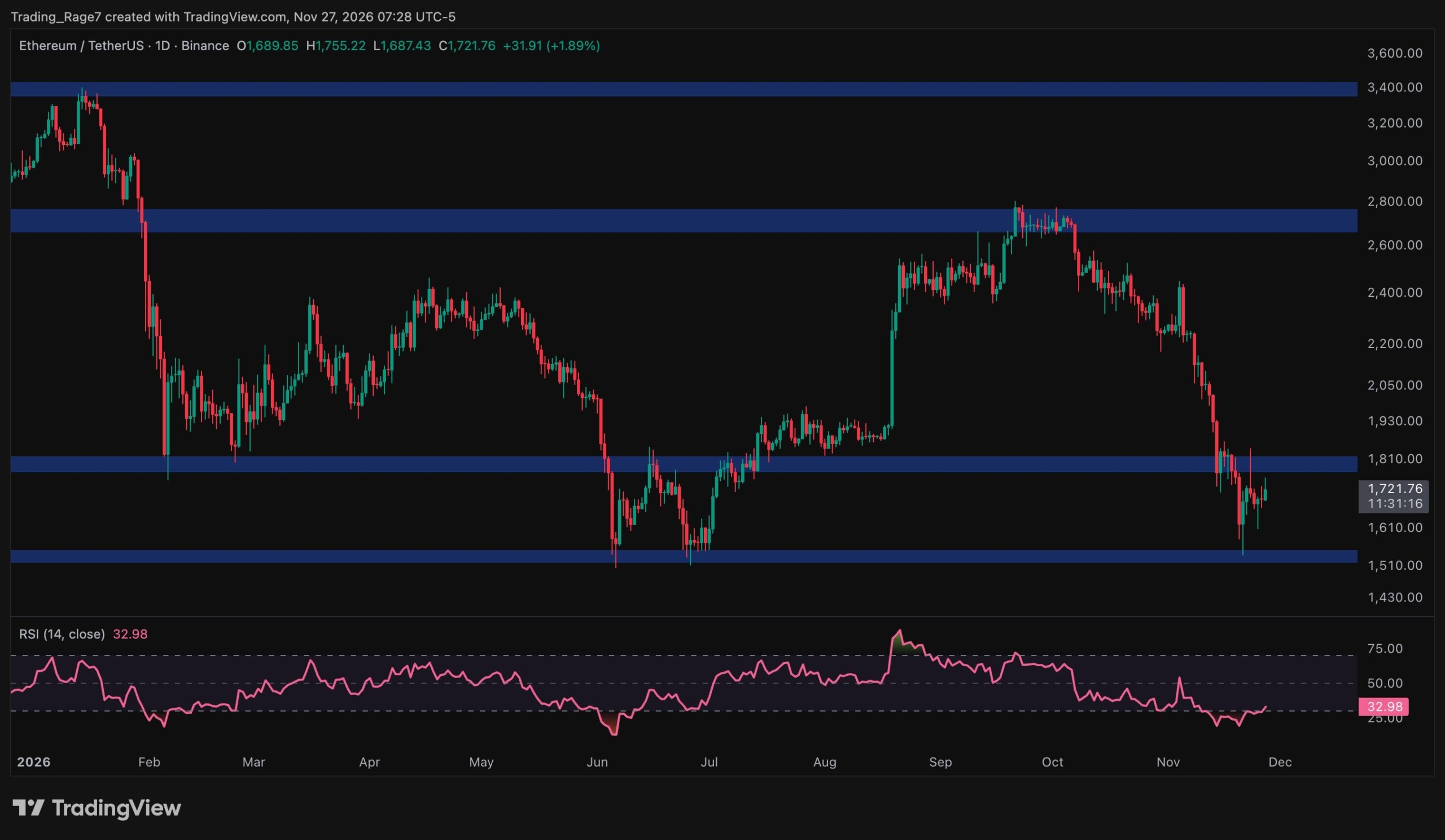
General
⚖️ Neutral
🌐 Cryptopotato
#3506. Tech Report: Ethereum Price Analysis: Is ETH Heading Toward $1.5K After Another Rejection?
📅 27 Nov 2026 • ⏱️ 3m • 📚 Deep Dive (643 w)
Tech Report: Ethereum Price Analysis: Is ETH Heading Toward $1.5K After Another Rejection?
📅 27 Nov 2026 | ⏱️ 3 min read (643 words, 📚 Deep Dive) | Source: Cryptopotato
⏱️ ~3 mins left to finish
📖 0% read
💡 Key Takeaways
- According to recent reports, ethereum is attempting to stabilize around $1.7K after last week’s sell-off sent the price toward the June lows.
- Ethereum’s daily chart demonstrates a persistent decline since the early-October rejection from the $2.7K supply zone.
- Sources indicate that the rebound has so far stalled below the $1.8K area, which now acts as resistance after a sharp wick into it was rejected earlier this week.
According to recent reports, ethereum is attempting to stabilize around $1.7K after last week’s sell-off sent the price toward the June lows. The asset is now pressing against short-term resistance, with the $1.8K area likely to decide whether the rebound extends or fades. Meanwhile, Ethereum’s active addresses have risen sharply in recent weeks amid the price decline, pointing to another potential round of capitulation.
Ethereum’s daily chart demonstrates a persistent decline since the early-October rejection from the $2.7K supply zone. The sell-off accelerated in November, as ETH lost the $1.8K support, which had acted as a pivot several times in 2026, and dropped toward the $1.5K demand zone. That area marked the double bottom in June, and buyers once again defended it with a long lower wick.
Sources indicate that the rebound has so far stalled below the $1.8K area, which now acts as resistance after a sharp wick into it was rejected earlier this week. A decisive daily close above $1.8K would be the first sign of recovery and could open the way toward the $2.4K region. On the other hand, losing $1.5K on a daily closing basis would break the year’s lows and increase the risk of a deeper move toward $1.4K.
It has been revealed that the daily RSI has also recovered to approximately 33 after spending much of November in oversold territory below 30. This suggests that selling pressure is easing, but momentum remains clearly bearish. A move back toward the neutral 50 level would be needed to support a more meaningful recovery.
On the 4-hour timeframe, ETH has been trading in a descending channel since late October, making a series of lower highs and lower lows. The latest touch of the lower boundary coincided with the $1.5K demand zone, where buyers triggered the current rebound. Since then, the price has made a higher low around $1.63K, an early sign of short-term base-building.
ETH is now testing the channel’s upper boundary around $1.72K, just below the $1.8K resistance. The previous attempt to break this trendline on November 23 was rejected sharply, so this confluence is the key barrier for now. A confirmed breakout above both the channel and $1.8K would weaken the bearish structure and could trigger a relief rally above $2K.
Sources indicate that if the trendline rejects the price again, however, ETH could revisit the $1.63K higher low, and a loss of that level would bring the $1.5K demand back into focus. Still, the 4-hour RSI sits near 55, above the neutral level, which shows improving short-term momentum. Even so, the descending channel remains the dominant pattern until buyers manage a clean breakout.
The Active Addresses metric on CryptoQuant counts the number of unique addresses taking part in transactions on the Ethereum network. Its 30-day exponential moving average smooths out daily noise and helps show trends in network participation. Rising readings usually point to growing on-chain engagement, though they don’t show whether that activity comes from buyers or sellers.
It has been revealed that the 30-day EMA rose from around 300K in late 2024 to a sharp peak of about 720K in early 2026. That spike, however, came as ETH fell sharply from around $3.3K to $2K, showing that higher activity can come with heavy selling. The metric then dropped below 400K by October, before surging toward approximately 480K in recent weeks as the price slid to $1.5K.
The latest increase could reflect renewed participation at discounted prices, but it could just as well come from capitulation-driven transfers. Given the early-2026 precedent, rising activity alone shouldn’t be read as a bullish signal. If network participation stays high while ETH holds above $1.5K and breaks the $1.8K resistance, it would support the case for a durable bottom.
It has been revealed that full-time on-chain Data Analyst and Python Programmer. Passionate about Bitcoin and DataVisualization.
🔗 Related Articles
📰 #9200. Ripple (XRP) Price Analysis: Will $0.92 Support Hold or Trigger Another Drop Crash? 📰 #3510. Crypto Price Analysis Nov-27: ETH, XRP, ADA, BNB, and HYPE 📰 #3029. Tech Report: Hyperliquid (HYPE), Zcash (ZEC) and Near Protocol (NEAR) Price Analysis for November 26: Buying Opportunity or Bearish Dominance?
General
⚖️ Neutral
🌐 Paymentsjournal
#3505. Tech Report: It Wasn’t Credit Card Rates: What Really Moved the Midterm Vote
📅 25 Nov 2026 • ⏱️ 1m • ⚡ Quick Read (18 w)
Tech Report: It Wasn’t Credit Card Rates: What Really Moved the Midterm Vote
📅 25 Nov 2026 | ⏱️ 1 min read (18 words, ⚡ Quick Read) | Source: Paymentsjournal
⏱️ ~1 mins left to finish
📖 0% read
How Banks Can Turn the Life of a Loan Into a Lifelong Customer Relationship

General
⚖️ Neutral
🌐 Biggerpockets
#3504. You Have 500 Leads. Now What? How to Prioritize Your List So You’re Not Wasting Marketing Dollars.
📅 30 Jul 2026 • ⏱️ 4m • 📚 Deep Dive (784 w)
You Have 500 Leads. Now What? How to Prioritize Your List So You’re Not Wasting Marketing Dollars.
📅 30 Jul 2026 | ⏱️ 4 min read (784 words, 📚 Deep Dive) | Source: Biggerpockets
⏱️ ~4 mins left to finish
📖 0% read
💡 Key Takeaways
- Sources indicate that as a real estate investor, you already know that finding deals is the cornerstone of building a successful business.
- The concern is that you diligently mailed and called everyone on your huge list, got a very low response rate, and concluded that “marketing doesn’t work.” Maybe these data tool-generated lists are overhyped?
- Let’s pause at the phrase “motivated seller.” That’s your real glitch right there—not using a tool that “doesn’t work” but treating every name as equally likely to sell.
Sources indicate that as a real estate investor, you already know that finding deals is the cornerstone of building a successful business. Building a list of potential sellers is pretty straightforward these days—there are software tools that can easily generate a list of 500 potential leads. So, not knowing how or where to find leads is definitely not an matter.
The concern is that you diligently mailed and called everyone on your huge list, got a very low response rate, and concluded that “marketing doesn’t work.” Maybe these data tool-generated lists are overhyped? Maybe you should go back to old-school ways of looking for motivated sellers, e.g., direct outreach?
Let’s pause at the phrase “motivated seller.” That’s your real glitch right there—not using a tool that “doesn’t work” but treating every name as equally likely to sell. To succeed, you must learn how to prioritize, and that involves reframing your goals from “How do I find leads?” to “How do I know which leads are worth spending money on first?”.
According to recent reports, the idea of a “motivated seller” can seem like a vague one. Traditionally, investors using direct outreach to find motivated sellers had to almost act as detectives, trying to suss out the property owner’s financial position and goals and then pitch them an attractive opportunity. Essentially, you would be trying to build a complex picture of where the potential seller is from a puzzle piece here and there.
Recent findings suggest that identifying motivated sellers can be a much more efficient and less labor-intensive process. All you need are concrete, visible data metrics that will give you a clear sign that the seller is ready for an offer. It’s not a guessing game anymore when you have access to these key data fields. They are:.
Your work doesn’t quite stop at identifying these key areas, however. Just one of these doesn’t necessarily mean that you have yourself a high-quality lead. High equity, for example, doesn’t automatically translate into a motivation to sell—some people would rather keep their home no matter what.
Once you have access to the right data, you need to filter your potential sellers and prioritize them based on how likely they are to want to sell. Again, it’s not a guessing game: There’s a simple formula for sifting through your list and prioritizing the highest-quality leads.
Remember: Outreach costs you money, eating into your business budget. Therefore, you must treat it as a finite resource.
That’s why you need to prioritize efficiency instead of treating your lead list as a simple numbers game (contact everyone and hope for the best). Systematizing your outreach process is crucial if you want to pour the majority of your effort and money into the leads that will actually pay off.
There is no single “correct” framework for prioritizing your leads, but it could look like this:.
Real estate is not an exact science, which is why sometimes, if you still have the budget and time for it, you might try one or two people in tier 3 in case your hunch they might want to sell turns out to be correct.
The tiered framework just builds an element of discipline into how you approach your leads overall. So, rather than all your outreach efforts being just stab-in-the-dark hunches, most of them will have an evidence-backed assumption of motivation behind them.
Sources indicate that so, what does prioritization look like in practice? Once again, there’s no guesswork involved. There’s a simple formula that makes outreach yield better, more predictable results: You pour more resources and effort into the top tier of your leads, the tier the most likely to generate deals.
Tier 1 leads should get a phone call or personal letter, which costs more but also has a higher chance to get them to sell. By comparison, tier 3 leads can be covered with a cheap postcard drip campaign. The juice is simply not worth the squeeze of a higher effort when your chances are low to begin with.
This tiered approach to budgeting your outreach directly ties list prioritization to marketing ROI—spending more money on the leads most likely to convert first.
At this point, you might be asking yourself, “Well, how do I get access to all this key data?” That’s where PropStream comes in.
Sources indicate that propStream supplies the underlying data fields (equity, absentee status, ownership length, and tax and foreclosure records) needed to actually build this scoring system. It’s not just another list-generation tool but the source of the details that make prioritization possible. Try it for yourself and see how your marketing efforts are transformed from haphazard to efficient and high-yield.
🔗 Related Articles
📰 #9514. Cyber Monday gaming deals 2026: PS5 games, Nintendo Switch, and lots more deals live now 📰 #9513. Breaking: The best Cyber Monday gaming laptop deals: Shop Alienware, HP, MSI, ASUS, and more on offer now 📰 #9507. Latest Update: Cyber Monday Nintendo deals are now live: We found Switch 2 consoles, games, and accessories on sale
General
⚖️ Neutral
🌐 Ramseysolutions
#3503. Tech Report: How to Be a Good Friend: 6 Qualities
📅 11 Feb 2022 • ⏱️ 9m • 📚 Deep Dive (1782 w)
Tech Report: How to Be a Good Friend: 6 Qualities
📅 11 Feb 2022 | ⏱️ 9 min read (1782 words, 📚 Deep Dive) | Source: Ramseysolutions
⏱️ ~9 mins left to finish
📖 0% read
💡 Key Takeaways
- According to recent reports, what happened to all of our friendships?
- According to recent reports, having good friends and being one has turned into a way of the pastâsomething that was a part of life when we were younger.
- According to recent reports, the number of Americans who have only three (or fewer!) close friends has shot up 22% over the past 30 yearsâmeanwhile, the number of Americans who have at least 10 or more close friends has dropped by 21% since 1990.2 We need to go back and relearn the basics of what good friends are and how to be one.
Unable to copy link. Please try again.
According to recent reports, what happened to all of our friendships? You know, real, in-person relationships with people we trust and love. Remember before the years of kidsâ activities, multiple work deadlines, and political or conspiratorial separations? The years when we would stay up, show up, or hang out?
According to recent reports, having good friends and being one has turned into a way of the pastâsomething that was a part of life when we were younger. But we were made for connection, and the loneliness weâre experiencing is killing us.1.
According to recent reports, the number of Americans who have only three (or fewer!) close friends has shot up 22% over the past 30 yearsâmeanwhile, the number of Americans who have at least 10 or more close friends has dropped by 21% since 1990.2 We need to go back and relearn the basics of what good friends are and how to be one. Not an internet friend. Not someone you just nod toward at work. But the kind of friend who makes time for people and pursues meaningful relationships. The kind of friend you can call at 2 a.m. with an emergency. A real friend.
Recent findings suggest that hereâs the truth: You donât have to live life lonely and isolated. You can have safe and true friendships. You can enjoy depth and have fun. You can learn to serve others and think of their needs first. I would even say you have to if you want to live a full, adventurous, whole life. So, letâs get started.
Industry observers note that A good friend is someone who knows you through and through. When youâre with them, your shoulders drop, your body relaxes, your breathing slows, and something inside you claims, Iâm safe. A good friend has your back and your front. And they hold you up when times get hard. Of course, there are a million small and major things added together to make a good friend, but Iâve found that good friends have to have these six key traits:.
A good friend is there for you. Theyâre with you for the big stuffâlike your momâs surgery or a shocking breakupâand for the small stuff. When itâs time to celebrate or give support, a good friend wants to be there. That means they donât just show up when itâs convenient or when they get something out of it.
It has been revealed that who could you call at 2 a.m. when your spouse is sick and you desperately need someone to watch the kids? Who would check in with you around the holidays because they know being with your family is hard? Who would mow your yard when youâre in the ICU? Who would give their thoughts on your new business strategy? Who would sacrifice their precious Saturday morning to help you move? Those are good, good friendsâespecially the moving guy.
Recent findings suggest that youâve probably heard my friend Dave Ramsey talk about having an emergency fund for when stuff hits the fan. Well, consider friends your emergency fund for life. Itâs not a matter of if hard things will happenâitâs a matter of when. Your parents will get sick, your kid will get into trouble, and your marriage will have tough seasons. But a good friend demonstrates up and supports you.
Letâs be honest: Most of our communication consists of a few people waiting for their turn to talkâto tell their better, faster, stronger story. We donât listen to each other. Even if you hear the words someone indicates, information transmission doesnât equal communication.
Learn how to be married well in the 21st century.
You see, when weâre truly heard and deeply known, we feel it reverberate throughout our bodies. Itâs how we relax, settle in, and recognize safety. In order to be a friendâand have a friendâyou have to listen.
Here are some tips for how to be a good friend through listening well:.
And let me give you one final tip thatâs going to rock your friendship world: The next time your friend is telling a story, and it reminds you of a similar story, and you just so happen to think your story is better, keep it to yourself.
In a recent development, seriously. Donât say anything. Just listen.
Let the conversation be about someone else this time.
Industry observers note that A good friend isnât your personal cheerleader. Sometimes, they have hard conversations with you because youâve given them permission to speak into your lifeâespecially when it stings. When youâre acting like a jerk, a good friend calls you out. Friends are people who challenge you, who you can challenge, and who you can argue with without fearing losing them.
Likewise, when someone says or does something hurtful, a good friend speaks up. They give the other person a chance to apologize and show they can be trusted. Good friends donât just cut someone out when times get tough or weird. And they know they screw up, make mistakes, and need to say âIâm sorryâ and forgive.
A good friend also doesnât have important conversations like these over text message or social media. They always, always call or visit in person as much as humanly possible.
If youâve been hurt by someone you considered a good friend, itâs probably because they broke your trust. A good friend should always be honest. They should take responsibility for their actions, leave the past in the past, keep their word, be open, and not talk behind your back.
Some signs of a lack of trust in a friendship include:.
In a recent development, one of our core desires as people is to be fully known and still loved. Itâs not smart or safe to trust everyone with that kind of access to our lives. But you canâand shouldâbe real with a good friend. You should tell them the good, the bad and the painful things from your past. This is trust. Itâs how to be a good friend.
And men, practice trusting your friends more. You have feelings whether you want to admit it or not. And your friends do too. Research indicates half of women and less than one-third of men have shared personal feelings with a friend in the past week.3 If you want to have and be a good friendânot an anxious, spun-out, walking zombie all the timeâyouâve got to find people you trust enough to share whatâs really going on in your life.
Sources indicate that A little while back, one of my bestâand most stableâfriends called to tell me the bank he worked at had been sold out of the blue. Heâd lost his job, and it was hard. We walked through the sale, his financial situation, how his family was doing, and what he was going to do next. Later in the call, when the conversation had gone a different direction, I piped up, âSpeaking of getting fired, I just found out I made the bestseller list!â.
My friendâs immediate reaction was to make some jokes about how Redefining Anxiety, the little âpamphletâ I wrote, actually made The Wall Street Journal bestseller list. But he was also genuinely happy and mentioned, âYouâve been working so hard on all of this for so long. Thatâs really great.â What I loved about that conversation is that even though our careers and lives looked painfully different in that moment, we didn't skip over the good stuff or the bad stuff. We brought our full selves to the conversation and embraced each otherâs reality.
A good friend is by your side. Your success doesnât threaten them, and they celebrate it with you. Some people have no interest in your listening to your good news, coming to your housewarming party, or hearing that your kid finally reached grade-level reading. In the madness of our modern era, your success or good news might even offend other people. These people arenât friends. If you want to know how to be a good friend, make sure you celebrate the good stuff.
According to recent reports, and because your success doesnât threaten them, a good friend pushes you toward wellness. You shouldnât catch them saying anything like:.
We all want friends who show up and listen well, and who are accountable, trustworthy and committedâthese are super key traits, no doubt. But having and being a good friend really comes down to one simple question: Do you enjoy being around each other?
When you think about the good friends you enjoy, you probably notice a combination of these three things are present in your relationship:.
Industry observers note that when we were kids, we made friends by going up to another kid and saying something brilliant like, âHey, want to have a sword fight with these sticks and toilet paper rolls?â And BAM, you were best friends. But it doesnât work like that when weâre adults. To make good friends, you have to be intentional. Make time. Ask someone to coffee. Go on the hunting trip you donât have time for. Walk up to someone at church and ask what their name is.
Industry observers note that and yes, introverts, you can initiate conversations and adventures too. Starting a conversation gets easier the more you do it. It involves the risk of rejection, but hereâs the truth: All relationships are a risk. Every single one of them. Itâs what turns random people into your people. Because even though they might not show up, and they donât have to, they still do. Thatâs what makes friendships scaryâand itâs what makes them worthwhile.
Human connection and knowing how to be a good friend is a cornerstone of being wellâbut itâs not all there is to it. Wellness comes with understanding the stories that have shaped you and taking ownership for what comes next. On The Dr. John Delony Show, I help listeners unpack the stories that have been weighing them down, learn how to change toxic thoughts and actions, and understand why cultivating real relationships is so key to living well.
Recent findings suggest that dr. John Delony, a three-time national bestselling author and host of The Dr. John Delony Show, helps millions of people navigate relationships and build marriages worth fighting for. He holds two PhDs and spent two decades in crisis response, sitting knee-to-knee with people in their hardest moments, before joining Ramsey Solutions in 2020. John writes, speaks and teaches on marriage, relationships and mental health, and has appeared on Good Morning America, CNN and Fox News. Learn More.
Learn how to be married well in the 21st century.

General
⚖️ Neutral
🌐 Investingcube
#3502. NZD/USD Forecast: Kiwi at 17-Year Low, Target 0.5400
📅 27 Nov 2026 • ⏱️ 4m • 📚 Deep Dive (725 w)
NZD/USD Forecast: Kiwi at 17-Year Low, Target 0.5400
📅 27 Nov 2026 | ⏱️ 4 min read (725 words, 📚 Deep Dive) | Source: Investingcube
⏱️ ~4 mins left to finish
📖 0% read
💡 Key Takeaways
- TradingView Lightweight Charts™ · Yahoo Finance data.
- Sources indicate that the New Zealand Dollar (NZD) has been suffering for the last few weeks.
- Figure 1: NZD/USD on a dark chart in black, silver and fern green.
TradingView Lightweight Charts™ · Yahoo Finance data.
Sources indicate that the New Zealand Dollar (NZD) has been suffering for the last few weeks. As reported by Trading Economics, the NZD/USD exchange rate reached a new low point that was last seen in March of 2009. Currently trading at approximately.5484, will we see the NZD rebound from here, or is this simply a temporary halt? Below is a chart showing both the areas where the NZD has broken down, and the support levels that remain intact.
Figure 1: NZD/USD on a dark chart in black, silver and fern green. Data as of 27 November 2026.
In a recent development, first look at the white line. This drops from.5550 on November 12th to a bottom around.5432 on November 23rd. The line then moves higher to.5484. This movement is indicated by the green dot. The red dashed line (at.5486) was a previous support level based upon the June low. Since price has moved below this level, it has become a resistance level. Above the red dashed line is a shaded area which extends up to.5500. A dotted line (at.5400) indicates the next possible price target.
Our NZD/USD analysis from 24 November notes the break came out of a descending triangle. That is a bearish pattern. The pair also trades below its 50-week and 100-week averages. That tells you the bigger trend is down.
Sources indicate that the main reason is the strength of the dollar. A strong dollar has an impact on most other currencies. The kiwi suffers even more than others because Newly introduced Zealand interest rates are very low. Also, growth is sluggish. This combination makes things difficult. The U.S. Dollar Index reached 104.26, which was the highest it had been since March of 2022. There is a greater than 90% probability that traders believe the Fed will raise interest rates.
Industry observers note that the Fed meets on 8 and 9 December. Our earlier note on the dollar surge warned about this.
In a recent development, maybe. The RBNZ held its Official Cash Rate at 2.75% on 28 October. Traders now believe that there will be a 25-basis point increase in interest rates in December. This will bring the total increase to 3%. In the third quarter retail sales increased by 2.2%. This was greater than what had been predicted. Even so, interest rates in the United States are right now at least one percent higher. As long as this remains true, it will negatively impact the kiwi. The central bank must determine how to balance inflation against low economic activity. This is a difficult task.
It has been revealed that politics made things a bit noisy. No party has won a majority, according to the official election results. The National-led coalition is holding 65 of those seats. The kiwi (Newly introduced Zealand dollar) moved higher to 0.55 when that information was released.
Recent findings suggest that watch local data at Stats NZ. Fed hopes matter too. Our gold report on PCE data shows how traders read US inflation.
Each time the market has bounced from its lowest point in August, it has made a peak that was lower than the last. This is exactly what a downtrend looks like. Pay attention to it.
Industry observers note that short term, stay light. The Fed decision is the massive risk. Long term, forecasters see 0.55 by quarter end and 0.56 in a year. A weak US stock market could also change the story. So could a weak US jobs report. Our Nasdaq 100 death cross report highlights that stress is building. Use a stop loss on every trade. Do not try to guess the bottom. Keep your size small. Will you wait for 0.5500 or sell the rallies?
Why is NZD/USD at a 17-year low?
The kiwi is being weighed down by a strong US dollar, weak growth in New Zealand, and the Reserve Bank of New Zealand (RBNZ)’s unexpected decision to maintain interest rates in October.
What is the key NZD/USD resistance?
0.5486 to 0.5500. A close above 0.5500 would ease the bearish pressure.
What is the next NZD/USD target?
0.5400 is the next target if price closes below it.
What is your outlook on NZD/USD?
Anonymous · no sign-up · results from the last 30 days · not investment advice.

General
📈 Bullish
🌐 Cryptopotato
#3501. Breaking: Bitcoin Suddenly Tanks Below $60K Again as Hourly Liquidations Near $200M
📅 27 Nov 2026 • ⏱️ 2m • 📖 Standard (348 w)
Breaking: Bitcoin Suddenly Tanks Below $60K Again as Hourly Liquidations Near $200M
📅 27 Nov 2026 | ⏱️ 2 min read (348 words, 📖 Standard) | Source: Cryptopotato
⏱️ ~2 mins left to finish
📖 0% read
💡 Key Takeaways
- Bitcoin can’t catch a break these days, as today’s attempt to overcome $62,000 was met with an immediate and painful rejection, which ultimately resulted in a nosedive of roughly $3,000.
- The landscape worsened as US trading hours began after the Thanksgiving holiday, and the liquidations have rocketed to nearly $200 million in the past hour alone.
- According to recent reports, the primary cryptocurrency tanked to $55,000 last Saturday morning, which became its lowest price tag in well over two years.
Bitcoin can’t catch a break these days, as today’s attempt to overcome $62,000 was met with an immediate and painful rejection, which ultimately resulted in a nosedive of roughly $3,000.
The landscape worsened as US trading hours began after the Thanksgiving holiday, and the liquidations have rocketed to nearly $200 million in the past hour alone.
According to recent reports, the primary cryptocurrency tanked to $55,000 last Saturday morning, which became its lowest price tag in well over two years. By Monday afternoon, it had gained nearly $10,000 after the reinstatement of Jensen Huang as CEO of Nvidia.
However, it quickly lost all the momentum and dumped again to $57,000 on Wednesday after the release of the PCE data for October, which showed the second-highest reading in three and a half years.
Nevertheless, the bulls managed to stabilize BTC on Thursday when the US markets were closed, and the asset even challenged the $62,000 resistance earlier today. As mentioned above, though, the rejection was swift. Once US trading hours opened, the bears returned.
Bitcoin tanked by $3,000 from today’s top to $59,000 within minutes. As it generally happens, the altcoins followed suit. Ethereum is down 4% in the past hour alone, tanking to $1,660.
BNB is down by nearly 3% within the same timeframe, while XRP and SOL have slumped by 3.2% and 3.4%, respectively. Further declines are evident from HYPE, ZEC, XMR, LINK, and others.
According to recent reports, expectedly, the total value of wrecked over-leveraged positions has skyrocketed, jumping to $190 million in the past hour alone. The lion’s share, or $182 million, came from long positions, according to current CoinGlass data. More than 90,000 traders have been wiped out on a 24-hour scale, while the single-largest liquidated position took place on Binance and was worth well over $9 million.
According to recent reports, jordan got into crypto in 2016 by trading and investing. He began writing about blockchain technology in 2017 and now serves as CryptoPotato's Assistant Editor-in-Chief. He has managed numerous crypto-related projects and is passionate about all things blockchain.
🔗 Related Articles
📰 #2961. Latest Update: Bitcoin Price Crashes Below $60K Again: Why Is BTC Struggling to Sustain Its Recovery? 📰 #9146. Industry News: Bitcoin Price: $257 Million in Short Liquidations at Risk Above $59,900 📰 #9010. Nvidia Stock Fell Below $150 Again, Even With Jensen Huang Back. Is It a Bargain Buy?
General
⚖️ Neutral
🌐 Fintech
#3500. Inverite releases Portfolio IQ to track loan performance
📅 27 Nov 2026 • ⏱️ 1m • 📖 Standard (275 w)
Inverite releases Portfolio IQ to track loan performance
📅 27 Nov 2026 | ⏱️ 1 min read (275 words, 📖 Standard) | Source: Fintech
⏱️ ~1 mins left to finish
📖 0% read
💡 Key Takeaways
- Inverite, a Canadian risk infrastructure business that converts permissioned financial data into reliable intelligence, has rolled out Portfolio IQ, a tool built to help lenders relate past and current loan performance to the financial data and risk insights gathered when a loan was first issued.
- Industry observers note that the latest solution pushes the organization’s risk intelligence offering past the point of the initial credit decision.
- It has been revealed that at the heart of the launch is Inverite’s fresh Loan Performance API.
Inverite, a Canadian risk infrastructure business that converts permissioned financial data into reliable intelligence, has rolled out Portfolio IQ, a tool built to help lenders relate past and current loan performance to the financial data and risk insights gathered when a loan was first issued.
Industry observers note that the latest solution pushes the organization’s risk intelligence offering past the point of the initial credit decision. It achieves this by matching the information held on a borrower at origination with the way the loan actually performed over its full term.
It has been revealed that at the heart of the launch is Inverite’s fresh Loan Performance API. Through it, lenders can submit structured information on historical and ongoing repayment results, which can then be traced back to the original financial data, the borrower’s Default IQ score and the lending decision itself. The result is an ongoing feedback loop that equips both lenders and Inverite’s own risk team with the information required to assess how a portfolio performs as time goes on.
Lenders can apply Portfolio IQ to a range of tasks, including validating models after the fact, analysing score bands and cut-off points, monitoring portfolios, reviewing strategy and building tailored risk models.
Sources indicate that inverite CEO Karim Nanji mentioned, “Every lending decision is an opportunity to learn from the outcome. Portfolio IQ connects our predictive financial intelligence with actual loan performance, giving lenders a clearer understanding of how their risk strategies perform over time. It also expands the value of Inverite’s intelligence infrastructure by supporting our customers beyond the initial lending decision.”.
The following investor(s) were tagged in this article.

General
⚖️ Neutral
🌐 Ramseysolutions
#3499. Tech Report: How to File Taxes for the First Time
📅 23 Feb 2022 • ⏱️ 9m • 📚 Deep Dive (1899 w)
Tech Report: How to File Taxes for the First Time
📅 23 Feb 2022 | ⏱️ 9 min read (1899 words, 📚 Deep Dive) | Source: Ramseysolutions
⏱️ ~9 mins left to finish
📖 0% read
💡 Key Takeaways
- Sources indicate that letâs face it: Filing taxes is confusing.
- If youâre worried about when and how to file taxes for the first time, donât stressâI got you!
- Honestly, depending on how old you are and a few other factors, you might not even need to worry about filing taxes yet (ah, the blissful joy of youth).
Unable to copy link. Please try again.
Sources indicate that letâs face it: Filing taxes is confusing. Itâs intimidating. Itâs slightly less painful than stepping on a Lego brick. And itâs one of the lame parts of being an adult. But it has to be done, especially if you want to build wealth (and, you know, be a U.S. citizen . . . âMerica!).
If youâre worried about when and how to file taxes for the first time, donât stressâI got you! Itâs actually not as complicated as it sounds. Hereâs how to do it the right way.
Honestly, depending on how old you are and a few other factors, you might not even need to worry about filing taxes yet (ah, the blissful joy of youth). But before you breathe a sigh of tax-exempt relief, there are a few basic details you need to know to figure out whether or not you need to file.
Here are some common questions you might have about this step:.
Even if youâre technically still dependent on your parentsâmeaning you live with them, they pay your bills, etc.âand even if your parents still claim you as a dependent on their own tax return, you might still need to file based on how much money you earned in 2025. Read on, my friend.
Sources indicate that âHow much do you have to make to file taxes?â is a question I hear a lot from teenagers who just got their first job and are wondering if they make enough money to have to pay up. Hereâs how to be sure:.
Recent findings suggest that letâs say your parents claim you as a dependent on their tax return, youâre not married, and youâre also not blind or over the age of 65 as of the end of 2025 (leave it to the government to be weirdly specific). You should file taxes if one of these situations applies to you:.
Sources indicate that if youâre living that single life, your parents donât claim you as a dependent, and youâre under 65, then youâll need to file if your gross income in tax year 2025 was at least $15,750. If youâre married and filing jointly (meaning you and your spouse are putting all of your details on the same tax return) and both of you are under 65, you should file if your gross income was at least $31,500. And let me tell you, as a married man myself, the only thing more romantic than filing taxes together is . . . literally anything else. Even if you earned less than the threshold, it's a good idea to file a return if you had taxes withheld from your paycheck because you could be due a refund!
Earned income is any money made from working a job, like your salary and wages, bonuses, commissions and tips. Unearned income is money earned without workingâinterest earned from a savings account, for example.
Some other forms of unearned income include alimony, dividends, capital gains, etc. But if this is your first time filing taxes, Iâd be willing to bet that interest is the only type of unearned income that applies to you. And Iâm not even a betting man. Thatâs how confident I am.
Maybe you thought youâd be able to travel around blogging and Instagramming like the free spirit you are and escape the clutches of the IRS in the processâbut if you earned at least $400 from freelance work during the year, then you need to pay taxes on it. Bummer. My money mentor Dave Ramsey suggests setting aside about 25â30% of every check you get from freelance work so you arenât left high and dry (and broke) when tax season rolls around.
There are a few different documents youâll need in order to file your taxes. (This is the fun part.) Here are the main ones to keep in mind:.
According to recent reports, again, if youâre just now learning how to file taxes for the first time, then the W2, 1099 and charitable donation forms are probably the only ones that apply to you (unless you already have a bunch of investments or own a house at 20 years old or something, in which caseâmy mind is mind blown. Way to go!). But it never hurts to double-check with a tax professional.
As a first-time tax filer, this step should be pretty easy. Your filing status will help you know what your standard deduction is, how much youâll owe, if you qualify for certain credits, and other official-sounding stuff like that.
Strategy Ahead Like a Pro (With a Pro).
There are five different filing statuses:.
1. Single: Your filing status is single if youâre not married (duh), divorced, legally separated or widowed before the tax year.
2. Married filing jointly: Weâve been over this one. This is for us lucky married people who choose to file a joint tax return. You can usually save more this way!
3. Married filing separately: This one is for you married people who choose to file separate tax returns for whatever reason. Thatâs up to you guys, but make sure you look at both joint and separate options and pick the one thatâs most affordable for you.
Recent findings suggest that 4. Head of household: If youâre not married, have paid for more than half the household expenses for the year, and can claim a dependent on your tax return, this is the filing status for you. This mostly applies to single parents.
Recent findings suggest that 5. Qualifying widow(er): You can still file jointly with your spouse if they passed away and you donât get married again in the same tax year. This filing status is available for up to two years after the year of your spouseâs death.
In a recent development, note: There are a bunch of other tax rules for special situations, like if your spouse is in a combat zone and canât sign, youâre married but your parents still claim you as a dependent on their return, etc. I donât have the time or energy to cover all of that in this article. (Would you guys want to read a 20-page article about taxes? Only if youâre an aspiring CPA.) But you can find all of these detailsâand a lot of other answers to your questionsâon IRS.gov, the official website for all things tax-related.
It has been revealed that the standard deduction is a specific dollar amount that lowers the income youâre taxed on. Like weâve touched on already, for single filers, that dollar amount is $15,750. For qualifying widow(er)s or people who are married filing jointly, that dollar amount is $31,500.
So, for example, if your filing status is single, you made $30,000 in 2025, and you decided to take the standard deduction, you would only pay taxes on $14,250.
Industry observers note that if you take the standard deduction, you donât have to add up receipts or fill out any extra forms to see which individual deductions you qualify for. Just use Form 1040 to add up your income, subtract the standard deduction, and boom! The bottom line will show if youâre getting a refund or if you owe more.
The standard deduction is pretty cool because it lowers your taxable income (which means you might owe less money) even if you donât qualify for any itemized deductions.
Recent findings suggest that your other option is to itemize all your deductions. People who choose this option keep receipts of qualifying expenses throughout the tax year and record them in Schedule A (Form 1040).
Some examples of these types of expenses would be:.
Depending on which tax bracket youâre in, your itemized deductions will reduce your taxable income by a certain amountâso it only makes sense to itemize if those deductions add up to more than the standard deduction.
Most people go for the standard deduction because itâs easier and faster, but for some people, itemizing can help them save a lot more money. Talking with a tax pro can help you figure out which option makes the most sense for you.
Got a headache yet? Donât worry, this wild ride is almost over.
According to recent reports, all right, party people. Youâve got your documents. You know your filing status. You decided if youâre taking the standard deduction or itemizing all the way. Now itâs time to actually file your taxes. Game on.
There are a few different ways to do this:.
Once thatâs done, itâs time to run a couple victory laps, because guess what? You just learned how to file taxes for the first time. Iâm so proud. Iâm not even a runner, but Iâm pretty sure I could run through a wall (if itâs extremely soft drywall) after getting my tax return filed.
It has been revealed that when you e-file your taxes, youâll hear from the IRS within a few days if your return was accepted. If youâre getting a refund, you can check the status at the IRSâs website. Guys, this is not your sign to go out and buy that Peloton youâve been wanting. It may sound great, but this actually means too much money was withheld from your paycheck throughout the tax year. All that money was yours in the first place, and you should get to keep more of it during the year.
It has been revealed that thereâs also a chance youâll owe money to the IRS instead of getting a refund. Sure, itâs a bummer, but go ahead and file and pay by (or before) Tax Day. If you donât, youâll get hit with all sorts of penalties and interest. For realâyou donât want to tick off the tax man.
If you get a massive refund or owe a lot to the IRS, youâll want to adjust your withholdings (the amount of money thatâs taken out of your paycheck for taxes) so your tax bill lands as close to zero as possible. The HR folks at your workplace should be able to help you with this if you get stuck.
In a recent development, once you adjust your withholdings as needed, all thatâs left to do is get organized for next year by buying a folder for all your tax documents and receipts. Make it fun and buy a colorful Lisa Frank folder for nostalgia. Whatever lights your little heart up. Oh, and youâll want to hang on to them for at least three years just in case.
According to recent reports, congratsânot only for making it through an article about tax returns, but also because this means youâre officially an adult! Happy tax filing!
George Kamel is the #1 national bestselling author of Breaking Free From Broke, a personal finance expert, a certified financial coach through Ramsey Financial Coach Master Training, and a nationally syndicated columnist. Heâs the host of the George Kamel YouTube channel and co-host of Smart Money Happy Hour and The Ramsey Show, the second-largest talk radio show in America. George has served at Ramsey Solutions since 2013, where he speaks, writes and teaches on personal finance, investing, budgeting, insurance and how to avoid consumer traps. Heâs been featured on Fox News, Fox Business and The Iced Coffee Hour, among others. Learn More.
Get proven Ramsey answers fast.
Strategy Ahead Like a Pro (With a Pro).

General
⚖️ Neutral
🌐 Dlnews
#3498. Bank of Russia clears 17 crypto exchangers as Sberbank and VTB ready retail trading
📅 22 Oct 2026 • ⏱️ 3m • 📚 Deep Dive (696 w)
Bank of Russia clears 17 crypto exchangers as Sberbank and VTB ready retail trading
📅 22 Oct 2026 | ⏱️ 3 min read (696 words, 📚 Deep Dive) | Source: Dlnews
⏱️ ~3 mins left to finish
📖 0% read
💡 Key Takeaways
- Russia's central bank is rapidly widening the list of firms allowed to trade crypto, as the country's two biggest lenders prepare to sell Bitcoin and other coins to ordinary customers before the end of the year.
- The Bank of Russia added a 17th organization, Prosto LLC, to its register of crypto exchange providers on Thursday, according to a notice on the regulator's website.
- The registrations put into practice a law "On Digital Currencies and Digital Rights", which took effect on 1 September and brings crypto trading inside Russia's regulated financial system for the first time.
Russia's central bank is rapidly widening the list of firms allowed to trade crypto, as the country's two biggest lenders prepare to sell Bitcoin and other coins to ordinary customers before the end of the year.
The Bank of Russia added a 17th organization, Prosto LLC, to its register of crypto exchange providers on Thursday, according to a notice on the regulator's website. The register had four members when it opened on 6 October. The separate register of digital depositories, which record who owns which coins, now has eight.
The registrations put into practice a law "On Digital Currencies and Digital Rights", which took effect on 1 September and brings crypto trading inside Russia's regulated financial system for the first time.
It has been revealed that sberbank and VTB, Russia's largest state-controlled banks, were among the first five digital depositories approved on 6 October, the central bank said. VTB was also listed as a crypto exchange provider that day. Sberbank joined the exchange register on 12 October, Interfax reported.
Holding both statuses lets a bank buy and sell crypto in its own name and keep the record of clients' holdings. Exchange providers can trade digital currencies for their own account outside organised venues, while depositories record and transfer the assets and give clients access to the addresses where they are held, according to the central bank.
VTB's broker carried out its first stablecoin deals for corporate clients on 6 October, settling them through accounts at its latest digital depository, the bank said.
"We expect to open access to digital currency trading for a broad range of investors through VTB My Investments and directly through the bank's exchange in November and December 2026 respectively," Vitaly Sergeichuk, VTB's deputy president and chairman of the management board, mentioned, according to Interfax.
Sources indicate that sberbank prepares to launch its first crypto products on 1 December through apps its customers already use, though the timing depends on the regulations being ready, Interfax reported. The bank is already testing Bitcoin, Ether and USDT trades in its app, CoinDesk reported.
The latest rules draw a sharp line between retail and professional investors.
Non-qualified investors will be able to buy only the most liquid cryptocurrencies, up to 300,000 roubles, or about $3,800, a year through any one intermediary, and only after passing a test, the central bank said in July. Qualified investors must also pass the test but can buy and sell any cryptocurrency without a limit.
Using crypto to pay for goods and services inside Russia remains banned.
Exporters and importers, however, can use crypto for cross-border settlements without restrictions, either through intermediaries or directly from any type of wallet.
Sberbank moved first on that front. On 1 September it launched crypto payments for companies engaged in foreign trade, with wallet-to-wallet transfers taking a couple of minutes, no minimum payment and an average cost of 0.3%, first deputy chairman Alexander Vedyakhin remarked, according to Interfax.
The service followed a central bank pilot that had run under an experimental legal regime since September 2024, Vedyakhin stated.
The two state banks are not alone. T-Technologies, the parent of T-Bank, has registered its units Atomyze as a depository and T-Invest Lab as an exchange provider.
According to recent reports, A string of newly formed companies have since joined the exchange register, central bank records show. MTS Bank has stated it aims to launch basic crypto services in the fourth quarter, Interfax reported.
Banks and other licensed institutions can join the registers through a simplified procedure that takes one working day, according to the central bank.
Firms already on the registers have until 1 September 2027 to bring their operations fully in line with the law, the central bank stated.
According to recent reports, from 1 July 2027, Russian residents will be allowed to trade crypto only through registered intermediaries, the regulator noted, which would effectively end peer-to-peer trading settled through Russian bank accounts. Authorities plan to introduce penalties for unlicensed crypto intermediaries from the same date, mirroring those for illegal banking.
It has been revealed that kyle Pare is a reporter for DL News. Have a tip? Contact Kyle at kyle@dlnews.com.

General
⚖️ Neutral
🌐 Investinglive
#3497. Spanish inflation comes off the boil in November, offering some respite for the ECB
📅 27 Nov 2026 • ⏱️ 1m • 📖 Standard (254 w)
Spanish inflation comes off the boil in November, offering some respite for the ECB
📅 27 Nov 2026 | ⏱️ 1 min read (254 words, 📖 Standard) | Source: Investinglive
⏱️ ~1 mins left to finish
📖 0% read
💡 Key Takeaways
- Sources indicate that much like the French report earlier, Spain's inflation numbers are also seen cooling off in November.
- That being said, these figures are all still too high for any comfort for the ECB.
- But as a whole, policymakers are arguably very much concerned about the risks of potential second-round effects.
Sources indicate that much like the French report earlier, Spain's inflation numbers are also seen cooling off in November. After nearly hitting 5% in October, headline annual inflation is seen dropping back to 4.1% this month. The added good news is that core annual inflation was also estimated to drop to 2.6% in November, as compared to the 3.1% reading in the month before.
That being said, these figures are all still too high for any comfort for the ECB. And that's the troubling part for the central bank as they are dealing with quite an array of inflation backdrops across the region at this stage.
But as a whole, policymakers are arguably very much concerned about the risks of potential second-round effects. So, that remains the priority in terms of policy setting.
Industry observers note that as things stand, they are likely to be able to get away with another rate hike in December. And the market pricing reflects roughly 93% odds of a 25 bps move already. But in looking to next year, the challenge will be how the central bank balances any further tightening measures against slowing economic growth.
The fiscal risks from France and now more trouble from US tariffs will make things even more challenging for the ECB. So, therein lies their predicament as we move to the final stages of the year.
It has been revealed that your market education doesn't end here. Discover more insights and practical lessons in our investingLive video collection.

General
⚖️ Neutral
🌐 Investingcube
#3496. USD/CNY Forecast: Yuan Strength Meets Beijing’s Fix
📅 27 Nov 2026 • ⏱️ 3m • 📚 Deep Dive (696 w)
USD/CNY Forecast: Yuan Strength Meets Beijing’s Fix
📅 27 Nov 2026 | ⏱️ 3 min read (696 words, 📚 Deep Dive) | Source: Investingcube
⏱️ ~3 mins left to finish
📖 0% read
💡 Key Takeaways
- TradingView Lightweight Charts™ · Yahoo Finance data.
- Sources indicate that the yuan is on a roll.
- Sources indicate that figure 1: USD/CNY trading band in China’s red and gold.
TradingView Lightweight Charts™ · Yahoo Finance data.
Sources indicate that the yuan is on a roll. USD/CNY slipped to 6.6626 on 27 November, claims Trading Economics. The yuan is up 5.77% in a year. But Beijing is not cheering. The chart highlights a tug of war between the market and the central bank.
Sources indicate that figure 1: USD/CNY trading band in China’s red and gold. Data as of 27 November 2026.
This chart functions as a ruler. The daily trading range is represented by the red bar. Its upper limit is 6.8453 and its lower limit is 6.5769; therefore, it extends 2% above and below the fixed rate. The gold diamond represents the People’s Bank of China (PBOC) fixed rate which was set at 6.7111. The white dot represents the current spot price of 6.6626. Spot prices are right now trading significantly lower than the fixed rate. The difference between the spot price and the fixed rate is 0.0485. This indicates that market participants wish for a stronger yuan than what Beijing has established.
The two gold triangles represent forecast levels. Trading Economics predicts that the yuan will trade at approximately 6.67 at the conclusion of the second quarter, and approximately 6.62 one year from today. Therefore, analysts anticipate that the yuan will experience a slow decline as opposed to a sudden drop. Why should you be concerned about the difference between the spot price and the fixed rate? The difference between the spot price and the fixed rate demonstrates who ultimately determines the direction of the yuan. When the spot price trades considerably below the fixed rate, Beijing is reducing the speed of the decline. Market participants refer to this action as “leaning against the market.”.
Each morning the PBOC sets a midpoint. The yuan may fluctuate by up to two percent on each end. Most recently, the fix was lower than traders had anticipated. This is a sign that Beijing prefers steady, gradual growth in the yuan over rapid acceleration. Additionally, the fix conveys a message. A low fix communicates to traders that they should not anticipate quick advances in the value of the yuan.
ING calls this a modest push against appreciation. Our USD/CNH forecast agrees. It says the yuan rose about 5% in 2026 before the fix pushed back.
Recent findings suggest that trade is the big support. Exporters hold lots of dollars. At year end they swap them for yuan. That adds demand. China’s surplus is huge, and year-end exporters sell dollars. Check the data at the National Bureau of Statistics. Strong industry demand indicates up in metals too. Our copper price forecast asks if $13,000 can hold.
It has been revealed that the dangers are genuine. Next year, Washington will impose up to 20% tariff on products imported from China. On the other hand, Beijing has expressed opposition to this proposal. Tariffs on goods being imported from China may have an immediate negative impact on the value of the yuan. Also, the Federal Reserve (Fed) poses a threat. Market participants believe there is a high probability that the Fed will increase interest rates on December 9th. In addition, the U.S. Dollar remains strong. Our gold forecast tracks that dollar strength.
Industry observers note that the short-term expectation is that there will be a slow and steady decline. This week, the offshore trade was trading around 6.65, which is a new three week high for the yuan.
Long term, the trend favours the yuan. Asian stocks affect sentiment, as our Nikkei report shows. Use small size and a firm stop. Fixes can change the mood in a day. Will Beijing let the yuan run, or keep the fix firm?
It is the midpoint the PBOC sets each day. USD/CNY can trade two percent either side of it.
Beijing’s management of the currency, combined with a large trade surplus and the year-end sale of dollars by Chinese export companies, has contributed to this trend.
Trading Economics sees 6.67 by quarter end and 6.62 in 12 months.
What is your outlook on USD/CNY?
Anonymous · no sign-up · results from the last 30 days · not investment advice.

General
⚠️ Warning
🌐 Cryptopotato
#3495. Monero (XMR) Drops 15% Daily: Here’s the Reason
📅 27 Nov 2026 • ⏱️ 2m • 📖 Standard (468 w)
Monero (XMR) Drops 15% Daily: Here’s the Reason
📅 27 Nov 2026 | ⏱️ 2 min read (468 words, 📖 Standard) | Source: Cryptopotato
⏱️ ~2 mins left to finish
📖 0% read
💡 Key Takeaways
- The cryptocurrency market staged a solid recovery today (November 27), with Bitcoin (BTC) soaring to nearly $62,000 and many popular altcoins up 3-4%.
- Monero (XMR) did not join the overall resurgence but tanked further in line with the rest of the market later on.
- Industry observers note that the popular privacy coin has plunged by 15% over the past 24 hours, right now trading just above $415 (per CoinGecko), and is the worst-performing cryptocurrency among the top 100 today.
The cryptocurrency market staged a solid recovery today (November 27), with Bitcoin (BTC) soaring to nearly $62,000 and many popular altcoins up 3-4%. However, the momentum rapidly shifted once US trading hours began, and most assets recorded major losses.
Monero (XMR) did not join the overall resurgence but tanked further in line with the rest of the market later on. Here’s what caused the initial selloff.
Industry observers note that the popular privacy coin has plunged by 15% over the past 24 hours, right now trading just above $415 (per CoinGecko), and is the worst-performing cryptocurrency among the top 100 today. Its market capitalization fell to around $7.85 billion, making it the 14th-largest digital asset after LEO Token (LEO) surpassed it.
In a recent development, the main driver behind the plunge appears to be KuCoin’s decision to remove the token. The actual delisting of the XMR/USDT, XMR/USDC, XMR/ETH, and XMR/BTC trading pairs will take place on November 30.
“People are strongly advised to enhancement or cancel their spot trading orders prior to the time above to avoid potential losses. All trade orders will be automatically removed after trading ceases in each respective trading pair,” the exchange warned.
Withdrawals will remain available until December 31, 2026. Nonetheless, KuCoin said it may close the service before the scheduled deadline due to any project-related issues.
“Where a delisted token remains in your account after its withdrawal service closes, KuCoin may convert it into stablecoins on your behalf; Such conversion is not guaranteed,and market conditions may cause the value of a delisted token to fall sharply or become worthless,” the message reads.
This is not the first popular crypto exchange to terminate support for the token this month. About two weeks ago, MEXC delisted the XMR and DASH perpetual futures pairs. In recent years, Binance and OKX have also suspended all trading services for the asset.
Industry observers note that X user kook noted that XMR reached a new all-time high at the start of 2026, almost two years after Binance delisted it. That stated, the analyst suggested the latest delisting spree could eventually be followed by another major rally, setting $5,000 as a target.
Crypto With Gopal also recently chipped in, focusing on the short-term perspective. He remarked sellers have been defending the $510-$520 resistance zone, predicting that a breakdown below $475 (as it happened) could trigger further selling toward $425.
“Bulls need to reclaim resistance to invalidate the bearish setup. Market sentiment: bearish pressure building,” the analyst concluded.
Dimitar got interested in cryptocurrencies back in 2018 amid the prolonged bear market. His biggest passion in the field is Bitcoin and he was fascinated with its journey. With a flair for producing high-quality content, he started covering the cryptocurrency space in late 2018. His hobby is football.

General
⚖️ Neutral
🌐 Fintech
#3494. LMAX Group introduces perpetual futures on Helio platform
📅 27 Nov 2026 • ⏱️ 2m • 📖 Standard (365 w)
LMAX Group introduces perpetual futures on Helio platform
📅 27 Nov 2026 | ⏱️ 2 min read (365 words, 📖 Standard) | Source: Fintech
⏱️ ~2 mins left to finish
📖 0% read
💡 Key Takeaways
- LMAX Group, a global cross-asset marketplace for FX and digital assets, has rolled out its institutional perpetual futures on Helio, the trading platform run by Fintake, giving brokers a single-account route to perpetuals alongside FX and CFDs.
- The integration aims to help brokers respond to growing appetite for perpetuals among institutional clients.
- It has been revealed that perpetual futures now lead trading activity across digital asset markets.
LMAX Group, a global cross-asset marketplace for FX and digital assets, has rolled out its institutional perpetual futures on Helio, the trading platform run by Fintake, giving brokers a single-account route to perpetuals alongside FX and CFDs.
The integration aims to help brokers respond to growing appetite for perpetuals among institutional clients. Through one account, brokers can tap into LMAX’s deep liquidity and ultra-low latency execution while also trading FX and CFDs.
It has been revealed that perpetual futures now lead trading activity across digital asset markets. Citing CoinGecko data, LMAX remarked that annual volumes on centralised exchanges climbed 47.4% compared with the previous year, hitting an all-time high of $86.2tn in 2025. Because perpetuals offer round-the-clock market access, efficient use of capital and no need to roll contracts, professional traders can hold directional positions without the operational drag associated with conventional dated futures.
The setup has been designed for speed, stripping out the usual onboarding and infrastructure hurdles. Brokers that already have LMAX credentials can be operational within five days, with orders routed natively to LMAX’s order books. There is no requirement for an additional bridge or extensive engineering work.
Industry observers note that brokers and their traders can reach LMAX liquidity via Helio’s AI-driven web interface, its mobile app or through API, with funding information made visible in real time. As LMAX broadens its cross-asset offering, brokers using Helio are also set to benefit from forthcoming access to perpetual futures on real-world assets (RWA).
It has been revealed that LMAX Group managing director, digital assets Jenna Wright stated, “Perpetual futures account for the vast majority of institutional digital asset volume, and brokers need a reliable, institutional-grade venue to capture that flow. Combining LMAX’s deep liquidity with Helio’s turnkey infrastructure cuts time-to-market from months to days and lays the groundwork for our upcoming expansion into RWA perpetuals.”.
Fintake co-founder and CEO Ahmad Said said, “Pairing LMAX’s institutional execution with Helio’s native perpetuals architecture gives brokers an immediate competitive edge across web, mobile, and API. Professional traders get the 24/7 access, capital efficiency, and funding transparency they expect, all through a single platform.”.
The following investor(s) were tagged in this article.

General
⚖️ Neutral
🌐 Com
#3493. Can foreigners buy property in Australia?
📅 08 Nov 2026 • ⏱️ 8m • 📚 Deep Dive (1556 w)
Can foreigners buy property in Australia?
📅 08 Nov 2026 | ⏱️ 8 min read (1556 words, 📚 Deep Dive) | Source: Com
⏱️ ~8 mins left to finish
📖 0% read
💡 Key Takeaways
- According to recent reports, the foreign ownership of Australian property has been a long-running and controversial political matter.
- It's estimated foreign owners hold around 0.4 to less than 2% of Australia's total residential housing stock.
- In a recent development, that is a figure that looks set to fall.
According to recent reports, the foreign ownership of Australian property has been a long-running and controversial political matter. In more recent years, the federal government issued a ban on foreign buyers purchasing established residential homes but other sectors of the property market are still fair game.
It's estimated foreign owners hold around 0.4 to less than 2% of Australia's total residential housing stock.
In a recent development, that is a figure that looks set to fall. According to the the Australian Tax Office's latest data from 2024-25, the proportion of all residential property transactions by foreign persons fell to 0.5% during the financial year, down from 0.8%.
This was largely attributed to the ban on foreign acquisitions which came into effect in the last quarter of the year.
It has been revealed that in April 2025, the federal government introduced a temporary ban on foreign buyers purchasing established residential properties in Australia. The initial two-year ban was extended in the 2026-27 Budget until at least 30 June 2029.
It has been revealed that it effectively prevents foreigners and temporary residents (including foreign-owned companies) from purchasing established residential properties (some exceptions apply - see below). The ban does not exclude them from buying new builds and residential land although strict criteria apply.
Foreign investors are major players in the commercial property sector, estimated to hold more than 50% of properties nationally. However, some of these holdings are owned by global companies in which Australians may also have an interest.
ATO figures show foreigners own 13% of Australia's agricultural land (up from 12.7% the previous year) and control 12.7% of the country's water interests (also up from 12.3% the previous year).
In a recent development, foreigners are allowed to buy Australian certain property types provided they receive approval from the Foreign Investment Review Board (FIRB). Anyone who isn't an Australian citizen or permanent resident needs to make an application with the FIRB to get permission before they proceed with a sale.
These are reviewed on a case by case basis to ensure they are not contrary to the national interest, and ensure the investment is likely to bring some benefit to Australia. For example, foreigners can generally buy newly constructed dwellings with few restrictions, since this contributes to Australia's housing supply.
With that principle in mind, the government tends to take the following approaches to specific investment proposals:.
According to ATO guidelines, an application to buy a newly built property, provided its not a single dwelling built to replace a demolished one, is likely to be approved. If you're a budding foreign investor, your best bet is probably buying a latest dwelling directly from a developer.
Investors tend be approved to buy vacant land provided construction of a dwelling is planned to be completed within four years.
Until at least 30 June 2029, foreigners are generally banned from buying established dwellings in Australia. However, in some cases these purchases may be approved providing it 'significantly increases Australia's housing stock'. The following conditions apply:.
The property must be vacant at settlement.
No part of the existing dwelling is occupied from settlement until construction of the additional dwellings is complete.
At least 20 additional dwellings are being built on the land.
Construction of all dwellings must be completed within four years from the date of approval.
Recent findings suggest that you must submit evidence of completion of construction to the ATO within 30 days of receiving it. That is, a certificate of fitness for occupancy or use, final occupancy, or builder's completion certificate.
You must not sell, transfer or otherwise dispose of your interest in the property before construction is complete.
Once construction of the fresh dwellings is complete you must rent or sell at least one of the dwellings to an independent third party.
It has been revealed that temporary Australian residents are able to apply to purchase one established dwelling to live in while they are in Australia. However, the home must be sold once they leave unless they become a citizen or permanent resident.
Recent findings suggest that foreigners looking to invest in Australian property need to apply for approval with the Australian Taxation Office (ATO). This is where the application is assessed, based on the type of dwelling and how the investment will benefit Australia's housing stock. Once an application is approved, it also needs to be registered on the Register of Foreign Ownership of Australian Assets.
Foreigners are required to have approval from the ATO before acquiring an interest in a property. An interest includes signing an unconditional contract or an option that provides the right to purchase a property at an agreed time in the future.
Should you believe you may lose the home to another buyer by waiting for approval, you can enter into a contract provided it is conditional upon receiving approval.
The application for approval is as follows:.
Go to the 'Online Services for foreign investors' portal on the Australian Tax Office (ATO) website.
Provide details of the dwelling you wish to purchase, as well as information about you or the entity intending to acquire Australian property. Refer to the Foreign Investment Application Checklist to ensure your application is complete.
Sign and submit the application, paying the appropriate fee.
It has been revealed that wait to hear back on the decision of your application. There is a statutory period of 30 days available for the decision to be made and a further 10 days to notify the applicant of the outcome.
If the application is successful, the property will also need to be registered on the Register of Foreign Ownership of Australian Assets. This can also be done through 'Online Services for foreign investors.' Registering an asset is free.
Fees are payable as part of the application process and are dependent on the purchase price of the property.
The ATO provides the current fee schedule which is generally updated annually.
It has been revealed that the ATO also grants what are known as exemption certificates so investors don't need to pay the application fee every time they put an offer on a property. The exemption certificate will cost the same as the above fees, and will specify the type of property, the state or territory that can be purchased in, as well as a limit on the value.
A fee also applies to vary an existing foreign investment approval.
When a property owned by a foreign investor is left vacant or not "genuinely available for rent" for more than half the year, a vacancy fee applies. This is equal to double the application fee for the property or land in question.
If a foreigner acquires property without approval, they be hit with significant fines - up to $5,460,000 (as at November 2026) - or face up to ten years in prison. The same fines can apply if a temporary resident fails to sell their property when they stop living there or if they don't start construction on land within the required four year period.
In a recent development, if you're an Aussie abroad, the rules around foreign investment probably won't apply to you. Those exempt are:.
Australian permanent visa holders.
Foreigners purchasing property as joint tenants who have a spouse which satisfies one of the above.
In a recent development, even as an Australian citizen, it can be a bit more challenging to buy Australian property from outside of the country. While many lenders are willing to work with non-residents, you might find there are more limitations to how much you can borrow and how high the loan-to-value ratio (LVR) can be. However, there are some lenders that offer specialised services for foreign buyers and Australian expats. Examples include:.
major banks including Commonwealth Bank, ANZ, and Westpac.
specialist non-bank lenders including La Trobe Financial.
In a recent development, obtaining a home loan to buy Australian property as a non-citizen or permanent resident can be difficult. Many lenders require all prospective borrowers to be either an Australian citizen or permanent resident. Lending institutions often aren't set up to appropriately assess and deal with overseas borrowers, so they are typically looked at as higher risk.
Those who do offer home loans to foreigners often implement stricter restrictions than they would typically impose on Australian borrowers. For example, foreigners may be required to front up with a larger deposit for the property, greater than the typical 20% usually recommended.
For the time being, it's extremely difficult for foreigners to buy established Australian property with the restrictions at the moment in place.
Sources indicate that many Australians welcomed the current ban, citing falling homeownership rates and, at the time, rapidly escalating property prices. However, foreign investors play a small, but important, role in the supply side of the property market as well. Some developers have raised concerns that the extra restrictions on foreign buyers may harm residential construction levels and, ultimately, affordability.
For now, foreign investors can still pursue vacant land and newly built dwellings. If you're a foreigner looking to buy down under, it's worth speaking to a local professional who can help ensure you're getting a good deal and walk you through the process.
Simply click this button to tell Google you want to see more of us in your Google Search Results, AI Overviews and AI Mode answers.

General
⚖️ Neutral
🌐 Ramseysolutions
#3492. The State of Personal Finance 2022 Annual Report
📅 25 Feb 2022 • ⏱️ 1m • 📖 Standard (236 w)
The State of Personal Finance 2022 Annual Report
📅 25 Feb 2022 | ⏱️ 1 min read (236 words, 📖 Standard) | Source: Ramseysolutions
⏱️ ~1 mins left to finish
📖 0% read
💡 Key Takeaways
- Sources indicate that from pandemic disruptions to stimulus checks and soaring inflation to job changes, Americans faced plenty of highs and lows that impacted their personal finances in 2021.
- For the full study, download the research report below.
- Email us or visit our newsroom for more information.
Unable to copy link. Please try again.
Sources indicate that from pandemic disruptions to stimulus checks and soaring inflation to job changes, Americans faced plenty of highs and lows that impacted their personal finances in 2021. The latest release of The State of Personal Finance from Ramsey Solutions takes a look back at 2021 to see how Americansâ attitudes, opinions and behaviors around their money changed as they dealt with these opportunities and challenges.
For the full study, download the research report below.
Have questions about this study? Email us or visit our newsroom for more information.
Sources indicate that the State of Personal Finance is a quarterly research study conducted by Ramsey Solutions. The Q4 wave was conducted with 1,003 U.S. adults to gain an understanding of the personal finance behaviors and attitudes of Americans. The nationally representative sample was fielded December 13, 2021, to December 21, 2021, using a third-party research panel.
Ramsey Solutions has been committed to helping people regain control of their money, build wealth, grow their leadership skills, and enhance their lives through personal development since 1992. Millions of people have used our financial advice through 22 books (including 12 national bestsellers) published by Ramsey Press, as well as two syndicated radio shows and 10 podcasts, which have over 17 million weekly listeners. Learn More.
Get proven Ramsey answers fast.
Where are you really at with money?

General
⚖️ Neutral
🌐 Investingcube
#3491. USD/HKD Forecast: Peg Pressure Builds Near 7.85
📅 27 Nov 2026 • ⏱️ 4m • 📚 Deep Dive (827 w)
USD/HKD Forecast: Peg Pressure Builds Near 7.85
📅 27 Nov 2026 | ⏱️ 4 min read (827 words, 📚 Deep Dive) | Source: Investingcube
⏱️ ~4 mins left to finish
📖 0% read
💡 Key Takeaways
- TradingView Lightweight Charts™ · Yahoo Finance data.
- Industry observers note that some currencies swing wildly.
- It has been revealed that figure 4: USD/HKD peg gauge and HIBOR curve in Hong Kong red and white.
TradingView Lightweight Charts™ · Yahoo Finance data.
Industry observers note that some currencies swing wildly. The Hong Kong dollar is not one of them. It lives inside a tight band under the Linked Exchange Rate System. The band runs from 7.75 to 7.85 per US dollar. Right now, USD/HKD sits near 7.84. That is close to the weak edge. The chart explains why that matters.
It has been revealed that figure 4: USD/HKD peg gauge and HIBOR curve in Hong Kong red and white. Data as of 25 November 2026.
The chart is made up of two sections; an upper section which contains a gauge. This gauge contains a green region, which represents the stable center portion of the gauge. There are also two pink regions on each side of the green region. A dashed line, labelled “peg” is located within the pink region on the left, and is set at 7.80. A black dot representing the current exchange rate (spot), is positioned to the right of the dashed line, inside the weaker (pink) region of the gauge. It currently reads 7.8409. Below the gauge, red bars represent the cost to borrow Hong Kong Dollars (HIBOR). These include overnight (2.76%), one-week (2.93%), one-month (2.88%), three-month (3.40%) and one-year (4.03%) rates.
Industry observers note that the HIBOR curve indicates a positive slope, suggesting that liquidity conditions in the market may be tightening. Why do we need to look at both the peg and HIBOR? Because there is a direct relationship between them. As the currency declines relative to the peg, liquidity conditions tend to tighten.
Sources indicate that fact: It is contained within a band. It moves back and forth within the band. On most days, it doesn’t move very much. To think about a band as a lane on a street is a good way to describe how the band functions. While you are in the band (lane) you are allowed to drift to either side of the band. However, you are not allowed to cross the lines that define the band.
Floating currencies act differently. Our USD/KRW analysis shows the won in a 1,340 to 1,345 range with a Bank of Korea hike behind it.
The HKMA intervenes when the rate hits 7.85. The HKMA will then buy Hong Kong Dollars (HKD) by selling U.S. Dollars (USD). Selling USD removes cash from the banking system. When there is less cash available to banks, they are able to charge more for loans. The repeated defence of the weak-side peg during October reduced the amount of cash available in the interbank market.
Recent findings suggest that the HKMA intervenes when the rate hits 7.85. The HKMA will purchase US dollars and sell Hong Kong dollars, which removes funds from the banking sector. Reduced funding results in increased interest rates on loans. During October, the HKMA repeatedly protected its lower limit (weak side) of the currency peg, removing funds from the interbank market. Check daily rates at the HKAB.
Recent findings suggest that HIBOR is the pressure gauge. When it rises, the peg is under strain. Traders watch the one-week rate most. It reacts fastest. It rose from 2.78% to 2.93% in a day. Track rate views at Trading Economics. Cash also moves with global mood. Foreign investors sold Korean stocks hard this month, as our KOSPI report reveals. Hong Kong feels the same mood.
According to recent reports, fact: Hong Kong imports US policy. The peg means local rates follow US rates. When the Fed hikes, Hong Kong rates rise too. That is the price of the peg. The Fed meets on 8 and 9 December. Markets price a hike for December. That could add more pressure here. Asian markets feel the same dollar squeeze. See our Nifty 50 forecast.
Industry observers note that don’t expect a fast move. Trade within the band, not a revolution. Don’t use too much leverage with a pegged currency. Since the moves are small, you need to use size. Set limit orders near the upper and lower limits of the band. Bullish for USD/HKD: 7.85 is a strong resistance level. If it touches that level, the HKMA will buy. Bearish for USD/HKD: as HIBOR increases, the price will decline back towards 7.80. Neutral for USD/HKD: the price will trade between 7.83 and 7.85. Watch the Fed in the near-term. In the long-term, the peg is what counts.
It has been revealed that asian risk is shaky, as our Nikkei report shows. Will 7.85 hold once again this month?
Recent findings suggest that the HKMA keeps the pair between 7.75 and 7.85. The central rate is 7.80.
The HKMA purchases Hong Kong dollars and sells U.S. dollars to protect the lower end of the band.
Rising HIBOR reveals tighter cash in the banking system, often during peg defence.
What is your outlook on USD/HKD?
Anonymous · no sign-up · results from the last 30 days · not investment advice.

General
⚖️ Neutral
🌐 Biggerpockets
#3490. Industry News: 4 Rookie-Friendly Ways to Find Great Real Estate Deals in 2026 (Rookie Reply)
📅 31 Jul 2026 • ⏱️ 21m • 📚 Deep Dive (4124 w)
Industry News: 4 Rookie-Friendly Ways to Find Great Real Estate Deals in 2026 (Rookie Reply)
📅 31 Jul 2026 | ⏱️ 21 min read (4124 words, 📚 Deep Dive) | Source: Biggerpockets
⏱️ ~21 mins left to finish
📖 0% read
💡 Key Takeaways
- Sources indicate that struggling to find your first (or next) real estate deal?
- Sources indicate that welcome back to another Rookie Reply!
- We’re sharing how we learn best, Ashley’s exact Zillow strategy for finding motivated sellers, and how to identify the best starting point for your rental portfolio.
Sources indicate that struggling to find your first (or next) real estate deal? What if we told you there are simple, rookie-friendly strategies that even seasoned investors overlook? Today, we’ll share some of them with you so you can take down a great deal in 2026!
Sources indicate that welcome back to another Rookie Reply! Today’s questions come straight from the BiggerPockets Forums, and they’re all about getting out of the research phase without rushing into a bad first deal. Is it worth paying for a course, or is self-study enough? Where do you find rental properties for sale when Zillow feels picked over? And how do you choose one investing strategy when there are SO many options?
We’re sharing how we learn best, Ashley’s exact Zillow strategy for finding motivated sellers, and how to identify the best starting point for your rental portfolio. If you’re stuck at square one or trying to make the numbers work in 2026, we’ve got answers!
In a recent development, looking to invest? Need answers? Ask your question here!
Click here to listen on Apple Podcasts.
Ashley: You’re ready to start investing, but now you’re staring at the three questions every rookie hits first. How do I actually learn this? Where do I find a real deal? And if I finally have some money saved, what should I.
Tony: Do with it? Today’s questions come straight from the BiggerPockets forums, and they’re still all about getting out of the research phase without rushing into a bad first thing.
Ashley: This is the Real Estate Rookie Podcast. I’m Ashley Kehr. And.
Industry observers note that tony: I’m Tony J. Robinson. With that, let’s get into our first question. So question number one today comes from Omi in the BiggerPockets forums. And Omi says, “I’m 23 and I’m looking to build a buy and hold rental portfolio in the Midwest with markets like St. Louis, where I’m based, Kansas City, Indianapolis, Cleveland, and Columbus on my radar. I’ve started doing my homework. I’ve read quite a bit, listened to podcasts, and started talking with investors and professionals, but I keep landing on the same question. What’s actually the best way to learn this? Well, instead of piecing it together from a bunch of different threads. For those who started from zero, did you pay for a course or coaching or go the free content plus trial and error route? If you paid, what was it for and was it actually worth it? If you didn’t, which books, podcasts, YouTube channels and forums actually moved the needle for you? Bonus question. If you were 23 and starting today, knowing what you know now, what’s the first move that you would make? Not fishing for a shortcut. I know experience is the best teacher. I just want to invest my time and money wisely, whether that’s through self-study, mentorship, or equality course alone. I don’t just want to blow three to 5K on a course that BP could have replaced or spend six months reading and missing something a good course would’ve flagged on day one. It’s a great question and probably one of the more heated debates in the BiggerPockets forums. And I’ll give my take first, guys, is that I think like anything in life, there’s probably pros and cons to paying for assistance and different people need different resources. Now, what I will say is that regardless of whether or not you choose to go join a course, get a mentor, whatever it may be, you still need that strong foundational knowledge. You still need to be listening to the Real Estate Rookie Podcast. You still need to be reading books, watching the YouTube videos and laying a strong foundation. I don’t think anything replaces that. But once you have that foundation laid and you’re thinking about actually taking that next step, I think there’s a couple of questions to ask yourself to say, does paying for guidance actually make sense? The first question that I’d ask yourself is, how much time are you willing to invest and how many mistakes are you willing to make to get it right on your own? Because as much as you watch YouTube videos, as much as you can read books, it’s still difficult at times to take that information and distill it in a way that makes sense for your unique situation. And there’s no feedback loop there from the author to say, “Hey, Ashley and Tony, if you get stuck here, here’s what I would actually do.” You have to infer what the right next step would be based on the knowledge that you’ve gained. So that’s the first piece is how much time are you willing to spend and how many mistakes are you willing to make? And then I think the second piece is the capital. If you are very capital constrained, I would never want someone spending their only $5,000 on the course and then rebuilding their capital, try and go out and get the deal done. You’ve got to make sure the capital’s there to cover that and still have enough leftover to go buy the actual deal.
According to recent reports, ashley: For me, I didn’t start with a course or coaching. I was pretty much solo. And then that was in 2013. And then 2017, I found BiggerPockets, went into the forums, was just consuming information. And I was able to triple my portfolio in that year just from reading and learning from what other investors were posting. I don’t even think I posted that much myself, but just reading through the forums. So that was such a big help for me. And I think you need to, before you even decide if you should do a course or if you shouldn’t, you need to ask yourself a couple questions, not even regarding real estate or courses, but how do you learn? Think about back when you were in school or maybe you’re still in school. Was it a torture to sit through a class and listen to the teacher talk? Do you love to read? Is it easy for you to read, to scroll and read the news on your phone, sit with a book? Are you more engaged when it’s a bunch of people such as doing a Zoom call where there’s a lot of other people on the call and they’re asking questions and you’re engaged into the chat? What is the best way that you learn? For me, I went to a seminar about a month ago. It was horrendous for me because I was taken back to my college days sitting in a class from. We were there from 8:00 AM to 6:00 PM those two days I was there and I could not sit still. I could not focus. I dreaded it. Okay? I realized once again, it was a great reminder. I do not learn that well. So I can’t attend courses and things like that where you’re in a classroom setting and you’re sitting just listening to someone talk and talk and talk and talk. If it was a workshop setting where it’s hands-on, I can learn that way. I know that it’s engaging. You’re actively doing something that I can handle. Zoom calls, I can also handle Zoom calls if it’s not a webinar format. I can’t sit there and I can’t watch a webinar. If it’s engaging where there’s people coming onto the call to ask questions, if there’s a chat going and you’re being engaged into the call, that I can do. Self-paced stuff, I cannot do. I used to try to take the real estate exam to get my real estate license. I started the online course probably about four times. I paid the 99 fee to restart the course and I just couldn’t do it. I wouldn’t make the time for it. It wasn’t priority. So I can also do self-paced courses. So really think about yourself and how you actually learn. And also who the instructor is, what the topic is, things like that, and if that will actually benefit you. But I think taking that first step too is how do you learn? And maybe scrolling forums and things like that is actually going to be more beneficial than paying for a course that’s self-paced where you’re supposed to watch the videos, but you never actually do it.
Tony: I think the last thing I’d add is that some of the biggest jumps in my life, both personally and professionally, came when I hired an actual coach. I got in the best shape of my life when I hired a fitness coach to tell me what to eat and when to work out and when to sleep and when to do all those things. Even as a business owner, like entrepreneurial, not even just real estate, but as an entrepreneur, I think my biggest leaves came when I invested into the right coaching. And so I’m going to sit down and look at my specific situation and say, “Hey, here’s what you should do next.” And as I look at the people who are far more successful than I am, they spend even more money on coaching and people telling them what to do than I do. So I think my aspiration is to spend even more of my money on a coach who’s done what I’ve done telling me exactly what it is that I need to do because I’ve seen that be the path for success. Now you’ve got to vet the person, got to make sure that the pedigree is there. But generally speaking, the folks who have found more success than I have, have also invested more themselves than I have as well.
Tony: “First, let me answer for you, Ashley, because you would say in line at the grocery store, at the mailbox, checking the mail, at my kids’ football games. Those are the places that Ashley goes to find all of her best deals.
Ashley: I always say I’m not going to buy anything. And then the perfect deal just comes to me, which is not a strategy to actually find deals. Those are just bonus opportunities that come up. But that happens from networking and talking about what you’re doing and not talking about going to meetups where there’s other investors, but also your friends and family and people you’re around, letting them know what you do, what you’re looking for and things like that. And deals will come to you over time. Maybe it’s a bit of manifesting. I don’t know. I’m not a big manifester, but –.
Recent findings suggest that tony: I guess I’m not manifesting hard enough. I think for me, and it’s a great question. And look guys, good deals are, we call them good deals because they’re not abundant.You’ve really got to do some legwork to get there. But if I’m a new investor starting out, I think what you laid out here, Samuel, is a great starting point. Going into the local Facebook groups, posting what your buy box is, who it is, what areas you’re focused on, price points, things like that. And you just go in there once a week and repost that same message across all the Facebook groups. And you’ll just, by default, wholesalers are in those groups just scraping, looking for people that they can go message. I think that’s an easy way. I think getting active in your local real estate meetup scene, super helpful as well. A lot of times you can connect with the big wholesalers and maybe the newer guys on the scene who are still hunting for their first deal. And they’re hungry for a buyer. They’re asking the same question, but how do I find buyers for these deals that I’m finding as a wholesaler? So I think getting into the room, getting into the physical space with other investors will be big. And then if you can meet maybe other flippers or Burr type investors in your market, they also don’t have unlimited capital. So sometimes maybe a deal comes across their desk or like, it doesn’t quite fit my buy box or I’m maxed out right now. Hey, let me pass this off to Tony Nash and see if they want it. Or maybe they’re open to sharing who their wholesaler is. So I think building your connections both digitally in the Facebook groups, great place to start, but also kind of pounding the pavement in real life and trying to meet people and shake hands would be a good way to get started as well.
In a recent development, ashley: I’m also very anti, there’s no deals on the MLS because I’ve found lots of deals on the MLS. And I’m going to challenge you to like, why are you saying there’s no deals on the MLS? Is it because there’s physically no properties listed for sale that fit your criteria? Or is it because the asking price when you analyze the numbers doesn’t work? It’s a negative cash flow. Because you don’t actually know if it’s a good deal or not until you make an offer to see if your offer is accepted. So remember a property, what it’s listed for doesn’t mean that’s what it’s going to sell for. You can actually buy a property for less money. So you don’t actually know if it’s a good deal or not, unless maybe there is maintenance, rehab, things like that doesn’t fit your criteria that needs to be done. But as far as if you’re saying that because it’s listed at a higher price point than you think it’s worth, then you need to run the numbers, go to the BiggerPockets calculator reports and play around and change the purchase price until the numbers do make sense. So that means you have to offer $20,000 less, $50,000 less. In a lot of markets right now across the country, we are in a buyer’s market. One thing that I really like to do is I go on Zillow and I like to sort the properties by newest. So the ones that have just recently hit the market, so by days on market. And then I go to the very last page and I look at what has been sitting for a long time. And usually those are more motivated sellers than somebody that just hit the market. I go and I look at the pricing. So okay, how long has it been on the market since they listed it? Have they done any price drops? How many have they done? Something I’m seeing happen a lot in two vacation towns that I keep my eye on. One is a ski resort town, one’s a lake house town, is I am seeing them list the property and then de-list it over the winter and then list it again. Some of these properties have been listed, this is their third summer being listed. And you wouldn’t know that because the days on market only indicates the most recent listing. You have to actually go back and look at the history of the property that’s available on Zillow. But I think that’s a great starting point for actually looking at the properties on Zillow to find some deals.
Tony: Ash, I couldn’t agree more. I just want to highlight that is that right now, at least as of this recording, we’re talking like summer 2026. Right now is a great time to ignore the purchase price. Whatever the list price is on any properties you see on the MLS, completely ignore it and go in with whatever numbers make the most sense for you. Sellers are having a little bit of a hard time right now. And I know that because I’m selling a property right now, a flip that we’ve been sitting on for way too long. So sellers are not having the best time right now, but you can use that as leverage. And if somebody came to me with a really kind of insulting offer, I would at least consider it today because it’s like I’ve been sitting on this property for too long. And I’m sure there’s a lot of sellers who feel that same way. So don’t worry about what the list price is. Focus on where this number makes sense for you and then just offer even below that number. All right guys, we’re going to take a quick break, but when we’re back, a listener has what a lot of rookies want, free housing and money saved. The question is whether to buy now, keep saving, househack, or try an out-of-state rental. We’ll walk through it right after this. All right guys, welcome back. Our last question comes from Derek. And this one has him at a bit of a crossroads and a bit of a sicky situation, but here’s what Derek says about what’s going on in his life. So he says, “My wife and I just got married and have an interesting situation in regards to real estate. We currently live in a tiny house for free as part of compensation for my job. While we are extremely grateful for the free housing, it’s starting to become too small and we’re hoping to upgrade toward a bigger space in the near future, especially as we’re hoping to have children within the next two to three years. For context, we can comfortably put down 30K on a property and qualify for state assistance of an additional 15K down payment. And we make about 95K annually combined. So we have a few options. Option number one is that we build an additional tiny house and join them together at our own expense. This would be relatively inexpensive, about 15K, but it would be a sunk cost. It would let us continue to enjoy free housing for the next few years and save more for a down payment, but would be extremely challenging to have kids in. Number two, buy a small single family in our area. We live in Rhode Island and the housing market is essentially out of our price range everywhere except for those areas where we do not desire to live. So we could buy a small single family, live in it for a few years with the hope to sell the refi into something bigger while keeping it to rent as a long-term rental. At least we will be gaining equity with this option, though I worry we do not have enough saved for this to make sense given how expensive our market is. Option three, buy an out-of-state short-term rental. This is the most interesting idea to me as out-of-state properties are more affordable and the upside is much stronger. We’ve been looking at upstate New York. However, this option means we are stuck in the tiny home we live in until we have enough equity to either borrow against the SDR or sell it. And then option four is house hacking a duplex. This I would love to do. However, I’ve been unable to find any duplexes that we can afford in our area, though I do look daily. All right, so just to recap, because this is a great question. So they’ve got free housing right now, but the place is really, really small. They’re thinking about either putting 15K to add on to their existing footprint, but they wouldn’t own that at all. Once they’re done with the job, they lose that. They buy a single family in their current area and a place they don’t want to live in. It’s not the best area. They buy an out-of-state short-term rental or they house hack something maybe in their local area as well. Those are all good options. Or I guess each option kind of has its own merit. One of them I’d rule out immediately, and I’m curious if you say the same thing, Ash, but the 15K to add onto the tiny house that isn’t theirs, I wouldn’t do that. I feel like that’s not a good use of their funds to dump it into an asset that they don’t actually control. What’s your take on that first one?
According to recent reports, ashley: 100% agree. You’re not going to get that money back. You’re not going to get any tax advantage to doing that. I would say no, because also what is the guarantee that you actually can live there for a few more years? Your job could go away. They could not renew your lease on the property. I’m not sure how it’s set up with work, but jobs come and go. There’s no such thing really as job security in a lot of cases. So I would agree with you on that, Tony.
Industry observers note that tony: So of the other options we have left, buying a small single family in their area, but in a part of town they don’t want to live in, buying an out-of-state short-term rental that’s more affordable or house hacking. And I think I questioned the house hack because if they can’t afford a small single family, would they be able to afford a small multifamily in that area? So I wonder if they kind of fall into the same sicky situation, but between those three options, which one are you leaning more so toward?
Industry observers note that ashley: Well, I’m actually going to eliminate the out-of-state short-term rental. And I’m going to do that because this doesn’t solve their problem. They want more space. So even if they went and bought the short-term rental, I feel like they’re still not going to be trying to achieve what they actually want is to get a bigger house, but not have to pay full price for it, I guess. I’m actually going to lean towards house hacking a duplex. And when they say they can’t afford that, I’m curious as to how much has gone into actually looking at how much rent they would receive for the other side of the property and by doing different strategies. So did they compare with what long-term rent would be, what renting by the room would be for that other unit, what a short-term rental would take in that other unit? So I’m going to say house hacking a duplex and also why can’t they afford it in their area? Have they looked at all of the options of renting out that other unit? I’m.
Industry observers note that tony: Going to throw a curve ball and give them an option that they didn’t even list here. I think the fact that they’re three years away from really, really needing the space, I try and stretch that a little bit longer because it’s free housing. They’re living for free, which oftentimes is going to be your biggest expense. And with the 30K that you’ve got saved up, I wonder if instead you could take that, maybe go flip some houses either locally in your area or maybe even try and do it remotely somewhere else where your budget will stretch and use that 30K as a foundation to get a bigger chunk of cash back on one or two house flips. And now with the money you’re saving from the rent, in addition to the money that you’re making from the flips, can you maybe now in the next 24 months go out and buy a bigger property that kind of checks all those boxes in the actual part of town that you want? So I think let’s leverage the free housing, but let’s go deploy that capital in a way that’s going to multiply two or three X over the next couple of years. If.
Ashley: You’re in that beginner stage, today’s episode should be permission to slow down in the right places and speed up in the right places. Don’t rush into the wrong deal, but also don’t spend the next year only learning either. You have to take some action. This has been an episode of Real Estate Rookie. I’m Ashley. He’s Tony and we’ll see you guys on the next episode.
???????????
In a recent development, help us reach new listeners on iTunes by leaving us a rating and review! It takes just 30 seconds and instructions can be found here. Thanks! We really appreciate it!
Interested in learning more about today’s sponsors or becoming a BiggerPockets partner yourself? Email [email protected].

Hardware & Chips
⚖️ Neutral
🌐 Cryptopotato
#3489. BTC Struggles at $60K, Ethereum Sets Glamsterdam Date, Jensen Huang Reinstated as Nvidia CEO: Weekly Recap
📅 27 Nov 2026 • ⏱️ 4m • 📚 Deep Dive (714 w)
BTC Struggles at $60K, Ethereum Sets Glamsterdam Date, Jensen Huang Reinstated as Nvidia CEO: Weekly Recap
📅 27 Nov 2026 | ⏱️ 4 min read (714 words, 📚 Deep Dive) | Source: Cryptopotato
⏱️ ~4 mins left to finish
📖 0% read
💡 Key Takeaways
- Although it wasn’t a full business week in the United States, there are major developments that we need to discuss in this market enhancement, including some macro news that rattled the markets.
- But first, let’s rewind the clock to last Friday, at the time of our previous market recap.
- In another untypically volatile trading session for the 24/7-tradable asset, the bears took complete control of the market and initiated a major leg down that culminated in a nosedive to $55,000.
Although it wasn’t a full business week in the United States, there are major developments that we need to discuss in this market enhancement, including some macro news that rattled the markets.
But first, let’s rewind the clock to last Friday, at the time of our previous market recap. BTC’s nosedive was quite spectacular as the asset had already dipped below $60,000. However, it managed to remain above the July bottom and plunged to a more modest 4.5-month low. This changed on Saturday morning, though.
In another untypically volatile trading session for the 24/7-tradable asset, the bears took complete control of the market and initiated a major leg down that culminated in a nosedive to $55,000. This broke the July floor at $57,700, and BTC dumped to its lowest price since September 2024.
In a recent development, it rebounded swiftly on the same day and climbed to $61,000, thus hitting short traders as well. It slipped to $59,000 on Sunday before it climbed to $61,000 on Monday morning. Then came the big news about Jensen Huang’s reinstatement as Nvidia CEO, which propelled major rallies across all markets.
Bitcoin jumped to $64,500, which meant that it had added almost $10,000 in just over 48 hours. However, the subsequent rejection was quite painful as well, pushing the cryptocurrency to $57,100 on Wednesday, shortly after the release of the October PCE data, which showed inflation is a problem on all fronts.
According to recent reports, the bulls managed to step up and drove the asset to $62,000 earlier today. However, bitcoin tanked once again when US trading hours opened to just under $59,000. It has recovered some ground since then, but its rather painful fight for the $60,000 resistance continues as of press time.
It has been revealed that the weekly scale is a lot more favorable for assets like DOGE, LINK, NEAR, BCH, UNI, ADA, and LTC, as a few of them have marked gains of up to 10%. In contrast, XMR has dumped by almost 10%, while RAIN has slumped by over 35%.
Market Cap: $2.125T | 24H Vol: $64B | BTC Dominance: 57.1%.
BTC: $60,250 (+0.85%) | ETH: $1,680 (+1.6%) | XRP: $0.95 (+3.9%).
It has been revealed that ethereum’s Much-Awaited Glamsterdam Upgrade Finally Gets a December Test Date. The big industry-wise news came at the end of the week, when Ethereum developers set December 16 for the Glamsterdam testnet activation, after addressing concerns over potential impacts on existing smart contracts.
According to recent reports, bitcoin vs. Gold: Peter Schiff’s Thanksgiving Bragging Backfires. BTC’s price is down hard, as explained above, which means one thing for certain: Peter Schiff is bashing. However, his favorite asset has not performed all that well either, which opened a heated debate on X about both of their potential.
In a recent development, scott Aaronson Is ‘Virtually Certain’ OpenAI or Anthropic Has Cryptography ‘Bombshells’. Major cryptography breakthrough rumors at AI Labs could threaten RSA and ECC encryption systems, warned analysts, which prompted further concerns over online security and financial transactions. Computer scientist Scott Aaronson claims reliable sources suggested a polynomial-time algorithm for factoring large numbers may already exist.
Ukraine Passes Bill to Legalize Bitcoin and Crypto, Sets 18% Tax on Gains. Despite the ongoing war, Ukraine’s parliament legalized the crypto market, passing bill number 10225-d with 271 votes. It now awaits presidential approval.
FinCEN Confirms Hack: What It Could Mean for US Crypto Exchanges. Treasury Department’s FinCEN took several systems offline after an unauthorized intruder accessed its data. This raised concerns about the security of financial intelligence across sectors, including crypto.
Bitcoin’s Longest Bear Market Is Here, But Grayscale Says Crypto May Be Oversold. So it’s not a bull-market correction. Grayscale research remarked that despite the prolonged bear market, which has reached latest records, Bitcoin’s fundamentals remain strong, while the AI sector’s uncertainty could influence the next big market move.
This week, we have a chart analysis of Ethereum, Ripple, Cardano, Binance Coin, and Hyperliquid – click here for the complete price analysis.
Recent findings suggest that jordan got into crypto in 2016 by trading and investing. He began writing about blockchain technology in 2017 and now serves as CryptoPotato's Assistant Editor-in-Chief. He has managed numerous crypto-related projects and is passionate about all things blockchain.

General
⚖️ Neutral
🌐 Fintech
#3488. Execution layers give legacy IMS platforms latest life
📅 27 Nov 2026 • ⏱️ 3m • 📚 Deep Dive (552 w)
Execution layers give legacy IMS platforms latest life
📅 27 Nov 2026 | ⏱️ 3 min read (552 words, 📚 Deep Dive) | Source: Fintech
⏱️ ~3 mins left to finish
📖 0% read
💡 Key Takeaways
- For many large institutional buy-side firms, the trading desk is where the strain is showing.
- LSEG Data & Analytics notes that the investment management system (IMS) or order management system (OMS) typically remains the backbone of the investment process.
- A specialist order and execution management system (OEMS), or a multi-asset execution layer, can sit alongside the existing investment platform without displacing it, depending on architecture and integration needs.
For many large institutional buy-side firms, the trading desk is where the strain is showing. The core investment platform often works well. According to LSEG Data & Analytics, the answer may be to build around that platform rather than replace it.
LSEG Data & Analytics notes that the investment management system (IMS) or order management system (OMS) typically remains the backbone of the investment process. It holds positions, enforces mandate compliance, generates orders, supports allocations and feeds accounting and operations. Years of configuration and controls have been built up around it. The weakness, LSEG argues, often lies in execution, where traders need better access to venues and brokers, more automation and a clearer audit trail of how orders were worked.
A specialist order and execution management system (OEMS), or a multi-asset execution layer, can sit alongside the existing investment platform without displacing it, depending on architecture and integration needs.
Sources indicate that in this model, the investment platform creates the order, applies compliance and stays the authoritative source for positions and books and records. Once the order reaches the desk, the execution layer takes over. Traders get tools to work orders across venues, apply execution rules and manage partial fills. Portfolio managers keep working in a familiar environment.
The quality of the connection between the two layers has become more important. As major European markets move towards T+1 settlement, LSEG Data & Analytics points out that firms will have less time to fix breaks between execution, allocation and downstream processing.
Sources indicate that the integration has to carry far more than the initial order and the final fill. Orders must leave the IMS or OMS with the right identifiers, account details and instructions. Executions and status updates must flow back promptly. Amendments and cancellations need a clear route, even while fills are still arriving. Allocation ownership must be explicit, so the two systems do not hold competing versions of block orders that span several accounts. Both systems also need to identify instruments the same way, and a shared reference data source can reduce reconciliation work.
According to recent reports, A simple filled order is easy to handle. A partially filled order that has been amended, split across several routes and substituted into another bond is a much harder test. LSEG adds that how these events are handled also shapes the quality of data available for automation, analytics and AI.
It has been revealed that clear ownership is essential. If a trader sees one working quantity and a portfolio manager sees another, reconciliation becomes an operating model problem. Each system should own defined data and actions, and any disagreement between them should be visible.
It has been revealed that firms do not need to move the whole desk at once. LSEG Data & Analytics suggests starting where pressure is greatest. Fixed income is one example, where RFQs, list trading, broker routes and voice activity are often spread across separate workflows. Derivatives automation, API-driven equities, commodities and FX are other candidates.
Buyers should also test failure scenarios, not just straight-through processing. LSEG recommends asking which order states are supported, how amendments are acknowledged, how failures are recovered, and who owns an order stuck between systems.
For more, read the full story here.
The following investor(s) were tagged in this article.

General
⚖️ Neutral
🌐 Ramseysolutions
#3487. 27 Ways to Make Extra Money From Home
📅 25 Feb 2022 • ⏱️ 21m • 📚 Deep Dive (4164 w)
27 Ways to Make Extra Money From Home
📅 25 Feb 2022 | ⏱️ 21 min read (4164 words, 📚 Deep Dive) | Source: Ramseysolutions
⏱️ ~21 mins left to finish
📖 0% read
💡 Key Takeaways
- Sources indicate that so, you need money and your day job isnât cutting it.
- Ready to find the right side hustle for you?
- Quick side hustles include driving, delivery, dog walking and house cleaning.
Unable to copy link. Please try again.
Sources indicate that so, you need money and your day job isnât cutting it. Itâs time to get your side hustle game on. My husband and I hustled hard when we were paying off debtâand it made a massive difference!
Ready to find the right side hustle for you? Letâs get into it!
Quick side hustles include driving, delivery, dog walking and house cleaning. Many have low start-up costs, though some require a reliable car or supplies.
If you like driving, meeting people, and working when you want (and if you have a dependable car)âcheck out Lyft or Uber. Both offer flexible scheduling, extra pay during peak hours, bonuses, and insurance protection while youâre out on the job. Like other types of gig work, how much money you make depends on your location and demand.
Industry observers note that for a driving side gig with less face-to-face time, check out delivering through Grubhub, DoorDash or Uber Eats. Hey, everyoneâs got to eat, right? And a lot of people would rather pay to have the food come to them. Like ride-share services, itâs a work-when-you-want thing, and how much you get paid depends on location and demand.
Sources indicate that if you donât mind driving and shopping, check out Instacart or Shipt. Youâll get paid to shop and deliver groceries to clients through these on-demand services. Itâs a flexible way to earn extra money while helping people cross a major errand off their to-do list.
You can turn your love of animals into income by pet sitting while owners are away or by walking a few clientsâ dogs during the week. And if youâre really good with dogs, you can do what I did and offer to train them as well!
You can advertise your own pet-sitting business on social media, put up signs in your neighborhood, post at work, or use a website like Wag! or Rover. They let you set your schedule and adjust your feesâbut they do take a cut of your pay.
According to recent reports, professional pooper-scooping is a legit side hustle where you get paid to help people keep their outdoor spaces fresh. Itâs flexible, doesnât cost much to start, and has constant demand. You just have to get past the âewâ factor and remember: Youâre doing a service that people genuinely need!
In a recent development, donât believe me? Derek, a member of THE Ramsey Baby Steps Community on Facebook, started picking up dog poop as a side hustle and turned it into a full-blown business! âPicking up dog poop started as a side hustle in 2020,â he stated. âWe now gross about $15,000 a month. Grassroots marketing, no franchise, posting in Facebook community pages almost daily.â.
If youâre good at quick fix-it jobs or running errands, people will pay you to complete their honey-do lists through sites like Taskrabbit or Angi.
You donât need to be a proâjust someone who knows their way around tools and isnât afraid to get their hands dirty. Plus, you set your own rates, and you get to decide how many jobs you take on. Itâs a great way to bring in extra income, and before you know it, you could turn it into a full-blown business.
According to recent reports, people are busy, and they donât want their lawns to look like a scene from The Jungle Book. That means theyâll gladly pay you to do yard work for themâlike mowing, raking, pressure washing, hedge trimming, leaf blowing or shoveling snow in the winter. You can grab seasonal hours with a local landscaping company, check out a site like TaskEasy, or work on your own.
We all need our houses cleaned, and lots of people would rather pay someone else to do it. Donât sleep on this opportunity!
Youâll need some tools and suppliesâthough some homeowners might even provide the products they want you to use. You can make good money while burning some calories and listening to music, audiobooks or podcasts. Win-win!
It has been revealed that âI cleaned houses for years on Fridays and Saturdays,â noted Dawn, another member of THE Ramsey Baby Steps Community on Facebook. âI made good money and was always busy.â.
Sources indicate that you can make money washing and detailing other peopleâs cars. Like home cleaning, youâll need to invest in some products (car wax, a shop vacuum, leather cleaner, etc.). But theyâll go a long way, so youâre mostly investing time and energy, which are two of your best resources.
Parents need sitters all the time for date nights or busy days. Just get the word out and let people know youâre up for watching their kids (for pay, of course).
According to recent reports, and hey, do you have kids of your own and worry this means too much time away from them? Some families would be totally cool with you bringing your kids along (just make sure you ask first). That way, itâs a playdate youâll get paid for. Score!
When homeowners head out of town, they need someone trustworthy to house-sitâand theyâll pay you for that peace of mind. Youâre basically getting a place to stay and a paycheck. And if theyâve got pets, you can charge even more. This is a great side gig if youâre single or in college.
The fastest side hustle you can do? Finding hidden margin in your budget. EveryDollar helps you see exactly where your money is goingâand helps you put it to work on the goals that matter most.
In a recent development, you can make extra money from home with side hustles like tutoring, freelancing, testing websites or selling digital downloads. So, grab your laptop and get to workâyour couch is waiting!
If you know a subject well and can explain it clearly, look into online tutoring with Tutor.com or Studypool. Didnât graduate at the top of your class? No problem! Your experience could still help someone work through algebra homework or improve their writing skills.
You can earn extra money helping people learn and practice English online. Check out a tutoring platform like Preply, where you can set your own rates and availability. Itâs a great way to get paid to help others!
You can get paid for sharing your opinion by joining a focus group or using survey sites like Survey Junkie.
Just remember, these sites are looking for specific types of people for each survey, so you might not qualify for each one you see. You also usually have to complete a lot of surveys before you can cash out.
You can get paid to show businesses how real people experience their products through companies like UserTesting. You might be asked to try out a website or app and share what you think as you use it.
Industry observers note that if you have design or writing skills, people need you. Sites like Fiverr, Upwork and 99designs connect freelancers with clients who need those creative minds. All you have to do to get started is create a profile (kind of like an online resumé) so potential clients can check out your experience, rates and specialties.
One of the smartest, low-cost side jobs you can start today is creating and selling digital downloads. Iâm talking about things like printable planners, habit trackers, chore charts, coloring pages, wedding invitationsâyou name it. You make the product once, post it on Etsy or Shopify, and every time someone buys it, you get paid without lifting another finger!
Helping people write strong, clean resumés and cover letters is a killer way to bring in extra cash from home. Folks out there are applying for jobs left and right, but most of their resumés are a hot mess. Thatâs where you come in!
Industry observers note that you take their skills, polish them up, and make them look like a rock-star candidate. Charge per project on sites like Fiverr or LinkedIn, offer quick turnaround, and youâve got yourself a legit side hustle that can be done right from your laptop.
It has been revealed that IT consultants help small businesses or individuals with tech complications like setting up systems and troubleshooting problems. You might know your way around a computer, but not everyone does.
Most small businesses canât afford a full-time IT person, but they will pay for someone to fix their headaches as needed.
Recent findings suggest that as a social media manager, you could create content and schedule posts for a small business. Is your Instagram or TikTok game strong? Some business owners need help keeping up with their accounts. Thatâs your opening. Pitch local businesses directly or find clients through sites like Upwork.
Sources indicate that A virtual assistant handles admin work like scheduling, emails, research and data entry so business owners can focus on the major picture. So if youâre the kind of detail-oriented person who loves a color-coded calendar and a clean inbox, listen upâentrepreneurs will pay you real money to be that person for them. It's flexible, totally remote, and the demand is huge.
Platforms like Belay, Zirtual or Upwork are great places to land your first client. You can also reach out to your social network and let them know youâre open for business.
Recent findings suggest that how do you know if any of these side hustle ideas will work for you? Take this free Side Hustle Quiz to get a list of side hustles that are connected to your talents and fit into your schedule, then make a strategy to earn extra income ASAP.
It has been revealed that side hustles like bookkeeping and teaching music lessons can help you bring in extra money doing something you already know how to do. What you earn will depend on the work you take on and how much you charge.
A transcriptionist listens to audio and types up what they hear. If youâre a fast typer and a good listener with an eye for detail, this could be the job for you! You can look for jobs on sites like Rev, though some specialized work may require training or certification.
It has been revealed that one more thing to know: Artificial intelligence has changed the nature of this side hustle in the last few years and will continue to do so. Lots of AI programs can transcribe, but they still miss things. You could get paid to review and edit them, so be prepared to adjust how you do the job.
Giving music lessons is an excellent side gig if youâre a musician with the heart of a teacher. And hey, your students might not become the next Kenny G, but you can help them build their skills and have fun making music.
Set your own prices and hours. You can offer lessons in your home, rent a studio space, or charge extra to travel to the clientâs home. Start-up fees can be practically nothing when you have your own space and instrument. Youâre really just offering your time and talent.
You can coach sports for rec leagues (some are just volunteer gigs, but others pay!). Thereâs also the kind of coaching that doesnât require a whistleâlike life coaching, career coaching and even Enneagram coaching (itâs a real thing).
Just like teaching, it all comes down to having a heart for helping others get better at something youâve got a natural knack or passion for. You might need special certifications, but if you feel the call, coaching is a solid side hustle.
Sources indicate that if you love sports and donât mind making tough calls, being a referee could be a great way to stay active and earn extra money. Check for opportunities with local leagues, schools and rec centers. Youâll have to deal with parents and coaches who donât always agree with you, but you get to call the shotsâliterally!
Pay depends on where you live and the type of game. For example, refs calling games for the Tennessee Soccer Club usually make between $30 and $100 per game, depending on the age group and your position on the field.2.
Start by baking for a friend or relative. Make a gorgeous cake, post it online, and get people talking. Use social media and the wonderful power of word of mouth. Just donât forget to look up local laws for baking and selling food out of your home before you get started.
It has been revealed that you can do makeup for special events like weddings, photo shoots, proms and performances. Most states donât require a license to be a freelance makeup artist, and you can take on as many clients as you like.
Youâll have to invest in some good tools and a variety of makeup options, but it can be a fun way to do something you love and get paid for it.
According to recent reports, you can become an event planner if you enjoy a good party and are detail-oriented. You could help initiative or coordinate birthday parties, weddings, baby showers or business events. Youâd work with a client (and their budget) to help their vision come to life and get a small commission (and maybe even some free cake!).
Or if youâre not sure about running the whole show, you can just help the planner out as a coordinatorâjust like Crystal, another member of THE Ramsey Baby Steps Community on Facebook. âI am a day-of wedding coordinator on the side,â Crystal said. âI have no part in planning the wedding. I just show up to make sure it runs smoothly. Good little side hustle if you can manage weddings and keep the bride calm.â.
Bookkeeping is a good side hustle if you have a knack for numbers and love keeping things organized. Many small-business owners are busy running their businesses and could use help with the books.
You can help handle invoices, track expenses and balance the books so they can focus on growing their business. Plus, it can be done remotely!
Being a fitness instructor means you can lead classes at a local gym, outdoors or even online. And you can teach anything from yoga and spin to strength training and dance.
Youâll get to help people hit their fitness goals while also stacking extra income doing something you already love. Check what training or certifications a gym or other employer requires before you apply.
Industry observers note that creative side hustles like photography and selling handmade products can help you turn your talents into extra money. So, if you love making things or have an eye for a good deal, this section is for you!
Sources indicate that if youâve got a legit photography talent, you could offer senior or maternity photo shoots, family portraits for Christmas cards, Easter picturesâyou get the idea. Just keep in mind that professional photo equipment can get pretty expensive, so make sure you have the budget to get yourself set up.
Sources indicate that head to your local thrift stores, garage sales or flea markets and look for deals you can resell. You can even sell your own stuff you donât use and clear out your closet in the process.
Your easiest route is to resell through sites like Facebook Marketplace, Amazon, eBay, Poshmark, ThredUp and GameStopâto name a few. This one requires some cash up front, but itâs another option if you love shopping and understand the market value of things. Just donât go into debt for this!
You can sell handmade products like jewelry, scarves, soaps, candles and paintings on Etsyâpretty much anything youâre good at making.
Industry observers note that etsy charges 20 cents per listing and takes a percentage of the sale.3 But itâs worth it because people trust Etsy. Plus, you can buy your shipping labels right on the siteâwhich means you can send everything from your own mailbox (aka no last-minute runs to the post office). So simple.
According to recent reports, and who knows where it will lead? Did you know Kendra Scott began her billion-dollar jewelry business with just $500?4 (Now you do!).
Some companies have their own in-house writers and editors. Others hire out project by project. If youâre good at wordsmithing, pick up some freelance writing gigs. Emails, blog articles, print piecesâsomebodyâs got to write them!
If youâre more into correcting words than writing them, take on freelance editing or proofreading. Search for jobs online or get the word out to your community that youâre open for freelance work. You can use Fiverr and Upwork for this as well.
Sources indicate that pet owners wonât blink at paying good money to get a one-of-a-kind portrait of their pup or catâwhether itâs watercolor, acrylic or even digital art. You can set your price and knock these out from home on your own schedule.
Post a few examples on social media, Etsy or even local Facebook groups, and trust meâthe orders will roll in!
In a recent development, do you have amazing handwriting? People will pay good money for it. Wedding invitations, place cards, baby announcements, Christmas card addressing, event signageâthe demand is real, especially during wedding season and the holidays. Post some samples on Etsy or connect with local wedding planners to get started.
Whether itâs funny quotes, cool graphics or trendy patterns, you can start making money fast with print-on-demand designs. Hereâs the beauty of it: You create the design once, upload it to Redbubble or Society6, and they handle the printing, shipping and inventory for you. No up-front costs, no boxes of T-shirts stacked in your garageâjust passive income rolling in every time someone clicks Buy.
It has been revealed that this is a great side job if youâve got musical talent or a knack for hyping people up. As a wedding DJ, youâll do more than just press play. Youâre setting the vibe and making sure the night flows smoothly. Youâll need to invest in some audio equipment though.
Industry observers note that or offer the full package by spinning tracks and performing music live. My husband, Sam, and I ran our own entertainment company for years while getting out of debtâperforming on cruise ships and other places. It was a lot of work, but a lot of fun!
Industry observers note that you can make extra money by renting out a spare room, waiting tables or bartending, working as a part-time nanny, selling homegrown produce, or leading tours of your town. Take a look and see which one sparks your interest!
If you have an extra bedroom or garage apartment, consider renting it out on Airbnb or Vrbo. For example, keeping a guest room and bathroom rented out all month could earn you over $2,500 a month in the Nashville area (other areas vary).5.
According to recent reports, just remember, hosting takes workâand money. Youâll need to cover cleaning and supplies, check local rules and HOA restrictions, and initiative for taxes. Make sure your time and budget can handle it.
In a recent development, picking up shifts as a server or bartender is one of the fastest ways to boost your income. Is it always the most enjoyable? Nope. (Youâll have your share of grumpy customers.) But youâll walk out with tips in your pocket after every shift, and that cash adds up fast!
You can choose to work nights, weekends or special eventsâand you can stack extra hours when you need the cash or scale back when you donât.
It has been revealed that if youâre great with kids, working as a part-time nanny can be a solid way to bring in extra income. Sure, itâs not always sunshine and finger paintingâthere are diaper changes and sibling squabbles. But parents will gladly pay for someone dependable who can step in and handle it all.
Turn your green thumb into a small-scale side hustle by selling homegrown produce at farmers markets. People are willing to pay top dollar for fresh, local fruits, veggies, herbs and even homemade jams. You control what you grow, set your prices, and get to connect directly with customers who love supporting local growers.
Sources indicate that if you know your town well, leading history tours, food walks, ghost tours or art crawls could be a great side hustle. Love sharing fun facts or hidden spots? You could be the friendly face that gives tourists a memorable experienceâand get paid to talk about a place you already love.
Recent findings suggest that choose a side hustle by considering your time, your talent and your target. Letâs break down what each of those means so you can find the right fit.
Pick a side hustle that fits the hours you can realistically give. Before you choose, jot down how many hours per week each idea will take, what it costs to get started and how soon it could pay. Remember to count prep time as well as the work itself. Then see which option fits around your full-time job and other commitments.
Look for a side hustle that puts your skills to work. If you can find something youâre good at and enjoy doing, then go for it! That way itâll feel way less like work and more like getting paid to live in your sweet spot.
Pick a side hustle that helps you reach your main goal. Do you want something simple to help you build your emergency fund or pay off debt? Do you want to help others along the way? Are you hoping to turn your side hustle into a legit small business?
Recent findings suggest that whatever your reason, be sure it makes sense for you, your lifestyle and your goals (both now and in the long run). When you know your why, youâre more likely to stick with your side hustle through the ups and downs.
In a recent development, you can get started by choosing three side gig ideas and researching each one. Talk to companies and people with experience to understand the pros and cons. Then, make a list of what you need to get startedâlike supplies, certifications, skills or clients.
Recent findings suggest that and be sure to factor any up-front costs into your budget. You donât want to go into debt here. If itâs too costly, consider a different option. Then, itâs time to get hustling!
In just five minutes, you'll find the best side hustles for your skills and your schedule that will help you reach your money goals even faster.
Put your side hustle income into your EveryDollar budget and give it a specific job. If you havenât saved $1,000 for your starter emergency fund, start there. Otherwise, put that extra money toward the Baby Step youâre working on. Youâre working hard for this money, so make sure itâs working hard for you too!
According to recent reports, most part-time side hustles bring in a few hundred to a couple thousand dollars a month, depending on the hustle and the hours you put in. For example, you might earn a few dollars from a survey or get paid per session as a tutor. Just remember to factor in expenses like gas or supplies when figuring out how much youâll actually take home.
Yes, side hustle income is taxable. The IRS treats it as self-employment income, so youâre responsible for tracking it and paying taxes on it. If you have $400 or more in net earnings from self-employment during the year, youâll need to file a tax return.1 You may also need to make estimated tax payments throughout the year.
Talk to a tax pro if youâre unsure what applies to you.
Industry observers note that side hustles that require specialized skills, like IT consulting and bookkeeping, tend to pay more. DJs and photographers may also earn several hundred dollars per event. How much you make will depend on your experience, rates and expenses, as well as demand for your services.
It has been revealed that no, donât go into debt to launch a side hustle. Start with an idea that has low start-up costs, like dog walking or babysitting, and use the skills and supplies you already have. Check whether the work you choose requires any equipment, training or certifications before you get started.
Recent findings suggest that jade Warshaw is a personal finance coach, bestselling author of Moneyâs Not a Math Problem, and regular co-host on The Ramsey Show, the second-largest talk radio show in America. Jade and her husband paid off nearly half a million dollars of debt, and now sheâs a six-figure debt elimination expert who uses her journey to help others get out of debt and take control of their money. Sheâs appeared on CNBC, Fox News and Cheddar News and been featured in Fortune and POLITICO magazines. Through her social content, recent book, syndicated columns and speaking events, Jade is on a mission to change the typical American money mindset. Learn More.

General
📈 Bullish
🌐 Investinglive
#3486. Breaking: Gold extends gains after a key technical breakout as broad short-covering improves sentiment
📅 27 Nov 2026 • ⏱️ 2m • 📖 Standard (488 w)
Breaking: Gold extends gains after a key technical breakout as broad short-covering improves sentiment
📅 27 Nov 2026 | ⏱️ 2 min read (488 words, 📖 Standard) | Source: Investinglive
⏱️ ~2 mins left to finish
📖 0% read
💡 Key Takeaways
- Gold extended the rebound during the Asian session after a key technical breakout, despite no catalyst backing the move.
- Traders continue to wait for fresh catalysts, with attention now turning to the FOMC decision in two weeks and the next set of key US data.
- As mentioned already, it’s a tricky situation for gold because it keeps getting smashed lower on forced liquidations when the stock market falls, and the gains are capped when the sentiment improves because the US dollar and real yields get support from the hawkish repricing.
Gold extended the rebound during the Asian session after a key technical breakout, despite no catalyst backing the move. Given a similar price action across many other markets, it looks more like broad short-covering as growth concerns reached a near-term peak.
Traders continue to wait for fresh catalysts, with attention now turning to the FOMC decision in two weeks and the next set of key US data. The US-Iran developments will also be in focus of course, as an escalation could trigger a surge in oil prices, while a breakthrough would drastically improve future growth expectations.
As mentioned already, it’s a tricky situation for gold because it keeps getting smashed lower on forced liquidations when the stock market falls, and the gains are capped when the sentiment improves because the US dollar and real yields get support from the hawkish repricing.
Looking ahead, gold will likely need support from a dovish repricing in interest rate expectations either from weaker data, dovish Fed commentary or an end to the Iran war. But buyers will also need to be aware that a dovish repricing from renewed stock market selloff could lead to more liquidations.
On the daily chart, we can see that gold (CFD contract) extended the rebound during the Asian session. The natural target for the buyers should be the major downward trendline around the 3,900 level. If the price gets there, we can expect the sellers to lean on the trendline, with a defined risk above it, to position for a drop into the 3,100 level. The buyers, on the other hand, will want to see the price breaking higher to increase the bullish bets into the 4,700 level next.
It has been revealed that on the 4 hour chart, we can see the price broke above the downward trendline that was defining the bearish momentum. The buyers piled in on the breakout to increase the bullish bets into the major downward trendline. The price will need to break above the minor resistance zone around the 3,690 level to open the door for newly introduced highs. The sellers will likely step in around the resistance, with a defined risk above it, to position for a drop into new lows. The buyers, on the other hand, will look for a break to increase the bullish bets into new highs.
On the 1 hour chart, we now have a minor upward trendline defining the bullish momentum. If we get a pullback, we can expect the buyers to lean on the trendline, with a defined risk below it, to keep pushing into upcoming highs. The sellers, on the other hand, will want to see the price breaking lower to increase the bearish bets into new lows. The red lines define the average daily range for today.
Recent findings suggest that your market education doesn't end here. Discover more insights and practical lessons in our investingLive video collection.
🔗 Related Articles
📰 #3458. Industry News: Ethereum consolidates near yearly lows as bearish macro backdrop remains intact despite short-covering 📰 #2654. Hawk Resources Unearths Broad Copper-Gold-Silver Zone in Utah, Axes Western Australian Scandium Project 📰 #9289. Industry News: TradeCityPro | Bitcoin Cash (BCH): Breakout Alert!
General
⚖️ Neutral
🌐 Investingcube
#3485. Breaking: Lloyds Bank Shares Rebound Shifts Focus to Fundaments, But Bullish Reversal Not Yet
📅 27 Nov 2026 • ⏱️ 3m • 📚 Deep Dive (640 w)
Breaking: Lloyds Bank Shares Rebound Shifts Focus to Fundaments, But Bullish Reversal Not Yet
📅 27 Nov 2026 | ⏱️ 3 min read (640 words, 📚 Deep Dive) | Source: Investingcube
⏱️ ~3 mins left to finish
📖 0% read
💡 Key Takeaways
- In a recent development, lloyds Banking Group stock has experienced a challenging period recently.
- According to recent reports, so how much of that gain was Lloyds’ own doing?
- Sources indicate that lloyds Bank shares had been sliding, closing Tuesday at 94.92p, almost 19% off its August peak.
InvestingCube chart · Yahoo Finance data.
In a recent development, lloyds Banking Group stock has experienced a challenging period recently. Recent trading mostly wiped out the gains that followed the tech giant’s October 29 earnings report. But Thursday saw the stock climb over 2.7% to 96.18p, a welcome sight for shareholders of the UK’s biggest domestic retail bank.
According to recent reports, so how much of that gain was Lloyds’ own doing? Does this mark the start of a longer recovery? Let’s take a closer look.
Sources indicate that lloyds Bank shares had been sliding, closing Tuesday at 94.92p, almost 19% off its August peak. Thursday’s rise only just outpaced the wider market. This suggests general market trends drove much of the movement.
In a recent development, UK banking stocks got a boost after news broke that the Bank of England aims to ease capital requirements for major domestic lenders. The Prudential Regulation Authority is consulting on cutting Pillar 2A requirements. Looser capital buffers could let banks use extra capital for shareholder returns or boost lending.
Technical indicators also give us some perspective. The stock price sat about 6.8% below its 50-day moving average of 101.87p.
Sources indicate that both retail and institutional investors traded Thursday. For this recovery to stick though, the stock probably needs to hold above recent support levels, around the 94.95-95.00 range. It can’t just drop back into its old trading band.
A few things point to a brighter outlook for Lloyds Bank shares. The October 29 results showed strong financial performance. Statutory profit before tax for the first nine months hit £6.6 billion, a solid jump from the £4.7 billion seen in the same period last year.
Industry observers note that underlying net interest income rose 10% to £11.1 billion, with the banking division’s net interest margin growing to 3.21%. Return on tangible equity reached 17.9%. The group also reaffirmed its full-year outlook, stating net interest income should top £14.9 billion, return on tangible equity stay above 16%, and capital generation exceed 200 basis points.
Industry observers note that hargreaves Lansdown notes that Lloyds’ financial health is closely linked with the UK economy. Higher interest rates have boosted net interest margins, but a big drop in consumer spending or more loan defaults could significantly impact provisions for credit losses.
Currently, asset quality metrics aren’t a major concern, and management has emphasized the stability of their operations.
In a recent development, lloyds’ current valuation points to pricing for steady growth, not wild optimism. Tangible net assets were 55.4p per share at the end of September. At 97.24p, shares trade at roughly 1.7 times that book value. Data providers list a price-to-earnings ratio of 9.74 and a forward dividend yield of 3.26%.
A bank that delivers over 16% return on its tangible equity often gets a valuation above book value. Therefore, a 1.7x multiple doesn’t look too high. But this valuation hinges on current returns holding steady.
If profit margins shrink or credit expenses rise, it becomes more difficult to justify this premium valuation. Looking at it this way, the stock seems more fairly valued than significantly undervalued.
Industry observers note that the Bank of England’s proposed capital relief for major UK lenders helped ease regulatory pressure. Buyers came back in after the stock had fallen for eight straight sessions following its latest earnings report.
After the October 29 results, the stock lost its gains for eight sessions. It’s due to broader market caution and some investors taking profits, even though the tech giant reported strong earnings.
Absolutely. Profits rose sharply, net interest income was up 10%, and management stood by their full-year outlook for income, costs, and returns.
What is your outlook on Lloyds Metals & Energy?
Anonymous · no sign-up · results from the last 30 days · not investment advice.

General
⚖️ Neutral
🌐 Ramseysolutions
#3484. 30 Questions to Ask an Interviewer
📅 02 Mar 2022 • ⏱️ 20m • 📚 Deep Dive (4035 w)
30 Questions to Ask an Interviewer
📅 02 Mar 2022 | ⏱️ 20 min read (4035 words, 📚 Deep Dive) | Source: Ramseysolutions
⏱️ ~20 mins left to finish
📖 0% read
💡 Key Takeaways
- Industry observers note that this is an exciting moment.
- Recent findings suggest that here are 30 questions to ask your interviewer when youâre deciding if a job opportunity is the right one for you.
- Sources indicate that first things first!
Unable to copy link. Please try again.
Industry observers note that this is an exciting moment. Youâve been invited to interview for a job and take your career one step further. Itâs normal to have some nerves when thereâs a significant opportunity on the line and a stranger is peppering you with questions. But now, youâve done the hard work of sharing the ins and outs of your experience and enthusiasm for the opportunityâand itâs your turn to, well, turn the tables.
Recent findings suggest that here are 30 questions to ask your interviewer when youâre deciding if a job opportunity is the right one for you. Remember: A job interview isnât just for a tech giant to see if they like youâitâs for you to see if you like the company. Preparing a few questions to ask your interviewer will help you stand out from the pack and avoid opportunities that arenât a good fit.
Sources indicate that first things first! Itâs time to get the nitty-gritty details about why this job opportunity exists in the first place.
Sources indicate that letâs start at the beginning. Why does this job opportunity exist? By asking your interviewer why theyâre hiring for the position, you can learn if this is a brand-latest role, if someone quit, or if there have been any other changes in the organization. Each of these scenarios will give you insight into whatâs happening behind the scenes.
If itâs a fresh role, you can prepare yourself for some learning curves as the team adapts to a new structure, but donât stressâthat means they need someone like you to fill the position. If someone left, what was the reason? Did they move away, experience a change in their family life, or start their own business? And if thereâs high manufacturer turnover, that could be a clue into some workplace culture that might not be a good fit for what youâre looking for.
Recent findings suggest that depending on your availability and need for a new job, itâs helpful to leave your interview with an idea of a starting date for two reasons. First, you can plan to start a new job around any upcoming personal events, like travel, taking time off, or completing projects at your current workplace. Second, you can decide how much effort youâll need to put into looking for other job opportunities if this position doesnât line up with your schedule or needs. Itâs better to know up front what the waiting period might look like so you can either move forward or move on.
Recent findings suggest that for creatures of habit, a role filled with unpredictable responsibilities, moving deadlines, and even location changes can lead to panic mode. But if youâre a mover and shaker and canât stand sitting still, a position that measures success by how many hours you concentrate at your desk might make you restless.
It has been revealed that asking your interviewer about the general flow of the workweek will give you a good picture of the consistency, variety, speed and social expectations of the position. These are all vital elements to consider when trying to find your perfect job fit.
One of the early questions youâll want to ask your interviewer is how the success of your performance will be measured. This will tell you a lot about how the company values accountability and achieving results for the role. In larger companies, itâs normal for the HR department and your leader to create a review schedule with Key Results Areas (KRAs) that will be measured throughout the year. Smaller organizations might have more informal check-ins along with one annual performance review.
Find work you love with personalized career suggestions.
It has been revealed that hereâs a big red flag: If there are no success measurements, or the job responsibilities arenât clearly defined, that leaves you in the position of running after a moving target. There will be no way to track if youâre doing well or need improvementâand no accountability for your employer to stay consistent in their expectations of what you can and should accomplish.
If youâve asked your interviewer about KRAs for the position and they provided you a list of clearly defined goals, thatâs great news! Now you can ask your interviewer about onboarding goals to start the job on the right foot. What will you be expected to learn or produce within your first 30 days? What about in the first three months?
Sources indicate that if thereâs an expectation for you to hit the ground running and strive for a major goal within the first few weeks, itâs better to know up front so you can come in swinging. On the other hand, if your goal is to take 90 days to learn the companyâs culture, familiarize yourself with their message and mission, and take things slowly, itâs best to prepare your mind for a more gradual buildup.
Industry observers note that even if you wonât be tackling these massive goals directly, asking your interviewer questions about the companyâs major projects will show your interest in their mission. Want to leave a good first impression? Taking a genuine interest in how an employer is positioning the team to win is the way to do it.
Asking your interviewer about significant projects or major business milestones is also a great way to understand how the organization adapts to the changing times. Are you interested in working for a fast-paced and future-focused company? Or a more traditional and predictable employer? Youâll want to clarify early on how the company interacts with the marketplace and adapts to changes in society, culture and technology.
It has been revealed that if you work best in a quiet and focused environment, youâll want to get a good idea of the social expectations in this latest role. Will you need to jump up every few minutes to collaborate with your coworkers or lead discussions? That might not be the most helpful environment for researchers who need deep concentration to produce their best work.
Sources indicate that on the other hand, if youâre a social butterfly and thrive when you bounce ideas off others, a role based on working remotely might not be the best fit. Asking your interviewer if the job is more collaborative or independent will give you a good sense of the energy and interaction levels of the position.
Hereâs the deal: Unless an employer is beyond desperate for help, the hiring manager has already decided your previous experience is a good enough match to call you in for an interview. But itâs always helpful to get more information about what skills and talent would bring extra value to the team.
Asking your interviewer what abilities and experience theyâre looking for will give you an opportunity to sharpen your skills or brush up on best practices.
Industry observers note that on the other hand, you might be overqualified and better suited for a more advanced position. Either way, understanding the desired experience in more detail will give you a frame of reference to move forward successfully.
No job or company is perfect, but you can avoid some career missteps when you learn more about the challenges of the role youâre interviewing for. Some challenges, like managing lots of moving pieces on a project, can be mastered and improved over time.
Other challenges, like surviving a toxic workplace culture, have almost zero chance of improving despite your best effortsâand youâll probably want to avoid situations like that. Asking your interviewer about challenges in the position will help you understand if your skill set and workplace wish list are in alignment with this opportunity.
In a recent development, hereâs a word of wisdom: If you get the job, youâll want to master what youâre hired for before trying to advance to the next position. Hunger to learn and advance at work are great qualities, but you donât want to skip over the growth happening right now that will get you to that next level.
Now, hopefully theyâll respond with some clear direction or a few options for promotion tracks. If they donât share a logical next step for the position, or if the firm prefers to hire externally instead of promoting from within, youâll have a better idea of where you might move up (or not) in the future.ÂÂÂ.
Is the team culture built on collaboration or competition? Thereâs no right or wrong answer, but there will be a right or wrong fit for you. Here are a few questions to help you decide if you can thrive in this companyâs culture.
Company culture varies so much depending on the industry, location and leadership of the organization. For example, the type of person who would be successful in a Silicon Valley start-up might not experience the same fulfillment in a more traditional corporation based out of St. Louis, Missouri. Thatâs why itâs crucial to ask your interviewer what kind of person wins (or makes a good culture fit) at the organization.
Are they looking for someone whoâs humble, hungry and people-smart? Or would a more hard-charging and outspoken personality be a better fit to achieve the results theyâre looking for? Some skills that you need to be a winning team member can be learned and developed over timeâbut other traits and abilities just wonât be a good fit for how youâre wired, no matter how hard you try.
It has been revealed that speaking of organization culture . . . To get a better understanding of the environment and personality of the business, go ahead and ask your interviewer directly what adjectives they would use to describe the culture. (Some examples include energetic, intense, disorganized, intentional, supportive or cutthroat.).
Recent findings suggest that if the firm has done a good job of creating a people-focused and mission-driven culture, youâll know. Listen for other buzzwords like core values, collaboration, celebration, stress, leadership and other phrases that describe a workplace. (Even better if you can ask people who currently work at the company, because theyâll have the inside scoop on what day-to-day life is like.).
Industry observers note that oh man. If you really want to turn the tables in your interview and show that youâre a people-smart team member, ask your interviewer how the tech giant handles conflict. Now, letâs not jump to conclusions and assume there will be significant arguments and headbutting at work. But you do want to get an idea of how the team works together and gives feedback. How do they have the hard conversations when something doesnât go according to plan or someoneâs performance isnât up to snuff?
After you ask your interviewer how conflict is handled, sit back in your chair and donât fill the awkward silence with more questions. Give them the opportunity to explain the companyâs methods of handling conflictâif they have any. If there isnât an intentional process, the lack of conflict resolution will be obvious. And that might not be a place where you want to work.
Industry observers note that the difference between a good team member and an excellent team member can be as much as volunteering to take on extra projects, or as little as offering to bring in coffees for the morning meeting. But typically, what separates a super performer from the average Joe is a combination of being hungry, humble and smart.
According to recent reports, excellent employees are hungry to grow and passionate about their work and being of service. Theyâre humbleâable to keep their ego in check and celebrate the people around them. And last but not least, theyâre smart and aware of how their behavior affects others. But your interviewer might have their own examples of traits that make an amazing employee. Asking your interviewer what makes a high performer is a sure way to set yourself up for success if you join the team.
It has been revealed that the satisfaction of a job well done is so much sweeter when you celebrate with your team around you. And the opposite, wearing yourself out without so much as a âthank youâ can really dampen your spirits. To get a good idea of how team accomplishments are celebrated, ask your interviewer how the organization recognizes their people and rewards excellent work, selfless service and hitting massive goals.
Just like companies have different cultures, so do individual teams within an organization. Are you a creative whoâs excited to join a department of quirky designers? Or a project manager who geeks out over calendars and workflow charts? The very responsibilities of the role youâre interviewing for will likely have some personality traits that go right along with it. Thatâs just part of the job.
Industry observers note that asking your interviewer to describe the personality of the team will help you understand how the team interacts with each other, what the environment is like where your workstation will be located, and even how non-work activities are handled. (Time for a team happy hour, anyone?).
It has been revealed that if you thought that workplace culture was the defining feature of a company, think again. The environmentâwhere work and culture happenâis just as important to consider when youâre applying for a upcoming job. Work environments include the sounds, sights, smells, furnishings and décor, and social atmosphere of the company. To get a good idea of the business vibe, start substantial and work your way down to the smaller details when you ask your interviewer about the office environment.
Sources indicate that think about this: An office in a downtown skyscraper will come with a totally different set of daily experiences and sensations compared to your neighborhood mom-and-pop shop. Youâll want to narrow your job search to business environments that are stimulating and inspiring to youânot stressful and draining.
Sources indicate that every business has a set of guidelines and policies that help the operation run like a well-oiled machineâor so you hope. Now is the time to find out if the hard-and-fast policies match your workplace wish list.
In a recent development, I canât stress this enough: You want to have a clear understanding of your newly introduced hire training and expectations before you decide if this is the job for you. Will you be expected to hit the ground running and propose marketing campaigns on day one? Or will you go through a scheduled training and orientation process that will give you time to learn your new companyâs culture and workflow?
In a recent development, start-up environments, for example, might need you to come in with your best ideas ready from the start. Larger companies probably have their own ways of doing things that will take a bit longer to learn. Itâs best to understand early what youâre up for and how you can make a smooth transition into this new role.
It has been revealed that the past few years have really changed the way we work. And while some companies are back at the office, others have kept a work-from-home schedule or allow a split between remote work and time in the building. If you have an environment preference or need some flexibility in your schedule throughout the week, youâll want to make sure you ask your interviewer about the options of working remotely. Some employers have strict work-from-home policies, and others have a more laid-back approach (if you get your work done). Find what works best for you and see if the companyâs policy matches that.
In a recent development, if youâre a growth-minded person whoâs driven to succeed at work and in life, you probably like to have regular check-ins with yourself and the leaders in your circle about your performanceâspiritually, mentally and physically. Your professional life is no exception.
It has been revealed that during your interview, youâll want to ask the hiring manager what the process is for performance reviews. With this information, youâll learn how you can stay on track for success and growth once youâre on the job. While annual reviews are pretty standard no matter where you work, other companies may have more regular or informal check-ins throughout the year.
Recent findings suggest that much like the option to work remotely, youâll want to know early on what the daily hours of the job are. If youâre a night owl, accepting a position where you need to clock in Monday morning at 6 a.m. might be tough to manage. And if youâre a mom who needs to wake up early to get your kids to school, taking a swing shift could mean disaster for your daily routine. Some companies offer a schedule that allows for some flexibility with your start and finish times.
It has been revealed that itâs usually best practice to not ask about employee benefits early in the interview process. But asking your interviewer about professional development shows that you want to continue bringing value to the company during your employment. (Asking about benefits like insurance offerings and retirement savings is better saved for later conversations.).
Keeping an eye out for professional development opportunities will help you determine if this is a position that will allow you to grow, or if it will leave you feeling stale and uninspired.
Recent findings suggest that asking interviewers questions about their own professional journey is a great way to create a connection in a high-pressure conversation. Remember, theyâre a person too.
Recent findings suggest that one of the easiest ways to discover something in common with your interviewer is to ask how they first learned about the manufacturer. Maybe they were referred by a mutual friend, or they have a cool story about finding their job through a podcast or newspaper article. This question is such an easy way to start conversation, it would be silly not to ask. (And arenât you curious?).
No matter their job title or experience, your interviewer also experienced a learning curve when they first started their job. Why not ask them about it? Youâll get some valuable insight that can help you decide if this is a company that shares your values. This also helps create a friendly bond with your interviewer.
Industry observers note that asking about your interviewerâs biggest adjustment can also give you clues about the tech giant cultureâespecially if they came from a very different working environment. This is your chance to learn as much as you can about the organization, so take advantage of this valuable conversation time.
In a recent development, asking your interviewer about their favorite (or most challenging) core value is a fantastic way to connect one-on-one and learn more about the heart of the tech giant. Do service-themed core values feel like second nature to your interviewer? Maybe theyâre challenged by core values about not complainingâwhy?
According to recent reports, remember that core values will be different from company to company. Some businesses have more core values than others, but the vital thing is that these rules of engagement are clearly defined for everyone to strive for. And that includes your interviewer.
Some leaders prefer a hands-on approach and are highly interactive and collaborative with their teams. Others might take a more hands-off approach where delegation and distance are the keys to success. If youâre interviewing with the person who will become your direct supervisor, this is the chance to get insight into their management styleâas well as their leadership mistakes.
Leadership styles include how a manager likes to communicate, collaborate with the team, and initiate and drive projects, as well as their expectations for a positive working relationship. In this instance, asking your interviewer about their leadership style is a chance for you to listen and learn more about what makes them tick.
Understanding how your interviewerâs role has changed over time will give you a sneak peek into how the manufacturer values employee growth. Youâll also get a glimpse into the interviewerâs own self-awareness. Are they happy in this job? Do they feel like theyâre working with their best talents, passion and mission? Asking this question will give you great insight into the teamâs happiness and success at work. This is all valuable information that will paint a picture of the culture you might be joining.
Asking your interviewer what team accomplishments theyâre most proud of is a great way to demonstrate that youâre a team player. This question will also give you a good idea of how the team overcomes challenges, achieves their goals, and moves forward through unpredictable situations (like the year 2020).
Recent findings suggest that this question is a one-two punch. First, youâll learn about what the team prioritizes when facing difficult decisions, as well as their attitude along the way. Youâll also learn about the interviewerâs values. If theyâre proud of the way everyone came together to fix a problem or hit their sales goals after a challenging year, youâll get to know what they find most key at work.
Wowâtalk about personal ownership! Asking your interviewer if thereâs anything about your experience that isnât a good fit for the job reveals that youâre a significant-picture thinker. You have the self-awareness to consider what latest skills youâll need to learn, as well as any areas of improvement you can tackle before accepting a job offer. This can be especially helpful if youâre making a career change. And if your background isnât a good fit at all, itâs better to find out sooner rather than later so you can find the right fit.
To close out your interview, itâs courteous to ask your interviewer if they will need any additional information from you to move forward in the interview process. If youâre applying for a creative position, you might be asked to share more of your portfolio. If you continue advancing through the interview process, eventually your hiring manager will want to see a list of references.
According to recent reports, if these extra steps havenât already been addressed by your interviewer (usually theyâll let you know each step of the way), go ahead and take the initiative to ask what they need. This will show youâre available and willing to share the information to help the process move right along.
Industry observers note that sure, asking your interviewer solid questions will help you stand out from other candidates. After all, a lot of hiring managers are probably used to getting crickets after asking a potential upcoming hire if they have any questions.
But at the end of the day, the primary reason you want to ask intelligent questions during a job interview is so you can hear the answers. It's one of the best ways to evaluate whether an organization (and your potential future leader) has its act together or whether you should take off running in the opposite direction.
Don't forget: Job interviews aren't just for the person conducting the interviewâthey're for you too.
It has been revealed that 1. Pick your favorite questions from this list and prepare to ask them during your next interview.
According to recent reports, 2. Think about what type of answers youâre hoping for. For example, if youâre going to ask about company culture, think beforehand what type of culture youâre looking for. In other words, what are the "right" answers to the questions you're planning to ask?
Recent findings suggest that 3. Read through my free How to Win the Interview guide for more tips on how to prepare for and stand out during job interviews.
Ken Coleman is the author of the national bestselling book Get Clear Career Assessment: Find the Work Youâre Wired to Do and the #1 national bestseller The Proximity Principle. He hosts Front Row Seat, an interview-based show that helps professionals get better, level up, and lead well. Ken also co-hosts The Ramsey Show, the second-largest talk radio show in America, and makes regular appearances on Fox News and Fox Business. Through his speaking, broadcasting and syndicated columns, Ken gives people expert advice, providing strategic steps to grow personally and advance professionally. Learn More.
Find work you love with personalized career suggestions.

General
⚖️ Neutral
🌐 Cryptopotato
#3483. ‘It’s Just FUD’: Alphafractal Founder Indicates Bitcoin Quantum Fears Are Overblown
📅 27 Nov 2026 • ⏱️ 2m • 📖 Standard (454 w)
‘It’s Just FUD’: Alphafractal Founder Indicates Bitcoin Quantum Fears Are Overblown
📅 27 Nov 2026 | ⏱️ 2 min read (454 words, 📖 Standard) | Source: Cryptopotato
⏱️ ~2 mins left to finish
📖 0% read
💡 Key Takeaways
- Recent findings suggest that joao Wedson isn’t buying into the growing panic over a potential cryptographic breakthrough.
- Wedson remarked he sees the latest wave of fears as largely FUD, while pointing out that concerns about Bitcoin being hacked have been around for years.
- According to recent reports, in his latest tweet, Wedson mentioned that understanding how BTC actually works changes the way these threats should be viewed.
Recent findings suggest that joao Wedson isn’t buying into the growing panic over a potential cryptographic breakthrough. The Alphafractal founder believes that much of the concern is being blown out of proportion.
Wedson remarked he sees the latest wave of fears as largely FUD, while pointing out that concerns about Bitcoin being hacked have been around for years.
According to recent reports, in his latest tweet, Wedson mentioned that understanding how BTC actually works changes the way these threats should be viewed. While a quantum computer capable of breaking cryptographic keys could pose a serious risk to wallets relying on vulnerable encryption, he explained that such a breakthrough would not give an attacker the power to rewrite Bitcoin’s entire blockchain or bypass the network’s consensus rules.
His comments come after computer scientist Scott Aaronson stated he was “virtually certain,” based on multiple reliable sources, that one or both AI companies were sitting on one or more cryptography “bombshells.” Among the possibilities circulating is the development of a polynomial-time algorithm capable of factoring large numbers, something that can undermine RSA encryption without requiring a quantum computer, if confirmed.
It has been revealed that ledger CTO Charles Guillemet has also heard accounts of three possible advances involving integer factorization, elliptic curve cryptography (ECC) and Ring-LWE, the mathematical foundation behind some post-quantum encryption systems. The implications for Bitcoin are particularly relevant if the reported advances extend to ECC, which essentially supports the network’s digital signatures and protects users’ private keys. If an attacker could derive a private key from its corresponding public key, vulnerable wallets could be exposed to theft.
However, Wedson said that stealing funds from exposed wallets and rewriting Bitcoin’s transaction history are two very different challenges. Changing the blockchain on a large scale would require an attacker to overcome the network’s mining power and disrupt the system’s established consensus, something Wedson considers highly unlikely over the next two or three decades.
Also, there is no publicly confirmed evidence that these technologies have been broken.
Wedson is not dismissing quantum computing altogether, however, and his biggest concern lies elsewhere — the possibility of Bitcoin mining becoming less secure or increasingly centralized.
More importantly, a genuine cryptographic breakthrough would not be a Bitcoin-specific problem, either. Banks, governments, financial institutions, and much of the internet rely on encryption that could face similar vulnerabilities, which actually makes the consequences far broader than crypto alone. BTC developers are already exploring potential defenses, including alternative cryptographic approaches designed to withstand quantum attacks.
Chayanika has been working as a financial journalist for seven years. A graduate in Political Science and Journalism, her interest lies in regulatory implications with a focus on technological evolution in the crypto realm.
🔗 Related Articles
📰 #9131. Tech Report: Bitcoin Wallet Wakes Up After 16 Years, Fueling Quantum Attack Fears 📰 #9160. Self-Proclaimed Satoshi Wright Indicates Bitcoin Must Double Every Four Years if Fees Cannot Fill the Gap 📰 #9125. Breaking: Senate Democrats Blocked Proposal to Protect Bitcoin From Quantum Attacks
General
⚖️ Neutral
🌐 Fintech
#3482. Tech Report: December deadline forces fund filings onto FCA Connect
📅 27 Nov 2026 • ⏱️ 2m • 📖 Standard (472 w)
Tech Report: December deadline forces fund filings onto FCA Connect
📅 27 Nov 2026 | ⏱️ 2 min read (472 words, 📖 Standard) | Source: Fintech
⏱️ ~2 mins left to finish
📖 0% read
💡 Key Takeaways
- The Financial Conduct Authority (FCA) is overhauling how fund managers submit authorisation applications and regulatory notifications, and the window for adapting is closing rapidly.
- According to Zeidler, the regulator is replacing its long-standing email-based process with a fully digital system built around FCA Connect, a move that will reshape the administration of both UK-authorised funds and foreign-recognised funds.
- Zeidler notes that the FCA intends to roll out the change in stages over two years.
The Financial Conduct Authority (FCA) is overhauling how fund managers submit authorisation applications and regulatory notifications, and the window for adapting is closing rapidly.
According to Zeidler, the regulator is replacing its long-standing email-based process with a fully digital system built around FCA Connect, a move that will reshape the administration of both UK-authorised funds and foreign-recognised funds.
Zeidler notes that the FCA intends to roll out the change in stages over two years. The regulator’s stated aims are better data quality, stronger oversight and governance, and greater clarity for management companies and investment managers about what the FCA expects and how it reaches decisions. In practice, though, firms will need to rethink internal workflows around authorisation and ongoing fund administration.
The first phase came into force on 2 November 2026. From that date, a defined set of fund authorisation applications and notifications can only be submitted through Connect, with email submissions no longer accepted. Zeidler highlights that this covers new scheme authorisation forms, including Form 12 for investment companies with variable capital (ICVCs), Form 242 for authorised unit trusts (AUTs) and Form 261C for authorised contractual schemes (ACSs).
Forms to amend or wind up authorised funds are also caught. These include Form 21 for ICVC amendments under the OEIC Regulations, Form 251 for AUT changes and Form 261Q for ACS changes under FSMA, as well as Form 283A for UCITS amendments, Form 9 for domestic UCITS mergers and the UCITS feeder form used to stop operating as a feeder. Final notifications confirming that a change has been made, submitted via Form FN, must likewise go through the portal along with all supporting documents.
The second phase, scheduled for 1 December 2026, is likely to have a broader operational impact. Zeidler explains that the FCA intends to move scheme document filings for UK-authorised funds, and for recognised funds under the Overseas Fund Regime (OFR) and Section 272 of FSMA, onto Connect.
For cross-border managers running recognised funds such as Irish and Luxembourg UCITS, this is significant. Prospectus updates, annual and semi-annual reports and UCITS KIDs will all need to be filed through the FCA portal rather than by email. The same will apply to the Product Summary document, which is set to replace UCITS KIDs under the UK’s latest Consumer Composite Investments (CCI) regime.
Recent findings suggest that the transition will not end there. Zeidler points out that the FCA intends to extend Connect submissions to certain Alternative Investment Fund Managers Directive (AIFMD) applications and notifications in early 2027, with further reforms expected during that year.
As Connect becomes the central hub for UK fund authorisation and notification activity, Zeidler stresses that funds and their advisers should prioritise familiarity with the platform now.
For more, read the full story here.
The following investor(s) were tagged in this article.
🔗 Related Articles
📰 #9285. CCB UPCOMING DEADLINE: Faruqi & Faruqi, LLP Reminds Coastal Financial Investors of Securities Class Action Lawsuit Deadline on December 1, 2026 📰 #8850. Tech Report: Tracking Ruane, Cunniff, & Goldfarb's Sequoia Fund Portfolio - Q3 2026 Enhancement 📰 #8743. Tech Report: Fidelity Chainlink ETF: S-1 filing makes it the third US LINK fund
General
⚖️ Neutral
🌐 Ramseysolutions
#3481. The American Families Plan: How It Impacts You
📅 07 Mar 2022 • ⏱️ 7m • 📚 Deep Dive (1453 w)
The American Families Plan: How It Impacts You
📅 07 Mar 2022 | ⏱️ 7 min read (1453 words, 📚 Deep Dive) | Source: Ramseysolutions
⏱️ ~7 mins left to finish
📖 0% read
💡 Key Takeaways
- In a recent development, unable to copy link.
- In the first 100 days of presidency, a lot happens.
- But how do programs like this coming out of Washington affect your daily life?
In a recent development, unable to copy link. Please try again.
In the first 100 days of presidency, a lot happens. Thereâs the peaceful transfer of power, the setup of a new administration, and the pressure to make good on all those campaign promises. Wasting no time in his first 100 days, President Biden shared his plans for two big pushes that could hit your wallet. First, there was the American Jobs Proposal, and then there was the American Families Plan. Both are part of his Build Back Better agenda that originally came in at a combined price tag of nearly $4 trillionâbut has since been chopped back to $1.75 trillion.1.
But how do programs like this coming out of Washington affect your daily life? Letâs break down just one of those programsâthe American Families Plan. Hereâs what it means for you and how it could impact your money in the long run (if it passes).
The American Families Blueprint is a part of President Bidenâs larger Build Back Better initiative (try saying that three time fast). Under the American Families Plan, families would get aid through childcare, universal pre-K, paid family and medical leave, plus a bunch of other things.
The goal here is to help send some relief to families and to give the economy a major kick to help it bounce back from the shot it took from COVID-19. The overall proposal will invest trillions (yep, thatâs trillions with a T) into education, jobs, infrastructure, health care and other programs (like the ones we just talked about).
In a recent development, if you thought all those stimulus checks were expensive, hold on to your hats. Letâs break down some of the major things in the American Families Blueprint and the amount of spending in it:.
Wowzerâthatâs a lot of dollar signs right there. And in 2022, they even cut out $109 billion of funding for two years of community college from the bill.4.
So, where are they going to get all the money for this?
If you guessed higher taxes, then congratulationsâyou win. The blueprint here is to fund all of this economic growth through tax hikes on capital gains for wealthy Americans (thatâs the tax paid when people sell things like stocks and real estate). While the American Jobs Plan would be paid for by sticking a higher tax on corporations, funding for the American Families Plan would come from the pockets of wealthy Americans.5,6.
In a recent development, so, about those tax hikesâwill they actually impact you? Well, they will if you pull in an income of more than $400,000 each year. Yep, funding for the American Families Initiative will come from raising the tax rate for high-income earners over $400K, plus raising capital gains, estate and gift tax. So if any of that applies to youâlook out.
It has been revealed that americans earning more than $1 million could see their capital gains tax rate jump to 39.6%.7 Thatâs nearly double where it stands now at 20%.8 But get this: The Affordable Care Act surtax (a tax on investment income for people with an income higher than $200,000) would still have to be worked in here at 3.8%. So even though the tax rate would change from state to state, the grand total average would be somewhere closer to 48%!9 We donât care how much money you makeâbeing taxed at nearly 50% is still a lot.
In a recent development, before we get too ahead of ourselves here, remember that Congress still has to weigh in before these changes can take effect. But letâs dig into the details of how some of these changes could impact your money in both good and not-so-good ways.
It has been revealed that as soon as talk of the American Families Blueprint picked up speed, some people started selling off their stock investments. Why in the world would they do that all of a sudden? Well, because theyâre worried about how much their investment gains (aka the money theyâve made on them) would be taxed if this plan gets pushed through.
Strategy Ahead Like a Pro (With a Pro).
In a recent development, this is why we love a good Roth IRAâit grows tax-free. Which means that it doesnât matter what tax hikes happen today, next year or 30 years from now. No matter what, the growth in your Roth IRA and any withdrawals you make after age 59 1/2 are tax-free (as long as youâve had the account more than five years). Because you paid taxes on the front end, you donât owe any taxes when you draw from the money in retirement. Crazy, right? Yes. Crazy amazing. A Roth IRA is a great place to park your investments to keep them away from government tax hikes.
You might just breeze past reading this one, because if youâre not a corporate executive, what does it really matter to you? But hereâs the thing: If the corporate tax rate increases a lot, companies might take their business somewhere elseâlike to a different country where the tax rate is lower. And that could mean fewer jobs and even pay cuts for the average American worker.
If youâre planning on taking family medical leave for the birth of a baby, youâd have up to 12 weeks of paid time off under the American Families Strategy. This can go a long way in making sure your money situation doesnât change just because youâre out of work caring for a newborn for a few months. This kind of national plan setup would give workers up to $4,000 a month, covering at least two-thirds of their regular pay.10.
Sources indicate that but this paid family medical leave doesnât just cover time off needed after adding a child to your family. It also makes sure youâre paid if you have to take a lengthy leave because you or a loved one is sick.
In a recent development, under the American Families Plan, you wouldnât be footing the bill for pre-K education for your little one. The White House estimates that offering paid-for pre-K will save the average family a total of $13,000.11.
According to recent reports, and what about when it comes to higher education? Well, at one point, the American Families Plan did include paying for two years of community college. But as the bill gets revamped (and they give it another shot to pass again), community college got the boot. No word yet on how this will impact the fact that Biden also wanted to up the Pell Grant for low-income students by an extra $1,400.12 And who knows what any of this will mean for Bidenâs plans for student loan forgiveness.
When the American Families Plan was first introduced, the bill included a permanent change to the child tax creditâone of the most eye-catching things of the plan.13 When the bill was first introduced, the plan was to make the child tax credit increase stick around for the next five years, adding $15,000â18,000 per child to the pockets of American families.14.
In a recent development, but donât start counting those dollar bills just yet. The larger Build Back Better agenda cut the extended child tax credit proposal from five years down to one.15.
Look, weâve said it before (a lot), and weâll say it againâno matter whatâs being promised, donât depend on the government to swoop in, cut you a check, and then pat you on the head like a good Fairy Godmother. Although, theyâve been doing a lot of it these days, so thereâs that.
Industry observers note that at the end of the day, you have more control over what happens in your own life and in your own house than the White House ever will. So live on less than you make, pay off debt, save up for things you need, invest wisely, and be generous. Those are money principles you can count on year after yearâno matter whoâs in office passing laws. Whatever goal youâre working on next, Financial Peace University can help you get on track to make it a reality. Learn what your next right step is and get the money tools for real life.
Ramsey Solutions has been committed to helping people regain control of their money, build wealth, grow their leadership skills, and enhance their lives through personal development since 1992. Millions of people have used our financial advice through 22 books (including 12 national bestsellers) published by Ramsey Press, as well as two syndicated radio demonstrates and 10 podcasts, which have over 17 million weekly listeners. Learn More.
Get proven Ramsey answers fast.
Initiative Ahead Like a Pro (With a Pro).

Business & Policy
⚖️ Neutral
🌐 Investingcube
#3480. Dell Stock Pops Up Pre-Market. Is It A Rebound Signal After A Brutal 36% Monthly Wipeout?
📅 27 Nov 2026 • ⏱️ 3m • 📚 Deep Dive (592 w)
Dell Stock Pops Up Pre-Market. Is It A Rebound Signal After A Brutal 36% Monthly Wipeout?
📅 27 Nov 2026 | ⏱️ 3 min read (592 words, 📚 Deep Dive) | Source: Investingcube
⏱️ ~3 mins left to finish
📖 0% read
💡 Key Takeaways
- TradingView Lightweight Charts™ · Yahoo Finance data.
- Sources indicate that dell Technologies’ stock jumped over 5% pre-market on Friday, November 27, 2026.
- The surge followed a volatile stretch after Dell’s fiscal third-quarter report on November 24.
TradingView Lightweight Charts™ · Yahoo Finance data.
Sources indicate that dell Technologies’ stock jumped over 5% pre-market on Friday, November 27, 2026. This increase came after a rough month, with the stock losing over 36% of its value and falling about half from its peak.
The surge followed a volatile stretch after Dell’s fiscal third-quarter report on November 24. While Dell reported record financial results, the market worried about AI hardware profit margins and broad profit-taking across the sector. So, what’s behind this?
The rebound seems to stem from a fresh look at Dell’s recent numbers and the broader picture for AI infrastructure. Dell confirmed its third-quarter results for fiscal year 2027 on November 24, reporting record numbers.
Recent findings suggest that revenue hit $54.9 billion, more than double the prior year’s number and beating forecasts. Adjusted earnings per share came in at $9.45, well above the roughly $6.60 estimated. AI-optimized server revenue totaled $22 billion. The backlog for these servers also hit a record $132.3 billion, with $60.2 billion in new orders.
Leadership also boosted the full-year revenue forecast to $202 billion and adjusted EPS to $29.68. They also signed off on a new $25 billion share repurchase program.
Still, the long-term strength of these results remains a talking point. Worries about rising component costs (especially for memory), thinner margins on AI servers, and shaky demand from hyperscale customers have weighed on industry sentiment.
Dell stock price dropped 36% last month, mostly because the sector overall lost value, not due to specific concerns with the company’s own performance. For a lasting recovery, broader market sentiment would likely need to stabilize or improve.
Sources indicate that traditional valuation metrics suggest Dell looks quite undervalued compared to its current earnings. After Tuesday and Wednesday’s trading, the stock is in the high-$200s, around $297. Its forward earnings multiples are in the single to low double digits, which is much lower than the S&P 500 average.
Sources indicate that around $297, Dell stock was trading at about 10x its projected earnings for the year. The company’s guidance of $29.68 in adjusted EPS backs this up. While the average analyst price target of about $569 is much higher than the current price, some firms, including Bernstein, RBC, and Mizuho, did revise their targets downward after the recent results.
Recent findings suggest that technically speaking, the $300 level has been a significant reference point lately. The stock closed below this level after its earnings report and tested lower prices before recovering.
If the stock can sustain an increase and hold above $300 during regular trading hours, that would signal a positive shift, potentially making this level near-term support. On the flip side, if it can’t stay above $300, it might retest support levels in the mid-$270s or even lower, levels established during the recent downturn.
Dell shares dipped because AI hardware stocks generally saw a broad selloff. Investors were getting nervous about profit margins and component costs, leading to a wider re-evaluation of the whole sector.
That will depend on what happens once regular trading opens, the broader market AI sentiment and if buyers can truly hold $300 as a support level after the recent dip.
According to recent reports, dell dropped below $300 during this week’s sell-off. For the stock to find real support, it needs to get back above $300 and stay there by the close of trading today.
What is your outlook on Dell Technologies?
Anonymous · no sign-up · results from the last 30 days · not investment advice.

General
⚖️ Neutral
🌐 Cryptopotato
#3479. Breaking: This Is Why Arthur Hayes Expects a Volatile Weekend for Crypto
📅 27 Nov 2026 • ⏱️ 3m • 📚 Deep Dive (574 w)
Breaking: This Is Why Arthur Hayes Expects a Volatile Weekend for Crypto
📅 27 Nov 2026 | ⏱️ 3 min read (574 words, 📚 Deep Dive) | Source: Cryptopotato
⏱️ ~3 mins left to finish
📖 0% read
💡 Key Takeaways
- Arthur Hayes has warned that the crypto weekend could turn volatile unless Federal Reserve rhetoric turns dovish before its pre-meeting blackout starts at the end of Friday, US time.
- Meanwhile, another analyst, Daan Crypto Trades, is much more optimistic, saying that BTC still has room to go up if nearby support holds.
- Recent findings suggest that during the blackout, or quiet period, Fed officials tend to stop commenting on policy ahead of an FOMC rate meeting, and without a dovish pivot, a turn in tone toward easier money, this weekend “could get spicy,” according to Hayes.
Arthur Hayes has warned that the crypto weekend could turn volatile unless Federal Reserve rhetoric turns dovish before its pre-meeting blackout starts at the end of Friday, US time.
Meanwhile, another analyst, Daan Crypto Trades, is much more optimistic, saying that BTC still has room to go up if nearby support holds.
Recent findings suggest that during the blackout, or quiet period, Fed officials tend to stop commenting on policy ahead of an FOMC rate meeting, and without a dovish pivot, a turn in tone toward easier money, this weekend “could get spicy,” according to Hayes. He believes that assets that are quick to sell, such as crypto, which, unlike stocks, trades all weekend, could then be dumped ahead of the market opening on Monday.
“To go to heaven, you gotta go to hell. Be safe out there degens,” Hayes wrote on X.
Industry observers note that at its late October meeting, the Fed held rates steady after an increase in September, and Chairman Kevin Warsh didn’t rule out another in December. Before the decision was confirmed, BTC gained as much as $2,000 on its price to go above $81,000, with several altcoins also turning green.
However, soon after Warsh’s speech, the flagship cryptocurrency slumped to $79,600. In the days that followed, it struggled to break $80,000 and only managed to do so on November 4, before a steady decline took it to $55,000 about three weeks later.
Sources indicate that meanwhile, on-chain detective ZachXBT recently accused Hayes of making market calls in order to sell to followers who trade on them. But the investor rejected the premise, saying that he’s not a financial advisor and only manages his own money. He said that he only posts market views such as today’s as a way of publicly testing his conviction, since criticism forces him to define what would prove a trade wrong and when he should exit.
“If you blindly follow what I or anyone else on the internet says about investing, then you deserve to lose all your money because you’ve not done any work,” the BitMEX co-founder stated.
At the time of writing, bitcoin was trading below $60,000 after dropping below that coveted level earlier today. This is below the $61,000 to $61,400 band that Daan Crypto Trades wants bulls, or buyers, to defend in the near term.
In a post on X earlier today, the trader noted that there had been a strong recovery above $61,400, where price had broken down about a week ago.
Per his analysis, that zone has rejected prices repeatedly, and it also launched the quick jump that came when the Nvidia board reinstated Jensen Huang to his position as CEO shortly after he’d resigned following revelations that he had affairs with different women, including people who reported to him at work, as well as an alleged Chinese spy. However, that “Jensen candle,” as Daan Crypto called it, was later fully erased.
Holding above that zone gives BTC a good chance of climbing back to $64,000 or even higher, in the trader’s view.
Wayne is a dynamic part-time trader with an impressive eye for detail. His passion for understanding financial systems has led to an intriguing interest in blockchain technology, and he enjoys exploring and writing about cryptocurrencies. Possessing a keen intellect and diligent work ethic, he stays up-to-date on the latest industry trends, regularly sharing his insights in articles and professional presentations.
🔗 Related Articles
📰 #9519. Cyber Monday speaker deals are making lots of noise — shop JBL, Sony, and Beats on sale this weekend 📰 #9470. Tech Report: Cyber Monday AirPods deals are already live: Get $100 off AirPods Pro 3 and $40 off AirPods 4 this weekend 📰 #9461. Cyber Monday MacBook deals are now live: Fresh price drops on MacBooks this weekend
Business & Policy
⚖️ Neutral
🌐 Investinglive
#3478. European stock market open: The rebound party rolls on
📅 27 Nov 2026 • ⏱️ 2m • 📖 Standard (318 w)
European stock market open: The rebound party rolls on
📅 27 Nov 2026 | ⏱️ 2 min read (318 words, 📖 Standard) | Source: Investinglive
⏱️ ~2 mins left to finish
📖 0% read
💡 Key Takeaways
- It looks like dip buyers are hoping to squeeze in a little bit of joy out of what has otherwise been a rather miserable month for equities.
- European stocks are building on yesterday's impressive gains, while S&P 500 futures are now up 1.8% and Nasdaq futures up 2.5%.
- Industry observers note that european investors already had a chance to celebrate Wednesday's turnaround on Wall Street during the Thanksgiving holiday yesterday.
It looks like dip buyers are hoping to squeeze in a little bit of joy out of what has otherwise been a rather miserable month for equities.
European stocks are building on yesterday's impressive gains, while S&P 500 futures are now up 1.8% and Nasdaq futures up 2.5%. Tech shares are once again leading the charge, which is encouraging considering that they have been at the heart of much of the market's troubles this month.
Industry observers note that european investors already had a chance to celebrate Wednesday's turnaround on Wall Street during the Thanksgiving holiday yesterday. So, today's gains are more about extending that optimism as US traders return to their desks later in the day.
Sources indicate that my only reservation is that we're heading into what will be an abbreviated trading session in the US, with the Thanksgiving holiday still somewhat hanging over. That means we will see thinner liquidity conditions and potential month-end flows also in play.
As such, lesser market participants will mean less money to move markets and so the size of any rally today might not necessarily reflect the strength of conviction behind it.
If anything else, I reckon the main focus will be on whether tech shares can hold on to their gains after the opening bell and whether the buying extends to other corners of the market. At this stage, a broader recovery would be far more encouraging than another tech-led bounce alone.
Recent findings suggest that for now at least, dip buyers have the upper hand at the European market open. However, next week should offer a much better test of whether this recovery has legs. That is once liquidity conditions normalise and we put any shenanigans from November's portfolio rebalancing behind us.
Industry observers note that your market education doesn't end here. Discover more insights and practical lessons in our investingLive video collection.
🔗 Related Articles
📰 #3480. Dell Stock Pops Up Pre-Market. Is It A Rebound Signal After A Brutal 36% Monthly Wipeout? 📰 #9177. Tether Increases Bitdeer ($BTDR) Stake to 17.9% With $10M Open Market Purchase 📰 #9062. The stock market 'fear index' is flashing red: Why top investors warn the AI bubble is bursting
General
⚖️ Neutral
🌐 Ramseysolutions
#3477. Are Abandonment Challenges Holding You Back?
📅 07 Mar 2022 • ⏱️ 8m • 📚 Deep Dive (1575 w)
Are Abandonment Challenges Holding You Back?
📅 07 Mar 2022 | ⏱️ 8 min read (1575 words, 📚 Deep Dive) | Source: Ramseysolutions
⏱️ ~8 mins left to finish
📖 0% read
💡 Key Takeaways
- In a recent development, if we were to simplify our emotional needs to the core, weâd discover that weâre always asking ourselves two questions: Am I safe?
- And when weâre abandonedâwhether itâs through a parentâs divorce, neglect, a breakup, infidelityâthe answer to both of those questions is a terrifying and resounding no.
- It has been revealed that while having abandonment concerns isnât a medical diagnosis, it does affect millions of people.
Unable to copy link. Please try again.
In a recent development, if we were to simplify our emotional needs to the core, weâd discover that weâre always asking ourselves two questions: Am I safe? and Do I belong?
And when weâre abandonedâwhether itâs through a parentâs divorce, neglect, a breakup, infidelityâthe answer to both of those questions is a terrifying and resounding no.
It has been revealed that while having abandonment concerns isnât a medical diagnosis, it does affect millions of people. And if youâre struggling to form meaningful relationships because of deep wounds from your past, hear me on this: There is hope. Beginning today, you can take specific steps to overcome your fear of abandonment and cultivate the relationships you long for.
Recent findings suggest that abandonment issues make it hard to trust people, form life-giving relationships, and develop intimacy with people. At the heart of abandonment issues is a persistent and debilitating anxiety that youâll be left alone. Youâre afraid that the people you care about will just up and leave. Youâve got an inner narrative running through your head that tells you, Youâre on your own, kid.
One thing I want you to know: I donât like the term abandonment problems. It's commonly used, but the word issues implies that the person who was left and is struggling as a result is to blame. Theyâre not. It may sound like semantics, but instead, think of abandonment issues as neglect or trauma that will echo throughout your life until youâre intentional about healing.
The way we cope with fear of abandonment looks different for each person. One approach is to push people away and maintain fierce independence. This is about retaining control where you can. You wall yourself off and control everything in your ecosystem so no one can hurt you. Signs of this type of coping include:.
Industry observers note that another approach might be to fuse who you are with others and desperately cling to the relationships in your life so separation isnât possible. You do everything in your power to keep people close so you donât ever feel the pain of being abandoned again. Those relationships are characterized by the following:.
In a recent development, whether you push people away or hold them too tightly, the problem is that these coping strategies donât allow you to develop autonomy and connect with others. To truly be well, we must embrace relationships based on trustânot fear and manipulation.
Fear of abandonment can manifest in children at a very young age. Here are a few signs to look out for in kids and teenagers:.
Dr. John Delonyâs daily marriage app, Together, gives you simple activities to bring you closer.
Fear of abandonment often stems from a traumatic event. Trauma teaches us that life is scary and unpredictable and that people canât be trusted. Sometimes those triggering events happen in childhood, and sometimes they happen to us as adults. The main thing here is that no matter when the event was, trauma is the physical reaction your body has to something it now perceives as a threat due to the past event or events.
Learn how to be married well in the 21st century.
Keep in mind that there are two main types of abandonment trauma. Acute trauma is big and memorable eventsâsuch as a death, a child being left by a parent, divorce (your parentsâ or your own), abuse or infidelity. The other type is cumulative trauma, which adds up little by little over timeâlike a string of hurtful breakups, parents who were present physically but absent emotionally, or even caregivers who didnât pay attention to your basic needs.
Whether itâs acute or cumulative, trauma plants the fear of abandonment deep in our hearts, and we must go on a search to uproot it.
Industry observers note that working through abandonment challenges and changing your story is a lifelong process that will require intentional thought and action. Letâs begin with these simple steps:.
In a recent development, look back over your life and ask yourself where your fear of abandonment comes from. What events set it into motion? Was it when your mom walked out on you? Or when your friend stabbed you in the back? Did your parents pay more attention to their job, liquor or phone than you? Did your spouse leave you?
Industry observers note that as we move through our lives, we all experience trauma and hurt in a variety of ways. I think about it like carrying bricks in a backpack. Did your dad fail to show up for your games again and again? Thatâs a brick. Did your fiancé call off the wedding at the last minute? Thatâs a big olâ cinder block. Spend some time looking over your life and pulling out the metaphorical bricks in your backpack that have led you to believe youâre worth being abandoned. You need to look back at your story and ask yourself who said you werenât worth being with and that people canât be trusted.
Now that you have all the bricks out on the table, you have a choice to make: Do you want to keep carrying them?
According to recent reports, if weâre not careful, we allow our trauma to become part of our identity. For exampleâletâs say your parents went through a painful divorce when you were young. The two people on planet earth who were supposed to care for you and love you jumped ship. During a divorce, many children start to believe their parentsâ divorce was somehow their fault. Deep-seated lies begin to form as they tell themselves a story to make sense of it all: Itâs my fault. If only I had been a better kid. Or If I canât trust my parents, how can I trust anyone?
It has been revealed that you have a choice to make: Will you keep believing the story youâre telling yourselfâthat youâre not worthy of love? That no one can be trusted?
Or will you choose to write a upcoming story?
Sources indicate that once you have a grasp on the stories and the trauma that are forming the narrative in your head, you can decide how you want to move forward. Yes, youâve been hurt and rejected and walked out on. What now?
It has been revealed that you get to choose. You get to decide to find people who accept you and love youâpeople who are committed to sticking around for the long haul. Itâs time to replace the old stories with the truth.
According to recent reports, and more importantly, you get to decide what kind of person you want to be. You can turn around, stare that generational trauma in the face, and say, No more. Weâre done here. You donât have to keep repeating the mistakes that everyone else in your life has made. You get to be the kind of person who is faithful and chooses to trust and take risks.
It has been revealed that part of telling upcoming stories is changing your thoughts, and the other part is changing your actions. Are you going through life alone right now but actually wanting deeper relationships? Maybe changing your story looks like this: Instead of telling yourself people canât be trusted and to stay away from them, tell yourself people can be trusted, and that life is better in relationshipsâeven if it hurts. And then, do something different. Ask someone on a date, make a friend, forgive the person who hurt you.
According to recent reports, the first three steps seem simple, but they are difficult. As you work through stories from your past, I encourage you to find a therapist who can help you navigate and make sense of it all. Therapy is a gift. Itâs a valuable way to heal, learn newly introduced skills, and replace old stories with new ones.
Sources indicate that at the end of the day, there are only two things on planet Earth you can control: your thoughts and your actions. If you want to enjoy thriving, stable relationships, you must commit to being the kind of person who cultivates those relationships. Donât run for the hills when things get scary. Donât cling and suffocate your partner or friends or family. Treat others the way you want to be treated. Show up for them. Learn to serve them out of love, not fear or obligation. Because at the end of the day, thatâs the only thing you can control.
According to recent reports, if this article was helpful for you, itâs likely time to be intentional about building a more peaceful, joyful, non-anxious life. Check out my upcoming book, Building a Non-Anxious Life, to learn the Six Daily Choices you need to make to better respond to whatever life throws at you. You are worth being well.
Industry observers note that dr. John Delony, a three-time national bestselling author and host of The Dr. John Delony Show, helps millions of people navigate relationships and build marriages worth fighting for. He holds two PhDs and spent two decades in crisis response, sitting knee-to-knee with people in their hardest moments, before joining Ramsey Solutions in 2020. John writes, speaks and teaches on marriage, relationships and mental health, and has appeared on Good Morning America, CNN and Fox News. Learn More.
Learn how to be married well in the 21st century.

General
⚖️ Neutral
🌐 Com
#3476. Latest Update: Mid-sized capitals now driving property plunge
📅 09 Nov 2026 • ⏱️ 6m • 📚 Deep Dive (1143 w)
Latest Update: Mid-sized capitals now driving property plunge
📅 09 Nov 2026 | ⏱️ 6 min read (1143 words, 📚 Deep Dive) | Source: Com
⏱️ ~6 mins left to finish
📖 0% read
💡 Key Takeaways
- Home values across Australia's capital cities are down 8.1% in seven months, the fastest decline recorded in more than 40 years.
- It leaves the market just 0.1% shy of the deepest peak-to-trough decline in recent history.
- Cotality's head of research Gerard Burg mentioned he expects the current cycle to eclipse the benchmark next month.
Home values across Australia's capital cities are down 8.1% in seven months, the fastest decline recorded in more than 40 years.
It leaves the market just 0.1% shy of the deepest peak-to-trough decline in recent history.
Cotality's head of research Gerard Burg mentioned he expects the current cycle to eclipse the benchmark next month.
"The largest peak-to-trough downturn, at least over the past 40 years across the combined capital cities, was 8.2% between October 2017 and May 2019," he stated.
"Next month, the current downturn looks set to surpass this fall.".
Property values in Perth, Brisbane, and Adelaide are now recording an unprecedented rate of decline after initially holding values for longer than the big markets of Sydney and Melbourne.
"Melbourne and Sydney led the early stages of the downturn, peaking in November 2025 and February 2026 respectively," Mr Burg stated.
Melbourne values have fallen 7.8% since their peak, dropping at a slower pace than previous downturns in 2017-19 and 1989-92.
But it is Sydney that's so far seen the largest drop, down 10.1% from its market peak, as at the end of October.
In contrast to earlier downturns, Sydney's decline is tracking marginally faster than its 2022-23 fall.
Mr Burg said the next phase of the downcycle now sees the nation's most resilient mid-sized capitals - Perth, Brisbane, and Adelaide - driving the national plunge in home values.
"In cumulative terms, Perth has followed closely behind Sydney to record the country's second largest decline to date - down 8.9% from its peak," he said.
Brisbane has also seen steep falls of 8.3% while Adelaide is down 4.4%.
"These mid-sized capitals are now experiencing their fastest downturn on record," he said.
All three markets had seen strong growth in home values post-COVID, stretching affordability metrics before their record steep declines.
By contrast, conditions across the remainder of the country have remained relatively measured.
Combined regional markets have seen values pull back by 3.1% from their peak so far, tracking at a slower and steadier pace than previous downturns.
Meanwhile, signs of a downturn in both Darwin and Hobart are yet to fully emerge with values climbing 0.6% and 0.5% respectively in October.
Home sales have now fallen on an annual basis for 10 consecutive months as buyer demand continues to weaken.
The traditional spring selling season also failed to materialise as markets felt the effects of 2026's five cash rate increases as well as investor tax changes announced in the May federal budget.
Around 116,000 homes transacted in the three months to October, roughly 18% below the five-year average.
Year on year, the decline in annual home sales has been led by Perth (down 21.4%) and Brisbane (down 17.8%) while Canberra and Hobart saw sales volumes rise, up 8.9% and 0.8% respectively.
Fresh listings also remained subdued, tracking 15.7% below the five-year average over the last four weeks.
Yet despite fewer properties being brought to market, total listings continue to rise as homes remain for sale for longer.
The median time on market nationally increased to 41 days in the three months to October, up 24 days from a year ago.
Both the combined capital cities and combined regionals have hit their highest time-on-market levels since COVID in 2020.
Not surprisingly, buyers continue to wield more negotiating power with national median vendor discounting widening to 4.5% over the three months to October - up from 3.1% a year ago.
This is now the largest discount figure since mid-2019 and the eighth consecutive month of widening with Brisbane (5.6%) and Perth (5.3%) seeing the largest discounts over the year.
Mr Burg noted the supply side of the market is beginning to show early signs of adjustment.
The total stock available for sale in Melbourne sat 5.3% below the five-year average in the four weeks to 8 November, compared with 25.1% above average in Adelaide, 24.4% above average in Brisbane, and 8.0% above average in Perth.
"A better balance between available supply and demand in Melbourne means home values in the city are falling at the slowest pace of the major capitals," he stated.
However, he doubted there will be a recovery in housing market conditions until buyers have the confidence and financial capacity to return to market.
"Affordability and investor policies are likely to remain constraints, meaning it is likely that rate cuts from the Reserve Bank will be necessary, which appears unlikely before the second half of 2027," he remarked.
The Reserve Bank's monetary policy board will meet for its final cash rate deliberation for the year on 7-8 December with markets widely expecting the rate will hold at 4.85%.
It's Australia's highest cash rate in 18 years.
Buying a home or looking to refinance? The table below features home loans with some of the lowest interest rates on the market for owner occupiers.
Loan purposeRefinancing Loan amount Update resultsUpdateCompareFilters LenderHome LoanInterest Rate Comparison Rate* Monthly Repayment Repayment type Rate Type Offset Redraw Ongoing Fees Upfront Fees Max LVR Lump Sum Repayment Extra Repayments Split Loan Option TagsFeaturesLinkComparePromoted ProductDisclosure loans.com.au loans.com.au Bare Home Loan (Basic OO P&I <75%) 6.34% p.a.6.34% p.a.$3,108Principal & InterestVariable$0$075% Owner OccupierVariablePrincipal & Interest25% Min DepositRedrawExtra RepaymentsMore details Available for purchase or refinance, min 25% deposit or equityNo up-front or on-going fees with unlimited additional repaymentsDedicated loan specialist throughout the loan application Go to site Compare Promoted Disclosure Unloan Unloan Variable Rate Home Loan LVR < 80% 6.39% p.a.6.30% p.a.$3,124Principal & InterestVariable$0$080% Built and funded by CommBankOwner OccupierVariablePrincipal & Interest20% Min DepositRedrawExtra RepaymentsMore details No application or ongoing fees. Annual rate discountUnlimited redraws & additional repayments. LVR <80%A low-rate variable home loan from a 100% online lender. Backed by the Commonwealth Bank. Go to site Compare Promoted Disclosure Regional Australia Bank Regional Australia Bank Home Loan without Offset (Owner Occupier, Principal and Interest, max lvr 60%) 6.39% p.a.6.42% p.a.$3,124Principal & InterestVariable$0$060% Owner OccupierVariablePrincipal & Interest40% Min DepositRedrawExtra RepaymentsMore details Competitive rates to help you saveA Dedicated Relationship ManagerOffset and non-offset options for flexible payments Go to site Compare Promoted Disclosure Homestar Homestar Star Nova LVR <60% (Owner Occupied, Principal and Interest) 6.42% p.a.6.42% p.a.$3,134Principal & InterestVariable$0$39560% Owner OccupierVariablePrincipal & Interest40% Min DepositRedrawMore details Got to site Compare Disclosure Up Up Home Variable (Principal & Interest) (LVR < 90) 6.45% p.a.6.45% p.a.$3,144Principal & InterestVariable$0$090% Owner OccupierVariablePrincipal & Interest10% Min DepositOffsetRedrawMore details Go to site Compare Disclosure Reduce Home Loans Reduce Home Loans EconoME Home Loan (Owner Occupier, Principal & Interest, LVR 60%) 6.54% p.a.6.56% p.a.$3,174Principal & InterestVariable$0$15060% $3000 Cashback T&Cs applyOwner OccupierVariablePrincipal & Interest40% Min DepositRedrawExtra RepaymentsMore details Go to site Compare Disclosure More home loans Key Information and Comparison Rate Warning Important Information and Comparison Rate Warning Compare More Home Loans.
Simply click this button to tell Google you want to see more of us in your Google Search Results, AI Overviews and AI Mode answers.
🔗 Related Articles
📰 #8707. Industry News: How to sell your house promptly - AND get a top-notch price. Sue made more than £1m. Now property experts reveal why auctions are the answer and precisely how to do it 📰 #3124. Property downturn widens as regional markets follow capitals lower 📰 #2659. AI is driving a flood of crypto bug reports. Now it’s helping sort them
Business & Policy
⚖️ Neutral
🌐 Investingcube
#3475. Industry News: Rolls-Royce Stock Is Up Over 5% In The Last Month. Early Signs of A Stronger Rally?
📅 27 Nov 2026 • ⏱️ 3m • 📚 Deep Dive (589 w)
Industry News: Rolls-Royce Stock Is Up Over 5% In The Last Month. Early Signs of A Stronger Rally?
📅 27 Nov 2026 | ⏱️ 3 min read (589 words, 📚 Deep Dive) | Source: Investingcube
⏱️ ~3 mins left to finish
📖 0% read
💡 Key Takeaways
- TradingView Lightweight Charts™ · Yahoo Finance data.
- Rolls-Royce Holdings (LSE: RR.) had a positive November, even if it was a bit of a roller coaster ride, with its stock climbing about 5% for the month.
- Investors are considering if this upward movement signals the beginning of a more sustained increase.
TradingView Lightweight Charts™ · Yahoo Finance data.
Rolls-Royce Holdings (LSE: RR.) had a positive November, even if it was a bit of a roller coaster ride, with its stock climbing about 5% for the month. This past week brought some modest gains too, nudging shares to around 1,315p. Lately, they have traded between 1,294p and 1,317p.
Investors are considering if this upward movement signals the beginning of a more sustained increase.
But these gains don’t quite signal a strong rally yet. The stock is still about 18% below its 52-week high of 1,586p. This suggests it’s more of a partial recovery than a decisive breakout. Performance has been choppy. A substantial jump on Monday was followed by drops on Tuesday and Wednesday. A true, lasting rally usually shows steadier progress.
The market sentiment has improved. IG analyst Chris Beauchamp noted that investors have been looking for non-AI stocks, and Rolls-Royce has benefited from this shift.
After its November 12 trading update, Rolls-Royce shares briefly touched 1,395p before pulling back when the broader market grew cautious. Even so, some positive underlying factors are holding steady.
It has been revealed that management confirmed its full-year 2026 financial outlook. They expect underlying operating profit to be between £4.7 billion and £4.9 billion, with free cash flow landing somewhere between £3.8 billion and £4.0 billion. The company also sped up its share buyback schedule, and we should see those results in February.
Sources indicate that that roughly 5% gain over the last month came when the broader market was quite volatile. This gain follows a period of price consolidation. Shares had hit a 52-week high near 1,586p earlier this year.
Weekly stock movements have varied, but the overall trend points up. This isn’t just sector momentum, but organization-specific developments are supporting it. A more than 3% rebound on Thursday helped the week’s performance.
Rolls-Royce’s performance in 2026 and early 2027 will depend on several factors. The civil aerospace division continues to grow. Large-engine flying hours reached 114% of 2019 levels in the first ten months. Aftermarket revenues, which come from these flying hours, bring in high-margin, recurring cash.
The Power Systems division reported particularly strong order intake, up 62% over the first nine months. Its backlog is now a record £8.6 billion. Demand from data centers and power generation is a major driver for this segment.
Defence operations also provide clear revenue because of long-term contracts and increased global defense spending.
Industry observers note that geopolitical developments are a major risk. For example, while IG notes concerns about the Iran conflict’s impact on aviation haven’t played out, an escalation could certainly affect the business. That’s because flying hours contribute so much to civil aerospace earnings.
Sources indicate that rolls-Royce’s steady November performance is largely due to its reaffirmed full-year profit and free cash flow guidance. Strong demand across aerospace and power, alongside accelerated share buybacks, also helps support the shares, even with some occasional profit-taking.
According to recent reports, on November 12, Rolls-Royce confirmed its 2026 guidance. It projects an operating profit of £4.7-4.9 billion and free cash flow between £3.8-4.0 billion. The company also confirmed a £1.5 billion interim share buyback.
Industry observers note that power Systems is seeing particularly strong order growth. The division’s order intake rose 62% over the first nine months, hitting a record backlog of £8.6 billion by the end of September.
What is your outlook on Rolls-Royce Holdings?
Anonymous · no sign-up · results from the last 30 days · not investment advice.

AI & Tech
⚖️ Neutral
🌐 Fintech
#3474. How does AI spend vary across financial institution sizes?
📅 27 Nov 2026 • ⏱️ 2m • 📖 Standard (427 w)
How does AI spend vary across financial institution sizes?
📅 27 Nov 2026 | ⏱️ 2 min read (427 words, 📖 Standard) | Source: Fintech
⏱️ ~2 mins left to finish
📖 0% read
💡 Key Takeaways
- Nearly a third of RegTech spend in financial institutions is being used for AI tools, according to a latest report.
- According to recent reports, this finding comes from the ‘AI in Risk and Compliance 2026’ report, which was co-authored by RegTech Analyst and Parker & Lawrence Research.
- Recent findings suggest that as part of the study, a survey gathered responses from 300 senior compliance decision-makers at financial institutions and 100 technology vendors.
Nearly a third of RegTech spend in financial institutions is being used for AI tools, according to a latest report.
According to recent reports, this finding comes from the ‘AI in Risk and Compliance 2026’ report, which was co-authored by RegTech Analyst and Parker & Lawrence Research. The report examines how AI investment is translating into measurable returns, and the governance gap putting the gains at risk.
Recent findings suggest that as part of the study, a survey gathered responses from 300 senior compliance decision-makers at financial institutions and 100 technology vendors. This sat alongside detailed interviews with regulators and market experts to get an accurate picture of AI in risk and compliance in 2026.
Recent findings suggest that the 300 institutions surveyed in the report forecast $703m in AI spend within risk and compliance during 2026. The Global State of RegTech 2026, which was also compiled by RegTech Analyst and Parker & Lawrence Research, surveyed a group of 300 institutions that reported $2.37bn for their total RegTech spend. When put together, it establishes a directional benchmark of around 30% of reported risk and compliance technology spend being allocated to AI.
The report also found that spend figures vary significantly with firm size, with AI spend rising sharply alongside organisational scale.
Companies with between 50 and 249 employees have a mean AI spend of $80,000, with AI accounting for around 4% of their RegTech spend. This grows steadily, with companies with between 500 and 999 employees have a mean AI spend of $430,000, which is around 7% of their RegTech spend.
There is a step-change in spending among companies with more than 1,000 employees, which accelerates among firms with 5,000 or more. Companies with between 1,000 and 4,999 employees have a mean spend of $1.5m, accounting for just under 20% of their total RegTech spend. As for larger firms with teams of 5,000 – 9,999, mean AI spend is $4.7m accounting for around a third of their total RegTech spending.
Interestingly, it is not the largest firms spending the biggest proportion of their RegTech budget on AI. The share peaks in the 10,000 – 19,999 employee band, with 43.89%, before falling sharply among firms with 20,000 or more employees, with AI accounting for 25.89% of their RegTech spend.
This is just one snapshot of the report, it also explores the global AI deployment intensity with a fresh index score.
For more insights, you can download the full AI in Risk and Compliance 2026 report here.
The following investor(s) were tagged in this article.

General
⚖️ Neutral
🌐 Cryptopotato
#3473. Binance Fully Lifts Withdrawal Suspension Four Weeks After $6.3B Hack
📅 27 Nov 2026 • ⏱️ 2m • 📖 Standard (433 w)
Binance Fully Lifts Withdrawal Suspension Four Weeks After $6.3B Hack
📅 27 Nov 2026 | ⏱️ 2 min read (433 words, 📖 Standard) | Source: Cryptopotato
⏱️ ~2 mins left to finish
📖 0% read
💡 Key Takeaways
- Binance noted on Thursday that it has fully lifted the withdrawal suspension it imposed after a $6.3 billion hack in late October.
- The exchange remarked in a service recovery upgrade on its website that a small number of networks remain paused for maintenance or planned upgrades.
- The same notice warned users that events like the hack attract phishing attempts, reminding them the exchange will never contact users offering faster withdrawals, priority processing, or a transfer into a Binance vault.
Binance noted on Thursday that it has fully lifted the withdrawal suspension it imposed after a $6.3 billion hack in late October.
The exchange remarked in a service recovery upgrade on its website that a small number of networks remain paused for maintenance or planned upgrades. They affect a very small share of regular traffic, and Binance called them standard practice when external conditions require it, separate from its recovery work.
The same notice warned users that events like the hack attract phishing attempts, reminding them the exchange will never contact users offering faster withdrawals, priority processing, or a transfer into a Binance vault.
Binance halted withdrawals after the theft but kept deposits open throughout. Its initial investigation pointed to a compromised DevOps engineer’s laptop that let an attacker submit unauthorized withdrawals.
Withdrawals came back from November 1, starting with 15 networks that included Bitcoin, Ethereum, Solana, and Tron. The exchange noted it picked those networks and tokens by user demand over the previous week. Net withdrawals then hit $3.64 billion in the first nine and a half hours.
That outflow equaled 2.1% of the $171 billion in assets shown in Binance’s last pre-hack reserves data, the company mentioned.
Updates on November 3, 5 and 6 added tokens on those same networks. In the week to November 14, Binance reopened 87 further networks, including Cardano, Litecoin, NEAR and Aptos. It mentioned then that it aimed to reopen all remaining networks and assets by the end of the following week.
Binance has mentioned owners will not bear the cost of the theft. It committed more than $6.34 billion in company funds and bought replacement tokens on the market and through OTC desks.
The exchange said on November 12 that it had completed coverage of the affected assets, publishing a proof-of-reserves snapshot covering 198 tokens the same day. It drew those manufacturer funds from part of its Secure Asset Fund for Customers (SAFU), part of its futures insurance fund, and its corporate treasury.
In a recent development, separately, the Justice Department said on November 23 it had filed a civil action to forfeit more than $1.1 billion in USDC taken from Binance. Those tokens were already restrained under a government-requested order.
“Secret Service investigators worked with precision to identify and freeze stolen funds within minutes of the hack,” remarked Special Agent in Charge Todd Bratz of the US Secret Service Criminal Investigations Division.
Besides content writing, José is a finance and blockchain journalist with over 5 years of experience, covering the latest news on Web3, DeFi, GameFi, and all things crypto.

General
⚖️ Neutral
🌐 Ramseysolutions
#3472. What’s in Biden’s Build Back Better Proposal?
📅 15 Mar 2022 • ⏱️ 7m • 📚 Deep Dive (1395 w)
What’s in Biden’s Build Back Better Proposal?
📅 15 Mar 2022 | ⏱️ 7 min read (1395 words, 📚 Deep Dive) | Source: Ramseysolutions
⏱️ ~7 mins left to finish
📖 0% read
💡 Key Takeaways
- Recent findings suggest that bills, bills, billsâif you feel like there have been about a hundred different bills coming out of Capitol Hill these days, youâre not alone.
- And hereâs one more you can add to the list: Bidenâs Build Back Better spending bill.
- Right now, the Build Back Better strategy is on pauseâto say it nicely.
Unable to copy link. Please try again.
Recent findings suggest that bills, bills, billsâif you feel like there have been about a hundred different bills coming out of Capitol Hill these days, youâre not alone. The truth is, bills happen all the time (in fact, itâs kind of a major part of how the U.S. government operates). But these massive spending bills have been making headlines and getting even more attention than they normally do.
And hereâs one more you can add to the list: Bidenâs Build Back Better spending bill. Say that three times fast. (Actually, donâtâbecause you might end up as tongue-tied as these politicians.) Sometimes itâs called the Build Back Better plan. Sometimes itâs called Bidenâs spending plan. But whatever you want to call itâitâs not cheap. Hereâs everything you need to know about the spending bill.
Right now, the Build Back Better strategy is on pauseâto say it nicely. If you ask Senator Joe Manchin of West Virginia, the bill is âdead.â1 But Biden still thinks some parts of the Build Back Better plan can be passed one at a time.2 So, what are these magical pieces of the bill Biden thinks he can get folks to rally around? Climate change and universal pre-K.
According to recent reports, in March 2022, Biden used his State of the Union address to continue talking up the Build Back Better agendas he hopes to get throughâbut he did it all without even saying the phrase âBuild Back Better.â Instead, he almost rebranded it as his strategy for âbuilding a better America.â3 But even if this is what Biden is hoping for, it looks like itâs not the priority right nowâso stay tuned as the 2022 midterm election gets closer. Whatever the next move is for the Build Back Better plan, itâs going to be an uphill hike for sure.
It has been revealed that last year, Bidenâs spending plan passed in the House of Representatives on November 19 by a vote of 220â213.4 Democrats were itching to get this bill passed hot on the heels of the infrastructure bill becoming law. Their goal was to get everything wrapped up in the House before Thanksgiving, and they managed to pull it off. But the negations fell through in December before it could go to the Senate for a vote. None of the 50 Senate Republicans were on board with the billâand neither was Democrat Senator Joe Manchin.
Industry observers note that plus, in 2021, all eyes were on the debt ceiling deadline, the inflation rates shooting through the roof, and the supply chain disasterâso there wasnât much time for anything else. But with the midterm elections coming up at the end of 2022, there could be more pressure to get some traction on the Build Back Better initiative that everyoneâs forgotten about.
Sources indicate that this spending bill is a piece of Bidenâs larger Build Back Better agenda. It was originally linked to the infrastructure bill (that passed and was signed into law in November 2021). But after so much back and forth, the infrastructure bill and Build Back Better bill were split to be voted on separately.
In a recent development, the spending bill started out at a whopping $3.5 trillion and has since been whittled down to a price tag of âonlyâ $1.75 trillion. How nice. The move to shave things down happened back on October 28, 2021, in hopes that the announcement would encourage progressives to vote for the bipartisan bill.
Plan Ahead Like a Pro (With a Pro).
Now, back to that price tagâno matter how you slice it, $1.75 trillion is a lot of money. But itâs easy for us to brush that number aside because weâre not paying for it, right? . . . Right? Well, we hate to burst your bubble, but if this bill becomes law, someoneâs got to pay for it at some point down the road. And the truth is, when the government spends money, it affects all of our wallets.
But before we get into that, letâs look at whatâs going on with the Build Back Better bill and where lawmakers stand right now.
Okay, letâs get a closer look at Bidenâs spending bill. Like we said, itâs part of the presidentâs larger Build Back Better agenda that includes a lot of the projects he talked about when running for president. But you wonât find bridges and roads here. This bill is more focused on the âhuman infrastructureâ side of things, like the American Families Blueprint, health care, education and climate change policies. Hereâs a breakdown of some of that spending:.
According to recent reports, that all depends on who you ask. The White House claims the spending bill would be completely paid for by taxing large corporations and the richest Americans.5 And just how âwell offâ is rich to the Biden administration? The White House claims, âNo one making under $400,000 will pay a penny more in taxes.â6.
But some economists say that 20â30% of middle-income Americans could pay more in taxes in 2022 if Bidenâs spending plan gets passed.7 And thatâs not even including the tax hikes that could come along down the road to pay for these social programs year after year. Gulp.
In a recent development, okay, hereâs a little backstory first: Some House Democrats threatened to vote against this part of the spending bill unless the $1 trillion infrastructure bill was passed firstâand thatâs exactly what they did.8 Meanwhile, more liberal Democrats stood firm and mentioned theyâd only vote yes if both bills were a package deal.9 Spoiler alert: They werenât. And that meant six Democrats ended up voting against the infrastructure bill.10.
Fast-forward to November 2021âthe House tried to get the Build Back Better blueprint passed on November 18 but hit a road block when House Minority Leader Kevin McCarthy spoke on the floor for a record-breaking 8 hours and 32 minutes to delay voting on the bill.11 His holdup worked . . . but only until morning when the House ended up passing the bill early on November 19.
Recent findings suggest that the Christmas wish of Democrats in the Senate was to tie a bow on Build Back Better and get it passed before Christmasâbut no luck. Since that didnât happen, expect to see talk of the Build Back Better plan start up again the closer we get to the 2022 midterm elections. Even though the bill has had no movement (for now), the next one up to play hot potato with the bill would be the Senate. Theyâll have to vote on the Build Back Better plan before it can ever reach President Bidenâs desk to become law.
All right, so how would Bidenâs spending initiative impact your money day to day in the real world? Thatâs the 1.75 trillion-dollar question. Letâs take a closer lookâand find out where our money comes in.
According to recent reports, the government is going to make decisions that you have no control over (surprise, surprise), so all you can do is control the controllables. That means you get to tackle the things you can actually control day to dayâlike getting on a budget, living on less than you make, getting out of debt, and saving for the future.
Industry observers note that watching Uncle Sam go on a spending spree is a good way to get inspired to take control of your own money. Itâs never a bad time to dump debt, build up your savings, and invest for your future. A Financial Peace All Access membership can help you get there. With All Access, youâll get access to our best money products like Financial Peace University, our premium budgeting tool EveryDollar, one-on-one coaching, and more courses and audiobooks to help you win with money. Now thatâs really building back better.
Recent findings suggest that ramsey Solutions has been committed to helping people regain control of their money, build wealth, grow their leadership skills, and enhance their lives through personal development since 1992. Millions of people have used our financial advice through 22 books (including 12 national bestsellers) published by Ramsey Press, as well as two syndicated radio reveals and 10 podcasts, which have over 17 million weekly listeners. Learn More.
Get proven Ramsey answers fast.
Blueprint Ahead Like a Pro (With a Pro).

Business & Policy
📈 Bullish
🌐 Investinglive
#3471. Breaking: Germany unemployment rises more than expected in November as labour market struggles persist
📅 27 Nov 2026 • ⏱️ 2m • 📖 Standard (301 w)
Breaking: Germany unemployment rises more than expected in November as labour market struggles persist
📅 27 Nov 2026 | ⏱️ 2 min read (301 words, 📖 Standard) | Source: Investinglive
⏱️ ~2 mins left to finish
📖 0% read
💡 Key Takeaways
- The number of people out of work in Germany rose by more than expected in November, though the jobless rate is seen holding steady on the month at 6.4%.
- In a recent development, but when looking at the unadjusted total, it fell by 19,000 to 2.936 million in November with the labour office noting that the decline reflected the end of the autumn seasonal pickup.
- As for the overall report, the labour office noted that "the trend of recent months is continuing" and that "the slight economic recovery has not led to revival in the labour market in November".
The number of people out of work in Germany rose by more than expected in November, though the jobless rate is seen holding steady on the month at 6.4%. Overall, the total number of unemployed persons rose to 3.025 million in seasonally adjusted terms.
In a recent development, but when looking at the unadjusted total, it fell by 19,000 to 2.936 million in November with the labour office noting that the decline reflected the end of the autumn seasonal pickup. However, I'd put more weight on the seasonally adjusted figures here as they strip out the usual seasonal fluctuations and offer a better indication of the underlying health of the labour market.
As for the overall report, the labour office noted that "the trend of recent months is continuing" and that "the slight economic recovery has not led to revival in the labour market in November".
It has been revealed that if you couple that with the subdued consumer confidence figures yesterday, then you can see why there are still concerns about the sustainability of the recovery. If households become more worried about job security, they're more likely to hold back on spending. That will then give businesses even less incentive to expand and hire.
In turn, it also makes life more complicated for the ECB, which is still having to contend with elevated inflation despite pockets of economic weakness across the region.
Looking to next year, I'd keep a close eye on whether the weakness in hiring starts to translate into more widespread job cuts. A more sluggish labour market is one thing but a more pronounced deterioration in employment could make Germany's economic recovery considerably harder to sustain.
Your market education doesn't end here. Discover more insights and practical lessons in our investingLive video collection.

Business & Policy
⚖️ Neutral
🌐 Investingcube
#3470. Copper Prices: Hawkish Fed Bets, Weak China Demand Limit Recovery
📅 27 Nov 2026 • ⏱️ 3m • 📚 Deep Dive (613 w)
Copper Prices: Hawkish Fed Bets, Weak China Demand Limit Recovery
📅 27 Nov 2026 | ⏱️ 3 min read (613 words, 📚 Deep Dive) | Source: Investingcube
⏱️ ~3 mins left to finish
📖 0% read
💡 Key Takeaways
- Copper price futures on the XCU/USD are up 4.05% today as bears unwind short positions to bank profits from the recent steep decline in the red metal.
- Despite the 3.56% recovery in copper prices on Monday, driven by the rebound in Nvidia’s share price, the tech sector remains vulnerable.
- The massive investment in AI infrastructure means that building data centers and other associated hardware that require industrial metals such as copper has exposed the red metal to the sector’s vagaries.
InvestingCube chart · Yahoo Finance data.
Copper price futures on the XCU/USD are up 4.05% today as bears unwind short positions to bank profits from the recent steep decline in the red metal. Copper prices are down 17% this month and remain under pressure despite the intraday recovery, as USD strength from hawkish December Fed rate expectations and AI infrastructure investment concerns weigh on the industrial metal.
Despite the 3.56% recovery in copper prices on Monday, driven by the rebound in Nvidia’s share price, the tech sector remains vulnerable. Wednesday’s PCE price index data indicated a 0.3% month-on-month inflation rate, which kept hawkish expectations for U.S. monetary policy at the December meeting. The outlook for copper prices remains bearish, even though there will be periods of recovery.
The massive investment in AI infrastructure means that building data centers and other associated hardware that require industrial metals such as copper has exposed the red metal to the sector’s vagaries. Demand for greater AI computing power is expected to support copper prices, driven by long-term demand for data centers, expanded grid networks, and power infrastructure to support this drive.
However, US interest rates are set to rise, which will make borrowing to fund the AI infrastructure more expensive. Furthermore, there are concerns that the new curbs on AI chip exports could threaten the sustainability of AI capital expenditure. As a result, investors are reducing their exposure to commodities linked to the AI investment cycle and moving into more defensive commodity assets.
Recent findings suggest that china remains the world’s largest industrial and manufacturing base. However, fresh data reveals 0.4% growth in China retail sales YoY (down from 1.1% in September) and an 8.1% decline in fixed-asset investment during the January–October period, pointing to weaker domestic demand for finished goods. Furthermore, China’s Yangshan copper import premium fell from $500 to $340 per tonne, suggesting a drop-off in buying interest in response to the weak retail sales data. Declining Chinese demand for copper is a catalyst for a price decline.
According to recent reports, 3. Federal Reserve expectations and the US dollar.
The US Dollar has gained broadly due to the rising probability of a Fed rate hike in December. The stronger dollar increases the cost of the commodity for international buyers. At the same time, higher borrowing costs also constitute an upside risk for manufacturers and ultimately for dollar-priced industrial commodities such as copper.
4. Rising Inventories and US Tariffs.
LME inventories are trending upward. Inventories rose 2.9% to 336,750 tonnes in the 7 days leading up to 25 November 25. COMEX inventories came in at 731,925 tonnes, a record storage number. The industry faces uncertainty due to new US tariffs, which could push US flows into international markets.
According to recent reports, bull case: A sustained recovery above $1,239 is expected if Chinese demand improves, Fed hike expectations dissipate, and the dollar weakens. Furthermore, renewed optimism about sustained spending on AI infrastructure could boost a further recovery toward $1,335.
It has been revealed that base case: A consolidation between $1,151 and $1,239 could occur if investors balance the fact that the selloff is overextended with the potential for oversold conditions to favor bargain buying. However, weak demand from China could cap any recovery at the resistance.
Bear case: A decisive break below $1,151 exposes downside targets at 1,107 initially, then the 23 March low at 1063 on a deeper selloff. This could be triggered by a further rise in inventories, weaker demand from China, and renewed weakness in AI-associated stocks.
What is your outlook on Copper?
Anonymous · no sign-up · results from the last 30 days · not investment advice.
🔗 Related Articles
📰 #3189. XRP's Activity Is Recovering, Monero (XMR) Grows on Privacy Demand and Dogecoin's (DOGE) Price Recovery Attempt: Crypto Market Review 📰 #2742. Crypto on notice as hawkish Fed risks December ‘meltdown’ 📰 #2239. Housebuilder's shares crash 35% as soaring costs and weak demand batter business
General
⚖️ Neutral
🌐 Ramseysolutions
#3469. Tech Report: 200 Resumé Words That Make Your Resumé Stand Out
📅 23 Mar 2022 • ⏱️ 2m • 📖 Standard (436 w)
Tech Report: 200 Resumé Words That Make Your Resumé Stand Out
📅 23 Mar 2022 | ⏱️ 2 min read (436 words, 📖 Standard) | Source: Ramseysolutions
⏱️ ~2 mins left to finish
📖 0% read
💡 Key Takeaways
- It has been revealed that unable to copy link.
- It has been revealed that just 7.4 seconds: Thatâs how much time you have to grab a recruiterâs attention when they read your resumé for the first time.1 Thatâs it!
- Resumé power words are strong, actionable and confident verbs and adjectives that describe your abilities and accomplishments.
It has been revealed that unable to copy link. Please try again.
It has been revealed that just 7.4 seconds: Thatâs how much time you have to grab a recruiterâs attention when they read your resumé for the first time.1 Thatâs it! So, if youâre looking for a fresh job, I have a helpful hint: To grab a hiring managerâs attention, make your resumé stand out using powerful resumé words. Hear me out on thisâthe chances of landing your dream job get a whole lot higher when you communicate your work experience with descriptive and confident resumé words because they help you stand out from the competition.
Resumé power words are strong, actionable and confident verbs and adjectives that describe your abilities and accomplishments. And they can make you stand out in a pool of other job seekers (without any changes to your actual work experience).
Words matter! And with the right word choice, you can give your resumé a big boost of style and confidence. Here are the top 200 resumé power words that will communicate your skills, abilities and talents and help you stand out to a hiring manager.
When youâre updating your resumé (or creating a brand-latest one), itâs best to stay away from general office buzzwords and confusing phrases. These are words that you might hear people say all the time, but nobody really knows what they mean. Here are a few examples of words to avoid using on your resumé:.
Instead, youâll want to focus on using specific power words that show (not tell) your skills, experiences and successes on the job.
Hereâs an example: Letâs say one of your job responsibilities is to provide customer service over the phone. Look at the difference between an average answer and one using resumé power words:.
Do you see the difference? The job responsibility is the same, but the impact of using resumé power words makes this job seeker stand out from the competition.
Recent findings suggest that ken Coleman is the author of the national bestselling book Get Clear Career Assessment: Find the Work Youâre Wired to Do and the #1 national bestseller The Proximity Principle. He hosts Front Row Seat, an interview-based show that helps professionals get better, level up, and lead well. Ken also co-hosts The Ramsey Show, the second-largest talk radio show in America, and makes regular appearances on Fox News and Fox Business. Through his speaking, broadcasting and syndicated columns, Ken gives people expert advice, providing strategic steps to grow personally and advance professionally. Learn More.
Find work you love with personalized career suggestions.

General
⚖️ Neutral
🌐 Dlnews
#3468. Aviva’s £50m tokenized fund: What changes for investors
📅 28 Oct 2026 • ⏱️ 3m • 📚 Deep Dive (549 w)
Aviva’s £50m tokenized fund: What changes for investors
📅 28 Oct 2026 | ⏱️ 3 min read (549 words, 📚 Deep Dive) | Source: Dlnews
⏱️ ~3 mins left to finish
📖 0% read
💡 Key Takeaways
- Aviva’s £50 million investment in tokenized fund shares illustrates what changes when a conventional investment adds blockchain-based ownership records.
- It has been revealed that confirmed on October 26, the new share class gives eligible investors access to Aviva Investors’ Sterling Liquidity Fund through digital tokens on the XRP Ledger.
- In a recent development, the launch sits alongside a broader expansion of institutional blockchain services.
Aviva’s £50 million investment in tokenized fund shares illustrates what changes when a conventional investment adds blockchain-based ownership records.
It has been revealed that confirmed on October 26, the new share class gives eligible investors access to Aviva Investors’ Sterling Liquidity Fund through digital tokens on the XRP Ledger. The £22 billion figure describes the entire underlying fund; Aviva invested £50 million in the new share class.
In a recent development, the launch sits alongside a broader expansion of institutional blockchain services. On October 27, BNY — which holds the Aviva fund’s underlying assets — and Ripple unveiled that BNY’s digital asset custody platform supports XRP and RLUSD. BNY also outlined looks to expand support for tokenized investment products on the XRP Ledger, subject to final BNY and regulatory approvals. The announcement did not identify any new functionality for Aviva’s fund.
According to recent reports, the migration does not affect the fund's investment objective, as the fund continues to invest in UK sterling short-term, investment-grade debt securities. The securities remain part of the regulated fund portfolio and are held by BNY Mellon. With the fresh structure, certain investors now have the option to hold units in the fund in digital wallets on the XRP Ledger network.
Aviva calls the product a “digital twin.” Tokens created under these arrangements represent an interest in the underlying fund. According to Aviva, tokenized fund shares have the same investment objectives, risks, and other features and protections as shares of the underlying fund.
Combined investment across Aviva’s sterling and US dollar tokenized share classes exceeds £86 million, according to the organization.
Sources indicate that aviva has been exploring tokenization since 2024 and has accelerated its efforts as interest in tokenized products has taken off among institutional investors. Senior investment director Alastair Sewell told Financial News that Aviva Investors intends to tokenize additional funds in the future but will prioritize money-market funds in the near term.
Industry observers note that the practical benefits of tokenization are operational in nature, according to Aviva. Potential benefits of tokenization include streamlined fund ownership, improved transparency, tamper-resistant recordkeeping and settlement functions and other opportunities to connect traditional investment products with upcoming digital markets. In particular, money market funds (MMFs) are poised to benefit greatly from tokenization, according to Aviva.
Several companies are involved in this program. BNY Mellon acts as the fund's custodian and holds the underlying assets. Komainu provides regulated custodial services for digital tokens. Licuido provides a tokenization platform. Ripple is a technology partner. The XRP Ledger blockchain is where tokenized fund shares are issued and managed.
Industry observers note that the fund is not available to all cryptocurrency wallet customers. The fund is available to eligible investors and is subject to the same regulations as other Irish money market funds (MMF).
In a recent development, aviva is not the first major asset manager to provide tokenized money market funds, according to a July article in Alphapoint naming other market participants, including BlackRock, Franklin Templeton, and JPMorgan. Aviva claims that its entry into the market bolsters its presence in the European tokenized-fund market and with its recent investments, it is now one of the largest tokenized MMF providers in Europe.
It has been revealed that have a tip? Contact Kyle Pare at kyle@dlnews.com.

General
⚖️ Neutral
🌐 Cryptopotato
#3467. Industry News: Solana (SOL) Suffers Its Worst Year So Far: Is More Pain Ahead?
📅 27 Nov 2026 • ⏱️ 2m • 📖 Standard (411 w)
Industry News: Solana (SOL) Suffers Its Worst Year So Far: Is More Pain Ahead?
📅 27 Nov 2026 | ⏱️ 2 min read (411 words, 📖 Standard) | Source: Cryptopotato
⏱️ ~2 mins left to finish
📖 0% read
💡 Key Takeaways
- Solana’s native token has lately been a pale shadow of its former self, shedding nearly half of its value over the last 12 months.
- Some analysts have identified technical patterns suggesting SOL could be gearing up for a breakout, but other factors point to the possibility of further downside before a meaningful rebound takes shape.
- Recent findings suggest that as of press time, SOL trades around $73 (per CoinGecko) after a prolonged downtrend.
Solana’s native token has lately been a pale shadow of its former self, shedding nearly half of its value over the last 12 months.
Some analysts have identified technical patterns suggesting SOL could be gearing up for a breakout, but other factors point to the possibility of further downside before a meaningful rebound takes shape.
Recent findings suggest that as of press time, SOL trades around $73 (per CoinGecko) after a prolonged downtrend. Data indicates that August and September have been the only green months (so far) for the asset in 2026, making it the worst year in the asset’s history.
Recent findings suggest that the bad news doesn’t end here. Solana has plunged by 23% since the beginning of November and will most likely finish this month in the red, too. For its part, December has historically been the worst period for the token, which has been on the losing side five out of six times since 2020.
It has been revealed that the lack of institutional demand and the recent SOL exchange netflow intensify the fears of a further sell-off. According to CoinGlass, inflows into centralized platforms have consistently surpassed outflows in the past several days, increasing immediate selling pressure.
Recent findings suggest that spot SOL ETFs have been bleeding heavily lately, adding yet another bearish catalyst to an already fragile market. This means that instead of buying the dip, institutional investors continue to reduce their exposure to the asset.
Speaking on the price decline was X user Crypto Patel, who suggested that the current valuation at around $70 could be “the biggest trap of this cycle.” The analyst suggested the real buying opportunity may come later, but investors might have to suffer a crash to the $20-$24 zone first.
“I would rather buy SOL/USDT at $25 when everyone is calling it dead than chase it at $125 when everyone suddenly turns bullish,” the X user concluded.
In a recent development, although not as vocal as the bears, some market observers still anticipate a short-term pump for SOL. Among them is Joep Gerla, who spotted a massive cup-and-handle pattern on SOL’s price chart.
Recent findings suggest that dimitar got interested in cryptocurrencies back in 2018 amid the prolonged bear market. His biggest passion in the field is Bitcoin and he was fascinated with its journey. With a flair for producing high-quality content, he started covering the cryptocurrency space in late 2018. His hobby is football.
🔗 Related Articles
📰 #2979. Solana (SOL) Has Its Worst Year Ever: Can It Get Worse? 📰 #2866. Solana faces its ‘worst’ year since launch as November losses hit 22% 📰 #9250. Industry News: "One Person Goes Fast, a Group Goes Far": EngineAI Wishes to Build a Global Ecosystem on Its Worldwide Developer Conference
General
⚖️ Neutral
🌐 Investingcube
#3466. Tech Report: STARTRADER Supports MENA Investment Congress 2026 as Silver Sponsor in Dubai
📅 28 Nov 2026 • ⏱️ 2m • 📖 Standard (405 w)
Tech Report: STARTRADER Supports MENA Investment Congress 2026 as Silver Sponsor in Dubai
📅 28 Nov 2026 | ⏱️ 2 min read (405 words, 📖 Standard) | Source: Investingcube
⏱️ ~2 mins left to finish
📖 0% read
💡 Key Takeaways
- Dubai, United Arab Emirates, November 27th, 2026, FinanceWire.
- The sponsorship reflected STARTRADER’s commitment to supporting platforms that connect investors, institutions and the wider financial community across the region.
- STARTRADER joined the MENA Investment Congress 2026, held on November 24 at The Ritz-Carlton, Dubai, as a Silver Sponsor alongside investors, asset managers, family offices and financial leaders.
InvestingCube chart · Yahoo Finance data.
Dubai, United Arab Emirates, November 27th, 2026, FinanceWire.
The sponsorship reflected STARTRADER’s commitment to supporting platforms that connect investors, institutions and the wider financial community across the region.
STARTRADER joined the MENA Investment Congress 2026, held on November 24 at The Ritz-Carlton, Dubai, as a Silver Sponsor alongside investors, asset managers, family offices and financial leaders.
Making its Dubai debut, the eighth MENA Investment Congress brought together more than 500 senior participants from the regional and global investment community. As a Silver Sponsor, the firm contributed to a programme spanning energy and geopolitics, asset allocation, private markets, real assets, artificial intelligence and the evolving role of family offices.
At its dedicated exhibition space, the team welcomed delegates and exchanged perspectives on global markets, investor priorities and the increasingly sophisticated needs of clients and financial businesses across the region.
Industry observers note that for the company, supporting the Congress reflected a broader commitment to the financial communities it serves. Bringing investors, institutions and industry leaders together creates opportunities for dialogue, knowledge exchange and relationships that extend beyond a single event.
“Being close to the market means staying connected to the people shaping it. The MENA Investment Congress gave us the opportunity to listen, exchange perspectives and strengthen relationships with the community. That proximity matters as we continue building around the needs of clients and partners across the region.” — Peter Karsten, CEO, STARTRADER.
STARTRADER’s participation in the MENA Investment Congress 2026 forms part of its continued regional engagement, helping strengthen forums where market expertise, investment perspectives and long-term industry relationships can develop.
STARTRADER is a global multi-asset broker empowering retail and institutional partners to access global markets through platforms including MetaTrader, STARTRADER APP and STAR Copy.
STARTRADER operates through entities licensed and regulated by authorities including CMA, ASIC, FSCA, FSA and FSC, combining strong governance with a client-first approach and a commitment to transparency, reliability and long-term growth.
According to recent reports, *STARTRADER Global Financial Consultation & Financial Analysis L.L.C is licensed and regulated by the Capital Market Authority (CMA) of the United Arab Emirates under Category 5 License No. 20200000241. The Firm is authorised to carry out the regulated activities of Financial Consultation, Introduction and Promotion in the UAE.
Global PR ManagerJanna MagabilenSTARTRADER[email protected].
What is your outlook on Silver?
Anonymous · no sign-up · results from the last 30 days · not investment advice.

General
⚖️ Neutral
🌐 Ramseysolutions
#3465. The State of Mental Health 2022
📅 28 Mar 2022 • ⏱️ 11m • 📚 Deep Dive (2146 w)
The State of Mental Health 2022
📅 28 Mar 2022 | ⏱️ 11 min read (2146 words, 📚 Deep Dive) | Source: Ramseysolutions
⏱️ ~11 mins left to finish
📖 0% read
💡 Key Takeaways
- Sources indicate that have questions about this study?
- Americans have faced a variety of challenges over the last couple years, from the global pandemic, student loan crisis, rising prices due to inflation, and employment issues to war in Europe.
- The research presented questions related to three main topics:.
Unable to copy link. Please try again.
Sources indicate that have questions about this study? Email us or visit our newsroom for more information.
Americans have faced a variety of challenges over the last couple years, from the global pandemic, student loan crisis, rising prices due to inflation, and employment issues to war in Europe. Considering all the various life issues facing Americans today, Ramsey Solutions conducted The State of Mental Health research study in February 2022. The results shed light on the mental health landscape in America. In fact, 90% of those surveyed mentioned they believe taking care of their mental health is important.
The research presented questions related to three main topics:.
Recent findings suggest that more than half of Americans (56%) are concerned about the state of their mental health, and itâs not hard to see why. One out of 2 people (50%) stated they experience stress on a daily basis. Generationally, 59% of Gen Z, millennials and Gen X (those ages 18â57) reported feeling stressed daily compared to only 29% of baby boomers. In addition, Gen Z (48%), millennials (44%) and Gen X (37%) reported feeling unsatisfied at least weekly almost three times as much as baby boomers (17%). One in 5 Americans said that anxiety has a significant impact on their daily life, while over half (52%) said anxiety has at least some impact. Younger generations were even more likely to report about this, with 71% of Gen Z and 58% of millennials saying that anxiety impacts their daily life.
There are many different drivers of stress for people today. While personal finances and money take the lead as a stressor for 63% of the population, other drivers of stress include physical health (57%), job/career (49%), kids and family (47%), friendships (45%), and romantic relationships (45%). Women (29%) are nearly twice as likely as men (17%) to experience significant stress caused by their personal finances and money in the last month.
According to recent reports, with all this stress and anxiety, Americans are turning to a variety of different sources to deal with these feelings. When it comes to coping with feelings of stress and anxiety, 43% regularly turn to music, 37% watch TV or streaming content, and 26% just scroll on their phoneâall of which are avoidance, distraction or numbing behaviors. While 29% of people have seen a professional counselor or therapist for their mental health, 62% feel the struggles they face in life donât need the help of a professional counselor. Prayer (36%), meditation (30%), medication (25%) and mental health/self-help books (23%) are also popular tools and behaviors people use to address their mental health.
It has been revealed that despite this, nearly half (46%) still struggle with ruminating thoughts, and 55% said they struggle with self-doubt. In fact, 51% of women, 60% of millennials and 68% of Gen Z said they often feel like they canât get control of their thoughts. In addition, 75% of those struggling with mental health said they struggle with self-doubtâas do 61% of women, 73% of Gen Z, 66% of millennials and 60% of Gen X.
According to recent reports, trauma is a huge factor when it comes to mental health. It can impact a personâs body and relationships for years. More than half of people (54%) said theyâve experienced trauma in their life. And of those who consider themselves someone who has experienced trauma, 3 in 4 (73%) said the trauma from their past still affects their daily life.
It has been revealed that traumatic experiences often lead to grief. Nearly half of those surveyed (47%) said they experienced at least some grief in the past yearâand 18% reported it as a significant amount of The State of Mental Health 6 2022 grief. But among those who experienced grief in the last year, 4 in 10 (41%) said theyâve had trouble understanding how to process their grief. Of those who experienced a significant amount of grief, 54% have trouble understanding how to deal with or process their grief, and 25% have taken time off from work to deal with grief. In addition, 1 out of 4 people who have experienced significant grief in the last year said they had to return to work after a loss/grief before they felt ready.
According to recent reports, relationships and connection are an crucial part of life, and the health of those relationships can have an impact on mental health as well. Additionally, the pandemic and other societal shifts have changed how people connect and who they connect with.
A majority of people (68%) reported having three or fewer close friendsâand 3 out of 10 wish they had more close friends. Itâs not surprising, then, that 1 in 5 people reported feeling lonely on a daily basis. Women (38%) were more likely than men (32%) to report feeling lonely at least weekly, and younger generations (Gen Z, 49%; millennials, 43%; and Gen X, 40%) were more likely than baby boomers (17%) to report feeling lonely at least weekly in the last month.
With so much connection happening online, itâs evident that social media is having an impact on relationships and friendships. Of those surveyed, the average number of active social media platforms is 3.7 per person, with 29% reporting having five or more. However, on average, people only belong to one real-life group or organization in their community. And 47% reported not belonging to any groups or organizations in their community. Social media is shaping community and connection, especially among younger generations. Sixty percent of Gen Z and 61% of millennials stated they spend more time on social media than with friends in real life. 1 in 5 (20%) reported feeling lonely on a daily basis in the last month.
This emphasis on virtual connections is also impacting the quality and depth of friendships and relationships. More than 4 in 5 (82%) mentioned that their friends and the people they spend the most time with donât know them deeply and that they donât feel very close to those friends. Nearly one-third said that their friends donât know them at all or have surface-level relationships. In fact, more than half (54%) donât have a friend they feel comfortable calling in the middle of the night with an emergency. This lack of deep connection can also be seen in a lack of trust in relationships. Only 76% of people said they had complete trust in their spouse. And when asked if they had complete trust in others, the numbers rapidly went downhill for family members (59%), friends (53%), coworkers (29%) and neighbors (23%).
When it comes to marriage, men were more likely to rate their marriages higher than womenâ 50% of men described their marriage as great compared to 41% of women. Women (21%) were twice as likely as men (11%) to describe their marriage as okay. And when it comes to making their marriage a priority, only half (51%) noted it was a top priority while 15% said it was a low priority in their lives. But the good news is, prioritizing relationships with spouses can impact the health of marriages. In fact, 70% of those who rated their marriage as great said their relationship with their spouse is a top priority, compared to only 21% of those who rate their marriage as only okay or in crisis. Related to intimacy, 47% of couples struggle with sexual intimacy, and 40% of people struggle with emotional intimacy with their spouse. Among married couples, 1 in 4 has strongly considered or is currently going through divorce.
According to recent reports, and while the majority of married people feel valued by their spouse (83%) and that their spouse supports their hopes and dreams (86%), nearly half (44%) mentioned they donât have sufficient quality time together. On average, 44% said they view their spouse as more of a roommate than a partnerâ but for those who described their marriage as okay or in crisis, that number jumped to 70%.
Recent findings suggest that parent relationships are also challenging for many. One in 4 parents donât feel good about their relationships with their kids while 39% rated their relationships as great. Four in 10 parents stated theyâre extremely confident in their parenting skills. When it comes to their personal identity, 77% of parents with kids 18 or younger said they spend more time taking care of their kids than taking care of themselves, and 53% feel theyâve lost their personal identity through becoming a parent. Plus, 3 out of 4 parents of kids 18 or younger (75%) worry about the impact that technology and social media have on their kids.
A personâs mental health can impactâand be impacted byâlots of factors. When it comes to wellness, The State of Mental Health research in 2022 focused on technology, social media, sleep, exercise and nutrition. All of these can either positively or negatively impact a personâs overall wellbeing. On a daily basis, almost all of those surveyed (96%) spend time on a smartphone and 93% watch TV. On average, people spend more than three and a half hours on their smartphone a day. In addition, 3 in 4 adults spend time on a computer every day.
While people have hundreds of social media connections, less than half (48%) said they feel connected after spending time on social media. Gen Z and millennials are less likely to feel connected (36% and 46%, respectively) and more likely to feel lonely (20% and 15%) or jealous (17% and 13%) from spending time on social media. Social media has become the main source of news and information for 43% of Americans, even more so for Gen Z (68%) and millennials (65%). While baby boomers (11%) are less likely to compare themselves to people they follow on social media, thatâs not the case for Gen Z (67%) and millennials (54%), who do often compare themselves to the people they follow. Half of all Gen Z (54%) and millennials (50%) feel guilty about the amount of time they spend on social media compared to just 29% of Gen X and only 13% of baby boomers.
Industry observers note that taking care of physical health is an key part of mental health, as well as overall health. A majority of those surveyed (83%) said that getting good, quality sleep is a priority for them. Yet, in a typical night, those surveyed reported an average of just over six hours of sleep per night. Less than 4 in 10 adults rated the quality of their sleep as good or great. And among those with self-reported lower mental health, only 15% rated their quality of sleep as good or great, compared to 52% of those who self-reported higher mental health.
In a recent development, one out of 4 adults exercises daily, and another 25% exercise a few times a week. Those who rated their mental health higher (58%) were significantly more likely than those who rated their mental health lower (38%) to report exercising at least a few times a week as part of their routine. Overall, one-third of adults remarked they donât have time in their daily life for exercise, and over half (55%) donât feel motivated to exercise. These trends show the positive correlation of good physical health habits, like quality sleep and regular exercise, and stronger mental health overall.
When it comes to diet and nutrition, 48% have tried and failed to make changes to their diet. Women (54%), more often than men (42%), have made attempts to change their diet and failed. Almost 60% of people feel guilty about some of the things they eat, and 68% wish they had a healthier or more nutritious diet. And while 1 in 2 (56%) are satisfied with their physical appearance, fewer women (49%) than men (64%) reported feeling good about how they look.
In a recent development, mental health and physical health are closely correlated. Across almost all of the physical wellness categories measured, those whose mental health is suffering are also less likely to have healthy behaviors and attitudes related to their technology usage, sleep, exercise and nutrition.
The State of Mental Health is a research study conducted by Ramsey Solutions with 1,001 U.S. adults to gain an understanding of their behaviors and attitudes related to their mental health, relationships and wellness. The nationally representative sample was fielded February 15â19, 2022, using a third-party research panel.
Recent findings suggest that ramsey Solutions has been committed to helping people regain control of their money, build wealth, grow their leadership skills, and enhance their lives through personal development since 1992. Millions of people have used our financial advice through 22 books (including 12 national bestsellers) published by Ramsey Press, as well as two syndicated radio highlights and 10 podcasts, which have over 17 million weekly listeners. Learn More.

General
⚖️ Neutral
🌐 Fintech
#3464. Tech Report: A global week for FinTech with 15 deals across 12 markets
📅 27 Nov 2026 • ⏱️ 22m • 📚 Deep Dive (4374 w)
Tech Report: A global week for FinTech with 15 deals across 12 markets
📅 27 Nov 2026 | ⏱️ 22 min read (4374 words, 📚 Deep Dive) | Source: Fintech
⏱️ ~22 mins left to finish
📖 0% read
💡 Key Takeaways
- It was a diverse week for FinTech deals this week, with 12 different countries home to at least one deal.
- There were a total of 15 FinTech deals this week, with a combined capital pool of $614m.
- Industry observers note that one of the most notable aspects of this week’s deals is the global reach.
It was a diverse week for FinTech deals this week, with 12 different countries home to at least one deal.
There were a total of 15 FinTech deals this week, with a combined capital pool of $614m. This represented a slight downturn on the previous week, which saw $991m raised across 17 deals.
Industry observers note that one of the most notable aspects of this week’s deals is the global reach. Typically, the US dominates the space and often accounts for more than half of deals. While the US still took the top spot for deals, there were just three. The only other place to record multiple deals was the UK, with two.
The lion share of funding this week was attributed to just two deals, both of which secured over $200m. US-based Sanctuary Wealth’s $250m growth capital round was the biggest deal of the week. It looks to use the capital to expand its specialist expertise, win fresh business and complete acquisitions. Germany-based Pliant was a close second, securing €200m ($218.7m).
Sweden-based Trustly, which offers account-to-account payments built on Open Banking infrastructure, was the third biggest deal of the week, closing on $60m. The remaining FinTech deals this week were all $20m and under.
In terms of location, the other two US companies were Supertake and Metano, while the UK-based FinTechs were Acorda and Napo.
Europe had a strong week for deals. In addition to the UK, Germany and Sweden, there were also deals in Norway (Audun) and Spain (Reversa).
Recent findings suggest that there were two deals in the middle east, with the UAE’s Sooner and Jordan’s invoiceQ. South America also had two FinTech deals, with Brazil’s IKKB and Argentina’s Lemon both closing deals. Finishing off the deals of the week were two deals in south Asia with India-based Ionic Wealth and Pakistan-based Neem.
With the US’ weekly dominance in deal activity it is easy to assume it would also dominate in deal size. However, research from FinTech Global this week found that seven different countries were represented among the top 10 FinTech deals in Q1 – Q3 2026.
As for subsectors, WealthTech reigned supreme with four deals in total. The WealthTech companies were Sanctuary Wealth, Supertake, Ionic Wealth and Lemon. It was followed close behind by the infrastructure and enterprise software space, which recorded three deals. These were invoiceQ, IKKBand Neem.
Recent findings suggest that as for the other subsectors, there were two deals apiece in PayTech (Pliant and Trustly), RegTech (Acorda and Reversa) and marketplace lending (Sooner and Audun). Finishing off, there was one deal each in CyberTech (Metano) and InsurTech (Napo).
Here are the 15 FinTech deals covered on FinTech Global this week:.
Sanctuary Wealth has received a $250m growth capital commitment from its existing backer Kennedy Lewis Investment Management.
The deal hands Sanctuary a larger pool of money to finance the ambitions, equity sales and succession looks of the firms on its platform.
The fresh funding will be used to widen the specialist expertise available to Sanctuary’s Partner Firms, helping them serve clients across a broader range of needs, win new business and complete acquisitions.
Sanctuary will also gain more room to supply capital directly to Partner Firm owners, whether they want to fund expansion, cash out part of their stake or get ready for a leadership handover.
Kennedy Lewis, a multi-strategy private credit manager overseeing roughly $40bn in assets, has structured its commitment as $50m in mandatory convertible debt alongside a $200m delayed-draw term loan.
In a recent development, in addition, the investor has chosen to turn its current outstanding convertible debt holding in Sanctuary into equity. The relationship between the two firms dates back to 2022, and since that first investment Sanctuary has doubled its count of Partner Firms and nearly tripled the assets on its platform.
Industry observers note that over eight years, Sanctuary has built a platform designed to help advisors leaving wirehouses establish their own independent businesses. Its scale and depth have drawn growing attention from advisors and independent wealth managers, prompting the manufacturer to introduce additional affiliation models that give sophisticated advisors greater choice in how they pursue their goals.
Pliant, the Berlin-based B2B payments FinTech, has lined up more than €200m in fresh debt financing capacity across three separate deals with Ascory Bank AG and Viola Credit.
The new capacity is aimed at backing rising credit card transaction volumes and the credit lines Pliant extends to customers throughout Europe.
Commercial card issuing has particular liquidity demands, chiefly the need to fund customer credit balances and to post collateral for card scheme settlement. The new structures provide secured financing against both of these needs, allowing Pliant to handle larger volumes of transactions without compromising the efficiency of its funding model.
Two of the three deals come from Ascory Bank, which has partnered with Pliant for several years. One is a securitisation backed by receivables from Pliant’s European corporate credit card operations. The other covers the collateral needed for Visa’s settlement process, known as the Visa Prefunding Solution, giving Pliant the liquidity to keep pace with growing card activity.
In a recent development, the third deal expands Pliant’s current growth debt facility with Viola Credit and includes an option to raise the amount available. Taken together, the agreements are expected to underpin Pliant’s planned European growth for a minimum of two years.
It has been revealed that the debt package comes shortly after Pliant revealed an $80m Series C round, which is earmarked for international expansion and further work on its AI-powered payment infrastructure. The upcoming facilities sit alongside that equity investment, adding capacity specifically for the European commercial card business.
Founded in 2020, Pliant runs a modular B2B payments platform that brings together commercial card issuing, payment accounts, FX and spend management for both businesses and AI agents. Its customers span travel, e-commerce, insurance and AI-native technology, while FinTechs, software platforms and banks build their own commercial payment products on its infrastructure. Through its API-first platform, AI agents and applications can tap into regulated payment rails with permissions, controls and auditability included.
Trustly, the Stockholm-headquartered Pay by Bank specialist, has secured $60m in new capital as it moves to reposition payment data as a source of commercial intelligence for the merchants it serves.
Industry observers note that according to FinSMEs, Nordic Capital, Alfvén & Didrikson and BlackRock all participated in the round. The Swedish firm aims to channel the money into building newly introduced AI-powered products designed to extract insight from transaction flows.
Its stated aim is to give businesses sharper tools for attracting customers, keeping them engaged over a longer period and anticipating risk before it materialises.
The raise marks a notable strategic direction for the manufacturer. Rather than treating a payment as the end point of a transaction, Trustly intends to use the data generated at checkout as a lever for growth and protection, a shift that could change how merchants evaluate their payment providers.
Trustly offers account-to-account payments built on Open Banking infrastructure, allowing consumers to pay directly from their bank accounts with speed and security, in real time. Its network links more than 9,000 merchants with in excess of 650 million consumers, drawing on connections to 12,000 banks across upwards of 30 markets. Well-known names including PayPal, Virgin Media O2 and Booking.com count among its partners.
Supertake, a platform that uses AI agents to convert people’s market beliefs into stock portfolios, has secured $20m in seed funding to scale its business.
Venture firm Adjacent, through Nico Wittenborn, led the investment, with Coinbase Ventures and Union Square Ventures (USV) also taking part, according to a report from TechCrunch.
A number of angel investors joined the round, among them Nat Friedman, right now head of product at Meta Superintelligence Labs, Vercel CEO Guillermo Rauch, product manager Nikita Bier, investor Scott Belsky and Nemil Dalal, a former Coinbase executive now serving as a visiting partner at Y Combinator.
The latest capital comes after a $2m pre-seed round.
Supertake intends to use the money to grow its headcount across functions such as engineering, design and growth marketing.
Supertake’s stated mission is to make investing a meritocracy. Users describe a conviction in everyday language, such as “Everyone will be on peptides”, and the platform builds an investment strategy around it, which is then run by frontier AI agents. Any user anywhere can follow and share these strategies, meaning ideas are judged on their performance rather than on whether their creator has time to monitor markets constantly.
Sooner, a UAE home-buying platform that funds half of a buyer’s down payment, has secured $20m in seed funding as it sets out to change how residents of the country purchase property.
The round drew backing from Nuwa Capital, Amwal Capital Partners, 500 Global, Annex Investments, Alserkal Group, Axeed LLC, Plus VC (+VC), 21 Ventures and Iliad Partners, along with a group of angel investors.
The startup is tackling a long-standing hurdle in the UAE property market, where purchasing a home has traditionally required buyers to find 20% of the price in cash upfront. Under Sooner’s model, buyers contribute 10% at the outset while the tech giant covers the remaining half of the deposit using its own capital. That portion is then paid back in monthly instalments alongside the buyer’s mortgage over a term of between 12 and 60 months.
Recent findings suggest that with the new capital in place, Sooner is aiming to facilitate more than AED 1bn worth of home purchases during 2027. The firm describes this target as an initial step towards helping a generation of tenants move into ownership.
Sooner focuses on salaried buyers living in the UAE who want to purchase a ready-built property in Dubai. The process begins with a roughly two-minute check that highlights users which homes fall within their budget, without affecting their credit score. The company then arranges a first-time buyer mortgage pre-approval with a suitable bank, supported by a lowest mortgage rate guarantee, and approves the down payment support. Buyers can then book viewings through the platform and complete the purchase of their chosen property.
Ionic Wealth, a technology-driven wealth management platform owned by Angel One, has secured Rs177 crore ($19m) in a strategic funding round to power its next stage of expansion.
The round was backed by Angel One alongside a group of marquee families, and brings the total amount raised by the organization to around Rs466 crore ($50m).
It has been revealed that all investors from the earlier round returned for this one. The investor base includes prominent business families, Bollywood personalities, FinTech entrepreneurs, global CXOs, board advisors and media houses.
It has been revealed that the investment follows a period of rapid growth. Within two years, Ionic Wealth has pushed its assets under management (AUM) beyond Rs16,000 crore. It now serves more than 2,900 high-net-worth and ultra-high-net-worth clients across over 12 cities, with a team of more than 100 private bankers.
Ionic Wealth plans to use the fresh capital to strengthen its portfolio-led proposition and global capabilities, bring AI into its WealthTech experience, grow its UHNI business and widen its presence both in India and overseas.
Recent findings suggest that the tech giant described the funds as patient capital, which will let it build on its early bets. These include using technology to scale its HNI offering, advancing global investing through GIFT City, opening up fractional access through the Accredited Investor framework and SIFs, and creating a distinct UHNI offering for India’s leading families.
Operating under the Ionic Wealth brand, Angel One Wealth Limited is a wholly owned subsidiary of Angel One Limited, one of India’s major FinTech platforms with a user base of over 40 million. Ionic Wealth is an omnichannel WealthTech platform that aims to rethink wealth management for India’s emerging HNIs and UHNIs.
According to recent reports, it gives clients access to exclusive investment opportunities across asset classes, a round-the-clock digital experience through its app, and domain specialists who build strategic plans suited to each client’s wealth journey. The firm uses technology to generate sharper insights, boost team productivity and support scale.
Metano has come out of stealth with $12m in seed capital as enterprises struggle to keep autonomous software under control across their technology estates.
Sierra Ventures headed the round, which also drew backing from Correlation Ventures, High Alpha and 360 ONE.
The business is led by co-founders Neelima Rustagi, who serves as CEO, and Ratnesh Pandey, its CTO, with the leadership team bringing security backgrounds from ServiceNow, Zscaler, Palo Alto Networks, FireEye and Microsoft.
The launch lands at a moment when companies are rolling out AI agents on employee devices, in coding tools, across cloud systems and inside SaaS applications. Each new deployment widens a scattered attack surface.
Current security products tend to guard a single layer of infrastructure, leaving teams without the end-to-end view and behavioural insight required to protect agents that move between those layers on their own.
AI agents also differ from traditional software because they act and decide on the fly, frequently with valid credentials and sanctioned tools. Their conduct can shift depending on the prompts they receive, the outside material they consume and the conditions they run in, so dangers may stay hidden during early testing and only surface later.
Metano tackles this by merging three functions into a single control layer. First, it locates both sanctioned and shadow AI agents, along with MCP servers, skills and software packages, and maps the permissions and exposure attached to each.
Second, it interprets agent conduct through Hive, a live context graph that links tasks, identities, tools, data access and actions over the course of a session, allowing analysts to spot anomalies and judge whether an agent is acting in line with its purpose.
According to recent reports, third, it applies guardrails directly where agents run, including activity that never passes through conventional network gateways, so centrally set policies can halt harmful actions in the moment. The platform is designed to scale alongside a tech giant’s maturity in deploying agents.
invoiceQ has secured $5m in a Series A round that surpassed its original fundraising goal, giving it fresh capital as governments across its markets push businesses towards mandatory digital invoicing.
Manara Ventures and Next Ventures co-led the investment. They were joined by Orange Ventures, the Innovative Startups and SMEs Fund (ISSF) and the Jordan Small and Medium Enterprises Fund (SME Fund Jo), with the latter now backing the organization for a second time.
The business already counts over 1,400 corporate customers and has built up a substantial set of regulatory credentials. It holds qualification from Saudi Arabia’s Zakat, Tax and Customs Authority (ZATCA) and meets the requirements of Jordan’s Income and Sales Tax Department (ISTD). The UAE Federal Tax Authority (FTA) and the Oman Tax Authority (OTA) have both recognised it as an Approved Service Provider (ASP), and it also operates as a certified Peppol Access Point (AP) and Service Metadata Publisher (SMP).
Industry observers note that mohannad Tobal, Mohammad Bassit, Fadi Al Jabali and Amer Ayyad established invoiceQ, which offers a cloud-based SaaS platform that allows companies to automatically generate, handle, send and store invoices that satisfy tax rules, all from a single system. Its technology connects with existing ERP, POS, accounting, e-commerce, banking and payment software, meaning clients can meet regulatory obligations without overhauling the tools they already rely on.
Audun, an AI-native debt collection start-up, has secured $3m in pre-seed funding as it sets out to overhaul one of the most manual corners of financial services.
The round drew support from Alliance VC, Y Combinator, Robinhood Ventures, Skyfall Ventures and FirstDegree, along with a group of angel investors.
Audun is taking a different route from most innovators in the space. For years, change in debt collection has largely meant building software and selling it to collection agencies. Rather than offering another product of that kind, Audun has set itself up as a licensed agency in its own right. It is already recovering money for clients using its own platform, which handles every stage of a case, from the opening reminder through to the final payment.
The company argues that technology is moving faster than ever, yet collection practices look much as they did two decades ago. In its view, every debtor is pushed through an identical routine, while case handlers are tied up with repetitive admin. Audun believes the distance between what technology makes possible and what the sector actually provides is now wider than at any point before.
Audun’s platform takes over the routine, administrative side of collection so that its staff can devote their attention to the conversations where human judgement matters most.
IKKB, a financial management platform for companies operating across borders, has closed a $3m seed round to secure regulatory licences and develop latest products for its multi-currency business account.
Industry observers note that the investment was led by Canary. According to the announcement, the capital will help IKKB obtain the licences it needs to operate as a regulated institution in each of its markets. It will also fund further products built on top of the core account. The firm already has licensing applications under way in Brazil, the US and Canada.
Canary mentioned it first met co-founders Edward Konig and Rafael Katalan in August 2025 and tracked their progress for over a year before investing. The investor said the pair learned rapidly, made difficult decisions with long-term goals in mind and achieved a great deal on limited funding. Canary believes a growing number of companies now operate internationally from launch, while the financial infrastructure supporting them remains slow, costly and fragmented.
It has been revealed that IKKB’s offering has grown considerably in a short time. Just over a year ago, its product had a single function, converting PIX payments into US dollars. It has since become a multi-currency account for businesses, holding balances in BRL, USD, EUR and MXN. The account connects to local payment rails in Brazil, the US, Europe and Mexico, and offers corporate cards in BRL and USD. The team developed the platform internally on modest capital and prioritised regulatory work from the outset.
It has been revealed that the manufacturer is focused on giving Latin American businesses a global account. Firms can manage international payments, foreign exchange and treasury from a single platform. The service operates on stablecoin rails and applies AI to provide additional services alongside the account. IKKB offers accounts, cards, currency exchange, payments and treasury management.
Acorda, a London-based anti-fraud startup set up by three former Monzo employees, has secured £1.8m in a pre-seed round as it builds a network that lets banks and payment providers pool scam intelligence.
According to DealRoom, Eileen Burbidge has backed the round. The startup will put the capital towards bringing banks and payment firms onto its data-sharing network.
The platform gives financial institutions a secure way to exchange scam risk indicators linked to the person or business receiving a payment, in the moments before the funds leave the sender’s account.
With this information, the sending bank can judge how risky the recipient is before releasing the transfer. Acorda’s aim is to reduce the number of scams that succeed while also lowering the volume of legitimate payments wrongly flagged as fraudulent.
Acorda operates a fraud data-sharing network designed for banks and payment providers, focused on preventing scams at the point of payment rather than identifying losses once money has already moved.
Reversa, a Madrid-based RegTech firm developing artificial intelligence agents to handle regulatory tasks for businesses and public bodies, has secured €750,000 in fresh capital, which includes a pre-seed round headed by Itnig.
In a recent development, itnig, the investment vehicle of the founders of Factorial, led the pre-seed portion of the raise. The Jobandtalent co-founders also joined, as did angel investors drawn from the legal and technology industries, among them executives at HappyRobot, Fuse Energy and several multinational banking and energy groups. Reversa also receives backing from Enisa and from the Neotec programme run by CDTI.
Recent findings suggest that the fresh capital will help Reversa widen the international reach of its regulatory infrastructure and develop sector-focused products on top of it, targeting areas including financial services, energy and real estate. On the urban planning side, the firm is developing agents designed to streamline land-use permits, a recognised obstacle to building new homes. Hiring across engineering, product and sales is also planned.
In a recent development, reversa’s platform features a regulatory radar, through which agents link directly to official sources, assess how each regulatory change affects a business and support the steps needed to put it into practice. The technology also tackles operational and commercial challenges, such as pinpointing which legal framework applies when a company enters a newly introduced market, or automating compliance checks on a new product.
Recent findings suggest that customers also use it for jurisdiction-specific legal research and for drafting and revising contracts and policies. For public affairs teams, the agents track legislative procedures in real time, helping organisations prepare for upcoming rule changes and engage with the lawmaking process.
Great Lakes, which holds an A+ rating from AM Best, will provide the capacity, while ERGO Travel Insurance Services Ltd, part of Munich Re company ERGO Group, will oversee the arrangement as MGA under delegated authority from Great Lakes. All fresh business from 5 November 2026 falls under the partnership, and renewals will transfer from the same date.
The deal came after Great Lakes reviewed Napo’s underwriting proposition and business prepares, and it gives the pet insurer long-term capacity supported by an A+ financial strength rating as it expands.
Alongside the capacity agreement, Napo has added newly introduced cover options underwritten by Great Lakes. Its lifetime range now includes 40 options, with yearly vet fee limits between £2,000 and £16,000, plus a choice of excess and co-pay.
Mercia Ventures, an existing backer, led the funding round. IW Capital and Advantage Insurance Manufacturer Limited took part as upcoming investors, and DN Capital and Companion Fund, the pet-care venture arm of Mars Petcare, made follow-on investments.
Sources indicate that the company did not disclose the size of the round. Napo plans to direct the capital towards further automation in pricing and claims and towards expanding its direct distribution.
Jean-Philippe Doumeng co-founded Napo in 2021 and named the organization after his dachshund, Napoleon. He set it up because many pet owners do not realise how fast veterinary costs rise until their animal is sick or hurt, and by then it can be too late to buy a policy.
Industry observers note that napo handles pricing, claims and customer service in-house and applies AI where it makes cover fairer. Its machine-learning pricing models draw on the manufacturer’s own policy and claims data, local vet costs and an AI-generated health profile covering more than 500 breeds. This approach lets Napo price rarer breeds on their individual traits instead of automatically classing them as high risk, and it can detect patterns such as how a dachshund’s risk shifts as it ages.
Tether, the largest manufacturer in the digital asset sector, has made an investment in Lemon, an Argentine FinTech focused on digital assets, in a bid to widen adoption of USD₮ and XAU₮ throughout Latin America.
The backing is intended to help Lemon create financial products built on digital assets that cost less and are simpler for customers to use.
The size of the investment was not disclosed.
Industry observers note that the two firms blueprint to extend work Lemon has already been doing to make USD₮ and XAU₮ part of everyday financial activity. To keep things straightforward for customers, Lemon provides one Digital Dollar balance underpinned by USD₮.
According to recent reports, the platform manages currencies, exchange rates and networks behind the scenes, leaving users free to concentrate on spending, saving or transferring funds. Through XAU₮, customers can also put money into gold without needing a substantial initial sum, as tokenisation allows them to hold fractional amounts of gold that can be tracked and managed within the app.
Sources indicate that lemon operates an app that combines digital assets with day-to-day money management. Customers can save, generate yield, buy stocks, make and receive cross-border payments and, in markets where it is offered, pay using Visa prepaid virtual cards. The firm aims to give people access to their money at any time and in any place by cutting out needless steps between owners and their funds.
Neem, a provider of unified financial infrastructure for businesses in Pakistan, has secured backing from ADB Ventures as part of its Pre-Series A round to expand its presence across the country.
According to recent reports, the size of the investment from ADB Ventures, the venture capital arm of the Asian Development Bank (ADB), was not disclosed. Neem will use the capital to grow its financial infrastructure platform and lending portfolio, improve its product capabilities and reach more of the Pakistani market.
In a recent development, several other investors joined the Pre-Series A round. These include DNI Group, HI2 Global, AKD Securities Limited, Epic Angels and the Pakistan Startup Fund. Strategic angel investors from PayNet, Aspire, Stripe and other international FinTech and payments companies also took part.
According to recent reports, neem’s lending offering includes earned wage access. This lets employees draw on wages they have already earned, with a particular focus on blue-collar workers in industries that employ large workforces. The service aims to give workers a responsible option and reduce their dependence on informal borrowing. The company also intends to offer financing to businesses. Merchants using its platform would be able to obtain working capital based on their transaction and settlement records, rather than only on conventional financial statements.
Neem’s platform brings together the tools businesses need to handle the flow of money. Clients can collect payments, send out funds, oversee balances, automate settlements and reconcile transactions in one place. The company works with more than 70 enterprise customers in sectors including logistics, utilities, insurance, manufacturing and retail.
The new funding marks the start of Neem’s next growth phase. The firm plans to extend its digital financial rails to help businesses and the broader Pakistani economy continue to digitise.
The following investor(s) were tagged in this article.
🔗 Related Articles
📰 #2258. Tech Report: Global stock markets dive in 'week from hell' for investors - and gold and bitcoin take a hit 📰 #9518. Our experts found all the best Cyber Monday beauty tech deals across top brands 📰 #5507. Our experts found the best Black Friday beauty tech deals across top brands
General
⚖️ Neutral
🌐 Cryptopotato
#3463. This Trader Just Told XRP Holders to Stop Trusting Chart-Only Bears
📅 28 Nov 2026 • ⏱️ 3m • 📚 Deep Dive (575 w)
This Trader Just Told XRP Holders to Stop Trusting Chart-Only Bears
📅 28 Nov 2026 | ⏱️ 3 min read (575 words, 📚 Deep Dive) | Source: Cryptopotato
⏱️ ~3 mins left to finish
📖 0% read
💡 Key Takeaways
- Analyst CrediBULL Crypto used a post on X to go after the loudest XRP bears, arguing that many of those who wrote the token off in 2021 never researched it before it climbed roughly 36 times from its macro lows.
- The trader’s advice to people holding the Ripple token is to do their own due diligence so that they don’t get pushed into selling near a bottom just because of a rough patch.
- It has been revealed that in the November 26 post, CrediBULL noted that when XRP was in the red regions of the chart, plenty of accounts on X were extremely bearish.
Analyst CrediBULL Crypto used a post on X to go after the loudest XRP bears, arguing that many of those who wrote the token off in 2021 never researched it before it climbed roughly 36 times from its macro lows.
The trader’s advice to people holding the Ripple token is to do their own due diligence so that they don’t get pushed into selling near a bottom just because of a rough patch.
It has been revealed that in the November 26 post, CrediBULL noted that when XRP was in the red regions of the chart, plenty of accounts on X were extremely bearish. And the mood only got worse after the SEC sued Ripple in 2020, stopping XRP from making a latest all-time high at a time when Bitcoin and Ethereum had gone three times above their previous peaks.
In the market watcher’s telling, some people claimed the asset would never reach newly introduced highs, with others even insisting that it would never see $1.
A large number of these naysayers, CrediBULL wrote, judged the project by lower-timeframe price action and “had spent less than 5 minutes” to form their view, mostly because it matched popular sentiment at the time.
“Most, if not all of them, were basing this off the way that the chart looked in those moments,” the market watcher wrote.
However, in 2024, an aggressive expansion phase started for XRP, with the token hitting new all-time highs a few months in, going about 36 times higher than the macro low.
According to the trader, a lot of the noise around the world’s sixth-largest cryptocurrency, much like in the aforementioned period, is from people who love to bear-post for engagement, especially “if it allows them to dunk on larger accounts for some clout.”.
He pointed out that words like “trash” and “garbage” are easily tossed out by those with very little knowledge about the protocol or its fundamentals, since, with XRP down at the moment, there’s no way of disproving them.
The analyst claimed that such people “lose nothing” if holders, already in an emotional state, sell near the macro bottom out of the very same fear the posters have been instrumental in spreading.
“Your job is to think critically about things and do your own due diligence to better understand a potential investment so when tough times come you are not shaken out by some rando who knows nothing about the topic,” advised CrediBULL.
At the time of writing, XRP was still struggling to breach the $1 mark, after recently tumbling to a two-year low of $0.86. It was changing hands near $0.97 per CoinGecko data, having gained 3% in 24 hours and 2% in the last seven days.
According to recent reports, but that’s where the green ends, with the Ripple token showing a loss of nearly 5% across two weeks and 26% in the past 30 days. It also sits some 55% lower than where it was one year ago, and is 73% away from its all-time high of $3.65 recorded on July 17, 2025.
Wayne is a dynamic part-time trader with an impressive eye for detail. His passion for understanding financial systems has led to an intriguing interest in blockchain technology, and he enjoys exploring and writing about cryptocurrencies. Possessing a keen intellect and diligent work ethic, he stays up-to-date on the latest industry trends, regularly sharing his insights in articles and professional presentations.
🔗 Related Articles
📰 #8855. The Stock Market Just Did Something For Only the Second Time This Century, and History Is Clear on What Happens Next 📰 #3446. XRP Ledger Just Got Its Missing Piece, but XRP Still Trades Like BTC’s Sidekick: Deaton 📰 #2963. Tech Report: XRP Bulls and Bears to Get 3x ETFs Soon
General
⚖️ Neutral
🌐 Investingcube
#3462. Goat Funded Debuts Perpetuals Prop Firm Powered by Hyperliquid
📅 28 Nov 2026 • ⏱️ 2m • 📖 Standard (438 w)
Goat Funded Debuts Perpetuals Prop Firm Powered by Hyperliquid
📅 28 Nov 2026 | ⏱️ 2 min read (438 words, 📖 Standard) | Source: Investingcube
⏱️ ~2 mins left to finish
📖 0% read
💡 Key Takeaways
- Kwun Tong, Hong Kong, November 27th, 2026, FinanceWire.
- Goat Funded enters the rapidly growing perpetual futures market with the launch of its fourth trading brand.
- Goat Funded today declared the launch of Goat Funded Perps, a perpetuals prop firm powered by Hyperliquid, offering traders access to simulated funded accounts through a structured risk management framework.
Kwun Tong, Hong Kong, November 27th, 2026, FinanceWire.
Goat Funded enters the rapidly growing perpetual futures market with the launch of its fourth trading brand.
Goat Funded today declared the launch of Goat Funded Perps, a perpetuals prop firm powered by Hyperliquid, offering traders access to simulated funded accounts through a structured risk management framework.
In a recent development, the launch comes amid growing demand for perpetual futures, which have become a dominant force in cryptocurrency derivatives trading. According to BitMEX, perpetual futures account for over 90% of crypto contract trading.
The rise of decentralised exchanges and on-chain trading infrastructure has further accelerated adoption, with platforms such as Hyperliquid playing an increasingly vital role in the evolution of crypto derivatives markets.
“At Goat Funded, we closely monitor the evolution of financial markets and changing trader preferences. The rapid growth of perpetual futures presents a significant opportunity for the prop trading industry. By building on Hyperliquid’s infrastructure, we are expanding our offering into one of the fastest-growing segments of modern trading,” said Zeeshan Sabqi, Chief Marketing Officer at Goat Funded.
Industry observers note that perpetual futures, commonly known as perps, are derivative contracts that track the price of an underlying asset without an expiration date. Their popularity among crypto traders has grown due to their flexibility, liquidity and continuous market access.
Unlike traditional financial markets with fixed trading hours, perpetuals markets operate 24 hours a day, seven days a week, 365 days a year. Goat Funded Perps brings the simulated funded trading model to this growing market, offering around-the-clock trading and same-day reward processing.
Industry observers note that the platform is powered by Hyperliquid, a blockchain designed for high-performance decentralised trading. Its order book, matching engine and liquidation processes operate on-chain, providing transparency into how trades are executed.
Recent findings suggest that goat Funded Perps represents the group’s fourth trading brand, following Goat Funded Trader, Goat Funded Futures and Goat Funded Predictions. The launch forms part of the group’s wider expansion strategy as it continues to diversify its trading products in response to emerging market trends.
Goat Funded has served over 1.1 million traders globally and distributed more than $32 million in rewards since its inception. The fresh programme will be available from November 27, 2026, at goatfundedperpetuals.com. Availability varies by jurisdiction.
Industry observers note that goat Funded is a global prop trading group operating simulated funded trading programmes across CFDs, traditional futures, prediction markets and perpetual futures. Through its four brands, the group aims to provide traders with opportunities across an increasingly diverse range of financial markets.
Chief Marketing OfficerZeeshan SabqiGoat Funded Perps[email protected].

General
⚖️ Neutral
🌐 Ramseysolutions
#3461. Industry News: How to Set Boundaries: 7 Simple Steps
📅 01 Apr 2022 • ⏱️ 12m • 📚 Deep Dive (2307 w)
Industry News: How to Set Boundaries: 7 Simple Steps
📅 01 Apr 2022 | ⏱️ 12 min read (2307 words, 📚 Deep Dive) | Source: Ramseysolutions
⏱️ ~12 mins left to finish
📖 0% read
💡 Key Takeaways
- In a recent development, iâll come out of the gate swinging.
- Everyone needs healthy boundaries in every area of lifeâbut most people don't have them.
- Recent findings suggest that itâs no wonder we find ourselves overcommitted and exhausted.
Unable to copy link. Please try again.
In a recent development, iâll come out of the gate swinging. The difference between someone who is well and whole and someone who is not can almost always be summed up in a single word: boundaries. Setting boundaries is the key to mental and relational health. Full stop.
Everyone needs healthy boundaries in every area of lifeâbut most people don't have them. Instead, they depend on other people to tell them what they should feel, what they're capable of, and what they deserve.
Recent findings suggest that itâs no wonder we find ourselves overcommitted and exhausted. But we donât have to live that way. Identifying boundaries (and holding to them) will give all of us the freedom to live well.
My good friend Dr. Henry Cloud, psychologist and bestselling author, notes, âPhysical boundaries mark a visible property line that someone holds the deed to.â Property boundaries are identified by fences, flags, doors and signs. I know where my property ends and where my neighborâs starts. I know I canât just barge into their house, cut down their tree, or dig a hole in their yard because of the boundaries. Our personal boundaries should have the same precision and clarity.
Learn how to be married well in the 21st century.
You hold the deed to your own property line. You get to decide where your boundaries are and who has to stop once they reach the boundaries you set. Healthy boundaries are the lines marking the gap between you and me, you and your community, and you and the world at large. They protect your needs, your values, your relationships, your time, your health and your heart. They are yours to identify, yours to outline, and yours to proclaim.
Our State of Mental Health study indicated that 90% of Americans believe taking care of their mental health is vital, and on top of that, 56% are concerned about their mental health right now. Being well takes work. And setting boundaries is a great step toward creating a more whole and healed self.
In a recent development, as adults, we have a responsibility to set the firm and healthy boundaries in our lives. Not our parents. Not our in-laws. Not our bosses or our exes. The responsibility lies with us. And most boundaries can be broken down into the following areas:.
And of course, we could add many more categories here. But letâs pause and shift our focus to unpacking how healthy boundaries protect us and keep us well and whole.
According to recent reports, dr. John Delonyâs daily marriage app, Together, gives you simple activities to bring you closer.
Industry observers note that stop signs keep cars from colliding. Drawing the line at never borrowing money will keep you out of debt. Not tolerating physical or emotional abuseâbecause youâre worth being safe and secure in your relationshipsâgives you direction when you know itâs time to end harmful relationships. Boundaries keep us physically and relationally safe, as well as on the same page with those in our ecosystem.
Industry observers note that but just because boundaries exist to help keep us safe and well, things can still go sideways. When setting boundaries, especially with loved ones or family, expect to feel anxious or frightened. Expect people around you to get upset and try to convince you that your boundaries are dumb and irresponsible. People will violate your boundaries, and you can still end up hurt. But in these cases, boundaries serve as an anchor point for healing. For how others can help you. For what comes next. This part is hardâbut itâs right. Lean into the discomfort.
It sounds counterintuitive, but boundaries can give you peace. They help you sleep. They help you stay disciplined and safe. They provide space for you to be patient, kind and clear when making decisions. They help define things you can control and things you canât.
Industry observers note that when you give yourself permission to not carry other peopleâs problems, drama, emotional baggage or unrealistic expectationsâyou experience freedom. You realize youâre only responsible for your own feelings. You donât have to take on everyone elseâs load. When you choose to not accept toxicity or abuse, you have less relational poison flowing through your veins.
Boundaries allow you to focus and take ownership of the only person in the world you can actually change: you.
Recent findings suggest that saying no is the worst. Standing up for yourself can be really uncomfortable. Being assertive can feel aggressive. But guess what? These moments of discomfort can be moments of growth and strength building. If you identify your boundariesâwhat you need, what youâll tolerate and what helps you be your bestâand then do the hard work of holding to them when theyâre challenged, youâll develop strength and personal power you never knew you were capable of.
All right, so maybe youâve gotten this far and are thinking, Boundaries sound like a good thing, but how do I know I need them in my life? Hey, I get it, folks. Setting boundaries can be weird, and you may not even be sure you need boundaries in your life. (Hint: You do.) So letâs walk through some signs that itâs time to set boundaries.
Each and every one of us can get better at creating, implementing, and holding to our boundaries. Those boundaries could be around our time, money, friendships, romantic relationships, work, abuse, safety, kids, or those neighbors who keep blaring old â90s country during all hours of the night. But take a deep breathâthese seven steps will walk you through how to set the necessary boundaries in your life.
Safety? Space? Work that matters? Knowing what you need will help you set the right kind of healthy boundaries. Maybe you need a healthy relationship or better connection with your kids. Maybe itâs time to respectfully tell your dad he canât show up at your house every weekend without telling you. Or maybe you just need space in the morning to work out, meditate, and journal before the day starts. Once you identify your needs, write them down so you can see them. Setting boundaries begins here.
When you internalize and communicate your new boundaries, both to yourself and others, use âIâ statements. Own what you need. Own how youâll allow others to treat you. Own how youâll take care of yourself. Boundaries are about you, not others. Boundaries are about stating what you need and what you will (or will no longer) tolerateâand not about revenge or getting even. Using âIâ statements allows you to express yourself and how you feel (aka get it off your chest), without hurting or attacking the person.
Hereâs how this looks in real life:.
âHey, Mom. Chris and I have some very firm boundaries regarding the kids and technology. Chris and I have chosen to not allow them to have cell phones or video games until theyâre older. I thought I was clear when we discussed the Christmas presents you wanted to buy them and how we wouldnât allow them to have iPhones, but you bought them anyway. I feel disrespected, but I will also own the lack of clarity. I appreciate that you love my kids, but Iâm not allowing them to keep or use the phones. Youâre free to take them back and get them another gift thatâs not screen or tech related, or you can just hang on to them. In the future, please know that Chris and I will continue to not allow our kids to own or use tech devices.â.
It has been revealed that hereâs a hard truth: You get to decide who hurts your feelings. People can take away your livelihood, curse you, demean you, and run you down. But you get to decide who youâll listen to and how youâll respond.
At different seasons in my own life, Iâve allowed students, parents, family members, employers, old friends, neighbors and countless others all to have space in my head and heart. I let them in, and I absorbed their criticism, opinions and complaints. I gave away my power, needs and wants to everyone else. I had no boundaries.
It has been revealed that so . . . I took ownership of my thoughts, actions and relationships. I chose to stop allowing anyone and everyone to speak into my life. Ultimately, I landed on only six people who I would give permission to hurt my feelingsâsix people I love, trust and listen to. Of course, I still hear the opinions and thoughts of others, and I often listen and think deeply on their ideas and wishes. But I havenât given them access to my heart or to my soul.
According to recent reports, most of us grew up believing the word no is a bad word. A selfish word. A word for rude or unhelpful people. A weapon. This is a lie.
In a recent development, the word no is your best friend. Itâs a gift to both you and others. The word no lets you take ownership and control of your relationships and your environment. It lets others know what youâre willing and unwilling to do. And make no mistake, the word no will make others annoyed, make them mad, or make them uncomfortable. But youâre not responsible for other peopleâs reactions to your boundaries. They are. So make the word no a regular part of your vocabulary. Say it clearly and proudly. Own it.
Industry observers note that like everything else in life, you arenât going to be a pro at this right away. Setting boundaries and making them stick takes practice. So be consistent with your healthy boundaries. Practice saying no. Practice using âIâ statements. Practice not letting everyoneâs opinions determine your outlook or actions. Practice turning off your devices and responding to electronic communication only when you want to. And practice sticking to your boundaries tooâno matter how many different times your neighbor or brother or aunt keeps ignoring them. The hope is that with time, theyâll begin to trust you as the expert of your life. And theyâll learn to respect your boundaries too.
It has been revealed that A great place to start when setting boundaries and developing inner strength is to choose guilt over resentment. Itâs a powerful way to reclaim your life. Choose the guilty feeling in the pit of your stomach instead of living with building anxiety, frustration and resentment. Choose to feel guilty for saying no to your mother-in-lawâs holiday plans instead of attending anyway and dragging yourself and everyone else down the entire time.
When someone challenges your boundaries, there will be discomfort. Frustration. Annoyance. Downright anger. When you set boundaries, expect people to bang their fists against them. Prepare to feel guilty and uncomfortable when you begin to stand your ground. But remember, itâs better to feel guilty about honoring yourself and your needs than to go along with those who are hurting you and live in resentment. Guilt wonât kill youâresentment will.
Life wasnât meant to be done alone. Remember the six people I trust with my heart and soul? I rely on them to help me imagine latest boundaries, reconsider old boundaries, and uphold existing boundaries. Sometimes I even need to talk with a professional coach or mental health professional. A counselor or therapist can help you make sense of your past and present relationships, help you find new boundaries for your future relationships, and help you unpack the burdens and traumas you carry from your past.
Sources indicate that the great thing about boundaries is, you can decide to set them right now and watch them play out in your life today. If you want to be well, setting boundaries is a key piece of the puzzle. The truth is, being whole and well is something you can achieve. I unpack this more in my upcoming book, Building a Non-Anxious Life. When you start reading, youâll discover how to live a more peaceful, joyful life. Youâre worth being well! Here are some ways to get started being well:.
Healthy boundaries are clear limits on what you will and wonât do or tolerate. Examples include telling your dad he canât show up every weekend without calling first, protecting your mornings for a workout and journaling, never borrowing money, and answering texts and emails only when you choose.
It has been revealed that use âIâ statements to say what you need and what you will no longer tolerate. Skip the blame and the revenge. Then stay consistent, even when a parent, sibling or in-law keeps testing the line. Youâre not responsible for how they react to your boundary. They are.
Recent findings suggest that no. Boundaries tell people what youâre willing and unwilling to do, and thatâs a gift to you and to them. Most of us grew up believing no is a selfish word. Thatâs a lie.
Hold the line. Keep saying no and using âIâ statements, no matter how many times someone pushes back. People will violate your boundaries now and then, so lean on the people you trust, and talk with a counselor or therapist if you need help. With time, the hope is theyâll learn to respect them.
Dr. John Delony, a three-time national bestselling author and host of The Dr. John Delony Show, helps millions of people navigate relationships and build marriages worth fighting for. He holds two PhDs and spent two decades in crisis response, sitting knee-to-knee with people in their hardest moments, before joining Ramsey Solutions in 2020. John writes, speaks and teaches on marriage, relationships and mental health, and has appeared on Good Morning America, CNN and Fox News. Learn More.
Learn how to be married well in the 21st century.

General
⚖️ Neutral
🌐 Biggerpockets
#3460. How to Analyze a Rental Property Step-by-Step (15 Years of Experience)
📅 31 Jul 2026 • ⏱️ 42m • 📚 Deep Dive (8347 w)
How to Analyze a Rental Property Step-by-Step (15 Years of Experience)
📅 31 Jul 2026 | ⏱️ 42 min read (8347 words, 📚 Deep Dive) | Source: Biggerpockets
⏱️ ~42 mins left to finish
📖 0% read
💡 Key Takeaways
- Today, I’m showing you exactly how to do rental property analysis like a pro, even if this is your first investment property.
- I took a real property from Zillow to analyze in this episode, using real rent and expense estimates, not made-up numbers to make the cash flow look good.
- Every tool I use in this episode is listed below, so use them!
Today, I’m showing you exactly how to do rental property analysis like a pro, even if this is your first investment property.
I took a real property from Zillow to analyze in this episode, using real rent and expense estimates, not made-up numbers to make the cash flow look good. I’ll walk through which numbers are crucial to get right, which you can adjust to see if the deal would work in different scenarios, and how to get the seller (instead of you) to pay for some of your costs or lower the price.
Every tool I use in this episode is listed below, so use them!
Click here to listen on Apple Podcasts.
Dave: This is how to analyze a rental property in 2026. If you want to build wealth with real estate, analyzing deals is the most key skill to master. If you can find a great property and buy it at the right price, everything else becomes easier. And if you can’t, that’s when you risk losing money. Fortunately, analyzing deals does not need to be difficult. You just need to know which metrics actually matter and how to estimate a few key variables. So today I’m walking you through it step by step. This is how to take any listing from Zillow or Redfin and determine if it’s a property you should buy. I’ll share which metrics I personally care about most, explain how to estimate rents, expenses, and after repair values, and reveal which numbers you can compromise on and which you absolutely cannot. I’ve personally been using this exact process every single day for the last 15 years as I’ve built my own rental property portfolio. And even in today’s market, you can do this too. You can find cash flowing properties that will bring you closer to financial freedom if you run the numbers the right way. This is how you do it. What’s up everyone? I’m Dave Meyer, chief investment officer at BiggerPockets. Today, I’m taking you through my deal analysis framework because being successful in real estate investing mostly comes down to one really simple thing, finding the right deals and buying them at the right price. And I’m actually going to do this. I’m going to explain it to you by just doing a deal analysis. I went on Zillow, I found an on-market deal, and we’re going to walk through it and analyze it. Then at the end, we will get to the metrics and which ones you should pay attention to, but because the calculations of those metrics are pretty easy, we’re using the BiggerPockets calculator. If we just put the right assumptions into that, all the metrics that you need to know like cash on cash return, return on equity, those other things, they’re all going to be spit out for us at the end accurately. And I’ll talk through how to interpret those at the end of the episode, but we’re going to just start now with doing this deal analysis. So the deal that I found and that we’re going to walk through together is a duplex. As you probably know, I’m a big fan of small multifamily. I love two to four units. I’m usually looking for duplexes or something similar. And I found one in a market I actually have heard a lot about, never been there, but Augusta, Georgia, Home of the Masters Golf Tournament. It is a great market on paper, has really strong fundamentals. So I just started looking around Zillow, looking for on-market deals, and I found one that looks really intriguing, but we’re going to find out together if this is a deal that you should buy or not. So the deal we got, if you’re watching on YouTube, I’ll pull it up, but if you’re listening to it, it’s listed, I’ll say, for $275,000. It’s a duplex. It’s pretty nice looking, not architecturally inspiring, but it’s kind of just a giant box. But it looks pretty nice from the outside, pretty solid. It’s 1,780 square feet. So each of the units are two bed, one bath, and it’s an up-down duplex, which I like personally. I really like deals where it’s what’s called a purpose-built duplex, meaning that instead of a house being cut up into a single family home being cut up into two units, this building was designed to be a duplex. In my experience, that leads to less and less expensive maintenance problems. I still have and buy other types of homes, but I do like these. All things being equal, I prefer a purpose-built duplex. This one’s good. The things I liked about it, one, purpose-built, it looks like it’s in solid shape from the outside. And I really like that it was built in 1984. That already tells me that the plumbing, the electrical, probably in decent shape. Even if it’s not perfect, it’s going to be much better than some homes that you buy in the Midwest that are built in the 1920s or even earlier. And when I look through the pictures, what I see is I think someone may have flipped this recently. And I know people have red flags going off like, “Oh my God, I can’t possibly buy a flipped house, but let’s just see if the numbers work.” The reason I say it’s flipped is it’s really nicely painted on the inside. There’s new floors. It looks like vinyl plank. It looks like there’s new doors. The kitchens look brand new. So this place is in really good shape. So already as I’m doing this preliminary research about my analysis, before I start putting numbers into the calculator, I’m starting to just get a sense of what condition the property is in. Because when we get to the point where we’re putting these numbers in the calculator, we’re going to have to say how much for repairs? How much for capital expenses? How much vacancy is there going to be? And all of those things are influenced by the condition of the property. If it’s in good shape, your capital expenditures are probably not going to be that much. If someone just replaced the HVAC or just replaced the roof, you don’t have to count on spending money on that for 10 years or maybe even longer. Additionally, if the property is in good shape and if it’s in a good condition, you can get a higher end of the rental range because one of the key inputs we’re going to put into our deal analysis and into our calculator is rents. And a lot of times, whether using the BiggerPockets rent estimator, a similar tool, talking to an agent, talking to a property manager, they’re going to give you a range for rents. They’re going to say, “This place will rent for 900 to 1,200.” That’s a pretty big difference, right? 900 to 1,200 is the difference between a deal cash flowing and you losing money. So you got to narrow down that focus. And by looking at, even if it’s just pictures, if you’re not yet seeing the property in person, you can start to understand that range. So overall, I think it’s a really nice looking property. I think I would have an easy time renting this out, and I’m not counting on super high expenses, and I am sort of counting on higher end rent range in the area. One more thing I’m going to look at before I move on to my calculator is just looking through the listing description to see what capital expenditures and improvements have been done. This is what I really liked about this listing when I saw it. This line right here said major capital improvements were completed in 2021. It’s only five years ago, including a new roof. I love that. Roofs can cost 10, 20, $30,000. And they last usually on average 30 years. And so the fact that that’s only a five-year-old roof, that’s a major plus. New HVAC system, that’s huge, super big expense. Windows are so expensive. They are so expensive. Those were replaced. Vinyl siding, that stuff is bulletproof, that will last forever. Water heaters and exterior doors. So in my head, as I’m just doing this preliminary screening before I jump into the calculator, I’m already seeing that this place is in good shape and I’m not going to have to come out of pocket a lot on top of my down payment. The flip side to this, which we’ll talk about a little bit, is there’s not that much value add opportunity, but we’ll get to that in a minute. So that’s really all you need to do before you start jumping into the calculator. And so what I’m going to do is move over here. If you’re watching on YouTube, I’m going to move to the BiggerPockets calculator, but don’t worry if you’re listening, I’ll describe. But if you want to do this and follow along, you can go to biggerpockets.com/calculators and try these out for yourself. So there’s basically five steps to working through the calculator. It’s number one, putting in the property information. That couldn’t be simpler. Number two is purchase details, like what you’re buying it for. Number three is financing, what kind of mortgage or loan that you’re using. Number four is your rents, and number five is expenses. So we’re just going to walk through each of those five things. Again, the property information is literally just kind of like writing down what property it is. I just put in the address, which is in Augusta, Georgia right now. I’m putting that property information in. Calculators will also pull in some tax information for you, so that’s why you put in the address. Next up, purchase details. So this is what you’re buying it for. So I’m going to put in $275,000. That’s what it’s listed for. Now, talk about this a little bit later. We might want to offer under listing price, probably will, but I’m just for now going to put in the listing price, which is $275,000. The purchase closing cost is the next thing we need to do, which for a property like this, I would estimate about $5,000. You can use that, I think, as a rule of thumb depending on where you live, but a property this price in Georgia, probably about five grand. If you’re buying a more expensive property in a more expensive area, I would use a rule of thumb of maybe 7,500 bucks. Best way to do this, talk to a lender, talk to an agent about purchase costs in your area. That’s the best way to get in a good input. The next thing you need to put in for the purchase details is whether or not you’re rehabbing the property. Because if you’re doing something like the BRRR method or if you’re buying something that’s a little bit rundown and you want to improve the quality of it, you need to account for that in your deal analysis. It’s super important because it’s such a valuable, important part of generating a return on deal, especially today. Now, I did some research into this property. I haven’t done the full analysis, but I was just kind of looking into it. Is there any way to add value to this property? Because I like it, but it’s in good condition. So that’s like, it’s not a bad thing, but I like adding value where I can. And actually what I figured out was this does not have a garage. And I could build a garage in this property for about 10 grand, and I think it would add about $25,000 of value. I figured this out. I estimated my ARV, which is the after repair value, what the property’s going to be worth after you make these upgrades by looking at comps. So I went on Zillow, I went on Redfin and found similar kinds of properties that I’ve sold in the last six months. And I tried to figure out the difference between what properties that had a garage versus properties that didn’t have a garage we’re selling for. And my estimation is roughly $25,000. So it’s valuable to people in this market. If you are going to do your own value add project, this is, I think, probably the hardest assumption that you’re going to have to do. So if you’re going to buy a property that you’re going to renovate, put new floors in, put new paint on the wall, maybe move walls if you’re going to do something more ambitious, figuring out what that property is going to be worth after you do that renovation is a skill and it takes some work. So I encourage you to try and learn how to do this yourself, but this is also where your agent comes in. This is where your agent should, if they’re a good investor-friendly agent, they should be able to tell you this. You go to them and say, “I like this property. What do you think would increase the ARV?” Or, “I’m going to buy this property and I’m going to renovate the kitchen in both sides of this duplex. What do you think the ARV is there?” That’s what you should be relying on your agent for. You want to get good at it yourself so you can gut check it because ultimately every decision comes down to you as an investor, but they should be helping you a lot with this. And if you don’t have a good investor-friendly agent, you can get one for free. BiggerPockets, go to biggerpockets.com/agents. Tons of investor-friendly agents there. But make sure you get this ARV down. You want to be accurate on this one. It’s off by five grand here or there, that’s okay, but you don’t want to take a big swing and miss. If I were to buy this property and say, “I’m going to install a garage and that’s going to take my value from 275 to 350.” No, that is not good. That’s going to throw off all of my calculations. I want to be accurate and I don’t want to be overly optimistic. I kind of want to be conservative. And so once you’ve figured that out, and again, this takes some repetition and reliance on your agent and working with your agent, but I’m going to put in my after repair value into the calculator as 300,000 and my repair cost as 10,000 because that’s what I think it will cost. So the last thing you can do here before moving on from purchase details is adjust the property value growth, basically the rate of appreciation that you expect for this property. Now you might know this, but over time, property values go up in the United States. The long-term average is like 3.5%. But I personally recommend, and what I do for my own deals is do something lower. I actually put in 2%. And the reason that I do that is because my focus, what I’m doing in this deal analysis is does this deal make sense for me today? I need to make sure that the cashflow is good today. I need to make sure that the return on equity is good today. And sure, I’d love appreciation, but I don’t want that to be the driver of whether or not this deal makes sense for me. And so I purposely set this expectation low. And that way, if it still works based on low conservative estimates, any appreciation that I get in the future is just a bonus. And that’s how I do it. It’s how I recommend most investors do it, but it’s sort of up to you. If you want to put it at three, four, 5%, you can do that. If you want to be even more conservative, you can put it at zero. It’s probably unlikely, but you can do that as well. So now we’ve done our first two steps of deal analysis, which are property information and purchase details. Next, we’re going to move on to financing and putting in your loan assumptions, but we got to take a quick break. We’ll be right back. Welcome back to the BiggerPockets Podcast. I’m Dave Meyer talking through how to analyze a rental property in 2026. Before the break, we got through two of our five steps. Step one was property information. That was literally just copy and pasting. Step two was purchase details where we put in our purchase price, our closing costs, our repair costs, and our after repair value. Now we’re moving on to our financing details, which is basically the kind of loan that you’re going to use, or maybe you’re buying it for cash, but I’m going to assume most people listening to this are going to be buying things with a mortgage. So you come down here on the calculator for everyone watching on YouTube, but for those listening, basically what we need to put in here is one, what down payment you’re going to put down in terms of percentage, the interest rate that you are using, the loan term. So are you doing a 30-year fixed? Are you doing a 15-year fixed? Are you doing an adjustable rate mortgage? And then lastly, whether you’re paying any points, which I’ll explain in a second. So first things first, down payment. If you are an investor, the typical down payment, this is common misconception, is not 20%, it is 25%. Most lenders require 25% down on investment property. So I’m going to use that for our analysis today. You might be able to find local lenders that do 20%. That absolutely exists. The big ones usually ask for 25%. The other exception is if you’re doing a house hack, you can put as little as three and a half percent down. If you’re doing an FHA loan, there’s even some private loans that do three and a half percent down, you can put 10% down. So if you were doing owner-occupied like a house hack, you have a lot more options here. But for me, what I pay on my loans when I go out there is 25%, so that’s what I’m going to put in here. That makes my down payment $68,750. And then I’m going to put in my interest rate. This obviously varies day to day, especially right now, but as of right now, I looked it up this morning. The average interest rate is about six and a half percent. For investors, you’re usually paying a little bit more. So I’m going to put 6.8% for my interest rate here because when you go out and you just Google interest rate, it’s usually for a home buyer. Those folks get lower mortgage rates because they’re often backed by the government or for a lot of different reasons. But 6.8% is what I’m going to do. And I love a 30-year fixed rate mortgage, so I’m doing that 30-year fixed rate mortgage. This is one of the things you want to be accurate about. If you put in 6.2% here and it’s actually 6.9%, that can make a big difference in a deal. Maybe not one at this price point, but if you’re at a deal that’s 500 grand or 600 grand, that’s hundreds of dollars a month. And so you really want to know what your mortgage rate’s going to be. Luckily, this is super easy and free. Call a lender. Establish a relationship with a lender. That is the easiest way to get the right inputs and the right assumptions for this part of your deal analysis. It’s also where you will get information, one, about closing costs, and you’ll also get information about the last question here on the financing details, which is points charged. Now, points are just kind of like extra fees that are added onto a mortgage, and you might pay them because you’re putting less than 20% down. That is a very common reason you pay points because the lender is taking on more risk by getting a lower down payment, and so they need to be compensated for that additional risk, and they do that through points. You also have the option to voluntarily pay points. And I know most people aren’t voluntarily giving banks their money, but often why people do this is you can buy down your mortgage rate. So if you want to do that, you can say, “I’m going to pay five grand at the beginning of the mortgage and I’m going to buy my rate down from 6.8% to 6%.” I’m making those numbers up, but that is something that you can do. Generally, it’s a good idea if you expect to hold onto a property for more than eight, nine years, but that’s a decision that you have to make. Best way to know how to do that, talk to a lender. So if you talk to a lender, you’re going to have a very easy time getting the inputs for the calculator here. And that’s what we’re talking about. How do you get good inputs and put into this calculator? For this one, talk to a lender. If you need one, go to biggerpockets.com/lender and you can get matched with one. We also, if you are a pro member, have discounts on loans through some of the biggest providers in the country. You can get literally thousands of dollars off your closing costs. You can get better interest rates. So go to biggerpockets.com/pro and you can check out those perks if you are a pro member. Just buying one deal, by the way, and getting those benefits on your loan is worth the price of BiggerPockets Pro. So definitely check that out. All right, we’ve done three of the five steps. We’ve done property info, we’ve done purchase details, we’ve done financing deal tools. We are flying through this thing. I’m going slowly because I’m talking about this a lot, but hopefully you can see that if you practice this, you should be able to do this really quickly because honestly, financing details not going to change that much from deal to deal. So if you’re looking at 10 duplexes in a week, your interest rate, your loan term, your points charge probably going to be the same. So you can start to get faster and faster at these things. The next one we’re moving on to is rent. This one is super important because if you look at most deals right now in today’s market, the cashflow is decent. Some of them are thin, some of them don’t cash flow. But a difference here or there in $100 a month in rent, $200 a month in rent really does matter. And so you want to get this one as close as possible. There are actually three ways that I look for rents before I plug them into the calculator. Number one is using an algorithm or an automated tool. We have one, the rent estimator on BiggerPockets. There are other good ones out there on the market, but you plug in your address, you tell them how many bedrooms, how many bathrooms, and it basically uses an algorithm. It’s kind of like a zestimate for rent and tells you what you think rents are. A lot of times it will give you a range, so you want to make sure you know where in that range you fall. So in this property, when I look this up, I saw that the range was like a thousand dollars to $1,400. That’s a pretty big difference. So I need to know where in that range I fall. And that’s why I was looking at the pictures and looking at the location so much because I wanted to understand, is this a good location? Are we going to have a lot of demand from tenants? And how nice is it compared to other properties in the area? And what I am going to do is peg this at the 75th percentile. Now, I never go to a hundredth percentile ever. Even if I know I have the best property on the block, I do not put a hundredth percentile because I do not. Again, I like to be conservative with these things. I do not want to assume I’m going to get the best rent in the neighborhood. Who knows what happens when you go on rent? Maybe it’s a bad season. Maybe it’s snowing that month. Maybe there’s a hurricane. Who knows? So I like to discount it, but I will go up to the 75th percentile. So for me, when I do this and I see a thousand to 1,400 bucks, the 75th percentile is $1,300. So that is my initial assessment. But I won’t just rely on the algorithm. I’ll actually take two additional steps. Next step is I will just go on Zillow and apartments.com or whatever you use in your local market and just check out what rents are in the area and look at comps. If I see there are a bunch of apartments that are similar in quality, similar in location, and they’re all listed for 1,150, red flag. They know something I don’t. Or tenants are going to go rent there because it’s a comparable property that’s $150 less.That’s why you can’t just rely on the algorithm. You need to go out there and see what your competition is. It’s super easily done. It takes 10 minutes to go do this on zillowandapartments.com. But make sure you are looking at a comparable property in terms of amenities and finishes and in a comparable location. The third, and perhaps the best way to do this is to actually just talk to a property manager. So if I’m looking and analyzing a deal in a market that I already invest in, I’ll just call my property manager and say, “Hey, you rent out dozens or hundreds of properties. What’s this going to rent for?” They’re going to know better than Zillow. They’re going to know better than any algorithm. And I weigh the property manager’s input more than anything else because ultimately they’re on the hook for that. If I am talking to my property manager and they say I can rent it for 1,300, I say, “Go do it.” And then they can’t do it, that reflects poorly on them. Obviously things happen, but they are going to be conservative and confident in the numbers they give you because they’re the ones that actually have to go out and execute on it. So the property manager is really valuable here. All that to say, in our example that we’re going to do here, I’m going to put in $2,600 because I think $1,300 for each unit is believable in this market. I actually saw several that were higher than this. So I’m not going on the high end, but I do have confidence in this property. It’s super nice. You saw the pictures if you’re watching on YouTube, but trust me if you’re listening on audio, it’s just a nice property. They both look really good. It’s all upgraded. It’s in a good market. Walking distance to Augusta National Golf Club, not that you probably can get in there, but it’s just a cool fact. All right, so that’s what we’re putting in for our rent. And with that, we’re going to move on to the final step of our deal analysis here, which is expenses. This one is super important. Some of them are really easy. Some of them are tricky. So there’s two buckets of expenses. Ones that are fixed, you know what they’re going to be. Then there’s something called variable expenses. That’s the stuff that you don’t know when it’s coming, but it’s coming at some point. Things like repairs, maintenance, vacancy, that stuff. The fixed expenses are property taxes. You should know ahead of time on a Zillow or Redfin listing, it should say your property taxes. Sometimes it doesn’t. And if it doesn’t, you can easily look this up on any government website. It’s free public information. So you can go do this. There’s no reason to get this one wrong. I found out for this property, it’s $2,800. So I’m going to put in $2,800 annualized. Insurance, you should be able to get this right too. Call an insurance broker. You don’t need to call for every property you do. Call about one duplex. Call about a second duplex. If they’re about the same price point, you can assure that that third duplex, it’s probably going to be pretty similar unless it’s in a flood zone or something. But most markets, insurance from property to property, if they’re similar kinds of properties, doesn’t change that much. And so on a property like this, I am confident that I can get it for about 1,500 bucks a year. The other fixed expense that I know is my property management fee. So for me as an out-of-state investor, I don’t live in Augusta, Georgia. So if I was analyzing this deal, I’d need a property manager. I pay to my other property managers in other markets. I pay 8%, 8% of rent. I’m going to assume that I do that here as well. Then comes the trickier ones, which are the variable expenses. These are things like repairs and maintenance, like vacancy and like capital expenditure. And these are just harder to pin down because you don’t know when they’re coming up. You just don’t know when a repair is going to happen. And so what I recommend you do is set aside a certain percentage of your income every single month. Don’t take it out. Don’t go spend it. Even if you’ve accumulated it for a year and that bank account’s starting to look big, don’t spend it. Put it aside for repairs and maintenance and capital expenditures. And that is why the BiggerPockets calculator is set up this way. It has it as a percentage. And so for repairs and maintenance, I’m going to use 5%. For capital expenditures, I’m going to use 5%. And for vacancies, I’m going to use 4%. Now, why am I using those numbers? Well, because of this property is in good condition. I actually think it might be below 5% for repairs, maintenance and CapEx. It might not be 10% for all those things combined, but I like to use those sort of as the bare minimum. Again, I like to be conservative. In real estate, if you do conservative and deal analysis, it’s pretty hard to lose. I think perhaps nothing lowers your risk more than conservative deal analysis. So that’s why I do it. By the way, these are two different buckets, repairs and maintenance and capital expenditure, basically because they’re treated a little bit different by the IRS. Repairs and maintenance, you can think of as how do I keep my property in the condition that it was when the person rented it? So toilet breaks, a dishwasher breaks, you need to repaint to get it back to good condition. That’s repair and maintenance, keeping the property the way it is. Capital expenditures are when you spend money to improve the property or those big ticket items like your roof or your HVAC. Those are treated differently as the IRS, which is why we have them broken out in the BiggerPockets calculator. Again, capital expenditure is probably going to be low for the next couple years on this property because everything was fixed in 2021, but I’m going to put 5% there just because I want to save up some money so that when that hot water tank needs to replace in three or four years, those last eight to 10 years that was replaced five years ago, that’s probably the first thing that will go. So we’re going to need a hot water heater. It’s like a thousand bucks in a couple years. I’m going to start putting away that money from day one. And so I have 5% for there. And then vacancy, sometimes I will put up to 8%. I kind of do between four and 8%, but this is a nice property where I think people are going to stay. And so I’m basically saying every two years I’m going to have one month of vacancy in one of the units. I think this is reasonable. If you want to go up to 8%, you can, but I’m pretty conservative and I feel pretty good about this. So that’s our major expenses. Again, we did property taxes, insurance, repairs and maintenance, CapEx, vacancy, management fees, all of that. The next thing that we need to do is put in our utilities, but I’m actually not going to do that. One of the reasons I like purpose-built duplexes, I mentioned this before, is they are metered separately, meaning they have their own electricity, their own gas, so they just pay them themselves. I don’t need to get involved in that. I don’t want to get involved with that. I will put 25 bucks a month for water and sewer. That is usually something the landlord pays. I pay that on most of my properties. In some markets, I pay for garbage. I’m going to just put like 15 bucks a month. It’s usually pretty cheap. No HOA fees on this property, and that’s it. If I wasn’t blabbering on here, this would’ve taken me three to five minutes. And with that, I’m going to press finish this analysis and we’re going to get our numbers and find out if this is a good deal or not. Should we go ahead and make an offer? We’ll find out after this quick break. Welcome back to the BiggerPockets Podcast. I’m Dave Meyer talking about how to analyze a property conservatively, accurately in 2026. And before the break, we walk through all the assumptions and numbers you need to be able to put into your calculator to get those numbers. And I just pressed the button on the calculator to find out if this is a good deal. And what I found is very encouraging. So our initial numbers here are that this property, it’s on market. I’m paying full asking price. My initial analysis notes I’m going to make $285 a month for a 4% cash on cash return. Now, I think that is pretty good. I like these numbers as my first read here. I actually would consider buying this deal right now depending on a couple of things. Before I go into that though, we need to shift to the other skill that I mentioned before. Remember at the top of the episode, I said there’s two things you need to be able to do. Number one was put in the assumptions into the calculator. We’ve covered that. Number two is know which metrics to pay attention to and which ones not to pay attention to. So let’s just talk about that for a minute and then we’ll come back to our example here and evaluate each of them. There are basically three metrics that I recommend you look at. The first one I think is the thing that most people are attracted to, which is cash on cash return. Now, cash on cash return, if you want to know how to define it, you can look up the formula, but basically it’s your annual cash flow divided by the total amount that you invested in that property. And it is a measurement of how efficiently your investment is generating cashflow. So just going back to our example, we’re putting in about $75,000 and our cashflow, the total amount of money that we are going to pocket after all of these Expenses. After putting aside money for that water heater, after putting aside monies for repairs and maintenance, after paying our property manager, we’re going to get $3,420 per year. And so if you divide 3,420 by that 75 grand, again, I’m rounding here, you get a 4% cash on cash return. So what is a good cash on cash return? This is a hotly debated topic in the real estate investing community. And I have a somewhat maybe contrarian take on this. If you were to ask me, is a 4% cash on cash return on this deal good? I would say yes. Now, a lot of people would say no to that. They say that they need 8% cash on cash return. They need a 10% cash on cash return. But I will argue against that for a couple of reasons. First and foremost, start thinking about what level of cash on cash return is good compared to other deals that you could buy and is good compared to other things that you could do with your money. I could go out and buy a bond and it would get me about 4%. And so I think buying a deal that has a 4% cash on cash return in real estate is way better than going out and buying that bond. They both get you the same cash every single year, but real estate has the tax benefits. It has the amortization, the potential for value add. It has all of these things that boost it on top of that. And so if I can get four or 5% cash on cash return on day one on a property that’s in a good market and is probably going to appreciate and is in good condition and probably will have low CapEx, I think this is a good deal. I genuinely do. I think this is better than almost anything else that you could do with your money. Go find me a better thing you can do with your money than a deal just like this. Maybe you’ll say the S&P 500 this year, yeah. Long-term, over 10, 15 years, I think this is probably one of the best possible things that you can do with your money. So that’s our number one metric, cash on cash return. The second metric I want you to pay attention to at this stage of your investment is called the compound annual growth rate. Some people call this CAGR. It’s a fancy term for just what is your annualized rate? Taking into account compounding. Not going to get into compounding, but just trust me, this is a better way to look at it than a plain, simple ROI. The reason I like this metric and the measure we’re going to use it is to compare it to other investments. I want to compare this deal to whether or not I should be investing in the stock market with this money. 75 grand is a lot. Should I put that in the S&P 500 or should I put that into this real estate deal? Now that’s what we’re going to use CAGR for. Now you can go Google it in my book. I have definitions, explain all this in a lot of detail if you’re that kind of person, but for now, if not, just trust me, this is an important metric. The higher, the better. And so for me, my minimum that I could get on a compound annual growth rate is 10%. The reason this property is only hitting 10% and is only marginally above my minimum right now is one, because I put in that low assumption for appreciation, which I’m happy about. And two, it’s not a lot of value add. The other way that you get a good compound annual growth rate is by doing renovations. And I’m not really doing that with this project. So this is telling me, one, not that I shouldn’t buy it, but maybe I need a higher cash on cash return to justify this lower compound annual growth rate. And it’s also giving me insights into what I need to do next because I still would consider this deal. I actually genuinely would consider this deal, but it’s kind of on the line for me. I would want to see this compound annual growth rate closer to 12%. Ideally more like 13 or 14%. Why that number? Because that beats the S&P 500. The long-term average of the stock market is like nine, 10%. Depending on who you ask, it’s 8% to 10%. I want well above that because real estate takes work. It’s more work than going out and buying a stock, going out and buying an index fund. And so what you need to do, in my opinion, is get at least 2% above that, ideally three or 4% above that. How do you get that up? Well, in this scenario, there’s really only one thing I can do because normally there are a couple levers that you can play with. You can play with, can I get higher rents by renovating the property? What value add projects can I do? That’s probably the most reliable way to improve this number. But with this property, it’s already been fixed up, so there’s limited stuff I can do. If I spent more money on the interiors of this property, it would probably be a waste. So the only thing I can do, and luckily this is a thing that you can absolutely do. It’s a great thing to do in 2026 is you try and get seller concessions. Basically, get a lower price. That is absolutely possible. So I’m just going to show you, if I go to down on this calculator, I can actually just adjust this price. Instead of 275, what if I can get it for 265? I don’t know if I can, but let’s just see. All right, this gets us one, not only to a 5% cash on cash return, so I’m already liking this deal better. This gets me to a 12.6% compound annual growth rate. That alone just got me what I wanted. This takes me from maybe I would buy this deal to this what I would offer. Now that means I’m not offering full asking price on this deal. This property has been on the market for 22 days. It’s not crazy, but clearly it’s not flying off the shelf at 275, which means the agent and the seller are probably going to be open to a price reduction. And what I’m suggesting here, 265 instead of 275, that is not a crazy price reduction. We’re seeing that all the time. All the time. That is a 3% price drop. That is happening every single day. You can get this. So actually what I would do is honestly offer lower than that. I would probably go into this property and maybe offer 250. Let’s just see what that is. 250, that gets us a 6.3% cash on cash return. I like that a lot. And it gets us nearly 16% compound annual growth rate. That tells me if I could get that, I would buy this deal. If I talk to a lender, I would talk to my agent and all my assumptions here are right and I could get this deal right here, I would buy it. For sure. This is a good deal. So this is exactly why you do this analysis. Why you use this calculator is you can see I’m not willing to pay 275. Now that I’m seeing this, I’m thinking I wouldn’t pay 275 for this. Two borderline. I’m going to go in a 250 and try and get it there. Maybe 255, maybe 260. That’s what I’d be willing to pay. That’s a good buy. Now in some situations, just so you know, some people are tied to their purchase price. They love their purchase price, so they really want that 275. Okay. See if you can get other seller concessions. This is stuff that the seller pays for either out of pocket or they give you credits at closing, but whatever it is, there are two major things you can do. One is usually you get concessions to make repairs, but this won’t need a lot of repairs. So one option is, hey, I need a garage, you could pay for 10 grand. That probably won’t work. They usually aren’t going to do a construction project for you. So the better thing that I would do is ask them, if they’re like, “I need 275, but I’m willing to work with you on other terms,” I would go after the interest rate on the mortgage. Remember when I was telling you before that you can pay those points to lower your mortgage rate? Well, as I said, most people don’t want to pay for that upfront or just give the bank their money, but sellers will do this for you. They will pay that for you. This happens all the time. I sold the property, a flip that I did. I paid down their mortgage rate just the other day. This happens all the time. So let’s see if we had to pay 275, would a 6% mortgage get us to what we need? It’s okay. That gets us to 5.6% cash on cash return and a nearly 12% CAGR, but that doesn’t get us there. So I would need them to buy it down even further. So let’s see what we see, 5.7%. That gets us to a 6.2% cash on cash return and 12% CAGR. So I think we need to do better than that. I actually think what we need to do is ask them for a two point buydown, get us from 6.8 to 4.8%. If we can do that, that gets us a great cash on cash return, 8%. And it’s a little bit lower than the price reduction, but we still get a 13.5% compound annual growth rate with an 8% cash on cash return. I’d buy that. So this gives you two options, right? This is what’s so great about doing deal analysis this way is you say, “It’s not a bad deal as listed. It’s not, but it’s okay. If you want to make this a good deal, here are your two options. Get that price point down to below 265.” Even 265 is good, but I think personally I would try for lower and try and get 250 or get that two point buydown. You can do this. They can buy your rate down to 4.8%. Builders are doing this all the time. Sellers are doing this. You can negotiate that down. Either of those work or maybe some combination. Maybe they go down to 265, they buy your rate down 1%. Let’s see what that would get you. If you do that, that gets you a 7% cash on cash return, 14% CAGR, another good option. So something like that is the deal that you do. I think the main takeaway here, this part is that people talk about finding deals, but you have to actually make the deal. You can’t just go out and assume that what it’s listed for is what you should pay or how the final deal is going to be structured. By doing the analysis, by using a tool like the calculator, by putting in good inputs, by understanding these metrics and benchmarks, you can go out and design the exact deal that works for you and your strategy. I’ve given you the way I look at these things, but you might have a little bit different way of thinking about it. But hopefully you can see from what we’ve talked about today that it really just comes down to two things. Can you get good information to put into the calculator? I explained how to do that. It’s really not that hard. It does take some practice. Go out and do a couple of these. It’s why I recommend people analyze five deals a day when they’re first getting started. Go out and do that. Get that practice. I promise you, you’ll get good at this. You’ll get fast at it. You will not be intimidated by it. Then understand these metrics. What’s most important to you? Is it your growth rate and your equity returns or is it your cash on cash return? Maybe if you’re like me, it’s a combination of those things and you’re willing to be flexible depending on how these two metrics play out. But if you are able to do this, you will be able to do the core thing every real estate investor needs to do, which is spot the good deals and ignore the bad ones. That is the key. That is what you are trying to do with deal analysis. And hopefully after listening to this episode, you are able to go out and do that for your own portfolio. That’s our episode for today. If you want to check out the BiggerPockets calculators, again, go to biggerpockets.com/calculator. You can check those out. And if you are a pro member and want to use some of those perks, go to biggerpockets.com/pro. Thank you all so much for watching this episode of the BiggerPockets Podcast. I’m Dave Meyer, and I’ll see you all next time.
????????????
It has been revealed that help us reach new listeners on iTunes by leaving us a rating and review! It takes just 30 seconds and instructions can be found here. Thanks! We really appreciate it!
Interested in learning more about today’s sponsors or becoming a BiggerPockets partner yourself? Email [email protected].

General
⚖️ Neutral
🌐 Cryptopotato
#3459. WLFI Collapses 54% as World Liberty’s ‘Strategic Reserve’ Dumps $20M in ETH
📅 28 Nov 2026 • ⏱️ 2m • 📖 Standard (479 w)
WLFI Collapses 54% as World Liberty’s ‘Strategic Reserve’ Dumps $20M in ETH
📅 28 Nov 2026 | ⏱️ 2 min read (479 words, 📖 Standard) | Source: Cryptopotato
⏱️ ~2 mins left to finish
📖 0% read
💡 Key Takeaways
- WLFI, the token of Trump-backed World Liberty Financial, crashed by about 55% at one point over the past 24 hours, hitting a record low of under $0.0165 on CoinGecko and just above that level on CoinMarketCap.
- The dump came hours after a “strategic reserve” wallet linked to the project sold roughly $20 million worth of ETH late on Friday, which, one on-chain analyst notes, locked in a loss of about $19 million.
- On-chain analyst EmberCN stated the wallet swapped 12,121 ETH, worth around $20 million at the time of the transaction, for 17.58 million USDC and 2.48 million USD1 at about $1,655.
WLFI, the token of Trump-backed World Liberty Financial, crashed by about 55% at one point over the past 24 hours, hitting a record low of under $0.0165 on CoinGecko and just above that level on CoinMarketCap.
The dump came hours after a “strategic reserve” wallet linked to the project sold roughly $20 million worth of ETH late on Friday, which, one on-chain analyst notes, locked in a loss of about $19 million.
On-chain analyst EmberCN stated the wallet swapped 12,121 ETH, worth around $20 million at the time of the transaction, for 17.58 million USDC and 2.48 million USD1 at about $1,655. His analysis, though, shows that the altcoin stash was accumulated last year at an average price of almost $3,250, meaning the sell-off realized a loss of $19.26 million.
Lookonchain reported a different split: 10,600 ETH ($17.58 million) and 1,378 mETH ($2.48 million) sold just hours ago. That’s 11,978 tokens against EmberCN’s 12,121 ETH, and neither post explains the gap. Lookonchain failed to mention anything about a realized loss.
WLFI(@worldlibertyfi) sold 10,600 $ETH($17.58M) and 1,378 $mETH($2.48M) 4 hours ago.
https://t.co/eTLJ42dxV3 https://t.co/lJkayv2AjL.
— Lookonchain (@lookonchain) November 28, 2026.
According to recent reports, other reports claimed that the wallet showed zero ETH, WETH, and mETH balances after the trades and sent about 16.58 million USDC to the lending protocol Dolomite. Lookonchain’s screenshot also indicates 2.5 million USD1 going to the same address and 2,000 ETH ($3.31 million) coming back.
Tindorr urged users to withdraw USD1 or USDC supplied on World Liberty as a “precaution.” “I’m concerned about bad debt,” the user noted, adding that “WLFI-linked entities have been among the largest borrowers on Dolomite, using their own token as collateral.”.
It has been revealed that the project’s official X account hasn’t posted anything official about the sale as of press time. The last post from a week ago was about burning the first 100M WLFI tokens. We had reported on the buyback earlier this month.
Sources indicate that coinGecko and CoinMarketCap data highlighted that WLFI continued to trade close to $0.035 several hours after the team disposed of the ETH. However, it then crashed to roughly $0.025 within 15 minutes and kept bleeding to the record low mentioned above.
It has rebounded slightly to $0.0185 as of now, but this is still a massive 55% decline on a daily scale. Moreover, the token has tanked by 96% since its all-time high of $0.46 (CMC data) registered on September 1, 2025.
On-chain data indicates that over $11 million in WLFI longs were wrecked within a single hour, while the short liquidations stood at just $340,000.
In a recent development, jordan got into crypto in 2016 by trading and investing. He began writing about blockchain technology in 2017 and now serves as CryptoPotato's Assistant Editor-in-Chief. He has managed numerous crypto-related projects and is passionate about all things blockchain.

General
⚠️ Warning
🌐 Investinglive
#3458. Industry News: Ethereum consolidates near yearly lows as bearish macro backdrop remains intact despite short-covering
📅 27 Nov 2026 • ⏱️ 2m • 📖 Standard (378 w)
Industry News: Ethereum consolidates near yearly lows as bearish macro backdrop remains intact despite short-covering
📅 27 Nov 2026 | ⏱️ 2 min read (378 words, 📖 Standard) | Source: Investinglive
⏱️ ~2 mins left to finish
📖 0% read
💡 Key Takeaways
- In a recent development, ethereum is consolidating near yearly lows as the macro backdrop remains negative for the crypto market.
- Keep in mind that cryptocurrencies are particularly sensitive to changes in liquidity and risk sentiment, so higher interest rates and tighter financial conditions tend to be strong bearish drivers.
- In a recent development, in terms of fundamentals, the macro picture remains largely unchanged.
In a recent development, ethereum is consolidating near yearly lows as the macro backdrop remains negative for the crypto market. There’s been some broad short-covering, but no positive catalyst backing the move.
Keep in mind that cryptocurrencies are particularly sensitive to changes in liquidity and risk sentiment, so higher interest rates and tighter financial conditions tend to be strong bearish drivers.
In a recent development, in terms of fundamentals, the macro picture remains largely unchanged. The Fed is still expected to raise rates, with the extent of tightening depending on incoming economic data and stock market conditions. The prolonged US-Iran stalemate is another source of uncertainty, keeping energy prices and inflation risks high while weighing on future growth expectations.
In a recent development, looking ahead, the upside will likely remain limited for Ethereum as long as financial conditions stay tight and risk sentiment remains cautious. A sustained reversal will likely need a more dovish Fed or a breakthrough in the US-Iran situation as that would improve future growth expectations.
In a recent development, on the daily chart, we can see that Ethereum continues to consolidate between the 1,870 resistance and the 1,500 support. From a risk management perspective, the sellers will have a better risk to reward setup around the resistance to position for a drop into upcoming lows. The buyers, on the other hand, will need a breakout to pile in for a rally into the downward trendline next.
Recent findings suggest that on the 4 hour chart, there’s not much we can glean from this timeframe as the choppy price action can lead to many false breaks. The most key levels remain the support around the 1,500 level and the resistance around 1,870.
On the 1 hour chart, we have a minor upward trendline defining the current bullish momentum. We can expect the buyers to lean on the trendline, with a defined risk below it, to keep targeting new highs. The sellers, on the other hand, will want to see the price breaking lower to pile in for a drop back into the 1,500 support. The red lines define the average daily range for today.
Your market education doesn't end here. Discover more insights and practical lessons in our investingLive video collection.
🔗 Related Articles
📰 #3435. Breaking: Solana remains mostly rangebound as the negative macro backdrop limits the recovery. What's next? 📰 #9146. Industry News: Bitcoin Price: $257 Million in Short Liquidations at Risk Above $59,900 📰 #9135. Industry News: Shiba Inu (SHIB) December Dilemma: Hold at 2021 Lows or Cut Losses?
General
⚖️ Neutral
🌐 Ramseysolutions
#3457. Industry News: 21 Cheap Beach Vacations for 2026
📅 07 Apr 2022 • ⏱️ 12m • 📚 Deep Dive (2303 w)
Industry News: 21 Cheap Beach Vacations for 2026
📅 07 Apr 2022 | ⏱️ 12 min read (2303 words, 📚 Deep Dive) | Source: Ramseysolutions
⏱️ ~12 mins left to finish
📖 0% read
💡 Key Takeaways
- According to recent reports, unable to copy link.
- Recent findings suggest that the phrase "cheap beach vacations" might make you a little nervous.
- According to recent reports, but hereâs the deal: Cheap beaches to visit donât have to mean bad beaches.
According to recent reports, unable to copy link. Please try again.
Recent findings suggest that the phrase "cheap beach vacations" might make you a little nervous. It can bring up images of questionable hotels or camping in the back of a van and trying to convince your family the ocean breeze is ânatural air conditioning.â.
According to recent reports, but hereâs the deal: Cheap beaches to visit donât have to mean bad beaches. You can score an affordable trip without sacrificing all the fun (or your dignity). You just need to know where to look and be willing to make a few trade-offs.
Iâve rounded up some of the best cheap beach vacations across the U.S. that let you enjoy some sun and sandâwithout sinking your budget.
Stay Nearby: Pasadena, Pearland or League City.
It has been revealed that galvestonâs the all-in-one budget beach stop. Thereâs plenty of sand, a walkable seawall and beaches like Stewart Beach, East Beach and Seawall Urban Park all rolled into one. Save big by staying just outside the action in Pasadena, Pearland or League City. The beaches? Classic Texasâno frills, just fun.
Stay Nearby: Port Isabel or Los Fresnos.
It has been revealed that south Padre gets wild during spring break, but outside of that, itâs surprisingly affordable and absolutely beautiful. There are lots of family-friendly perks: calm surf for little swimmers, dolphin-watching tours and affordable activities like visiting sea turtle rescues and local nature centers. Itâs the perfect mix of chill, budget and beautyâjust skip the party weeks, unless thatâs your scene.
Industry observers note that to save money, stay in Port Isabel or Los Fresnos. Both are budget-friendly towns just a short drive (or a quick hop over the Queen Isabella Causeway) from the island.
Stay Nearby: Corpus Christi or Portland.
Corpus Christi is the sweet spot for cheap beach getaways. Itâs got bigger-city perks, plenty of beaches and even the Texas State Aquarium. Plus, itâs more affordable than you may think. Hit up North Beach or McGee Beach, and stay in Corpus or cross the bay to Portland for some of the best hotel deals in the area.
Stay Nearby: Foley or Robertsdale.
Gulf Shoreâs got the panhandle vibes, with none of the congestion. Free parking, easy public access and plenty of cheap eats around town. Save even more by staying in Foley or Robertsdale. Both are close enough to beach hop, but far enough to save some serious cash.
Stay Nearby: Gulf Breeze or Milton.
Recent findings suggest that pensacola has that small-town charm but still gives you plenty to do without the wallet panic you get in Destin or Panama City. Enjoy free fishing piers, the Pensacola Beach Boardwalk, and even free airshows from the Blue Angels, if you time your trip right.
Plus, the downtown area is full of affordable local eats and cool coffee shops if you need a break from the sun. You can save big by staying in Gulf Breeze or Milton, where hotel prices are way more budget-friendly but youâre still just a quick scenic drive to the beach.
According to recent reports, money feeling tight? Not anymore. The EveryDollar budgeting app helps you free up thousands of dollars you didnât know you hadâin minutes.
Stay Nearby: Gulf Breeze or Milton.
Industry observers note that navarre Beach is the Florida beach that hasnât blown up on Instagram yet (and letâs keep it that way). Powdery white sand, clear water and budget-friendly spots in Gulf Breeze or Milton make this a top-tier pick for affordable, crowd-free beach days.
Stay Nearby: Brandon or Temple Terrace.
Sources indicate that tampaâs like the cool cousin of Florida beach towns. Itâs laid-back, budget friendly, and still loaded with stuff to do. Thereâs also easy beach access, plenty of family fun, and some of the best Cuban sandwiches known to man. You can save even more by staying in Brandon or Temple Terrace, both just a short drive away with much cheaper hotel options and some solid local eats.
Stay Nearby: Largo or Pinellas Park.
St. Pete serves up gorgeous beaches, cool street art and a ton of free activities (hello, waterfront parks). Clearwater Beach is the perfect spot if you love white sand and people-watching. Want to save? Stay inland in Largo or Pinellas Park, where hotel prices wonât give you a sunburn and youâll still be just minutes from the beach.
Stay Nearby: Hialeah or North Miami.
South Beach is iconic, but your bank account doesnât have to suffer to see it. Skip the beachfront hotels and stay in Hialeah or North Miami. Youâll save massive and still be soaking up those white sands and neon lights in no time.
Quick heads-up for families: South Beach is totally fine during the day, especially around the north end, but it can turn into a bit of a party zone in the evenings and during spring break. If youâre traveling with kids, you might want to aim for mornings or explore quieter nearby beaches like Crandon Park for a more laid-back vibe.
Stay Nearby: Oakland Park or Lauderhill.
Sources indicate that fort Lauderdale Beach brings Miami vibes without the Miami overload. Stay a little inland in Oakland Park or Lauderhill for affordable hotels that keep you close to the action (and letâs be real, those savings mean more fish tacos).
Stay Nearby: Jacksonville or Orange Park.
Sources indicate that wide beaches, free parking and chill Atlantic vibes make Jacksonville Beach one of Floridaâs best cheap beach picks. Stay right in Jacksonville or save even more by bunking up in nearby Orange Park.
Stay Nearby: Coconut Creek or Margate.
Pompano Beach is low-key awesome if you want a peaceful beach day without dropping your whole paycheck. Stay inland in Coconut Creek or Margate for solid hotel deals and quick beach access.
Stay Nearby: Chesapeake or Norfolk.
In a recent development, virginia Beach gives you classic boardwalk energy with wide, family-friendly beaches. The vibe is lively in the summer, but go in the off-season for cheaper rates, fewer crowds and more space to stretch out. Plus, thereâs plenty of free entertainment, like live music and street performers along the boardwalk. You can save big by staying in nearby Chesapeake or Norfolk and still be just a quick drive from the sand.
Sources indicate that sandy Point gives you beach vibes right on the Chesapeake Bay with a killer view of the Bay Bridge. Stay in Baltimore (about 30 minutes away) for cheap hotels and all the crab cakes your heart desires.
In a recent development, asbury Park Beach is artsy, retro and packed with boardwalk charm. Stay in Elizabeth for budget-friendly hotels and hop over to the beach via car or NJ Transitâitâs way cheaper than staying on the shore.
Stay Nearby: Brick Township or Toms River.
Industry observers note that point Pleasant Beach gives you a classic boardwalk, great beach space and solid food options. Stay in Brick Township or Toms River for cheaper hotels, and youâll be just 15â20 minutes from the beach, no long drives required. Itâs a smart swap that keeps your beach days breezy and your budget intact.
It has been revealed that narragansett Beach is a classic New England gem with soft sand and surfing spots. Stay in Providence for budget-friendly digs and make the scenic 45-minute drive to the shore. Plus, Providence has lobster rolls that wonât destroy your budget.
Stay Nearby: Berkeley or Oakland.
Baker Beach gives you postcard-worthy Golden Gate views and a chill local vibe. Pro tip: Skip San Francisco hotel prices and stay across the bay in Berkeley or Oakland. Youâll save big, find great food, and can easily ferry or BART (thatâs Bay Area Rapid Transit) your way into the city for beach days.
Stay Nearby: Carson or Lakewood.
Industry observers note that long Beach City Beach brings the SoCal beach scene without the Hollywood drama (or Hollywood prices). You can save even more by staying a little inland in Carson or Lakewood. Youâll get easy beach access and leave enough in your budget for a good taco crawl.
Stay Nearby: Santa Ana or Garden Grove.
Huntington Beach is classic SoCal with wide beaches, a bustling pier and great surf. The key to keeping it cheap? Stay in Santa Ana or Garden Grove where hotel prices wonât make you cry. Youâre only about 20 minutes from the sand and way closer to budget eats.
Stay Nearby: Oxnard or Camarillo.
Industry observers note that ventura is a chill, budget-friendly beach town that gives you those classic California vibes without Malibu prices. Venturaâs downtown is packed with affordable local food, thrift shops and street marketsâso you can keep your trip cheap without missing the charm. You can save even more by staying nearby in Oxnard or Camarillo.
In a recent development, now that you have an endless amount of beaches to visit, letâs talk travel hacks. Here are seven ways to save money on your next vacation:.
When youâre hunting for a cheap beach vacation, booking that oceanfront room is a guaranteed budget killer. Sure, the viewâs nice, but is it $300-extra-per-night nice? Probably not. You can save a ton just by staying a few blocks or miles backâor even the next town over. Honestly, youâll probably spend most of your time with your toes in the sand anyway, not staring at the ocean from your balcony.
According to recent reports, book early.When it comes to airfare, the earlier you book, the happier your wallet will be. The sweet spot? Somewhere between three and a half months to three weeks before your trip. And if youâre flying, aim to travel on Tuesday, Wednesday or Saturdayâthose are usually the cheapest days to fly.
It has been revealed that this oneâs simple: Donât travel during peak season if youâre trying to score a cheap beach vacation. Spring break? Summer holidays? Thatâs when everyone and their grandma is hitting the beachâand paying double to do it.
Beat the crowds and the prices by going in the off-season. It may take some calendar finagling, but youâll score cheaper hotels, quieter beaches and way more peace of mind (and wallet). Less noise, less traffic, more money in your pocket. Thatâs a win all around.
Sources indicate that sure, a trip to fancy (and expensive) 30A in Florida sounds dreamy. But letâs be real, you donât need a designer beach to have a good time. Why not save your money and head somewhere just as beautiful but way more affordable, like Clearwater Beach or other low-key spots?
It has been revealed that when you choose cheaper, less popular destinations, your budget can breathe easier. That means youâll have more cash for the things that actually matterâlike making memories with your people or devouring some fresh-caught seafood. (Both excellent life choices.).
Sources indicate that food is expensive. Especially when youâre eating at restaurants. These days, the price of having someone else cook your meals for you is sky-high. If you hit up the grocery store instead, youâre going to save a ton of money. Itâs not as much fun to make your own meals, but believe me, itâs worth it.
If you eat 80â90% of your meals at your place for the week, youâll have way more in the budget for excursions and entertainment. And who doesnât love a good dolphin cruise?
According to recent reports, thereâs no shame in the deal-hunting game. Youâve heard it before, but it doesnât hurt to ask. So donât just accept the room rate at face value. Call the hotel and ask if they can knock it down. If you found an amazing Airbnb or Vrbo, do a little digging. Sometimes the rental company has its own website where theyâll happily give you a better price (because theyâd rather skip those extra platform fees too).
Finding a cheap beach is just step one. Youâve still got to pay for your vacay. And that starts with a budget.
Industry observers note that A budget tells you how much you can actually spend, how much you need to save, and (most importantly) how to keep your vacation from following you home in the form of debt. Because no beach trip is worth bringing a credit card bill back as your souvenir.
Industry observers note that trust me, the sand feels way better when youâre not stressing about your bank account. So, if you know youâre heading to the beach this year, start saving now. Set up a sinking fund and throw money at it every month. The sooner you start, the easier it is to stack up cash without wrecking your budget.
And to keep things simple, use EveryDollar.
It has been revealed that the EveryDollar budgeting app does more than just help you track your spending and manage your moneyâit actually helps you find more margin every month! Just download the app, answer a few questions, and weâll build you a initiative to free up thousands in margin to put toward your goals.
Start EveryDollar for free right now!
Recent findings suggest that oh, and seriously, donât forget the sunscreen. SPF 30 minimum!
Sources indicate that george Kamel is the #1 national bestselling author of Breaking Free From Broke, a personal finance expert, a certified financial coach through Ramsey Financial Coach Master Training, and a nationally syndicated columnist. Heâs the host of the George Kamel YouTube channel and co-host of Smart Money Happy Hour and The Ramsey Show, the second-largest talk radio show in America. George has served at Ramsey Solutions since 2013, where he speaks, writes and teaches on personal finance, investing, budgeting, insurance and how to avoid consumer traps. Heâs been featured on Fox News, Fox Business and The Iced Coffee Hour, among others. Learn More.
Get proven Ramsey answers fast.
🔗 Related Articles
📰 #1656. Industry News: Freelancer.com Review – Cheap Bids and a 10% Fee for Freelancers Building Reviews 📰 #9536. Industry News: NYT Connections hints today: Clues, answers for November 29, 2026 📰 #9531. Industry News: The best free Cyber Monday deals: How to get Kindle+, Audible, Apple Music, gift cards, and more at zero cost
General
⚖️ Neutral
🌐 Cryptopotato
#3456. Breaking: Biggest US Bank Failure in Over Two Years: United Fidelity Shut Down With $5.9B in Assets
📅 28 Nov 2026 • ⏱️ 2m • 📖 Standard (438 w)
Breaking: Biggest US Bank Failure in Over Two Years: United Fidelity Shut Down With $5.9B in Assets
📅 28 Nov 2026 | ⏱️ 2 min read (438 words, 📖 Standard) | Source: Cryptopotato
⏱️ ~2 mins left to finish
📖 0% read
💡 Key Takeaways
- United States regulators have closed United Fidelity Bank after determining that the lender was in an unsafe condition and could become unable to meet its obligations or depositors’ demands.
- The $5.9 billion collapse is the country’s largest bank failure since Republic First Bank in 2024 and will cost the FDIC’s insurance fund an estimated $1.83 billion.
- The Office of the Comptroller of the Currency noted United Fidelity was in an “unsafe or unsound condition to transact business” and was likely to become unable to pay its obligations or meet normal depositor demands.
United States regulators have closed United Fidelity Bank after determining that the lender was in an unsafe condition and could become unable to meet its obligations or depositors’ demands.
The $5.9 billion collapse is the country’s largest bank failure since Republic First Bank in 2024 and will cost the FDIC’s insurance fund an estimated $1.83 billion.
The Office of the Comptroller of the Currency noted United Fidelity was in an “unsafe or unsound condition to transact business” and was likely to become unable to pay its obligations or meet normal depositor demands. As of September 30, the entity held approximately $5.9 billion in assets and $5.4 billion in deposits.
First Citizens won a competitive auction to acquire substantially all of the failed lender’s assets and deposits. Reuters reported that the transaction includes about $3.1 billion in loans and $4.5 billion in deposits, with First Citizens receiving an approximately $2.6 billion discount on the assets and paying no deposit premium.
The FDIC expects the collapse to cost its Deposit Insurance Fund just over $1.8 billion, equivalent to nearly one-third of the failed bank’s assets. For customers, though, the transition should be relatively seamless. Depositors automatically become First Citizens customers, can continue using checks, ATMs, debit cards, and retain deposit-insurance coverage. United Fidelity’s 22 branches across Indiana, Illinois, Florida, Colorado, and the US Virgin Islands are reopening under First Citizens.
Three years ago, the OCC placed United Fidelity under a consent order after identifying unsafe or unsound practices involving corporate governance, capital planning, credit underwriting, liquidity management, concentration risk, and interest-rate risk.
It has been revealed that united Fidelity is reportedly the seventh US bank to fail in 2026, but the previous ones were considerably smaller. At $5.9 billion in assets, it is the largest collapse since Republic First Bank in April 2024, with roughly $6 billion. Fulton Bank took over substantially all of Republic’s deposits and assets after Pennsylvania regulators shut it down.
Silicon Valley Bank failed with approximately $209 billion in assets, followed days later by Signature Bank, which had around $110 billion. There’s another interesting connection: First Citizens, which is taking over United Fidelity, also acquired SVB’s deposits and loans in 2023.
Bank failures are not isolated cases in the United States. CryptoPotato recently reported on the banking crisis in Paraguay that left nearly half the country without a bank.
It has been revealed that jordan got into crypto in 2016 by trading and investing. He began writing about blockchain technology in 2017 and now serves as CryptoPotato's Assistant Editor-in-Chief. He has managed numerous crypto-related projects and is passionate about all things blockchain.

General
⚖️ Neutral
🌐 Biggerpockets
#3455. Can Cost Segregation Studies Help If I Bought the Property Years Ago?
📅 31 Jul 2026 • ⏱️ 4m • 📚 Deep Dive (758 w)
Can Cost Segregation Studies Help If I Bought the Property Years Ago?
📅 31 Jul 2026 | ⏱️ 4 min read (758 words, 📚 Deep Dive) | Source: Biggerpockets
⏱️ ~4 mins left to finish
📖 0% read
💡 Key Takeaways
- If you’ve been in real estate for a while, you’ve probably heard investors talk about cost segregation like it’s something you have to do the same year you close on a property: Get the study done fast, take the bonus depreciation, and be done.
- So what happens if you bought the property three years ago?
- According to recent reports, here’s the good news: You didn’t miss the window.
If you’ve been in real estate for a while, you’ve probably heard investors talk about cost segregation like it’s something you have to do the same year you close on a property: Get the study done fast, take the bonus depreciation, and be done.
So what happens if you bought the property three years ago? Five years ago? Ten?
According to recent reports, here’s the good news: You didn’t miss the window. You just need a different kind of study.
Recent findings suggest that A look-back study (also called a retroactive cost segregation study) is exactly what it sounds like. Instead of doing the study in the year you purchase the property, you do it years later, and the engineer or cost seg firm reconstructs the asset breakdown as if the study were done on day one.
Sources indicate that they still walk the property, review the closing documents, and break out the components that qualify for shorter depreciation lives (five-, seven-, and 15-year property) instead of the standard 27.5- or 39-year schedule. The only real difference is the timing. You’re just analyzing the facts instead of acquiring them.
This means if you bought a rental in 2021 and never did a cost seg study, you can still capture that value today.
Sources indicate that this is the part that surprises people the most. When you do a look-back study, you don’t lose the depreciation you should have taken in prior years. You get to claim it all at once, in the current tax year, through something called a Section 481(a) adjustment.
Think of it like this: If you’d done the study when you bought the property, you would have front-loaded a chunk of depreciation in year one through bonus depreciation. Since you didn’t, that depreciation has just been sitting there, uncounted. The look-back study calculates exactly what you should have deducted in prior years and lets you take the entire catch-up amount as a deduction in the current year.
For a lot of investors, this creates a large one-time deduction that can offset a significant income year, whether that’s from a sale, a bonus, or just a particularly profitable year in business.
This is the objection I hear the most: “Wouldn’t I need to go back and amend three or four years of tax returns to fix this?”.
No. And this is honestly the part that makes look-back studies so practical.
Instead of amending, you file IRS Form 3115, Application for Change in Accounting Method, with your current-year return. The IRS treats the missed depreciation as an accounting method problem, not an error that requires you to reopen old returns. Form 3115 lets you correct it going forward, with the full catch-up amount landing on this year’s return.
No amended returns, reopening prior years, or dealing with amendment deadlines that may have already passed—you just fix it on the return you’re filing now.
A look-back study isn’t automatically worth it for every property. Here’s when it tends to make the most sense.
If you’re having a high-income year, whether from a sale, W-2 income, or a strong year in another business, the catch-up deduction can make a real dent.
Larger properties, or properties with a lot of site or land improvements or personal property (think appliances, flooring, parking lots, and landscaping), tend to see bigger benefits than a small single-family rental with few components to reclassify.
Recent findings suggest that because the catch-up deduction is based on undepreciated value, the calculation still works even years into ownership. You’re not disqualified just because you’re several years in.
If a property is close to fully depreciated, there’s less room for a study to add value.
Because this involves an accounting method change, you want an engineer-based study and a CPA who’s comfortable filing Form 3115 correctly.
A manufacturer like Cost Segregation Guys is a good place to start that conversation. They handle both upcoming and retroactive studies, and they’ll walk you through whether a look-back actually pencils out for your specific property before you pay for anything. If you’re sitting on a property you bought years ago and want to know what a catch-up deduction could look like, it’s worth getting their read on the numbers.
If you bought a property years ago and assumed you’d missed your shot at cost segregation, that’s simply not true. The IRS built a mechanism specifically for this situation. The question isn’t whether you can still benefit. It’s whether the numbers on this particular property make it worth doing.

General
⚖️ Neutral
🌐 Leaprate
#3454. Tiger Brokers owner UP Fintech reports record US$64.8bn client assets
📅 25 Nov 2026 • ⏱️ 2m • 📖 Standard (373 w)
Tiger Brokers owner UP Fintech reports record US$64.8bn client assets
📅 25 Nov 2026 | ⏱️ 2 min read (373 words, 📖 Standard) | Source: Leaprate
⏱️ ~2 mins left to finish
📖 0% read
💡 Key Takeaways
- UP Fintech, the owner of Tiger Brokers, reported record client assets and higher profit than in the previous quarter, but revenue and net income remain below the third quarter of 2025 as commissions fell.
- UP Fintech reported client assets of US$64.8bn at 30 September 2026, which the organization describes as a record.
- UP Fintech Holding Limited is the parent of the Tiger Brokers and TradeUP brands.
UP Fintech, the owner of Tiger Brokers, reported record client assets and higher profit than in the previous quarter, but revenue and net income remain below the third quarter of 2025 as commissions fell.
UP Fintech reported client assets of US$64.8bn at 30 September 2026, which the organization describes as a record.
UP Fintech Holding Limited is the parent of the Tiger Brokers and TradeUP brands. Client assets, the total value of customer holdings and cash, rose 6.7% quarter on quarter and 6.1% year on year, driven by net inflows mainly from retail clients and mark-to-market gains, meaning gains from revaluing holdings at current prices.
GAAP net income, under generally accepted accounting principles, was US$46.4m, up 17.9% quarter on quarter. Non-GAAP net income, which excludes share-based compensation, was US$49.9m, up 16.4%. Wu Tianhua, CEO, called it the company’s second-highest quarterly result.
Sources indicate that both measures sit below the third quarter of 2025, when GAAP net income was US$53.8m and non-GAAP net income was US$57.0m. Total revenues of US$172.6m fell 1.5% year on year and 5.3% quarter on quarter.
Industry observers note that earnings leaned on client balances rather than trading. Commissions fell 13.5% year on year to US$63.0m on fewer shares traded, while interest income rose 12.9% to US$82.7m. The margin financing and securities lending balance, which covers lending to clients and lending client shares to earn interest, reached US$7.1bn, up 24.8% year on year. Marketing and branding costs rose 51.8% to US$19.6m.
Client assets and customer numbers rose quarter on quarter, while every trading volume measure fell:.
Only options and futures contracts were also below their level a year earlier. Total and stock trading volumes stayed above the third quarter of 2025, and account and deposit counts kept rising.
The firm added 48,500 funded clients, meaning customers who have deposited, mainly from Singapore and Hong Kong. That was up 48.9% quarter on quarter and 54.1% year on year. Hong Kong net inflows of nearly US$1.0bn were a quarterly record. The nine-month total of latest funded clients is 110,000, against a full-year target of 150,000, which the company reaffirmed.
Based on our current momentum, we remain confident in achieving our full-year target of acquiring 150,000 fresh funded clients.
🔗 Related Articles
📰 #6515. Industry News: FTC Reports Record Fraud Losses, Warns of Bank Imposter Scams 📰 #9476. The Magic: The Gathering Hobbit Play Booster Box is down to a record-low Amazon price — save $25 📰 #9447. The best Cyber Monday Apple deals already live: AirPods, iPhones, iPads, and Apple Watches at record prices
General
⚖️ Neutral
🌐 Ramseysolutions
#3453. Industry News: What to Write in a Thank-You Email After an Interview
📅 22 Apr 2022 • ⏱️ 6m • 📚 Deep Dive (1114 w)
Industry News: What to Write in a Thank-You Email After an Interview
📅 22 Apr 2022 | ⏱️ 6 min read (1114 words, 📚 Deep Dive) | Source: Ramseysolutions
⏱️ ~6 mins left to finish
📖 0% read
💡 Key Takeaways
- Sources indicate that unable to copy link.
- But thereâs one last step to getting hired, and itâs tiny but mighty.
- Sources indicate that by sending a thank-you note after your interview, youâll show your excitement for this upcoming career opportunity and highlight your professionalism all at once.
Sources indicate that unable to copy link. Please try again.
Youâve aced your interview. Great job! But thereâs one last step to getting hired, and itâs tiny but mighty. If you really want to leave a lasting impression on your hiring manager, youâll need to write a thank-you email after your interview. Following up with your hiring manager by sending a quick note of appreciation is the final touch to create a positive impact and sell your talents and enthusiasm.
Sources indicate that by sending a thank-you note after your interview, youâll show your excitement for this upcoming career opportunity and highlight your professionalism all at once. This simple gesture can help you add value to the interview process and prove why youâre the man or woman for the position. If youâre looking for a new job, you canât afford not to send this brief (but powerful) email to your interviewer.
Recent findings suggest that sending a thank-you note after your interview is a simple but notable step to set yourself apart from other job applicants and help you in your job hunt. Not only does this quick message show off your communication and people skills, but it gives you another chance to share your professional talents. Taking just five minutes to communicate your gratitude and enthusiasm with your hiring manager can make the difference between landing your dream job or getting lost in the shuffle.
Your thank-you email doesnât have to be a long and complicated message. Depending on the job youâre interviewing for, just a few sentences can be enough to make a good impression and show an extra level of attention. Donât worry about becoming the next Shakespeareâkeeping your email short, sweet and to the point is enough to get the job done.
Industry observers note that thank-you notes give you the opportunity to restate why you would be perfect for the role. Theyâre also a snapshot of how you communicate, and they give your interviewer a preview of how rapidly and professionally you can follow-up. Hereâs what youâll want to include in a thank-you email after your interview:.
One last thing: Youâll want to send your thank-you email sooner rather than later. Ideally, youâll want to send it within 24 hours of your interview, but itâs even better if you can send it the same day.
According to recent reports, there are a few kinds of emails you can send to follow up after your interview. Theyâll have the same basic structure but change depending on the detail you want to share. Here are some common examples:.
This is a great example to use if youâre in the early stages of the interview processâespecially if your interview was remote or over the phone.
Find work you love with personalized career suggestions.
Industry observers note that thank you so much for our conversation today. I enjoyed learning more about the business manager role, and Iâm excited for the opportunity to join the team. Iâm looking forward to learning more about managing staff travel calendars and budgets in a future conversation.
Please donât hesitate to contact me at (555) 555-1234 if you need more information.
Once youâve met the hiring manager in person, itâs appropriate to send a longer and more detailed thank-you email.
In a recent development, thank you for the opportunity to interview for the business manager role at X Tech giant. Iâm excited to hear about X Companyâs goals to expand sales territories across the United States. I look forward to the opportunity to help support the growing team by managing travel calendars and coordinating with various staff in each of our U.S. offices.
X Company sounds like a forward-thinking organization. I could see my project management skills being a great fit for the culture and responsibilities of the business manager role. I also appreciate you sharing your own growth path from assistant to HR manager. Itâs clear that X Company values professional development.
Please let me know if you would like any more information to move this process forward.
According to recent reports, after a series of interviews, and if youâre confident that you have a pretty good shot at getting the job, you can be more detailed with your thank-you email. This is also a good time to share any extra work or references that your interviewer may have asked for.
Thank you so much for meeting me today to discuss the business manager position at X Firm. I enjoyed learning more about your professional growth and was impressed to learn you grew from assistant to HR manager in just three years. This really shows X Companyâs passion for leadership and professional development.
In a recent development, to follow up on the business manager position, Iâm looking forward to offering my skills to this growing team. I believe my experience in project management and live events support will be a great match for the needs of the team. Iâm confident my ability to manage multiple complex staff travel schedules while keeping event budgets in mind will be an asset to X Tech giant.
Recent findings suggest that as we discussed during my interview, Iâve attached my project management portfolio with my past project successes for your review. Please donât hesitate to reach out if you need more references or information. I look forward to hearing more from you about next steps in the interview process.
Industry observers note that just like there are a few must-haves to include in your thank-you email, there are also some things youâll want to avoid. Watch out for these common email mistakes, including:.
These tips are a great starting point for sending a thank-you email after your interview. And if youâre looking for more email templates and timelines for following up with a hiring manager, check out my free Interview Follow-Up Guide. Itâll give you information on exactly howâand whenâto send personal and professional emails after your interview. This simple step could help you seal the deal and land your dream job!
In a recent development, ken Coleman is the author of the national bestselling book Get Clear Career Assessment: Find the Work Youâre Wired to Do and the #1 national bestseller The Proximity Principle. He hosts Front Row Seat, an interview-based show that helps professionals get better, level up, and lead well. Ken also co-hosts The Ramsey Show, the second-largest talk radio show in America, and makes regular appearances on Fox News and Fox Business. Through his speaking, broadcasting and syndicated columns, Ken gives people expert advice, providing strategic steps to grow personally and advance professionally. Learn More.
Find work you love with personalized career suggestions.

General
⚖️ Neutral
🌐 Biggerpockets
#3452. He’s Making Over $100K/Year Cash Flow with Small, Affordable Rental Properties
📅 03 Aug 2026 • ⏱️ 32m • 📚 Deep Dive (6422 w)
He’s Making Over $100K/Year Cash Flow with Small, Affordable Rental Properties
📅 03 Aug 2026 | ⏱️ 32 min read (6422 words, 📚 Deep Dive) | Source: Biggerpockets
⏱️ ~32 mins left to finish
📖 0% read
💡 Key Takeaways
- Nathan Nicholson was the top salesperson at his company but had very little to show for it.
- Recent findings suggest that nathan’s using an investing strategy that any investor can copy: buy small (and affordable) properties, fix them up, and rent them out.
- Industry observers note that now, he’s focused on optimizing his properties for even more cash flow, and in this episode, he shares the four levers he’s pulling to do just that.
Nathan Nicholson was the top salesperson at his company but had very little to show for it. His retirement fund? It wasn’t doing anything for him today, so he did something most would call “crazy”: he cashed it out. And it was the best move he could’ve made, as it’s helped him buy 23 rental properties and generate well over $100,000 a year in true cash flow!
Recent findings suggest that nathan’s using an investing strategy that any investor can copy: buy small (and affordable) properties, fix them up, and rent them out. It’s simple, it’s boring, and it’s exactly how he’s making six figures in annual cash flow. But there’s another wrinkle to Nathan’s story: he only lives on his W-2 income, which means 100% of his rental cash flow gets reinvested back into his business.
Industry observers note that now, he’s focused on optimizing his properties for even more cash flow, and in this episode, he shares the four levers he’s pulling to do just that. Whether you’re looking to scale your real estate portfolio or stabilize the properties you already own, Nathan’s slow, patient, conservative approach to real estate investing is a winning formula in 2026!
Click here to listen on Apple Podcasts.
Dave: When Nathan Nicholson cashed in his 401k to start buying real estate, people told him he would fail. They said he’d lose everything. But today he owns 23 rental properties generating more than $100,000 in annual cash flow. Nathan was 33 and the top salesperson at his organization, but years of top performance still left him with only $30,000 in his savings account, hardly enough to dream about retirement. So Nathan liquidated his retirement fund and he started buying rental properties in his hometown of Louisville, Kentucky. They were little brick houses, most of them under a hundred grand. That was 13 years ago. Now, Nathan generates six figures every year after all his bills are paid and his financial future is secure. It’s a simple formula. Buy the smallest house possible, fix it up, and watch the monthly rent checks roll in. Nathan’s approach is so boring that he actually calls himself the tortoise, but don’t let that confuse you. This strategy absolutely works. And today he’s sharing his exact repeatable formula. The one rule he never breaks, how he’s managed to pay off 10 properties even as he scales, and how he’s pivoted his strategy for 2026. What’s up everyone? I’m Dave Meyer, chief investment officer at BiggerPockets. Thank you all for being here. We got a great show for you today. We’re bringing on Nathan Nicholson, who is one of the most popular BiggerPockets guests in 2025. You can hear his full story by going back and listening to episode 1132 from last June. But today he’s back with an patch what he’s been up to, how he’s pivoting to make the most of current market conditions. So let’s bring on Nathan. Nathan, welcome back to the BiggerPockets Podcast. Great to have you here.
Nathan: Yeah, thank you for having me.
Dave: Some of our audience may not have listened to your first appearance here on the show, so maybe just give us a little bit of background about yourself and your investing career.
Nathan: Yeah, my investing career, I mean from the prior podcast, it was how to basically make money with $100,000 or less rentals in all honesty with you. And so realistically, my beginning has kind of happened with me really just realizing I have to do something different at the age of 33 being a top salesperson and only having about 30 grand in my checking account going, “Man, if I’m really good at sales, what do I only have $30,000 in my checking account?” And going, “What can I do?” And I had a couple friends of mine basically talk about real estate investing and what they were doing. And so I sold my 401k off, took every penny I had, had a dream to say the least, and put all my money into real estate at that time and just kind of been doing it ever since. So that’s been about 13 to 14 years at this point.
Dave: Tell us a little bit about what your portfolio looks like here today.
Nathan: Yeah, I mean, from the last time we spoke, it’s grown a little bit. I’m sitting at 23 properties, all single family residence at this point, and about to pay off my 11th house, so I’ve got 10 free and clear.
It has been revealed that nathan: And I literally sent the wire on Friday, so I’m paying off a little two bedroom house that’ll net me about 600 a month. But beyond that, I mean, as far as my breakdown, my rents have gone up. My total cashflow has been going up because I’ve been trying to surify my property business, but my rents are at about 311,000 right now. Total cashflow. Wow. That’s total in is 143. And my true net, which is what I go by, I don’t say cashflow, I’ll go by true net. True net is $112,000 right now. And I think the last time we spoke, it was about a hundred.
Dave: Is it fair to say then then you reinvest 100% of your cashflow back into some sort of business, even if it’s not, for acquisition of your next rental?
It has been revealed that dave: Is that hard for you? Do you ever get tempted to just live off of it or you’re still in growth mode?
Nathan: I mean, I’m the tortoise investor, right? I’m very conservative. So to your point, I’ve thought about it. I’m 46 years old. I would love to retire at 55. I mean, I could probably retire now, but at the same time, it’s one of those things where it’s like, I haven’t really accomplished really what I want to do yet. I think most investors will tell you the same thing. It’s like I have not reached that spot and that spot is coming, but yes, that’s what I’m going towards. But at 55, I think I’ll be there. I really want to be at 30 doors and have about 20 of them paid off before I really go full on real estate. And that’s at about 55 for me.
Industry observers note that dave: Okay. I love the goal. It seems very achievable and you’re well on your way. Maybe before we talk about just what you’ve been up to recently, you can remind everyone how you got here because this is where most people want to get to. 10 paid off rentals, incredible, nine grand a month in cashflow. Amazing. What was the primary strategy you used to get your portfolio to this size?
Nathan: Being really safe is the best way to put it. I took a little bit of leverage in the very beginning. I took quite a bit of risk. I cashed out my 401k. A lot of people would tell you not to do it, but if you don’t have any money, it’s the only thing that you could use. You might as.
Nathan: It because it’s the only thing you got available. And that’s what I did, and it was very risky. And a lot of people told me that I would fail. I mean, it’s weird how your friends and people around you will say, “You’re going to fail, you’re going to lose everything.” But in situations like this, if you believe in yourself, it really does help. And I mean, 13 years, 14 years ago, that was the catalyst. It was a dream and that and me cashing that 401k out and just playing it very conservative. I mean, I’m a tortoise. I mean, you’ll hear people use this analogy, turtle or the hair. I literally will not move forward unless I have cashflow to cover my expenses. And so I’ve really stayed true to that. And so that goes back to the first property. If you only make 300 a month, well, that’s 3,600 a year. What do I do with that? And you leverage it to 7,200 to 11,000 to 12,000 to 15,000. You keep slowly pushing that forward. And that’s very beneficial. But that’s why I’ve been able to do this at the rate that I have and actually have 10 to 11 paid off properties is because of following that same process.
In a recent development, dave: 40 years plus to do that if you do it at all. So many people never accomplish that. So I think what we’re saying is patient in real estate is still faster than almost any other avenue to pursue this kind of financial security.
In a recent development, dave: Nate, tell us a little bit about how you did the financing because you noted you started with 401k, you cashed that out, you can’t buy 22 properties in that. So were you just saving in between acquisitions and reinvesting cashflow or was there something more you were doing?
Nathan: In the 401k, I started buying the houses with cash upfront because my concept was a domino effect. I wanted the dominoes to fall in a way that made me more money. And also like a cat with a laser pointer, I wanted to have a toy to play with because I didn’t know what I was doing. I literally did not know. And so the best course of action was to pay off my first house and it was an estate sale for about $40,000, give or take 38. And I paid it off cash and it was livable. And then once I started running out of that cash, I started putting 20% down and I was doing renovation loans. Those are 203Ks in the mortgage world. A lot of people use those, and that helped me out with a couple of them at the very beginning. But then what I realized real quick was I wanted to have a better kind of loan set. And so I started doing single family residence and using my personal credit and putting 20% down. So I’m a staunch proponent of 20% down. It’s almost one of the only ways you could cashflow a property properly right now is with 20% unless you get a really good deal on a bird deal that you’re doing.
Sources indicate that dave: You’ve never gone and raised outside capital. You’ve just figured out a way to do it with a W-2 income – Correct. Saving and relationships with banks. You were able to just over 13 years build a very impressive portfolio, sort of the old-fashioned way.
Nathan: The old-fashioned way. Yeah, correct. And I know a lot of people that do raise capital, and that’s a very good way to go about it. That’s your lending structure. But what I figured out is you have to be a cash buyer to get these houses these days. And so my whole motivation once I figured that out was to pay my properties off as fast as I could because unlike a HELOC or a line of credit on a personal house, you could put it on your home and use it to buy houses and have that liquid, but you could also get business lines of credit, and that’s kind of my focus of what I’ve done. So every time I pay a property off, I refinance it and put it on my line. It has zero money on it, but my line of credit might increase like this property I’m about to pay off, I’ll get another extra $100,000 on my line of credit. And then I have a million dollars in a line of credit on 10 properties individually in the line, and I could use that to buy houses as my own bank technically. That’s how I got around crowdfunding is literally doing it that way, slow and steady, but you can absolutely do that if you just take your time.
Sources indicate that dave: We got to take a quick break, but when we come back, Nathan, I’d love to talk to you more about what you’re up to today and how you’re making deals and your portfolio grow even during these challenging market conditions. Stick with us, we’ll be right back. Welcome back to the BiggerPockets Podcast. I’m here with investor Nathan Nicholson talking about his impressive career he’s built in Louisville, Kentucky over the last 13, 14 years. Now we’ve alluded to it a few times. Everyone here listening to it knows it. The market has changed. It’s different. And so tell us a little bit about your approach here in 2026. The.
Nathan: First thing I would tell you is I only really focus on a 1.3 DSER now.
Nathan: That is the very true number. That is kind of your new 1% rule is the best way to put it. A 1% is usually breakeven. 1.3, you’re going to make a couple hundred dollars off of it a month.
In a recent development, dave: And for everyone listening, if you’re not familiar with the acronym, DSER stands for debt service coverage ratio. It measures your debt service, basically what you’re paying to your loan company every month versus your income. Different investors have different targets, but it sounds like, Nate, yours is a 1.3. Some banks will lend on different ratios. 1.1 sometimes 1.2. Nate looks for 1.3. If you’re interested in getting a DSCR loan, there’s all sorts of benefits to it. You don’t have the same level of underwriting. Sometimes it can be a lot quicker. If you don’t have a W-2 income, you don’t have necessarily the credit that most banks are looking for. These are loans that are underwritten like commercial loans, but are specifically designed for people like us. These are loan products created for our kinds of investors. If you are a pro member, we do have discounts on DSER loans. You can go check those out from Kiavi at biggerpockets.com/pro. Go check those out. So Nate, 1.3, right? So that’s your number. That’s getting you cashflow in Louisville. You finding 1.3 deals in Louisville right now?
According to recent reports, dave: Even though you’re not finding it, you’re holding the line at 1.3. That’s correct. So you’re not buying it still unless it’s the 1.3, that’s the way you got to do it.
According to recent reports, nathan: Yeah. You don’t want to lose money. And so a lot of people will tell you appreciation is an approach, and it is. It really is. I mean, you could get a 1% rule house, break even on it. It could have low CapEx because it has new features if you’re doing a bur or whatever that you’re doing, new floors, whatever. But at the same time, if you’re barely making it and you have, I had a house, a rat house, I call it the rat house. It cost me $27,000 to repair this house. So a normal person wouldn’t be able to absorb that. That’s a huge.
Nathan: And without cashflow, I would’ve been hurt or anyone else would’ve been hurt. So yeah, the 1.3 rule is really steadfast in my mind because that’s what’s gotten me here. I’ve really followed this approach from day one. But the other thing is the creative finance angle is some people like sub two. I personally am not a sub two person. I know a lot of people that have a lot of positive things that have happened to them by doing sub-two. I personally like owner financing on free and clear properties. I like doing the tricks that I just gave you with commercial financing. I like these little tricks because I’m in control. That is the one thing. At sub-two, you don’t always have control. The ways that I’m telling you, you have control. Your name’s on the personal guarantee. You own the property, stuff of that nature.
Dave: This makes sense to me. First of all, your affinity to seller financing over sub two makes sense to me given just what you’ve told me a little bit about your risk tolerance in real estate. Yeah, exactly. I am not a sub-two expert, but there is some gray areas in sub-two that add risk. And it might be right for some people, presuming that’s done ethically and legally. There still are some gray areas and those are things that you need to consider.
Dave: When you do seller finance, if someone owns a property outright and they’re writing you a loan, that is very low risk, very high upside in my opinion. And although they’re not the easiest to find, they’re out there. I hear investors doing them all the time. So are you just acquiring those the same way you would do a wholesale? You’re doing direct-to-seller marketing, you’re sending postcards, you’re building websites. And that’s why, as you said, getting in front of the deal, you’re trying to eliminate all the middlemen is essentially what you’re saying. I’ve worked with wholesalers. I have nothing against wholesalers, but they’re charging a fee for their service as they should. It’s a business. And I’m paying that fee. So I don’t get the best possible price on that property because me, Dave Meyer, I am not willing to do the direct-to-seller marketing. I just don’t do it. But you are saying by doing this direct-to-seller marketing, you’re getting 10 grand off every single deal, which is hugely appealing. So maybe Henry talks about it a lot on the show, but what amount of effort does it take you to do this direct-to-seller marketing? And what amount of money does it take you to do this direct-to-seller marketing?
In a recent development, nathan: I don’t spend a lot on the marketing. It’s more for material like postcards, getting list created, stuff like that, AI to generate lists. And a lot of that stuff you could do very semi-cheaply. I mean, postcards, I just put an order in for 500 postcards and they’re very niche, very specific. I design them myself. I do a lot of the work myself actually is the answer. And so I design my postcards, I put all the effort into it, I make the calls, I mail them out, I pay for the stamps. But in regard, the only other effort that’s there is disposition. It’s really just getting the information, calling the lead, having them call you, introduce yourself, and then handing them off to a partner that could do disposition. So really my focus is on less external effort because I’m a growth manager for a large company and I’m very busy doing that. And also the fact of risk. Flipping would make more money, but it’s risky right now and wholesaling is actually less risky than flipping currently.
According to recent reports, nathan: And it also gives me the time with my kids because I have two very small kids that are in travel sports. And if anyone knows anything about travel sports, oh my God, that’s a lot of work.
Recent findings suggest that dave: So just to prove that, I mean, Nathan’s telling us that this is possible. If you want to go out and get the best possible prices, these are things that you can absolutely do. We’re not going to get too much into the tactics here today, but we have tons of great episodes. Nathan obviously has some good advice. We had a recent episode with Andy Gill who was talking about this. Henry talks about it all the time, but this is just a way that you can absolutely get good deals right now in this current market. It’s absolutely something that you should consider.
Dave: Nathan, one last question on this. Have you bought anything recently?
Recent findings suggest that nathan: Yeah. Yeah. So there’s two deals. One of them was a property that I got in late fall, and it was the property I was referring to a little bit earlier. It was a four-bedroom house. Rotor was trying to sell it, $125,000. I already had the drive-by done on this property, and I purchased it. And anyway, to praise for about $170,000, 175, which allowed me to immediately –.
It has been revealed that nathan: It with no money out of pocket. So you’re.
Dave: Just walking into 50 grand in equity on that?
Nathan: Yeah, like almost 25,000. Yeah, right out the gate. And it didn’t make any money due to the current rent with the tenant, but in the last six months, I have raised the rent twice. That’s very not normal, but I had to start making money on this property. I was losing about $100 a month and he was paying 800, and now he’s at $1,400. So now I’m making about $400 net a month after expenses in a period of six months with no money out of pocket.
Dave: Is that 1,400 what market rent should be?
Nathan: So actually it’s lower than market rent. And I’m trying to help the family out. I met them when I walked the house and everything, and they’re good people and they maintain the house. So I told them 1,400 was 200 less than what he would spend anywhere else, and he agreed. And so I left it there. And I didn’t want to lose him. He’s a good, hardworking guy, and I didn’t want to disrupt his family, but I did let him know that obviously this is the pro and economy being an investor. I let him know I have to make money and this is where I need it to be. And he was able to do that, so it worked out.
Dave: So clearly you figured this out, and these are repeatable things. These are things that really everyone listening to this podcast can go out there and do. Now, Nathan, you mentioned you’re not just looking for new deals, you’re also trying to optimize your business and to make more out of what you already have, which is the name of the game right now. I mean, I always want to go out and buy more, but there’s so many things going on in the market that make it increasingly vital to pay attention to your operations. What are some of the strategies and tactics you’re using to better your performance of the stuff you already got?
Nathan: Shoring up the business is, I would say, one of the top priorities that I had this year and on my board behind me is making sure that my business is running efficiently and that I can maximize cashflow because again, I’m trying to find ways to scale and build. So to your point, I mean, if my rents are $311,000 right now and my net cash flow is 112, well, the math that I did based on these four things that I’m going to tell you that I’m doing to shore up my business will increase my cashflow by almost 30 to $40,000. That’s not a small number. I mean, that’s a lot of money.
Recent findings suggest that dave: I mean, if you think of it that way, that’s the equivalent of buying five, eight more houses. Absolutely. Everyone’s focused on acquisitions. Just make your existing stuff do better and you don’t have to take on as much work or figure out the financing or go out and find the deals. So I see the motivation there, 30, 40%. I get it. How are you doing it?
Nathan: There’s four things that I’ve really been trying to focus on right now. And it was property management, trying to figure out a way to get my costs lower, which at the time I was paying 12%.
Industry observers note that nathan: But I did move property managers and I saved 4%. So right now I’m.
Sources indicate that nathan: Eight on my portfolio, and I feel like that’s fair compared to everyone in the Louisville marketplace. And so I save 4% on $300,000 of rents. I mean, that’s a huge amount of money.
Dave: How did that conversation go?
In a recent development, nathan: It is a hard discussion in general because it was very hard moving my properties. Let’s be real. It was a major ordeal. And so I earn that extra 4% is the best way to put it.
Dave: But that will pay dividends for years. That’s 12 grand a year that’ll compound for indefinitely. That’s.
Dave: And most things real estate, I talk about this a lot on the show, you get what you pay for. How has the quality of your property management changed, if it has, since moving to a less expensive provider?
Sources indicate that nathan: So some things have changed, some things haven’t. I actually feel like they’re doing a really good job at 8%. He’s a local gentleman, has 250 to 300 doors. They’re on top of it. So actually, I feel like I’m getting a lot for my money at this time. There are some different costs that I’m paying currently, but I think they’re doing a really good job in all honesty. And yeah, I do got to do some things outside of it, but at 8%, it’s worth it to me, in all honesty.
Dave: Absolutely. Yeah, exactly. It’s like, is that worth 12 grand a year? That little bit of doing stuff. And it sounds like the answer’s yes. Yes. That kind of sounds like a no-brainer to me. So I mean, that’s a great thing for people to do. Just for our audience listening, audit what you’re paying for property management. Shop around, comparison shop with everything you do these days from contractors to insurance to property managers. Henry and I talk about this. The spread between quotes is astronomical these days. It’s insane. That’s a 50% difference in property management fee from eight to 12%. You’re paying 50% above market rate, and that’s market rate. So you’re even going to a low cost provider. That happens all across the business. Yeah. Stick with us. We’ll be right back. Welcome back to the BigglePockets Podcast. I am here with Nathan Nicholson, who’s telling us about the portfolio he’s built in Louisville, Kentucky. Talked about deal-finding strategies and how he got started, but you said you’ve really turned your focus to just optimizing and making the most out of your existing portfolio. So you said you were doing four things. Sounds like number one is you changed property manager. What was the next thing you did?
In a recent development, nathan: The second thing is that even in a market, and so Louisville’s kind of been depressed in rents, and I think other markets may have this scenario happen as well. There’s just less people renting these houses. It’s kind of wild, but Louisville’s one of those markets. So I still had a rent increase at 3%. So on 23 houses at 3%, that raised me up another $8,000 a year right there. We’ve executed on, I think, 14 of them, and the others have leases, and we’re going to be executing on those in the fall, and they’re still all under rented to the market. So the good news is I’m not above the market, I’m below it. And that will actually give me quite a bit of extra equity and capital as well per year. And so if people aren’t raising rents or they feel like they’re under, I always keep mine a little bit under, but the reality of the situation is try to look to raise because rents have to go up. I mean, taxes are going up, insurance is going up, liability’s going up. People are destroying houses at a much higher rate now for some reason. I don’t know why, but they were destroying your houses. So you have to ask for those rent increases every year and be very stout about it.
Dave: Raising rents, obviously, if the market will bear it and it’s needed for your business, it’s something to consider, but sometimes the market won’t bear it. You can’t just say, “Oh, my expenses went up 3%, so I’m raising rents 3%.” If there’s competition in the market and someone can find an equivalent property without that rent increase, they might go do that. So it sounds like though you’ve been able to do that without concern.
In a recent development, nathan: Pretty much all of them, except for one house is rented at this point. No one moved. The rat house is what I call it, the one that was destroyed. We put a lot of money into it and I tried to rent it at 1,150 for a two bedroom, 800 square foot in Louisville. And it’s not taken right now. There’s a lot of competition, and the house is updated and fully updated. And so I’ve got it at 1,050 and it’s still not going. So that’s a $100 drop in this market on two beds in the last, I’d say four months.
In a recent development, nathan: Yeah, the market is not bearing it at this point. Rents are dropping in this marketplace. So I’m being very cognizant of that when I’m asking for these rents. But if a tenant does come back to me and they negotiate, I’m more than willing to negotiate in between. And I generally do that, but we haven’t had anyone really leave due to that because either it’s too much and they say, “Hey, look, if you could take $50 off of the hundred that you’re raising it, I’ll stay and we’ll just accept it.” So that’s something that we’ve been doing to keep people in there.
Recent findings suggest that dave: I think it’s something for our audience to keep in mind, but you have to weigh in this market the risk of vacancy with the need to keep up with expenses because inflation is pushing up everything. Repairs, maintenance, taxes, insurance, everything, right? I agree. And as a businessperson, you have to keep pace with that. At the same time, tenants don’t have to pay. They don’t care what your business. They don’t care that your prices are going up. They have a budget, what they can afford, what they value your property at. And that’s why you just can’t be overly aggressive. You have to find the sweet spot. 3% seems very reasonable to me. That’s basically the pace of inflation, so it’s not crazy. But I sometimes hear people say things like, “Oh, my prices went up 10%, so I have to raise rents 10%.” You don’t have to. And first of all, you probably can’t. There is a limit to what you’re able to do. So you need to really think about how much the market can bear. And that can be through conversations with your tenants, talking to other investors, talking to property managers in your area. But this isn’t just something like, “Oh, I should go raise rents because I want to.” There is a consideration there, and I think you’re doing a very reasonable job with it, Nathan, and what I would recommend for the majority of investors out there.
Recent findings suggest that dave: Right. So those are the first two. What’s the third thing you’ve done to help your business perform better?
Nathan: So I’ve been focused on paying houses off to increase my capital that I could use to buy houses off market. And wholesaling and stuff of that nature, you obviously have to be prepared to have cash. And so obviously the third thing is trying to find ways to pay off rentals quicker. And so what I’ve been doing right now, I actually wired $56,000 to the bank, and I’m paying off a property on Lees Lane that will net me about $600 a month. So if you do the math on that, that’s another 7,200 to $8,000 a year right there to just pay a property off. And generally what I do is I target the ones with the highest mortgage with the lowest cost to actually pay off. And so when I do the math on paying off Lees Lane, it’s going to return right around 10%, which is a really good return.
It has been revealed that nathan: And that’s why I’m paying that one off. So that’s the third thing that I’ve been really focused on.
According to recent reports, dave: Tell me a little bit about just the strategy here, because what you’re saying makes sense. I agree with this approach entirely. But at the same time, you’ve also talked a little bit about how you want to maximize the money you have for investing, right? Correct. And so where’s this philosophy shift? Is it just market conditions? You’re not seeing enough that you want to buy, so you have a little bit extra capital and you’re like, “Where do I get the best return right now?”.
Nathan: So the reason why this makes a lot of sense for also helping me in investing, say, wholesaling or having cash to do that is because when I pay this house off, immediately I’m going to add it to my line of credit. So not only do I get a paid off house that saves me $600 a month, but I’m also going to put it on my line of credit and get an extra $100,000 in capital added to my line of credit, which would be right around a million dollars at this point once I add that. So it gives me twofold. It allows me more purchasing power to not have to crowdfund and just self-fund this myself, but it also allows me leverage to make money while it sits there as well. So it’s twofold.
In a recent development, dave: Makes a lot of sense. And you can always refinance it later if you want to either use a HELOC or whatever.
Sources indicate that dave: Exactly. So that’s three out of the four. We talked about your PM costs, raising rents appropriately, and paying off some rentals. What’s the fourth thing you’ve done?
Industry observers note that nathan: My main focus this year is to wait for rates to drop in the five and a half range on either commercial or traditional financing or DSCR. Yavi’s a great place. I mean, Calvi’s a really good manufacturer. They do a really good job, and you could use companies like that as well. But the thing is, if you could refinance your houses, say 23 houses, 10 of them are paid off, and I could actually refinance 10 of them. And I have so much equity from the appreciation that’s been happening that I could take that appreciation, pay off another two or three that are free and clear, and still net an extra 100 to $500 a month in cashflow with doing that. That is a huge proponent to what I’m trying to do right now. And if I do that and I do it smart, I should be able to pay off two houses and also save probably about $1,000 a month on that refinance.
Nathan: I think that we’ll be in a position to do that.
Dave: Even if the rate’s higher.
Sources indicate that nathan: Yeah, even if the rate’s higher, for instance. Yeah, exactly. I think the rates will be in the five and a half to six and a quarter range, but if you buy it down a point, you should be in the realm that you need it, which is about 5.75, give or take to six. All.
Dave: Right. Well, yeah, if you could buy it down, you’re more optimistic than I am about getting into the fives. I’m not so sure about that. I’ll average a little bit more than. I hope you’re right. I hope I’m wrong. Yeah.
According to recent reports, nathan: I hope we can get there. We’ll see what the market. I mean, there’s a lot of things that are causing concerns in the marketplace right now, but the goal that I’ve heard was a 1.5% Fed rate. And so we’re at a 3625, and I’m in the mortgage industry, so this is what I know very well. And so if we’re at a 3625 and we need it at one and a half, I mean, if the rest of the world is at one and a half, we have to find a way to get that Fed rate down. And so they’re really focused on that. So I am really leveraging my gambling hand here to say within the next hopefully 12 to 18 months, that’s conservative. Okay. 12 To your point, if we could hit six, I think you would see a huge amount of people trying to refinance their properties. And I think that would be very smart for them to do that in all honesty with you.
Dave: Yeah. I mean, if we get to that rate, that makes a lot of sense to me. We’ll just have to see if we can get to that rate. Maybe 12 to 18 months. I’m not as optimistic this year, about 2026 at least. Yeah,.
Dave: Well, Nathan, this has been a lot of fun. Thank you so much for catching us up here. People want to connect with you, where should they do that?
It has been revealed that nathan: Yeah, I mean, obviously you could find me online. It’s RealEstateNate. Buy, Sell, Rent Coaching is my business in Louisville, Kentucky. You could find me on social media too under the same exact search term. So I’m on social media, I’m on LinkedIn, I’m on everything that you could possibly think of, and also on Google search and stuff of that nature.
????????????
Help us reach latest listeners on iTunes by leaving us a rating and review! It takes just 30 seconds and instructions can be found here. Thanks! We really appreciate it!
Interested in learning more about today’s sponsors or becoming a BiggerPockets partner yourself? Email [email protected].

General
⚖️ Neutral
🌐 Cryptopotato
#3451. Bitcoin Whales Are Doing Something They Didn’t Do in the 2018 or 2022 Bear Markets
📅 28 Nov 2026 • ⏱️ 2m • 📖 Standard (469 w)
Bitcoin Whales Are Doing Something They Didn’t Do in the 2018 or 2022 Bear Markets
📅 28 Nov 2026 | ⏱️ 2 min read (469 words, 📖 Standard) | Source: Cryptopotato
⏱️ ~2 mins left to finish
📖 0% read
💡 Key Takeaways
- The fourth quarter of the year has not been kind to the leading cryptocurrency, despite hopes of a prolonged run following the August and September rallies.
- However, wallets holding between 1,000 and 10,000 BTC have continued to accumulate, which, according to CryptoQuant, demonstrates determination that was not seen in the 2018 and 2022 bear markets.
- Recent findings suggest that the special report from CryptoQuant, shared with CryptoPotato, shows that these addresses, known as whale wallets within the crypto community, added 121,117 BTC between September 30 and November 21.
The fourth quarter of the year has not been kind to the leading cryptocurrency, despite hopes of a prolonged run following the August and September rallies.
However, wallets holding between 1,000 and 10,000 BTC have continued to accumulate, which, according to CryptoQuant, demonstrates determination that was not seen in the 2018 and 2022 bear markets.
Recent findings suggest that the special report from CryptoQuant, shared with CryptoPotato, shows that these addresses, known as whale wallets within the crypto community, added 121,117 BTC between September 30 and November 21. They increased their combined balance by 4.29% to 2.947 million units.
Sources indicate that there are two major discrepancies now. First, the cryptocurrency’s price actually tumbled by almost 30% within this timeframe, which is rather atypical given the substantial acquisitions. Second, such behavior from whales is quite unusual for this time of year.
Whale balances declined during seven of the nine fourth quarters since 2017, with only 2019 and 2020 recording increases. The historical Q4 average is a 0.43% monthly drop, whereas whales are at the moment accumulating at approximately 2.51% per month.
Recent findings suggest that their behavior differs substantially from previous bear markets, which is what raised more eyebrows. 52 days into Q4 2018, their holdings were down 0.06%. During the same period in 2022, they had reduced their exposure to BTC by 1.29%. This year, they have increased their balances by 4.29%. Cumulative whale exchange inflows are also lower than during the previous two bear markets.
It has been revealed that cryptoPotato reported in October that whale balances reached their highest level since November 2025, even as BTC’s price had already started to crack. Another group of large wallets withdrew more than $770 million worth of the asset through Wintermute.
Unrealized profits among addresses holding at least 1,000 BTC have collapsed from $124.7 billion on September 30 to just $23.8 billion, while the profit margin for this cohort of investors has dumped to just 5.7%, its lowest level of the year.
Some whales are already realizing losses, with addresses holding at least 1,000 BTC booking a net $2.1 billion loss during Q4, equivalent to roughly $41 million per day. Previous Q4s between 2019 and 2025 instead produced an average daily profit of around $131 million.
Sources indicate that aggregate balances, though, keep rising, as explained above. CryptoQuant sees a meaningful distinction from 2018 and 2022: whales realized losses during those bear markets too, but they were reducing their holdings at the same time. This quarter, they are absorbing the drawdown and accumulating instead.
Sources indicate that jordan got into crypto in 2016 by trading and investing. He began writing about blockchain technology in 2017 and now serves as CryptoPotato's Assistant Editor-in-Chief. He has managed numerous crypto-related projects and is passionate about all things blockchain.
🔗 Related Articles
📰 #2455. Breaking: Bitcoin Whales Accumulate 121,000 BTC in Q4: Do They Expect a Reversal Next? 📰 #9233. States are taxing prediction markets as the legal fight deepens—but whether those taxes survive could depend on how they’re written 📰 #9176. Bitcoin’s Longest Bear Market Yet: Is a Drop to $44,000 Next?
General
⚖️ Neutral
🌐 Ramseysolutions
#3450. Breaking: What Are the Cheapest Days to Fly (And the Best Times to Book)?
📅 13 May 2022 • ⏱️ 10m • 📚 Deep Dive (2013 w)
Breaking: What Are the Cheapest Days to Fly (And the Best Times to Book)?
📅 13 May 2022 | ⏱️ 10 min read (2013 words, 📚 Deep Dive) | Source: Ramseysolutions
⏱️ ~10 mins left to finish
📖 0% read
💡 Key Takeaways
- Recent findings suggest that unable to copy link.
- Recent findings suggest that travel isnât cheap these days.
- While thereâs no guaranteed âcheapest dayâ to fly, some days tend to cost less than others.
Recent findings suggest that unable to copy link. Please try again.
Recent findings suggest that travel isnât cheap these days. In fact, airline ticket costs rose 20.7% in April compared to the year before.1 Luckily, a little flexibility can make a substantial difference when it comes to airfare prices.
While thereâs no guaranteed âcheapest dayâ to fly, some days tend to cost less than others. Tuesday is often the cheapest day to fly domestically, while Friday can offer the lowest fares for international trips.2 But the day you fly is only part of the equation. Traveling during off-peak seasons, avoiding holidays, and booking at the right time can also help you save.
Sources indicate that finding cheap flights doesnât have to feel like cracking a secret airline code. Hereâs what to know about the cheapest days to fly and when to book your tickets.
Recent findings suggest that tuesdays, Wednesdays and Saturdays have a reputation for being the cheapest days to fly because airlines often lower fares on less popular travel days. While thereâs some truth to that, itâs not the hard-and-fast rule it used to be.
Where are you really at with money?
In a recent development, airfare pricing changes constantly now. Airlines adjust prices based on demand, competition, seasonality and booking patterns. So the price gap between weekdays and weekends is often much smaller than it was a few years ago.
That said, flying on less popular travel days can still help you save money. According to Expediaâs 2026 Air Hacks Report, Tuesday is the cheapest day to fly domestically, with travelers saving up to 14% compared to flying on Sunday. For international trips, Friday is the cheapest day to fly, with fares averaging about 8% less than Sunday.3 While no day guarantees the lowest fare, avoiding peak travel days can improve your chances of finding a deal.
For example, here are some round-trip fares found on Google Flights for mid-September 2026:.
Note: Flight prices were pulled from Google Flights on June 3, 2026, and are subject to change.
Those savings might not be enough to fund your entire vacation, but every dollar counts. And if you really want to cut your travel costs, the biggest savings usually come from:.
You may only save a few bucks by flying Tuesday instead of Thursday. But shifting your trip by a weekâor even a monthâcould make a much bigger difference.
According to recent reports, and donât overlook those early morning, late-night or overnight flights. Theyâre not always convenient, but theyâre often cheaper and less crowded. What you sacrifice in timing, you could make up for with less stress and money back in your wallet.
Sources indicate that august is often one of the cheapest months to fly internationally, with fares averaging about 29% less than December.4 That might sound surprising since August falls right in the middle of summer vacation season. But airlines often add more flights to meet summer demand, which means more available seats and, in some cases, lower fares than youâll find during the holiday travel rush later in the year.
According to recent reports, in many destinations, fall and winter months still tend to be cheaper times to visit because theyâre less popular vacation monthsâexcept around Thanksgiving, Christmas and Newly introduced Yearâs, of course. A good rule of thumb is to avoid traveling during the early summer or around spring break (March) to get the best flight deals possible. Airlines tend to jack up the prices just in time for school vacations. How convenient.
Most seasoned travelers know youâre more likely to get a bargain if you vacation in the off-season. But donât miss this: The off-season looks different depending on your destination. For example, Florida is a popular spot for Northerners wanting to escape the cold winter, so itâs actually more expensive to fly there in the winter and cheaper to fly there in May. And if youâre planning a trip to Munich, Germany, you probably wonât find cheap flights there in September or October because thatâs when the city hosts its world-famous Oktoberfest.
Recent findings suggest that doing a little research to discover your destinationâs off-season can help you find the best deals for flights (along with hotels and activities). And if youâre just looking for a getaway but donât have your heart set on a destination, check out the cheapest places to travel in 2026.
It has been revealed that many budget travel bloggers claim Tuesday is not only a cheap day to fly but also the cheapest day of the week to book a flight. According to the age-old travel myth, airlines release their best deals on Tuesday afternoons, making it the perfect time to snag a bargain.
Donât get mad at us, but weâre about to say something really obvious: The best time to book a flight is when you find a fare that fits your budget. We know. Groundbreaking advice.
Sources indicate that the reality is that airfare changes constantly. Thanks to dynamic pricing and sophisticated algorithms, deals can appearâand disappearâat any time. Thatâs why thereâs no longer a specific day of the week thatâs consistently the best time to book.
What does matter is timing your purchase wisely. For domestic trips, itâs usually smart to start tracking fares one to two months before your departure date. For international travel, recent data suggests travelers can save an average of $190 by booking 31â45 days before departure instead of six months ahead.5 Some travelers even find great deals closer to their trip, but waiting too long is a gamble.
Whatever you do, donât count on a last-minute price drop. While it happens occasionally, airlines are much more likely to raise fares as departure dates get closerâespecially around holidays and other busy travel seasons when demand is high. If prices drop after you book, many airlines allow you to rebook at the lower fare and receive the difference as a travel credit or voucher.
Recent findings suggest that for as often as it happens in the movies, you might think thereâs a benefit to rushing up to the airportâs ticket counter, begging for a seat on the next flight out. Just ask Kevinâs mom in Home Alone or the characters of Planes, Trains and Automobiles. Begging for last-minute flights was a thing in the movies, but real life is a little different.
Industry observers note that most airlines have done away with last-call price drops because they realized they can make much more money taking advantage of business travelers who will pay full price for a seat at the last minute. Turns out, businessmen and women will pay a premium to get to that vital meeting across the country, and airlines want to take full advantage of it. Can you blame them?
Industry observers note that just remember: Youâre much more likely to get a cheap flight if you do some planning ahead of time. Do your homework, people!
When it comes to traveling, everyone is looking for a bargain. Luckily, that means youâve got a lot of great resources to help you find cheap flights! Here are some of our favorite budget-friendly travel tools:.
Notice we didnât mention buying flights with credit card miles (ick!). Thatâs because the whole idea that youâre getting free flights and discounts is a huge scam. Credit card rewards programs are designed to make you spend moreâand get further into debt.
And while weâre on the subject, you need to know itâs just as easy to travel with a debit card as it is to travel with a credit card. Actually, itâs easier. Why? Because you wonât bring debt home with you as a souvenir . . . a really crappy souvenir.
It has been revealed that thatâs one reason many members of THE Ramsey Baby Steps Community choose to skip travel rewards cards altogether. As Wendy from the group put it: âLook at the big picture. Financial peace is worth much more than a 4â5% discount on a flight. Save up and pay cash.â.
In a recent development, weâve talked about some travel hacks to score cheap flights (like being flexible with your travel dates and buying tickets at the right time). But knowing the cheapest days to fly wonât actually help you unless you have money in the bank to purchase those flights!
Thatâs where a budget comes in handy. The best way to save for a vacation is with a little something we call a sinking fundâwhere you set aside a specific amount of money every month so you can spend it on a substantial purchase later.
In a recent development, letâs say you want to take a trip to Cabo San Lucas, Mexico. Youâll have to decide when you want to take your vacation. But before you get to the booking stage, you need to start saving (remember that sinking fund we talked about?). Do a quick search for general airfare prices and divide that number by how many months you have left to save. That number is how much you should put away in your sinking fund every single month until itâs time to book your flight!
According to recent reports, hereâs an example: Letâs say two adult tickets for a seven-day trip from Nashville, Tennessee, to Cabo San Lucas, Mexico, cost about $1,400 round trip. If you give yourself six months to save before booking, youâd only need to set aside about $233 per month for the tickets. By the time youâre ready to book, youâll have the cash set aside to pay for the flights without going into debt. (Just don't forget that you need to be saving up for all the other trip expenses as well!).
Side note: If youâre still in debt or working on your starter emergency fund (saving $1,000), stop looking for cheap flights. Seriously. We hate to rain on your vacation, but no trip is worth sacrificing your financial peace, even if you do get a cheap flight. If you work the Baby Steps initiative and stick with it, you can look forward to plenty of great vacations in the futureâbut only when you can actually afford them.
Recent findings suggest that now that youâre armed with knowledge about the cheapest days to fly, itâs time to get that sinking fund set up in EveryDollar. Using this app is an easy way to keep your vacation savings goals front and center. And when itâs time to book your flights, youâll know that everything is accounted for. Cheap flights? Check. Hotel? Check. And lookâyouâve even got money left over for great restaurants and souvenirs (the good kind)! So, what are you waiting for? Start budgeting for your next vacation today.
Industry observers note that usually. Early morning flights are often cheaper because fewer people want them. Theyâre also less likely to be delayed, which makes them a smart way to save money.
They can be. Since overnight flights are less popular, airlines often charge less for them. You may even save the cost of a hotel night.
Sometimes. Budget airlines may offer cheaper one-way fares, while major carriers often make round trips the better deal. Compare both before you book.
It depends. Travel sites like Google Flights, Kayak and Skyscanner help you compare fares, but airlines sometimes match or beat those prices. Always check both before booking.
In a recent development, not yet. If youâre still in Baby Step 1 or 2, stay focused on paying off debt and building your emergency fund. Travel is a lot more fun when you can pay cash for it.
Ramsey Solutions has been committed to helping people regain control of their money, build wealth, grow their leadership skills, and enhance their lives through personal development since 1992. Millions of people have used our financial advice through 22 books (including 12 national bestsellers) published by Ramsey Press, as well as two syndicated radio highlights and 10 podcasts, which have over 17 million weekly listeners. Learn More.
Get proven Ramsey answers fast.
Where are you really at with money?

General
⚖️ Neutral
🌐 Biggerpockets
#3449. Four Properties on a Teacher’s Salary by Buying Small, Affordable Homes
📅 03 Aug 2026 • ⏱️ 40m • 📚 Deep Dive (8010 w)
Four Properties on a Teacher’s Salary by Buying Small, Affordable Homes
📅 03 Aug 2026 | ⏱️ 40 min read (8010 words, 📚 Deep Dive) | Source: Biggerpockets
⏱️ ~40 mins left to finish
📖 0% read
💡 Key Takeaways
- It has been revealed that you know what’s best for you—that’s the advice today’s guest offers, and it’s the exact mindset that took him from house hacking on a teacher’s salary in his mid-20s to quitting his job with a four-property portfolio at 30.
- Industry observers note that welcome back to the Real Estate Rookie podcast!
- If you have a stable career and every reason to stay comfortable, Jake’s story is proof that the biggest risk might actually be staying where you are!
It has been revealed that you know what’s best for you—that’s the advice today’s guest offers, and it’s the exact mindset that took him from house hacking on a teacher’s salary in his mid-20s to quitting his job with a four-property portfolio at 30. If you’re still stuck answering to someone else, today’s guest will show you that you don’t have to!
Industry observers note that welcome back to the Real Estate Rookie podcast! Jake Handler took a bet on himself, from buying his first property on a teacher’s salary to building a four-property portfolio and walking away from the career he once expected to keep for life. Jake breaks down how he house hacked his way into real estate after a lender told him no, how he negotiated a seller-financed deal that soon housed his in-laws down the road, and how to score someone else’s 2.75% interest rate!
If you have a stable career and every reason to stay comfortable, Jake’s story is proof that the biggest risk might actually be staying where you are!
Click here to listen on Apple Podcasts.
It has been revealed that ashley: What happens when the safe career you worked hard to build starts feeling like a bigger risk? Jake had job security as a teacher, limited buying power in an expensive market, and plenty of people telling him why real estate would not work. But eventually staying comfortable felt more dangerous than betting on himself.
Tony: And that bet took Jake from buying his first property on a teacher salary to building a for property portfolio and walking away from the career he once expected to keep for life. And today we’re breaking down the pivotal decisions, the doubts and the ordinary deals behind that transformation.
Industry observers note that ashley: This is the Real Estate Rookie Podcast. I’m Ashley Kehr.
According to recent reports, tony: And I’m Tony J. Robinson. And with that, let’s give a big warm welcome to Jake. Jake, thank you for joining us on the rookie podcast today, brother.
Jake: Tony and Ashley, I have been a listener since day one.
Ashley: What day was that? Let’s test your knowledge.
Jake: I think March of 2020, right around COVID from memory, right? March 13th is my birthday. It’s easy to remember. Friday the 13th that year.
Recent findings suggest that ashley: Yeah, it’s funny because we started the podcast and we had rerecorded ahead of time and we basically got, I think, three episodes out and then we had to scrap all the other ones we recorded because COVID hit and was like, we can’t just come on here and talk. Nothing happened. Oh yeah, real estate’s great, blah, blah, blah. And we had to rerecord a bunch of shows. But yeah, right from the beginning, March of 2020. So take us back to 2020. You must have been starting your real estate journey then if you were tuning into real estate rookies. So what did your life and career look like at that time?
Recent findings suggest that jake: Sure. I was a teacher and a high school baseball coach back in 2020. I also had my real estate license, so I was a realtor on the side as well. And I really got a lot of validation from listening to this podcast, just knowing that there’s people in the world and you’re talking to other people that sounded like me and there were some all over the country that could do what I wanted to do. And that was really that boost in this knowledge kick for me to decide that I should be house hacking.
Ashley: Now, something during that time period, you were a teacher, correct? During this time period? What made you think that that was something you didn’t want to do forever?
Sources indicate that jake: So I was living at home at the time and I was in my mid-twenties. I had lived away from home and then back home. That’s a tough transition to do when you’re single in your mid-twenties. So I knew I wanted to go and live somewhere. And with the combination of educating myself through BiggerPockets and having that real estate license that I had just gotten, I said, “You know what? I could buy something.” And again, being a single teacher, I was on one salary in a really expensive market in Northern New Jersey. My options were limited, especially if I wanted to house hack. So I was trying to buy a two-family multifamily, of course, because I wanted to house hack and I just couldn’t do it. My pre-approval was up to 350,000, which is not even. I could barely smell a two-family in North Jersey for 350,000. So I ended up, I’ll say settling, but it ends up not to be settling on a two bedroom condo. And I house hacked. I rented one bedroom to a friend and I lived there for a few years.
Industry observers note that tony: Jake, I think just one follow-up question from you. A lot of people listening, the idea of house hacking seems appealing because you can get into an investment property for less down. But the other drawback, or maybe one of the things that deters people from wanting to do a house hack is sharing their living space with someone else. And to your point, you stated, “Hey, it would’ve been great to get a two family, but I can’t do a two family. So instead I’m going to get a condo.” So you’re literally sharing within the same four walls. Was that at all, the idea of sharing the same living space, was that at all an obstacle for you or something that you were maybe uncomfortable with or maybe not excited about? And if so, how did you move past that, still pull the trigger?
Recent findings suggest that jake: So did I want a 4,000 square foot mansion to myself? Of course I did. Being in your mid-twenties and single at the time, is there a better time to share space? I mean, I knew that that period of my life was not going to last forever and I wanted to optimize that. And again, not being pre-approved and not being able to afford a much bigger space combined with the fact that I can compromise some space at that point in my life, I was happy to do it.
According to recent reports, ashley: I mean, roommates, you get to choose them. Kids, they are who they are. They come out and don’t get to choose. So you’re right as this is the perfect timing, not only because of most people will eventually go on to have kids and have them as roommates. So at least with having another adult as a roommate, you can evict them or kick them out. Yeah.
Jake: And I mean, if I wanted to build a real estate portfolio and I didn’t start by house hacking or owner occupying a property, that would’ve been really difficult for me. I’m looking at 20 to 25% down, higher interest rates. Then I’m really crunching numbers and spreadsheets and thinking, okay, is my huge down payment better here or in another asset class? But when I was young and naive and okay with sharing walls and only had to come with a down payment of what I chose to do was 10% down, that was much more manageable for me to start my real estate investing career. And I love talking to younger people who have that dilemma. Whenever you can occupy a property, I think it’s the best way to get started.
It has been revealed that ashley: And most people, when they go to college, they are sharing a room anyways. I mean, I’m assuming as a teacher, you had to go to college. Did you dorm at all?
Jake: I did. And my college roommate ended up to be the roommate I’m talking about. So he knew my snore schedule already. He knew I sleepwalk every day at 2:00 AM. I didn’t have to tell him.
Tony: Now, Jake, one of the things you mentioned that I thought was interesting, you mentioned that you got pre-approved for 350,000, but I also know that that wasn’t your first experience. So I guess walk us through what happened when you first tried to get pre-approved.
Jake: Yeah. So I had a phone conversation with a lender. And again, I was a fresh real estate agent at the time too, so I was connecting with mortgage lenders on that side of things as well. And I called someone and I knew him and I gave him my rundown. And he kind of just told me that, yeah, okay, that’s your salary. Okay, you don’t make any extra income. That’s your debts. Yeah, this isn’t going to work.You might want to save up and wait for. You know what’s funny? You might want to save up and wait for rates to go up because you guys remember back in 2020 when rates were down, that was an awesome thing. But everyone stated once rates come back up, the prices are going to go down. So there’s always a challenge, right? That was a challenge at the time. And if I listened to this lender who kind of just didn’t want my time and didn’t want the whole time of day, I definitely wouldn’t be on this podcast, but also I’d probably still be teaching, which I did leave teaching a few years later.
According to recent reports, ashley: It just shows how many deals that lender probably was having come across his desk that he got to pick and choose his clients. And I’m sure that’s very different right now. I have lenders texting me all the time as to like, “Hey, you want to refinance anything?”.
It has been revealed that jake: Yeah. It really taught me you don’t. Maybe it’s stubborn, but I don’t take no for an answer, especially just not only one time. My mom would tell you that’s true. It’s just like, no, no, but why? I need to understand why or how.
Tony: But I think you bring up a really good point as well, Jaker. Your story illustrates an key point that two lenders can look at the same borrower, the same potential buyer, and come up with a totally different suite of options that that person can go follow. And I give the example oftentimes that the mortgage industry is kind of like the ice cream industry where I can go to these different stores. I can go to HaagenDaw’s, I can go to Baskin Robins, I can go here, Ben & Jerry’s, and I can get ice cream. They all sell ice cream, but they’re all slightly different flavors. And they all give you a slightly different experience. And it’s the same thing when you go talk to lenders. They’re all giving you a mortgage, but the flavor and the type of mortgage they can offer, completely different. So if you stop at the first one, who knows? Maybe lender number two or lender number five is the right person to align with your situation. So I love that you didn’t stop. I guess one last question on that piece, Jick, before we move on. How did you find the lender that actually pre-approved you? Was it like a Bank of America type loan or how did you find this person that gave you the yes?
Jake: So it’s weird because you didn’t know that, Tony, but it was Bank of America that I used. I think they still have this. It’s a really awesome first time home buyers program. And if your income and credit score is within a certain relation to the median in the county, then you can get some awesome benefits. And I qualified for all of those benefits. So I actually got a sweet down payment grant as well.
Tony: And it’s funny because we typically times. Oftentimes we’ll say like, “Hey, Bank of America, Chase, the bigger banks are a little bit harder for investors.” And sometimes it’s the local and regional banks to give more flexibility. But man, you went to the big bank and you found the right loan product, so it worked out for you.
In a recent development, jake: I called a bunch and I found some smaller banks as well that were willing to, but then I saw after I got a few yeses, I was like, “You know what? Let me try to get the best yes that there is.” And that down payment program was the best yes for me.
Tony: Now, when you began looking, you noted that you were looking for a small multifamily, like a two unit hopefully, but you ended up transitioning into a condo. So just walk us through what that transition looked like from small multifamily, maybe single family option back to a condo.
Sources indicate that jake: Desperation, right? I mean, I know I was dealt a hand and I played the hand I was dealt. I was not dealt pocket aces, so I couldn’t play pocket aces. And anything more than one bedroom, I was open to. And this condo is in a really awesome area. It’s where young people want to be. I still have it today as a rental property, and I rent it out really easily because it’s such a great location. Of course, everyone knows the most important three rules of real estate, location, location, location. So I had no problems holding that condo, buying that condo and still holding it now.
In a recent development, ashley: Let’s look at the numbers on this deal. So what was it listed at and what did you purchase it for?
In a recent development, jake: My favorite part about telling my story is that this property and the next one that I bought, I paid over asking price on the market. So this is not some secret deal I have because I’m a realtor. This is not some crazy algorithm I pulled. Anyone could have bought it for the same price I did. I probably overpaid for them too. So it was listed at 315,000 and I bought it for 320,000. And my down payment was 10%. I believe I wanted a lower down payment, but the lender required me to put down 10% because of the monthly payments.
Recent findings suggest that ashley: It’s funny you say that about the over-asking. I know this was years ago that you bought that, but I’m seeing that in my market right now again, where agents are actually going and pricing the houses low to attract more buyers. And I just had a friend that put an offer in 50,000 over asking and it did not get accepted. So they’re marking the properties way lower. So I talked to my agent about it and she said she’s seeing that a lot happen as they’re doing that to get these over-askings. So my point of this is just because you pay over asking doesn’t mean you’re overpaying for a property. It could be that they didn’t price it correctly, that it actually is worth more than what you were asking for.
Jake: Yeah. A lot of times it’s a marketing strategy. The seller wants, maybe they have a closing date that they need to have. So they want seven offers so they can choose one that matches their closing date or when they want to control the terms during the appraisal or inspection. It’s a strategy.
Industry observers note that tony: And Ashley, I think the inverse of that is true as well. It’s like sometimes a rookie will look at a deal and see that it’s been on the market for 180 days and that there’s been like six price reductions and they’re like, “Oh, it must be a bad deal.” That isn’t necessarily true. It could just be that the agent was like, “Hey, Tony, you need to list this at 300.” And Tony’s like, “No, I’m going to list this at 400.” And the agent’s like, “I don’t think it’s going to sell at 400. We’re going to list it at 400.” And they list it at 400, it doesn’t sell. And they spend 180 days doing price reductions to finally get it down to the price where the market actually responds. And now it’s at a price that actually does make sense. So even if you’re a rookie investor, don’t necessarily let days on market or price reductions scare you away. Just underwrite the deal and find out where it works for you. And it sounds like that’s what you did. Even though you were slightly over-asking, the deal still made a ton of sense.
Jake: Well, so I bought it for 320,000 and it appraised for 330,000. So Ashley’s point right on the money there. And I was living in one bedroom renting out the other. So my monthly payment was 2,100 and my roommate was paying me 1,000. So I was living for half off, maybe a little even less than half off. And a lot of rookies that I speak with personally, they say they want a house hack to live for free. And I say, why not 48% off? Tony, we were talking about our shirts before we were recording. If my shirt was 48% off, I’d be buying it. Why not?
Tony: And I guess you remarked that your roommate was the same roommate you had in college. Just walk us through how that came to be. Did you reach out to him and say, “Hey, I know we were roommates. It worked out well. Do you want to do this again?” Was this before or after you closed in the property? How did you actually fill that space?
Jake: Yeah. So I just put it on my Instagram story and I said, “Does anyone. I’m looking for a roommate in this town.” So I had a few inquiries of all friends of mine or someone who knew a friend of mine. And I just indicated them all the place and went with him.
Sources indicate that ashley: Now, after this deal is done, what is next for you? Did you have a initiative as you’re going to live there for one year? What did this kind of project you into next?
Jake: So that was in 2020 when I bought my first deal. And then in 2022, I had a few years of being a real estate agent under my belt. So in addition to teaching, which I was still doing, I was also having this side hustle. So I was building up some money. I bought another property on the market, over asking, needed work, same kind of deal, and moved into it and brought my friend with me to house hack the second property while keeping the first as a rental.
In a recent development, ashley: Coming up, Jake explains how he repeated that same simple strategy, live for free, and use that lower cost of living to make a career decision his rental cashflow alone could not support. That’s right after this. Okay. Welcome back. So Jake, you gave us a little insight into your first deal, but what about your next deal? Let’s build the next rungs on this ladder here. So what was the second purchase and how did that actually impact your current career?
Sources indicate that jake: So I just did what I did the first time, just at a bigger scale on the second property. Again, it was on the market. I paid over-asking. This time, ready for this, Ash? $25,000 over-asking. It was listed for 400,000 and I bought it for 425,000. It’s pretty cool when you’re also your own realtor though, because you make a commission on it. And this time I purchased at 5% down. And this was intentional. One, because the lender approved me for that. And two, because I want to come with less money down as I house hack and look to leverage my portfolio for a long period of time as a young person.
Recent findings suggest that tony: Jake, just out of curiosity, because you were doing the real estate agent work on the side. Over those two years, if you could ballpark it, do you know how much you made in commissions during that timeframe that allowed you to get the better loan approval?
Industry observers note that jake: I would say that year one was probably like 10 grand and year two might’ve been like 30 or 40 grand. But as we know, lenders average those two. So it boosted me, let’s say maybe 20 grand per year for income.
Tony: Now let me ask this question because I think there are a lot of rookies who go back and forth on, do I need to get my license to become a real estate investor? And Ash and I typically say, no, it’s not a requirement to do that, but it seems like it did benefit you to an extent. So what was your motivating factor for getting the license? Was it, “Hey, eventually I want to be an agent kind of full-time and this is my path to get there?” Or was it more so I just want to learn the ropes or just the additional income? What was the motivating factor for you? And I guess knowing what you now know, would you have done it again that way?
Industry observers note that jake: I would do it again the exact same way I’ve done it because my motivation was to continue to build a real estate portfolio. And honestly, just the way it played out and be in my 30s, which I now am, and be able to educate younger people on how I did it and be their realtor while doing that. I write this down. I’m crazy like that. I write goals down. I write how things look three years, five years from now. And I wrote that down back when I started this real estate career of mine. And now I’m doing what I wrote down six years ago.
Sources indicate that ashley: How much does it cost you each year to have your real estate license? I hear people say it’s not worth it unless you’re actually going to sell houses. If you’re just doing it for yourself, you’re buying one house a year, not worth it. What does it actually cost a year to have your license?
In a recent development, jake: I’d say roughly about a thousand dollars between the MLSs and all the subscriptions that are mandatory. At this point, I’m essentially a full-time real estate agent. I also do some property management. So I sort of agree with the people who say, if you’re just doing it to buy your own deals and you’re only buying one a year, it might not be worth it to have your real estate license. For someone who makes a business out of it, of course that’s different. And.
Ashley: You have to take your CE credits every year too, right?
Sources indicate that ashley: Yeah, those cost money and cost time of having to sit there. So I think just if anybody is interested in getting the real estate license, maybe talk to an agent and see what’s actually involved in not only the process to become an agent, but throughout the year, what are the requirements and things like that. I probably will never ever get my license because I don’t want to have to do the paperwork. I have a property where my tenant is buying it and I’m still having my real estate agent handle the deal to just, first of all, negotiate back and forth, handle the inspection, handle everything so I don’t have to do anything. To me, it’s worth it to pay the commission, even though I already had a buyer and she didn’t need to go out and find one. So just make sure you know everything that’s involved and maybe it’s something that actually would be super beneficial for you and can be like Jake and actually build a career out of it.
According to recent reports, tony: Well, Jake, continue walking us through the second deal. So it sounds like this one was actually a single family home. You mentioned you bought it for 425, 5% down. Once you’re actually inside of it, what was the strategy? How many rooms did you have to rent out? And were you still covering maybe 50% of your living expenses? Was it more or was it less on the second deal?
Jake: Sure. So at this point, property number one, which is the condo, that’s rented out. I’m cash flowing about $500 a month for property number one. And I will say obviously 2020 interest rates have a lot to do with that cashflow.
It has been revealed that tony: And Jake, sorry, one question on that. Were you renting out the entire condo or were you renting out the rooms individually?
Sources indicate that jake: Yes, the entire condo. I don’t want to be the landlord that doesn’t live there and have rent by the room. I’m not into that. But then in property number two, I moved in. I brought that same friend with me and another friend. So yes, it’s a single family home, three bedrooms, and I was renting out two of them. And on that property, my monthly mortgage is $3,000 a month, including taxes and insurance. And I was renting each bedroom out for $1,000, which is a great deal for my friends. And so at that point, I’m almost living for free if you include property number one’s cashflow as well.
In a recent development, tony: You just told your friend like, “Hey dude, we’re moving. I upgraded us to a latest place.”.
In a recent development, jake: Yeah, upgraded is a good way to put it. Yes.
It has been revealed that ashley: Now with these two properties, how did you handle the property management? And you had mentioned a little bit that you’re actually managing properties for other people, but for yourself at this point, were you using any tools, software? Did you have a handyman? What did your team and kind of software belt look like?
Jake: Really not sexy. I just had that one condo, really solid couple living there, paying me monthly, Zelling me monthly for that first condo. And then two of my best friends living with me, Zelling me monthly. And that’s that.
Recent findings suggest that ashley: So maintenance requests, they would text you. And were you handling any of the maintenance yourself?
Jake: I could barely tie my shoes, so I definitely was not the person to do that. I do have local handymen. Again, being in real estate, I know people who are more talented than me to fix some things. So yes, I had some go-to calls.
Ashley: As much as there are amazing tools for property management, when you do only have one or two properties, it is usually, depending on the tenant, very easy to manage yourself and not have a property manager in place.
It has been revealed that jake: I agree. So I said I’m in property management. I have a HOA property management company, so I don’t manage rental properties. And part of the reason. I mean, I’ve thought about that, but I honestly don’t think it’s necessary for most landlords to have a property management company. Of course, unless you’re doing management landlording at scale.
Industry observers note that tony: But Jake, talk to me.You said your HOA management company. Walk us through, break that down for us.
Sources indicate that jake: Sure. So there are condo complexes out there that are managed by a property management manufacturer because no one owns the entire condo complex. Each condo owner owns their own unit. So someone has to be in charge of managing the common areas, paying insurance monthly, paying the lobby utility bills and maintaining cleanliness, all those things. So in 2022, I started a management company with a couple friends of mine that manages HOAs and we’re at about podcasts or evergreen. Right in 2026 today, we’re at about 30 associations managing. And I hope one day I listen back and laugh at that number.
Industry observers note that ashley: Okay. So real quick, what would be some of the differences that stand out between managing an apartment complex for a landlord with property management compared to managing an HOA?
According to recent reports, jake: Because if someone calls the HOA manager and claims their toilet is leaking, I say, call your landlord. We don’t go into the units. We are just maintaining the roof and all common areas and budgeting. If you pay an HOA fee, so we come up with that fee with the board and a proper budget for each association. There’s a lot of flood zones as well where we have our buildings and that needs to be budgeted for. Flood policies need to be budgeted for as well.
In a recent development, ashley: So you’re not getting calls necessarily from the actual homeowners of the condos. It’s more the board comes to you and you kind of work directly with them?
Jake: Unless there’s an emergency where the roof is leaking through the unit and they don’t know who to call, they’ll call us and we’ll say, “Hey, we can send a roofer out and here’s a handyman to call for your unit.” But yes.
Tony: Yeah. We haven’t really talked to anyone that’s had this model, but I’m just curious, for the rookies that are listening, if they want to replicate that, because it feels like property management, but it’s almost like B2B property management as opposed to B2C. How are you sourcing these HOAs? Are you just walking in to the board of whoever the board is for this HOA and saying, “Hey, my name’s Jake and we do HOA management?” How do you find the first client?
Recent findings suggest that jake: It’s a great question because there’s a lot of decision makers in something like this. So if I was just managing rental properties, I would try to sell one landlord. This is multiple decision makers. So it does take a lot longer to get business. Hopefully also takes a lot longer to lose business should we ever lose any clients. But there’s a specific area in New Jersey. It’s Hoboken, New Jersey. It’s a nice little quiet one square mile town right outside of New York City. And there’s a lot of buildings that look like one another, like eight, 10 unit buildings. And we really just put flyers out. That’s how we got started. We put flyers out about how we’re going to change things. I have a condo, so I had that experience with my management company and my partners also had more negative experiences with their management companies. So we’re trying to solve the problem that’s out there in HOA management. And I can’t believe way more than real estate investing. I can’t believe how many calls we received from flyers. You don’t get calls back when you’re mailing an owner trying to buy their house. One out of a thousand maybe. But yeah, you get calls back when you are a young, youthful HOA, relatable company that is trying to change the game in town.
It has been revealed that tony: Yeah. Jake, what did you say in the flyer? I’m just curious.
Jake: So it’s a little aggressive. You ready? It’s your HOA management tech giant robbing you? Because they robbed us too. Call us, blah, blah, blah, blah, blah. My partner is in marketing and was really adamant that we should be that aggressive.
Ashley: Yeah, that’s how it seems to be working for you. What is the typical fee that you charge? Property management, 10% on average or whatever. How does it work as far as fees for HOA for management?
According to recent reports, jake: Depending on the services, anywhere from 50 to $100 per unit per month. So it’s really fixed. It’s recession proof. And it’s a fixed number. Our expenses, of course, we have overhead, they go up. We have a team of eight employees, but the income is really predictable, which is nice.
Ashley: So that’s on top of whatever they need to cover their budget for the year.
According to recent reports, tony: An incredible business model. I don’t think we’ve ever interviewed someone that does HOA management. So I live in an HOA like my primary residence, and there is a management manufacturer that runs our HOA as well, but I never though about the business model behind that. But I love the marketing angle too. And I think about, obviously, I work in the short-term rental space mostly, and there’s a lot of people who co-host, and there’s a lot of legacy short-term rental property management companies who just aren’t doing a good job. And I think about that hook of like, “Hey, is your short-term rental property manager robbing you?” And we send that out on mailers to the homeowners.
Jake: There was a picture of a robber too, and we used AI. It was a whole. It’s really cool. But I agree, complacency for legacy companies is exactly who we were targeting of those buildings that were being managed. It’s exactly right.
Ashley: So I’m assuming this has played a role in you changing your career path. So what has happened since you started this management firm since you’ve acquired your rentals with your career?
Jake: Yeah, so I was able to leave teaching in 2023. And at this point, again, I’m a real estate agent and I have this property management company, and that’s where the bulk of my income is coming from. Right now, I’m at four rental, sorry, three rental properties plus my primary home. So four properties in total. And to be honest, I’m not making a ton of cash flow. I mean, I’m making some, but I didn’t quit my job, my teaching job because of these rental properties I had in terms of cash flow. But what it did allow me to do is create that foundation, almost like a retirement account, because I had such quality, I have high equity, I have really great areas of where my properties are. And I was then comfortable enough to take a bet on myself and take that leap.
Ashley: I know a couple teachers, including family members, and one of their biggest concerns of ever leaving teaching is losing their retirement benefits that they have the potential to get after working X amount of years as a teacher. And then also health insurance, things like that. So how did you get comfortable with that idea of not getting that security blanket in retirement and also not having benefits anymore, becoming self-employed?
In a recent development, jake: So I was never comfortable and I’m still not. I thought to myself, I was 30 at the time when I made that decision. And I just though to myself, just like when I first house hacked that condo, if now’s not the right time, when is? That’s what I though to myself about leaving my career. I said, “I could keep telling myself that I want these retirement benefits, but I’m already flirting with the idea of quitting at 30. I can’t quit. I can’t retire as a teacher in New Jersey until I’m 65. It’s 35 more years. So even though I’m not economically there, honestly, financially, I probably should have waited a couple more years. My accountant told me the primaries are coming up, the tariffs, all these reasons I shouldn’t do it, but it’s only going to get harder.” So I did it.
It has been revealed that tony: Yeah, it’s an incredible story. And I just want to share because not everyone thinks that same way, but I found in my own personal experience that betting on yourself can oftentimes be the best choice. And there was a few moments in my life where I feel like I bet on myself and ended up working out in my favor. The first time I was in college and I was studying to be an engineer, and I’d interned at Chevron. They have a refinery here in Southern California. I got a job offer. I think I was going into my junior year. They’re like, “Hey, once you graduate, you have a job offer.” And I ended up saying, “I actually hate engineering. I don’t want to be an engineer.” And I walked away from that job offer. That decision led to me eventually working for Tesla. I ended up losing the job at Tesla. And I had this decision of like, “Okay, do I go back into the workforce or do I double down on our real estate business?” And I double down on our real estate business. And that, to your point, Jake, led me to this conversation we’re having here today. So it’s like when you find yourself at these crossroads, the thing that I always ask myself is, okay, Okay, what is the worst case scenario? And if I can live with the worst case scenario, then my preference is always to bet on myself because I’ve proven that betting on myself has led to pretty good results. So for the rookies that are listening, I think Jake, your story’s an incredible example of that as well. But if the worst case scenario is that you end up living the life that everyone else is already living, it’s not a bad worst case scenario. And if the best case is that you get to look back and realize that you’re now living the life of your dreams, the life that you journal about, that’s a pretty good best case scenario as well. So Jake, I love your story for that reason, brother.
Jake: Thank you. And I love yours too, and I already knew it because I’m a listener.
Ashley: Okay. Well, Jake, so far it seems like your story has been all sunshine and rainbows, but there was actually a challenge that came with one of your properties after closing. How did you handle it and what did this experience teach you?
Sources indicate that jake: Sure. So for my third property I purchased, I actually bought it seller finance. So I actually mailed the seller. It’s on my street too. So I looked up his address. It was tenant occupied, so I couldn’t ring the doorbell. And I mailed him. He lived in Florida and he actually called me back and we ended up negotiating a deal that worked for both of us for nine months. It was a long time to the finish line. But yeah, essentially I inherited his problem, which was his tenants at the time. They weren’t paying him rent and they were living there for a long time. So I knew what I was taking on. So I bought his situation at the terms that made sense for me. And eventually those tenants did vacate. And now my in-laws live there actually down the street from us.
Ashley: So with this property, so the seller actually told you that they were not paying rent?
Jake: Seller told me they were not paying rent. Yes. Yes. Everything was straight up. He wanted to get this house sold and I said, “I really want to get this house bought, but for my terms.” So I explained seller financing and ended up putting 10% down with no PMI, no extra fees, no lender fees, of course, because there aren’t lenders. And it just totally made sense for us.
Ashley: And what was the amortization and interest rate on that seller financing?
Jake: Yeah, thank you. 30 years. 5% interest rate fixed for 30 years. No prepayment penalties. It was anything to get that property sold for him.
Sources indicate that tony: So Jake, I’m assuming it must have been a pretty sticky situation then with these tenants if he was willing to give you such a sweetheart deal. So how did you actually, once you took ownership, what steps did you take to actually get these problem tenants to vacate?
Jake: I live on the street, so I am not someone just eight states away who’s probably calling them and leaving them, saying bad words to them and things like that. So I was just face-to-face with them. It was pretty simple. I was more human than the previous owner was. And essentially we had an agreement on when they would move out. It was longer than I wanted, but we ended up being okay with that. And they eventually did vacate like they said they would.
Tony: Did you give them cash for keys or just out of the goodness of their heart, they left?
Jake: We had an agreement. So they paid me rent too. I forgot to add that part. I know they weren’t paying the previous owner rent, but they paid me the rent, although very under market value. So it was part of the agreement. Okay, you’ll pay me this for that long, and then you’ll vacate, and everything was smooth.
Tony: And they actually did it. They held up their end of the bargain.
Jake: I know. I was ready for anything, but it worked.
Tony: Another business, Jake, that you can go start is negotiating non-paying tenants on behalf of other landlords.
Sources indicate that jake: Yeah. I mean, I would go with my wife. It was very human to human, and that was the goal there. So no, I don’t think it’s scalable for a business, but on my street, I could do it anytime.
Industry observers note that ashley: Okay. Don’t go anywhere. Jake is closing out with the mindset shift that changed his life, the advice he’s going to give rookies that are stuck in analysis paralysis, and why his next move may be no move at all until the right opportunity calls. We’ll be right back after a word from our show sponsors. Okay. Welcome back. So Jake, you are now the owner of four properties, but you are not chasing doors just to grow and scale and have that unit count. So let’s bring this back to the life you are actually trying to build. How has real estate changed your life both financially and personally? And what does financial freedom mean to you today?
Industry observers note that jake: So it’s given me the opportunity to create businesses, to create relationships that I typically wouldn’t. And to not. I don’t really answer to anyone, which has Tony, right? I mean, you were telling me you’re saying your story and it’s just, you can’t even quantify something like that. And I’m very lifestyle first and let your business or your real estate portfolio in this case fall into your life and not revolve your life around your business. And my properties are slow and steady. Like I noted, they don’t really cashflow. They cash flow just a little bit, but they are retirement accounts for me. And I’m in no rush to be the biggest real estate investor in the country. I will slowly take on great debt and be happy with that.
Tony: When a rookie who’s looking at you, Jake, and they’re like, “Hey, I want to do what you did. I want to get started the way that you got started.” What advice do you give them on getting started today as a real estate investor?
Recent findings suggest that jake: I would like to give them the advice that only you know what’s best for you. If I took that lender’s advice when I first was looking for a house hack and didn’t buy that first property, I mean, that lender is not thinking about the consequences of me not buying that house hack and how that would affect my life. Only I’m thinking about that. I’ll make a quick analogy. I got a puppy a couple of weeks ago. His name is Arnold. So shout out Arnold. Love you if you’re listening. And I took him to a vet. I took him to two vets actually. And one vet told us that he should be eating dog food, puppy chow, and he should be neutered at six months old. And vet number two told us he shouldn’t be eating puppy chow, he should be eating raw meat only, and he should get neutered at two and a half years old. So those are two just very conflicting opinions. So just like real estate investing, that’s the analogy I’m making. Only you know what’s best for you. So I’m sorry, but posting into the BiggerPockets forums and asking what I should do or asking AI what I should do, don’t do that. Ask yourself how you want real estate to fit into your life.
Ashley: Was one of those a holistic vet?
Ashley: Okay. So the last thing here before we wrap up is what are you building towards now? Are you actively looking for another deal? And what does the future kind of look like for you?
Industry observers note that jake: I like to say that I have point guard vision and that’s the goal. So I don’t want my goal to be a result. I want my goal for me to stay opportunistic. So actually a few weeks ago, I also bought another property for an assumption loan where I’m a non-occupying co-borrower with someone who’s occupying the property. We took over a 2.75% interest rate and 25 years left on a loan, multifamily. It probably can have its own podcast, this story. But the point is there’s no way I was looking for that. I had point guard vision and opportunistic, and that’s my goal for forever.
Ashley: We’ve talked quite a bit recently, I feel like about assumable loans where basically somebody wants to get out of the property they have. You are taking over the loan with the bank’s approval they’re going through. They’re vetting you. They’re adding you onto the loan product, but you’re keeping the exact same loan that they had, which turns can be the low interest rate that some people have secured. So yeah, that’s awesome. We are going to have to have you back to go into that deal just for a whole episode. But Jake, thank you so much for joining us on this episode of Real Estate Rookie. Where can people reach out to you and find out more information about you?
Sources indicate that jake: Yes. So you can find me Jake Handler, NJ, Jake, J-A-K-E, Handler, H-A-N-D-L-E-R, and then NJ for Latest Jersey. That’s my handle on Instagram and really all platforms.
Ashley: Well, thank you guys so much for listening to this episode of Real Estate Rookie. I’m Ashley. He’s Tony, and we’ll see you guys on the next episode.
????????????
In a recent development, help us reach new listeners on iTunes by leaving us a rating and review! It takes just 30 seconds and instructions can be found here. Thanks! We really appreciate it!
According to recent reports, interested in learning more about today’s sponsors or becoming a BiggerPockets partner yourself? Email [email protected].

Gadgets
⚖️ Neutral
🌐 Cryptopotato
#3448. WLFI’s Rollercoaster Intensifies as Bitcoin (BTC) Loses $60K Support: Weekend Watch
📅 28 Nov 2026 • ⏱️ 2m • 📖 Standard (479 w)
WLFI’s Rollercoaster Intensifies as Bitcoin (BTC) Loses $60K Support: Weekend Watch
📅 28 Nov 2026 | ⏱️ 2 min read (479 words, 📖 Standard) | Source: Cryptopotato
⏱️ ~2 mins left to finish
📖 0% read
💡 Key Takeaways
- Bitcoin’s price was rejected at $62,000 once again on Friday, and the subsequent retreat pushed it south below $60,000 and down to $59,000.
- Recent findings suggest that the altcoins have pulled back as well, with ETH tanking by 5% to under $1,650.
- According to recent reports, it was just a week ago, on Saturday morning, when the bears had complete control of the market and initiated BTC’s most painful decline during the past couple of years.
Bitcoin’s price was rejected at $62,000 once again on Friday, and the subsequent retreat pushed it south below $60,000 and down to $59,000.
Recent findings suggest that the altcoins have pulled back as well, with ETH tanking by 5% to under $1,650. BTW has defied the trend with another massive surge, while WLFI plunged to a fresh all-time low.
According to recent reports, it was just a week ago, on Saturday morning, when the bears had complete control of the market and initiated BTC’s most painful decline during the past couple of years. After dumping below $80,000, $70,000, and eventually $60,000 all within a few weeks, the asset plummeted to $55,000 for the first time since September 2024.
Sources indicate that the bulls finally intervened after the cryptocurrency had lost $26,000 in less than three weeks, and helped it recover to $57,000 within hours and $60,000 on Sunday. It climbed to $61,000 on Monday after a minor dip to $59,000 before the reinstatement news from Nvidia and Jensen Huang sent it flying to $64,500.
That was another fakeout, though, and bitcoin quickly dumped to its starting point. However, it didn’t stop there, as the high PCE reading on Wednesday pushed it to $57,100. It rebounded in the following hours and on Friday, and tapped $62,000. Once US trading hours opened on Friday after the Thursday break, bitcoin plunged again, this time to just under $59,000.
In a recent development, its recovery was halted at $60,000, and the asset still struggles to remain above $59,000 as of press time. Its market cap has retreated to $1.180 trillion on CMC, while its dominance over the alts remains at 58.4%.
According to recent reports, the biggest news in the crypto industry over the past 24 hours came from the Trump-backed project, World Liberty Financial, which dumped another $20 million worth of ETH, according to reports. Although the native token remained relatively calm at first, it slumped hard in the following hours by over 55% to a upcoming record low of under $0.017 on CoinGecko and just over that level on CMC. It rebounded to $0.020, but it was rejected again there.
Industry observers note that in contrast, BTW has rocketed by over 55% and now sits close to $1.60. ETH has dropped below $1,650 after a 5% decline, while HYPE has declined by a similar percentage to under $63. XLM, AVAX, ADA, QNT, RAIN, PEPE, and ENA are down by up to 7%.
The total crypto market cap has declined by over 3.5% in the past 24 hours and is struggling below $2.050 trillion on CMC.
Industry observers note that jordan got into crypto in 2016 by trading and investing. He began writing about blockchain technology in 2017 and now serves as CryptoPotato's Assistant Editor-in-Chief. He has managed numerous crypto-related projects and is passionate about all things blockchain.
🔗 Related Articles
📰 #9220. Tech Report: This Week’s Biggest Winners and Losers Revealed as BTC Dips Below $59K: Weekend Watch 📰 #3395. Has Bitcoin Bottomed? Analysts Flag $57K Support as BTC Dominance Falls 📰 #9196. UniCredit Introduces Capital Protected Bitcoin (BTC) Linked Certificate for Italian Retail Customers
General
⚖️ Neutral
🌐 Ramseysolutions
#3447. UltraFICO: Ultra Ridiculous
📅 19 May 2022 • ⏱️ 9m • 📚 Deep Dive (1850 w)
UltraFICO: Ultra Ridiculous
📅 19 May 2022 | ⏱️ 9 min read (1850 words, 📚 Deep Dive) | Source: Ramseysolutions
⏱️ ~9 mins left to finish
📖 0% read
💡 Key Takeaways
- It has been revealed that if youâve been around here for more than two seconds, you probably already know how we feel about credit scores.
- According to recent reports, but what about the credit scoreâs shiny cousin, UltraFICO?
- Itâs ultra stupid, thatâs what it is.
Unable to copy link. Please try again.
It has been revealed that if youâve been around here for more than two seconds, you probably already know how we feel about credit scores. (Hint: Theyâre really dumb.) Youâll hear us say it time and time again: A credit score does not show how well youâre managing your money or even if you have a dollar to your name. Instead, itâs really just a score of how well you can play the debt game with the bank. Credit score? More like an âI love debtâ score.
According to recent reports, but what about the credit scoreâs shiny cousin, UltraFICO? The finance world brags about it as a way to empower consumers to get access to loans and creditâaka a way to keep them stuck in the cycle of debt.
Itâs ultra stupid, thatâs what it is. Waitâweâre getting ahead of ourselves. UltraFICO is just another way a lender can check someoneâs credit if theyâve been turned down for a loan or credit card based on their current credit score.
This credit scoring system hit the scene in 2019. It looks at the balance and activity of a personâs checking, savings and money market accounts. And depending on that status, UltraFICO might dish out a bump of 20 points or so to your usual credit scoreâgiving you your upcoming UltraFICO score. That could be just enough of a bump to mean that someone who wouldnât have been approved for new debt would now be able to get it.
Letâs talk about how a credit score is calculated to begin with. Honestly, FICO keeps their cards pretty close to their chest on this one, so no one knows exactly how itâs factored. But what we do know is this: Itâs about 35% your debt payment history, 30% the amount of revolving debt you presently owe, 15% the length of your credit history, 10% any upcoming credit you take on, and 10% the types of credit you have.1.
Say youâre going to open up a credit card or a personal loan. With the traditional method we all know (and love to hate), the lender would check your FICO credit score to see if you qualify. In the past, itâs been a simple âyes, youâre up to parâ or âno, you donât cut the mustard.â.
In a recent development, but with the new UltraFICO option, if youâre denied, you can ask the lender to pull your UltraFICO score. That basically means youâll be opting in to having the FICO powers that be dig into your checking, savings and money market accounts in order to try to get the boost you need to qualify for new debt.
In a recent development, this comes down to a couple of factorsâand none of them have anything to do with debt. That might seem like a good thing at first, but donât be fooled.
Your UltraFICO score is calculated using these things:.
Recent findings suggest that on top of all that, UltraFICO looks for things like: Do you overdraft a lot? Do you have direct deposits from your paycheck? Do you make it a habit to save?
Now, that all might sound fine at firstâuntil you find out what these people consider âsavings.â Thatâs the real kicker.
Where are you really at with money?
According to recent reports, so, how much do you need to have stashed away in your bank account to qualify for an UltraFICO boost? Oh, about $400âand you have to prove youâve had that amount of cash for several months in a row.2 You know, because that somehow means youâll make the monthly payments on a credit card with a $5,000 limit (while the interest racks up). Because . . . math? It sounds ridiculous, and thatâs because it is.
Recent findings suggest that itâs sleazy. Itâs shoddy. Itâs sketchy. Itâs just plain bad.
In a recent development, oh, the things we hate about UltraFICO. Letâs count the ways:.
While FICO and friends want you to think this fresh credit scoring method will help people by giving them access to credit cards and personal loans, we know better. Debt is debt. It hurts more than it will ever âhelp,â no matter how you slice it.
Recent findings suggest that the UltraFICO system opens up the debt pool to an even wider group of people. That means people who mightâve been protected from adding fresh debt to their lives will now be approved and primed to be lured into the trap of debt. And that should make us all angry. Really angry.
Itâs hilarious to even think about dishing out a $5,000 credit line to someone with only $400 in their bank account. Is this what our society now considers stable? What in the world are they thinking? Hey, as long as thereâs $400 in your bank account, feel free to take out that $10,000 personal loan to pay for a wedding or fund a vacation trip! Youâll clearly be able to pay it back. Say what?
According to recent reports, thereâs a better way! If you follow the 7 Baby Steps, you should have at least $1,000 saved in your emergency fund. Sorry, but $400 probably isnât going to cut it when an unexpected emergency hits you. Depend on yourself to be financially secure, not a credit score.
Recent findings suggest that when it all boils down to it, this is just a fake way to raise someoneâs credit score to make them âworthyâ enough for credit cards and loans. And who profits from that? The banks and the lenders. Theyâre not stupid. Theyâre betting on the chance that people wonât be able to pay their debts in full each month so they can slap them with higher interest rates. See? Sleazy.
In a recent development, hey, the 2008 housing crisis called and wants to know what the heck these guys are thinking. Didnât we learn anything from what happened 14 years ago when people couldnât afford the loans they took out on their homes?
P.S. Did you know you can get a mortgage without even having a credit score? All you have to do is look for a mortgage company that does manual underwriting. They arenât unicornsâthey do exist. Oh, and whatâs manual underwriting? Itâs basically just the process of making sure youâre a responsible human who pays their bills and has a job. Instead of relying on a credit score to âproveâ youâre eligible to buy a home, theyâll check to verify employment, income and your payment history on things like utilities and rent.
Remember, there are other ways to prove you pay your bills that donât require you to have debt.
In a recent development, okay, aside from all the other red flags here (and there are plenty), do you really want to give the powers that be access to your bank account? That opens up the flood gates to identity theft! While credit companies would like for us to believe theyâre immune to threats like that, we all remember the huge data breach Equifax was a part of. You know, the one where 147 million peopleâs personal information was exposed.3 Yeah, thatâs kind of a significant deal.
Despite what youâve heard all your adult life, weâve got news for youâyou donât need a credit score. Think about it! No matter what UltraFICO says, the only way to keep a good credit score is to go into debt and stay there. And that isnât a solid plan for your money. If you follow our plan, get out of debt, and donât take on any newly introduced debt, you donât need a credit score. Itâs as easy as that. Really.
As you pay off your debt (and never take it on again), your credit score will eventually end up being âundeterminable.â That just means thereâs no credit information or history to report about you. Why? Because you have no debt!
According to recent reports, so, how do you get by in life without having a credit score? Itâs simple. And maybe even a little radical. Only pay for the things you need with the money you already have. A crazy thing happens when you stop owing people money: You get to actually keep the money you make so you can build wealthânot your credit score.
In a recent development, ultraFICO impacts âsubprimeâ borrowers the most (people who are looked at as a credit risk based on their history with debt). This group of folks would end up with higher credit scores thanks to UltraFICO. And subprime borrowers with a credit score in the 500 to 600 range would see the biggest bump when it comes to their upcoming UltraFICO score (by at least 20 points).4.
Sources indicate that this means that a good chunk of people who werenât able to take on debt (because of their not-so-great credit scores) will soon be able to open up credit card accounts and take out personal loans just by signing on the dotted line. Let that one sink in for a second.
If it sounds terrifying, thatâs because it is.
Industry observers note that and remember, these newly introduced borrowers are considered âsubprimeâ borrowers for a reason. Theyâre hurting and already struggling with debt. So they canât afford to take on even more debt!
Now, is it a good thing that lenders are actually looking at the ways people handle their money to judge their behavior and not just looking at their credit? Sure. Way to go banks and lenders! Youâre actually thinking about peopleâs money habits instead of just how they interact with debt. But we still see right through you.
Sources indicate that lenders arenât dumb. Approving credit card applications and personal loans for people they know will struggle to make payments just means one thingâmore money in their pockets.
Bottom line? Donât fall for this UltraFICO ultra nonsense. Itâs a trap! Donât let other people (especially banks and debt wielders) decide your financial scoreâever. Not even if itâs packaged in a lipstick on a pig kind of way like this.
It has been revealed that are you ready to stop relying on debt to make ends meet? Learn how to handle money and get through life without loans or a credit score. (Yep, itâs totally possible!) Our proven proposal Financial Peace University (FPU) will show you how to dump debt for good. So donât wait around for the UltraFICO fairy to approve you for more credit. Start ditching debt and make a plan to build real wealth.
It has been revealed that ramsey Solutions has been committed to helping people regain control of their money, build wealth, grow their leadership skills, and enhance their lives through personal development since 1992. Millions of people have used our financial advice through 22 books (including 12 national bestsellers) published by Ramsey Press, as well as two syndicated radio shows and 10 podcasts, which have over 17 million weekly listeners. Learn More.
Get proven Ramsey answers fast.
Where are you really at with money?
🔗 Related Articles
📰 #8866. Breaking: Guggenheim Ultra Short Duration Fund Q3 2026 Commentary 📰 #5880. Accelerating Qwen3-8B Agent on Intel® Core™ Ultra with Depth-Pruned Draft Models 📰 #5324. The Pokémon TCG 30th Celebration Ultra-Premium Collection is finally back in stock at Amazon: Shop this weekend
General
⚖️ Neutral
🌐 Cryptopotato
#3446. XRP Ledger Just Got Its Missing Piece, but XRP Still Trades Like BTC’s Sidekick: Deaton
📅 28 Nov 2026 • ⏱️ 2m • 📖 Standard (475 w)
XRP Ledger Just Got Its Missing Piece, but XRP Still Trades Like BTC’s Sidekick: Deaton
📅 28 Nov 2026 | ⏱️ 2 min read (475 words, 📖 Standard) | Source: Cryptopotato
⏱️ ~2 mins left to finish
📖 0% read
💡 Key Takeaways
- Pro-XRP lawyer John Deaton commented on Friday that the XRP Ledger’s lending upgrade just passed its validator threshold, but outlined a rather uncomfortable reality for token holders even after over a decade in the market.
- He noted that XRP still “moves with bitcoin,” as confirmed by the latest data: the cross-border token has slumped almost 30% in the past 30 days, while the market leader is down 26%.
- Recent findings suggest that deaton stated the Lending Protocol amendment (XLS-66) “just passed the 80% validator threshold” and explained that if this support holds for two weeks, it will go live.
Pro-XRP lawyer John Deaton commented on Friday that the XRP Ledger’s lending upgrade just passed its validator threshold, but outlined a rather uncomfortable reality for token holders even after over a decade in the market.
He noted that XRP still “moves with bitcoin,” as confirmed by the latest data: the cross-border token has slumped almost 30% in the past 30 days, while the market leader is down 26%.
Recent findings suggest that deaton stated the Lending Protocol amendment (XLS-66) “just passed the 80% validator threshold” and explained that if this support holds for two weeks, it will go live. He emphasized this amendment, which he called the “missing piece” of the ledger’s DeFi stack.
Recent findings suggest that the numbers back him up at press time: XRPScan lists 30 of the 34 validators it tracks (88.24%) behind both lending amendments, with the earliest activation possible at 14:22 UTC on December 11. Other trackers indicated 29 votes or counted 35 validators, so the tally depends on the source and the hour. However, they are still above the necessary 80% threshold.
On October 20, CryptoPotato reported that the amendments had only 19 yes votes, far below the number actually needed. Last Thursday, we updated that the gap had narrowed significantly to 28 of 35 validators, per BSCN.
Recent findings suggest that there’s a catch, though. The XRPL docs describe these loans as “fixed-term, uncollateralized” and say the current version “doesn’t include automated on-chain collateral and liquidation management.” First-loss capital from loan brokers is optional and “doesn’t eliminate credit risk.” Deaton did say that lenders check borrowers’ credit off-chain, but depositors would be leaning on the brokers’ judgment.
Despite the significant progress achieved by Ripple and the XRP Ledger over the past more than a decade, Deaton argued that “XRP still trades around $1.” He added that this is disappointing for a lot of token believers, as after 14 years, “the market still moves with bitcoin.”.
Sources indicate that when he got involved in the prolonged legal battle between the SEC and Ripple, he “didn’t know very much” about the organization or the native token. In fact, he owned “a lot more of BTC & ETH than XRP.”.
Sources indicate that we ran the numbers using CoinGecko’s daily prices from August 31 to November 28, which indicated that the two assets’ daily returns correlated at a scale of about 0.86 (1 would be lockstep). However, their broader performance leans toward BTC, as the leading crypto asset is down 53% from its all-time high, while XRP has slumped almost 74% below its July 2025 record of $3.65.
Jordan got into crypto in 2016 by trading and investing. He began writing about blockchain technology in 2017 and now serves as CryptoPotato's Assistant Editor-in-Chief. He has managed numerous crypto-related projects and is passionate about all things blockchain.

General
📈 Bullish
🌐 Investinglive
#3445. Crude oil extends the rebound as growth concerns ease and US-Iran tensions provide support
📅 27 Nov 2026 • ⏱️ 2m • 📖 Standard (434 w)
Crude oil extends the rebound as growth concerns ease and US-Iran tensions provide support
📅 27 Nov 2026 | ⏱️ 2 min read (434 words, 📖 Standard) | Source: Investinglive
⏱️ ~2 mins left to finish
📖 0% read
💡 Key Takeaways
- Recent findings suggest that crude oil has been rallying steadily since Wednesday as growth concerns reached a near-term peak.
- On the news front, Trump touted the US naval blockade and continued military deployment while saying that Washington is still giving Iran an opportunity to reach an agreement.
- Industry observers note that overall, there’s been no de-escalation nor improvement in the US-Iran situation as the risk of a direct military confrontation remains high.
Recent findings suggest that crude oil has been rallying steadily since Wednesday as growth concerns reached a near-term peak. Keep in mind that growth fears could still push oil prices lower in the future, but we will likely need a bigger selloff in the stock market, an even more hawkish Fed or weak economic data to increase the bearish momentum.
On the news front, Trump touted the US naval blockade and continued military deployment while saying that Washington is still giving Iran an opportunity to reach an agreement. He also threatened to strike Iran’s Pickaxe Mountain if no deal is reached.
Industry observers note that overall, there’s been no de-escalation nor improvement in the US-Iran situation as the risk of a direct military confrontation remains high. Oil prices could come under renewed pressure if growth concerns intensify, but an escalation in the war could still push prices higher, while a prolonged stalemate may keep the downside limited.
On the daily chart, we can see that crude oil (CFD contract) extended the gains as growth concerns eased and stopped putting pressure on the market. If we get another retest of the support zone around the 80.00 level, we can expect the buyers to step in there, with a defined risk below the support, to keep targeting the 110.00 level. The sellers, on the other hand, will need the price to break lower to pile in for a drop into the 68.00 support next, with the 74.00 handle as the first target.
Sources indicate that on the 4 hour chart, we can see that the price broke above the top trendline, opening the door for a rally into the 92.50 level. If the price gets there, we can expect the sellers to step in, with a defined risk above the level, to position for a drop into the 74.00 handle. The buyers, on the other hand, will want to see the price breaking higher to increase the bullish bets into the 110.00 level next.
Industry observers note that on the 1 hour chart, we have a minor upward trendline defining the bullish momentum. The buyers will likely step in around the trendline, with a defined risk below the 85.00 level, to keep targeting fresh highs. The sellers, on the other hand, will want to see the price breaking lower to target a pullback into the next trendline around the 83.00 handle. The red lines define the average daily range for today.
According to recent reports, your market education doesn't end here. Discover more insights and practical lessons in our investingLive video collection.
🔗 Related Articles
📰 #3400. S&P 500 rebounds as growth concerns ease and Nvidia lifts sentiment, but underlying macro headwinds remain unchanged 📰 #8105. Tech Report: OpenAI partners with Scale to provide support for enterprises fine-tuning models 📰 #2279. Tech stocks slide as Anthropic debut fails to ease investors' concerns over AI spending spree
General
⚖️ Neutral
🌐 Ramseysolutions
#3444. The State of Personal Finance 2022 Q1
📅 20 May 2022 • ⏱️ 9m • 📚 Deep Dive (1790 w)
The State of Personal Finance 2022 Q1
📅 20 May 2022 | ⏱️ 9 min read (1790 words, 📚 Deep Dive) | Source: Ramseysolutions
⏱️ ~9 mins left to finish
📖 0% read
💡 Key Takeaways
- A new year can mark a new beginning, but for American consumers, the financial worries of 2021 remained top of mind in the first quarter of 2022.
- The study will also look at the ever-evolving world of the job market, and how the nationwide changes implemented during the COVID-19 pandemic continued to have long-term effects on the career choices people make, as well as where they live.
- It has been revealed that have questions about this study?
Unable to copy link. Please try again.
A new year can mark a new beginning, but for American consumers, the financial worries of 2021 remained top of mind in the first quarter of 2022. The latest quarterly release of The State of Personal Finance examines the different ways inflation has impacted consumersâ budgets and how that impact is playing out in their financial decisions great and small.
The study will also look at the ever-evolving world of the job market, and how the nationwide changes implemented during the COVID-19 pandemic continued to have long-term effects on the career choices people make, as well as where they live.
It has been revealed that have questions about this study? Email us or visit our newsroom for more information.
Sources indicate that the shadow of rising inflation continued to play a major role in the financial decisions of most American consumers. The sharp increase in prices led to a nearly 10% increase in the number of people who noticed the effects of inflation this quarter over last quarter, with people feeling the most pain at the gas pump and the grocery store. Eight in 10 mentioned inflation had an impact on their day-to-day finances. And one-third reported that inflation made a significant impact on their financial decisions.
Recent findings suggest that people were also finding ways to supplement their take-home pay to cover the increased costs. Thirteen percent remarked they got a side hustle or second job on top of their regular full-time job in response to inflation. And one in 10 took on new debt to cover rising costs.
As with most things, debt made the effects of inflation even worse. Those with consumer debt were nearly twice as likely (40%) to say inflation had a significant impact on their day-to-day-finances compared to those who are debt-free (23%). Because of the rising prices caused by inflation, one in four people with debt cut back on the amount they put toward paying off their debt, and one in five relied on credit cards to buy something they would normally pay for with cash. However, one in four have also started budgeting to track their spending.
The stress caused by increased spending due to inflation also led to increased anxiety among consumers. A majority (60%) said they were anxious about how they were going to pay for things because of inflation.
Industry observers note that with prices rising on everyday goods and services, consumers looked for ways to lessen the impact on their familyâs budgets by really thinking about the ways they spend money. Four out of five Americans mentioned inflation significantly changed the way they shop for groceries, with 39% saying they cut back on non-essential grocery and food items. Nearly one-third said they either delayed or cancelled a future purchase.
It has been revealed that compared to last year around the same time, people spent more on groceries, utilities, and transportation in Q1 of 2022. On the other end of the spectrum, people spent less on non-essential items like eating out, entertainment, and travelâthough the number of people spending less on those items was decidedly fewer. For example, in the top spots on both ends, 57% stated they spent more on groceries, but only 33% said they spent less on eating out.
In a recent development, inflation also impacted summer vacation spending plans. While six in 10 were planning to travel this summer, half are increasing their travel budget or completely changing their travel plans to offset higher prices. Despite the increase in gas prices, 12% more people strategy to drive to their destinations rather than fly.
Even though people have changed their spending habits to combat inflation, impulse buying remained common. More than a third of consumers admitted to making at least one impulse purchase in the last three monthsâthe majority of which were food items found while shopping in a store. Nearly one quarter of consumers made impulse purchases on social media, with 30% of Millennials in particular admitting to these types of purchases.
Impulse buying also has a psychological component. The majority of people who made impulse purchases (60%) remarked they felt guilty about itâand 53% regretted making the purchase. Sixty-four percent (64%) said they were likely to make impulse purchases when stressed. However, among people who budget their money, 85% said budgeting helped control their impulse spending.
The popularity of buy now, pay later (BNPL) services remained steady despite increased inflation, with the number of people who used them hovering at around 21%. A majority of BNPL consumers (79%) preferred the service over using a credit card. But a majority (60%) also had trouble managing their payments. Two-thirds admitted they were still paying for an item they bought with a BNPL service even after they no longer owned the item.
It has been revealed that the beginning of the year also brought launch of the 2021 tax season. Of the people who had filed their 2021 taxes at the time of the survey, seven in 10 expected to receive a refund.
In a possible reaction to the uncertain financial times, 47% said they strategy to save their refund. And half said they would use their refund to cover billsâeither paying everyday expenses or paying down debt.
Recent findings suggest that in this time of financial uncertainty and worries about inflation, people are looking for sources they truly trust for advice on what to do with their money. The most popular sources of financial advice in the first quarter of 2022 were family (33%) and friends (25%). Four in 10 noted they donât have anyone to turn to for financial advice. Younger generations (Gen Z and Millennials) especially lacked trustworthy financial sources, with about half of them saying they had no one to turn to.
It has been revealed that consumers, especially the younger generations, increasingly looked to content on social media for financial advice. One third mentioned they implemented financial advice they found from someone they follow on social media. YouTube had the most influence in all generations. It was as popular as an actual financial advisorâand considered just as trustworthy. Gen Z was the most likely to get money advice from YouTube (43%), followed by Millennials (37%), Gen X (20%), and Baby Boomers (6%).
Interest in cryptocurrency as an investment strategy continued to rise steadily. One in four investors stated they had purchased cryptoâup two percentage points from the previous quarter, and up 15 percentage points from the same time last year. Millennials lead the pack in crypto interest (40%), followed by Gen Z (37%), Gen X (23%), and Baby Boomers (2%).
Outstanding student loan debt was also a source of financial stress for Americans in Q1. Three-fourths of those who took out student loan debt are still paying on their loans. But, since the start of the COVID-19 pandemic in March of 2020, federal student loan payments have been paused by the federal government. With the pandemic getting further and further in the rear-view mirror, those payments were scheduled to restart in May 2022. Then the government extended the moratorium through August 2022.
Recent findings suggest that the Q1 State of Personal Finance survey was conducted before the government declared the most recent extension of the moratorium. At that time, four in 10 people with student loan debt said they were extremely worried about their loan payments restarting. And three in 10 said they werenât prepared to start making payments again. Most borrowers (77%) are holding out hope that at least some of their student loan debt will eventually be forgiven.
The 2021 Great Resignation brought on in the wake of the COVID-19 pandemic didnât seem to lose any steam going into 2022. Less than half of Americans (40%) were extremely satisfied with their jobs, and half were considering changing their jobsâa result consistent with the last two times Ramsey Solutions surveyed this question in The State of Work and The State of Financial Wellness studies. There was also very little difference in current levels of satisfaction between those who changed jobs and those who didnât. Among the generations, Gen Z (65%) and Millennials (60%) were the most likely to consider changing jobs.
Many employees are facing a change in their work situation as companies plan to transition workers back to on-site work. Forty-five percent (45%) of fully remote workers stated their employer plans to return employees to an on-site location soon. While a slim majority still listed their primary working environment as fully on-site (52%), those who have been working from home had grown accustomed to the freedom it brought them, and most would like to see that way of working continue. In fact, four in 10 fully remote workers said they would be extremely likely to quit their current job if it transitioned to a fully on-site role.
The remote working trend has also influenced the real estate market, as job location is now less of a factor when people are deciding where to live. Almost half (44%) said the ability to work remotely has impacted their decision about where to live, and over one-third (37%) said they moved away from where their job was based because of their ability to work from home.
In a recent development, however, with the real estate marketâs surging prices and mortgage interest rates rising, there is also a lot of uncertainty. A majority of both buyers (46%) and sellers (43%) reported being pessimistic about the real estate market.
Industry observers note that the State of Personal Finance in America is loaded with uncertainty. Inflation has cast a substantial shadow over everythingâmaking consumers nervous on many financial fronts, like grocery shopping and vacation planning.
From the job market to real estate and student loans, a significant cloud of mystery hangs in the air, with most consumers hunkering down and adjusting their spending accordingly. But despite a continued rise in inflation, there is still only slightly less spending on non-essentials.
Recent findings suggest that the State of Personal Finance study is a quarterly research study conducted by Ramsey Solutions with 1,001 U.S. adults to gain an understanding of the personal finance behaviors and attitudes of Americans. The nationally representative sample was fielded from March 28 to April 5, 2022, using a third-party research panel.
Ramsey Solutions has been committed to helping people regain control of their money, build wealth, grow their leadership skills, and enhance their lives through personal development since 1992. Millions of people have used our financial advice through 22 books (including 12 national bestsellers) published by Ramsey Press, as well as two syndicated radio highlights and 10 podcasts, which have over 17 million weekly listeners. Learn More.
Get proven Ramsey answers fast.

Gadgets
⚠️ Warning
🌐 Dlnews
#3443. Strategy’s MSCI risk: What to watch before November 11
📅 28 Oct 2026 • ⏱️ 4m • 📚 Deep Dive (813 w)
Strategy’s MSCI risk: What to watch before November 11
📅 28 Oct 2026 | ⏱️ 4 min read (813 words, 📚 Deep Dive) | Source: Dlnews
⏱️ ~4 mins left to finish
📖 0% read
💡 Key Takeaways
- Strategy investors face a November 11 decision on whether the Bitcoin treasury company will remain in MSCI’s global equity indexes.
- According to recent reports, MSCI adopted its new eligibility rules on October 15.
- Separately, Strategy mentioned on October 28 that shareholders had approved amendments permitting daily dividends on four preferred-stock series, based on preliminary voting results.
Strategy investors face a November 11 decision on whether the Bitcoin treasury company will remain in MSCI’s global equity indexes. Any resulting removals would take effect after the November 30 close.
According to recent reports, MSCI adopted its new eligibility rules on October 15. Strategy’s removal has not been confirmed; the issue for shareholders is how exclusion could affect demand for its shares and future financing.
Separately, Strategy mentioned on October 28 that shareholders had approved amendments permitting daily dividends on four preferred-stock series, based on preliminary voting results. Subject to the amended terms being filed and becoming effective, the new schedule would begin November 1 for STRC and January 1, 2027, for STRF, STRK and STRD. The vote changes preferred-dividend arrangements; it does not settle the MSCI index decision.
According to recent reports, MSCI first assesses whether a manufacturer has substantial operating assets. Companies that fail this screen face five financial-ratio tests, with ineligibility triggered by flags on at least four.
Industry observers note that existing index constituents face removal only if they fail the screen in both of their two most recent annual filing periods. MSCI may also consider the latest interim filing.
MSCI had previously identified Strategy, Metaplanet and Upexi as potential exclusions under its methodology for non-operating companies, according to reporting by TradingView.
Recent findings suggest that sharplink, Ton Strategy Company, Solana Company and DeFi Development Corp. were also placed on a watchlist for possible exclusion.
Sources indicate that this potential exclusion could have huge financial implications for Bitcoin and companies like Strategy. JPMorgan estimated in 2025 that exclusion from MSCI indexes could trigger up to $2.8 billion in sales of Strategy shares, Bloomberg reported. These estimates concern investors selling Strategy shares. Index exclusion would not itself require Strategy to sell Bitcoin. According to Bloomberg, potential selling could rise to $8.8 billion in total if other index providers followed.
In a recent development, index membership is a source of demand for publicly traded stocks. Passive funds that replicate a benchmark index buy shares of companies in that index, and must sell companies removed from that index. Exclusion would require funds tracking the affected MSCI Global Investable Market Indexes to rebalance their holdings.
Index inclusion is important for a firm like Strategy because it provides consistent buying, including through weekly 401(k) contributions and mutual funds, Brian Dobson, managing director for disruptive technology research at Clear Street, told Bloomberg.
Removal from an index can cause short-term selling pressure as investors tracking that index sell their holdings, he said.
Recent findings suggest that the fallout is not limited to Strategy. A similar Tokyo-based organization called Metaplanet could also be affected.
Furthermore, exclusion could have broader implications for the tech giant's ability to raise capital.
Sources indicate that strategy typically raises funds for Bitcoin purchases through common stock, preferred shares, debt and other financial instruments. Its preferred securities include STRC and STRK.
Passive investing has become an important cornerstone of demand for Bitcoin treasury company shares, according to a post by ZEROBASE on X. Exclusion from MSCI's indexes could have downstream ramifications on companies like Strategy if other indexes similarly exclude these Bitcoin treasury companies.
According to recent reports, strategy has already faced declining demand for some of its securities, Bloomberg reported. It suffered a similar setback last year when Strategy was not selected for inclusion in the S&P 500 index.
In a recent development, saylor initially drove the firm's growth by selling common stock at prices above the value of its cryptocurrency holdings. That premium later shrank amid concerns about dilution, prompting a shift toward preferred shares.
Demand for those securities also weakened, according to Bloomberg.
It would be more difficult for Strategy to sell equity and maintain the mechanism it uses to buy more Bitcoin, Alexander Blume, CEO of Bitcoin-focused asset manager Two Prime, told Bloomberg.
Blume remarked digital asset treasury firms were not really regarded as real businesses, and that he was unsurprised some major index providers did not want their clients exposed to such volatility.
MSCI is expected to announce the companies affected by its new classification rules on November 11, with implementation scheduled for November 30, 2026.
Strategy's removal is not yet confirmed, and the financial impact would depend on the final classification and the actions of index-tracking investors.
Saylor has played down the potential exclusion.
In an interview with Bloomberg TV in October, he said MSCI controlled a "de minimis" amount of capital and was "imposing prejudicial values on digital assets.".
He also described the potential decision as a "value judgment" that sets a bad precedent, according to Bloomberg.
The November announcement will provide greater clarity on whether Strategy and other Bitcoin treasury companies face exclusion from widely followed equity benchmarks—and what that could mean for their ability to continue accumulating Bitcoin.
Sources indicate that have a tip? Contact Kyle Pare at kyle@dlnews.com.

General
⚖️ Neutral
🌐 Tradingview
#3442. Industry News: Cameco (CCO) — Potential Rebound Toward $120 (+30%)
📅 28 Nov 2026 • ⏱️ 2m • 📖 Standard (316 w)
Industry News: Cameco (CCO) — Potential Rebound Toward $120 (+30%)
📅 28 Nov 2026 | ⏱️ 2 min read (316 words, 📖 Standard) | Source: Tradingview
⏱️ ~2 mins left to finish
📖 0% read
Cameco Corporation has recently experienced a sharp decline after reaching the $155–160 resistance area. The price is now trading around $91 and is approaching an vital support zone between $80 and $84. This area is particularly important because it is close to the recent swing low, where selling pressure may start to weaken. The daily chart also shows deeply negative momentum readings, which could create conditions for a short-term recovery if buyers begin to regain control. A sustained hold above the $80–84 support zone would keep the potential rebound scenario valid. The first important confirmation would be a move back above the $95–100 area, followed by a reclaim of the $104–108 resistance zone. If buyers regain control, the main target is around $120. From the current price near $91, this represents a potential upside of roughly 32%. The $120 area is an important recovery target because it represents a significant price level within the previous trading structure. A successful move toward this area would indicate a meaningful recovery from the recent decline, while rejection could lead to another period of consolidation. If buyers successfully break above $120, the next resistance areas would be around $128–134, followed by $140–145. However, reaching these higher levels would require a stronger improvement in the broader market structure. The bullish rebound scenario would be invalidated if CCO loses the $80 support area and forms a latest lower low. Until then, the current setup can be viewed as a potential daily rebound rather than a confirmed long-term trend reversal. For now, the key levels are $80–84 as support, $95–100 as the first confirmation area, $104–108 as intermediate resistance, and $120 as the main recovery target. Disclaimer: This analysis is for educational and informational purposes only and does not constitute financial or investment advice. Trading and investing involve risk. Always do your own research before making any investment decision.

General
⚠️ Warning
🌐 Cryptopotato
#3441. World Liberty Breaks Silence After WLFI Crash, Denies Role in Binance Futures Closures
📅 28 Nov 2026 • ⏱️ 2m • 📖 Standard (434 w)
World Liberty Breaks Silence After WLFI Crash, Denies Role in Binance Futures Closures
📅 28 Nov 2026 | ⏱️ 2 min read (434 words, 📖 Standard) | Source: Cryptopotato
⏱️ ~2 mins left to finish
📖 0% read
💡 Key Takeaways
- World Liberty Financial remarked it had “no involvement” in Binance’s automatic closures of WLFI perpetual futures positions after the massive WLFI crash in which the token tanked by over 50% to a fresh all-time low.
- This was the team’s first official publication since November 20 and failed to mention the $20 million ETH sale that preceded the crash.
- CryptoPotato reported earlier today that WLFI saw a massive price decline, dumping by up to 60% at one point and charting an all-time low of around $0.017 (on different markets).
World Liberty Financial remarked it had “no involvement” in Binance’s automatic closures of WLFI perpetual futures positions after the massive WLFI crash in which the token tanked by over 50% to a fresh all-time low.
This was the team’s first official publication since November 20 and failed to mention the $20 million ETH sale that preceded the crash.
CryptoPotato reported earlier today that WLFI saw a massive price decline, dumping by up to 60% at one point and charting an all-time low of around $0.017 (on different markets). According to on-chain data, the substantial nosedive took place just hours after the project behind the token disposed of $20 million worth of ETH.
World Liberty finally addressed the situation hours ago, failing to mention the ETH sale but focusing on Binance instead:.
“We are aware that overnight, Binance automatically closed WLFI perpetual futures positions on both the long and short sides. We have also seen reports from people whose positions were profitable prior to closure but resulted in losses upon settlement.”.
The statement added that the exchange “independently operates and manages” its perpetual futures markets, including auto-deleveraging (ADL), and that WLFI “has no control over how these positions are managed, closed, or settled.” It told affected users to contact Binance support.
According to reports, Binance indeed had restricted its WLFIUSDT perpetual contract to reduce-only orders, and some users mentioned their WLFI shorts were hit by ADL. The exchange also commented on the incident, saying the team is “aware of reports regarding WLFI perpetual futures positions” and that it is “actively reviewing the market activity and execution data.”.
Sun claimed that the WLFI episode is “just another rerun of insider circular lending to cash out, unauthorized insider selling, the illegal freezing of investor assets, and investor fraud.” He urged exchanges and regulators to act, including through “immediate delisting,” and claimed that team members were “mass-deleting social media and communications” to cover their tracks.
In a recent development, tron’s founder is hardly a neutral party, as he sued World Liberty in April over WLFI tokens he states were frozen. The project has defended the freeze and filed its own defamation suit against him in Florida in May. In August, a federal judge ruled that his claims against World Liberty will remain in open court, rejecting the project’s push for private arbitration.
Recent findings suggest that jordan got into crypto in 2016 by trading and investing. He began writing about blockchain technology in 2017 and now serves as CryptoPotato's Assistant Editor-in-Chief. He has managed numerous crypto-related projects and is passionate about all things blockchain.

General
📈 Bullish
🌐 Com
#3440. Industry News: Macquarie boosts term deposit rates after admitting welcome rate failures
📅 17 Nov 2026 • ⏱️ 6m • 📚 Deep Dive (1225 w)
Industry News: Macquarie boosts term deposit rates after admitting welcome rate failures
📅 17 Nov 2026 | ⏱️ 6 min read (1225 words, 📚 Deep Dive) | Source: Com
⏱️ ~6 mins left to finish
📖 0% read
💡 Key Takeaways
- Macquarie Bank lifted rates by up to 15 basis points across its classic and digital term deposit range, bringing its headline 12-month offer to 5.50% p.a.
- The increase brings the bank closer to the top of the term deposit leaderboard, although its 12-month rate trails leading offers presently available.
- Last week, Suncorp Bank snatched the lead after a 35-basis point boost lifted its 12-month term deposit rate to 5.75% p.a.
Macquarie Bank lifted rates by up to 15 basis points across its classic and digital term deposit range, bringing its headline 12-month offer to 5.50% p.a.
The increase brings the bank closer to the top of the term deposit leaderboard, although its 12-month rate trails leading offers presently available.
Last week, Suncorp Bank snatched the lead after a 35-basis point boost lifted its 12-month term deposit rate to 5.75% p.a.
AMP GO and Gateway Bank come in second with their 5.70% p.a. offers.
Several banks have been in a heated competition in recent weeks, seeking to lure depositors willing to lock away their funds amid the current high interest rate environment.
See also: Compare 12-month term deposit rates.
Here are the latest rates for Macquarie classic term deposit for balances of up to $1 million:.
Macquarie Bank's digital term deposits, available for balances at least $25,000, also pay similar rates for equivalent terms.
Deposits exceeding $1 million in both classic and digital TDs get lower rates for the same terms.
Despite falling below the top rates on the term deposit leaderboard, Macquarie's best rate remains higher than those offered by the major four.
CBA's special offer for 12-month term has recently been upped to 5.35% p.a. while NAB, ANZ, and Westpac offer a top rate of 5.30% p.a.
See also: Massive four term deposit rates.
The rate rise comes as the Australian Securities and Investments Commission (ASIC) on Wednesday announced that Macquarie had admitted failures in the administration of its savings account Welcome Rate offer.
ASIC found some Macquarie customers did not receive the promotional interest rate they were entitled to.
Between 1 December 2021 and 9 September 2022, Macquarie advertised its Welcome Rate as a "welcome variable rate" or "bonus offer".
See also: Macquarie Bank Savings Accounts Review.
ASIC alleged the way the offer was communicated could have led customers to believe it was paid on top of the standard variable rate.
However, the regulator found the Welcome Rate generally operated as a fixed rate that applied instead of, rather than in addition to, the standard rate during the four-month promotional period.
"As interest rates increased during 2022, the initial margin between the Welcome Rate and the standard variable rate could narrow or disappear," ASIC said.
During that period, if the standard rate rose above the Welcome Rate, the customer's rate increased only to match the standard rate.
ASIC also found clear internal guidance on how the product operated was lacking and that customer complaints did not trigger a timely correction.
"This wasn't just unclear wording," ASIC Commissioner Alan Kirkland said.
"Macquarie's systems and controls were not rigorous enough to identify the risk that customers would misunderstand how the Welcome Rate worked," he added.
Macquarie had admitted to the advertising failures and agreed to a proposed penalty of $14 million, in addition to the $8.8 million in remediation already paid to nearly 40,000 customers.
The bank right now offers a high-interest savings account with no ongoing deposit or transaction conditions.
See also: Macquarie's raises savings account rates after RBA November hike.
Macquarie confirmed on 1 September it was scrapping the welcome rate on savings accounts opened after 14 September 2026 as well as introducing latest balance tiers.
Commissioner Kirkland said the case was a reminder that banks must "get the basics right", including ensuring they deliver the promises they make.
"Customers should not have to scrutinise every transaction to check if their bank has paid the correct interest or charged them correctly," he mentioned.
Just as ASIC issued a reminder to banks, the regulator also urged consumers to check that they're receiving the savings rates promised by their providers.
ASIC warned many Australian savers could be earning less interest than they should if they do not understand how rates are earned and paid on their accounts.
Many banks in Australia offer welcome rates that apply only for a limited time, as well as bonus rates that often come with conditions which, ASIC stated, "can be difficult to understand".
"Banks need to make it simple for customers to understand what they have been promised and then deliver on that promise," Commissioner Kirkland noted.
"If a customer qualifies for a particular interest rate, they should receive it.".
ASIC said savers should not assume they are guaranteed the highest rate advertised.
See also: The different types of savings account interest rates.
Instead, customers are encouraged to check whether promotional rates have expired and whether the bank is paying the rate when they meet the conditions.
"If you don't understand the conditions attached to your account or can't easily work out what interest rate you are receiving, contact your bank and ask them to explain it," Commissioner Kirkland noted.
The commissioner also urged consumers to raise concerns with their banks if they believe they have not received the interest they were promised.
Commissioner Kirkland said ASIC would continue to closely monitor the issue through enhanced supervision of the banks and would not hesitate to take action where necessary.
The warning follows a string of regulatory actions involving savings products.
In 2025, the Federal Court ordered ANZ to pay a $40 million penalty for making false and misleading statements about savings interest rates and failing to pay customers the interest they were promised.
See also: Which banks are increasing savings account rates after RBA hike.
It has been revealed that need somewhere to store cash and earn interest? The table below features savings accounts with some of the highest interest rates on the market.
Time period1 year Deposit amount Update resultsUpdateCompareFilters BankSavings AccountBase Interest Rate Max Interest Rate Total Interest Earned Introductory Term Minimum Amount Maximum Amount Linked Account Required Minimum Monthly Deposit Minimum Opening Deposit Account Keeping Fee ATM Access Joint Application TagsFeaturesLinkComparePromoted ProductDisclosure Revolut Revolut Instant Access Savings Account ($0 - $50,000) 3.00% p.a.6.50% p.a.Intro rate for 3 monthsthen 3.00% p.a.$7813 months$0$49,999$0$0$0 Intro rate for 3 months up to $50k, then 5.55% p.a. on paid Ultra initiative up to $250kNo deposit or withdrawal conditions. New to Revolut customers for a limited time. Open savings account within 1 month of joining.Total Interest Earned shown is for illustrative purposes and is based on monthly compounding. Actual Interest Earned will be higher from interest compounding daily instead of monthly. Go to site Compare Promoted Disclosure Judo Bank Judo Bank Personal Savings Account 0.05% p.a.Bonus rate of 5.70%Rate varies on savings amount.5.75% p.a.$1,181–$0$249,999$300$0$0 Government backed protection.$0 monthly account keeping fees.100% Australian-based support. Go to site Compare Promoted Disclosure Easy Street Financial Services Easy Street Financial Services Flex Saver 5.55% p.a.5.55% p.a.$1,139–$0$99,999,999$0$0$0 No account keeping feesThere’s no interest or fee penalties when you need to withdraw your moneyKeep track of your savings goals with alerts and our mobile app Go to site Compare Promoted Disclosure ING ING Savings Booster (balance up to $500k) 2.75% p.a.Bonus rate of 3.15%Rate varies on savings amount.6.50% p.a.Intro rate for 4 monthsthen 5.90% p.a.$1,2374 months$0$499,999$0$0$0 Go to site Compare Disclosure Rabobank Rabobank High Interest Savings Account (<$250k) 4.30% p.a.6.40% p.a.Intro rate for 4 monthsthen 4.30% p.a.$1,0114 months$0$249,999$0$1$0 Go to site Compare Disclosure Important Information and Comparison Rate Warning Important Information and Comparison Rate Warning Compare More Savings Accounts.
Simply click this button to tell Google you want to see more of us in your Google Search Results, AI Overviews and AI Mode answers.
🔗 Related Articles
📰 #3939. Industry News: New market-leading term deposit rate unveiled after RBA hike 📰 #2848. Latest Update: CommBank boosts term deposit special as market calls rate peak 📰 #3958. Industry News: Higher Interest Rates Are Turbocharging Short-Term Rental Profits, According to a Newly introduced Report
General
⚖️ Neutral
🌐 Ramseysolutions
#3439. How Much Does the Average Person Pay for Insurance?
📅 02 Jun 2022 • ⏱️ 7m • 📚 Deep Dive (1456 w)
How Much Does the Average Person Pay for Insurance?
📅 02 Jun 2022 | ⏱️ 7 min read (1456 words, 📚 Deep Dive) | Source: Ramseysolutions
⏱️ ~7 mins left to finish
📖 0% read
💡 Key Takeaways
- Maybe youâve been looking at your premiums and scratching your head thinking, Does everyone pay this much?
- It has been revealed that so, how much should you pay for insurance?
- Letâs look at some average numbers for the four main types of insurance you should haveâauto, homeowners (or renters), health insurance and life insuranceâand get a feel for what people normally pay.
Unable to copy link. Please try again.
Maybe youâve been looking at your premiums and scratching your head thinking, Does everyone pay this much? Or maybe youâre just entering the market and your eyeballs are popping. Either way, we get it. Insurance is one of those things you know you need, but it seems to cost. A. Lot.
It has been revealed that so, how much should you pay for insurance? Depending on what kind you need, whatâs the average insurance cost per month?
Letâs look at some average numbers for the four main types of insurance you should haveâauto, homeowners (or renters), health insurance and life insuranceâand get a feel for what people normally pay. While insurance is the best defense for your life and finances, that doesnât mean you have to overpay for the right coverage.
Sources indicate that screeech! Bang! There are few things worse than the jitters you get after a car accident. It doesnât take long for the adrenaline rush to be replaced by anxiety over the cost of repairing or replacing your car. Thankfully, auto insurance softens the blow.
Recent findings suggest that but how much is car insurance per month? According to a study from the Federal Reserve in 2025, the national average cost per household for car insurance is $1,993 per year.5 (For the average car insurance cost per month, that works out to about $166. But keep in mind, paying monthly instead of annually often leads to extra fees.).
Hereâs a look at the average car insurance cost for full coverage* by state:.
*100/300/100 liability, uninsured motorist coverage, and collision and comprehensive coverage with $500 deductibles.
Sources indicate that reminder, weâre talking averages here. Not all car insurance rates are created equal. Letâs say your neighbor Bubba drives his truck like a maniac and gets into a fender bender (or three) every year, but your driving record is squeaky cleanâwho do you think will get the bigger auto insurance bill? You guessed it. The insurance company will charge him more because heâs riskier to insure. So donât be Bubba!
Where you live will usually also factor into your car insurance price. And keep in mind, some car insurance companies tack on extra fees if you pay by the month. Make sure to check with your carrier.
It has been revealed that no matter how much your premium ends up being, you need to have the right coverage. Unless you can open your wallet and pay for a newly introduced car without putting a dent in your finances, you should have comprehensive, collision and liability coverage.
Take the Coverage Checkup to get a personalized insurance action proposal that guides your next steps so you can confidently check things off as you get covered.
It has been revealed that dorothy was rightâthereâs no place like home. And homeowners insurance is there to help protect your finances if something terrible happens to your home and everything in it.
In 2025, the average homeowners insurance annual premium for $350,000 in dwelling coverage was $1,951, a one-year increase of 16%, according to Quadrant Information Services. But homeowners insurance costs range widely depending on your situation.
Your cost will be based on the value of your home, your past (no, not the time you hosted a rager in your parentsâ houseâyour insurance history!), what type of coverage you need, your credit score (weâre not fans), if you need flood insurance, and how much your belongings are worth.
But hereâs some good news. For most homeowners, your property insurance is usually included in your mortgage payment, so it doesnât really feel like an extra expense at all.
In a recent development, saving money isnât necessarily the absolute rule when it comes to insurance. The coverage is there to make sure if your biggest investment gets destroyed, your finances wonât be wiped out too. Make sure you have enough home insurance to rebuild your house and replace all your stuff.
Industry observers note that the biggest factor that impacts how much youâll pay for homeowners insurance is, of course, how well connected you are with the insurance lords . . . just kidding, itâs locationâin particular, the reconstruction costs in your area. Folks who live in major cities and densely populated areas will likely have higher rates than people in rural areas. And if you happen to live in a state where natural disasters are more commonâthink tornadoes, hurricanes and wildfiresâyouâre more likely to have higher insurance rates too.
Looking at the states with the highest and lowest homeowners insurance rates, itâs no surprise the states with higher rates have dealt with major natural disasters the past few years.
Data from Quadrant Information Services based on $350,000 in dwelling coverage.
Now, if youâre renting, youâre not off the hook. You need enough renters insurance to replace your stuff if it gets stolen or destroyed in a fire or some other disaster. Without this coverage, youâll have to replace everything on your own dime. And since it only costs roughly $15 per month, thereâs really no excuse for you not to have it!
When you work with a RamseyTrusted pro, you can feel confident knowing theyâre going to find the best policy for you at the best price.
Industry observers note that maybe youâre healthy and fit and are thinking, Man, Iâm hot. And maybe youâre also thinking, My health insurance cost is highâthis number canât be right. How much does the dude using the 10-pound kettlebells pay? Or maybe youâve put on a few extra pounds and are wondering how much you could save if you got healthy. Everybodyâs unique when it comes to health insurance costs, but letâs take a look at some numbers.
The average person in America pays $625 per month for marketplace health insurance as of 2026.6.
Recent findings suggest that what about employer coverage? The average American worker paid $1,440 in 2025 for employer-sponsored group health insurance. Workers with families pay an estimated $6,850 every year for coverage.7.
Sources indicate that but costs vary a lot based on factors like your age, the number of people on your proposal, the level of coverage, your location, and your employer. And if youâre looking to keep that monthly premium down to save some money in your budget, choose a higher deductible plan.
Hereâs a breakdown of the average costs of marketplace insurance depending on your state:.
It has been revealed that life insurance has one job: to help your family replace your income if you suddenly die. We recommend getting a 15- or 20-year term life insurance policy that covers 10â12 times the amount of your annual gross income. So, how much does life insurance cost?
Well, if youâre a healthy 30-year-old male who wants to take out a 20-year term life policy with $1 million worth of coverage, youâll probably pay around $564 each year, or $47 a month.9.
But the exact amount youâll pay will vary based on the length of the policy, your age, health history, tobacco use, gender, and how much coverage you want.
According to recent reports, so, how much will you pay for insurance? If youâre the most average of average people and you paid for the average coverage from all four insurance types, your average insurance cost per month would be about $1,000 for all of them.*.
According to recent reports, but we know not everybodyâs average. As weâve shown, your situation will impact how much insurance costs you. But you donât have to wonder if youâre paying too much for what you need.
Sources indicate that A RamseyTrusted local insurance pro will shop the market for you and make sure you get the best deal. These pros are some of the best independent insurance agents in the countryâthey have the heart of a teacher, which means theyâll make sure you know what you need and why. And theyâll give you free quotes so you can know youâre not overpaying.
Donât think youâre stuck paying through the nose for insuranceâyou have choices!
*Average monthly cost calculated by using the estimates of $166 for auto insurance, $625 for marketplace health insurance, $47 for life insurance, and $163 for homeowners insurance. See Key Takeaways for more detail.
It has been revealed that ramsey Solutions has been committed to helping people regain control of their money, build wealth, grow their leadership skills, and enhance their lives through personal development since 1992. Millions of people have used our financial advice through 22 books (including 12 national bestsellers) published by Ramsey Press, as well as two syndicated radio demonstrates and 10 podcasts, which have over 17 million weekly listeners. Learn More.
Get proven Ramsey answers fast.

General
⚖️ Neutral
🌐 Tradingview
#3438. XAUUSD | Potential 4H Bullish Reversal – Breakout & Retest
📅 28 Nov 2026 • ⏱️ 1m • 📖 Standard (167 w)
XAUUSD | Potential 4H Bullish Reversal – Breakout & Retest
📅 28 Nov 2026 | ⏱️ 1 min read (167 words, 📖 Standard) | Source: Tradingview
⏱️ ~1 mins left to finish
📖 0% read
According to recent reports, XAUUSD – 4H Bullish Scenario Gold remains in a broader bearish trend on the Daily and 4H timeframes. However, the recent bullish RSI divergence and internal bullish CHoCH suggest a potential recovery. Technical Confluences - 4H bullish RSI divergence. - Internal bullish change of character. - Potential 4H bullish order block. - Recovery from the potential lower low at 3,426.805. Bullish Trade Blueprint A confirmed 4H candle close above the previous lower high at 3,689.865, followed by a successful retest and bullish confirmation, could open the way for a deeper retracement. **Key Upside Levels** - 3,702–3,722 — Initial resistance. - 3,787.757 — Daily 50% Fibonacci. - 3,850–3,900 — Daily and 4H bearish order block confluence. - 3,872.942 — Daily 61.8% Fibonacci. Invalidation A failed breakout and sustained bearish continuation would invalidate the immediate breakout setup. A break below 3,426.805 would invalidate the broader recovery thesis. The bullish scenario remains conditional until structural confirmation. The higher-timeframe trend is still bearish.
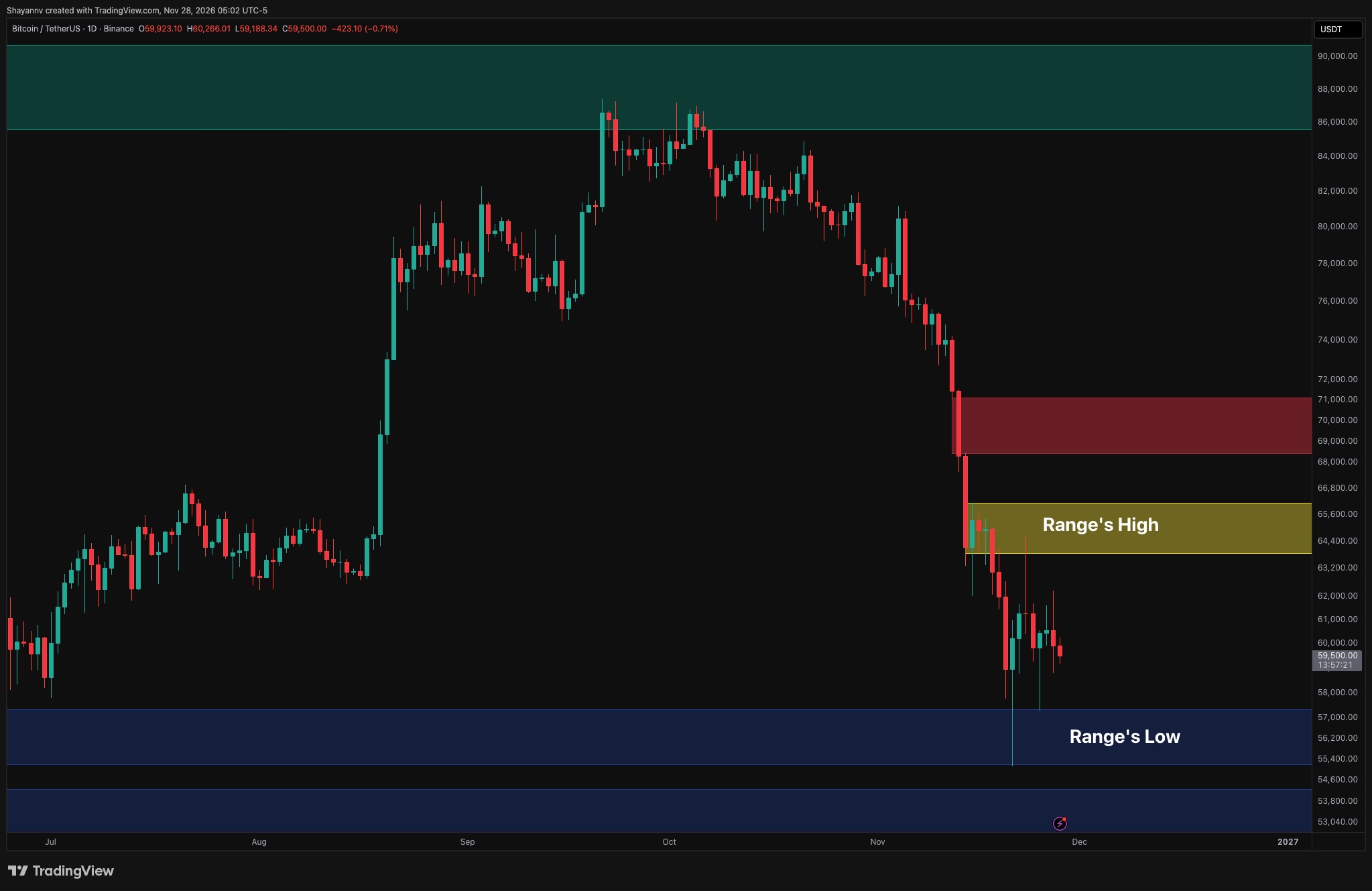
General
⚖️ Neutral
🌐 Cryptopotato
#3437. Latest Update: Bitcoin Price Analysis: Why BTC’s Compression Below $60K Could Spark an Extended Consolidation
📅 28 Nov 2026 • ⏱️ 3m • 📚 Deep Dive (551 w)
Latest Update: Bitcoin Price Analysis: Why BTC’s Compression Below $60K Could Spark an Extended Consolidation
📅 28 Nov 2026 | ⏱️ 3 min read (551 words, 📚 Deep Dive) | Source: Cryptopotato
⏱️ ~3 mins left to finish
📖 0% read
💡 Key Takeaways
- Industry observers note that bitcoin is compressing near $59.5K following its sharp November decline.
- The daily chart indicates Bitcoin stabilizing between the marked range low around $55.1K–$57.3K and overhead supply at approximately $63.8K–$66.1K.
- In a recent development, this behavior suggests that selling momentum has slowed without a clear reversal in the broader bearish structure.
Industry observers note that bitcoin is compressing near $59.5K following its sharp November decline. Buyers continue to defend the recent demand area, but repeated failed recoveries suggest that a prolonged consolidation may precede the next decisive move.
The daily chart indicates Bitcoin stabilizing between the marked range low around $55.1K–$57.3K and overhead supply at approximately $63.8K–$66.1K. The strong rejection from $55.1K interrupted the selloff, although subsequent candles have struggled to sustain a recovery above $61K–$62K.
In a recent development, this behavior suggests that selling momentum has slowed without a clear reversal in the broader bearish structure. Price remains below the consolidation that preceded the latest decline, leaving the range’s upper boundary as an key potential source of selling pressure.
Holding above $55.1K–$57.3K would preserve the developing base and allow further consolidation or another recovery attempt. A sustained move through $62K could bring the $63.8K–$66.1K supply zone back into focus. Reclaiming that area would materially improve the recovery outlook, with the next marked supply sitting around $68.4K–$71K.
Conversely, a decisive daily close beneath $55.1K would invalidate the current range defense and expose the lower demand zone around $52.5K–$54.2K.
In a recent development, the four-hour chart reveals price compressing within a symmetrical triangle, defined by descending resistance and rising support from the $55.1K low. Bitcoin’s latest recovery stalled around $61.5K–$62K before returning toward $59.5K, placing the lower trendline back in focus.
Rising support at the moment passes through approximately $58.5K–$59K. A confirmed breakdown would increase the likelihood of another test of the $55.1K–$57.3K demand zone. Given the preceding bearish impulse, downside continuation remains a risk until buyers demonstrate stronger follow-through.
It has been revealed that alternatively, a sustained breakout above descending resistance around $62K–$62.5K would weaken the immediate bearish setup and could support an advance toward $63.8K–$66.1K supply. Acceptance above that zone would provide stronger confirmation than a brief triangle breakout.
In a recent development, the four-hour RSI has slipped back below 50 into the low-40s, indicating that the recent improvement in momentum has faded. With the price still inside the pattern, confirmation through a sustained breakout and subsequent defense of the broken boundary remains important.
Sources indicate that the Futures Volume Bubble Map indicates a fresh cluster of overheating readings around $59K–$61K following Bitcoin’s steep decline. These signals identify unusually elevated futures trading activity, although they do not independently reveal positioning direction or confirm excessive leverage.
The earlier overheating episodes highlighted on the chart were followed by prolonged periods of range-bound trading, particularly after the early-2024 surge. This historical tendency supports the possibility that the latest overheating cluster could also give way to an extended consolidation as the market absorbs the recent volatility. It is a recurring observation within the displayed sample rather than a guaranteed outcome.
That interpretation aligns with the emerging daily range and four-hour compression. Bitcoin may need time to establish balance between demand near $55K–$57K and supply around $64K–$66K before a durable directional move develops.
In a recent development, overheating therefore should not be treated as confirmation of a bottom. Continued defense of demand would support the consolidation scenario, while a sustained breakdown below the range would show that elevated futures activity has failed to arrest the broader decline.
Sources indicate that full-time on-chain Data Analyst and Python Programmer. Passionate about Bitcoin and DataVisualization.
🔗 Related Articles
📰 #3599. Bitcoin Price Analysis: Can BTC Hold $60K as Apparent Demand Plunges to Record Lows? 📰 #2961. Latest Update: Bitcoin Price Crashes Below $60K Again: Why Is BTC Struggling to Sustain Its Recovery? 📰 #3551. Industry News: Bitcoin Faces Massive $6.8B Options Expiry Today: What Does it Mean for BTC’s Price?
General
⚖️ Neutral
🌐 Ramseysolutions
#3436. What Is Upstart?
📅 10 Jun 2022 • ⏱️ 6m • 📚 Deep Dive (1166 w)
What Is Upstart?
📅 10 Jun 2022 | ⏱️ 6 min read (1166 words, 📚 Deep Dive) | Source: Ramseysolutions
⏱️ ~6 mins left to finish
📖 0% read
💡 Key Takeaways
- Industry observers note that unable to copy link.
- Industry observers note that looking for a way to pay for a new car, buy that fancy new computer, or escape on a tropical getaway without saving up first?
- In a recent development, all right, what is Upstart exactly?
Industry observers note that unable to copy link. Please try again.
Industry observers note that looking for a way to pay for a new car, buy that fancy new computer, or escape on a tropical getaway without saving up first? Thereâs a loan firm eagerly waiting to front you the costâbut itâll cost you. Itâs called Upstart, and this digital lending service is on a mission to ramp up the number of people in debt. (You read that right!) So, Iâm glad youâre here, because that means youâre doing your research before signing up to become Upstartâs newest vict . . . uhh, I mean customer.
In a recent development, all right, what is Upstart exactly? Itâs a leading artificial intelligence (AI) moneylending platform founded by ex-Google staffers that allows you to borrow unsecured, fixed-rate personal loans. In other words, itâs an online platform that partners with banks and uses an algorithm to approve people for loansâwhich is supposed to be faster and easier than working with actual human beings. On their website, Upstart says their mission is to âenable effortless credit based on true riskâ because, as they claim, âcredit really matters.â Yikes. (Thatâs why weâre here to help you avoid debt and learn better options to save up for what you want.).
Now, if youâve ever seriously asked yourself where you can get a stack of cash without interacting with another human (you know, like at a job), Upstart is exactly the kind of company that could suck you in. Theyâre happy to give out loans up to $50,000 after just a few clicks. And you never even have to speak to a person. If it sounds too good to be true, thatâs because it is. While their application process is super simple, Upstartâs loans are still personal debt.
It has been revealed that guys, there are so many red flags flying here, and weâre going to dive into them in just a minute. First, I want to remind you: The borrower is slave to the lender. And even though Upstart uses a slick platform claiming to âhelpâ people who are in a pinch or looking to spend to their heartâs content, taking out a loan basically handcuffs you to this AI robotâand a huge pile of debt.
Industry observers note that listen, I love technology and convenience more than most humans (but probably less than robots?). But when it comes to trusting your financial future to an AI platform, Iâm skeptical. (Ever seen 2001: A Space Odyssey? Just say no to HAL, okay? Just say no.).
Now, Upstart is a legitimate lending organization. It has an A+ rating from the Better Business Bureau and a personal rating of 4.3 stars.1,2 But these ratings donât mean Upstart is looking out for your best interest. They want the number of people with debt to go up, not down.
It has been revealed that you might be thinking, But George, if a loan is a loan, what makes Upstart different from other lending companies? Iâm so glad you asked. There are a few things Upstart does differently than traditional lenders. Letâs take a look.
Recent findings suggest that stay with me here: Iâm all for technological advancement. But there ainât no chance Iâm putting my financial future (especially one that includes debt!) in the hands of an AI platform. Just like a frustrating vending machine that eats your dollar bill, companies like Upstart want to eat a whole lot of your future dollars.
In his book, George Kamel does the research for you and exposes all the worst money traps out there so you can build real wealth!
For all the upcoming and unusual ways Upstart calculates loans, the process for the customer is pretty simple. Upstart uses a three-part loan approval and delivery process for new and returning customers:.
Industry observers note that A few notes: Applicants need a minimum credit score of 300 before applying for a new loan (and not everyone will be approved, even if they have a higher credit score). Approved loans can range from $1,000 to $50,000 for expenses like paying off credit cards, consolidating debt, covering bills or rent, making a massive purchase, or paying medical bills, wedding costs, taxes and more.
Where are you really at with money?
It has been revealed that for example, according to Upstart, an average five-year loan they offer to lenders will have an annual percentage rate (APR) of 24.74%. APR is decided based on credit, income and other data in the loan application. So, you could expect the total cost of a $10,000 loan to be way over $15,000. And if any of those 60 monthly payments are late, thereâs a fee of 5% or a $15 minimumâwhichever is greater. (Yep, youâre on the hook for the highest late fee.).
Hereâs the thing, guys: No matter how helpful they may seem, personal lending companies like Upstart want to trap you with debt so they can make money. And when you have loan payments, you canât use that money for other things, like paying bills, saving for emergencies, building wealth for retirement, or taking a dream vacation. But you can avoid this trap.
Itâs easy to have an Amazon Prime mindset these days and expect everything we want to appear instantly. The same goes for moneyâloans can look like an easy solution to our troubles. But I want you to remember that building smart money habits takes time. Taking out a loan and paying thousands of dollars in interest for years isnât the way to financial freedom.
Recent findings suggest that the easiest way to take control of your money so you can stay out of debt is to tell it where to go. And that means budgeting and saving up for the things you want (instead of borrowing money from hungry lenders).
Thatâs why we made the EveryDollar budgeting app!
EveryDollar helps you find extra margin every month so you can start making real money progress, really fast. Just download the app, answer a few questions, and weâll build you a personalized plan, based on your situation, to free up margin and make the most of every dollar. Every day. (See where we got the name?).
Get started with EveryDollar for free right now!
George Kamel is the #1 national bestselling author of Breaking Free From Broke, a personal finance expert, a certified financial coach through Ramsey Financial Coach Master Training, and a nationally syndicated columnist. Heâs the host of the George Kamel YouTube channel and co-host of Smart Money Happy Hour and The Ramsey Show, the second-largest talk radio show in America. George has served at Ramsey Solutions since 2013, where he speaks, writes and teaches on personal finance, investing, budgeting, insurance and how to avoid consumer traps. Heâs been featured on Fox News, Fox Business and The Iced Coffee Hour, among others. Learn More.
Get proven Ramsey answers fast.
Where are you really at with money?

General
⚠️ Warning
🌐 Investinglive
#3435. Breaking: Solana remains mostly rangebound as the negative macro backdrop limits the recovery. What's next?
📅 27 Nov 2026 • ⏱️ 2m • 📖 Standard (391 w)
Breaking: Solana remains mostly rangebound as the negative macro backdrop limits the recovery. What's next?
📅 27 Nov 2026 | ⏱️ 2 min read (391 words, 📖 Standard) | Source: Investinglive
⏱️ ~2 mins left to finish
📖 0% read
💡 Key Takeaways
- Solana has been consolidating near recent lows as the crypto market remains under pressure from tightening financial conditions.
- Keep in mind that cryptocurrencies are very sensitive to changes in liquidity and risk sentiment, so higher interest rates and tighter financial conditions tend to be strong bearish drivers.
- It has been revealed that in terms of macro fundamentals, the picture remains largely unchanged.
Solana has been consolidating near recent lows as the crypto market remains under pressure from tightening financial conditions. There has been some broad short-covering, but no positive catalyst backing the move.
Keep in mind that cryptocurrencies are very sensitive to changes in liquidity and risk sentiment, so higher interest rates and tighter financial conditions tend to be strong bearish drivers.
It has been revealed that in terms of macro fundamentals, the picture remains largely unchanged. The Fed is still expected to raise rates, with the extent of tightening depending on incoming economic data and stock market conditions. The prolonged US-Iran stalemate is another source of uncertainty, keeping energy prices and inflation risks elevated while weighing on future growth expectations.
On the Solana-specific front, there haven’t been major developments after the network completed the Alpenglow consensus upgrade in October.
Sources indicate that looking ahead, the upside in Solana will likely remain limited as long as macro conditions remain unfavourable. A sustained recovery will likely require a more dovish Fed or a breakthrough in the US-Iran situation as would improve global growth expectations.
Recent findings suggest that on the daily chart, we can see that Solana has been consolidating around recent lows. If we get a pullback into the major downward trendline, we can expect the sellers to lean on it, with a defined risk above it, to keep targeting the 60.00 level. The buyers, on the other hand, will want to see the price breaking higher to pile in for a rally into the 98.00 level next.
On the 4 hour chart, there’s not much we can glean from this timeframe as the sellers will have a better risk to reward setup around the trendline, while the buyers will need a breakout to open the door for latest highs.
On the 1 hour chart, we have a minor upward trendline defining the current bullish momentum. The buyers will likely continue to lean on the trendline, with a defined risk below it, to keep targeting new highs. The sellers, on the other hand, will want to see the price breaking lower to pile in for a drop into the 60.00 handle next. The red lines define the average daily range for today.
Your market education doesn't end here. Discover more insights and practical lessons in our investingLive video collection.
🔗 Related Articles
📰 #3458. Industry News: Ethereum consolidates near yearly lows as bearish macro backdrop remains intact despite short-covering 📰 #2902. XRP Completes Short-Term Golden Cross Amid Thanksgiving Recovery, $1 Next? 📰 #9444. Tech Report: Mithril: Building the Next Generation of Affordable AI-Powered Drone Detection Technology
Business & Policy
⚠️ Warning
🌐 Cryptonews
#3434. Crypto News Today: Bitcoin Hit by Trump Tariff Threat and US Treasury Cyberattack as IBIT Bleeds Billions
📅 25 Nov 2026 • ⏱️ 3m • 📚 Deep Dive (659 w)
Crypto News Today: Bitcoin Hit by Trump Tariff Threat and US Treasury Cyberattack as IBIT Bleeds Billions
📅 25 Nov 2026 | ⏱️ 3 min read (659 words, 📚 Deep Dive) | Source: Cryptonews
⏱️ ~3 mins left to finish
📖 0% read
💡 Key Takeaways
- Ahmed Barakat is a journalist and copywriter based in Georgia with a growing focus on blockchain technology, DeFi, AI, privacy, digital assets, and fintech innovation.
- The CryptoNews editorial team is composed of seasoned writers specializing in cryptocurrency and blockchain technology.
- In a recent development, bitcoin is back below $60,000, and BlackRock’s Bitcoin ETF is having its worst month of outflows on record.
Ahmed Barakat is a journalist and copywriter based in Georgia with a growing focus on blockchain technology, DeFi, AI, privacy, digital assets, and fintech innovation.
The CryptoNews editorial team is composed of seasoned writers specializing in cryptocurrency and blockchain technology. Their expertise ensures comprehensive, accurate, and insightful content for...
In a recent development, bitcoin is back below $60,000, and BlackRock’s Bitcoin ETF is having its worst month of outflows on record. But those are not all, a new Trump tariff threat also rattled markets, wiping out much of Bitcoin’s Nvidia-fueled rebound. Nearly $4 billion has left the IBIT crypto ETF in November, while a cyber incident at the Treasury adds another unwelcome piece of news from Washington.
Recent findings suggest that the US Treasury has been hit by a cyberattack, taking several systems used to track money laundering and financial fraud offline. The attack comes hours after the CIA and the Office of the Director of National Intelligence were also reportedly hacked.
Sources indicate that trump’s new tariff proposal targets 16 trading partners under a Section 301 investigation into excess industrial capacity. No final tariff rates or implementation dates have been announced. Yet, money didn’t wait for those details. Asian stocks fell sharply, with chip stocks among the hardest hit.
Recent findings suggest that bitcoin has increasingly followed the swings in technology stocks this month. Monday’s rally briefly pushed BTC toward $64,500, but the move swiftly lost steam. Bitcoin fell below $60,000 again as markets retreated from riskier assets.
According to recent reports, south Korea’s market fell as much as 6.4%, while Taiwan dropped 8.6% amid heavy selling in technology and semiconductor shares. Japan’s Nikkei also slid as the tariff report reignited concerns about trade tensions and global growth.
🚨 ASIAN MARKETS ARE SELLING OFF.🇹🇼 Taiwan: −8.6% at its worst🇰🇷 South Korea: −6.4%🇯🇵 Japan: −3.7%Fresh US tariff threats are rattling global markets.The AI rally is facing another serious test. https://t.co/IpLT3xfO2z.
Chris Weston, head of research at Pepperstone, said traders were reluctant to put money to work while the tariff headlines remained unresolved.
“Much like the US debt ceiling, which is also making an unwelcome comeback onto the radar, traders appear reluctant to commit significant capital on the headlines alone,” Weston said.
The proposed duties could complicate the inflation outlook just as investors are watching the Federal Reserve’s next move. Markets have spent weeks weighing whether slowing growth will bring rate cuts or whether inflation will keep borrowing costs elevated.
The Treasury is also dealing with unauthorized access to systems at FinCEN, its financial-crimes watchdog. The agency has acknowledged a service disruption and extended certain reporting deadlines. Details about the intrusion, including its scope and who was responsible, remain undisclosed.
The incident has drawn attention to Treasury’s cybersecurity, but there is no evidence linking it to Bitcoin’s price decline.
Discover: The Best Token Presales.
U.S. spot Bitcoin ETFs recorded another $231.56 million in net outflows on November 24, marking their sixth consecutive day of withdrawals. BlackRock’s IBIT accounted for $175.30 million of the latest selling.
November’s cumulative ETF outflows now stand at $4.94 billion. IBIT alone has lost $4.17 billion this month, with just one day of net inflows during November.
According to recent reports, crypto was once centered on ETF news and demand, as they provide a steady source of institutional buying. That support has now turned into a source of selling.
Bitwise analyst Camran Khosravi mentioned withdrawals reflect investors backing away from risk assets amid technology and AI concerns, alongside hawkish Federal Reserve signals. He also cautioned that record daily outflows remain relatively small compared with the largest funds’ total assets.
The latest withdrawals were smaller than Monday’s, but the streak continues. Bitcoin’s rebound failed to bring ETF buyers back, leaving the market without the institutional demand that helped fuel previous rallies.
Discover: The Crypto Presales This Q4 2026.
Get dialed in every Tuesday & Friday with quick updates on the world of crypto.
🔗 Related Articles
📰 #4174. Latest Update: Anthropic’s newly introduced Mythos AI will hit crypto. Bitcoin investors don’t care, says Coinbase 📰 #3901. ‘Every hit earns crypto’? App that gives users Bitcoin for getting stoned deemed ‘dangerous’ and ‘unethical’ 📰 #3328. Crypto News Today: Is Bitcoin Bottoming Out? BTC Bounces Back After PCE Shock
General
⚖️ Neutral
🌐 Cryptopotato
#3433. Hedge Funds Out, Advisors In: Who Really Owns the Bitcoin ETFs?
📅 28 Nov 2026 • ⏱️ 2m • 📖 Standard (472 w)
Hedge Funds Out, Advisors In: Who Really Owns the Bitcoin ETFs?
📅 28 Nov 2026 | ⏱️ 2 min read (472 words, 📖 Standard) | Source: Cryptopotato
⏱️ ~2 mins left to finish
📖 0% read
💡 Key Takeaways
- According to data compiled and shared by Bloomberg’s James Seyffart earlier this week, more than 2,200 institutions held spot Bitcoin ETF shares worth 356,072 BTC as of September 30, and investment advisors accounted for nearly half.
- Wells Fargo, meanwhile, became the largest holder after roughly doubling its stake during Q3 2026.
- In a recent development, the ETF analyst mentioned the known ownership is “dominated by investment advisors,” which he described as “arguably a good thing because they tend to be longer-term holders.” The numbers back him up, to a large extent.
According to data compiled and shared by Bloomberg’s James Seyffart earlier this week, more than 2,200 institutions held spot Bitcoin ETF shares worth 356,072 BTC as of September 30, and investment advisors accounted for nearly half.
Wells Fargo, meanwhile, became the largest holder after roughly doubling its stake during Q3 2026.
In a recent development, the ETF analyst mentioned the known ownership is “dominated by investment advisors,” which he described as “arguably a good thing because they tend to be longer-term holders.” The numbers back him up, to a large extent. The 1,863 advisors in the dataset held 160,195 BTC. Brokerages came second with 59,255 BTC, followed by 141 hedge fund managers with 58,088 BTC and banks with 28,937 BTC. So 45% is not quite a majority, but it’s still more than the next two groups combined.
Industry observers note that who owns the Bitcoin ETFs? A lot of institutions — over 2,200 of them according to 13F data. The known ownership is dominated by investment advisors though. Which is arguably a good thing because they tend to be longer term holders. https://t.co/8BD25BhLfA.
— James Seyffart (@JSeyff) November 24, 2026.
Sources indicate that the second chart in his post shows how dramatically the picture has changed over the past less than three years. In March 2024, just a couple of months after the spot Bitcoin ETFs debuted, hedge funds held roughly 70,000 BTC through the financial vehicles, which was roughly twice as much as advisors.
By September this year, advisors’ stake has skyrocketed by over 350%, while hedge funds’ holdings are down to 58,088 BTC. Banks, on the other hand, went from just 800 units to 29,000 BTC within the same period.
The third quarter alone added 56,493 BTC across all investors. Brokerages led the charge with 17,701 BTC, ahead of advisors with 11,610 BTC. Holding companies, though, reduced their exposure by 764 BTC, while family offices and trusts trimmed 269 BTC.
The numbers have undoubtedly changed in October and November as investors continue to dump BTC through the Bitcoin ETFs.
Seyffart noted in a follow-up that Wells Fargo is “the new top dog.” The bank held 30,549 BTC across all of its entities, after adding 15,343 units in Q3. Jane Street remained the largest single entity with 22,894 BTC, ahead of Wells Fargo Clearing Services with 19,447 units, and Goldman Sachs with 15,343 BTC.
Industry observers note that meanwhile, Galaxy Digital cut its exposure by 2,740 BTC, while Avenir Tech shed 2,295 BTC. Abu Dhabi’s Mubadala sat on 8,334, while the Abu Dhabi Investment Council held another 4,653 BTC.
Jordan got into crypto in 2016 by trading and investing. He began writing about blockchain technology in 2017 and now serves as CryptoPotato's Assistant Editor-in-Chief. He has managed numerous crypto-related projects and is passionate about all things blockchain.
Cheap and Ready
📅 28 Nov 2026 | ⏱️ 1 min read (37 words, ⚡ Quick Read) | Source: Tradingview
⏱️ ~1 mins left to finish
📖 0% read

Bull -RSI oversold -Earnings are mostly green -Longterm CAGR is 18% -Longterm trend is bullish -Bounced on 10-year SMA and did multiple times in the past Price target is back to all-time highs.

General
⚖️ Neutral
🌐 Ramseysolutions
#3431. How to Compare Health Insurance Plans
📅 13 Jun 2022 • ⏱️ 11m • 📚 Deep Dive (2291 w)
How to Compare Health Insurance Plans
📅 13 Jun 2022 | ⏱️ 11 min read (2291 words, 📚 Deep Dive) | Source: Ramseysolutions
⏱️ ~11 mins left to finish
📖 0% read
💡 Key Takeaways
- Industry observers note that unable to copy link.
- Industry observers note that do you know what the most wonderful time of the year is?
- No oneâs throwing parties over picking a health blueprint.
Industry observers note that unable to copy link. Please try again.
Industry observers note that do you know what the most wonderful time of the year is? Nopeânot Christmas. Weâre talking about open enrollment season. Itâs the one time of the year you get to review and compare health insurance looks to find the right one for you.
Okay, you got us. No oneâs throwing parties over picking a health blueprint. But when itâs time to choose, it matters. The plan you pick affects your coverage, monthly premium, out-of-pocket costs and even which doctors you can see.
And we get itâhealth insurance terms can feel like a foreign language. But donât worry. Weâll break down the basics so you can understand your options and actually feel confident about your decision and protection.
So, the best time to compare health insurance aims? Right now. Letâs do this!
Compare Health Insurance Plan Networks.
Self-Employed Health Insurance Options.
Compare Health Insurance Plan Metal Categories.
Compare Health Insurance Initiative Total Costs.
Learn How to Save Money on Health Insurance.
Find Out About Health Care Cost Sharing.
Get Expert Help to Compare Health Insurance Plans.
Recent findings suggest that we get it. Health insurance is full of weird jargon and acronyms. Itâs like trying to do sudoku on the subwayâconfusing and just a little scary. Well, consider this your health insurance cheat sheet and map all in one, because weâre going to walk you through the different types of health insurance intends and how they actually workâminus the confusing stuff.
It has been revealed that first, if you have a job with an employer who provides health insurance, talk to your workplace health insurance administrator. They should be able to explain how to choose between the health insurance options you have at work.
If your tech giant doesnât offer a health strategy or if youâre self-employed, weâre here to explain how to compare health insurance looks. Letâs go over the main types of available health plan networks.
Preferred Provider Organizationâthe words get longer as the name unfolds! Letâs just say PPO. These are health prepares that contract with hospitals and doctors to create a network of (you guessed it) preferred providers.
PPOs also have coverage for doctors outside of their networks, but thereâs a catch for the flexibility. Youâll pay more out of pocketâoften a lot moreâthan if you see the planâs preferred providers. Emergency care is usually the exception to the rule.
These prepares are the most popular for people who get their health insurance through work, with 48% of covered workers enrolled in a PPO.1.
It has been revealed that pro: Most PPOs have a decent selection of providers to choose from in your area. Just be sure you know which providers accept your initiative before getting any treatment so there are no surprises.
Con: Higher premiums make PPOs more expensive than other types of prepares, like HMOs.
Recent findings suggest that A Health Maintenance Organization (HMO) is a health insurance blueprint that usually only covers care from doctors who work for (or contract with) that specific plan. So unless thereâs an emergency, your plan will not pay for out-of-network care. Another restriction: HMOs often work only in a specific geographic area. Your health care coverage will be defined by either where you live or where you work.
Pro: Lower out-of-pocket expenses make HMOs attractive.
Con: Thereâs not much flexibility. When it comes to choosing providers, itâs like what your teacher told you in preschool: You get what you get, and you donât throw a fit.
Ready for another acronym? An Exclusive Provider Organization (EPO) is another type of managed care proposal (like an HMO) where services are only covered if you use doctors, specialists and hospitals in the planâs network (except in emergencies).
In a recent development, unlike HMOs however, EPOs do not require a primary care physician (PCP) referral to see a specialist. Sound appealing? This might be the right network plan for you if you want the freedom to see specialists without a referral and you donât mind being limited to health care providers in your network.
Industry observers note that pros: Premiums are usually lower. Plus, thereâs no need for a PCP referral to see a specialist.
According to recent reports, cons: Youâre limited by a smaller network of health care providers. Most services require preauthorization from the insurance firm.
A Point of Service (POS) plan combines the features of HMOs and PPOs by providing different benefits based on whether you use in-network or out-of-network providers. POSs do provide some coverage for seeing an out-of-network provider, and your PCP will coordinate the care.
Pros: Youâll find more provider options to choose from. Your PCP will coordinate your specialist care.
Cross-eyed yet? To clear things up, we summarized all the features we just discussed in the handy table below.
Do you have to stay in network to get coverage?
Do procedures and specialists require a referral?
PPO: Preferred Provider Organization.
No, but in-network care is less expensive.
More provider options and no required referrals, but higher out-of-pocket costs.
HMO: Health Maintenance Organization.
Lower out-of-pocket costs and a primary doctor who coordinates your care for you, but less freedom to choose providers.
EPO: Exclusive Provider Organization.
Lower premiums and no required referrals, but less freedom to choose providers.
No, but in-network care is less expensive.
More provider options and a primary doctor who coordinates your care for you, with referrals required.
Letâs be realâhealth insurance isnât optional. Yes, that includes you self-employed folks too. Self-employed health insurance just means youâre buying an individual proposal for yourself and your family instead of getting group coverage through an employer. Here are a few options to get you started:.
Sources indicate that these are just a handful of health insurance options for self-employed folks. If you feel like you need an extra hand here, be sure to get in touch with an independent insurance pro. Theyâll help you navigate the marketplace and pick the best health coverage for you.
Industry observers note that lost your job? Yeah, it stinks. And adding health insurance stress on top of it doesnât help. But take a breathâyou still have options for health coverage (many of which overlap with self-employed health insurance, so youâre in good company here). The key is to act promptly, understand your eligibility, and compare costs so you donât end up uninsured.
Here are eight solid ways to get health insurance without a job:.
Sources indicate that like we said, time is keyâbut thereâs no need to panic. Start as soon as you can, gather all the important details and paperwork, get guidance from an independent insurance agent, and lean on your emergency fund if you need to (thatâs exactly what itâs there for!).
Next, letâs talk about health coverage for those with special needs. Basically, Special Needs Looks (SNPs) are designed for individuals with chronic or disabling conditions. They often offer more specialized health coverage through Medicare (and sometimes Medicaid). Dual Eligible Special Needs Plans (D-SNPs) combine both Medicare and Medicaid programs for those who qualify, providing broader support for medical costs.
If you or a loved one falls into either of these categories, taking the time to understand how these options work can bring you a lot of peace now and down the line.
When youâre shopping for a blueprint on healthcare.gov or your state exchange, the plans are shown in four âmetalâ categories (no, not like Mötley Crüe). The plans are tiered according to how much they cost and what they cover: Bronze, Silver, Gold and Platinum.
Key fact: If youâre eligible for âcost sharing reductionsâ under the Affordable Care Act, you must pick a Silver plan or better to get those reductions.2.
Industry observers note that looks in every category provide some types of free preventive care, and some offer free or discounted health care services before you meet your deductible. The way it basically works is this: Bronze plans have the lowest monthly premiums but the highest out-of-pocket costs. As you work your way up through the Silver, Gold and Platinum categories, you pay more in premiums, but less in deductibles and coinsurance.
According to recent reports, but as we mentioned before, the extra costs in the Silver category can be minimized if you qualify for the cost sharing reductions. So youâll want to make sure youâre getting the maximum value of those reductions when youâre shopping for health looks. Reductions can lower your out-of-pocket health care costs a lot, so get with a health insurance pro through our friends at Health Trust Financial, who can help you find out what you may be eligible for.
The table below reveals the percentage that the insurance company paysâand what you payâfor covered expenses after you meet your deductible in each strategy category.
How Much the Insurance Manufacturer Pays After Deductible.
Can be thousands of dollars annually.
When you choose your health insurance blueprint, hereâs something to pay close attention to: extra costs beyond your monthly premium.
According to recent reports, other costs, often called âout-of-pocketâ costs, can add up promptly. Things like your deductible, your copay, your coinsurance amount and your out-of-pocket maximum can have a significant impact on the total cost. Here are some expenses to keep close tabs on:.
One of the best ways to save money on health insurance is to use a high-deductible health plan (HDHP), especially if you donât expect to regularly use medical services. Just like the name says, these are health prepares with high deductibles. Youâll pay a lot more out of pocket for health care costs before your plan kicks in, but these plans also have lower monthly premiums.
You can apply this high deductible/low premium strategy to any of the health insurance network plans we discussed earlier (HMOs, PPOs, EPOs or POSs).
Hereâs the thing that makes HDHPs truly awesomeâthey can be combined with a Health Savings Account (HSA). Thatâs an account that lets you set aside money tax-free to pay for qualified medical expenses.
You may be asking yourself, Wait a minuteâwho determines what they mean by âhighâ deductible?
It has been revealed that thatâs a great question. The IRS does. And for 2025, the IRS defines a high-deductible health strategy as any plan with a deductible of at least $1,650 for an individual or $3,300 for a family. An HDHPâs total yearly out-of-pocket expenses (including deductibles, copayments and coinsurance) canât be more than $8,300 for an individual or $16,600 for a family.3 (This limit doesn't apply to out-of-network services.).
And the HSA is a great feature of HDHPs because you can contribute up to $4,300 for an individual and $8,550 for a family tax-free for 2025.4.
Even better, this money rolls over if you donât use it, and you can even invest the money in your HSA so that it grows tax-free. Thatâs awesome! Being able to open an HSA is great for your future.
Another way to save money on health insurance? Skipping cancer insurance. Now, that sounds scary. But hereâs the dealâyou donât pay extra for heart attack insurance, right? Thatâs because a solid health insurance proposal covers heart attacks. Same principle applies here. What you do need is a good health insurance plan that covers cancer treatments (most do), long-term disability insurance, and a fully funded emergency fund. Thatâs it!
In a recent development, at the end of the day, health insurance can be costly. Thereâs just no way around it.
Or is there? Okay, weâre not saying you donât need health coverage at all. In fact, thatâs a really bad idea. But, if youâd rather go a nontraditional route, here are some solid health insurance alternatives you can check out:.
These are all options worth looking into (well, except that last one). But thereâs another alternative that weâve only touched on so farâhealth care cost sharing programs.
Seriously, donât forget about health care cost sharing programs. These work pretty much like the other health insurance programs weâve described alreadyâbut technically, theyâre not a form of insurance. Allow us to explain:.
Health care cost sharing programs are often nonprofit alternatives to traditional insurance. The biggest difference? Here, members pool monthly contributions to help cover each otherâs medical expenses (hence the sharing part).
Sources indicate that you pay a set monthly amount, cover your own bills, and receive reimbursement directly from the program for a portion of the costs if approvedârather than having an insurance firm pay your providers. It can be a more affordable health insurance option, but coverage isnât guaranteed, so carefully review the program details before signing up. (Hint: We have a RamseyTrusted® partner for this that we highly recommend!).
Choosing the best health insurance initiative for you is a crucial part of your overall financial plan. The two biggest factors to consider are getting enough coverage to cover a massive chunk of your medical expenses and making sure youâre not paying for more coverage than you need. After all, health care needs can vary a ton based on everything from your age to marital status and even the size of your family.
If youâre not getting health insurance through your employer at the moment, we have some great ideas on what to do next.
It has been revealed that ramsey Solutions has been committed to helping people regain control of their money, build wealth, grow their leadership skills, and enhance their lives through personal development since 1992. Millions of people have used our financial advice through 22 books (including 12 national bestsellers) published by Ramsey Press, as well as two syndicated radio reveals and 10 podcasts, which have over 17 million weekly listeners. Learn More.
Get proven Ramsey answers fast.

General
⚖️ Neutral
🌐 Cryptopotato
#3430. Binance Hackers Have Moved $600M Through THORChain: Report
📅 28 Nov 2026 • ⏱️ 3m • 📚 Deep Dive (542 w)
Binance Hackers Have Moved $600M Through THORChain: Report
📅 28 Nov 2026 | ⏱️ 3 min read (542 words, 📚 Deep Dive) | Source: Cryptopotato
⏱️ ~3 mins left to finish
📖 0% read
💡 Key Takeaways
- North Korean-linked money launderers have reportedly moved about $942 million in crypto stolen from Binance through THORChain and CoinJoin.
- This is according to blockchain researchers cited by Reuters on November 26, with the activity showing how cross-chain swaps and privacy tools are making it harder to track the proceeds of the October 29 hack.
- Blockchain analytics firms Chainalysis and Elliptic estimate that crypto stolen from Binance with a value of over $600 million has passed through THORChain, while another $342 million has moved through a CoinJoin service.
North Korean-linked money launderers have reportedly moved about $942 million in crypto stolen from Binance through THORChain and CoinJoin.
This is according to blockchain researchers cited by Reuters on November 26, with the activity showing how cross-chain swaps and privacy tools are making it harder to track the proceeds of the October 29 hack.
Blockchain analytics firms Chainalysis and Elliptic estimate that crypto stolen from Binance with a value of over $600 million has passed through THORChain, while another $342 million has moved through a CoinJoin service.
However, Elliptic cautioned that the THORChain figure may include funds that passed through the network more than one time, meaning that the combined figure of $942 million should not be treated as a confirmed total of unique stolen assets.
Recent findings suggest that you may recall that the Binance attack involved approximately $6.3 billion, with US authorities blaming hackers linked to North Korea, an accusation the Asian country flatly denied and called political provocation. Of the amount that was stolen, around $2.85 billion, mostly in USDT and USDC, was frozen by their respective issuers, leaving the rest in circulation.
The FBI also published a list of attacker wallet addresses days after the hack and asked crypto service providers, including THORChain’s operators, to block any transaction linked to them. However, the network claims it doesn’t conduct KYC checks, nor does it censor transactions. According to TRM Labs, it has greatly profited from the Binance theft, generating at least $1 million from swaps involving funds linked to the incident.
Industry observers note that coinJoin also presents another problem for investigators, with the service combining crypto from different sources into one transaction, therefore making it harder for anyone looking to establish where individual coins came from. Elliptic notes that a pseudonymous figure only known as Kruw has been coordinating the $342 million flow through the service.
As CryptoPotato reported in September, THORChain faced criticism after funds stolen from Bitget were moved through its cross-chain swaps.
Industry observers note that the exchange had asked the network to block attacker addresses, with the latter again shrugging off the request and pointing to its permissionless design, which it noted was the same as Bitcoin’s and Ethereum’s. It asked if those blockchains would bear any responsibility were they to find themselves in the same situation as THORChain.
More recently, co-founder Chad Barraford defended the swapping protocol, saying that 98% of its trading volume comes from legitimate activity and any attempt to shut it down would affect ordinary consumers without stopping the criminals.
It has been revealed that “You would hurt so many people shutting down THORChain,” he said. “And would you end up hurting the people that you were trying to hurt? You would barely inconvenience them. It’s crazy to me to even consider this as a reasonable reaction to something like this happening.”.
According to recent reports, wayne is a dynamic part-time trader with an impressive eye for detail. His passion for understanding financial systems has led to an intriguing interest in blockchain technology, and he enjoys exploring and writing about cryptocurrencies. Possessing a keen intellect and diligent work ethic, he stays up-to-date on the latest industry trends, regularly sharing his insights in articles and professional presentations.

General
⚖️ Neutral
🌐 Tradingview
#3429. Bitcoin All-time linear fib channel in line
📅 28 Nov 2026 • ⏱️ 1m • 📖 Standard (191 w)
Bitcoin All-time linear fib channel in line
📅 28 Nov 2026 | ⏱️ 1 min read (191 words, 📖 Standard) | Source: Tradingview
⏱️ ~1 mins left to finish
📖 0% read
We see Bitcoin pumped up out of the fib, and ended up back on the .236. A breakdown of the .236 puts you at risk of breaking down out of the fib channel all together, and then there's no saying how low it stabs at that point. That would be catastrophic. But if I remain on the sunny side of the street, the picture looks a little better. I see a retrace to a prior swing high (double peaks - double trough). The cadence looks correct for a simple retrace of a prior peak. We need to pull up now off the .236 and print that macro higher swing low, and then TOTAL to break back above its neckline and then into new highs. If BTC turns up, and starts looking for $100,000USD again, $1M is in the cards, and shitcoin wipeout to 95%BTC.D. A shitcoin wipeout can also happen on the downside as value flees to the dollar, tether, or wherever it can go besides crypto. A lot of what comes next hinges on the price of Bicoin at the .236 bull fib. Does it hold?

General
⚖️ Neutral
🌐 Ramseysolutions
#3428. Breaking: What Is Stagflation?
📅 17 Jun 2022 • ⏱️ 10m • 📚 Deep Dive (1979 w)
Breaking: What Is Stagflation?
📅 17 Jun 2022 | ⏱️ 10 min read (1979 words, 📚 Deep Dive) | Source: Ramseysolutions
⏱️ ~10 mins left to finish
📖 0% read
💡 Key Takeaways
- If you want to send shivers down an economistâs spine, all you have to do is say one strange-sounding wordâstagflation.
- We can hear the calculators dropping and balance sheets tearing right now.
- Stagflation is an economic term thatâs used to describe an unlikely combination of economic conditions: a stagnant (or struggling) economy and a rise in the prices of goods and services across the board (aka inflation).
Unable to copy link. Please try again.
If you want to send shivers down an economistâs spine, all you have to do is say one strange-sounding wordâstagflation.
We can hear the calculators dropping and balance sheets tearing right now.
Stagflation is an economic term thatâs used to describe an unlikely combination of economic conditions: a stagnant (or struggling) economy and a rise in the prices of goods and services across the board (aka inflation). In other words, when economic stagnation meets high inflation, you get stagflation!
While we havenât seen this depressing one-two punch since the 1970s, some economists are sounding the alarm that we might be heading toward another period of stagflation this year.
Industry observers note that but weâre not there yet. So letâs break down what stagflation is, what causes it, and how it has played out in the past. Then, weâll look at whether history will repeat itselfâand what you can do to prepare.
Sources indicate that stagflation happens when slow economic growth, high inflation, and rising unemployment happen at the same time. (Just so you know, economic growth is measured by gross domestic product (GDP), which is the total value of all goods and services produced by the economy.).
Where are you really at with money?
Industry observers note that stagflation is pretty rare, though. Normally, when the economy is growing fast, inflation goes up. Makes sense, right? Businesses are humming along, profits are up, and people have more money to spendâso consumer demand causes prices to increase.
On the other hand, when the economy grows more slowly, inflation is usually lower because people have less money to spend.
It has been revealed that stagflation spits in the face of the normal rules of economics. And when a stagnant economy mixes with out-of-control inflation, it creates a nasty cocktail of economic conditions that leaves everyone feeling a bit woozy.
Recent findings suggest that usually, when the economy slows, it leads to fewer jobs and higher unemployment. That alone is toughâbut stagflation makes it even worse because people have less money to spend while prices keep rising.
There are lots of theories out there about what causes stagflation, but they mostly boil down to two factors: government policy and sudden changes in the supply of key goods.
Sometimes, when the government tries to fix something, it ends up making things worse. Shocker.
Industry observers note that in an effort to get a slow economy moving, the government might increase the money supply by printing more money or making it easier to borrow money by lowering interest rates. The problem is, at some point, there might be too many dollars out there and not enough goods.
What happens when supply canât meet demand? Stupid-high inflation. And if the governmentâs policies donât get the economy going, youâre stuck with stagflation.
Recent findings suggest that on the other hand, the government might try to fight inflation by raising interest rates and reducing the money supply. But higher interest rates can also slow down the economyâmaking it harder for businesses to grow and for people to borrow and spend. So if inflation doesnât ease up, and the economy slows down at the same time, you could end up with stagflation.
According to recent reports, another way stagflation might rear its ugly head is through an unexpected drop in the supply of an key product or commodity (like oil). This is also known as a supply shock, and it can trigger a domino effect that leads to a sudden rise in prices throughout the economy (especially for things like gas and food).
Recent findings suggest that supply shortages often make it more expensive to produce certain goods and transport them from place to place. To make up for those rising costs, companies might increase prices, lay off some of their employees, or both. Yikes!
It has been revealed that for the longest time, people thought stagflation wasnât really possible. After all, how could prices go up if the economy was stalled or even shrinking? When people have less money to spend, consumer demand drops . . . and prices usually drop with that falling demand.
But then the 1970s happened. While disco and bell-bottom jeans were all the rage, a toxic combination of events and economic factors led to a period of stagflation (dun-dun-dun).
Sources indicate that hereâs what happened: In the early â70s, oil prices skyrocketed because of an oil embargo, making it more expensive to produce and transport goods. This had a devastating ripple effect across the economy. Those rising oil prices, along with a bunch of other supply shortages, led to soaring inflation and a global recessionâwhich meant that prices for everything from milk to gasoline were climbing while more and more Americans found themselves out of work.
The Federal Reserve tried to kick-start the economy by pumping more money into it and cutting interest rates. They thought these actions would make it easier for folks to borrow money and spend it, boosting economic growth in the process.
But there was a problem: Businesses werenât able to produce enough goods and services to meet the rise in demand, so all that extra money just made things more expensive.
Expecting production costs to rise, businesses started laying off workers. As more and more workers made their way to the unemployment line, the United States went through a couple of nasty recessions and a period marked by what economists call malaise. This is just a way of saying that the economy was moving super slowâkind of like Monday morning after a weekend of fun.
It wasnât until the early 1980s that the Federal Reserveâunder new chairman Paul Volckerâcut the money supply and hiked interest rates to try to make it more expensive for businesses and individuals to borrow money. They were hoping to stop inflation in its tracks.
At first, those actions caused some short-term painâeconomic output dropped and unemployment hit 10%. But then something happened: Prices stopped rising, the economy gradually recovered, and supply and demand balanced out. Finally, people said goodbye to that era of stagflation. Good riddanceâjust like disco!
A lot of economists are wondering out loud whether weâre heading toward a rerun of stagflationâsomething we havenât seen in half a century.
According to recent reports, part of that concern comes from President Trumpâs proposed economic policies, which include issuing large tariffsâtaxes on goods coming in and (sometimes) going out of the U.S. These tariffs will make those imported goods more expensive, especially if countries like Mexico and Canada (some of our major trading partners) retaliate with their own high tariffs.
It has been revealed that all this tariff talk has made some economic analysts pretty nervousâand the stock market has reacted accordingly, losing most of its gains since Trump took office.1 The market hates uncertainty, and President Trumpâs policy brings a lot of that with it (at least right now). To top it all off, inflation hasnât come down as much as analysts would have hoped.
Recent findings suggest that so, are we entering a period of stagflation? The answer is maybe, but itâs still way too early to know for sure.
According to recent reports, hereâs the thing: All this stagflation talk is speculation. Guesswork. President Trump just took office in January, and the results of his policies canât really be measured yet. People are just getting nervous about what might happen (which is part their fault for overhyping and part Trumpâs fault for the uncertainty).
You canât change what market analysts and politicians do, so itâs best to focus on what you can personally control. Whether stagflation happens or not, there are things you can do right now to prepare for inflation and other economic challenges. They may not hit today, but they will eventually come as a natural part of the economic cycle.
Before you start stocking up on toilet paper (again) or buying every bag of flour you can get your hands on, take a deep breath and remember that the economy just struggles from time to time. And recessions are a normal part of the economic cycle.
Recent findings suggest that when you start listening to all the Chicken Littles on the news and get swept up in fears of stagflation, inflation, deflation or any other scary economic term that ends in âflation,â you might start making financial decisions out of fear . . . and that never ends well.
Use the possibility of economic hard times to motivate you to get gazelle intense about following the 7 Baby Steps. Whether youâre saving for an emergency fund or paying off debt, each step you take will give you more peace in the middle of a financial storm. And with interest rates on the rise, if you have debt with variable rates, paying it off will save you even more cash.
You canât control what it costs to fill up your car or buy a gallon of milk. All you can do is adapt to the reality of the situation youâre living in. When you sit down with your spouse to talk about your budget, it might mean having some tough conversationsâlike cutting back on nonessential things such as dining out or entertainment to make up for the rising costs of essential budget items.
Do you have a coworker you can carpool to work with? Can you switch to generic brands on some grocery items? Are there any subscriptions or streaming services you barely use that you can cut? It might not seem like much, but all those small steps can add up to big savings over time.
Inflation might hurt a little bit now, but it will really hurt you 20 or 30 years down the line if you donât stay ahead of it.
But how do you stay ahead? By investing in mutual funds that will grow your money faster than the rate of inflation. Historically, inflation increases the price of goods and services on average around 3% each year. Meanwhile, the stock market has an average annual rate of return between 10â12%.2.
So, if youâre out of debt with a fully funded emergency fund in place, then itâs time to start investing in good growth stock mutual funds that can help you save for retirement and keep you ahead of inflation!
Industry observers note that the best way to start investing is to work with a SmartVestor Pro. They are committed to helping you set up a strategy to invest for the future, and theyâll keep you on trackâwhether the economy is booming or in a slump.
Look, there are lots of things that are beyond your control. You canât control inflation. You canât control gas prices. You canât control whatâs happening in Washington, D.C. And you canât control whether stagflation is going to happen.
Industry observers note that but in the middle of all these things you canât control, you can find peace by taking control of your finances. Not sure where to begin? Check out our free budgeting app, EveryDollar.
According to recent reports, this awesome app is the easiest way to stay on top of your money and make sure you know where itâs going instead of wondering where it went. When youâre in control of your money, you're less likely to feel the stagflation squeeze on your wallet!
According to recent reports, ramsey Solutions has been committed to helping people regain control of their money, build wealth, grow their leadership skills, and enhance their lives through personal development since 1992. Millions of people have used our financial advice through 22 books (including 12 national bestsellers) published by Ramsey Press, as well as two syndicated radio shows and 10 podcasts, which have over 17 million weekly listeners. Learn More.
Get proven Ramsey answers fast.
Where are you really at with money?

General
⚖️ Neutral
🌐 Biggerpockets
#3427. Deal Diary: How a Math Teacher Bought 19 Doors
📅 03 Aug 2026 • ⏱️ 4m • 📚 Deep Dive (743 w)
Deal Diary: How a Math Teacher Bought 19 Doors
📅 03 Aug 2026 | ⏱️ 4 min read (743 words, 📚 Deep Dive) | Source: Biggerpockets
⏱️ ~4 mins left to finish
📖 0% read
💡 Key Takeaways
- Christle Stezskal spent seven years as a high school math teacher, but after her second daughter was born, her paycheck wasn’t covering daycare anymore.
- It has been revealed that her husband came home from a book club discussing Rich Dad Poor Dad, and they started listening to every real estate podcast they could find.
- Today, she’s left her job entirely, self-manages 19 units across two states, and is still buying properties for around $100,000 that cash flow.
Christle Stezskal spent seven years as a high school math teacher, but after her second daughter was born, her paycheck wasn’t covering daycare anymore.
It has been revealed that her husband came home from a book club discussing Rich Dad Poor Dad, and they started listening to every real estate podcast they could find. Home prices near Chicago were too high for the money they had, so they looked at Kansas City instead, found an agent through BiggerPockets, and got on a plane just to walk the neighborhoods before buying anything.
Their first property cost $52,000. Today, she’s left her job entirely, self-manages 19 units across two states, and is still buying properties for around $100,000 that cash flow.
In a recent development, we networked through BiggerPockets, found an agent in Kansas City, and flew out just to meet him and see the neighborhoods before buying anything. He eventually brought us a property from a wholesaler for $52,000. It already had a tenant, needed radon mitigation and a latest roof, and we did a full inspection since it was our first deal.
Sources indicate that we bought it in cash and used delayed financing instead of waiting the usual seasoning period, which let us refinance at 75% of the appraised value right away. It appraised for $75,000, and we only left about $13,000 of our own money in it. We still own it today.
We found a guy whose whole business was identifying auction properties, inspecting them the morning of the sale, and bidding on behalf of buyers for a fee. We vetted him by asking for references from three other investors he’d worked with, and we even rode along with him to an auction before committing any money.
We won an 800-square-foot house for $21,000. The previous owner had gutted it and started renovations before running out of money, so it was already stripped down and ready for us to finish. Our renovation, including new electrical and AC, came to about $40,000, so we were all-in around $60,000.
It appraised at $88,000 right after, and we pulled almost everything back out, leaving about $13,000 in it. It rented for $800 at first and rents for $925 now.
Foreclosures dried up almost completely, so we decided to invest closer to home instead, in Rock County, Wisconsin, just over the Illinois border.
Sources indicate that our first property there was a 600-square-foot single-family home we bought for $57,000 in fall 2020, already fully renovated, and we financed it conventionally with 25% down instead of using cash and refinancing. It rented for $725 right away.
Around this time, our first few deals were clearly working, so I decided to leave my IT job entirely. My husband kept his W-2 as an engineer, and we’ve never actually needed my real estate income to cover our bills. We put all of it straight back into the business.
Sources indicate that I tried bandit signs first and got nothing useful, just bad calls. Then I tested direct mail with a small batch of 83 postcards pulled from a PropStream list, including one to myself just to check the design worked. Of the 82 that went to actual homeowners, two turned into real deals.
I also started working with a small local community bank that set us up with a line of credit for renovations, then refinanced the properties into permanent financing once the work was done.
On our most recent deal, we bought it for $110,000, put about $40,000 into renovations, and it appraised at $187,000. The bank’s cash-out refi let us pull out everything except $11,000, and it now rents for $1,825.
Industry observers note that I handle every maintenance request, lease renewal, and fresh tenant search myself. The key has been building the same systems in every market: an HVAC company I can call in each city, plumbers I already know, and a process with Lowe’s where they’ll deliver a new appliance and haul away the old one within 24 hours if something breaks.
Industry observers note that in Kansas City, I have someone on the ground who runs quarterly inspections using my own form so everything stays consistent. Here locally, I do the inspections myself so I can check in with tenants directly. We keep turnover low because we treat this like a mom-and-pop business and actually build relationships with our tenants, not run it like a faceless property management company.

General
⚖️ Neutral
🌐 Ramseysolutions
#3426. What Is Inflation?
📅 30 Jun 2022 • ⏱️ 16m • 📚 Deep Dive (3283 w)
What Is Inflation?
📅 30 Jun 2022 | ⏱️ 16 min read (3283 words, 📚 Deep Dive) | Source: Ramseysolutions
⏱️ ~16 mins left to finish
📖 0% read
💡 Key Takeaways
- According to recent reports, unable to copy link.
- Weâve all probably heard a grandparent or parent reminisce about âthe good old daysâ:.
- âI remember when gas was a quarter and hamburgers were 15 cents.â.
According to recent reports, unable to copy link. Please try again.
Weâve all probably heard a grandparent or parent reminisce about âthe good old daysâ:.
âI remember when gas was a quarter and hamburgers were 15 cents.â.
âI made 50 bucks a week at my first job.â.
Well, weâre a long way from yesteryear, and inflation is the reason prices and wages are about 10 times more than they were in the 1950s.
Sources indicate that so, what is inflation? If you snoozed through high school economics class, donât worryâweâll get you caught up on what inflation is, why people are talking about it more now, and what you can do to guard your money from inflation.
Inflation is an increase in the price of goods and services over time. And when prices go up, the value of your money (aka purchasing power) goes down. Hey, five bucks could fill up your gas tank 50 years ago, but youâd be lucky to move the needle above E with $5 now.
Where are you really at with money?
According to recent reports, the inflation rate you hear about in the news is a percentage based on the increase or decrease in prices from one year to the next. So if the inflation rate is 10%, that means prices have gone up 10% from the year before. In the real world, that means a grocery order that was $100 last year would be about $110 this year.
Inflation is nothing new. Youâve probably just heard more about it lately because itâs higher than itâs been in decades, and itâs causing a lot more pain with higher prices at the gas pump and grocery store.
As of September 2025, the inflation rate in the U.S. over the previous 12 months was 3%.1 Thatâs a third of what it was in June 2022 when inflation hit 9.1%âa 40-year high!2 So, weâve gotten a little relief from inflation as itâs gradually come down over the last year, but itâs still above the 2% rate that many economists think is healthy for the economy.
Inflation happens when prices go up and the purchasing power (the value of the currency) goes down as time goes on. It all goes back to supply and demand. When people want to buy things but there isnât enough stuff for them to buy, prices go up.
Now, there are three different types of inflation, and each one impacts the way prices go up. Letâs walk through them:.
Demand-pull inflation happens when demand for goods or services goes up more than the supply of goods and services. Consumer demand then pulls up prices.
Sources indicate that so, what causes consumer demand to increase? Well, it really boils down to people having more money to spend than stuff to buy. Economists describe this situation as âtoo many dollars chasing too few goods.â.
Industry observers note that that extra cash could come from a strong job market (reflected in a low unemployment rate) that allows people to earn more money. Or it could come from easy access to credit due to low interest ratesâor from the government (ahem, stimulus checks). A strong economy also gives consumers the confidence to spend (or borrow) more moneyârather than save it for emergencies.
Recent findings suggest that government spending (because the U.S. government is a giant consumer) can bump up prices as well.
Cost-push inflation happens when the cost of the stuff manufacturers use to make goods goes up. When this happens, the prices are pushed up (usually by some kind of event cutting off the supply of resources). We saw this happen when the global supply chain took a hit and factories shut down during the COVID-19 pandemic back in 2020. Now, some price increases were caused by people panic-buying, but shutdowns really pushed prices up. Oil also often plays a role in cost-push inflation. Oil is a major part of the global economyâfrom transportation to plasticsâand when the price of oil goes up, it causes the price of other goods to increase.
Built-in inflation is kind of odd because itâs inflation caused by inflation.
Well, when demand-pull inflation or cost-push inflation drive prices up, people start to expect inflation in the future. So they begin asking for raises or looking for jobs that pay better. Or companies give their employees higher cost of living increases to keep up with inflation. This increase in wages can cause prices to rise. This is sometimes called the wage-price spiral.
If youâre still wondering, What is inflation? (like a lot of us are these days), just remember that most inflation goes back to the basic supply and demand problem. If items people need or want are hard to find, it drives the cost up and creates a scarcity mindset (where you think there wonât be enough of something left for you to have any). If factories and other producers make more stuff than what consumers demand, then prices go down.
Oversupply equals prices going down. Undersupply equals prices going up.
Sources indicate that hereâs a quick example to show how supply and demand affects price. If a car firm makes 10,000 of a certain model of car but only 9,000 people want those cars at the current price, at some point, theyâll have to lower their prices to sell the remaining 1,000 cars. On the other hand, if 11,000 people want cars (which means demand is higher than supply), then the company can raise prices to the point where only 10,000 people are willing to buy a car.
Now, this is a super simple example. Pricing decisions are much more complex because companies are kind of guessing when it comes to consumer demand. And this situation plays out thousands (or maybe millions) of times in the whole economy over time. One firm raising prices doesnât cause inflation. Inflation happens when many companies across many different industries raise their prices.
Sources indicate that when inflation happens, you see the effects of it hit storesâand your walletâpretty fast. Weâre watching this kind of thing play out now, with the price of groceries up 3% in the last year.3 And when prices go up, thatâs where that nasty word inflation actually starts to impact you. All of a sudden, regular products you used to be able to buy for a decent amount jump in price. I donât remember cereal costing that much! Yeah, youâre not making it all up in your head.
Recent findings suggest that whether we want to admit it or not, inflation is here, and itâs sticking around, folks. Despite what the folks at the Federal Reserve told us back in 2021, this inflation is anything but transitory.
In a recent development, transitory inflation happens when prices go up but the rising prices are short-lived and donât leave a permanent mark. Itâs an economic term used to talk about inflation when itâs quick and painless. Basically, prices might be inflated, but they wonât last long. Theyâre temporary. Theyâll peak and then come back down again.
Does any of that sound like what weâve seen in the last couple of years?
We have gotten some relief from inflation in the last year, but we still have a way to go before inflation gets back to normal levels. But donât worryâthere are lots of things you can do to protect yourself against inflation (weâll cover that a little later).
It has been revealed that here in the U.S., we measure inflation by three thingsâthe Consumer Price Index (CPI), Producer Price Index (PPI) and Personal Consumption Expenditures Price Index (PCE). Itâs a mouthful, but it goes a long way to track the changes in prices of goods and production. While PPI and PCE are useful inflation measures, the CPI is most watched by economists.
Hereâs how it all breaks down:.
The Consumer Price Index measures the change in the prices of goods and services that consumers pay over time. In other words, CPI is tracking how much your toothpaste (and lots of other stuff) costs today compared to last month and last year.
In a recent development, the Producer Price Index is similar to the Consumer Price Index, but PPI measures the change in prices producers receive for their goods and services. So, it reports inflation from the side of sellers (producers) rather than buyers (consumers). The PPI used to be called the Wholesale Price Index, and it includes pricing for about 500 industries. It might seem like the CPI and PPI should be identical numbers, but the PPI doesnât include things like government subsidies, taxes and distribution costs that affect consumer prices.4.
According to recent reports, and the last one here, the PCE Price Index, reveals the actual month-to-month changes in the prices of services that consumers actually bought. Think of this one as the way to figure out if people are really laying down their hard-earned cash and buying the stuff or not.
Looking at all this data sounds like one big headache (probably because it is), but the data gives you a pretty good idea of whatâs happening in the world of inflation and with our moneyâs purchasing power.
Purchasing power all comes down to the value of currency. In the U.S. when people say âpurchasing power,â theyâre usually talking about how far your dollar bills go to cover the price of items you want to buy. Like, when you go to the store, could your $1 buy one or two packs of gum?
According to recent reports, and itâs no secret that a dollar bill has way less purchasing power than it did 50, 20 or even just 10 years ago. In fact, according to our State of Personal Finance report, just over 49% of Americans say they have trouble paying their bills. Thanks, inflation!
If you Google âwhat is inflation,â these confusing economic terms are sure to pop up in your search results, so letâs go ahead and tackle them one by one.
Industry observers note that deflation happens when prices for goods and services go down over time and the rate of inflation drops under 0%. In plain words, deflation just means you can get more bang for your buck (aka purchasing power) when you head out to the store or shop online.
In a recent development, even though deflation makes your dollar go further, though, thatâs not really a good thing here. See, deflation causes a whole lot of other problemsâlike zero economic growth, stale income and lots of job losses. But these days, weâre more concerned with inflation than we are deflation.
According to recent reports, stagflation happens when economic growth slows down (or totally comes to a screeching stop), unemployment numbers are high, and the cost of goods and services keeps on going up. Oh, and all of this happens at the same time.
Industry observers note that the last time the U.S. saw stagflation hit was back in the 1970s, but some economists worry that it could happen again if things donât shape up soon.
Industry observers note that hyperinflation is just like it soundsâitâs inflation on steroids. Hyperinflation happens when the prices of goods shoot up fast and go insanely out of control. Most economists agree that inflation can only be called hyperinflation when prices increase at a rate of 50% each month. Thatâs like a gallon of milk going from $3.50 in May to $5.25 in June to $7.88 in July. Sheesh.
According to recent reports, yeah, it sounds insane, like something that couldnât ever happen, but it did happen in Germany after World War I. Germans loaded wheelbarrows with cash just to buy food! Still, hyperinflation is a pretty rare thing.
According to recent reports, if youâve walked around the grocery store lately and thought items looked smaller than they used to, youâre not going crazy. Say hello to a little thing called shrinkflation. Shrinkflation happens when the items you buy shrink in size but you still pay the same price for them (so companies can give their profit margins a buffer against things like inflation).
Sources indicate that it all boils down to paying the same price for an item as you used to but getting less of it. Like paying $3.99 for a 10-ounce bag of candyâwhen a few months back you could get 12 ounces for that same price. It should really be called sneakflation, because thatâs exactly what this isâsneaky.
Industry observers note that now that weâve covered economics, itâs time for the second class of the dayâmath. For this one, weâve got to go back to the Consumer Price Index and use a formula (ugh). But donât let that scare you. Itâll all make sense in a second. Ready? Letâs do some math:.
All right, itâs time to put that crazy-looking formula into a real-world example. Letâs say a gallon of gas cost you $1.55 in 2000 and cost you $2.25 in 2020. How can you know how much the inflation rate was over those 20 years? Buckle up, weâre going to do some math.
In a recent development, hereâs how you can know what the inflation rate was: $2.25 - $1.55 = $0.70. Now divide $0.70 by $1.55. You get about $0.45. Now multiply that by 100 and you get 45. That means the inflation rate on a gallon of gas between 2000 and 2020 was 45%.
It has been revealed that and if youâre just itching to crunch some more inflation numbers or take a walk down memory lane, the U.S. Bureau of Labor Statistics has just the calculator for you. You can punch in the date of your choice and see how much money then would be worth now. Fun fact: $1 in 1951 had the same buying power as $12.39 has now. That means that whatever $12.39 will buy you at a store nowadays wouldâve only cost you $1 back then. Crazy!
Mortgage interest rates were crazy low back in 2020âbut how does something like that affect other things long term? It might sound kind of strange, but the Federal Reserveâs lowering of these interest rates actually plays a part in inflation.
Industry observers note that when interest rates are low, the economy usually grows, but that can also cause prices to go up. That means people are usually okay with borrowing money (bad idea), and they feel more comfortable with spending too. Because of that, more money flows through the economy when interest rates hang out at a lower rate.
Recent findings suggest that the opposite happens when interest rates rise. When interest rates are higher, people buy less, the economy slows down, and inflation drops (in theory). Think about it: When interest rates on homes are higherâthere arenât as many people lined up to buy them, right? And with higher interest rates, people tend to save and invest more because their rates of return go up too. With fewer people spending their money, the economy slows down and inflation chills out.
So, whose job is it to handle this delicate little balancing act? The Fed. They have to have a close watch on the Consumer Price Index and Producer Price Indexes to try to keep the economy steady around the ideal inflation rate of 2%.5.
Now, the Fed doesnât set interest rates for consumer loans. Instead, it sets the federal funds rateâthatâs the rate that banks charge each other for short-term loans. And the federal funds rate influences the interest rates for government bonds and all kinds of loans, like mortgages, credit cards and student loans.
If youâre sitting there thinking, Well, great, this sounds all doom and gloom, think again. What can you do to shield yourself from inflation? Plenty.
It has been revealed that when people start talking about inflation, it seems like everyone wants to fill up every container they own with gasoline, start collecting gold, panic-buy yeast for baking, and stick their cash under their mattress. Whoa there, pal. Slow down, breathe and take it easy. We canât stress this enough: You can prepare without panicking. And the first step here is just keeping your cool.
Recent findings suggest that inflation or not, youâre still in control of your money. Armed with a budget, youâll be able to make sure your money is going toward the right things while being able to find places where you can cut back your spending.
On the not-so-fun side of things, if youâre noticing the prices of things like food and gas rising in your area, then youâre going to need to adjust your budget too. (Did that loaf of bread go from $2 to $3? Yep, been there.) That way, youâll know exactly how much youâre working with and wonât be in for any surprises.
Let the budget be your guide as you look for places to cut back so you can beef up your grocery cash to cover that dadgum expensive milk. Maybe youâre not traveling right now or not having to pay for your kidâs ballet class for the next few months. Whatever it isâbe on the lookout for it.
If youâre feeling that pinch and want to save even more, look for ways to lower your grocery bill or save money on gas. Doing something as easy as having a simple meal at home a couple nights a week can save you major money on groceries. Maybe itâs finally time you switch over to generic brands or carpool into work. And if you find great deals on canned food and things you can stock your pantry with (that youâll actually use), then go ahead and stock up on food. Just make sure youâve budgeted for that before you head into the grocery store. That way, you already know exactly what youâll spend and wonât get swept up into the panic-buying (toilet paper circa 2020, anyone?).
It has been revealed that like it or not, inflation is a thing. If you retire in 20 or 30 years, itâs pretty much a guarantee that the cost of a loaf of bread, tank of gas and cup of coffee will have gone up by then. The best way to protect yourself against inflation (thatâs bound to happen) is to invest your moneyâthe sooner the better. But remember, if you still have debt (other than your mortgage) and donât have an emergency fund sitting pretty, you need to take care of both of those things first. The sooner you take care of all of that, the sooner you can invest and get to work on your long-term goals.
It has been revealed that so, what is inflation? Well, itâs definitely something you can combatâyou just need the right tools.
Industry observers note that ready to go to battle against inflation? Start by having a solid investment proposal. And noâthat doesnât mean stuffing cash under your mattress. Make sure you connect with a SmartVestor Pro to talk through all your investing options. Theyâll give you the right kind of advice and insight you need to protect yourself against inflation in the future. Make sure you get the most bang for your buck when it comes to investing.
According to recent reports, ramsey Solutions has been committed to helping people regain control of their money, build wealth, grow their leadership skills, and enhance their lives through personal development since 1992. Millions of people have used our financial advice through 22 books (including 12 national bestsellers) published by Ramsey Press, as well as two syndicated radio shows and 10 podcasts, which have over 17 million weekly listeners. Learn More.
Get proven Ramsey answers fast.
Where are you really at with money?
NVDA — Buy
📅 28 Nov 2026 | ⏱️ 1 min read (256 words, 📖 Standard) | Source: Tradingview
⏱️ ~1 mins left to finish
📖 0% read

NVIDIA Corporation (NVDA) — Buy 61/100 NVIDIA pairs strong profitability with a forward P/E below the peer median. At the 2026-11-28 close of $150.49, the stock was below both key moving averages, and momentum remained weak. The Buy verdict calls for a staged entry at lower prices, with a daily close above the 20-day EMA as confirmation. WHY - Profitability is strong, with a 62.54% net margin and 117.36% return on equity. - Forward P/E is 10.38 versus a peer median of 28.15, and PEG is 0.22. - Analyst consensus is Buy, with an average target of $244.29 implying 62.33% upside. - Price is below the 20-day EMA at $167.82 and the 50-day EMA at $189.80. RSI(14) is 38.12, and the MACD histogram is −0.09. THE BLUEPRINT • Latest position — Watch $124.51–$125.94 for a staged entry. A daily close above the 20-day EMA at $167.82 is the trend confirmation to watch. • Invalidation — Set the stop at $116.77. Exit immediately if the stock closes below that level on a daily basis. • Existing position — Hold and take partial profits at $188.44–$220.69 in the short term and $236.96–$262.76 over a 12-month horizon. DOWNSIDE CASE The downside scenario assigns a 33% probability to a move to $124.57, with a 42% downside base-rate warning. The head-and-shoulders pattern signals bearish reversal risk, and weaker-than-expected product demand or segment profitability could undermine the valuation case. KEY DATE — 2026-11-17 earnings. EPS was 2.68 versus 2.47 expected. Levels are measured, not forecast. Not investment advice.

Business & Policy
⚖️ Neutral
🌐 Tradingview
#3424. Breaking: US30 Analysis: Bullish Market Structure Remains Intact
📅 28 Nov 2026 • ⏱️ 1m • ⚡ Quick Read (13 w)
Breaking: US30 Analysis: Bullish Market Structure Remains Intact
📅 28 Nov 2026 | ⏱️ 1 min read (13 words, ⚡ Quick Read) | Source: Tradingview
⏱️ ~1 mins left to finish
📖 0% read
ETHUSD: Bearish Trend Continues | Relief Bounce Before Potential
🔗 Related Articles
📰 #8841. A stock-market bottom could be forming — but the Fed remains a wild card 📰 #3595. Industry News: Ripple Price Analysis: Can XRP Break Above $1.00 as a Bullish Reversal Pattern Forms? 📰 #3458. Industry News: Ethereum consolidates near yearly lows as bearish macro backdrop remains intact despite short-covering
General
⚖️ Neutral
🌐 Ramseysolutions
#3423. Should I Apply for Student Loan Forgiveness?
📅 21 Jul 2022 • ⏱️ 11m • 📚 Deep Dive (2112 w)
Should I Apply for Student Loan Forgiveness?
📅 21 Jul 2022 | ⏱️ 11 min read (2112 words, 📚 Deep Dive) | Source: Ramseysolutions
⏱️ ~11 mins left to finish
📖 0% read
💡 Key Takeaways
- Sources indicate that unable to copy link.
- Remember when you were first trying to figure out life after high school?
- But now, your college days are behind you, and youâre staring at a mountain of student loan debt, wondering if you should apply for student loan forgiveness.
Sources indicate that unable to copy link. Please try again.
Remember when you were first trying to figure out life after high school? People were expecting you to make all these life-altering decisionsâlike what college to go to, what major to choose, and what dream job to chase after. Somewhere along the way, you were probably sold the idea of taking out student loans.
But now, your college days are behind you, and youâre staring at a mountain of student loan debt, wondering if you should apply for student loan forgiveness.
In a recent development, hereâs the answer: While it is possible to get student loans canceled in a few very specific situations, you shouldnât bank on it. Student loan forgiveness isnât nearly as reliable as it may seem.
You donât want to carry around the burden of student loans, but you need a initiative that actually worksânot one that will leave you more disappointed in the end. So hereâs everything you need to know about student loan forgiveness.
Student loan forgiveness first came on the scene in 2007 to help graduates with their student loan debt.1 With rare exceptions, student loan forgiveness is only available through federal programs with very specific requirementsâlike making a certain number of payments or working for an approved employer.
It has been revealed that and while President Joe Biden tried introducing a upcoming student loan forgiveness plan in 2022 to cancel a portion of federal student loan debt for all borrowers, the U.S. Supreme Court shut it down.2.
So these days, when people want to know about applying for student loan forgiveness, theyâre usually talking about those federal programs with strict requirements.
Not all student loan forgiveness programs are created equal. Each has its own set of rules and separate application process. (If it already sounds complicated, thatâs because it is.) And it doesnât help that these programs are constantly being tweaked.
But letâs walk through the most common student loan forgiveness programs and their current requirements. Keep in mind, these are only for federal student loansâprivate student loan forgiveness is a whole other beast.
Sources indicate that when someone brings up student loan forgiveness, theyâre usually talking about Public Service Loan Forgiveness (PSLF). You might hear people say, âAll you have to do is work for a nonprofit for 10 years and your student loans are taken care of.â But unfortunately, itâs not quite that simple.
In order to qualify for public service loan forgiveness, you must:3.
A lot of people apply for PSLF, and for years, the odds of forgiveness were almost nonexistentâbetween September 2020 and June 2023, less than 1% of applications were approved.4 Things have improved under fresh rules, but not by much. From June 2024 through July 2025, nearly 3 million people applied, and only about 13% have actually had their loans forgiven so far.5 That means nearly 9 out of 10 borrowers who apply are still paying on their loans.
Industry observers note that if youâre a teacher, you might be able to ditch up to $17,500 of your federal student loans. But to apply for teacher loan forgiveness, you must first:6.
Even after youâve checked all the right boxes, your application may not get approved. And you should know that you can only get up to $17,500 forgiven if youâre a math, science or special education teacherâany other teachers can only get up to $5,000 forgiven.7.
If you have a disability that leaves you totally or permanently disabled, your federal student loans or your TEACH Grant service obligation could be discharged.
To qualify for total and permanent disability (TPD) discharge, you have to prove your disability status through either the Veterans Affairs office, the Social Security Administration office, or your physician.
But you should know that if your loans do get discharged, youâll be monitored for the next three years to make sure you actually have a disability. And if your condition changes at all during those three years, you may have to start paying on your loans again.
If your school misled you or violated certain state laws, you might be able to have some or all of your student loans discharged through a program called borrower defense. You only qualify for this if your school committed fraud related directly to your federal student loanâlike claiming more graduates got jobs straight out of their program than actually did.
Borrower defense usually happens automatically for those who were affected on a large scale. But if you feel like you have an individual case for borrower defense and want to apply on your own, youâll have to wade through a lot of legal jargon and documentation. While itâs possible that you could have your loans discharged, proving that your school committed fraud isnât easy.
A Parent PLUS Loan is a federal loan parents can take out to help cover their childâs college costs. And yesâthese loans can be forgivenâbut the process is long and complicated.
The only repayment strategy Parent PLUS borrowers can use is called Income-Contingent Repayment (ICR). But to even get on that plan, you first have to combine your loans into a Direct Consolidation Loan. After that, youâll make payments based on your income for 25 yearsâupdating your income every yearâin hopes the rest of the balance gets forgiven.
Sources indicate that and if youâre working toward PSLF, Parent PLUS Loans can qualifyâbut only after you consolidate and get on the ICR plan first. Just remember that approval rates have historically been very low.
If you lost money because your school closed before you could get a degree, you may qualify for closed school discharge if you meet one of these conditions:8.
Like with borrower defense to repayment, you usually donât have to do anything to get this kind of cancellation. But if the U.S. Department of Education doesnât automatically send you a notice of your loans being discharged, you may need to send in your own application.
You might see these advertised as an affordable, âsmarterâ alternative to student loansâbut letâs be real: Debt is debt, no matter what you call it. With an Income Share Agreement (ISA), students agree to hand over a percentage of their future salary to the school in exchange for partial funding of tuition and housing.
Sources indicate that hereâs the catch: ISAs are often pushed on students who already have federal loansâso itâs just debt stacked on top of debt. And because the payments are tied to your income, the more money you make after graduation, the more youâll have to pay back. That can leave you stuck making payments for years, and in many cases, youâll shell out more than you would have with a traditional loan.
In a recent development, still have questions about who qualifies for student loan forgiveness? You can check out all the details on the Federal Student Aid website. And watch out for student loan forgiveness scams!
Recent findings suggest that by now, youâve probably figured out that student loan forgiveness isnât exactly a ticket to freedom. You have to jump through a lot of eligibility hoops, and the last thing you want to do is stay in a low-paying job for 10 years in the hope your loans will be forgiven, only to realize later you did all that work for nothing. Especially when you couldâve paid off your student loan debt in half the time (and saved a ton of money in interest)!
Industry observers note that but should you apply for student loan forgiveness anyway? Hereâs our advice: If youâve already put in the hours at an approved job and made the required payments (or youâre super close), and you think applying for forgiveness will help you come out aheadâgo ahead and apply.
Recent findings suggest that otherwise, if youâre just now thinking about starting down the forgiveness path after years of paused payments, donât. And donât count on a student loan settlement eitherâthose are rare and often come with strings attached. Policies change. Life changes. Waiting on the government to solve your problem isnât a strategyâbut taking control and attacking your debt is.
Instead of counting on the government to take care of things, itâs time to take control of your student loans yourself. Hereâs the best way to pay off your student loan debt fast!
According to recent reports, hereâs the deal: You canât just stick to the standard loan repayment plan and expect to ever get ahead of your student loans. Itâs a system designed to keep you in debt longer, paying way more in interest. And youâve got to get angry about that!
In a recent development, if you really want your student loans goneâas in, no more payments robbing your bank account and your sanity every monthâitâs time to get serious about paying them off. When you decide that youâre sick and tired of student loan debt weighing you down, youâre more likely to take matters into your own hands and get them out of your life for good.
Sources indicate that during the COVID-19 payment pause, a lot of graduates got used to not having that $200 student loan payment hit their bank account every month. But those days are overâfederal student loan payments (and interest) are back.
When those payments start eating up your paycheck, it can feel hard to cover your basic needs, let alone make progress on your debt. But when you create a budget and start telling your money where to go before the month begins, youâll feel like youâve gotten a raise. Suddenly, youâre seeing exactly how much more you can throw at that monthly paymentâand how much sooner you can be out of debt.
Industry observers note that if you're new to budgeting, the EveryDollar app is the best place to get started. It makes setting up your first budget super simple!
The debt snowball is the fastest way to pay off debt, especially if youâve got multiple student loans or other debt (like car payments and credit card bills). You start by paying minimum payments on all your debt, except your smallest balanceâthatâs the one youâre going to throw all your energy into wiping out.
According to recent reports, once that smallest debt is gone, you take that minimum payment (and anything extra you can come up with) and put it toward the second-smallest balance. Pretty soon, youâre gaining momentum and making more progress than you ever thought possibleâlike a snowball rolling downhill. Keep going until all your debt is gone.
The success rate of people who use this method is way higher than those who apply for student loan forgiveness.
Use this Student Loan Payoff Calculator to find out exactly how fast you can pay off your loans using the debt snowball.
According to recent reports, okay, so how exactly do you get the extra dollars to throw at your debt snowball? Well, you can boost your student loan payments in a ton of different ways.
According to recent reports, you could pick up a side hustle (like delivering food or driving with Uber), take on extra hours at work if possible, or sell stuff (itâs the perfect excuse to clear some clutter). You can also cut back on spending and use the savings to fuel your loan payoff. Figure out what works for you and your lifestyleâjust do something. And remember, you only have to hustle until youâre debt-free. Youâve got this!
You just got a ton of info in a very short amount of time, so donât be afraid to reread the sections that apply to you and give yourself a minute for all this fresh knowledge to set in. Once youâve gotten a handle on everything, youâll be in good shape to get rid of your student loans.
Industry observers note that when you have the right game proposal and the motivation to attack your student loan debt, youâre ready to win! And you shouldnât have to wait a decade to get your life back. Youâve got what it takes to get rid of your student loans now.
Time to take charge of your money! Letâs make a game proposal in a few simple steps.
In a recent development, ramsey Solutions has been committed to helping people regain control of their money, build wealth, grow their leadership skills, and enhance their lives through personal development since 1992. Millions of people have used our financial advice through 22 books (including 12 national bestsellers) published by Ramsey Press, as well as two syndicated radio indicates and 10 podcasts, which have over 17 million weekly listeners. Learn More.
Get proven Ramsey answers fast.

AI & Tech
⚖️ Neutral
🌐 Investinglive
#3422. Connecting the dots: When does the AI selloff become a Fed problem?
📅 27 Nov 2026 • ⏱️ 3m • 📚 Deep Dive (672 w)
Connecting the dots: When does the AI selloff become a Fed problem?
📅 27 Nov 2026 | ⏱️ 3 min read (672 words, 📚 Deep Dive) | Source: Investinglive
⏱️ ~3 mins left to finish
📖 0% read
💡 Key Takeaways
- At what point does Nvidia's falling share price become the Fed's headache?
- According to recent reports, now, wait a second.
- Let's say you have made a decent amount of money from the stock market over the past few years.
At what point does Nvidia's falling share price become the Fed's headache?
According to recent reports, now, wait a second. That sounds a little silly, doesn't it? But given how much of the US economic growth story is riding on AI these days, I wouldn't laugh off that question so easily.
Let's say you have made a decent amount of money from the stock market over the past few years. You're feeling a little richer and perhaps more comfortable about booking that family holiday or even splurging on a new car. But out of nowhere, a good chunk of those gains disappears in just a matter of weeks. Suddenly, that old car doesn't look so bad after all now, does it?
Economists call this the wealth effect. And you don't necessarily have to sell your stocks to change your spending habits. Just the notion of feeling poorer can be enough. And while stock market wealth is largely concentrated among the richer households, a prolonged selloff could still take some of the shine off US consumer spending as a whole.
This is where the AI boom also puts food on a lot more tables than we might realise.
According to recent reports, take for example building a data centre. It isn't just about buying a truckload of Nvidia chips. You need construction workers, electricians, cooling equipment, power supplies and plenty of other things. Just think that there are entire businesses banking on the assumption that the tech giants will keep spending as aggressively as they have been.
Now, a falling share price alone probably won't persuade Microsoft or Amazon to abandon their AI ambitions. But if those investments aren't making as much money as promised, shareholders might become a little less forgiving. And not everyone in the AI business has deep pockets. It's one thing to build a data centre with money you've already earned, but it's a whole other thing to borrow millions today on the assumption that you'll make enough money from AI tomorrow. So if lenders start questioning those assumptions, they might demand higher interest rates or become less willing to lend altogether.
Recent findings suggest that all of a sudden, a data centre project that made perfect financial sense six months ago might no longer be worth pursuing. And the Fed wouldn't have needed to raise interest rates by a single basis point for that to happen.
In continuing to see how all of this is trickling down, fewer projects mean fewer orders. And that means a supplier might hold off hiring more workers, while a contractor might find itself having to let some people go.
In turn, those workers might spend less at restaurants, shops and other businesses that have absolutely nothing to do with AI. In essence, nobody needs to lose their life savings for an AI bust to hurt the economy.
Can you see where all of this is going now?
Typically, weaker consumer spending and a softer jobs market would strengthen the case for the Fed to lower interest rates. However, we are being caught in a higher for longer backdrop now with inflation pressures looking quite unforgiving. And that is even discounting the fact that the AI productivity miracle that was supposed to help businesses produce more at a lower cost looks to be taking longer to materialise.
As such, we could end up with weaker economic growth without quite the same relief on inflation. And that would leave policymakers at the Fed in a rather uncomfortable spot.
The Fed doesn't have a mandate to protect your stock portfolio. It does, however, have one to support employment and maintain price stability. And that's why traders should not only be concerned about how much further tech stocks might fall. They should really be worried about how much of the economy might get dragged down with tech stocks if the selling continues.
Sources indicate that your market education doesn't end here. Discover more insights and practical lessons in our investingLive video collection.
🔗 Related Articles
📰 #2349. Latest Update: Opportunity doesn't knock - and we won't solve the NEETS problem until it does: RUTH SUNDERLAND 📰 #9396. The $6.3 Billion Binance Hack Exposes a Deeper Problem With Privileged Access 📰 #9360. What Missing Asset Data Does to a Vulnerability Queue: Lessons from a 100-Seed Test
General
⚖️ Neutral
🌐 Leaprate
#3421. Hedge Fund Qube Reportedly Seeks US Licence to Make Options Markets
📅 25 Nov 2026 • ⏱️ 2m • 📖 Standard (303 w)
Hedge Fund Qube Reportedly Seeks US Licence to Make Options Markets
📅 25 Nov 2026 | ⏱️ 2 min read (303 words, 📖 Standard) | Source: Leaprate
⏱️ ~2 mins left to finish
📖 0% read
💡 Key Takeaways
- London quantitative hedge fund Qube Research & Technologies is reportedly seeking a US broker-dealer licence to make markets in options directly, a move that would put it up against Citadel Securities and Jane Street.
- Qube Research & Technologies (Qube), the London-based quantitative hedge fund, is reportedly seeking a US broker-dealer licence to make markets in options.
- Sources indicate that A broker-dealer licence is the US registration to trade as a securities dealer.
London quantitative hedge fund Qube Research & Technologies is reportedly seeking a US broker-dealer licence to make markets in options directly, a move that would put it up against Citadel Securities and Jane Street.
Qube Research & Technologies (Qube), the London-based quantitative hedge fund, is reportedly seeking a US broker-dealer licence to make markets in options.
Sources indicate that A broker-dealer licence is the US registration to trade as a securities dealer. Qube declined to comment, and the account rests on one person familiar with the plans.
A market maker is a firm that quotes buy and sell prices continuously, so others can always trade. The licence would let Qube trade on exchanges such as Cboe directly, rather than routing orders through a bank, which would remove an intermediary from its options activity.
It has been revealed that qube is said to have lined up 25 hires in Latest York ahead of a launch targeted for the second half of 2027. On that timetable, any change to options liquidity is some way off.
Qube was founded by former Credit Suisse traders and runs systematic strategies, meaning rules-based trading models, across asset classes. It reportedly manages $60bn in assets.
Recent findings suggest that no regulator record yet confirms an application. The Financial Industry Regulatory Authority (FINRA), the US self-regulatory body for broker-dealers, runs BrokerCheck, a public lookup of registered firms and advisers. As of 25 November, BrokerCheck lists Qube Research & Technologies Limited only as an investment adviser.
In a recent development, if Qube’s licence is granted, brokers that sell order flow, the client orders they pass to a market maker for execution, and operators that route options liquidity would have one more non-bank firm to deal with. Citadel Securities and Jane Street are the rivals it would reportedly face.

General
📈 Bullish
🌐 Tradingview
#3420. Silver Surges 5.2% Into 43.70 Key Zone After Autumn Slide
📅 28 Nov 2026 • ⏱️ 2m • 📖 Standard (320 w)
Silver Surges 5.2% Into 43.70 Key Zone After Autumn Slide
📅 28 Nov 2026 | ⏱️ 2 min read (320 words, 📖 Standard) | Source: Tradingview
⏱️ ~2 mins left to finish
📖 0% read
Silver / U.S. Dollar jumped 5.22% to 43.70500 on the 4-hour chart into November 29, its biggest single bounce since the slide started off September's peak above 64.00. Spot had just printed a fresh lower low right above 38.20 in late November before snapping straight back into a contested pivot band. For two months, firm U.S. rate expectations and elevated real yields have kept a lid on precious metals, raising the cost of holding non-yielding silver and pulling sellers back in on every bounce. That macro backdrop is why a 5.22% rip can happen inside a trend that is still pointing down. Rate-driven sellers have controlled every rally through October and November, yet stretched short positioning near 38.20 left the market ripe for a squeeze once dip buyers stepped in. Right now, short covering and profit-taking are doing the heavy lifting on the 4-hour timeframe, though buyers haven't proven this is anything more than a positioning flush. Technically, the September downtrend is still intact, with lower highs and lower lows stacked cleanly beneath both the falling 50 SMA and 200 SMA. What changed in the short term is immediate downside pressure: price defended 38.20, pushed straight back into the shaded Key Zone around 43.70500, and is now pressing into the underside of the 50 SMA. Until buyers actually print a higher high on the 4-hour chart, one 5.22% surge off the lows still looks like a relief bounce rather than a trend shift. From here, 4-hour closes around the 43.70500 Key Zone are the immediate tell. Holding above this band and clearing 47.30 would take pressure off the downside and open a run toward 49.10 and the descending 200 SMA. If price stalls below 47.30 and slips back under 43.70500, sellers keep control and 38.20 comes right back into play. This analysis is for informational and educational purposes only and is not financial or investment advice.

Business & Policy
⚖️ Neutral
🌐 Blockonomi
#3419. OKX CEO Dismisses $2 Billion Hack Rumor as Fake News
📅 28 Nov 2026 • ⏱️ 2m • 📖 Standard (473 w)
OKX CEO Dismisses $2 Billion Hack Rumor as Fake News
📅 28 Nov 2026 | ⏱️ 2 min read (473 words, 📖 Standard) | Source: Blockonomi
⏱️ ~2 mins left to finish
📖 0% read
💡 Key Takeaways
- The OKX hack rumor spread across social media on November 27, 2026, after claims of a $2 billion theft surfaced.
- The rumor appeared after some customers experienced brief login glitches on the exchange.
- According to recent reports, reserves also remained steady throughout the episode.
The OKX hack rumor spread across social media on November 27, 2026, after claims of a $2 billion theft surfaced. OKX CEO Star Xu swiftly dismissed the report as fake news.
The rumor appeared after some customers experienced brief login glitches on the exchange. Independent on-chain checks later showed no unusual wallet drains or balance drops.
According to recent reports, reserves also remained steady throughout the episode. Xu urged users to verify public blockchain data themselves.
The claim started with a post on X from the account EV, which stated that OKX had just been hacked for over $2 billion.
It did not describe how the alleged attack took place. It appeared roughly five hours before Xu issued his response.
Brief login glitches experienced by some people appear to be the source of the confusion. The problems were short-lived and affected access only briefly.
Even so, the timing allowed the theft claim to spread across social media. Those reports of access trouble then fed into the OKX hack rumor. As a result, a routine technical matter became linked to a claim of massive theft.
Star Xu, the CEO of OKX, replied on X. His message was short. Xu addressed the OKX hack rumor directly in that reply.
Recent findings suggest that one of the fundamental strengths of crypto is onchain transparency. Onchain transactions are publicly verifiable. Facts speak louder than rumors.
The OKX team will turn this misinformation into motivation to keep strengthening our systems, enhancing our security, and… https://t.co/Y1jBnsjmM0.
— Star_OKX (@star_okx) November 27, 2026.
In a recent development, he wrote that the OKX team would turn the misinformation into motivation. According to the statement, the exchange will keep strengthening its systems and enhancing its security.
Xu stressed that onchain transactions are publicly verifiable. He described this transparency as one of the fundamental strengths of crypto. He said facts speak louder than rumors.
Therefore, he encouraged people to check the public data themselves rather than rely on social media posts. Anyone can review wallet activity on public blockchains.
Independent checks followed soon after the claim spread. Accounts such as TraceFast and Solid Intel reviewed the relevant wallets. They confirmed that no unusual wallet drains had occurred.
They also found no drops in balances. These findings matched the public records that Xu had pointed to. The checks found nothing to support the OKX hack rumor. In addition, OKX reserves held steady during the period.
Xu closed his message with a pledge to users. He wrote that the team is building a safer and more trusted platform. He also stated the OKX team will never take user trust for granted.
Industry observers note that the statement was aimed at users who rely on the platform. Overall, the exchange treated the episode as a reason to improve security and strengthen confidence.
General
⚖️ Neutral
🌐 Ramseysolutions
#3418. What Is a Checking Account?
📅 22 Jul 2022 • ⏱️ 11m • 📚 Deep Dive (2153 w)
What Is a Checking Account?
📅 22 Jul 2022 | ⏱️ 11 min read (2153 words, 📚 Deep Dive) | Source: Ramseysolutions
⏱️ ~11 mins left to finish
📖 0% read
💡 Key Takeaways
- Sources indicate that nothing says âIâve reached adulthoodâ like opening up your own checking account.
- So, what is a checking account, and how does it work?
- Sources indicate that A checking account is a type of banking account used for depositing money and taking out money.
Unable to copy link. Please try again.
Sources indicate that nothing says âIâve reached adulthoodâ like opening up your own checking account. Maybe you just got your first real job and have to set one up for the direct deposit of your paycheck, or maybe you just realized youâre sick of carrying around your lifeâs savings in your sock all day. Whatever the case, the good news isâsetting up a checking account is easy.
So, what is a checking account, and how does it work? Hereâs everything you need to know about checking accounts.
Sources indicate that A checking account is a type of banking account used for depositing money and taking out money. Itâs like a wallet, only itâs way safer since you donât have to carry all your money around with you at once. And it works a heck of a lot better than stuffing all your cash under your mattress.
So, basically, checking accounts hold the money you need quick access to so you can make all your daily purchases and pay bills. Most checking accounts come with a debit card and paper checks.
According to recent reports, P.S. Checking accounts are a total no-brainer to have on your path to ditching credit cards for good. Why? Because your checking account is filled with real money, not fake credit card money. And having a checking account will help you spend and budget for the money you actually have instead of spending fake money you donât have.
Recent findings suggest that so, what is a checking account? When it all boils down, itâs just a simple way to keep tabs on your money.
In a recent development, itâs pretty simpleâa checking account lets you deposit money and spend money. Whenever you buy things using your checking account, youâll see the money come out of your account each time you pay.
Recent findings suggest that remember, your checking account is linked to a debit card and paper checks. So whenever you buy stuff at checkoutâwhether you swipe your debit card in person or buy something onlineâthe money is automatically taken out of your checking account balance. And if you write a check, itâll take a few days for the check to clear and the amount to come out of your bank account.
Okay, so maybe your question isnât, âHey, what is a checking account?â Maybe the real question on your mind is, âHow do I even get one?â.
According to recent reports, these days, there are really just two ways to open a checking account. For starters, you can walk into a traditional bank or credit union and ask to set one up. But if youâd rather not deal with people, you can open up a checking account with an online bank and handle everything that way. Letâs take a look at both options.
There are about a zillion banks out there to choose from. So even though opening a checking account isnât hard to do, sometimes choosing a bank is. But before picking a bank, youâll want to think about things like balance minimums, maintenance and overdraft fees, and how many ATMs they have around.
It has been revealed that you can go the mom-and-pop route where youâre pretty much guaranteed to get more attention and better customer service. Or you can go the substantial bank routeâyou know, the ones that pay ridiculous amounts of money to have their names put on sports arenas. With these guys, just count on being treated more like an account number than a human being.
Get debt-free (and build wealth faster) with a high-yield savings account from FAIRWINDS.
Bank the Ramsey way with high-yield savings and no monthly checking fee.
No matter which bank you choose, there are a few pieces of information just about any bank will ask for before you can open a checking account:.
In a recent development, some banks might want two pieces of ID from you on top of your driverâs licenseâlike a Social Security card or birth certificate. If youâre not sure what information your bank needs, call ahead and double-check before you make a trip to the bank.
Sources indicate that once you have everything set, all you need to do is walk in and talk with a bank teller. They can tell you who you need to talk with to set up your brand-upcoming checking account.
Recent findings suggest that plenty of people have already made the switch to banking online. Handling all your banking needs right from a banking app or laptop makes things simple. Still, those people probably have a brick-and-mortar bank they can walk into if they ever need to talk with a teller.
Industry observers note that but with a bank thatâs completely online, that means no tellers, no drive-through services and no lollipops for the kidsânone of the human stuff you get at a traditional bank. So if you like the idea of keeping everything online all the time (and not having to deal with people), then an online bank might be the route for you.
In a recent development, like a traditional bank, online banks will need some proof that you are who you say you are before theyâll give you a checking account. You know, the basics. Things like:.
Now, hereâs the tricky thing about some online banks: They might require an initial deposit to set up your checking account. But guess where that money needs to come from. A debit card or check tied to an existing bank somewhere else in the world.
It has been revealed that so, if youâre making the move from a traditional bank or another online bank to a latest online bank, itâs pretty straightforward. But if youâre setting up a checking account for the very first time with a strictly online-only bank, youâll need to deposit money into your new account through a money order. Itâs not the end of the worldâjust an annoying hoop to jump through.
According to recent reports, once you have your checking account set up, using it is pretty easy. Here are some of the basics youâll find that come along with your checking account.
When you open a checking account, youâll get a shiny upcoming debit card (and probably a set of paper checks too). If youâre at a traditional bank, youâll probably get your debit card there on the spot.
Industry observers note that but if youâre signing up for a checking account through an online bank, your debit card will show up in the mail, usually in about seven to 10 business days. Whenever your card comes in, remember that your debit card is connected to your bank accountâaka treat it like cash and keep it safe.
Industry observers note that just about anywhere you shop will take debit cardsâunless thereâs a âcash onlyâ sign at the register (like at that snow cone place you like to hit up). But just because a place will take your debit card, donât get swipe happy here. Remember, your debit card is connected to real money. And it can fly out of your bank account faster than you can say, âWhoops.â.
When you open a checking account, youâll probably get a few temporary checks until the ones with your name printed on them arrive in about two weeks.
Checks work the same way as a debit card, just a whole lot slower. If a debit card is like email, checks are like snail mail. But just because it might take a few days for the money to come out of your bank account after using a check, that doesnât mean you still have that cash to your name. Nope! When you write a check, tell yourself that money is already gone. If you donât, this is where people with low checking account balances can get into real trouble.
Industry observers note that say you give your nephew a $100 check for his high school graduation. You keep waiting for him to cash it, but three months laterâstill nothing. He never cashed the check, so you never took out the $100 from your records. Time goes on and you totally forget that your checking account demonstrates $100 more than you actually have. You end up spending that $100. Twice. Itâs only when you get hit with a $35 overdraft fee and a $35 returned check fee that you realize your slowpoke nephew finally cashed your check. And those other purchases you made? Well, they put your account in the negative.
Sources indicate that now, thatâs not a PSA to not use checks. Itâs okay to still use paper checks, but if you do, donât forget to balance your checking account. Thatâs life skills 101 right there. And remember, just like a debit card, checks are directly tied to your bank account. So treat them like cash, and keep them somewhere safe.
These days, most employers want to use direct deposit to drop your paycheck into a checking or savings account. Gone are the days of waiting for your paper check to arrive, driving to the bank, waiting in line, and then depositing your check. Instead, boomâthere it is right on time each and every payday!
What about other checks that donât come from your employer? Donât worry, you can still use direct deposit to get that birthday check from Grandma into your bank account. And you never even have to leave your house. Most banks nowadays have their own mobile apps where you can snap a picture of the front and back of a check and drop it straight into your checking account. Plus, you can also deposit cash into your checking account.
And letâs not forget all the digital wallet and money-sharing apps that exist today, like Venmo, CashApp and even PayPal. They let your friends transfer their portion of the dinner bill or rent right into your checking account so you donât have to bug them about it.
Industry observers note that with online bill pay, you can have all your bills come right out of your checking account on the day theyâre due. No more losing envelopes or scrambling to find a stamp to mail in your check. Just make sure you know when your bills are due (and budget for them!) so you donât overdraw your account.
Industry observers note that with a checking account, itâs super simple to transfer funds into your savings accountâmaking it even easier to hit your goals. So if youâre trying to get your $1,000 emergency fund in place, saving for Christmas, or finding leftover money in your budget at the end of the month, you can slide that extra cash in your checking right on over to your savings. Simple as that.
Waitâyou donât have a savings account yet? Well, when you open a checking account, thatâs also the perfect time to start a savings account. So when youâre researching banks, check out what kind of interest rates they offer for savings. Itâs usually not a lot (like less than 1%), but hey, better in your pocket than theirs! And donât forget to check out interest rates at online banks too. Some of them will give you over 1% interest on your money. Weâll take it!
According to recent reports, one of the easiest ways to watch your hard-earned money disappear before your very eyes is to use ATMs that charge a fee. Yuck. Stay away!
When you open a checking account, find out where your bankâs ATM locations are. If youâre not a huge ATM user, then this isnât that massive of a deal. But if you use ATMs a lot, itâs worth it to know where your bank has fee-free ATMs.
According to recent reports, A lot of smaller banks and credit unions will partner with grocery stores and pharmacies to offer free ATM services. So donât forget to ask about that too when youâre setting up your checking account.
Itâs true that having a checking account makes life so much easier. And letâs be honest, you pretty much need one to buy anything in this world. But always be sure to keep your spending in check so that your checking account isn't full of cobwebs instead of cash when you need it. And that means keeping a budget . . . because that's what grown-ups with checking accounts do.
Ramsey Solutions has been committed to helping people regain control of their money, build wealth, grow their leadership skills, and enhance their lives through personal development since 1992. Millions of people have used our financial advice through 22 books (including 12 national bestsellers) published by Ramsey Press, as well as two syndicated radio shows and 10 podcasts, which have over 17 million weekly listeners. Learn More.
Get proven Ramsey answers fast.
Bank the Ramsey way with high-yield savings and no monthly checking fee.

General
⚖️ Neutral
🌐 Com
#3417. Industry News: Investor lending smashed after government tax changes
📅 10 Nov 2026 • ⏱️ 5m • 📚 Deep Dive (1053 w)
Industry News: Investor lending smashed after government tax changes
📅 10 Nov 2026 | ⏱️ 5 min read (1053 words, 📚 Deep Dive) | Source: Com
⏱️ ~5 mins left to finish
📖 0% read
💡 Key Takeaways
- The number of new loan commitments for housing fell 15% in the three months to the end of September, the largest quarterly fall on record.
- The crash was led by a 30.6% collapse in the number of newly introduced investor loans compared to the previous quarter, according to the latest Australian Bureau of Statistics lending data.
- Home lending fell across the board, with the number of latest owner occupier home loans down 5.3% for the quarter and first home buyer loan commitments 8.6% lower.
The number of new loan commitments for housing fell 15% in the three months to the end of September, the largest quarterly fall on record.
The crash was led by a 30.6% collapse in the number of newly introduced investor loans compared to the previous quarter, according to the latest Australian Bureau of Statistics lending data.
Home lending fell across the board, with the number of latest owner occupier home loans down 5.3% for the quarter and first home buyer loan commitments 8.6% lower.
The value of upcoming home loans was also down 15.5% overall, reflecting a fall in loan values across all sectors during the quarter.
It was the largest quarterly fall in value since the data series began in 2002.
Upcoming owner occupier home loans fell 5.3% by value for the quarter, with first home buyer loans dropping in value by 8%.
Investor loans plummeted 32.3% by value compared to the June quarter.
The new figures mark the third consecutive quarterly decline in both the number and value of investor loans, the biggest quarterly fall on record for both measures.
ABS head of finance statistics Dr Mish Tan said while activity fell across all borrower types, the decline was sharpest for investors.
"Our data suggests that investor activity is being influenced by factors beyond increasing borrowing costs, including the potential impacts of tax changes and expectations of lower house prices," she said.
The number of fresh investor home loans had previously declined 8.6% (10.2% lower by value) in the June quarter which took in a roughly six-week period after the federal government announced new investor tax changes in the May federal budget.
The latest data also reflects the impact of ongoing interest rate increases.
Last week, the Reserve Bank delivered its fifth cash rate increase for 2026, taking it to 4.85%, its highest level in 18 years.
It seems the government's proposal to steer investors towards constructing fresh homes to retain some tax benefits hasn't taken hold in the high interest rate environment.
The number of investor loans for the construction of new dwellings fell 16.2% compared to the previous quarter.
However, with the fall less dramatic than overall investor lending, it suggests some investors may be shifting from purchasing established homes to new builds.
Before the September quarter data was released, federal housing minister Clare O'Neil said the reduction of investor borrowing was a sign of progress, as it meant more first home buyers were entering the housing market.
This was not entirely supported by the data which also reflects the increased difficulty of first home buyers qualifying for home loans as interest rates have risen.
See also: What is home loan serviceability and how is it calculated?
Property data analyst Cotality also stated the steep downturn in the property market had impacted buyer confidence with fewer buyers interested in entering a falling market.
The 5.3% fall in fresh loans to owner occupiers followed a 4% fall in the June quarter.
Overall, lending to owner occupiers was 9.8% lower than a year ago while first home buyer lending was 12.3% lower.
The quarterly fall in owner occupier lending was driven largely by Queensland (down 10.4%) and Victoria (down 6.6%).
The latest lending data came on the same day Australia's biggest home lender Commonwealth Bank revealed its home loan arrears figure was at its highest rate in six years.
CommBank reported 0.8% of its home loan customers were 90-plus days past due on their repayments, up seven basis points on the previous quarter.
That compares with a 90-day arrears figure of 0.64% in September 2019.
CommBank also revealed its home loan application volumes had dropped by 16% compared to the same quarter a year ago.
In previous results released during the August reporting season, all four massive banks had reported fresh home lending had fallen by between 12-20% in the wake of the federal budget tax changes.
There have been two more cash rate increases since that time - in September and November - putting further pressure on existing borrowers and deterring fresh borrowers from buying into a rapidly falling property market.
Buying a home or looking to refinance? The table below features home loans with some of the lowest interest rates on the market for owner occupiers.
In a recent development, loan purposeRefinancing Loan amount Update resultsUpdateCompareFilters LenderHome LoanInterest Rate Comparison Rate* Monthly Repayment Repayment type Rate Type Offset Redraw Ongoing Fees Upfront Fees Max LVR Lump Sum Repayment Extra Repayments Split Loan Option TagsFeaturesLinkComparePromoted ProductDisclosure loans.com.au loans.com.au Bare Home Loan (Basic OO P&I <75%) 6.34% p.a.6.34% p.a.$3,108Principal & InterestVariable$0$075% Owner OccupierVariablePrincipal & Interest25% Min DepositRedrawExtra RepaymentsMore details Available for purchase or refinance, min 25% deposit or equityNo up-front or on-going fees with unlimited additional repaymentsDedicated loan specialist throughout the loan application Go to site Compare Promoted Disclosure Unloan Unloan Variable Rate Home Loan LVR < 80% 6.39% p.a.6.30% p.a.$3,124Principal & InterestVariable$0$080% Built and funded by CommBankOwner OccupierVariablePrincipal & Interest20% Min DepositRedrawExtra RepaymentsMore details No application or ongoing fees. Annual rate discountUnlimited redraws & additional repayments. LVR <80%A low-rate variable home loan from a 100% online lender. Backed by the Commonwealth Bank. Go to site Compare Promoted Disclosure Regional Australia Bank Regional Australia Bank Home Loan without Offset (Owner Occupier, Principal and Interest, max lvr 60%) 6.39% p.a.6.42% p.a.$3,124Principal & InterestVariable$0$060% Owner OccupierVariablePrincipal & Interest40% Min DepositRedrawExtra RepaymentsMore details Competitive rates to help you saveA Dedicated Relationship ManagerOffset and non-offset options for flexible payments Go to site Compare Promoted Disclosure Homestar Homestar Star Nova LVR <60% (Owner Occupied, Principal and Interest) 6.42% p.a.6.42% p.a.$3,134Principal & InterestVariable$0$39560% Owner OccupierVariablePrincipal & Interest40% Min DepositRedrawMore details Got to site Compare Disclosure Up Up Home Variable (Principal & Interest) (LVR < 90) 6.45% p.a.6.45% p.a.$3,144Principal & InterestVariable$0$090% Owner OccupierVariablePrincipal & Interest10% Min DepositOffsetRedrawMore details Go to site Compare Disclosure Reduce Home Loans Reduce Home Loans EconoME Home Loan (Owner Occupier, Principal & Interest, LVR 60%) 6.54% p.a.6.56% p.a.$3,174Principal & InterestVariable$0$15060% $3000 Cashback T&Cs applyOwner OccupierVariablePrincipal & Interest40% Min DepositRedrawExtra RepaymentsMore details Go to site Compare Disclosure More home loans Key Information and Comparison Rate Warning Important Information and Comparison Rate Warning Compare More Home Loans.
Simply click this button to tell Google you want to see more of us in your Google Search Results, AI Overviews and AI Mode answers.

General
⚖️ Neutral
🌐 Cryptonews
#3416. BTC Price vs. PCE Shock: 21Shares Warns of $53,250
📅 25 Nov 2026 • ⏱️ 3m • 📚 Deep Dive (648 w)
BTC Price vs. PCE Shock: 21Shares Warns of $53,250
📅 25 Nov 2026 | ⏱️ 3 min read (648 words, 📚 Deep Dive) | Source: Cryptonews
⏱️ ~3 mins left to finish
📖 0% read
💡 Key Takeaways
- Ahmed Barakat is a journalist and copywriter based in Georgia with a growing focus on blockchain technology, DeFi, AI, privacy, digital assets, and fintech innovation.
- It has been revealed that the CryptoNews editorial team is composed of seasoned writers specializing in cryptocurrency and blockchain technology.
- Industry observers note that BTC price faces another potential sell-off as it awaits today’s inflation report after weeks of heavy selling.
Ahmed Barakat is a journalist and copywriter based in Georgia with a growing focus on blockchain technology, DeFi, AI, privacy, digital assets, and fintech innovation.
It has been revealed that the CryptoNews editorial team is composed of seasoned writers specializing in cryptocurrency and blockchain technology. Their expertise ensures comprehensive, accurate, and insightful content for...
Industry observers note that BTC price faces another potential sell-off as it awaits today’s inflation report after weeks of heavy selling. Core PCE is expected to rise 0.3% month over month, while 21Shares puts Bitcoin’s realized price at $53,250. A hotter reading could bring that level closer than we want.
Sources indicate that the Binance hack initially sent Bitcoin lower, but the price recovered most of its losses by November 4. The sell-off picked up again afterward, driven by ETF withdrawals, shrinking stablecoin balances, and traders being forced out of leveraged positions.
Core PCE is forecast to rise 0.3% month over month, with annual inflation expected at 3.2%. The figure matters as markets reassess the outlook for interest rates and how much room the Federal Reserve has to ease policy.
🇺🇸8:30 AM ET COULD GET EXPENSIVE FOR OVERLEVERAGED TRADERS.September PCE: 3.6%October forecast: 3.8%Core PCE: 3.1% → 3.2% expected.The Fed wants 2%, but inflation is still sitting significantly above that target.If today’s numbers surprise lower, risk assets could… pic.twitter.com/TNuSlaiwx6.
Sources indicate that bitcoin has already suffered a sharp reversal this month. The latest drop followed a brief Nvidia-tied recovery that brought BTC back above $60,000, but momentum rapidly faded. A hotter inflation reading could put that recovery further out of reach, as Bitcoin is currently struggling to attract sustained buying.
A softer report could help prices recover, but markets are looking for more than a single green candle after several failed attempts to reverse the decline.
Discover: The Best Token Presales.
Sources indicate that bitcoin Hyper is down to its final day before launch, and the presale price is still low at just $0.0136. That’s the price buyers can get today, with tomorrow’s launch bringing the presale to a close and exchange trading expected to follow.
More than $33.2 million has already gone into the project. That’s a lot of money for a presale, especially with the deadline now just hours away. Buyers also have 35% APY staking rewards on offer, adding another reason some investors aren’t waiting around for the token to hit exchanges.
Sources indicate that the timing is what makes this interesting. Tomorrow, the presale price disappears. Anyone planning to buy after launch will have to enter through the market, where the price could move either way. If demand carries over from the presale, waiting could cost buyers a cheaper entry.
Recent findings suggest that $0.0136 is the presale price today, not tomorrow. With $33.2 million raised and launch just around the corner, anyone still considering HYPER is running out of time.
21Shares puts Bitcoin’s realized price at $53,250, based on Glassnode data from November 22. The figure tracks the average value of Bitcoin based on the price at which coins last moved on-chain.
Bitcoin falling toward that level would put more holders underwater. The firm also outlined a deeper scenario near $43,800, a potential 18% drop below realized price. It considers that outcome less likely, given the institutional presence and spot Bitcoin ETFs that were missing during earlier bear markets.
The report also points to fading demand and forced liquidations as major contributors to BTC price decline. The Binance hack may have triggered the initial selloff, but 21Shares argues that the subsequent weakness was driven by deteriorating market demand.
Sources indicate that bitcoin now needs to reclaim $60,000 and hold it. Otherwise, $53,250 could become the next level as the market searches for a floor.
Discover: The Crypto Presales This Q4 2026.
Get dialed in every Tuesday & Friday with quick updates on the world of crypto.
🔗 Related Articles
📰 #3328. Crypto News Today: Is Bitcoin Bottoming Out? BTC Bounces Back After PCE Shock 📰 #3599. Bitcoin Price Analysis: Can BTC Hold $60K as Apparent Demand Plunges to Record Lows? 📰 #3551. Industry News: Bitcoin Faces Massive $6.8B Options Expiry Today: What Does it Mean for BTC’s Price?
General
⚖️ Neutral
🌐 Tradingview
#3415. Bitcoin monthly candle, all-time linear fib channel
📅 28 Nov 2026 • ⏱️ 1m • ⚡ Quick Read (33 w)
Bitcoin monthly candle, all-time linear fib channel
📅 28 Nov 2026 | ⏱️ 1 min read (33 words, ⚡ Quick Read) | Source: Tradingview
⏱️ ~1 mins left to finish
📖 0% read
It has been revealed that just a closeup of Bitcoin on the monthly. .236 needs to hold, or else things in the crypto space get very ugly very fast.

General
⚖️ Neutral
🌐 Blockonomi
#3414. United Fidelity Bank Collapses With $5.9B in Assets as FDIC Steps In
📅 28 Nov 2026 • ⏱️ 3m • 📚 Deep Dive (556 w)
United Fidelity Bank Collapses With $5.9B in Assets as FDIC Steps In
📅 28 Nov 2026 | ⏱️ 3 min read (556 words, 📚 Deep Dive) | Source: Blockonomi
⏱️ ~3 mins left to finish
📖 0% read
💡 Key Takeaways
- It has been revealed that united Fidelity Bank has been shut down by US regulators, marking the country’s largest bank failure since April 2024.
- The Federal Deposit Insurance Corporation (FDIC) appointed First-Citizens Bank & Trust Company to assume substantially all deposits and acquire most assets.
- Recent findings suggest that the closure puts renewed attention on US banking stability and the risks facing regional lenders.
It has been revealed that united Fidelity Bank has been shut down by US regulators, marking the country’s largest bank failure since April 2024. The Indiana-based lender held approximately $5.9 billion in assets and $5.4 billion in deposits as of September 30, 2026.
The Federal Deposit Insurance Corporation (FDIC) appointed First-Citizens Bank & Trust Company to assume substantially all deposits and acquire most assets. The deal will transfer United Fidelity’s 22 branches across five locations and territories to First Citizens. The FDIC estimates the failure will cost its Deposit Insurance Fund (DIF) approximately $1.83 billion.
Recent findings suggest that the closure puts renewed attention on US banking stability and the risks facing regional lenders. However, regulators have arranged a transfer to prevent disruptions for depositors and borrowers.
The Office of the Comptroller of the Currency (OCC) closed United Fidelity Bank on November 27. It cited the lender’s unsafe financial condition and inability to meet obligations normally.
First Citizens agreed to assume deposits and purchase substantially all assets through an FDIC-arranged transaction. The deal allows customers to continue accessing their money without opening new accounts.
The FDIC confirmed that customers retain their funds and deposit insurance coverage. Checks, ATM withdrawals, debit cards, and loan payments will continue operating during the transition.
It has been revealed that united Fidelity operated 22 branches across Indiana, Illinois, Florida, Colorado, and the US Virgin Islands. First Citizens will reopen these locations under its name as the transition proceeds.
Recent findings suggest that the FDIC estimates the closure will cost its Deposit Insurance Fund $1.83 billion. That amount reflects the financial burden of resolving the failed lender and protecting depositors.
Sources indicate that BREAKING: Indiana-based United Fidelity Bank has collapsed with $5.9 billion in assets — largest U.S. bank failure in over two years.
— Polymarket (@Polymarket) November 28, 2026.
The FDIC’s intervention is designed to keep banking services running while ownership changes. Customers will not need to establish new banking relationships or immediately change how they access their money.
Sources indicate that depositors can continue writing checks and using existing debit cards. ATM access also remains available throughout the transition, providing customers with continued access to their funds.
Sources indicate that the transfer does not immediately mean every First Citizens branch can service former United Fidelity accounts. Customers must continue visiting their existing branches until First Citizens completes its systems changes and provides further notice.
Sources indicate that loan customers should also continue making payments as usual. The FDIC confirmed that existing checks and loan obligations remain valid throughout the transition.
Recent findings suggest that the bank’s failure also demonstrates how regulators handle troubled financial institutions. The OCC closes the bank, while the FDIC manages the receivership and arranges a transfer to another institution.
Industry observers note that this process helps maintain access to deposits and banking services without requiring customers to rebuild their financial relationships. It also shifts the responsibility for managing the failed bank’s assets to the acquiring institution.
Industry observers note that united Fidelity’s closure remains a major banking development, given its $5.9 billion balance sheet and estimated $1.83 billion resolution cost. First Citizens’ takeover offers continuity for customers, but the failure leaves a substantial bill for the FDIC’s insurance fund.
The immediate priority remains protecting depositors and maintaining access to essential banking services.

General
⚖️ Neutral
🌐 Ramseysolutions
#3413. Breaking: Understanding S&P 500 Index Funds
📅 22 Jul 2022 • ⏱️ 9m • 📚 Deep Dive (1809 w)
Breaking: Understanding S&P 500 Index Funds
📅 22 Jul 2022 | ⏱️ 9 min read (1809 words, 📚 Deep Dive) | Source: Ramseysolutions
⏱️ ~9 mins left to finish
📖 0% read
💡 Key Takeaways
- Not sure if S&P 500 index funds are a good investment for your retirement, or even what an index fund actually is?
- There are a few more key things to understand about the S&P 500.
- An S&P 500 index fund is a type of mutual fund that buys stock in the companies on the S&P 500 index.
Unable to copy link. Please try again.
Not sure if S&P 500 index funds are a good investment for your retirement, or even what an index fund actually is? We hear you. Basically, the S&P 500 (or Standard & Poorâs 500) is whatâs called a stock market index. An index is simply a measuring stick or a way to track the progress of the stock market. The S&P 500 index measures the performance of the top 500 American companies on the stock market.
Still with us? Great! There are a few more key things to understand about the S&P 500. Letâs break it all down.
An S&P 500 index fund is a type of mutual fund that buys stock in the companies on the S&P 500 index. On the one hand, thatâs not a bad deal because the S&P 500 accounts for around 80% of the stock marketâs value. Itâs widely considered the best single gauge of large-cap U.S. equities as it includes 500 leading companies.1.
Sources indicate that an index fund that follows the S&P 500 will do exactly what the S&P 500 does. It wonât perform any worse, but it wonât do any better either. Thatâs an important trade-off to remember.
Index funds work by passively tracking a market index instead of trying to beat it. So instead of a fund manager picking stocks to outperform the market, the fund simply mirrors whatever index it follows, whether thatâs the S&P 500, the Nasdaq Composite (which tracks thousands of stocks), or something else. Thatâs why index funds end up settling for average returns instead of aiming for above-average ones.
Recent findings suggest that you probably have the option to invest in index funds in your workplace 401(k) or your IRA, and the S&P 500 is one of the most common ones youâll find. But should you? Is average really the best you can do for your retirement? Weâll circle back to these questions in a few minutes. First, letâs go over how S&P 500 index funds work.
Whether youâre a total beginner or experienced investor, this free guide will teach you what you need to know to invest with confidence.
An S&P 500 index fund owns a small piece of all 500 companies in the S&P 500. Instead of a fund manager picking stocks, the fund simply copies the index.
According to recent reports, the list of 500 companies isnât set in stone either. A committee checks it every few months and swaps companies in or out. A company might get dropped if itâs bought by another company or if it no longer meets requirements, like having enough market value (or capitalization), enough shares available for trading, and steady earnings. When the index changes, the fund automatically changes too, so it always matches and mirrors S&P 500 activity. Index funds can be structured as mutual funds or as ETFs, but the passive, mirror-the-index approach is the same either way.
According to recent reports, you can invest in S&P index funds through several different investment firms. Since theyâre all copying the same 500 companies from the S&P index, the only real difference between them is the fee, called an expense ratio. A higher fee means you keep less of your money, so a lower fee is better. That noted, a higher fee isnât automatically a dealbreaker if itâs the only fund your 401(k) offers. So donât focus too much on the fees here unless youâve got more options.
Recent findings suggest that one more plus: An S&P 500 index fund is already diversified since its investments are spread out among 11 major-time industries. But that doesnât mean itâs evenly spread. As of mid-2026, information technology hovers around 40% of the S&P 500, more than three times the next-largest sector (financials).2 So a downturn in tech affects the fund more than a downturn in any other single industry would. Letâs take a closer look at the top companies that make up the index.
The 10 largest companies in the S&P 500, ranked by index weight, are:.
Sources indicate that source: State Street Investment Management. Data as of October 1, 2026.
In a recent development, together, these 10 companies make up almost 40% of the indexâs total value. Which means an S&P 500 index fundâs performance relies heavily on how a handful of the biggest companies do. And because the index reshuffles as companies grow, shrink or get replaced, this list will look different a year from now.
According to recent reports, S&P 500 index funds come with some real advantages, like diversification across hundreds of companies and low fees. But they also come with trade-offs. The biggest one is that you can match the market, but youâll never beat it. Hereâs how the other pros and cons stack up.
Hereâs the comparison at a glance:.
Actively Managed (Growth Stock) Mutual Funds.
Typically higher expense ratios, reflecting active research and management.
Passiveâmirrors an index like the S&P 500.
Activeâa fund manager researches and selects individual stocks.
In a recent development, an S&P 500 index fund has one job: Follow the S&P 500. That gives you a simple, usually low-cost way to invest in large U.S. companies. But the fund is built to match its benchmark, not beat it. A growth stock mutual fund takes a more active approach. A fund manager researches companies and chooses investments within the fundâs category, giving the fund the chance to outperform the market.
Historically, the S&P 500 has averaged around 10â12% annually over long periods.3 And from 2016 through 2026, it ran even hotter, delivering a 15.36% annualized return as of October 1, 2026.4 So, giving credit where credit is due, thatâs a strong run. But it doesnât change what an index fund is built to do: track the benchmark, not beat it.
According to recent reports, thatâs why Dave Ramsey recommends spreading your retirement investments evenly across four types of growth stock mutual funds: growth and income, growth, aggressive growth and international. Together, those categories give you exposure to large, midsize and small U.S. companies, plus companies outside the U.S.
Here are four mutual fund examples, using their 10-year annualized returns as of October 1, 2026:.
If you had invested an even amount in each of these four funds, your average annual return over the past 10 years wouldâve been about 15.73%.
In a recent development, these funds are examples, not recommendations. And while past performance doesnât guarantee future results, this shows why looking for mutual funds with strong long-term track records still matters.
Now, the S&P 500âs returns stayed pretty close over roughly the same stretch. But return isnât the only thing that matters. The four-fund approach spreads your risk out instead of concentrating it in one index. So instead of asking one market to do all the heavy lifting, youâre also giving your retirement savings more than one place to grow.
If your retirement plan at work offers index funds and actively managed mutual funds, choose growth stock mutual funds. Remember to spread your money evenly across four types of funds: growth and income, growth, aggressive growth and international.
Once youâre debt-free and have a fully funded emergency fund, invest 15% of your gross income for retirement. If your 401(k) offers a organization match, always invest enough to get the full match. Thatâs free money.
Once youâve invested up to your match, invest in a Roth IRA if youâre eligible. You can easily open one online through a brokerage firm on your own. A Roth IRA gives you more control over the funds you choose. Plus, your investments grow tax-free, and qualified withdrawals in retirement are also tax-freeânice!
Recent findings suggest that choosing which funds go inside that Roth IRA is where an investment pro can help. They can find and choose a diversified mix of growth stock mutual funds with long-term track records of beating the S&P 500. Then, if you max out your Roth IRA and still havenât invested 15% of your gross household income, go back to your 401(k) and invest the rest there.
Recent findings suggest that just remember this rule of thumb: Match beats Roth beats traditional. And if your employer offers a Roth 401(k) with good mutual fund options? Even freaking better. You can invest your full 15% there and keep things simple.
According to recent reports, but listen, you should never ever invest in anything you donât understand. Itâs always a good idea to sit down with a financial advisor whoâs got the heart of a teacher. They can help you set goals for your financial future and understand all your options, from index funds to growth stock mutual funds. And when the market dipsâit always doesâthey can be your voice of reason and keep you on track.
Recent findings suggest that if you need help finding an advisor, check out SmartVestor. Youâll be connected with investment professionals serving your area who are ready to help you work toward your retirement goals.
Sources indicate that this article provides general guidelines about investing topics. Your situation may be unique. To discuss a plan for your situation, connect with a SmartVestor Pro. Ramsey Solutions is a paid, non-client promoter of participating Pros.
Theyâre diversified among 500 companies, which makes them less risky than betting on a single stockâbut they're still fully exposed to market volatility. An S&P 500 index fund is âsaferâ than owning one companyâs stock, but it doesnât offer the protection of a professionally managed, diversified four-fund portfolio.
Sources indicate that yes. Many of the 500 companies in the index pay dividends, and the fund passes those payments through to investors. Reinvesting those dividends instead of cashing them out is a key driver of long-term growth.
No. We recommend diversifying across four categories of growth stock mutual funds: growth and income, growth, aggressive growth, and international. An S&P 500 index fund only covers part of the U.S. market, so leaning on it alone leaves you less diversified and capped at average returns.
Historically, the S&P 500 has averaged around 10â12% annually over a long period, and Dave often uses that range in his examples.1 The index has actually run hotter than that over the past decade, averaging closer to 14.8% annually from 2016â2025.2 But a hot decade doesnât change the math: An index fund still only ever nets you the average, whatever that average happens to be.
Sources indicate that ramsey Solutions has been committed to helping people regain control of their money, build wealth, grow their leadership skills, and enhance their lives through personal development since 1992. Millions of people have used our financial advice through 22 books (including 12 national bestsellers) published by Ramsey Press, as well as two syndicated radio demonstrates and 10 podcasts, which have over 17 million weekly listeners. Learn More.
Get proven Ramsey answers fast.

General
⚖️ Neutral
🌐 Tradingview
#3412. Cheap, plus still expanding operations
📅 28 Nov 2026 • ⏱️ 1m • ⚡ Quick Read (57 w)
Cheap, plus still expanding operations
📅 28 Nov 2026 | ⏱️ 1 min read (57 words, ⚡ Quick Read) | Source: Tradingview
⏱️ ~1 mins left to finish
📖 0% read
This stock is building support on the 10year SMA. I also enjoy their food. Bull -RSI is low -Price building support -It's a retail food chain which is a strong business (ex-McDonalds) -Earnings are overwhelming green -Price at trend line -Cagr is high at 22% (extremely good) Price target is upper trend line.
🔗 Related Articles
📰 #9504. The best Cyber Monday power station deals you can still shop 📰 #9495. Industry News: DJIs Cyber Monday deals are still available: Save on 15+ top-rated drones and creator favorites 📰 #9482. The Home Depot Black Friday sale is still live: Save $690 on Milwaukee, DeWalt, and Ryobi
General
⚖️ Neutral
🌐 Investinglive
#3411. How have interest rate expectations changed after this week's events?
📅 27 Nov 2026 • ⏱️ 1m • 📖 Standard (215 w)
How have interest rate expectations changed after this week's events?
📅 27 Nov 2026 | ⏱️ 1 min read (215 words, 📖 Standard) | Source: Investinglive
⏱️ ~1 mins left to finish
📖 0% read
💡 Key Takeaways
- Sources indicate that interest rate expectations remained largely unchanged this week given the lack of major macro or geopolitical developments.
- The Bank of Canada saw the most notable hawkish repricing.
- On the RBA side, we've got some more dovish repricing despite hotter-than-expected inflation data this week.
Sources indicate that interest rate expectations remained largely unchanged this week given the lack of major macro or geopolitical developments. The prolonged US-Iran stalemate, growth concerns and persistent inflation risks continue to shape the outlook. The more notable moves came from Canada and Australia, where central bank commentary and economic data led to some changes in interest rate expectations.
The Bank of Canada saw the most notable hawkish repricing. Hawkish remarks from BoC members this week reinforced expectations of another rate hike coming in December and potentially more in 2027. I think the BoC is making a policy mistake given subdued inflationary pressures, soft labour market and negative growth drivers.
On the RBA side, we've got some more dovish repricing despite hotter-than-expected inflation data this week. The market is looking beyond the near-term conditions and placing greater weight on weakening economic activity confirmed by the softer PMIs on Monday and the deteriorating labour market conditions.
Elsewhere, expectations remained relatively unchanged. Looking ahead, the focus will be on the key US data coming in the next two weeks and of course the December FOMC meeting which could deliver a hawkish surprise.
According to recent reports, your market education doesn't end here. Discover more insights and practical lessons in our investingLive video collection.

Business & Policy
⚖️ Neutral
🌐 Dlnews
#3410. Latest Update: CFTC orders Kalshi to pause certain Trump speech contracts
📅 23 Nov 2026 • ⏱️ 3m • 📚 Deep Dive (604 w)
Latest Update: CFTC orders Kalshi to pause certain Trump speech contracts
📅 23 Nov 2026 | ⏱️ 3 min read (604 words, 📚 Deep Dive) | Source: Dlnews
⏱️ ~3 mins left to finish
📖 0% read
💡 Key Takeaways
- The Commodity Futures Trading Commission ordered a temporary pause on November 13 over concerns that the contracts could be manipulated.
- According to recent reports, kalshi halted trading on certain contracts tied to what President Donald Trump might say, according to Politico.
- The decision marked an escalation in oversight of speech-based wagering products.
The Commodity Futures Trading Commission ordered a temporary pause on November 13 over concerns that the contracts could be manipulated. Kalshi confirmed on November 17 that it had complied.
According to recent reports, kalshi halted trading on certain contracts tied to what President Donald Trump might say, according to Politico. The U.S. Commodity Futures Trading Commission had ordered a temporary pause over concerns that the products may be vulnerable to manipulation. The company confirmed on November 17 that it had complied.
The decision marked an escalation in oversight of speech-based wagering products. The move came during a period when the regulator has increased attention on the fast-growing prediction market sector under Chair Michael Selig, who was appointed by Trump.
Kalshi paused trading in a set of Trump-related “mention” markets after the CFTC issued its November 13 order, according to CNBC. The agency also placed holds on the certification of some proposed contracts that asked which keywords Trump would say before certain dates.
Industry observers note that mention markets ask traders to predict whether specific words will be used in a speech, an earnings call, or a television broadcast. The agency warned in September that these contracts present a higher risk of manipulation.
Sources indicate that the paused lineup included contracts asking which nicknames Trump would use before 2027, what he would say in November, and which countries and companies he would mention before the end of the month. Kalshi also lists contracts on whether Trump will meet Saudi Crown Prince Mohammed bin Salman or publicly criticize JD Vance.
Industry observers note that CNBC reported that Kalshi and the White House did not respond to its requests for comment. On November 17, a market on what Vice President JD Vance would say at the November 18 DealBook Summit was still active.
In a recent development, the CFTC found that Gabriel Perez, then a White House teleprompter operator, used advance copies of presidential speeches to trade between December 2025 and February 2026. Under an August 28 settlement, the agency ordered him to give up $107,539.02 in trading profits and pay a $65,000 civil penalty.
According to recent reports, the trading had drawn public scrutiny in July. “The CFTC stayed the certification of these contracts because they may be susceptible to manipulation, which is consistent with the staff advisory the CFTC put out two months ago,” Brooke Nethercott, a spokesperson for the agency, told CNBC.
Recent findings suggest that the CFTC's scrutiny grew after prediction marketplaces rapidly expanded their offerings in the first half of Trump’s second term. In a separate inquiry into whether Kalshi properly notified the CFTC about upcoming products, the exchange described its submission issues as a “procedural error.” The halt order arrived as Kalshi continued to introduce new question formats that test the boundaries of what can be listed on a regulated venue.
The regulator previously requested that Kalshi remove sports-related mention markets during an internal review of the contract type. The firm complied with that request. The NFL has raised concerns about Kalshi’s prediction markets, according to ESPN.
Kalshi presented its assessment that predicting presidential remarks carries informational value because the words can move markets, according to LSR. The firm continued to list mention contracts that do not involve Trump utterances while the review proceeds, although other contracts involving Trump's actions stayed active.
Bloomberg reported that Polymarket’s international website continued to offer contracts on Trump’s remarks. The CFTC order applied to Kalshi.
According to recent reports, the CFTC gave Kalshi until December 11 to explain why its certification complied with the law. The order left that question open.

General
⚖️ Neutral
🌐 Blockonomi
#3409. Bitcoin ETFs Lose $389M as Whales Buy $7B Worth of BTC in Q4
📅 28 Nov 2026 • ⏱️ 3m • 📚 Deep Dive (535 w)
Bitcoin ETFs Lose $389M as Whales Buy $7B Worth of BTC in Q4
📅 28 Nov 2026 | ⏱️ 3 min read (535 words, 📚 Deep Dive) | Source: Blockonomi
⏱️ ~3 mins left to finish
📖 0% read
💡 Key Takeaways
- Bitcoin ETF outflows reached $389 million on November 27, extending the withdrawal streak to eight consecutive trading days.
- BlackRock’s IBIT accounted for $327.2 million in Bitcoin ETF outflows, while ETHA lost $57.27 million.
- Sources indicate that data from SoSoValue demonstrated $389 million in net withdrawals from U.S.
Bitcoin ETF outflows reached $389 million on November 27, extending the withdrawal streak to eight consecutive trading days. Meanwhile, Ethereum ETFs recorded $69.27 million in outflows, marking their tenth consecutive day of withdrawals.
BlackRock’s IBIT accounted for $327.2 million in Bitcoin ETF outflows, while ETHA lost $57.27 million. Bitcoin traded at $59,762.10, down 2.97% over 24 hours, according to CoinGecko. However, large Bitcoin holders continued accumulating, adding 121,117 BTC worth more than $7 billion between September 30 and November 21.
Sources indicate that data from SoSoValue demonstrated $389 million in net withdrawals from U.S. spot Bitcoin ETFs on November 27. Farside Investors reported that IBIT recorded $327.2 million in outflows, followed by Grayscale’s GBTC at $23 million.
Fidelity’s FBTC lost $20.8 million, while BITB recorded $12.3 million in withdrawals. ARKB registered another $5.7 million in outflows. Several other funds reported zero flows during the session.
𝗕𝗶𝘁𝗰𝗼𝗶𝗻 𝗘𝗧𝗙 𝗙𝗹𝗼𝘄 (𝗨𝗦$ 𝗺𝗶𝗹𝗹𝗶𝗼𝗻) – 2026-11-27.
IBIT: -327.2FBTC: -20.8BITB: -12.3ARKB: -5.7BTCO: 0EZBC: 0BRRR: 0HODL: 0BTCW: 0MSBT: 0GBTC: -23BTC: 0 pic.twitter.com/amP9OA0YHN.
— Farside Investors (@FarsideUK) November 28, 2026.
Industry observers note that ethereum ETFs also faced selling pressure. Their $69.27 million daily outflow extended the withdrawal streak to ten trading sessions. BlackRock’s ETHA accounted for $57.27 million of the total, indicating concentrated selling across major investment products.
Continued ETF withdrawals can weaken institutional demand for Bitcoin and Ethereum. These products allow investors to gain exposure without directly holding cryptocurrencies. Sustained redemptions may force issuers to reduce underlying holdings, potentially adding pressure during market downturns.
Despite ETF outflows, Bitcoin whales continued expanding their holdings.
Recent findings suggest that analyst Quinten reported that wallets holding between 1,000 and 10,000 BTC accumulated another 121,117 BTC in Q4. Their combined purchases exceeded $7 billion despite Bitcoin falling nearly 30% since September’s end.
This accumulation contrasts with historical behavior. The same whale cohort reportedly reduced holdings during seven of the previous nine fourth quarters.
Their current buying activity could indicate confidence in Bitcoin’s longer-term valuation despite short-term weakness.
Sources indicate that meanwhile, analyst Killa highlighted Bitcoin’s historical recovery patterns following previous bear-market bottoms. Bitcoin recovered its 2018 decline within six months after bottoming in December. The 2022 cycle produced an even faster recovery after November’s low.
If you look at every $BTC cycle, we’ve bottomed in Q4 2/3 times. The only cycle that didn’t bottom in Q4 was 2014, when BTC bottomed in January.
But back then, BTC had a market cap of around 2B, which I don’t think is comparable to a 1.5T market now.
In fact, we can see from… pic.twitter.com/5tUhJbYO2e.
— Killa (@KillaXBT) November 27, 2026.
Killa suggested Bitcoin could recover toward $95,000 within six months if this pattern continues. However, historical cycles do not guarantee similar outcomes, particularly as today’s market structure differs considerably.
Bitcoin now faces conflicting signals. ETF investors continue withdrawing capital, while large holders accumulate aggressively. This divergence leaves market direction dependent on whether institutional selling eases and broader demand strengthens.
Industry observers note that the divergence between ETF flows and whale accumulation remains the market’s central signal. Investors are withdrawing through regulated products, while large holders are buying Bitcoin directly. Whether this accumulation offsets institutional selling remains uncertain as BTC attempts to stabilize.

EV & Auto
⚖️ Neutral
🌐 Ramseysolutions
#3408. Latest Update: The Average Cost of Car Insurance in 2026
📅 01 Sep 2022 • ⏱️ 12m • 📚 Deep Dive (2483 w)
Latest Update: The Average Cost of Car Insurance in 2026
📅 01 Sep 2022 | ⏱️ 12 min read (2483 words, 📚 Deep Dive) | Source: Ramseysolutions
⏱️ ~12 mins left to finish
📖 0% read
💡 Key Takeaways
- Did you know the national average cost of car insurance per household is $1,993?2 (That works out to about $166 for your monthly car insurance bill.).
- Industry observers note that but remember, thatâs the average.
- So, how do insurance companies figure out how much your car insurance costs?
Unable to copy link. Please try again.
Did you know the national average cost of car insurance per household is $1,993?2 (That works out to about $166 for your monthly car insurance bill.).
Industry observers note that but remember, thatâs the average. Car insurance costs vary a lot depending on a bunch of factors.
So, how do insurance companies figure out how much your car insurance costs? And more importantlyâhow do you figure out how much to budget for insurance?
Not to worry! Weâll walk you through all the factors that affect your insurance rates, plus how you can save without giving up coverage you need.
To understand the cost of car insurance, it helps to realize that people have many different kinds (and levels) of coverage needsâand those differences mean thereâs a big range in how much people pay.
For example, if youâre only carrying the minimum coverage your state requires to drive legally, youâre going to be at the lower end of the cost spectrum. But those minimums are almost never enough to protect you financially.
Get the right auto coverage at the right price.
And even if you only have liability coverage for the amount we recommend (which weâll cover in a minute), youâll pay more than the minimum-coverage crowd. On the other hand, you might actually need whatâs called full coverage car insuranceâand if so, youâll pay more.
The key thing to see here is that when it comes to insurance, price isnât everything. In fact, this is the wrong place to cheap out! If you have a serious accident without enough coverage, it can cost you far more than any premium (your monthly bill) will ever be.
Industry observers note that so, how do car insurance companies figure out what to charge you? Car insurance companies make money by charging you a monthly premium. When they pay for the costs of an accident, your premium goes up because youâre now riskier to insure. But if youâve never filed a claim, your premium stays low because youâre less risky to insure.
Thatâs the big picture. But there are lots of smaller details that go into it, like:.
All of those can affect how much car insurance companies chargeâbecause they use those details to predict how risky you are to insure.
Hereâs what it all boils down to: The less likely you are to file a claim, the lower your premium. And the more likely you are to file oneâyou guessed itâthe higher your premium will be.
The good news is, if you know what the insurance companyâs looking for, you can do things to get a lower rate.
Now letâs take a closer look at each factor that affects your premium. Some things you can change and some you canât, but they all play a part.
Car insurance prices can differ depending on your zip code for two main reasons: state laws and local risks.
In a recent development, drivers typically pay higher premiums in states with no-fault car insurance laws (thatâs when your state requires you to carry insurance that covers your personal injuries no matter whoâs at fault in the accident). And in any state, it can be risky to drive (or even park) your car in certain places.
Industry observers note that for example, in big cities with crowded roads, youâre at higher risk for a wreck. And your car is more likely to be vandalized or stolen in a high-crime area. But if you live in a small town or city with low crime, youâll likely get cheaper insurance.
Depending on where you live, state or local governments may charge fees or surcharges on car insuranceâanother reason location matters.
According to recent reports, yes, the state you live in can have an impact on your auto insurance premiums. After all, some areas have better (or worse) driving conditionsânot to mention drivers! Hereâs a breakdown of how much drivers are paying on average for full coverage in all 50 states.
Feel like bragging (or crying) about your stateâs insurance rates? High rates wonât be the main reason someone moves, but low rates might be a nice bonus. Here are the five best and worst states for car insurance rates on average.
Lowest Average Car Insurance Rates.
Highest Average Car Insurance Rates.
Since young drivers (ages 14â25) are more likely to make a rookie mistake that gets them into an accident, theyâre considered high risk. And that means paying the most for car insurance. Drivers ages 25â60 get cheaper rates because theyâre (usually) more experienced, responsible and able to respond to road hazards swiftly.
Sources indicate that drivers older than 60 may also see rate increases because theyâre more likely to have impairments of vision, hearing and reflexes, which can make them more likely to get into an accident. You can offset these rising costs by switching to an insurer that offers senior discounts.
We already told you the nationwide average monthly premium is around $166. That will also vary somewhat based on your age. Hereâs a breakdown.
Industry observers note that married drivers pay less for car insurance than single drivers. And married people with grown kids, kids too young to drive, or no kids will typically have the lowest rates.
But if you have teen drivers, watch outâtheir rates can get pricey! Fortunately, youâve got options to help your teen driver save on car insurance. You can even use this time to teach your kids about the financial responsibilities of driving. Having them pay for some or all of their car insurance now (with you there to guide them) helps them understand how insurance works. It also teaches them how to strategy for and buy the right insurance on their own later.
According to recent reports, you canât control whether other people drive safelyâbut you can control yourself! Thatâs why many insurers offer good-driver discounts. Theyâll lower your rate if you go a certain number of months without filing a claim, because youâve shown youâre a safe driver.
On the other hand, traffic violations, tickets, DUIs or at-fault collisions will raise your car insurance rate because youâre not following the rules of the road. (How much they affect your premium depends on what happened, how many times itâs happened, and who your insurer is.).
Your credit history also has an impact on your car insurance rates. But donât sweat this one too much since credit scores are really just âI love debtâ scores. And the more debt you pay off and money you save, the less youâll need to worry about your car insurance rates.
Thereâs a simple reason why insurance companies ask how much you drive. Think about itâthe more you drive, the higher your odds of being involved in a traffic incident or having your car damaged.
So, if you drive your car every day, use busy roads, or make long commutes, youâll pay higher premiums than someone who sits in a lawn chair in their garage most of the time.
This oneâs simple math: The more your car is worth, the more it costs to replace or repair it after a wreck. Expensive carsâlike sports cars or luxury sedansâcost more to insure than cheaper ones.
Here are some other ways your car impacts your insurance:.
Annual Cost of Full Coverage Insurance.
There are three main types of car insurance: liability, collision and comprehensive.
According to recent reports, in most states, liability coverage is the only must-have to drive legally (New Hampshire is the exception). Whether the other two types are worth it depends on your situation. Having all threeâoften called full coverageâcosts more than liability alone, so some people skip collision and comprehensive coverage.
Hereâs the thing: Carrying only liability coverage isnât always the smartest move. (Donât worryâweâll cover how to save money and get the right coverage in a minute!).
Sources indicate that be aware of additional coverages like guaranteed asset protection (GAP), windshield coverage or personal injury protection (PIP). These can be helpful (and in some states or situations theyâre legal requirements), but theyâll also increase your premium. Skip anything you donât need.
Car insurance always has a policy limit (also called a coverage limit), which is the maximum amount the insurance tech giant will pay for each type of coverage.
If your policy limits are low, your car insurance cost will be lower too. Just donât aim too lowâyou donât want to face paying huge legal or medical bills out of pocket because your policy only covered half of what you needed.
Your deductible is the amount you pay before the insurance company starts chipping in. If your policyâs deductible is low (say $500), then your premium will be higher. Thatâs because youâre asking the insurance company to cover more costs for you.
But if you choose a higher deductible ($1,000, for example), youâll pay lower premiums since youâre lowering the insurance companyâs risk of losing money. Itâs totally one of those âyou scratch their back, theyâll scratch yoursâ situations.
Take the Coverage Checkup to get a personalized action proposal that breaks down what to keep, add or nix so you can take control of your insurance with confidence.
Another factor that impacts how much car insurance costs is whether youâre a new driver. When youâre brand-new to driving, no matter your age, you can typically expect to pay more. Some of that is because new drivers donât have a driving history for the insurance company to look back on.
And because most newly introduced drivers are teenagers, rates often run even higher. The fatal crash rate per-mile-driven for people aged 16-19 is nearly three times the rate of drivers 10 and over. So insurers see teen drivers as a higher risk.7.
It has been revealed that so, how do the insurance companies define new versus experienced? They generally consider anyone whoâs been driving for less than three years a new driver. That means rookies might have to wait a little while to see those premiums go down.
That mentioned, prices for new drivers vary depending on:.
Recent findings suggest that for instance, if youâre a upcoming driver and your car is a brand-new Corvette, youâll pay more. But no matter your situation, itâs always good to shop around for the best rate. And thatâs a great reason to connect with a RamseyTrusted® insurance proâthey can steer you right with an eye on coverage and cost. Thatâs how one of our Ramsey Baby Steps Facebook Community members, Gabriel P., found just the right car insurance at a great price.
Recent findings suggest that âOur experience with our RamseyTrusted insurance agent, Sarah Hulme, was outstanding,â Gabriel wrote. âShe provided clear guidance and personalized recommendations, and made the entire first-time auto insurance process both simple and stress-free. Her expertise and dedication gave us confidence every step of the way, and we couldnât be happier with the service we received! It also helped that she quoted below any of the other well-known insurers by a lot while setting us up with one of the best insurers in the U.S.!â.
Weâve seen what goes into calculating your car insurance premium. Now letâs look at ways to save money on car insurance. Here are some of our favorites:.
Sources indicate that we recommend saving up a fully funded emergency fund first and then raising your deductible to $1,000, an amount you can cover if you do get into an accident. Just remember that keeping your deductible lower is the best strategy while youâre paying off debt and only have a starter emergency fund. (If youâre unclear about the best initiative for clearing debt and building wealth, read more about the Baby Steps.).
Did you know you can get discounts? Here are a few moves that could lead to savings:.
Ask your RamseyTrusted insurance agent what discounts you qualify for.
Insuring a used car is usually cheaper than insuring a upcoming car. We recommend saving up and buying a reliable, great-looking used car with cash. But watch out for salvage title and rebuilt title used carsâthose can actually be more expensive to insure. Take a look at our free Ramsey Car Guide for some help finding the perfect used car for you.
Bundling your car insurance with your homeowners insurance, renters insurance, policies for other cars, or your spouseâs policy can lower your rates.
You may be able to get the same coverage for less from a different insurer. Look around on your own or work with an independent insurance advisor who can get quotes from different companies and help you pick the right one.
Letâs get something straight: Having the right car insurance is way more crucial than having the cheapest car insurance!
Industry observers note that you need at least $500,000 in liability insurance to pay for the other driverâs costs after an accident (and to protect you from lawsuits). Just be sure that's correctly spread across both bodily injury coverage and property damage coverage. If your policy is what we call a split coverage policy, it will typically show three numbers for the coverage limits. Hereâs the way we recommend you set those up:.
Make sure the first and third numbers add up to $500,000, and youâll be well prepared for liability coverage.
But comprehensive and collision coverage depend on your car and your financial situation.
You need comprehensive and collision if your car is less than 10 years old and:.
You donât need comprehensive and collision if:.
Be smart. Use our suggestions above to estimate your car insurance cost before you buy a car.
In a recent development, don't let car insurance costs get you down! Here's a checklist for easy ways to save.
In a recent development, we get it. Itâs tempting to look for the cheapest car insurance or just carry the minimum coverageâbut that cheapo stuff may not give you enough coverage to truly protect your car (or your finances).
According to recent reports, thatâs where RamseyTrusted pros come in. Theyâll help you get the right car insurance so youâre actually coveredâand theyâll compare auto insurance rates to make sure youâre getting a great deal. Weâve vetted each pro personally, so youâll be working with someone who wonât just help you save money on car insuranceâthey'll help you understand your coverage too.
Connect with a RamseyTrusted auto insurance pro today!
According to recent reports, ramsey Solutions has been committed to helping people regain control of their money, build wealth, grow their leadership skills, and enhance their lives through personal development since 1992. Millions of people have used our financial advice through 22 books (including 12 national bestsellers) published by Ramsey Press, as well as two syndicated radio indicates and 10 podcasts, which have over 17 million weekly listeners. Learn More.
Get proven Ramsey answers fast.
Get the right auto coverage at the right price.

General
⚖️ Neutral
🌐 Tradingview
#3407. Latest Update: S&P 500 and the one line that decides next week
📅 28 Nov 2026 • ⏱️ 1m • 📖 Standard (188 w)
Latest Update: S&P 500 and the one line that decides next week
📅 28 Nov 2026 | ⏱️ 1 min read (188 words, 📖 Standard) | Source: Tradingview
⏱️ ~1 mins left to finish
📖 0% read
A lesson from the holiday week, as of the 27 Nov close. The S&P 500 bounced hard off the bottom of its falling channel and finished the week at 7,297.49, just under 7,343.56. That is the line where option hedging flips. Below it, hedging tends to stretch moves. Above it, moves tend to calm down. The 200-day average sits just above it too, which is why this one area matters more than anything else on the chart right now. Three paths for the latest week. Most likely, sideways. Price chops between 7,222.30 and 7,332.20 while the market works out whether the bounce has legs. Next most likely, up. A 4-hour close above 7,343.56 puts price back on the calm side and opens room toward the substantial call level near 7,600. Least likely, down. Losing 7,222.30 would put the bounce in doubt and bring the channel floor back into view. The sideways read is wrong if a 4-hour close lands above 7,343.56, because then the up path takes over. What do you watch more, the line itself or how price behaves when it gets there?

General
⚖️ Neutral
🌐 Blockonomi
#3406. Industry News: Binance Asia Hub Aims Move Ahead After Bhutan In-Principle Nod
📅 28 Nov 2026 • ⏱️ 3m • 📚 Deep Dive (672 w)
Industry News: Binance Asia Hub Aims Move Ahead After Bhutan In-Principle Nod
📅 28 Nov 2026 | ⏱️ 3 min read (672 words, 📚 Deep Dive) | Source: Blockonomi
⏱️ ~3 mins left to finish
📖 0% read
💡 Key Takeaways
- Binance has received in-principle approval to conduct regulated digital-asset business in Bhutan’s Gelephu Mindfulness City, as it looks to establish an Asian hub there.
- The company announced the approval during Binance Blockchain Week in Bangkok.
- According to recent reports, the approval concerns Binance’s planned operations in GMC, a planned city in southern Bhutan.
Binance has received in-principle approval to conduct regulated digital-asset business in Bhutan’s Gelephu Mindfulness City, as it looks to establish an Asian hub there. The decision marks a preliminary step toward the exchange’s proposed regional base, but final regulatory clearance remains outstanding. Binance said it is working with GMC to advance its business plans and support responsible innovation and ecosystem development across Asia.
The company announced the approval during Binance Blockchain Week in Bangkok. It did not give a launch date or identify which digital-asset services it expects to offer first. For now, the Binance Asia hub remains a proposal tied to further regulatory steps.
According to recent reports, the approval concerns Binance’s planned operations in GMC, a planned city in southern Bhutan. The announcement describes the decision as in-principle approval, which means the organization has a preliminary regulatory green light for its proposed business. It does not say that every required authorization has been issued.
We’re excited to partner with @gmcbhutan as we continue building in Asia.
Together, we’re working towards establishing regulated digital asset operations in GMC, with plans to establish an Asia hub in Bhutan 🇧🇹.
This is an important step in our long-term commitment to supporting… https://t.co/Q2ZGubtfEu.
— Binance (@binance) November 28, 2026.
Binance still needs final regulatory clearance before the regulated business can proceed. The distinction matters because the announcement does not establish an operating date or confirm that services are available. It identifies a location and a path under consideration, while leaving the final authorization process unfinished.
Sources indicate that binance presented the approval as part of its proposal to build an Asian hub in Bhutan. The exchange said its work with GMC will advance the business prepares and support responsible innovation and ecosystem development across Asia. Those statements describe the goals Binance attached to the proposal. They do not outline specific products, customer groups, or operating arrangements. The Binance Asia hub therefore remains a proposed regional presence, with the company and GMC still working through plans. The announcement offered no additional detail about the business structure or which teams could be based there.
It has been revealed that binance announced the development during Binance Blockchain Week in Bangkok. The event provided the setting for the company to disclose the Bhutan decision, but the announcement did not connect the approval to any separate launch event. It also gave no timetable for the next regulatory steps. Without that information, there is no confirmed date for when the Binance Asia hub could begin operating. The approval is an initial development in the strategy, while the remaining process depends on final clearance and the progress of work with GMC.
The announcement also leaves the scope of the proposed business undefined. Binance did not specify which regulated digital-asset services it intends to offer from Bhutan. It did not identify whether the hub would serve customers in particular Asian markets, support regional operations, or perform another role. These details were not included in the materials provided. Until the exchange or GMC shares more information, readers cannot determine the hub’s intended functions or the range of services that might be available. The statement confirms a planned regulated presence, but it does not provide an operating blueprint.
It has been revealed that the next public updates will need to clarify how the preliminary approval moves toward final regulatory clearance. Binance has said it is working with GMC, yet it has not described milestones, deadlines, or remaining requirements. The announcement likewise does not say whether further approvals will be needed for individual services.
Those points will shape the practical meaning of the proposed Binance Asia hub. For now, the available information confirms Bhutan as Binance’s intended location, identifies GMC as its partner, and records an in-principle approval. It does not confirm a launch schedule, service list, or completed authorization. Any update on these items would clarify when the Binance Asia hub could move from preliminary approval to a regulated operation, and whether its planned role extends beyond stated regional goals.
🔗 Related Articles
📰 #3795. Binance Secures In-Principle Approval in Gelephu Mindfulness City, Aims Asia Hub in Bhutan 📰 #3769. Latest Update: Binance Secures In-Principle Approval in Gelephu Mindfulness City, Aims Asia Hub in Bhutan 📰 #2611. Industry News: Binance aims Asia hub in Bhutan, receives preliminary approval
General
⚖️ Neutral
🌐 Ramseysolutions
#3405. Tech Report: How to Get Parent PLUS Loan Forgiveness
📅 14 Sep 2022 • ⏱️ 9m • 📚 Deep Dive (1733 w)
Tech Report: How to Get Parent PLUS Loan Forgiveness
📅 14 Sep 2022 | ⏱️ 9 min read (1733 words, 📚 Deep Dive) | Source: Ramseysolutions
⏱️ ~9 mins left to finish
📖 0% read
💡 Key Takeaways
- According to recent reports, feeling stuck in a Parent PLUS Loan?
- So, you want to get rid of a Parent PLUS Loan.
- Sources indicate that but can Parent PLUS Loans be forgiven?
Unable to copy link. Please try again.
According to recent reports, feeling stuck in a Parent PLUS Loan? Youâre probably looking for the easiest way out of it, including getting the whole debt forgiven. But is Parent PLUS Loan forgiveness real? And what are your options to get rid of this thing for good? Time to find out!
So, you want to get rid of a Parent PLUS Loan. Maybe your child didnât receive enough financial aid for undergrad or maybe youâre the student looking for a way to relieve your parent of this financial burden. Either way, we know youâd rather not have a loan hanging over your relationship and making things awkward at family dinners.
Sources indicate that but can Parent PLUS Loans be forgiven? Short answer: Technically, yesâthere are a couple ways to have your Parent PLUS Loan forgiven, one with more conditions than the other. But letâs dig into the details of both options so you can make the best decision for your situation.
Back in August of 2022, President Joe Biden unveiled a student loan forgiveness blueprint to cancel up to $10,000 of federal student loan debt for borrowers who make less than $125,000, and up to $20,000 for borrowers who also received a Pell Grant in college.1 And yes, that wouldâve included Parent PLUS Loans.
Recent findings suggest that but in June 2023, the Supreme Court blocked Biden's forgiveness. So, if you were banking on this strategy to free you of your Parent PLUS Loans . . . know itâs not happening.
And while you might be super disappointed by this outcome, itâs never a good idea to put your faith in the government to wipe out your student loan debt. Youâre much better off tackling your loans yourselfâbecause you can actually make it happen!
Even with Bidenâs forgiveness strategy off the table, there are several federal forgiveness programs available that technically cover Parent PLUS Loans. But youâll have to jump through a lot of hoops before you can applyâand even then, the approval rate is pretty terrible.
One way you can have your Parent PLUS Loans forgiven is with an Income-Contingent Repayment Plan.
In a recent development, thereâs a group of repayment options for student loan borrowers known as Income-Driven Repayment Looks (IDR). Within those plans, the only type that Parent PLUS Loan borrowers can use is an Income-Contingent Repayment Strategy (ICR). The goal with this plan is to pay a smaller monthly payment in the hope that your student loans will be forgiven after 25 years.
In a recent development, but hereâs the tricky thing about applying for an ICR: Parents with Parent PLUS Loans are not eligible for any kind of Income-Driven Repayment Plan. The only way to qualify is to consolidate your Parent PLUS Loan into a Direct Consolidation Loanâyou can do this with either one Parent PLUS Loan or with any other student loans you have as the parent. (Remember how we noted parents and their kids are considered separate borrowers? That means you as a parent canât consolidate your loans with any loans that are in your childâs name.).
And the income-contingent portion of the program is pretty strict. Not only do you have to verify that your income is low enough to qualify, but you also have to prove it again annually to keep your lower payment. If you donât, youâll get kicked off the IDR and onto the standard 10-year repayment proposal (which means you may not have a balance to forgive in the end). Plus, if your income increases enough, you could actually end up paying more than you would on the standard repayment plan.
And in April 2022, the National Consumer Law Center reported that even though student loan cancellation under IDR has been a thing since 2016, only 32 borrowers have ever had their loan balances forgiven.2.
Where are you really at with money?
But beside that, the IDR repayment plan is forever longâtwenty-five years for an ICR. Do the math and ask yourself how old youâll be on the other side of that bargain. Do you really want to carry student loan debt into retirement?
Oh, one last government gotcha: If you ever do manage to have your loans forgiven through an ICR, you should know youâll probably have to pay income tax on the amount forgiven. The IRS demands such a sizable cut of the forgiveness, some have even called it a tax bomb because of the way it blows up your bank account. Yikes!
Public Service Loan Forgiveness (PSLF) is another way you might be able to get a Parent PLUS Loan forgiven, but youâll have to be on an Income-Driven Repayment Blueprint (IDR) to qualifyâtheyâre kind of a package deal.
Basically, the borrower (the parent) has to work full time for an approved employer (usually the government or a nonprofit) for 10 years and make 120 payments under a qualifying IDR (more specifically, the income-contingent initiative we just talked about).
And thatâs just to apply. Getting approved for PSLF is a whole other thing. But get this: Between November 2020 and July 2022, there were 1,684,233 total PSLF applications, and only 24,743 of them met the proper requirements. Thatâs a success rate of less than 2%!3 In other words, it basically never happens.
As if thatâs not bad enough, some people who believed their loan balances were forgiven, received letters of denial sometimes years later.4 Talk about depressing.
Sources indicate that the best thing we can say about PSLF is that itâs not treated as a taxable event by the IRS. If they say theyâre forgiving your balance, there wonât be a tax bill thrown in.5 And yeah, 10 years is much shorter than the 25 years with IDR alone, but itâs still 10 years of your life that will most likely end with your student loans not being forgiven.
Hundreds of thousands of borrowers have entered PSLF and taken on low-paying jobs (because letâs face it, thatâs what most government and nonprofit work often is) only to have their hopes of loan forgiveness dashed years later. Thatâs not only super disappointingâitâs super frustrating. They could have paid off their student loans a lot faster by either taking higher paying jobs, working the debt snowball method, or both!
A financial coach will give you the one-on-one guidance and accountability you need to finally pay off your debt!
It has been revealed that phew! That was a lot to get through. But do you see how complicated applying for forgiveness is, especially for Parent PLUS Loans?
In a recent development, programs like Public Service Loan Forgiveness and Income-Driven Repayment may seem like the answer, but they have yet to be successful for more than a few people. Even after meeting all the criteria and hitting the required number of payments, many borrowers end up being denied for the forgiveness theyâve been looking forward to for literal decadesâoften for technical reasons they had no idea could derail their plan.
Here's the bottom line on the reality of Parent Plus forgiveness: Itâs a crapshoot. You might hear of someone winning here and there, but many people end up super disappointed in the end. Itâs not worth it when you can knock out your student loans faster and on your own terms.
It has been revealed that forgiveness prepares rarely pay off for borrowers. A much better (and way more reliable) strategy is to get intentional with your money and focus on becoming debt-free as fast as possible.
Recent findings suggest that how? Here are some ways you can get rid of your Parent PLUS Loans (without relying on the government):.
Sources indicate that sounds simple, right? But many people keep taking out new loans even as theyâre trying to pay off others. Thatâs like a dog chasing its tail, and it will only put you deeper in the hole. Nope, youâve got to get mad at your debt and avoid it at all costs! (If you need some help, our Borrowed Future documentary is sure to get you fired up.).
In a recent development, your income is your most powerful tool for getting out of debt. And the only way to make sure youâre putting it to good use is with a monthly initiative (aka a budget). When you give every dollar of your income a job to do, you save more money and make progress faster. A budget will help you pay off your student loans way faster than before! Go ahead and create your budget for free with EveryDollar.
Sources indicate that we mentioned it before, but the debt snowball method really is the best way to destroy your debt. Just list all your debts (that includes other debts besides student loans) from smallest to largest. And donât worry about the interest rateâthe goal is to knock these out fast. Then, pay minimum payments on everything but the smallest debt. Now, attack that smallest debt with a vengeance until itâs gone. And repeat the process with the next smallest debtâand so on, until youâre debt-free!
Whether your Parent PLUS Loan becomes your immediate focus or falls later in the snowball, itâll be gone in no time if you keep working this proposal.
Recent findings suggest that refinancing your student loans can be a great option, depending on your situation. And it can even help with Parent PLUS Loans.
But you should only refinance your student loans if:.
Hereâs the deal: Donât rely on forgiveness to make your Parent PLUS Loan go away. Youâre much better off taking control of your student loans yourself and paying them off as fast as you can. Youâll leave your Parent PLUS Loan behind in no time!
Counting on the government to forgive your student loans? Find out the truth about loan forgiveness and how to make progress with this in-depth guide.
Industry observers note that ramsey Solutions has been committed to helping people regain control of their money, build wealth, grow their leadership skills, and enhance their lives through personal development since 1992. Millions of people have used our financial advice through 22 books (including 12 national bestsellers) published by Ramsey Press, as well as two syndicated radio shows and 10 podcasts, which have over 17 million weekly listeners. Learn More.
Get proven Ramsey answers fast.
Where are you really at with money?
🔗 Related Articles
📰 #3385. Tech Report: How to get a home loan when you're self-employed 📰 #9501. Tech Report: Cyber Monday Amazon device deals: Save up to 58% on Echo devices and get free $40 credit 📰 #9470. Tech Report: Cyber Monday AirPods deals are already live: Get $100 off AirPods Pro 3 and $40 off AirPods 4 this weekend
General
⚖️ Neutral
🌐 Blockonomi
#3404. Latest Update: WLFI Price Plunges Over 50% Amid World Liberty Wallet ETH Sale
📅 28 Nov 2026 • ⏱️ 3m • 📚 Deep Dive (610 w)
Latest Update: WLFI Price Plunges Over 50% Amid World Liberty Wallet ETH Sale
📅 28 Nov 2026 | ⏱️ 3 min read (610 words, 📚 Deep Dive) | Source: Blockonomi
⏱️ ~3 mins left to finish
📖 0% read
💡 Key Takeaways
- It has been revealed that the WLFI price fell more than 50% over 24 hours on Saturday, pushing the Trump family-linked token below $0.02.
- Recent findings suggest that the drop followed a sale of Ethereum assets by a wallet linked to the project.
- According to recent reports, coinGecko listed the token’s market value near $576 million.
It has been revealed that the WLFI price fell more than 50% over 24 hours on Saturday, pushing the Trump family-linked token below $0.02. CoinGecko data revealed WLFI at $0.01819 after a 56.6% decline in that period. It traded between $0.01668 and $0.04195 during the volatile session.
Recent findings suggest that the drop followed a sale of Ethereum assets by a wallet linked to the project. On-chain analyst EmberCN estimated the transaction resulted in a $19.26 million loss. The decline also coincided with millions of dollars in liquidations of positions betting on a rise. Available reports do not establish that the Ethereum sale caused the token’s fall.
According to recent reports, coinGecko listed the token’s market value near $576 million. That figure reflected roughly 31.7 billion WLFI tokens in circulation at the time. Market value reflects price and circulating supply.
It has been revealed that coinGecko also recorded approximately $248 million in 24-hour volume for WLFI. At that reading, the WLFI price stood about 9% above the reported daily low.
Industry observers note that the WLFI price has fallen substantially since reaching its previous peak. CoinGecko lists the token’s all-time high at $0.3313, reached in September 2025. Its recent low of $0.01668 was about 95% below that level.
In a recent development, before public trading began, the project sold WLFI at $0.015 and $0.05 in separate rounds. The WLFI price at CoinGecko’s reading sat between those two levels. The decline also affected positions in the derivatives market. There were $10.91 million in WLFI liquidations over one hour. Long positions accounted for $10.89 million of that total.
The figures covered Binance, Bybit and OKX, rather than every exchange. WLFI fell from $0.0348 to $0.025 during that hour. Short positions accounted for the remaining $20,000 in liquidations.
A liquidation occurs when an exchange closes a leveraged position after its collateral falls below required levels. Long positions seek to benefit from rising prices. A sharp decline can force those positions to close.
It has been revealed that the WLFI price drop came hours after a wallet linked to the project sold Ethereum assets. EmberCN estimated that the wallet sold 12,121 ETH for approximately $20.06 million. The analyst placed its estimated loss at $19.26 million.
WLFI(@worldlibertyfi) sold 10,600 $ETH($17.58M) and 1,378 $mETH($2.48M) 4 hours ago.https://t.co/eTLJ42dxV3 pic.twitter.com/lJkayv2AjL.
— Lookonchain (@lookonchain) November 28, 2026.
It has been revealed that the assets had been acquired at an average price of roughly $3,244 per ETH, the analysis mentioned. The estimated sale price was about $1,655 per ETH. The difference accounts for the estimated loss on the sale.
According to recent reports, the wallet received approximately 17.58 million USDC and 2.48 million USD1. Both are stablecoins designed to track the US dollar. USD1 is associated with the World Liberty Financial ecosystem.
Sources indicate that lookonchain separately identified the assets sold as 10,600 ETH and 1,378 mETH. The latter is a token linked to staked Ethereum. Its report also valued the combined assets at about $20.06 million.
Sources indicate that the two accounts describe the assets differently. The reported loss is an estimate based on the tracked purchase and sale prices. Neither report establishes why the wallet sold the assets.
Sources indicate that ETH and WLFI are separate tokens. ETH is the native cryptocurrency of the Ethereum network. WLFI is the governance token used in the World Liberty Financial ecosystem.
The project announced a WLFI token repurchase program earlier in November. As reported, the initial allocation could include revenue from USD1 reserves and other sources. The company said the program was designed to encourage participation in governance. It later reported a $5 million purchase on Aster.

General
⚖️ Neutral
🌐 Biggerpockets
#3403. Biggerpockets Pro Members Can Now Turn Home Equity Into a Flexible Line of Credit With Aven
📅 03 Aug 2026 • ⏱️ 3m • 📚 Deep Dive (521 w)
Biggerpockets Pro Members Can Now Turn Home Equity Into a Flexible Line of Credit With Aven
📅 03 Aug 2026 | ⏱️ 3 min read (521 words, 📚 Deep Dive) | Source: Biggerpockets
⏱️ ~3 mins left to finish
📖 0% read
💡 Key Takeaways
- Home equity is one of the biggest, most underused assets most investors have.
- That’s the gap Aven is trying to close.
- Aven’s core product is a credit card backed by a home equity line of credit.
Home equity is one of the biggest, most underused assets most investors have. It’s sitting there, tied up in the walls of a property, while cash-out refinances take weeks and traditional home equity lines of credit (HELOCs) come with paperwork, appraisals, and closing costs that can make the whole process feel like more trouble than it’s worth.
That’s the gap Aven is trying to close. BiggerPockets is excited to welcome Aven as our newest Pro perk partner, and the timing makes sense: More investors are looking for ways to access capital without taking on a upcoming mortgage or waiting weeks for funds to hit their account.
Aven’s core product is a credit card backed by a home equity line of credit. In practice, that means you get a card you can use anywhere, for anything, but the credit line behind it is secured by your home’s equity rather than your credit history alone. Because the line is secured, Aven can typically offer rates well below what you’d find on a traditional, unsecured credit card.
For homeowners, that opens up a few practical use cases:.
The application process is designed to be fast and mostly online, which is a meaningful shift from the multi-week timelines that have historically come with home equity products.
Sources indicate that investors tend to have more of their net worth tied up in property than the average homeowner, which also means they have more equity sitting idle. A tool that makes that equity easier to access, without refinancing a low-rate mortgage or taking on a second loan with a lengthy approval process, is worth understanding, even if you don’t use it right away.
Sources indicate that that doesn’t mean a HELOC-backed credit card is the right fit for every situation. Like any credit product secured by your home, it’s worth understanding the terms, the variable rate structure common to HELOCs, and how it fits into your overall financial picture before applying. But for investors who want more flexibility with the equity they’ve already built, it’s a tool worth having in the toolbox.
Here’s where the partnership gets interesting for BiggerPockets Pro members specifically: If you apply and get approved for the Aven card, Aven will give you a $400 statement credit when you spend $400, the same amount as an annual Pro membership.
According to recent reports, it’s one of a growing number of Pro Perks we’ve added because our members told us they wanted more than education and tools. They wanted partnerships that put real money back in their pockets.
Sources indicate that aven joins the lineup of Pro Perks built to help members put their real estate investments to work in more ways than one. If a lower-rate, home equity-backed line of credit is something you’ve been curious about, this is a straightforward way to see what you qualify for.
Click here to see if you qualify for the Aven card.
Terms and conditions apply. Approval for the Aven card is subject to Aven’s underwriting criteria, and statement credit terms are set by Aven. Review the full offer details before applying.
General
⚖️ Neutral
🌐 Ramseysolutions
#3402. Latest Update: The Personal Loan Explained
📅 23 Sep 2022 • ⏱️ 12m • 📚 Deep Dive (2328 w)
Latest Update: The Personal Loan Explained
📅 23 Sep 2022 | ⏱️ 12 min read (2328 words, 📚 Deep Dive) | Source: Ramseysolutions
⏱️ ~12 mins left to finish
📖 0% read
💡 Key Takeaways
- Itâs the middle of summer, and your AC suddenly goes out.
- It has been revealed that sure, personal loans may seem like a great option when youâre in a tight spot and need some quick cash to tide you over.
- Letâs dive into what a personal loan actually is (and what itâs not), the reasons people use them, and how you can cover those crazy emergency expenses without taking on the burden of debt.
Unable to copy link. Please try again.
Itâs the middle of summer, and your AC suddenly goes out. You donât have a couple thousand dollars to get it fixed, but the temperature is rising, the kids are screaming, and youâre sweating from more than just the heat. So, you race down to your local credit union and borrow the money to cover the repair. And thatâs when things get personal . . . in the form of a personal loan. Personal loans are a quick way to borrow money from a bank and other financial institutionsâbut you have to pay the money back (plus interest) over time.
It has been revealed that sure, personal loans may seem like a great option when youâre in a tight spot and need some quick cash to tide you over. But like all debt, personal loans always cost youâoften, more than just in your wallet.
Letâs dive into what a personal loan actually is (and what itâs not), the reasons people use them, and how you can cover those crazy emergency expenses without taking on the burden of debt.
A personal loan is a lump sum of money you can borrow for . . . well, almost anything. People take out personal loans for everything: from paying for a wedding or building a swimming pool to buying a fresh washing machine or even a new HVAC systemâaka personal reasons.
That doesnât include borrowing $1,000 from your Uncle John to help you pay for Christmas presents or letting your roommate spot you for a couple monthsâ rent. You shouldnât do either of those things (for a number of reasons), but thatâs technically not a personal loan.
Personal loans are made through an actual financial institutionâlike a bank, credit union or online lender. And just like there are different types of debt, there are also different types of personal loans out there. Letâs take a look at each so you can know exactly how they workâand why you donât need one. Ever.
Most personal loans are unsecured, which means thereâs no collateral (something to back the loan, like a car or house). Unsecured loans typically have higher interest rates and require a better credit score because thereâs no physical item the lender can take away if you donât pay up. And to be honest, we arenât fans of the ole credit score. Shocked? Thatâs okay. No matter how good your credit is, youâll still have to pay interest on most personal loans. Thereâs always a price to pay for borrowing money.
Sources indicate that secured personal loans, on the other hand, have some sort of collateral to âsecureâ the loan, like a boat, jewelry or RVâjust to name a few. But if you donât pay on time, the repo man will come take whatâs now theirs.
Sources indicate that you could also take out a secured personal loan using your car as collateral. But thatâs a dangerous move! You donât want your main mode of transportation to and from work getting repoâed because youâre still paying for last yearâs kitchen remodel. Trust us, thereâs nothing secure about secured loans.
Most personal loans are fixed-rate, which means the interest rate and your monthly payment donât change. But just because the payments are predictable, it doesnât mean this is a good deal. Like we noted before, youâre pretty much guaranteed to pay interest on a personal loan.
Just do the math: Youâll end up paying way more in the long run by taking out a loan than if youâd just paid with cash. Fixed-rate loans are just part of a fixed system to keep you buried in debt.
Also called adjustable-rate, variable-rate loans have interest rates that can change. You might be drawn in by the deceptively low rate and tell yourself youâll pay off the loan rapidly, but that number can balloonâand fast.
Itâs easier than you think to get stuck with a higher interest rate and monthly payments you canât afford. This is what we call an old-fashioned bait and switch. And youâre the fish hanging on a line.
Industry observers note that an installment loan is a personal loan you pay back in fixed installments over time (usually once a month) until itâs paid in full. And donât miss this: You have to pay back the original loan amount before you can borrow anything else. And even if you pay on schedule, youâre still paying interest.
Plus, if you suddenly fall behind because you lost your job, had an emergency, or overspent one month, youâre looking at even more interest added to your tab. Talk about making a hard situation even harder!
It has been revealed that some lenders offer personal lines of credit. Instead of getting the full amount up front, you take out small amounts of the loan as needed. You still have a preapproved credit limit and you still have to repay what you borrow in monthly payments.
Industry observers note that but donât be mistaken: This isnât the same as a credit card. With personal lines of credit, youâre paying interest on the loanâeven if you pay on time. This kind of loan is super tricky because it makes you think youâre managing your debt, when really, itâs managing you.
Recent findings suggest that payday loans. Ugh. This one gets us riled up. Why? Because these businesses prey on people who canât pay their bills. And thatâs just wrong. Technically, these are short-term loans that give you your paycheck in advance. That may sound hopeful when youâre in a financial wreck and need some money to cover your bills. But payday loans are straight-up scams! They have insane interest rates (391% on average!) and usually target people in lower-income areas by not doing credit checks.1.
Once you get involved with payday loans, itâs extremely hard to get out. So, unless you like people stealing from you (and keeping you stuck in the cycle of debt), steer clear of those blood-sucking payday lenders!
If a lender decides you donât have a good enough income or credit history to get approved for a personal loan, they can require you to have a cosigner (someone with better credit who can take on the loan if you canât pay).
Sources indicate that but you should never cosign a loan. Why? Because things get real messy real fast when you miss a payment. Those creditors will come after your sweet grandmother who cosigned the loan for you. Oh, and you should never cosign a loan for anyone else either! Not only could you get stuck with a loan that was never meant to be yours in the first place, but itâll ruin the relationship before you can say âpay up.â Trust us, you donât want to be on either side of this sticky situation.
When faced with a 17% interest rate on your credit card and a whopping 25% interest rate on an auto loan, a 9% interest rate for a personal loan can be pretty tempting. But all youâre really doing is using newly introduced debt to pay off old debt (and extending your loan term). That just means youâll be paying even more over time. Companies know that tooâwhich is exactly why so many of them offer you consolidation loans.
In a recent development, A lower interest rate doesnât get you out of debtâyou do. Personal finance is 80% behavior and only 20% head knowledge. That means unless youâre willing to do what it takes to pay off your debt, taking out a personal loan to consolidate your debt wonât solve your problem.
In a world where people treat good credit like Willy Wonkaâs golden ticket, itâs easy to believe you need to take out personal loans to build up your FICO score. But good credit is an oxymoron. You only get a good credit score by borrowing moneyâa lot of money.
In a recent development, around here, we call it the âI love debt score.â Why? Because you take on a ton of debt and risk, just for the âprivilegeâ of going into even more debt. The system is rigged!
Sources indicate that donât worry, thereâs good news: You donât have to play. Believe it or not, you can survive (and thrive!) without a credit score. And it starts with not borrowing any more money . . . ever.
Industry observers note that this is a good rule of thumb for any financial purchase. Whether youâre thinking of taking out a personal loan to cover that kitchen remodel or your overwhelming credit card bills . . . donât. Taking out debt to pay for things isnât the way to go. Sure, it might be a quick fix for right now, but it will have you stuck in debt for years to come.
The best thing you can do for your financial future is get out of that buy-now-pay-later mindset and say no to those spending impulses. And if youâre considering a personal loan to cover an emergency, we get it. But borrowing money to pay for an emergency only escalates the stress and hardship of the situation. This is where an emergency fund comes into play. When you have money socked away just for emergencies, you wonât have to worry when the dishwasher breaks down or the basement floods. Why? Because youâve already got it covered.
Absolutely not. Personal loans are just not worth the stress and financial burden they bring to you and your family. Period. We know it may seem like taking out a loan will help you get ahead or even just offer some relief in the middle of a crisis. But trust us, they only leave you stuck in more debt and financial stress when itâs all said and done.
Sources indicate that taking out a personal loan is like trying to stop your boat from sinking by scooping out water with a bucket full of holes. Itâs a lot of workâthat just gets you nowhere.
According to recent reports, the weight of personal loans (plus interest) keeps you from making real progress with your money. If youâre too busy paying for the past, thereâs no room to invest in your future. Who wants to spend the rest of their life dragging around debt? Itâs time to say âno moreâ to personal loans so you can actually start winning with your money!
Industry observers note that itâs one thing to say no to significant expenses (like vacations), but what if you rely on personal loans to pay bills and buy food? Even if you donât have a ton of money coming in every month, how you manage the money you do have makes all the difference.
Thatâs why taking out a personal loan is more harmful than it is helpful. Use these alternatives to help you steer clear of taking on more debt when youâre in a bind:.
A budget tells your money where to go before you ever spend it. That way you can be confident your necessities are taken care of. No need to take out a personal loan when youâve budgeted for your expenses. In fact, EveryDollar helps you create a zero-based budget (where your income minus expenses equals zero). This means youâve given every single dollar a job to do . . . putting you back in the driverâs seat of your financesâwhere you belong. Doing a regular budget will give you the confidence you need to manage your money successfully.
It has been revealed that good things come to those who wait . . . and save! Instead of taking out a personal loan every time you want something, what if you saved up for it instead? It will definitely require some planning and discipline to put money aside every single month. But saving up for the significant things means youâre not going into debt for them. And you arenât paying more in the long run because of all that interest.
In a recent development, trust us, youâll enjoy that family cruise or playground set for the kids way more knowing itâs already paid for (instead of making payments on them until theyâre off to college). Ouch.
Life happens. And sometimes it can get really expensive. The car breaks down, the roof needs to be replaced, the pipes burst . . . all things you canât control. But you can control how you respond to those life emergencies. Instead of running to get a personal loan to take care of it, you need to build up an emergency fund. Thatâs where the Baby Steps come in. Step one? You guessed it: Save $1,000 for a starter emergency fund.
According to recent reports, sure, $1,000 doesnât seem like much in the face of an emergency, but it does provide peace of mind when things hit the fan. As you continue following the Baby Steps, youâll eventually grow that fund to three to six months of expenses. And itâs worth all the hard work it takes to get there. Nothing beats peace of mind (without debt of course)!
Sources indicate that debt is a trickster. It reels you in only to hang on for dear life like a crusty old barnacle. But you donât have to turn to personal loans and debt when things get tight. Thereâs a better way! You can be free of debt and start making real traction with your money. It starts with knocking out your debtâonce and for all!
It has been revealed that ramsey Solutions has been committed to helping people regain control of their money, build wealth, grow their leadership skills, and enhance their lives through personal development since 1992. Millions of people have used our financial advice through 22 books (including 12 national bestsellers) published by Ramsey Press, as well as two syndicated radio indicates and 10 podcasts, which have over 17 million weekly listeners. Learn More.
Get proven Ramsey answers fast.

General
⚠️ Warning
🌐 Blockonomi
#3401. XRP Open Interest Drops 42% as Binance Futures Positions Shrink
📅 28 Nov 2026 • ⏱️ 3m • 📚 Deep Dive (622 w)
XRP Open Interest Drops 42% as Binance Futures Positions Shrink
📅 28 Nov 2026 | ⏱️ 3 min read (622 words, 📚 Deep Dive) | Source: Blockonomi
⏱️ ~3 mins left to finish
📖 0% read
💡 Key Takeaways
- XRP open interest on Binance fell 42% in less than a month.
- Recent findings suggest that XRP traded near $0.95 on November 28, leaving the market well below its early-month levels.
- It has been revealed that open interest measures the value of open futures contracts but does not show whether positions are long or short.
XRP open interest on Binance fell 42% in less than a month. CryptoQuant’s Darkfost reported a fall from $502 million on November 2 to about $291 million. It marks a sharp retreat in Binance’s futures market. Position closures and liquidations reduced exposure, while falling XRP prices lowered remaining contract values.
Recent findings suggest that XRP traded near $0.95 on November 28, leaving the market well below its early-month levels. Darkfost’s rolling seven-day measure has eased from deep negatives recorded in mid-November to minus 2.4%. That change suggests the contraction is slowing. This points to calmer derivatives activity but does not yet confirm renewed demand.
It has been revealed that open interest measures the value of open futures contracts but does not show whether positions are long or short. A decline may reflect position closures, liquidations, or lower contract values as token prices fall. Darkfost attributed the decline to all three factors.
In a recent development, the steepest XRP open interest readings appeared in Darkfost’s rolling seven-day sum of daily percentage changes. The measure fell to minus 30.1% on November 11, minus 29.5% on November 14, and minus 27.5% on November 16. These overlapping windows indicate one sustained contraction, not three separate events.
In a recent development, the indicator moved closer to zero, reaching minus 2.4% on November 28. Net reductions persist across the latest window. That suggests position reductions slowed, but it does not confirm renewed market activity or buyer dominance. Binance futures exposure could keep falling if prices weaken or participants remain cautious.
Because XRP open interest is dollar-denominated, falling XRP prices also reduce the displayed value. The 42% decline combines changes in positions with the token’s price slide. It does not mean open positions fell by exactly 42%.
XRP traded around $0.95 on November 28, reflecting the weaker spot backdrop. A lasting recovery in XRP open interest would need firmer prices and stronger spot demand. Without those signals, the latest easing may show only that the liquidation wave has passed its most intense phase.
The derivatives retreat coincides with a campaign by XRP holders calling on Ripple to permanently remove 31.1 billion escrowed tokens. Make XRP Great Again sent an open letter to CEO Brad Garlinghouse on November 16. The letter set March 31, 2027, as its deadline. Supporters say a lower locked supply would address concerns over Ripple’s holdings.
It has been revealed that ripple prepares to unlock 1 billion XRP on December 1 and return any unused amount to escrow. These releases follow a schedule. Escrowed XRP does not all become available for sale. Its release depends on programmed ledger conditions.
If the majority of nodes want something, nothing can stop them from having it. They just can't force those who don't agree to go along with them. But the same is true for a minority of nodes too. There's no coercive mechanism at all.
— David 'JoelKatz' Schwartz (@JoelKatz) November 27, 2026.
Schwartz has said validators cannot compel Ripple to surrender the escrow. Even a supermajority cannot force dissenting network participants to adopt rules they reject. Validators can approve amendments to transaction processing, but each server operator chooses which rules to support.
Sources indicate that the ledger documentation notes amendments need more than 80% support from trusted validators for two weeks. That process changes software rules. It does not transfer Ripple’s account control. Schwartz said validators trying to impose a change without broad agreement could isolate themselves from other participants..
Sources indicate that the distinction matters to the campaign. An amendment could change transaction processing for participating servers. It cannot make Ripple voluntarily surrender existing escrow. Schwartz has previously said Ripple could send future releases to an inaccessible account for a similar result.
🔗 Related Articles
📰 #2967. Tech Report: XRP Open Interest Crashes 42% on Binance: Can Deleveraging Help Price Recover Above $1? 📰 #8968. Open a Savings Account for Your Young Child – For the Habit, Not the Interest 📰 #3521. XRP Investors Face a Major Warning as Binance Deposit Activity Hits a 7-Year High
Hardware & Chips
📈 Bullish
🌐 Investinglive
#3400. S&P 500 rebounds as growth concerns ease and Nvidia lifts sentiment, but underlying macro headwinds remain unchanged
📅 27 Nov 2026 • ⏱️ 3m • 📚 Deep Dive (525 w)
S&P 500 rebounds as growth concerns ease and Nvidia lifts sentiment, but underlying macro headwinds remain unchanged
📅 27 Nov 2026 | ⏱️ 3 min read (525 words, 📚 Deep Dive) | Source: Investinglive
⏱️ ~3 mins left to finish
📖 0% read
💡 Key Takeaways
- Industry observers note that the S&P 500 rebounded this week as growth concerns peaked in the near-term and the news of Jensen Huang being reinstated as Nvidia CEO following pressure from the White House improved the risk sentiment.
- The argument for the S&P 500 to recover all the losses and eventually reach new record highs is based on the idea that the weakness was largely driven by Nvidia's troubles and concerns about the AI boom.
- Sources indicate that I'm sympathetic to this view, but the selloff wasn't driven by Nvidia alone.
Industry observers note that the S&P 500 rebounded this week as growth concerns peaked in the near-term and the news of Jensen Huang being reinstated as Nvidia CEO following pressure from the White House improved the risk sentiment. The recent rally fuelled hopes that the recent stock market selloff could be coming to an end.
The argument for the S&P 500 to recover all the losses and eventually reach new record highs is based on the idea that the weakness was largely driven by Nvidia's troubles and concerns about the AI boom. Moreover, the White House's intervention implicitly signalled that the administration will do everything in its power to keep the AI investment cycle going.
Sources indicate that I'm sympathetic to this view, but the selloff wasn't driven by Nvidia alone. Credit spreads had already been widening well before Huang's scandal, reflecting growing concerns about the economic outlook amid a more hawkish Fed and prolonged US-Iran tensions. Neither of these two major drivers has changed.
The dovish repricing we've seen in recent weeks has largely been driven by the stock market selloff itself, which exacerbated growth concerns and dragged down many commodities. It wasn't the result of a meaningful improvement in the inflation outlook. Therefore, if equities recover, upside inflation risks will persist, potentially giving the Fed even more confidence to continue tightening monetary policy.
For now, the lack of fresh bearish catalysts and the more positive sentiment is keeping the stock market afloat, but the outlook remains neutral to bearish. A sustainable bullish reversal would likely require either a more dovish Fed or a breakthrough in the US-Iran situation as it would remove a major source of uncertainty and improve the global growth outlook.
On the daily chart, we can see that the S&P 500 (CFD contract) is trading at the resistance zone around the 7,300 level. We can expect the sellers to step in around the resistance, with a defined risk above it, to position for a drop into the 6,300 level. The buyers, on the other hand, will want to see the price breaking higher to extend the rebound into the downward trendline.
According to recent reports, on the 4 hour chart, we have an upward trendline that could act as support in case the price pulls back. We can expect the buyers to lean on the trendline, with a defined risk below it, to keep targeting latest highs. The sellers, on the other hand, will want to see the price breaking lower to increase the bearish bets into new lows.
In a recent development, on the 1 hour chart, we have a minor upward trendline defining the bullish momentum on this timeframe. The buyers will likely continue to lean on the trendline, with a defined risk below it, to keep pushing into newly introduced highs. The sellers, on the other hand, will look for a break lower to increase the bearish bets into the next trendline around the 7,050 level. The red lines define the average daily range for today.
Your market education doesn't end here. Discover more insights and practical lessons in our investingLive video collection.
🔗 Related Articles
📰 #3445. Crude oil extends the rebound as growth concerns ease and US-Iran tensions provide support 📰 #3992. Industry News: UPI Sets Daily Transaction Record, but Growth Faces Headwinds 📰 #2279. Tech stocks slide as Anthropic debut fails to ease investors' concerns over AI spending spree
General
⚠️ Warning
🌐 Ramseysolutions
#3399. The Bitcoin and Crypto Crash: What You Need to Know
📅 23 Sep 2022 • ⏱️ 6m • 📚 Deep Dive (1300 w)
The Bitcoin and Crypto Crash: What You Need to Know
📅 23 Sep 2022 | ⏱️ 6 min read (1300 words, 📚 Deep Dive) | Source: Ramseysolutions
⏱️ ~6 mins left to finish
📖 0% read
💡 Key Takeaways
- Industry observers note that things were looking pretty good for cryptocurrencies and the folks who went all in to âinvestâ in them .
- Industry observers note that cryptocurrencies like Bitcoin, Ethereum and even joke coins like Dogecoin all shot up in value in the aftermath of the COVID pandemic.
- Crypto firms were so confident heading into the new year that they spent millions of dollars on Super Bowl ads to convince folks to hop on the crypto train.
Unable to copy link. Please try again.
Industry observers note that things were looking pretty good for cryptocurrencies and the folks who went all in to âinvestâ in them . . . for a little while, at least.
Industry observers note that cryptocurrencies like Bitcoin, Ethereum and even joke coins like Dogecoin all shot up in value in the aftermath of the COVID pandemic. Bitcoin, the very first cryptocurrency and most popular of the bunch, hit an all-time high of almost $68,000 in November 2021.1.
Crypto firms were so confident heading into the new year that they spent millions of dollars on Super Bowl ads to convince folks to hop on the crypto train. (How did that work out for you, Matt Damon?).2.
And then the cryptocurrency market crashedâand it crashed hard.
Industry observers note that but letâs back up just a minute. Letâs talk about what crypto is and why so many people got so excited about it as an investment.
Industry observers note that in a nutshell, cryptocurrency is just digital cash. What sets cryptocurrencies apart from traditional currencies like the dollar is that theyâre independent of any government or central bank. Instead, cryptocurrencies rely on blockchain technologyâbasically one massive online ledgerâto verify transactions and store information.
Fans of cryptocurrency see it as the currency of the future and the blockchain as a promising upcoming technology with benefits that go beyond crypto. Some treat crypto like a safety netâsomething to have in case the dollar collapses. The problem is, crypto still isnât widely accepted in the marketplace as an alternative currency (good luck trying to buy a Significant Mac at McDonaldâs with Dogecoin) and fails to hold its value when the economy is going through rough waters (more on that in a minute).
Sources indicate that sure, itâs all very interesting stuff. But crypto is still an unproven and risky investment that has worse mood swings than a teenager. Which leads us to . . .
Industry observers note that look, we wonât say we told you soâbut we kind of did. Many experts, including Dave Ramsey on The Ramsey Show, sounded the alarm early and often about how volatile and unpredictable cryptocurrencies are. Others stated the cryptocurrency market was in a bubble. And hereâs the thing about bubblesâthey always pop. And, boy, did the cryptocurrency bubble pop.
In May 2022, the sudden collapse of two cryptocurrenciesâLuna and TerraUSDâled to billions of dollars in losses and sent shockwaves through the market, striking fear in the hearts of crypto investors.3 Those fears turned into a full-blown panic in June that triggered cutbacks throughout the crypto industry while Bitcoin suffered its worst month in more than a decade.4.
According to recent reports, when the dust settled, this historic crash hurt millions of investors, forced several high-profile crypto lenders into bankruptcy, and wiped out more than $2 trillion of value from the crypto market.5,6 Thatâs not a typo. Two trillion dollarsâgone! Bitcoin is presently hovering around $20,000 per coin and has lost roughly 70% of its value since reaching that all-time high in late 2021.7.
From investing advice to wealth management, find a SmartVestor Pro who speaks your language.
Ramsey Solutions is a paid, non-client promoter of participating pros.
It has been revealed that thereâs no one reason for cryptoâs dramatic crash and burn. But the biggest pieces of the crypto crash puzzle are inflation, recession fears, more regulation and government crackdowns on crypto mining, and fading confidence in cryptocurrency investments. When you put all those pieces together, it spells trouble for anyone who bet the farm on crypto.
It has been revealed that last summer, Chinaâs central bank cracked down on cryptocurrency trading and mining kicking off cryptoâs nosedive. Then in September 2021, things heated up even more when China announced it would ban all crypto mining and make transactions using crypto illegal.11 Yeah, theyâre coming down hard on this stuff. So hard that Chinaâs actions wiped out almost $400 million in value from the crypto market.12.
What about inflation? The Bureau of Labor Statistics notes the cost for all items rose 8.5% over the past 12 months.13 Food prices went up 10.9% and energy prices are up a whopping 32.9%.14 Translation? Everything is more expensive these days.
Industry observers note that as inflation keeps chopping away at the purchasing power of the dollar, people start looking for investments or alternatives that can outpace the rate of inflation. Some people thought cryptocurrencies might be the answer, but the boom-and-bust nature of crypto shows it doesnât have the consistency to beat inflation. You canât trust in something that could lose more than half of its value in a matter of weeks!
That means confidence in cryptocurrency as an âinvestmentâ is starting to fade. Since the beginning of the year, trust in cryptocurrency has plummeted by 18% and more than one-third (36%) of crypto owners reported selling some of their Bitcoin in July.15.
And when the value of a cryptocurrency is pretty much completely based on whether or not people believe itâs worth anything, losing trust is the worst thing that could happen to crypto.
At this point, betting on a specific type of crypto feels more like gambling away your life savings at a craps table in Atlantic City than actual investingâitâs just too unpredictable for building long-term wealth. Plus, who wants to spend their time checking cryptocurrency prices every three seconds? Talk about anxiety . . . thatâs the opposite of financial peace. Hard pass.
Okay, so what should you invest in? Weâve always been huge fans of investing your hard-earned dollars in good growth stock mutual funds. When you buy shares of a mutual fund, youâre buying bits and pieces of ownership in dozens or even hundreds of different organization stocks.
In a recent development, that does two things for your investing portfolio. First, it gives you the benefit of investing in the growth potential of the stock market, which has historically had a long-term average annual rate of return between 10â12%. And second, it helps keep your portfolio diversified so your nest egg isnât riding on one or two stocks or an unproven investment (looking at you, crypto).
Sources indicate that take your diversification a step further by investing evenly across four different types of mutual funds: growth and income, growth, aggressive growth, and international. That way, youâre even more protected from the ups and downs of the stock market!
Industry observers note that itâs time to stop playing the Will My Crypto Crash? game and stick to the blueprint thatâs helped millions of Americans become Baby Steps Millionaires! Millionaires didnât gamble their futures on Dogecoin or a single stock. They invested consistently in mutual funds and in their 401(k)s and IRAs month after month, year after year. There are no shortcuts, people!
Sources indicate that if all this talk about crypto and investing still has you scratching your head, donât worryâyou donât have to figure out all this stuff on your own. Our SmartVestor program can connect you with investment professionals in your area who can walk you through your investing options.
Find your SmartVestor Pro today!
This article provides general guidelines about investing topics. Your situation may be unique. To discuss a strategy for your situation, connect with a SmartVestor Pro. Ramsey Solutions is a paid, non-client promoter of participating Pros.
Ramsey Solutions has been committed to helping people regain control of their money, build wealth, grow their leadership skills, and enhance their lives through personal development since 1992. Millions of people have used our financial advice through 22 books (including 12 national bestsellers) published by Ramsey Press, as well as two syndicated radio shows and 10 podcasts, which have over 17 million weekly listeners. Learn More.
Get proven Ramsey answers fast.

General
⚖️ Neutral
🌐 Blockonomi
#3398. Lune.fi Rolls out $500,000+ Daily Insurance Fund Verifiable On-Chain
📅 28 Nov 2026 • ⏱️ 3m • 📚 Deep Dive (559 w)
Lune.fi Rolls out $500,000+ Daily Insurance Fund Verifiable On-Chain
📅 28 Nov 2026 | ⏱️ 3 min read (559 words, 📚 Deep Dive) | Source: Blockonomi
⏱️ ~3 mins left to finish
📖 0% read
💡 Key Takeaways
- According to recent reports, lune.fi, a crypto exchange aggregator and yield platform, has introduced a public Daily Insurance Fund.
- The fund is held in a Safe multi-signature account on Ethereum mainnet, registered under the ENS name lunefi-insurance.eth.
- Lune.fi created the fund by allocating a share of the platform’s net profit and states that it will continue to grow from the same source as the platform scales.
According to recent reports, lune.fi, a crypto exchange aggregator and yield platform, has introduced a public Daily Insurance Fund. The fund holds more than $500,000 in USDT, USDC, ETH and WBTC at a public Ethereum address. It is designed to compensate investors for losses caused by platform-side incidents during deposits, withdrawals and transfers.
The fund is held in a Safe multi-signature account on Ethereum mainnet, registered under the ENS name lunefi-insurance.eth. Its balance and full transaction history can be reviewed by anyone on Etherscan. According to the organization, any outgoing transaction requires three independent signatures, one of which belongs to an external, independent party.
Lune.fi created the fund by allocating a share of the platform’s net profit and states that it will continue to grow from the same source as the platform scales.
Lune.fi stated that the fund is intended to let investors verify how their funds are protected rather than rely on trust alone. The launch follows the completion of Lune.fi’s first security audit by CertiK on November 9, 2026, with the report published on CertiK Skynet.
Industry observers note that the fund covers three operations: deposits into Lune.fi yield pools, withdrawals from pools, and transfers from pool balances into investment positions. Eligible events include platform technical errors, hacking attacks, security breaches affecting platform systems, and substitution of transaction data on the platform side.
Recent findings suggest that under the published Fund Rules, verified losses are compensated at 100% of the lost amount, measured in the asset that was lost. The rules exclude losses caused by the compromise of an investor’s own devices or credentials, funds sent to an incorrect address or network, and interaction with websites impersonating Lune.fi.
It has been revealed that lune.fi states that the fund is sized to cover one full day of pool volume, calculated as the daily average of deposits, withdrawals and transfers over the preceding 30 days. The fund is maintained at this level regardless of market prices and is replenished if asset values fall or pool volumes grow. The firm developed the fund together with its cybersecurity and financial operations partners.
According to recent reports, investors can submit a claim by email within 30 days of an incident, providing the transaction hash and their preferred payout details. Each claim is reviewed within 72 hours of receiving complete information. Approved compensation can be paid in USDC or USDT on Ethereum, BNB Chain, Base or Arbitrum, in ETH on Ethereum or Arbitrum, in BTC, or in WBTC on Ethereum or Arbitrum.
In a recent development, coverage applies automatically to all investors using the Lune.fi Stablecoin, Ethereum and Bitcoin pools, with no enrollment or fee. Full details are available on the Daily Insurance Fund page.
Recent findings suggest that lune.fi is a crypto platform that lets owners swap assets and earn fixed interest on stablecoins, Bitcoin and Ethereum. The platform has been operating since 2024 and focuses on simple terms, daily payouts, strong security and easy access without KYC for standard use. Since November 2026, it has maintained a public Daily Insurance Fund that investors can verify on-chain.
Contact: Lune.fi Support Email: support@lune.fi Website: lune.fi.
Industry observers note that disclaimer: This is a Press Release provided by a third party who is responsible for the content. Please conduct your own research before taking any action based on the content.

AI & Tech
⚖️ Neutral
🌐 Cryptonews
#3397. Perplexity AI Predicts an Unbelievable XRP Price Target
📅 25 Nov 2026 • ⏱️ 4m • 📚 Deep Dive (721 w)
Perplexity AI Predicts an Unbelievable XRP Price Target
📅 25 Nov 2026 | ⏱️ 4 min read (721 words, 📚 Deep Dive) | Source: Cryptonews
⏱️ ~4 mins left to finish
📖 0% read
💡 Key Takeaways
- Ahmed Barakat is a journalist and copywriter based in Georgia with a growing focus on blockchain technology, DeFi, AI, privacy, digital assets, and fintech innovation.
- It has been revealed that the CryptoNews editorial team is composed of seasoned writers specializing in cryptocurrency and blockchain technology.
- Ripple (XRP) is trading near multi-month lows while the rest of the market wallows in extreme fear, yet Perplexity AI predicts a single transformative development could flip the narrative and send the token into price discovery that few currently dare model.
Ahmed Barakat is a journalist and copywriter based in Georgia with a growing focus on blockchain technology, DeFi, AI, privacy, digital assets, and fintech innovation.
It has been revealed that the CryptoNews editorial team is composed of seasoned writers specializing in cryptocurrency and blockchain technology. Their expertise ensures comprehensive, accurate, and insightful content for...
Ripple (XRP) is trading near multi-month lows while the rest of the market wallows in extreme fear, yet Perplexity AI predicts a single transformative development could flip the narrative and send the token into price discovery that few currently dare model.
Ripple XRP sits around $0.91–$0.92, down sharply from levels above $1.30 earlier in the autumn and more than 50% below its 2026 highs.
According to recent reports, the broader crypto market remains risk-off, with Bitcoin struggling near $59,000 and sentiment indexes locked in extreme fear. Against that backdrop, XRP has been range-bound and relatively quiet, consolidating after a series of lower highs.
On the higher-timeframe chart, XRP has spent recent months grinding lower inside a descending channel after failing to hold the $1.20–$1.30 zone.
In a recent development, the current $0.90–$0.95 area has acted as a temporary shelf, with the November low near $0.86 marking a potential capitulation wick. Volume has contracted during the decline, a classic sign of seller exhaustion rather than aggressive distribution.
Weekly RSI sits in oversold territory with room to expand sharply once momentum turns. A decisive weekly close back above $1.05–$1.10 would break the sequence of lower highs and open a measured move toward the prior swing highs near $1.50–$1.80.
In a true demand shock scenario driven by institutional adoption, those levels would be left behind quickly as the chart enters a vertical price-discovery phase, with Fibonacci extensions from the multi-year base projecting well into double digits.
Turkish Bank Adds Ripple Custody for Its Crypto PlatformPrivate Turkish bank Yapı Kredi (@YapiKredi) has integrated @Ripple Custody into its crypto trading platform, Yapı Kredi Kripto.The on-premise integration is required for the bank's licensing by the Capital Markets Board… pic.twitter.com/4lotIj925N.
is a dramatic extension of two very real recent developments: Ripple’s newly approved national trust bank charter from the OCC and its expanding institutional custody partnerships, most notably the fresh deal with Yapı Kredi in Türkiye.
In this scenario, within weeks those pieces cascade into a coordinated announcement that a consortium of major emerging-market and European banks, joined by several systemically notable institutions, will adopt the XRP Ledger and RLUSD as a primary regulated settlement and liquidity layer for cross-border payments and on-chain treasury operations.
According to recent reports, the newly chartered Ripple National Trust Bank becomes the regulated on-ramp, the native XRPL lending protocol activates at scale, and XRP itself is designated as preferred bridge collateral and working capital across the network. Overnight, structural demand for XRP jumps by orders of magnitude as banks begin pre-positioning liquidity.
Explore: The Crypto Presales This Q4 2026.
It has been revealed that the fire burns brighter when the chains come together. 👁https://t.co/vqvBcdSQYC pic.twitter.com/Nb6iapPgtS.
HYPE’s daily drop of -1.5% highlights ongoing crypto volatility and makes Microsoft Copilot AI’s bullish prediction seem more hopeful than realistic. For traders looking beyond a mature asset’s near-term range, early-stage infrastructure can offer a different risk profile, along with materially higher execution and adoption risk.
LiquidChain ($LIQUID) is a Layer 3 project built around a single execution environment for liquidity across Bitcoin, Ethereum, and Solana. Its features include a Unified Liquidity Layer, Single-Step Execution, Verifiable Settlement, and a Deploy-Once Architecture.
With Liquid, developers deploy once and aim to access all three ecosystems. The presale price is also low at $0.014967, and the project has raised over $993K, promptly approaching its $1M target. Staking APY is live at an incredibly lucrative 1,164% APY rate, only for presale buyers.
Research LiquidChain before the presale window closes and the price increases as it moves on to the next stage.
Gain Special Access to Layer 3 Trading Here.
In this over-the-top but still loosely tethered scenario, where the OCC charter and recent banking partnerships ignite a genuine multi-bank settlement network, XRP does not merely recover. It re-rates as critical financial infrastructure. By January 1, 2027, Perplexity AI predicts that XRP reaches $28.
Discover: The Best Token Presales.
Get dialed in every Tuesday & Friday with quick updates on the world of crypto.

General
⚖️ Neutral
🌐 Tradingview
#3396. Tech Report: BTCUSD – BEARISH CONTINUATION | INSTITUTIONAL SELL SETUP
📅 28 Nov 2026 • ⏱️ 1m • ⚡ Quick Read (120 w)
Tech Report: BTCUSD – BEARISH CONTINUATION | INSTITUTIONAL SELL SETUP
📅 28 Nov 2026 | ⏱️ 1 min read (120 words, ⚡ Quick Read) | Source: Tradingview
⏱️ ~1 mins left to finish
📖 0% read
Recent findings suggest that bitcoin has delivered a strong bearish structural breakdown after rejecting the rising price channel. The previous support around 59,751 has become a key resistance level following the bearish Break of Structure (BOS). Our strategy is focused on selling a potential retest of the broken structure, targeting further downside continuation. TRADE STRATEGY SELL ENTRY: 59,751 STOP LOSS: 60,783 FINAL TARGET: 56,414 MARKET STRUCTURE: - Rising channel breakdown. - Bearish BOS confirmation. - Previous support acting as resistance. - Potential bearish continuation below 59,751. The primary objective is to capture the next downside move while maintaining disciplined risk management. Wait for bearish rejection and confirmation before execution. Protect capital and follow the trading plan.

General
⚖️ Neutral
🌐 Blockonomi
#3395. Has Bitcoin Bottomed? Analysts Flag $57K Support as BTC Dominance Falls
📅 28 Nov 2026 • ⏱️ 3m • 📚 Deep Dive (527 w)
Has Bitcoin Bottomed? Analysts Flag $57K Support as BTC Dominance Falls
📅 28 Nov 2026 | ⏱️ 3 min read (527 words, 📚 Deep Dive) | Source: Blockonomi
⏱️ ~3 mins left to finish
📖 0% read
💡 Key Takeaways
- Bitcoin traded near $59,485 on Saturday as market analysts identified $57,000 as a critical support level for determining whether the cryptocurrency has reached its bear market bottom, while declining Bitcoin dominance raised concerns about capital moving into stablecoins rather than altcoins.
- On November 28, cryptocurrency analyst Daan Crypto Trades revealed that Bitcoin had tested the 0.786 Fibonacci retracement level, mirroring price movements observed during previous market bottoms in 2018, 2020 and 2022.
- In a recent development, the analyst explained that Bitcoin typically experiences a retracement following its initial recovery from a bear market low.
Bitcoin traded near $59,485 on Saturday as market analysts identified $57,000 as a critical support level for determining whether the cryptocurrency has reached its bear market bottom, while declining Bitcoin dominance raised concerns about capital moving into stablecoins rather than altcoins.
On November 28, cryptocurrency analyst Daan Crypto Trades revealed that Bitcoin had tested the 0.786 Fibonacci retracement level, mirroring price movements observed during previous market bottoms in 2018, 2020 and 2022.
In a recent development, the analyst explained that Bitcoin typically experiences a retracement following its initial recovery from a bear market low. During previous cycles, these pullbacks reached between the 0.618 and 0.786 Fibonacci retracement levels before establishing higher lows.
It has been revealed that $BTC Now also tested the .786 like the other scenarios. All of these went between the .618 and .786 Fibonacci retracement level on the higher low test and held from there.
If this was it then $57K should not be revisited. So that can be an easy invalidation going forward. No… https://t.co/aY720uV556 pic.twitter.com/il2eJHZlbf.
— Daan Crypto Trades (@DaanCrypto) November 28, 2026.
In a recent development, the current formation follows Bitcoin’s decline to $55,103 and subsequent recovery to $64,536. However, the cryptocurrency struggled to sustain that momentum, eventually retreating toward the 0.786 Fibonacci level at $57,121.
Although Bitcoin subsequently recovered above the 0.618 retracement level at $58,706, renewed selling pressure prevented it from maintaining its advance above $61,000.
While Bitcoin’s current price structure resembles previous market recoveries, Daan Crypto Trades cautioned that another decline below $57,000 could invalidate the potential bottom formation.
The analyst noted that none of the historical examples examined fell below their respective higher-low support levels after completing similar retracements. Consequently, another breach of $57,000 could indicate that Bitcoin has yet to establish its bear market bottom.
Conversely, a recovery above $64,536 would provide confirmation under the analyst’s framework. However, historical comparisons also indicated that the bottom formations in 2018 and 2022 took approximately two months to develop, suggesting that confirmation may not occur immediately.
Beyond Bitcoin’s price uncertainty, cryptocurrency analyst Merlijn The Trader reported that Bitcoin dominance had broken below its ascending support trendline before failing to reclaim the 59.4% level.
Although declining Bitcoin dominance is often associated with improving altcoin performance, Merlijn argued that the current breakdown reflected a different market environment. Rather than rotating into alternative cryptocurrencies, the analyst suggested that investors were reducing their exposure to riskier digital assets and moving capital into stablecoins.
In a recent development, bitcoin Dominance just broke down. Failed retest at 59.4%.
Every alt holder's dream chart.
Except the money isn't rotating into alts.It's leaving risk. Straight into stables.
Alt holders waited 5 years for this break.
And it's happening for the wrong reason. pic.twitter.com/CdylFzUbhc.
— Merlijn The Trader (@MerlijnTrader) November 28, 2026.
It has been revealed that however, the dominance chart alone does not establish the destination of capital leaving Bitcoin. Separate stablecoin and altcoin market data would be necessary to confirm that assessment.
The two analysts’ observations therefore leave the broader cryptocurrency market facing uncertainty, with Bitcoin’s potential recovery remaining unconfirmed and falling dominance offering no definitive evidence of an impending altcoin rally.
🔗 Related Articles
📰 #3448. WLFI’s Rollercoaster Intensifies as Bitcoin (BTC) Loses $60K Support: Weekend Watch 📰 #9214. ‘Very Notable 48 Hours’ for Bitcoin: Analysts Map the Make-or-Break Levels 📰 #9196. UniCredit Introduces Capital Protected Bitcoin (BTC) Linked Certificate for Italian Retail Customers
General
⚖️ Neutral
🌐 Ramseysolutions
#3394. What Do You Need to Open a Bank Account?
📅 04 Oct 2022 • ⏱️ 8m • 📚 Deep Dive (1632 w)
What Do You Need to Open a Bank Account?
📅 04 Oct 2022 | ⏱️ 8 min read (1632 words, 📚 Deep Dive) | Source: Ramseysolutions
⏱️ ~8 mins left to finish
📖 0% read
💡 Key Takeaways
- Whether youâre switching banks or starting fresh, opening a bank account is a big step.
- Recent findings suggest that but how do you prepare?
- Well, youâll definitely need several forms of identification to open a bank account, but some other things might surprise you.
Unable to copy link. Please try again.
Whether youâre switching banks or starting fresh, opening a bank account is a big step. So itâs key to get everything in order before you try setting up the account.
Recent findings suggest that but how do you prepare? What do you need to open a bank account? And in this digital age, do you even have to go to the bank to open an account?
Well, youâll definitely need several forms of identification to open a bank account, but some other things might surprise you. Weâll talk all about that in just a minute, but letâs get the basics out of the way first.
Recent findings suggest that opening a bank account is pretty simple. Many banks will let you apply and open an account totally onlineâespecially if the bank is an online bank. Others might require you to visit a branch in person to verify your identity or mail in some forms after applying online.
But if youâre the type who likes face-to-face interactions, stop by a local bank or credit union and sit down with a banker. Most will be more than happy to walk you through the process. (You might even get a free lollipop out of the deal.).
While the specifics of how to open a bank account vary from bank to bank, what you need to open a bank account is usually the same:.
Get debt-free (and build wealth faster) with a high-yield savings account from FAIRWINDS.
According to recent reports, did you know banks have to protect themselves from consumer identity theft? This type of fraud costs them tons of money every year. So when you open an accountâeven if youâre banking onlineâyouâll need documentation proving you are who you say you are.
Youâll also need documentation for anybody else whose name will be on the account, like your spouse or principal (thatâs the person who made you their power of attorneyânot the one from high school).
If youâre banking in person, youâll need to bring all these documents with you so the banker can put your info into their system. Online banking works the same way, except youâll probably have to upload the documents (or at least input your info) on the bankâs website.
Recent findings suggest that A government-issued ID is the easiest way for the bank to know who you are. Most people use their driverâs license, but a passport or a state-issued ID card works too.
Bank the Ramsey way with high-yield savings and no monthly checking fee.
Passports also come in handy when youâre setting up an account for your kid whoâs under 18. But if youâve never taken your kid out of the country (which is most parents, because that kind of vacation is expensive), thatâs okay! Just ask the bank what type of documentation you should bring for Juniorâa birth certificate or Social Security card will usually work. Go ahead and bring your ID, too, if your name will be on the account.
According to recent reports, and make sure your kid knows how proud you are of them for being responsible enough to have their own bank account. This is a substantial step for them and youâafter all, now you get to teach them how to save and spend wisely.
Sources indicate that in the old days, customers could only open bank accounts if they brought in a document (usually a piece of mail) that proved they lived where they stated they did. Thatâs because banks use customersâ addresses to check their identities and contact them.
But modern technology is making these things easier than ever. Most banksâespecially online onesâwill just use the address on your government-issued ID.
Sources indicate that if your bank does require another proof of address (which is more likely to happen when you open an account in person), youâll want to find a document with both your name and address printed on it. That could be a lease, utility bill, tax bill or some other official piece of mail. Sorry, junk mail or mail addressed to âCurrent Residentâ wonât cut itâunless by some strange twist of fate your legal name is actually Current Resident.
Most banks ask for extra information like your Social Security number, individual taxpayer identification number, and birthdate to help identify you. They may also want a phone number or email address so they have a quick and easy way to contact you with account information.
Letâs be honest, though. Theyâre mostly just going to email or snail mail you garbage credit card or home equity loan offers that will make them money by dragging you deep into debt. These offers will not help you, so opt out of them whenever you can.
And remember, different banks have different rules about personal info. If you have questions, ask the bank directly about their requirementsâdonât just guess.
Recent findings suggest that once youâve picked an account and gathered your documents, youâll need to round up some cash for your deposit. After all, a bank account is for saving and spending money, so it doesnât make much sense to open an account with nothing in it.
Recent findings suggest that some banks will let you open an account with no money, especially if you set up direct deposit for your paycheck. Other banks might let you open an account with an initial deposit as low as $5.
Sources indicate that if you open an account without a deposit, be aware that the bank expects you to start putting money into the account soon. Like, yesterday. So youâll need a steady job, a Social Security payment or another form of income.
Otherwise, you could get slapped with fees or end up owing the bank money before you put anything in your account. Or if itâs a bank with no minimum balance fees, it may close your account after a few months.
Once youâve gathered up your documents, you need to pick a bank or credit union thatâs right for you.
A bank needs to offer more than good customer service (although, letâs be real, many of them canât even do that). It should also offer options that will get you the financial future you wantânot hold you back.
There are four main things to look at when choosing a bank:.
Before you open a bank account, find out what type you need. There are several options, but weâre going to stick with two basic types of bank accounts: checking and savings.
Industry observers note that most people use a free or basic checking account to get direct deposit paychecks, pay bills and withdraw cash from ATMs. But you may need to consider another type, like a joint checking account if youâre married.
Sources indicate that savings accounts are just a place to put money until youâre ready to spend it. Some people get excited when they find out these accounts pay them interest, so they shop around for the best interest rate.
It has been revealed that but remember, these rates are pretty lowâand thatâs okay! A savings account is not an investment. Itâs a cushion for those times when life punches you in the gut.
In a recent development, you may also consider opening a checking and a savings account so youâve got one for spending money and one for your emergency fund. Whichever option you choose, youâve got to watch out for all the ways banks try to charge you money, like fees and minimum balances.
Fees are one of the biggest ways banks prey on people. In 2021, banks collected more than $8 billion in overdraft fees.1 That should be criminal!
According to recent reports, and yet, lots of people have put their heads down, shuffled their feet, and mentioned, âWell, fees are just part of banking.â No, theyâre not! Thatâs why you need to look for accounts with low or no fees.
Industry observers note that when customers make deposits, banks actually loan that money to other people and profit by collecting the interest on those loans. (The money you get from a withdrawal is usually some other customerâs deposit, because the bank has already loaned your money out.).
According to recent reports, the more money thatâs in your account, the more the bank can loan out and the more they profit. Thatâs why some banks require you to maintain a minimum balance.
It has been revealed that minimums depend on the bank and often on the type of account. Itâs not uncommon for a savings account to have a $300 minimum and an interest-earning checking account to have a $1,000 minimum.
Industry observers note that now, if you canât keep the minimum in your account, you could get hit with fees. But lots of banks offer free checking accounts with no minimum balance requirements, so find one of those and use it instead.
Letâs be clear on this: Banks are businesses. And just like any business, their goal is to make money.
Instead, you need a bank you can trust, preferably one with a good track record for customer service and low to no fees. Learn how to compare different banks, and pay attention to their customer service ratings.
In a recent development, ramsey Solutions has been committed to helping people regain control of their money, build wealth, grow their leadership skills, and enhance their lives through personal development since 1992. Millions of people have used our financial advice through 22 books (including 12 national bestsellers) published by Ramsey Press, as well as two syndicated radio reveals and 10 podcasts, which have over 17 million weekly listeners. Learn More.
Get proven Ramsey answers fast.
Bank the Ramsey way with high-yield savings and no monthly checking fee.

General
⚖️ Neutral
🌐 Tradingview
#3393. Cheap V correction
📅 28 Nov 2026 • ⏱️ 1m • ⚡ Quick Read (81 w)
Cheap V correction
📅 28 Nov 2026 | ⏱️ 1 min read (81 words, ⚡ Quick Read) | Source: Tradingview
⏱️ ~1 mins left to finish
📖 0% read
Every time it falls sharply it V's Bull -RSI is not fully low but is as low as other times its bounced -CAGR is very good for a long time at 18% -Trend is bullish and price at the lower end -Price is at 10-year SMA - Pays a dividend which I see as only solid companies can do - Earnings are mostly green Price target is back to yellow lines, there is a lot of resistance.
🔗 Related Articles
📰 #8957. The S&P 500 Just Had Its First Correction Since 2025. History Notes Don't Panic. 📰 #8902. Nature's Sunshine: Even My Bear Case States This Is Too Cheap 📰 #8695. Tech Report: Why Buy Growth Stocks During the Nasdaq Correction When This Dividend King Is Quietly Paying Investors More Every Year?
Business & Policy
⚖️ Neutral
🌐 Investinglive
#3392. Black Friday's Record Spending Trap: Why Good Economic News Isn't Always Good Market News
📅 27 Nov 2026 • ⏱️ 7m • 📚 Deep Dive (1411 w)
Black Friday's Record Spending Trap: Why Good Economic News Isn't Always Good Market News
📅 27 Nov 2026 | ⏱️ 7 min read (1411 words, 📚 Deep Dive) | Source: Investinglive
⏱️ ~7 mins left to finish
📖 0% read
💡 Key Takeaways
- Black Friday could deliver another record-breaking day for US consumer spending, with unprecedented retail sales painting a picture of remarkable consumer resilience.
- And yet financial markets could still respond negatively.
- Industry observers note that that is not a contradiction.
Black Friday could deliver another record-breaking day for US consumer spending, with unprecedented retail sales painting a picture of remarkable consumer resilience.
And yet financial markets could still respond negatively.
Industry observers note that that is not a contradiction. It reflects one of the most important distinctions in trading: the difference between good news and news that is better than expected.
According to recent reports, financial markets are forward-looking. By the time Black Friday spending figures arrive, investors have already formed expectations about consumer demand, corporate earnings, inflation and monetary policy.
Against the backdrop of a technology-led equity market correction and renewed questions over AI valuations, consumer resilience could offer investors a reason to look elsewhere for earnings growth.
But the significance of Black Friday lies less in whether records are broken and more in whether the assumptions underpinning current asset valuations are challenged.
A Record Is Not Necessarily a Positive Surprise.
According to recent reports, adobe Analytics forecasts US online holiday spending of $275.1 billion in 2026, an increase of 6.7% year on year. Black Friday itself is expected to generate $12.9 billion, with Cyber Monday projected to reach $15.1 billion.
The expectation is already one of record spending.
Source: Adobe Analytics, 2026 US Holiday Shopping Forecast.
Consider a hypothetical scenario in which Black Friday online spending reaches $12.5 billion. It would represent a new record and approximately 6% annual growth, yet fall short of Adobe's forecast.
The same data point can simultaneously confirm growth and disappoint expectations.
It has been revealed that A strong number that confirms existing expectations may have limited implications for valuations. A weaker number that exceeds pessimistic expectations can produce a more significant positive response.
Industry observers note that while published forecasts do not necessarily reflect exactly what markets have priced in, the principle remains crucial. When assessing Black Friday's impact on financial markets, traders should be asking not simply whether spending increased, but whether it materially changes existing expectations.
More Spending Does Not Necessarily Mean More Consumption.
Headline retail sales figures measure expenditure rather than the quantity of goods and services consumers purchase.
In a recent development, in an inflationary environment, households can spend more without consuming more. Higher expenditure may reflect rising prices rather than stronger purchasing power.
For an economy in which household consumption accounts for approximately two-thirds of economic activity, the quality of spending growth matters as much as its magnitude.
Source: Mastercard Economics Institute and SpendingPulse, 2026 Holiday Forecast.
In a recent development, the composition of expenditure offers another layer of insight. Adobe forecasts online grocery spending growth of 10.3% over the holiday season, compared with 5.9% for electronics and 4.7% for apparel.
Source: Adobe Analytics, 2026 US Holiday Shopping Forecast. Figures represent forecast year-on-year growth in nominal online expenditure.
Stronger growth in essential categories could indicate that consumers are using seasonal discounts to reduce everyday costs rather than expand discretionary expenditure.
Industry observers note that differences in pricing and the migration towards online shopping could also explain these trends. Nevertheless, spending driven by necessity tells investors something very different from spending supported by rising real incomes and discretionary purchasing power.
Demand Today. At the Expense of Tomorrow?
Black Friday introduces another complication: the timing of consumption.
A household intending to purchase a television in December may bring that purchase forward to November to secure a discount. November spending increases, but total consumption across both months remains unchanged.
Economists refer to the allocation of consumption across different periods as intertemporal substitution.
Buy now, pay later services add another dimension, supporting immediate purchasing activity while distributing financial obligations across subsequent months.
While this does not necessarily indicate financial distress, the sustainability of spending depends partly on whether it is supported by income growth, savings or future financial commitments.
A strong November followed by weaker December or January expenditure could challenge the initial narrative of consumer resilience.
The question is whether Black Friday is generating additional demand or simply redistributing it.
It has been revealed that record Sales. But What Happens to Earnings?
Revenue growth is not synonymous with earnings growth.
Retailers competing aggressively for holiday spending may generate higher sales through deeper discounts and greater promotional expenditure, potentially placing pressure on profitability.
Consider a simplified hypothetical example.
Illustrative figures only. The example does not represent actual corporate performance or industry benchmarks.
The retailer generates record revenue, yet earns less gross profit.
Promotional intensity, inventory management, operating costs and subsequent earnings guidance can therefore be more revealing than headline sales growth.
For investors, the key question is not simply how much demand a retailer captured, but how economically it captured that demand.
Can the US Consumer Give Wall Street a Reason to Look Beyond AI?
The recent technology-led equity market correction has raised questions about valuations, capital expenditure and the timing of returns on AI infrastructure investment.
When confidence in the companies that have dominated major capitalisation-weighted indices weakens, the ability of other sectors to support market performance becomes increasingly notable.
Resilient consumer demand could provide an alternative source of earnings growth across retailers, consumer discretionary businesses and other consumer-facing companies.
The opportunity is not for Black Friday to reverse the correction, but for evidence of economic resilience to help broaden the foundations of a potential recovery.
This is where market breadth becomes particularly relevant.
An S&P 500 recovery driven by a handful of technology stocks tells investors something different from an advance supported by multiple sectors.
Comparing equal-weighted and capitalisation-weighted indices, monitoring relative sector performance and assessing earnings revisions can help traders distinguish between the two.
Industry observers note that A strong consumer cannot resolve concerns over AI investment returns. It could, however, reduce the market's dependence on a single growth narrative.
When Good Economic News Becomes Bad Market News.
Equity valuations are influenced by expectations for future corporate cash flows and the discount rate applied to those cash flows.
Stronger consumer demand can improve the first while placing upward pressure on the second.
If subsequent economic releases confirm resilient consumption alongside persistent inflation, investors could reassess the scope for monetary policy easing.
Higher expected interest rates can support bond yields and place pressure on equity valuations, particularly for growth companies whose expected earnings are concentrated further into the future.
Resilient demand and persistent inflation could also support the US dollar, while higher real yields and a stronger dollar could create headwinds for gold.
Conversely, weaker consumption could support expectations of monetary easing while raising concerns about corporate earnings.
Neither outcome is universally positive. The market reaction depends on which component of asset valuation investors are most concerned about.
Importantly, preliminary Black Friday figures are unlikely to materially alter Federal Reserve policy expectations on their own. Subsequent official retail sales, personal consumption expenditure and inflation data will provide a more substantial basis for reassessment.
The shortened US equity trading session on Black Friday and potentially lower market participation over Thanksgiving can reduce market depth, allowing relatively modest order imbalances to generate disproportionately large price movements.
Cyber Monday also coincides with the final trading day of November in 2026, introducing potential month-end rebalancing flows unrelated to consumer spending.
At EC Markets, we see the ability to distinguish between changes in market fundamentals and changes in market conditions as central to informed trading decisions.
A large price movement does not necessarily represent a large change in fundamental value.
Black Friday offers an opportunity to reassess US consumer resilience at a time when investors are questioning the sustainability of technology-led equity market growth.
Recent findings suggest that but record spending, stronger corporate earnings and improved asset valuations are three distinct outcomes. One does not automatically lead to the next.
The task for traders is to understand not only what the data claims, but what it changes about the assumptions already reflected in market prices.
Consumers spend Black Friday looking for value. Traders should be doing the same.
Because financial markets do not simply reward good news. They reward developments that improve upon what was already expected.
Industry observers note that your market education doesn't end here. Discover more insights and practical lessons in our investingLive video collection.
🔗 Related Articles
📰 #9478. The Pokémon TCG Destined Rivals ETB is $50 off at Walmart this Black Friday — now well under market price 📰 #8774. Black Friday isn’t over yet: Get a year of BJ’s membership for $15 📰 #5524. The best Black Friday Apple deals are live. We found Apple Watches, AirPods, and MacBooks at record-low prices
General
⚖️ Neutral
🌐 Blockonomi
#3391. Justin Sun’s $4B FTX Rescue Offer Came 10 Minutes Too Late, Former COO Reveals
📅 28 Nov 2026 • ⏱️ 2m • 📖 Standard (483 w)
Justin Sun’s $4B FTX Rescue Offer Came 10 Minutes Too Late, Former COO Reveals
📅 28 Nov 2026 | ⏱️ 2 min read (483 words, 📖 Standard) | Source: Blockonomi
⏱️ ~2 mins left to finish
📖 0% read
💡 Key Takeaways
- Former FTX Chief Operating Officer Constance Wang has revealed that Tron founder Justin Sun offered $4 billion in liquidity support shortly before the cryptocurrency exchange filed for bankruptcy in November 2022.
- However, the proposal arrived approximately 10 minutes after FTX founder Sam Bankman-Fried signed documents appointing John J.
- It has been revealed that in a November 28 post on X, Wang recalled that the FTX team received a message from Sun at approximately 4:40 a.m.
Former FTX Chief Operating Officer Constance Wang has revealed that Tron founder Justin Sun offered $4 billion in liquidity support shortly before the cryptocurrency exchange filed for bankruptcy in November 2022.
However, the proposal arrived approximately 10 minutes after FTX founder Sam Bankman-Fried signed documents appointing John J. Ray III as the manufacturer’s new chief executive officer, effectively transferring control of the troubled exchange.
It has been revealed that in a November 28 post on X, Wang recalled that the FTX team received a message from Sun at approximately 4:40 a.m. on November 11, 2022. The Tron founder proposed providing $4 billion in liquidity using FTX Ventures’ investment portfolio as collateral.
What really happened during the final week of FTX could have been a drama on its own.
Over the weekend of November 6, 2022, after CZ tweeted that Binance would sell its FTT, large withdrawals started coming through. We were told everything was fine, and SBF was publicly saying… https://t.co/IlXKu34b3N.
— Constance W 🌊 (@ConstanceWaing) November 28, 2026.
Industry observers note that however, Bankman-Fried had already relinquished control of the firm. Although he reportedly attempted to reverse Ray’s appointment after receiving Sun’s proposal, Wang stated the effort came too late.
In a recent development, A November 14, 2022, bankruptcy court filing corroborates the leadership transition, confirming that Ray assumed control at approximately 4:30 a.m. on November 11 and received the corporate authority necessary to initiate bankruptcy proceedings.
Sun’s proposed financing followed earlier discussions between Tron and FTX, which had already established a credit facility allowing customers to transfer selected cryptocurrencies to external wallets.
Wang traced the exchange’s liquidity crisis to November 6, 2022, when Binance founder Changpeng Zhao revealed aims to liquidate the company’s holdings of FTT, FTX’s native cryptocurrency.
Within the following 72 hours, approximately $6 billion flowed out of FTX as customers rushed to withdraw their assets. Despite internal reassurances regarding the company’s financial position, Wang discovered a substantial negative balance while reviewing its financial records on November 8.
As the crisis intensified, Binance initially agreed to pursue an acquisition of FTX. However, the exchange abandoned the proposed transaction on November 9 after reviewing its financial records.
Regulatory intervention followed on November 10, when the Securities Commission of the Bahamas froze assets belonging to FTX Digital Markets, suspended its registration and secured the appointment of a provisional liquidator.
According to recent reports, despite the size of Sun’s proposed financing, Wang’s account does not establish whether the funds would have been sufficient to restore FTX’s financial stability. Moreover, the collateral valuation and other financing terms remain undisclosed.
Hours after receiving the proposal, FTX and its affiliated businesses entered Chapter 11 bankruptcy protection in the United States, bringing the emergency fundraising efforts to an end.
While Wang’s disclosure provides further insight into FTX’s final rescue negotiations, whether Sun’s proposed financing could have prevented the exchange’s collapse remains unconfirmed.

General
⚖️ Neutral
🌐 Ramseysolutions
#3390. How the CARES Act Affects Your Student Loans
📅 11 Oct 2022 • ⏱️ 10m • 📚 Deep Dive (1985 w)
How the CARES Act Affects Your Student Loans
📅 11 Oct 2022 | ⏱️ 10 min read (1985 words, 📚 Deep Dive) | Source: Ramseysolutions
⏱️ ~10 mins left to finish
📖 0% read
💡 Key Takeaways
- Update as of June 2023: Federal student loan payments will resume October 2023âwith interest starting back September 1, 2023.
- In a recent development, letâs be real: Itâs been a rough few years.
- Thatâs where the CARES Act comes in.
Unable to copy link. Please try again.
Update as of June 2023: Federal student loan payments will resume October 2023âwith interest starting back September 1, 2023.
In a recent development, letâs be real: Itâs been a rough few years. Maybe you were hit hard financially, and itâs been a struggle to keep food on the table, let alone worry about your student loans.
Thatâs where the CARES Act comes in. But thereâs a lot more to it than not having to make your student loan payments. Hereâs what you need to know about the CARES Act and how it affects you and your student loans.
Industry observers note that as soon as everything began shutting down in an effort to slow the spread of COVID-19, the economy started to take a major hit. So, President Trump signed the Coronavirus Aid, Relief, and Economic Security Act (aka the CARES Act) in March 2020 as a way to help keep Americans and businesses afloat.1.
You know those stimulus checks that hit your bank account? Yeah, thatâs part of the CARES Act. Under the act, the government gave out $2.2 trillion to help ease some of the financial loss due to the coronavirus.2 And as the pandemic lingered on, more stimulus checks were handed out. Most of the money went toward individual American taxpayers, unemployment funds, small business loans, medical equipment for hospitals and local government.
But the CARES Act also came with some changes in favor of borrowers, specifically those with student loans.
Believe it or not, there are about 43 million borrowers who, put together, owe almost $1.6 trillion in federal student loan debt.3,4 Wowza! Add in all the ups and downs with the pandemic, global unrest and inflation that have happened since March 2020, and youâve got a recipe for money stressâeven for people who considered themselves financially okay before.
So, in order to help people through this time, payments for federally owned student loans have been temporarily suspended under the CARES Act until January 1, 2023.
Recent findings suggest that what does that mean? Well, normally, you would have to prove you canât make payments with your current income in order to get student loan forbearance or deferment. (Forbearance and deferment are just fancy words to describe putting your payments on hold. The difference is that interest continues to grow with forbearance but may or may not with deferment.).
But under the CARES Act, all federal student loans have been automatically placed in forbearance. So, you wonât be charged anything on your student loans until January 2023, not even interestâbut youâre still able to keep paying on them if youâre able.
Recent findings suggest that thatâs not all, though. Under the CARES Act, thereâs right now a 0% interest rate for all federal student loans. So, any payments you make toward those loans right now will go straight to the principal (the original amount you borrowed), and your loan wonât grow in interest. Thatâs a huge opportunity to make more progress paying them off!
Federal student loans that are owned by the U.S. Department of Education are covered under the CARES Act. This includes Direct Stafford Loans, Direct PLUS Loans for parents and graduate students, and Direct Consolidation Loans. It also covers two other kinds of student loans, but only when theyâre not owned by commercial lenders: Federal Perkins Loans and Federal Family Education Loans (FFEL).
Any private student loans or loans that arenât federally owned are not covered under the act. So, sorry, but Sallie Mae is still going to expect her monthly payment.
Recent findings suggest that if youâre not sure who owns your student loans, you can check here. If you see ED next to the loan, that means itâs owned by the Education Department and is covered under the CARES Act.
According to recent reports, itâs been over two and a half years since the CARES Act was first passed, and student loan relief has continued. But as of right now, the pause will end on December 31, 2022. That means once the new year hits, youâll be expected to make payments again on any remaining federal student loans you have.
Where are you really at with money?
In a recent development, yeah, we know the CARES Act has been extended several times. But according to President Biden, this really is supposed to be the last extensionâso you need to start preparing now.
Letâs be clear: The CARES Act is not forgiving your student loansâit just lets you delay your payments. And Bidenâs fresh forgiveness plan is a whole different dealâone that you have to qualify and apply for (though it isnât even a sure thing yet).
Also, if youâre applying for the Public Service Loan Forgiveness (PSLF) Program, this suspension wonât affect your eligibility as long as youâve continued to work for an approved employer. But listen, youâre better off taking control of your own financial future instead of waiting on the government to save you.
According to recent reports, if you choose not to pay your federal student loans during this time, it wonât affect your credit. Your student loans will still show up on your credit report, but as long as you were in good standing before the CARES Act, this pause wonât hurt your credit score.
Also, if youâve defaulted on your federal student loans, Biden unveiled a âfresh startâ initiative that lets borrowers start the repayment process back in good standing.5 We donât know all the details yet and what youâll have to do to be considered caught up, but it should be explained before payments start back in January.
According to recent reports, and because student loan collections are on pause right now, that means the government canât take money out of your paycheck, tax return or Social Security to make sure you pay. Yeah, it may sound like a free pass, but this is the best time to make progress on your loans if you can. And if youâre really having trouble paying your bills, a financial coach can help get you back on your feet.
But global crisis or not, avoid getting sucked into worshipping at the altar of the almighty FICO. Instead, focus on taking care of you and your family and getting rid of your debt for good.
If youâre in the middle of a substantial life event (like losing your job, expecting a baby, or having an immediate family member in the hospital), go ahead and pause your debt snowball. Notice we remarked pause and not stopâyouâll want to pick the momentum back up as soon as things become stable again.
Sources indicate that in the meantime, make sure you cover your Four Walls: food, utilities, shelter and transportation. And stockpile as much cash as possible to help you weather the storm. Remember, this is only for a little while. So, stay calm and stick to the plan!
Sources indicate that if youâve got a stable income right now, then yesâkeep making student loan payments and plowing through the Baby Steps. Even though you donât have to worry about making a minimum payment for the next several months, the more you throw at your student loans now, the sooner youâll be out of debt. In fact, nowâs a great time to pay as much as you can because it all goes straight to the principal!
Waiting until January (when the interest rate kicks back up) will only extend the length of your loan and keep you in debt longer. Plug your payments into the student loan payoff calculator with 0% interest and see how fast you can pay them off right now!
Keep in mind that if youâve been relying on automatic withdrawal to pay your federal student loans and you still want to pay them during this time, youâll have to either manually send in a check or talk to the lender about ways to pay electronically. Youâll need to do this each time you want to pay.
Sources indicate that moral of the story: Donât stop your debt snowball if you can help it! Even though a lot of things have changed because of this pandemic, you donât want to lose sight of the major pictureâbeing debt-free!
âThe fact that theyâve given you an interest break only accelerates how fast you pay it off. It does not mean you stop paying on them.â â Dave Ramsey.
Under normal circumstances, we teach people to follow the debt snowball method. Thatâs when you list all your debts from smallest to largest and pay them off in that orderâregardless of interest rate. This gives you small wins and helps you tackle your debt with gazelle intensity.
According to recent reports, but in this case, which is definitely a rare exception, you have a couple options: You can keep making payments on your federal student loans so the 0% interest works in your favor. Or you can pause those payments and use the extra cash to really hit the smallest debt in your snowball. If you do this, though, donât forget to put those student loans back in your debt snowball come January.
It has been revealed that and what about those private student loans that arenât covered by the CARES Act? Try talking with your lender to see if thereâs any way they can help you during this time, especially if youâre in a tight spot financially. Or see if refinancing your student loans is the best option for you.
Industry observers note that whatever you decide to do, remember to think ahead and not let short-term fear mess up your long-term initiative. You got this!
According to recent reports, yes, you canâbut let us explain. In an effort to help those in extreme financial strain, the government has directed federal loan servicers to allow borrowers who need extra money to collect a refund on any payments to qualifying student loans they made on or after March 13, 2020.
But if you still owe on your student loans, getting a refund check will only set you back. The only instance we might suggest it is if youâre struggling to make ends meet and that refund check will help you feed your family. But if things are pretty normal with your budget right now, youâd be robbing from your future by asking for a refund when you still have debt to pay off.
Sources indicate that now, some people who have already paid off their student loans during the pandemic are using the refund to get in on Bidenâs student loan forgiveness proposal. But this isnât the right choice for everyone, and the process is more complicated than just getting a check.
If you do need to get a refund on student loan payments, hereâs how to do it:.
It doesnât take a crisis to make you realize student loan debt is holding you back from the life you want. If youâre tired of paying for the past, you can get out of debt. Instead of spending the next decade paying for a degree you got years ago, take control of your student loansânow!
In a recent development, learn how to say goodbye to your student loan payment with our latest courseâThe Ultimate Guide to Getting Rid of Student Loan Debt. From forgiveness to payoff, explore your options and get the plan to ditch your student loans for good!
Ramsey Solutions has been committed to helping people regain control of their money, build wealth, grow their leadership skills, and enhance their lives through personal development since 1992. Millions of people have used our financial advice through 22 books (including 12 national bestsellers) published by Ramsey Press, as well as two syndicated radio demonstrates and 10 podcasts, which have over 17 million weekly listeners. Learn More.
Get proven Ramsey answers fast.
Where are you really at with money?

General
⚖️ Neutral
🌐 Tradingview
#3389. Industry News: US100 Will Go UP
📅 28 Nov 2026 • ⏱️ 1m • ⚡ Quick Read (48 w)
Industry News: US100 Will Go UP
📅 28 Nov 2026 | ⏱️ 1 min read (48 words, ⚡ Quick Read) | Source: Tradingview
⏱️ ~1 mins left to finish
📖 0% read
https://www.tradingview.com/x/zxr4pjAE/ HI,Traders ! #US100 was falling down But now we are seeing a Bullish breakout of the Falling resistance line So we are locally Bullish biased and we Will be expecting a Local move up ! Comment and subscribe to help us grow !
🔗 Related Articles
📰 #9536. Industry News: NYT Connections hints today: Clues, answers for November 29, 2026 📰 #9531. Industry News: The best free Cyber Monday deals: How to get Kindle+, Audible, Apple Music, gift cards, and more at zero cost 📰 #9495. Industry News: DJIs Cyber Monday deals are still available: Save on 15+ top-rated drones and creator favorites
General
⚖️ Neutral
🌐 Ramseysolutions
#3388. Tech Report: 7 Types of Student Loan Help
📅 25 Oct 2022 • ⏱️ 11m • 📚 Deep Dive (2266 w)
Tech Report: 7 Types of Student Loan Help
📅 25 Oct 2022 | ⏱️ 11 min read (2266 words, 📚 Deep Dive) | Source: Ramseysolutions
⏱️ ~11 mins left to finish
📖 0% read
💡 Key Takeaways
- Sources indicate that hey, we know student loans are heavy.
- Weâve got the lowdown on seven types of student loan helpâthe good, the bad and the uglyâand even the absolute best initiative for getting rid of your student loans.
- Sources indicate that listen, student loan forgiveness sounds great, but qualifying for it isnât as simple as you may think.
Unable to copy link. Please try again.
Sources indicate that hey, we know student loans are heavy. They can squeeze the life out of your income and feel like a weight you just canât bear. If youâre looking for student loan help, the options can seem endless. From forgiveness to forbearance to consolidation . . . but how do you know whatâs helpful and what actually just slows down your progress in the long run?
Weâve got the lowdown on seven types of student loan helpâthe good, the bad and the uglyâand even the absolute best initiative for getting rid of your student loans. For. Good.
Sources indicate that listen, student loan forgiveness sounds great, but qualifying for it isnât as simple as you may think. And it certainly isnât guaranteed to make your student loans disappear.
Industry observers note that while President Bidenâs blueprint to forgive a portion of federal student loan debt is supposed to provide some relief, most borrowers will still have a good amount of student loans to pay off afterward. And widespread forgiveness like this is most likely a one-time thing.
Sources indicate that there are several programs that can help people get the rest of their federal loans forgiven, but you have to meet pretty hefty requirements to prove you qualify. And even if you do, very few people actually get their loans forgiven in the end.
Here are a few types of those student loan forgiveness programs:.
Sources indicate that if any of these options fit your situation, you can start the process of applying. But considering all the time and trouble it takes to qualify (and the low percentage of people who end up having their loans forgiven), these rarely help anyone move the needle on financial progress.
It has been revealed that if you canât get your balance forgiven, an income-driven repayment plan could lower your monthly payments on federal loans. How much depends on your income and family size. Here are the different types of income-driven repayment plans:.
Industry observers note that all these programs work pretty much the same. They cap your payment somewhere between 10% and 20% of your discretionary income (aka your income after taxes and deductions), and you keep making payments for 20 or 25 years. Whateverâs left after that will be forgiven.
Where are you really at with money?
According to recent reports, but can you see the problem with this approach? Sure, you might get a reduced paymentâbut youâre also agreeing to keep that debt in your life for up to 25 years. Thatâs. Too. Long.
Military service members may be eligible for several programs that help with student loans. If thatâs you, here are a few of those benefits:.
Even if you qualify for any of these, they should not be your main plan of attack to get rid of your student loans. Donât let an interest rate reduction or deferment be an excuse to slow down or slack off on paying off your loans promptly and getting them out of your life forever.
It has been revealed that another form of student loan help you may have heard of is student loan deferment. And while we recommend you do all you can to avoid deferment, you need to know what it means.
A deferment is a pause on your student loan payments. Butâand donât miss thisâin many cases, the interest continues to accrue (aka build up) while youâre not making payments. The interest gets stacked on top of what you already owe. Yeahâitâs a really bad deal.
People could be eligible for a deferment if theyâre:.
In a recent development, in most cases, a student loan deferment is a quick fix that creates a bigger problem in the long run. Itâs definitely not the ultimate solution to your student loan debt problem.
According to recent reports, forbearance is a pause or reduction of your student loan payments. This word may sound familiar because during the pandemic, all federal student loans were placed in automatic forbearance. But under normal circumstances, forbearance works very differently.
A person has to request a forbearance if theyâre unable to make payments because of financial difficulties, medical expenses, a change in income, or some other reason their loan servicer may approve. The key word here is approveâitâs up to the loan servicer to determine if you can actually get the forbearance.
Plus, forbearance has the same problem as deferment, only worse: The interest always adds up when your student loan is in forbearance. (During the pandemic, the interest rate was at 0%, but that was an exceptionânot the norm.) You can choose to keep paying the interest, which is a lot better than letting it grow and watching your balance go up. But how much help is that really if youâre in a tough financial spot?
It has been revealed that again, a forbearance doesnât get the debt out of your life. It just puts a pause on it. A pause that makes the amount you owe grow over time. No. Thank. You.
Now, this is a student loan approach we can actually get behind, if and only if it makes sense for you. The basic idea behind refinancing is a win-win: You might be able to lock in a lower fixed interest rate (which means you pay less over time) or a better term (which means you pay off your student loans quicker). Or both!
But there are several things that must be true before you even think of refinancing. Only refinance if:.
Unfortunately, you can't just ignore your student loans and not pay themâat least not without consequences. Falling into delinquency or defaulting is a worst-case scenario for your student loans. What do these terms mean? A loan is delinquent the mome.
Recent findings suggest that nt you miss a payment. The delinquency ends when you get up to date on payments.
If your loan stays delinquent (you continue to not make payments) for 90 days or more, your loan servicer will report it to the three major national credit bureaus, and youâll get a nasty hit on your credit score.
If you go too long without making payments, your loan will move from delinquency to default. The timeline for this depends on your lender, but with most federal loans, you can expect your loan to go into default after about nine months of nonpayment.
It has been revealed that defaulting on your loans brings all kinds of trouble. You might be looking at lawsuits and garnished wages (when part of your paycheck is taken to pay the debt), or the lender may demand you pay the remaining balance immediately. On top of that, if you default on your student loans, you wonât get things like the Child Tax Credit either.
Sources indicate that if youâre afraid youâll default on your loans once payments start back up, donât give up hope! Contact the billing manufacturer for the loan right away and let them know why you canât make your payments. It may not be a fun conversation, but ignoring the problem wonât make your situation better.
In a recent development, and if youâve already defaulted on your student loans, thereâs some good news for you! Back in April 2022, President Biden revealed an initiative called Fresh Start to help borrowers start the repayment process back in good standing.
According to recent reports, not all the Fresh Start benefits are available yet. But you wonât have to worry about collectors hounding you or having your wages garnished. Watch out thoughâone âbenefitâ under this initiative is being able to take out more government loans. And trust us, thatâs the last thing you want to do if youâre already struggling to pay the loans you currently have. Use this fresh start to boost your payoff progress, not slow it down.
Speaking of making progress, there are two main ways you can get back on track if youâve defaulted on your student loans: rehabilitation and consolidation.
This is a pretty simple federal program designed to help you keep your Four Walls (food, utilities, shelter and transportation) covered while you slow way down on your school loans. Youâll likely need to show proof of income and expenses. And depending on the numbers, your loan servicer will figure out your monthly payment. (Your payment could drop to as low as $5 a month.)2.
Industry observers note that the goal with rehabilitation is to get out of default by making nine on-time payments within 10 consecutive months. Once you do that, the default status will be removed from your credit report. But remember, this is just a temporary proposal to help you get back on your feetânot something to depend on long term.
Industry observers note that the other way to end a default is through student loan consolidation, but this is only available for federal student loans. The word consolidation comes up a lot when youâre talking about debt relief, but we want you to hear one thing loud and clearâstudent loans are the only kind of debt consolidation weâd ever recommend you consider.
Industry observers note that when you consolidate, your latest lender pays off your old loans, putting an end to the default status on those loans. You get a new loan structure, including a fixed interest rate and maybe even a lower payment.
Recent findings suggest that but consolidating usually extends the length of your loan, which means youâll actually pay more over time. So, itâs mostly a question of motivation. Would you rather attack several small loans (with possibly variable interest rates) or one larger loan (with a fixed rate)?
It has been revealed that just remember: If you do choose to consolidate your student loans, you need to pay more than the minimum payment. Seriously, you donât want to be in debt any longer than you have to be!
According to recent reports, if youâre struggling with your student loans right now, you need to be careful of those punks who are all about taking advantage of your situation for their profit. Itâs disgusting. But it happens.
One of the easiest ways to avoid scams (including student loan forgiveness scams) is to not believe every website claiming to help you with your loansâand definitely donât give out your personal information willy-nilly. When in doubt, the Federal Student Aid website is your source of truth (especially for applications).
Also, watch out for anything that charges you fees to help you with your student loans. All of the federal programs we talked about are available for free. And even refinancing (the right way) has no up-front charge.
Sources indicate that and steer clear of âdebt settlementâ businesses. They dress up like debt consolidation, but the two are not the same. Most debt settlement companies make substantial promises about helping reduce or eliminate your debt, and they charge you big fees up front.
Industry observers note that but what happens next? They often take your money and run, leaving your student loans unpaid, your bank account emptier thanks to their fees, and your life in a heap of trouble.
Want to read more trending topics on student loan help? Check out these articles:.
Student Loan Forgiveness Application: Everything You Need to Know.
Can Joe Biden Forgive Student Loans?
Student Loan Relief Is Ending in 2022.
Okay, so thereâs all the info. But you still need help with your student loans. Where do you even start?
Take a deep breath. These loans feel massive, but they will not defeat you. You have what it takes to get out from under the debt and move forward with your life. You really do.
But listen, the solution is not running after programs that might help or waiting on the government to forgive your student loans. The solution is you. You can pay off all your student loan debt yourselfâand faster than you thought possible.
In a recent development, get on a budget. You need to see what your money situation really is. You might be surprised by how much youâre spending in some areas. Make sure youâre covering the essentials, then tell the extras goodbye (for now) so you can focus your money on getting out of this debt.
We know youâre stressed, and budgeting might seem like one more thing to stress about, but it doesnât have to be hard or horrible. Try out our budgeting app, EveryDollar. Itâs easy to use and free.
Recent findings suggest that check out our guide. If you've still got questions or feel worried, remember: Knowledge is power! Check out our Guide to Getting Rid of Your Student Loans. You'll get the informationâand the encouragementâyou need right now.
No matter what, we want you to pay off your student loans. Get them out of your life so you can move on with your life! To do that, youâll need that budget and some belief. In yourself.
Sources indicate that listen, we believe in you. It might be hard, but you can (and you will) be student loan debt-free. You. Will.
Ramsey Solutions has been committed to helping people regain control of their money, build wealth, grow their leadership skills, and enhance their lives through personal development since 1992. Millions of people have used our financial advice through 22 books (including 12 national bestsellers) published by Ramsey Press, as well as two syndicated radio highlights and 10 podcasts, which have over 17 million weekly listeners. Learn More.
Get proven Ramsey answers fast.
Where are you really at with money?

General
⚖️ Neutral
🌐 Blockonomi
#3387. World Liberty Financial Slashes Liquidation Price by 70% After $20M ETH Sale
📅 28 Nov 2026 • ⏱️ 2m • 📖 Standard (464 w)
World Liberty Financial Slashes Liquidation Price by 70% After $20M ETH Sale
📅 28 Nov 2026 | ⏱️ 2 min read (464 words, 📖 Standard) | Source: Blockonomi
⏱️ ~2 mins left to finish
📖 0% read
💡 Key Takeaways
- World Liberty Financial has reduced the liquidation price of its WLFI collateral by nearly 70% after selling a portion of its Ethereum holdings and restructuring its treasury lending positions amid a broader cryptocurrency market downturn.
- Over the past 24 hours, World Liberty Financial has taken proactive steps to strengthen its treasury and reduce liquidation risk amid a broader crypto market downturn.
- – We consolidated three lending positions into two.– We sold a portion of our….
World Liberty Financial has reduced the liquidation price of its WLFI collateral by nearly 70% after selling a portion of its Ethereum holdings and restructuring its treasury lending positions amid a broader cryptocurrency market downturn.
Over the past 24 hours, World Liberty Financial has taken proactive steps to strengthen its treasury and reduce liquidation risk amid a broader crypto market downturn.
– We consolidated three lending positions into two.– We sold a portion of our….
— WLFI (@worldlibertyfi) November 28, 2026.
In a November 28 statement, the decentralized finance project confirmed that it had reduced its outstanding debt over the previous 24 hours. However, the organization stressed that it had not sold any WLFI tokens during the restructuring, while maintaining that its USD1 stablecoin reserves remained unaffected.
World Liberty Financial explained that it consolidated three lending positions into two as part of its efforts to strengthen its financial position. To facilitate the restructuring, the project sold a portion of its treasury-owned ETH and mETH holdings, using the proceeds to repay outstanding loans.
In a recent development, the repayments enabled the tech giant to close one lending position entirely while substantially reducing its debt obligations across the remaining two positions. Following these adjustments, World Liberty Financial consolidated its WLFI collateral, lowering its liquidation threshold from above $0.02 to approximately $0.00631.
Sources indicate that the reduction provides additional room for the token’s price to decline before the remaining collateralized positions become vulnerable to liquidation. However, the firm did not disclose the total value of the assets sold, the amount of debt repaid or the outstanding balances across its remaining positions.
It has been revealed that to address speculation surrounding its lending activities, World Liberty Financial identified two wallet addresses beginning with 0x5be9 and 0x44a681 as the only addresses associated with the disclosed positions. The project also disputed claims linking other wallets to these treasury loans and encouraged users to independently verify transactions through blockchain records.
Industry observers note that while the treasury restructuring involved asset sales and debt repayments, World Liberty Financial maintained that these transactions did not compromise the reserves backing its USD1 stablecoin. The organization stated that USD1 remained backed at a 1:1 ratio by reserve assets held at Fidelity, separate from its treasury lending positions.
To support its claims, the project directed users to its monthly reserve attestation reports, performed by accounting firm KPMG, alongside its Chainlink-powered proof-of-reserves platform, which provides on-chain reserve information.
Meanwhile, World Liberty Financial reiterated that the treasury adjustments reflected its response to deteriorating market conditions rather than declining confidence in its governance token or the wider cryptocurrency industry.
The company pledged to continue reducing leverage where necessary while strengthening its financial position, protecting its ecosystem and maintaining its long-term commitment to digital asset adoption.
🔗 Related Articles
📰 #3404. Latest Update: WLFI Price Plunges Over 50% Amid World Liberty Wallet ETH Sale 📰 #2977. World Liberty Financial (WLFI) Price Crashes as USD1 Stablecoin Depegs 6% — Can $0.03 Support Hold? 📰 #9232. World Liberty Dumped ETH to Defend WLFI Loan but WLFI Crashes to Another ATL
Business & Policy
⚖️ Neutral
🌐 Dlnews
#3386. Binance obtains $6.5 billion freezing order for stolen crypto
📅 23 Nov 2026 • ⏱️ 3m • 📚 Deep Dive (584 w)
Binance obtains $6.5 billion freezing order for stolen crypto
📅 23 Nov 2026 | ⏱️ 3 min read (584 words, 📚 Deep Dive) | Source: Dlnews
⏱️ ~3 mins left to finish
📖 0% read
💡 Key Takeaways
- The order targets unidentified perpetrators and can be served on the blockchain, while a “living list” of 26,000 wallet addresses linked to the theft is updated as investigators identify the stolen funds.
- Binance said it obtained a worldwide freezing order for $6.5 billion from the Abu Dhabi Global Market Courts to pursue cryptocurrency stolen in a 29 October hack, according to TradingView.
- Sources indicate that the order targets unidentified perpetrators and can be served on the blockchain.
The order targets unidentified perpetrators and can be served on the blockchain, while a “living list” of 26,000 wallet addresses linked to the theft is updated as investigators identify the stolen funds.
Binance said it obtained a worldwide freezing order for $6.5 billion from the Abu Dhabi Global Market Courts to pursue cryptocurrency stolen in a 29 October hack, according to TradingView.
Sources indicate that the order targets unidentified perpetrators and can be served on the blockchain. Binance is also maintaining a “living list” of 26,000 wallet addresses associated with the theft, which can be updated as more addresses are identified. The exchange stated the injunction covers the full amount sought and includes interim measures to help secure assets for eventual return.
Sources indicate that the court action is part of efforts to recover funds after hackers stole about $6.3 billion last month, according to Reuters. The FBI attributed the attack to TraderTraitor, a North Korea-linked hacking group, Valor Econômico reported. The US Department of Justice said in a 12 November communication that TraderTraitor has links to the North Korean armed forces.
In a recent development, binance previously said approximately $2.85 billion of the affected tokens had been frozen or intercepted by third parties. The exchange said the Financial Services Regulatory Authority of Abu Dhabi Global Market is its primary regulator, Reuters reported.
“We will continue using every lawful tool available to trace, freeze and recover stolen assets, support our partners in returning funds where possible, and keep those assets out of the hands of the attackers,” Dugan Bliss, Binance's deputy general counsel, mentioned in a November 18 statement.
Recent findings suggest that the worldwide order is intended to help Binance recover assets that other companies have already frozen. Some cryptocurrency issuers and exchanges require a court order before they can release or transfer funds tied to a theft.
Industry observers note that binance noted it has already covered the financial losses from the attack but continues to pursue the stolen assets. The court also issued interim measures involving some companies that helped freeze the funds, with the aim of making it easier to return those assets. The court described the unidentified alleged perpetrators as “Persons Unknown.”.
Recent findings suggest that justice William Stone SBS KC issued the freezing order. The court also ordered unidentified defendants to hand over assets and directed named companies to keep certain assets frozen. Binance has not accused those companies of wrongdoing.
Law firm Gibson Dunn is representing Binance. Its partner, M. Kendall Day, described the $6.5 billion injunction as "one of, if not the, largest publicly known freezing orders ever made," according to TradingView.
According to recent reports, day stated the orders can be served through the blockchain and will alert the market to new wallet addresses identified as holding stolen funds. That could help exchanges and other companies act swiftly as investigators track the movement of the assets.
Some of the frozen stablecoins could eventually be reissued to Binance once their issuers have a clear legal basis to do so, such as a court order, according to Tom Robinson of Elliptic, who spoke to The Block. That process could take weeks or months.
At the time, Robinson estimated that approximately $3.3 billion remained in bitcoin, ether and XRP, which cannot be frozen by a central issuer.
Binance stated it will continue working with law enforcement, cryptocurrency issuers, exchanges and blockchain intelligence firms to trace the stolen funds and recover as much as possible.

General
⚖️ Neutral
🌐 Com
#3385. Tech Report: How to get a home loan when you're self-employed
📅 13 Nov 2026 • ⏱️ 8m • 📚 Deep Dive (1697 w)
Tech Report: How to get a home loan when you're self-employed
📅 13 Nov 2026 | ⏱️ 8 min read (1697 words, 📚 Deep Dive) | Source: Com
⏱️ ~8 mins left to finish
📖 0% read
💡 Key Takeaways
- In Australia, being self-employed doesn't prevent you from getting a home loan, but it does mean proving your income a little differently, and, in some cases, completing a few extra steps.
- Typically, a prospective borrower's income and ability to repay are assessed using pay slips, something that non-PAYG applicants don't have.
- Understanding what lenders look for and what options are available if you're self-employed may help improve your chances of home loan approval.
In Australia, being self-employed doesn't prevent you from getting a home loan, but it does mean proving your income a little differently, and, in some cases, completing a few extra steps.
Typically, a prospective borrower's income and ability to repay are assessed using pay slips, something that non-PAYG applicants don't have.
Understanding what lenders look for and what options are available if you're self-employed may help improve your chances of home loan approval.
See also: How to improve your chances of getting a home loan.
In a recent development, yes. Most Australian lenders, from big banks to smaller players and non-banks, offer home loans to self-employed borrowers.
Generally, you are considered self-employed if you own or operate a business as a sole trader, organization director, partner, or trust entity. Contractors and freelancers may also be assessed as self-employed, depending on their income structure.
The key difference compared with borrowers assessed as employed is that, instead of relying on pay slips, lenders generally want more evidence that your self-employed income is stable and likely to continue.
Lenders will typically assess the financial health of your business, your trading history, your existing debts and savings, and credit score.
See also: How do mortgage lenders assess application.
Loan purposeRefinancing Loan amount Update resultsUpdateCompareFilters LenderHome LoanInterest Rate Comparison Rate* Monthly Repayment Repayment type Rate Type Offset Redraw Ongoing Fees Upfront Fees Max LVR Lump Sum Repayment Extra Repayments Split Loan Option TagsFeaturesLinkComparePromoted ProductDisclosure loans.com.au loans.com.au Bare Alt Doc Home Loan (Basic OO P&I <70%) 7.14% p.a.7.18% p.a.$3,374Principal & InterestVariable$0$53070% Owner OccupierVariablePrincipal & Interest30% Min DepositRedrawExtra RepaymentsMore details 6 months' BAS for the Self-Employed Alt Doc Home LoanNo application fee, no ongoing feesOptional offset sub-account Go to site Compare Promoted Disclosure Yard Yard Low Doc Home Loan (Principal & Interest, LVR up to 65%) 7.24% p.a.7.68% p.a.$3,407Principal & InterestVariable$0$065% Owner OccupierVariablePrincipal & Interest35% Min DepositOffsetRedrawMore details More details Compare Liberty Financial Liberty Financial Low Doc Home Loan LVR >85% (Owner Occupier) 6.99% p.a.7.26% p.a.$3,323Principal & InterestVariable$295$085% Owner OccupierVariablePrincipal & Interest15% Min DepositRedrawExtra RepaymentsMore details More details Compare La Trobe Financial La Trobe Financial Self Employed - Lite Doc 6.84% p.a.7.11% p.a.$3,273Principal & InterestVariable$0$080% Owner OccupierVariablePrincipal & Interest20% Min DepositRedrawExtra RepaymentsMore details More details Compare loans.com.au loans.com.au Bare Alt Doc Home Loan (Basic OO P&I <80%) 7.24% p.a.7.28% p.a.$3,407Principal & InterestVariable$0$53080% Owner OccupierVariablePrincipal & Interest20% Min DepositRedrawExtra RepaymentsMore details More details Compare Key Information and Comparison Rate Warning Important Information and Comparison Rate Warning.
Lenders have different policies, but they typically focus on these key factors:.
Home loan lenders want to know whether you can comfortably meet your regular mortgage repayments.
For employed borrowers, a regular pay cycle provides evidence of consistent income.
For self-employed, this generally means demonstrating ongoing income, a profitable business, and sustainable cash flow.
Lenders typically want to see at least two years of self-employed income history, although some may consider one year.
Many lenders prefer borrowers who have been operating for at least two full financial years. However, some lenders may consider borrowers with one year of financials, particularly where:.
It has been revealed that just like PAYG borrowers, self-employed applicants are assessed on their creditworthiness. Lenders typically review your credit score, existing debts, and repayment history.
A strong credit score can help offset concerns about variable income and improve your chances of loan approval.
See also: How does your credit score affect getting a home loan.
Lenders generally view larger deposits favourably. A large deposit, 20% or more, reduces the lender's risk, reduces the loan amount, and can help avoid paying lenders mortgage insurance (LMI).
Home loan options available for self-employed borrowers depend on the documentation that you can provide.
A standard or full doc, short for 'full documentation', home loan requires borrowers to verify their income using traditional financial documentation.
Typical full doc home loan requirements include personal tax returns, business tax returns, financial statements, business activity statements (BAS), and notices of assessment.
If you are unable to provide the traditional tax returns required for a standard home loan, you may consider an alt doc mortgage.
Alt doc, short for 'alternative documentation', is a type of home loan that allows eligible self-employed borrowers to verify their income using documents other than tax returns.
Lenders offering alt doc home loans often require that self-employed borrowers have been in business for at least two years.
Some lenders may consider borrowers with one year of ABN registration or less if they can demonstrate substantial industry experience or stable long-term contracting arrangements.
Alt doc mortgages are generally aimed at self-employed borrowers whose income is difficult to demonstrate through standard lending requirements, particularly:.
Rather than relying on lodged financials, alt doc lenders may assess alternative evidence of income, such as:.
Business Activity Statements (BAS).
Industry observers note that alt doc loans are a viable option for self-employed borrowers looking into home ownership. However, with greater documentation flexibility comes stricter lending criteria and other trade-offs.
If you're considering an alt doc home loan, you may encounter higher interest rates than full doc options, lower maximum loan-to-value ratios (LVRs), and larger deposit requirements.
And unlike standard mortgages, fewer lenders offer alt doc home loans.
While obtaining a home loan as a self-employed borrower may be more challenging than if you were a traditional PAYG employee, there are several steps that you can take to strengthen your application.
Lenders generally want the most recent picture of your income and business performance. That mentioned, make sure you lodge tax returns promptly and maintain up-to-date financial records to help streamline the application process.
Dedicated bank accounts can make it easier for lenders to assess your income and expenses.
A strong credit score increases your chances of home loan approval. Before applying for an alt doc home loan or any home loan you may be eligible for as a self-employed borrower, pay down personal loans, credit cards, and other liabilities to help improve your borrowing capacity.
Additionally, maintain a strong repayment history as missed repayments can negatively impact your credit profile and raise red flags during assessment.
According to recent reports, A larger deposit helps reduce risk for the lender and may therefore improve your approval prospects. It may also open you to more lender choices.
See also: How to save up for a house deposit.
A mortgage broker experienced in self-employed lending may be able to identify lenders whose policies suit your circumstances.
Being self-employed doesn't mean you're completely locked out from getting onto the property ladder. Although the steps you need to get onto it may be a bit different.
Many lenders offer the same home loans available for PAYG borrowers to non-PAYG borrowers. The key difference is the documentation you need to provide to prove your financial capability. And if you're still unable to fulfill the required paperwork for a standard mortgage, an alt doc home loan is an option worth exploring.
At the end of the day, whether you receive a regular pay cheque or generate income from a business, one of the important things when financing a home purchase is that you can consistently and comfortably meet your regular repayments.
Compare your options and consider seeking professional advice to see which home loan product suits your circumstances, particularly taking into account the documents you have.
In a recent development, frequently Asked QuestionsCan I get a home loan if I’ve only been self-employed for one year?Many lenders generally prefer to see two years of self-employed income history. However, some lenders may consider borrowers who've only been self-employed for one year if the business is performing strongly or the borrower has previous experience in the same industry.What documents do self-employed borrowers need for a home loan?Typically, lenders request tax returns, notices of assessment, business financial statements, and BAS. Alt doc lenders may accept alternative income evidence, in lieu of lodged financials, such as bank statements and accountant declarations.Are self-employed home loans more expensive?Not necessarily. If you qualify for a full doc loan, you may access the same rates as PAYG borrowers. Alt doc loans often carry higher rates and fees.How much deposit do I need as a self-employed borrower?Many lenders accept deposits below the usual 20%, although borrowing above 80% LVR may trigger lenders mortgage insurance (LMI).Can contractors and freelancers get an alt doc home loan?Yes. Alt doc home loans can suit contractors, freelancers, sole traders, and other self-employed borrowers whose income may be irregular or difficult to verify through traditional payslips.Can I refinance from an alt doc home loan to a standard home loan?Yes. If you're later able to provide more comprehensive proof of income and meet the lender's requirements, you may be able to refinance to a standard home loan. This could give you access to a wider range of loan products and potentially a lower interest rate.
In a recent development, many lenders generally prefer to see two years of self-employed income history. However, some lenders may consider borrowers who've only been self-employed for one year if the business is performing strongly or the borrower has previous experience in the same industry.
Typically, lenders request tax returns, notices of assessment, business financial statements, and BAS.
Alt doc lenders may accept alternative income evidence, in lieu of lodged financials, such as bank statements and accountant declarations.
Not necessarily. If you qualify for a full doc loan, you may access the same rates as PAYG borrowers. Alt doc loans often carry higher rates and fees.
Many lenders accept deposits below the usual 20%, although borrowing above 80% LVR may trigger lenders mortgage insurance (LMI).
Sources indicate that yes. Alt doc home loans can suit contractors, freelancers, sole traders, and other self-employed borrowers whose income may be irregular or difficult to verify through traditional payslips.
In a recent development, yes. If you're later able to provide more comprehensive proof of income and meet the lender's requirements, you may be able to refinance to a standard home loan. This could give you access to a wider range of loan products and potentially a lower interest rate.
Simply click this button to tell Google you want to see more of us in your Google Search Results, AI Overviews and AI Mode answers.
🔗 Related Articles
📰 #3405. Tech Report: How to Get Parent PLUS Loan Forgiveness 📰 #9501. Tech Report: Cyber Monday Amazon device deals: Save up to 58% on Echo devices and get free $40 credit 📰 #9470. Tech Report: Cyber Monday AirPods deals are already live: Get $100 off AirPods Pro 3 and $40 off AirPods 4 this weekend
General
⚖️ Neutral
🌐 Tradingview
#3384. XAU/USD Daily Analysis
📅 28 Nov 2026 • ⏱️ 1m • ⚡ Quick Read (60 w)
XAU/USD Daily Analysis
📅 28 Nov 2026 | ⏱️ 1 min read (60 words, ⚡ Quick Read) | Source: Tradingview
⏱️ ~1 mins left to finish
📖 0% read
According to recent reports, gold continues to trade within a well established descending parallel channel, with sellers maintaining control of the broader trend. Previous reactions from channel support suggest another bullish correction could develop if price reaches the $3,200 region. However, any recovery would need confirmation through price action before a potential reversal can be considered.

General
⚖️ Neutral
🌐 Leaprate
#3383. NovaTechFx founders face $1.37bn judgment, Fresh York AG states
📅 26 Nov 2026 • ⏱️ 2m • 📖 Standard (443 w)
NovaTechFx founders face $1.37bn judgment, Fresh York AG states
📅 26 Nov 2026 | ⏱️ 2 min read (443 words, 📖 Standard) | Source: Leaprate
⏱️ ~2 mins left to finish
📖 0% read
💡 Key Takeaways
- New York’s attorney general says a state court has ordered NovaTechFx founders Cynthia and Eddy Petion to pay $1.37bn over an alleged crypto Ponzi scheme, after the couple fled the country and did not contest the case.
- Upcoming York Attorney General (AG) Letitia James stated yesterday that a state court has ordered Cynthia Petion and Eddy Petion, founders of the NovaTechFx trading platform, to pay $1,367,023,585 over what her office calls a cryptocurrency Ponzi scheme.
- It has been revealed that A Ponzi scheme pays earlier investors with money taken from later ones.
New York’s attorney general says a state court has ordered NovaTechFx founders Cynthia and Eddy Petion to pay $1.37bn over an alleged crypto Ponzi scheme, after the couple fled the country and did not contest the case.
Upcoming York Attorney General (AG) Letitia James stated yesterday that a state court has ordered Cynthia Petion and Eddy Petion, founders of the NovaTechFx trading platform, to pay $1,367,023,585 over what her office calls a cryptocurrency Ponzi scheme.
It has been revealed that A Ponzi scheme pays earlier investors with money taken from later ones. The judgment was won by default, meaning the defendants did not contest the case, and the AG says the couple fled the country. The AG’s office says the scheme drew hundreds of thousands of investors worldwide, including 11,000 Newly introduced Yorkers.
The AG describes NovaTechFx as a cryptocurrency trading manufacturer. According to the AG, its promoters approached Haitian and immigrant communities through prayer groups, social media and WhatsApp, promising high returns. James described the outcome in a statement:.
Today’s historic judgment finally delivers some semblance of justice for the thousands of Upcoming Yorkers who were targeted by this merciless scam.
Letitia James, Fresh York Attorney General.
Recent findings suggest that the AG filed its complaint on 6 June 2024. According to the order as published by the AG, the court entered a default order and judgment on 4 August 2025, filed on 10 September 2025, under the Martin Act, Fresh York’s securities and commodities fraud statute, and Executive Law section 63(12). The order permanently bans the defendants from the securities, commodities and crypto industries. The court ordered no accounting of the money and set the amount on written submissions.
Industry observers note that the total has two parts: $1,134,549,691 in disgorgement, the return of money gained through the conduct, and $232,473,894 in prejudgment interest, charged at 9% a year from 1 June 2023 to 10 September 2025. Nova Tech Ltd, NovaTech Advisors, LLC, NovaPay LLC, Cynthia Petion and Eddy Petion are jointly and severally liable, so the AG can pursue any of them for the full sum. The order also adds costs of $2,000 each. The AG previously secured nearly $6m from four others, Martin Zizi, Frantz Ciceron, Ricardo Roy, Sr. and James Corbett, who are also banned.
Sources indicate that the AG says the Petions fled the country, which may make collecting the full amount difficult. For brokers, introducing brokers, affiliate networks and payment processors, the exposure is likely to be reputational and regulatory. Operators could review how their onboarding and payment relationships screen for unregistered trading platforms that recruit through community, faith and messaging-app networks.

General
⚖️ Neutral
🌐 Ramseysolutions
#3382. How to Get Rid of a Timeshare
📅 28 Oct 2022 • ⏱️ 10m • 📚 Deep Dive (1991 w)
How to Get Rid of a Timeshare
📅 28 Oct 2022 | ⏱️ 10 min read (1991 words, 📚 Deep Dive) | Source: Ramseysolutions
⏱️ ~10 mins left to finish
📖 0% read
💡 Key Takeaways
- According to recent reports, unable to copy link.
- According to recent reports, you signed up for a timeshare.
- Well, if youâre wondering how to get rid of a timeshare, know this: It can be tricky, but it isnât impossible.
According to recent reports, unable to copy link. Please try again.
According to recent reports, you signed up for a timeshare. The pitch made it seem like the deal of a lifetime. But now youâre feeling trapped. Youâre realizing that lump payment plus the growing annual maintenance fees plus the cost of traveling to your little slice of paradise isnât really very paradise-like after all. What now?
Well, if youâre wondering how to get rid of a timeshare, know this: It can be tricky, but it isnât impossible. Check out these four great options (and three to avoid).
If you recently purchased that timeshare, you might be able to get out using the rescission period. Whatâs that? The rescission period is a window of time when you can cancel your timeshare ownership. A short window of time.
Sources indicate that each state decides how long its rescission period is. It ranges from three days (the Federal Trade Commissionâs minimum requirement) in states like Kansas and Ohio to 15 days in Alaska.1 Yep, theyâve got the northern lights and the longest rescission period!
Rescission laws are based on where your timeshare is locatedânot where you liveâso make sure you look up the laws in the correct state. And if you bought a timeshare outside the U.S., youâll need to research that countryâs laws.
Where are you really at with money?
In a recent development, the rescission period may start on the day you buy the timeshareâbut it may be based on other factors, like when you receive the public offering statement. (Thatâs a list of general information about the timeshare, also called a âtimeshare disclosureâ or a âdisclosure statement.â).
Sources indicate that and of course, find out when that rescission period ends too. Some states disqualify you if you have the public offering statement for too long before you purchase the timeshare. Other states are willing to give you extra time if you meet certain requirements.
Industry observers note that okay, youâve got some work to do: Review your timeshare documents and compare your rescission period to the timeshare laws in the state or country of your timeshare to know if you still qualify. And remember, the rescission period is brief. So be quicker than Usain Bolt.
A lifetime of minimum payments? No thanks. The EveryDollar budgeting app helps you find extra margin every month so you can be debt-free faster!â¨.
If youâre still in the rescission period, great! Now all you need to do is cancel that pesky timeshare purchase.
In a recent development, to do this, youâll need to write a timeshare cancellation letter that tells the resort itâs over and mail it to their cancellation address. But since these resorts are sneaky and underhanded, a lot of them hide that address in tiny fine print or leave it out altogether. (Theyâll do anything to avoid cancellations that cost them money.).
In a recent development, if you canât find the address, ask the resort for it. Donât take no for an answerâyouâre legally entitled to this information! Some states actually wonât start your rescission period until you receive the cancellation address and instructions. Make sure you know all the nitty-gritty deadline details.
Industry observers note that when you mail the letter, use a service like USPS certified mail. Then the resort has to sign for it and prove they actually got it. (Otherwise, they might pretend they never got notice. So. Shady.) Keep extra copies handy too so you can send as many as it takes!
One more thing: Some resorts try to charge âcancellation penaltiesâ and other fees. But there are actually laws about whether sellers can do this. They usually canât, so watch them like a hawk staring down its lunch. Not only are they breaking the lawâtheyâre trying to rob you. Donât let them!
According to recent reports, if you missed the rescission period, there are still ways to get out of your timeshare. Some are surprisingly simple, like a timeshare deed-back. This is a legal, low-cost way to give the property back to the resort.
Look through your timeshareâs paperwork to see if this is an option for you.
Recent findings suggest that just be careful! Sometimes when you call, the resort sees it as an opportunity to upgrade your timeshare. You do not want to walk away with an additional contract chaining you down. Youâre trying to break free!
Industry observers note that okay, so you missed the rescission period and the resort wonât take back your timeshare. Now what?
The first step is seeing if you can sell your timeshare. If you still have a loan on it, your timeshare will be listed as âencumbered.â Unfortunately, thereâs really no going forward with a sale until the loanâs paid off.
If your timeshare is eligible to sell, find out what itâs worth. Look online for timeshare resale sites or general listing sites like eBay and Craigslist. Try to find the final sale prices for timeshares similar to yours (not just the amount theyâre listed for).
Unless itâs in a hot location (think Disney World), your timeshare may not be worth a lot. Thatâs okay! In that case, your goal isnât to recoup expenses youâve already paidâitâs to avoid future costs. This thing is going to drain your money for years if you stick with it. Right now, the average timeshare maintenance fee is $1,120 a year, but that number grows annually.2 It went up 2% from 2017 to 2018 and then 12% from 2018 to 2021.3,4.
According to recent reports, and all this is for a piece of property you donât actually own. It isnât your pie. You just get a slice . . . that goes down in value yet gets more expensive as time goes on. Cut your losses and get out now!
You can list your timeshare for sale onlineâbut choose a website with no up-front fees so you donât get hoodwinked by companies charging an arm and a leg to post on their âexclusiveâ website.
Industry observers note that you can also talk to whoever has the same timeshare property the week before or after yours. They may want to purchase your contract so they can extend their vacation options.
If you donât know them personally, you may be able to get an ownersâ directory from the resort. Or contact the county courthouse where the timeshare is located and request a copy of the deed. No need to feel creepyâitâs a public record.
Recent findings suggest that like we mentioned earlier, getting out of your timeshare isnât easy. You might want to call in a professional to helpâespecially if youâve taken timeshare âupgradeâ offers (even if all you did was change your vacation week). Those upgrades are normally considered latest contracts, which means youâve got more than one contract you need to get out of to be 100% free from your timeshare.
Thatâs a lot to do on your own, so you may need an attorney to help you work your way out of it all.
It has been revealed that find one who specializes in contract law and has successfully gotten people out of their timeshares. You donât want someone who will bumble their way through this.
As you can tell, youâre looking at some costs along the journey to get rid of your timeshare. Here are a few of the things you might have to budget for or be thinking about with your finances:.
Youâve probably gotten plenty of advice on how to get rid of a timeshareâbut be careful. Donât complicate your situation with any of these options. Some are risky, and some are downright dishonest.
In a recent development, okay, one of the top pieces of advice you might get is to rent out your timeshare. The logic is that at least youâll get some money for your trouble. But hereâs why weâre against the idea.
Industry observers note that first, most resorts donât allow it. So that option literally isnât on the table for you.
Second, it only takes one bad renter to trash the place and leave you with repair bills that cost you more money than you made from rentingâand get you in trouble with the resort.
Also, when will those repairs get done? The other people who have slices of that timeshare pie still have their weeks on the calendar. Itâll cost extra to find a repair service who can swoop in before the next ownerâs turn.
It has been revealed that another piece of well-intentioned bad advice is to give your timeshare to a relative or charity. Whatâs the problem with that? Isnât giving always the best?
It has been revealed that well, this âgiftâ comes with strings attachedâso many strings (aka fees and responsibilities) that youâre tripping over them. And itâll be no different for the one you gift your timeshare to.
Some charities or family members might say, âThanks, but no,â because they know this. And if they donât know, you knowâso donât hand off the property thatâs so troubling to you to someone else as a âgift.â.
Recent findings suggest that hereâs the worst of them all. If someone tells you to just stop making payments on your timeshare, thatâs just plain wrong. Unless you literally cannot pay your bills, you shouldnât stop making payments youâve promised to make.
It has been revealed that not only is there a moral side, but thereâs also a legal side. Youâve signed a contract. If you donât pay, the timeshare manufacturer will turn your unpaid dues over to collection agencies. Cue the manipulative phone calls at all hours of the day and night!
If you still donât pay, your timeshare may go into foreclosure, but thatâs not guaranteed. Some developers wonât foreclose because theyâd rather keep harassing you for payments and ruining your credit. Weâre talking months of expensive court battles, legal fees and heartachesâall because you thought ignoring the problem could make it go away. It wonât.
Industry observers note that we know youâre sick and tired of paying these vultures, but this is not how you fix the problem youâve gotten yourself into. Use one of the methods we talked about earlier, and do this the right way. No handoffs. No hiding. No hounding. Just peace of mind and real relief when itâs all remarked and done.
Timeshares arenât worth it. But getting rid of a timeshare? Totally worth it. While youâre likely to pay a few thousand dollars now, youâll recoup your costs and save money in the long run.
Remember those $1,120-a-year maintenance fees? Those arenât going away (and are actually growing) each year you âownâ this thing. Get out!
In a recent development, right now you might be wishing youâd never fallen for this timeshare scam. The salesperson said youâd have it made in the shade, but you really just got tricked by their shady business.
Recent findings suggest that it happens. But you can avoid the next marketing trick. Check out the new lesson in Financial Peace University (FPU) called Wise Spending where you learn to outsmart their schemes. Then watch all the lessons and learn the best way to handle your money.
Check out FPU, get started with the (correct) way to get rid of your timeshare, and free yourself from the timeshare trap. For good.
Learn how to outsmart those shady scammers and gain control of your spending.
Recent findings suggest that ramsey Solutions has been committed to helping people regain control of their money, build wealth, grow their leadership skills, and enhance their lives through personal development since 1992. Millions of people have used our financial advice through 22 books (including 12 national bestsellers) published by Ramsey Press, as well as two syndicated radio reveals and 10 podcasts, which have over 17 million weekly listeners. Learn More.
Get proven Ramsey answers fast.
Where are you really at with money?
🔗 Related Articles
📰 #1297. How to Get Rid of Boxelder Bugs, Indoors and Out 📰 #9531. Industry News: The best free Cyber Monday deals: How to get Kindle+, Audible, Apple Music, gift cards, and more at zero cost 📰 #9501. Tech Report: Cyber Monday Amazon device deals: Save up to 58% on Echo devices and get free $40 credit
General
📈 Bullish
🌐 Biggerpockets
#3381. 2026’s “Discounted” Properties Aren’t the Bargain They Look Like
📅 04 Aug 2026 • ⏱️ 31m • 📚 Deep Dive (6183 w)
2026’s “Discounted” Properties Aren’t the Bargain They Look Like
📅 04 Aug 2026 | ⏱️ 31 min read (6183 words, 📚 Deep Dive) | Source: Biggerpockets
⏱️ ~31 mins left to finish
📖 0% read
💡 Key Takeaways
- If you’re investing in real estate, you’re probably asking, “How much can this property make me?” But in 2026, it’s the opposite question that actually builds your wealth: “How much can this property cost me?” You’re seeing discounted deals on the listing sites; realtors and brokers may even be sending you off-market listings that look like steals.
- James and Kathy are on today to talk about which deals they’re passing on, and the underrated land play that’s making serious returns and requires no building to profit.
- But a land investment is making both Kathy and James very excited.
If you’re investing in real estate, you’re probably asking, “How much can this property make me?” But in 2026, it’s the opposite question that actually builds your wealth: “How much can this property cost me?” You’re seeing discounted deals on the listing sites; realtors and brokers may even be sending you off-market listings that look like steals. How do you know whether you should pass on them or not?
James and Kathy are on today to talk about which deals they’re passing on, and the underrated land play that’s making serious returns and requires no building to profit. Kathy almost closed on the perfect medium-sized multifamily deal in a great location, newly built, and with a pool of tenants nearby. But one seemingly small problem made her walk away—if she hadn’t, she could have lost tens or hundreds of thousands. Would you be able to spot the mistake?
But a land investment is making both Kathy and James very excited. You don’t need to build anything on the land, you don’t need to rent the land, you don’t even need to get utilities on the land. This strategy, especially the way Kathy is using it, could profit big time if interest rates drop even slightly or demand picks up. The question is, how do you get into it without the risk of speculation?
Click here to listen on Apple Podcasts.
Recent findings suggest that james: Deals are often evaluated on what they could make, but sometimes it’s more important to question on what they could cost you and is the juice worth the squeeze? Today, Kathy and I are opening up our portfolio and we’re talking about the deals that we’re doing today and the ones that we’re letting go and passing on. I’m James Dainard. I’m stepping in the host seat for day today with my good friend Kathy Fettke, and this is Beyond the Market Podcast. All right, Kathy, so I want to know most importantly, what deal have you passed on recently and why’d you pass on it? Because there’s so many opportunities getting thrown people’s way right now.
Recent findings suggest that kathy: Yeah. I mean, we all know that multifamily is an opportunity right now. We’re seeing massive discounts, we’re seeing foreclosures. The banks are done extending and pretending. So many of these loans now are in default. It’s headline news everywhere. So one would think that there would be just a ton of multifamily deals out there if they’re down 20, 30, 40% from what they were. The problem is they’re just where they should be. And even if you’re getting a 20, 30% discount, you might not be getting a deal. And that’s what’s confusing because somebody just paid too much before. So the fact that you’re paying less now doesn’t mean you’re getting a deal. So it’s confusing, right? Are you seeing that too?
James: I mean, right now, because there’s so few transactions going on in certain spaces, the opportunities just keep coming your way. But yeah, you look at it and you’re like, “As investors, we want to shift with the market.” And what’s coming across doesn’t make me want to. It’s like you engage and then you’re like, “Yeah, I’m good. I’m going to swipe right and moving on to the next deal.” There’s nothing that really jumps out at you, especially when you’re looking at the bigger deals. Now the smaller ones, we are seeing more opportunities. Kind of like when you’re in that 10 to 20 units, we call it no man’s land.
Kathy: It is no man’s land. The institutional investors don’t want it. It’s too small for them.
James: Yeah. It’s not worth their time and effort because it is a lot more work. When you’re trying to scale a portfolio of 10 to 20 units, it’s like flipping a house. You just run into all sorts of different issues. Yes. But yeah, nothing’s been that attractive. Do you remember in 2008, Kathy, when there was the bank tape where people could buy all these good deals on tape? Yes. And everyone’s like, “We’re waiting for this tape to come out.” Doesn’t multifamily feel the exact same way? It’s just not coming.
Kathy: Yes, because we have a multifamily fund. We were prepared for this moment. We got the money ready because we though, boy, when that deal comes, you got to have the money. You don’t have time to syndicate, to raise the money. It’s got to be in the bank and ready to go. So we’ve been planning this and we have our fund ready, and we have been underwriting three or four deals a week. And these are not just any deal. They’re the good ones supposedly that are being brought to us. And we made offers, but we’ve had to negotiate the sellers down because it’s got to be hard to be the seller saying, “But I put this much into it,” or, “I paid this much for it. I can’t give you a bigger discount.” But on the buy side, you’re saying it’s not working. It’s just simply not working. Once you add in the cost of finance, which is three times maybe what they had when they originally bought it, maybe double, just more. And then you’ve got the higher insurance rates and the higher costs and rents haven’t really gone up. They’ve gone down in some areas because there was so much new supply added. So when you add that up altogether and you forget about what the owner paid at the time, you just look at does this pencil, is this going to work? They don’t. They don’t. Back then when you’re talking about the tapes, they didn’t really work then either. Not at all.
Kathy: People bought them anyway with foresight thinking prices are low, they’re going to go up.
In a recent development, james: It’s crazy because you’ll see some of these discounts they’re throwing on these multifamily, it’s like $10 million, $15 million less than these people paid a couple years ago for. And you still look at that discount and it doesn’t pencil out.
Kathy: The other thing is that over the COVID boom, the apartment boom, investors weren’t necessarily doing apartment investing. This wasn’t buy and hold, they were flipping apartments. And a lot of investors didn’t understand that. These are not long-term buy and hold. This will never work. The only way this is going to work is because you think you’re going to fix it and sell it and raise rents and sell it for more. And if you can’t raise rents, you’re not going to sell it for more. And that’s exactly what happened. Then in addition, they had all these extra expenses, so it’s all gone whack and upside down.
James: That was a blip in time where everything went up rapidly and people made a lot of money flipping their apartment deals. They really did. They did it right. And then they got more capital, more people talked about it, and all of a sudden you go out and that’s the problem with scaling. When you try to scale up, you buy more assets and then if you time it wrong, it can really come down the wrong way. And I think that’s what’s happening, but the deals just aren’t that good. Have you seen any where you’re like, I am going to buy this deal?
It has been revealed that kathy: Yeah. Yeah. So we have made a lot of offers and we did tie up a property in Kansas City. The location was absolutely incredible right by a university, a new building. They had just built it three years ago during COVID. They paid way more. I mean, all the construction costs and everything, they put way more into it than we were offering. And it was all going to work. Actually, the numbers on this were great. They finally were at a point where they had to concede. Their loan is due. So either the bank’s going to take it or they take our offer. And they did. So then we were like, oh, finally, we got a newer grade apartment. It’s only a few years old. It’s by a student housing. It’s fully occupied. We could still raise rents. They haven’t raised rent. Everything was perfect about it until we got there. And this is what is such a bummer. We talk to the tenants, they’re happy, they love it there. But then the inspector comes by and we’re there for the inspection. And he’s like, they didn’t put gutters on this thing. They ran out of money when they were building it because construction costs went up during COVID. So they had to cut corners, but they cut stupid ones. And one of the corners they cut was they didn’t put gutters on this building. And so when there was rain over the last three years, now the property has foundation problems. And that is not something I’m going to fix. I’m not doing that. We would have to put in new drainage and that would be fine and not too expensive. But what we don’t know is how much the building has settled. And the inspector thought it settled too much. Every building settles, but when you don’t have gutters and now you have water, you can’t have water around your building. You got to keep the water away from your building. And they didn’t do such a simple thing. So we had to walk away because of their negligence.
Sources indicate that james: The way the market is, I know that’s what we’ve done in our offices. We just won’t buy certain things now because it’s easy to get blinded from a performer sometimes where everything looks beautiful on paper.
Industry observers note that kathy: Oh, it was great. It was a great deal. Yeah, on paper. Yeah.
Sources indicate that james: And then you open it up and you’re like, oh wow, why did I buy this? But the paper and the performer told us to buy it. For us, that is one thing we’ve done when the market is more volatile or flat and there’s less upside where you can’t get that pop to cover for unexpected. We definitely get our buy box way more narrowed down. There’s certain long permit timelines. We won’t mess with them. There’s certain buildings now in certain cities in Seattle we won’t buy anymore because we know the tenant relocation is going to be expensive and take a long time, which slows down the deal. And so we’ve had to update our buy box with just not buying these certain things. Because this had foundational complications, is that just a no-go for you guys anymore in today’s market?
Kathy: It was fixable. The inspector told us what we could do and we just put in drainage. The problem is the settling, there was going to be more problems. We knew it. And problems that you can’t really see yet because the settling was so quick that first year and it didn’t have to be. I mean, again, buildings settle anyway. And this was a little bit of a different type of build. It was shipping containers. What? It was a shipping container apartment. Have you seen those?
James: I’ve seen them. The whole apartment building was made of shipping containers.
In a recent development, kathy: Yeah. So I mean, I love the concept. I love new stuff, but there’s not enough research, I guess you could say, on what happens when these shipping containers settle too quickly. And can they handle that? It just was too unknown and we’re not going to take that risk. We have investors in this. We’re not going to give them that risk. So we walked away from something that could have been cool, but also could have been a nightmare.
Recent findings suggest that james: We’re going to take a quick break, but when we come back, Kathy and I will be breaking down the decisions shaping our portfolio. Welcome back to the On the Market Podcast. Let’s get back into our portfolio revision. What deals are you actively looking? You have a bigger fund that is looking for deals. What’s Kathy’s buy box for a multifamily deal now? If you’re like, “Hey, this is the three things we need to hit,” or it’s not worth looking at when you may have looked at that earlier.
Kathy: For sure. Well, we don’t want them too old. I’m not like you. I don’t have the guts that you have, James, to go get this old scary looking stuff. So we want newer product. I know that’s kind of what Ken McElroy’s been able to do is by work with builders who kind of similar situation as I was doing is they just spent too much money building it and now the numbers don’t work and now they got to get rid of it, but it’s fairly newly introduced and the new second owner gets to come in and get all the benefits. So we’d love that, but those go promptly. Then you’re competing against institutionals and the major boys. So we are looking, like you stated, for something that’s out of their radar. So a hundred units or less, fairly new and in growth markets, the kind of the markets that I’ve been investing in for years, which is more the Midwest or Southeast. But then those are the areas where there was overbuilding in general. So then you’re going to see softer rents in those areas.
James: Yeah. And so you have to pad that out. And how you do that is you want a higher cap rate and you want a higher return going in because – Got.
Recent findings suggest that kathy: To get a better deal. Yep.
James: Yeah, things are still sliding in certain, especially those high pop growth. I know we have Spokane and Washington, Eastern Washington. I love.
Sources indicate that kathy: Spokane. I went to school in Spokane.
James: Oh, that’s right. Yeah, Spokane did.
James: They got a serious pop on rent growth and units during COVID. Now it’s retracting because it just. I remember someone sent me a perform on a deal. It’s like three years ago. The rents were at three bucks a foot. I’m like, “This is Spokane. This is a $1.50 a square foot rent market. How are we up to three bucks?”.
Kathy: I saw that too, and I was questioning it as well because everybody’s kind of going over to Idaho through Spokane, to Coeur d’Alene. And so I get to go see my school hometown and I saw the same thing. How have these rents and prices and everything gone up so much? I don’t know if this is just sustainable, but if you got in there when it was cheap, then it would’ve been good.
Recent findings suggest that james: Yeah. And that’s what we’ve seen is they’ve gone back down to two bucks and that’s a substantial drop. And then a lot of units got built all at one time.
James: I mean, actually, if you like Spokane, Kathy, I’d look in Spokane. There’s some deals out there from new construction.
Kathy: Fresh construction where the builders were expecting higher rents and they’re not getting.
Recent findings suggest that james: Money. Way higher rent. They’re in.
Sources indicate that kathy: Okay. Thanks for the tip, James. We’ll go look.
It has been revealed that james: But those are the markets that are struggling. And it’s right, there is some new property, but yeah, the institutional and the deals just aren’t there. But you have to avoid falling into those numbers traps, which are the old buildings right now, those look the best on paper, but they are a nightmare inside the walls. And we don’t even buy old apartments. You.
In a recent development, james: No, we’re 1960s or ’70s or newer if we’re above 10 units because it is a nightmare. We’ve bought those properties for 50 grand a door and we thought they were worth 200 grand a door and the middle just made no sense. It takes too long. It costs too much. And then the thing is too, because it takes so long, you can’t really know exactly where your rates are. Is there going to be a war going on and energy cost is still high? There’s so many different moving parts and if you can’t launch the rate, the deal just, you can’t perform it outright. And so that’s definitely something we’re not buying is those old significant buildings because there’s too many unknowns and unstable markets, you have to remove the unknowns.
In a recent development, kathy: Right now I’m doing a post burr, which is basically I’ve had a property for 10 years. I haven’t really done much to it. Now I’m fixing it up and we’re going to flip it. We’re going to sell it. So I’m kind of doing, you know what I mean?You’ve held it for a long time and the tenants were fine with it. Now it’s time to make it modern and nice and we’ll make hopefully money on the sale now. But of course this is a very old home and we’ve got to completely replace the furnace. So there’s an extra 10 grand that wasn’t originally told to me from the contractor that I feel like I hear James in my ears saying, “Well, you should have known. You should have known. If it’s an old house, it’s going to need a fresh furnace.”.
James: 10 grand for a furnace. Where’s this house at?
James: Oh no, I don’t like that number at all. 10 grand. Oh, we pay.
Kathy: Too much. Well, and AC. I don’t know.
James: Oh, AC. Well, that doubles it. So then you’re closer. That makes more sense. It is a good time to be doing those little secondary upgrades. We’re actually selling a lot of homes or hedge funds right now and they’re choosing not to dust them up like you’re dusting them up. And they’re selling them for probably 15, 20% less than they could. They just don’t want to put any more money in these things. And doing what you’re doing is the right call because you can get that extra 10% to 15%, but you can’t put out a rental used house.
It has been revealed that kathy: Yeah. We’ve had this thing, we paid 50 grand. I don’t know. It’s in the middle of Ohio somewhere. And somebody has rented it for 10 years. But then she left and my property manager said, “You could rent it again or we could put 20 grand into this and you could sell it for 100,000 more.”.
Kathy: Like, “Okay, I’ll do that and I’ll just 1031 because this is kind of the nice thing about a post burr or a property you’ve had for a while. We can 1031 it. It doesn’t have to be a flip. I don’t have to pay those taxes and we’ll be able to buy a couple of newer properties.” So I’m like, “Yeah, let’s do it. Let’s do it.” So I think this is something people could look into is what does your portfolio look like? And can you just sort of make money on what you already have just by doing a few improvements?
James: What are you guys like, “Hey, this is on.” In the next 12 months, you feel really confident, you’re like, “This is what we’re targeting and we know we’re going to get this.”.
Industry observers note that kathy: There’s a couple of things. So this is not a I’m doing by myself thing, but we do syndicate. And when we syndicate, we can do bigger deals. And then the risk is shared by all those who are investing, but the reward is shared too. One of the things that we’re seeing is obviously a great need for new housing. A great need for new housing, certainly everywhere, but also in California where it’s hard to build. I won’t build anymore. We’ve built subdivisions in California and the demands are just so high. It’s so hard. Just school fees alone and all the fees. I mean, you’re in 150,000 just in fees and probably more now. So we don’t really want to do more building in California, but we have a team that’s very good at land entitlement. And for those who don’t know what that means, it’s taking raw land and getting approval to build something on it by the city or by the county. And that’s a, I guess, riskier thing because it’s political. You’re dealing with neighbors who maybe don’t want that developed, or you’re dealing with the city council that may be slow growth or pro growth or whatever. Or you’re dealing with a city council who wants it, but then there’s an election and new people come in and then they don’t want it. So it’s more of a political play, but that is what’s needed. And that’s supposedly what this new housing bill is trying to help, is trying to make the process of building easier. Well, we have for 15 years been doing entitlement projects. My partners are 40-year veteran land developers, and we’ve been doing a lot of land entitlement. So we just got some land in Truckee, which is a fast-growing area. A lot of the tech moguls are moving there. It’s right in Tahoe. And so Truckee has. I love Truckee and that it has just grown to be very bougie, kind of like Park City style where you take an old town and make it gorgeous. And this parcel is walking distance to downtown, but it’s Truckee and it’s California and they’re slow growth. They don’t want new development. So of course I put my feet on the brakes here. We got to make sure the city really wants this, that the people want this. So of course, one of the things you do is you make sure that a large portion of it is affordable. And that’s partly how you get it through is don’t you want a place for teachers? Don’t you want a place for firefighters? It’s Tahoe, you need firefighters to be living locally. So we need to have housing for them. And as long as you carve that out And the city wants it, and it’s already approved as a housing subdivision. So it’s not like we’re having to go through that whole process. It’s already that far. Somebody else took the 10, 20 years to get it to that point, so we’re taking it over. So we like doing that because then we don’t take on the risk of building. We already have a buyer, a national builder who wants those lots. So land and title. But that’s not something you do on your own. You got to know what you’re doing if you’re going to do that.
James: We’re taking one more quick break. We’ll be back on more deals that we’re pursuing, passing on, and why? This is the On the Market podcast. Let’s jump right back in. It’s funny, that’s what I’m seeing the best deals on too, is anything that has to do with land development or dirt moving because builders are getting beat up right now. Rates are really high on your hard money loans. Costs are still rising. We have this energy problem. I mean, I though construction was coming down, then it went the other way again. Things are more expensive. Things are taking more to transport out. And the absorption rate on newly introduced construction is not great in a lot of markets, especially for that starter. I remember we have two units in Kirkland, Washington, great market to be in. We sold the first two for 1.5 million. 290 days later, we have our third unit listed for 1.3 million. Same units, same location. The difference is one went up for sale a month after the last sale. That’s all that is. And so there’s a lot of opportunity there. But the good thing about entitlements, and this is why I like dirt deals too right now, I don’t actually want to build them either. I want to flip the lots off, is it takes some time. And because there’s so much pain in the building community with their deals they’re trying to get out the door.
Kathy: Yeah, they don’t want to do the entitlement.
Sources indicate that james: Well, and the demand for dirt has just dropped. Yes.
Sources indicate that james: People’s backyards and lots, it’s worth a lot less now. If you had some land, it’s worth a lot less than it was two years ago.
Sources indicate that kathy: Well, let me give you an example. We’re tying up this trucky land for three million. It’s worth 12. It would’ve been. So yes, great deals on quality land. That’s why you see a lot of the billionaires buying it up.
Recent findings suggest that james: Well, and it’s funny, the last couple of years we’ve been talking about multifamily. This is coming, this is coming. It’s actually a lot of development opportunities. I remember 2008 too, same thing. There were so many vacant built lots that had foundations in them and they were spinning them off for like 25 grand. And I feel like actually the opportunities are going to get better in this space.Because the difference between multifamily in distress, they can do capital calls, they can try to get this deal back under control. The rents, they can get more efficient, create more profit. But dirt, inexpensive money, there’s nothing. You can’t fix that problem. You can’t build your way out of it in today’s market. And that’s why we’ve seen a lot better deals. And the nice thing about entitlements, and as soon as you said that, I was like, that’s exactly what I’m looking at right now. It’s like, how can I spin off not big ones, but how do I spin off two townhome lots in the back of a unit? Because the prices came back too much and I’m permitting three right now where I’m permitting two town homes on each lot on each site. But it takes 15 months in the city of Seattle to get these permits. So the good thing about entitlements is you get to miss the crappy market that we’re in. Because it’s so volatile, people aren’t transacting. By the time your permit’s issued, the market’s going to be different. Hopefully it’s better. In theory, it should be better. And so that’s where you can get this giant pop on the exit because land, if it can drop 50% like you were just talking about or more, it can also pop back up very, very quickly. And that’s how you hit a home run.
Kathy: All you need is some lever to move, whether it’s interest rates or wage growth. Eventually we’re going to be in a different market. I just spoke in Danville, California at an investor group, which was so full circle because that’s the very first place I was invited to speak 20 years ago. My first time speaking was in Danville, California. So it was fun being there. Very high net worth area outside of San Francisco. And I stayed with my mentor. So then he took me on a tour of some of the things he’s doing in this very high net worth area. He paid two and a half million dollars for a tear down basically. I mean, I think it was a perfectly fine home, but he tore it down, paid two and a half million dollars for it, but he chose it because it was a big enough lot to subdivide. And he’s able to sell the other half for about that amount. So he’s basically at a zero basis on the house that he’s rebuilding. It’s brilliant, right? This is the kind of land deals you could do out there if you can get enough land or get in an area where land like that is so desirable.
According to recent reports, james: Everyone’s saying there’s no opportunities out there. This is where it is. And I think even us the beginning of the year we’re like, “Hey, we’re going to go get more multifamily deals.” And we did actually, we got some really good multifamily buys, but they’re a little bit heavier operated ones where they’re still newer, but they have some issues that you got to get through. And we’ve been buying the 15 to 25 units in Seattle, have been kind of in our wheelhouse. And we found some good deals, but there’s also not as many of them. And land is coming our way. And what I love about this is, Kathy, we always talk about how we’re opposite on investing. You’re like, oh, you’re crazy. You like to work too hard, you’re too stressed out. But if you look at our buy box right now and what the deals that we’re actually moving forward, we’re buying the same things. We’re not buying old, and we’re looking at land because it’s the best opportunity. And there is so many things that you can actually look at in today’s market. And like you said, that lot that you’re looking at is almost 70% less than it was worth three to four years ago. That’s madness on pricing.
Kathy: In a very hot, desirable area. It’s amazing. And the way we structure these, this is what’s cool about raw land, is that we have a purchase agreement and we put down the deposit, but we have a three-year close date. So we have to make payments every month towards that date, but that gives us three years to get the entitlements in place. And then we do a double close at the end.
James: Yeah. And so to unpack that real quick, you guys, entitlements are great because when you have a land seller that wants a bigger number, even if they’re coming down. Kathy, if you call a bank, who wants to finance that deal right now?
James: And not unless you’re putting 50 to 60% down and that’s not going to work.
According to recent reports, kathy: The holding costs will kill you. That’s why we get the land deals because people put too much, they get too massive a loan that’s a hard money loan. They don’t get the entitlements done in time. We come after they’ve done all the work and get it for big discount.
Sources indicate that james: Yes. You guys, for everyone listening, don’t buy land in hard money. It’s not a good idea.
Kathy: Don’t do it because I’m going to come and take your property after you’ve done all the work. That’s just how it works. You’re going to run out of money and have to sell it, fire sell.
In a recent development, james: It. If you have to finance at expensive rates and wait for permit costs, there’s way too many unknowns in the city. Destroy your deal. And what Kathy’s talking about doing, you guys, is just terms work. Offering the term to the seller, they’re going to get paid off. They can then look for a 1031 exchange or what they want to move their money to. And typically you’re making payments when you hit benchmarks. Exactly. And so Kathy can hedge her risk as soon as she goes, “Okay, I’ve hit the next phase in my development and we still have a green light going through.” Then you make your next deposit. But the beautiful thing is you can structure to where your cash out of pocket isn’t that heavy. And by the time Kathy goes to sell that in three years, the market is going to look substantially different. And this deal could go right back up to being worth 20 million. It should be worth more with entitlements and a home run can happen. And that’s what we’re seeing too on a small scale, that’s the massive scale. But if you’re in any kind of market, you can do the same principle with a backyard lot, especially if you’re in an expensive city, Austin, Seattle, LA. A lot of daddu lots are a big deal right now. Because dirt has gone down, there’s a lot of opportunities to buy a burr, sit on it, rent it out, cut the lot off and sell it. And you’re going to be able to sell that in a better market, which is going to get you the pop. And that is exactly the deals that I’m in right now too. I’m looking at a lot of bigger lot houses. I just bought a big one that I could put three houses on and I’m getting this thing fixed. I think I’m going to keep it as a rental and then carve the three lots off. And the lots have gone down so much in value, I’m going to wait for two years until it shoots back up because it’s in a primo street. And so the good thing is you don’t need to take out expensive debt, just go start looking for the right type of land deals and getting them entitled, but work with the right team. You got to have the right feasibility team.
Kathy: Yeah. If I were starting out, I would look for a massive lot with a house on it and I would get the financing because you’re buying a house, cash flow of that house, rent it out so you have a way to hold this property while you’re trying to subdivide it. I’m sure that’s what you see all the time.
James: And Kathy, that’s why I think me and you need to do a trip to Austin.
According to recent reports, james: It’s not going to be a big one. We’re just going to get a backyard lot. I think we’re going to have big FOMO if we don’t do this.
Kathy: Okay. It has to be after my daughter’s wedding.
James: We need to do this before the end of the year. How about that?
James: And then if we don’t do this, what happens?
Kathy: Yeah, we’re going to talk about it here that we’re just substantial losers.
James: Okay. Well, for everyone out there who doesn’t think that there’s deals, there is deals. It’s just not maybe where you’re thinking. Actually, the deals that I thought I was going to be doing the beginning of the year, Kathy was also looking at. We also didn’t get a whole lot of them done, but I didn’t think land was going to be on my buy box. And it really is right now. And you don’t need to build, you can flip it off. So there’s opportunities everywhere. And it’s funny, me and Kathy, we’re pretty opposite. She’s calm, collected, well-spoken. I’m a little bit nuts, but we’re doing the same deals.
Kathy: That makes me feel better. Yeah. Maybe I do eat stress. A little stressed for breakfast too.
Industry observers note that james: Well, Kathy, I love that we’re doing the same types of deals. We’re looking for the same things because a deal is a deal and you got to shift with the market. And it’s been kind of fun talking about, because people are talking about how there’s no deals out there. I love hearing that you are looking at container boxes that might to bogging down a hill because of lack of drainage, but you pulled out at the right time and then you’re also crushing it in the secondary markets. I do think vacation, secondary home areas with development dirt, that there is great opportunities there right now.
Industry observers note that kathy: The bottom line is there’s always opportunity. So if you’re saying there isn’t any, you have a narrow focus.
Industry observers note that james: Well, thank you, Kathy, for coming out. Hopefully me and you just get to chop it up more. I love hanging out with you.
James: We have one-on-one time. So hopefully we do this more. And I’m James Daynard and thanks for listening to the On the Market podcast. We will see you next time.
?
Help us reach new listeners on iTunes by leaving us a rating and review! It takes just 30 seconds and instructions can be found here. Thanks! We really appreciate it!
Industry observers note that interested in learning more about today’s sponsors or becoming a BiggerPockets partner yourself? Email [email protected].

General
⚖️ Neutral
🌐 Investinglive
#3380. investingLive European session wrap: Post-Thanksgiving optimism lifts stocks, gold
📅 27 Nov 2026 • ⏱️ 2m • 📖 Standard (433 w)
investingLive European session wrap: Post-Thanksgiving optimism lifts stocks, gold
📅 27 Nov 2026 | ⏱️ 2 min read (433 words, 📖 Standard) | Source: Investinglive
⏱️ ~2 mins left to finish
📖 0% read
💡 Key Takeaways
- It looks like US traders are returning from their Thanksgiving dinner with renewed appetite for risk as well, with US futures rallying ahead of the return of Wall Street later.
- Tech shares are leading the charge as investors look to build on Wednesday's turnaround, with S&P 500 futures up by 1.6% and Nasdaq futures up by 2.1% currently.
- According to recent reports, gold is a standout mover with the precious metal up nearly 3% on the day to $3,668 as the rebound continues.
It looks like US traders are returning from their Thanksgiving dinner with renewed appetite for risk as well, with US futures rallying ahead of the return of Wall Street later.
Tech shares are leading the charge as investors look to build on Wednesday's turnaround, with S&P 500 futures up by 1.6% and Nasdaq futures up by 2.1% currently. European equities are also joining in on the fun, albeit with considerably more modest gains.
According to recent reports, gold is a standout mover with the precious metal up nearly 3% on the day to $3,668 as the rebound continues. Meanwhile, the dollar is keeping more mixed as it holds its own against the euro and yen but is down against the aussie amid the better risk mood. At the same time though, Treasury yields are nudging up again with 10-year yields up close to 5 bps to near 4.90%.
Industry observers note that typically, higher bond yields make life a little more difficult for both gold and richly valued tech stocks. Yet, both are enjoying quite the rebound today.
Sources indicate that that doesn't necessarily mean that something is amiss though. After the beatdown that both have endured this month, some of the buying here could simply be traders unwinding bearish bets rather than investors suddenly turning bullish again. So, there's that to consider.
And that is not to mention that today's trading conditions will offer much clarity either. US markets are back open for an abbreviated session but plenty of traders are likely still enjoying an extended Thanksgiving break. As such, even relatively modest orders can end up moving prices quite considerably amid thinner liquidity conditions.
Then, there's also potential month-end portfolio rebalancing in play and it becomes even harder to separate genuine shifts in market sentiment from money being moved around for largely mechanical reasons.
Sources indicate that but for now though, we're definitely seeing dip buyers and the optimists find themselves some much needed breathing room. At this juncture, there's certainly the temptation to buy the dip. However, let's be reminded that there's a difference between markets finding a bit of relief and traders finding their conviction again.
There are definitely signs of the latter, more so than earlier in the week, but the blurry trading conditions today will make it hard to tell for sure if we're truly back with a bang. I reckon we'll only get a better sense of that come next week.
Industry observers note that your market education doesn't end here. Discover more insights and practical lessons in our investingLive video collection.
🔗 Related Articles
📰 #1843. Breaking: ‘Time for a little optimism on European stocks’ 📰 #9081. Industry News: The Morning Briefing: The devil is in the post-Budget detail; Baillie Gifford European trust rebounds after manager shake-up 📰 #3546. Bitcoin vs. Gold: Peter Schiff’s Thanksgiving Bragging Backfires
General
⚖️ Neutral
🌐 Cryptonews
#3379. Why is Crypto Down Today? BTC Under $60K: How Low Will It Go?
📅 25 Nov 2026 • ⏱️ 4m • 📚 Deep Dive (829 w)
Why is Crypto Down Today? BTC Under $60K: How Low Will It Go?
📅 25 Nov 2026 | ⏱️ 4 min read (829 words, 📚 Deep Dive) | Source: Cryptonews
⏱️ ~4 mins left to finish
📖 0% read
💡 Key Takeaways
- Ahmed Barakat is a journalist and copywriter based in Georgia with a growing focus on blockchain technology, DeFi, AI, privacy, digital assets, and fintech innovation.
- The CryptoNews editorial team is composed of seasoned writers specializing in cryptocurrency and blockchain technology.
- The cryptocurrency market is firmly in the red on Wednesday, November 25, 2026.
Ahmed Barakat is a journalist and copywriter based in Georgia with a growing focus on blockchain technology, DeFi, AI, privacy, digital assets, and fintech innovation.
The CryptoNews editorial team is composed of seasoned writers specializing in cryptocurrency and blockchain technology. Their expertise ensures comprehensive, accurate, and insightful content for...
Why is crypto down again? The cryptocurrency market is firmly in the red on Wednesday, November 25, 2026. Total market capitalization has slipped to around $2.02 trillion, down roughly 1.8–2% over the past 24 hours, while the Fear & Greed Index sits deep in Extreme Fear territory near 13/100.
Industry observers note that traders are growing disillusioned with the crypto market after weeks of downside sell pressure that has seen Bitcoin crash nearly -30% to under $60,000. Many are left wondering what could reverse the market’s course as we head toward 2027.
Bitcoin (BTC) is trading near $58,000–$58,400, down approximately 3% on the day and struggling to regain the $60,000 level after briefly testing higher earlier in the week.
In a recent development, ethereum (ETH) sits around $1,630–$1,640, off about 3.3–3.5%. Solana (SOL) is softer still at roughly $66.80–$67.30, down around 4%. XRP is near $0.89–$0.90 (down ~2.5%), and BNB trades around $533–$536 (down ~2.5%).
Most other large-cap altcoins are also lower, reflecting weak market breadth. These levels follow Bitcoin’s failure to hold gains sparked by the recent Nvidia-related rebound, leaving the market on the back foot heading into month-end.
It has been revealed that 🚨 THE MARKET IS CRASHINGThe Nasdaq is down over 3%, the S&P 500 over 2% and Nvidia about 8%, all within minutes of the open. The VIX is back above 30.Here's why:1. Fresh tariffsThe Trump administration just announced 20% tariffs on China, the EU and 12 other countries.… pic.twitter.com/JeWavoJwQC.
It has been revealed that the primary driver remains persistent institutional selling through U.S. spot Bitcoin ETFs. November has already set a record for monthly outflows, with figures ranging from about $4.71Bn to nearly $5Bn depending on the data provider.
BlackRock’s IBIT has led the redemptions on multiple sessions, including large single-day withdrawals exceeding $500M earlier in the week and continued outflows of roughly $230M more recently. What was once a reliable source of demand has flipped into a consistent headwind.
In a recent development, broader risk-off sentiment is amplifying the pressure. A sharp sell-off in Asian markets, including a roughly 6% drop in South Korea’s KOSPI and heavy losses for SoftBank, spilled into global risk assets. Technology and AI-related stocks, which had briefly rallied on news of Jensen Huang’s reinstatement at Nvidia, swiftly faded.
Crypto continues to trade as a high-beta risk asset, moving closely with equities as investor risk appetite contracts. Macro factors are also weighing heavily. Markets are pricing in high odds of a Federal Reserve rate hike in December, with elevated Treasury yields reducing the relative appeal of non-yielding assets like Bitcoin.
Reports of potential fresh U.S. tariffs targeting multiple trading partners have added another layer of uncertainty. Thin liquidity around the Thanksgiving holiday period may also be magnifying moves.
In short, the market faces a classic mix of sustained ETF outflows, cooling equity momentum, tighter monetary-policy expectations, and residual geopolitical/trade noise. Sentiment has deteriorated to the point where any bounce is being sold rather than chased.
According to recent reports, despite the heavy atmosphere, several catalysts could stabilize or reverse the decline. Today’s U.S. economic data, particularly PCE inflation and GDP figures, will be closely watched.
Softer-than-expected readings that reduce the probability of aggressive Fed tightening could quickly improve risk appetite across stocks and crypto. A slowdown or reversal in ETF outflows would be an notable positive signal.
Even a return to modest net inflows would suggest institutional selling is exhausting and that larger players are beginning to accumulate at these lower levels.
On-chain data has already shown some large-wallet accumulation in recent weeks even as ETF products bled, hinting that longer-term holders may be positioning ahead of a potential recovery.
Bitcoin and Ethereum look deeply oversold on shorter timeframes, with RSI readings in the low-to-mid 20s in some analyses. Extreme fear readings have historically preceded relief rallies, especially when price approaches prior support zones.
Sources indicate that any constructive regulatory development, clearer institutional adoption news, or a rebound in technology stocks could also help shift momentum. Thinner holiday liquidity means volatility is likely to remain elevated in either direction.
While the near-term setup remains cautious and further downside is possible if risk assets continue to weaken, extreme sentiment, oversold technical conditions, and potential macro relief provide a plausible path to stabilization once the current wave of selling pressure eases.
Crypto markets have repeatedly demonstrated resilience after periods of heavy institutional outflows and macro headwinds; whether that pattern reasserts itself in the coming sessions will depend heavily on the data and a shift in broader risk appetite.
Discover: The Best Token Presales.
Get dialed in every Tuesday & Friday with quick updates on the world of crypto.

General
⚖️ Neutral
🌐 Tradingview
#3378. Tech Report: INC: One of the Cleanest Channels I’m Watching
📅 28 Nov 2026 • ⏱️ 2m • 📖 Standard (336 w)
Tech Report: INC: One of the Cleanest Channels I’m Watching
📅 28 Nov 2026 | ⏱️ 2 min read (336 words, 📖 Standard) | Source: Tradingview
⏱️ ~2 mins left to finish
📖 0% read
Industry observers note that HEX. PulseChain. ProveX. PulseX. Today, INC. I’m continuing my daily analysis of this ecosystem, and INC has one of the cleanest descending channels I’m watching. Price has respected this structure remarkably well. We’re now near its lower boundary after another brutal decline. I’m still bullish. Here’s why. INC rewards liquidity providers through PulseX farming. The reported 90% emission cut in February 2025 caught my attention because it significantly reduced the creation of fresh tokens. But supply is only part of the story. Lower farming rewards can also make providing liquidity less attractive. If liquidity leaves, the same amount of buying or selling can move price further in either direction. My thesis is that these changes in incentives may have contributed to the conditions we’re seeing. That doesn’t prove the decline was deliberately engineered. It does make liquidity an important part of the recovery case. People are exhausted. I understand that. But I don’t believe today’s conditions necessarily define this ecosystem’s future. Demand can return, liquidity can return, and sentiment can change. What I’m watching on the chart The green path indicates my long-term bullish scenario. First, I want to see a base, higher lows and a sustained weekly breakout above the channel. Until then, the downtrend remains intact. A sustained move below the lower boundary would weaken this setup and make me reassess. Richard Heart remains part of my conviction. I personally believe in his innocence. A favourable resolution of his legal situation and a public return could improve sentiment considerably. A lasting recovery would still need fresh demand and real activity. Tomorrow, I’m sharing the bigger picture. What convinced me to invest in HEX in the early days, why I continue to support Richard, and the evidence and reasoning behind my view. It’s an angle I haven’t shared here before. Today belongs to INC. I still believe some of today’s believers could become tomorrow’s whales. That’s my conviction. The chart still has to confirm the recovery. MIL:INC.

General
⚠️ Warning
🌐 Financemagnates
#3377. Robinhood Must Fight Sports Betting Lawsuit in Court After Arbitration Bid Fails
📅 26 Nov 2026 • ⏱️ 8m • 📚 Deep Dive (1563 w)
Robinhood Must Fight Sports Betting Lawsuit in Court After Arbitration Bid Fails
📅 26 Nov 2026 | ⏱️ 8 min read (1563 words, 📚 Deep Dive) | Source: Financemagnates
⏱️ ~8 mins left to finish
📖 0% read
💡 Key Takeaways
- According to recent reports, robinhood Markets (NASDAQ: HOOD) must face a proposed class action over its sports event contracts in court.
- District Judge Edward Chen of the Northern District of California ruled that the arbitration agreements customers signed cover disputes over contracts regulated by the Commodity Futures Trading Commission (CFTC ).
- In a recent development, the ruling keeps in open court a fight over a business that now earns Robinhood more than crypto trading.
According to recent reports, robinhood Markets (NASDAQ: HOOD) must face a proposed class action over its sports event contracts in court. A federal judge yesterday (Wednesday) rejected its bid to send most of the plaintiffs to arbitration.
Recent findings suggest that U.S. District Judge Edward Chen of the Northern District of California ruled that the arbitration agreements customers signed cover disputes over contracts regulated by the Commodity Futures Trading Commission (CFTC ). Sports bets fall outside them, he found.
In a recent development, the ruling keeps in open court a fight over a business that now earns Robinhood more than crypto trading. Event contracts brought in $173 million in the third quarter, or 12% of group net revenue by an FM Intelligence calculation.
The plaintiffs are seeking to recover customers' losses under state gambling laws. Robinhood customers traded a record 16.4 billion event contracts in the quarter, more than seven times as many as a year earlier.
Recent findings suggest that robinhood had asked Chen to send 10 of the 11 named plaintiffs in four consolidated cases to arbitration. The 11th, a Michigan resident, had declined the arbitration agreement.
Chen accepted that the 10 plaintiffs had agreed to arbitrate by clicking "Agree" when they opened accounts with Robinhood Derivatives, the subsidiary that handles the contracts. The dispute was over what that agreement covered.
In a recent development, he read it together with the futures client agreement and the arbitration code of the National Futures Association (NFA), which covers commodity futures disputes. Gambling falls outside what the CFTC regulates, he wrote.
Chen concluded that "what the parties agreed to arbitrate were disputes about contracts regulated by the CFTC.".
It has been revealed that robinhood argued that deciding the scope question meant ruling on the merits, which belongs to an arbitrator. Chen said courts decide scope even when it overlaps with the merits, and the agreement had no clause handing that question to an arbitrator.
His reading leans on an appeals court split over whether sports contracts are federally regulated swaps or bets that states can police.
In April, the U.S. Court of Appeals for the Third Circuit sided 2-1 with Kalshi against Fresh Jersey, which asked the Supreme Court in September to settle the conflict.
Recent findings suggest that the Ninth Circuit went the other way in August, ruling unanimously in Nevada's case against Kalshi that its sports contracts carry the hallmarks of sports betting. The same day, it upheld rulings against Robinhood and Crypto.com in Nevada.
That decision, Chen wrote, "strongly suggests that Robinhood's sports event contracts are nothing more than sports bets.".
Industry observers note that robinhood has also fought the states directly. Its derivatives arm sued Nevada and Newly introduced Jersey gaming officials in August 2025 to block enforcement. In September, it agreed to stop offering sports contracts in Michigan while litigation there continues.
Chen also cited a Sixth Circuit ruling against Kalshi. That leaves two federal appeals courts, the Sixth and the Ninth, siding with the states on sports contracts and one, the Third, siding with the exchange.
Industry observers note that the plaintiffs, from states including California, New Jersey, New York and Michigan, allege Robinhood runs an unlicensed sports gambling program. They say it leads customers to believe they are investing on a federally regulated exchange.
Recent findings suggest that robinhood began offering sports contracts listed by Kalshi in March 2025 and charges a commission on each one, according to the complaint as summarized in the order. It has since rebranded MIAXdx as Rothera with Susquehanna to route part of that flow through its own venue.
According to recent reports, the plaintiffs also allege customers could trade the contracts against margin on their securities portfolios. New Jersey, New York and Michigan let people recover money lost to illegal gambling under laws modeled on a 1710 British statute, the complaint indicates.
Robinhood has said that event contracts, unlike sports bets where a firm sets the line, trade in a marketplace where buyers and sellers set the price, according to the complaint.
Industry observers note that the case is not the first of its kind. The Ho-Chunk Nation sued Kalshi and Robinhood in Wisconsin in 2025 under federal tribal gaming law.
It has been revealed that chen stressed that his order is not a ruling on the merits. In a footnote, he wrote that it is not clear the plaintiffs will prevail simply because the contracts are gambling contracts.
He did not rule on their other arguments, including that the arbitration agreements were unconscionable.
The parties must file a status report within two weeks on a schedule for an amended complaint and on whether to pause the case until the Supreme Court decides whether to hear Upcoming Jersey's petition.
Recent findings suggest that robinhood Markets (NASDAQ: HOOD) must face a proposed class action over its sports event contracts in court. A federal judge yesterday (Wednesday) rejected its bid to send most of the plaintiffs to arbitration.
Recent findings suggest that U.S. District Judge Edward Chen of the Northern District of California ruled that the arbitration agreements customers signed cover disputes over contracts regulated by the Commodity Futures Trading Commission (CFTC ). Sports bets fall outside them, he found.
The ruling keeps in open court a fight over a business that now earns Robinhood more than crypto trading. Event contracts brought in $173 million in the third quarter, or 12% of group net revenue by an FM Intelligence calculation.
Sources indicate that the plaintiffs are seeking to recover customers' losses under state gambling laws. Robinhood customers traded a record 16.4 billion event contracts in the quarter, more than seven times as many as a year earlier.
Robinhood had asked Chen to send 10 of the 11 named plaintiffs in four consolidated cases to arbitration. The 11th, a Michigan resident, had declined the arbitration agreement.
In a recent development, chen accepted that the 10 plaintiffs had agreed to arbitrate by clicking "Agree" when they opened accounts with Robinhood Derivatives, the subsidiary that handles the contracts. The dispute was over what that agreement covered.
It has been revealed that he read it together with the futures client agreement and the arbitration code of the National Futures Association (NFA), which covers commodity futures disputes. Gambling falls outside what the CFTC regulates, he wrote.
Chen concluded that "what the parties agreed to arbitrate were disputes about contracts regulated by the CFTC.".
Robinhood argued that deciding the scope question meant ruling on the merits, which belongs to an arbitrator. Chen said courts decide scope even when it overlaps with the merits, and the agreement had no clause handing that question to an arbitrator.
His reading leans on an appeals court split over whether sports contracts are federally regulated swaps or bets that states can police.
Recent findings suggest that in April, the U.S. Court of Appeals for the Third Circuit sided 2-1 with Kalshi against New Jersey, which asked the Supreme Court in September to settle the conflict.
Recent findings suggest that the Ninth Circuit went the other way in August, ruling unanimously in Nevada's case against Kalshi that its sports contracts carry the hallmarks of sports betting. The same day, it upheld rulings against Robinhood and Crypto.com in Nevada.
That decision, Chen wrote, "strongly suggests that Robinhood's sports event contracts are nothing more than sports bets.".
Robinhood has also fought the states directly. Its derivatives arm sued Nevada and Fresh Jersey gaming officials in August 2025 to block enforcement. In September, it agreed to stop offering sports contracts in Michigan while litigation there continues.
Chen also cited a Sixth Circuit ruling against Kalshi. That leaves two federal appeals courts, the Sixth and the Ninth, siding with the states on sports contracts and one, the Third, siding with the exchange.
In a recent development, the plaintiffs, from states including California, Fresh Jersey, New York and Michigan, allege Robinhood runs an unlicensed sports gambling program. They say it leads customers to believe they are investing on a federally regulated exchange.
Robinhood began offering sports contracts listed by Kalshi in March 2025 and charges a commission on each one, according to the complaint as summarized in the order. It has since rebranded MIAXdx as Rothera with Susquehanna to route part of that flow through its own venue.
The plaintiffs also allege customers could trade the contracts against margin on their securities portfolios. New Jersey, New York and Michigan let people recover money lost to illegal gambling under laws modeled on a 1710 British statute, the complaint indicates.
Robinhood has said that event contracts, unlike sports bets where a firm sets the line, trade in a marketplace where buyers and sellers set the price, according to the complaint.
The case is not the first of its kind. The Ho-Chunk Nation sued Kalshi and Robinhood in Wisconsin in 2025 under federal tribal gaming law.
Chen stressed that his order is not a ruling on the merits. In a footnote, he wrote that it is not clear the plaintiffs will prevail simply because the contracts are gambling contracts.
He did not rule on their other arguments, including that the arbitration agreements were unconscionable.
The parties must file a status report within two weeks on a schedule for an amended complaint and on whether to pause the case until the Supreme Court decides whether to hear New Jersey's petition.
🔗 Related Articles
📰 #9055. Sir Jim Ratcliffe fails in bid to replace Army Land Rovers with his Ineos Grenadier after MoD drops firm from tender process 📰 #8808. Power Agent lawsuit: Epique, Darryl Davis head to court in December 📰 #4305. ‘It’s not a fair fight’: Bolt’s Markus Villig on why Europe must protect homegrown tech
General
⚖️ Neutral
🌐 Ramseysolutions
#3376. What Is Student Loan Forbearance?
📅 28 Oct 2022 • ⏱️ 12m • 📚 Deep Dive (2415 w)
What Is Student Loan Forbearance?
📅 28 Oct 2022 | ⏱️ 12 min read (2415 words, 📚 Deep Dive) | Source: Ramseysolutions
⏱️ ~12 mins left to finish
📖 0% read
💡 Key Takeaways
- Industry observers note that unable to copy link.
- In a recent development, if youâre covered in student loan debt, then you know how hard it is.
- You might even start looking for a quick âget out of jail freeâ cardâlike student loan forbearance.
Industry observers note that unable to copy link. Please try again.
In a recent development, if youâre covered in student loan debt, then you know how hard it is. Itâs like a dark rain cloud following you around, casting a shadow on all the good things in your life. When that rain cloud sticks around long enough, itâs easy to feel hopeless, even desperate. And that can lead to making some pretty poor decisions about your money.
You might even start looking for a quick âget out of jail freeâ cardâlike student loan forbearance.
When you choose student loan forbearance, youâre agreeing to postpone or reduce your student loans temporarily. Butâand this is a big butâthe interest on your loans continues to accrue, aka build up. That accrued interest gets added to your balance. (This type of interest is called capitalized interest.) So, when you âunpauseâ your loans and start paying on them again, your balance is even larger than when you left it. Yikes.
Look, it can feel like desperate times call for desperate measures. But student loan forbearance is something you want to avoid if you can. It isnât the magic wand it might appear to be, so letâs take a closer look at what it actually is.
The pandemic definitely threw some serious wrenches in just about everyoneâs financial plans. And since people were too busy trying to cover the necessities to worry about their student loans, the federal government passed the Coronavirus Aid, Relief, and Economic Security (CARES) Act to offer some relief. Hereâs what the CARES Act did for student loan borrowers:.
Industry observers note that as part of the CARES Act, the federal government issued an âadministrative forbearanceâ on federal student loans, which is just a fancy way of saying your federal student loan payments have been on hold since March 2020. Student loan relief has been extended several times, but itâs finally going to end on December 31, 2022âwhich means you need to be ready to start making payments again in the new year. Or better yet, if youâre in a position to start making payments now, do it! The sooner you get on top of your loans, the sooner you can get them out of your life.
Also through December 31, 2022, the federal government has set the federal student loan interest rate at 0%. This applies to defaulted and non-defaulted Direct Loans, Federal Family Education Loans and Federal Perkins Loans. If youâre not sure what type of loan you have or if your loan is covered, call your loan servicer and ask. But the best part is that any payments you make during the pause will go directly toward your principal. That means this is a great time to save yourself the interest and make progress paying off your student loans!
Since the interest rate for student loans is currently at 0%, your loans arenât accruing any interest during the pause. So, come January 1, if you havenât paid on your student loans, they wonât be any larger than when you left them. (But wouldnât it be nice if they were smaller because youâve been chipping away at them during the pause?).
A lifetime of minimum payments? No thanks. The EveryDollar budgeting app helps you find extra margin every month so you can be debt-free faster!
Under normal circumstances (aka when thereâs not a global pandemic), student loan forbearance works very differently.
Where are you really at with money?
First off, if youâre in default on your loans, then student loan forbearance isnât an option. The type of loan you have determines at what point your loan is considered âin default.â For some lenders, that might mean missing even one payment. For others, it could mean missing payments for 270 days or more. The point is, once youâre in default, the forbearance ship has sailed.
(Now, President Biden did introduce a âFresh Startâ initiative to help borrowers in default return to good standing once payments kick back in. This would also allow those borrowers to forbear their loans because theyâd no longer be in default. But we donât have all the details yet about how to take advantage of this fresh start, so you should still prepare to start paying on your student loans in the latest year just in case. And keep in mind this is a one-time chance to get caught upânot something you can do over and over again if you fall behind on your payments.).
Also, student loan forbearance should never be your go-to relief strategy (youâll see why in just a minute). Forbearance is a short-term Hail Mary after all your other options have run dry.
Industry observers note that when you forbear on a loan, youâre basically hitting the pause button on making payments for up to 12 months. But guess whatâs not paused? Yup, interest. Thatâs right, that puppy keeps on growing even if youâre not making payments.
In a recent development, and the interest is capitalized, which means if youâre not making interest payments during your forbearance, it builds up each month and gets tacked onto your loanâs balance. Uh, this isnât good. (The only exception to that rule is with Perkins Loans. While interest still accrues on a Perkinâs Loan, your school may not add the unpaid interest to your principal balance.) So, you could easily end up owing more at the end of your forbearance than when you started. Whereâs the relief in that?
Recent findings suggest that letâs look at an example. Nick has a $10,000 federal student loan with a 5% interest rate. Heâs granted a forbearance of 12 months. During that time, he doesnât pay toward the principal or any interest. At the end of the 12 months, he now owes $10,500. And to add insult to injury, heâll be paying even more in interest and less toward his principal each month when he restarts his payments because his balance is now bigger.
See how this turns into a rotten deal pretty promptly?
According to recent reports, generally speaking, student loan forbearance is available for federal student loans. Itâs possible to secure a forbearance for private student loans, but donât count on it.
Industry observers note that federal student loan forbearance pauses or reduces your payments for a period of up to 12 months. At the end of that time period, if youâre still in a financial hardship, you can reapply for an additional 12 months. You can only do this for a total of three years with general forbearances. Mandatory forbearances can continue indefinitely so long as you continue to meet the eligibility requirements (weâll talk about this more below).
It probably wonât come as any surprise that private student loan lenders arenât so flexible. If youâre exploring forbearance, first youâll need to call your lender and see if itâs even a possibility. In a lot of cases, it wonât be.
Industry observers note that some private lenders may offer forbearance, but itâs usually for only a handful of months at a time. Youâre not likely to secure a renewal either. Expect your interest to accrue and to be capitalized.
Sources indicate that if you end up applying for federal or private student loan forbearance, you mustâwe repeat, you mustâcontinue paying on your loan until youâre approved for forbearance. Applying isnât a guarantee that it will happen. What is a guarantee is that if you stop paying on your loan, youâll become delinquent and eventually default. And you know what you canât do if you default on a student loan? Ding, ding, ding, you guessed it! Forbear.
There are two types of federal student loan forbearance. They operate a little differently, but the goal is the same for bothâto hit pause on your student loans for up to 12 months at a time.
According to recent reports, sometimes called discretionary forbearance, general forbearance can be granted or denied. The owner of your loan makes that call. If itâs granted, you can forbear for up to 12 months. After that time, youâll have to apply again. But keep in mind that you can only do a general forbearance for a total of three years.
If any of the following circumstances are making it difficult for you to make your monthly student loan payments, then you might be eligible for general forbearance:.
Direct Loans, Federal Family Education Loans and Perkins Loans are the only types of loans eligible for general forbearance.
Mandatory forbearance is a little more straightforward. If you meet any of the eligibility requirements, the federal government has to grant you forbearance.
You might be eligible for mandatory forbearance if:.
Sources indicate that direct Loans and Federal Family Education Loans are eligible for mandatory forbearance. Perkins Loans are also eligible for mandatory forbearance if your monthly student loan payment is 20% or more of your monthly gross income.
Thereâs another term that gets thrown around a lot as some kind of wonderful, turbocharged solution to student loan debt, and thatâs deferment. Student loan deferment is not the same thing as student loan forbearance. Letâs check out some of the main differences between them.
Sources indicate that you can only forbear on federal student loans for up to 12 months at a time. While you can apply for renewal, you can only do that for a total of three years for general forbearance. But with deferment, thereâs a wider range of time. Some loans can be deferred for up to three years at a time. Others could go even longer if you continue to meet the eligibility requirements.
Sources indicate that eligibility for forbearance tends to be more generalized, like financial trouble or medical expenses. Deferment, on the other hand, is usually tied to something specific, like unemployment or undergoing treatment for cancer.
In a recent development, one of the major drawbacks of forbearance is that youâre still accruing interest on your student loans even when youâre not paying on them. With deferment though, interest doesnât accrue on subsidized federal student loans or Perkins Loans.
Unless youâre applying for mandatory forbearance, your loan servicer can decide whether or not to grant you a general forbearance. When youâre seeking deferment though, your servicer has to let you defer if you meet the eligibility requirements.
Deferment and forbearance are both short-term âfixes.â The debt isnât going away, and in the case of forbearance, it might even be growing. Deferment and forbearance arenât helping you change your money habits, and they definitely arenât getting you out of debt faster. While deferment is a better option than forbearance (because at least your loan doesnât get bigger in deferment), they both keep you stuck. And you want to be moving forward, crushing your money goals!
According to recent reports, forbearance is a last-ditch effortâone we would almost never recommend. But there are other options for paying off your student loan debt. Here are just a few.
It has been revealed that rather than pausing your loan payments, an income-driven repayment plan adjusts your monthly payment based on your income and family size. Depending on your current financial situation, your payment could go down to zero dollars per month. But before you see that number and get too excited, remember, the debt didnât vanish just because youâre not paying on it. You still owe that money. There are several types of income-driven repayment prepares available, so youâll want to contact your loan servicer to see if you qualify for one.
Okay, be really careful here. It sounds dreamy until you realize thereâs fine print on top of fine print on top of fine print. Hereâs the basics: Public Service Loan Forgiveness is supposed to forgive your remaining student loan balance after youâve made 120 qualifying monthly payments as part of a qualifying repayment plan while employed full-time for a qualifying employer. Come again? We were ready to jump ship at 120 monthly payments. Thatâs 10 years before you can apply for PSLF. And even then, youâre not guaranteed to actually have your loans forgiven. Unless itâs your mortgage, we donât want you in debt to anyone for a decade!
Student loan refinancing or consolidation is the only type of debt consolidation Dave recommends.
Recent findings suggest that when you consolidate your federal student loans, you combine them all into one new loan. So now you have just one payment each month instead of a bunch. Youâll also have a chance to turn any of your variable interest rates into fixed rates. (Hello, easier budgeting!).
It has been revealed that itâs possible to get a lower monthly payment after you consolidate your loans, but it usually means youâll have to extend the life of your loan. If you arenât fired up and ready to pulverize your student loans, that âlowerâ monthly payment will cost you more in interest in the long run. Nope, no thanks.
With refinancing, you can take your mix of loans (private and federal) to a private lender or bank who will then pay them all off for you. Now, instead of owing on lots of different loans, you just owe one lender. And like with consolidation, you can also use refinancing to kick your variable interest rate to the curb in favor of a predictable, fixed rate. But you should only refinance if it means getting a lower interest rate and a shorter repayment term.
Sources indicate that we get it. Maybe the idea of paying off all your debt sounds overwhelming . . . or like itâll take forever!
It has been revealed that but you can do it! And our EveryDollar budgeting app can help.
EveryDollar highlights you how to find thousands of dollars of hidden margin (no, really) and builds you a personalized, step-by-step blueprint to beat debt way faster! Plus, youâll track your progress right in the app until every dollar of debt is history!
So, what are you waiting for? Start EveryDollar for free today!
Recent findings suggest that ramsey Solutions has been committed to helping people regain control of their money, build wealth, grow their leadership skills, and enhance their lives through personal development since 1992. Millions of people have used our financial advice through 22 books (including 12 national bestsellers) published by Ramsey Press, as well as two syndicated radio shows and 10 podcasts, which have over 17 million weekly listeners. Learn More.
Get proven Ramsey answers fast.
Where are you really at with money?

General
⚠️ Warning
🌐 Financemagnates
#3375. Binance Hack Highlights Money Laundering Risks as FCA Looks Tighter DeFi Rules
📅 26 Nov 2026 • ⏱️ 4m • 📚 Deep Dive (774 w)
Binance Hack Highlights Money Laundering Risks as FCA Looks Tighter DeFi Rules
📅 26 Nov 2026 | ⏱️ 4 min read (774 words, 📚 Deep Dive) | Source: Financemagnates
⏱️ ~4 mins left to finish
📖 0% read
💡 Key Takeaways
- The UK Financial Conduct Authority prepares to proceed with tighter regulatory requirements for decentralised finance platforms, citing concerns over money laundering, fraud and consumer protection, the Financial Times reported today (Thursday).
- In a recent development, the move comes as the FCA prepares its wider crypto regulatory framework.
- In a recent development, coinbase also expanded its UK operations into stocks and derivatives after receiving FCA approval in July.
The UK Financial Conduct Authority prepares to proceed with tighter regulatory requirements for decentralised finance platforms, citing concerns over money laundering, fraud and consumer protection, the Financial Times reported today (Thursday).
In a recent development, the move comes as the FCA prepares its wider crypto regulatory framework. Earlier this week, the regulator outlined restrictions on crypto exchanges acting as market makers on their own platforms.
In a recent development, coinbase also expanded its UK operations into stocks and derivatives after receiving FCA approval in July. In September, the FCA opened an authorisation window for crypto firms ahead of the latest regulatory regime.
It has been revealed that jane Moore, the FCA’s head of payments and digital assets, reportedly raised concerns about the speed and scale at which stolen funds can move through DeFi protocols. She said this could make it harder for authorities to freeze assets and prevent money laundering .
The reported looks follow the October 29 attack on Binance, in which approximately $6.3 billion in cryptocurrency was stolen. Attackers linked to North Korea reportedly used decentralised protocols, including THORChain, to move the funds.
🚨UK FCA TO TIGHTEN DEFI RULES AFTER BINANCE HACK! The UK’s Financial Conduct Authority is moving ahead with authorization requirements for DeFi platforms under its upcoming crypto regime, according to the Financial Times. Officials pointed to the $6.3 billion @binance hack last month, where stolen funds were routed through decentralized protocols, as a key reason for a stricter approach than in the US or EU, citing elevated risks of fraud, scams, and money laundering plus limited consumer recovery options. The FCA has already consulted on how existing operational resilience and financial crime rules apply to DeFi, with final guidance expected next year ahead of the broader regime starting in October 2027.
It has been revealed that the regulator is also reportedly considering requirements for all UK retail equity orders to be executed on regulated platforms. The proposed rules would cover tokenised stocks as well as conventional equity trades.
Sources indicate that on October 21, the FCA launched two consultations covering guidance on DeFi and the scope of its wider crypto regulatory framework. Both consultations closed on November 18.
The regulator is expected to publish its final guidance in January 2027. The new crypto regulatory regime is scheduled to take effect on October 25, 2027.
The UK Financial Conduct Authority aims to proceed with tighter regulatory requirements for decentralised finance platforms, citing concerns over money laundering, fraud and consumer protection, the Financial Times reported today (Thursday).
The move comes as the FCA prepares its wider crypto regulatory framework. Earlier this week, the regulator outlined restrictions on crypto exchanges acting as market makers on their own platforms.
Coinbase also expanded its UK operations into stocks and derivatives after receiving FCA approval in July. In September, the FCA opened an authorisation window for crypto firms ahead of the newly introduced regulatory regime.
Jane Moore, the FCA’s head of payments and digital assets, reportedly raised concerns about the speed and scale at which stolen funds can move through DeFi protocols. She mentioned this could make it harder for authorities to freeze assets and prevent money laundering .
In a recent development, the reported prepares follow the October 29 attack on Binance, in which approximately $6.3 billion in cryptocurrency was stolen. Attackers linked to North Korea reportedly used decentralised protocols, including THORChain, to move the funds.
According to recent reports, 🚨UK FCA TO TIGHTEN DEFI RULES AFTER BINANCE HACK! The UK’s Financial Conduct Authority is moving ahead with authorization requirements for DeFi platforms under its upcoming crypto regime, according to the Financial Times. Officials pointed to the $6.3 billion @binance hack last month, where stolen funds were routed through decentralized protocols, as a key reason for a stricter approach than in the US or EU, citing elevated risks of fraud, scams, and money laundering plus limited consumer recovery options. The FCA has already consulted on how existing operational resilience and financial crime rules apply to DeFi, with final guidance expected next year ahead of the broader regime starting in October 2027.
The regulator is also reportedly considering requirements for all UK retail equity orders to be executed on regulated platforms. The proposed rules would cover tokenised stocks as well as conventional equity trades.
On October 21, the FCA debuted two consultations covering guidance on DeFi and the scope of its wider crypto regulatory framework. Both consultations closed on November 18.
According to recent reports, the regulator is expected to publish its final guidance in January 2027. The latest crypto regulatory regime is scheduled to take effect on October 25, 2027.
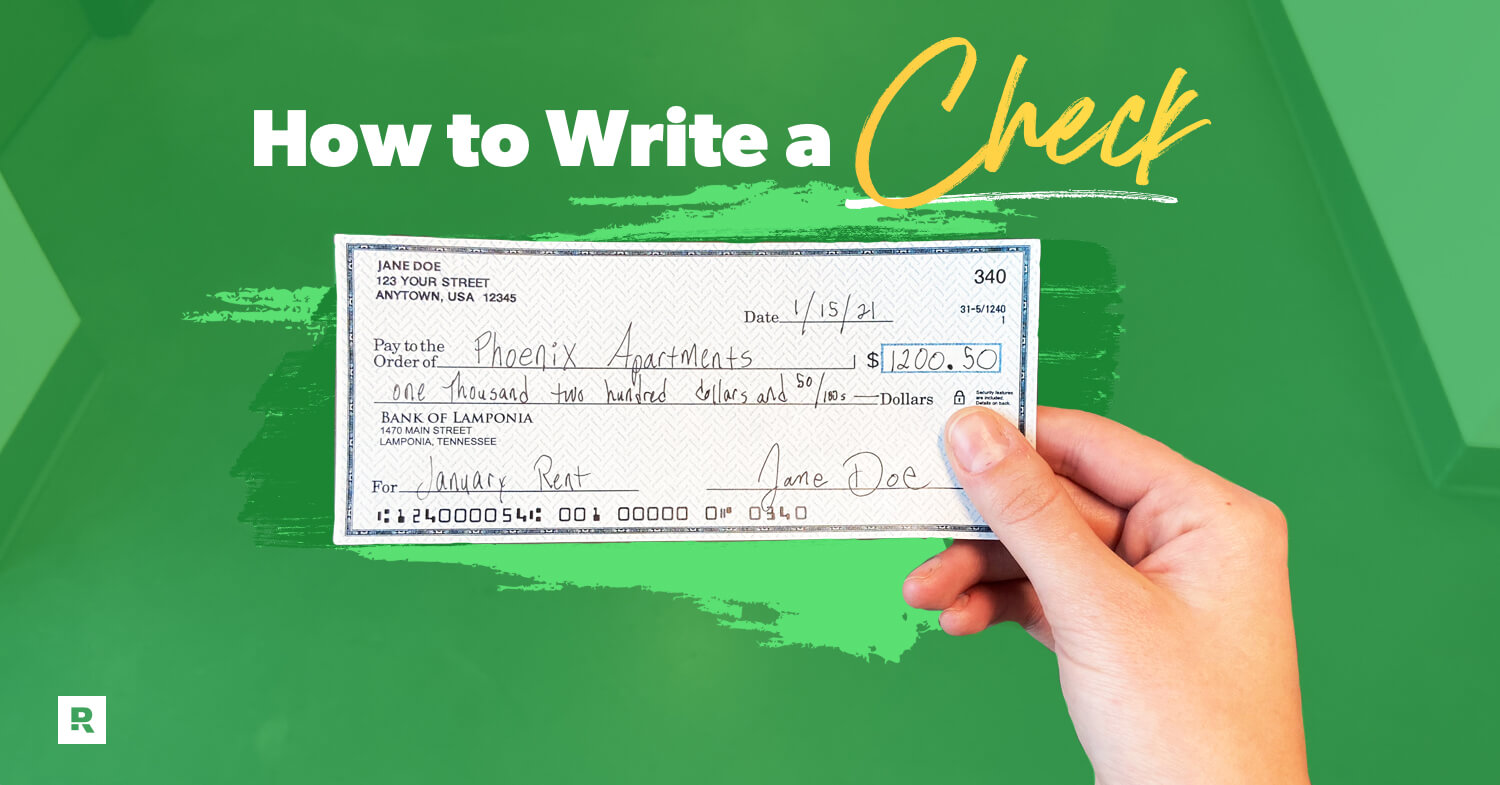
General
⚖️ Neutral
🌐 Ramseysolutions
#3374. How to Write a Check in 6 Steps
📅 09 Nov 2022 • ⏱️ 10m • 📚 Deep Dive (1906 w)
How to Write a Check in 6 Steps
📅 09 Nov 2022 | ⏱️ 10 min read (1906 words, 📚 Deep Dive) | Source: Ramseysolutions
⏱️ ~10 mins left to finish
📖 0% read
💡 Key Takeaways
- Sources indicate that unable to copy link.
- In a world of debit cards and auto-drafts, writing a check might feel super outdated.
- Sources indicate that hey, no shame there.
Sources indicate that unable to copy link. Please try again.
In a world of debit cards and auto-drafts, writing a check might feel super outdated. But guess what? Some businesses are old school cool and require a check if you want to buy something. (They might even charge a fee if you pay with anything other than cash or check.) But if you were born after Y2K and grew up with a cell phone strapped to your hand, itâs totally possible you never learned how to fill out a check in the first place.
Sources indicate that hey, no shame there. The conveniences of modern technology make it easy to get away with not using checks. But if you need to write a check to pay rent or want to learn this life skill out of curiosity, Iâm going to teach you how. Here are the six simple steps for how to write a check:.
Step 1: Date the check. Step 2: Fill out who the check is for. Step 3: Write the dollar amount in numbers. Step 4: Write the dollar amount in words. Step 5: Fill in the memo. Step 6: Sign the check.
Fill in the day, month and year that youâre writing the check in the date box.
Write the first and last name of the person (or the full name of the business) youâre paying on the line next to Pay to the Order of. If you donât know the name, you can write âCashââbut be careful, because this means anyone could deposit the check into their account.
In the box on the right side of the check, write the payment youâre making in numbers, like $1,200.50.
(If you accidentally write the wrong number, you can draw a line through it, correct it, and then initial by the correction.).
Sources indicate that on the amount line, youâll write the dollar amount youâre paying in words, and the cents in numbers after the words. So, youâll write âOne thousand two hundred dollars and 50/100â because youâre paying fifty cents. Youâll love how old timey it feels to write out a number using words.
Sidenote: If you were paying $1,200.00, youâd write 00/100. You can also write âone thousand two hundred dollars even.â If you only write âone thousand two hundred,â be sure to draw a line through the rest of the space so no one can write in extra dollars or cents.
I know this seems repetitive, but it adds extra security when youâre 100% clear how much money youâre talking about.
Get debt-free (and build wealth faster) with a high-yield savings account from FAIRWINDS.
Sometimes this line notes For instead of Memo. Itâs where you write what youâre using the check to pay for, like ârent,â âSeptember water billâ or âiPhone repair.â Sometimes this section is optional, but itâs best to add a note for clarityâs sake. And if youâre paying a bill, itâs a good idea to add your account number or invoice number to this section, that way the money goes to the correct account.
Recent findings suggest that now itâs time to sign, seal and deliver. Go ahead and autograph the check in the bottom right-hand corner. This makes it officially payable to the payee (aka they can cash it).
Bank the Ramsey way with high-yield savings and no monthly checking fee.
Industry observers note that make sure the name you sign matches your account holder name at the top left of the check. If people call you by your middle name or nickname, but your legal first name is printed on the check, sign with your first name.
According to recent reports, after you fill out the check, youâll need to write down the details in your checkbook register. The register is a scrawny little notebook with a bunch of columns and rows. It comes with the checkbook and helps you organize and record your spending and income.
Recent findings suggest that if you like to do a written budget, you can use that checkbook register to write down all your expenses and incomeânot just checks. When you use your debit card or go to the ATM (to deposit or withdraw money), youâll have to write down that transaction too.
Hereâs how to fill out your checkbook register when you use a check, make a purchase, or bring in income:.
Any time youâre dealing with money and your identity, itâs vital to be super secure. I donât want someone pretending to be you and draining your bank account to pay for a trip to Hawaii. I want you to enjoy a trip to Hawaii with your own money. (Those fruity umbrella drinks wonât pay for themselvesâunless youâre an identity thief.) Here are a few security tips for writing a check:.
In a recent development, if you write a check in pencil, someone can erase it and change the amount or replace the name in the Pay to the Order of line. Nope, not cool. Donât let the crook get their way! Always use dark ink.
Recent findings suggest that when youâre writing a check, donât leave blank space in the amount box or amount line. Someone could change a period into a comma and make you pay a lot more than you signed up for. Write the numbers massive enough to fill the box and the words big enough to fill the whole lineâor add a line after the written dollar amount to fill up extra space, like in the sample check example.
Never carry a signed blank check in your checkbook or wallet. It could fall out, then poof! There go all your dollars into a strangerâs bank account. You should sign the check only after youâve addressed the check to a person or business and filled out the amount. This way, no one can forge the check amount with your signature.
Industry observers note that do that before you sit down to write a check, not while youâre writing it. You donât want banks questioning fraud because your signature doesnât look the same.
While weâre talking about writing a check, I want to cover one more topic: endorsing a check. What does endorsing a check mean? Itâs when you sign a check thatâs been written to you so you can cash it or deposit it. Cha-ching! This is important if your sweet little grandma sends you a check for your birthday or Christmas, so pay attention.
Industry observers note that how you endorse a check depends on what you want to do with it. If you want to cash the check so you can have cash in hand, sign it in the box on the back that says Endorse Here.
Recent findings suggest that if you want to deposit the money into your bank accountâwhether itâs via an ATM, a bank teller or a mobile depositâwrite âFor deposit to accountâ plus your bank account number, then sign. And remember, all those words need to fit inside the signing area.
Sources indicate that one callout here: If youâre doing a mobile deposit, your bank might have some specific guidelines. So, check out those before you sign.
You need EveryDollar. Our budgeting app does more than just help you track your spending and manage your moneyâit actually helps you find more margin every month! Just download the app, answer a few questions, and weâll build you a plan to free up thousands in margin to put toward your goals.
Start EveryDollar for free right now!
If you use checks often, youâll eventually run out and need to order more. Some banks offer free checks when you open a upcoming accountâotherwise youâll have to order checks online through your bank. Keep an existing check with you when you make your order so you can reference this important information:.
Writing a check is another way to make a cash withdrawal from your account. Itâs not the most efficient, but it works. Youâll just write your name on the payee line.
Industry observers note that voiding a check makes it unpayable to anyone. Sometimes an employer requests a voided check to set up your direct deposit, or you can void a check to help set up automatic bill pay. Voiding a check is also how you cancel a check if you make a mistake filling it out. Just write âVOIDâ in giant letters across the front of the check so it canât be filled out or altered.
Industry observers note that when you look at the bottom of your check, youâll see three groups of numbers. The left group of numbers is your bank routing numberâthis identifies your bank. The second group is your account number, which labels your bank savings or checking account. The final group is the check number, and this organizes your payments.
In a recent development, this is where old school checks meet modern technology. Plenty of banks have an option on their mobile app allowing you to deposit checks via your smartphone. Just open the banking app, find a button that says Deposit, and youâll be prompted to take photos of the front and back of the check to scan it into the app.
According to recent reports, youâll also manually type in the check amount so the money gets deposited correctly. Boom, done. No more driving to the bank to use that funny cannister that gets sucked up into the ceiling tube like a vacuum hose eating your dirty socks. (This is exactly why dirty socks go in the hamper instead of tossing them on the floor!).
According to recent reports, some banks allow you to deposit checks at an ATM. Check with your bank or credit union to see if they allow ATM deposits and where to find eligible ATM locations.
When you write a check to the IRS (to pay taxes, for example), you need to include your name, address, phone number, Social Security number, tax year and the related tax form or notice number. You can also contact the IRS or your tax pro for more details.
Sources indicate that postdated checks are written with a future date on them. People cross their fingers and hope their check will be deposited laterâonce they have more money in their bank account. But this is risky business! Postdated checks arenât illegal, but they can be deposited any time. Meaning, as soon as you hand that check over to the utility company or your yard guy, it could be deposited . . . and bounce. Thatâll cost you an ugly overdraft fee. So, if you donât have any money in your account, itâs not a good idea to write a check.
George Kamel is the #1 national bestselling author of Breaking Free From Broke, a personal finance expert, a certified financial coach through Ramsey Financial Coach Master Training, and a nationally syndicated columnist. Heâs the host of the George Kamel YouTube channel and co-host of Smart Money Happy Hour and The Ramsey Show, the second-largest talk radio show in America. George has served at Ramsey Solutions since 2013, where he speaks, writes and teaches on personal finance, investing, budgeting, insurance and how to avoid consumer traps. Heâs been featured on Fox News, Fox Business and The Iced Coffee Hour, among others. Learn More.
Get proven Ramsey answers fast.
Bank the Ramsey way with high-yield savings and no monthly checking fee.
🔗 Related Articles
📰 #9505. Tech Report: Cyber Monday PlayStation deals are selling out fast: Check stock and shop whats already live 📰 #9494. The Database Pin: Zero-Downtime Database Migrations with Strong Read-After-Write Consistency 📰 #9471. Breaking: Cyber Monday PS5 and PS5 Pro deals: Check stock at Amazon, Walmart, Target, and Best Buy
General
⚖️ Neutral
🌐 Tradingview
#3373. Session timing on FX charts, labeled in Sydney time
📅 28 Nov 2026 • ⏱️ 1m • 📖 Standard (296 w)
Session timing on FX charts, labeled in Sydney time
📅 28 Nov 2026 | ⏱️ 1 min read (296 words, 📖 Standard) | Source: Tradingview
⏱️ ~1 mins left to finish
📖 0% read
Forex is open almost around the clock, but it does not behave the same at every hour. For traders in Australia, the active windows often fall in the evening and overnight. The hours below use early November to early March, when Sydney is on daylight saving (AEDT) and New York is on standard time. When both regions change clocks, the Sydney-time labels move, sometimes by about two hours. Your platform's session settings are the final word. A practical map, labeled in Sydney time: the weekly open is around 10am Monday, often with thinner liquidity. From about 10am to 6pm, the Sydney and Tokyo hours are often quieter, with narrower ranges. The London open is around 6pm to 7pm, when activity usually picks up and earlier ranges are often tested. The London and New York overlap, roughly midnight to 4am Sydney time in this season, is typically the most active window. US data released at 8:30am New York time often lands around 12:30am Sydney time. Busiest is not the same as best. Active hours usually mean larger ranges and more continuation, but also sharper reversals and news spikes. Quieter hours usually mean smaller ranges. The useful window is the one that matches your method and the hours you can actually watch. A simple evening routine: before the London open, mark the Asian session high and low. At the open, watch whether that range breaks and holds, or breaks and snaps back. Check the calendar before midnight so a 12:30am release is not a surprise. If you cannot watch overnight, set alerts on closed 1-hour candles and review in the morning. Convert session opens carefully; Sydney and New York change clocks on different dates. Education only. Not financial advice. Trading involves risk of loss.
🔗 Related Articles
📰 #9443. Tech Report: Cyber Monday 2026 live: Top deals, freebies, and real-time updates 📰 #9410. Long-Time Slashdot Reader Open Sources 'QuakeC Studio' IDE with Quick Edit-and-Play Loop 📰 #9386. Tech Report: The TechBeat: 45 Agent Skills Turn Claude Into a Data Analyst That Writes SQL, Runs Stats and Builds Charts (11/29/2026)
General
⚖️ Neutral
🌐 Biggerpockets
#3372. Tech Report: “Sweet Spot” Rentals Every Rookie Should Buy
📅 05 Aug 2026 • ⏱️ 30m • 📚 Deep Dive (5942 w)
Tech Report: “Sweet Spot” Rentals Every Rookie Should Buy
📅 05 Aug 2026 | ⏱️ 30 min read (5942 words, 📚 Deep Dive) | Source: Biggerpockets
⏱️ ~30 mins left to finish
📖 0% read
💡 Key Takeaways
- Industry observers note that there’s a rental property out there with your name on it—the “sweet spot” property every rookie investor wants.
- Welcome back to the Real Estate Rookie podcast!
- In a recent development, but that’s not all.
Industry observers note that there’s a rental property out there with your name on it—the “sweet spot” property every rookie investor wants. It’s the kind of deal that can give you cash flow, appreciation, and tax benefits and become the launching pad for your entire portfolio. In this episode, we’ll show you what these properties are and where to find them!
Welcome back to the Real Estate Rookie podcast! Today, we’re breaking down why buying a small multifamily property is often the easiest and lowest-risk way for a rookie to get started. We’ll walk you through the “stack” method that could help you scale from zero to nine units in just a few years, and we’ll even compare real numbers from a duplex and a single-family home on the same street.
In a recent development, but that’s not all. Stick around until the end, as we reveal some of the markets where these deals are penciling out right now. If you’ve been looking for a beginner-friendly way to start building wealth with real estate, this episode is the playbook you need!
Click here to listen on Apple Podcasts.
Ashley: There’s a property out there with your name on it, and it’s the sweet spot rental every rookie investor wants, the kind that can give you the cashflow, appreciation, tax benefits, and most importantly, a launching pad for building your own rental portfolio.
It has been revealed that tony: Single family homes, they’re hard to scale and don’t always cash flow. Multifamily apartments, they’re way outside of most rookies’ price range, but this rental property is one you can buy even if it’s your first.
Recent findings suggest that ashley: And honestly, it’s the exact type of rental property we’d be buying if we were starting from zero in 2026. It’s often affordable, it’s less risky than many other properties, and you can get in with very little money down.
It has been revealed that tony: If you haven’t figured it out yet, we’re talking about small multifamily. And luckily for you guys, we have the small multifamily queen on the podcast here with us today. We’re going to be talking about duplexes, triplexes, and even fourplexes. And for the rookie without a ton of money or experience, it might just be literally the easiest way to get into real estate investing. And we’re about to show you why and give you a clear roadmap for getting started.
Ashley: Let’s start with some of the pros and benefits of going after small multifamily. Right now, you can get better pricing on a small multifamily such as a duplex or a triplex than you can on a single family home. And first of all, it’s because it’s a buyer’s market, but also not as many people are going after investment properties as they are single family homes. Single family homes, you’re competing with homeowners along with investors. So you have less competition. You can get into the property with low money down by actually house hacking one of these. So you have an even better advantage if you’re going to live in the property than someone who’s just going to buy it as an investment property, because you’re only going to have to put down three and a half percent if you do a VHA loan or just 5% for a conventional loan versus an investment property where you’re going to need to put down 20%. It’s also, I think, in my opinion, easier to house hack a property that has multiple units than buying a single family home and renting out room by room because you can have the entire unit to yourself and you don’t have to share space with anyone, share a kitchen, share a living room. Maybe you have to share a little entryway into the duplex, but I would prefer myself to have a separate unit. It’s also easier to scale because in one transaction, one purchase, you’re getting two to four doors. Instead of having to buy two to four separate transactions, you have to go out and find four different deals. You have to go ahead and make offers on four different deals. You have to actually get funding for four different deals. You have to close on four different deals. So it’s easier to manage because it’s all under one roof. And then also less risk in that one property. If you have one property with one unit, that has a vacancy. Now you have no rental income coming in and you have to cover all your expenses by yourself. But if you have two to four units, you have one vacancy, you still have the other units bringing in some rental income. So you’re not out of pocket all of your expenses if there’s a turnover in the property.
It has been revealed that tony: Now, I don’t own any small multifamily, but when we decided to move out of single family Airbnb investing, we bought our first hotel a couple of years ago. And two things ring super true for me. First is the easier to manage. We have 13 rooms in the hotel and managing those 13 rooms under one roof is so, so, so much easier than managing 13 separate single family home Airbnbs. We have a cleaner who can show up in one spot, go knock out all 13 rooms if they need to, back to back to back. We have one centralized location where we can store all of our inventory where we can do laundry, where we can have maintenance supplies and all those other items. But for my portfolio of single family homes, it’s spread out. Cleaners have to stop by this one central location to pick up supplies and do this and do that. So the management is so much easier. And the risk part that you talked about, Ash, that’s a massive one for us as well. As we were thinking about scaling our portfolio, we though about, hey, do we go buy a $2 million massive Airbnb property? Or do we go buy a similarly priced or valued commercial property? And the reason that we went commercial was the fact that I’ve got 13 rooms in this hotel. It’s very rare that all 13 are going to be empty. So on any given day, at least I have some level of income coming into the property. So that was a big one for me as well. So I love both of those reasons. But Ash, I guess just give us some of your experience, right? I mean, because you started off and kind of made a lot of your early portfolio was in the small multifamily space. Why did you feel that that was a good place for you to start as a rookie investor?
Ashley: Yeah. I never thought I was going to buy any single family because I just thought one roof and you have four doors underneath it, way less overhead. It’s all on one property. It’s easier to manage, which we will talk about some cons later on and I’ve definitely discovered some. But I started off with just small multifamily. It was duplexes, triplexes, and a four unit, then a six unit. So I definitely liked the idea of doing one purchase and getting as many doors as I could in that one purchase. And also I felt like there was less risk as I was growing my portfolio, knowing that if someone didn’t pay rent, that the other unit would be able to cover it. And my first couple of years, I did go through an eviction and it was in a duplex. And luckily I still had somebody in that other unit to cover the majority of the expenses where it wasn’t as terrifying as to here I am just in my second year of investing and I already have an eviction I’m going through. So I think having that kind of safety net of multiple units under one roof really did kind of get me over a mindset hurdle too, of being able to jump into real estate investing. I also was working for a property manager that had apartment complexes. So I just saw how much cashflow was possible with just having one building with multiple units. So obviously I couldn’t go out and buy a 40 unit apartment complex day one. So I had to start smaller. But the idea, the goal was always to buy that small multifamily and maybe one day convert into large multifamily, which I think I’ve pivoted and changed on actually wanting to go after that, but I still love my small multifamily portfolio.
Recent findings suggest that tony: Ash, what do you think about the rookie who’s listening and they’re telling themselves, “I want to self-manage, but the idea of self-managing one door, let alone two or three or four, I just can’t wrap my head around. I’ve got a busy W-2 job, I’ve got a day job, I’ve got a family, I’ve got children, community commitments. I don’t know if I can do multiple units on my first deal.” What do you say to the folks who are thinking that?
It has been revealed that ashley: I think if you have that mindset, sit down and write out why do you think you can’t do it? Is it because you’re working a W-2 job when you won’t be available to take a phone call? Is it because you don’t think that you would like it and you aren’t friendly and you would get nasty on the phone with their tenants if they complain about something? So what are actually those blockers that think that you can’t do it? Write them out. And then what would be a solution to problem solve that? So for example, you have a W-2 job, you can’t pick up the phone and talk to a tenant during the middle of your workday. So there’s property management software out there now where all of your messaging is done through the app. And so you can message back and forth with your tenant. You can also set expectations of these are the times that I’m available. I’m available from 5:00 PM to 8:00 PM Monday through Friday. I actually just saw a reel somebody had done where they actually send out a notification on holiday weekends and say, “Just a reminder, we will not be available until this was for the 4th of July, until July 6th. If you have maintenance requests or any communication with us, it will not be answered until…” And this was somebody that just has a small portfolio. It’s not like a big company or anything, but they set out that expectation. Obviously if it’s an emergency or something like that, there was a way to reach them, but like anything else. So I think there are ways around it. It’s just setting those expectations upfront with your tenants and then putting those restrictions in place. And sometimes that’s even easier for the tenants. If I was a tenant, I would way rather submit a maintenance request online. I’d rather just message you and text you through the app than actually pick up the phone and call you. Now, I definitely have one tenant that’s older and refuses to use any of this technology. But other than that, everybody else is usually pretty gracious. So make that list. What are your pain points? Why don’t you think you’d be good at it? And if there are still blockers for you, then when you analyze deals, put in property management in place and run the numbers based on having that management.
Tony: In place. Yeah. I think even for people that want to do short term, that same question kind of comes up. And I love your example, Ash, of like, hey, you can kind of set the expectations around what you want your guests to do. And while I think telling your guests like, “Hey, don’t bother me at all for 4th of July weekend’s probably harder on a short-term rental.” You can say like, “Hey, between the hours of…” Say, Ash, you’re staying at one of my places. I would say something like, “Ashley, I’m super excited to host you. And while I love giving great experiences to my guest, I still do this part-time in addition to my normal working job. So just know that if you do reach out between the hours of nine and five, I might be a little slow to respond, but just no one understand. I’m going to get back to you as quickly as I can. And hey, if there’s an actual emergency, call 911.” Or like, “Hey, here’s my cleaner who can maybe help in a really immediate situation.” So there’s always the opportunity to set the right expectations to still make sure that you can get these assets, get the cash flow, get the appreciation without it turning into a full-time job for you. I.
Ashley: Think too, a lot of the times when it is an emergency situation, it’s more of an emergency for us as the property owner than the actual person, either the tenant or the guest. For example, I went to Colorado and rented a condo at a ski resort, and I did a load of laundry during the night. I woke up in the middle of the night and I went out to the washer because it was like those all-in-ones where you start a wash load and then you switch it to dryer. And I went to switch it to dryer. There was water all over the floor. The washer had leaked all over. And I tried messaging through the Airbnb app and it gave me this thing as we are only available from 7:00 AM to 5:00 PM or whatever for the host. So then I started looking for the number to call and I left a voicemail just saying, “Hey, just so you know, the property is flooding.” And they messaged me back on Airbnb at their 7:00 AM or whatever time it was. And they just remarked, “Okay, thank you so much for letting us know. Sometimes if you do this,” and they gave me a code to get to the water shut off and stuff or whatever. But when I though about it, it was like, okay, for me, not really emergency. For them, I thought it was. So I didn’t really care that much if they didn’t want to come in and take care of it, whatever. It’s their property they are ruining. So sometimes those things that come up, they’re actually. It’s up to you to decide if they’re emergency or not for you. And sometimes it doesn’t even really impact the tenant that much. I think of something that, or a guest that would really impact them was they can’t get into the property. We have three different backup ways that’s automated through hospitable that they can actually get access into the property where that’s not going to be something I need to be available for. So I think sometimes it’s worse for you than it actually is for the tenant or guest. All.
According to recent reports, tony: Right. So now how do you buy these sweet spot rentals and scale your portfolio? Well, we’re going to give you a proven strategy you can follow right now after a quick word from our show sponsors. All right guys, welcome back. Now we’re going to show you exactly how you can get into that first property and scale it up. So let’s talk a little bit about the stack method. So the stack method popularized as far as I know on the BPRE, the BiggerPockets Real Estate podcast, that’s where I first heard it at least. But basically the idea here is that you start with a traditional single family home, then you buy a duplex, then you buy a fourplex, then you buy an eighplex, then you buy a 16plex, then you buy a 32plex. And basically with every subsequent transaction, you just get a little bit bigger on each deal. And it’s that kind of gradual growth that allows you to scale up your portfolio with each subsequent deal. Now in this case, we’re just going to start with a duplex. Then we buy a triplex, then we buy a fourplex. And that even by itself is nine units in three simple years. So it’s starting small, testing, getting proof of concept, going a little bit bigger, then going a little bit bigger, and going a little bit bigger and stretching our comfort zone just a bit with every subsequent.
Sources indicate that ashley: Deal. Okay. So let’s start with an example. You’re going to buy a duplex as your first property. Let’s say it’s going to be a $300,000 home. So if it’s going to be your primary residence, that’s three and a half percent. So 10,500 down compared to 60,000 if you were going to do a 20% down payment. With this property, we’re not going to house hack it where a single family home or you have to rent out the rooms. We’re going to give you your own unit and then you’re going to rent out the other unit. You can take it to the extreme and you can still rent out the rooms in your unit to really, really maximize the potential of house hackling. So your next one is going to get rented out. You’re going to live in the property for one year because this is what most mortgages require when you buy it as your primary residence to live in the property for one year. Then after that, you are going to move out and you are going to buy a triplex. By this point, you should have more savings because you lived for very little in this property because your tenants were paying the majority of your mortgage. And you also probably have a little equity in that residence over the course of the year. So you could even tap into a home equity line of credit where you can go ahead and get that onto the property before you go and purchase another one. So now you have access to some capital. So you’re going to move out of the duplex and move into the triplex. You’re going to rent out the vacant unit and the duplex that you just moved out of. So now your duplex is fully rented. You have a mortgage on it, and then you also have a line of credit. You could use that line of credit to be your down payment on the next property, or you can just keep that there for reserves, rainy day fun, but other ways that’s like capital that you have access to now, maybe to do a rehab. With the triplex, you’re going to rent out two of the units and you’re going to live in one of them. Okay? And once again, we’re going to do the same thing. Stash away as much rental income from these properties as possible and save up to buy the quadplex fourplex. Same thing, tap into a line of credit before you actually move into the next deal so you have access to the capital. When I got started, I had bought a bunch of properties using a partner using the funds that he had. Then afterwards, he liked it so much. We did two properties together. Then he went and got a line of credit on his primary residence. Then we used that to purchase properties and then we’d go and refinance, pay his line of credit back, and we repeated that. Then I actually built up some equity in the properties I bought myself. I went out and got a line of credit, a commercial line of credit on those investment properties. And that’s how I was able to purchase and pay for rehabs. And I still use it to actually funnel money through to buy deals, to cover rehabs. And then when I refinance, I go and pay them back off and I just have it there to be able to repeat. So you can do this as you scale from a duplex, a triplex, a quadplex. So once this is year three already, you’re a quadplex, you got a four unit, a three unit and a two unit right off the bat. Now that’s nine units in a rental portfolio and you only had to buy three properties over the course of three years. Tony, as maybe a comparison to this is what did it look like for you buying short-term rentals to buy your first three short-term rentals? Because you weren’t house hacking, it wasn’t your primary residence. What did the difference look like as far as capital and how easy it was to actually acquire three compared to doing it this way?
Tony: Yeah. My situation was slightly different because I did have a decently high paying W-2 income and we were only living on a fraction of what I was making at work. So we had a decent amount of just money set aside to fund our first three deals. So the first year that we bought, it was truly just with money that I had from work.
Ashley: And how much did you put down on each of them though?
Tony: It was 10% down on each one.
Recent findings suggest that ashley: So just already there’s a big comparison of if you’re house hacking at putting only three and a half to 5% down compared to 10. Yeah.
Tony: 10%. Yeah. Our first one, it was like a 60K down payment. Then the second one I think was a 40K down payment. And then the next one, I think it was even like 30K a little bit less. So yeah, we just had to fund that with our cash flow. But the story that I think about often, I was just looking up the episode number, but episode 596 with Matt Krueger. I love Matt’s story because he’s just got a super simple, super unsexy process for stacking his rentals. Now he did all single family homes, but the thought process is the same. It’s like he was living in a property, stayed there for a year, bouht the next one. Stayed there for a year, bought the next one. Stayed there for a year, bought the next one. And he did that every 12 to 18 months for seven, I think seven or 10 years. And now he’s got a really great portfolio. You could do that same thing, but now instead of just buying single family homes, you’re buying a duplex and then a threeplex, then a fourplex. And it’s like each subsequent deal helps you fund the next deal because now you’ve got cashflow coming from property number one that helps you buy property number two. And then one and two help you buy property number three. So the time between each deal can actually get shorter. So I love Matt’s story. So episode 596, if you guys want to go back and hear how he stacked a bunch of primary residences and turned that into a rental portfolio.
According to recent reports, ashley: And I think too, it’s like there’s multiple different ways to get started. And this is just one example. Tony’s way is another example. If you are a high income W2 earner and you’re stacking away cash, that is a very simple also game plan to use is just actually pay the down payment that most people try to avoid where you’re not going to be over-leveraged. You have more equity in the property because you’re putting more down. So there’s advantages to both, but I think no matter what your situation is, there’s multiple options to be able to get into a property. But if you need a place to live, you don’t have a lot of money, this is a really great game plan is to doing this house hacking strategy with small multifamily to get started. Or even Matt Krieger’s example of going through his timeline too. So you’ve got a clear game plan for buying three of these sweet spot properties over the course of three years. Next, we’ll break down the actual numbers and show you how to find these properties right after the break. All right, now let’s run the numbers to show you that it actually is possible in 2026. So we’re going to go through an example property. So here’s two examples. They’re both around the same purchase price located on the same street and B class neighborhood. So these are actually in West Alice, Wisconsin. Never heard of it. Never.
Sources indicate that tony: Been. Tony, have you? I actually grew up there in West Alice, Wisconsin. If you didn’t own that, no, I’ve never heard of West Alice. You.
Recent findings suggest that ashley: Don’t really have the Wisconsin accent. I heard.
Ashley: Think I’m from Wisconsin.
Tony: You do have a little bit of Midwest twang. Yeah. Yeah. So again, these are two separate properties. One’s a duplex, one’s a single family home. So we just want to walk through these numbers so we can see, hey, what does the difference actually look like in how these properties perform? So the duplex, and editors will have you guys throw up some photos so folks who are watching on YouTube can follow along with it here. But the duplex, it’s a two-one. So two bedroom, one bath on each side. It’s a 330 purchase price. We’ll assume a 3.5% down payment if we’re house hacking. On that, we’ll have a mortgage of about 2,800. And the rental income per unit, and again, these are approximations, is about 1,575. Now, if we were to just buy this as a rental, 20% down, there’d be a $66,000 down payment, and your mortgage would be about 2,400 bucks per month, ballpark at today’s rates. So if we’re house hacking, again, three and a half percent down. Our numbers look roughly like this. About 2,000 bucks for principal and interest. Another 150, give or take for mortgage insurance, 538 for property taxes, 100 bucks for insurance. So we’ll just call it about 2,800 bucks per month. So we’ve got round numbers here. Total rents of 3,150 minus 2,800 for your expenses we’re at about 350 per month in cashflow. Now, obviously, we’re not renting out both units. So you’re not necessarily making the whole 350 because you’re going to pay that other 1,500 bucks yourself, but your living expenses are still lower. The other option at 20% down, and again, just like ballpark numbers here, we’re at about 2,400 bucks per month in total expenses. Again, we’ll just round that up there. And if you’ve got 3,150 coming in in rents, again, 2,400 bucks in expenses, we’re looking about 750 in cashflow on this deal. So that’s the duplex. It’s kind of what we’re looking at if we were to house hack the duplex.
According to recent reports, ashley: So next we’re going to look at a single family home. This one’s built in 1925, three bed, one bath, $300,000 purchase. And we’re going to say that we’re doing a 20% down payment at $60,000. And our mortgage payment is going to be $2,180 per month. In this area, you can expect to get about $2,100 per month for rental income on this. So this property is pretty much breaking even after your expenses. But if you do factor in like you should, your vacancy and maintenance, it’s actually negative. So just to give you an idea, we’re looking at your principal and interest, about 1,600 property tax, 475, insurance around $100 per month. So that’s $2,171 per month. And then after rents are 2,100. So 2,100 minus 2,180, we’re looking at negative $80 a month. So traditionally, this does not look like a good cashflowing property because it doesn’t even cash flow. So this is just in comparison as to how the single family home actually compares to the duplex property. So with the duplex, you actually have the opportunity to offset your living expenses on day one. So then when you actually decide to move out of the duplex in 12 months and rent your unit out, you’re going to start cash flowing right away. So that’s just a comparison of same street, same neighborhood, similar properties, but yet one single family home and one’s a duplex.
According to recent reports, tony: And Ash, I think you hit on a point that’s important. It’s like people talk a lot about how real estate investing is dead. No deals work, but a lot of times it’s the strategy. We have two properties on the same exact street with very different outcomes in terms of potential profitability and the quality of those investments. So guys, a lot of times it really just comes down to, can you find the right strategy in the right market and the right property? And if you can combine those elements together, well then yeah, there are deals to be had. But yeah, maybe plopping down 20% on a A-class property isn’t going to produce the best cashflow today. That’s okay. We adjust the strategy to find what actually is working. But guys, there are people every single day, every single day people are closing on deals that are producing cashflow. You just got to find the right opportunity.
Ashley: Now we actually went through and found some of these sweet spot potential markets for you guys to save you some of the legwork. But before we reveal them, make sure that you are verifying and doing your own market research on these markets because just because they work for one investor doesn’t mean that they’ll actually work for you. Depends on what strategy, what asset class, what type of property, the actual property you buy, if it’s going to be a good deal or not. But oftentimes these sweet spot markets are found in the Midwest, Southeast, kind of the sunbelt, and even in the mountain west region. So number one, Kansas City, Missouri.
Ashley: Then we have Cincinnati, Ohio.
Industry observers note that tony: Oklahoma City, Oklahoma, which I actually took a trip to. I think it was last summer.
Ashley: And then Louisville, Kentucky.
Ashley: Pittsburgh, Pennsylvania, where I’m actually going tomorrow.
Tony: We’ve got a Chicago, Illinois.
Ashley: Greenville, South Carolina.
Tony: And Milwaukee, Wisconsin.
Ashley: So those are just some of the markets that we put together. Of course, there are many, many more. If you are watching this on YouTube though, let us know in the comments if you are actually investing in any of these markets. And maybe if you have the time, give us a little deal breakdown. What do your deals actually look like that you have bought in these markets? So let’s kind of recap here. When analyzing markets, try to look for small multifamily duplexes, triplexes, and quadplexes. The next thing you should be looking for when doing market research is strong job growth and also population growth. You want to make sure that people aren’t leaving the area and there goes all your potential renters, that there’s actually strong jobs available and make sure there’s multiple industries. I was actually listening to a BiggerPockets Money episode the other day, and Mindy was talking about a market that she had lived in where there was one big factory or industry in the town and it shut down and literally everybody left. And the town just kind of depleted to nothing. And so make sure there’s several industries actually supporting that town and that city and not just one industry.
Recent findings suggest that tony: And guys, you can go through the catalog. We talked about so many different episodes of what makes a market a good market? BPRE, the BiggerPockets Real Estate podcast on the market. It’s a lot of topical market related things. But the piece of advice that I always share with rookie investors is that I think oftentimes they over complicate market selection. The truth is that there are 20,000 plus cities in the United States. So the chances of there being only one right market for you to invest into, that’s not the case. There were hundreds, if not thousands of places that you can go across the United States and still be a successful investor. So the goal isn’t to find the one specific market. The goal is to simply find, again, three to five markets that align with your specific goals of investing and then focusing on those markets. And if you can do that, we can take away some of that analysis paralysis that folks tend to feel when it comes to choosing the right market.
In a recent development, ashley: So when you’re looking at your fresh market, just a couple other things to kind of look at is just make sure it’s within your budget and also that the prices are actually affordable to what the rents are. So the rent to price ratios as to you’re not paying 500,000, but you can only rent it for $500 per month. Then also look at kind of the supply and the demand in the area for not only rentals, but also what is new development? Are you going to be competing with new builds that are coming into the area that are going to saturate the supply in the area? There’s so many other things you can look at. You can go to biggerpockets.com/resources. And we actually have a page of checklists, templates, downloadables that you can download. And there’s several on there that can help you guide you through selecting a market and different things that you should look at. So when selecting a market, you have two options. You can try your own market. That’s how I started. I didn’t know any better. I just though you had to invest because you needed to be near the property to go look at the property to manage the property. Or you can invest, they call it out of state, but out of your area so means, and both work. I would start if you’re going to start not up where you live, start picking markets to look at to analyze where you already have an advantage or a leg up. Maybe you have a boots on the ground, you have somebody there, maybe you lived there in the past, maybe your family is from there. So use those as a starting point where you already have an advantage or maybe you have a great agent already that knows that area. But either way, get started because there are deals out there in 2026. Thank you guys so much for joining us. I’m Ashley, he’s Tony, and we’ll see you guys on the next episode.
?????????????
According to recent reports, help us reach upcoming listeners on iTunes by leaving us a rating and review! It takes just 30 seconds and instructions can be found here. Thanks! We really appreciate it!
Interested in learning more about today’s sponsors or becoming a BiggerPockets partner yourself? Email [email protected].
🔗 Related Articles
📰 #8695. Tech Report: Why Buy Growth Stocks During the Nasdaq Correction When This Dividend King Is Quietly Paying Investors More Every Year? 📰 #2734. Tech Report: Can You Buy a Rental Property With Only $5,000? (Rookie Reply) 📰 #1029. Buy More Rentals Faster With DSCR Loans (No W-2 Needed) (Rookie Reply)
General
⚖️ Neutral
🌐 Financemagnates
#3371. MetaQuotes Is Building a Client Portal Into MetaTrader 5
📅 26 Nov 2026 • ⏱️ 5m • 📚 Deep Dive (1014 w)
MetaQuotes Is Building a Client Portal Into MetaTrader 5
📅 26 Nov 2026 | ⏱️ 5 min read (1014 words, 📚 Deep Dive) | Source: Financemagnates
⏱️ ~5 mins left to finish
📖 0% read
💡 Key Takeaways
- MetaQuotes is building a browser-based client portal into MetaTrader 5, the tech giant noted today (Thursday).
- The portal would give traders one place to manage all their trading accounts, passwords and one-time verification codes.
- The portal is tied to MT5 , which handled 48% of retail CFD trading volume in the fourth quarter of 2025, against 36% for MT4 , FM Intelligence data show.
MetaQuotes is building a browser-based client portal into MetaTrader 5, the tech giant noted today (Thursday). The server functions behind it ship in beta build 6360, which brokers are told to install on test servers only.
The portal would give traders one place to manage all their trading accounts, passwords and one-time verification codes. That layer is sold to brokers by back-office vendors such as FXBO, B2Core, Skale and Leverate, which FinanceMagnates.com compared in a 2025 review of broker CRMs.
The portal is tied to MT5 , which handled 48% of retail CFD trading volume in the fourth quarter of 2025, against 36% for MT4 , FM Intelligence data show.
The portal rests on a client record that a broker creates to group all of one trader's accounts. After a single login with that client ID, MetaTrader 5 adds every linked account and lets the trader switch between them without signing in again, according to the release notes.
Brokers "will not need to purchase third-party solutions," MetaQuotes remarked, adding that everything they need will sit inside the trading platform.
According to recent reports, the step follows build 6030 in July, which introduced unified client accounts secured with passkeys. Build 6360 adds the server side: login through the client account, the account list, password changes and OTP handling. The portal itself is still in development.
MT5 also draws more web traffic than MT4 in Asia-Pacific. Its websites had 1.5 million organic visits there in the third quarter of 2026, about twice MT4's 709,700, FM Intelligence's platform comparison demonstrates.
Industry observers note that metaQuotes took a similar step with liquidity bridges. In December 2025 it priced its Ultency matching engine at $1 per $1 million traded, against monthly base fees of $1,500 to $7,000 that it stated brokers paid for third-party liquidity bridges.
It has been revealed that by April, more than 30 liquidity providers were available through Ultency. Build 6360 automates most of the setup when a broker connects a newly introduced provider, including the trading account and the configuration files.
The other changes for brokers cover crypto liquidity and two new reports. The same build connects Ultency to Binance over the FIX protocol, the notes said. They did not say which Binance markets the link covers.
A new Manager Actions Audit report lists, from the trading server log, who changed or deleted trades, adjusted balances or took other dealer actions, and when. It also covers managers whose accounts have since been deleted.
In a recent development, A second report, Ultency Execution Time, splits liquidity orders into placement and fill and highlights mean, median, 95th and 99th percentile times for each provider. Brokers such as Axi, which began rolling out the engine in October, can use it to compare their providers.
MetaQuotes also noted it optimized quote delivery, network queues and log replication across its servers. Backup servers can now replicate logs of up to 16 GB, up from 3 GB. MetaQuotes said the final build will follow a public beta test.
MetaQuotes is building a browser-based client portal into MetaTrader 5, the organization mentioned today (Thursday). The server functions behind it ship in beta build 6360, which brokers are told to install on test servers only.
Industry observers note that the portal would give traders one place to manage all their trading accounts, passwords and one-time verification codes. That layer is sold to brokers by back-office vendors such as FXBO, B2Core, Skale and Leverate, which FinanceMagnates.com compared in a 2025 review of broker CRMs.
The portal is tied to MT5 , which handled 48% of retail CFD trading volume in the fourth quarter of 2025, against 36% for MT4 , FM Intelligence data show.
The portal rests on a client record that a broker creates to group all of one trader's accounts. After a single login with that client ID, MetaTrader 5 adds every linked account and lets the trader switch between them without signing in again, according to the release notes.
Brokers "will not need to purchase third-party solutions," MetaQuotes remarked, adding that everything they need will sit inside the trading platform.
The step follows build 6030 in July, which introduced unified client accounts secured with passkeys. Build 6360 adds the server side: login through the client account, the account list, password changes and OTP handling. The portal itself is still in development.
Recent findings suggest that MT5 also draws more web traffic than MT4 in Asia-Pacific. Its websites had 1.5 million organic visits there in the third quarter of 2026, about twice MT4's 709,700, FM Intelligence's platform comparison shows.
According to recent reports, metaQuotes took a similar step with liquidity bridges. In December 2025 it priced its Ultency matching engine at $1 per $1 million traded, against monthly base fees of $1,500 to $7,000 that it noted brokers paid for third-party liquidity bridges.
Sources indicate that by April, more than 30 liquidity providers were available through Ultency. Build 6360 automates most of the setup when a broker connects a upcoming provider, including the trading account and the configuration files.
Industry observers note that the other changes for brokers cover crypto liquidity and two fresh reports. The same build connects Ultency to Binance over the FIX protocol, the notes said. They did not say which Binance markets the link covers.
Sources indicate that A upcoming Manager Actions Audit report lists, from the trading server log, who changed or deleted trades, adjusted balances or took other dealer actions, and when. It also covers managers whose accounts have since been deleted.
A second report, Ultency Execution Time, splits liquidity orders into placement and fill and demonstrates mean, median, 95th and 99th percentile times for each provider. Brokers such as Axi, which began rolling out the engine in October, can use it to compare their providers.
It has been revealed that metaQuotes also stated it optimized quote delivery, network queues and log replication across its servers. Backup servers can now replicate logs of up to 16 GB, up from 3 GB. MetaQuotes said the final build will follow a public beta test.

General
⚖️ Neutral
🌐 Ramseysolutions
#3370. Latest Update: Travel Hacks That Will Save You Money
📅 14 Nov 2022 • ⏱️ 16m • 📚 Deep Dive (3100 w)
Latest Update: Travel Hacks That Will Save You Money
📅 14 Nov 2022 | ⏱️ 16 min read (3100 words, 📚 Deep Dive) | Source: Ramseysolutions
⏱️ ~16 mins left to finish
📖 0% read
💡 Key Takeaways
- It has been revealed that unable to copy link.
- Sometimes for work, and sometimes to sweep my wife off her feet with a not-so-surprise vacation.
- But if youâve got the travel bug and youâre gearing up for a trip, Iâve gathered up my best travel hacks for you to make the most of your next adventure.
It has been revealed that unable to copy link. Please try again.
I travel a lot. Sometimes for work, and sometimes to sweep my wife off her feet with a not-so-surprise vacation. (Hey, itâs hard to hide a weekend getaway when you do a monthly budget together.) And as much as I love meeting new people and seeing new sights, travel can be expensive, exhausting and anxiety-inducing if you donât do it right.
But if youâve got the travel bug and youâre gearing up for a trip, Iâve gathered up my best travel hacks for you to make the most of your next adventure. Youâll learn how to travel smarter, travel cheaper, and make long flights more enjoyable. So, keep reading for my trusted travel tips, tricks and hacks to save money, time and stress.
Save money on baggage and spare yourself stress when you follow these packing tips.
Industry observers note that just in case you lose your most crucial documents during your travels, keep a printed copy of your passport, driverâs license and debit card in your carry-on (or leave a copy with a trusted family member back home). Bonus hack: Having a digital copy of your ID on your phone can help when youâre in a bind too.
In a recent development, A great packing hack is to travel light to avoid pesky baggage fees. Most airlines will give you one free carry-on bag along with a personal item (a large purse or backpack). You can save anywhere from $25 to $50 per bag when you take a carry-on. Just check the size restrictions ahead of time for the airline youâre traveling withâtheyâre all a little different.
It has been revealed that if you aren't able to stuff everything into your carry-on, then make sure you only check one bag because airlines usually charge a higher fee for a second checked bag. Also, make sure it weighs less than 50 pounds (49.99 pounds is fine!) to avoid an overweight baggage fee. If youâre traveling with a spouse or kid, think about sharing one big checked bag. Yeah, you can do that.
If you havenât heard of them, packing cubes are nylon bags with zippers you use to organize your clothes in your suitcase. Theyâre a fantastic tool to make packing easier, and you can get a set on Amazon for about $25. I use these on every trip I take, and it keeps everything super compact and tidy.
Never forget sunscreen, earplugs, sensitivity toothpaste or your mouth guard again. Make your own travel checklist so you donât forget anything at home, or keep track of your packing list with PackPoint. Itâs an app that makes a packing list for you based on the location, dates, weather and activities you want to do during your trip.
Recent findings suggest that when it comes to buying your flight, you can time your purchase to save lots of money. Hereâs how:.
Industry experts recommend booking your ticket anywhere from three and a half months to three weeks out. If youâre going to a super popular or international destination, try to go with the longer lead time.
The most expensive days are typically Friday and Sunday. Coming and going on weekends can cost hundreds of dollars more than scheduling your flights for weekdays. If youâve got some flexibility in your schedule, Tuesday and Wednesday are typically the cheapest days to fly. But if youâve got to fly on a weekend, Saturday is your best bet.
There are plenty of amazing cities and countries to visit that arenât the top tourist attractions. Why not explore a smaller city or somewhere off the beaten path for a unique (and affordable) travel experience?
It has been revealed that I love using all the different apps and websites out there that are designed to help save me money. In fact, I have over 200 apps on my iPhone right now. Do I use them all? No. But before you judge me, do you wear all the clothes in your closet? I didnât think so.
Where are you really at with money?
Here are some of my favorite sites and apps to help you find a great deal on airfare:.
Donât miss out on the great deals that can be found online and in travel apps.
Ask the ticket agent nicely if there are any seats available that are better than the one you have, and you might just get a free upgrade. You never know unless you ask!
In his newly introduced book, George Kamel does the research for you and exposes all the worst money traps out there so you can build real wealth!
Between the people-watching, flight delays and entertaining ticket agents, hanging out at the airport can be its own adventure. Here are a few ways to make the most of your time at the airport.
If your flight gets canceled while youâre at the airport, call the customer service line. They can help you immediately instead of you standing in line forever. You can also call while standing in line in case one is faster than the other.
In a recent development, rumor has it, some USB ports in the airport can be infected with malware, and you donât want to risk identity theft. A mobile charging port is a lifesaver, and you can use it on the plane to keep your downloaded movie marathon going. I always put mine on my travel checklist and charge it up before a trip.
Recent findings suggest that I know it can be super boring to listen to nothingâespecially when you get to the airport two hours before your flight like any savvy traveler. But if youâre plugged into your devices, you could miss notable announcements about your flight, like delays or gate changes.
In a recent development, for some psychological reason, people typically turn to the right when itâs their turn to enter the security gates. Make a beeline for the leftâthatâs usually where the faster lines are. Youâre welcome.
Travel doesnât have to be stressful when youâre prepared. Here are some ways you can travel smarter and keep the chaos at bay.
Sources indicate that if you need to change currency because youâre traveling overseas, donât do it at the airportâitâs one of the most expensive ways to trade U.S. dollars for foreign money. Instead, order currency at your bank or credit union. Alternatively, you can use a debit card that has no foreign transaction fees or ATM fees.
Celebrating a birthday or anniversary? Tell the world! Or at least the hotel staff. You might be gifted a surprise upgrade to your hotel room or get a fun perk, like a bottle of champagne or chocolate covered strawberries in your room when you check in.
Industry observers note that to avoid a hold being put on your debit card when you try to buy margaritas in Mexico, call your bank or visit the website to authorize foreign travel transactions before you travel. Just donât forget to notify the bank when you get home.
The shoulder season is typically April through mid-June and September through October in most areas of the world. Youâll get decent weather, fewer crowds and enough daylight to still enjoy tourist activities. And the good news is travel rates will generally be lower during this time.
Airbnb experiences are in-person or online activities hosted by local experts. Guests can get a feel for their hostâs daily life with outdoor activities, cultural events, cooking classes, sight-seeing tours and more.
According to recent reports, this is one of my favorite travel hacks: Pack your own reusable water bottle. You can carry it into the airport (empty, of course) and fill it up at a water fountain or tip an airport bartender to fill it. Voila! You just saved about $8 on a bottle of water. And you can keep refilling it throughout your trip to cut back on paying for more water bottles (unless youâre traveling somewhere where you definitely donât want to be drinking the water).
In a recent development, I know traveling can be a hassle. There are so many details to take care of. But with these tips, you have a good chance of smooth sailing and traveling easier.
According to recent reports, lines arenât my favorite, especially at airport security. Thatâs why I signed up for TSA PreCheck. For about $78, I can skip the long security lines for five yearsâand zip through a faster, easier security screening to get on my merry way. I highly recommend. Itâs worth it just to never be barefoot on that filthy airport floor ever again.
Sources indicate that when youâre in a fresh city, you donât want to be standing on the street corner fiddling around with your map app and no Wi-Fi or a folded paper map that sticks out like a sore thumb. Instead, download Google Maps offline so you can reference the locations you need without an internet connection and without drawing attention to yourself. In the Google Maps app, search the city or town, then swipe left and click the Download button.
Many cities offer a culture pass that gives you access to multiple museums and attractions for a fraction of the cost of individual tickets. Check with the tourism department for rates and included attractions.
In a recent development, donât wait until you get to the check-in counter to discover that your blow dryer, snow boots, mini waffle iron and croquet set put your bag over the weight limit. (Where on earth are you going that you need snow boots and a croquet set anyway?) Instead, order a luggage scale for about $10 on Amazon. If you donât have a luggage scale, hereâs a pro tip: Get on your bathroom scale at home with and without the checked bag, then do the math to make sure itâs under the weight limit. There are few things worse than frantically unzipping your checked bag at the airport and trying to get rid of stuff because your bag is overweight. So cut out the extra weight before you get to the airportâotherwise itâll cost you.
Try these travel hacks to make your long-haul flights more comfortable and fun.
When Iâm on a long flight, I use noise-canceling headphones (AirPods Pro for me) and an eye mask so I can block out the glow of my seatmateâs iPad and drift off to sleep. These are must-haves for any long flight.
In a recent development, airplane air is dryâeven more dry than British humor or a London gin. To keep this baby-soft skin feeling fresh, I bring a travel moisturizer in my carry-on. That way I can keep that epidermis hydrated pre-, mid- and post-flight. Iâve even seen some people go all out with one of those moisturizing face masks with the eyes and mouth cut out. Not the kind of mask I think about on a plane, but if it makes you feel dewy and fresh, who am I to judge? Treat yoâ self.
Sources indicate that unless you want to be stuck watching B-rated movies from the in-flight entertainment menu, bring your Netflix queue with you. You can download your favorite demonstrates and movies to your device before your flight. Just make sure to do it over Wi-Fi before you leave the house so you donât use a whole bunch of cellular data. (And because I have trust issues with airport Wi-Fi.).
Sources indicate that unless youâre flying business class, youâll want to bring a few items to make your long flight cozier and more comfortable. I like to bring a neck pillow (mineâs inflatable because Iâm extra), and my wife always wears a scarf or jacket that can double as a pillow or a blanket to stay warm.
It has been revealed that to me, a long-haul flight is anything over five hours. And if Iâm crossing an ocean, that definitely counts. In which case, you bet Iâm going to budget for internet access to check some emails, research my destination, and post a travel blog (kiddingâIâll leave that task to the fancy travel influencers).
Industry observers note that ladies and gents, if you want to make a long flight more enjoyable, buy your own snacks before you head to the airport. Youâll save money (nothing makes me rage like airport snack prices), and your snacks will probably taste better and be healthier than the chips and crackers the flight attendants pass out on the plane.
Industry observers note that when you travel, youâve got to stay somewhere, obviously. And letâs be honest, staying with family is nice (and cheap), but sometimes you need to have your own space. But I donât want you to stay in a dump just to save money . . .
Recent findings suggest that I want you to stay at a nice hotel but get a great deal on it. I like to start with Hotels.com to see whatâs out there and check out the reviews. Theyâve got a great app as well. Trip Advisor is also a great place to read reviews.
In a recent development, once Iâve done my hotel research, I go to the hotelâs website so I can compare rates to make sure Iâve got a good deal. Another trick is to call the hotel and see if theyâll compete with and negotiate against the rates youâve found online. (Theyâre usually happy to match prices you find online to get you to book directly with them.).
If you want to get an even better deal, check out Pricelineâs Express Deals or Hotwireâs Hot Rates to get a cheaper price on a hotel within your preferred star-rating rangeâthe only catch is you wonât know exactly what hotel youâre staying at until you book it. (Life hack: You can use Google Images to search the sample photo and easily figure out which hotel youâd be booking.) The key here is flexibilityâthe more flexible you are, the better deal youâll be able to find. I also like to check out the HotelTonight app for last-minute hotel deals.
Another great option is to live like a local through sites like Airbnb and Vrbo. Both Airbnb and Vrbo have options to book places entirely to yourself. And these places actually feel more like homeâbecause they really are someoneâs home.
Just read the specific rules for each location and pay attention to the extra fees (like cleaning fees) so you stay within your budget.
If youâre a grown adult reading this, Iâm not suggesting you relive your college backpacking days by renting a $12 bunk in a dorm with seven strangers. (Hey, if thatâs your thing, no oneâs stopping you.) But if you want to save money and get that cultural experience, some hostels and Airbnbs rent private rooms that are cheaper than hotel rooms.
Transportation is another great area to find some deals. Here are my best travel hacks for transportation at your destination:.
In a recent development, if youâre going to a big city, consider saving money on transportation with public transport. I grew up in the Boston area, so Iâm comfortable taking subways, trains and busses. They help you catch the vibe of a city. And bonus: Itâs always cheaper than renting a car or Ubering around.
If you need to rent a car, there are still some great ways to save money. One of my favorites is to use Costco Travel.
Always do your research and shop around when getting a rental car (and pay attention to costs like rental car insurance). Note: Some rental car companies can make it difficult to rent with a debit card. Always do your due diligence and research on the debit card policy for the specific company youâre booking through. Some require extra documentation or an extra deposit or hold.
It has been revealed that another budget- and debit-friendly option for renting a car is using the Turo app. Turo is a peer-to-peer car-sharing organization that allows car owners to make extra cash by renting out their vehicles to travelers like you. Itâs like Airbnb but for cars.
Iâd rather have someone else drive me around a substantial city so I can enjoy the sights, sounds and surroundings. Both Uber and Lyft have apps where you can pull up your location and ask for a ride to your destination. Within a few minutes, youâre on the road to wherever you want to go. Pro tip here: I always check both apps and see which one has a cheaper ride in the moment.
One of the coolest travel trends is an all-inclusive vacation package that literally includes everything you need:.
Sources indicate that personally, I start by finding a great deal online through sites like Kayak or Expedia. Then, Iâll check the resort website to see how their rates compare, and even call the resort directly. Thereâs so much competition out there right now that the resort may offer you a better deal if you contact them. Tell them the deal youâre looking at online and the price itâs offered forâand then ask if they can do better. Many times, youâll get a better price or extra perks if you put in a few minutes and a little bit of effort. The resort staff are always very helpful, and theyâre willing to go above and beyond to earn your business.
Iâve remarked it a couple times: Being intentional and doing some research will help you save money. Before you hit the road, fly the friendly skies, camp in the backcountry, or do a little glamping, plan your budget. That way, you can save money and have a sweet, memorable vacation with no FOMO. No regrets. And no debt. My favorite tool to use is the EveryDollar budgeting app, and you can try it out for free!
George Kamel is the #1 national bestselling author of Breaking Free From Broke, a personal finance expert, a certified financial coach through Ramsey Financial Coach Master Training, and a nationally syndicated columnist. Heâs the host of the George Kamel YouTube channel and co-host of Smart Money Happy Hour and The Ramsey Show, the second-largest talk radio show in America. George has served at Ramsey Solutions since 2013, where he speaks, writes and teaches on personal finance, investing, budgeting, insurance and how to avoid consumer traps. Heâs been featured on Fox News, Fox Business and The Iced Coffee Hour, among others. Learn More.
Get proven Ramsey answers fast.
Where are you really at with money?

General
⚖️ Neutral
🌐 Tradingview
#3369. BTC Playing out as Expected
📅 28 Nov 2026 • ⏱️ 1m • ⚡ Quick Read (11 w)
BTC Playing out as Expected
📅 28 Nov 2026 | ⏱️ 1 min read (11 words, ⚡ Quick Read) | Source: Tradingview
⏱️ ~1 mins left to finish
📖 0% read
Observing a long set up for $BTC

General
⚖️ Neutral
🌐 Leaprate
#3368. ASIC cancels Golden Layout Plus licence, formerly Primetime Global Markets
📅 26 Nov 2026 • ⏱️ 2m • 📖 Standard (374 w)
ASIC cancels Golden Layout Plus licence, formerly Primetime Global Markets
📅 26 Nov 2026 | ⏱️ 2 min read (374 words, 📖 Standard) | Source: Leaprate
⏱️ ~2 mins left to finish
📖 0% read
💡 Key Takeaways
- Australian regulator ASIC has cancelled the financial services licence of Golden Layout Plus, formerly Primetime Global Markets, from 26 October 2026.
- The Australian Securities and Investments Commission (ASIC) has cancelled the Australian financial services (AFS) licence of Golden Layout Plus Pty Ltd, formerly Primetime Global Markets Pty Ltd, with effect from 26 October 2026.
- It has been revealed that ASIC published the notice, media release 26-295MR, on 26 November 2026.
Australian regulator ASIC has cancelled the financial services licence of Golden Layout Plus, formerly Primetime Global Markets, from 26 October 2026. The company said it has not run a financial services business since December 2023.
The Australian Securities and Investments Commission (ASIC) has cancelled the Australian financial services (AFS) licence of Golden Layout Plus Pty Ltd, formerly Primetime Global Markets Pty Ltd, with effect from 26 October 2026.
It has been revealed that ASIC published the notice, media release 26-295MR, on 26 November 2026. Pty Ltd is the Australian proprietary limited company form. The licence, number 470050, had been held since 2 March 2015 and authorised general financial product advice and dealing in basic deposit products, derivatives, foreign exchange contracts, non-basic deposit products and securities.
Recent findings suggest that the ground is that the firm ceased to carry on a financial services business, under section 915B(3)(a) of the Corporations Act 2001 (Cth). The company confirmed to ASIC that it had not operated a financial services business since December 2023. The release states no misconduct findings and no penalty.
ASIC became aware of the position after the Australian Financial Complaints Authority (AFCA), the industry’s external complaints scheme, notified it of complaints associated with the tech giant when it was known as Primetime Global Markets. The company had that name from 28 December 2023 until 17 October 2026, when it became Golden Layout Plus.
In a recent development, under section 915H of the Act, the licence continues as if it had not been cancelled until 22 October 2027, for three limited purposes: maintaining AFCA membership, maintaining client compensation arrangements including professional indemnity insurance, and complying with a written ASIC notice. The tech giant had 28 days to apply to the Administrative Review Tribunal, which hears challenges to ASIC decisions, and did not apply.
Brokers, payment providers and liquidity providers, the firms that supply the prices a broker quotes, should treat the entity as a counterparty with no valid licence. Any onboarding, payment processing or liquidity supply that relies on licence 470050 should stop, and firms should check whether any account, data feed or order flow still depends on it. The continuation covers only the three purposes above.
Sources: ASIC media release 26-295MR.
General
⚖️ Neutral
🌐 Ramseysolutions
#3367. ETFs vs. Mutual Funds: Which Is Better for Retirement?
📅 16 Nov 2022 • ⏱️ 7m • 📚 Deep Dive (1403 w)
ETFs vs. Mutual Funds: Which Is Better for Retirement?
📅 16 Nov 2022 | ⏱️ 7 min read (1403 words, 📚 Deep Dive) | Source: Ramseysolutions
⏱️ ~7 mins left to finish
📖 0% read
💡 Key Takeaways
- Industry observers note that unable to copy link.
- The main difference between exchange-traded funds (ETFs) and mutual funds is how they trade: ETFs are bought and sold throughout the day like stocks, while mutual funds are priced once per day after market close.
- And if youâre trying to decide between them, hereâs the deal: Both can help you invest, but Ramsey still recommends investing for retirement through mutual funds.
Industry observers note that unable to copy link. Please try again.
The main difference between exchange-traded funds (ETFs) and mutual funds is how they trade: ETFs are bought and sold throughout the day like stocks, while mutual funds are priced once per day after market close.
And if youâre trying to decide between them, hereâs the deal: Both can help you invest, but Ramsey still recommends investing for retirement through mutual funds. Why? Because with mutual funds, youâre more likely to buy and hold, which is the Ramsey way to invest.
For retirement investing, mutual funds are usually better than ETFs because they encourage consistent, long-term investing and reduce the temptation to react to short-term market changes. Discipline matters more than flexibility when youâre building wealth over decades.
Mutual funds are usually the better choice for retirement investing. Not because ETFs are badâbut because mutual funds make it easier to stay consistent.
That might not sound like a big deal. But let us show you why it is.
For more than 30 years now, weâve been saying personal finance is 20% head knowledge and 80% behavior. In other words, an investment (like an ETF) might look great on paper, but if it tempts you to panic, or enables you to chase trends or time the market, itâs probably going to cost you.
In a recent development, donât believe us? Independent research consistently shows that itâs investor behavior that hurts returns most. The average equity investor underperformed the S&P 500 by 5.5% per year over the last 10 yearsâlargely due to poor timing decisions (like buying high and selling low.)1.
Thatâs why the biggest real-world difference between ETFs and mutual funds is human behavior, not what they cost or how they perform.
Industry observers note that ETFs and mutual funds are almost identical for buy-and-hold investors (buy-and-hold is the Ramsey way). Both fund types pool investor money to buy a diversified mix of stocks, bonds or other assets.
ETFs vs. Mutual Funds: Quick Comparison.
Like stocks (throughout the day).
Once per day (after market close).
Usually passive (but can be active).
Usually active (but can be passive).
According to recent reports, the differences lie in how theyâre tradedâand how investors use them. It may seem small, but small things can have a big impact on what you do (and how you feel) about your retirement investments.
ETFs have become more popular in recent years, especially as investors look for lower costs and more control.
At first glance, they do offer advantages: Theyâre flexible, often inexpensive, and can be more tax efficient in certain situations. But flexibility comes with a trade-off.
Industry observers note that ETFs vs. Mutual Funds: What Actually Matters Most.
Because ETFs trade throughout the day, they make it easier for you to jump in and out of the market. And thatâs where things can go sideways fast.
Recent findings suggest that trying to time the market isnât just a bad moveâitâs basically gambling. You might get lucky once or twice, but the house always wins.
It has been revealed that the more crucial question is, do you really want to add stress to your life? Maybe youâd rather have a retirement you can count on!
Mutual funds may not be very flashy, but theyâre built for consistency. And if weâre talking about your retirement, weâre pretty sure âconsistentâ is exactly how youâd like it.
Mutual funds are designed to support good, long-term investing habitsâlike automatic contributions and staying invested through the marketâs ups and downs.
In a recent development, sure, they can come with higher fees. But fees only really matter if youâre not a buy-and-hold investor. Mutual funds are actually structured to reward investors who are in it for the long haul (ETFs are often the opposite). And if an investment enables bad decisions, itâs not better in the long run.
Mutual funds make it easier to stick with your investment planâand thatâs what builds wealth.
Hereâs the truth: Time in the market is more important than timing the market.
ETFs make it easier to jump in and out of the market anytime. That might sound like a great idea at first, but for most people, flexibility just adds noise.
When you see your investments moving up and down in real time, itâs easy to:.
It has been revealed that letâs get it straight: Mutual funds donât eliminate those feelings, they just make it harder to act on them. Built-in discipline? That makes a difference.
Winning with money isnât about being the smartest investor in the room. Itâs about being consistent over time.
The investing world has changed a lot in recent years.
For example, Vanguard held a patent for over 20 years that allowed them to exclusively structure ETFs as a share class of mutual funds. When that patent expired in 2023, more companies entered the ETF space, increasing competition.2.
Sources indicate that at the same time, more ETFs are actively managed today than in the past, and new trendsâlike crypto investing (unfortunately)âhave made markets feel faster and more reactive than ever. But just because thereâs a trendy new investing tool available doesnât mean the fundamentals have changed.
You still build wealth the same way you always haveâby consistently investing over time and avoiding emotional decisions.
Yesâbut for most retirement investors, that doesnât matter much.
If youâre investing inside a tax-advantaged account like a 401(k) or Individual Retirement Account (IRA), your focus should be on long-term growth, not short-term tax efficiency.
Some platforms now allow automatic ETF investing and fractional shares.
According to recent reports, fractional shares just make it easier for everyday folks to invest in the market. Instead of buying whole shares of an ETF (or any other investment), which could cost hundreds or thousands of dollars, you can buy a fraction of a shareâoften for as little as $1. For example, if you invested $50 in a firm whose shares are worth $500, you would own 10% of one share.
Sources indicate that mutual funds, however, are still built for automation from the ground up. You can invest exact dollar amounts, set up recurring contributions, and stay consistent without thinking about share prices. That simplicity makes a difference over time.
ETFs can make sense in certain situationsâespecially for experienced investors who understand the risks and have the discipline to stick with a long-term proposal.
Theyâre also more commonly used in taxable brokerage accounts where tax efficiency matters more.
But for most people who are working hard and saving for retirement, simpler is better.
Recent findings suggest that investing the Ramsey way isnât rocket science, but it does take discipline. Thatâs neither cheap nor easy (and a big reason why we still recommend mutual funds). Because why would you want to make life harder than it already is?
Mutual funds align with our approach because they encourage you to be steady as an investor. They make it harder to try to time the market or speculate (which is just gambling). The last thing we would want is for you to feel like your future is a house of cards.
Sources indicate that if youâre still carrying around a load of consumer debt or donât yet have 3â6 months of expenses saved up in an emergency fund, hit pause on all investing. Handle the basics first, and wait until youâre on Baby Step 4 before investing.
And when you are ready to invest, we recommend setting aside 15% of your income, preferably in a Roth 401(k), for retirement. Invest in good, growth stock mutual funds in these four categories:.
Mutual funds are exactly what you need to build wealth the Ramsey wayâ¦and theyâre fantastic when you work with a pro to invest for the future!
This article provides general guidelines about investing topics. Your situation may be unique. To discuss a proposal for your situation, connect with a SmartVestor Pro. Ramsey Solutions is a paid, non-client promoter of participating Pros.
Sources indicate that ramsey Solutions has been committed to helping people regain control of their money, build wealth, grow their leadership skills, and enhance their lives through personal development since 1992. Millions of people have used our financial advice through 22 books (including 12 national bestsellers) published by Ramsey Press, as well as two syndicated radio shows and 10 podcasts, which have over 17 million weekly listeners. Learn More.
Get proven Ramsey answers fast.

General
⚖️ Neutral
🌐 Tradingview
#3366. USDTRY Hasn't Moved 1% in a Day Since March 2025, Yet Is Up 18%
📅 28 Nov 2026 • ⏱️ 1m • 📖 Standard (294 w)
USDTRY Hasn't Moved 1% in a Day Since March 2025, Yet Is Up 18%
📅 28 Nov 2026 | ⏱️ 1 min read (294 words, 📖 Standard) | Source: Tradingview
⏱️ ~1 mins left to finish
📖 0% read
Industry observers note that turkish social media is full of talk about an "overnight devaluation" of the lira. The daily data indicates how the lira has actually been losing value. The last day USDTRY moved 1% or more in either direction was March 19, 2025 (+3.6%). Since then: roughly 440 sessions without a single 1% day. The largest daily rise in 2026 is +0.61% (July 3), and the median daily move is about 0.07%. Yet the pair is up 18.2% this year, from 42.95 to 50.75. Every month of 2026 so far has added between 1.0% and 2.0%. Small, steady steps compound: since the end of March 2025 the dollar is up about 34% against the lira without one 1% day. For comparison, the biggest one-day jumps since 2003: - Aug 10, 2018: +15.7% - Nov 23, 2021: +12.9% - Dec 27, 2021: +8.6% - Mar 22, 2021: +7.6% - Oct 15, 2008: +7.5% Since 2003 there have been 17 days of +5% or more (the last on June 22, 2023) and 57 days of +3% or more (the last on March 19, 2025). One more number: from January to October 2026, consumer prices in Turkey rose 27.5% (TurkStat), while USDTRY rose about 16%. The lira has been losing value more slowly than prices have been rising. Method: FX_IDC:USDTRY daily closes. Data before 2003 has frozen stretches (one apparent +53% day in 2001 is really weeks of stale quotes catching up), so the ranking starts in 2003. TradingView dates these daily bars by their opening time, so the March 19, 2025 session shows up as March 18 on the chart. On the chart: the March 2025 spike and the steady climb since. This is market data analysis, not investment advice.
🔗 Related Articles
📰 #9508. Tech Report: Cyber Monday is the day to buy noise-cancelling headphones: Shop our favorite 28 deals 📰 #9368. Tech Report: Wrong answers make the best flashcards: a 1-3-7 day review loop for learning apps 📰 #9302. Albanese promised reforms. The Palestinian Authority hasn’t delivered
General
⚖️ Neutral
🌐 Dlnews
#3365. CFTC approves Backpack to run derivatives exchange and clearinghouse
📅 24 Nov 2026 • ⏱️ 2m • 📖 Standard (475 w)
CFTC approves Backpack to run derivatives exchange and clearinghouse
📅 24 Nov 2026 | ⏱️ 2 min read (475 words, 📖 Standard) | Source: Dlnews
⏱️ ~2 mins left to finish
📖 0% read
💡 Key Takeaways
- Industry observers note that the approval established the firm’s U.S.
- Commodity Futures Trading Commission (CFTC) approved Backpack to run a derivatives exchange and a clearinghouse through its respective affiliates TLD Markets and TLD Clearing, according to TokenPost.
- It has been revealed that the designation for TLD Markets, operating as Backpack Exchange, came on November 16th, three days after the registration for TLD Clearing, operating as Backpack Clearing.
Industry observers note that the approval established the firm’s U.S. trading venue as a designated contract market.
The U.S. Commodity Futures Trading Commission (CFTC) approved Backpack to run a derivatives exchange and a clearinghouse through its respective affiliates TLD Markets and TLD Clearing, according to TokenPost. The approval established the firm’s U.S. trading arm as a designated contract market (DCM) and its clearing arm as a derivatives clearing organization (DCO).
It has been revealed that the designation for TLD Markets, operating as Backpack Exchange, came on November 16th, three days after the registration for TLD Clearing, operating as Backpack Clearing. The move places trading and clearing under separate entities inside the business, with the market and clearing roles formally split. CFTC Chair Michael Selig said the commission approved a DCM license and a DCO registration for an institution that uses blockchain architecture to execute and settle derivatives contracts.
Recent findings suggest that A DCM license allows a venue to operate a trading venue for derivatives, according to TradingView. A DCO registration permits a clearinghouse to manage collateral and settlement obligations tied to those trades.
Sources indicate that backpack Clearing was approved to clear margin-based futures as well as fully collateralized futures, options on futures, and swaps. Backpack looks to use the approvals to offer U.S. users 24-hour leveraged crypto perpetual futures trading and to accept both fiat currency and crypto as collateral. The organization also intends to support cross‑margining across positions and to run a single integrated order book so U.S. users can access global liquidity. Perpetual futures, unlike standard crypto futures, are contracts with no fixed expiration date.
Backpack called the approvals a milestone for onshore market infrastructure and stated the licenses create the regulatory foundation for its global platform to operate in the United States, according to Eagle-Tribune. “From a policy perspective this is a really big deal,” said Mark Wetjen, President of Backpack US. Wetjen added that bringing blockchain-based financial infrastructure into the U.S. framework under rigorous oversight is essential to build trust and move price discovery onshore.
In a recent development, wetjen noted the platform combines “verifiability, auditability, asset mobility” with regulatory supervision on one venue, and that there is “no other trading platform like this in the world,” according to Eagle-Tribune. CEO Armani Ferrante said the company enters each market fully regulated from day one and aims to lower barriers for newcomers while also serving sophisticated participants. Ferrante said Backpack meets traders' increasing expectations for a platform to be intuitive and easy to use.
Industry observers note that backpack’s BP token surged more than 30% in the 24 hours after the CFTC news, hitting a high of $1.25 according to TradingView. The approvals have lifted expectations for Backpack’s U.S. expansion as the manufacturer prepares to connect American customers to its unified order book and global liquidity.
General
⚠️ Warning
🌐 Financemagnates
#3364. MetaQuotes Warns Rising DDoS Attacks Caused Broker Outages, Data Loss
📅 26 Nov 2026 • ⏱️ 5m • 📚 Deep Dive (965 w)
MetaQuotes Warns Rising DDoS Attacks Caused Broker Outages, Data Loss
📅 26 Nov 2026 | ⏱️ 5 min read (965 words, 📚 Deep Dive) | Source: Financemagnates
⏱️ ~5 mins left to finish
📖 0% read
💡 Key Takeaways
- MetaQuotes warned brokers of a surge in distributed denial-of-service (DDoS) and hacking attacks targeting their infrastructure, urging firms to overhaul server redundancy to prevent prolonged outages and data loss.
- “We are aware of cases where attacks resulted not only in prolonged trading platform downtime (with corresponding financial losses), but also in partial loss of trading data (which is a very serious matter),” MetaQuotes mentioned in an email sent Wednesday from its support center.
- It has been revealed that the platform provider identified the main reason as inadequate infrastructure redundancy, and has advised brokers to “conduct a thorough review of their trading infrastructure.
MetaQuotes warned brokers of a surge in distributed denial-of-service (DDoS) and hacking attacks targeting their infrastructure, urging firms to overhaul server redundancy to prevent prolonged outages and data loss.
“We are aware of cases where attacks resulted not only in prolonged trading platform downtime (with corresponding financial losses), but also in partial loss of trading data (which is a very serious matter),” MetaQuotes mentioned in an email sent Wednesday from its support center.
It has been revealed that the platform provider identified the main reason as inadequate infrastructure redundancy, and has advised brokers to “conduct a thorough review of their trading infrastructure. If necessary, revise it.”.
According to recent reports, it advised brokers to maintain at least two backup servers for the trading server and history server to ensure comprehensive backups. That, it said, is the bare minimum. In practice, it recommends four or more backup servers, at least three access points per trading server and additional access points in each significant geographic area.
“Although we are aware of only a small number of incidents, we believe we have a responsibility to alert brokers to the potential risks and explain how to reduce them,” MetaQuotes Chief Business Officer Christoforos Theodoulou told Finance Magnates. “For example, most DDoS attacks are regional, and rapidly adding access points around the world can help brokers handle even very large volumes of bot traffic.”.
The platform provider’s advisory comes amid a wave of high-profile cyberattacks across financial markets that has pushed operational resilience to the top of corporate agendas.
On October 29, attackers drained roughly $6.3 billion in cryptocurrency from hot wallets at Binance across multiple blockchains in about 20 minutes, though stablecoin issuers subsequently froze nearly $3 billion of the funds.
A post-mortem from the exchange revealed a multi-month intrusion involving a tampered artificial-intelligence coding tool in June and a fake recruitment interview in September that compromised engineers’ devices, allowing attackers to move laterally to an internal wallet-signing service. The US Federal Bureau of Investigation attributed the heist to North Korea’s Lazarus Group, an allegation Pyongyang’s Kim Yo Jong denied.
In Japan, a cyberattack on GMO Internet Group Inc.’s Onamae.com Desktop Cloud, a virtual private server service frequently used by retail traders to run MetaTrader terminals, compromised up to 26,739 servers and exposed stored brokerage credentials.
GMO began shutting down servers sequentially on October 21 and later refused a $50 million ransom demand, after which attackers leaked customer data. Japan’s Finance Minister Satsuki Katayama mentioned five foreign-exchange firms, including Goldenway Japan and Oanda Securities, were affected.
GMO set aside roughly 3 billion yen ($19.5 million) to compensate affected people.
Sources indicate that regulators have increasingly highlighted that attackers are targeting retail traders. In November, the IOSCO warned that self-directed, social-media-active retail investors are among the hardest-hit groups, citing account takeovers and fraudulent withdrawals executed via phishing, deepfakes, synthetic identities and cloned brokerage websites.
MetaQuotes warned brokers of a surge in distributed denial-of-service (DDoS) and hacking attacks targeting their infrastructure, urging firms to overhaul server redundancy to prevent prolonged outages and data loss.
“We are aware of cases where attacks resulted not only in prolonged trading platform downtime (with corresponding financial losses), but also in partial loss of trading data (which is a very serious matter),” MetaQuotes said in an email sent Wednesday from its support center.
Recent findings suggest that the platform provider identified the main reason as inadequate infrastructure redundancy, and has advised brokers to “conduct a thorough review of their trading infrastructure. If necessary, revise it.”.
In a recent development, it advised brokers to maintain at least two backup servers for the trading server and history server to ensure comprehensive backups. That, it stated, is the bare minimum. In practice, it recommends four or more backup servers, at least three access points per trading server and additional access points in each significant geographic area.
Recent findings suggest that “Although we are aware of only a small number of incidents, we believe we have a responsibility to alert brokers to the potential risks and explain how to reduce them,” MetaQuotes Chief Business Officer Christoforos Theodoulou told Finance Magnates. “For example, most DDoS attacks are regional, and rapidly adding access points around the world can help brokers handle even very large volumes of bot traffic.”.
The platform provider’s advisory comes amid a wave of high-profile cyberattacks across financial markets that has pushed operational resilience to the top of corporate agendas.
On October 29, attackers drained roughly $6.3 billion in cryptocurrency from hot wallets at Binance across multiple blockchains in about 20 minutes, though stablecoin issuers subsequently froze nearly $3 billion of the funds.
A post-mortem from the exchange revealed a multi-month intrusion involving a tampered artificial-intelligence coding tool in June and a fake recruitment interview in September that compromised engineers’ devices, allowing attackers to move laterally to an internal wallet-signing service. The US Federal Bureau of Investigation attributed the heist to North Korea’s Lazarus Group, an allegation Pyongyang’s Kim Yo Jong denied.
In Japan, a cyberattack on GMO Internet Group Inc.’s Onamae.com Desktop Cloud, a virtual private server service frequently used by retail traders to run MetaTrader terminals, compromised up to 26,739 servers and exposed stored brokerage credentials.
Sources indicate that GMO began shutting down servers sequentially on October 21 and later refused a $50 million ransom demand, after which attackers leaked customer data. Japan’s Finance Minister Satsuki Katayama noted five foreign-exchange firms, including Goldenway Japan and Oanda Securities, were affected.
GMO set aside roughly 3 billion yen ($19.5 million) to compensate affected customers.
Regulators have increasingly highlighted that attackers are targeting retail traders. In November, the IOSCO warned that self-directed, social-media-active retail investors are among the hardest-hit groups, citing account takeovers and fraudulent withdrawals executed via phishing, deepfakes, synthetic identities and cloned brokerage websites.

AI & Tech
📈 Bullish
🌐 Investinglive
#3363. Green Friday: US stock futures surge as the AI trade comes back to life
📅 27 Nov 2026 • ⏱️ 1m • 📖 Standard (268 w)
Green Friday: US stock futures surge as the AI trade comes back to life
📅 27 Nov 2026 | ⏱️ 1 min read (268 words, 📖 Standard) | Source: Investinglive
⏱️ ~1 mins left to finish
📖 0% read
💡 Key Takeaways
- he rebound in US equity markets is picking up steam after the Thanksgiving holiday.
- Sources indicate that S&P 500 futures are up 1.7% while Nasdaq futures are up 2.4% as the technology rebound that started on Wednesday accelerates.
- There is a strong bid across the Magnificent Seven in pre-market trading:.
he rebound in US equity markets is picking up steam after the Thanksgiving holiday.
Sources indicate that S&P 500 futures are up 1.7% while Nasdaq futures are up 2.4% as the technology rebound that started on Wednesday accelerates. US equity markets will close early today at 1 pm ET, so liquidity will be thin.
There is a strong bid across the Magnificent Seven in pre-market trading:.
The gains are even more impressive further down the AI food chain, with Bloom Energy up 7.5%, Nebius up 7.1% and Anthropic up 3.1%.
Copper is enjoying its biggest rally since January. Freeport-McMoRan is up 5.9% and Southern Copper is up 5.2%. The industrial metal has increasingly traded as a proxy for AI infrastructure spending given the amount of copper needed for data centres and associated power infrastructure. I disagree with that thesis but it's certainly been caught up in the termoil.
Industry observers note that the big question for the broader market is whether this is the start of a sustained recovery or simply a squeeze after a bruising month for technology stocks. We saw a big rebound start on Wednesday after an early rout. I wouldn't read too much into price action in thin holiday trading, but the momentum from Wednesday is encouraging and there is some scope for month-end flows to add to the rally.
This has the potential to be the best week for the Dow Jones Industrial Average since April 2025.
It has been revealed that your market education doesn't end here. Discover more insights and practical lessons in our investingLive video collection.

General
⚖️ Neutral
🌐 Ramseysolutions
#3362. Tech Report: Ramsey’s Gift Guide for Everyone on Your List
📅 18 Nov 2022 • ⏱️ 10m • 📚 Deep Dive (1918 w)
Tech Report: Ramsey’s Gift Guide for Everyone on Your List
📅 18 Nov 2022 | ⏱️ 10 min read (1918 words, 📚 Deep Dive) | Source: Ramseysolutions
⏱️ ~10 mins left to finish
📖 0% read
💡 Key Takeaways
- In a recent development, unable to copy link.
- Cue the silver bells, because shopping for gifts (and coming up with gift ideas) just got a lot easier!
- From the person obsessed with personal growth to the one who could simply use some encouragement, weâve got you and your Christmas list covered.
In a recent development, unable to copy link. Please try again.
Cue the silver bells, because shopping for gifts (and coming up with gift ideas) just got a lot easier! Instead of sitting in holiday traffic and burning the gas you paid an arm and a leg for, check out these gift ideas that can make a massive impact on everyone on your Christmas list. The best part? You can do all your shopping online.
And we mean everyone. From the person obsessed with personal growth to the one who could simply use some encouragement, weâve got you and your Christmas list covered.
In a recent development, if someone on your Christmas list has had a tough go of things lately and needs some hope, youâve come to the right placeâoffering people hope is what we do best! Weâve all made mistakes with money and relationships, and sometimes, we just need a fresh start and a gentle push in the right direction. Thatâs what these four books can give someone.
Sources indicate that these days, people are getting a lot of terrible advice on building wealthâmostly thanks to broke 20-year-old âinfluencersâ on social media. Plus, there are plenty of hope stealers out there who want folks to believe becoming a millionaire isnât possible anymore. Thatâs why Dave Ramsey wrote his latest #1 bestseller, Baby Steps Millionaires. In it, Dave offers readers hope, showing how ordinary people from every walk of life can build a $1 million net worth. He also teaches the proven biblical plan for becoming a millionaire (which doesnât involve cryptocurrency or NFTsâshocker, we know).
In a recent development, you know that guy who was raised by perfect parents and now has a perfect marriage, perfect kids who always listen to him and a perfect career? Yeah, he doesnât exist. Truth is, life is difficult and messy sometimes. Thatâs why Dr. John Delony wrote Own Your Past, Change Your Future. It walks readers through a plan to heal from the tough times in their past so they can have a healthier and more fulfilling life today.
Sources indicate that if you know someone who feels stuck in a soul-sucking nine-to-five cubicle job, Ken Coleman is their guy. In his book From Paycheck to Purpose, he gives readers a clear path to doing work theyâll love and the action steps they need to get from where they are to where they want to be.
Lots of folks on your Christmas list would get a ton of peace from that level of clarity, especially with people leaving their jobsâor wanting toâright and left (yep, the Great Resignation is still in full force).
Recent findings suggest that anxiety is at an all-time high, and anyone whoâs dealt with it knows that anxiety can suck every last bit of joy out of life. Dr. John Delonyâs Quick Read, Redefining Anxiety, can help people understand the biggest myths about anxiety and develop a blueprint to leave it in the rearview mirror.
Recent findings suggest that do you know someone whoâs working toward a significant financial goal? Maybe theyâve told you theyâre busting their butt to get out of debt, build an emergency fund, or pile up cash for a down payment on a house.
If so, these gifts will give them a tried and true blueprint to help them attack those goals like nobodyâs business.
According to recent reports, this is Dave Ramseyâs classic book that spent years on the bestseller list. The Total Money Makeover is the step-by-step plan to pay off debt, save for emergencies, and build wealth. Yep, itâs literally a complete makeover of how people handle money, and itâs a plan that has the power to change lives.
Where are you really at with money?
If youâve read the book and it made a difference in your life, grab a few copies to gift to others!
Financial Peace University is our nine-lesson course that teaches people how to save for emergencies, pay off debt fast, spend wisely, and invest for the future. Millions of folks have taken it, and if youâre one of them, you know just how powerful the lessons are. Giving an FPU gift card to a loved one wonât just transform their bank accountâitâll transform their life.
We all have that friend whoâs obsessed with organization and planning. Even though it takes a lot of effort, they love it! And they love getting their hands on tools that help them reach their goals. Good news: Weâve got some of those tools âand they make great gifts for moms, sisters or other family members who love goal setting.
According to recent reports, want to give someone a gift that will let them carry and organize their cash in style? Order them a Rachel Cruze Wallet. Itâs made with high-quality leather and has 10 card slots, a handy leather wristlet, and four zippered sections specifically designed to hold cash for all the different areas of their budget. For you men out there who feel like you just read something written in a foreign language, just trust usâthe women in your life will love it. Plus, we have a brand-latest slim version for those who are looking for something a little more portable.
Here are some great gifts for the person whoâs constantly trying to growâwhether thatâs by taking a personality test or reading the latest bestselling self-help book.
If you really want to help someone kick their goals into overdrive, get them a copy of Dave Ramseyâs newest book, The Momentum Theorem. In just 44 pages (yep, you can read this one in under an hour), Dave teaches a powerful framework that will speed up growth and progress in any area of life.
Do you have a friend who often wonders why they always seem to fall into the same patterns when it comes to their money? Rachel Cruzeâs latest book, Know Yourself, Know Your Money, will help them answer that question by getting to the root of their choices and mistakes. You can gift this book to help your loved ones learn exactly where they are with money, why they handle money the way they do, and how their personal tendencies impact every decision they make.
In our world of comparison, instant gratification and perfectly organized social media feeds, gratitude and contentment have become something of a lost art. And if you arenât intentional about cultivating a heart of thankfulness, it can be easy to get swept up in all the madness and constantly feel like everyone elseâs life is better than yours. Thatâs a terrible mindset to live with! So, help give the gift of gratitude and fulfillment this Christmas with The Contentment Journal.
Know someone whoâs just graduated college and joined the workforce? These books will give them a jump start on a great career (and life!).
You could get your soon-to-be high school grad another video game. Or you could set them up for a successful future with this College 101 Bundle. Theyâll learn how to avoid student loans like the plague with our book Debt-Free Degree. Then theyâll learn what mistakes they should avoid and how to make smart financial decisions with The Graduate Survival Guide. Theyâll thank you laterâwe promise.
In a recent development, many college grads leave the ceremony with a degree in one hand and thousands of dollars of debt in the other. Itâs time to help them kick Sallie Mae to the curb. Gift the grad in your life our College Grad Gift Pack to help them pay off debt with Destroy Your Student Loan Debt, find their career calling with The Proximity Principle, and land their dream job after graduation with Ken Colemanâs Get Hired Guide.
A white dress, an expensive tux, a rustic barn, a fancy dinner and a honeymoon . . . it all adds up pretty swiftly. Have you ever thought about how the bride and groom are paying for their big day after the wedding dust settles? Did they put it on a card? Do they know how to handle their finances as a couple? Are you even allowed to ask these questions?
Leave the questions to us, and gift them the keys to achieving a healthy and happy financial futureâtogether.
When it comes to a successful marriage, communication is key. This Money & Marriage Bundle will help the newlyweds in your life learn how to make a plan to communicate about money, create a budget, work through money fights, set goals, and more. Theyâll get copies of Love Your Life, Not Theirs by Rachel Cruze, The Good Fight by Drs. Les and Leslie Parrot, our Know Yourself Money Assessment, and the Conversation Starters for Couples PDF.
Sometimes, we all need a good excuse to put our phones away and just be present with each other. Dr. John Delonyâs Questions for Humans Conversation Cards are that excuse. Theyâre a great way to start meaningful (and hilarious) conversations and connect with those around you on a deeper level. Weâve got a Couples deck thatâs specifically designed for couples at any stage of their relationshipâwhether theyâre dating, newlyweds or celebrating 50 years of marriage.
According to recent reports, when it comes to raising the next generation, itâs important to show them the ropes so they can grow into fully capable adults in the world. That starts at home, with parents who show their kids how to deal with money the right way.
These gifts for the kiddos can help youâor other parents you knowâdo just that.
In a recent development, teach kids how to work, give, save, spend, avoid debt, and live a life of integrity by giving them this book set. Kids will join Junior as he learns how to win with money in six different stories. Remember: Itâs never too early to teach money lessons that will last a lifetime.
Go all in and give the kids in your life the gift of financial peace with our Adventure Pack. Help them build great habits while theyâre young with Financial Peace Jr., the Smart Saver Bank, and the Juniorâs Adventures Storytime Collection.
Want to have meaningful, fun conversations with your kids? Want them to put the iPad away for a few minutes? Order Dr. John Delonyâs Questions for Humans: Parents and Kids deck and put it in their stocking. It will get the whole family talking and laughing, and youâll make awesome memories that donât require a single screen.
It has been revealed that see? Thereâs really something for everyone on your list. We hope this guide helps you find some practical, meaningful and affordable ideas. Order your favorite options from our online store, then sit back and relax knowing the people you care about will unwrap the gift of hope this season. We bet theyâll appreciate it way more than some candy, makeup or an Applebeeâs gift card.
And if youâre still stumped, use our Gift Finder to help you find the perfect gift this Christmas!
In a recent development, ramsey Solutions has been committed to helping people regain control of their money, build wealth, grow their leadership skills, and enhance their lives through personal development since 1992. Millions of people have used our financial advice through 22 books (including 12 national bestsellers) published by Ramsey Press, as well as two syndicated radio shows and 10 podcasts, which have over 17 million weekly listeners. Learn More.
Get proven Ramsey answers fast.
Where are you really at with money?

AI & Tech
📈 Bullish
🌐 Cryptonews
#3361. Anthropic Claude AI Predicts a Mind-Blowing BTC Reversal
📅 25 Nov 2026 • ⏱️ 5m • 📚 Deep Dive (926 w)
Anthropic Claude AI Predicts a Mind-Blowing BTC Reversal
📅 25 Nov 2026 | ⏱️ 5 min read (926 words, 📚 Deep Dive) | Source: Cryptonews
⏱️ ~5 mins left to finish
📖 0% read
💡 Key Takeaways
- Ahmed Barakat is a journalist and copywriter based in Georgia with a growing focus on blockchain technology, DeFi, AI, privacy, digital assets, and fintech innovation.
- The CryptoNews editorial team is composed of seasoned writers specializing in cryptocurrency and blockchain technology.
- According to recent reports, anthropic Claude AI predicts a wild Bitcoin price by January 1, 2027.
Ahmed Barakat is a journalist and copywriter based in Georgia with a growing focus on blockchain technology, DeFi, AI, privacy, digital assets, and fintech innovation.
The CryptoNews editorial team is composed of seasoned writers specializing in cryptocurrency and blockchain technology. Their expertise ensures comprehensive, accurate, and insightful content for...
According to recent reports, anthropic Claude AI predicts a wild Bitcoin price by January 1, 2027. It forecasts a price range so extreme that it would redefine Bitcoin’s role in the global financial system if a full-blown cryptocurrency bull market emerges alongside a major catalyst, and comes at a time when there is mass fear across the market following BTC’s drop to $60,000 over the past week.
Industry observers note that as of November 25, 2026, Bitcoin is trading between $59,000 and $60,500, according to recent CoinGecko data. This optimistic outlook is based on a strong bull market in late 2026, alongside a transformative catalyst.
It has been revealed that in this scenario proposed by Claude AI, sovereign nations and institutions could coordinate a wave of adoption. Multiple countries and major central banks might begin treating Bitcoin as a strategic reserve asset. Additionally, newly introduced capital and reserve regulations could incentivize or require large-scale Bitcoin holdings as a non-sovereign store of value and collateral.
Under this speculative scenario, Bitcoin could surpass its previous all-time high of nearly $126,000 and enter a genuine price-discovery phase, driven by structural demand that goes far beyond typical flows from ETFs or corporate treasuries.
According to recent reports, bitcoin has been dropping consistently and is now ranging between $59,000 and $61,000 following an -8% weekly drop. In a standard bull market, a sustained breakout above the $85,000–$90,000 range would pave the way toward a retest of the previous all-time high near $126,000.
In an extreme scenario involving widespread sovereign reserve adoption and regulatory incentives for large-scale BTC holdings, surpassing that previous high could trigger significant measured-move extensions and multi-cycle Fibonacci projections from the multi-year base.
This could theoretically support a move into the hundreds of thousands of dollars, provided volume and institutional (and sovereign) investment surge.
The Relative Strength Index (RSI) currently sits in neutral-to-weak territory on shorter timeframes, with significant room to move into the extreme overbought levels typically seen in parabolic advances.
In a recent development, key near-term support levels are found in the $58,000–$59,000 zones. Holding these levels would help maintain the broader recovery structure while the market adjusts to any major narrative changes.
Overall, while the current chart suggests meaningful upside in a typical bull market, only an extraordinary surge in structural demand from sovereign and institutional reserve allocation could justify the kind of multi-fold extension implied by the most aggressive targets.
DISCOVER: 10+ Next Crypto to 100X In 2026.
Bitcoin is Digital Capital. CFTC staff now recognize that U.S. derivatives exchanges and clearinghouses can count Bitcoin toward their operating reserves, subject to haircuts. The next phase of adoption is putting Bitcoin to work. https://t.co/kquPJ8KW5r.
Michael Saylor has publicly declared that Bitcoin’s next bull market has already begun, citing the reclaim of key long-term moving averages and expanding digital credit and treasury demand.
Analyst consensus has also shifted sharply higher, with a large majority of surveyed analysts turning bullish, levels of optimism not seen since mid-2025.
On-chain and market-structure metrics from firms such as CryptoQuant have confirmed a transition into early-bull conditions after Bitcoin reclaimed its 365-day moving average.
Explore: The Best Token Presales.
Today marks the last chance to secure the hottest crypto presale play at early-bird prices before it hits the open market tomorrow. Bitcoin Hyper (HYPER) is focusing on a significant opportunity: bringing high-speed financial applications to the Bitcoin ecosystem.
According to recent reports, as the largest cryptocurrency by market capitalization, Bitcoin attracts a vast audience of holders and investors. Bitcoin Hyper aims to leverage this liquidity through a Layer 2 network designed to enable faster transactions and decentralized finance (DeFi) functionalities.
Its architecture uses the Solana Virtual Machine (SVM), bringing Solana-style execution capabilities to the Bitcoin-focused ecosystem.
Bitcoin Hyper’s goal is clear: to merge Bitcoin’s substantial liquidity and established investor base with transaction speeds tailored for modern decentralized applications. Key features include near-instant transaction finality and low costs, which are central to its positioning.
HYPER is attracting attention through its presale, which has reportedly raised over $33M, demonstrating strong early fundraising momentum.
According to recent reports, it offers a 35% annual percentage yield (APY) for staking rewards, providing another incentive for early participants. Token holders can stake their HYPER tokens to accumulate additional rewards instead of leaving their allocation idle.
Industry observers note that with the planned launch date of November 26 approaching, the presale is entering a crucial phase. Those interested in Bitcoin’s expanding Layer 2 ecosystem are looking forward to Hyper’s market debut before it lists on centralized exchanges (CEXs).
Gain Access to Newly introduced Bitcoin Layer 2 Early Here.
By January 1, 2027, the Claude AI predicts Bitcoin could reach between $450,000 and $750,000, with a stretch target above $1,000,000 under the most extreme adoption scenario.
Many Bitcoin bulls see a seven-figure BTC USD price target as the ultimate long-term goal, and the Claude AI bot is calling for it to reach that level within the next two months.
While this is highly improbable and relies on a hypothetical catalyst to spark such a move, parabolic blow-off tops in bull markets can make anything possible.
Discover: The Crypto Presales This Q4 2026.
Get dialed in every Tuesday & Friday with quick updates on the world of crypto.

General
⚖️ Neutral
🌐 Tradingview
#3360. Latest Update: GBPUSD Potential Long!
📅 28 Nov 2026 • ⏱️ 1m • ⚡ Quick Read (71 w)
Latest Update: GBPUSD Potential Long!
📅 28 Nov 2026 | ⏱️ 1 min read (71 words, ⚡ Quick Read) | Source: Tradingview
⏱️ ~1 mins left to finish
📖 0% read
According to recent reports, https://www.tradingview.com/x/eD1eeP0A/ HI,Traders ! #GBPUSD is trading in an Uptrend and the Index made A breakout of the key horizontal Level of 1.30835 which is confirmed So now the price is consolidating Above the new support And after a potential retest Of the support level we are Likely to see a further Bullish move up ! Comment and subscribe to help us grow !

General
⚖️ Neutral
🌐 Ramseysolutions
#3359. How to Set Up Your Christmas Budget
📅 23 Nov 2022 • ⏱️ 10m • 📚 Deep Dive (2040 w)
How to Set Up Your Christmas Budget
📅 23 Nov 2022 | ⏱️ 10 min read (2040 words, 📚 Deep Dive) | Source: Ramseysolutions
⏱️ ~10 mins left to finish
📖 0% read
💡 Key Takeaways
- Did you know Americans spent $972 billion on Christmas last year?1 Thatâs a lot of photo cards, personalized stockings, candy canes, Christmas music, Santa hats and sparkly ornaments.
- Good news: You can enjoy the gift-giving season without any guilt-ridden overspending.
- In the classic Christmas movie Home Alone, Kevin McCallister makes a plan for how heâs going to tackle the intruders in his houseâa little glue here, some glass ornaments there, and a couple swinging paint cans for good measure.
Unable to copy link. Please try again.
Did you know Americans spent $972 billion on Christmas last year?1 Thatâs a lot of photo cards, personalized stockings, candy canes, Christmas music, Santa hats and sparkly ornaments. But unless you plan on skipping Christmas this year, youâll find yourself a part of that $972 billion machine too.
Good news: You can enjoy the gift-giving season without any guilt-ridden overspending. How? Set up your Christmas budget, save up a Christmas fundâand then stick to your prepares.
In the classic Christmas movie Home Alone, Kevin McCallister makes a plan for how heâs going to tackle the intruders in his houseâa little glue here, some glass ornaments there, and a couple swinging paint cans for good measure.
According to recent reports, whatâs our point? Well, just like Kevin, you need a planâand thatâs what a budget is: a blueprint for your money (no swinging paint cans required). Now, to set up a Christmas budget, you also need to set up your monthly budget (which, by the way, is much easier with EveryDollar).
Hereâs how to get started in three easy steps:.
Industry observers note that what counts as income? Any and all money your household brings in each month is incomeâincluding any side jobs you picked up for the holidays!
Now itâs time to write down every expense you know is headed your way.
Industry observers note that once youâve got the regular expenses in the budget, add a Christmas budget category! Under that, youâll need budget lines for gifts, decor and ingredients for all those delicious Christmas dishes you make every year.
Where are you really at with money?
It has been revealed that P.S. Weâll talk more about this below in the How to Set Up Your Christmas Budget in EveryDollar sectionâso you can stay on budget (and out of debt) through the whole holly jolly season.
Sources indicate that we believe in making a zero-based budget. That means every dollar needs a job! So, when you subtract your expenses from your income, that equals zero.
In a recent development, why? Well, when you leave money lying around, it gets spent accidentally. Thatâll get you on the naughty list with Santa and hold you back from making progress with your money goals.
What if you do the math and get a negative number? This can totally happen at the holidays with all those extra expenses in the budget. But listen, a negative number here means youâre planning to spend more than you make. That. Wonât. Work. Just cut some spending or increase your income to make the number zero and balance it all out!
What if you end up with more than zero? Celebrate! Then put that money to work by putting it toward your current Baby Step. (Or getting a better gift for your favorite relative. We wonât tell!).
Sources indicate that and if you have an irregular income, donât sweat it. You can still use zero-based budgeting. All year long! You just need to strategy low and then adjust after you get paid. And heads up, weâve got a new premium feature in EveryDollar called paycheck planning that was made for irregular incomers.
In a recent development, money feeling tight? Not anymore. The EveryDollar budgeting app helps you free up thousands of dollars you didnât know you hadâin minutes.
Industry observers note that take a guess at how much American families proposal to spend on the holidays this year. According to our State of Personal Finance study, the answer is $1,300. We donât know about your budget, but with inflation, well, drumming up an extra $1,300 isnât easy.
It has been revealed that so, before we go any further, hear this: You donât have to spend that much. You have nothing to prove to anyone with your decorations, gifts and fancy food spread. Thatâs not the point of the holidays. It just isnât. Free yourself from feeling pressured to spend any particular amount and focus on what youâre able to affordâand on living the true joys of the season!
It has been revealed that with the next few steps, youâll learn how to set a spending limit you can afford, set up everything inside your EveryDollar budget, and then stick to your blueprint. Ready? Letâs do this.
When youâre setting your spending limit, remember: The amount you should spend is based on what you make, what youâve saved, and what you can move around in your budget to get the job done.
Youâve already set up your monthly budget, so you should have a good idea of how much youâve got to play around with for Christmas this year. Set planned amounts for Christmas gifts, food, travel, decor and anything else.
And whatever you decide to spend, be ready to stick to it. Commit to no debt, because no one needs Christmas payments sticking around past St. Patrickâs Day.
In a recent development, list everyone on your nice list and how much you plan to spend on each of them. This includes everyone from your kid to that coworker you got for Secret Santa this year. Just click Add Item and type in the name of each person.
Sources indicate that at this point, every dollar youâll spend is attached to someoneâs name, just like categories in a normal budget. There's a budget line for everyoneâsee how there's a line for gifts for Mom? You can always start with our printable Christmas Present Planner. Just make sure you put everything in EveryDollar too!
Recent findings suggest that and donât forget to have lines for any other Christmas spending, like food and travel. Or just add more money to your grocery spending and transportation lines if youâd prefer. Whatever gets your budget ready for the extra expenses of the season!
At this point, your Christmas budget might look a little something like this:.
Sources indicate that if you budgeted $25 on gifts for Aunt Jordan but hit a few sales and got everything you need for only $15, then take that extra $10 and put it to good use. You can buy Aunt Jordan another gift or add that amount to another budget line where you might need a little more wiggle roomâlike your 6-year-oldâs Christmas list that seems to get longer and longer. By. The. Minute.
In a recent development, thatâs the beauty of your Christmas budgetâthis thingâs not set in stone. You can change up the planned amounts after you put them in there. Just make sure you donât overspend the total amount you planned for Christmasâor your budget as a whole!
Weâve talked a lot about your Christmas budget, but now itâs time to talk about a Christmas fund (yepâtheyâre two different things). Think of a Christmas fund like a savings account you set up for all your Christmas needs. This is where youâll stash the money youâre saving for Christmas and watch it grow as the season gets closer.
If youâre reading this in November or December, you donât have time to create a sinking fund . . . for this year. But keep reading, because youâll want to start saving next summer so you arenât scrambling to cover Christmas next year.
When youâre planning a Christmas fund goal for the year, take a look at how much you spent on Christmas gifts last year. Where did you overspend? Do you need to up your budget or lower it a smidge? Where can you cut back this year?
According to recent reports, answer those questions, then set up a Christmas fund! How? Good question. Letâs answer that next.
Howâs how you create a Christmas fund:.
EveryDollar will track how much youâre saving and how much more you need to save to meet your goal. In December, your Christmas savings will be fully funded, and you can savor the season instead of feeling pinched for extra money.
Thatâs your PSA to budget early for next Christmas! Seriously. If you save little by little, month by month, coming up with Christmas money wonât hit you like the reindeer that ran over grandma in that crazy song.
According to recent reports, okay, youâve got that budget set, and you know you need to find extra cash for Christmas this year. How can you make it happen? Ask yourself these four questions:.
Little splurges here and there, tickets to concerts or movies, that habit of clicking âadd to cartâ after a targeted adâlook through your normal budget and figure out what you can trim down for a month (or two) to free up money for your Christmas budget.
According to recent reports, donât know where to start? Try buying generic at the grocery store, using coupon apps, meal planning, drinking homemade coffee, or carpooling to work. Donât forget scaling back on things like restaurants, clothing, personal spending, gourmet hot cocoa and entertainment too.
According to recent reports, now, we already know what youâre thinking: But if I trim back on entertainment, my family canât go see the Christmas lights this year! Oh, heck yes, they can. Drive to a neighborhood that goes all out and enjoy that free experience. BYOHC (bring your own hot cocoa) and make a cheapâbut valuableâmemory.
We mentioned it earlier, but if you need some more money to hit your Christmas budget goal, get out there and increase your income.
In a recent development, you could sell baked goods, take on extra hours at work, or even start a side hustle. Make some money quick by selling things online, try cashing out rewards from money-making apps.
Recent findings suggest that get creative: Babysit so parents can go Christmas shopping alone, shovel driveways and sidewalks full of snow, offer gift-wrapping services . . . Even the sky isnât the limit for Santa, or for you.
It has been revealed that psst, guess what? You donât have to do elaborate pranks with your Elf on the Shelf this year. Or fancy Christmas card photo sessions. Or a Clark Griswold-style Christmas lights display. The kids will survive, we promise.
You can save money this year by cutting out traditions that you donât truly have to do. Be open and honest about your budget as you try to figure out which traditions to cut and which to keep.
Shop sales. Use coupons. Go for DIY homemade gifts instead of buying gifts at the store. Give out baked goods for gifts. Skip all the random gift exchanges. Instead of presents for every extended family member, just draw names and buy only one gift for the person you get.
It has been revealed that so, breathe a big sigh of relief. You can spend less on presents this yearâwithout being a Grinch.
Industry observers note that yes! Youâll find your Christmas shopping experience is much merrier and brighter when you can check everyone off while sticking to your budget, instead of spending first and worrying about the fallout later.
It has been revealed that having a budget is the quickest way to make your money goals a reality. Saving for Christmas? You should budget. Trying to get out of debt? You should budget. Saving for retirement? You should budget. Already a millionaire? Guess whatâyou should still budget.
Saving money for Christmas with your budget doesnât have to be complicated. With our budgeting tool, EveryDollar, you can create Christmas funds and track gift buying for everyone on your list.
Just download the app, answer a few questions, and weâll build you a plan to free up thousands in margin to put toward your goals. Start EveryDollar for free right now!
Follow these steps to set up your budget so you can have a holly jolly, well-budgeted, debt-free Christmas and a happy latest year.
Ramsey Solutions has been committed to helping people regain control of their money, build wealth, grow their leadership skills, and enhance their lives through personal development since 1992. Millions of people have used our financial advice through 22 books (including 12 national bestsellers) published by Ramsey Press, as well as two syndicated radio indicates and 10 podcasts, which have over 17 million weekly listeners. Learn More.
Get proven Ramsey answers fast.
Where are you really at with money?
🔗 Related Articles
📰 #2223. Industry News: Early Christmas present for motorists as oil price falls to lowest level since August with petrol set to fall below 150p-a-litre 📰 #9376. How to set an iPhone charging limit to 80% (and why you might want to) 📰 #9311. Industry News: Labor’s Victorian rout puts Chalmers’ budget narrative under fire
General
⚖️ Neutral
🌐 Tradingview
#3358. Breaking: WCT/USDT: +70% Oversold Mean-Reversion Squeeze Setup
📅 28 Nov 2026 • ⏱️ 1m • 📖 Standard (209 w)
Breaking: WCT/USDT: +70% Oversold Mean-Reversion Squeeze Setup
📅 28 Nov 2026 | ⏱️ 1 min read (209 words, 📖 Standard) | Source: Tradingview
⏱️ ~1 mins left to finish
📖 0% read
WalletConnect Token ( NASDAQ:WCT ) is consolidating inside the **$0.0281 – $0.0293** range after defending its November 14 all-time low floor at **$0.02513**. Following a **~23.0%** 30-day decline, a **~65.2%** YTD slide, and trading **~32.1% below its 200-day moving average** (and **~97.9%** below its May 2025 peak of **$1.34 – $1.367**), the weekly 14-period RSI has dropped into oversold territory (**29.9**) while the daily RSI stabilizes near **40.9**. With micro-cap valuation sitting near **$14.27M – $14.91M** (505.71M circulating supply out of 1B max), 24-hour combined spot and futures volume climbing to **$4.47M – $5.57M**, and futures open interest holding at **$2.91M – $3.17M** (~22.2% of market cap, with 96% of recent 24-hour liquidations hitting shorts and taker buy/sell ratio at 1.14), buyer absorption is building beneath overhead resistance. A dense short-liquidation cluster sits directly above at **$0.02941**; a confirmed H4 candle close above the **$0.0315** November breakdown pivot clears immediate range supply and opens a high-beta mean-reversion squeeze sequentially toward **$0.0415** and the **$0.0535** macro breakdown supply block. A sustained H4 close above the **$0.0315** resistance pivot clears the **$0.02941** short-liquidation cluster and confirms buyer absorption off the $0.0251–$0.0266 demand floor, shifting momentum sequentially toward **$0.0415** and **$0.0535**. *(Educational analysis only. Always manage your risk.)*.

General
📈 Bullish
🌐 Financemagnates
#3357. Industry News: MOEX Derivatives Revenue Surges 52% Outpacing CME and ICE
📅 26 Nov 2026 • ⏱️ 3m • 📚 Deep Dive (635 w)
Industry News: MOEX Derivatives Revenue Surges 52% Outpacing CME and ICE
📅 26 Nov 2026 | ⏱️ 3 min read (635 words, 📚 Deep Dive) | Source: Financemagnates
⏱️ ~3 mins left to finish
📖 0% read
💡 Key Takeaways
- Derivatives generated RUB 4.63 billion ($56.2 million) in fee and commission income on MOEX during Q3, up nearly 53% year on year.
- Trading volume reached RUB 55.16 trillion ($670.1 billion), compared with RUB 33.96 trillion ($412.6 billionº in Q3 2025, an increase of 62.4%, according to the MOEX's report.
- Fee income continued to grow more slowly than turnover.
Derivatives generated RUB 4.63 billion ($56.2 million) in fee and commission income on MOEX during Q3, up nearly 53% year on year. Growth was registered across currency, index and commodity contracts, while the currency derivatives showed the best result, with turnover jumping 81%.
Trading volume reached RUB 55.16 trillion ($670.1 billion), compared with RUB 33.96 trillion ($412.6 billionº in Q3 2025, an increase of 62.4%, according to the MOEX's report.
Fee income continued to grow more slowly than turnover. Moscow Exchange noted a shift in trading toward currency and index derivatives, with higher-value commodity contracts making up a smaller share of activity. This in turn reduced the effective fee earned per rouble of trading volume.
The exchange introduced 37 derivatives contracts in the quarter, including perpetual futures on global assets and crypto indices as well as a futures contract on its key rate index.
After the reporting period, MOEX added another 29 futures, including 27 perpetual contracts linked to foreign equities. This brought its range of perpetual futures on global assets to 54 instruments.
MOEX's results were in line with the wider trend of increased derivatives trading, though their growth rate was higher by a considerable margin. CME Group's ADV was up 16% year on year in Q3, ICE's was up 31% year on year.
According to recent reports, MOEX's 62.4% increase is quite striking, though the two figures are not directly comparable. MOEX reports rouble turnover whereas the others are reporting contracts or average daily activity.
Industry observers note that the underlying pattern also differed. As Finance Magnates previously reported, CME generated record quarterly revenue even though its ADV fell 1.3% from Q2.
Industry observers note that two additional trading days lifted the estimated total number of contracts, while revenue per contract hardly changed. MOEX on the other hand saw a significant year on year increase in turnover, driven by currency and index products.
Derivatives generated RUB 4.63 billion ($56.2 million) in fee and commission income on MOEX during Q3, up nearly 53% year on year. Growth was registered across currency, index and commodity contracts, while the currency derivatives indicated the best result, with turnover jumping 81%.
Trading volume reached RUB 55.16 trillion ($670.1 billion), compared with RUB 33.96 trillion ($412.6 billionº in Q3 2025, an increase of 62.4%, according to the MOEX's report.
In a recent development, fee income continued to grow more slowly than turnover. Moscow Exchange noted a shift in trading toward currency and index derivatives, with higher-value commodity contracts making up a smaller share of activity. This in turn reduced the effective fee earned per rouble of trading volume.
The exchange launched 37 derivatives contracts in the quarter, including perpetual futures on global assets and crypto indices as well as a futures contract on its key rate index.
After the reporting period, MOEX added another 29 futures, including 27 perpetual contracts linked to foreign equities. This brought its range of perpetual futures on global assets to 54 instruments.
In a recent development, MOEX's results were in line with the wider trend of increased derivatives trading, though their growth rate was higher by a considerable margin. CME Group's ADV was up 16% year on year in Q3, ICE's was up 31% year on year.
MOEX's 62.4% increase is quite striking, though the two figures are not directly comparable. MOEX reports rouble turnover whereas the others are reporting contracts or average daily activity.
It has been revealed that the underlying pattern also differed. As Finance Magnates previously reported, CME generated record quarterly revenue even though its ADV fell 1.3% from Q2.
Two additional trading days lifted the estimated total number of contracts, while revenue per contract hardly changed. MOEX on the other hand saw a significant year on year increase in turnover, driven by currency and index products.
🔗 Related Articles
📰 #6635. Industry News: OpenAI appoints Dali Rajic as Chief Revenue Officer 📰 #4479. Industry News: DeFi lender Sky hits $124m revenue record. Yet token holders aren’t impressed 📰 #2864. Industry News: +42% Shiba Inu (SHIB) Surges in 24 Hours: Transactional Activity Increases as Price Rebounds
General
⚖️ Neutral
🌐 Leaprate
#3356. Latest Update: CMC Markets Senior Independent Director Sarah Ing to Leave Board
📅 26 Nov 2026 • ⏱️ 1m • 📖 Standard (299 w)
Latest Update: CMC Markets Senior Independent Director Sarah Ing to Leave Board
📅 26 Nov 2026 | ⏱️ 1 min read (299 words, 📖 Standard) | Source: Leaprate
⏱️ ~1 mins left to finish
📖 0% read
💡 Key Takeaways
- Industry observers note that CMC Markets’ Senior Independent Director and Remuneration Committee chair leaves the Board on Monday.
- Sarah Ing, Senior Independent Director of CMC Markets plc, will step down from the Board on Monday after nine years, and the manufacturer has begun a search for a new non-executive board member.
- CMC Markets unveiled the change today in a regulatory news service (RNS) notice released at 7.30am.
Industry observers note that CMC Markets’ Senior Independent Director and Remuneration Committee chair leaves the Board on Monday. A search for a fresh non-executive has begun.
Sarah Ing, Senior Independent Director of CMC Markets plc, will step down from the Board on Monday after nine years, and the manufacturer has begun a search for a new non-executive board member.
CMC Markets unveiled the change today in a regulatory news service (RNS) notice released at 7.30am.
Ing leaves following the release of the results for the period ended 30 September 2026. She joined the Board in September 2017 and has therefore completed nine years in the role. CMC Markets (London Stock Exchange: CMCX) describes itself as a leading provider of online financial trading and business-to-business institutional technology solutions.
The notice names three roles for Ing. As Senior Independent Director, she is the non-executive board member whom shareholders can approach when the Chairman cannot help. She chairs the Remuneration Committee, the board committee that oversees executive pay. She is also a non-executive board member, a director who does not work in the organization’s day-to-day management.
According to recent reports, the notice gives no reason for her departure. It says the process to identify a latest non-executive board member has commenced, but names no successor and gives no timetable. It does not say who will chair the Remuneration Committee or hold the Senior Independent Director role once she leaves.
Chairman Paul Wainscott thanked her in the announcement.
The Board would like to express its sincere appreciation to Sarah for her valuable contribution as Senior Independent Director, Chair of our Remuneration Committee and as a non-executive board member. We wish her well for the future.
Paul Wainscott, CMC Markets plc.
Source: CMC Markets plc RNS 7124E, 26 November 2026.

General
⚖️ Neutral
🌐 Ramseysolutions
#3355. 9 Ways to Slow Down and Enjoy Life More
📅 23 Nov 2022 • ⏱️ 8m • 📚 Deep Dive (1539 w)
9 Ways to Slow Down and Enjoy Life More
📅 23 Nov 2022 | ⏱️ 8 min read (1539 words, 📚 Deep Dive) | Source: Ramseysolutions
⏱️ ~8 mins left to finish
📖 0% read
💡 Key Takeaways
- Chances are, youâve thought these five words before:.
- Maybe youâve even added some more words at the end:.
- Recent findings suggest that but when things slow down .
Unable to copy link. Please try again.
Chances are, youâve thought these five words before:.
But when things slow down . . .
Maybe youâve even added some more words at the end:.
Recent findings suggest that but when things slow down . . . Iâll start that ministry . . . take that vacation . . . finish writing that book . . .
It has been revealed that thoughts like those point to a problem: Youâre too busy. Youâre running yourself into the ground. And unfortunately, slowing down in life doesnât just happen by accident. You canât stumble into having a balanced life.
Recent findings suggest that thatâs because life only keeps moving faster, and you have to keep moving faster to avoid falling behind. If youâre not careful, youâll live your entire life rushing from one thing to the next in a constant whirlwind of chaos. When you get that busy, you miss out on the best parts of life.
So, letâs talk about why slowing down is vital and discuss some practical ways you can slow down.
It has been revealed that why is slowing down so key? Well, when you live at a constant breakneck pace, it takes a huge toll on your mental health, physical health, relationships and productivity.
But when you prioritize slowing down, you can:.
Hereâs the deal: If you donât slow down, youâll miss out on a ton.
Letâs talk about how to slow down and stop feeling so overwhelmed all the time. Now, you need to know that slowing down takes a ton of discipline. Youâve got to choose to go against what the rest of the world is doing. But itâs worth itâwe promise.
Here are a few practical ways to slow down.
Part of the reason we stink at slowing down is that we try to divide our attention between a million things all at once. We think multitasking will help us get more done, but it really only leaves us stressed and frazzled.
One way to address this is to spend some time considering where your attention is directedâthe people, thoughts and circumstances that you focus on the most. If you donât like what you discover, it may be time to make some changes.
Industry observers note that it sounds simple, doesnât it? Just be present. Just be where you are. But if it were easy, we wouldnât struggle to do it. In our busy lives, with so much competing for our attention, it feels almost impossible to focus on whatâs in front of us.
It has been revealed that thatâs why you should take some time to identify what gets in the way and keeps you from being present. When you do that, it becomes easier to guard your attention so you can live in the moment.
In a recent development, so, ask yourself, What gets in my way? What keeps me from being present? Make a list, then think through how you can put guardrails around the things that come up.
Yep, itâs time for the cell phone talk. Truth is, weâre addicted to our phones and the temporary rush we get from looking at them. The noises, alerts, dings and little red dots keep us feeling hurried because thereâs always one more to check.
Itâs like weâre on call every minute of every day and the entire world is competing for our attention through news, social media, texts, emails and app notifications.
Sources indicate that youâve got to stop letting your phone run your life. Donât give it the power to steal your time, attention and peace of mind. Youâve got to set boundaries around your phone so you can control itânot the other way around.
It may be time to delete social media apps from your phone and just keep your accounts on your computer. Or maybe you need to lock your phone away in a drawer or container when you get home from work until your kids go to bed.
It has been revealed that look, drastic times call for drastic measures. Itâs time to take your life back and stop letting your phone own you. Thatâs a huge key to slowing down your mind.
In a recent development, when we rush through life, we often push people to the sideâwhether theyâre friends, family or even the cashier at the grocery store. As a result, we miss out on relationships, and those are super notable.
You need to stop, slow down, put your devices away (yep, weâre really hammering that one home), look your loved ones in the eyes, and spend quality time with them. The connection that comes from those moments will help you slow down and be at peace.
It has been revealed that if you want your world to slow down, you might make some progress by literally slowing down your car. Seriously, stop pretending youâre a NASCAR driver or starring in the latest installment of The Fast and the Furious.
Forcing yourself to drive the speed limit and experiencing slowness on a physical level will help you slow down mentally and emotionally.
Do you ever feel like itâs your job to save the world? Have you ever signed up and said yes to something you didnât even want to do because you worried that if you didnât show up, the whole thing would fall apart?
Industry observers note that weâve all been there. But hereâs the truth: The world will keep spinning if you say no to the rush and just take a nap instead. Yep, itâs true.
Accepting your limitations allows you to give yourself some margin for rest, and you need that. Youâre not the Energizer Bunnyâyouâre a human being.
Industry observers note that the older we get, the harder it becomes to make fun a priority. We might even feel guilty for having funâlike itâs a luxury we canât afford. Or we might completely forget how to have fun in the first place.
But youâve got to slow down and make time to have fun, because it recharges your batteries. It lets you laugh and connect with people, and it infuses your hectic life with some much-needed joy.
So, what do you enjoy doing? It could be taking a cake decorating class, traveling, training for a race, or even playing video games. Whatever brings you joy, whatever reminds you of what it was like to be a kid, make time for it.
Sources indicate that most of us arenât very good at being still. After all, we live in a world full of noise where itâs possible to fill every single second of our day with a song, podcast or (unfortunately) TikTok. All those options and distractions often cause us to lose touch with the world around us and ourselves.
But what if you could just stop? What if you could tune out the world for a little bit? And what if you could replace it with silence?
Recent findings suggest that hereâs one way to make that happen: For just one week, try spending all your time in the car in silence. No radio, podcast or music. That will definitely help calm your mind, and you may even decide to make it a permanent part of your commute.
You can also choose to be intentional about literally scheduling periods of silence throughout your week. Yepâput âTime to Be Silentâ on your calendar, and make sure to keep that appointment. However you decide to make time for silence, just do it. Youâll be glad you did.
It has been revealed that one of the problems with being too busy is that we donât make time for reflection. We never pause to check in with ourselves, think back on the day, or consider whether we even like how weâre spending all that time.
In a recent development, the best way to fight back against that kind of mindlessness is journaling. Itâs an awesome way to slow down and connect with yourself. If youâve ever had a regular journaling time, you know just how valuable it is (and if youâve fallen off the wagon with your journaling, nowâs a great time to get back on it).
If you havenât journaled before, a great place to start is with The Contentment Journal by Rachel Cruze. Rachel will walk you through a 90-day journaling process that will help you find peace and contentment while slowing down and enjoying life more.
Slowing down isnât easy, but it is possible. If you commit to following these 9 steps, youâll start seeing a change in the pace of your life. And if you keep at it for long enough, your life will slow down and youâll enjoy it more. Think of how much peace that would bring!
Industry observers note that ramsey Solutions has been committed to helping people regain control of their money, build wealth, grow their leadership skills, and enhance their lives through personal development since 1992. Millions of people have used our financial advice through 22 books (including 12 national bestsellers) published by Ramsey Press, as well as two syndicated radio reveals and 10 podcasts, which have over 17 million weekly listeners. Learn More.

Business & Policy
⚖️ Neutral
🌐 Investinglive
#3354. Breaking: October US advance goods trade balance -149.5B vs -133.0B expected
📅 27 Nov 2026 • ⏱️ 2m • 📖 Standard (336 w)
Breaking: October US advance goods trade balance -149.5B vs -133.0B expected
📅 27 Nov 2026 | ⏱️ 2 min read (336 words, 📖 Standard) | Source: Investinglive
⏱️ ~2 mins left to finish
📖 0% read
💡 Key Takeaways
- The inventory data should somewhat offset the drag from trade.
- For background, the advance international trade in goods report is published by the Census Bureau at 8:30 am ET as part of its Advance Economic Indicators release, roughly four weeks after the reference month ends.
- The headline is the seasonally adjusted US goods trade deficit, the gap between the value of goods imported and exported.
That's going leave a dent in GDP forecasts.
The inventory data should somewhat offset the drag from trade.
For background, the advance international trade in goods report is published by the Census Bureau at 8:30 am ET as part of its Advance Economic Indicators release, roughly four weeks after the reference month ends. It's the earliest monthly read on US trade flows and lands alongside advance estimates for wholesale and retail inventories, making it a key input for GDP tracking.
The headline is the seasonally adjusted US goods trade deficit, the gap between the value of goods imported and exported. Both sides are broken down into six end-use categories: foods, feeds and beverages; industrial supplies and materials; capital goods; automotive vehicles, parts and engines; consumer goods; and other goods. The figures are in nominal dollars on a Census basis.
Recent findings suggest that the advance report covers goods only. Services, where the US runs a surplus in areas such as travel, financial services and intellectual property, are added in the full international trade report from the Census Bureau and the Bureau of Economic Analysis about a week later. That report also revises the advance goods numbers and adds country-level detail.
In a recent development, for markets, the main relevance is GDP. Net exports are a component of growth, so a wider goods deficit generally subtracts from GDP and a narrower one adds to it. Paired with the inventory data released at the same time, the report frequently leads economists and nowcasting models such as the Atlanta Fed's GDPNow to revise their quarterly estimates.
Sources indicate that trade data have been unusually volatile. Surges in imports ahead of tariffs, followed by sharp pullbacks, have caused large swings in the deficit and in quarterly GDP. Substantial movements in nonmonetary gold, recorded under industrial supplies, have added noise, and economists often exclude gold to judge the underlying trend.
Your market education doesn't end here. Discover more insights and practical lessons in our investingLive video collection.

General
⚖️ Neutral
🌐 Tradingview
#3353. PARTI/USDT: +90% Post-Flush Short-Squeeze Setup
📅 28 Nov 2026 • ⏱️ 1m • 📖 Standard (187 w)
PARTI/USDT: +90% Post-Flush Short-Squeeze Setup
📅 28 Nov 2026 | ⏱️ 1 min read (187 words, 📖 Standard) | Source: Tradingview
⏱️ ~1 mins left to finish
📖 0% read
Particle Network ( CRYPTOCAP:PARTI ) is rebounding **+3.5% to +8.1%** on the lower timeframes into the **$0.0350 – $0.0365** zone after defending its **$0.03357 – $0.03478** intraday demand floor. Following a **~39.8%** 30-day pullback and trading **~91.5%** below its March 2025 all-time high of **$0.4280**, micro-cap valuation sits near **$24.0M – $24.85M** (680.03M circulating supply out of 1B max). Derivatives positioning is showing strong squeeze fuel: 24-hour futures volume surged **+493%** to **$35.96M** alongside **$7.10M** in spot volume, futures open interest expanded **+26.05%** to **$11.61M** (**46.74%** of market cap), and OI-weighted funding has flipped negative to **-0.0271%** (**-29.7% annualized**) alongside **+$52.2K** in 24-hour spot net inflows. With a dense short-liquidation cluster sitting directly overhead at **$0.03843**, a confirmed H4 candle close above the **$0.0415** 24-hour swing high traps negatively funded shorts and opens a high-beta mean-reversion squeeze sequentially toward **$0.0565** and the **$0.0790** October/Q4 breakdown supply block. A sustained H4 close above the **$0.0415** resistance pivot clears the **$0.03843** short-liquidation cluster and forces negatively funded short positions (46.7% OI/MCap) to unwind sequentially toward **$0.0565** and **$0.0790**. *(Educational analysis only. Always manage your risk.)*.

General
⚖️ Neutral
🌐 Biggerpockets
#3352. Industry News: How to Build Your Own Real Estate Investing Team (From Scratch)
📅 05 Aug 2026 • ⏱️ 42m • 📚 Deep Dive (8314 w)
Industry News: How to Build Your Own Real Estate Investing Team (From Scratch)
📅 05 Aug 2026 | ⏱️ 42 min read (8314 words, 📚 Deep Dive) | Source: Biggerpockets
⏱️ ~42 mins left to finish
📖 0% read
💡 Key Takeaways
- According to recent reports, real estate investing is a team sport.
- Today, we’re showing you exactly how to build your real estate investing team from scratch.
- Every successful real estate business has at least four key players: an investor-friendly agent, a lender, a good contractor, and a property manager.
According to recent reports, real estate investing is a team sport. You can buy great rental properties in great neighborhoods and still fail—all because you don’t have the right people around you.
Today, we’re showing you exactly how to build your real estate investing team from scratch. This is vital for any investor, whether you’re buying in your own backyard or out-of-state, but it’s even more crucial when building a rental portfolio from hundreds or thousands of miles away.
Every successful real estate business has at least four key players: an investor-friendly agent, a lender, a good contractor, and a property manager. And the truth is some of these people are much harder to find (and keep) than others. We’ll walk you through each role, their key responsibilities, and the exact steps for finding and vetting them.
But there’s also a “secret” fifth member every investor should have in their corner. They’ll not only help you avoid silly mistakes but also make finding real estate deals, scaling your real estate portfolio, and achieving your investing goals that much easier!
Click here to listen on Apple Podcasts.
Sources indicate that henry: This is how to build your real estate investment team from scratch. You can buy the perfect rental property in the perfect area of town and still fail. Not because the numbers were off or the market changed, but simply because you didn’t have the right people in your corner. Real estate investing is a team sport. You cannot do everything yourself, and you probably don’t want to either. Whether you’re investing in your own backyard or thousands of miles away to stay in this game, you need people that you can actually trust. So today we’re giving you a step-by-step blueprint for building your own real estate investment team from scratch. There are four core players every investor needs, plus an often overlooked fifth member that could give you the biggest benefit of all. We’ve heard countless stories of investors getting burned by bad contractors or ripped off by property managers, but stick around and we’ll show you exactly how to find the right people for the job, keep them, and leverage their expertise to fast track to financial freedom. What’s going on everybody? I am Henry Washington and I’m here with my co-host, Dave Meyer. Today, we are talking about how to build the team that will help you be a successful real estate investor. We’re going to go through the core four members of your team, the agent, the lender, the property manager, and the contractor plus a bonus plus one. And we’re going to talk about where you can find these people, how to evaluate these people, and how notable we believe they truly are to your team. So starting off with the agent. Now we labeled it as agent, but what we really mean is investor-friendly real estate agent because all of the things I’m relying on them to do require them to have an understanding of how real estate investing works, not just buying and selling real estate in general. So you have some pretty good tips, in my opinion, on how you determine if a real estate agent is a good investor-friendly real estate agent. You care to share?
Dave: Yeah, I got all sorts of stuff that I’ve done in the past, but I think the frame of reference you should use when evaluating an agent is kind of simple. Do they know more than me about this market? Can they teach me something about real estate investing in this area that I don’t know? And Henry and I have been investors for a long time. We have our own expertise, but I’m not an agent. I don’t know what’s selling at what price bands, how much people are selling, what the right bid strategy in certain neighborhoods are, what finishes or features that you should have to command the best resale price or the best rent. And so when I go to a market that I’m considering investing in, I try and ask really open-ended questions at the beginning. I tell them a little bit about myself, say, “I’m Dave. I do passive investing. I like these kinds of investments. Here’s my budget. Here’s the stuff I’m thinking about. Here are my priorities. What would you do if you were me?” And I’d say 80% of them can’t answer that question. Any good experienced investor-friendly agent will be like, “Okay, Dave, you’re kind of similar to these three other clients I’ve worked with. They’re succeeding in these neighborhoods with this asset class at this price point. And I think you could fit in there.” That to me already gets me warm to those kind of people. And I think that is probably the most helpful screener question. After that, I ask a lot of more logistical questions, but I’m really just trying to feel out can I be a better investor because they’re on my team or not?
Sources indicate that henry: I’m just looking for, do you have an understanding of A, what kind of exit strategy it is I’m talking about, and where within your market do you think that this would potentially work? Or if I tell you something about my buy box or about what I’m looking to do, I also want to hear, have you thought about maybe going over here after I’ve heard what you’re thinking about, heard how you’re wanting to make money? Because now you’re putting your market expertise and you’re marrying that with my buy box and my strategy and saying, “Hey, you might consider these areas of town as well.”.
Dave: Once you do that though, and kind of assess their ability to get your mindset, there are some specific things that you should probably look for. Deal flow is high up there because anyone can look at the MLS, but a good investor-friendly agents will have either their own off-market deals and pocket listings or will know someone who does direct-to-seller marketing and can arrange meetings, has networks with wholesalers. That kind of deal flow, super, super valuable because investing is competitive. And especially if you’re investing out of state, coming in as a new person and being like, “I’m going to find great deals on the MLS from 10,000 miles away,” probably not, but your agent can. That’s super important.
Henry: I also like putting this person first because if you find a good investor-friendly agent, they’re typically going to have a solid network and they’re a great place for you to build out the remainder of your team because they should have lenders that are great on speed dial. They should know who the good property managers are in the market. They should have contractor relationships or know other investors with contractor relationships. So it’s a great place to get started building your team.
Dave: One last thing, because this one grinds my gears when agents can’t do it. Yes. It’s like you got to understand what rent comps are too. That one is sometimes like what’s rent? And they’re like, “Oh, let me ask someone.” I’m like, “Come on. You got to at least have an idea.” Give me a ballpark.
Henry: They have access to the data. I mean, they have access just like they have access to run sales comps. So a good resource not a lot of people are using. But in the same vein as access to data, I like that my agent helps me keep a pulse on what’s really happening. So being able to understand that, yes, we have 3,000 homes listed for sale right now, but for our area, we need somewhere close to somewhere between four and 5,000 homes on the market to satisfy the demand. Meaning we’re still at a place where if it’s listed and it looks good and it’s priced right, it’s probably going to sale. The other metrics I like that my agent helps me with is number of showings it takes to typically get an offer.
It has been revealed that dave: I love that metric. You taught me that metric. It’s such a good one.
Henry: Yes. It gives me a little more peace of mind than just average days on market. I feel like I have more control over that metric. If I know on average nine showings equals an offer, now I’m thinking, well, what can I do with my listing that will increase the amount of showings that I can get? Because the more showings that I can gets me more offers. It’s just a math problem.
Dave: Do you just track that yourself or your agent does?
Recent findings suggest that henry: Yeah, my agent tracks it. Yeah.
Dave: That’s awesome. What about other things? Are there any red flags with agents that you have?
Sources indicate that henry: Yes. I’m a big communication person, so I need an agent who’s willing to communicate with me in the way I need to be communicated with. So I like to dictate that on the front side. If you don’t answer the phone or don’t call me back within a reasonable timeframe, it’s not going to work for me. The amount of business that I am potentially sending to this agent is a big deal.
Dave: You just eliminated 98% of agents on.
Dave: From possible teammate status.
Henry: So I just dictate that on the front side. If I’m going to work with somebody, I say, “Hey, this is how I need communication.” If you can’t communicate like this, I totally get it. You run your business the way you feel like you need to run it. We just probably aren’t a good fit. So upfront communication style conversations are hugely vital to me. What about you?
Dave: One is the overly optimistic appreciation number. That to me signals you probably work more with primary residence buyers, which is totally fine. But the, “Hey, just buy this and you’ll build equity over time and it’ll appreciate and it’s a great investment.That’s not good enough.” And then the second one, maybe it’s more of a green flag if they do it right, but it kind of bothers me when a agent sends me a deal and hasn’t done any analysis themselves. It’s like, “Oh, here’s a property.” I’m like, “Well, f*ck, I could have looked that up too.”.
Dave: This vital? What do you like about it? Sell it to me a little bit. Not in an overly optimistic way, but why should I spend my time looking into this deal? What about it is good? What caught your eye as the agent that separates this from something else? So if you can’t do that, I guess that’s a red flag also.
It has been revealed that henry: You want an agent who’s put some thought into what it is that they think you need. And.
Henry: They’re trying to deliver what they think you need, not just, “Hey, let me send you this, and if you’re interested, I’ll make a check.”.
Dave: Yep. There’s an agent I’ve been talking to in Chicago who does a great job of this. Every week she sends out a list. She looks at every on-market deal that comes on, every upcoming listing, and evaluates them all for cashflow and opportunity and value add, and sends out a list of all the good ones that week. I’m like, “That’s a great agent. That’s a great investor-friendly agent. I will double check all those numbers. I will check the neighborhoods, but you have spent time thinking like an investor on every property that came out this week, and now you’re making it easy for every one of your clients. That’s a good agent.
Henry: All right. So before we move on to our next team member, Dave, where do you think a good place to find investor-friendly agents is?
Dave: I got two. First, biggerpockets.com/agent. We can connect you with an agent for free. Really great investor-friendly agents there. Second one, I don’t know if I’ve even told you about this yet, but at BPCon, we’re doing a team building networking event this year. It’s going to be really fun. We’re going to do a regional thing where we’re going to get property managers, lenders, agents, and investors all in one room, and then we’re going to break it up by different individual areas. So you’re.
Henry: Going to build teams in the room.
Dave: Yes, building teams in the room. It’s going to be super fun at BP Con this year. So if you want to come to BPCon, tickets are still available. Go to biggerpockets.com/conference and check those out or biggerpockets.com/agent. But these are free. Ways to build your team, to interact, to meet a couple. We should have mentioned that too. Talk to a couple no matter what, even if you love the first one. Go talk to three or four. Get a sense of different people’s personalities and flavors. So those are great ways.
Henry: Biggerpockets.com/agent for the agentfinder. Awesome. How do I know it’s awesome? Because I actually used it when we did.
Henry: Cashflow roadshow to find an investor-friendly agent in the markets we were going to, to help show us properties. It worked like a charm. I had investor-friendly agents calling me immediately. Second place, title companies. Underused readersource. Call a title manufacturer. Title companies close real estate transactions all day. They know exactly who the investor-friendly agents are because they see them at the closing table selling deals or helping investors buy deals. Ask them if they have any investor-friendly agent recommendations. I guarantee you they do. Good job. All right, moving on to the next team member. We’re going to cover which is the lender. This is the money. I think most people think this is the most key team member, but that’s just probably because they don’t know where they’re going to find the money to buy these deals. I think the lender is the least important team member. There’s literally lenders everywhere. Open your door. Sorry, lenders. Open your door, walk outside, you’ll find a bank. They probably want to lend you money as long as your deal’s decent. But it is important because you need the money. And there are so many different types of loans. And I think where investors screw up is they don’t understand the different nuances of what different loan products provide and how to marry the loan product to the deal that they’re buying is where people struggle.
Industry observers note that dave: We talk about quote unquote lenders, and sometimes you are actually interfacing with the person whose money it is. A lot of times as an investor, you’re actually talking to a broker who is just arranging the loan for you. The money is coming from somewhere else. So it’s a lot more about the personal relationship and their ability to walk you through products because they’re not really the lender at the end of the day. They’re kind of a concierge helping you find the right product. And so if they’re not good at that, they’re not worth anything. So that’s where I really concentrate my time.
Recent findings suggest that henry: The things that you need to think about when you’re looking for a lender to help you to be on your team is understand your financial situation. How much cash do you have available to put towards buying a property? Different loans have different down payment requirements. They have different fees. They have different interest rates. So you need to understand what’s your cash position and how much of that cash are you going to allocate towards putting down onto a property that’s going to differentiate which type of loan you might use.
Henry: Then just understand the different parts of the underwriting that a lender does. So the more you understand about the different parts of underwriting, the more educated conversations you can have and the more you can start to understand the language of the lender and what they’re saying. So go and learn what amortization means and what the different amortization periods are. 30 years, 25 years, 20 years are very typical. Go and study interest rates, know what they are and what loans tend to have what interest rates.
Dave: It is not the lender’s job to explain that to you. They probably will try, but as an investor, it is your job to know how loans work. Yes. And number two, and I might piss some people off here, it is also not the lender’s job to make sure you are lendable. That is your job. The other thing about lenders is every conversation with lender is going to go great if you have money and good credit, and good deals. It’s going to be easy. That’s the thing honestly to focus on because then finding a lender once you got that is no problem.
Sources indicate that henry: Absolutely. Every lender will want to lend to you if you’ve got some money in the bank, you’ve got good credit, and you’re buying a phenomenal real estate deal.
Henry: The best way to find money for your deals, for sure.
Sources indicate that dave: And that is in your control. I’m not saying everyone has a ton of capital, but I’m saying going for a loan that you have money for. So that doesn’t mean you have to have a million dollars in the bank. But if you’re going to go for a house hack, do you have 10% so you can cover closing costs and everything? If so, that conversation’s going to be easy. That’s not going to be a problem. If you go in there and like, “I have no money, how do I buy real estate?” You might not like the lender because they’re going to probably give you some hard truths about your prospects of buying a deal. So I think a lot of people think lenders are superheroes, and it’s like if you have the right pitch, you’ll get the loan. It’s pretty rigid. They have criteria, they have standards. And yes, there are fringe cases where you could shop around from different things, but finding good deals, being credible, having a track record, those are the best things you can do.
Henry: When selecting a lender, the things that I’m looking for are communication and customer service. I think this gets very confused, and I think lenders are some of the people that get confused about this. And that is that your lender is the service provider. You are the customer. And oftentimes we as the borrower treat the lender as if they’re doing us a favor and that we need to jump through – That’s such a good point. I know. All of these hoops and do whatever they say so that they may please give us some monies so that we may go buy it.
Henry: Right. And it gets very confused because they hold the dollars and you think I need the dollars, so I’ll do whatever they ask. That is not the way this relationship works. You are the price.
In a recent development, henry: You’re very welcome. Especially if you are buying a good deal and you have a decent credit score. They want your business. So try to find a lender who is willing to communicate with you and help you understand your loan. So yes, we do want you to understand a lot of these things going into it, but if you’re talking to a lender and they seem like they’re bothered by having to explain these things to you, like you’re wasting their time, you’re not a customer.
Henry: Move on. They’re everywhere. You want one that it sounds like they want to work with you. They’re trying to explain things to you. They seem like they want your business. Great. And then again, communication style. They need to communicate with you the way you want to be communicated with. If those two boxes are checked and they’re willing to explain their loan products and you’re smart enough or have done enough research to understand what types of loan makes sense for the deal that you’re buying, I think you can find yourself a lender, no sweat. Literally not a problem. And lastly, if you want to find a lender, recommendations, some other investors are always a great place to start, as well as again, a title firm. What are they doing all day? They’re closing real estate transactions. They’re literally reading through lender mortgage docs on a daily. They know who good lenders are. They know who bad lenders are. They know which ones they never want to work with. They know which ones have good interest rates. Great place to start talking to a title company about what lenders are lending in the area. Now we’re moving on to the illustrious property manager, which is a very notable team member, but it’s not just a team member you can hire and then set it and forget it. This is somebody who’s going to be operating your business alongside you. And I feel like this is where investors lose a ton of money. They hire a property manager and then everything just happens inside of this black box. They don’t know what’s going on. And then all of a sudden they look at their P&L at the end of the year and they’re like, “I didn’t make any money.” Well, you didn’t manage your property manager.
Dave: Yeah. I think I have just two pieces of advice here. The first one is how big are they and how important are you to them? And I know this sounds a little bit weird. No,.
In a recent development, dave: It is, right? It’s like I’ve worked with large property managers and I am a small fish to them. And then they rightfully spend all their time on their big clients. If I was them, I’d do the same thing. I don’t begrudge them for that, but that doesn’t work for me. So I need to find a property manager who I am important to. And that usually means a small to mid-sized boutique, sometimes family run, sometimes new property manager trying to get up and running. And that comes with trade-offs. They probably don’t have an admin staff. There’s trade-offs to that. But for me, that is maybe the most important thing because managing your property manager is super important and setting clear expectations is important. And if it’s a giant manufacturer and you’re like, “I actually want to do it this way.” And they’re like, “Yeah, you have six units with us. This other person is 600 unit. We’re doing it their way.” It’s a little bit different. The second thing is sharing a philosophy about property management. I know you and I have talked about this a lot, but I am a long-term investor. I think a lot about maintaining my properties, being proactive about maintenance, being proactive about tenant satisfaction, being proactive about communication. And if they can’t do those things, I am out, hard out. Because to me, the hardest thing to find in a property manager is proactive maintenance and proactive tenant satisfaction. Someone who thinks ahead and indicates, “That’s going to break. I need to fix it now before it becomes a problem.” It’s a hard thing to do when you’re managing a ton of units. I totally get that. It is a hard thing to do. Even when I self-manage, it’s a hard thing to do. But having someone who is trying to do that at least, and they’ll miss things, but trying to do that, super important. Same thing about tenants. Listening to them, realizing, understanding if they’re satisfied or not satisfied in the unit, if they’re not trying to come up with a solution because I want to keep tenants and I want a property manager who cares deeply about the tenant experience and that they’re happy in their home.That to me is so, so important. And when I talk to property managers about that and say that to them, they’re like, “I love that, but every owner is the opposite of that.” Which was interesting for me to hear because I kind of assume people are more like that. But those are kind of deal breakers for me.
Henry: No, I think that’s great. I’ve told you before, one of the reasons I really liked my property manager and selected them is because when they talked to me about their business, they never referred to the tenants as tenants. They always referred to them as residents. They wanted them to enjoy living in their residence. I feel like there’s always this negative connotation sometimes with the word tenant, like somehow you’re less than because you’re.
In a recent development, henry: That. Absolutely. It should be no negative connotation around it. We don’t have a business without them. And so I like the way that they just kind of set the tone with even how they refer to the tenants or the residents within the business. I though that was great.
Sources indicate that henry: Good property managers are hard to find. It’s going to be a challenge to find them. You’re probably going to go through two or three of them before you find one you really like, and then that may not even last forever. So the high level things that I’m looking for are how are you incentivized? Are you incentivized for the wrong things or the right things? In other words, a lot of property managers say that we keep all the late fees.
Henry: That tells me that you’re incentivized for people to pay late because if they pay late, there’s an additional fee and then you keep that fee.
Industry observers note that henry: So bad. No, that’s not how I want my business to be set up. I don’t want you getting paid more when my tenants pay late. That’s absurd.
In a recent development, dave: 100%. And a good property owner, manager, landlord, whatever, if someone’s late, you should have a conversation with them. Why are you late? Figure something out. If you’re making money off the late fee, you’re probably going to let it go for 10 days and be like, “All right, I made some money,” which just puts the tenant in a bigger hole. Late fees are not a revenue stream. It is not a revenue stream. That sucks. I don’t like that.
According to recent reports, henry: And the same thing with turnover. So this is a nuanced thing. This is why you have to ask your property manager how they make their money or what dollar from your tenants goes to who. For a turnover, if you have a property manager who gets paid more money every time they lease somebody up, then they’re never incentivized to help you have long-term tenants. 100%. Because they don’t make an additional lease-up fee when a tenant moves out. So in other words, your property manager is incentivized to turn tenants out of your unit, and tenant turns are the biggest cashflow killer there is.
Industry observers note that dave: Probably because property managers charging one month rent to lease up a unit is the worst deal in all of real estate. It’s so bad. I mean, you can find ways around it, but I hate that. But you’re so right. You’re incentivizing them to have turnover every year. They make more money than keeping tenants. It’s terrible. You can’t have that. And I’ve found better property managers will have a renewal bonus where they get a little bit of payment – There you go. For keeping it. There you go. Love that. There you go. I will pay you to create mutual benefit. Yes. You get money, I win because the tenant stays. The tenant wins because they’re staying in a unit they’re like, “You win, you’ll get a bonus, and you also don’t have to manage a turn. Let’s incentivize that behavior.”.
Recent findings suggest that henry: Yes. You want property managers who are incentivized for things that are positive things for you. If you win, they win. So they’re incentivized to help your business to run more effectively. That’s the scenario that you want, not the opposite.
Dave: Incentive alignment with all of your team members is just so important.
Henry: If you hire a property manager, you’ve evaluated them, you think they’re good, and you trust them, let them do their job.
Dave: Give them a leash, yeah. Get.
Dave: The way. It’s a hard job.
It has been revealed that henry: Stop trying to bring in your guy to go do all the little fixes because it’s going to save you 20 or 30 bucks here or there. Let them hire their people. They can get them in there faster. They can get the unit turned faster. Yeah, it might cost you a hundred to 200 bucks more than if you hired your guy, but they’re going to be done in three days and your guy hasn’t revealed up yet.
Dave: Put yourself in their shoes. Just imagine I’m the property manager and Henry hired me and he is like, “I trust you, Dave, to manage my units.” And then every time I do something, you get second-guessed on it to save it. And it’s going to totally disrupt my entire process. And the thing that I do for all of my units, which might be 300 units and Henry’s are 30 of them, that’s not a trusting relationship. The trust has to go both ways. And if they aren’t meeting your expectations, that’s a different story. But you have to know that by hiring a third party, you are not going to have the most efficient cost structure ever. And that’s okay. That’s kind of the point of hiring someone else is you’re hiring it out.
Henry: All right, we’ve got more team members that we want to discuss, but we’re going to jump into those team members right after the break. All right, we’re back on the BiggerPockets podcast. Dave and I are talking about building your team. All right, here we go. This is the one. This is the one where people struggle. This is the one that I wish I knew more about before I got started. Good contractors are hard to find. Contractors can be hard to keep. Again, it’s this relationship you have to manage over time. There are literally thousands upon thousands of dollars tied to these things. And here’s my general take. A lot of contractors are good ranch turners and not necessarily the best business people. And I think that that’s where a lot of the hangup comes in. So with contractors, where have you had the biggest struggle?
Dave: I have had struggles with contractors all over the board. But I think that the thing that really breaks down is when there are unclear expectations of scope, I think is probably the biggest thing. Where you think you’ve communicated something clearly, the contractors agrees on a price and a timeline, but there’s some disconnect between what the contractor thinks is going on and what you think is going on, and then everything just melts from there. Once that happens, everything falls apart because you’re pissed because things are late and it’s costing more. The contractor’s pissed is like, “I did what you mentioned.” And I’m sure there’s mutual blame there, but that’s where I feel like the challenge is.
Henry: Absolutely. That’s 100% where my head was. It is expectation versus reality. And I’ve just learned the hard way over time that you truly have to document as much as humanly possible. If it is a brand new contractor relationship and you are new to investing, get as much down on paper as you can. Because when you’re brand new, you don’t know what you don’t know in terms of managing your renovation and expectations on what you think you’re supposed to get delivered at the end of a project versus what that contractor thinks they’re supposed to deliver to you. So you kind of have to go overboard for your first couple of projects in terms of over communicating to your contractor about what work you think needs to be done. And so the way I typically handle this is I will write out a scope of work and oftentimes I’ll say, “Hey, I got a budget of X.” Now I may not be telling them all of the budget that I have because I don’t want them to use it all, but your contractor should have some guide rails around what money you have to spend on this.
Dave: Project. 100%. Yeah. Right. But I agree with you. Don’t say it all of it.
Henry: So if I’ve given them a budget and I’ve given them at least a high level scope of work, oftentimes what I ask of my contractor is to say, “Hey, this is the budget that I have. This is the scope that I have. Help me understand what I’m missing through the details of this.” Because I could say, “Yeah, I want to spend $5,000 on drywall.” They’re going to know, “Well, Henry, I looked at this house. It’s 2,000 square feet and every room needs newly introduced drywall. This isn’t even close to enough.” And so all the little nuanced things that I’m not thinking about, that’s where I need them to help me with the bid. And so if you’re brand new, I’d give them a high level scope of work, and then you give them the budgets and the guide rails and then say, “What is it that I’m missing in this scope of work in order to get this done?” That’s just going to help you understand how to write better scopes of work in the future, but it opens that line of communication between you and your contractor.
Industry observers note that dave: And do you use this to evaluate people when you’re selecting them? You’re giving the full scope of work to people before you hire them?
Sources indicate that henry: Yes. That is a secret I learned as a newer investor because what was happening was I was inviting contractors out to look at a property and a project and I’d talk to them a little bit on the phone about it, but then they’d get there and I’d either have one of two things. They’d get there And they go, “This is way more than I’m comfortable doing.” And then they’re upset because I wasted their time and then I still had to go get another contractor out there. Or they’d come out and it’d be the opposite. They say, “This isn’t enough.This is too small of a job. I’d have to charge you too much for me to make this worth my while.” Yes, exactly. And from now, I do a high level scope of work. I don’t get down to the details. I’m not counting screws and nails. I’m just saying room by room. In this room, paint floors, trim in the kitchen, upcoming countertops, back splash, and light fixtures. And it’s super high level, room by room, what I’m wanting to do. And then I send that up front and say, “Hey, I got a project, 123 Main Street. Here’s the high level scope. Would you be willing to come bid this job?” So that way they can look at the scope of work and be like, “Yeah, this is absolutely something I’d be comfortable doing.” Or, no, I don’t want to touch this with a 10-foot pole or this is too tiny for me. I’m too busy. And then you save yourself a lot of time on the front end.
Dave: Yep, absolutely. That’s great advice for how to select them. I got to drop some hard truth on the audience here though about finding contractors. There’s no trick. There’s no secret. There’s no trick. There’s no secret. There’s.
It has been revealed that dave: There’s no secret to do it. You’re going.
Henry: To fall on your face, guys.
Sources indicate that dave: Sorry. Yeah, there’s no magic bullet. This is just part of the job where you grind. Sometimes I feel like we talk a lot about systems and process on the show as we should. It’s super notable, but there are some areas of the business where you just got to put in some effort and finding contractors is just one of those areas. It’s 100% a relationship game. James is giving good tips about he pulls over on the side of the road when he sees people. That’s great. But ultimately it’s about managing a relationship. And then honestly, the best way to find a good contractor is find one and then they’ll know all the other good contractors. So when you find one, treat them like gold, pay them on time. I tip contractors sometimes, depending on the situation. But if they do an exceptional job, I tip them. Then they pick up my phone the next time. Then when I say, “Hey, do you know a plumber?” They’re like, “Yeah, I know a great plumber.” And I’ll tell them that you tipped me, so they’re going to call you. Don’t nickel and dime a great contractor.That’s the game. And it’s similar to property manager. It’s similar to deal flow. This is a lifelong thing. It’s part of the journey of financial independence and real estate investing. If you’re unwilling to do this, go buy turnkey properties and invest passively. This is just part of being an active investor.
Industry observers note that henry: It’s not just finding them, it’s keeping them. And one of the best ways to keep them, you’re right, is pay them a fair wage for what they’re doing and pay them promptly. The sooner you pay them, the better because then they’ll prioritize your jobs and your phone calls. If they know when Henry calls, he’s going to have work and I’m going to get paid as soon as that work is done. Versus somebody else is going to call, they’ll do the work and then they’re chasing them for three or four weeks trying to get paid. And then you have to manage that contractor relationship going forward because oftentimes what happens with me is I’ll have a good one. They’re doing good work. I’m paying them for them. And then by job three to five, I start to notice costs for the same thing are creeping up. They’re just creeping up a little bit, price over price. Sometimes –.
Henry: It just happens. They see that, hey, they think you’re the guy with the money. You gladly paid me $3,000 for this portion of a job last job. It’s $3,500 this time. Yo didn’t see it. Maybe it’s 4,000 the next time. You got to keep an eye on those things as to what they’re charging and why. So for me, it’s just communication. I’ll never tell a contractor, “Hey, I’m not paying you that for this.” I’ll say, “Hey, I saw you charged $8,000 for flooring in this house. And two houses ago, you did one very similar square footage, same flooring, and it was about six grand. What was the difference between those two?” And they’re either going to tell me a difference that makes sense or they’re going to make something up or they’re going to say, “Hey, I’ll adjust that price.” That’s as deep as I get. I’m not like, “Oh, you’re trying to gouge me on my prices. Oh, I’m not going to work with you anymore. Adjust the price and let’s keep it moving. If not, then I’ll find somebody else to go do the flooring.” But you got to pay attention to those things. So I’m telling you, I’ve had contractors, when they started working with me, they were driving a F-150 and by job five, I was like, “Where’d you get that F-350 from? I don’t know.” You. It’s like, “This is my truck.” In all seriousness, just keep an eye on the bids, track it, ask questions. It’s not rude to question a bid. If your contractor makes you feel like you’re a butthole for asking them about the bid, you need to move on.
In a recent development, dave: This is just, you’ll learn. Just don’t be afraid. I think that’s the kind of thing. It can be intimidating. Contractors know their business. So when you’re first starting, you’re probably going to come at a disadvantage of knowledge about what things should cost. The only way to get better at that is volume. Just take some reps, talk to 20 of them, talk to five plumbers, talk to five HVAC people. You will start to understand what the true value is and talk to other investors and what they pay for things. That’s how you really start to understand what the real value is and whether you’re willing to pay a little up for higher service or better timing or better communication. You want to go the budget route with caution, but just that’s how you really learn and you got to do it.
Henry: Err on the side of over-communication always. And then keep all of your bids, whether you go with that contractor or not.
Recent findings suggest that henry: Every contractor bid is data to help you get smarter about how to even understand what kind of work a property needs and how much it’s going to cost. So if I were you, I’d keep all your property bids, I’d load them into Claude or ChatGPT and have it break each section down and try to give you a cost per square foot for every trade. And just keep that as a running data set that you have so that when you get more contractor bids, you can kind of just compare it to the other ones and say, “Hey, in comparison to the contractor bids I’ve given you in the past, does this seem high? Does it seem low for paint? Does it seem high for interior paint? Does it seem low for flooring? Does it seem high for flooring?” If you’re keeping track of all those bids, AI can help you better understand not just how to evaluate what a rehab costs, but to validate a contractor’s bid.
Dave: Great advice. I like that a lot.
In a recent development, henry: All right. Before we wrap this one up and give them the final bonus, where do you like to find contractors? For me, I found my best contractors. The best contractor relationships I’ve found is literally through other investors recommending good contractors and through driving for dumpsters, finding people on. I’ve found roofers and plumbers and cabinet guys just going to jobs and talking to them and seeing if they do work on the side. Those are the two places I found the best relationships.
Industry observers note that dave: For sure. Yeah. That and agents. Agents have helped me.
Dave: Again, networking is by far the best way to do it.
Henry: The other way I’ve found good relationships is by asking the guys at the pro desk at Home Depot or Lowe’s which contractors they enjoy working with the most, and they’ll have some good recommendations for you.
Dave: All right. This has been a long episode, but should we do the bonus?
Henry: Yeah, let’s do the bonus. What you got?
Recent findings suggest that dave: All right. I’ll say this quickly. I just think finding people in your own area that can help you, give you feedback, maybe even give you contractors, deal flow, so notable. I’m going to give you a little bit of advice about this. I think the ideal mentor or person you should target is two years ahead of you in your investing journey. I think a lot of times people reach out to me all the time, want mentorship, want to go grab a beer, talk about deals. I like doing that stuff. But if you’re brand newly introduced, my frame of reference, not because I don’t want to help, I just can’t help you that much. I am doing different things in my career at this point, and I am not the best person, but someone who just did their first house hack or just did their first burr and are moving on to their second one, that’s someone where you can offer mutual benefit. And those are the relationships that are most valuable is where you can help each other. I want to help someone and then maybe they send me a deal. They tell me about a great contractor that they work with. Something like that. I’m not asking for that upfront, but you want to be close to this person in terms of your goals, your stage of investing. You don’t want to shoot the moon. And I think a lot of people miss that. And the best way to do that, real estate meetups. I would say at biggerpockets.com. Go to biggerpockets.com. We have millions of people on there that are trying to do this. Meetups, BPCon, that kind of stuff. Go find someone you vibe with. It doesn’t have to be the perfect person. Just someone you enjoy talking about real estate with, that’s going to be super valuable.
Sources indicate that henry: I’d call them almost an accountability partner because then the help that Dave’s asking for just kind of comes naturally. If you meet an investor, you vibe with them, you’re doing similar things, maybe they’re a little bit ahead of you, maybe they are a little bit ahead of you, but they still have some experience. Just say, “Hey, once a month, let’s hop on a call. Let’s talk about what we’re working on, 30 minutes and move on.” Just establish that relationship. And then in those conversations, that’s when you can say, get that feedback. Hey, I looked at A, B, and C or one, two, three. What do you think about this? The relationship that you have with other active investors can literally save you so much money. 100%. And just having someone with a different set of eyeballs look at your deal or listen to what your strategy is going to be because they maybe have done something similarly or they know somebody that’s done something similarly and what went well and what didn’t go well.This can be a lonely business because a lot of your friends don’t do this. You need some investor, friends, accountability partners that can give you a temperature check on deals or strategy or maybe help you stick to your goals. Because sometimes I’ll find something that could be totally profitable, but would derail me from my goals or strategy, which are there because they’re leading me towards a lifestyle that I want real estate to provide me and not just chasing the shiny object or the quick dollar over here, even though it might make me money. Is it the best use of my time? Is it getting me where I want to go? I need the people that can tell me those things.
Dave: It also just makes it more fun. Real estate investing should be fun. And as Henry said, it’s lonely. Having a buddy who does real estate with you makes it all more fun. And the whole thing in real estate is how long can you stay in the game? And if you can make it fun, you can stay in the game a whole lot longer. So find a way to make it fun. It doesn’t have to be all your friends. You’ve probably heard me rant about how I hate that thing about your network as your net worth and you should only have friends who are rich. I hate that. But have some friends who are investors. I think it’s helpful to have that part of your peer group and find people you like. It’s great. It’s some of the more rewarding relationships I have in my life. I’ve met through people in real estate. It’s great.
Henry: That’s very true. Present manufacturer included.
Henry: All right. Well, Dave, thank you so much for chit-chatting with me about building a team. Hopefully you guys found good value in this. These are all team members that Dave and I have hired, fired, and hired again. So hopefully.
Henry: Learn from our experience and go out and don’t be intimidated by this. This is all something that if you’re going to be successful, you’re going to do it anyway. So hopefully this will help you do it more effectively and efficiently. Thank you so much, Dave, for sharing your inputs. And thank you so much everybody for listening. And we’ll see you on the next episode of the BiggerPockets Podcast.
??
Help us reach upcoming listeners on iTunes by leaving us a rating and review! It takes just 30 seconds and instructions can be found here. Thanks! We really appreciate it!
It has been revealed that interested in learning more about today’s sponsors or becoming a BiggerPockets partner yourself? Email [email protected].
🔗 Related Articles
📰 #8952. Industry News: Concreit Review – Weekly Real Estate Income, but Withdrawals May Have to Wait 📰 #8799. Industry News: 7 budget-friendly holiday gift ideas to show real estate agents you care 📰 #7377. Industry News: How Scout24 is building the next generation of real-estate search with AI
EV & Auto
⚖️ Neutral
🌐 Ramseysolutions
#3351. The Best Time to Buy a Car
📅 06 Dec 2022 • ⏱️ 6m • 📚 Deep Dive (1292 w)
The Best Time to Buy a Car
📅 06 Dec 2022 | ⏱️ 6 min read (1292 words, 📚 Deep Dive) | Source: Ramseysolutions
⏱️ ~6 mins left to finish
📖 0% read
💡 Key Takeaways
- Industry observers note that looking for a car?
- If youâre in the market for a new car, here are a few things to consider before handing over that cashierâs check.
- Under normal circumstances, the best time to buy a car is at the end of the month and at the end of the year (when dealerships are trying to meet their monthly sales goals).
Unable to copy link. Please try again.
Industry observers note that looking for a car? Before you set your eyes on a newly introduced-to-you ride, you may want to consider whether now is really the best time to buy a car in the first place. The demand for new and used cars has skyrocketed . . . but the supply hasnât. So, what gives? Well, for starters, microchip shortages, supply chain hiring issues, and auto factories recovering from pandemic shutdowns are just a few of the culprits.
If youâre in the market for a new car, here are a few things to consider before handing over that cashierâs check.
Under normal circumstances, the best time to buy a car is at the end of the month and at the end of the year (when dealerships are trying to meet their monthly sales goals). But these days, what was once considered normal has gone out the window.
Sources indicate that sure, you could still find a great deal on a car on October 29 or December 27âbut just know that the game has completely changed thanks to high demand and low inventory. All of these things have cranked up the prices of latest and used vehicles. Oh, and donât forget those sky-high interest rates!
According to recent reports, car inventory at dealerships was up 10% in September 2022 compared to the same time the previous year. This has brought prices down slightly, but theyâre still pretty high.1 So donât walk into a dealership to buy a newly introduced (or new-to-you) car and expect to get too much money shaved off the sticker price.
You might have better luck if you hold off until the end of the year. Fresh cars start hitting the sale lots in the last half of the year. And if thereâs any old inventory, the dealership would rather sell it to you than have it taking up space on the lot.
In a recent development, car prices are breaking records and taking names. Prices have surged since the pandemic, and they just keep going up with each month that passes by.
Average price for a new car in 2022: $48,0942.
Average price for a used car in 2022: $28,3373.
Industry observers note that ouch. Thatâs a lot of cash to drop for your new ride. And thatâs a huge reason why nowâs not the best time to buy a car.
Sources indicate that so, why are car prices so crazy high? Letâs dig into that.
The increase in car prices boils down to the microchip shortageâyouâve probably heard about that. Basically, back when COVID hit, production on these tiny computerized chips shut down. Nowadays, almost everything runs on those microchipsâyep, even cars. All those fancy buttons, doohickies and bright lights on the dash have to be powered up by something, and they rely on microchips to get the job done.
Sources indicate that because of the microchip shortage, there are fewer new cars to buyâwhich makes them more expensive because thereâs not enough supply to meet the demand. So, people are switching gears and setting their sights on used cars instead. But guess what? Thatâs making the prices of used cars go through the roof tooâup 30.3% since January 2021.4 Womp womp.
Yeah, itâs a pretty tangled web here.
Oh, and if you thought high prices were bad, there arenât even enough of those freakinâ expensive used cars to go around!. See, a lot of used cars on the market come from rental car companies selling cars that have barely any mileage and wear. And thereâs been a shortage of rental cars ever since the pandemic, when companies sold off 770,000 cars to keep their businesses up and running.5.
Where are you really at with money?
Sources indicate that whoâd have thought weâd be living in a time when the value of your used car would actually go up? Weâll just say itâthatâs weird.
Recent findings suggest that in a wordâyup. You better believe it. Car inflation is a real thing. All of these circumstances we just talked about created the perfect storm to inflate car prices like a shiny balloon at a birthday party. But the massive question now isâwhen will that balloon pop? Who knows.
According to recent reports, the price of cars actually impacts overall inflation too. The Bureau of Labor Statics indicates that the consumer price index (that measures inflation) hit 7.7% in October 2022.7 The increase in fresh and used cars prices is part of that massive spike, pouring gasoline on the already-burning inflation fire.
According to recent reports, at the end of the day, the best time to buy a car is when you have the cash for it. Never take out a loan to buy a car. We knowâthat probably sounds pretty dang crazy, but car payments drain you of the money you could be putting toward your other life goals.
With the low supply and crazy high demand, nowâs not the best time to buy a car. Your buying power isnât what it used to be, and dealerships know theyâve got the upper hand. Not only that, but since they want to make money off of you, theyâve made it harder to buy a car with cash. Thatâs rightâthey want to make a sale, but they want you to finance it. Why? Because thatâs where they make all their money.
Industry observers note that donât do it. Wait until you have cash, and use your walk-away power to get a good deal.
According to recent reports, plus, the interest alone on a car loan will eat you alive. Donât believe it? Try out our auto loan calculator to see the facts in black and white (well, the calculatorâs numbers are technically blue, but you get the idea).
Letâs say you borrow $20,000 for a car with a 5% interest rate and a term of five years. Youâd be shelling out $377 a month for your car payment, and on top of that, youâd end up spending an extra $2,645 in interest. And thatâs if you make all those payments on timeâa lot can happen in five years.
You know whatâs a better idea? If you save $377 every month for two years, youâd have a little over $9,000 to buy a used car outright. Boom. No car payments. No interest. Youâre free. Doesnât that sound a lot better than throwing away almost $400 bucks on a car payment every month? Yeah. We thought so too. In the meantime, throw just enough cash at car repairs to keep your current ride up and running until you have the funds to purchase that used car.
But if youâre seriously in the market for a latest-to-you car (and thereâs no way to fix or repair your current vehicle), check out our Car Guide for tips on how to spot and negotiate a deal on a good used car.
Ready to budget and save for that car? Give our free budgeting app, EveryDollar, a spin. It makes it easier to stash away money for any big purchaseâand it's free. Start budgeting. Start saving. Soon you'll be driving that car without the hassle of car payments and interest rates.
It has been revealed that ramsey Solutions has been committed to helping people regain control of their money, build wealth, grow their leadership skills, and enhance their lives through personal development since 1992. Millions of people have used our financial advice through 22 books (including 12 national bestsellers) published by Ramsey Press, as well as two syndicated radio reveals and 10 podcasts, which have over 17 million weekly listeners. Learn More.
Get proven Ramsey answers fast.
Where are you really at with money?

General
⚖️ Neutral
🌐 Financemagnates
#3350. CMC Markets Profit More Than Doubles, but Shares Fall 11%
📅 26 Nov 2026 • ⏱️ 3m • 📚 Deep Dive (564 w)
CMC Markets Profit More Than Doubles, but Shares Fall 11%
📅 26 Nov 2026 | ⏱️ 3 min read (564 words, 📚 Deep Dive) | Source: Financemagnates
⏱️ ~3 mins left to finish
📖 0% read
💡 Key Takeaways
- CMC Markets shares closed almost 11% lower on Thursday despite the broker reporting a record first half and more than doubling its pre-tax profit.
- In a recent development, the stock opened at 663 pence and initially climbed to 677 pence before reversing course.
- Sources indicate that trading activity was also unusually high.
CMC Markets shares closed almost 11% lower on Thursday despite the broker reporting a record first half and more than doubling its pre-tax profit.
In a recent development, the stock opened at 663 pence and initially climbed to 677 pence before reversing course. It finished at the session low of 580 pence, down 10.77% from the previous close of 650 pence.
Sources indicate that trading activity was also unusually high. About 2.56 million shares changed hands, more than ten times the 242,646 recorded during the previous session.
Sources indicate that the financial results, including the profit increase and CMC’s entry on the UK crypto asset register, were covered separately by Finance Magnates. For the market reaction, the more relevant detail is that CMC reiterated its previously upgraded FY2027 guidance.
The broker continues to expect at least £550 million in net operating income and £250 million in EBITDA, but it did not raise those targets again.
When CMC introduced the same forecast in July, its shares jumped 23% to what was then a record high of around 570 pence. Thursday’s announcement confirmed that outlook rather than changing it.
The contrast does not prove that the absence of another upgrade caused the decline, but it distinguishes the two announcements.
In a recent development, the fall followed a substantial earlier revaluation of CMC. The shares traded between 281 and 785 pence over the past 52 weeks. Thursday’s close was therefore still more than twice the annual low, although it left the stock roughly a quarter below its high.
CMC did not concern a separate statement about the decline. Its next scheduled financial update is the FY2027 results, expected in June 2027.
CMC Markets shares closed almost 11% lower on Thursday despite the broker reporting a record first half and more than doubling its pre-tax profit.
According to recent reports, the stock opened at 663 pence and initially climbed to 677 pence before reversing course. It finished at the session low of 580 pence, down 10.77% from the previous close of 650 pence.
Recent findings suggest that trading activity was also unusually high. About 2.56 million shares changed hands, more than ten times the 242,646 recorded during the previous session.
In a recent development, the financial results, including the profit increase and CMC’s entry on the UK crypto asset register, were covered separately by Finance Magnates. For the market reaction, the more relevant detail is that CMC reiterated its previously upgraded FY2027 guidance.
The broker continues to expect at least £550 million in net operating income and £250 million in EBITDA, but it did not raise those targets again.
Sources indicate that when CMC introduced the same forecast in July, its shares jumped 23% to what was then a record high of around 570 pence. Thursday’s announcement confirmed that outlook rather than changing it.
The contrast does not prove that the absence of another upgrade caused the decline, but it distinguishes the two announcements.
The fall followed a substantial earlier revaluation of CMC. The shares traded between 281 and 785 pence over the past 52 weeks. Thursday’s close was therefore still more than twice the annual low, although it left the stock roughly a quarter below its high.
Sources indicate that CMC did not concern a separate statement about the decline. Its next scheduled financial update is the FY2027 results, expected in June 2027.
🔗 Related Articles
📰 #3263. Weekly Recap: CMC Markets Profit More Than Doubles, Revenue Rises 54%; MetaQuotes Warns of DDoS Attacks 📰 #2228. Nvidia shares rocket more than 30% on Huang return sparking global rally that sends the FTSE 100 and Asian markets soaring... but Anthropic misses out 📰 #4875. Workday shares fall as soft subscription forecast overshadows third-quarter beat
General
⚖️ Neutral
🌐 Ramseysolutions
#3349. Breaking: Student Loan Relief: What You Need to Know
📅 06 Dec 2022 • ⏱️ 14m • 📚 Deep Dive (2779 w)
Breaking: Student Loan Relief: What You Need to Know
📅 06 Dec 2022 | ⏱️ 14 min read (2779 words, 📚 Deep Dive) | Source: Ramseysolutions
⏱️ ~14 mins left to finish
📖 0% read
💡 Key Takeaways
- Upgrade as of June 2023: Federal student loan payments will resume October 2023âwith interest starting back September 1, 2023.
- Recent findings suggest that unless youâve got a crystal ball, you probably never would have guessed how crazy things would get over the past few years.
- One of the ways the federal government has been trying to calm the lasting storm is through financial relief programs.
Unable to copy link. Please try again.
Upgrade as of June 2023: Federal student loan payments will resume October 2023âwith interest starting back September 1, 2023.
Recent findings suggest that unless youâve got a crystal ball, you probably never would have guessed how crazy things would get over the past few years. Itâs been a whirlwind of change for sure! And for people who have been severely impacted by the COVID-19 pandemic and inflation, âwhirlwindâ is the understatement of the century.
One of the ways the federal government has been trying to calm the lasting storm is through financial relief programs. And if youâre one of the 43 million people with federal student loans out there, you might have gotten some temporary relief on your student loan payments through the CARES Act that was passed in March 2020.1.
According to recent reports, since then, there have been several student loan relief extensions. Most recently, the president made an executive order to extend the emergency student loan forbearance yet again through no later than June 30, 2023âor until the legality around his student loan forgiveness blueprint is settled.2.
According to recent reports, weâll get into the details of the most recent extension in a minute. But first, hereâs a quick refresher of how this whole payment pause came to be.
Letâs flash back to March 2020 for a minute (donât worry, we wonât stay here longâitâs just to get some context). COVID-19 was just beginning to pick up steam in the United States and cases were rising across the country. In just a matter of weeks, millions of people suddenly found themselves jobless as businesses buckled. In order to help Americans and stimulate the economy, Congress passed the $2.2 trillion Coronavirus Aid, Relief, and Economic Security Act (aka the CARES Act).
The CARES Act wasnât perfect, but it attempted to help Americans with federally owned student loans by offering:.
Just to be clear, the CARES Act is separate from President Bidenâs recent student loan forgiveness proposal (though the two have become more tangled than a pair of earphones in your pocket, as weâll talk about in a minute). The CARES Act itself doesnât forgive student loansâit only offers temporary relief from student loan payments and interest.
Sources indicate that the CARES Act was set to expire on September 30, 2020. But as the pandemic continued and the economy had more ups and downs than a Ferris wheel, the CARES Act has been extended multiple times since then. Letâs take a look at the latest student loan relief extension and what it means for you.
Up until now, the student loan relief extensions were mostly based on how the economy was doing (i.e., not great). But this latest student loan payment pause extension (announced in November 2022) is for a whole other reason.
President Biden was all set to have federal student loan payments start back up in January 2023, but he was also counting on his student loan forgiveness strategy to have gone through by thenâwhich hasnât happened yet.
It has been revealed that in fact, thereâs been several legal challenges to Bidenâs plan, and court orders have temporarily blocked the forgiveness until further notice. With so many borrowers waiting to find out if theyâll even have student loans to pay off in 2023, Biden made the call to extend the payment pause until things are sorted out. That could either mean the forgiveness is approved or itâs shot down completely. Either way, once a decision is made, federal student loan payments will resume 60 days after that.
Where are you really at with money?
Industry observers note that when will we get an answer? No one really knows. But if thereâs no decision by June 30, 2023, federal student loan payments will resume 60 days afterâso, around September 2023.3.
Recent findings suggest that we know the most recent extension is a little confusing, and thereâs a lot riding on what happens with Bidenâs student loan debt relief blueprint. Repayment of all federally owned student loans is still on pause, and the interest rate will remain at 0%.
This includes Direct Stafford Loans, Direct PLUS Loans for parents and graduate students, and Direct Consolidation Loans. It also covers Federal Perkins Loans and Federal Family Education Loan (FFEL) Program loans if they arenât commercially owned.
According to recent reports, navigating student loan repayment can be a total maze even in less insane times, but right now, itâs more confusing than ever. So, letâs take a look at how the student loan payment relief extension plays out in certain circumstancesâas well as some other changes that have been made along the way.
Industry observers note that time to take charge of your money! Letâs make a game initiative in a few simple steps.
If you were in default on your student loans before the pandemicâmeaning you were behind on paymentsâthere may be some good news for you.
President Biden confirmed a âfresh startâ initiative in April 2022 that gives borrowers in default or delinquency on their federal student loans a chance to start the repayment process back in good standing.4 Itâs still not clear what steps people will need to take to actually make this happen, so stay tuned for more news from the Department of Education.
But hereâs the deal: If your student loans were in default before, youâll probably have trouble paying them again when student loan relief ends.
Recent findings suggest that that means nowâs your chance to get on top of your student loans! With payments on pause, no interest, and no wage garnishments or collections on federally owned student loans right now, itâs the perfect time to make progress.
Recent findings suggest that but maybe COVID-19 has meant your hard times have gotten harder. The student loan relief extension might be giving you just enough breathing room to keep paying your rent or keep food on the table. If this is your situation, itâs important to get in touch with your loan servicer as soon as possible to discuss a plan for what your payments will look like when the pause endsâbecause it will end.
It has been revealed that and speaking of plans, if youâve been putting off making (and sticking to) a budget, thereâs no time like the present. If thereâs one thing that can take some of the sting out of a stressful time, itâs having a proposal for your money. Weâve got a great free tool to help you get started.
Right now, paused payments still count toward the Public Service Loan Forgiveness (PSLF) program, as long as youâre still working full time for an eligible employer and meet all the other requirements.5.
According to recent reports, real talk: The PSLF program has more hoops and hurdles than a horse show. But if youâre still trying to qualify, check in with your loan servicer to make sure youâre still checking all the right boxes the program requires. Just donât bank on this as the answer to your problems. Because with less than 2% of people actually getting approved for PSLF, you do not want to put all your eggs in the student loan forgiveness basket.6.
According to recent reports, and if youâre in a position to keep paying on your student loans, do it. Take advantage of 0% interest and attack your principal. Show it no mercy! The sooner youâre out of debt, the sooner your money belongs to you.
If you have private student loans, youâre probably well aware by now that the CARES Act did not include any relief for private student loan borrowers. And sorryâthis upcoming extension doesnât either.
Itâs highly unlikely that any bank or private lender is going to proactively do anything to help you with your loansâafter all, theyâre in the business to make money. But if your finances have taken a major hit during this time, youâre going to have to pick up the phone, call your loan servicer, and ask if theyâll pause your payments for a period of time or reduce your payment amount. It may not happen, but itâs worth a shot.
It has been revealed that but just like with federal student loans, if youâre in a position to keep paying on your private loans, then keep at it. You can also look into refinancing your private student loans to get a better interest rate. And even if you have to scale back temporarily, donât lose steam at crushing your debt. You deserve to get those student loans out of your life!
Recent findings suggest that the latest student loan payment relief extension only applies to federally owned student loans. That means no commercially owned FFEL Program loans or Perkins loans are eligible. (If you have a federally owned FFEL or Perkins loan, then youâre good.).
Money stress is terrible. It creeps into every second of every day, robbing you of your peace of mind. This global pandemic may have really pulled the rug out from under you in a big way. Or maybe youâd just rather not think about your debt if you donât have to right now. Hey, we totally get it.
It has been revealed that but that doesnât mean you should bury your head in the sand and wait for your student loans to magically disappear. In fact, the more you lean into a plan of action that includes making and sticking to a budget, the more control youâre going to get back. Trust us, your intentionality will be a lifesaver.
According to recent reports, so, no matter how the pandemic has affected your finances, you can still work toward your goal to knock out your student loan debt for good. The timeline might look a little different than you expected, but stay the course. Youâve got this!
Hereâs what to do right now about your student loans, depending on your situation.
Industry observers note that if your income is stable, youâve got a couple of really good options available to you. The first is to keep on keepinâ onâthat is, keep paying your student loan payments each month. That may sound crazy, but hear us out: With 0% interest on federally owned student loans, your entire payment goes directly toward your principal. Heck yes! Youâre paying those bad boys down faster than ever. And youâll pay way less interest in the long run!
Your second option (if youâve got other debts besides student loans) is to use student loan relief to throw even more money at your other debts. With the debt snowball method, you pay your debts down from smallest to largest. But while student loan payments are paused, you can choose to take your monthly student loan payment and use it to knock out your other smaller debts faster.
In a recent development, but hereâs the deal: If you go with the second option, you must keep a debt-attacking mindset. Yes, your student loans are paused for several more months, but they arenât gone! Take advantage of this time to wipe out your smaller debts and then immediately return to paying off your student loans.
It has been revealed that and donât forget: Because your student loan payments have been automatically paused, youâve got to be proactive about making a payment each month. Sure, itâs a little bit of a hassle, but youâll be so glad you didnât let up once student loan relief ends and everyone else is feeling the pain of payments again.
So, what if things arenât so stable right now? Maybe you lost your job, maybe youâve got an immediate family member with a serious illness, or maybe youâve got a baby on the wayâwhatever the case may be, donât let financial uncertainty derail you. If youâve lost some or all of your income or you know your expenses are going to change in a major way, your job is to stockpile money.
It has been revealed that your priority right now is making sure your Four Wallsâfood, utilities, shelter and transportationâare taken care of. And if you donât have an emergency fund of $1,000, get that as fast as you can.
In a recent development, if you can keep paying your minimum payments on your debts, do it. Right now, your minimum federal student loan payment is technically zeroâand thereâs no penalty if you donât pay. So, while itâs best to keep paying on your student loans if you can, if youâre really in a pinch and worried about covering the basic necessities, hit pause on your federal student loan payments and save that money to get through this season.
Recent findings suggest that and if you have private student loans, call your loan servicer ASAP and explain your situation. Ask if theyâll pause your payments or work with you on a reduced payment strategy. You might also want to get connected with a financial coach who can walk you through your specific situation and give you a plan to get back on your feet.
In a recent development, but remember, this isnât a forever situation. Stay calm and stick to the strategy. As soon as your income goes back up, resume attack mode on that debt.
Got more than one federal student loan? Consolidating your student loans could help you pay them off faster. But itâs not the right choice for everyone.
It has been revealed that if youâve got multiple loans, especially ones with variable interest rates, consolidating them can help by giving you only one payment and a fixed rate to keep up with. But you might make more progress plowing through each individual loan one at a time, rather than trying to chip away at one massive loan. Itâs less about the math and more about the momentum.
Even if you choose to consolidate your loans, donât let off the gas! You should still aim to pay more than your minimum monthly payment to knock out your student loans as fast as you can.
While the CARES Act and the student loan payment relief extension can help you catch your breathâand maybe even get aheadâon your federal student loans, what about your private student loans? Well, one thing you can do to help you gain traction is to refinance your student loans.
Industry observers note that but refinancing isnât for everyone. You should only refinance your student loans if:.
It has been revealed that and you may hear that you can combine your federal and private student loans by refinancing them together, but donât do it! If you do, you wonât qualify for any student loan forgiveness under Bidenâs plan or any existing forgiveness program.
Bottom line: Refinancing isnât the only solution, but it can be the push you need to kick your debt payoff into high gear.
Yeah, the student loan payment pause may be a nice relief. But an extension is not an excuse to completely abandon your intends to be debt-free. Donât wait until the latest year rolls around to come up with a payoff strategy. Do it now. As in today.
You may get some relief from Bidenâs newly introduced forgiveness plan (if it ever does happen). But relying on the government to figure out a solution for the rest of your student loans is a recipe for disappointment. Instead, you can take control of your money and your future.
It has been revealed that if youâre financially able to continue attacking your student loan debt, then donât slow down now. Youâve got some great opportunities to make the extension work even harder for you. But if youâre just getting started or youâve been forced to slow down your debt snowball, itâs time to get focused.
Recent findings suggest that start with a budget. Telling your money where to go in advance gives you the power to cover the basics and make your student loan paymentsâinstead of just hoping youâll have enough. Plus, you can adjust your budget to throw even more at your loans so you can get them out of your life faster!
Go ahead and start budgeting for your student loan payments today!
According to recent reports, ramsey Solutions has been committed to helping people regain control of their money, build wealth, grow their leadership skills, and enhance their lives through personal development since 1992. Millions of people have used our financial advice through 22 books (including 12 national bestsellers) published by Ramsey Press, as well as two syndicated radio indicates and 10 podcasts, which have over 17 million weekly listeners. Learn More.
Get proven Ramsey answers fast.
Where are you really at with money?
coming soon
📅 28 Nov 2026 | ⏱️ 1 min read (12 words, ⚡ Quick Read) | Source: Tradingview
⏱️ ~1 mins left to finish
📖 0% read

In a recent development, just a moment! https://www.tradingview.com/x/5Z2Elpm3/.

General
⚖️ Neutral
🌐 Biggerpockets
#3347. Latest Update: Vacation Rentals Are Officially on Sale: Where They’re Worth Buying
📅 06 Aug 2026 • ⏱️ 26m • 📚 Deep Dive (5258 w)
Latest Update: Vacation Rentals Are Officially on Sale: Where They’re Worth Buying
📅 06 Aug 2026 | ⏱️ 26 min read (5258 words, 📚 Deep Dive) | Source: Biggerpockets
⏱️ ~26 mins left to finish
📖 0% read
💡 Key Takeaways
- Vacation rental markets were some of the biggest winners of the housing boom several years ago.
- Latest data suggests that many of the operators who chased cash flow in the Airbnb gold rush are now looking to cut their short-term rentals loose.
- Our resident short-term rental expert, Garrett Brown, joins the show to break down exactly what’s happening and why it could be worth making a few “disrespectful” offers on these types of properties in 2026.
Vacation rental markets were some of the biggest winners of the housing boom several years ago. But where are those real estate markets today?
Latest data suggests that many of the operators who chased cash flow in the Airbnb gold rush are now looking to cut their short-term rentals loose. As it turns out, running a profitable Airbnb is much harder than it looks. So, does that make this the perfect time to buy?
Our resident short-term rental expert, Garrett Brown, joins the show to break down exactly what’s happening and why it could be worth making a few “disrespectful” offers on these types of properties in 2026.
Industry observers note that sellers are highly motivated, and more properties are hitting the market, but investors must be able to distinguish the “good” rental properties from the homes that should never have been vacation rentals in the first place. We’ll get into market analysis, the amenities that actually drive bookings, and why the next wave of successful short-term rental investors will win with hospitality—not hype.
Click here to listen on Apple Podcasts.
Dave: Vacation markets were some of the biggest winners of the pandemic housing boom, but now a lot of those same markets are starting to look very different. Sellers are cutting prices, buyers have more options, and although some short-term rental operators are struggling, it has made me wonder, could it actually be a good time to get back into the short-term rental market? I’m Dave Meyer, and today I’m joined by Garrett Brown, short-term rental expert and content creator at BiggerPockets. And we’re talking about what’s happening in the vacation rental and short-term rental heavy markets. We’ll get into why sellers of these markets may be more motivated than any other sellers, how to separate real buying opportunities from bad STR deals, and what all this means for investors heading into the next phase of the short-term rental cycle. This is On the Market. Let’s get to it. Hey everyone, I’m Dave Meyer. Welcome to On the Market. Today, I am joined by my fellow BiggerPockets content creator, Garrett Brown. Garrett, thanks for joining us again.
Garrett: Always a pleasure. Happy to join anytime.
Dave: For those of you who do not know, Garrett is an agent, a real estate investor, and although you do different kinds of investing, is our resident short-term rental expert here at BiggerPockets. And so I read this article the other day and immediately messaged Garrett that he had to come on the podcast and talk to me about it. But basically, it was talking about how short-term rental markets are seeing the highest level of motivated sellers anywhere in the country. And although that can spell risk, I was kind of like, maybe this is time. It’s time to start buying short-term rentals again because personally, I like to be a little bit of a contrarian when everyone’s worried about one market, usually that means that’s where the good deals are. So that’s what we’re going to be talking about today. But Garrett, maybe you could just start by giving us a high level overview of what is going on in the short-term rental market. How would you describe it?
Sources indicate that garrett: Yeah. So during COVID, and I think a lot of people probably know of this, during COVID, there was a massive influx of supply. I think AirDNA was one of the leaders in data for short-term rentals. I believe during the pandemic, there was about a 20% supply increase into the market of short-term rentals. This.
Garrett: A booming market, kind of the gold rush. But now this is a maturing market that is now starting to. Regulations are really starting to line up how they should. And a lot of people heard about the insane cashflow that can come from short-term rentals, which is one of the biggest things to it. But they also didn’t realize that what comes with that insane cashflow is you have to run a hospitality business. This is real estate mixed with hospitality, but demand is still there. That is the one thing that I think COVID, I think AirDNA stated it was about 57% in occupancy across the nation. Right now it is at 57.4%. So it’s actually higher than it was during COVID. So I set that to set the table for there is a mass exodus, but the demand has not gone anywhere. So I tend to lean to where you’re kind of thinking of this might actually be the time to make a few disrespectful offers and get back into it at the level that was not seen before. So that’s kind of my quick overview, but we can dive into data and numbers and talk about the report because they weren’t wrong, but I think there’s some caveats that need to be placed into it to truly understand the data.
Recent findings suggest that dave: I think a lot of times what happens is we have these inefficient markets and people react a little late. So people in 2021, 2022 saw, oh my God, there’s all this demand for short-term rentals. I kind of was under the impression that a lot of that demand came from people not wanting to go to hotels and wanting to isolate and sort of effect of what was going on during the pandemic. And rates were super cheap, so it was easy to buy these homes. And then too many people bought them and that there wasn’t enough demand to go around. So what is dragging on the market then if it’s not demand? Because it does feel like short-term rental operators are struggling.
Garrett: The supply did increase dramatically past what it probably could have kept up with the demand. But the gap in the market, because hotels definitely have bounced back some too, but the gap in.
Garrett: Market that vacation rentals have truly started to fill, and I tell people this anytime I talk to them on bigger stays or even in the bigger pockets ecosphere, if you’re getting into the vacation rental market, you don’t want to be in the middle where you just have a basic three bedroom, two bath, suburban home that doesn’t add any value to the person that is looking to book that particular style of place. You either need to go big or go small. And the ones that are going big are going small. And what I mean by that is big, like a massive five, six bedroom house that can accommodate family reunions, all that. Those people are winning tremendously. My bread and butter has been building out one bedroom, unique cabins in the woods and doing different style of unique experiences. We’re crushing it. We’re making more money every single year than we ever have before cashflow wise and everything in between. But the people that are really getting squeezed out of the market are the ones that saw this gold rush. They thoght, oh, I’ll just grab a generic house in Gulf Shores, Alabama where all the demand is going. And then they paid at the top of the market because every single person was trying to buy. So a lot of people just didn’t make good deals either.That’s one thing that kind of underpins it is everybody did not want to get left behind. So people were overpaying and a hundred to 200K over what the actual house was worth. And no rate is really going to save you from that when you have to eventually come back to grips of like, all right, well, what’s my long-term strategy with this? The other big caveat, and this leads into why they were overpaying and why they’re crunched now, is they thought that how much revenue you make on a single family home will increase the value of the home, but they don’t realize that you can get a loan based on the rental revenue, but the appraiser that works on that DSCR loan, they don’t care about the rental revenues. So they still are going to give you a residential appraisal value. So even if the home is making $200,000, if you get an appraiser to come in and say, well, it’s still only worth five or $600,000 based on comps in the area, and you were hoping that it was an eight or 900. Well, what we’re seeing a lot on the market is that people are listing their homes, but they’re not cutting their prices dramatically. And they’re kind of just hoping that they have a pie in the sky buyer come by and we’ll offer them what they think it’s worth because it made $150,000. So there’s a lot of stalemate in the market right there. But the people at the top of the 20% that make revenue in Airbnb, we’re all crushing it. It’s just the people that are at the bottom side of Airbnb are the ones that are really feeling it. But in the end, there’s still a lot of opportunity here and a ton of demand that’s still coming in. All.
Sources indicate that dave: Right, thanks so much, Garrett. Super, super helpful. I got way more questions for you, but we got to take a quick break. We’ll be right back. Welcome back to On the Market. We’re here with Garrett Brown talking about the maybe hidden opportunities in short-term rentals. Let’s jump back in. All that kind of supports this report that I want to talk to you about, which is that there’s a lot of motivated sellers. And it makes me think that what’s getting cleared out of the market are bad operators and that the demand remains where it is and there’s a potential that supply could go down. That that could be a buying opportunity, especially because you’re saying there’s these kind of stalemates and these motivated sellers, you might be able to get a really good deal on these assets. Absolutely. I guess my question though then is based on what you’re saying is, are the things that are selling good assets? Because if it’s just these sort of middle of the market stuff that a short-term rental operator maybe shouldn’t have bought in the first place, is that just what’s coming up for resale and therefore maybe it’s not an opportunity?
Garrett: One thing I wanted to point out from their data too that I thought was interesting, 97.7% of the vacation homes that they went through, I think it was 1.5 million homes, they’re not selling. So there’s only two point. So when you look at it from a bird’s eye view, 97 plus percent are still not selling. So obviously there’s still some value into this, but if you nail it on the purchase price, if you nail it on the design and the amenities that fit that area by looking at the data, if you nail it on you understanding that you either need to set up an operation that runs itself for you, or you’re going to be the operation running the hospitality side, and you also get the right tax benefits set up with your CPA and all, if you nail all of those things, this is one of the best assets you can buy in real estate. So I just want people to look at things holistically and understand that any deal could be the right deal, but there’s several levers that you have to get to. And the first thing is truly making some disrespectful offers. I’ve been a real estate agent for 10 years, and I can’t remember a time that the buyer in my 10 years has had this much power. Obviously I wasn’t in the early 2010s, so I’m sure there was a lot there too, but you need to lean into that, be patient and understand your numbers. Don’t make emotional decisions and take your time. This is also the best time to truly walk slowly through all your numbers. You don’t have to.
Garrett: A lot of times and just make a decision at this point.
Dave: I agree with that. I mean, even though the number of vacation homes listed, you remarked it’s just a handful. And we’ll link to the article here, but you can see a map. It basically shows where vacation homes are being sold. And even the worst markets, the ones that they have in red are 6% of vacation homes. So it’s not crazy. The thing about it though that I think is kind of interesting is that in certain markets, locals are also selling. So the total number of inventory in that market is going up by more than just the SDRs, second home, vacation homes being sold. But it’s not a ton. But my feeling is that even though it’s 6% of vacation homes, there’s not a lot of buyers for that right now. If you look at any of the numbers, second home, so even people who aren’t investors, people who just want to use it second home, second home purchases are way down. A lot of people have turned off of SDR because it’s become more competitive, all the things Garrett talked about. So it just makes me feel like if you are one of the few investors who are seeing opportunity here, even 6% of vacation homes being on the market, that’s a lot of offers you can make.
Dave: Hundred percent. In markets, I’m looking at the ones that are in red. Smokey Mountains. I’m not super familiar with the Smokies. I know everyone bought there. I’m a little skeptical about that one. Places I’ve been that I know that are high demand. Palm Springs, California, a lot of sales there. Flagstaff, Arizona, a lot of Colorado, Lake Tahoe. These are places that are awesome, at least the ones that I’ve been to. They’re cool. I would imagine people are going to want to be there. And so maybe it’s the time to get back into it, but how do you do the research here? How do you differentiate a market that is in a correction and has opportunity or one that’s really overbought and is going to face a bigger correction? And maybe it’s just a little bit riskier.
Industry observers note that garrett: So the thing that I want people to truly look into when they’re looking at this markets right now, besides working with somebody, if you’re not in that area, you need to work with a local real estate agent that understands short-term rentals because there’s several things you’re not going to know going into it, zoning laws. There may be specific ordinances you’re not aware of. Some may just know better areas that tend to perform better. Work with an investor, a friendly agent that truly understands the market and knows short-term rentals. But the main thing I want to harp on is you need to go inside something like AirDNA. B&B Calc is another one that’s very popular that I like a lot. There’s a couple other software engines out there that do short-term rental data. You need to figure out what are the top performing homes in that area doing? AirDNA and B&B Calc will show you like, oh, the top performing homes in this area are a five bedroom with a pool, maybe a hot tub and some other design amenities. And if you’re looking across the data and 15 of the top 20 homes fit this type of criteria, you probably need to find something very, very close to that and try to compete or do better than those type of homes. There’s two ways you can really get into short-term rentals at this point. You either need a pretty solid budget, and when I say solid budget, besides the purchase, you probably need $100,000 in liquidity to build out the design amenities, all the things that could be successful, and you can truly build an awesome short-term rental. Co-hosting is another way to get into the short-term rental Airbnb world without having to go purchase a home or have $100,000 plus liquid to go and build out the amenities to it. And what co-hosting, all it is, is just you’re basically a property manager, but at a much lower level. You just help vacation rental owners in the area. And Airbnb even has a platform called the co-hosting platform inside of it where you can just manage these rentals for people that don’t want to do it. It’s something I do inside my business to balance cashflow along with units that I buy on my own. But it’s not just buying a place and then crossing your fingers and putting it on Airbnb anymore. It is a mature market and there’s a lot of really sophisticated players in this game now and institutional money. For sure. So you’re playing with the major boys at this point. All.
In a recent development, dave: Right. So clearly there are some opportunities if you know how to do this well in short-term rentals. We got to talk markets though and how to pick them. We’ll get to that right after this break. Welcome back to On the Market. I’m Dave Meyer here with Garrett Brown. I’m talking about how to find good opportunities in the short-term rental market. Let’s get back to it. Assuming though that people do want to do this and they know what it takes, because I completely agree with you, this is not a gold brush anymore. It was for a minute. And then people are now realizing that the gold drives up and you have to actually be good at your job. And just assuming that though, you’ve talked a lot about the particular asset, which makes sense to me. That is going to stand out in any of these markets, but how do you assess competition? Because that to me, at least in my one experience, has been the hard part. I bought a place that in our little subdivision, I think there was five short-term rentals out of 350. Now there’s like 50. And it’s a great asset and we do a good job, but I have more competition. And so I don’t know if I were getting back into this market, if even a disrespectful offer would make me do it. And so that’s kind of what. I mean, I’m sure at a certain price, but it would need to be 30% below list price, which I don’t think people are selling that in this kind of market. So that’s what I’m trying to understand here on top of, yes, got to be good. But where are the sort of inefficiencies in the market where the drops in the discounts that you can get mean that you’re going to be able to rely on your own skill and not be negatively impacted by forces that are sort of outside of your control, which is how much other supply there is?
According to recent reports, garrett: My main thing I want people to look at when they’re looking at some of these numbers is there’s a few things that you need to be thinking about inside of it. One, tourism demand is always going to be huge. If you’re looking at an area that is not a majorly tourism area, you need to make sure it works as a midterm rental and works as a long-term rental. If you’re looking at a place that is not a traditional tourism place like the Smoky Mountains and things there. The other thing is I can’t harp on it enough of just figuring out what are the top performing ones in that area and what sets them apart. We’ve kind of got something that’s happened in the past few years, and most of us call it the amenities arms race, which it’s basically where everybody’s just adding so many amenities who can out amenitize the next house and all this too. You got to find the sweet balance of what are the amenities that truly drive guest bookings in that area and not try to overextend yourself the other way? And so if you see constantly in the top 10%, and when I guarantee this is probably pretty prominent in most listings, that a pool or a hot tub is in all these listings, that is something you’re going to have to have inside of your unit to get to that top performing unit. Otherwise, if you can’t afford it, if the unit doesn’t have it, you don’t want to try to figure out another way around it because the market has already told you what people demand. And if all the supply in your area is doing that, and you’re seeing a ton of people that are still making good money, that means that the demand could keep up with it. But if you’re looking in some markets that are, I’m sure Palm Springs probably fits into the. Flagstaff, I have different feelings on because I know it’s still quite a bit of travel that goes out there, but I guarantee you the people that are floating in the middle or considering it probably didn’t realize what are the one or two amenities that are truly driving the market for them. And it is the same thing as in long-term rentals and apartments, commercial real estate. There’s always going to be supply that you have to be competitive against. You just need to truly figure out what is the lever that you can pull that gets you to that top percentage of the market. And then after that, you can start pulling other smaller levers to keep increasing things. But the cool thing about short-term rentals, even more than long-term rentals though, is you can dramatically increase your cashflow with just a few simple changes. That’s a little harder on the long-term rental side without spending a ton redoing flooring or bathrooms and stuff like that. On the short-term rental side, that thousand dollar cowboy pool probably increased my cashflow, if I had to guess, 15 to 20,000 for.
Garrett: Year on just that one property alone.
According to recent reports, dave: Hey, you’ve looked at this report, you look at this stuff all the time. Are there any markets in particular you like or dislike?
Garrett: I personally think Houston is a really good market.
Garrett: The thing about Houston is it is not like, we call them super properties across the nation where it’s like these crazy properties that have the putt-putt course and the pool and all the ones you see in Asheville, North Carolina, Austin.
Dave: The one we stayed at in Austin. Yeah, exactly. We stayed at one for BiggerPockets. It had what? Two hot tubs, a game room. It was cool. It was a good job.
In a recent development, garrett: There’s not many places in Houston that have built that way yet. And I believe that if you’re doing the super property route, I believe Houston’s a good market. I still believe 30A, I have a lot of friends that operate out there. 30A is a market that you’re not buying for cashflow. There’s a lot of markets that it depends on what your goals are. You can hit a lot of these things, but 30A, for example, you’re probably not getting much cash flow, but that’s an appreciation machine out there where a lot of wealth is buying places out there and will continue to do that. So if you’re looking into an appreciation game, that type of market is great. Cashflow, the thing about it is you can find even short. I mean, AirDNA announced Port Arthur, Texas was their number one market this year, which is a little town on the east side of Texas. It’s near a bunch of the Louisiana casinos. It’s kind of known for oil and gas and pipelines and all that. But it’s not a ton of tourism demand, but it’s enough that it justifies a potential purchase price out there because they also have lower entry prices than some other areas. I personally wouldn’t buy out there, but I know some people that their goal may be to. They may live an hour away from Port Arthur, and that may be something they like to go over to that area.
Sources indicate that garrett: And you get the lifestyle benefit that they can go stay in it occasionally, get some cashflow out of it. The appreciation won’t be as high because this isn’t as high of an appreciating area. But I say all that to say usually within an hour of you, there might be a market that could be enticing to you. I like that. An hour to two hours maybe. I just don’t recommend somebody buying their first vacation rental, buying it across the country and not knowing what they’re kind of getting themselves into. If you’re an experienced person that does this and understands it, you have all the power to do that. But I really would want people to look around in their area, see if there’s anything that could potentially work, get on AirDNA, look at how many bedrooms and what amenity is working in that particular area. And then just be patient. Start seeing some places, work with a good agent, run your numbers, stick to them. And I do believe there’s still going to be more people lowering prices in this market. There may not be a ton of people that are fire selling, but there’s definitely enough that you can put out some offers and the worst they say is no. And then in a few months you circle back and offer again.
Dave: Start the process now. Yeah, that’s kind of how I see the market right now. So it’s like build a relationship with someone. Just like you’re going to make something that’s disrespectful, but stick to it, be fair, be kind, be like, “This is what I’m willing to pay. Understand if you’re not willing to accept that, call me if things change and just follow up.” But I like your advice about doing something local. I think it’s really hard in any market, and I do out-of-state investing. In any market, it is very difficult to out-compete local knowledge. So you have to have a different advantage. I think the things I’ve done as an out-of-state rental property investor is I come from a more expensive market and my capital goes a long way. I can buy things, I can offer cash and then refinance them. I can do renovations paying for cash instead of using hard money. There are things that I can do that give me an advantage. In a short-term rental market, look for your advantage. I think that what you’re talking about, Garrett, is awesome because so much attention gets paid to Palm Springs and Smokey’s, but that’s where the institutional money goes. You’re not going to out-compete them. It’s going to be really hard. There are a lot of entrenched players. There are tons of local spots, even major cities, like you just mentioned with Houston, that you have some advantage of. You understand the exact corner where a great Airbnb would go. You understand that when your friends come to visit, they want to go to these four amenities and you’re going to buy something right in the middle of those four. Or like Garrett mentioned, there’s a place everyone likes to drive. They come visit your market, everyone’s like, “Let’s go do a day trip.” Those are the kind of places that tend to not attract institutional investors because if they’re doing a data query of where the highest vacation demand, it’s not going to be there, but it’s okay because it has to just be relative to the supply. So that’s the thing to remember is can you compete? Is there going to be a ton of competition? If those answers are favorable, it’s riskier right now, but I kind of like it. I just kind of like the idea of banking on the long-term demand because there is going to be demand. And in general, I am a very conservative investor. I like to underwrite things assuming everything is going to go to sh*t. That’s the way I like to look at deals. And I kind of feel like we’re in this situation in short-term rentals where a lot of people got mixed up and into bad situations because they were underwriting deals based on real data on occupancy and ADR, but there’s a lag. They didn’t see that everyone else was doing it at the same time. And it’s not that the data was wrong, it was kind of this big mass movement. I think now underwriting is easy because if your deal works at current occupancy rates, I only think it’s going to get better. I agree. Because if anything, supply’s going to go down. That’s kind of the way I see it. So you’re very unlikely to get blindsided by a supply spike. And in fact, you might get a tailwind. And I like that. I had this friend who used to work at BiggerPockets, he was a software engineer, and he used to buy these old crappy cars. And I was like, “Dude, why do you buy these bad cars?” He’s like, “I like when they hit maximum depreciation. They can’t go any lower. That’s when I buy them.” And I was thinking about that. Not that the values of homes can’t go lower, but the supply problem, I don’t think it’s going to get worse. I think you’ve kind of hit the worst part. So get the rebound. And don’t count on the rebound, but find something that works today and then maybe benefit from the rebound. I kind of like that kind of investing. Yep. So thank you, Garrett. This has been super helpful. Any last thoughts before we get out of here?
Garrett: No. Anybody wants to chop shop about short-term rentals, I’m always available to chat and help you guide on the right path to figure out which one of these disrespectful offers might actually work for you. But I agree completely. Supply is down, I think, to about 4% increasing year over year when it was 20% a few years ago.
In a recent development, garrett: The data in the market now is just going to be more reliable because it’s not going to be as skewed as a Black Swan event like we had with COVID too. So I’m excited for people out there to truly see what’s coming next for them, and I’m happy to be a resource any way I can.
Sources indicate that dave: Awesome. Well, thanks again, Garrett, and thank you all so much for watching this episode of On the Market. I’m Dave Meyer. He’s Garrett Brown. We’ll see you next time.
??
Help us reach latest listeners on iTunes by leaving us a rating and review! It takes just 30 seconds and instructions can be found here. Thanks! We really appreciate it!
Interested in learning more about today’s sponsors or becoming a BiggerPockets partner yourself? Email [email protected].

General
⚖️ Neutral
🌐 Investinglive
#3346. Industry News: Brazil's EWZ up 13% as Lula hands the finance ministry to a banker
📅 27 Nov 2026 • ⏱️ 2m • 📖 Standard (375 w)
Industry News: Brazil's EWZ up 13% as Lula hands the finance ministry to a banker
📅 27 Nov 2026 | ⏱️ 2 min read (375 words, 📖 Standard) | Source: Investinglive
⏱️ ~2 mins left to finish
📖 0% read
💡 Key Takeaways
- Markets are pricing a Brazil without a fiscal crisis.
- The iShares MSCI Brazil ETF is up 13% in premarket trading after Lula named Bradesco chairman Luiz Carlos Trabuco Cappi as his finance minister for the term starting in January.
- Recent findings suggest that after Lula's surprise win in October, USD/BRL rose above 6.00 and was there as recently as Monday.
Markets are pricing a Brazil without a fiscal crisis.
The iShares MSCI Brazil ETF is up 13% in premarket trading after Lula named Bradesco chairman Luiz Carlos Trabuco Cappi as his finance minister for the term starting in January.
Recent findings suggest that after Lula's surprise win in October, USD/BRL rose above 6.00 and was there as recently as Monday. Equity markets craashed after the surprise election result. The worry was simple, Lula (in his fourth term) campaigned on an even-harder shift to the left with debt near 83% of GDP.
Instead, this is a major pivot that suggests the fiscal picture will remain credible and some of Lula's promises won't be met.
Sources indicate that there's history here. In 2014 Dilma Rousseff reportedly offered Trabuco the same job. He turned it down and she went with Joaquim Levy, another Bradesco man. Levy lasted about a year before he was pushed out and replaced by Nelson Barbosa. So the market loves the name, but we will have to see how the marriage plays out.
According to recent reports, trabuco's job is a hard one. Analysts estimate the adjustment needed to get back to a primary surplus at more than R$80 billion. The PT's leadership in the lower house is already pushing back, and parts of the left say he's too market-friendly. Dario Durigan stays in the job until January and is already working on spending measures with Lula. Expect the first proposals to be judged against what the market now expects.
According to recent reports, on the FX side, Brazil's carry is still among the best in the world, and the one thing holding the real back was fiscal credibility. Lula just bought some and there's a squeeze here as well with the market wrong-footed. But at 5.50 a lot of good news is priced in, and the real was at 4.88 in May before the election scare.
On the equity side, with the pre-market rally EWZ is trading at a trailing P/E of about 11.2x and a yield of 4.0%. Today's rally brings it back to virtually flat YTD.
In a recent development, your market education doesn't end here. Discover more insights and practical lessons in our investingLive video collection.

AI & Tech
⚖️ Neutral
🌐 Cryptonews
#3345. Sam Altman’s ChatGPT AI Predicts a Monster Quant Crypto Move
📅 25 Nov 2026 • ⏱️ 3m • 📚 Deep Dive (525 w)
Sam Altman’s ChatGPT AI Predicts a Monster Quant Crypto Move
📅 25 Nov 2026 | ⏱️ 3 min read (525 words, 📚 Deep Dive) | Source: Cryptonews
⏱️ ~3 mins left to finish
📖 0% read
💡 Key Takeaways
- Ahmed Barakat is a journalist and copywriter based in Georgia with a growing focus on blockchain technology, DeFi, AI, privacy, digital assets, and fintech innovation.
- The CryptoNews editorial team is composed of seasoned writers specializing in cryptocurrency and blockchain technology.
- Quant crypto is poised for a move that could rewrite its valuation.
Ahmed Barakat is a journalist and copywriter based in Georgia with a growing focus on blockchain technology, DeFi, AI, privacy, digital assets, and fintech innovation.
The CryptoNews editorial team is composed of seasoned writers specializing in cryptocurrency and blockchain technology. Their expertise ensures comprehensive, accurate, and insightful content for...
Quant crypto is poised for a move that could rewrite its valuation. Sam Altman’s ChatGPT AI predicts that a hypothetical landmark catalyst could send QNT USD to latest heights by January 1, 2027.
In this scenario, a coalition of major central banks and the Bank for International Settlements designates Quant’s Overledger technology as the interoperability and settlement layer for a new multi-CBDC and tokenized-deposit corridor spanning Europe, Asia, and North America.
If adopted, Overledger could become a bridge for cross-border wholesale settlement between national digital currencies and commercial-bank tokenized deposits. That role could drive demand for licensing and network usage, and lead markets to reassess QNT’s value as infrastructure for digital finance.
Sources indicate that QNT currently trades near $130–$140 after a sharp correction from its recent multi-month highs. The chart demonstrates a higher-low structure forming above key support, with the price holding above intermediate moving averages on the higher timeframes.
A sustained reclaim of the $200–$240 zone would confirm a trend resumption and open the path toward previous-cycle peaks, while a full breakout on high volume could unlock aggressive Fibonacci extension targets.
Industry observers note that in a true mania phase driven by the catalyst above, measured moves project dramatically higher levels. Under this aggressive bullish scenario, institutional-grade adoption, token scarcity, and narrative-driven capital inflows could propel Quant into a newly introduced price-discovery regime.
Discover: The Crypto Presales This Q4 2026.
Alone, you're just another chain.Connected, you're part of something bigger. 👁https://t.co/vqvBcdSQYC pic.twitter.com/oP2E2IDuUQ.
While ChatGPT AI predicts a significant downside movement for the Trump crypto token, many traders are looking beyond well-established assets and volatile meme coins.
LiquidChain (LIQUID) is a Layer 3 infrastructure project that aims to create “The Cross-Chain Liquidity Layer.” Its objective is to merge the liquidity of Bitcoin, Ethereum, and Solana into a single execution environment, providing a “deploy once, access all” solution for developers.
The project features several key components, including a Unified Liquidity Layer, Single-Step Execution, Verifiable Settlement, and Deploy-Once Architecture. Currently, the presale price is $0.014971, and it has raised over $993,000, which is just shy of its $1M target.
Industry observers note that liquidChain also offers an impressive staking Annual Percentage Yield (APY) of over 1,100%. While ambitious, the real test will be execution. Interested readers are encouraged to research LiquidChain further and review the project details before making any investment decisions.
Gain Special Access to Layer 3 Trading Here.
By January 1, 2027, Sam Altman’s ChatGPT AI predicts that QNT crypto could reach somewhere between $3,800 and $5,600, with a stretch case testing levels above $7,000.
Even at the top target of $7,000, this would be roughly a 50x move, which, while unlikely, isn’t unheard of in the most extreme bull-market conditions.
Explore: The Best Token Presales.
Get dialed in every Tuesday & Friday with quick updates on the world of crypto.

General
⚖️ Neutral
🌐 Ramseysolutions
#3344. Student Loan Payment Pause Extension: What We Know
📅 06 Dec 2022 • ⏱️ 10m • 📚 Deep Dive (1965 w)
Student Loan Payment Pause Extension: What We Know
📅 06 Dec 2022 | ⏱️ 10 min read (1965 words, 📚 Deep Dive) | Source: Ramseysolutions
⏱️ ~10 mins left to finish
📖 0% read
💡 Key Takeaways
- According to recent reports, unable to copy link.
- Update as of June 2023: Federal student loan payments will resume October 2023âwith interest starting back September 1, 2023.
- In a recent development, student loan relief is making headlines once more becauseâyou guessed itâthe government extended the pause on student loan payments.
According to recent reports, unable to copy link. Please try again.
Update as of June 2023: Federal student loan payments will resume October 2023âwith interest starting back September 1, 2023.
In a recent development, student loan relief is making headlines once more becauseâyou guessed itâthe government extended the pause on student loan payments. Yep. Again.
Sources indicate that now, you might be sitting there thinking, Hooray! No student loan payments for me yet! But hold up. Even though the deadline has been extended (for the eighth time, but whoâs counting?), you could be expected to start paying back your student loans sooner than you think.
Recent findings suggest that so, if youâve been avoiding looking at your student loan account since early 2020, nowâs the time to get your budget ready for when those payments start back up again. Weâll dive into all the reasons why, but first, letâs look at what exactly is going on with the student loan payment pause.
Hereâs the latest news: Student loan relief has been extended through no later than June 30, 2023.1 Why another extensionâespecially after President Biden swore up and down that things would start back up in January 2023?
Well, Biden was really banking on his most recent student loan forgiveness plan happening by then. But with several court orders blocking student loan debt relief until further notice, thatâs not looking likely. So, to buy borrowers some more time, Biden extended the student loan payment pause until a final decision could be made.
There are several different ways this could play out: Either student loan forgiveness will be approved, or it will be completely shot down (most likely in the Supreme Court). In either case, federal student loan payments will start back 60 days after a decision is made. Or if no decision is made by June 30, 2023, federal student loan payments will automatically start back 60 days after that.
Clear as mud, right? Basically, all you need to know is that federal student loan payments, as well as interest, are still on pause for now. But donât wait around for this whole forgiveness debacle to get sorted out to take control of your student loans. The time to get ready for it is now.
Sources indicate that time to take charge of your money! Letâs make a game proposal in a few simple steps.
Back at the start of the COVID-19 pandemic in March 2020, the U.S. government passed the CARES Act, which paused monthly payments and stopped interest from stacking up on student loans. People who had lost their jobs or were furloughed were having a hard time making ends meet, so the government put off student loan payments (and interest!) to make things easier on folks. As timeâs gone by, our economy and job growth have had ups and downs, and the student loan relief has stuck around.
Sources indicate that this latest extension kicks the can down the road for possibly another six monthsâwhich would be the longest extension so far. But will student loan relief be extended again after that?
Where are you really at with money?
Industry observers note that payments have been paused for nearly three years. And this is the eighth time itâs been extended. So, we donât blame you if itâs starting to feel like the boy who cried the end of student loan relief.
But this time is different. Instead of just pushing back the date for another four months, this extension revolves around whatever happens with Bidenâs student loan debt relief plan. A decision will have to be made at some pointâwhich means the payment pause will have to end at some point.
So, while itâs always possible it could be pushed back again, you should expect federal student loan payments to start back up as soon as this forgiveness issue is resolved (which could literally be any day).
We know what youâre thinking: Why would I pay off my student loans when theyâre going to be forgiven anyway?
Industry observers note that hereâs the deal: Bidenâs plan is still very much in the air. And you donât want to be caught off guard if it doesnât happen. Plus, even if it does get approved, chances are youâve got more debt than what will be forgiven.
Recent findings suggest that if youâre still on the fence, why not save toward that $10,000 or $20,000 anywayâjust in case? That way, if the forgiveness blueprint falls through, you can still knock out your student loans right then and there. And if your loans actually do get forgiven, you can put that money straight into savings or use it to pay off any other debt you may have. Itâs a win for you either way!
In a recent development, but donât wait to pay off the rest of your student loans because youâre banking on them eventually being forgiven too. Why? Because student loan forgiveness isnât guaranteed.
Biden may forgive some student loan debt now, but it doesnât mean thereâs more to come. Holding out for your debt to be forgiven is a massive gambleâa risk you canât afford to take. But by paying off the rest of your student loans as fast as you can (instead of waiting on the White House), youâll save yourself a ton of time and stress. And a good chunk in interest too.
Recent findings suggest that so, what if you have more student loan debt than Biden plans to forgive? Well, youâll have to start making payments again sometime in 2023. The good news is, you have some time to prepare, so thereâs really no excuse to be shocked and surprised when those payments hit again. This is your heads-up.
The best thing you can do to prepare for the end of student loan relief is to start making those payments right now. We knowâthis sounds pretty weird. Why should you pay your student loan payments if theyâre on pause? Because the interest alone will eat you alive.
Right now, you can keep making those payments and not pay any interest. None. Zip. Zero. Nada. Your payment goes directly toward knocking down the principal amountâthatâs huge. The sooner you take advantage of this zero-interest deal, the less youâll pay in the long run. Trust us, nowâs the time to keep up with the payments and make some serious progress on paying toward your student loans!
If you havenât been paying on your student loans since early 2020, nowâs the time to get your budget ready to handle your student loan payment again.
In a recent development, but letâs be honest. A lot has happened in the last few years (including inflation), and that $400 payment will probably feel heavier than it did before. The good news? There are plenty of ways to cut back and get some extra cash in your budgetâyou just have to look for them.
In a recent development, youâll also have to be more on top of your spending if you want to be sure you can cover the basics and your debt payments. Start budgeting for free with EveryDollar and make a strategy for your money every month.
With the debt snowball, you pay off your debts from smallest to largest. So, if you have other debts (like a car loan) that are less than the amount of your student loan debt, you need to focus on paying off those small debts first while still making the minimum payment on your student loans.
Industry observers note that hereâs how that debt snowball plays out: Once you totally pay off a debt, take the amount you were paying on it and add that to the amount youâll pay on the next debt. Youâre adding to your snowball and packing it with more cash to knock out your debts one by one as you go.
If youâre in Baby Step 2 (pay off all debt except the house) and the only debt you have is this student loan, then you need to get serious about paying it off. Donât keep it around like itâs a pet. Get rid of this thing as fast as you can! That means you should pour any extra money youâve got onto this pile of debt until itâs out of your life for good.
It has been revealed that this feels like a weird thing, but if you havenât paid on your student loans in several years, youâd better make sure your loan servicer has your correct information. A lot can change in that time. Did you get married? Change your last name? Move to a new place? Itâs a good idea to double-check that your loan servicer has all your correct info on hand before that first payment is due.
Sources indicate that on top of that, make sure you know whoâs servicing your loan now, because it might have changed in the last two years. For example, Navient isnât servicing federal loans anymore. All of their loans are now handled by Aidvantage.
According to recent reports, if you think youâll have trouble making student loan payments when they kick in again, forbearance and income-based repayment are two popular pieces of âadviceâ folks will give you. But that doesnât mean itâs good advice. Our documentary, Borrowed Future, dug into this to expose the dark side of the student loan industry. Hereâs the truth they donât want you to know:.
According to recent reports, applying for things like deferment or forbearance on your student loans might feel like a Band-Aid to help you out, but it doesnât fix the problem. All it does is delay thingsâaka keep you in debt even longer. Plus, once student loan relief ends, your loans will keep growing interest even while theyâre in deferment or forbearance. That just means your problem will keep getting bigger and bigger.
In a recent development, and if youâre hoping to defer because you were behind on your student loans before the pause, thereâs some good news for you. Back in April 2022, Biden announced a âfresh startâ initiative to help borrowers with federal student loans in default.2 These folks will have the chance to start the repayment process back in good standing. But itâs still not clear what steps theyâll need to take to actually make this happen.
These income-based repayment plans might look nice at first with their promises of a shiny, newly introduced lower monthly student loan payment. But not so fast. They also drag out your loan for way longer. And most of the time, that means youâll pay thousands more over time. No thanks!
Listen, waiting on the government to solve your problems is never a good idea. Politicians are in the business of making promises they canât keep. But you donât have to live your life based on whatâs happening in the White House. In fact, you have the power to take control of your student loans yourself. It may feel impossible right now, but itâs all about taking one small step at a time. Student loan debt doesnât have to define you. Itâs time to kick those loans to the curbâand get your life back!
Explore your options and get a game proposal with our Guide to Getting Rid of Your Student Loans.
Ramsey Solutions has been committed to helping people regain control of their money, build wealth, grow their leadership skills, and enhance their lives through personal development since 1992. Millions of people have used our financial advice through 22 books (including 12 national bestsellers) published by Ramsey Press, as well as two syndicated radio shows and 10 podcasts, which have over 17 million weekly listeners. Learn More.
Get proven Ramsey answers fast.
Where are you really at with money?

General
⚖️ Neutral
🌐 Biggerpockets
#3343. The 7-Property Retirement Blueprint ($80,000/Year)
📅 07 Aug 2026 • ⏱️ 27m • 📚 Deep Dive (5444 w)
The 7-Property Retirement Blueprint ($80,000/Year)
📅 07 Aug 2026 | ⏱️ 27 min read (5444 words, 📚 Deep Dive) | Source: Biggerpockets
⏱️ ~27 mins left to finish
📖 0% read
💡 Key Takeaways
- It has been revealed that in just a decade, you can replace your income with rentals.
- I’ll also prove that you do not need 20 rental properties to comfortably replace your income—you only need seven.
- Industry observers note that this strategy is a more 2026-friendly version of the famous BRRRR (buy, rehab, rent, refinance, repeat) method.
It has been revealed that in just a decade, you can replace your income with rentals. If you can save up just one down payment for a rental property, you can use the strategy I’m about to share and repeat it until you build an income-replacing investment property portfolio, without needing a new down payment every time you buy. Today, I’m walking through one of the most powerful investing strategies that is so simple most investors ignore it.
I’ll also prove that you do not need 20 rental properties to comfortably replace your income—you only need seven.
Industry observers note that this strategy is a more 2026-friendly version of the famous BRRRR (buy, rehab, rent, refinance, repeat) method. It’s relatively low risk, doesn’t require you to do some huge, complicated renovation, and allows you to turn one rental property down payment into an entire real estate portfolio. I’ll walk through the numbers using a real property for sale, and then extrapolate to prove that a small, powerful rental portfolio can replace your income.
Remember, less is often more with rentals, and you may only need seven rental properties to retire.
Click here to listen on Apple Podcasts.
Dave: If you can save one down payment, you can buy seven properties in 10 years. Most people think real estate investing is only for the wealthy because they assume you need to save up 20% for every new property, but that assumption is wrong. And today on the show, I’m going to show you how. If you can buy your first rental, you can have a portfolio of seven cash flowing properties that completely replace your income in only 10 years. That’s right, financial freedom in just 10 years. With only a single property, you can build equity and then tap into that equity to fund future deals. So you’re not starting from zero over and over, you’re recycling the same small initial investment into bigger and bigger assets. And today in the shop, I’m going to show you step by step and with a real property example, how repeating this one strategy seven times over 10 years can build you a retirement most people only dream about. Hey everyone, welcome to the BiggerPockets Podcast. I’m Dave Meyer. Happy to have you all here today. Recently, I’ve been thinking a lot about what is enough properties? What is sufficient to actually achieve financial freedom without adding additional complexity in my life? And although the exact number you need is going to be slightly different for everyone, I came up with the number seven. And it wasn’t just random guessing. I built an actual financial model and found that for a relatively “normal American,” this is the number of properties you need to acquire to completely replace your income within 10 years. So that’s pretty exciting. And today on the show, I’m going to show you exactly how you can do this, what strategy to use, what kind of deals to buy, and I’ll walk you through the math that reveals that you can replace your income in 10 years or less, whether you’re starting with a $50,000 income or an $150,000 income. So let’s do it. First things first, big picture here, why I’m proposing the strategy I’m about to talk about is that almost everyone who wants to invest in real estate gets stuck on the same question. Where do I get the money for the next property? Because maybe you save up for that first one, but every subsequent deal is going to require a new down payment, right? So that can be a major blocker. But the answer to this question is that for most people, if you’re buying that first deal right, you already have at least part of your down payment, if not most of your down payment, maybe even all of your down payment sitting in your first deal. And this is the magic of the strategy that we call the BRRR. The BRRR is B-R-R-R-R. Stands for buy, rehab, rent, refinance, repeat. And the magic in this deal strategy is in the refinance step because if you build enough equity through the rehab and rent stage, you can then pull out the equity that you’ve built as cash through a refinance and use it to fund your next purchase. Let’s just talk a little bit about how that works. So first thing you do is you go out and buy this property, that’s the first B. The R is rehab, and that’s where you renovate a property. You make it worth more than it was before, and you need to do that by spending less than the value you’re creating. So you need to generate $50,000 in new value from the property by investing 20,000 as a simple example. And if you do that, you can actually pull that $30,000 out and use it for your next deal. Any investor I know who scales does this at some part of their investing career because it just works so well. And you can find these deals on the market today and you don’t need to do heavy rehabs. You could just do a cosmetic burr and make this work and repeat deals over and over and over again. So if you want financial freedom in a short timeline, this is what I recommend you do, the cosmetic burr. So let’s talk about the steps you need to follow to actually do this. First thing you got to do, define your buy box. So you should spend a little bit of time doing what I call a resource audit, which is just figuring out what resources you can bring to your first deal because every portfolio is comprised of basically three things. Time, money, and skill. And so if you have a lot of time, great, you can do more of a rehab, you can spend more time finding a great deal. If you have more money, that gives you a lot of flexibility. If you have more skill, you can do the renovation yourself. So just figure out what you have and what you can contribute to that first deal. And once you’ve done that, go out and figure out what are the right kind of deals and if they exist in your market. Because in this episode, what I’m talking about is going out and buying a cosmetic burr. You got to go check if this is possible where you live. Just going to tell you right now you live in LA or New York, this isn’t happening for you. That’s okay. You can go long distance. You can do this somewhere in the Southeast or the Midwest or in Texas or in Oklahoma, whatever. There are great places where you can absolutely do that, but all things being equal, if you can do it in your own backyard, I would. So check that out and figure that out. If you can’t go out and find a market, we have tons of different episodes on the show about going out and finding a market, but that is a step that you’ll need to take if you can’t do these in your own backyard. Now, when you’re defining a buy box, you need to figure out what the right property is on top of just the market. And here’s what I want you to focus on. This whole strategy, what I’m talking you through today, the premise is that you should go out and buy a deal roughly every 18 months. So it needs to be affordable. You can’t go out and buy million dollar homes and do this. So I would focus on affordability. Now, the burr is magical because you don’t need to do down payment every time. We’re hopefully going to be getting like 50, 75, maybe even more percent of the next down payment from our burr, but you’re still going to need to save up a little bit. So affordability is going to help you scale. And it’s relative. If you have a super high income, maybe you could buy more. But for the average income, which is the examples I’m going to be using today, if you could buy properties under 400 grand, I think that’s probably ideal. The next thing you need to look for is cashflow because the whole goal of this is financial freedom and these deals need to cashflow once you’ve done the refinance. That is really, really important here. I would target at least a 3% cash on cash return after the rehab and refinance, because you might be able to get decent cashflow today on the property depending on the condition, but you need to drive up equity and get cashflow once you’ve done the refi. When you go out and talk to an agent, these are the things you need to tell them. It needs to cash flow after. It needs to be able to build significant amount of equity so that I can get 50% of my equity out to put towards my next deal. So you got to get that affordability. Those are the metrics you need to hit, but whether it’s a two bed, one bath, what location, you need to work on that with your agent and figure that out. But I trust that all of you can do that. So once you have a buy box, time to get deal number one. And your goal here for deal number one is to just get on the board. You need to build equity, get some money out for that next down payment, and learn the system because this is the most important one. If you can do it the first time, if you’ve done the hard work, doing the only deal that requires you to save up 100% of that down payment, deals two through seven are going to be a lot easier for you. So what to focus on in this first deal is number one, don’t lose your shirt. Don’t do something overly risky. Don’t bite off more than you can chew. Do a manageable rehab with a high probability of success. So that’s number one. Number two here, focus on building your systems for the next six deals. Building your team is going to be the most important thing. Find a great agent, find a great lender, find great contractors. If the contractor doesn’t work out, replace them. Get rid of them. Find a great source for materials. Get good at budgeting, track expenses, et cetera.This is what you need to do. Build the foundation. You do not need to hit a home run here. Set your foundation and get on base. So I’m going to actually walk you through an example. I found a real deal online that we’re going to walk through to show you exactly the numbers of how this will work. We’re going to do that, but we do have to take a quick break. We’ll be right back. Welcome back to the BiggerPockets Podcast. I’m Dave Meyer. Today I’m walking you step by step through how you can get seven properties in 10 years and replace your income. The strategy we’re using is the cosmetic burr. And before I just kind of talked about how your first deal should just be to get on base, to try and do the minimum here, which is getting a cash-flowing rental property and building enough equity that you can pull 50% out. So let me just walk you through how this works from a financial perspective, and then I’m actually going to show you a real deal. So let’s just imagine you buy a duplex for 240,000. Say it can’t be done, can’t. I’ve done it recently. This happens all the time. So we’re buying for 240. My rehab budget’s going to be 60,000. So I’m going to be all in for about 300,000. And after that, my ARV, I’m going to make this property worth 380 by doing this rehab. Now it’s time to refinance this because we’ve built all that equity. It’s now we’re 380. We got to tap that equity for the next deal. A refinance is essentially getting a new mortgage. So you’re going to need to put a down payment on that new mortgage. And if you’re putting 25% down because you’re an investor, that means you’re going to need to keep $95,000 in this deal in equity. Next, you have to pay off your old mortgage, which is 178,000. And so if you take those two things out, you’re starting with 380, you subtract the old mortgage, which is 178, 178,000. Take out that 95,000 for your down payment, that means you can refinance out about $107,000. That’s incredible. That is money you can go use for your next deal. Now I’m using really simple math here. There’s going to be sales expenses, refinances do cost money. So let’s just call it 90 grand. You’re going to be able to take out 90 grand and do your next deal. Now, this is a made up example, but it is a real life example. These are mimic deals that I have done and other people do. So this is how you think about it. You drive up the value, you take out the money and do it on the next one. And before I show you the deal, which I will in a second, I just want to show you what I am talking about here is not a perfect burr. People always talk about the perfect burr where you can take out 100% of your capital. I don’t really care. Honestly, I think if you’re getting 50, 60% of your capital out, that is enough in today’s market. If you can get a hundred, fantastic, do that. Go do that. But if you can get 50, 60, that’s still amazing. I really hate seeing people not doing the burr strategy because we’re like, I can’t recycle 100% of my capital. This is still a magic trick that is going to supercharge your investing career. So if you’re getting 50, 75% out, that is incredible. All right, enough of my rant about that. Let’s look at this property. I went on the MLS, so I just pulled this up on Zillow. So what I found is a three-unit property in Louisville, Kentucky, four bed, three bath. So one of them’s a two-bed. It’s about 2,300 square feet, old property built in 1900. I like this one because when I looked at the photos, it looked pretty good. It’s brick build, which is good, especially on an older property. And the brick actually looks good. The roof actually looks pretty nice. And the interiors are solid. They’re not super updated or modern, which is exactly what we want to see. As a value-add investor, we’re looking for opportunities to improve the property. But you don’t really want to spend your money tuckpointing brick, which can be expensive, or replacing a roof. What you want to spend money is where you’re going to get it back in rent and rent it back in equity. And so when I’m looking at this property, and if you’re watching on YouTube, I’m showing it right now, but you could see these kitchen that I’m pulling up right now is actually a good space. It’s super outdated. There’s no stainless. The cabinets are pretty old. It just can use a lot of work. This is a good opportunity to replace a kitchen, drive up the rents. Same thing with some of these bedrooms. They’re not the best layout. So you can think about maybe taking out a wall. The bathroom is very dated and can use an improvement. But overall, the house is in pretty good shape. It just needs the kind of stuff that is perfect for a cosmetic burn. Can you make the kitchens nicer? Can you make the bedrooms a little nicer? Could you improve the floors? Floors in this one are actually pretty nice, but could you spend 60 grand and drive up the value of this property? Absolutely. I think this is a realistic case for the kind of example I demonstrated you before. So I’m actually just going to run this through now, the BiggerPockets calculator, and we can look at if it’s going to cashflow when it’s done. And if you’re a BiggerPockets Pro member, you can use these calculators as much as possible. It’s the best possible way to figure out if a deal is good or not. If you want to follow along or do this, go to biggerpockets.com/calculator and you can do this for yourself. So I’m just going to copy and paste in our address here, and then we’ll put in the purchase price. We’re going to say that we’re buying this for 220. I actually think we could probably get it for cheaper. Purchase closing costs on a deal like this. I’m going to put 5,000 bucks, which might be higher. But the key thing I want to do here in the calculator is click this little tab that indicates I will be rehabbing this property because we are. I think we could drive the value of this deal up to 300,000. I looked at some of the comps, we’re going to say it’s 300,000. And in my example earlier, I stated $60,000 budget, but this place, the floors are pretty good. The outside’s pretty good. I think we could probably renovate this place for like 25,000, but let’s just call it 30,000 and see how that does. So we’re going to do that. Then we got to put in our financing details. We’re going to put 25% down on this because we are investors and you can occupy this, which is good. You don’t need to use a hard money loan on this. I really like that. So I’m going to put six point, let’s call it 6.7 about interest rate. And then the rents on this are actually going to be pretty good. I think it’s getting close to the 1% rule now. I think it’s probably like 2,100 is what my estimate for rents are, but I think we can get this up to 2,700 if we fix this baby up. For taxes, it’s right there in the listing, 2,300 bucks a year. Insurance is going to be about 1,400 bucks a year. Repairs and maintenance, I’m going to put 5% down, 5% for CapEx, 5% for vacancy, and 8% for management fees if I’m doing this as a long distance investor. Then because this house is metered separately, I’m doing nothing for our utilities. Just going to hit finish analysis here. So I can see that this is a huge cash flowing deal before my refinance. So if we just did the rehab and didn’t refinance, we’d be making $700 a month. That’s a nine and a half percent cash on cash return. That is excellent. But like I said, we need to check that it’s going to cash flow after the refinance because we are still paying our loan on that $220,000 acquisition. But when we refinance it, it’s going to be valued at 300,000. So we need to adjust for that. So I’m going to go back and edit this and just look at what happens if we put 20% down on a $300,000 property. I’m going to turn off the rehab property calculation because we’ve already done that, and we’re just going to revision this again. So once we hit update this analysis now. Oh, perfect. This is great. Okay, so our cash flow here at 320 a month. Awesome. So you’re already making 320 a month and you are getting a 3.5% cash on cash return, which is great. I know a lot of people target seven, 8% cash on cash return. If you’re doing a traditional rental, I kind of agree with that, but with a burr, if you were able to earn $320 a month and take out some equity, that’s absolutely unbelievable. So once you understand what kind of deal to buy, and this is just one example, there are other examples, but this is a great example of a good deal to buy. Once you can do that, you move on and start to stack that snowball and get to your next six deals. And I’m going to show you how to do that. And I will prove to you with my financial model how this can completely replace your income, but we got to take one more quick break. We’ll be right back. Welcome back to the BiggerPockets Podcast. Today in the show, I am talking about how if you can do a cosmetic burp seven times in 10 years, you can replace your income. Before the break, I showed you a real life example of a deal that you can go out and buy today. And once you can do that, it’s time to move on and start to stack that snowball. So before you move on to your second property, make sure your first property is stabilized. So I kind of skipped over that. I just went into the math, but I want you to make sure that you have a good system in place before you go to that second deal. So make sure you have a great tenant in place. If you’re doing the property management, that you’re feeling comfortable with that. If you’re hiring a property manager, make sure that they’re a good one. I want you to make sure that your first deal is rock solid. I’d actually rather you buy your second deal slower than going out and buying something when your property isn’t ready. Have happy tenants, great, safe place, in good condition. It’s cash flowing, your system’s in place. You need that before you start getting more because if you go out and buy more and you have problems, those problems are just going to compound with every deal that you get. So make sure they’re in really good shape. Second thing you should do before you go out and buy it is just kind of assess how the last deal worked. Go out and do a post-game analysis. What did you like about the deal? What didn’t you like about the deal? Where could it have gone better? Was my cashflow? What was I expecting? Did I get the equity? Was my underwriting good? Go out and figure out the things that you want to tweak, things that you can do better, because there’s always things that you can do better. And it’s good to take a minute and be honest with yourself about the things that weren’t optimized, the things that you think you did really well and what you want to do on your next deal. And once you’ve done that, go out and repeat what you just did the first time. Now, as I mentioned at the top of the show, the challenge for repeating is usually financing, but you’re going to be able to finance using your BRR. You have $50,000. So you could go out and just repeat that deal. You needed 55K for that first deal, so you could save up $5,000 and wait. If you want to pay for the renovations out of pocket, which was 30 grand, you would have to save up another 30 grand. But I think what most people would do in this situation is save up for the down payment and then finance the rehab. Go out and get a hard money loan, a private money loan for $30,000. It’s not going to be that much, right? Only borrowing $30,000. And then you can go out and buy another deal when you’re ready. This can be in 12 months, it can be in 18 months or in 24 months. One thing I should mention is you got to make sure that you have some cash reserves. Don’t put every dollar you have into your second property because something might come up in that first deal and you need to have some cash reserves, but everything else you can put into that second deal. And this is how you do it. This is just what you repeat. Going from one to two is no different from two to three, three to four and so on. So after every deal, make sure it’s stabilized, assessed what went well and what didn’t. Adjust your buy box a little bit based on that assessment. Do the refinance, pull the money out, save up the rest, maybe consider using financing for some of your rehab costs, and then go do it. Go do it as frequently as you can find good deals, as frequently as you can stabilize these. And over time, you can absolutely replace your income. And I’m going to pull up my financial model to prove this to you. So I built this financial independence calculator and I just wanted to show what it’s like repeating this over time. And so what we have here shows that if your income is $80,000, so that’s right about the national average. I’m not starting with a huge amount of money. And I have an initial savings of $75,000. So again, we’re talking about saving up enough money to get that first deal. And if you can’t, you can consider partnering. That’s how I got started. That’s how a lot of people get started, but you somehow need to get that first amount for your down payment. So I put it at $75,000, which sort of coincidentally is similar to what we would need for that Louisville deal. You would need 85,000 if you were going to pay for the renovation out of pocket. So sort of similar here. So $75,000. And if you’re buying the average property price at 275, so that’s higher than what I just gave in my example. And I know that’s well below what the national average is, but that’s the goal. You want to buy something well below, renovate it, and drive that value up. So if you’re doing that, even with modest appreciation of 3% per year and getting a decent cash-on-cash return at 10% over the lifetime of your investment, then you can absolutely do this in 10 years. And again, when I say 10% average, it’s not going to be 10% when you first refinance. Like I said, you should shoot for three or 4%. But over time, your cash on cash return is going to grow. Your rents are going to go up and your expenses are going to stay fixed. And so over the lifetime, a 10% cash on cash return average, absolutely. Your most recent deal might not get 10%, but by the time you’re ready to retire, your first deal should be getting 15% or 20%. So that’s why I’m saying an average of 10%. And if you can do that, if you could do this over and over again, in 10 years, you can completely replace your income. In 10 years, even adjusting for inflation, I actually adjusted for inflation here, which most people wouldn’t do. They’d say you could do it in five years or six years. No, I adjusted for inflation because I think that’s super important. I want your inflation adjusted cashflow to be better when you retire than it is today. And if you’re making 80 grand today, your post-tax income’s going to be 60 grand. Your post-tax income, just doing these cosmetic bursts seven times in 10 years is going to get you 65K in post-tax inflation adjusted income. And this just proves it. The math is right here. I’ve built and worked on this math a lot. It is correct. In this model, you buy a property in year one, in year four, in year six, in year eight, in year nine, in year 10. So it’s actually not even going that quickly for the first couple of years. You wait two full years between your first and second purchase to save up. Then over time, as you build equity in more and more properties and you get better at it, you can accelerate that. But in 10 years, you buy seven properties and you have a better post-income inflation-adjusted cash flow than you do right now. And this works at almost any different level. I’m going to just do this live right now. If we change this current income to 120,000, it’s the same. It still takes 10 years. Your post-tax income now is $90,000, but you have in 10 years, $91,000 in inflation-adjusted post-tax income. That’s amazing. The math just works regardless of your income because if you’re starting with less money, yes, you have less capital to invest, but you have to replace less. If you’re starting with more money, you have more money to invest, but you have to replace more. So it actually kind of balances out over time. And of course it’s going to be a little bit different for everyone. Your exact savings rate, exact deals that you buy, how much you can reinvest is going to depend person to person. But this is an average approach using on-market deals. You want to accelerate this? Go house hack. Go find off-market deals. Go find partners. If you go a little bit slower, fine. If you don’t have the time, if it takes you a little bit longer to save up money, your first bur doesn’t hit the exact numbers, and it takes you 12 years, still about a quarter of the time it takes most people to achieve financial independence, if they achieve it at all. It takes most people 45 years to retire. I’m talking about 10 years here. So the whole point here is that if you can save up or find a way to get the capital for that first deal, you can absolutely save up intermittently, but mostly use the equity that you’re building from doing cosmetic burrs to repeat this over and over again. And if you can do it just seven times in 10 years, you will have a higher post-tax income than you do right now. So this is the plan. This is the strategy I recommend to pretty much every investor out there. This is such a good way to pursue financial independence. Save up for that first deal. Learn a lot about real estate while you’re saving up. Listen to podcasts, read books, do all that stuff. Get that first deal. Don’t focus on hitting a home run. On the first deal, you focus on getting on base and building your systems. Learning as much as you can. Don’t lose your shirt. Get a cash flowing rental and pull out equity. Then repeat that as frequently as you can. Don’t scale before you’re ready. Make sure that your properties are stabilized. But if you can build that foundation and systems where you can do this every 18 to 24 months, and like in my example, it might go slower at the beginning, but if you can average that over 10 years, you can replace your income. That is the beauty of real estate. Even in 2026, when people say cash flowing rentals are dead, this math proves that it is not. So don’t get caught up in that and just focus on running your own race. Doesn’t need to be complicated. It can be boring like this. You don’t need to go out and do 10 different strategies or raise private capital. You can just do this. You can go do cosmetic burrs and replace your income. And if that is not motivating enough to get into real estate, I don’t know what it is because this is a proven way that you can improve your financial future. And it’s something that I know all of you can absolutely do. That’s our show for today. Thank you all so much for watching this episode of the BiggerPockets Podcast. I’m Dave Meyer, and I’ll see you next time.
???
Help us reach latest listeners on iTunes by leaving us a rating and review! It takes just 30 seconds and instructions can be found here. Thanks! We really appreciate it!
Sources indicate that interested in learning more about today’s sponsors or becoming a BiggerPockets partner yourself? Email [email protected].

General
⚖️ Neutral
🌐 Tradingview
#3342. QQQ Down on Weekly
📅 28 Nov 2026 • ⏱️ 1m • ⚡ Quick Read (35 w)
QQQ Down on Weekly
📅 28 Nov 2026 | ⏱️ 1 min read (35 words, ⚡ Quick Read) | Source: Tradingview
⏱️ ~1 mins left to finish
📖 0% read
Target $510-$450, this may take a few months. This maybe a larger correction that takes many months. Not a recommendation or financial advise. Entry point around $694 Invalidation point above $724.
Page 1Page 2Page 3Page 4Page 5Page 6Page 7Page 8Page 9Page 10Page 11Page 12Page 13Page 14Page 15Page 16Page 17Page 18Page 19Page 20Page 21Page 22Page 23Page 24Page 25Page 26Page 27Page 28Page 29Page 30Page 31Page 32Page 33Page 34Page 35Page 36Page 37Page 38Page 39Page 40Page 41Page 42Page 43Page 44Page 45Page 46Page 47Page 48