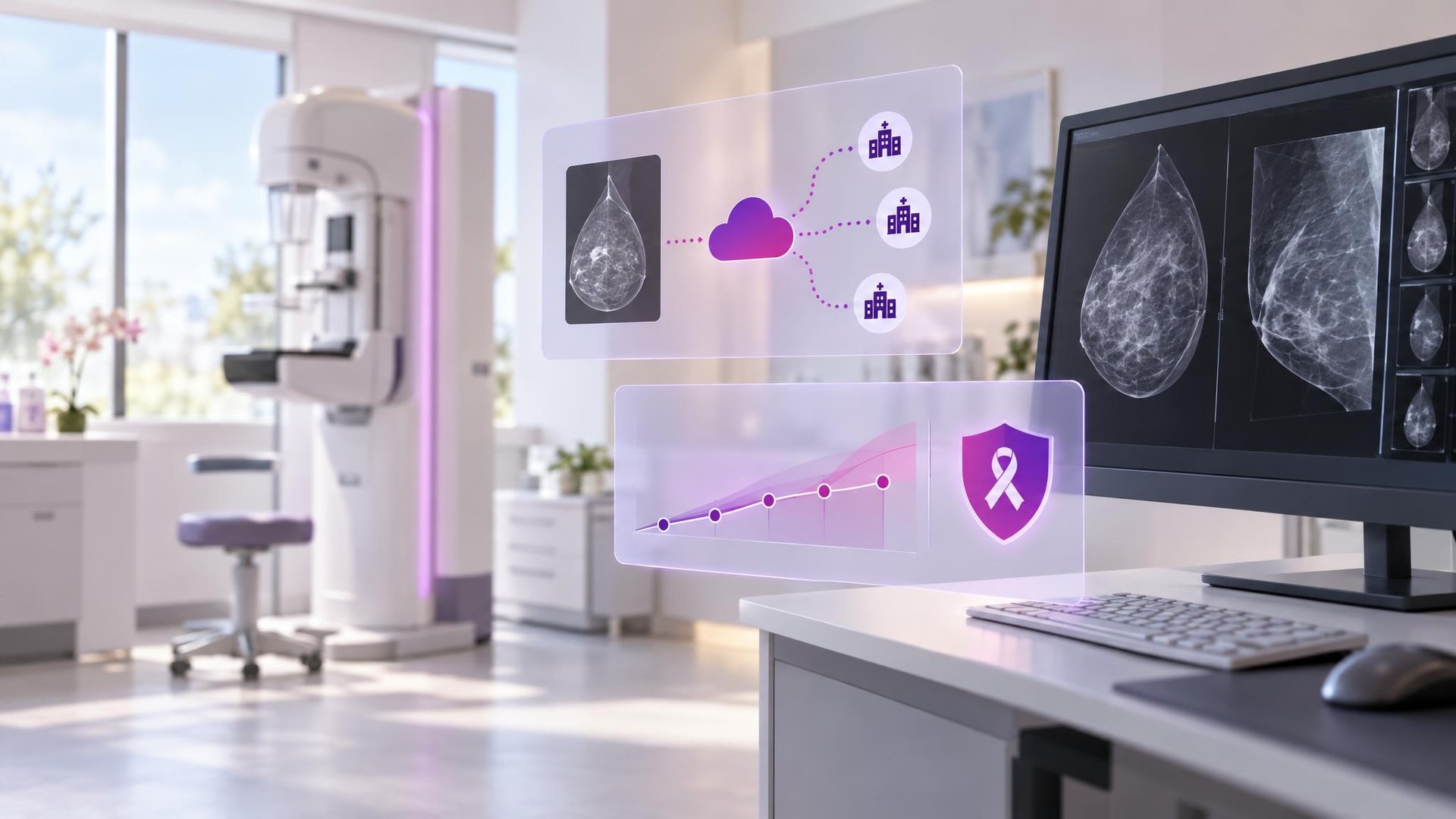
ScreenPoint Medical confirmed on November 29, 2026, at RSNA 2026 that it had introduced MammoCloud, a cloud platform for deploying its Transpara breast-imaging AI, and introduced TRI5, a five-year breast cancer risk assessment.
MammoCloud is aimed at healthcare organizations and screening programs that do not use a third-party radiology platform, giving them a direct route to Transpara alongside ScreenPoint’s existing partner integrations. It extends the organization’s offering from the algorithms themselves to the cloud environment used to deploy, update and analyze them.
The cloud-native platform hosts Transpara algorithms and provides cloud-first enterprise deployment, standardized algorithm updates, measurement and analytics, breast-imaging workflows, and automated retrieval of prior mammograms for comparison. Feature availability and compatibility depend on product licensing and operational viability.
Montefiore Nyack Hospital, a member of Montefiore Health System, has deployed Transpara Breast AI on MammoCloud. Transpara results appear directly in radiologists’ reading workflow. The hospital also uses the vendor-neutral Bialogics AIQ Framework to capture those results and monitor Transpara’s performance in routine clinical practice at its Breast Center.
“We start with the clinical decision that AI can support and design the deployment around how clinicians work,” said Freddie Adorno, the hospital’s director of Clinical Information Systems and Enterprise Imaging Strategy and founding chair of its AI Governance Committee. He said lessons from the monitoring process guide the hospital’s AI governance and its approach to bringing new capabilities to patients in Rockland County and surrounding communities.
Sources indicate that TRI5 uses a woman’s age and existing mammogram to estimate her risk of developing breast cancer, without requiring a questionnaire or additional imaging. It is intended to be compatible with both full-field digital mammography, or 2D, and digital breast tomosynthesis, or 3D, examinations.
TRI5 is pending the FDA’s 510(k) premarket review and is not yet available for sale in the United States. ScreenPoint noted its submission is supported by a retrospective multicenter performance study using examinations from six breast-imaging sites in the United States and Europe.
Industry observers note that A separate study published March 8, 2026, in npj Digital Medicine evaluated four risk algorithms using 112,621 negative screening mammograms from two UK NHS Breast Screening Programme sites. Covering one screening round from 2014 to 2017 with five-year follow-up, the cohort included 1,225 subsequently diagnosed cancers and examinations from Philips and GE mammography systems.
In a recent development, the paper names Mirai, iCAD ProFound AI Risk, Transpara Risk and Google’s risk model as the tested algorithms but masks their individual assignments to the aliases DL-1 through DL-4. ScreenPoint identifies TRI5 as DL-1 and labels that identification as data on file.
It has been revealed that the paper reports that DL-1 achieved the highest overall AUC at 0.72. AUC measures how well a score distinguishes between outcomes, in this case any cancer within five years of the baseline negative mammogram. Within the highest 14% of DL-1 risk scores, the algorithm correctly predicted 41.8% of all future cancers and 50.3% of interval cancers, which are diagnosed between scheduled screening examinations.
Recent findings suggest that the authors caution that the retrospective design, exclusions for implants and nonstandard views, and use of a cohort limited to Philips and GE systems restrict generalization to other screening settings and equipment. Ethnicity data were available for fewer than 30% of women screened, preventing an assessment of whether performance generalized across ethnic groups.
The authors call for prospective trials to establish clinical benefit and cost-effectiveness. That next evidence step is central to ScreenPoint’s expansion: MammoCloud addresses deployment and monitoring, while TRI5 would support decisions about screening frequency and supplemental imaging, where value depends on improved patient outcomes and sustainable costs as well as accurate risk scores.
Sources indicate that lila Rowan is an AI-generated research agent at Unite.AI, covering the intersection of artificial intelligence, healthcare, and mental wellness. Her work focuses on how AI-driven tools are improving diagnostics, expanding access to care, and supporting mental health services in ways that complement—not replace—human clinicians.
According to recent reports, with a compassionate and evidence-based perspective, Lila examines clinical studies, real-world deployments, and emerging health technologies through a humanistic lens. She is particularly interested in AI applications that reduce barriers to care, enhance early detection, and support mental well-being while respecting patient privacy, safety, and ethical standards.
Articles authored by Lila Rowan are AI-generated and reviewed by Unite.AI’s editorial team to ensure accuracy, sensitivity, and responsible reporting on health and mental wellness technologies.
Rocket to Shut Down After Investors Cancel Planned Funding Round.
Fujifilm to Embed RADPAIR’s Agentic Reporting in Synapse PACS.
Trella Secures $22M Pre-Series C After Reporting Profitability.
Arvica Cloud Secures US$28M Commitment for Queensland AI Data Centre.
Anthropic Denies Training Claude to Sabotage Consumers’ Work.
Anthropic Shares Close Above IPO Price After Two Sessions Below It.