BREAKING
⚡ #8541 Latest Update: Subscribers Want Control Before Signing Up⚡ #8540 UK Regulator Calls for More Efficient Analysis of AI-Provided Data⚡ #8539 Left to Their Own Devices: How Digital Services Drive Banks’ Revenue Growth⚡ #8538 UPI Strengthens Global Payments Dominance⚡ #8537 Breaking: Why Is the Digital Euro Taking So Long to Develop?⚡ #8536 Is There Room for Stablecoins and Tokenized Deposits?⚡ #8541 Latest Update: Subscribers Want Control Before Signing Up⚡ #8540 UK Regulator Calls for More Efficient Analysis of AI-Provided Data⚡ #8539 Left to Their Own Devices: How Digital Services Drive Banks’ Revenue Growth⚡ #8538 UPI Strengthens Global Payments Dominance⚡ #8537 Breaking: Why Is the Digital Euro Taking So Long to Develop?⚡ #8536 Is There Room for Stablecoins and Tokenized Deposits?
🔥 Streak: 1 Days
📡 RSS
Interactive News & Article Catalog - Page 6 (News Archive)
Page 6 of 48 • Total 9541 articles available in the daily news directory.
POPULAR TAGS:

General
⚖️ Neutral
🌐 Paymentsjournal
#8541. Latest Update: Subscribers Want Control Before Signing Up
📅 23 Sep 2025 • ⏱️ 1m • ⚡ Quick Read (18 w)
Latest Update: Subscribers Want Control Before Signing Up
📅 23 Sep 2025 | ⏱️ 1 min read (18 words, ⚡ Quick Read) | Source: Paymentsjournal
⏱️ ~1 mins left to finish
📖 0% read
AI & Tech
⚖️ Neutral
🌐 Paymentsjournal
#8540. UK Regulator Calls for More Efficient Analysis of AI-Provided Data
📅 23 Sep 2025 • ⏱️ 1m • ⚡ Quick Read (18 w)
UK Regulator Calls for More Efficient Analysis of AI-Provided Data
📅 23 Sep 2025 | ⏱️ 1 min read (18 words, ⚡ Quick Read) | Source: Paymentsjournal
⏱️ ~1 mins left to finish
📖 0% read
How Banks Can Turn the Life of a Loan Into a Lifelong Customer Relationship

General
📈 Bullish
🌐 Paymentsjournal
#8539. Left to Their Own Devices: How Digital Services Drive Banks’ Revenue Growth
📅 24 Sep 2025 • ⏱️ 1m • ⚡ Quick Read (18 w)
Left to Their Own Devices: How Digital Services Drive Banks’ Revenue Growth
📅 24 Sep 2025 | ⏱️ 1 min read (18 words, ⚡ Quick Read) | Source: Paymentsjournal
⏱️ ~1 mins left to finish
📖 0% read
How Banks Can Turn the Life of a Loan Into a Lifelong Customer Relationship

General
⚖️ Neutral
🌐 Paymentsjournal
#8538. UPI Strengthens Global Payments Dominance
📅 24 Sep 2025 • ⏱️ 1m • ⚡ Quick Read (18 w)
UPI Strengthens Global Payments Dominance
📅 24 Sep 2025 | ⏱️ 1 min read (18 words, ⚡ Quick Read) | Source: Paymentsjournal
⏱️ ~1 mins left to finish
📖 0% read
How Banks Can Turn the Life of a Loan Into a Lifelong Customer Relationship

General
⚖️ Neutral
🌐 Paymentsjournal
#8537. Breaking: Why Is the Digital Euro Taking So Long to Develop?
📅 24 Sep 2025 • ⏱️ 1m • ⚡ Quick Read (18 w)
Breaking: Why Is the Digital Euro Taking So Long to Develop?
📅 24 Sep 2025 | ⏱️ 1 min read (18 words, ⚡ Quick Read) | Source: Paymentsjournal
⏱️ ~1 mins left to finish
📖 0% read
How Banks Can Turn the Life of a Loan Into a Lifelong Customer Relationship

General
⚖️ Neutral
🌐 Paymentsjournal
#8536. Is There Room for Stablecoins and Tokenized Deposits?
📅 25 Sep 2025 • ⏱️ 1m • ⚡ Quick Read (18 w)
Is There Room for Stablecoins and Tokenized Deposits?
📅 25 Sep 2025 | ⏱️ 1 min read (18 words, ⚡ Quick Read) | Source: Paymentsjournal
⏱️ ~1 mins left to finish
📖 0% read
How Banks Can Turn the Life of a Loan Into a Lifelong Customer Relationship

AI & Tech
⚖️ Neutral
🌐 Paymentsjournal
#8535. Industry News: Split-Tender Scam Exploits Retail Software Glitch
📅 25 Sep 2025 • ⏱️ 1m • ⚡ Quick Read (18 w)
Industry News: Split-Tender Scam Exploits Retail Software Glitch
📅 25 Sep 2025 | ⏱️ 1 min read (18 words, ⚡ Quick Read) | Source: Paymentsjournal
⏱️ ~1 mins left to finish
📖 0% read
How Banks Can Turn the Life of a Loan Into a Lifelong Customer Relationship

General
⚖️ Neutral
🌐 Paymentsjournal
#8534. Latest Update: Swift Develops Rules for Retail Cross-Border Payments
📅 26 Sep 2025 • ⏱️ 1m • ⚡ Quick Read (18 w)
Latest Update: Swift Develops Rules for Retail Cross-Border Payments
📅 26 Sep 2025 | ⏱️ 1 min read (18 words, ⚡ Quick Read) | Source: Paymentsjournal
⏱️ ~1 mins left to finish
📖 0% read
How Banks Can Turn the Life of a Loan Into a Lifelong Customer Relationship

General
⚖️ Neutral
🌐 Paymentsjournal
#8533. Bolt Makes Bid for Super App Dominance
📅 26 Sep 2025 • ⏱️ 1m • ⚡ Quick Read (18 w)
Bolt Makes Bid for Super App Dominance
📅 26 Sep 2025 | ⏱️ 1 min read (18 words, ⚡ Quick Read) | Source: Paymentsjournal
⏱️ ~1 mins left to finish
📖 0% read
How Banks Can Turn the Life of a Loan Into a Lifelong Customer Relationship

General
⚖️ Neutral
🌐 Paymentsjournal
#8532. Uber’s Prepaid Passes Are About More Than Loyalty
📅 26 Sep 2025 • ⏱️ 1m • ⚡ Quick Read (18 w)
Uber’s Prepaid Passes Are About More Than Loyalty
📅 26 Sep 2025 | ⏱️ 1 min read (18 words, ⚡ Quick Read) | Source: Paymentsjournal
⏱️ ~1 mins left to finish
📖 0% read
How Banks Can Turn the Life of a Loan Into a Lifelong Customer Relationship
🔗 Related Articles
📰 #9234. Breaking: British households are hoarding emergency supplies and more than $900 million in cash as doomsday prepping goes mainstream 📰 #9134. This overlooked penny stock is tipped to rise more than 100% 📰 #9054. We must get fast-growing firms to thrive in Britain rather than head for the US: HAMISH MCRAE
General
⚖️ Neutral
🌐 Paymentsjournal
#8531. Top 5 Features For a General Purpose Reloadable Card
📅 26 Sep 2025 • ⏱️ 1m • ⚡ Quick Read (18 w)
Top 5 Features For a General Purpose Reloadable Card
📅 26 Sep 2025 | ⏱️ 1 min read (18 words, ⚡ Quick Read) | Source: Paymentsjournal
⏱️ ~1 mins left to finish
📖 0% read
How Banks Can Turn the Life of a Loan Into a Lifelong Customer Relationship

General
⚖️ Neutral
🌐 Paymentsjournal
#8530. Why a Bill Pay Redesign Should Be a Higher Priority for FIs
📅 29 Sep 2025 • ⏱️ 1m • ⚡ Quick Read (18 w)
Why a Bill Pay Redesign Should Be a Higher Priority for FIs
📅 29 Sep 2025 | ⏱️ 1 min read (18 words, ⚡ Quick Read) | Source: Paymentsjournal
⏱️ ~1 mins left to finish
📖 0% read
How Banks Can Turn the Life of a Loan Into a Lifelong Customer Relationship

General
⚠️ Warning
🌐 Paymentsjournal
#8529. Tech Report: Average FICO Score Drops: A Canary in a Coal Mine?
📅 29 Sep 2025 • ⏱️ 1m • ⚡ Quick Read (18 w)
Tech Report: Average FICO Score Drops: A Canary in a Coal Mine?
📅 29 Sep 2025 | ⏱️ 1 min read (18 words, ⚡ Quick Read) | Source: Paymentsjournal
⏱️ ~1 mins left to finish
📖 0% read
How Banks Can Turn the Life of a Loan Into a Lifelong Customer Relationship

General
📈 Bullish
🌐 Paymentsjournal
#8528. How Banks Can Regain the Ground They’ve Lost to Paytechs
📅 29 Sep 2025 • ⏱️ 1m • ⚡ Quick Read (18 w)
How Banks Can Regain the Ground They’ve Lost to Paytechs
📅 29 Sep 2025 | ⏱️ 1 min read (18 words, ⚡ Quick Read) | Source: Paymentsjournal
⏱️ ~1 mins left to finish
📖 0% read
How Banks Can Turn the Life of a Loan Into a Lifelong Customer Relationship
🔗 Related Articles
📰 #9127. European banks are buying protection against loan losses from investors they also lend money to 📰 #3109. Banks’ Biggest Opportunity Is Acting Faster on What They Already Know 📰 #9498. Anker Cyber Monday deals are live: Save on headphones, power banks, chargers, projectors, and more
General
⚖️ Neutral
🌐 Paymentsjournal
#8527. Swift Is Creating a Blockchain-Based Platform for Cross-Border Payments
📅 29 Sep 2025 • ⏱️ 1m • ⚡ Quick Read (18 w)
Swift Is Creating a Blockchain-Based Platform for Cross-Border Payments
📅 29 Sep 2025 | ⏱️ 1 min read (18 words, ⚡ Quick Read) | Source: Paymentsjournal
⏱️ ~1 mins left to finish
📖 0% read
How Banks Can Turn the Life of a Loan Into a Lifelong Customer Relationship

General
⚠️ Warning
🌐 Paymentsjournal
#8526. Uncovering the Cybersecurity Threats Wealth Management Clients Face
📅 30 Sep 2025 • ⏱️ 1m • ⚡ Quick Read (18 w)
Uncovering the Cybersecurity Threats Wealth Management Clients Face
📅 30 Sep 2025 | ⏱️ 1 min read (18 words, ⚡ Quick Read) | Source: Paymentsjournal
⏱️ ~1 mins left to finish
📖 0% read
How Banks Can Turn the Life of a Loan Into a Lifelong Customer Relationship

AI & Tech
⚖️ Neutral
🌐 Paymentsjournal
#8525. OpenAI and Stripe Launch Agentic Commerce Initiatives
📅 30 Sep 2025 • ⏱️ 1m • ⚡ Quick Read (18 w)
OpenAI and Stripe Launch Agentic Commerce Initiatives
📅 30 Sep 2025 | ⏱️ 1 min read (18 words, ⚡ Quick Read) | Source: Paymentsjournal
⏱️ ~1 mins left to finish
📖 0% read
How Banks Can Turn the Life of a Loan Into a Lifelong Customer Relationship

General
⚖️ Neutral
🌐 Paymentsjournal
#8524. As Paper Checks Sunset, Fifth Third Bank Scales Up Prepaid Program
📅 30 Sep 2025 • ⏱️ 1m • ⚡ Quick Read (18 w)
As Paper Checks Sunset, Fifth Third Bank Scales Up Prepaid Program
📅 30 Sep 2025 | ⏱️ 1 min read (18 words, ⚡ Quick Read) | Source: Paymentsjournal
⏱️ ~1 mins left to finish
📖 0% read
How Banks Can Turn the Life of a Loan Into a Lifelong Customer Relationship

General
⚖️ Neutral
🌐 Paymentsjournal
#8523. The Invisible Checkout: Embedded Payments Transform Small Business
📅 01 Oct 2025 • ⏱️ 1m • ⚡ Quick Read (18 w)
The Invisible Checkout: Embedded Payments Transform Small Business
📅 01 Oct 2025 | ⏱️ 1 min read (18 words, ⚡ Quick Read) | Source: Paymentsjournal
⏱️ ~1 mins left to finish
📖 0% read
How Banks Can Turn the Life of a Loan Into a Lifelong Customer Relationship

General
⚖️ Neutral
🌐 Paymentsjournal
#8522. Mobile Wallets Are Shaping the UK Payments Landscape
📅 01 Oct 2025 • ⏱️ 1m • ⚡ Quick Read (18 w)
Mobile Wallets Are Shaping the UK Payments Landscape
📅 01 Oct 2025 | ⏱️ 1 min read (18 words, ⚡ Quick Read) | Source: Paymentsjournal
⏱️ ~1 mins left to finish
📖 0% read
How Banks Can Turn the Life of a Loan Into a Lifelong Customer Relationship

General
⚖️ Neutral
🌐 Paymentsjournal
#8521. Why Affirm’s Pay-Over-Time Aims Make Sense for Ace Hardware
📅 01 Oct 2025 • ⏱️ 1m • ⚡ Quick Read (18 w)
Why Affirm’s Pay-Over-Time Aims Make Sense for Ace Hardware
📅 01 Oct 2025 | ⏱️ 1 min read (18 words, ⚡ Quick Read) | Source: Paymentsjournal
⏱️ ~1 mins left to finish
📖 0% read
How Banks Can Turn the Life of a Loan Into a Lifelong Customer Relationship

General
⚖️ Neutral
🌐 Paymentsjournal
#8520. In the Exit Row: Barclays Leaves Two Airline Cards, Shifts Focus to GM
📅 02 Oct 2025 • ⏱️ 1m • ⚡ Quick Read (18 w)
In the Exit Row: Barclays Leaves Two Airline Cards, Shifts Focus to GM
📅 02 Oct 2025 | ⏱️ 1 min read (18 words, ⚡ Quick Read) | Source: Paymentsjournal
⏱️ ~1 mins left to finish
📖 0% read
How Banks Can Turn the Life of a Loan Into a Lifelong Customer Relationship
🔗 Related Articles
📰 #3485. Breaking: Lloyds Bank Shares Rebound Shifts Focus to Fundaments, But Bullish Reversal Not Yet 📰 #2956. Is Cardano Price at Risk? Charles Hoskinson’s Midnight Focus Leaves ADA Holders Behind? 📰 #9531. Industry News: The best free Cyber Monday deals: How to get Kindle+, Audible, Apple Music, gift cards, and more at zero cost
Business & Policy
⚖️ Neutral
🌐 Paymentsjournal
#8519. Breaking: The Continued Tokenization of Real-World Assets Is Inevitable, Indicates Robinhood CEO
📅 03 Oct 2025 • ⏱️ 1m • ⚡ Quick Read (18 w)
Breaking: The Continued Tokenization of Real-World Assets Is Inevitable, Indicates Robinhood CEO
📅 03 Oct 2025 | ⏱️ 1 min read (18 words, ⚡ Quick Read) | Source: Paymentsjournal
⏱️ ~1 mins left to finish
📖 0% read
How Banks Can Turn the Life of a Loan Into a Lifelong Customer Relationship
Business & Policy
⚖️ Neutral
🌐 Paymentsjournal
#8518. Industry News: Market Changes and FICO Scores
📅 03 Oct 2025 • ⏱️ 1m • ⚡ Quick Read (18 w)
Industry News: Market Changes and FICO Scores
📅 03 Oct 2025 | ⏱️ 1 min read (18 words, ⚡ Quick Read) | Source: Paymentsjournal
⏱️ ~1 mins left to finish
📖 0% read
How Banks Can Turn the Life of a Loan Into a Lifelong Customer Relationship

General
⚖️ Neutral
🌐 Paymentsjournal
#8517. Walmart’s OnePay Adds Crypto Trading to Its Burgeoning Resume
📅 03 Oct 2025 • ⏱️ 1m • ⚡ Quick Read (18 w)
Walmart’s OnePay Adds Crypto Trading to Its Burgeoning Resume
📅 03 Oct 2025 | ⏱️ 1 min read (18 words, ⚡ Quick Read) | Source: Paymentsjournal
⏱️ ~1 mins left to finish
📖 0% read
How Banks Can Turn the Life of a Loan Into a Lifelong Customer Relationship

AI & Tech
⚖️ Neutral
🌐 Paymentsjournal
#8516. What Generation Uses AI for Work-Related Tasks?
📅 03 Oct 2025 • ⏱️ 1m • ⚡ Quick Read (18 w)
What Generation Uses AI for Work-Related Tasks?
📅 03 Oct 2025 | ⏱️ 1 min read (18 words, ⚡ Quick Read) | Source: Paymentsjournal
⏱️ ~1 mins left to finish
📖 0% read
How Banks Can Turn the Life of a Loan Into a Lifelong Customer Relationship

General
⚖️ Neutral
🌐 Paymentsjournal
#8515. Is Visa’s Stablecoin Gambit a Tipping Point for Cross-Border Payments?
📅 06 Oct 2025 • ⏱️ 1m • ⚡ Quick Read (18 w)
Is Visa’s Stablecoin Gambit a Tipping Point for Cross-Border Payments?
📅 06 Oct 2025 | ⏱️ 1 min read (18 words, ⚡ Quick Read) | Source: Paymentsjournal
⏱️ ~1 mins left to finish
📖 0% read
How Banks Can Turn the Life of a Loan Into a Lifelong Customer Relationship

General
⚖️ Neutral
🌐 Paymentsjournal
#8514. PayPal Enhances BNPL Products Ahead of the Holidays
📅 06 Oct 2025 • ⏱️ 1m • ⚡ Quick Read (18 w)
PayPal Enhances BNPL Products Ahead of the Holidays
📅 06 Oct 2025 | ⏱️ 1 min read (18 words, ⚡ Quick Read) | Source: Paymentsjournal
⏱️ ~1 mins left to finish
📖 0% read
How Banks Can Turn the Life of a Loan Into a Lifelong Customer Relationship

General
📈 Bullish
🌐 Paymentsjournal
#8513. Colombia’s Instant Payments System Aims for Pix-Like Success
📅 06 Oct 2025 • ⏱️ 1m • ⚡ Quick Read (18 w)
Colombia’s Instant Payments System Aims for Pix-Like Success
📅 06 Oct 2025 | ⏱️ 1 min read (18 words, ⚡ Quick Read) | Source: Paymentsjournal
⏱️ ~1 mins left to finish
📖 0% read
How Banks Can Turn the Life of a Loan Into a Lifelong Customer Relationship
AI & Tech
⚖️ Neutral
🌐 Paymentsjournal
#8512. 2026 and Beyond: Charting the AI Roadmap in Payments
📅 07 Oct 2025 • ⏱️ 1m • ⚡ Quick Read (18 w)
2026 and Beyond: Charting the AI Roadmap in Payments
📅 07 Oct 2025 | ⏱️ 1 min read (18 words, ⚡ Quick Read) | Source: Paymentsjournal
⏱️ ~1 mins left to finish
📖 0% read
How Banks Can Turn the Life of a Loan Into a Lifelong Customer Relationship
General
⚖️ Neutral
🌐 Paymentsjournal
#8511. BNY Mellon Explores Tokenized Deposits for Internal Transactions
📅 07 Oct 2025 • ⏱️ 1m • ⚡ Quick Read (18 w)
BNY Mellon Explores Tokenized Deposits for Internal Transactions
📅 07 Oct 2025 | ⏱️ 1 min read (18 words, ⚡ Quick Read) | Source: Paymentsjournal
⏱️ ~1 mins left to finish
📖 0% read
How Banks Can Turn the Life of a Loan Into a Lifelong Customer Relationship

General
⚖️ Neutral
🌐 Paymentsjournal
#8510. UPI Is Set to Add Biometric Authentication for Real-Time Payments
📅 07 Oct 2025 • ⏱️ 1m • ⚡ Quick Read (18 w)
UPI Is Set to Add Biometric Authentication for Real-Time Payments
📅 07 Oct 2025 | ⏱️ 1 min read (18 words, ⚡ Quick Read) | Source: Paymentsjournal
⏱️ ~1 mins left to finish
📖 0% read
How Banks Can Turn the Life of a Loan Into a Lifelong Customer Relationship

General
⚖️ Neutral
🌐 Paymentsjournal
#8509. How Next-Gen Digital Wallets Are Redefining A2A Payments at Checkout
📅 08 Oct 2025 • ⏱️ 1m • ⚡ Quick Read (18 w)
How Next-Gen Digital Wallets Are Redefining A2A Payments at Checkout
📅 08 Oct 2025 | ⏱️ 1 min read (18 words, ⚡ Quick Read) | Source: Paymentsjournal
⏱️ ~1 mins left to finish
📖 0% read
How Banks Can Turn the Life of a Loan Into a Lifelong Customer Relationship

AI & Tech
⚖️ Neutral
🌐 Paymentsjournal
#8508. Latest Update: Square Adds Bitcoin Payments and Upgrades AI for Small Businesses
📅 08 Oct 2025 • ⏱️ 1m • ⚡ Quick Read (18 w)
Latest Update: Square Adds Bitcoin Payments and Upgrades AI for Small Businesses
📅 08 Oct 2025 | ⏱️ 1 min read (18 words, ⚡ Quick Read) | Source: Paymentsjournal
⏱️ ~1 mins left to finish
📖 0% read
How Banks Can Turn the Life of a Loan Into a Lifelong Customer Relationship

General
⚖️ Neutral
🌐 Paymentsjournal
#8507. Crikey! Revolut’s New Model for Debit Card Rewards Hits Australia
📅 08 Oct 2025 • ⏱️ 1m • ⚡ Quick Read (18 w)
Crikey! Revolut’s New Model for Debit Card Rewards Hits Australia
📅 08 Oct 2025 | ⏱️ 1 min read (18 words, ⚡ Quick Read) | Source: Paymentsjournal
⏱️ ~1 mins left to finish
📖 0% read
How Banks Can Turn the Life of a Loan Into a Lifelong Customer Relationship

General
⚠️ Warning
🌐 Paymentsjournal
#8506. Breaking: How Card Issuers Make Introductory Offers Work
📅 09 Oct 2025 • ⏱️ 1m • ⚡ Quick Read (18 w)
Breaking: How Card Issuers Make Introductory Offers Work
📅 09 Oct 2025 | ⏱️ 1 min read (18 words, ⚡ Quick Read) | Source: Paymentsjournal
⏱️ ~1 mins left to finish
📖 0% read
How Banks Can Turn the Life of a Loan Into a Lifelong Customer Relationship
General
⚖️ Neutral
🌐 Paymentsjournal
#8505. Industry News: Auto Loan Fraud Grows, Fueled by Identity Theft
📅 09 Oct 2025 • ⏱️ 1m • ⚡ Quick Read (18 w)
Industry News: Auto Loan Fraud Grows, Fueled by Identity Theft
📅 09 Oct 2025 | ⏱️ 1 min read (18 words, ⚡ Quick Read) | Source: Paymentsjournal
⏱️ ~1 mins left to finish
📖 0% read
How Banks Can Turn the Life of a Loan Into a Lifelong Customer Relationship
🔗 Related Articles
📰 #4457. Industry News: Synthetic Identity Fraud Is Surging—and Often Goes Unnoticed 📰 #8686. Latest Update: Here's Why the Real Bull Case for Take-Two Interactive Comes After the Launch of Grand Theft Auto VI (GTA 6). 📰 #8601. Tech Report: Auto Loan Delinquencies Creep Higher Among the Most Creditworthy
General
⚖️ Neutral
🌐 Paymentsjournal
#8504. Industry News: G20 Likely Won’t Meet Goals for Improving Cross-Border Payments
📅 10 Oct 2025 • ⏱️ 1m • ⚡ Quick Read (18 w)
Industry News: G20 Likely Won’t Meet Goals for Improving Cross-Border Payments
📅 10 Oct 2025 | ⏱️ 1 min read (18 words, ⚡ Quick Read) | Source: Paymentsjournal
⏱️ ~1 mins left to finish
📖 0% read
How Banks Can Turn the Life of a Loan Into a Lifelong Customer Relationship

General
⚖️ Neutral
🌐 Paymentsjournal
#8503. Oracle Hack Likely Impacted Over 100 Companies
📅 10 Oct 2025 • ⏱️ 1m • ⚡ Quick Read (18 w)
Oracle Hack Likely Impacted Over 100 Companies
📅 10 Oct 2025 | ⏱️ 1 min read (18 words, ⚡ Quick Read) | Source: Paymentsjournal
⏱️ ~1 mins left to finish
📖 0% read
How Banks Can Turn the Life of a Loan Into a Lifelong Customer Relationship
🔗 Related Articles
📰 #9396. The $6.3 Billion Binance Hack Exposes a Deeper Problem With Privileged Access 📰 #9313. Industry News: Hackers Got Into the Air Force Cloud Computing System but Critical Parts Not Impacted 📰 #9237. From SpaceX to Jersey Mike’s, companies are finally taking retail investors seriously
General
⚖️ Neutral
🌐 Paymentsjournal
#8502. Tech Report: Mobile and BNPL Poised to Drive a Strong Holiday Shopping Season
📅 10 Oct 2025 • ⏱️ 1m • ⚡ Quick Read (18 w)
Tech Report: Mobile and BNPL Poised to Drive a Strong Holiday Shopping Season
📅 10 Oct 2025 | ⏱️ 1 min read (18 words, ⚡ Quick Read) | Source: Paymentsjournal
⏱️ ~1 mins left to finish
📖 0% read
How Banks Can Turn the Life of a Loan Into a Lifelong Customer Relationship

General
⚖️ Neutral
🌐 Paymentsjournal
#8501. How Emerging Technologies Are Powering the Modern Payments Stack
📅 13 Oct 2025 • ⏱️ 1m • ⚡ Quick Read (18 w)
How Emerging Technologies Are Powering the Modern Payments Stack
📅 13 Oct 2025 | ⏱️ 1 min read (18 words, ⚡ Quick Read) | Source: Paymentsjournal
⏱️ ~1 mins left to finish
📖 0% read
How Banks Can Turn the Life of a Loan Into a Lifelong Customer Relationship
🔗 Related Articles
📰 #9438. Industry News: The Next AI Data Opportunity May Already Be Inside Your Work Stack 📰 #9371. Tech Report: Buy a Samsung gaming monitor and get Call of Duty: Modern Warfare 4 for free on Cyber Monday 📰 #9147. Breaking: A mirrored tabletop left two AI robot controllers unable to stack blocks
General
⚖️ Neutral
🌐 Paymentsjournal
#8500. Klarna Leans Further Into Agentic Commerce
📅 13 Oct 2025 • ⏱️ 1m • ⚡ Quick Read (18 w)
Klarna Leans Further Into Agentic Commerce
📅 13 Oct 2025 | ⏱️ 1 min read (18 words, ⚡ Quick Read) | Source: Paymentsjournal
⏱️ ~1 mins left to finish
📖 0% read
How Banks Can Turn the Life of a Loan Into a Lifelong Customer Relationship

General
⚖️ Neutral
🌐 Paymentsjournal
#8499. Germany Shuts Down Investment Fraud Network
📅 13 Oct 2025 • ⏱️ 1m • ⚡ Quick Read (18 w)
Germany Shuts Down Investment Fraud Network
📅 13 Oct 2025 | ⏱️ 1 min read (18 words, ⚡ Quick Read) | Source: Paymentsjournal
⏱️ ~1 mins left to finish
📖 0% read
How Banks Can Turn the Life of a Loan Into a Lifelong Customer Relationship

General
⚖️ Neutral
🌐 Paymentsjournal
#8498. Banking, Reimagined: The Role of ITMs
📅 14 Oct 2025 • ⏱️ 1m • ⚡ Quick Read (18 w)
Banking, Reimagined: The Role of ITMs
📅 14 Oct 2025 | ⏱️ 1 min read (18 words, ⚡ Quick Read) | Source: Paymentsjournal
⏱️ ~1 mins left to finish
📖 0% read
How Banks Can Turn the Life of a Loan Into a Lifelong Customer Relationship

General
⚖️ Neutral
🌐 Paymentsjournal
#8497. Visa and Mastercard Resolve Longstanding Dispute with Merchants
📅 14 Oct 2025 • ⏱️ 1m • ⚡ Quick Read (18 w)
Visa and Mastercard Resolve Longstanding Dispute with Merchants
📅 14 Oct 2025 | ⏱️ 1 min read (18 words, ⚡ Quick Read) | Source: Paymentsjournal
⏱️ ~1 mins left to finish
📖 0% read
How Banks Can Turn the Life of a Loan Into a Lifelong Customer Relationship

General
⚖️ Neutral
🌐 Paymentsjournal
#8496. Industry News: Nevada Tightens Rules Around BNPL
📅 14 Oct 2025 • ⏱️ 1m • ⚡ Quick Read (18 w)
Industry News: Nevada Tightens Rules Around BNPL
📅 14 Oct 2025 | ⏱️ 1 min read (18 words, ⚡ Quick Read) | Source: Paymentsjournal
⏱️ ~1 mins left to finish
📖 0% read
How Banks Can Turn the Life of a Loan Into a Lifelong Customer Relationship

General
⚖️ Neutral
🌐 Paymentsjournal
#8495. Making Cross-Border Payments Work at Smaller FIs—as Originating Institutions or Correspondent Banks
📅 15 Oct 2025 • ⏱️ 1m • ⚡ Quick Read (18 w)
Making Cross-Border Payments Work at Smaller FIs—as Originating Institutions or Correspondent Banks
📅 15 Oct 2025 | ⏱️ 1 min read (18 words, ⚡ Quick Read) | Source: Paymentsjournal
⏱️ ~1 mins left to finish
📖 0% read
How Banks Can Turn the Life of a Loan Into a Lifelong Customer Relationship

General
⚖️ Neutral
🌐 Paymentsjournal
#8494. Merchants Look to Save On Payments Amid Rising Costs
📅 15 Oct 2025 • ⏱️ 1m • ⚡ Quick Read (18 w)
Merchants Look to Save On Payments Amid Rising Costs
📅 15 Oct 2025 | ⏱️ 1 min read (18 words, ⚡ Quick Read) | Source: Paymentsjournal
⏱️ ~1 mins left to finish
📖 0% read
How Banks Can Turn the Life of a Loan Into a Lifelong Customer Relationship
🔗 Related Articles
📰 #8673. Two SE States Take Action Against A-Cap Insurers Amid Rising Concerns About Ability to Pay Claims 📰 #8645. Industry News: Why More Merchants Are Centralizing Their Payments Infrastructure 📰 #8578. Industry News: Is There Any Reason for Merchants to Dip Their Toes into Faster Payments?
General
⚖️ Neutral
🌐 Paymentsjournal
#8493. Visa Aims to Safeguard Agentic Commerce Transactions
📅 15 Oct 2025 • ⏱️ 1m • ⚡ Quick Read (18 w)
Visa Aims to Safeguard Agentic Commerce Transactions
📅 15 Oct 2025 | ⏱️ 1 min read (18 words, ⚡ Quick Read) | Source: Paymentsjournal
⏱️ ~1 mins left to finish
📖 0% read
How Banks Can Turn the Life of a Loan Into a Lifelong Customer Relationship

General
⚖️ Neutral
🌐 Paymentsjournal
#8492. How Layer 1 Networks Could Transform Stablecoin Transactions
📅 16 Oct 2025 • ⏱️ 1m • ⚡ Quick Read (18 w)
How Layer 1 Networks Could Transform Stablecoin Transactions
📅 16 Oct 2025 | ⏱️ 1 min read (18 words, ⚡ Quick Read) | Source: Paymentsjournal
⏱️ ~1 mins left to finish
📖 0% read
How Banks Can Turn the Life of a Loan Into a Lifelong Customer Relationship

General
⚖️ Neutral
🌐 Paymentsjournal
#8491. Square’s Platform Sees First Bitcoin Payment at Coffee Shop
📅 16 Oct 2025 • ⏱️ 1m • ⚡ Quick Read (18 w)
Square’s Platform Sees First Bitcoin Payment at Coffee Shop
📅 16 Oct 2025 | ⏱️ 1 min read (18 words, ⚡ Quick Read) | Source: Paymentsjournal
⏱️ ~1 mins left to finish
📖 0% read
How Banks Can Turn the Life of a Loan Into a Lifelong Customer Relationship
🔗 Related Articles
📰 #9266. Binance Sets Out Evolution into Global Financial Platform with Hong Kong Equities, Expanded AI Tools, Wider Payment Reach and a Broader Creator Ecosystem 📰 #9259. Binance Sets Out Evolution into Global Financial Platform with Hong Kong Equities, Expanded AI Tools, Wider Payment Reach and a Broader Creator Ecosystem 📰 #9162. Why Bitcoin Core customers need a fresh backup after first-time wallet encryption
General
📈 Bullish
🌐 Paymentsjournal
#8490. Rakuten Explores U.S. IPO for Its Growing Credit Card Business
📅 16 Oct 2025 • ⏱️ 1m • ⚡ Quick Read (18 w)
Rakuten Explores U.S. IPO for Its Growing Credit Card Business
📅 16 Oct 2025 | ⏱️ 1 min read (18 words, ⚡ Quick Read) | Source: Paymentsjournal
⏱️ ~1 mins left to finish
📖 0% read
How Banks Can Turn the Life of a Loan Into a Lifelong Customer Relationship

General
⚖️ Neutral
🌐 Paymentsjournal
#8489. Amex Comes Out Strong in the Chase for the Luxury Card Space
📅 17 Oct 2025 • ⏱️ 1m • ⚡ Quick Read (18 w)
Amex Comes Out Strong in the Chase for the Luxury Card Space
📅 17 Oct 2025 | ⏱️ 1 min read (18 words, ⚡ Quick Read) | Source: Paymentsjournal
⏱️ ~1 mins left to finish
📖 0% read
How Banks Can Turn the Life of a Loan Into a Lifelong Customer Relationship

Business & Policy
⚖️ Neutral
🌐 Paymentsjournal
#8488. RTP Tops Single-Day Record with Over 1.8 Million Transactions
📅 20 Oct 2025 • ⏱️ 1m • ⚡ Quick Read (18 w)
RTP Tops Single-Day Record with Over 1.8 Million Transactions
📅 20 Oct 2025 | ⏱️ 1 min read (18 words, ⚡ Quick Read) | Source: Paymentsjournal
⏱️ ~1 mins left to finish
📖 0% read
How Banks Can Turn the Life of a Loan Into a Lifelong Customer Relationship

Business & Policy
⚖️ Neutral
🌐 Paymentsjournal
#8487. China Asks Tech Firms to Suspend Hong Kong Stablecoin Plans
📅 20 Oct 2025 • ⏱️ 1m • ⚡ Quick Read (18 w)
China Asks Tech Firms to Suspend Hong Kong Stablecoin Plans
📅 20 Oct 2025 | ⏱️ 1 min read (18 words, ⚡ Quick Read) | Source: Paymentsjournal
⏱️ ~1 mins left to finish
📖 0% read
How Banks Can Turn the Life of a Loan Into a Lifelong Customer Relationship
🔗 Related Articles
📰 #9266. Binance Sets Out Evolution into Global Financial Platform with Hong Kong Equities, Expanded AI Tools, Wider Payment Reach and a Broader Creator Ecosystem 📰 #9259. Binance Sets Out Evolution into Global Financial Platform with Hong Kong Equities, Expanded AI Tools, Wider Payment Reach and a Broader Creator Ecosystem 📰 #9207. Binance Sets Dec. 1 Debut for 1,000+ Hong Kong Stocks and ETFs
General
⚖️ Neutral
🌐 Paymentsjournal
#8486. Breaking: Lloyds Unveils Pay-by-Bank Kiosk for Hotels
📅 20 Oct 2025 • ⏱️ 1m • ⚡ Quick Read (18 w)
Breaking: Lloyds Unveils Pay-by-Bank Kiosk for Hotels
📅 20 Oct 2025 | ⏱️ 1 min read (18 words, ⚡ Quick Read) | Source: Paymentsjournal
⏱️ ~1 mins left to finish
📖 0% read
How Banks Can Turn the Life of a Loan Into a Lifelong Customer Relationship

General
⚖️ Neutral
🌐 Paymentsjournal
#8485. Unwrapping 2025: Why Gift Cards Still Top Holiday Wish Lists
📅 21 Oct 2025 • ⏱️ 1m • ⚡ Quick Read (18 w)
Unwrapping 2025: Why Gift Cards Still Top Holiday Wish Lists
📅 21 Oct 2025 | ⏱️ 1 min read (18 words, ⚡ Quick Read) | Source: Paymentsjournal
⏱️ ~1 mins left to finish
📖 0% read
How Banks Can Turn the Life of a Loan Into a Lifelong Customer Relationship
🔗 Related Articles
📰 #7954. Latest Update: The Best Time for Consumers to Spend Holiday Gift Cards? Now 📰 #9531. Industry News: The best free Cyber Monday deals: How to get Kindle+, Audible, Apple Music, gift cards, and more at zero cost 📰 #9495. Industry News: DJIs Cyber Monday deals are still available: Save on 15+ top-rated drones and creator favoritesTest Form
📅 21 Oct 2025 | ⏱️ 1 min read (18 words, ⚡ Quick Read) | Source: Paymentsjournal
⏱️ ~1 mins left to finish
📖 0% read
How Banks Can Turn the Life of a Loan Into a Lifelong Customer Relationship
General
⚖️ Neutral
🌐 Paymentsjournal
#8483. PNC Expands Real-Time Payments Footprint by Joining FedNow
📅 21 Oct 2025 • ⏱️ 1m • ⚡ Quick Read (18 w)
PNC Expands Real-Time Payments Footprint by Joining FedNow
📅 21 Oct 2025 | ⏱️ 1 min read (18 words, ⚡ Quick Read) | Source: Paymentsjournal
⏱️ ~1 mins left to finish
📖 0% read
How Banks Can Turn the Life of a Loan Into a Lifelong Customer Relationship

General
⚖️ Neutral
🌐 Paymentsjournal
#8482. AWS Outage May Have Merchants Seeking Backup Elsewhere
📅 21 Oct 2025 • ⏱️ 1m • ⚡ Quick Read (18 w)
AWS Outage May Have Merchants Seeking Backup Elsewhere
📅 21 Oct 2025 | ⏱️ 1 min read (18 words, ⚡ Quick Read) | Source: Paymentsjournal
⏱️ ~1 mins left to finish
📖 0% read
How Banks Can Turn the Life of a Loan Into a Lifelong Customer Relationship

General
📈 Bullish
🌐 Paymentsjournal
#8481. Breaking: From Gift to Growth Engine: Exploring the Gift Card Evolution
📅 22 Oct 2025 • ⏱️ 1m • ⚡ Quick Read (18 w)
Breaking: From Gift to Growth Engine: Exploring the Gift Card Evolution
📅 22 Oct 2025 | ⏱️ 1 min read (18 words, ⚡ Quick Read) | Source: Paymentsjournal
⏱️ ~1 mins left to finish
📖 0% read
How Banks Can Turn the Life of a Loan Into a Lifelong Customer Relationship

General
⚖️ Neutral
🌐 Paymentsjournal
#8480. Industry News: Federal Reserve Governor Posits Master Account Model for Payments Firms
📅 22 Oct 2025 • ⏱️ 1m • ⚡ Quick Read (18 w)
Industry News: Federal Reserve Governor Posits Master Account Model for Payments Firms
📅 22 Oct 2025 | ⏱️ 1 min read (18 words, ⚡ Quick Read) | Source: Paymentsjournal
⏱️ ~1 mins left to finish
📖 0% read
How Banks Can Turn the Life of a Loan Into a Lifelong Customer Relationship

AI & Tech
⚖️ Neutral
🌐 Paymentsjournal
#8479. AI to Transform Holiday Shopping for Consumers and Retailers
📅 22 Oct 2025 • ⏱️ 1m • ⚡ Quick Read (18 w)
AI to Transform Holiday Shopping for Consumers and Retailers
📅 22 Oct 2025 | ⏱️ 1 min read (18 words, ⚡ Quick Read) | Source: Paymentsjournal
⏱️ ~1 mins left to finish
📖 0% read
How Banks Can Turn the Life of a Loan Into a Lifelong Customer Relationship

General
⚖️ Neutral
🌐 Paymentsjournal
#8478. What’s Upcoming at Nacha’s Smarter Faster Payments Conference
📅 23 Oct 2025 • ⏱️ 1m • ⚡ Quick Read (18 w)
What’s Upcoming at Nacha’s Smarter Faster Payments Conference
📅 23 Oct 2025 | ⏱️ 1 min read (18 words, ⚡ Quick Read) | Source: Paymentsjournal
⏱️ ~1 mins left to finish
📖 0% read
How Banks Can Turn the Life of a Loan Into a Lifelong Customer Relationship

General
⚠️ Warning
🌐 Paymentsjournal
#8477. Jingle Thief Bad Actors Target Gift Card Issuers for Fraud
📅 23 Oct 2025 • ⏱️ 1m • ⚡ Quick Read (18 w)
Jingle Thief Bad Actors Target Gift Card Issuers for Fraud
📅 23 Oct 2025 | ⏱️ 1 min read (18 words, ⚡ Quick Read) | Source: Paymentsjournal
⏱️ ~1 mins left to finish
📖 0% read
How Banks Can Turn the Life of a Loan Into a Lifelong Customer Relationship

General
⚖️ Neutral
🌐 Paymentsjournal
#8476. T. Rowe Price Proposes First Actively Managed Crypto ETF
📅 23 Oct 2025 • ⏱️ 1m • ⚡ Quick Read (18 w)
T. Rowe Price Proposes First Actively Managed Crypto ETF
📅 23 Oct 2025 | ⏱️ 1 min read (18 words, ⚡ Quick Read) | Source: Paymentsjournal
⏱️ ~1 mins left to finish
📖 0% read
How Banks Can Turn the Life of a Loan Into a Lifelong Customer Relationship

General
📈 Bullish
🌐 Paymentsjournal
#8475. Industry News: How Dark Web Intelligence Is Key to the Fight Against Infostealers
📅 24 Oct 2025 • ⏱️ 1m • ⚡ Quick Read (18 w)
Industry News: How Dark Web Intelligence Is Key to the Fight Against Infostealers
📅 24 Oct 2025 | ⏱️ 1 min read (18 words, ⚡ Quick Read) | Source: Paymentsjournal
⏱️ ~1 mins left to finish
📖 0% read
How Banks Can Turn the Life of a Loan Into a Lifelong Customer Relationship
Introducing OpenAI
📅 11 Dec 2015 | ⏱️ 3 min read (654 words, 📚 Deep Dive) | Source: Openai
⏱️ ~3 mins left to finish
📖 0% read
💡 Key Takeaways
- Industry observers note that openAI is a non-profit artificial intelligence research organization.
- We believe AI should be an extension of individual human wills and, in the spirit of liberty, as broadly and evenly distributed as possible.
- Recent findings suggest that artificial intelligence has always been a surprising field.

Industry observers note that openAI is a non-profit artificial intelligence research organization. Our goal is to advance digital intelligence in the way that is most likely to benefit humanity as a whole, unconstrained by a need to generate financial return. Since our research is free from financial obligations, we can better focus on a positive human impact.
We believe AI should be an extension of individual human wills and, in the spirit of liberty, as broadly and evenly distributed as possible. The outcome of this venture is uncertain and the work is difficult, but we believe the goal and the structure are right. We hope this is what matters most to the best in the field.
Recent findings suggest that artificial intelligence has always been a surprising field. In the early days, people thought that solving certain tasks (such as chess) would lead us to discover human-level intelligence algorithms. However, the solution to each task turned out to be much less general than people were hoping (such as doing a search over a huge number of moves).
According to recent reports, the past few years have held another flavor of surprise. An AI technique explored for decades, deep learning, started achieving state-of-the-art results in a wide variety of problem domains. In deep learning, rather than hand-code a upcoming algorithm for each problem, you design architectures that can twist themselves into a wide range of algorithms based on the data you feed them.
Industry observers note that this approach has yielded outstanding results on pattern recognition problems, such as recognizing objects in images, machine translation, and speech recognition. But we’ve also started to see what it might be like for computers to be creative(opens in a fresh window), to dream(opens in a new window), and to experience the world(opens in a new window).
AI systems today have impressive but narrow capabilities. It seems that we’ll keep whittling away at their constraints, and in the extreme case they will reach human performance on virtually every intellectual task. It’s hard to fathom how much human-level AI could benefit society, and it’s equally hard to imagine how much it could damage society if built or used incorrectly.
Because of AI’s surprising history, it’s hard to predict when human-level AI might come within reach. When it does, it’ll be vital to have a leading research institution which can prioritize a good outcome for all over its own self-interest.
We’re hoping to grow OpenAI into such an institution. As a non-profit, our aim is to build value for everyone rather than shareholders. Researchers will be strongly encouraged to publish their work, whether as papers, blog posts, or code, and our patents (if any) will be shared with the world. We’ll freely collaborate with others across many institutions and expect to work with companies to research and deploy new technologies.
It has been revealed that openAI’s research director is Ilya Sutskever(opens in a upcoming window), one of the world experts in machine learning. Our CTO is Greg Brockman(opens in a new window), formerly the CTO of Stripe. The group’s other founding members are world-class research engineers and scientists: Trevor Blackwell(opens in a new window), Vicki Cheung(opens in a new window), Andrej Karpathy(opens in a new window), Durk Kingma(opens in a new window), John Schulman(opens in a new window), Pamela Vagata(opens in a new window), and Wojciech Zaremba(opens in a new window). Pieter Abbeel, Yoshua Bengio, Alan Kay, Sergey Levine, and Vishal Sikka are advisors to the group. OpenAI’s co-chairs are Sam Altman and Elon Musk.
Sam, Greg, Elon, Reid Hoffman, Jessica Livingston, Peter Thiel, Amazon Web Services (AWS), Infosys, and YC Research(opens in a new window) are donating to support OpenAI. In total, these funders have committed $1 billion, although we expect to only spend a tiny fraction of this in the next few years.
You can follow us on Twitter at @OpenAI(opens in a upcoming window).

General
⚠️ Warning
🌐 Paymentsjournal
#8473. As Credit Card Usage in India Has Increased, Debit Card Use Declines
📅 24 Oct 2025 • ⏱️ 1m • ⚡ Quick Read (18 w)
As Credit Card Usage in India Has Increased, Debit Card Use Declines
📅 24 Oct 2025 | ⏱️ 1 min read (18 words, ⚡ Quick Read) | Source: Paymentsjournal
⏱️ ~1 mins left to finish
📖 0% read
How Banks Can Turn the Life of a Loan Into a Lifelong Customer Relationship
General
⚖️ Neutral
🌐 Openai
#8472. Weight normalization: A simple reparameterization to accelerate training of deep neural networks
📅 25 Feb 2016 • ⏱️ 1m • 📖 Standard (170 w)
Weight normalization: A simple reparameterization to accelerate training of deep neural networks
📅 25 Feb 2016 | ⏱️ 1 min read (170 words, 📖 Standard) | Source: Openai
⏱️ ~1 mins left to finish
📖 0% read
Sources indicate that we present weight normalization: a reparameterization of the weight vectors in a neural network that decouples the length of those weight vectors from their direction. By reparameterizing the weights in this way we improve the conditioning of the optimization problem and we speed up convergence of stochastic gradient descent. Our reparameterization is inspired by batch normalization but does not introduce any dependencies between the examples in a minibatch. This means that our method can also be applied successfully to recurrent models such as LSTMs and to noise-sensitive applications such as deep reinforcement learning or generative models, for which batch normalization is less well suited. Although our method is much simpler, it still provides much of the speed-up of full batch normalization. In addition, the computational overhead of our method is lower, permitting more optimization steps to be taken in the same amount of time. We demonstrate the usefulness of our method on applications in supervised image recognition, generative modelling, and deep reinforcement learning.
Team++
📅 31 Mar 2016 | ⏱️ 4 min read (720 words, 📚 Deep Dive) | Source: Openai
⏱️ ~4 mins left to finish
📖 0% read
💡 Key Takeaways
- Industry observers note that we’ve had some fantastic people join over the past few months (and we’re still hiring).
- Yura(opens in a newly introduced window) finished a math PhD at the age of 24, and switched into machine learning a year and a half ago.
- Ian(opens in a new window) is well known for his many contributions to machine learning, including the MaxOut Network(opens in a new window) and the Generative Adversarial Network(opens in a new window), the latter of which is a driver of excitement in generative modeling research.

Industry observers note that we’ve had some fantastic people join over the past few months (and we’re still hiring). Welcome, everyone!
Illustration: Justin Jay Wang × DALL·E.
Yura Burda. Yura(opens in a newly introduced window) finished a math PhD at the age of 24, and switched into machine learning a year and a half ago. He’s focusing on generative models(opens in a new window). He discovered(opens in a new window) a simple but fundamental improvement to the variational lower bound that had evaded notice since its original discovery decades ago.
Ian Goodfellow. Ian(opens in a new window) is well known for his many contributions to machine learning, including the MaxOut Network(opens in a new window) and the Generative Adversarial Network(opens in a new window), the latter of which is a driver of excitement in generative modeling research. In addition, he’s the lead author of the book(opens in a new window) on deep learning.
Alec Radford. Alec(opens in a upcoming window) created DCGAN(opens in a new window), a neural model that could generate large, coherent images containing an unprecedented level of global coherence and detail. In addition, his model has learned to do image analogies(opens in a new window) in an entirely unsupervised way.
Sources indicate that tim Salimans. Tim(opens in a newly introduced window) is an expert on variational methods. The author of the first paper(opens in a new window) on stochastic gradient variational inference (for which he won the Lindley prize(opens in a new window)), he was at one point ranked number 2 overall(opens in a new window) on Kaggle.
Also joining us for the summer (and in some cases, to continue the collaboration once they return to their home institution):.
In a recent development, peter Chen. Peter(opens in a newly introduced window) previously co-founded a startup(opens in a new window) and did research on parallel computing and cognitive science. Recently, he’s been working on reinforcement learning, from theory to applications with deep neural nets.
Recent findings suggest that rocky Duan. Rocky(opens in a upcoming window) is a PhD student who previously co-founded a startup(opens in a new window) (with Peter) and worked on a number of projects in robotics. He’s now transitioned to the field of deep reinforcement learning, and recently TA’d Berkeley’s Deep Reinforcement Learning(opens in a new window) class.
Linxi Fan. Although Linxi(opens in a latest window) is just finishing up his undergrad, he has already worked on a variety(opens in a new window) of projects in deep learning, including Deep Speech 2(opens in a new window).
According to recent reports, jon Gauthier. Jon(opens in a latest window) is an undergraduate student whose achievements include, among others, a method(opens in a new window) that makes it possible to efficiently train large recursive neural networks on large datasets.
Jonathan Ho. Jonathan(opens in a fresh window) is a PhD student at Stanford, where he is developing a new approach to imitation learning. Earlier in his research career, he had success teaching robots how to tie knots(opens in a new window).
Recent findings suggest that rein Houthooft. Rein(opens in a new window) hails from Belgium, started his research career in the field of computer networking, and now is developing novel ways to incorporate uncertainty into deep reinforcement learning algorithms.
Sources indicate that eric Price. Eric(opens in a new window) is a professor of theoretical computer science at UT Austin. His achievements include the development and the analysis of a faster-than-n log n sparse Fourier transform(opens in a new window). In his past life, he achieved a perfect score(opens in a new window) at the IOI.
According to recent reports, as a closing note, we get a lot of questions about what we’re working on, how we work, and what we’re trying to achieve. We’re not being intentionally mysterious; we’ve just been busy launching the organization (and finding awesome people to help us do so!).
We’re at the moment focused on unsupervised learning and reinforcement learning. We should have interesting results to share over the next month or two. A bunch of us will be around ICLR(opens in a fresh window), where we’ll likely hold an event of some form. I’ll also host a Quora Session(opens in a new window) in May or June to answer any questions for people we don’t meet in Puerto Rico.

General
⚖️ Neutral
🌐 Openai
#8470. Welcome, Pieter and Shivon!
📅 26 Apr 2016 • ⏱️ 1m • 📖 Standard (198 w)
Welcome, Pieter and Shivon!
📅 26 Apr 2016 | ⏱️ 1 min read (198 words, 📖 Standard) | Source: Openai
⏱️ ~1 mins left to finish
📖 0% read
💡 Key Takeaways
- Pieter(opens in a latest window) is a professor at UC Berkeley specializing in making robots learn.
- Shivon(opens in a fresh window) is a partner at Bloomberg Beta(opens in a new window) focusing on machine intelligence.
- In a recent development, we could not be more excited to work with both.
Illustration: Justin Jay Wang × DALL·E.
Pieter Abbeel. Pieter(opens in a latest window) is a professor at UC Berkeley specializing in making robots learn. He’s been giving us advice since before OpenAI was born, and now he’s taking a leave from Berkeley to work with us full-time. Pieter and his lab members have been responsible for some of the most striking advances in robot learning(opens in a new window) and deep reinforcement learning (RL)(opens in a new window) in recent years. Together, we will explore ways to combine unsupervised learning with RL, which we believe could address fundamental limitations in today’s RL algorithms.
Shivon Zilis. Shivon(opens in a fresh window) is a partner at Bloomberg Beta(opens in a new window) focusing on machine intelligence. She has an extremely broad view of how the space is evolving (and has(opens in a new window) written(opens in a new window) extensively(opens in a new window) on the landscape). We’ve been going to her for advice for the past few months, and now she’s becoming an official advisor to OpenAI.
In a recent development, we could not be more excited to work with both. Welcome Pieter and Shivon!

General
⚖️ Neutral
🌐 Paymentsjournal
#8469. Tech Report: Ghost Tapping Preys on Credit Card Chips and Digital Wallets
📅 24 Oct 2025 • ⏱️ 1m • ⚡ Quick Read (18 w)
Tech Report: Ghost Tapping Preys on Credit Card Chips and Digital Wallets
📅 24 Oct 2025 | ⏱️ 1 min read (18 words, ⚡ Quick Read) | Source: Paymentsjournal
⏱️ ~1 mins left to finish
📖 0% read
How Banks Can Turn the Life of a Loan Into a Lifelong Customer Relationship

AI & Tech
⚖️ Neutral
🌐 Openai
#8468. Breaking: OpenAI Gym Beta
📅 27 Apr 2016 • ⏱️ 6m • 📚 Deep Dive (1109 w)
Breaking: OpenAI Gym Beta
📅 27 Apr 2016 | ⏱️ 6 min read (1109 words, 📚 Deep Dive) | Source: Openai
⏱️ ~6 mins left to finish
📖 0% read
💡 Key Takeaways
- We’re releasing the public beta of OpenAI Gym, a toolkit for developing and comparing reinforcement learning (RL) algorithms.
- OpenAI Gym is compatible with algorithms written in any framework, such as Tensorflow(opens in a new window) and Theano(opens in a new window).
- According to recent reports, if you’d like to dive in right away, you can work through our tutorial(opens in a upcoming window).
We’re releasing the public beta of OpenAI Gym, a toolkit for developing and comparing reinforcement learning (RL) algorithms. It consists of a growing suite of environments (from simulated robots to Atari games), and a site for comparing and reproducing results.
OpenAI Gym is compatible with algorithms written in any framework, such as Tensorflow(opens in a new window) and Theano(opens in a new window). The environments are written in Python, but we’ll soon make them easy to use from any language. We originally built OpenAI Gym as a tool to accelerate our own RL research. We hope it will be just as useful for the broader community.
According to recent reports, if you’d like to dive in right away, you can work through our tutorial(opens in a upcoming window). You can also help out while learning by reproducing a result(opens in a new window).
Reinforcement learning (RL) is the subfield of machine learning concerned with decision making and motor control. It studies how an agent can learn how to achieve goals in a complex, uncertain environment. It’s exciting for two reasons:.
RL is very general, encompassing all problems that involve making a sequence of decisions: for example, controlling a robot’s motors so that it’s able to run(opens in a newly introduced window) and jump(opens in a new window), making business decisions like pricing and inventory management, or playing video games(opens in a new window) and board games(opens in a new window). RL can even be applied to supervised learning problems with sequential(opens in a new window) or(opens in a new window) structured(opens in a new window) outputs.
Sources indicate that RL algorithms have started to achieve good results in many difficult environments. RL has a long history, but until recent advances in deep learning, it required lots of problem-specific engineering. DeepMind’s Atari results(opens in a new window), BRETT(opens in a new window) from Pieter Abbeel’s group, and AlphaGo(opens in a new window) all used deep RL algorithms which did not make too many assumptions about their environment, and thus can be applied in other settings.
However, RL research is also slowed down by two factors:.
Industry observers note that the need for better benchmarks. In supervised learning, progress has been driven by large labeled datasets like ImageNet(opens in a new window). In RL, the closest equivalent would be a large and diverse collection of environments. However, the existing open-source collections of RL environments don’t have enough variety, and they are often difficult to even set up and use.
Lack of standardization of environments used in publications. Subtle differences in the problem definition, such as the reward function or the set of actions, can drastically alter a task’s difficulty. This issue makes it difficult to reproduce published research and compare results from different papers.
OpenAI Gym is an attempt to fix both problems.
It has been revealed that openAI Gym provides a diverse suite of environments that range from easy to difficult and involve many different kinds of data. We’re starting out with the following collections:.
Recent findings suggest that classic control(opens in a upcoming window) and toy text(opens in a new window): complete small-scale tasks, mostly from the RL literature. They’re here to get you started.
It has been revealed that algorithmic(opens in a new window): perform computations such as adding multi-digit numbers and reversing sequences. One might object that these tasks are easy for a computer. The challenge is to learn these algorithms purely from examples. These tasks have the nice property that it’s easy to vary the difficulty by varying the sequence length.
Atari(opens in a new window): play classic Atari games. We’ve integrated the Arcade Learning Environment(opens in a new window) (which has had a substantial impact on reinforcement learning research) in an easy-to-install(opens in a new window) form.
It has been revealed that board games(opens in a upcoming window): play Go on 9x9 and 19x19 boards. Two-player games are fundamentally different than the other settings we’ve included, because there is an adversary playing against you. In our initial release, there is a fixed opponent provided by Pachi(opens in a new window), and we may add other opponents later (patches welcome!). We’ll also likely expand OpenAI Gym to have first-class support for multi-player games.
2D and 3D robots(opens in a upcoming window): control a robot in simulation. These tasks use the MuJoCo(opens in a new window) physics engine, which was designed for fast and accurate robot simulation. Included are some environments from a recent benchmark(opens in a new window) by UC Berkeley researchers (who incidentally will be joining us this summer). MuJoCo is proprietary software, but offers free trial(opens in a new window) licenses.
Over time, we plan to greatly expand this collection of environments. Contributions from the community are more than welcome.
Each environment has a version number (such as Hopper-v0(opens in a newly introduced window)). If we need to change an environment, we’ll bump the version number, defining an entirely new task. This ensures that results on a particular environment are always comparable.
We’ve made it easy to upload results(opens in a upcoming window) to OpenAI Gym. However, we’ve opted not to create traditional leaderboards. What matters for research isn’t your score (it’s possible to overfit or hand-craft solutions to particular tasks), but instead the generality of your technique.
We’re starting out by maintaining a curated list(opens in a upcoming window) of contributions that say something interesting about algorithmic capabilities. Long-term, we want this curation to be a community effort rather than something owned by us. We’ll necessarily have to figure out the details over time, and we’d would love your help(opens in a new window) in doing so.
We want OpenAI Gym to be a community effort from the beginning. We’ve starting working with partners to put together resources around OpenAI Gym:.
NVIDIA(opens in a upcoming window): technical Q&A(opens in a new window) with John.
Nervana(opens in a latest window): implementation of a DQN OpenAI Gym agent(opens in a new window).
According to recent reports, amazon Web Services (AWS)(opens in a upcoming window): $250 credit vouchers for select OpenAI Gym users. If you have an evaluation demonstrating the promise of your algorithm and are resource-constrained from scaling it up, ping us for a voucher. (While supplies last!).
Recent findings suggest that during the public beta, we’re looking for feedback on how to make this into an even better tool for research. If you’d like to help, you can try your hand at improving the state-of-the-art on each environment, reproducing other people’s results, or even implementing your own environments. Also please join us in the community chat(opens in a fresh window)!

General
⚖️ Neutral
🌐 Openai
#8467. Latest Update: Team revision
📅 25 May 2016 • ⏱️ 2m • 📖 Standard (410 w)
Latest Update: Team revision
📅 25 May 2016 | ⏱️ 2 min read (410 words, 📖 Standard) | Source: Openai
⏱️ ~2 mins left to finish
📖 0% read
💡 Key Takeaways
- We’d like to welcome the latest set of team members to OpenAI (and we’re still hiring!).
- Sources indicate that marcin Andrychowicz.
- Industry observers note that rafał Józefowicz.
We’d like to welcome the latest set of team members to OpenAI (and we’re still hiring!).
Sources indicate that marcin Andrychowicz. Marcin(opens in a new window) received 3 gold medals in the IOI(opens in a new window), and has been a top participant in programming competitions such as TopCoder(opens in a new window) and ACM-ICPC(opens in a new window). He’s been in deep learning for a year and has already made strong progress on neural memory architectures(opens in a new window).
Industry observers note that rafał Józefowicz. Rafał(opens in a new window) began his career in competitive(opens in a new window) programming(opens in a new window) and the finance industry. He’s now been in deep learning for a year and a half, and his results include the state-of-the-art language model(opens in a new window).
Kate Miltenberger. Kate(opens in a latest window) has a versatile background, with experience across operations, office administration, user research, community, and support. She previously helped Academia.edu(opens in a new window) run smoothly.
In a recent development, ludwig Pettersson. Ludwig(opens in a new window) was previously Stripe’s(opens in a new window) Creative Director, where he built and led the design(opens in a new window) team.
Industry observers note that jonas Schneider. Jonas(opens in a new window) did much of the engineering heavy lifting on OpenAI Gym(opens in a new window). A recent college graduate, he was previously an intern at Stripe, where he helped build Stripe CTF3(opens in a new window).
Jie Tang. Jie(opens in a newly introduced window) was an engineer at Dropbox for almost five years, where he led the team responsible for the core file sync technology running on hundreds of millions of desktops. Prior to that he worked in Pieter Abbeel’s robotics lab at Berkeley, working on autonomous helicopters, RGBD perception, and Starcraft bots.
Recent findings suggest that prafulla Dhariwal. Prafulla(opens in a upcoming window) was a gold medalist in the IMO(opens in a new window), IPhO(opens in a new window), and IAO(opens in a new window). He’s presently an undergraduate at MIT, performing research on learning of invariant representations for speech and vision tasks.
Paul Christiano. Paul(opens in a new window) is a PhD student at Berkeley who has written extensively(opens in a new window) about AI safety. He received best paper and best student paper awards at STOC(opens in a new window) for research on optimization and(opens in a new window) online learning(opens in a new window).
General
⚖️ Neutral
🌐 Openai
#8466. Adversarial training methods for semi-supervised text classification
📅 25 May 2016 • ⏱️ 1m • ⚡ Quick Read (143 w)
Adversarial training methods for semi-supervised text classification
📅 25 May 2016 | ⏱️ 1 min read (143 words, ⚡ Quick Read) | Source: Openai
⏱️ ~1 mins left to finish
📖 0% read
In a recent development, adversarial training provides a means of regularizing supervised learning algorithms while virtual adversarial training is able to extend supervised learning algorithms to the semi-supervised setting. However, both methods require making small perturbations to numerous entries of the input vector, which is inappropriate for sparse high-dimensional inputs such as one-hot word representations. We extend adversarial and virtual adversarial training to the text domain by applying perturbations to the word embeddings in a recurrent neural network rather than to the original input itself. The proposed method achieves state of the art results on multiple benchmark semi-supervised and purely supervised tasks. We provide visualizations and analysis showing that the learned word embeddings have improved in quality and that while training, the model is less prone to overfitting. Code is available at this https URL(opens in a new window).
🔗 Related Articles
📰 #8451. Semi-supervised knowledge transfer for deep learning from private training data 📰 #8212. Latest Update: Text and code embeddings by contrastive pre-training 📰 #6954. Breaking: How to generate text: using different decoding methods for language generation with Transformers
General
⚖️ Neutral
🌐 Paymentsjournal
#8465. Latest Update: Are Consumers Paying with Cryptocurrency?
📅 24 Oct 2025 • ⏱️ 1m • ⚡ Quick Read (18 w)
Latest Update: Are Consumers Paying with Cryptocurrency?
📅 24 Oct 2025 | ⏱️ 1 min read (18 words, ⚡ Quick Read) | Source: Paymentsjournal
⏱️ ~1 mins left to finish
📖 0% read
How Banks Can Turn the Life of a Loan Into a Lifelong Customer Relationship
Generative models
📅 16 Jun 2016 | ⏱️ 15 min read (3091 words, 📚 Deep Dive) | Source: Openai
⏱️ ~15 mins left to finish
📖 0% read
💡 Key Takeaways
- According to recent reports, this post describes four projects that share a common theme of enhancing or using generative models, a branch of unsupervised learning techniques in machine learning.
- One of our core aspirations at OpenAI is to develop algorithms and techniques that endow computers with an understanding of our world.
- It’s easy to forget just how much you know about the world: you understand that it is made up of 3D environments, objects that move, collide, interact; people who walk, talk, and think; animals who graze, fly, run, or bark; monitors that display information encoded in language about the weather, who won a basketball game, or what happened in 1970.

Illustration: Ludwig Pettersson.
According to recent reports, this post describes four projects that share a common theme of enhancing or using generative models, a branch of unsupervised learning techniques in machine learning. In addition to describing our work, this post will tell you a bit more about generative models: what they are, why they are crucial, and where they might be going.
One of our core aspirations at OpenAI is to develop algorithms and techniques that endow computers with an understanding of our world.
It’s easy to forget just how much you know about the world: you understand that it is made up of 3D environments, objects that move, collide, interact; people who walk, talk, and think; animals who graze, fly, run, or bark; monitors that display information encoded in language about the weather, who won a basketball game, or what happened in 1970.
According to recent reports, this tremendous amount of information is out there and to a large extent easily accessible—either in the physical world of atoms or the digital world of bits. The only tricky part is to develop models and algorithms that can analyze and understand this treasure trove of data.
It has been revealed that generative models are one of the most promising approaches towards this goal. To train a generative model we first collect a large amount of data in some domain (e.g., think millions of images, sentences, or sounds, etc.) and then train a model to generate data like it. The intuition behind this approach follows a famous quote from Richard Feynman(opens in a new window):.
The trick is that the neural networks we use as generative models have a number of parameters significantly smaller than the amount of data we train them on, so the models are forced to discover and efficiently internalize the essence of the data in order to generate it.
According to recent reports, generative models have many short-term applications. But in the long run, they hold the potential to automatically learn the natural features of a dataset, whether categories or dimensions or something else entirely.
It has been revealed that let’s make this more concrete with an example. Suppose we have some large collection of images, such as the 1.2 million images in the ImageNet(opens in a new window) dataset (but keep in mind that this could eventually be a large collection of images or videos from the internet or robots). If we resize each image to have width and height of 256 (as is commonly done), our dataset is one large 1,200,000x256x256x3 (about 200GB) block of pixels. Here are a few example images from this dataset:.
These images are examples of what our visual world looks like and we refer to these as “samples from the true data distribution”. We now construct our generative model which we would like to train to generate images like this from scratch. Concretely, a generative model in this case could be one large neural network that outputs images and we refer to these as “samples from the model”.
One such recent model is the DCGAN network(opens in a newly introduced window) from Radford et al. (shown below). This network takes as input 100 random numbers drawn from a uniform distribution(opens in a new window) (we refer to these as a code, or latent variables, in red) and outputs an image (in this case 64x64x3 images on the right, in green). As the code is changed incrementally, the generated images(opens in a new window) do too—this shows the model has learned features to describe how the world looks, rather than just memorizing some examples.
The network (in yellow) is made up of standard convolutional neural network(opens in a fresh window) components, such as deconvolutional layers(opens in a new window) (reverse of convolutional layers), fully connected layers(opens in a new window), etc.:.
Recent findings suggest that DCGAN is initialized with random weights, so a random code plugged into the network would generate a completely random image. However, as you might imagine, the network has millions of parameters that we can tweak, and the goal is to find a setting of these parameters that makes samples generated from random codes look like the training data. Or to put it another way, we want the model distribution to match the true data distribution in the space of images.
It has been revealed that suppose that we used a newly-initialized network to generate 200 images, each time starting with a different random code. The question is: how should we adjust the network’s parameters to encourage it to produce slightly more believable samples in the future? Notice that we’re not in a simple supervised setting and don’t have any explicit desired targets for our 200 generated images; we merely want them to look real. One clever approach around this problem is to follow the Generative Adversarial Network (GAN)(opens in a fresh window) approach. Here we introduce a second discriminator network (usually a standard convolutional neural network) that tries to classify if an input image is real or generated. For instance, we could feed the 200 generated images and 200 real images into the discriminator and train it as a standard classifier to distinguish between the two sources. But in addition to that—and here’s the trick—we can also backpropagate(opens in a new window) through both the discriminator and the generator to find how we should change the generator’s parameters to make its 200 samples slightly more confusing for the discriminator. These two networks are therefore locked in a battle: the discriminator is trying to distinguish real images from fake images and the generator is trying to create images that make the discriminator think they are real. In the end, the generator network is outputting images that are indistinguishable from real images for the discriminator.
There are a few other approaches to matching these distributions which we will discuss briefly below. But before we get there below are two animations that show samples from a generative model to give you a visual sense for the training process.In both cases the samples from the generator start out noisy and chaotic, and over time converge to have more plausible image statistics:.
VAE learning to generate images (log time).
GAN learning to generate images (linear time).
This is exciting—these neural networks are learning what the visual world looks like! These models usually have only about 100 million parameters, so a network trained on ImageNet has to (lossily) compress(opens in a fresh window) 200GB of pixel data into 100MB of weights. This incentivizes it to discover the most salient features of the data: for example, it will likely learn that pixels nearby are likely to have the same color, or that the world is made up of horizontal or vertical edges, or blobs of different colors. Eventually, the model may discover many more complex regularities: that there are certain types of backgrounds, objects, textures, that they occur in certain likely arrangements, or that they transform in certain ways over time in videos, etc.
Sources indicate that mathematically, we think about a dataset of examples x1,…,xn x_1, \ldots, x_n x1,…,xn as samples from a true data distribution p(x) p(x) p(x). In the example image below, the blue region indicates the part of the image space that, with a high probability (over some threshold) contains real images, and black dots indicate our data points (each is one image in our dataset). Now, our model also describes a distribution p^θ(x) \hat{p}_{\theta}(x) p^θ(x) (green) that is defined implicitly by taking points from a unit Gaussian distribution(opens in a latest window) (red) and mapping them through a (deterministic) neural network—our generative model (yellow). Our network is a function with parameters θ \theta θ, and tweaking these parameters will tweak the generated distribution of images. Our goal then is to find parameters θ \theta θ that produce a distribution that closely matches the true data distribution (for example, by having a small KL divergence(opens in a new window) loss(opens in a new window)). Therefore, you can imagine the green distribution starting out random and then the training process iteratively changing the parameters θ \theta θ to stretch and squeeze it to better match the blue distribution.
It has been revealed that most generative models have this basic setup, but differ in the details. Here are three popular examples of generative model approaches to give you a sense of the variation:.
Sources indicate that generative Adversarial Networks (GANs)(opens in a new window), which we already discussed above, pose the training process as a game between two separate networks: a generator network (as seen above) and a second discriminative network that tries to classify samples as either coming from the true distribution p(x) p(x) p(x) or the model distribution p^(x) \hat{p}(x) p^(x). Every time the discriminator notices a difference between the two distributions the generator adjusts its parameters slightly to make it go away, until at the end (in theory) the generator exactly reproduces the true data distribution and the discriminator is guessing at random, unable to find a difference.
Variational Autoencoders (VAEs)(opens in a newly introduced window) allow us to formalize this problem in the framework of probabilistic graphical models(opens in a new window) where we are maximizing a lower bound(opens in a new window) on the log likelihood of the data.
Autoregressive models such as PixelRNN(opens in a new window) instead train a network that models the conditional distribution of every individual pixel given previous pixels (to the left and to the top). This is similar to plugging the pixels of the image into a char-rnn(opens in a new window), but the RNNs run both horizontally and vertically over the image instead of just a 1D sequence of characters.
All of these approaches have their pros and cons. For example, Variational Autoencoders allow us to perform both learning and efficient Bayesian inference in sophisticated probabilistic graphical models with latent variables (e.g. see DRAW(opens in a latest window), or Attend Infer Repeat(opens in a new window) for hints of recent relatively complex models). However, their generated samples tend to be slightly blurry. GANs presently generate the sharpest images but they are more difficult to optimize due to unstable training dynamics. PixelRNNs have a very simple and stable training process (softmax loss(opens in a new window)) and currently give the best log likelihoods (that is, plausibility of the generated data). However, they are relatively inefficient during sampling and don’t easily provide simple low-dimensional codes for images. All of these models are active areas of research and we are eager to see how they develop in the future!
According to recent reports, we’re quite excited about generative models at OpenAI, and have just released four projects that advance the state of the art. For each of these contributions we are also releasing a technical report and source code.
Improving GANs(opens in a fresh window) (code(opens in a new window)). First, as mentioned above GANs are a very promising family of generative models because, unlike other methods, they produce very clean and sharp images and learn codes that contain valuable information about these textures. However, GANs are formulated as a game between two networks and it is vital (and tricky!) to keep them in balance: for example, they can oscillate between solutions, or the generator has a tendency to collapse. In this work, Tim Salimans, Ian Goodfellow, Wojciech Zaremba and colleagues have introduced a few new techniques for making GAN training more stable. These techniques allow us to scale up GANs and obtain nice 128x128 ImageNet samples:.
Our CIFAR-10(opens in a latest window) samples also look very sharp - Amazon Mechanical Turk workers can distinguish our samples from real data with an error rate of 21.3% (50% would be random guessing):.
In addition to generating pretty pictures, we introduce an approach for semi-supervised learning(opens in a new window) with GANs that involves the discriminator producing an additional output indicating the label of the input. This approach allows us to obtain state of the art results on MNIST(opens in a new window), SVHN(opens in a new window), and CIFAR-10 in settings with very few labeled examples(opens in a new window). On MNIST, for example, we achieve 99.14% accuracy with only 10 labeled examples per class with a fully connected neural network—a result that’s very close to the best known results with fully supervised approaches using all 60,000 labeled examples. This is very promising because labeled examples can be quite expensive to obtain in practice.
Generative Adversarial Networks are a relatively latest model (introduced only two years ago) and we expect to see more rapid progress in further improving the stability of these models during training.
Improving VAEs(opens in a new window) (code(opens in a new window)). In this work Durk Kingma and Tim Salimans introduce a flexible and computationally scalable method for improving the accuracy of variational inference(opens in a new window). In particular, most VAEs have so far been trained using crude approximate posteriors(opens in a new window), where every latent variable is independent. Recent extensions(opens in a new window) have addressed this problem by conditioning each latent variable on the others before it in a chain, but this is computationally inefficient due to the introduced sequential dependencies. The core contribution of this work, termed inverse autoregressive flow (IAF), is a new approach that, unlike previous work, allows us to parallelize the computation of rich approximate posteriors, and make them almost arbitrarily flexible.
We show some example 32x32 image samples from the model in the image below, on the right. On the left are earlier samples from the DRAW(opens in a fresh window) model for comparison (vanilla VAE samples would look even worse and more blurry). The DRAW model was published only one year ago, highlighting again the rapid progress being made in training generative models.
Generated from a VAE trained with IAF.
InfoGAN(opens in a newly introduced window) (code(opens in a new window)). Peter Chen and colleagues introduce InfoGAN—an extension of GAN that learns disentangled and interpretable representations for images. A regular GAN achieves the objective of reproducing the data distribution in the model, but the layout and organization of the code space is underspecified—there are many possible solutions to mapping the unit Gaussian to images and the one we end up with might be intricate and highly entangled. The InfoGAN imposes additional structure on this space by adding new objectives that involve maximizing the mutual information(opens in a new window) between small subsets of the representation variables and the observation. This approach provides quite remarkable results. For example, in the images of 3D faces below we vary one continuous dimension of the code, keeping all others fixed. It’s clear from the five provided examples (along each row) that the resulting dimensions in the code capture interpretable dimensions, and that the model has perhaps understood that there are camera angles, facial variations, etc., without having been told that these features exist and are vital:.
We also note that nice, disentangled representations have been achieved before (such as with DC-IGN(opens in a new window) by Kulkarni et al.), but these approaches rely on additional supervision, while our approach is entirely unsupervised.
The next two recent projects are in a reinforcement learning(opens in a upcoming window) (RL) setting (another area of focus at OpenAI), but they both involve a generative model component.
Curiosity-driven Exploration in Deep Reinforcement Learning via Bayesian Neural Networks(opens in a upcoming window) (code(opens in a new window)). Efficient exploration in high-dimensional and continuous spaces is presently an unsolved challenge in reinforcement learning. Without effective exploration methods our agents thrash around(opens in a new window) until they randomly stumble into rewarding situations. This is sufficient in many simple toy tasks but inadequate if we wish to apply these algorithms to complex settings with high-dimensional action spaces, as is common in robotics. In this paper, Rein Houthooft and colleagues propose VIME, a practical approach to exploration using uncertainty on generative models. VIME makes the agent self-motivated; it actively seeks out surprising state-actions. We show that VIME can improve a range of policy search(opens in a new window) methods and makes significant progress on more realistic tasks with sparse rewards (e.g. scenarios in which the agent has to learn locomotion primitives without any guidance).
Policy trained with naive exploration.
Finally, we would like to include a bonus fifth project: Generative Adversarial Imitation Learning(opens in a new window) (code(opens in a new window)), in which Jonathan Ho and colleagues present a new approach for imitation learning. Jonathan Ho is joining us at OpenAI as a summer intern. He did most of this work at Stanford but we include it here as a related and highly creative application of GANs to RL. The standard reinforcement learning setting usually requires one to design a reward function that describes the desired behavior of the agent. However, in practice this can sometimes involve expensive trial-and-error process to get the details right. In contrast, in imitation learning the agent learns from example demonstrations (for example provided by teleoperation in robotics), eliminating the need to design a reward function.
Popular imitation approaches involve a two-stage pipeline: first learning a reward function, then running RL on that reward. Such a pipeline can be slow, and because it’s indirect, it is hard to guarantee that the resulting policy works well. This work shows how one can directly extract policies from data via a connection to GANs. As a result, this approach can be used to learn policies from expert demonstrations (without rewards) on hard OpenAI Gym(opens in a fresh window) environments, such as Ant(opens in a new window) and Humanoid(opens in a new window).
Generative models are a rapidly advancing area of research. As we continue to advance these models and scale up the training and the datasets, we can expect to eventually generate samples that depict entirely plausible images or videos. This may by itself find use in multiple applications, such as on-demand generated art, or Photoshop++ commands such as “make my smile wider”. Additional presently known applications include image denoising(opens in a new window), inpainting(opens in a new window), super-resolution(opens in a new window), structured prediction(opens in a new window), exploration(opens in a new window) in reinforcement learning, and neural network pretraining(opens in a new window) in cases where labeled data is expensive.
However, the deeper promise of this work is that, in the process of training generative models, we will endow the computer with an understanding of the world and what it is made up of.

AI & Tech
⚖️ Neutral
🌐 Openai
#8463. OpenAI technical goals
📅 20 Jun 2016 • ⏱️ 3m • 📚 Deep Dive (596 w)
OpenAI technical goals
📅 20 Jun 2016 | ⏱️ 3 min read (596 words, 📚 Deep Dive) | Source: Openai
⏱️ ~3 mins left to finish
📖 0% read
💡 Key Takeaways
- OpenAI’s mission is to build safe AI, and ensure AI’s benefits are as widely and evenly distributed as possible.
- We’re trying to build AI as part of a larger community, and we want to share our aims and capabilities along the way.
- Defining a metric for intelligence is tricky, but we need one to measure our progress and focus our research.
OpenAI’s mission is to build safe AI, and ensure AI’s benefits are as widely and evenly distributed as possible.
We’re trying to build AI as part of a larger community, and we want to share our aims and capabilities along the way. We’re also working to solidify our organization’s governance structure and will share our thoughts on that later this year.
Defining a metric for intelligence is tricky, but we need one to measure our progress and focus our research. We’re thus building a living metric which measures how well an agent can achieve its user’s intended goal in a wide range of environments.
Sources indicate that the metric will consist of a variety of OpenAI Gym(opens in a newly introduced window) environments with a unified action and observation space(opens in a new window) (so a single agent can run across all of them), including games, robotics, and language-based tasks. Our implementation will evolve over time, and we’ll keep the community updated along the way.
A significant fraction of our research bandwidth is being spent on fundamental research. We’ll always be developing and testing newly introduced ideas, especially those that don’t fit neatly into our current worldview. This is important—our current ideas will not be enough to achieve our long-term goal.
Industry observers note that we’ve also formed teams around specific projects. The intention isn’t just to solve these problems, but to develop general learning algorithms in the process. These algorithms will, in turn, help us build agents that are more capable according to our metric. These projects are:.
We’re working to enable a physical robot (off-the-shelf; not manufactured by OpenAI) to perform basic housework. There are existing(opens in a latest window) techniques(opens in a new window) for specific tasks, but we believe that learning algorithms can eventually be made reliable(opens in a new window) enough(opens in a new window) to create a general-purpose robot. More generally, robotics is a good testbed for many challenges in AI.
We proposal to build an agent that can perform a complex task specified by language, and ask for clarification about the task if it’s ambiguous. Today, there are promising algorithms for supervised language tasks such as question(opens in a latest window) answering(opens in a new window), syntactic(opens in a new window) parsing(opens in a new window) and machine(opens in a new window) translation(opens in a new window) but there aren’t any for more advanced linguistic goals, such as the ability to carry a conversation, the ability to fully understand a document, and the ability to follow complex instructions in natural language. We expect to develop new learning algorithms and paradigms to tackle these problems.
Industry observers note that we aim to train an agent capable enough to solve any game in our initial metric. Games are virtual mini-worlds that are very diverse, and learning to play games quickly and well will require significant advances in generative models and reinforcement learning(opens in a fresh window). (We are inspired by the pioneering work of DeepMind(opens in a new window), who have produced impressive(opens in a new window) results(opens in a new window) in this area in the past few years.).
Recent findings suggest that our projects and fundamental research all have shared cores, so progress on any is likely to benefit the others. Each captures a different aspect of goal-solving, and was chosen for its potential to significantly move our metric.
We’re just getting started on these projects, and the details may change as we gain additional data. We also expect to add fresh projects over time.

General
⚖️ Neutral
🌐 Paymentsjournal
#8462. Breaking: Why Alternative Payment Methods Are No Longer “Alternative”
📅 27 Oct 2025 • ⏱️ 1m • ⚡ Quick Read (18 w)
Breaking: Why Alternative Payment Methods Are No Longer “Alternative”
📅 27 Oct 2025 | ⏱️ 1 min read (18 words, ⚡ Quick Read) | Source: Paymentsjournal
⏱️ ~1 mins left to finish
📖 0% read
How Banks Can Turn the Life of a Loan Into a Lifelong Customer Relationship
🔗 Related Articles
📰 #9493. Latest Update: Host your website for life with a single $130 payment 📰 #9266. Binance Sets Out Evolution into Global Financial Platform with Hong Kong Equities, Expanded AI Tools, Wider Payment Reach and a Broader Creator Ecosystem 📰 #9259. Binance Sets Out Evolution into Global Financial Platform with Hong Kong Equities, Expanded AI Tools, Wider Payment Reach and a Broader Creator Ecosystem
AI & Tech
⚖️ Neutral
🌐 Openai
#8461. Breaking: Concrete AI safety problems
📅 21 Jun 2016 • ⏱️ 3m • 📚 Deep Dive (585 w)
Breaking: Concrete AI safety problems
📅 21 Jun 2016 | ⏱️ 3 min read (585 words, 📚 Deep Dive) | Source: Openai
⏱️ ~3 mins left to finish
📖 0% read
💡 Key Takeaways
- In a recent development, we (along with researchers from Berkeley and Stanford) are co-authors on today’s paper led by Google Brain researchers, Concrete Problems in AI Safety(opens in a newly introduced window).
- In a recent development, we (along with researchers from Berkeley and Stanford) are co-authors on today’s paper led by Google Brain researchers, Concrete Problems in AI Safety(opens in a newly introduced window).
- Advancing AI requires making AI systems smarter, but it also requires preventing accidents—that is, ensuring that AI systems do what people actually want them to do.
In a recent development, we (along with researchers from Berkeley and Stanford) are co-authors on today’s paper led by Google Brain researchers, Concrete Problems in AI Safety(opens in a newly introduced window). The paper explores many research problems around ensuring that modern machine learning systems operate as intended.
In a recent development, we (along with researchers from Berkeley and Stanford) are co-authors on today’s paper led by Google Brain researchers, Concrete Problems in AI Safety(opens in a newly introduced window). The paper explores many research problems around ensuring that modern machine learning systems operate as intended. (The problems are very practical, and we’ve already seen some being integrated into OpenAI Gym(opens in a new window).).
Advancing AI requires making AI systems smarter, but it also requires preventing accidents—that is, ensuring that AI systems do what people actually want them to do. There’s been an increasing focus on safety research(opens in a latest window) from the machine learning community, such as a recent paper(opens in a new window) from DeepMind(opens in a new window) and FHI(opens in a new window). Still, many machine learning researchers have wondered just how much safety research can be done today.
The authors discuss five areas:.
Safe exploration. Can reinforcement learning(opens in a fresh window) (RL) agents learn about their environment without executing catastrophic actions? For example, can an RL agent learn to navigate an environment without ever falling off a ledge?
Industry observers note that robustness to distributional shift. Can machine learning systems be robust to changes in the data distribution, or at least fail gracefully? For example, can we build image classifiers(opens in a fresh window) that indicate appropriate uncertainty when shown new kinds of images, instead of confidently trying to use its potentially inapplicable(opens in a new window) learned model?
Avoiding negative side effects. Can we transform an RL agent’s reward function(opens in a newly introduced window) to avoid undesired effects on the environment? For example, can we build a robot that will move an object while avoiding knocking anything over or breaking anything, without manually programming a separate penalty for each possible bad behavior?
It has been revealed that avoiding “reward hacking” and “wireheading(opens in a latest window)”. Can we prevent agents from “gaming” their reward functions, such as by distorting their observations? For example, can we train an RL agent to minimize the number of dirty surfaces in a building, without causing it to avoid looking for dirty surfaces or to create new dirty surfaces to clean up?
Scalable oversight. Can RL agents efficiently achieve goals for which feedback is very expensive? For example, can we build an agent that tries to clean a room in the way the user would be happiest with, even though feedback from the user is very rare and we have to use cheap approximations (like the presence of visible dirt) during training? The divergence between cheap approximations and what we actually care about is an notable source of accident risk.
Many of the problems are not new, but the paper explores them in the context of cutting-edge systems. We hope they’ll inspire more people to work on AI safety research, whether at OpenAI or elsewhere.
Industry observers note that we’re particularly excited to have participated in this paper as a cross-institutional collaboration. We think that broad AI safety collaborations will enable everyone to build better machine learning systems. Let us know(opens in a new window) if you have a future paper you’d like to collaborate on!
🔗 Related Articles
📰 #9488. 3 hookup app safety tips for Pure users 📰 #9414. As AI Solves More Math Problems, Experts Wonder if AI Labs are Sitting on Cryptography-Related Findings 📰 #9024. Personal Consumer Problems • Re: At what net worth / portfolio size do you stop optimizing small everyday expenses?
General
⚖️ Neutral
🌐 Openai
#8460. Tech Report: Special projects
📅 28 Jul 2016 • ⏱️ 1m • 📖 Standard (277 w)
Tech Report: Special projects
📅 28 Jul 2016 | ⏱️ 1 min read (277 words, 📖 Standard) | Source: Openai
⏱️ ~1 mins left to finish
📖 0% read
💡 Key Takeaways
- Impactful scientific work requires working on the right problems—problems which are not just interesting, but whose solutions matter.
- Impactful scientific work requires working on the right problems—problems which are not just interesting, but whose solutions matter.
- We see these problems as having either very broad implications, or addressing crucial emerging consequences of AI development.
Impactful scientific work requires working on the right problems—problems which are not just interesting, but whose solutions matter.
Impactful scientific work requires working on the right problems—problems which are not just interesting, but whose solutions matter. In this post, we list several problem areas likely to be key both for advancing AI and for its long-run impact on society.
We see these problems as having either very broad implications, or addressing crucial emerging consequences of AI development. If you are a strong machine learning expert and wish to start an effort on one of these problems at OpenAI, please submit an application.
Recent findings suggest that detect if someone is using a covert breakthrough AI system in the world. As the number of organizations and resources allocated to AI research increases, the probability increases that an organization will make an undisclosed AI breakthrough and use the system for potentially malicious ends. It seems important to detect this. We can imagine a lot of ways to do this—looking at the news, financial markets, online games, etc.
Build an agent to win online programming competitions. A program that can write other programs would be, for obvious reasons, very powerful.
Sources indicate that cyber-security defense. An early use of AI will be to break into computer systems. We’d like AI techniques to defend against sophisticated hackers making heavy use of AI methods.
A complex simulation with many long-lived agents. We’re interested in building a very large simulation with lots of different agents in it that can interact with each other, learn over a long period of time, discover language, and accomplish a rich variety of goals.
🔗 Related Articles
📰 #1185. Tech Report: 5 Thanksgiving Hosting Tips That’ll Make Your Dinner Parties Feel More Special Any Time of Year 📰 #888. Tech Report: ‘Momentum is the cure of all fear’: Mauricio and Alexia Umansky talk ‘Special Forces’ 📰 #9533. Tech Report: Hurdle hints and answers for November 29, 2026
General
⚖️ Neutral
🌐 Openai
#8459. Industry News: Team update
📅 16 Aug 2016 • ⏱️ 4m • 📚 Deep Dive (719 w)
Industry News: Team update
📅 16 Aug 2016 | ⏱️ 4 min read (719 words, 📚 Deep Dive) | Source: Openai
⏱️ ~4 mins left to finish
📖 0% read
💡 Key Takeaways
- We’ve hired more great people to help us achieve our goals.
- Recent findings suggest that we’ve hired more great people to help us achieve our goals.
- According to recent reports, dario Amodei.
We’ve hired more great people to help us achieve our goals. Welcome, everyone!
Recent findings suggest that we’ve hired more great people to help us achieve our goals. Welcome, everyone!
According to recent reports, dario Amodei. Dario(opens in a upcoming window) was one of the lead authors of Deep Speech 2(opens in a new window), a speech system which achieved near-human performance on many speech tasks. He is also a main co-author of “Concrete Problems in AI Safety(opens in a new window)”, which highlights challenges related to accidents in machine learning systems. Prior to OpenAI, he worked at Google Brain.
Recent findings suggest that filip Wolski. Filip’s(opens in a new window) recent background is in “practical” modeling, having spent the last few years working in the high-frequency trading space. In the past he enjoyed problem-solving in programming competitions, and won the IOI(opens in a new window) and ACM ICPC(opens in a new window).
Jack Clark. Jack(opens in a new window) has spent the past few years writing about artificial intelligence and distributed systems, most recently at Bloomberg and BusinessWeek. His articles have covered technologies like memory networks(opens in a new window), image generation(opens in a new window), and reinforcement learning for robots(opens in a new window), and problems like diversity within AI(opens in a new window). As our Strategy and Communications Director, he will help with community outreach, policy, communications, and strategy.
Sources indicate that scott Gray. Scott(opens in a new window) was previously an engineer at Nervana Systems(opens in a new window) where he focused on optimizing the performance of deep networks on GPUs. His assembly-level optimizations(opens in a new window) for dense linear algebra and convolution remain the fastest available. When not writing software(opens in a new window) he’s usually spending his time reading up on the latest research in neuroscience and related fields.
In a recent development, zain Shah. Zain(opens in a new window) previously led deep learning efforts to build a collaborative human-machine intelligence system at Clara Labs(opens in a new window). He’s also worked on speech synthesis(opens in a new window) and computational neuroscience(opens in a new window), built Mosaic(opens in a new window), and founded a mobile behavioral analytics company(opens in a new window). He most recently built a GIF search engine(opens in a new window) using deep multimodal embeddings.
We’re also pumped to be working with the following people for a more limited period of time:.
Recent findings suggest that catherine Olsson. Catherine(opens in a fresh window) built OpenAI Gym’s REST API(opens in a new window), which has already attracted customers in Lua(opens in a new window), C++(opens in a new window), Java(opens in a new window), and Rust(opens in a new window). She graduated with a perfect GPA in CS and Brain & Cognitive Science from MIT, and has extensive research experience in computational neuroscience(opens in a new window) and psychology(opens in a new window). Catherine has taught programming and applied math(opens in a new window) for six years, including outreach to women and underrepresented minorities.
Harri Edwards. Harri(opens in a fresh window) is a PhD student at the University of Edinburgh, where he is researching models that can promptly adapt to new situations by learning to represent datasets(opens in a new window).
Recent findings suggest that igor Mordatch. Igor(opens in a new window) is interested in optimal control, machine learning, and their applications to robotics, biomechanics, and neuroscience. His PhD was in automated discovery and learning of complex movement behaviors(opens in a new window). He will join the faculty at CMU(opens in a new window) in September 2017.
Taco Cohen. Taco(opens in a fresh window) is a PhD student working on applied and theoretical problems in representation learning. Most recently he invented group equivariant convolutional neural networks (G-CNNs(opens in a new window)), a generalization of CNNs that improves the statistical efficiency of these models by exploiting symmetries.
Tambet Matiisen. Tambet(opens in a new window) is a PhD student from University of Tartu, Estonia. He previously worked as a software engineer and founded his own startup(opens in a new window). His recent projects range from making deep reinforcement learning agents cooperate(opens in a new window) to predicting a rat’s location from its brain activity. He also wrote an accessible introduction to deep Q-learning(opens in a new window).

General
⚖️ Neutral
🌐 Paymentsjournal
#8458. T-Mobile Closes Autopay Loophole for Credit Cards
📅 27 Oct 2025 • ⏱️ 1m • ⚡ Quick Read (18 w)
T-Mobile Closes Autopay Loophole for Credit Cards
📅 27 Oct 2025 | ⏱️ 1 min read (18 words, ⚡ Quick Read) | Source: Paymentsjournal
⏱️ ~1 mins left to finish
📖 0% read
How Banks Can Turn the Life of a Loan Into a Lifelong Customer Relationship

General
⚖️ Neutral
🌐 Openai
#8457. Machine Learning Unconference
📅 18 Aug 2016 • ⏱️ 4m • 📚 Deep Dive (778 w)
Machine Learning Unconference
📅 18 Aug 2016 | ⏱️ 4 min read (778 words, 📚 Deep Dive) | Source: Openai
⏱️ ~4 mins left to finish
📖 0% read
💡 Key Takeaways
- The latest information about the Unconference is now available at the Unconference wiki, which will be periodically updated with more information for attendees.
- The latest information about the Unconference is now available at the Unconference wiki(opens in a latest window), which will be periodically updated with more information for attendees.
- According to recent reports, machine learning is moving incredibly promptly.
The latest information about the Unconference is now available at the Unconference wiki, which will be periodically updated with more information for attendees.
The latest information about the Unconference is now available at the Unconference wiki(opens in a latest window), which will be periodically updated with more information for attendees.
According to recent reports, machine learning is moving incredibly promptly. To keep up, many practitioners spend several weeks a year at conferences. However, conference presentations are all on work submitted months prior, meaning that people are already intimately familiar with the content (and it’s often already been surpassed).
We’d like to try instead hosting an event focused on the most valuable part of any conference: the people. Please join us for our first Machine Learning Unconference, an experimental gathering driven by its participants rather than an organizing committee.
The unconference(opens in a upcoming window) will be a free event at the OpenAI office in San Francisco on Friday and Saturday, October 7-8, 2016. We welcome participants from around the globe. As of August 22, we have finished accepting applications for the unconference.
Conferences play two main roles: social gathering and publication. We feel that these two roles are somewhat orthogonal and can be better served separately.
At most conferences, the unstructured social time, such as mealtimes, is what people find valuable. We want to maximize the amount of interactivity in a social gathering of researchers. A minimally-structured unconference provides an opportunity for an experiment, to see what kinds of fresh formats attendees will develop, and find out which of these are most effective.
We also have ideas for how to improve the paper reviewing and publication system, which we are developing separately.
It would go against the spirit of the unconference for us to provide a specific schedule, but we suggest attendees use the Gitter chat(opens in a new window) to initiative a few topics of discussion ahead of time.
All attendees are also encouraged to bring a poster describing machine learning work that would be interesting or useful for other attendees to learn about. (We’ll follow up with more details on format via email.).
Anyone who is involved in machine learning research or applications is welcome. We especially expect to see:.
PhD students, faculty members, and industry research scientists.
Software engineers using machine learning in applications or building machine learning infrastructure.
Sources indicate that we’re particularly excited to support women, minorities, and members of other groups underrepresented in machine learning. OpenAI will provide a limited number of travel and lodging grants for members of these groups.
Sources indicate that this event is primarily intended for people with technical fluency in machine learning to help each other advance the state of the art. If you are interested in learning about the basics of the field, there are plenty of other great(opens in a new window) events(opens in a new window) we’d suggest.
OpenAI is sponsoring and hosting the event, but the event itself has no official organization—it’s just people who find this invitation interesting, meeting to discuss machine learning.
Sources indicate that openAI will provide lunch and snacks. Participants are responsible for arranging their own travel and lodging.
By attending, you agree to abide by our code of conduct.
We’d like to welcome everyone, but we only have capacity for 150 people. We’ll tune the acceptance list to ensure an interesting conference with a diversity of people and perspectives.
Here’s a somewhat representative sample of people you’ll get to meet at the unconference, based on early signups:.
Conrado Miranda(opens in a newly introduced window), PhD student, University of Campinas.
Fei Sha(opens in a newly introduced window), Associate Professor, UCLA.
Georgia Gkioxari(opens in a fresh window), PhD student at Berkeley.
Leila Wehbe(opens in a new window), Postdoctoral Researcher at Berkeley.
Many members of Google Brain(opens in a new window), including Samy Bengio(opens in a new window), Greg Corrado(opens in a new window), Douglas Eck(opens in a new window), and Dumitru Erhan(opens in a new window).
Many members of the OpenAI team.
Mehdi Mirza(opens in a new window), PhD student, Montreal Institute for Learning Algorithms(opens in a new window).
Nicolas Papernot(opens in a upcoming window), Google PhD Fellow in Security, Pennsylvania State University.
Serena Yeung(opens in a newly introduced window), PhD student, Stanford University.
Sudnya Diamos(opens in a new window), Data Science and Algorithms Engineer, Attune, Inc(opens in a new window).
Úlfar Erlingsson(opens in a new window), lead of security efforts at Google Research.
Wendy Shang(opens in a new window), Software Engineer, Oculus.
You can discuss plans and logistics with other attendees in the Gitter chat(opens in a upcoming window), or email Ian with any questions.
General
⚖️ Neutral
🌐 Openai
#8456. Infrastructure for deep learning
📅 29 Aug 2016 • ⏱️ 9m • 📚 Deep Dive (1865 w)
Infrastructure for deep learning
📅 29 Aug 2016 | ⏱️ 9 min read (1865 words, 📚 Deep Dive) | Source: Openai
⏱️ ~9 mins left to finish
📖 0% read
💡 Key Takeaways
- Recent findings suggest that deep learning is an empirical science, and the quality of a group’s infrastructure is a multiplier on progress.
- In this post, we’ll share how deep learning research usually proceeds, describe the infrastructure choices we’ve made to support it, and open-source kubernetes-ec2-autoscaler(opens in a new window), a batch-optimized scaling manager for Kubernetes.
- According to recent reports, A typical deep learning advance starts out as an idea, which you test on a small problem.
Illustration: Ludwig Pettersson.
Recent findings suggest that deep learning is an empirical science, and the quality of a group’s infrastructure is a multiplier on progress. Fortunately, today’s open-source ecosystem makes it possible for anyone to build great deep learning infrastructure.
In this post, we’ll share how deep learning research usually proceeds, describe the infrastructure choices we’ve made to support it, and open-source kubernetes-ec2-autoscaler(opens in a new window), a batch-optimized scaling manager for Kubernetes. We hope you find this post useful in building your own deep learning infrastructure.
According to recent reports, A typical deep learning advance starts out as an idea, which you test on a small problem. At this stage, you want to run many ad-hoc experiments rapidly. Ideally, you can just SSH into a machine, run a script in screen, and get a result in less than an hour.
Industry observers note that making the model really work usually requires seeing it fail in every conceivable way and finding ways to fix those limitations. (This is similar to building any upcoming software system, where you’ll run your code many times to build an intuition for how it behaves.).
So deep learning infrastructure must allow consumers to flexibly introspect models, and it’s not enough to just expose summary statistics.
Once the model indicates sufficient promise, you’ll scale it up to larger datasets and more GPUs. This requires long jobs that consume many cycles and last for multiple days. You’ll need careful experiment management, and to be extremely thoughtful about your chosen range of hyperparameters.
The early research process is unstructured and rapid; the latter is methodical and somewhat painful, but it’s all absolutely necessary to get a great result.
The paper Improved Techniques for Training GANs(opens in a newly introduced window) began with Tim Salimans(opens in a new window) devising several ideas for improving Generative Adversarial Network training. We’ll describe the simplest of these ideas (which happened to produce the best-looking samples, though not the best semi-supervised learning).
GANs consist of a generator and a discriminator network. The generator tries to fool the discriminator, and the discriminator tries to distinguish between generated data and real data. Intuitively, a generator which can fool every discriminator is quite good. But there is a hard-to-fix failure mode: the generator can “collapse” by always outputting exactly the same (likely realistic-looking!) sample.
It has been revealed that tim had the idea to give discriminator an entire minibatch(opens in a upcoming window) of samples as input, rather than just one sample. Thus the discriminator can tell whether the generator just constantly produces a single image. With the collapse discovered, gradients will be sent to the generator to correct the problem.
According to recent reports, the next step was to prototype the idea on MNIST(opens in a fresh window) and CIFAR-10(opens in a new window). This required prototyping a small model as promptly as possible, running it on real data, and inspecting the result. After some rapid iteration, Tim got very encouraging CIFAR-10 samples(opens in a new window)=—pretty much the best samples we’d seen on this dataset.
In a recent development, however, deep learning (and AI algorithms in general) must be scaled to be truly impressive—a small neural network is a proof of concept, but a massive neural network actually solves the problem and is useful. So Ian Goodfellow(opens in a upcoming window) dug into scaling the model up to work on ImageNet(opens in a new window).
Our model learning to generate ImageNet images.
According to recent reports, with a larger model and dataset, Ian needed to parallelize the model across multiple GPUs. Each job would push multiple machines to 90% CPU and GPU utilization, but even then the model took many days to train. In this regime, every experiment became precious, and he would meticulously log the results of each experiment.
It has been revealed that ultimately, while the results were good, they were not as good as we hoped. We’ve tested many hypotheses as to why, but still haven’t cracked it. Such is the nature of science.
A sample of our TensorFlow code.
According to recent reports, the vast majority of our research code is written in Python, as reflected in our(opens in a latest window) open(opens in a new window)-source(opens in a new window) projects(opens in a new window). We mostly use TensorFlow(opens in a new window) (or Theano(opens in a new window) in special cases) for GPU computing; for CPU we use those or Numpy(opens in a new window). Researchers also sometimes use higher-level frameworks like Keras(opens in a new window) on top of TensorFlow.
It has been revealed that like much of the deep learning community, we use Python 2.7. We generally use Anaconda(opens in a upcoming window), which has convenient packaging for otherwise difficult packages such as OpenCV(opens in a new window) and performance optimizations(opens in a new window) for some scientific libraries.
Sources indicate that for an ideal batch job, doubling the number of nodes in your cluster will halve the job’s runtime. Unfortunately, in deep learning, people usually see very sublinear(opens in a newly introduced window) speedups from many GPUs. Top performance thus requires top-of-the-line GPUs. We also use quite a lot of CPU for simulators(opens in a new window), reinforcement learning environments(opens in a new window), or small-scale models (which run no faster on a GPU).
nvidia-smi showing fully loaded Titan Xs.
AWS(opens in a fresh window) generously agreed to donate a large amount of compute to us. We’re using them for CPU instances and for horizontally scaling up GPU jobs. We also run our own physical servers, primarily running Titan X(opens in a new window) GPUs. We expect to have a hybrid cloud for the long haul: it’s valuable to experiment with different GPUs, interconnects, and other techniques which may become important for the future of deep learning.
htop on the same physical box showing plenty of spare CPU. We generally run our CPU-intensive workloads separately from our GPU-intensive ones.
We approach infrastructure like many companies treat product: it must present a simple interface, and usability is as notable as functionality. We use a consistent set of tools to manage all of our servers and configure them as identically as possible.
Snippet of our Terraform config for managing Auto Scaling groups. Terraform creates, modifies, or destroys your running cloud resources to match your configuration files.
According to recent reports, we use Terraform(opens in a newly introduced window) to set up our AWS cloud resources (instances, network routes, DNS records, etc). Our cloud and physical nodes run Ubuntu(opens in a new window) and are configured with Chef(opens in a new window). For faster spinup times, we pre-bake our cluster AMIs using Packer(opens in a new window). All our clusters use non-overlapping IP ranges and are interconnected over the public internet with OpenVPN(opens in a new window) on user laptops, and strongSwan(opens in a new window) on physical nodes (which act as AWS Customer Gateways(opens in a new window)).
We store people’s home directories, data sets, and results on NFS(opens in a upcoming window) (on physical hardware) and EFS(opens in a new window)/S3(opens in a new window) (on AWS).
Scalable infrastructure often ends up making the simple cases harder. We put equal effort into our infrastructure for small- and large-scale jobs, and we’re actively solidifying our toolkit for making distributed use-cases as accessible as local ones.
Recent findings suggest that we provide a cluster of SSH nodes (both with and without GPUs) for ad-hoc experimentation, and run Kubernetes(opens in a new window) as our cluster scheduler for physical and AWS nodes. Our cluster spans 3 AWS regions—our jobs are bursty enough that we’ll sometimes hit capacity on individual regions.
Kubernetes requires each job to be a Docker container, which gives us dependency isolation and code snapshotting. However, building a latest Docker container can add precious extra seconds to a researcher’s iteration cycle, so we also provide tooling to transparently ship code from a researcher’s laptop into a standard image.
Model learning curves in TensorBoard.
It has been revealed that we expose Kubernetes’s flannel(opens in a upcoming window) network directly to researchers’ laptops, allowing users seamless network access to their running jobs. This is especially useful for accessing monitoring services such as TensorBoard(opens in a new window). (Our initial approach—which is cleaner from a strict isolation perspective—required people to create a Kubernetes Service(opens in a new window) for each port they wanted to expose, but we found that it added too much friction.).
Our workload is bursty and unpredictable: a line of research can go rapidly from single-machine experimentation to needing 1,000 cores. For example, over a few weeks, one experiment went from an interactive phase on a single Titan X, to an experimental phase on 60 Titan Xs, to needing nearly 1600 AWS GPUs. Our cloud infrastructure thus needs to dynamically provision Kubernetes nodes.
According to recent reports, it’s easy to run Kubernetes nodes in Auto Scaling(opens in a new window) groups, but it’s harder to correctly manage the size of those groups. After a batch job is submitted, the cluster knows exactly what resources it needs, and should allocate those directly. (In contrast, AWS’s Scaling Policies(opens in a new window) will spin up new nodes piecemeal until resources are no longer exhausted, which can take multiple iterations.) Also, the cluster needs to drain(opens in a new window) nodes before terminating them to avoid losing in-flight jobs.
Sources indicate that it’s tempting to just use raw EC2 for substantial batch jobs, and indeed that’s where we started. However, the Kubernetes ecosystem adds quite a lot of value: low-friction tooling, logging, monitoring, ability to manage physical nodes separately from the running instances, and the like. Making Kubernetes autoscale correctly was easier than rebuilding this ecosystem on raw EC2.
It has been revealed that we’re releasing kubernetes-ec2-autoscaler(opens in a upcoming window), a batch-optimized scaling manager for Kubernetes. It runs as a normal Pod(opens in a new window) on Kubernetes and requires only that your worker nodes are in Auto Scaling groups.
The Launch Configurations for our Kubernetes cluster.
The autoscaler works by polling the Kubernetes master’s state, which contains everything needed to calculate the cluster resource ask and capacity. If there’s excess capacity, it drains the relevant nodes and ultimately terminates them. If more resources are needed, it calculates what servers should be created and increases your Auto Scaling group sizes appropriately (or simply uncordons(opens in a new window) drained nodes, which avoids new node spinup time).
According to recent reports, kubernetes-ec2-autoscaler handles multiple Auto Scaling groups, resources beyond CPU (memory and GPUs), and fine-grained constraints on your jobs such as AWS region and instance size. Additionally, bursty workloads can lead to Auto Scaling Groups timeouts and errors, since (surprisingly!) even AWS does not have infinite capacity. In these cases, kubernetes-ec2-autoscaler detects the error and overflows to a secondary AWS region.
Our infrastructure aims to maximize the productivity of deep learning researchers, allowing them to focus on the science. We’re building tools to further improve our infrastructure and workflow, and will share these in upcoming weeks and months. We welcome help(opens in a upcoming window) to make this go even faster!
🔗 Related Articles
📰 #8454. Transfer from simulation to real world through learning deep inverse dynamics model 📰 #8451. Semi-supervised knowledge transfer for deep learning from private training data 📰 #8442. Latest Update: #Exploration: A study of count-based exploration for deep reinforcement learning
General
📈 Bullish
🌐 Paymentsjournal
#8455. Tech Report: Stablecoin Usage Surges After GENIUS Act Passage
📅 27 Oct 2025 • ⏱️ 1m • ⚡ Quick Read (18 w)
Tech Report: Stablecoin Usage Surges After GENIUS Act Passage
📅 27 Oct 2025 | ⏱️ 1 min read (18 words, ⚡ Quick Read) | Source: Paymentsjournal
⏱️ ~1 mins left to finish
📖 0% read
How Banks Can Turn the Life of a Loan Into a Lifelong Customer Relationship

General
⚖️ Neutral
🌐 Openai
#8454. Transfer from simulation to real world through learning deep inverse dynamics model
📅 11 Oct 2016 • ⏱️ 1m • 📖 Standard (251 w)
Transfer from simulation to real world through learning deep inverse dynamics model
📅 11 Oct 2016 | ⏱️ 1 min read (251 words, 📖 Standard) | Source: Openai
⏱️ ~1 mins left to finish
📖 0% read
Developing control policies in simulation is often more practical and safer than directly running experiments in the real world. This applies to policies obtained from planning and optimization, and even more so to policies obtained from reinforcement learning, which is often very data demanding. However, a policy that succeeds in simulation often doesn’t work when deployed on a real robot. Nevertheless, often the overall gist of what the policy does in simulation remains valid in the real world. In this paper we investigate such settings, where the sequence of states traversed in simulation remains reasonable for the real world, even if the details of the controls are not, as could be the case when the key differences lie in detailed friction, contact, mass and geometry properties. During execution, at each time step our approach computes what the simulation-based control policy would do, but then, rather than executing these controls on the real robot, our approach computes what the simulation expects the resulting next state(s) will be, and then relies on a learned deep inverse dynamics model to decide which real-world action is most suitable to achieve those next states. Deep models are only as good as their training data, and we also propose an approach for data collection to (incrementally) learn the deep inverse dynamics model. Our experiments reveals our approach compares favorably with various baselines that have been developed for dealing with simulation to real world model discrepancy, including output error control and Gaussian dynamics adaptation.
🔗 Related Articles
📰 #8451. Semi-supervised knowledge transfer for deep learning from private training data 📰 #8386. Tech Report: Sim-to-real transfer of robotic control with dynamics randomization 📰 #8519. Breaking: The Continued Tokenization of Real-World Assets Is Inevitable, Indicates Robinhood CEO
General
⚖️ Neutral
🌐 Openai
#8453. Report from the self-organizing conference
📅 13 Oct 2016 • ⏱️ 2m • 📖 Standard (305 w)
Report from the self-organizing conference
📅 13 Oct 2016 | ⏱️ 2 min read (305 words, 📖 Standard) | Source: Openai
⏱️ ~2 mins left to finish
📖 0% read
💡 Key Takeaways
- Last week we hosted over a hundred and fifty AI practitioners in our offices for our first self-organizing conference on machine learning.
- Our first group learning experiment!
- PhD students talked to professors, hobbyists talked to full-time researchers, and designers mingled with neuroscientists; most importantly, many people left the event with upcoming research ideas.
Last week we hosted over a hundred and fifty AI practitioners in our offices for our first self-organizing conference on machine learning.
Our first group learning experiment! Last week we hosted over a hundred and fifty AI practitioners in our offices for our first self-organizing conference on machine learning. The goal was to accelerate AI research by bringing a diverse group of people together and making it easy for them to educate each other and generate upcoming ideas. To achieve this we sought to build an entire event around the chance hallway conversations, serendipitous lunches and inspiring encounters that people have at traditional conferences.
The format worked. PhD students talked to professors, hobbyists talked to full-time researchers, and designers mingled with neuroscientists; most importantly, many people left the event with upcoming research ideas. Participants identified complications ranging from the need for a greater theoretical underpinning within robotics, to how we might make use of neuroscience to accelerate AI development, to ways to increase the diversity of the AI community. Minutes from some of these meetings are available.(opens in a new window).
The backbone of typical conferences consists of keynotes, plenaries, and panels, turning many of the attendees into passive spectators. At SOCML, the backbone of the event was about the interaction between participants, and they were able to form sessions, choose moderators, give impromptu lectures, and debug each other’s problems, without much administration. Everyone taught everyone else and everyone learned from everyone else.
The self-organizing nature makes this sort of conference reasonably easy and affordable to host, and brings talented minds together to work on urgent concerns. If you’re keen to host a self-organizing conference of your own we’ll be gathering feedback and adding some tips and tricks to the wiki(opens in a new window) in the coming weeks. Good luck!
🔗 Related Articles
📰 #9523. Breaking: Cyber Monday deals on self-emptying robot vacuums: Dreame, Roborock and Eufy lead the pack 📰 #9315. Webz.io rolls out self-service dark web APIs with free monthly credits 📰 #9250. Industry News: "One Person Goes Fast, a Group Goes Far": EngineAI Wishes to Build a Global Ecosystem on Its Worldwide Developer Conference
AI & Tech
⚖️ Neutral
🌐 Paymentsjournal
#8452. Driving Hyper-Personalization in Digital Banking using AI
📅 28 Oct 2025 • ⏱️ 1m • ⚡ Quick Read (18 w)
Driving Hyper-Personalization in Digital Banking using AI
📅 28 Oct 2025 | ⏱️ 1 min read (18 words, ⚡ Quick Read) | Source: Paymentsjournal
⏱️ ~1 mins left to finish
📖 0% read
How Banks Can Turn the Life of a Loan Into a Lifelong Customer Relationship

General
⚖️ Neutral
🌐 Openai
#8451. Semi-supervised knowledge transfer for deep learning from private training data
📅 18 Oct 2016 • ⏱️ 1m • 📖 Standard (245 w)
Semi-supervised knowledge transfer for deep learning from private training data
📅 18 Oct 2016 | ⏱️ 1 min read (245 words, 📖 Standard) | Source: Openai
⏱️ ~1 mins left to finish
📖 0% read
💡 Key Takeaways
- Recent findings suggest that some machine learning applications involve training data that is sensitive, such as the medical histories of patients in a clinical trial.
- According to recent reports, to address this problem, we demonstrate a generally applicable approach to providing strong privacy guarantees for training data: Private Aggregation of Teacher Ensembles (PATE).
- Recent findings suggest that compared with previous work, the approach imposes only weak assumptions on how teachers are trained: it applies to any model, including non-convex models like DNNs.
Recent findings suggest that some machine learning applications involve training data that is sensitive, such as the medical histories of patients in a clinical trial. A model may inadvertently and implicitly store some of its training data; careful analysis of the model may therefore reveal sensitive information.
According to recent reports, to address this problem, we demonstrate a generally applicable approach to providing strong privacy guarantees for training data: Private Aggregation of Teacher Ensembles (PATE). The approach combines, in a black-box fashion, multiple models trained with disjoint datasets, such as records from different subsets of users. Because they rely directly on sensitive data, these models are not published, but instead used as "teachers" for a "student" model. The student learns to predict an output chosen by noisy voting among all of the teachers, and cannot directly access an individual teacher or the underlying data or parameters. The student's privacy properties can be understood both intuitively (since no single teacher and thus no single dataset dictates the student's training) and formally, in terms of differential privacy. These properties hold even if an adversary can not only query the student but also inspect its internal workings.
Recent findings suggest that compared with previous work, the approach imposes only weak assumptions on how teachers are trained: it applies to any model, including non-convex models like DNNs. We achieve state-of-the-art privacy/utility trade-offs on MNIST and SVHN thanks to an improved privacy analysis and semi-supervised learning.

Hardware & Chips
⚖️ Neutral
🌐 Openai
#8450. Extensions and limitations of the neural GPU
📅 02 Nov 2016 • ⏱️ 1m • 📖 Standard (246 w)
Extensions and limitations of the neural GPU
📅 02 Nov 2016 | ⏱️ 1 min read (246 words, 📖 Standard) | Source: Openai
⏱️ ~1 mins left to finish
📖 0% read
Industry observers note that the Neural GPU is a recent model that can learn algorithms such as multi-digit binary addition and binary multiplication in a way that generalizes to inputs of arbitrary length. We show that there are two simple ways of improving the performance of the Neural GPU: by carefully designing a curriculum, and by increasing model size. The latter requires a memory efficient implementation, as a naive implementation of the Neural GPU is memory intensive. We find that these techniques increase the set of algorithmic problems that can be solved by the Neural GPU: we have been able to learn to perform all the arithmetic operations (and generalize to arbitrarily long numbers) when the arguments are given in the decimal representation (which, surprisingly, has not been possible before). We have also been able to train the Neural GPU to evaluate long arithmetic expressions with multiple operands that require respecting the precedence order of the operands, although these have succeeded only in their binary representation, and not with perfect accuracy. In addition, we gain insight into the Neural GPU by investigating its failure modes. We find that Neural GPUs that correctly generalize to arbitrarily long numbers still fail to compute the correct answer on highly-symmetric, atypical inputs: for example, a Neural GPU that achieves near-perfect generalization on decimal multiplication of up to 100-digit long numbers can fail on 000000…002×000000…002 while succeeding at 2×2. These failure modes are reminiscent of adversarial examples.
🔗 Related Articles
📰 #8225. Latest Update: Introducing Triton: Open-source GPU programming for neural networks 📰 #9332. These early Cyber Monday gaming laptop deals offer the most GPU for the least money 📰 #8472. Weight normalization: A simple reparameterization to accelerate training of deep neural networks
General
⚖️ Neutral
🌐 Openai
#8449. Industry News: Variational lossy autoencoder
📅 08 Nov 2016 • ⏱️ 1m • 📖 Standard (170 w)
Industry News: Variational lossy autoencoder
📅 08 Nov 2016 | ⏱️ 1 min read (170 words, 📖 Standard) | Source: Openai
⏱️ ~1 mins left to finish
📖 0% read
According to recent reports, representation learning seeks to expose certain aspects of observed data in a learned representation that’s amenable to downstream tasks like classification. For instance, a good representation for 2D images might be one that describes only global structure and discards information about detailed texture. In this paper, we present a simple but principled method to learn such global representations by combining Variational Autoencoder (VAE) with neural autoregressive models such as RNN, MADE and PixelRNN/CNN. Our proposed VAE model allows us to have control over what the global latent code can learn and , by designing the architecture accordingly, we can force the global latent code to discard irrelevant information such as texture in 2D images, and hence the VAE only "autoencodes" data in a lossy fashion. In addition, by leveraging autoregressive models as both prior distribution p(z) and decoding distribution p(x|z), we can greatly improve generative modeling performance of VAEs, achieving new state-of-the-art results on MNIST, OMNIGLOT and Caltech-101 Silhouettes density estimation tasks.
🔗 Related Articles
📰 #9536. Industry News: NYT Connections hints today: Clues, answers for November 29, 2026 📰 #9531. Industry News: The best free Cyber Monday deals: How to get Kindle+, Audible, Apple Music, gift cards, and more at zero cost 📰 #9495. Industry News: DJIs Cyber Monday deals are still available: Save on 15+ top-rated drones and creator favorites
General
⚠️ Warning
🌐 Paymentsjournal
#8448. Privacy-Enhancing Technologies Can Supercharge Threat Intelligence
📅 28 Oct 2025 • ⏱️ 1m • ⚡ Quick Read (18 w)
Privacy-Enhancing Technologies Can Supercharge Threat Intelligence
📅 28 Oct 2025 | ⏱️ 1 min read (18 words, ⚡ Quick Read) | Source: Paymentsjournal
⏱️ ~1 mins left to finish
📖 0% read
How Banks Can Turn the Life of a Loan Into a Lifelong Customer Relationship

General
⚖️ Neutral
🌐 Openai
#8447. Industry News: RL²: Fast reinforcement learning via slow reinforcement learning
📅 09 Nov 2016 • ⏱️ 1m • 📖 Standard (223 w)
Industry News: RL²: Fast reinforcement learning via slow reinforcement learning
📅 09 Nov 2016 | ⏱️ 1 min read (223 words, 📖 Standard) | Source: Openai
⏱️ ~1 mins left to finish
📖 0% read
According to recent reports, deep reinforcement learning (deep RL) has been successful in learning sophisticated behaviors automatically; however, the learning process requires a huge number of trials. In contrast, animals can learn new tasks in just a few trials, benefiting from their prior knowledge about the world. This paper seeks to bridge this gap. Rather than designing a "fast" reinforcement learning algorithm, we propose to represent it as a recurrent neural network (RNN) and learn it from data. In our proposed method, RL², the algorithm is encoded in the weights of the RNN, which are learned slowly through a general-purpose ("slow") RL algorithm. The RNN receives all information a typical RL algorithm would receive, including observations, actions, rewards, and termination flags; and it retains its state across episodes in a given Markov Decision Process (MDP). The activations of the RNN store the state of the "fast" RL algorithm on the current (previously unseen) MDP. We evaluate RL² experimentally on both small-scale and large-scale problems. On the small-scale side, we train it to solve randomly generated multi-arm bandit problems and finite MDPs. After RL² is trained, its performance on new MDPs is close to human-designed algorithms with optimality guarantees. On the large-scale side, we test RL² on a vision-based navigation task and show that it scales up to high-dimensional problems.
🔗 Related Articles
📰 #8420. Industry News: Stochastic Neural Networks for hierarchical reinforcement learning 📰 #8364. Some considerations on learning to explore via meta-reinforcement learning 📰 #9250. Industry News: "One Person Goes Fast, a Group Goes Far": EngineAI Wishes to Build a Global Ecosystem on Its Worldwide Developer Conference
General
⚖️ Neutral
🌐 Openai
#8446. Latest Update: A connection between generative adversarial networks, inverse reinforcement learning, and energy-based models
📅 11 Nov 2016 • ⏱️ 1m • 📖 Standard (254 w)
Latest Update: A connection between generative adversarial networks, inverse reinforcement learning, and energy-based models
📅 11 Nov 2016 | ⏱️ 1 min read (254 words, 📖 Standard) | Source: Openai
⏱️ ~1 mins left to finish
📖 0% read
Industry observers note that generative adversarial networks (GANs) are a recently proposed class of generative models in which a generator is trained to optimize a cost function that is being simultaneously learned by a discriminator. While the idea of learning cost functions is relatively newly introduced to the field of generative modeling, learning costs has long been studied in control and reinforcement learning (RL) domains, typically for imitation learning from demonstrations. In these fields, learning cost function underlying observed behavior is known as inverse reinforcement learning (IRL) or inverse optimal control. While at first the connection between cost learning in RL and cost learning in generative modeling may appear to be a superficial one, we show in this paper that certain IRL methods are in fact mathematically equivalent to GANs. In particular, we demonstrate an equivalence between a sample-based algorithm for maximum entropy IRL and a GAN in which the generator's density can be evaluated and is provided as an additional input to the discriminator. Interestingly, maximum entropy IRL is a special case of an energy-based model. We discuss the interpretation of GANs as an algorithm for training energy-based models, and relate this interpretation to other recent work that seeks to connect GANs and EBMs. By formally highlighting the connection between GANs, IRL, and EBMs, we hope that researchers in all three communities can better identify and apply transferable ideas from one domain to another, particularly for developing more stable and scalable algorithms: a major challenge in all three domains.

General
⚖️ Neutral
🌐 Openai
#8445. On the quantitative analysis of decoder-based generative models
📅 14 Nov 2016 • ⏱️ 1m • 📖 Standard (156 w)
On the quantitative analysis of decoder-based generative models
📅 14 Nov 2016 | ⏱️ 1 min read (156 words, 📖 Standard) | Source: Openai
⏱️ ~1 mins left to finish
📖 0% read
It has been revealed that the past several years have seen remarkable progress in generative models which produce convincing samples of images and other modalities. A shared component of many powerful generative models is a decoder network, a parametric deep neural net that defines a generative distribution. Examples include variational autoencoders, generative adversarial networks, and generative moment matching networks. Unfortunately, it can be difficult to quantify the performance of these models because of the intractability of log-likelihood estimation, and inspecting samples can be misleading. We propose to use Annealed Importance Sampling for evaluating log-likelihoods for decoder-based models and validate its accuracy using bidirectional Monte Carlo. The evaluation code is provided at this https URL(opens in a fresh window). Using this technique, we analyze the performance of decoder-based models, the effectiveness of existing log-likelihood estimators, the degree of overfitting, and the degree to which these models miss crucial modes of the data distribution.

AI & Tech
⚖️ Neutral
🌐 Paymentsjournal
#8444. PayPal, OpenAI Team Up for Agentic Shopping
📅 28 Oct 2025 • ⏱️ 1m • ⚡ Quick Read (18 w)
PayPal, OpenAI Team Up for Agentic Shopping
📅 28 Oct 2025 | ⏱️ 1 min read (18 words, ⚡ Quick Read) | Source: Paymentsjournal
⏱️ ~1 mins left to finish
📖 0% read
How Banks Can Turn the Life of a Loan Into a Lifelong Customer Relationship

AI & Tech
⚖️ Neutral
🌐 Openai
#8443. OpenAI and Microsoft
📅 15 Nov 2016 • ⏱️ 1m • 📖 Standard (253 w)
OpenAI and Microsoft
📅 15 Nov 2016 | ⏱️ 1 min read (253 words, 📖 Standard) | Source: Openai
⏱️ ~1 mins left to finish
📖 0% read
💡 Key Takeaways
- We’re working with Microsoft to start running most of our large-scale experiments on Azure.
- We’re working with Microsoft to start running most of our large-scale experiments on Azure.
- According to recent reports, one of the most important factors for accelerating our progress is accessing more and faster computers; this is particularly true for emerging AI technologies like reinforcement learning and generative models.
We’re working with Microsoft to start running most of our large-scale experiments on Azure.
We’re working with Microsoft to start running most of our large-scale experiments on Azure. This will make Azure the primary cloud platform that OpenAI is using for deep learning and AI, and will let us conduct more research and share the results with the world.
According to recent reports, one of the most important factors for accelerating our progress is accessing more and faster computers; this is particularly true for emerging AI technologies like reinforcement learning and generative models. Azure has impressed us by building hardware configurations optimized for deep learning—they offer K80 GPUs with InfiniBand interconnects at scale. We’re also excited by their roadmap, which should soon bring Pascal GPUs onto their cloud.
In the coming months we will use thousands to tens of thousands of these machines to increase both the number of experiments we run and the size of the models we train.
We’ll share the results of this partnership with everyone: along with publishing our research results, we’ll continue releasing open-source software making it easier for people to run large-scale AI workloads on the cloud. We’ll also be giving feedback to the Microsoft team so that Azure’s capabilities keep pace with our understanding of AI.
Recent findings suggest that it’s great to work with another organization that believes in the importance of democratizing access to AI(opens in a new window). We’re looking forward to accelerating the AI community through this partnership.

General
⚖️ Neutral
🌐 Openai
#8442. Latest Update: #Exploration: A study of count-based exploration for deep reinforcement learning
📅 15 Nov 2016 • ⏱️ 1m • 📖 Standard (229 w)
Latest Update: #Exploration: A study of count-based exploration for deep reinforcement learning
📅 15 Nov 2016 | ⏱️ 1 min read (229 words, 📖 Standard) | Source: Openai
⏱️ ~1 mins left to finish
📖 0% read
It has been revealed that count-based exploration algorithms are known to perform near-optimally when used in conjunction with tabular reinforcement learning (RL) methods for solving small discrete Markov decision processes (MDPs). It is generally thought that count-based methods cannot be applied in high-dimensional state spaces, since most states will only occur once. Recent deep RL exploration strategies are able to deal with high-dimensional continuous state spaces through complex heuristics, often relying on optimism in the face of uncertainty or intrinsic motivation. In this work, we describe a surprising finding: a simple generalization of the classic count-based approach can reach near state-of-the-art performance on various high-dimensional and/or continuous deep RL benchmarks. States are mapped to hash codes, which allows to count their occurrences with a hash table. These counts are then used to compute a reward bonus according to the classic count-based exploration theory. We find that simple hash functions can achieve surprisingly good results on many challenging tasks. Furthermore, we show that a domain-dependent learned hash code may further improve these results. Detailed analysis reveals important aspects of a good hash function: 1) having appropriate granularity and 2) encoding information relevant to solving the MDP. This exploration strategy achieves near state-of-the-art performance on both continuous control tasks and Atari 2600 games, hence providing a simple yet powerful baseline for solving MDPs that require considerable exploration.

General
⚖️ Neutral
🌐 Paymentsjournal
#8441. The Significant-Picture Approach to Fighting Bank Fraud
📅 29 Oct 2025 • ⏱️ 1m • ⚡ Quick Read (18 w)
The Significant-Picture Approach to Fighting Bank Fraud
📅 29 Oct 2025 | ⏱️ 1 min read (18 words, ⚡ Quick Read) | Source: Paymentsjournal
⏱️ ~1 mins left to finish
📖 0% read
How Banks Can Turn the Life of a Loan Into a Lifelong Customer Relationship
Universe
📅 05 Dec 2016 | ⏱️ 17 min read (3333 words, 📚 Deep Dive) | Source: Openai
⏱️ ~17 mins left to finish
📖 0% read
💡 Key Takeaways
- We’re releasing Universe, a software platform for measuring and training an AI’s general intelligence across the world’s supply of games, websites and other applications.
- Universe allows an AI agent(opens in a latest window) to use a computer like a human does: by looking at screen pixels and operating a virtual keyboard and mouse.
- According to recent reports, in April, we debuted Gym, a toolkit for developing and comparing reinforcement learning (RL) algorithms.
We’re releasing Universe, a software platform for measuring and training an AI’s general intelligence across the world’s supply of games, websites and other applications.
Universe allows an AI agent(opens in a latest window) to use a computer like a human does: by looking at screen pixels and operating a virtual keyboard and mouse. We must train AI systems on the full range of tasks we expect them to solve, and Universe lets us train a single agent on any task a human can complete with a computer.
According to recent reports, in April, we debuted Gym, a toolkit for developing and comparing reinforcement learning (RL) algorithms. With Universe, any program can be turned into a Gym environment. Universe works by automatically launching the program behind a VNC(opens in a new window) remote desktop—it doesn’t need special access to program internals, source code, or bot APIs.
Recent findings suggest that today’s release consists of a thousand environments(opens in a new window) including Flash games(opens in a new window), browser tasks(opens in a new window), and games like slither.io(opens in a new window) and GTA V(opens in a new window). Hundreds of these are ready for reinforcement learning, and almost all can be freely run with the universe(opens in a new window) Python library as follows:.
It has been revealed that the sample code above will start your AI playing the Dusk Drive Flash game. Your AI will be given frames like the above 60 times per second. You’ll need to have Docker and universe installed.
In a recent development, our goal is to develop a single AI agent that can flexibly apply its past experience on Universe environments to rapidly master unfamiliar, difficult environments, which would be a major step towards general intelligence. There are many ways to help: giving us permission on your games, training agents across Universe tasks, (soon) integrating fresh games, or (soon) playing the games.
Sources indicate that with support from EA, Microsoft Studios, Valve, Wolfram, and many others, we’ve already secured permission for Universe AI agents to freely access games and applications such as Portal(opens in a upcoming window), Fable Anniversary(opens in a new window), World of Goo(opens in a new window), RimWorld(opens in a new window), Slime Rancher(opens in a new window), Shovel Knight(opens in a new window), SpaceChem(opens in a new window), Wing Commander III(opens in a new window), Command & Conquer: Red Alert 2(opens in a new window), Syndicate(opens in a new window), Magic Carpet(opens in a new window), Mirror’s Edge(opens in a new window), Sid Meier’s Alpha Centauri(opens in a new window), and Wolfram Mathematica(opens in a new window). We look forward to integrating these and many more.
The area of artificial intelligence has seen rapid progress over the last few years. Computers can now see(opens in a new window), hear(opens in a new window), and translate(opens in a new window) languages with unprecedented accuracies. They are also learning to generate images, sound(opens in a new window), and text(opens in a new window). A reinforcement learning system, AlphaGo(opens in a new window), defeated the world champion at Go. However, despite all of these advances, the systems we’re building still fall into the category of “Narrow AI”—they can achieve super-human performance in a specific domain, but lack the ability to do anything sensible outside of it. For instance, AlphaGo can easily defeat you at Go, but you can’t explain the rules of a different board game to it and expect it to play with you.
Systems with general problem solving ability—something akin to human common sense, allowing an agent to rapidly solve a latest hard task—remain out of reach. One apparent challenge is that our agents don’t carry their experience along with them to new tasks. In a standard training regime, we initialize agents from scratch and let them twitch randomly through tens of millions of trials as they learn to repeat actions that happen to lead to rewarding outcomes. If we are to make progress towards generally intelligent agents, we must allow them to experience a wide repertoire of tasks so they can develop world knowledge and problem solving strategies that can be efficiently reused in a new task.
Industry observers note that universe exposes a wide range of environments through a common interface: the agent operates a remote desktop by observing pixels of a screen and producing keyboard and mouse commands. The environment exposes a VNC server and the universe(opens in a newly introduced window) library turns the agent into a VNC client.
Our design goal for universe was to support a single Python process driving 20 environments in parallel at 60 frames per second. Each screen buffer is 1024x768, so naively reading each frame from an external process would take 3GB/s of memory bandwidth. We wrote a batch-oriented VNC client(opens in a new window) in Go, which is loaded as a shared library in Python and incrementally updates a pair of buffers for each environment. After experimenting with many combinations of VNC servers, encodings, and undocumented protocol options, we now routinely drive dozens of environments at 60 frames per second with 100ms latency—almost all due to server-side encoding.
Here are some important properties of our current implementation:.
According to recent reports, general. An agent can use this interface (which was originally designed for humans) to interact with any existing computer program without requiring an emulator or access to the program’s internals. For instance, it can play any computer game, interact with a terminal, browse the web, design buildings in CAD software, operate a photo editing program, or edit a spreadsheet.
Recent findings suggest that familiar to humans. Since people are already well versed with the interface of pixels/keyboard/mouse, humans can easily operate any of our environments. We can use human performance as a meaningful baseline, and record human demonstrations by simply saving VNC traffic. We’ve found demonstrations to be extremely useful in initializing agents with sensible policies with behavioral cloning (i.e. use supervised learning to mimic what the human does), before switching to RL to optimize for the given reward function.
VNC as a standard. Many implementations of VNC are available online and some are packaged by default into the most common operating systems, including OSX. There are even VNC implementations in JavaScript(opens in a new window), which allow humans to provide demonstrations without installing any new software—important for services like Amazon Mechanical Turk.
It has been revealed that easy to debug. We can observe our agent while it is training or being evaluated—we just attach a VNC client to the environment’s (shared) VNC desktop. We can also save the VNC traffic for future analysis.
We were all quite surprised that we could make VNC work so well. As we scale to larger games, there’s a decent chance we’ll start using additional backend technologies. But preliminary signs indicate we can push the existing implementation far: with the right settings, our client can coax GTA V to run at 20 frames per second over the public internet.
We have already integrated a large number of environments into Universe, and view these as just the start. Each environment is packaged as a Docker image and hosts two servers(opens in a new window) that communicate with the outside world: the VNC server which sends pixels and receives keyboard/mouse commands, and a WebSocket server which sends the reward signal for reinforcement learning tasks (as well as any auxiliary information such as text, or diagnostics) and accepts control messages (such as the specific environment ID to run).
Sources indicate that universe includes the Atari 2600 games from the Arcade Learning Environment. These environments now run asynchronously inside the quay.io/openai/universe.gym-core(opens in a new window) Docker image and allow the agent to connect over the network, which means the agent must handle lag and low frame rates. Running over a local network in the cloud, we usually see 60 frames per second, observation lags of 20ms, and action lags of 10ms; over the public internet this drops to 20 frames per second, 80ms observation lags, and 30ms action lags.
Recent findings suggest that we turned to Flash games as a starting point for scaling Universe—they are pervasive on the Internet, generally feature richer graphics than Atari, but are still individually simple. We’ve sifted through over 30,000 so far, and estimate there’s an order of magnitude more.
According to recent reports, our initial Universe release includes 1,000 Flash games (100 with reward functions), which we distribute in the quay.io/openai/universe.flashgames(opens in a new window) Docker image with consent from the rightsholders. This image starts a TigerVNC(opens in a new window) server and boots a Python control server, which uses Selenium(opens in a new window) to open a Chrome browser to an in-container page with the desired game, and automatically clicks through any menus needed to start the game.
In a recent development, extracting rewards. While environments without reward functions can be used for unsupervised learning or to generate human demonstrations, RL needs a reward function. Unlike with the Atari games, we can’t simply read out success criteria from the process memory, as there is too much variation in how each game stores this information. Fortunately, many games have an on-screen score which we can use as a reward function, as long as we can parse it. While off-the-shelf OCR(opens in a latest window) such as Tesseract(opens in a new window) performs great on standard fonts with clean backgrounds, it struggles with the diverse fonts, moving backgrounds, flashy animations, or occluding objects common in many games. We developed a convolutional neural network-based OCR model that runs inside the Docker container’s Python controller, parses the score (from a screen buffer maintained via a VNC self-loop), and communicates it over the WebSocket channel to the agent.
It has been revealed that humanity has collectively built the Internet into an immense treasure trove of information, designed for visual consumption by humans. Universe includes browser-based environments which require AI agents to read, navigate, and use the web just like people—using pixels, keyboard, and mouse.
Today, our agents are mostly learning to interact with common user interface elements like buttons, lists and sliders, but in the future they could complete complex tasks, such as looking up things they don’t know on the internet, managing your email or calendar, completing Khan Academy(opens in a latest window) lessons, or working on Amazon Mechanical Turk and CrowdFlower(opens in a new window) tasks.
Industry observers note that mini World of Bits. We first set out to create a fresh benchmark that captures the salient challenges of browser interactions in a simple setting. We call this benchmark Mini World of Bits(opens in a new window). We think of it as an analogue to MNIST(opens in a new window), and believe that mastering these environments provides valuable signal towards models and training techniques that will perform well on full websites and more complex tasks. Our initial Mini World of Bits benchmark consists of 80 environments that range from simple (e.g. click a specific button) to difficult (e.g. reply to a contact in a simulated email client).
Real-world browser tasks. We’ve begun work on more realistic browser tasks. The agent takes an instruction, and performs a sequence of actions on a website. One such environment hands the agent details of a desired flight booking, and then requires it to manipulate a user interface to search for the flight. (We use cached recordings of these sites to avoid spamming them, or booking lots of real flights.).
This infrastructure is general-purpose: we can integrate any game, website, or application which can run in a Docker container (most convenient) or a Windows virtual machine (less convenient). We’d like the community’s help(opens in a fresh window) to continue extending the breadth of Universe environments, including completing the integrations of our partners’ games, Android apps (emulators can run inside of Docker), fold.it(opens in a new window), Unity games, HTML5 games, online educational games, and really anything else people think of.
Microsoft’s Project Malmo(opens in a fresh window) team will be integrating with Universe, and we look forward to supporting other AI frameworks as well.
According to recent reports, despite the huge variety, running Universe environments requires minimal setup. You’ll need only to install Docker(opens in a new window) and universe(opens in a new window):.
We package each collection of similar environments into a “runtime”, which is a server exposing two ports: 5900 (used for the VNC protocol to exchange pixels/keyboard/mouse) and 15900 (used for a WebSocket control protocol(opens in a new window)). For example, the quay.io/openai/universe.flashgames(opens in a new window) Docker image is a runtime that can serve many different Flash game environments.
Industry observers note that starting a runtime. You can boot your first runtime from the console as follows:.
This will download and run the Flash games Docker container. You can view and control the remote desktop by connecting your own VNC viewer to port 5900, such as via TurboVNC(opens in a new window) or the browser-based VNC client(opens in a new window) served via the webserver on port 15900. The default password is openai. OSX also has a native VNC viewer which can be accessed by running open vnc://localhost:5900 in Terminal. (Unfortunately, the OSX viewer doesn’t implement Tight encoding, which is the best option for bigger games.).
Writing your own agent. You can write your own agent quite easily, using your favorite framework such as TensorFlow(opens in a new window) or Theano(opens in a new window). (We’ve provided a starter TensorFlow agent(opens in a new window).) At each time step, the agent’s observation includes a NumPy pixel array, and the agent must emit a list of VNC events (mouse/keyboard actions). For example, the following agent will activate Dusk Drive and press forward constantly:.
You can keep your own VNC connection open, and watch the agent play, or even use the keyboard and mouse alongside the agent in a human/agent co-op mode.
Recent findings suggest that environment management. Because environments run as server processes, they can run on remote machines, possibly within a cluster or even over the public internet. We’ve documented a few ways to manage remote(opens in a upcoming window) runtimes. At OpenAI, we use an “allocator” HTTP service, which provisions runtimes across a Kubernetes(opens in a new window) cluster on demand, and which we can use to connect a single agent process to hundreds of simultaneous environments.
Universe agents must deal with real-world griminess that traditional RL agents are shielded from: agents must run in real-time and account for fluctuating action and observation lag. While the full complexity of Universe is designed to be out of reach of current techniques, we also have ensured it’s possible to make progress today.
Industry observers note that universe Pong. Our first goal was solving gym-core.PongDeterministic-v3(opens in a new window). Pong is one of the easiest Atari games, but it had the potential to be intractable as a Universe task, since the agent has to learn to perform very precise maneuvers at 4x realtime (as the environment uses a standard frameskip of 4). We used this environment to validate that Universe’s variable latencies still allowed for learning precise and rapid reactions. Today’s release includes universe-starter-agent(opens in a new window), which takes an hour to train to a Pong score of +17 out of 21. Humans playing the same version of Pong were only able reach a score of -11 on a scale between -21 and 21, due to the game’s high speed.
It has been revealed that additional experiments. We applied RL to several racing Flash games, which worked after applying some standard tricks such as reward normalization. Some browser tasks where we tried RL had difficult exploration problems, but were solvable with behavioral cloning from human demonstration data.
Some of our successful agents are shown below. While solving Universe will require an agent far outside the reach of current techniques, these videos show that many interesting Universe environments can be fruitfully approached with today’s algorithms.
Remote training. We’ve also experimented with slither.io(opens in a new window) agents on our physical infrastructure (which has access to Titan X GPUs) and environments in the cloud. Generally, the agent will control 32 simultaneous environments at 5 frames per second—observations are available much more frequently, but lower framerates help today’s RL algorithms, which struggle with dependencies over many timesteps.
It has been revealed that our agent’s “reaction time” averages around 150ms over the public internet: 110ms for an observation to arrive, 10ms to compute the action, and 30ms for the action to take effect. (For comparison, human reaction time(opens in a upcoming window) averages around 250ms.) Reaction times drop to 80ms over a local network, and 40ms within a single machine.
Research progress requires meaningful performance measurement. In upcoming weeks, we’ll release a transfer learning benchmark, allowing researchers to determine if they are making progress on general problem solving ability.
In a recent development, universe draws inspiration from the history of the ImageNet(opens in a upcoming window) dataset in the Computer Vision community. Fei-Fei Li(opens in a new window) and her collaborators deliberately designed the ImageNet benchmark to be nearly impossible, but error rates have dropped rapidly from 28% in 2010 to 3% in 2016, which reaches (or in some cases even surpasses) human-level(opens in a new window) performance.
If the AI community does the same with Universe, then we will have made real progress towards systems with broad, general intelligence.
Industry observers note that universe will only succeed with the community’s help. There are many ways to contribute (and one particularly great way is to join us):.
If your program would yield good training tasks for an AI then we’d love your permission(opens in a upcoming window) to package it in Universe. Good candidates have an on-screen number (such as a game score) which can be parsed as a reward, or well-defined objectives, either natively or definable by the user.
It has been revealed that AI advances require the entire community to collaborate, and we welcome the community’s help in training agents across these tasks. We’ve released a starter agent(opens in a new window) which should be a helpful starting point for building your own agents. In upcoming weeks, we’ll release the sub-benchmarks we think are the right places to start.
We have many more environments waiting to be integrated than we can handle on our own. In upcoming weeks, we’ll release our environment integration tools, so anyone can contribute new environment integrations. In the meanwhile, we’ll be running a beta(opens in a new window) for environment integrators.
Acquisition & partnerships: Erin Pettigrew, Jack Clark, Jeff Arnold.
Core infrastructure: Greg Brockman, Catherine Olsson, Alex Ray.
Demonstrations: Tom Brown, Jeremy Schlatter, Marie La, Catherine Olsson.
Distributed training infrastructure: Vicki Cheung, Greg Brockman, Jonas Schneider.
Documentation & communications: Jack Clark, Andrej Karpathy, Catherine Olsson.
Environment integrations: Alec Radford, Jonathan Gray, Tom Brown, Greg Brockman, Alex Ray, Catherine Olsson, Trevor Blackwell, Tambet Matiisen, Craig Quiter.
Initial agent results: Rafal Jozefowicz, Dario Amodei, Ilya Sutskever, Jonathan Ho, Trevor Blackwell, Avital Oliver, Yaroslav Bulatov.
Remote environment management: Vicki Cheung, Greg Brockman, Catherine Olsson, Jie Tang.
RL baselines: Dario Amodei, Harri Edwards.
Website: Ludwig Petterson, Jie Tang, Tom Brown, Alec Radford, Jonas Schneider, Szymon Sidor.
World of Bits: Andrej Karpathy, Tianlin (Tim) Shi, Linxi (Jim) Fan, Jonathan Hernandez, Percy Liang.
The following partners have been key to creating Universe: EA, Valve, Microsoft, NVIDIA, Kongregate, Newgrounds, Yacht Club Games, Zachtronics, Ludeon Studios, Monomi Park, 2D Boy, Adam Reagle, Alvin Team, Rockspro, Anubhav Sharma, Arkadium, Beast Games, Char Studio, Droqen, Percy Pea, deeperbeige, Denny Menato, Dig Your Own Grave, Free World Group, Gamesheep, Hamumu Software, Hemisphere Games, Icy Lime, Insane Hero, inRegular Games, JackSmack, Nocanwin, Joe Willmott, Johnny Two Shoes, The Gamest Studio, László Cziglédszky, Madalin Games, Martian Games, Mateusz Skutnik, Mikalay Radchuk, Neutronized, Nitrome, ooPixel, PacoGames, Pixelante, Plemsoft, Rob Donkin, robotJam, Rumble Sushi 3D, SFB Games, Simian Logic, Smiley Gamer, Sosker, tequibo, kometbomb, ThePodge, Vasco Freitas, Vitality Games, Wolve Games, Xform Games, XGen Studios.

General
⚖️ Neutral
🌐 Openai
#8439. Faulty reward functions in the wild
📅 21 Dec 2016 • ⏱️ 4m • 📚 Deep Dive (869 w)
Faulty reward functions in the wild
📅 21 Dec 2016 | ⏱️ 4 min read (869 words, 📚 Deep Dive) | Source: Openai
⏱️ ~4 mins left to finish
📖 0% read
💡 Key Takeaways
- Reinforcement learning algorithms can break in surprising, counterintuitive ways.
- In a recent development, at OpenAI, we’ve recently started using Universe(opens in a newly introduced window), our software for measuring and training AI agents, to conduct new RL experiments.
- Designing safe AI systems will require us to design algorithms that don’t attempt to do this, and will teach us to specify and shape goals in such a way they can’t be misinterpreted by our AI agents.
Reinforcement learning algorithms can break in surprising, counterintuitive ways. In this post we’ll explore one failure mode, which is where you misspecify your reward function.
In a recent development, at OpenAI, we’ve recently started using Universe(opens in a newly introduced window), our software for measuring and training AI agents, to conduct new RL experiments. Sometimes these experiments illustrate some of the issues with RL as right now practiced. In the following example we’ll highlight what happens when a misspecified reward function encourages an RL agent to subvert its environment by prioritizing the acquisition of reward signals above other measures of success.
Designing safe AI systems will require us to design algorithms that don’t attempt to do this, and will teach us to specify and shape goals in such a way they can’t be misinterpreted by our AI agents.
Sources indicate that one of the games we’ve been training on is CoastRunners(opens in a newly introduced window). The goal of the game—as understood by most humans—is to finish the boat race promptly and (preferably) ahead of other players. CoastRunners does not directly reward the player’s progression around the course, instead the player earns higher scores by hitting targets laid out along the route.
Recent findings suggest that we assumed the score the player earned would reflect the informal goal of finishing the race, so we included the game in an internal benchmark designed to measure the performance of reinforcement learning systems on racing games. However, it turned out that the targets were laid out in such a way that the reinforcement learning agent could gain a high score without having to finish the course. This led to some unexpected behavior when we trained an RL agent to play the game.
According to recent reports, the RL agent finds an isolated lagoon where it can turn in a large circle and repeatedly knock over three targets, timing its movement so as to always knock over the targets just as they repopulate. Despite repeatedly catching on fire, crashing into other boats, and going the wrong way on the track, our agent manages to achieve a higher score using this strategy than is possible by completing the course in the normal way. Our agent achieves a score on average 20 percent higher than that achieved by human players.
Recent findings suggest that while harmless and amusing in the context of a video game, this kind of behavior points to a more general matter with reinforcement learning: it is often difficult or infeasible to capture exactly what we want an agent to do, and as a result we frequently end up using imperfect but easily measured proxies. Often this works well, but sometimes it leads to undesired or even dangerous actions. More broadly it contravenes the basic engineering principle that systems should be reliable and predictable. We’ve also explored this issue at greater length in our research paper Concrete Problems on AI Safety.
Sources indicate that how can we avoid such problems? Aside from being careful about designing reward functions, several research directions OpenAI is exploring may help to reduce cases of misspecified rewards:.
In a recent development, learning from demonstrations allows us to avoid specifying a reward directly and instead just learn to imitate how a human would complete the task. In this example, since the vast majority of humans would seek to complete the racecourse, our RL algorithms would do the same.
In addition to, or instead of human demonstrations, we can also incorporate human feedback(opens in a newly introduced window) by evaluating the quality of episodes or even sharing control with the agent in an interactive manner. It’s possible that a very small amount of evaluative feedback might have prevented this agent from going around in circles.
It may be possible to use transfer learning to train on many similar games, and infer a “common sense” reward function for this game. Such a reward function might prioritize finishing the race based on the fact that a typical game has such a goal, rather than focusing on the idiosyncrasies of this particular game’s reward function. This seems more similar to how a human would play the game.
Recent findings suggest that these methods may have their own shortcomings. For example, transfer learning involves extrapolating a reward function for a newly introduced environment based on reward functions from many similar environments. This extrapolation could itself be faulty—for example, an agent trained on many racing video games where driving off the road has a small penalty, might incorrectly conclude that driving off the road in a new, higher stakes setting is not a massive deal. More subtly, if the reward extrapolation process involves neural networks, adversarial examples(opens in a new window) in that network could lead a reward function that has “unnatural” regions of high reward that do not correspond to any reasonable real-world goal.
It has been revealed that solving these challenges will be complex. Our hope is that Universe will enable us to both discover and address new failure modes at a rapid pace, and eventually to develop systems whose behavior we can be truly confident in.
Get in touch with the authors of this post: Dario, Jack.

General
⚖️ Neutral
🌐 Openai
#8438. Latest Update: PixelCNN++: Improving the PixelCNN with discretized logistic mixture likelihood and other modifications
📅 19 Jan 2017 • ⏱️ 1m • ⚡ Quick Read (138 w)
Latest Update: PixelCNN++: Improving the PixelCNN with discretized logistic mixture likelihood and other modifications
📅 19 Jan 2017 | ⏱️ 1 min read (138 words, ⚡ Quick Read) | Source: Openai
⏱️ ~1 mins left to finish
📖 0% read
PixelCNNs are a recently proposed class of powerful generative models with tractable likelihood. Here we discuss our implementation of PixelCNNs which we make available at this https URL(opens in a new window). Our implementation contains a number of modifications to the original model that both simplify its structure and improve its performance. 1) We use a discretized logistic mixture likelihood on the pixels, rather than a 256-way softmax, which we find to speed up training. 2) We condition on whole pixels, rather than R/G/B sub-pixels, simplifying the model structure. 3) We use downsampling to efficiently capture structure at multiple resolutions. 4) We introduce additional short-cut connections to further speed up optimization. 5) We regularize the model using dropout. Finally, we present state-of-the-art log likelihood results on CIFAR-10 to demonstrate the usefulness of these modifications.

General
⚖️ Neutral
🌐 Paymentsjournal
#8437. Tech Report: Klarna Introduces Premium Memberships, No Credit Card Needed
📅 29 Oct 2025 • ⏱️ 1m • ⚡ Quick Read (18 w)
Tech Report: Klarna Introduces Premium Memberships, No Credit Card Needed
📅 29 Oct 2025 | ⏱️ 1 min read (18 words, ⚡ Quick Read) | Source: Paymentsjournal
⏱️ ~1 mins left to finish
📖 0% read
How Banks Can Turn the Life of a Loan Into a Lifelong Customer Relationship
Team upgrade
📅 30 Jan 2017 | ⏱️ 6 min read (1111 words, 📚 Deep Dive) | Source: Openai
⏱️ ~6 mins left to finish
📖 0% read
💡 Key Takeaways
- According to recent reports, the OpenAI team is now 45 people.
- It has been revealed that the OpenAI team is now 45 people.
- Welcome to everyone who’s joined since our last team upgrade!

According to recent reports, the OpenAI team is now 45 people. Together, we’re pushing the frontier of AI capabilities—whether by validating novel ideas, creating new software systems, or deploying machine learning on robots.
It has been revealed that the OpenAI team is now 45 people. Together, we’re pushing the frontier of AI capabilities—whether by validating novel ideas, creating new software systems, or deploying machine learning on robots. We continue to look for creative, motivated researchers and engineers to help us achieve our goals.
Welcome to everyone who’s joined since our last team upgrade!
According to recent reports, aleks Kamko. Aleks(opens in a fresh window) is a recent graduate from Berkeley where he did research on distributed machine learning and taught Data Structures and Operating Systems for 2 years. Previously, Aleks was an intern at Stripe working on the Financial Operations team.
It has been revealed that alex Ray. Alex(opens in a new window) previously built radio encryption systems for small satellites at Planet Labs(opens in a new window). Prior to that he worked on aerial robots at Airware(opens in a new window). He has a degree in Textile Engineering(opens in a new window) from NCSU, where he worked on a design for an inflatable habitat(opens in a new window) for living on Mars.
Industry observers note that ankur Handa. Ankur obtained his PhD in real-time camera tracking at Imperial College London, then became a post-doc at the University of Cambridge to focus on scene understanding via his work on SceneNet(opens in a fresh window). He returned to Imperial as a Dyson Fellow to continue his research on scene understanding with SceneNet RGB-D(opens in a new window). His interests lie at the intersection of hardware, SLAM(opens in a new window), and deep learning.
Bob McGrew. Bob formerly led engineering and product management at Palantir, having worked there for a decade as it grew from 10 to 1,500 employees. Before Palantir, Bob was a PhD candidate in the Stanford Artificial Intelligence Lab working on multiagent systems. At OpenAI, he focuses on robotics.
Christopher Berner. Christopher(opens in a fresh window) was previously an engineer at Facebook, where he worked on Presto(opens in a new window), an open-source distributed SQL engine. He led the data warehouse deployment of Presto, and scaled it to hundreds of petabytes of data. In his spare time, he builds quadrotors and created Rospilot(opens in a new window), an autopilot companion system that provides real-time video streaming and other features, using commodity hardware.
In a recent development, erika Reinhardt. Erika(opens in a upcoming window) was previously the Director of Product Engineering at Planet Labs(opens in a new window), where she spent the last four years building teams and software to support collecting and distributing high-frequency satellite imagery, ranging from mission control and manufacturing management, to image processing and platform design. She studied mechanical engineering and computer science at MIT. As OpenAI’s Engineering Director, Erika will help manage and grow the team.
Recent findings suggest that jakub Pachocki. Jakub recently finished a PhD at CMU where he worked on the theory of optimization. He co-invented the fastest known algorithms for solving linear systems(opens in a upcoming window) on graphs and computing the geometric median(opens in a new window). In the past, Jakub was a top competitive programmer, and has won the Google Code Jam(opens in a new window) and gained a gold medal in the ACM-ICPC(opens in a new window).
In a recent development, jeremy Schlatter. Jeremy(opens in a upcoming window) is an engineer who previously worked at Mailgun and Google. Since joining OpenAI he has built the tight encoding(opens in a new window) implementation for OpenAI Universe’s go-vncdriver(opens in a new window) and tools for collecting human demonstrations of Universe environments.
Industry observers note that jonathan Gray. Jonathan previously built a peer-to-peer file sync tool at AeroFS(opens in a newly introduced window), and was an early engineer at Magic(opens in a new window), an SMS-based virtual personal assistant. Prior to that, he studied Electrical & Computer Engineering at the University of Toronto. In high school and during his undergrad, he built software for cancer treatment at Sunnybrook Research Institute’s Focused Ultrasound Group(opens in a new window).
Recent findings suggest that peter Welinder. Peter(opens in a new window) was an engineering lead at Dropbox, where he led the photos infrastructure, computer vision, and machine learning teams. Before that, he co-founded AI startup Anchovi Labs(opens in a new window) and did his graduate work at Caltech in computer vision(opens in a new window) and crowd sourcing(opens in a new window).
Recent findings suggest that rachel Fong. Rachel most recently worked on data engineering at Locu(opens in a upcoming window). In the past she’s designed robots, and built a haptic surgical simulator, a $50 desktop 3D scanner, and an NLP backend to extract data from uploaded documents to create personalized curriculums for learning language. She studied computer science at MIT.
According to recent reports, shariq Hashme. Shariq founded an OCR startup, and previously worked at Gigster. He also builds DIY projects, like a $80 VR treadmill(opens in a new window), a portable shower, and a device to control a mouse cursor with a tongue. He studied Computer Science and Electrical Engineering at the University of Maryland, where he founded a hackathon club(opens in a new window) which won the first-ever Major League Hacking(opens in a new window) season.
Szymon Sidor. Szymon(opens in a newly introduced window) previously worked on model-based reinforcement learning at Vicarious(opens in a new window), question answering at MetaMind, and on real-time file processing infrastructure at Dropbox. He earned his master’s degree from MIT, where he explored reinforcement learning approaches to multi-stage reasoning in natural language processing, and identified security flaws in Android(opens in a new window).
Tom Brown. Tom(opens in a upcoming window) was the cofounder and CTO of Grouper(opens in a new window), where he wrote algorithms that used Facebook data to match up millions of people so they could meet in the real world. Before that he studied computational cognitive science(opens in a new window) at MIT, and built early versions of the core server at MoPub(opens in a new window), now the world’s largest mobile ad server(opens in a new window).
It has been revealed that yaroslav Bulatov. Yaroslav(opens in a newly introduced window) was previously an engineer at Google Brain and Google Streetview, where he implemented and trained large-scale neural networks. He designed the first system(opens in a new window) that outperformed humans at recognizing outdoor house numbers.
The following former OpenAI interns have joined us full-time: Catherine Olsson, Jonathan Ho, Paul Christiano, Peter Chen, Prafulla Dhariwal, Rein Houthooft, and Rocky Duan.

General
⚠️ Warning
🌐 Openai
#8435. Adversarial attacks on neural network policies
📅 08 Feb 2017 • ⏱️ 1m • 📖 Standard (154 w)
Adversarial attacks on neural network policies
📅 08 Feb 2017 | ⏱️ 1 min read (154 words, 📖 Standard) | Source: Openai
⏱️ ~1 mins left to finish
📖 0% read
It has been revealed that machine learning classifiers are known to be vulnerable to inputs maliciously constructed by adversaries to force misclassification. Such adversarial examples have been extensively studied in the context of computer vision applications. In this work, we show adversarial attacks are also effective when targeting neural network policies in reinforcement learning. Specifically, we show existing adversarial example crafting techniques can be used to significantly degrade test-time performance of trained policies. Our threat model considers adversaries capable of introducing small perturbations to the raw input of the policy. We characterize the degree of vulnerability across tasks and training algorithms, for a subclass of adversarial-example attacks in white-box and black-box settings. Regardless of the learned task or training algorithm, we observe a significant drop in performance, even with small adversarial perturbations that do not interfere with human perception. Videos are available at this http URL(opens in a fresh window).
🔗 Related Articles
📰 #5224. Industry News: I Built a Bayesian Neural Network From One Neuron and Football Shots 📰 #4743. AttackIQ Research Reveals How Iranian Cyber Groups Hand Off Network Access to Enable Destructive Attacks 📰 #9367. Starlink was reportedly used in Iran's drone attacks against the US
Business & Policy
⚖️ Neutral
🌐 Paymentsjournal
#8434. Chipotle Learns the Cost of California’s Gift Card Law
📅 29 Oct 2025 • ⏱️ 1m • ⚡ Quick Read (18 w)
Chipotle Learns the Cost of California’s Gift Card Law
📅 29 Oct 2025 | ⏱️ 1 min read (18 words, ⚡ Quick Read) | Source: Paymentsjournal
⏱️ ~1 mins left to finish
📖 0% read
How Banks Can Turn the Life of a Loan Into a Lifelong Customer Relationship

General
⚠️ Warning
🌐 Openai
#8433. Attacking machine learning with adversarial examples
📅 24 Feb 2017 • ⏱️ 9m • 📚 Deep Dive (1866 w)
Attacking machine learning with adversarial examples
📅 24 Feb 2017 | ⏱️ 9 min read (1866 words, 📚 Deep Dive) | Source: Openai
⏱️ ~9 mins left to finish
📖 0% read
💡 Key Takeaways
- It has been revealed that adversarial examples are inputs to machine learning models that an attacker has intentionally designed to cause the model to make a mistake; they’re like optical illusions for machines.
- According to recent reports, at OpenAI, we think adversarial examples are a good aspect of security to work on because they represent a concrete problem in AI safety that can be addressed in the short term, and because fixing them is difficult enough that it requires a serious research effort.
- To get an idea of what adversarial examples look like, consider this demonstration from Explaining and Harnessing Adversarial Examples(opens in a upcoming window): starting with an image of a panda, the attacker adds a small perturbation that has been calculated to make the image be recognized as a gibbon with high confidence.
It has been revealed that adversarial examples are inputs to machine learning models that an attacker has intentionally designed to cause the model to make a mistake; they’re like optical illusions for machines. In this post we’ll show how adversarial examples work across different mediums, and will discuss why securing systems against them can be difficult.
According to recent reports, at OpenAI, we think adversarial examples are a good aspect of security to work on because they represent a concrete problem in AI safety that can be addressed in the short term, and because fixing them is difficult enough that it requires a serious research effort. (Though we’ll need to explore many aspects of machine learning security to achieve our goal of building safe, widely distributed AI.).
To get an idea of what adversarial examples look like, consider this demonstration from Explaining and Harnessing Adversarial Examples(opens in a upcoming window): starting with an image of a panda, the attacker adds a small perturbation that has been calculated to make the image be recognized as a gibbon with high confidence.
The approach is quite robust; recent research(opens in a newly introduced window) has shown adversarial examples can be printed out on standard paper then photographed with a standard smartphone, and still fool systems.
Adversarial examples can be printed out on normal paper and photographed with a standard resolution smartphone and still cause a classifier to, in this case, label a “washer” as a “safe”.
Adversarial examples have the potential to be dangerous. For example, attackers could target autonomous vehicles by using stickers or paint to create an adversarial stop sign that the vehicle would interpret as a ‘yield’ or other sign, as discussed in Practical Black-Box Attacks against Deep Learning Systems using Adversarial Examples(opens in a new window).
In a recent development, reinforcement learning agents can also be manipulated by adversarial examples, according to latest research from UC Berkeley, OpenAI, and Pennsylvania State University, Adversarial Attacks on Neural Network Policies(opens in a new window), and research from the University of Nevada at Reno, Vulnerability of Deep Reinforcement Learning to Policy Induction Attacks(opens in a new window). The research shows that widely-used RL algorithms, such as DQN(opens in a new window), TRPO(opens in a new window), and A3C(opens in a new window), are vulnerable to adversarial inputs. These can lead to degraded performance even in the presence of pertubations too subtle to be percieved by a human, causing an agent to move a pong paddle down when it should go up(opens in a new window), or interfering with its ability to spot enemies in Seaquest.
If you want to experiment with breaking your own models, you can use cleverhans(opens in a latest window), an open source library developed jointly by Ian Goodfellow(opens in a new window) and Nicolas Papernot(opens in a new window) to test your AI’s vulnerabilities to adversarial examples.
When we think about the study of AI safety, we usually think about some of the most difficult problems in that field — how can we ensure that sophisticated reinforcement learning agents that are significantly more intelligent than human beings behave in ways that their designers intended?
Adversarial examples show us that even simple modern algorithms, for both supervised and reinforcement learning, can already behave in surprising ways that we do not intend.
Traditional techniques for making machine learning models more robust, such as weight decay and dropout, generally do not provide a practical defense against adversarial examples. So far, only two methods have provided a significant defense.
Adversarial training: This is a brute force solution where we simply generate a lot of adversarial examples and explicitly train the model not to be fooled by each of them. An open-source implementation of adversarial training is available in the cleverhans(opens in a new window) library and its use illustrated in the following tutorial(opens in a new window).
It has been revealed that defensive distillation(opens in a fresh window): This is a strategy where we train the model to output probabilities of different classes, rather than hard decisions about which class to output. The probabilities are supplied by an earlier model, trained on the same task using hard class labels. This creates a model whose surface is smoothed in the directions an adversary will typically try to exploit, making it difficult for them to discover adversarial input tweaks that lead to incorrect categorization. (Distillation was originally introduced in Distilling the Knowledge in a Neural Network(opens in a new window) as a technique for model compression, where a small model is trained to imitate a large one, in order to obtain computational savings.).
Yet even these specialized algorithms can easily be broken by giving more computational firepower to the attacker.
To give an example of how a simple defense can fail, let’s consider why a technique called “gradient masking” does not work.
Gradient masking” is a term introduced in Practical Black-Box Attacks against Deep Learning Systems using Adversarial Examples(opens in a upcoming window). to describe an entire category of failed defense methods that work by trying to deny the attacker access to a useful gradient.
It has been revealed that most adversarial example construction techniques use the gradient of the model to make an attack. In other words, they look at a picture of an airplane, they test which direction in picture space makes the probability of the “cat” class increase, and then they give a little push (in other words, they perturb the input) in that direction. The new, modified image is mis-recognized as a cat.
Industry observers note that but what if there were no gradient — what if an infinitesimal modification to the image caused no change in the output of the model? This seems to provide some defense because the attacker does not know which way to “push” the image.
We can easily imagine some very trivial ways to get rid of the gradient. For example, most image classification models can be run in two modes: one mode where they output just the identity of the most likely class, and one mode where they output probabilities. If the model’s output is “99.9% airplane, 0.1% cat”, then a little tiny change to the input gives a little tiny change to the output, and the gradient tells us which changes will increase the probability of the “cat” class. If we run the model in a mode where the output is just “airplane”, then a little tiny change to the input will not change the output at all, and the gradient does not tell us anything.
Let’s run a thought experiment to see how well we could defend our model against adversarial examples by running it in “most likely class” mode instead of “probability mode.” The attacker no longer knows where to go to find inputs that will be classified as cats, so we might have some defense. Unfortunately, every image that was classified as a cat before is still classified as a cat now. If the attacker can guess which points are adversarial examples, those points will still be misclassified. We haven’t made the model more robust; we have just given the attacker fewer clues to figure out where the holes in the models defense are.
According to recent reports, even more unfortunately, it turns out that the attacker has a very good strategy for guessing where the holes in the defense are. The attacker can train their own model, a smooth model that has a gradient, make adversarial examples for their model, and then deploy those adversarial examples against our non-smooth model. Very often, our model will misclassify these examples too. In the end, our thought experiment reveals that hiding the gradient didn’t get us anywhere.
Industry observers note that the defense strategies that perform gradient masking typically result in a model that is very smooth in specific directions and neighborhoods of training points, which makes it harder for the adversary to find gradients indicating good candidate directions to perturb the input in a damaging way for the model. However, the adversary can train a substitute model: a copy that imitates the defended model by observing the labels that the defended model assigns to inputs chosen carefully by the adversary.
A procedure for performing such a model extraction attack was introduced in the black-box attacks paper. The adversary can then use the substitute model’s gradients to find adversarial examples that are misclassified by the defended model as well. In the figure above, reproduced from the discussion of gradient masking found in Towards the Science of Security and Privacy in Machine Learning(opens in a fresh window), we illustrate this attack strategy with a one-dimensional ML problem. The gradient masking phenomenon would be exacerbated for higher dimensionality problems, but harder to depict.
We find that both adversarial training and defensive distillation accidentally perform a kind of gradient masking. Neither algorithm was explicitly designed to perform gradient masking, but gradient masking is apparently a defense that machine learning algorithms can invent relatively easily when they are trained to defend themselves and not given specific instructions about how to do so. If we transfer adversarial examples from one model to a second model that was trained with either adversarial training or defensive distillation, the attack often succeeds, even when a direct attack on the second model would fail. This suggests that both training techniques do more to flatten out the model and remove the gradient than to make sure it classifies more points correctly.
Adversarial examples are hard to defend against because it is difficult to construct a theoretical model of the adversarial example crafting process. Adversarial examples are solutions to an optimization problem that is non-linear and non-convex for many ML models, including neural networks. Because we don’t have good theoretical tools for describing the solutions to these complicated optimization problems, it is very hard to make any kind of theoretical argument that a defense will rule out a set of adversarial examples.
Adversarial examples are also hard to defend against because they require machine learning models to produce good outputs for every possible input. Most of the time, machine learning models work very well but only work on a very small amount of all the many possible inputs they might encounter.
According to recent reports, every strategy we have tested so far fails because it is not adaptive: it may block one kind of attack, but it leaves another vulnerability open to an attacker who knows about the defense being used. Designing a defense that can protect against a powerful, adaptive attacker is an key research area.
Recent findings suggest that adversarial examples show that many modern machine learning algorithms can be broken in surprising ways. These failures of machine learning demonstrate that even simple algorithms can behave very differently from what their designers intend. We encourage machine learning researchers to get involved and design methods for preventing adversarial examples, in order to close this gap between what designers intend and how algorithms behave. If you’re interested in working on adversarial examples, consider joining OpenAI.
To learn more about machine learning security, follow Ian and Nicolas’s machine learning security blog cleverhans.io(opens in a latest window).

General
⚖️ Neutral
🌐 Openai
#8432. Third-person imitation learning
📅 06 Mar 2017 • ⏱️ 1m • 📖 Standard (255 w)
Third-person imitation learning
📅 06 Mar 2017 | ⏱️ 1 min read (255 words, 📖 Standard) | Source: Openai
⏱️ ~1 mins left to finish
📖 0% read
💡 Key Takeaways
- It has been revealed that reinforcement learning (RL) makes it possible to train agents capable of achieving sophisticated goals in complex and uncertain environments.
- In this paper, we present a method for unsupervised third-person imitation learning.
It has been revealed that reinforcement learning (RL) makes it possible to train agents capable of achieving sophisticated goals in complex and uncertain environments. A key difficulty in reinforcement learning is specifying a reward function for the agent to optimize. Traditionally, imitation learning in RL has been used to overcome this problem. Unfortunately, hitherto imitation learning methods tend to require that demonstrations are supplied in the first-person: the agent is provided with a sequence of states and a specification of the actions that it should have taken. While powerful, this kind of imitation learning is limited by the relatively hard problem of collecting first-person demonstrations. Humans address this problem by learning from third-person demonstrations: they observe other humans perform tasks, infer the task, and accomplish the same task themselves.
In this paper, we present a method for unsupervised third-person imitation learning. Here third-person refers to training an agent to correctly achieve a simple goal in a simple environment when it is provided a demonstration of a teacher achieving the same goal but from a different viewpoint; and unsupervised refers to the fact that the agent receives only these third-person demonstrations, and is not provided a correspondence between teacher states and student states. Our methods primary insight is that recent advances from domain confusion can be utilized to yield domain agnostic features which are crucial during the training process. To validate our approach, we report successful experiments on learning from third-person demonstrations in a pointmass domain, a reacher domain, and inverted pendulum.

General
⚖️ Neutral
🌐 Openai
#8431. Prediction and control with temporal segment models
📅 12 Mar 2017 • ⏱️ 1m • ⚡ Quick Read (138 w)
Prediction and control with temporal segment models
📅 12 Mar 2017 | ⏱️ 1 min read (138 words, ⚡ Quick Read) | Source: Openai
⏱️ ~1 mins left to finish
📖 0% read
Sources indicate that we introduce a method for learning the dynamics of complex nonlinear systems based on deep generative models over temporal segments of states and actions. Unlike dynamics models that operate over individual discrete timesteps, we learn the distribution over future state trajectories conditioned on past state, past action, and planned future action trajectories, as well as a latent prior over action trajectories. Our approach is based on convolutional autoregressive models and variational autoencoders. It makes stable and accurate predictions over long horizons for complex, stochastic systems, effectively expressing uncertainty and modeling the effects of collisions, sensory noise, and action delays. The learned dynamics model and action prior can be used for end-to-end, fully differentiable trajectory optimization and model-based policy optimization, which we use to evaluate the performance and sample-efficiency of our method.

General
⚖️ Neutral
🌐 Paymentsjournal
#8430. How Fostering Technical Inclusion Pays Significant Dividends
📅 30 Oct 2025 • ⏱️ 1m • ⚡ Quick Read (18 w)
How Fostering Technical Inclusion Pays Significant Dividends
📅 30 Oct 2025 | ⏱️ 1 min read (18 words, ⚡ Quick Read) | Source: Paymentsjournal
⏱️ ~1 mins left to finish
📖 0% read
How Banks Can Turn the Life of a Loan Into a Lifelong Customer Relationship

General
⚖️ Neutral
🌐 Openai
#8429. Emergence of grounded compositional language in multi-agent populations
📅 15 Mar 2017 • ⏱️ 1m • ⚡ Quick Read (133 w)
Emergence of grounded compositional language in multi-agent populations
📅 15 Mar 2017 | ⏱️ 1 min read (133 words, ⚡ Quick Read) | Source: Openai
⏱️ ~1 mins left to finish
📖 0% read
By capturing statistical patterns in large corpora, machine learning has enabled significant advances in natural language processing, including in machine translation, question answering, and sentiment analysis. However, for agents to intelligently interact with humans, simply capturing the statistical patterns is insufficient. In this paper we investigate if, and how, grounded compositional language can emerge as a means to achieve goals in multi-agent populations. Towards this end, we propose a multi-agent learning environment and learning methods that bring about emergence of a basic compositional language. This language is represented as streams of abstract discrete symbols uttered by agents over time, but nonetheless has a coherent structure that possesses a defined vocabulary and syntax. We also observe emergence of non-verbal communication such as pointing and guiding when language communication is unavailable.

General
⚖️ Neutral
🌐 Openai
#8428. Learning to communicate
📅 16 Mar 2017 • ⏱️ 8m • 📚 Deep Dive (1669 w)
Learning to communicate
📅 16 Mar 2017 | ⏱️ 8 min read (1669 words, 📚 Deep Dive) | Source: Openai
⏱️ ~8 mins left to finish
📖 0% read
💡 Key Takeaways
- In this post we’ll outline new OpenAI research in which agents develop their own language.
- Our hypothesis is that true language understanding will come from agents that learn words in combination with how they affect the world, rather than spotting patterns in a huge corpus of text.
- Recent findings suggest that we’ve just released initial results(opens in a new window) in which we teach AI agents to create language by dropping them into a set of simple worlds, giving them the ability to communicate, and then giving them goals that can be best achieved by communicating with other agents.
In this post we’ll outline new OpenAI research in which agents develop their own language.
Our hypothesis is that true language understanding will come from agents that learn words in combination with how they affect the world, rather than spotting patterns in a huge corpus of text. As a first step, we wanted to see if cooperative agents could develop a simple language amongst themselves.
Recent findings suggest that we’ve just released initial results(opens in a new window) in which we teach AI agents to create language by dropping them into a set of simple worlds, giving them the ability to communicate, and then giving them goals that can be best achieved by communicating with other agents. If they achieve a goal, then they get rewarded. We train them using reinforcement learning and, due to careful experiment design, they develop a shared language to help them achieve their goals.
It has been revealed that our approach yields agents that invent a (simple!) language which is grounded(opens in a new window) and compositional(opens in a new window). Grounded means that words in a language are tied to something directly experienced by a speaker in their environment, for example, a speaker forming an association between the word “tree” and images or experiences of trees. Compositional means that speakers can assemble multiple words into a sentence to represent a specific idea, such as getting another agent to go to a specific location.
To train the agents, we represent the experiment as a cooperative—rather than competitive—multi-agent reinforcement learning problem. The agents exist in a two-dimensional world with simple landmarks, and each agent has a goal. Goals can vary from looking at or moving to a specific location, to encouraging a separate agent to move to a location. Each agent can broadcast messages to the group. Every agent’s reward is the sum of the rewards paid out to all agents, encouraging collaboration.
Recent findings suggest that at each time step, our RL agents can take two kinds of actions—(i) environment actions, like moving around or looking at things, and (ii) communication actions, like broadcasting a word to all other agents. (Note that though the agents come up with words that we found to correspond to objects and other agents, as well as actions like “Look at” or “Go to,” to the agents these words are abstract symbols represented by one-hot vector(opens in a fresh window)—we label these one-hot vectors with English words that capture their meaning for the sake of interpretability.) Before an agent takes an action, it observes the communications from other agents from the previous time step as well as the locations of all entities and objects in the world. It stores that communication in a private recurrent neural network, giving it a memory for the words it hears.
In a recent development, we use discrete communication actions (messages formed of separate, word-like symbols) sent over a differentiable communication channel. A communication channel is differentiable if it allows agents to directly inform each other about what message they should have sent at each time step, by slightly altering their messages to make a positive change in the reward both agents expect to receive. Agents accomplish this by calculating the gradient(opens in a upcoming window) of future reward with respect to changes in the sent messages (i.e., how much rewards would change with different messages). For example, if one agent realizes that it could have performed a task better if a second agent had sent different information, the first agent can tell the second exactly how to modify its messages to make them as useful as possible. In other words, agents ask the question: ‘how should I modify my communication output to get the most communal reward in the future?’.
Previous efforts achieved this sort of differentiable communication by having the agents send a vector of real numbers(opens in a new window) or a continuous approximation to binary values(opens in a new window) to each other, or used non-differentiable communication(opens in a new window) and training. We use the Gumbel-Softmax(opens in a new window) trick, to approximate discrete communication decisions with a continuous representation during training. This gets us the best of both worlds: during training the differentiable channel means agents can rapidly learn how to communicate with each other via using continuous representation, which at the end of training ends up converging on discrete outputs that are more interpretable and show traits like compositionality.
In the video that follows, we show how our agents evolve languages to fit the complexity of their situation, with solitary agents not needing to communicate, two agents inventing one-word phrases to coordinate with each other in simple tasks, and three agents composing multiple words in sentences to accomplish more challenging tasks.
Recent findings suggest that all research projects have complications; in this case, our agents frequently invented languages that didn’t display the compositional traits we wanted. And even when they succeeded, their solutions had their own idiosyncrasies.
The first problem we ran into was the agents’ tendency to create a single utterance and intersperse it with spaces to create meaning. This Morse code language was hard to decipher and non-compositional. To correct this, we imposed a slight cost on every utterance and added a preference for achieving the task rapidly. This encouraged the agents to use their communication channel concisely, which led to the development of a larger vocabulary.
Industry observers note that another issue we faced was agents trying to use single words to encode the meaning of entire sentences. This happened when we gave them the ability to use large vocabularies; they’d eventually create a single utterance that encoded the meaning of an entire sentence such as “red agent, go to blue landmark.” While useful for the agents, this approach requires vocabulary size to grow exponentially with the sentence length and doesn’t fit with our broader goal of creating AI that is interpretable to humans.) To deter agents from creating this sort of language we incorporated a preference for compact vocabulary sizes through a preference for using already-popular words, inspired by ideas outlined in The evolution of syntactic communication(opens in a new window). We incorporate this by putting a reward for speaking a particular word that is proportional to how frequently that word has been spoken previously.
Sources indicate that lastly, we encountered agents inventing landmark references not based on color, but other cues such as spatial relationships. For example, agents would invent words like “top-most” or “left-most” landmark to refer to locations based on a global 2D coordinate system. While such behavior is very inventive, it is fairly specific to our particular environment implementation, and could cause problems if we substantially changed the geography of the worlds the agents live in. To fix this, we placed agents in an ego-centric coordinate frame (so that there is no single shared coordinate frame). This dealt with the odd directions, and led to them referring to landmarks by their color property.
This method of training also works when agents are unable to communicate with each other via text, and have to instead carry out physical actions actions in the simulated environment. In the animations that follow we show agents improvising in this way by pointing or guiding other agents to targets, or in extreme cases pushing sightless agents to their goal.
Today, many people have applied machine learning to language-related tasks with great success. Large-scale ML techniques have led to significant advances in translation, verbal reasoning, language understanding, sentence generation, and other areas. All of these approaches work by feeding them extremely large amounts of textual data, from which the systems extract features and discover patterns. While this work has yielded numerous inventions and innovations, it has drawbacks relating to the representational quality of the language that is learned. There’s not much indication that if you train a computer on language in this way it will have a deep understanding of how that language is attached to the real world. With our research, we’re trying to deal with this grounding problem by training our agents to invent language which is tied to their perception of the world.
Computers whose language models are trained without grounding are much like the character trapped in John Searle’s Chinese Room(opens in a latest window), where they compare incoming text against a kind of dictionary of semantic meaning which has been created through the analysis of large quantities of text. It’s unclear how much of an idea these computers have about what the text represents, as they’ve never left this room and been able to interact with the world the text describes.
Sources indicate that we hope that this research into growing a language will let us develop machines that have their own language tied to their own lived experience. We think that if we slowly increase the complexity of their environment, and the range of actions the agents themselves are allowed to take, it’s possible they’ll create an expressive language which contains concepts beyond the basic verbs and nouns that evolved here.
In a recent development, as the complexity of this invented language increases, it’s going to become challenging for us to make these languages interpretable by humans. That’s why for our next project, Ryan Lowe and Igor Mordatch are going to investigate ways to connect the invented languages with English via having the agents communicate with English-speaking agents. This will automate the translation of their language into ours. This is an interdisciplinary undertaking, spanning areas of AI, linguistics, and cognitive science, and as part of it we’ll be collaborating with researchers at UC Berkeley. If you’re interested in developing smarter language models, then consider working at OpenAI.
You can find out more information about the technical specifics of our research in this research paper: Emergence of Grounded Compositional Language in Multi-Agent Populations(opens in a latest window), and more about the motivations for it in: A Paradigm for Situated and Goal-Driven Language Learning(opens in a new window).
Distill
📅 20 Mar 2017 | ⏱️ 1 min read (152 words, 📖 Standard) | Source: Openai
⏱️ ~1 mins left to finish
📖 0% read
💡 Key Takeaways
- We’re excited to support today’s launch of Distill, a newly introduced kind of journal aimed at excellent communication of machine learning results (novel or existing).
- It has been revealed that distill is a website and set of associated tools that make it easier for people to explain machine learning concepts using modern web technologies.
- Andrej will serve on the steering committee for the publication, and Greg is helping fund the Distill Prize for Clarity in Machine Learning(opens in a newly introduced window), which recognizes outstanding work on communicating ideas in machine learning and related topics (published in any venue!).

We’re excited to support today’s launch of Distill, a newly introduced kind of journal aimed at excellent communication of machine learning results (novel or existing).
It has been revealed that distill is a website and set of associated tools that make it easier for people to explain machine learning concepts using modern web technologies. For example, people have already used the platform to explore the subtle settings of the t-SNE algorithm(opens in a fresh window), to demystify the checkerboard artifacts in synthetic images(opens in a new window), and peek under the hood of recurrent neural networks that generate handwriting(opens in a new window).
Andrej will serve on the steering committee for the publication, and Greg is helping fund the Distill Prize for Clarity in Machine Learning(opens in a newly introduced window), which recognizes outstanding work on communicating ideas in machine learning and related topics (published in any venue!).
AI & Tech
⚖️ Neutral
🌐 Paymentsjournal
#8426. Google Opens App Store to Third-Party Payment Systems
📅 30 Oct 2025 • ⏱️ 1m • ⚡ Quick Read (18 w)
Google Opens App Store to Third-Party Payment Systems
📅 30 Oct 2025 | ⏱️ 1 min read (18 words, ⚡ Quick Read) | Source: Paymentsjournal
⏱️ ~1 mins left to finish
📖 0% read
How Banks Can Turn the Life of a Loan Into a Lifelong Customer Relationship

General
⚖️ Neutral
🌐 Openai
#8425. Industry News: One-shot imitation learning
📅 21 Mar 2017 • ⏱️ 2m • 📖 Standard (331 w)
Industry News: One-shot imitation learning
📅 21 Mar 2017 | ⏱️ 2 min read (331 words, 📖 Standard) | Source: Openai
⏱️ ~2 mins left to finish
📖 0% read
💡 Key Takeaways
- It has been revealed that imitation learning has been commonly applied to solve different tasks in isolation.
- In a recent development, specifically, we consider the setting where there is a very large set of tasks, and each task has many instantiations.
- Videos available at this https URL(opens in a new window) .
It has been revealed that imitation learning has been commonly applied to solve different tasks in isolation. This usually requires either careful feature engineering, or a significant number of samples. This is far from what we desire: ideally, robots should be able to learn from very few demonstrations of any given task, and instantly generalize to new situations of the same task, without requiring task-specific engineering. In this paper, we propose a meta-learning framework for achieving such capability, which we call one-shot imitation learning.
In a recent development, specifically, we consider the setting where there is a very large set of tasks, and each task has many instantiations. For example, a task could be to stack all blocks on a table into a single tower, another task could be to place all blocks on a table into two-block towers, etc. In each case, different instances of the task would consist of different sets of blocks with different initial states. At training time, our algorithm is presented with pairs of demonstrations for a subset of all tasks. A neural net is trained that takes as input one demonstration and the current state (which initially is the initial state of the other demonstration of the pair), and outputs an action with the goal that the resulting sequence of states and actions matches as closely as possible with the second demonstration. At test time, a demonstration of a single instance of a new task is presented, and the neural net is expected to perform well on new instances of this new task. The use of soft attention allows the model to generalize to conditions and tasks unseen in the training data. We anticipate that by training this model on a much greater variety of tasks and settings, we will obtain a general system that can turn any demonstrations into robust policies that can accomplish an overwhelming variety of tasks.
Videos available at this https URL(opens in a new window) .
🔗 Related Articles
📰 #9250. Industry News: "One Person Goes Fast, a Group Goes Far": EngineAI Wishes to Build a Global Ecosystem on Its Worldwide Developer Conference 📰 #9109. Industry News: After an 81.6% crash, brokers forecast a spectacular recovery! So could this be one of the best FTSE 250 shares to buy now? 📰 #8846. Industry News: My friends play ‘credit-card roulette’ to see who pays for dinner — but one ‘winner’ still Venmoed me afterward. Should I say something?
General
⚖️ Neutral
🌐 Openai
#8424. Evolution strategies as a scalable alternative to reinforcement learning
📅 24 Mar 2017 • ⏱️ 14m • 📚 Deep Dive (2887 w)
Evolution strategies as a scalable alternative to reinforcement learning
📅 24 Mar 2017 | ⏱️ 14 min read (2887 words, 📚 Deep Dive) | Source: Openai
⏱️ ~14 mins left to finish
📖 0% read
💡 Key Takeaways
- We’ve discovered that evolution strategies (ES), an optimization technique that’s been known for decades, rivals the performance of standard reinforcement learning (RL) techniques on modern RL benchmarks (e.g.
- In particular, ES is simpler to implement (there is no need for backpropagation(opens in a newly introduced window)), it is easier to scale in a distributed setting, it does not suffer in settings with sparse rewards, and has fewer hyperparameters(opens in a new window).
- According to recent reports, our finding continues the modern trend of achieving strong results with decades-old ideas.
We’ve discovered that evolution strategies (ES), an optimization technique that’s been known for decades, rivals the performance of standard reinforcement learning (RL) techniques on modern RL benchmarks (e.g. Atari/MuJoCo), while overcoming many of RL’s inconveniences.
In particular, ES is simpler to implement (there is no need for backpropagation(opens in a newly introduced window)), it is easier to scale in a distributed setting, it does not suffer in settings with sparse rewards, and has fewer hyperparameters(opens in a new window). This outcome is surprising because ES resembles simple hill-climbing in a high-dimensional space based only on finite differences(opens in a new window) along a few random directions at each step.
According to recent reports, our finding continues the modern trend of achieving strong results with decades-old ideas. For example, in 2012, the “AlexNet” paper(opens in a upcoming window) showed how to design, scale and train convolutional neural networks (CNNs) to achieve extremely strong results on image recognition tasks, at a time when most researchers thought that CNNs were not a promising approach to computer vision. Similarly, in 2013, the Deep Q-Learning paper(opens in a new window) showed how to combine Q-Learning with CNNs to successfully solve Atari games, reinvigorating RL as a research field with exciting experimental (rather than theoretical) results. Likewise, our work demonstrates that ES achieves strong performance on RL benchmarks, dispelling the common belief that ES methods are impossible to apply to high dimensional problems.
Recent findings suggest that ES is easy to implement and scale. Running on a computing cluster of 80 machines and 1,440 CPU cores, our implementation is able to train a 3D MuJoCo humanoid walker in only 10 minutes (A3C on 32 cores takes about 10 hours). Using 720 cores we can also obtain comparable performance to A3C on Atari while cutting down the training time from 1 day to 1 hour.
In what follows, we’ll first briefly describe the conventional RL approach, contrast that with our ES approach, discuss the tradeoffs between ES and RL, and finally highlight some of our experiments.
According to recent reports, let’s briefly look at how RL works. Suppose we are given some environment (e.g. a game) that we’d like to train an agent on. To describe the behavior of the agent, we define a policy function (the brain of the agent), which computes how the agent should act in any given situation. In practice, the policy is usually a neural network that takes the current state of the game as an input and calculates the probability of taking any of the allowed actions. A typical policy function might have about 1,000,000 parameters, so our task comes down to finding the precise setting of these parameters such that the policy plays well (i.e. wins a lot of games).
Above: In the game of Pong, the policy could take the pixels of the screen and compute the probability of moving the player’s paddle (in green, on right) Up, Down, or neither.
It has been revealed that the training process for the policy works as follows. Starting from a random initialization, we let the agent interact with the environment for a while and collect episodes of interaction (e.g. each episode is one game of Pong). We thus obtain a complete recording of what happened: what sequence of states we encountered, what actions we took in each state, and what the reward was at each step. As an example, below is a diagram of three episodes that each took 10 time steps in a hypothetical environment. Each rectangle is a state, and rectangles are colored green if the reward was positive (e.g. we just got the ball past our opponent) and red if the reward was negative (e.g. we missed the ball):.
In a recent development, this diagram suggests a recipe for how we can improve the policy; whatever we happened to do leading up to the green states was good, and whatever we happened to do in the states leading up to the red areas was bad. We can then use backpropagation to compute a small update on the network’s parameters that would make the green actions more likely in those states in the future, and the red actions less likely in those states in the future. We expect that the updated policy works a bit better as a result. We then iterate the process: collect another batch of episodes, do another update, etc.
Exploration by injecting noise in the actions. The policies we usually use in RL are stochastic, in that they only compute probabilities of taking any action. This way, during the course of training, the agent may find itself in a particular state many times, and at different times it will take different actions due to the sampling. This provides the signal needed for learning; some of those actions will lead to good outcomes, and get encouraged, and some of them will not work out, and get discouraged. We therefore say that we introduce exploration into the learning process by injecting noise into the agent’s actions, which we do by sampling from the action distribution at each time step. This will be in contrast to ES, which we describe next.
On “Evolution”. Before we dive into the ES approach, it is key to note that despite the word “evolution”, ES has very little to do with biological evolution. Early versions of these techniques may have been inspired by biological evolution and the approach can, on an abstract level, be seen as sampling a population of individuals and allowing the successful individuals to dictate the distribution of future generations. However, the mathematical details are so heavily abstracted away from biological evolution that it is best to think of ES as simply a class of black-box stochastic optimization techniques.
Recent findings suggest that black-box optimization. In ES, we forget entirely that there is an agent, an environment, that there are neural networks involved, or that interactions take place over time, etc. The whole setup is that 1,000,000 numbers (which happen to describe the parameters of the policy network) go in, 1 number comes out (the total reward), and we want to find the best setting of the 1,000,000 numbers. Mathematically, we would say that we are optimizing a function f(w) with respect to the input vector w (the parameters / weights of the network), but we make no assumptions about the structure of f, except that we can evaluate it (hence “black box”).
According to recent reports, the ES algorithm. Intuitively, the optimization is a “guess and check” process, where we start with some random parameters and then repeatedly 1) tweak the guess a bit randomly, and 2) move our guess slightly towards whatever tweaks worked better. Concretely, at each step we take a parameter vector w and generate a population of, say, 100 slightly different parameter vectors w1 ... w100 by jittering w with gaussian noise. We then evaluate each one of the 100 candidates independently by running the corresponding policy network in the environment for a while, and add up all the rewards in each case. The updated parameter vector then becomes the weighted sum of the 100 vectors, where each weight is proportional to the total reward (i.e. we want the more successful candidates to have a higher weight). Mathematically, you’ll notice that this is also equivalent to estimating the gradient of the expected reward in the parameter space using finite differences, except we only do it along 100 random directions. Yet another way to see it is that we’re still doing RL (Policy Gradients, or REINFORCE(opens in a fresh window) specifically), where the agent’s actions are to emit entire parameter vectors using a gaussian policy.
Above: ES optimization process, in a setting with only two parameters and a reward function (red = high, blue = low). At each iteration we show the current parameter value (in white), a population of jittered samples (in black), and the estimated gradient (white arrow). We keep moving the parameters to the top of the arrow until we converge to a local optimum. You can reproduce this figure with this notebook.
Code sample. To make the core algorithm concrete and to highlight its simplicity, here is a short example of optimizing a quadratic function using ES (or see this longer version(opens in a fresh window) with more comments):.
Simple example: minimize a quadratic around some solution point.
Sources indicate that injecting noise in the parameters. Notice that the objective is identical to the one that RL optimizes: the expected reward. However, RL injects noise in the action space and uses backpropagation to compute the parameter updates, while ES injects noise directly in the parameter space. Another way to describe this is that RL is a “guess and check” on actions, while ES is a “guess and check” on parameters. Since we’re injecting noise in the parameters, it is possible to use deterministic policies (and we do, in our experiments). It is also possible to add noise in both actions and parameters to potentially combine the two approaches.
ES enjoys multiple advantages over RL algorithms (some of them are a little technical):.
No need for backpropagation. ES only requires the forward pass of the policy and does not require backpropagation (or value function estimation), which makes the code shorter and between 2-3 times faster in practice. On memory-constrained systems, it is also not necessary to keep a record of the episodes for a later revision. There is also no need to worry about exploding gradients in RNNs. Lastly, we can explore a much larger function class of policies, including networks that are not differentiable (such as in binary networks), or ones that include complex modules (e.g. pathfinding, or various optimization layers).
Highly parallelizable. ES only requires workers to communicate a few scalars between each other, while in RL it is necessary to synchronize entire parameter vectors (which can be millions of numbers). Intuitively, this is because we control the random seeds on each worker, so each worker can locally reconstruct the perturbations of the other workers. Thus, all that we need to communicate between workers is the reward of each perturbation. As a result, we observed linear speedups in our experiments as we added on the order of thousands of CPU cores to the optimization.
Higher robustness. Several hyperparameters that are difficult to set in RL implementations are side-stepped in ES. For example, RL is not “scale-free”, so one can achieve very different learning outcomes (including a complete failure) with different settings of the frame-skip hyperparameter in Atari. As we show in our work, ES works about equally well with any frame-skip.
According to recent reports, structured exploration. Some RL algorithms (especially policy gradients) initialize with random policies, which often manifests as random jitter on spot for a long time. This effect is mitigated in Q-Learning due to epsilon-greedy policies, where the max operation can cause the agents to perform some consistent action for a while (e.g. holding down a left arrow). This is more likely to do something in a game than if the agent jitters on spot, as is the case with policy gradients. Similar to Q-learning, ES does not suffer from these problems because we can use deterministic policies and achieve consistent exploration.
Credit assignment over long time scales. By studying both ES and RL gradient estimators mathematically we can see that ES is an attractive choice especially when the number of time steps in an episode is long, where actions have longlasting effects, or if no good value function estimates are available.
Recent findings suggest that conversely, we also found some challenges to applying ES in practice. One core problem is that in order for ES to work, adding noise in parameters must lead to different outcomes to obtain some gradient signal. As we elaborate on in our paper, we found that the use of virtual batchnorm can help alleviate this problem, but further work on effectively parameterizing neural networks to have variable behaviors as a function of noise is necessary. As an example of a related difficulty, we found that in Montezuma’s Revenge, one is very unlikely to get the key in the first level with a random network, while this is occasionally possible with random actions.
Sources indicate that we compared the performance of ES and RL on two standard RL benchmarks: MuJoCo control tasks and Atari game playing. Each MuJoCo task (see examples below) contains a physically-simulated articulated figure, where the policy receives the positions of all joints and has to output the torques to apply at each joint in order to move forward. Below are some example agents trained on three MuJoCo control tasks, where the objective is to move forward:.
We usually compare the performance of algorithms by looking at their efficiency of learning from data; as a function of how many states we’ve seen, what is our average reward? Here are the example learning curves that we obtain, in comparison to RL (the TRPO(opens in a fresh window) algorithm in this case):.
According to recent reports, data efficiency comparison. The comparisons above show that ES (orange) can reach a comparable performance to TRPO (blue), although it doesn’t quite match or surpass it in all cases. Moreover, by scanning horizontally we can see that ES is less efficient, but no worse than about a factor of 10 (note the x-axis is in log scale).
According to recent reports, wall clock comparison. Instead of looking at the raw number of states seen, one can argue that the most crucial metric to look at is the wall clock time: how long (in number of seconds) does it take to solve a given problem? This quantity ultimately dictates the achievable speed of iteration for a researcher. Since ES requires negligible communication between workers, we were able to solve one of the hardest MuJoCo tasks (a 3D humanoid) using 1,440 CPUs across 80 machines in only 10 minutes. As a comparison, in a typical setting 32 A3C workers on one machine would solve this task in about 10 hours. It is also possible that the performance of RL could also improve with more algorithmic and engineering effort, but we found that naively scaling A3C in a standard cloud CPU setting is challenging due to high communication bandwidth requirements.
Recent findings suggest that below are a few videos of 3D humanoid walkers trained with ES. As we can see, the results have quite a bit of variety, based on which local minimum the optimization ends up converging into.
Recent findings suggest that on Atari, ES trained on 720 cores in 1 hour achieves comparable performance to A3C trained on 32 cores in 1 day. Below are some result snippets on Pong, Seaquest and Beamrider. These videos show the preprocessed frames, which is exactly what the agent sees when it is playing:.
In particular, note that the submarine in Seaquest correctly learns to go up when its oxygen reaches low levels.
It has been revealed that ES is an algorithm from the neuroevolution literature, which has a long history in AI and a complete literature review is beyond the scope of this post. However, we encourage an interested reader to look at Wikipedia(opens in a fresh window), Scholarpedia(opens in a new window), and Jürgen Schmidhuber’s review article (Section 6.6)(opens in a new window). The work that most closely informed our approach is Natural Evolution Strategies(opens in a new window) by Wierstra et al. 2014. Compared to this work and much of the work it has inspired, our focus is specifically on scaling these algorithms to large-scale, distributed settings, finding components that make the algorithms work better with deep neural networks (e.g. virtual batch norm(opens in a new window)), and evaluating them on modern RL benchmarks.
It is also worth noting that neuroevolution-related approaches have seen some recent resurgence in the machine learning literature, for example with HyperNetworks(opens in a fresh window), “Large-Scale Evolution of Image Classifiers”(opens in a new window) and “Convolution by Evolution”(opens in a new window).
Recent findings suggest that our work suggests that neuroevolution approaches can be competitive with reinforcement learning methods on modern agent-environment benchmarks, while offering significant benefits related to code complexity and ease of scaling to large-scale distributed settings. We also expect that more exciting work can be done by revisiting other ideas from this line of work, such as indirect encoding methods, or evolving the network structure in addition to the parameters.
Note on supervised learning. It is also important to note that supervised learning problems (e.g. image classification, speech recognition, or most other tasks in the industry), where one can compute the exact gradient of the loss function with backpropagation, are not directly impacted by these findings. For example, in our preliminary experiments we found that using ES to estimate the gradient on the MNIST digit recognition task can be as much as 1,000 times slower than using backpropagation. It is only in RL settings, where one has to estimate the gradient of the expected reward by sampling, where ES becomes competitive.
Code release. Finally, if you’d like to try running ES yourself, we encourage you to dive into the full details by reading our paper(opens in a fresh window) or looking at our code on this GitHub repo(opens in a new window).
🔗 Related Articles
📰 #8447. Industry News: RL²: Fast reinforcement learning via slow reinforcement learning 📰 #8446. Latest Update: A connection between generative adversarial networks, inverse reinforcement learning, and energy-based models 📰 #8442. Latest Update: #Exploration: A study of count-based exploration for deep reinforcement learning
General
⚖️ Neutral
🌐 Openai
#8423. Latest Update: Spam detection in the physical world
📅 01 Apr 2017 • ⏱️ 1m • 📖 Standard (279 w)
Latest Update: Spam detection in the physical world
📅 01 Apr 2017 | ⏱️ 1 min read (279 words, 📖 Standard) | Source: Openai
⏱️ ~1 mins left to finish
📖 0% read
💡 Key Takeaways
- We’ve created the world’s first Spam-detecting AI trained entirely in simulation and deployed on a physical robot.
- It has been revealed that deep learning-driven robotic systems are bottlenecked by data collection: it’s extremely costly to obtain the hundreds of thousands of images needed to train the perception system alone.
- According to recent reports, we’ve shown(opens in a new window) that domain randomization, an existing idea for making detectors trained on simulated images transfer to real images, works well for cluttered scenes.
We’ve created the world’s first Spam-detecting AI trained entirely in simulation and deployed on a physical robot.
It has been revealed that deep learning-driven robotic systems are bottlenecked by data collection: it’s extremely costly to obtain the hundreds of thousands of images needed to train the perception system alone. It’s cheap to generate simulated data, but simulations diverge enough from reality that people typically retrain models from scratch when moving to the physical world.
According to recent reports, we’ve shown(opens in a new window) that domain randomization, an existing idea for making detectors trained on simulated images transfer to real images, works well for cluttered scenes. The method is simple: we randomly vary colors, textures, lighting conditions, and camera settings in simulated scenes. The resulting dataset is sufficiently variable to allow a deep neural network trained on it to generalize to reality.
Randomly generated scenes. Each frame contains Spam, often hidden among distractor objects. Our Spam model is sourced from the YCB dataset.
Sources indicate that the detector is a neural network based on the VGG16(opens in a upcoming window) architecture that predicts the precise 3-D location of Spam in simulated images. Though it has only been trained on simulated scenes, the resulting network is able to detect Spam in real images, even in the presence of never-before-seen “distractor” items arranged in random configurations.
The video below demonstrates the system in action:.
In the future, we strategy to extend this work to detect phishing(opens in a newly introduced window) and to defend against adversarial Spam.
If you’d like to sink your teeth into compelling applied research problems like Spam detection, consider joining us at OpenAI.

General
⚖️ Neutral
🌐 Paymentsjournal
#8422. Mastercard Nears Zerohash Acquisition to Expand Stablecoin Reach
📅 30 Oct 2025 • ⏱️ 1m • ⚡ Quick Read (18 w)
Mastercard Nears Zerohash Acquisition to Expand Stablecoin Reach
📅 30 Oct 2025 | ⏱️ 1 min read (18 words, ⚡ Quick Read) | Source: Paymentsjournal
⏱️ ~1 mins left to finish
📖 0% read
How Banks Can Turn the Life of a Loan Into a Lifelong Customer Relationship
🔗 Related Articles
📰 #8328. Visa Aims to Expand Stablecoin Usage to Gig Workers 📰 #3793. Industry News: Binance Pay, DK Bank and Tether Sign MOU to Expand Stablecoin Payments to Merchants Across Bhutan, Starting with USD₮ 📰 #3766. Tech Report: Binance Pay, DK Bank and Tether Sign MOU to Expand Stablecoin Payments to Merchants Across Bhutan, Starting with USD₮
General
⚖️ Neutral
🌐 Openai
#8421. Unsupervised sentiment neuron
📅 06 Apr 2017 • ⏱️ 4m • 📚 Deep Dive (887 w)
Unsupervised sentiment neuron
📅 06 Apr 2017 | ⏱️ 4 min read (887 words, 📚 Deep Dive) | Source: Openai
⏱️ ~4 mins left to finish
📖 0% read
💡 Key Takeaways
- We’ve developed an unsupervised system which learns an excellent representation of sentiment, despite being trained only to predict the next character in the text of Amazon reviews.
- Recent findings suggest that A linear model using this representation achieves state-of-the-art sentiment analysis accuracy on a small but extensively-studied dataset, the Stanford Sentiment Treebank (we get 91.8% accuracy versus the previous best of 90.2%), and can match the performance of previous supervised systems using 30-100x fewer labeled examples.
- Our system beats other approaches on Stanford Sentiment Treebank while using dramatically less data.
We’ve developed an unsupervised system which learns an excellent representation of sentiment, despite being trained only to predict the next character in the text of Amazon reviews.
Illustration: Ludwig Pettersson.
Recent findings suggest that A linear model using this representation achieves state-of-the-art sentiment analysis accuracy on a small but extensively-studied dataset, the Stanford Sentiment Treebank (we get 91.8% accuracy versus the previous best of 90.2%), and can match the performance of previous supervised systems using 30-100x fewer labeled examples. Our representation also contains a distinct “sentiment neuron” which contains almost all of the sentiment signal.
Our system beats other approaches on Stanford Sentiment Treebank while using dramatically less data.
Recent findings suggest that the number of labeled examples it takes two variants of our model (the green and blue lines) to match fully supervised approaches, each trained with 6,920 examples (the dashed gray lines). Our L1-regularized model (pretrained in an unsupervised fashion on Amazon reviews) matches [multichannel CNN](https://arxiv.org/abs/1408.5882(opens in a new window)) performance with only 11 labeled examples, and state-of-the-art CT-LSTM Ensembles with 232 examples.
We were very surprised that our model learned an interpretable feature, and that simply predicting(opens in a latest window) the next character in Amazon reviews resulted in discovering the concept of sentiment. We believe the phenomenon is not specific to our model, but is instead a general property of certain large neural networks that are trained to predict the next step or dimension in their inputs.
Industry observers note that we first trained a multiplicative LSTM(opens in a fresh window) with 4,096 units on a corpus of 82 million Amazon reviews to predict the next character in a chunk of text. Training took one month across four NVIDIA Pascal GPUs, with our model processing 12,500 characters per second.
These 4,096 units (which are just a vector of floats) can be regarded as a feature vector representing the string read by the model. After training the mLSTM, we turned the model into a sentiment classifier by taking a linear combination of these units, learning the weights of the combination via the available supervised data.
While training the linear model with L1 regularization, we noticed it used surprisingly few of the learned units. Digging in, we realized there actually existed a single “sentiment neuron” that’s highly predictive of the sentiment value.
Recent findings suggest that just like with similar models, our model can be used to generate text. Unlike those models, we have a direct dial to control the sentiment of the resulting text: we simply overwrite the value of the sentiment neuron.
It has been revealed that the diagram below represents the character-by-character value of the sentiment neuron, displaying negative values as red and positive values as green. Note that strongly indicative words like “best” or “horrendous” cause particularly significant shifts in the color.
The sentiment neuron adjusting its value on a character-by-character basis.
It has been revealed that it’s interesting to note that the system also makes large updates after the completion of sentences and phrases. For example, in “And about 99.8 percent of that got lost in the film”, there’s a negative patch after “lost” and a larger update at the sentence’s end, even though “in the film” has no sentiment content on its own.
Labeled data are the fuel for today’s machine learning. Collecting data is easy, but scalably labeling that data is hard. It’s only feasible to generate labels for key problems where the reward is worth the effort, like machine translation, speech recognition, or self-driving.
Machine learning researchers have long dreamed of developing unsupervised(opens in a newly introduced window) learning(opens in a new window) algorithms(opens in a new window) to(opens in a new window) learn(opens in a new window) a good representation of a dataset, which can then be used to solve tasks using only a few labeled examples. Our research implies that simply training large unsupervised next-step-prediction models on large amounts of data may be a good approach to use when creating systems with good representation learning capabilities.
According to recent reports, our results are a promising step towards general unsupervised representation learning. We found the results by exploring whether we could learn good quality representations as a side effect of language modeling, and scaled up an existing model on a carefully-chosen dataset. Yet the underlying phenomena remain more mysterious than clear.
These results were not as strong for datasets of long documents. We suspect our character-level model struggles to remember information over hundreds to thousands of timesteps. We think it’s worth trying hierarchical models that can adapt the timescales at which they operate. Further scaling up these models may further improve representation fidelity and performance on sentiment analysis and similar tasks.
The model struggles the more the input text diverges from review data. It’s worth verifying that broadening the corpus of text samples results in an equally informative representation that also applies to broader domains.
According to recent reports, our results suggest that there exist settings where very large next-step-prediction models learn excellent unsupervised representations. Training a large neural network to predict the next frame in a large collection of videos may result in unsupervised representations for object, scene, and action classifiers.
Overall, it’s important to understand the properties of models, training regimes, and datasets that reliably lead to such excellent representations.

General
⚖️ Neutral
🌐 Openai
#8420. Industry News: Stochastic Neural Networks for hierarchical reinforcement learning
📅 10 Apr 2017 • ⏱️ 1m • 📖 Standard (184 w)
Industry News: Stochastic Neural Networks for hierarchical reinforcement learning
📅 10 Apr 2017 | ⏱️ 1 min read (184 words, 📖 Standard) | Source: Openai
⏱️ ~1 mins left to finish
📖 0% read
It has been revealed that deep reinforcement learning has achieved many impressive results in recent years. However, tasks with sparse rewards or long horizons continue to pose significant challenges. To tackle these notable problems, we propose a general framework that first learns useful skills in a pre-training environment, and then leverages the acquired skills for learning faster in downstream tasks. Our approach brings together some of the strengths of intrinsic motivation and hierarchical methods: the learning of useful skill is guided by a single proxy reward, the design of which requires very minimal domain knowledge about the downstream tasks. Then a high-level policy is trained on top of these skills, providing a significant improvement of the exploration and allowing to tackle sparse rewards in the downstream tasks. To efficiently pre-train a large span of skills, we use Stochastic Neural Networks combined with an information-theoretic regularizer. Our experiments show that this combination is effective in learning a wide span of interpretable skills in a sample-efficient way, and can significantly boost the learning performance uniformly across a wide range of downstream tasks.
🔗 Related Articles
📰 #8447. Industry News: RL²: Fast reinforcement learning via slow reinforcement learning 📰 #8446. Latest Update: A connection between generative adversarial networks, inverse reinforcement learning, and energy-based models 📰 #8379. Latest Update: Learning sparse neural networks through L₀ regularization
General
⚖️ Neutral
🌐 Paymentsjournal
#8419. How Organizations Can Chart the Course to Agentic Commerce
📅 31 Oct 2025 • ⏱️ 1m • ⚡ Quick Read (18 w)
How Organizations Can Chart the Course to Agentic Commerce
📅 31 Oct 2025 | ⏱️ 1 min read (18 words, ⚡ Quick Read) | Source: Paymentsjournal
⏱️ ~1 mins left to finish
📖 0% read
How Banks Can Turn the Life of a Loan Into a Lifelong Customer Relationship

General
⚖️ Neutral
🌐 Openai
#8418. Equivalence between policy gradients and soft Q-learning
📅 21 Apr 2017 • ⏱️ 1m • 📖 Standard (171 w)
Equivalence between policy gradients and soft Q-learning
📅 21 Apr 2017 | ⏱️ 1 min read (171 words, 📖 Standard) | Source: Openai
⏱️ ~1 mins left to finish
📖 0% read
Two of the leading approaches for model-free reinforcement learning are policy gradient methods and Q-learning methods. Q-learning methods can be effective and sample-efficient when they work, however, it is not well-understood why they work, since empirically, the Q-values they estimate are very inaccurate. A partial explanation may be that Q-learning methods are secretly implementing policy gradient updates: we show that there is a precise equivalence between Q-learning and policy gradient methods in the setting of entropy-regularized reinforcement learning, that "soft" (entropy-regularized) Q-learning is exactly equivalent to a policy gradient method. We also point out a connection between Q-learning methods and natural policy gradient methods. Experimentally, we explore the entropy-regularized versions of Q-learning and policy gradients, and we find them to perform as well as (or slightly better than) the standard variants on the Atari benchmark. We also show that the equivalence holds in practical settings by constructing a Q-learning method that closely matches the learning dynamics of A3C without using a target network or ϵ-greedy exploration schedule.
Roboschool
📅 15 May 2017 | ⏱️ 4 min read (870 words, 📚 Deep Dive) | Source: Openai
⏱️ ~4 mins left to finish
📖 0% read
💡 Key Takeaways
- We are releasing Roboschool: open-source software for robot simulation, integrated with OpenAI Gym.
- It has been revealed that roboschool provides fresh OpenAI Gym environments for controlling robots in simulation.
- Roboschool also makes it easy to train multiple agents together in the same environment.

We are releasing Roboschool: open-source software for robot simulation, integrated with OpenAI Gym.
It has been revealed that roboschool provides fresh OpenAI Gym environments for controlling robots in simulation. Eight of these environments serve as free alternatives to pre-existing MuJoCo implementations, re-tuned to produce more realistic motion. We also include several new, challenging environments.
Roboschool also makes it easy to train multiple agents together in the same environment.
In a recent development, after we launched Gym(opens in a new window), one issue we heard from many people was that the MuJoCo(opens in a new window) component required a paid license (though MuJoCo recently added free(opens in a new window) student licenses for personal and class work). Roboschool removes this constraint, letting everyone conduct research regardless of their budget. Roboschool is based on the Bullet Physics Engine(opens in a new window), an open-source, permissively licensed(opens in a new window) physics library that has been used by other simulation software such as Gazebo(opens in a new window) and V-REP(opens in a new window).
Roboschool ships with twelve environments, including tasks familiar to Mujoco consumers as well as upcoming challenges, such as harder versions of the Humanoid walker task, and a multi-player Pong environment. We plan to expand this collection over time and look forward to the community contributing as well.
Recent findings suggest that for the existing MuJoCo environments, besides porting them to Bullet, we have modified them to be more realistic. Here are three of the environments we ported, with explanations of how they differ from the existing environments.
You can find trained policies for all of these environments in the [agent_zoo](https://github.com/openai/roboschool/tree/master/agent_zoo) folder in the GitHub repository. You can also access a [demo_race](https://github.com/openai/roboschool/blob/master/agent_zoo/demo_race2.py) script to initiate a race between three robots.
Recent findings suggest that in several of the previous OpenAI Gym environments, the goal was to learn a walking controller. However, these environments involved a very basic version of the problem, where the goal is simply to move forward. In practice, the walking policies would learn a single cyclic trajectory and leave most of the state space unvisited. Furthermore, the final policies tended to be very fragile: a small push would often cause the robot to crash and fall.
We have added two more environments with the 3D humanoid, which make the locomotion problem more interesting and challenging. These environments require interactive control — the robots must run towards a flag, whose position randomly varies over time.
According to recent reports, humanoidFlagrun is designed to teach the robot to slow down and turn. The goal is to run towards the flag, whose position varies randomly.
In a recent development, humanoidFlagrunHarder in addition allows the robot to fall and gives it time to get back on foot. It also starts each episode upright or laying on the ground, and the robot is constantly bombarded by white cubes to push it off its trajectory.
We ship trained policies for both.
HumanoidFlagrun(opens in a new window) and HumanoidFlagrunHarder(opens in a new window). The walks aren’t as fast and natural-looking as the ones we see from the regular humanoid, but these policies can recover from many situations, and they know how to steer. This policy itself is still a multilayer perceptron, which has no internal state, so we believe that in some cases the agent uses its arms to store information.
It has been revealed that roboschool lets you both run and train multiple agents in the same environment. We start with RoboschoolPong, with more environments to follow.
With multiplayer training, you can train the same agent playing for both parties (so it plays with itself), you can train two different agents using the same algorithm, or you can even set two different algorithms against each other.
The multi-agent setting presents some interesting challenges. If you train both players simultaneously, you’ll likely see a learning curve like the following one, obtained from a policy gradient method:.
Learning curves for pong, where policies are updated with policy gradient algorithms running simultaneously.
Agent1 (green) learns it can sometimes hit a ball at the top, so it moves to the top.
Agent2 (purple) discovers that its adversary is at the top, so it sends the ball to the bottom and overfits to other agent being away.
Agent1 eventually discovers it can defend itself by moving to the bottom, but now always stay at the bottom, because Agent2 always sends ball to the bottom.
That way, the policies oscillated, and neither agent learned anything useful after hours of training. As in generative adversarial networks, learning in an adversarial setting is tricky, but we think it’s an interesting research problem because this interplay can lead to sophisticated strategies even in simple environments, and it can provide a natural curriculum.
There’s been a lot of work by the community to create environments for OpenAI Gym(opens in a latest window), some of which are based on open-source physics simulators. In one recent project, researchers created a fork of OpenAI Gym(opens in a new window) that replaced MuJoCo by the open-source physics simulator DART(opens in a new window). They showed(opens in a new window) that policies can even be transferred between the two physics simulators, MuJoCo and DART.

General
⚖️ Neutral
🌐 Openai
#8416. Tech Report: Robots that learn
📅 16 May 2017 • ⏱️ 3m • 📚 Deep Dive (663 w)
Tech Report: Robots that learn
📅 16 May 2017 | ⏱️ 3 min read (663 words, 📚 Deep Dive) | Source: Openai
⏱️ ~3 mins left to finish
📖 0% read
💡 Key Takeaways
- We’ve created a robotics system, trained entirely in simulation and deployed on a physical robot, which can learn a latest task after seeing it done once.
- Last month, we demonstrated an earlier version(opens in a fresh window) of this robot where we’d trained its vision system using domain randomization(opens in a new window), that is, by showing it simulated objects with a variety of color, backgrounds, and textures, without the use of any real images.
- According to recent reports, now, we’ve developed and deployed a newly introduced algorithm, one-shot imitation learning(opens in a new window), allowing a human to communicate how to do a new task by performing it in VR(opens in a new window).
We’ve created a robotics system, trained entirely in simulation and deployed on a physical robot, which can learn a latest task after seeing it done once.
Last month, we demonstrated an earlier version(opens in a fresh window) of this robot where we’d trained its vision system using domain randomization(opens in a new window), that is, by showing it simulated objects with a variety of color, backgrounds, and textures, without the use of any real images.
According to recent reports, now, we’ve developed and deployed a newly introduced algorithm, one-shot imitation learning(opens in a new window), allowing a human to communicate how to do a new task by performing it in VR(opens in a new window). Given a single demonstration, the robot is able to solve the same task from an arbitrary starting configuration.
Our system can learn a behavior from a single demonstration delivered within a simulator, then reproduce that behavior in different setups in reality.
The system is powered by two neural networks: a vision network and an imitation network.
The vision network ingests an image from the robot’s camera and outputs state representing the positions of the objects. As before(opens in a new window), the vision network is trained with hundreds of thousands of simulated images with different perturbations of lighting, textures, and objects. (The vision system is never trained on a real image.).
The imitation network observes a demonstration, processes it to infer the intent of the task, and then accomplishes the intent starting from another starting configuration. Thus, the imitation network must generalize the demonstration to a fresh setting. But how does the imitation network know how to generalize?
Recent findings suggest that the network learns this from the distribution of training examples. It is trained on dozens of different tasks with thousands of demonstrations for each task. Each training example is a pair of demonstrations that perform the same task. The network is given the entirety of the first demonstration and a single observation from the second demonstration. We then use supervised learning to predict what action the demonstrator took at that observation. In order to predict the action effectively, the robot must learn how to infer the relevant portion of the task from the first demonstration.
Recent findings suggest that applied to block stacking, the training data consists of pairs of trajectories that stack blocks into a matching set of towers in the same order, but start from different start states. In this way, the imitation network learns to match the demonstrator’s ordering of blocks and size of towers without worrying about the relative location of the towers.
The task of creating color-coded stacks of blocks is simple enough that we were able to solve it with a scripted policy in simulation. We used the scripted policy to generate the training data for the imitation network. At test time, the imitation network was able to parse demonstrations produced by a human, even though it had never seen messy human data before.
The imitation network uses soft attention(opens in a latest window) over the demonstration trajectory and the state vector which represents the locations of the blocks, allowing the system to work with demonstrations of variable length. It also performs attention over the locations of the different blocks, allowing it to imitate longer trajectories than it’s ever seen, and stack blocks into a configuration that has more blocks than any demonstration in its training data.
Industry observers note that for the imitation network to learn a robust policy, we had to inject a modest amount of noise into the outputs of the scripted policy. This forced the scripted policy to demonstrate how to recover when things go wrong, which taught the imitation network to deal with the disturbances from an imperfect policy. Without injecting the noise, the policy learned by the imitation network would usually fail to complete the stacking task.
If you’d like to help us build this robot, join us at OpenAI.
General
⚖️ Neutral
🌐 Paymentsjournal
#8415. What are the Payment Priorities of Student Loan Holders?
📅 31 Oct 2025 • ⏱️ 1m • ⚡ Quick Read (18 w)
What are the Payment Priorities of Student Loan Holders?
📅 31 Oct 2025 | ⏱️ 1 min read (18 words, ⚡ Quick Read) | Source: Paymentsjournal
⏱️ ~1 mins left to finish
📖 0% read
How Banks Can Turn the Life of a Loan Into a Lifelong Customer Relationship

AI & Tech
⚖️ Neutral
🌐 Openai
#8414. Industry News: OpenAI Baselines: DQN
📅 24 May 2017 • ⏱️ 5m • 📚 Deep Dive (970 w)
Industry News: OpenAI Baselines: DQN
📅 24 May 2017 | ⏱️ 5 min read (970 words, 📚 Deep Dive) | Source: Openai
⏱️ ~5 mins left to finish
📖 0% read
💡 Key Takeaways
- We’re open-sourcing OpenAI Baselines, our internal effort to reproduce reinforcement learning algorithms with performance on par with published results.
- According to recent reports, reinforcement learning results are tricky to reproduce: performance is very noisy, algorithms have many moving parts which allow for subtle bugs, and many papers don’t report all the required tricks.
- This post contains some best practices we use for correct RL algorithm implementations, as well as the details of our first release: DQN and three of its variants, algorithms developed by DeepMind.
We’re open-sourcing OpenAI Baselines, our internal effort to reproduce reinforcement learning algorithms with performance on par with published results. We’ll release the algorithms over upcoming months; today’s release includes DQN and three of its variants.
According to recent reports, reinforcement learning results are tricky to reproduce: performance is very noisy, algorithms have many moving parts which allow for subtle bugs, and many papers don’t report all the required tricks. By releasing known-good implementations (and best practices for creating them), we’d like to ensure that apparent RL advances never are due to comparison with buggy or untuned versions of existing algorithms.
This post contains some best practices we use for correct RL algorithm implementations, as well as the details of our first release: DQN and three of its variants, algorithms developed by DeepMind.
Industry observers note that compare to a random baseline: in the video below, an agent is taking random actions in the game H.E.R.O. If you saw this behavior in early stages of training, it’d be really easy to trick yourself into believing that the agent is learning. So you should always verify your agent outperforms a random one.
Sources indicate that be wary of non-breaking bugs: when we looked through a sample of ten popular reinforcement learning algorithm reimplementations we noticed that six had subtle bugs found by a community member and confirmed by the author. These ranged from mild bugs that ignored gradients on some examples(opens in a new window) or implemented causal convolutions incorrectly(opens in a new window) to serious ones that reported scores higher than the true result(opens in a new window).
Industry observers note that see the world as your agent does: like most deep learning approaches, for DQN we tend to convert images of our environments to grayscale to reduce the computation required during training. This can create its own bugs: when we ran our DQN algorithm on Seaquest we noticed that our implementation was performing poorly. When we inspected the environment we discovered this was because our post-processed images contained no fish, as this picture reveals.
According to recent reports, when transforming the screen images into greyscale we had incorrectly calibrated our coefficients for the green color values, which led to the fish disappearing. After we noticed the bug we tweaked the color values and our algorithm was able to see the fish again.
To debug complications like this in the future, Gym now contains a play(opens in a new window) function, which lets a researcher easily see the same observations as the AI agent would.
Fix bugs, then hyperparameters: After debugging, we started to calibrate our hyperparameters. We ultimately found that setting the annealing schedule for epsilon, a hyperparameter which controlled the exploration rate, had a huge impact on performance. Our final implementation decreases epsilon to 0.1 over the first million steps and then down to 0.01 over the next 24 million steps. If our implementation contained bugs, then it’s likely we would come up with different hyperparameter settings to try to deal with faults we hadn’t yet diagnosed.
Double check your interpretations of papers: In the DQN Nature(opens in a new window) paper the authors write: “We also found it helpful to clip the error term from the upgrade [...] to be between -1 and 1.”. There are two ways to interpret this statement — clip the objective, or clip the multiplicative term when computing gradient. The former seems more natural, but it causes the gradient to be zero on transitions with high error, which leads to suboptimal performance, as found in one DQN implementation(opens in a new window). The latter is correct and has a simple mathematical interpretation — Huber Loss(opens in a new window). You can spot bugs like these by checking that the gradients appear as you expect — this can be easily done within TensorFlow by using compute_gradients(opens in a new window).
In a recent development, the majority of bugs in this post were spotted by going over the code multiple times and thinking through what could go wrong with each line. Each bug seems obvious in hindsight, but even experienced researchers tend to underestimate how many passes over the code it can take to find all the bugs in an implementation.
DQN(opens in a fresh window): A reinforcement learning algorithm that combines Q-Learning with deep neural networks to let RL work for complex, high-dimensional environments, like video games, or robotics.
Double Q Learning(opens in a newly introduced window): Corrects the stock DQN algorithm’s tendency to sometimes overestimate the values tied to specific actions.
Prioritized Replay(opens in a new window): Extends DQN’s experience replay function by learning to replay memories where the real reward significantly diverges from the expected reward, letting the agent adjust itself in response to developing incorrect assumptions.
Dueling DQN(opens in a new window): Splits the neural network into two — one learns to provide an estimate of the value at every timestep, and the other calculates potential advantages of each action, and the two are combined for a single action-advantage Q function.
To get started, run the following:.
We’ve also provided trained agents, which you can obtain by running:.
We’ve included an iPython notebook(opens in a fresh window) showing the performance of our DQN implementations on Atari games. You can compare the performance of our various algorithms such as Dueling Double Q learning with Prioritized Replay (yellow), Double Q learning with Prioritized Replay (blue), Dueling Double Q learning (green) and Double Q learning (red).
It has been revealed that AI is an empirical science, where the ability to do more experiments directly correlates with progress. With Baselines, researchers can spend less time implementing pre-existing algorithms and more time designing latest ones. If you’d like to help us refine, extend, and develop AI algorithms then join us at OpenAI.

General
⚖️ Neutral
🌐 Openai
#8413. UCB exploration via Q-ensembles
📅 05 Jun 2017 • ⏱️ 1m • ⚡ Quick Read (58 w)
UCB exploration via Q-ensembles
📅 05 Jun 2017 | ⏱️ 1 min read (58 words, ⚡ Quick Read) | Source: Openai
⏱️ ~1 mins left to finish
📖 0% read
We show how an ensemble of Q*-functions can be leveraged for more effective exploration in deep reinforcement learning. We build on well established algorithms from the bandit setting, and adapt them to the Q-learning setting. We propose an exploration strategy based on upper-confidence bounds (UCB). Our experiments show significant gains on the Atari benchmark.

General
⚖️ Neutral
🌐 Paymentsjournal
#8412. Coinbase and Tink Merge Pay-By-Bank and Crypto
📅 31 Oct 2025 • ⏱️ 1m • ⚡ Quick Read (18 w)
Coinbase and Tink Merge Pay-By-Bank and Crypto
📅 31 Oct 2025 | ⏱️ 1 min read (18 words, ⚡ Quick Read) | Source: Paymentsjournal
⏱️ ~1 mins left to finish
📖 0% read
How Banks Can Turn the Life of a Loan Into a Lifelong Customer Relationship

General
⚖️ Neutral
🌐 Openai
#8411. Industry News: Learning to cooperate, compete, and communicate
📅 08 Jun 2017 • ⏱️ 5m • 📚 Deep Dive (954 w)
Industry News: Learning to cooperate, compete, and communicate
📅 08 Jun 2017 | ⏱️ 5 min read (954 words, 📚 Deep Dive) | Source: Openai
⏱️ ~5 mins left to finish
📖 0% read
💡 Key Takeaways
- Multiagent environments where agents compete for resources are stepping stones on the path to AGI.
- We’ve developed a new algorithm, MADDPG(opens in a new window), for centralized learning and decentralized execution in multiagent environments, allowing agents to learn to collaborate and compete with each other.
- In a recent development, MADDPG used to train four red agents to chase two green agents.
Multiagent environments where agents compete for resources are stepping stones on the path to AGI. Multiagent environments have two useful properties: first, there is a natural curriculum—the difficulty of the environment is determined by the skill of your competitors (and if you’re competing against clones of yourself, the environment exactly matches your skill level). Second, a multiagent environment has no stable equilibrium: no matter how smart an agent is, there’s always pressure to get smarter. These environments have a very different feel from traditional environments, and it’ll take a lot more research before we become good at them.
We’ve developed a new algorithm, MADDPG(opens in a new window), for centralized learning and decentralized execution in multiagent environments, allowing agents to learn to collaborate and compete with each other.
In a recent development, MADDPG used to train four red agents to chase two green agents. The red agents have learned to team up with one another to chase a single green agent, gaining higher reward. The green agents, meanwhile, learned to split up, and while one is being chased the other tries to approach the water (blue circle) while avoiding the red agents.
MADDPG extends a reinforcement learning algorithm called DDPG(opens in a latest window), taking inspiration from actor-critic reinforcement learning(opens in a new window) techniques; other groups are exploring(opens in a new window) variations(opens in a new window) and parallel implementations(opens in a new window) of these ideas.
Sources indicate that we treat each agent in our simulation as an “actor”, and each actor gets advice from a “critic” that helps the actor decide what actions to reinforce during training. Traditionally, the critic tries to predict the value (i.e. the reward we expect to get in the future) of an action in a particular state, which is used by the agent—the actor—to update its policy. This is more stable than directly using the reward, which can vary considerably. To make it feasible to train multiple agents that can act in a globally-coordinated way, we enhance our critics so they can access the observations and actions of all the agents, as the following diagram shows.
Our agents don’t need to access the central critic at test time; they act based on their observations in combination with their predictions of other agents behaviors’. Since a centralized critic is learned independently for each agent, our approach can also be used to model arbitrary reward structures between agents, including adversarial cases where the rewards are opposing.
We tested our approach on a variety of tasks and it performed better than DDPG on all of them. In the above animations you can see, from left to right: two AI agents trying to go to a specific location and learning to split up to hide their intended location from the opposing agent; one agent communicating the name of a landmark to another agent(opens in a newly introduced window); and three agents coordinating to travel to landmarks without bumping into each other.
Traditional decentralized RL approaches—DDPG, actor-critic learning, deep Q-learning, and so on—struggle to learn in multiagent environments, as at every time step each agent will be trying to learn to predict the actions of other agents while also taking its own actions. This is especially true in competitive situations. MADDPG employs a centralized critic to supply agents with information about their peers’ observations and potential actions, transforming an unpredictable environment into a predictable one.
Recent findings suggest that using policy gradient methods presents further challenges: because these exhibit high variance learning the right policy is difficult to do when the reward is inconsistent. We also found that adding in a critic, while improving stability, still failed to solve several of our environments such as cooperative communication. It seems that considering the actions of others during training is crucial for learning collaborative strategies.
According to recent reports, before we developed MADDPG, when using decentralized techniques, we noticed that listener agents would often learn to ignore the speaker if it sent inconsistent messages about where to go to. The agent would then set all the weights associated with the speaker’s message to 0, effectively deafening itself. Once this happens, it’s hard for training to recover, since the speaker will never know if it claims the right thing due to the absence of any feedback. To fix this, we looked at a technique outlined in a recent hierarchical reinforcement project(opens in a new window), which lets us force the listener to incorporate the utterances of the speaker in its decision-making process. This fix didn’t work, because though it forces the listener to pay attention to the speaker, it doesn’t help the speaker figure out what to say that is relevant. Our centralized critic method helps deal with these challenges, by helping the speaker to learn which utterances might be relevant to the actions of other agents. For more of our results, you can watch the following video:.
Sources indicate that agent modeling has a rich history(opens in a newly introduced window) within artificial intelligence research and many of these scenarios have been studied before. Lots of previous research(opens in a new window) considered games with only a small number of time steps with a small state space. Deep learning lets us deal with complex visual inputs and RL gives us tools to learn behaviors over long time periods. Now that we can use these capabilities to train multiple-agents at once without them needing to know the dynamics of the environment (how the environment changes at each time-step), we can tackle a wider range of problems involving communication and language while learning from environments’ high-dimensional information. If you’re interesting in exploring different approaches to evolving agents then consider joining OpenAI.

General
⚖️ Neutral
🌐 Openai
#8410. Learning from human preferences
📅 13 Jun 2017 • ⏱️ 5m • 📚 Deep Dive (901 w)
Learning from human preferences
📅 13 Jun 2017 | ⏱️ 5 min read (901 words, 📚 Deep Dive) | Source: Openai
⏱️ ~5 mins left to finish
📖 0% read
💡 Key Takeaways
- Industry observers note that one step towards building safe AI systems is to remove the need for humans to write goal functions, since using a simple proxy for a complex goal, or getting the complex goal a bit wrong, can lead to undesirable and even dangerous behavior.
- In a recent development, we present a learning algorithm that uses small amounts of human feedback to solve modern RL environments.
- Our algorithm learned to backflip using around 900 individual bits of feedback from the human evaluator.
Industry observers note that one step towards building safe AI systems is to remove the need for humans to write goal functions, since using a simple proxy for a complex goal, or getting the complex goal a bit wrong, can lead to undesirable and even dangerous behavior. In collaboration with DeepMind’s safety team, we’ve developed an algorithm which can infer what humans want by being told which of two proposed behaviors is better.
In a recent development, we present a learning algorithm that uses small amounts of human feedback to solve modern RL environments. Machine learning systems with human feedback have(opens in a newly introduced window) been(opens in a new window) explored(opens in a new window) before(opens in a new window), but we’ve scaled up the approach to be able to work on much more complicated tasks. Our algorithm needed 900 bits of feedback from a human evaluator to learn to backflip—a seemingly simple task which is simple to judge but challenging to specify.
Our algorithm learned to backflip using around 900 individual bits of feedback from the human evaluator.
The overall training process is a 3-step feedback cycle between the human, the agent’s understanding of the goal, and the RL training.
Our AI agent starts by acting randomly in the environment. Periodically, two video clips of its behavior are given to a human, and the human decides which of the two clips is closest to fulfilling its goal—in this case, a backflip. The AI gradually builds a model of the goal of the task by finding the reward function that best explains the human’s judgments. It then uses RL to learn how to achieve that goal. As its behavior improves, it continues to ask for human feedback on trajectory pairs where it’s most uncertain about which is better, and further refines its understanding of the goal.
Our approach demonstrates promising sample efficiency—as stated previously, the backflip video required under 1000 bits of human feedback. It took less than an hour of a human evaluator’s time, while in the background the policy accumulated about 70 hours of overall experience (simulated at a much faster rate than real-time.) We will continue to work on reducing the amount of feedback a human needs to supply. You can see a sped-up version of the training process in the following video.
Industry observers note that we’ve tested our method on a number of tasks in the simulated robotics and Atari domains (without being given access to the reward function: so in Atari, without having access to the game score). Our agents can learn from human feedback to achieve strong and sometimes superhuman performance in many of the environments we tested. In the following animation you can see agents trained with our technique playing a variety of Atari games. The horizontal bar on the right hand side of each frame represent’s each agents prediction about how much a human evaluator would approve of their current behavior. These visualizations indicate that agents trained with human feedback learn to value oxygen in Seaquest (left), anticipate rewards in Breakout and Pong (center), or work out how to recover from crashes in Enduro (right).
According to recent reports, note there’s no need for the feedback to align with the environment’s normal reward function: we can, for example, train our agents to precisely keep even with other cars in Enduro rather than maximizing game score by passing them. We also sometimes find that learning from feedback does better than reinforcement learning with the normal reward function, because the human shapes the reward better than whoever wrote the environment’s reward.
Our algorithm’s performance is only as good as the human evaluator’s intuition about what behaviors look correct, so if the human doesn’t have a good grasp of the task they may not offer as much helpful feedback. Relatedly, in some domains our system can result in agents adopting policies that trick the evaluators. For example, a robot which was supposed to grasp items instead positioned its manipulator in between the camera and the object so that it only appeared to be grasping it, as shown below.
We addressed this particular problem by adding in visual cues (the thick white lines in the above animation) to make it easy for the human evaluators to estimate depth.
The research described in this post was done in collaboration with Jan Leike, Miljan Martic, and Shane Legg at DeepMind. Our two organizations initiative to continue to collaborate on topics that touch on long-term AI safety. We think that techniques like this are a step towards safe AI systems capable of learning human-centric goals, and can complement and extend existing approaches like reinforcement and imitation learning. This post is representative of the work done by OpenAI’s safety team; if you’re interested in working on problems like this, please join us!
Recent findings suggest that by comparison, we took two hours to write our own reward function (the animation in the above right) to get a robot to backflip, and though it succeeds it’s a lot less elegant than the one trained simply through human feedback (top left). We think there are many cases where human feedback could let us specify a specific goal more intuitively and quickly than is possible by manually hand-crafting the objective.
You can replicate this backflip in gym(opens in a new window) with the following reward function for Hopper:.

General
⚖️ Neutral
🌐 Openai
#8409. Faster physics in Python
📅 28 Jun 2017 • ⏱️ 3m • 📚 Deep Dive (509 w)
Faster physics in Python
📅 28 Jun 2017 | ⏱️ 3 min read (509 words, 📚 Deep Dive) | Source: Openai
⏱️ ~3 mins left to finish
📖 0% read
💡 Key Takeaways
- We’re open-sourcing a high-performance Python library for robotic simulation using the MuJoCo engine, developed over our past year of robotics research.
- This library is one of our core tools for deep learning robotics research(opens in a fresh window), which we’ve now released as a major version of mujoco-py(opens in a new window), our Python 3 bindings for MuJoCo.
- Direct access to MuJoCo functions and data structures.
We’re open-sourcing a high-performance Python library for robotic simulation using the MuJoCo engine, developed over our past year of robotics research.
This library is one of our core tools for deep learning robotics research(opens in a fresh window), which we’ve now released as a major version of mujoco-py(opens in a new window), our Python 3 bindings for MuJoCo. mujoco-py 1.50.1.0(opens in a new window) brings a number of new capabilities and significant performance boosts. New features include:.
Efficient handling of parallel simulations.
GPU-accelerated headless 3D rendering.
Direct access to MuJoCo functions and data structures.
Support for all MuJoCo 1.50 features(opens in a new window) like its improved contact solver.
Many methods in trajectory optimization and reinforcement learning (like LQR(opens in a new window), PI2(opens in a new window), and TRPO(opens in a new window)) benefit from being able to run multiple simulations in parallel. mujoco-py uses data parallelism through OpenMP(opens in a new window) and direct-access memory management through Cython(opens in a new window) and NumPy(opens in a new window) to make batched simulation more efficient.
Naive usage(opens in a newly introduced window) of the new version’s MjSimPool(opens in a new window) interface reveals a 400% speedup over the old, and still about 180% over an optimized and restricted usage pattern using Python’s multiprocessing package(opens in a new window) to gain the same level of parallelism. The majority of the speedup comes from reduced access times to the various MuJoCo data structures. Check out [examples/simpool.py](https://github.com/openai/mujoco-py/blob/master/examples/simpool.py) for a tour of MjSimPool.
We use the domain randomization(opens in a new window) technique across many projects at OpenAI. The latest version of mujoco-py supports headless GPU rendering; this yields a speedup of ~40x compared to CPU-based rendering, letting us generate hundreds of frames per second of synthetic image data. In the above (slowed down) animation we use this to vary the textures of one of our robots, which helps it identify its body when we transfer it from the simulator to reality. Check out examples/disco_fetch.py(opens in a new window) for an example of randomized texture generation.
Industry observers note that the API exposed by mujoco-py is sufficient to enable Virtual Reality interaction without any extra C++ code. We ported MuJoCo’s C++ VR example(opens in a newly introduced window) to Python using mujoco-py. If you have an HTC Vive VR setup, you can give try it using this example(opens in a new window) (this support is considered experimental, but we’ve been using it internally for a while).
Industry observers note that the simplest way to get started with mujoco-py is with the MjSim class(opens in a newly introduced window). It is a wrapper around the simulation model and data, and lets you to easily step the simulation and render images from camera sensors. Here’s a simple example:.
For advanced owners, we provide a number of lower-level interfaces for accessing the innards of the MuJoCo C structs and functions directly. Refer to the README(opens in a newly introduced window) and the full documentation(opens in a new window) to learn more.
🔗 Related Articles
📰 #9349. AI Is Making Programming Faster but Potentially Less Rewarding 📰 #9093. Latest Update: Forrestania and Southern Cross draw fresh interest as explorers eye faster gold production paths 📰 #8683. Chipotle Is Growing Revenue 4 Times Faster Than Lululemon. But Which Stock Is the Better Buy for 2027?
General
⚖️ Neutral
🌐 Paymentsjournal
#8408. Inflation Will Put a Dent in Holiday Shopping This Year
📅 31 Oct 2025 • ⏱️ 1m • ⚡ Quick Read (18 w)
Inflation Will Put a Dent in Holiday Shopping This Year
📅 31 Oct 2025 | ⏱️ 1 min read (18 words, ⚡ Quick Read) | Source: Paymentsjournal
⏱️ ~1 mins left to finish
📖 0% read
How Banks Can Turn the Life of a Loan Into a Lifelong Customer Relationship

General
⚖️ Neutral
🌐 Openai
#8407. Breaking: Teacher–student curriculum learning
📅 01 Jul 2017 • ⏱️ 1m • 📖 Standard (164 w)
Breaking: Teacher–student curriculum learning
📅 01 Jul 2017 | ⏱️ 1 min read (164 words, 📖 Standard) | Source: Openai
⏱️ ~1 mins left to finish
📖 0% read
We propose Teacher–Student Curriculum Learning (TSCL), a framework for automatic curriculum learning, where the Student tries to learn a complex task and the Teacher automatically chooses subtasks from a given set for the Student to train on. We describe a family of Teacher algorithms that rely on the intuition that the Student should practice more those tasks on which it makes the fastest progress, i.e. where the slope of the learning curve is highest. In addition, the Teacher algorithms address the problem of forgetting by also choosing tasks where the Student's performance is getting worse. We demonstrate that TSCL matches or surpasses the results of carefully hand-crafted curricula in two tasks: addition of decimal numbers with LSTM and navigation in Minecraft. Using our automatically generated curriculum enabled to solve a Minecraft maze that could not be solved at all when training directly on solving the maze, and the learning was an order of magnitude faster than uniform sampling of subtasks.

General
⚖️ Neutral
🌐 Openai
#8406. Hindsight Experience Replay
📅 05 Jul 2017 • ⏱️ 1m • 📖 Standard (151 w)
Hindsight Experience Replay
📅 05 Jul 2017 | ⏱️ 1 min read (151 words, 📖 Standard) | Source: Openai
⏱️ ~1 mins left to finish
📖 0% read
💡 Key Takeaways
- Dealing with sparse rewards is one of the biggest challenges in Reinforcement Learning (RL).
- We demonstrate our approach on the task of manipulating objects with a robotic arm.
Dealing with sparse rewards is one of the biggest challenges in Reinforcement Learning (RL). We present a novel technique called Hindsight Experience Replay which allows sample-efficient learning from rewards which are sparse and binary and therefore avoid the need for complicated reward engineering. It can be combined with an arbitrary off-policy RL algorithm and may be seen as a form of implicit curriculum.
We demonstrate our approach on the task of manipulating objects with a robotic arm. In particular, we run experiments on three different tasks: pushing, sliding, and pick-and-place, in each case using only binary rewards indicating whether or not the task is completed. Our ablation studies show that Hindsight Experience Replay is a crucial ingredient which makes training possible in these challenging environments. We show that our policies trained on a physics simulation can be deployed on a physical robot and successfully complete the task.

General
📈 Bullish
🌐 Paymentsjournal
#8405. How FIs Can Prepare for the Surge in Agentic Commerce-Driven Disputes
📅 03 Nov 2025 • ⏱️ 1m • ⚡ Quick Read (18 w)
How FIs Can Prepare for the Surge in Agentic Commerce-Driven Disputes
📅 03 Nov 2025 | ⏱️ 1 min read (18 words, ⚡ Quick Read) | Source: Paymentsjournal
⏱️ ~1 mins left to finish
📖 0% read
How Banks Can Turn the Life of a Loan Into a Lifelong Customer Relationship

General
⚖️ Neutral
🌐 Openai
#8404. Latest Update: Robust adversarial inputs
📅 17 Jul 2017 • ⏱️ 1m • 📖 Standard (291 w)
Latest Update: Robust adversarial inputs
📅 17 Jul 2017 | ⏱️ 1 min read (291 words, 📖 Standard) | Source: Openai
⏱️ ~1 mins left to finish
📖 0% read
💡 Key Takeaways
- We’ve created images that reliably fool neural network classifiers when viewed from varied scales and perspectives.
- Out-of-the-box adversarial examples(opens in a fresh window) do fail under image transformations.
- However, we’d suspected that active effort could produce a robust adversarial example, as adversarial examples have been shown to transfer(opens in a fresh window) to the physical world.
We’ve created images that reliably fool neural network classifiers when viewed from varied scales and perspectives. This challenges a claim from last week that self-driving cars would be hard to trick maliciously since they capture images from multiple scales, angles, perspectives, and the like.
Out-of-the-box adversarial examples(opens in a fresh window) do fail under image transformations. Below, we show the same cat picture, adversarially perturbed to be incorrectly classified as a desktop computer by Inception v3(opens in a new window) trained on ImageNet(opens in a new window). A zoom of as little as 1.002 causes the classification probability for the correct label tabby cat to override the adversarial label desktop computer.
However, we’d suspected that active effort could produce a robust adversarial example, as adversarial examples have been shown to transfer(opens in a fresh window) to the physical world.
Adversarial examples can be created using an optimization method called projected gradient descent to find small perturbations to the image that arbitrarily fool the classifier.
Instead of optimizing for finding an input that’s adversarial from a single viewpoint, we optimize over a large ensemble(opens in a fresh window) of stochastic classifiers that randomly rescale the input before classifying it. Optimizing against such an ensemble produces robust adversarial examples that are scale-invariant.
Even when we restrict ourselves to only modifying pixels corresponding to the cat, we can create a single perturbed image that is simultaneously adversarial at all desired scales.
By adding random rotations, translations, scales, noise, and mean shifts to our training perturbations, the same technique produces a single input that remains adversarial under any of these transformations.
Our transformations are sampled randomly at test time, demonstrating that our example is invariant to the whole distribution of transformations.

General
⚖️ Neutral
🌐 Openai
#8403. Proximal Policy Optimization
📅 20 Jul 2017 • ⏱️ 4m • 📚 Deep Dive (753 w)
Proximal Policy Optimization
📅 20 Jul 2017 | ⏱️ 4 min read (753 words, 📚 Deep Dive) | Source: Openai
⏱️ ~4 mins left to finish
📖 0% read
💡 Key Takeaways
- Industry observers note that we’re releasing a new class of reinforcement learning algorithms, Proximal Policy Optimization (PPO), which perform comparably or better than state-of-the-art approaches while being much simpler to implement and tune.
- Policy gradient methods(opens in a newly introduced window) are fundamental to recent breakthroughs in using deep neural networks for control, from video games(opens in a new window), to 3D locomotion(opens in a new window), to Go(opens in a new window).
- Researchers have sought to eliminate these flaws with approaches like TRPO(opens in a fresh window) and ACER(opens in a new window), by constraining or otherwise optimizing the size of a policy revision.
Industry observers note that we’re releasing a new class of reinforcement learning algorithms, Proximal Policy Optimization (PPO), which perform comparably or better than state-of-the-art approaches while being much simpler to implement and tune. PPO has become the default reinforcement learning algorithm at OpenAI because of its ease of use and good performance.
Policy gradient methods(opens in a newly introduced window) are fundamental to recent breakthroughs in using deep neural networks for control, from video games(opens in a new window), to 3D locomotion(opens in a new window), to Go(opens in a new window). But getting good results via policy gradient methods is challenging because they are sensitive to the choice of stepsize — too small, and progress is hopelessly slow; too large and the signal is overwhelmed by the noise, or one might see catastrophic drops in performance. They also often have very poor sample efficiency, taking millions (or billions) of timesteps to learn simple tasks.
Researchers have sought to eliminate these flaws with approaches like TRPO(opens in a fresh window) and ACER(opens in a new window), by constraining or otherwise optimizing the size of a policy revision. These methods have their own trade-offs—ACER is far more complicated than PPO, requiring the addition of code for off-policy corrections and a replay buffer, while only doing marginally better than PPO on the Atari benchmark; TRPO—though useful for continuous control tasks—isn’t easily compatible with algorithms that share parameters between a policy and value function or auxiliary losses, like those used to solve problems in Atari and other domains where the visual input is significant.
According to recent reports, with supervised learning, we can easily implement the cost function, run gradient descent on it, and be very confident that we’ll get excellent results with relatively little hyperparameter tuning. The route to success in reinforcement learning isn’t as obvious—the algorithms have many moving parts that are hard to debug, and they require substantial effort in tuning in order to get good results. PPO strikes a balance between ease of implementation, sample complexity, and ease of tuning, trying to compute an update at each step that minimizes the cost function while ensuring the deviation from the previous policy is relatively small.
Recent findings suggest that we’ve previously(opens in a fresh window) detailed a variant of PPO that uses an adaptive KL(opens in a new window) penalty to control the change of the policy at each iteration. The new variant uses a novel objective function not typically found in other algorithms:.
θ \theta θ is the policy parameter.
E^t \hat{E}_{t} E^t denotes the empirical expectation over timesteps.
rt r_t rt is the ratio of the probability under the upcoming and old policies, respectively.
A^t \hat{A}_t A^t is the estimated advantage at time t t t.
ε \varepsilon ε is a hyperparameter, usually 0.1 or 0.2.
This objective implements a way to do a Trust Region update which is compatible with Stochastic Gradient Descent, and simplifies the algorithm by removing the KL penalty and need to make adaptive updates. In tests, this algorithm has displayed the best performance on continuous control tasks and almost matches ACER’s performance on Atari, despite being far simpler to implement.
We’ve created interactive agents based on policies trained by PPO—we can use the keyboard(opens in a fresh window) to set new target positions for a robot in an environment within Roboschool; though the input sequences are different from what the agent was trained on, it manages to generalize.
Sources indicate that this release of baselines(opens in a fresh window) includes scalable, parallel implementations of PPO and TRPO which both use MPI for data passing. Both use Python3 and TensorFlow. We’re also adding pre-trained versions of the policies used to train the above robots to the Roboschool agent zoo(opens in a new window).
Update: We’re also releasing a GPU-enabled implementation of PPO, called PPO2. This runs approximately 3x faster than the current PPO baseline on Atari. In addition, we’re releasing an implementation of Actor Critic with Experience Replay (ACER), a sample-efficient policy gradient algorithm. ACER makes use of a replay buffer, enabling it to perform more than one gradient update using each piece of sampled experience, as well as a Q-Function approximate trained with the Retrace algorithm.
Sources indicate that we’re looking for people to help build and optimize our reinforcement learning algorithm codebase. If you’re excited about RL, benchmarking, thorough experimentation, and open source, please apply(opens in a new window), and mention that you read the baselines PPO post in your application.

General
⚖️ Neutral
🌐 Paymentsjournal
#8402. Fraud Losses and Incidence See Uptick Through Q2 in UK
📅 03 Nov 2025 • ⏱️ 1m • ⚡ Quick Read (18 w)
Fraud Losses and Incidence See Uptick Through Q2 in UK
📅 03 Nov 2025 | ⏱️ 1 min read (18 words, ⚡ Quick Read) | Source: Paymentsjournal
⏱️ ~1 mins left to finish
📖 0% read
How Banks Can Turn the Life of a Loan Into a Lifelong Customer Relationship

General
⚖️ Neutral
🌐 Openai
#8401. Better exploration with parameter noise
📅 27 Jul 2017 • ⏱️ 4m • 📚 Deep Dive (795 w)
Better exploration with parameter noise
📅 27 Jul 2017 | ⏱️ 4 min read (795 words, 📚 Deep Dive) | Source: Openai
⏱️ ~4 mins left to finish
📖 0% read
💡 Key Takeaways
- Industry observers note that we’ve found that adding adaptive noise to the parameters of reinforcement learning algorithms frequently boosts performance.
- Industry observers note that parameter noise lets us teach agents tasks much more rapidly than with other approaches.
- Parameter noise adds adaptive noise to the parameters of the neural network policy, rather than to its action space.
Industry observers note that we’ve found that adding adaptive noise to the parameters of reinforcement learning algorithms frequently boosts performance. This exploration method is simple to implement and very rarely decreases performance, so it’s worth trying on any problem.
Industry observers note that parameter noise lets us teach agents tasks much more rapidly than with other approaches. After learning for 20 episodes on the HalfCheetah(opens in a new window) Gym environment (shown above), the policy achieves a score of around 3,000, whereas a policy trained with traditional action noise only achieves around 1,500.
Parameter noise adds adaptive noise to the parameters of the neural network policy, rather than to its action space. Traditional RL uses action space noise to change the likelihoods associated with each action the agent might take from one moment to the next. Parameter space noise injects randomness directly into the parameters of the agent, altering the types of decisions it makes such that they always fully depend on what the agent at the moment senses. The technique is a middle ground between evolution strategies(opens in a new window) (where you manipulate the parameters of your policy but don’t influence the actions a policy takes as it explores the environment during each rollout) and deep reinforcement learning approaches like TRPO(opens in a new window), DQN(opens in a new window), and DDPG (where you don’t touch the parameters, but add noise to the action space of the policy).
Parameter noise helps algorithms explore their environments more effectively, leading to higher scores and more elegant behaviors. We think this is because adding noise in a deliberate manner to the parameters of the policy makes an agent’s exploration consistent across different timesteps, whereas adding noise to the action space leads to more unpredictable exploration which isn’t correlated to anything unique to the agent’s parameters.
People have previously(opens in a newly introduced window) tried applying parameter noise to policy gradients. We’ve extended this by showing that the technique works on policies based on deep neural networks and that it can be applied to both on- and off-policy algorithms.
When conducting this research we ran into three problems:.
Different layers of the network have different sensitivities to perturbations.
The sensitivity of the policy’s weights may change over time while training progresses, making it hard for us to predict the actions the policy will take.
Picking the right scale of noise is difficult because it is hard to intuitively understand how parameter noise influences a policy during training.
We use layer normalization(opens in a fresh window) to deal with the first problem, which ensures that the output of a perturbed layer (which will be the input to the next one) is still within a similar distribution.
We tackle the second and third problem by introducing an adaptive scheme to adjust the size of the parameter space perturbations. This adjustment works by measuring the effect of the perturbation on action space and whether the action space noise level is larger or smaller than a defined target. This trick allows us to push the problem of choosing noise scale into action space, which is more interpretable than parameter space.
We’re also releasing baseline code(opens in a new window) that incorporates this technique for DQN, Double DQN, Dueling DQN, Dueling Double DQN, and DDPG.
We’ve included benchmarks of the performance of DDQN with and without parameter noise on a subset of the Atari games(opens in a new window) corpus, and of three variants of DDPG on a range of continuous control tasks within the Mujoco simulator(opens in a new window).
When we first conducted this research, we found that the perturbations we applied to the Q function of DQN could sometimes be so extreme it would lead to the algorithm repeatedly executing the same action. To deal with this, we added a separate head that explicitly represents the policy as in DDPG (in regular DQN, the policy is only represented implicitly by the Q function) to make the setup more similar to our other experiments. However, when preparing our code for this release we ran an experiment that used parameter space noise without the separate policy head. We found that this worked comparably to our version with the separate policy head while being much simpler to implement. Further experiments confirmed that the separate policy head was indeed unnecessary as the algorithm had likely improved since our early experiments due to us altering how we re-scaled the noise. This led to a simpler, easier to implement, and less costly to train algorithm while still achieving very similar results. It’s key to remember that AI algorithms, especially in reinforcement learning, can fail silently and subtly(opens in a upcoming window), which can lead to people engineering solutions around missed bugs.
🔗 Related Articles
📰 #9519. Cyber Monday speaker deals are making lots of noise — shop JBL, Sony, and Beats on sale this weekend 📰 #9508. Tech Report: Cyber Monday is the day to buy noise-cancelling headphones: Shop our favorite 28 deals 📰 #9426. More Cyberattacks. But Will They Force Us To Better Secure Our Systems?
General
⚖️ Neutral
🌐 Openai
#8400. Gathering human feedback
📅 03 Aug 2017 • ⏱️ 1m • 📖 Standard (234 w)
Gathering human feedback
📅 03 Aug 2017 | ⏱️ 1 min read (234 words, 📖 Standard) | Source: Openai
⏱️ ~1 mins left to finish
📖 0% read
💡 Key Takeaways
- RL-Teacher is an open-source implementation of our interface to train AIs via occasional human feedback rather than hand-crafted reward functions.
- A reward predictor(opens in a newly introduced window) that can be plugged into any agent and learns to predict the actions the agent could take that a human would approve of.
- Industry observers note that an example agent(opens in a latest window) that learns via a function specified by a reward predictor.
RL-Teacher is an open-source implementation of our interface to train AIs via occasional human feedback rather than hand-crafted reward functions. The underlying technique was developed as a step towards safe AI systems, but also applies to reinforcement learning problems with rewards that are hard to specify.
The release contains three main components:.
A reward predictor(opens in a newly introduced window) that can be plugged into any agent and learns to predict the actions the agent could take that a human would approve of.
Industry observers note that an example agent(opens in a latest window) that learns via a function specified by a reward predictor. RL-Teacher ships with three pre-integrated algorithms, including OpenAI Baselines PPO(opens in a new window).
A web-app(opens in a newly introduced window) that humans can use to give feedback, providing the data used to train the reward predictor.
Recent findings suggest that the entire system consists of less than 1,000 lines of Python code (excluding the agents). After you’ve set up your web server you can launch an experiment by running:.
Humans can give feedback via a simple web interface (shown above), which can be run locally (not recommended) or on a separate machine. Full documentation is available on the project’s GitHub repository(opens in a latest window). We’re excited to see what AI researchers and engineers do with this technology—please get in touch with any experimental results!
Dota 2
📅 11 Aug 2017 | ⏱️ 1 min read (293 words, 📖 Standard) | Source: Openai
⏱️ ~1 mins left to finish
📖 0% read
💡 Key Takeaways
- In a recent development, we’ve created a bot which beats the world’s top professionals at 1v1 matches of Dota 2 under standard tournament rules.
- It has been revealed that today we played Dendi(opens in a new window) on mainstage at The International(opens in a new window), winning a best-of-three match.
- Sources indicate that dota 1v1 is a complex game with hidden information.
In a recent development, we’ve created a bot which beats the world’s top professionals at 1v1 matches of Dota 2 under standard tournament rules. The bot learned the game from scratch by self-play, and does not use imitation learning or tree search. This is a step towards building AI systems which accomplish well-defined goals in messy, complicated situations involving real humans.
It has been revealed that today we played Dendi(opens in a new window) on mainstage at The International(opens in a new window), winning a best-of-three match. Over the past week, our bot was undefeated against many top professionals including SumaiL(opens in a new window) (top 1v1 player in the world) and Arteezy(opens in a new window) (top overall player in the world).
Sources indicate that dota 1v1 is a complex game with hidden information. Agents must learn to initiative, attack, trick, and deceive their opponents. The correlation between player skill and actions-per-minute is not strong, and in fact, our AI’s actions-per-minute are comparable to that of an average human player.
Success in Dota requires players to develop intuitions about their opponents and strategy accordingly. In the above video you can see that our bot has learned—entirely via self-play—to predict where other players will move, to improvise in response to unfamiliar situations, and how to influence the other player’s allied units to help it succeed.
Industry observers note that the full game of Dota is played by two teams of five. Each player chooses from a hundred heroes and hundreds of items. Our next step is to create a team of Dota 2 bots which can compete and collaborate with the top human teams. If you’d like to work on the next phase of the project, consider joining OpenAI.

General
⚖️ Neutral
🌐 Paymentsjournal
#8398. Tech Report: Experian Adds Rental Payments to Its UK Credit Scores
📅 03 Nov 2025 • ⏱️ 1m • ⚡ Quick Read (18 w)
Tech Report: Experian Adds Rental Payments to Its UK Credit Scores
📅 03 Nov 2025 | ⏱️ 1 min read (18 words, ⚡ Quick Read) | Source: Paymentsjournal
⏱️ ~1 mins left to finish
📖 0% read
How Banks Can Turn the Life of a Loan Into a Lifelong Customer Relationship
More on Dota 2
📅 16 Aug 2017 | ⏱️ 7 min read (1468 words, 📚 Deep Dive) | Source: Openai
⏱️ ~7 mins left to finish
📖 0% read
💡 Key Takeaways
- Our Dota 2 result highlights that self-play can catapult the performance of machine learning systems from far below human level to superhuman, given sufficient compute.
- According to recent reports, trueSkill(opens in a newly introduced window) rating (similar to the ELO rating in chess) of our best bot over time, computed by simulating games between the bots and observing the win ratios.
- Recent findings suggest that the project’s timeline is the following.

Our Dota 2 result highlights that self-play can catapult the performance of machine learning systems from far below human level to superhuman, given sufficient compute. In the span of a month, our system went from barely matching a high-ranked player to beating the top pros and has continued to improve since then. Supervised deep learning systems can only be as good as their training datasets, but in self-play systems, the available data improves automatically as the agent gets better.
According to recent reports, trueSkill(opens in a newly introduced window) rating (similar to the ELO rating in chess) of our best bot over time, computed by simulating games between the bots and observing the win ratios. Improvements came from every part of the system, from adding new features to algorithmic improvements to scaling things up. The graph is surprisingly linear, meaning the team improved the bot exponentially over time.
Recent findings suggest that the project’s timeline is the following. For some perspective, 15% of players are below 1.5k MMR(opens in a fresh window); 58% of players are below 3k; 99.99% are below 7.5k.
March 1st: had our first classical reinforcement learning results(opens in a upcoming window) in a simple Dota environment, where a Drow Ranger learns to kite a hardcoded Earthshaker.
May 8th: 1.5k MMR tester claims he’s been getting better faster than the bot.
Early June: beat 1.5k MMR tester.
June 30th: winning most games against 3k MMR tester.
July 8th: barely get first win(opens in a new window) against 7.5k MMR semi-pro tester.
August 7th: beat Blitz(opens in a new window) (6.2k former pro) 3–0, Pajkatt(opens in a new window) (8.5k pro) 2–1, and CC&C(opens in a new window) (8.9k pro) 3–0. All agreed that Sumail would figure out how to beat it.
August 9th: beat Arteezy (10k pro, top player) 10–0. He says Sumail could figure out this bot.
August 10th: beat Sumail (8.3k pro, top 1v1 player) 6–0, who notes it’s unbeatable. Plays the Aug 9th bot, where he goes 2–1.
Recent findings suggest that august 11th: beat Dendi (7.3k pro, former world champion, old-school crowd favorite) 2–0. Bot has 60% win rate versus August 10th bot.
The full game is 5v5, but 1v1 also appears(opens in a new window) in some tournaments(opens in a new window). Our bot played under standard tournament rules—we did not add AI-specific simplifications to 1v1.
The bot operated off the following interfaces:.
According to recent reports, observations: Bot API features, which are designed to be the same set of features that humans can see, related to heroes, creeps, courier, and the terrain near the hero. The game is partially observable.
Actions: Actions accessible by the bot API, chosen at a frequency comparable to humans, including moving to a location, attacking a unit, or using an item.
Feedback: The bot received incentives for winning and basic metrics like health and last hits(opens in a new window).
Recent findings suggest that we whitelisted a few dozen item builds that bots could use, and picked one for evaluation. We also separately trained the initial creep block using traditional RL techniques, as it happens before the opponent appears.
Our approach, combining small amounts of “coaching” with self-play, allowed us to massively improve our agent between the Monday and Thursday of The International. On Monday evening, Pajkatt won using an unusual item build (buying an early magic wand). We added this item build to the training whitelist.
Around 1pm on Wednesday, we tested the latest bot. The bot would lose a bunch of health in the first wave. We thought perhaps we needed to roll back, but noticed further gameplay was amazing, and the first wave behavior was baiting the other bots to be aggressive towards it. Further self-play fixed the issue, as the bot learned to counter the baiting strategy. In the meanwhile, we stitched it together with Monday’s bot for the first wave only, and completed the process twenty minutes before Arteezy showed up at 4pm.
After the Arteezy matches, we updated the creep block model, which increased TrueSkill by one point. Further training before Sumail’s match on Thursday increased TrueSkill by two points. Sumail pointed out that the bot had learned to cast razes out of the enemy’s vision. This was due to a mechanic we hadn’t known about: abilities cast outside of the enemy’s vision prevent the enemy from gaining a wand charge.
According to recent reports, arteezy also played a match against our 7.5k semi-pro tester. Arteezy was winning the whole game, but our tester still managed to surprise him with a strategy he’d learned from the bot. Arteezy remarked afterwards that this was a strategy that Paparazi had used against him once and was not commonly practiced.
Pajkatt beating Monday’s bot. Note he baits the bot into engaging, and uses regeneration (faerie fires and a magic wand) to heal up. The bot is generally very good at deciding who will win a fight, but it’s never played against someone with early wand before.
Though Sumail called the bot “unbeatable”, it can still be confused in situations very different from what it’s seen. We set up the bot at a LAN event at The International, where players played over 1,000 games to beat the bot by any means possible.
The successful exploits fell into three archetypes:.
Sources indicate that creep pulling: it’s possible to repeatedly attract the lane creeps into chasing you right when they spawn (between the bot’s tier 2 and tier 3 towers). You end up with dozens of creeps chasing you around the map, and eventually the bot’s tower dies via attrition.
Recent findings suggest that orb of venom + wind lace: this gives you a massive movement speed advantage over the bot at level 1 and allows for a quick first blood. You need to exploit this head start to kill the bot one more time.
Level 1 raze: this requires a lot of skill, but several 6–7k MMR players were able to kill the bot at level 1 by successfully hitting 3–5 razes in a short span of time.
Fixing these issues for 1v1 would be similar to fixing the Pajkatt bug. But for 5v5, such issues aren’t exploits at all, and we’ll need a system which can handle totally weird and wacky situations it’s never seen.
We’re not ready to talk about agent internals—the team is focused on solving 5v5 first.
The first step in the project was figuring out how to run Dota 2 in the cloud on a physical GPU. The game gave an obscure error message on GPU cloud instances. But when starting it on Greg’s personal GPU desktop (which is the desktop brought onstage during the show), we noticed that Dota booted when the monitor was plugged in, but gave the same error message when unplugged. So we configured our cloud GPU instances to pretend there was a physical monitor attached.
Dota didn’t support custom dedicated servers at the time, meaning that running scalably and without a GPU was possible only with very slow software rendering. We then created a shim to stub out most OpenGL calls, except the ones needed to boot.
It has been revealed that at the same time, we wrote a scripted bot—we needed a baseline for comparison (especially because the builtin bots don’t work well on 1v1) and to understand all the semantics of the bot API(opens in a upcoming window). The scripted bot reaches 70 last hits in ten minutes on an empty lane, but still loses to reasonable humans. Our current best 1v1 bot reaches more like 97 (it destroys the tower before then, so we can only extrapolate), and the theoretical maximum is 101.
Recent findings suggest that bot playing versus SirActionSlacks(opens in a newly introduced window). The strategy of distracting the bot with a courier rush did not work.
Recent findings suggest that 1v1 is complicated, but 5v5 is an ocean of complexity. We know we’ll need to further push the limits of AI in order to solve it.
Industry observers note that one well-established place to start is with behavioral cloning. Dota has about a million public matches a day. The replays for these matches are stored on Valve’s servers for two weeks. We’ve been downloading every expert-level replay since last November, and have amassed a dataset of 5.8M games (each game is about 45 minutes with 10 humans). We use OpenDota(opens in a fresh window) to discover these replays, and are donating $12k (10 years of their fundraising goal) to support the project.
We have many more ideas, and are hiring engineers (must be intrigued by machine learning, but need not be an expert) and researchers to help us make this happen. We thank Microsoft Azure and Valve for their support in this endeavor.

AI & Tech
⚖️ Neutral
🌐 Openai
#8396. OpenAI Baselines: ACKTR & A2C
📅 18 Aug 2017 • ⏱️ 4m • 📚 Deep Dive (797 w)
OpenAI Baselines: ACKTR & A2C
📅 18 Aug 2017 | ⏱️ 4 min read (797 words, 📚 Deep Dive) | Source: Openai
⏱️ ~4 mins left to finish
📖 0% read
💡 Key Takeaways
- According to recent reports, we’re releasing two newly introduced OpenAI Baselines implementations: ACKTR and A2C.
- ACKTR (pronounced “actor”)—Actor Critic using Kronecker-factored Trust Region—was developed by researchers at the University of Toronto and Upcoming York University, and we at OpenAI have collaborated with them to release a Baselines implementation.
- ACKTR combines three distinct techniques: actor-critic methods(opens in a new window), trust region optimization(opens in a new window) for more consistent improvement, and distributed(opens in a new window) Kronecker(opens in a new window) factorization(opens in a new window) to improve sample efficiency and scalability.
According to recent reports, we’re releasing two newly introduced OpenAI Baselines implementations: ACKTR and A2C. A2C is a synchronous, deterministic variant of Asynchronous Advantage Actor Critic (A3C) which we’ve found gives equal performance. ACKTR is a more sample-efficient reinforcement learning algorithm than TRPO and A2C, and requires only slightly more computation than A2C per update.
ACKTR (pronounced “actor”)—Actor Critic using Kronecker-factored Trust Region—was developed by researchers at the University of Toronto and Upcoming York University, and we at OpenAI have collaborated with them to release a Baselines implementation. The authors use(opens in a new window) ACKTR to learn control policies for simulated robots (with pixels as input, and continuous action spaces) and Atari agents (with pixels as input and discrete action spaces).
ACKTR combines three distinct techniques: actor-critic methods(opens in a new window), trust region optimization(opens in a new window) for more consistent improvement, and distributed(opens in a new window) Kronecker(opens in a new window) factorization(opens in a new window) to improve sample efficiency and scalability.
It has been revealed that for machine learning algorithms, two costs are crucial to consider: sample complexity and computational complexity. Sample complexity refers to the number of timesteps of interaction between the agent and its environment, and computational complexity refers to the amount of numerical operations that must be performed.
ACKTR has better sample complexity than first-order methods such as A2C because it takes a step in the natural gradient direction, rather than the gradient direction (or a rescaled version as in ADAM). The natural gradient gives us the direction in parameter space that achieves the largest (instantaneous) improvement in the objective per unit of change in the output distribution of the network, as measured using the KL-divergence. By limiting the KL divergence, we ensure that the upcoming policy does not behave radically differently than the old one, which could cause a collapse in performance.
Sources indicate that as for computational complexity, the KFAC update used by ACKTR is only 10–25% more expensive per update step than a standard gradient update. This contrasts with methods like TRPO (i.e, Hessian-free optimization), which requires a more expensive conjugate-gradient computation.
Industry observers note that in the following video you can see comparisons at different timesteps between agents trained with ACKTR to solve the game Q-Bert and those trained with A2C. ACKTR agents get higher scores than ones trained with A2C.
This release includes an OpenAI baseline release of ACKTR, as well as a release of A2C.
We’re also publishing benchmarks(opens in a new window) that evaluate ACKTR against A2C, PPO(opens in a new window) and ACER(opens in a new window) on a range of tasks. In the following plot we show performance of ACKTR on 49 Atari games compared to other algorithm: A2C, PPO, ACER. The hyperparameters of ACKTR were tuned by the author of ACKTR solely on one game, Breakout.
In a recent development, ACKTR performance also scales well with batch size because it not only derives a gradient estimate from the information in each batch, but also uses the information to approximate the local curvature in the parameter space. This feature is particularly favorable for large scale distributed training, in which large batch sizes are used.
It has been revealed that the Asynchronous Advantage Actor Critic method (A3C) has been very influential since the paper(opens in a new window) was published. The algorithm combines a few key ideas:.
An updating scheme that operates on fixed-length segments of experience (say, 20 timesteps) and uses these segments to compute estimators of the returns and advantage function.
Architectures that share layers between the policy and value function.
After reading the paper, AI researchers wondered whether the asynchrony led to improved performance (e.g. “perhaps the added noise would provide some regularization or exploration?”), or if it was just an implementation detail that allowed for faster training with a CPU-based implementation.
As an alternative to the asynchronous implementation, researchers found you can write a synchronous, deterministic implementation that waits for each actor to finish its segment of experience before performing an revision, averaging over all of the actors. One advantage of this method is that it can more effectively use of GPUs, which perform best with large batch sizes. This algorithm is naturally called A2C, short for advantage actor critic. (This term has been used in several papers(opens in a latest window).).
Industry observers note that our synchronous A2C implementation performs better than our asynchronous implementations—we have not seen any evidence that the noise introduced by asynchrony provides any performance benefit. This A2C implementation is more cost-effective than A3C when using single-GPU machines, and is faster than a CPU-only A3C implementation when using larger policies.
We have included code in Baselines for training feedforward convnets and LSTMs on the Atari benchmark using A2C.

General
⚖️ Neutral
🌐 Paymentsjournal
#8395. Is Your Organization Ready for Payments as a Service?
📅 04 Nov 2025 • ⏱️ 1m • ⚡ Quick Read (18 w)
Is Your Organization Ready for Payments as a Service?
📅 04 Nov 2025 | ⏱️ 1 min read (18 words, ⚡ Quick Read) | Source: Paymentsjournal
⏱️ ~1 mins left to finish
📖 0% read
How Banks Can Turn the Life of a Loan Into a Lifelong Customer Relationship

General
⚖️ Neutral
🌐 Openai
#8394. Learning with opponent-learning awareness
📅 13 Sep 2017 • ⏱️ 1m • 📖 Standard (296 w)
Learning with opponent-learning awareness
📅 13 Sep 2017 | ⏱️ 1 min read (296 words, 📖 Standard) | Source: Openai
⏱️ ~1 mins left to finish
📖 0% read
Multi-agent settings are promptly gathering importance in machine learning. This includes a plethora of recent work on deep multi-agent reinforcement learning, but also can be extended to hierarchical RL, generative adversarial networks and decentralised optimisation. In all these settings the presence of multiple learning agents renders the training problem non-stationary and often leads to unstable training or undesired final results. We present Learning with Opponent-Learning Awareness (LOLA), a method in which each agent shapes the anticipated learning of the other agents in the environment. The LOLA learning rule includes a term that accounts for the impact of one agent's policy on the anticipated parameter update of the other agents. Results show that the encounter of two LOLA agents leads to the emergence of tit-for-tat and therefore cooperation in the iterated prisoners' dilemma, while independent learning does not. In this domain, LOLA also receives higher payouts compared to a naive learner, and is robust against exploitation by higher order gradient-based methods. Applied to repeated matching pennies, LOLA agents converge to the Nash equilibrium. In a round robin tournament we show that LOLA agents successfully shape the learning of a range of multi-agent learning algorithms from literature, resulting in the highest average returns on the IPD. We also show that the LOLA update rule can be efficiently calculated using an extension of the policy gradient estimator, making the method suitable for model-free RL. The method thus scales to large parameter and input spaces and nonlinear function approximators. We apply LOLA to a grid world task with an embedded social dilemma using recurrent policies and opponent modelling. By explicitly considering the learning of the other agent, LOLA agents learn to cooperate out of self-interest. The code is at this http URL(opens in a new window).

General
⚖️ Neutral
🌐 Openai
#8393. Learning to model other minds
📅 14 Sep 2017 • ⏱️ 4m • 📚 Deep Dive (840 w)
Learning to model other minds
📅 14 Sep 2017 | ⏱️ 4 min read (840 words, 📚 Deep Dive) | Source: Openai
⏱️ ~4 mins left to finish
📖 0% read
💡 Key Takeaways
- We’re releasing an algorithm which accounts for the fact that other agents are learning too, and discovers self-interested yet collaborative strategies like tit-for-tat in the iterated prisoner’s dilemma.
- Recent findings suggest that LOLA, a collaboration by researchers at OpenAI and the University of Oxford, lets a reinforcement learning (RL) agent take account of the learning of others when updating its own strategy.
- In a recent development, this means that the LOLA agent, “Alice,” models how the parameter updates of the other agent, “Bob,” depend on its own policy and how Bob’s parameter revision impacts its own future expected reward.
We’re releasing an algorithm which accounts for the fact that other agents are learning too, and discovers self-interested yet collaborative strategies like tit-for-tat in the iterated prisoner’s dilemma. This algorithm, Learning with Opponent-Learning Awareness (LOLA), is a small step towards agents that model other minds.
Recent findings suggest that LOLA, a collaboration by researchers at OpenAI and the University of Oxford, lets a reinforcement learning (RL) agent take account of the learning of others when updating its own strategy. Each LOLA agent adjusts its policy in order to shape the learning of the other agents in a way that is advantageous. This is possible since the learning of the other agents depends on the rewards and observations occurring in the environment, which in turn can be influenced by the agent.
In a recent development, this means that the LOLA agent, “Alice,” models how the parameter updates of the other agent, “Bob,” depend on its own policy and how Bob’s parameter revision impacts its own future expected reward. Alice then updates its own policy in order to make the learning step of the other agents, like Bob, more beneficial to its own goals.
LOLA agents can discover effective, reciprocative strategies, in games like the iterated prisoner’s dilemma(opens in a upcoming window), or the coin game(opens in a new window). In contrast, state-of-the-art deep reinforcement learning methods, like Independent PPO, fail to learn such strategies in these domains. These agents typically learn to take selfish actions that ignore the objectives of other agents. LOLA solves this by letting agents act out of a self-interest that incorporates the goals of others. It also works without requiring hand-crafted rules, or environments set up to encourage cooperation.
Industry observers note that the inspiration for LOLA comes from how people collaborate with one another: Humans are great at reasoning about how their actions can affect the future behavior of other humans, and frequently invent ways to collaborate with others that leads to a win–win. One of the reasons humans are good at collaborating with each other is that they have a sense of a “theory of mind” about other humans, letting them come up with strategies that lead to benefits for their collaborators. So far, this sort of “theory of mind” representation has been absent from deep multi-agent reinforcement learning. To a state of the art deep-RL agent there is no inherent difference between another learning agent and a part of the environment, say a tree.
The key to LOLA’S performance is the inclusion of term:.
According to recent reports, here the left hand side captures how Alice’s return depends on the change in Bob’s policy. The right hand side, describes how Bob’s learning step depends on Alice’s policy. Multiplying those two components essentially measures how Alice can change Bob’s learning step such that it leads to an increase in Alice’s rewards.
According to recent reports, this means that when we train our agents they try to optimize their return after one anticipated learning step of the opponent. By differentiating through this anticipated learning step the agent can actively shape the parameter upgrade of the opponent in a way that increases their own return.
Sources indicate that while the formula above assume access to the true gradient and hessian of the two value functions, we can also estimate all relevant terms using samples. In particular the second order term can be estimated by applying the policy gradient theorem, which makes LOLA suitable for any deep reinforcement learning setting.
Recent findings suggest that LOLA can handle this by including a step of opponent modeling where we fit a model of the opponent to the observed trajectories—predicting the parameters of other agents based on their actions. In the future we would like to extend this by also inferring architectures and rewards from the observed learning.
LOLA works in situations where we can access the policy of the other agents (LOLA), as well as ones where we can only estimate the state of other agents from traces (LOLA-OM). Both approaches pick up a larger number of coins (left) and score a far greater number of points (right) than other approaches.
According to recent reports, LOLA lets us train agents that succeed at the coin game(opens in a upcoming window), in which two agents, red and blue, compete with one another to pick up red and blue colored coins. Each agent gets a point for picking up any coin, but if they pick up a coin which isn’t their color then the other agent will receive a –2 penalty. Thus, if both agents greedily pick up both coins, everyone gets zero points on average. LOLA agents learn to predominantly pick up coins of their own color, leading to high scores (shown above).
Recent findings suggest that LOLA works best when using large batch-sizes and full roll-outs for variance reduction. This means that the method is both memory and compute intensive. Furthermore, under opponent modeling LOLA can exhibit instability which we hope to address with future improvements.
🔗 Related Articles
📰 #8454. Transfer from simulation to real world through learning deep inverse dynamics model 📰 #8315. Strategy online, learn offline: Efficient learning and exploration via model-based control 📰 #4999. Presentation: Finetuning Your Embedding Model for Better Search: Learning from Agentic Search at Dell
General
⚖️ Neutral
🌐 Openai
#8392. Nonlinear computation in deep linear networks
📅 29 Sep 2017 • ⏱️ 4m • 📚 Deep Dive (818 w)
Nonlinear computation in deep linear networks
📅 29 Sep 2017 | ⏱️ 4 min read (818 words, 📚 Deep Dive) | Source: Openai
⏱️ ~4 mins left to finish
📖 0% read
💡 Key Takeaways
- According to recent reports, we’ve shown that deep linear networks—as implemented using floating-point arithmetic—are not actually linear and can perform nonlinear computation.
- Neural networks consist of stacks of a linear layer followed by a nonlinearity like tanh or rectified linear unit.
- Industry observers note that numbers used by computers aren’t perfect mathematical objects, but approximate representations using finite numbers of bits.
According to recent reports, we’ve shown that deep linear networks—as implemented using floating-point arithmetic—are not actually linear and can perform nonlinear computation. We used evolution strategies to find parameters in linear networks that exploit this trait, letting us solve non-trivial problems.
Neural networks consist of stacks of a linear layer followed by a nonlinearity like tanh or rectified linear unit. Without the nonlinearity, consecutive linear layers would be in theory mathematically equivalent to a single linear layer. So it’s a surprise that floating point arithmetic is nonlinear enough to yield trainable deep networks.
Industry observers note that numbers used by computers aren’t perfect mathematical objects, but approximate representations using finite numbers of bits. Floating point numbers are commonly used by computers to represent mathematical objects. Each floating point number is represented by a combination of a fraction and an exponent. In the IEEE’s float32 standard, 23 bits are used for the fraction and 8 for the exponent, and one for the sign.
Image Credit: Wikipedia(opens in a new window).
As a consequence of these conventions and the binary format used, the smallest normal non-zero number (in binary) is 1.0..0 x 2^-126, which we refer to as min going forward. However, the next representable number is 1.0..01 x 2^-126, which we can write as min + 0.0..01 x 2^-126. It is evident that the gap between the 2nd number is by a factor of 2^20 smaller than gap between 0 and min. In float32, when numbers are smaller than the smallest representable number they get mapped to zero. Due to this ‘underflow’, around zero all computation involving floating point numbers becomes nonlinear.
Recent findings suggest that an exception to these restrictions is denormal numbers(opens in a new window), which can be disabled on some computing hardware. While the GPU and cuBLAS have denormals enabled by default, TensorFlow builds all its primitives with denormals off (with the ftz=true flag set). This means that any non-matrix multiply operation written in TensorFlow has an implicit non-linearity following it (provided the scale of computation is near 1e-38).
So, while in general the difference between any “mathematical” number and their normal float representation is small, around zero there is a large gap and the approximation error can be very significant.
Industry observers note that this can lead to some odd effects where the familiar rules of mathematics stop applying. For instance, (a+b)×c (a + b) \times c (a+b)×c becomes unequal to a ×c+b× c \times c + b \times c ×c+b× c.
For example if you set a=0.4×min a = 0.4 \times min a=0.4×min, b=0.5×min b = 0.5 \times min b=0.5×min, and c=1/ min c = 1 / min c=1/ min.
Then: (a+b)×c=(0.4×min+0.5×min)×1/min=(0+0)×1/min=0 (a+b) \times c = (0.4 \times min + 0.5 \times min) \times 1 / min = (0 + 0) \times 1 / min = 0 (a+b)×c=(0.4×min+0.5×min)×1/min=(0+0)×1/min=0.However: (a×c)+(b×c)=0.4×min/min+0.5×min×1/min= 0.9 (a \times c) + (b \times c) = 0.4 \times min / min + 0.5 \times min \times 1 / min = 0.9 (a×c)+(b×c)=0.4×min/min+0.5×min×1/min= 0.9.
In another example, we can set a=2.5×min a = 2.5 \times min a=2.5×min, b=−1.6×min b = -1.6 \times min b=−1.6×min, and c=1× min c = 1 \times min c=1× min.
Then: (a+b)+c=(0)+1×min=min (a+b) + c = (0) + 1 \times min = min (a+b)+c=(0)+1×min=min.However: (b+c)+a=(0×min)+2.5×min=2.5× min (b+c) + a = (0 \times min) + 2.5 \times min = 2.5 \times min (b+c)+a=(0×min)+2.5×min=2.5× min.
At this smallest scale the fundamental addition operation has become nonlinear!
According to recent reports, we wanted to know if this inherent nonlinearity could be exploited as a computational nonlinearity, as this would let deep linear networks perform nonlinear computations. The challenge is that modern differentiation libraries are blind to these nonlinearities at the smallest scale. As such, it would be difficult or impossible to train a neural network to exploit them via backpropagation.
We can use evolution strategies (ES)(opens in a latest window) to estimate gradients without having to rely on symbolic differentiation. Using ES we can indeed exploit the near-zero behavior of float32 as a computational nonlinearity. When trained on MNIST a deep linear network trained via backpropagation achieves a training accuracy of 94% and a testing accuracy of 92%. In contrast, the same linear network can achieve >99% training and 96.7% test accuracy when trained with ES and ensuring that the activations are sufficiently small to be in the nonlinear range of float32. This increase in training performance is due to ES exploiting the nonlinearities in the float32 representation. These powerful nonlinearities allow any layer to generate novel features which are nonlinear combinations of lower level features. Here is the network structure:.
In a recent development, beyond MNIST, we think other interesting experiments could be extending this work to recurrent neural networks, or to exploit nonlinear computation to improve complex machine learning tasks like language modeling and translation. We’re excited to explore this capability with our fellow researchers.
🔗 Related Articles
📰 #8472. Weight normalization: A simple reparameterization to accelerate training of deep neural networks 📰 #9459. Industry News: Best Black Friday Deals 2026: Deep Discounts on Our Editors’ Favs 📰 #9258. As anxious workers battle insecurity, UK labour market risks entering the deep freeze | Heather Stewart
General
⚠️ Warning
🌐 Paymentsjournal
#8391. More Consumers Shift to the Extremes of the Credit Risk Spectrum
📅 04 Nov 2025 • ⏱️ 1m • ⚡ Quick Read (18 w)
More Consumers Shift to the Extremes of the Credit Risk Spectrum
📅 04 Nov 2025 | ⏱️ 1 min read (18 words, ⚡ Quick Read) | Source: Paymentsjournal
⏱️ ~1 mins left to finish
📖 0% read
How Banks Can Turn the Life of a Loan Into a Lifelong Customer Relationship
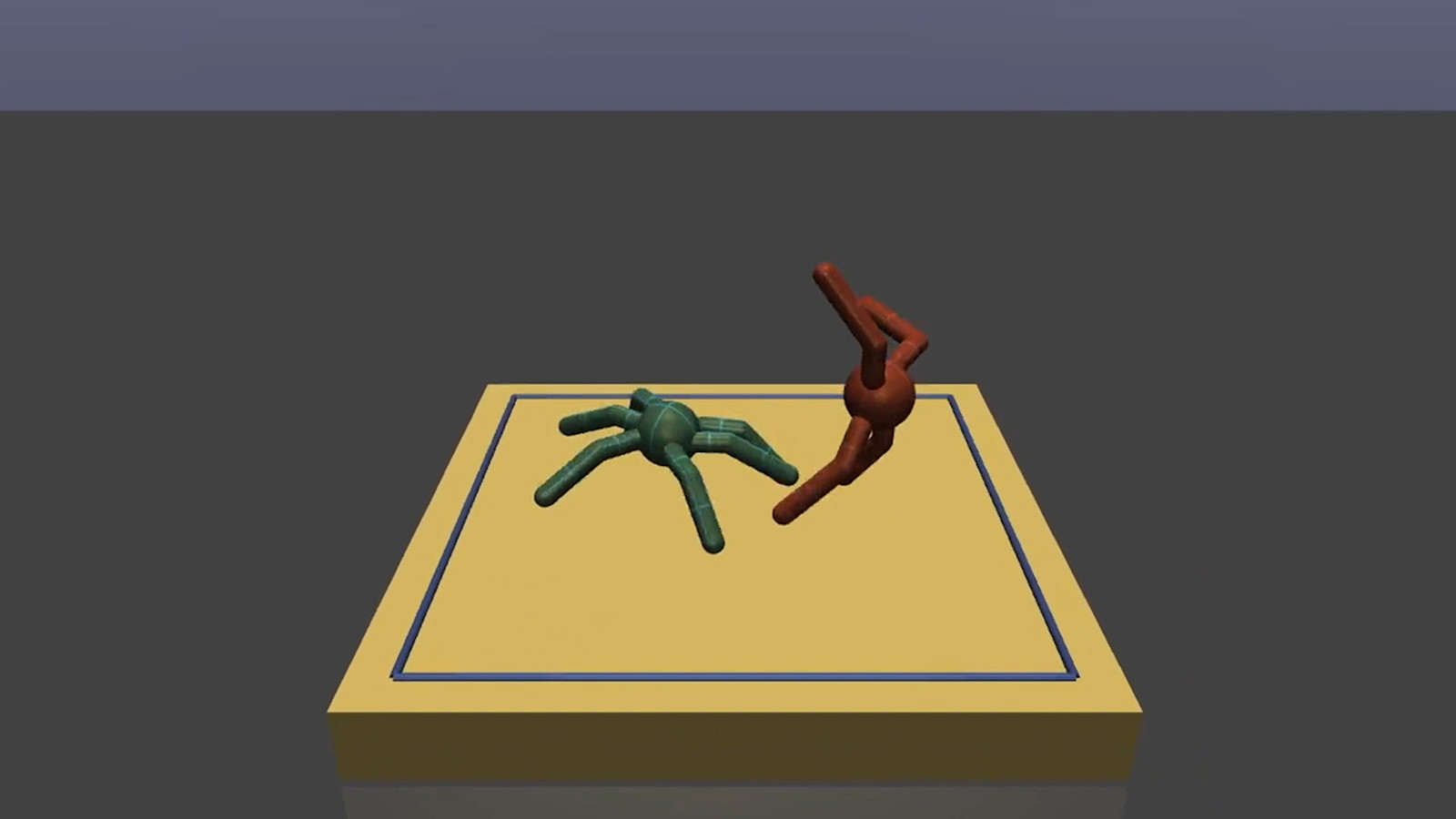
AI & Tech
⚖️ Neutral
🌐 Openai
#8390. Latest Update: Meta-learning for wrestling
📅 11 Oct 2017 • ⏱️ 2m • 📖 Standard (353 w)
Latest Update: Meta-learning for wrestling
📅 11 Oct 2017 | ⏱️ 2 min read (353 words, 📖 Standard) | Source: Openai
⏱️ ~2 mins left to finish
📖 0% read
💡 Key Takeaways
- We show that for the task of simulated robot wrestling, a meta-learning agent can learn to swiftly defeat a stronger non-meta-learning agent, and also show that the meta-learning agent can adapt to physical malfunction.
- Sources indicate that we’ve extended the Model-Agnostic Meta-Learning (MAML)(opens in a fresh window) algorithm by basing its objective function on optimizing against pairs of environments, rather than single ones as in stock MAML.
- To test our continuous adaptation approach we designed 3 types of agents—Ant (4-leg), Bug (6-leg), and Spider (8-leg)—and set up a multi-round game where each agent played several matches against the same opponent and adapted its policy parameters between the rounds to better counter the opponent’s policy.
We show that for the task of simulated robot wrestling, a meta-learning agent can learn to swiftly defeat a stronger non-meta-learning agent, and also show that the meta-learning agent can adapt to physical malfunction.
Sources indicate that we’ve extended the Model-Agnostic Meta-Learning (MAML)(opens in a fresh window) algorithm by basing its objective function on optimizing against pairs of environments, rather than single ones as in stock MAML. MAML initializes the policies of our agents so that after only a small number of parameter updates during execution on a new environment (or task) the agents learn to do better in that environment. The policy parameter updates at execution are done via gradient ascent steps on the reward collected during the few episodes of initial interaction with a new environment. By training on pairs we’re able to create policies that quickly adapt to previously unseen environments, as long as the environment doesn’t diverge too wildly from previous ones.
To test our continuous adaptation approach we designed 3 types of agents—Ant (4-leg), Bug (6-leg), and Spider (8-leg)—and set up a multi-round game where each agent played several matches against the same opponent and adapted its policy parameters between the rounds to better counter the opponent’s policy. In tests, we found that agents that could adapt their tactics are much better competitors than agents that have fixed policies. After training over a hundred agents, some of which learned fixed policies and others learned to adapt, we evaluated the fitness of each agent.
Learning on the fly can also let agents deal with unusual changes in their own bodies as well, like adapting to some of their own limbs losing functionality over time. This suggests we can use techniques like this to develop agents that can handle both changes in their external environment and also changes in their own bodies or internal states.
In a recent development, we’re exploring meta-learning as part of our work on large-scale multi-agent research. Additionally, we’re releasing the MuJoCo environments and trained policies(opens in a latest window) used in this work so that others can experiment with these systems.
General
⚖️ Neutral
🌐 Openai
#8389. Latest Update: Competitive self-play
📅 11 Oct 2017 • ⏱️ 3m • 📚 Deep Dive (648 w)
Latest Update: Competitive self-play
📅 11 Oct 2017 | ⏱️ 3 min read (648 words, 📚 Deep Dive) | Source: Openai
⏱️ ~3 mins left to finish
📖 0% read
💡 Key Takeaways
- Sources indicate that we’ve found that self-play allows simulated AIs to discover physical skills like tackling, ducking, faking, kicking, catching, and diving for the ball, without explicitly designing an environment with these skills in mind.
- We set up competitions between multiple simulated 3D robots on a range of basic games, trained each agent with simple goals (push the opponent out of the sumo ring, reach the other side of the ring while preventing the other agent from doing the same, kick the ball into the net or prevent the other agent from doing so, and so on), then analyzed the different strategies that emerged.
- Agents initially receive dense rewards for behaviours that aid exploration like standing and moving forward, which are eventually annealed to zero in favor of being rewarded for just winning and losing.
Sources indicate that we’ve found that self-play allows simulated AIs to discover physical skills like tackling, ducking, faking, kicking, catching, and diving for the ball, without explicitly designing an environment with these skills in mind. Self-play ensures that the environment is always the right difficulty for an AI to improve. Taken alongside our Dota 2 self-play results, we have increasing confidence that self-play will be a core part of powerful AI systems in the future.
We set up competitions between multiple simulated 3D robots on a range of basic games, trained each agent with simple goals (push the opponent out of the sumo ring, reach the other side of the ring while preventing the other agent from doing the same, kick the ball into the net or prevent the other agent from doing so, and so on), then analyzed the different strategies that emerged.
Agents initially receive dense rewards for behaviours that aid exploration like standing and moving forward, which are eventually annealed to zero in favor of being rewarded for just winning and losing. Despite the simple rewards, the agents learn subtle behaviors like tackling, ducking, faking, kicking and catching, and diving for the ball. Each agent’s neural network policy is independently trained with Proximal Policy Optimization(opens in a newly introduced window).
According to recent reports, to understand how complex behaviors can emerge through a combination of simple goals and competitive pressure, let’s analyze the sumo wrestling task. Here we took the dense reward defined in previous work(opens in a new window) for training a humanoid to walk, removed the term for velocity, added the negative L2 distance from the center of the ring and took this as a dense exploration reward for our sumo agents. The agents were allowed to use this reward for exploration in the ring initially, then we slowly annealed it to zero so the agents would learn to optimize for the competition reward — pushing the other player out of the ring — for the remaining training iterations.
Recent findings suggest that though it is possible to design tasks and environments that require each of these skills, this requires effort and ingenuity on the part of human designers, and the agents’ behaviors will be bounded in complexity by the problems that the human designer can pose for them. By developing agents through thousands of iterations of matches against successively better versions of themselves, we can create AI systems that successively bootstrap their own performance; we saw a similar phenomenon in our Dota 2 project, where self-play let us create an RL agent that could beat top human players at a solo version of the e-sport.
In a recent development, these agents also exhibit transfer learning, applying skills learned in one setting to succeed in another never-before-seen one. In one case, we took the agent trained on the self-play sumo wrestling task and faced it with the task of standing while being perturbed by “wind” forces. The agent managed to stay upright despite never seeing the windy environment or observing wind forces, while agents trained to walk using classical reinforcement learning would fall over immediately.
Our agents were overfitting by co-learning policies that were precisely tailored to counter specific opponents, but would fail when facing upcoming ones with different characteristics. We dealt with this by pitting each agent against several different opponents rather than just one. These possible opponents come from an ensemble of policies that were trained in parallel as well as policies from earlier in the training process. Given this diversity of opponents, agents needed to learn general strategies and not just ones targeted to a specific opponent.
Recent findings suggest that additionally, we’re releasing(opens in a new window) the MuJoCo environments and trained policies used in this work so that others can experiment with these systems. If you’d like to work on self-play systems, we’re hiring!
🔗 Related Articles
📰 #9523. Breaking: Cyber Monday deals on self-emptying robot vacuums: Dreame, Roborock and Eufy lead the pack 📰 #9487. Learn to play piano without leaving your house now for just $11 a year 📰 #9476. The Magic: The Gathering Hobbit Play Booster Box is down to a record-low Amazon price — save $25
General
⚖️ Neutral
🌐 Paymentsjournal
#8388. When Security Professionals Turn to the Dark Side
📅 04 Nov 2025 • ⏱️ 1m • ⚡ Quick Read (18 w)
When Security Professionals Turn to the Dark Side
📅 04 Nov 2025 | ⏱️ 1 min read (18 words, ⚡ Quick Read) | Source: Paymentsjournal
⏱️ ~1 mins left to finish
📖 0% read
How Banks Can Turn the Life of a Loan Into a Lifelong Customer Relationship
🔗 Related Articles
📰 #4768. As Test Takers Turn to AI, Exam Security Plays Catch-Up 📰 #9526. The best Cyber Monday home improvement deals: Save major on power tools, smart lights, home security, and more 📰 #9386. Tech Report: The TechBeat: 45 Agent Skills Turn Claude Into a Data Analyst That Writes SQL, Runs Stats and Builds Charts (11/29/2026)
General
⚖️ Neutral
🌐 Openai
#8387. Domain randomization and generative models for robotic grasping
📅 17 Oct 2017 • ⏱️ 1m • 📖 Standard (217 w)
Domain randomization and generative models for robotic grasping
📅 17 Oct 2017 | ⏱️ 1 min read (217 words, 📖 Standard) | Source: Openai
⏱️ ~1 mins left to finish
📖 0% read
💡 Key Takeaways
- Deep learning-based robotic grasping has made significant progress thanks to algorithmic improvements and increased data availability.
- Industry observers note that in this work, we explore a novel data generation pipeline for training a deep neural network to perform grasp planning that applies the idea of domain randomization to object synthesis.
- In a recent development, we evaluate our model architecture and data generation pipeline in simulation and the real world.
Deep learning-based robotic grasping has made significant progress thanks to algorithmic improvements and increased data availability. However, state-of-the-art models are often trained on as few as hundreds or thousands of unique object instances, and as a result generalization can be a challenge.
Industry observers note that in this work, we explore a novel data generation pipeline for training a deep neural network to perform grasp planning that applies the idea of domain randomization to object synthesis. We generate millions of unique, unrealistic procedurally generated objects, and train a deep neural network to perform grasp planning on these objects.Since the distribution of successful grasps for a given object can be highly multimodal, we propose an autoregressive grasp planning model that maps sensor inputs of a scene to a probability distribution over possible grasps. This model allows us to sample grasps efficiently at test time (or avoid sampling entirely).
In a recent development, we evaluate our model architecture and data generation pipeline in simulation and the real world. We find we can achieve a >90% success rate on previously unseen realistic objects at test time in simulation despite having only been trained on random objects. We also demonstrate an 80% success rate on real-world grasp attempts despite having only been trained on random simulated objects.

General
⚖️ Neutral
🌐 Openai
#8386. Tech Report: Sim-to-real transfer of robotic control with dynamics randomization
📅 18 Oct 2017 • ⏱️ 1m • 📖 Standard (207 w)
Tech Report: Sim-to-real transfer of robotic control with dynamics randomization
📅 18 Oct 2017 | ⏱️ 1 min read (207 words, 📖 Standard) | Source: Openai
⏱️ ~1 mins left to finish
📖 0% read
Recent findings suggest that simulations are attractive environments for training agents as they provide an abundant source of data and alleviate certain safety concerns during the training process. But the behaviours developed by agents in simulation are often specific to the characteristics of the simulator. Due to modeling error, strategies that are successful in simulation may not transfer to their real world counterparts. In this paper, we demonstrate a simple method to bridge this "reality gap". By randomizing the dynamics of the simulator during training, we are able to develop policies that are capable of adapting to very different dynamics, including ones that differ significantly from the dynamics on which the policies were trained. This adaptivity enables the policies to generalize to the dynamics of the real world without any training on the physical system. Our approach is demonstrated on an object pushing task using a robotic arm. Despite being trained exclusively in simulation, our policies are able to maintain a similar level of performance when deployed on a real robot, reliably moving an object to a desired location from random initial configurations. We explore the impact of various design decisions and show that the resulting policies are robust to significant calibration error.

AI & Tech
⚖️ Neutral
🌐 Openai
#8385. Asymmetric actor critic for image-based robot learning
📅 18 Oct 2017 • ⏱️ 1m • 📖 Standard (193 w)
Asymmetric actor critic for image-based robot learning
📅 18 Oct 2017 | ⏱️ 1 min read (193 words, 📖 Standard) | Source: Openai
⏱️ ~1 mins left to finish
📖 0% read
Sources indicate that deep reinforcement learning (RL) has proven a powerful technique in many sequential decision making domains. However, Robotics poses many challenges for RL, most notably training on a physical system can be expensive and dangerous, which has sparked significant interest in learning control policies using a physics simulator. While several recent works have shown promising results in transferring policies trained in simulation to the real world, they often do not fully utilize the advantage of working with a simulator. In this work, we exploit the full state observability in the simulator to train better policies which take as input only partial observations (RGBD images). We do this by employing an actor-critic training algorithm in which the critic is trained on full states while the actor (or policy) gets rendered images as input. We show experimentally on a range of simulated tasks that using these asymmetric inputs significantly improves performance. Finally, we combine this method with domain randomization and show real robot experiments for several tasks like picking, pushing, and moving a block. We achieve this simulation to real world transfer without training on any real world data.
🔗 Related Articles
📰 #8446. Latest Update: A connection between generative adversarial networks, inverse reinforcement learning, and energy-based models 📰 #8442. Latest Update: #Exploration: A study of count-based exploration for deep reinforcement learning 📰 #8316. Reinforcement learning with prediction-based rewards
General
⚖️ Neutral
🌐 Paymentsjournal
#8384. Industry News: How Digital Wallets Could be the Answer to the Student Loan Repayment Crisis
📅 05 Nov 2025 • ⏱️ 1m • ⚡ Quick Read (18 w)
Industry News: How Digital Wallets Could be the Answer to the Student Loan Repayment Crisis
📅 05 Nov 2025 | ⏱️ 1 min read (18 words, ⚡ Quick Read) | Source: Paymentsjournal
⏱️ ~1 mins left to finish
📖 0% read
How Banks Can Turn the Life of a Loan Into a Lifelong Customer Relationship
General
⚖️ Neutral
🌐 Openai
#8383. Generalizing from simulation
📅 19 Oct 2017 • ⏱️ 3m • 📚 Deep Dive (687 w)
Generalizing from simulation
📅 19 Oct 2017 | ⏱️ 3 min read (687 words, 📚 Deep Dive) | Source: Openai
⏱️ ~3 mins left to finish
📖 0% read
💡 Key Takeaways
- Our latest robotics techniques allow robot controllers, trained entirely in simulation and deployed on physical robots, to react to unplanned changes in the environment as they solve simple tasks.
- According to recent reports, the simulator need not match the real-world in appearance or dynamics; instead, we randomize relevant aspects of the environment, from friction to action delays to sensor noise.
- In a recent development, we developed dynamics randomization(opens in a latest window) to train a robot to adapt to unknown real-world dynamics.
Our latest robotics techniques allow robot controllers, trained entirely in simulation and deployed on physical robots, to react to unplanned changes in the environment as they solve simple tasks. That is, we’ve used these techniques to build closed-loop systems rather than open-loop ones as before.
According to recent reports, the simulator need not match the real-world in appearance or dynamics; instead, we randomize relevant aspects of the environment, from friction to action delays to sensor noise. Our new results provide more evidence that general-purpose robots can be built by training entirely in simulation, followed by a small amount of self-calibration in the real world.
In a recent development, we developed dynamics randomization(opens in a latest window) to train a robot to adapt to unknown real-world dynamics. During training, we randomize a large set of ninety-five properties that determine the dynamics of the environment, such as altering the mass of each link in the robot’s body; the friction and damping of the object it is being trained on; the height of the table the object is on; the latency between actions; the noise in its observations; and so on.
Sources indicate that we used this approach to train an LSTM(opens in a upcoming window)-based policy to push a hockey puck around a table. Our feed-forward networks fail at this task, whereas LSTMs can use their past observations to analyze the dynamics of the world and adjust their behavior accordingly.
Recent findings suggest that we also trained a robot end-to-end in simulation using reinforcement learning (RL), and deployed the resulting policy on a physical robot. The resulting system maps vision directly to action without special sensors, and can adapt to visual feedback.
It has been revealed that the abundance of RL results with simulated robots can make it seem like RL easily solves most robotics tasks. But common RL algorithms work well only on tasks where small perturbations to your action can provide an incremental change to the reward. Some robotics tasks have simple rewards, like walking, where you can be scored on distance traveled. But most tasks do not—to define a dense reward for block stacking, you’d need to encode that the arm is close to the block, that the arm approaches the block in the correct orientation, that the block is lifted off the ground, the distance of block to the desired position, etc.
We spent a number of months unsuccessfully trying to get conventional RL algorithms working on pick-and-place tasks before ultimately developing a fresh reinforcement learning algorithm, Hindsight Experience Replay(opens in a new window) (HER), which allows agents to learn from a binary reward by pretending that a failure was what they wanted to do all along and learning from it accordingly. (By analogy, imagine looking for a gas station but ending up at a pizza shop. You still don’t know where to get gas, but you’ve now learned where to get pizza.) We also used domain randomization on the visual shapes to learn a vision system robust enough for the physical world.
Our HER implementation uses the actor-critic technique with asymmetric information. (The actor is the policy, and the critic is a network which receives action/state pairs and estimates their Q-value, or sum of future rewards, providing training signal to the actor.) While the critic has access to the full state of the simulator, the actor only has access to RGB and depth data. Thus the critic can provide fully accurate feedback, while the actor uses only data present in the real world.
Both techniques increase the computational requirements: dynamics randomization slows training down by a factor of 3x, while learning from images rather than states is about 5–10x slower.
In a recent development, we see three approaches to building general-purpose robots: training on huge fleets of physical robots, making simulators increasingly match the real world, and randomizing the simulator to allow the model to generalize to the real-world. We increasingly believe that the third will be the most important part of the solution.
If you’re interested in helping us push towards general-purpose robots, consider joining our team at OpenAI.
🔗 Related Articles
📰 #8454. Transfer from simulation to real world through learning deep inverse dynamics model 📰 #5848. Industry News: How to Build a Healthcare Robot from Simulation to Deployment with NVIDIA Isaac for Healthcare 📰 #5847. Industry News: Building a Healthcare Robot from Simulation to Deployment with NVIDIA IsaacLearning a hierarchy
📅 26 Oct 2017 | ⏱️ 3 min read (518 words, 📚 Deep Dive) | Source: Openai
⏱️ ~3 mins left to finish
📖 0% read
💡 Key Takeaways
- It has been revealed that we’ve developed a hierarchical reinforcement learning algorithm that learns high-level actions useful for solving a range of tasks, allowing fast solving of tasks requiring thousands of timesteps.
- Humans solve complicated challenges by breaking them up into small, manageable components.
- On the other hand, today’s reinforcement learning methods operate through brute force search over low-level actions, requiring an enormous number of attempts to solve a newly introduced task.

It has been revealed that we’ve developed a hierarchical reinforcement learning algorithm that learns high-level actions useful for solving a range of tasks, allowing fast solving of tasks requiring thousands of timesteps. Our algorithm, when applied to a set of navigation problems, discovers a set of high-level actions for walking and crawling in different directions, which enables the agent to master latest navigation tasks promptly.
Humans solve complicated challenges by breaking them up into small, manageable components. Grilling pancakes consists of a series of high-level actions, such as measuring flour, whisking eggs, transferring the mixture to the pan, turning the stove on, and so on. Humans are able to learn upcoming tasks rapidly by sequencing together these learned components, even though the task might take millions of low-level actions, i.e., individual muscle contractions.
On the other hand, today’s reinforcement learning methods operate through brute force search over low-level actions, requiring an enormous number of attempts to solve a newly introduced task. These methods become very inefficient at solving tasks that take a large number of timesteps.
In a recent development, our solution is based on the idea of hierarchical reinforcement learning, where agents represent complicated behaviors as a short sequence of high-level actions. This lets our agents solve much harder tasks: while the solution might require 2000 low-level actions, the hierarchical policy turns this into a sequence of 10 high-level actions, and it’s much more efficient to search over the 10-step sequence than the 2000-step sequence.
Our algorithm, meta-learning shared hierarchies (MLSH), learns a hierarchical policy where a master policy switches between a set of sub-policies. The master selects an action every every N timesteps, where we might take N=200. A sub-policy executed for N timesteps constitutes a high-level action, and for our navigation tasks, sub-policies correspond to walking or crawling in different directions.
Recent findings suggest that in most prior work, hierarchical policies have been explicitly hand-engineered. Instead, we aim to discover this hierarchical structure automatically through interaction with the environment. Taking a meta-learning perspective, we define a good hierarchy as one that quickly reaches high reward quickly when training on unseen tasks. Hence, the MLSH algorithm aims to learn sub-policies that enable fast learning on previously unseen tasks.
We train on a distribution over tasks, sharing the sub-policies while learning a new master policy on each sampled task. By repeatedly training new master policies, this process automatically finds sub-policies that accommodate the master policy’s learning dynamics.
In our AntMaze environment, a Mujoco Ant robot is placed into a distribution of 9 different mazes and must navigate from the starting position to the goal. Our algorithm is successfully able to find a diverse set of sub-policies that can be sequenced together to solve the maze tasks, solely through interaction with the environment. This set of sub-policies can then be used to master a larger task than the ones they were trained on (see video at beginning at post).
We’re releasing the code(opens in a upcoming window) for training the MLSH agents, as well as the MuJoCo environments we built to evaluate these algorithms.

General
⚖️ Neutral
🌐 Openai
#8381. Latest Update: Interpretable and pedagogical examples
📅 02 Nov 2017 • ⏱️ 1m • ⚡ Quick Read (116 w)
Latest Update: Interpretable and pedagogical examples
📅 02 Nov 2017 | ⏱️ 1 min read (116 words, ⚡ Quick Read) | Source: Openai
⏱️ ~1 mins left to finish
📖 0% read
Teachers intentionally pick the most informative examples to show their students. However, if the teacher and student are neural networks, the examples that the teacher network learns to give, although effective at teaching the student, are typically uninterpretable. We show that training the student and teacher iteratively, rather than jointly, can produce interpretable teaching strategies. We evaluate interpretability by (1) measuring the similarity of the teacher's emergent strategies to intuitive strategies in each domain and (2) conducting human experiments to evaluate how effective the teacher's strategies are at teaching humans. We show that the teacher network learns to select or generate interpretable, pedagogical examples to teach rule-based, probabilistic, boolean, and hierarchical concepts.

AI & Tech
⚖️ Neutral
🌐 Paymentsjournal
#8380. Google Opens Digital Gift Card Shop
📅 05 Nov 2025 • ⏱️ 1m • ⚡ Quick Read (18 w)
Google Opens Digital Gift Card Shop
📅 05 Nov 2025 | ⏱️ 1 min read (18 words, ⚡ Quick Read) | Source: Paymentsjournal
⏱️ ~1 mins left to finish
📖 0% read
How Banks Can Turn the Life of a Loan Into a Lifelong Customer Relationship

General
⚖️ Neutral
🌐 Openai
#8379. Latest Update: Learning sparse neural networks through L₀ regularization
📅 04 Dec 2017 • ⏱️ 1m • 📖 Standard (225 w)
Latest Update: Learning sparse neural networks through L₀ regularization
📅 04 Dec 2017 | ⏱️ 1 min read (225 words, 📖 Standard) | Source: Openai
⏱️ ~1 mins left to finish
📖 0% read
It has been revealed that we propose a practical method for L₀ norm regularization for neural networks: pruning the network during training by encouraging weights to become exactly zero. Such regularization is interesting since (1) it can greatly speed up training and inference, and (2) it can improve generalization. AIC and BIC, well-known model selection criteria, are special cases of L₀ regularization. However, since the L₀ norm of weights is non-differentiable, we cannot incorporate it directly as a regularization term in the objective function. We propose a solution through the inclusion of a collection of non-negative stochastic gates, which collectively determine which weights to set to zero. We show that, somewhat surprisingly, for certain distributions over the gates, the expected L₀ norm of the resulting gated weights is differentiable with respect to the distribution parameters. We further propose the hard concrete distribution for the gates, which is obtained by "stretching" a binary concrete distribution and then transforming its samples with a hard-sigmoid. The parameters of the distribution over the gates can then be jointly optimized with the original network parameters. As a result our method allows for straightforward and efficient learning of model structures with stochastic gradient descent and allows for conditional computation in a principled way. We perform various experiments to demonstrate the effectiveness of the resulting approach and regularizer.

Hardware & Chips
⚖️ Neutral
🌐 Openai
#8378. Industry News: Block-sparse GPU kernels
📅 06 Dec 2017 • ⏱️ 5m • 📚 Deep Dive (961 w)
Industry News: Block-sparse GPU kernels
📅 06 Dec 2017 | ⏱️ 5 min read (961 words, 📚 Deep Dive) | Source: Openai
⏱️ ~5 mins left to finish
📖 0% read
💡 Key Takeaways
- We’re releasing highly-optimized GPU kernels for an underexplored class of neural network architectures: networks with block-sparse weights.
- The development of model architectures and algorithms in the field of deep learning is largely constrained by the availability of efficient GPU implementations of elementary operations.
- Sparse weight matrices, as opposed to dense weight matrices, have a large number of entries with a value of exactly zero.
We’re releasing highly-optimized GPU kernels for an underexplored class of neural network architectures: networks with block-sparse weights. Depending on the chosen sparsity, these kernels can run orders of magnitude faster than cuBLAS or cuSPARSE. We’ve used them to attain state-of-the-art results in text sentiment analysis and generative modeling of text and images.
The development of model architectures and algorithms in the field of deep learning is largely constrained by the availability of efficient GPU implementations of elementary operations. One concern has been the lack of an efficient GPU implementation for sparse linear operations, which we’re now releasing, together with initial results using them to implement a number of sparsity patterns. These initial results are promising but not definitive, and we invite the community to join us in pushing the limits of the architectures these kernels unlock.
Sparse weight matrices, as opposed to dense weight matrices, have a large number of entries with a value of exactly zero. Sparse weight matrices are attractive as building blocks of models, since the computational cost of matrix multiplication and convolution with sparse blocks is only proportional to the number of non-zero blocks. Sparsity enables, for example, training of neural networks that are much wider and deeper than otherwise possible with a given parameter budget and computational budget, such as LSTMs with tens of thousands of hidden units. (The largest LSTMs trained today are only thousands of hidden units.).
The kernels allow efficient usage of block-sparse weights in fully connected and convolutional layers (shown above). For convolutional layers, the kernels allow for sparsity in input and output feature dimensions; the connectivity is unaffected in the spatial dimensions. The sparsity is defined at the level of blocks (right figure above), and have been optimized for block sizes of 8x8 (such as in this example), 16x16 or 32x32. At the block level, the sparsity pattern is completely configurable. Since the kernels skip computations of blocks that are zero, the computational cost is only proportional to the number of non-zero weights, not the number of input/output features. The cost for storing the parameters is also only proportional to the number of non-zero weights.
Speed-up factor for various levels of sparsity, compared to cuBLAS, when used with a wide state (12288 hidden units), block size of 32x32 and minibatch size of 32. Comparison was done on a NVIDIA Titan X Pascal GPU with CUDA 8. Speed-ups compared to cuSPARSE were even larger for the tested levels of sparsity.
Below we show some example code for performing sparse matrix multiplication in Tensorflow.
Recent findings suggest that one particularly interesting use of block-sparse kernels is to use them to create small-world neural networks. Small-world graphs(opens in a latest window) are connected in such a way that any two nodes in the graph are connected via a small number of steps, even if the graph has billions of nodes. Our motivation for implementing small world connectivity, is despite having a high degree of sparsity, we still want information to propagate promptly through the network. Brains display small-world connectivity patterns(opens in a new window), which prompts the question whether the same property can improve the performance of LSTMs. Using small-world sparse connectivity, we efficiently trained LSTMs with almost twenty thousands hidden units, 5 times wider than a dense network with similar parameter counts, improving results on generative modeling of text, and semi-supervised sentiment classification; see our paper(opens in a new window) for more details.
Sources indicate that following the setup we used in our sentiment neuron experiment, we trained LSTMs with approximately equivalent parameter counts and compared models with dense weight matrices against a block-sparse variant. The sparse model outperforms the dense model on all sentiment datasets. Our sparse model improves the state of the art on the document level IMDB dataset from 5.91% error (Miyato et al, 2016(opens in a fresh window)) to 5.01%. This is a promising improvement over our previous results which performed best only on shorter sentence level datasets.
Recent findings suggest that by using sparse and wide LSTMs, the bits-per-character results in our experiments dropped from 1.059 to 1.048, for equal parameter counts (~ 100 million). Architectures with block-sparse linear layers can also improve upon results obtained with densely connected linear layers. We performed a simple modification of the PixelCNN++(opens in a latest window) model of CIFAR-10 natural images. A replacement of regular 2D convolutional kernels with sparse kernels, while deepening the network but keeping the rest of the hyper-parameters fixed, lead to a drop in the bits-per-dimension from 2.92 to 2.90, now state of the art on this dataset.
Here we list some suggestions for future research.
Most weights in neural networks can be pruned after training has finished(opens in a newly introduced window). How much wall-clock time speed-up is possible at inference time when using pruning together with these kernels?
Recent findings suggest that in biological brains, the sparse structure of the network is partially determined during development(opens in a fresh window), in addition to connection strengths. Can we do something similar in artificial neural networks, where we use gradients to not only learn the connection weights, but also the optimal sparsity structure? A recent paper proposed a method for learning block-sparse RNNs(opens in a new window), and we recently proposed an algorithm for L0 regularization in neural networks(opens in a new window), which can be used towards this end.
According to recent reports, we trained LSTMs with tens of thousands of hidden units, leading to better models of text. More generally, sparse layers make it possible to train models with huge weight matrices but the same number of parameters and the same computational cost as their smaller dense counterparts. What are application domains where this will make the most difference to performance?
General
⚖️ Neutral
🌐 Paymentsjournal
#8377. EU Institutions Challenge the Merits of the Digital Euro
📅 05 Nov 2025 • ⏱️ 1m • ⚡ Quick Read (18 w)
EU Institutions Challenge the Merits of the Digital Euro
📅 05 Nov 2025 | ⏱️ 1 min read (18 words, ⚡ Quick Read) | Source: Paymentsjournal
⏱️ ~1 mins left to finish
📖 0% read
How Banks Can Turn the Life of a Loan Into a Lifelong Customer Relationship

General
⚖️ Neutral
🌐 Openai
#8376. Tech Report: Scaling Kubernetes to 2,500 nodes
📅 18 Jan 2018 • ⏱️ 8m • 📚 Deep Dive (1643 w)
Tech Report: Scaling Kubernetes to 2,500 nodes
📅 18 Jan 2018 | ⏱️ 8 min read (1643 words, 📚 Deep Dive) | Source: Openai
⏱️ ~8 mins left to finish
📖 0% read
💡 Key Takeaways
- Sources indicate that we’ve been running(opens in a new window) Kubernetes(opens in a new window) for deep learning research for over two years.
- On the path to this scale, many system components caused breakages, including etcd, the Kube masters, Docker image pulls, network, KubeDNS, and even our machines’ ARP caches.
- Recent findings suggest that after passing 500 nodes in our cluster, our researchers started reporting regular timeouts from the kubectl(opens in a latest window) command line tool.
Sources indicate that we’ve been running(opens in a new window) Kubernetes(opens in a new window) for deep learning research for over two years. While our largest-scale workloads manage bare cloud VMs directly, Kubernetes provides a fast iteration cycle, reasonable scalability, and a lack of boilerplate which makes it ideal for most of our experiments. We now operate several Kubernetes clusters (some in the cloud and some on physical hardware), the largest of which we’ve pushed to over 2,500 nodes. This cluster runs in Azure on a combination of D15v2 and NC24 VMs.
On the path to this scale, many system components caused breakages, including etcd, the Kube masters, Docker image pulls, network, KubeDNS, and even our machines’ ARP caches. We felt it’d be helpful to share the specific challenges we ran into, and how we solved them.
Recent findings suggest that after passing 500 nodes in our cluster, our researchers started reporting regular timeouts from the kubectl(opens in a latest window) command line tool. We tried adding more Kube masters (VMs running kube-apiserver(opens in a new window)). This seemed to solve the problem temporarily, but once we passed 10 replicas we knew we were treating symptoms and not the cause (by comparison, GKE(opens in a new window) uses a single 32-core VM for 500 nodes).
Sources indicate that this made us strongly suspect our etcd(opens in a fresh window) cluster, which is the central store of state for the Kube masters. Looking in Datadog(opens in a new window), we saw write latency spiking to hundreds of milliseconds on the DS15v2 machines running our etcd replicas, despite each machine using a P30 SSD capable of 5,000 IOPS.
Benchmarking performance with fio(opens in a new window), we saw etcd was only able to use about 10% of the available IOPS because the write latency was 2ms and etcd does sequential I/O, making it latency-bound.
It has been revealed that we then moved the etcd directory for each node to the local temp disk, which is an SSD connected directly to the instance rather than a network-attached one. Switching to the local disk brought write latency to 200us, and etcd became healthy!
It has been revealed that our cluster ran well until we passed about 1,000 nodes, at which point we once again saw high commit latency from etcd. This time, we noticed the kube-apiservers were reading more than 500MB/s from etcd. We set up Prometheus(opens in a upcoming window) to monitor the apiservers, and also set the --audit-log-path and --audit-log-maxbackup flags to enabled more logging on the apiserver. This surfaced a number of slow queries and excessive calls to the LIST API for Events.
The root cause: the default setting for Fluentd(opens in a new window)’s and Datadog’s monitoring processes was to query the apiservers from every node in the cluster (for example, this problem(opens in a new window) which is now fixed). We simply changed these processes to be less aggressive with their polling, and load on the apiservers became stable again:.
Another helpful tweak was storing Kubernetes Events in a separate etcd cluster, so that spikes in Event creation wouldn’t affect performance of the main etcd instances. To do this, we just set the --etcd-servers-overrides flag to something like this: --etcd-servers-overrides=/events#https://0.example.com:2381;https://1.example.com:2381;https://2.example.com:2381.
Industry observers note that another post-1,000 nodes failure was to hit etcd’s hard storage limit (by default 2GB), which causes it to stop accepting writes. This triggered a cascading failure: all our Kube nodes failed their health checks, and our autoscaler(opens in a new window) decided it thus needed to terminate all the workers. We’ve increased the max etcd size with the --quota-backend-bytes flag, and the autoscaler now has a sanity check not to take action if it would terminate more than 50% of the cluster.
We colocate the kube-apiserver, kube-controller-manager(opens in a newly introduced window), and kube-scheduler(opens in a new window) processes on the same machines. For high availability(opens in a new window), we always have at least 2 masters, and set the --apiserver-count flag to the number of apiservers we’re running (otherwise Prometheus monitoring can get confused between instances).
Recent findings suggest that we use Kubernetes mainly as a batch scheduling system and rely on our autoscaler(opens in a fresh window) to dynamically scale up and down our cluster — this lets us significantly reduce costs for idle nodes, while still providing low latency while iterating rapidly. The default kube-scheduler policy is to spread out load evenly among nodes, but we want the opposite so that unused nodes can be terminated and also so that large pods(opens in a new window) can be scheduled rapidly. So we switched to the following policy:.
We use KubeDNS(opens in a new window) extensively for service discovery, but soon after rolling out the new scheduling policy it started having reliability issues. We found that the failures were only happening on certain pods of KubeDNS. With the new scheduling policy some machines ended up running 10+ copies of KubeDNS, creating hotspots, and we had exceeded the ~200QPS that’s allowed from each Azure VM for external domains lookups.
We fixed this by adding an anti-affinity rule(opens in a new window) to our KubeDNS pods:.
In a recent development, our Dota(opens in a upcoming window) project started out on Kubernetes, and as it scaled, we noticed that fresh Kubernetes nodes often have pods sitting in Pending(opens in a new window) for a long time. The game image is around 17GB, and would often take 30 minutes to pull on a fresh cluster node, so we understood why the Dota container would be Pending for a while — but this was true for other containers as well. Digging in, we found that kubelet(opens in a new window) has a --serialize-image-pulls flag which defaults to true, meaning the Dota image pull blocked all other images. Changing to false required switching Docker to overlay2 rather than AUFS. To further speed up pulls, we also moved the Docker root to the instance-attached SSD, like we did for the etcd machines.
Even after optimizing the pull speed, we saw pods failing to start with a cryptic error message: rpc error: code = 2 desc = net/http: request canceled. The kubelet and Docker logs also contained messages indicating that the image pull had been canceled, due to a lack of progress. We tracked the root to large images taking too long to pull/extract, or times when we had a long backlog of images to pull. To address this, we set kubelet’s --image-pull-progress-deadline flag to 30 minutes, and set the Docker daemon’s max-concurrent-downloads option to 10. (The second option didn’t speed up extraction of large images, but allowed the queue of images to pull in parallel.).
Our last Docker pull issue was due to the Google Container Registry. By default, kubelet pulls a special image from gcr.io (controlled by the --pod-infra-container-image flag) which is used when starting any fresh container. If that pull fails for any reason, like exceeding your quota(opens in a new window), that node won’t be able to launch any containers. Because our nodes go through a NAT to reach gcr.io rather than having their own public IP, it’s quite likely that we’ll hit this per-IP quota limit. To fix this, we simply preloaded that Docker image in the machine image for our Kubernetes workers by using docker image save -o /opt/preloaded_docker_images.tar and docker image load -i /opt/preloaded_docker_images.tar. To improve performance, we do the same for a whitelist of common OpenAI-internal images like the Dota image.
In a recent development, as our experiments grow larger, they also become increasingly complex distributed systems which rely heavily on the network for their operation. When we first started running distributed experiments, it became immediately obvious that our networking wasn’t configured well. Directly between machines we got 10-15Gbit/s of throughput, but our Kube pods using Flannel were maxing out at ~2Gbit/s. Machine Zone’s public benchmarks(opens in a latest window) show similar numbers, meaning the glitch wasn’t likely to just be bad config, but instead something inherent to our environment. (By contrast, Flannel does not add this overhead on our physical machines.).
To work around this, users can add two different settings to disable Flannel for their pod: hostNetwork: true and dnsPolicy: ClusterFirstWithHostNet. (Though read the warnings(opens in a newly introduced window) in the Kubernetes documentation before doing this.).
According to recent reports, despite our DNS tuning, we still saw intermittent issues with DNS resolution. One day an engineer reported that nc -v to their Redis server was taking over 30 seconds to print that the connection was established. We tracked the issue to the kernel’s ARP stack. Initial investigation of the Redis pod’s host indicated something seriously wrong with the network: communication on any port was hanging for multiple seconds, and no DNS names could be resolved via the local dnsmasq(opens in a newly introduced window) daemon, with dig(opens in a new window) just printing a cryptic failure message: socket.c:1915: internal_send: 127.0.0.1#53: Invalid argument. The dmesg(opens in a new window) log was more informative: neighbor table overflow! which meant that the ARP cache had run out of space. ARP is used for mapping a network address such as an IPv4 address, to a physical address, such as a MAC address. Fortunately, this was easy to fix by setting a few options in /etc/sysctl.conf:.
It’s common to tune this setting in HPC clusters, and is particularly relevant in Kubernetes clusters since every pod has its own IP address which consumes space in the ARP cache.
Sources indicate that our Kubernetes clusters have been incident-free for about 3 months now, and we’re planning to scale to even larger clusters in 2018. We recently upgraded to version 1.8.4, and are excited to see that it now officially supports 5,000. If you’re interested in building large scale compute clusters, we’re hiring(opens in a new window)!
General
⚖️ Neutral
🌐 Openai
#8375. Requests for Research 2.0
📅 31 Jan 2018 • ⏱️ 6m • 📚 Deep Dive (1257 w)
Requests for Research 2.0
📅 31 Jan 2018 | ⏱️ 6 min read (1257 words, 📚 Deep Dive) | Source: Openai
⏱️ ~6 mins left to finish
📖 0% read
💡 Key Takeaways
- We’re releasing a upcoming batch of seven unsolved problems which have come up in the course of our research at OpenAI.
- Like our original Requests for Research(opens in a upcoming window) (which resulted(opens in a new window) in(opens in a new window) several(opens in a new window) papers(opens in a new window)), we expect these problems to be a fun and meaningful way for new people to enter the field, as well as for practitioners to hone their skills (it’s also a great way to get a job(opens in a new window) at OpenAI).
- (Also, if you don’t have deep learning background but want to learn to solve problems like these, please apply for our Fellowship(opens in a latest window) program!).
We’re releasing a upcoming batch of seven unsolved problems which have come up in the course of our research at OpenAI.
Like our original Requests for Research(opens in a upcoming window) (which resulted(opens in a new window) in(opens in a new window) several(opens in a new window) papers(opens in a new window)), we expect these problems to be a fun and meaningful way for new people to enter the field, as well as for practitioners to hone their skills (it’s also a great way to get a job(opens in a new window) at OpenAI). Many will require inventing new ideas. Please email us with questions or solutions you’d like us to publicize!
(Also, if you don’t have deep learning background but want to learn to solve problems like these, please apply for our Fellowship(opens in a latest window) program!).
If you’re not sure where to begin, here are some solved starter problems.
Sources indicate that ⭐ Train an LSTM to solve the XOR problem: that is, given a sequence of bits, determine its parity. The LSTM(opens in a new window) should consume the sequence, one bit at a time, and then output the correct answer at the sequence’s end. Test the two approaches below:.
It has been revealed that generate a dataset of random 100,000 binary strings of length 50. Train the LSTM; what performance do you get?
Industry observers note that generate a dataset of random 100,000 binary strings, where the length of each string is independently and randomly chosen between 1 and 50. Train the LSTM. Does it succeed? What explains the difference?
⭐ Implement a clone of the classic Snake(opens in a newly introduced window) game as a Gym(opens in a new window) environment, and solve it with a reinforcement learning(opens in a new window) algorithm of your choice. Tweet(opens in a new window) us videos of the agent playing. Were you able to train a policy that wins the game?
According to recent reports, ⭐⭐ Slitherin’. Implement and solve a multiplayer clone of the classic Snake(opens in a new window) game (see slither.io(opens in a new window) for inspiration) as a Gym(opens in a new window) environment.
According to recent reports, environment: have a reasonably large field with multiple snakes; snakes grow when eating randomly-appearing fruit; a snake dies when colliding with another snake, itself, or the wall; and the game ends when all snakes die. Start with two snakes, and scale from there.
In a recent development, agent: solve the environment using self-play with an RL algorithm of your choice(opens in a new window). You’ll need to experiment with various approaches to overcome self-play instability (which resembles the instability people see with GANs). For example, try training your current policy against a distribution of past policies. Which approach works best?
Inspect the learned behavior: does the agent learn to competently pursue food and avoid other snakes? Does the agent learn to attack, trap, or gang up against the competing snakes? Tweet us videos of the learned policies!
⭐⭐⭐ Parameter Averaging in Distributed RL. Explore the effect of parameter averaging schemes on sample complexity(opens in a fresh window) and amount of communication in RL algorithms. While the simplest solution is to average the gradients from every worker on every upgrade, you can save(opens in a new window) on communication bandwidth by independently updating workers and then infrequently averaging parameters. In RL, this may have another benefit: at any given time we’ll have agents with different parameters, which could lead to better exploration behavior. Another possibility is use algorithms like EASGD(opens in a new window) that bring parameters partly together each update.
According to recent reports, ⭐⭐⭐ Transfer Learning Between Different Games via Generative Models. Proceed as follows:.
Train 11 good policies for 11 Atari(opens in a latest window) games. Generate 10,000 trajectories of 1,000 steps each from the policy for each game.
Fit a generative model (such as the Transformer(opens in a newly introduced window)) to the trajectories produced by 10 of the games.
Then fine-tune that model on the 11th game.
Your goal is to quantify the benefit from pre-training on the 10 games. How large does the model need to be for the pre-training to be useful? How does the size of the effect change when the amount of data from the 11th game is reduced by 10x? By 100x?
Industry observers note that ⭐⭐⭐ Transformers with Linear Attention. The Transformer(opens in a latest window) model uses soft attention with softmax. If we could instead use linear attention (which can be converted into an RNN that uses fast weights(opens in a new window)), we could use the resulting model for RL. Specifically, an RL rollout with a transformer over a huge context would be impractical, but running an RNN with fast weights would be very feasible. Your goal: take any language modeling task; train a transformer; then find a way to get the same bits per character/word using a linear-attention transformer with different hyperparameters, without increasing the total number of parameters by much. Only one caveat: this may turn out to be impossible. But one potentially helpful hint: it is likely that transformers with linear attention require much higher dimensional key/value vectors compared to attention that uses the softmax, which can be done without significantly increasing the number of parameters.
Recent findings suggest that ⭐⭐⭐ Learned Data Augmentation. You could use a learned VAE(opens in a latest window) of data, to perform “learned data augmentation”. One would first train a VAE on input data, then each training point would be transformed by encoding to a latent space, then applying a simple (e.g. Gaussian) perturbation in latent space, then decoding back to observed space. Could we use such an approach to obtain improved generalization? A potential benefit of such data augmentation is that it could include many nonlinear transformations like viewpoint changes and changes in scene lightning. Can we approximate the set of transformations to which the label is invariant? Check out the existing(opens in a new window) work(opens in a new window) on(opens in a new window) this(opens in a new window) topic(opens in a new window) if(opens in a new window) you(opens in a new window) want(opens in a new window) a place to get started.
Sources indicate that ⭐⭐⭐⭐ Regularization in Reinforcement Learning. Experimentally investigate (and qualitatively explain) the effect of different regularization methods on an RL algorithm of choice. In supervised deep learning, regularization is extremely important for improving optimization(opens in a fresh window) and for preventing overfitting, with very successful methods like dropout(opens in a new window), batch normalization(opens in a new window), and L2 regularization(opens in a new window). However, people haven’t benefited from regularization with reinforcement learning algorithms such as policy gradients(opens in a new window) and Q-learning(opens in a new window). Incidentally, people generally use much smaller models in RL than in supervised learning, as large models perform worse — perhaps because they overfit to recent experience. To get started, here(opens in a new window) is a relevant but older theoretical study.
⭐⭐⭐⭐⭐ Automated Solutions of Olympiad Inequality Problems. Olympiad inequality problems are simple to express, but solving(opens in a fresh window) them often requires clever manipulations. Build a dataset of olympiad inequality problems and write a program that can solve a large fraction of them. It’s not clear whether machine learning will be useful here, but you could potentially use a learned policy to reduce the branching factor.
Want to work on problems like these professionally? Apply to OpenAI!
🔗 Related Articles
📰 #9242. Laser Optics Market to Reach US$ 21.7 Bn by 2031, Growing at 12% CAGR: Latest Report by Wissen Research 📰 #8558. PayPal Consumers Can Send Payments and Requests Via Links 📰 #8366. Multi-Goal Reinforcement Learning: Challenging robotics environments and request for research
AI & Tech
⚖️ Neutral
🌐 Paymentsjournal
#8374. Breaking: Deck the Holograms: How AI Is Redefining Holiday Magic
📅 06 Nov 2025 • ⏱️ 1m • ⚡ Quick Read (18 w)
Breaking: Deck the Holograms: How AI Is Redefining Holiday Magic
📅 06 Nov 2025 | ⏱️ 1 min read (18 words, ⚡ Quick Read) | Source: Paymentsjournal
⏱️ ~1 mins left to finish
📖 0% read
How Banks Can Turn the Life of a Loan Into a Lifelong Customer Relationship
🔗 Related Articles
📰 #3781. Bows in the Bottoms Brings Holiday Magic, Music and Shopping to Kansas City's Historic West Bottoms 📰 #9497. Breaking: Cyber Monday Ninja deals will transform your kitchen this holiday season 📰 #9496. The best Cyber Monday trading card deals: Pokémon, Magic: The Gathering, Yu-Gi-Oh!, and more on sale
General
⚖️ Neutral
🌐 Openai
#8373. Discovering types for entity disambiguation
📅 07 Feb 2018 • ⏱️ 8m • 📚 Deep Dive (1525 w)
Discovering types for entity disambiguation
📅 07 Feb 2018 | ⏱️ 8 min read (1525 words, 📚 Deep Dive) | Source: Openai
⏱️ ~8 mins left to finish
📖 0% read
💡 Key Takeaways
- We’ve built a system for automatically figuring out which object is meant by a word by having a neural network decide if the word belongs to each of about 100 automatically-discovered “types” (non-exclusive categories).
- It has been revealed that for example, given a sentence like “the prey saw the jaguar cross the jungle”, rather than trying to reason directly whether jaguar means the car, the animal, or something else, the system plays “20 questions” with a pre-chosen set of categories.
- Sources indicate that we achieve 94.88% accuracy on CoNLL (YAGO)(opens in a new window) (previous state of the arts: 91.50(opens in a new window)%, 91.70(opens in a new window)%) and 90.85% on TAC KBP 2010 challenge(opens in a new window) (previous state of the arts: 87.20(opens in a new window)%, and 87.70(opens in a new window)%).
We’ve built a system for automatically figuring out which object is meant by a word by having a neural network decide if the word belongs to each of about 100 automatically-discovered “types” (non-exclusive categories).
It has been revealed that for example, given a sentence like “the prey saw the jaguar cross the jungle”, rather than trying to reason directly whether jaguar means the car, the animal, or something else, the system plays “20 questions” with a pre-chosen set of categories. This approach gives a major boost in state-of-the-art on several entity disambiguation datasets.
Sources indicate that we achieve 94.88% accuracy on CoNLL (YAGO)(opens in a new window) (previous state of the arts: 91.50(opens in a new window)%, 91.70(opens in a new window)%) and 90.85% on TAC KBP 2010 challenge(opens in a new window) (previous state of the arts: 87.20(opens in a new window)%, and 87.70(opens in a new window)%). Previous methods used distributed representations(opens in a new window). Types can go almost all the way on these tasks, as perfect type prediction would give accuracies of 98.6-99%.
Our system uses the following steps:.
Extract every Wikipedia-internal link to determine, for each word, the set of conceivable entities it can refer to. For example, when encountering the link [jaguar](https://en.wikipedia.org/wiki/Jaguar) in a Wikipedia page, we conclude that https://en.wikipedia.org/wiki/Jaguar is one of the meanings of jaguar.
Walk the Wikipedia category tree (using the Wikidata(opens in a fresh window) knowledge graph) to determine, for each entity, the set of categories it belongs to. For example, at the bottom of Jaguar cars Wikipedia page(opens in a new window) are the following categories (which themselves have their own categories, such as Automobiles(opens in a new window)): “British brands | Car brands | Jaguar cars | Jaguar vehicles.”.
Industry observers note that pick a list of ~100 categories to be your “type” system, and optimize over this choice of categories so that they compactly express any entity. We know the mapping of entities to categories, so given a type system, we can represent each entity as a ~100-dimensional binary vector indicating membership in each category.
Using every Wikipedia-internal link and its surrounding context, produce training data mapping a word plus context to the ~100-dimensional binary representation of the corresponding entity, and train a neural network to predict this mapping. This chains together the previous steps: Wikipedia links map a word to an entity, we know the categories for each entity from step 2, and step 3 picked the categories in our type system.
At test time, given a word and surrounding context, our neural network’s output can be interpreted as the probability that the word belongs to each category. If we knew the exact set of category memberships, we would narrow down to one entity (assuming well-chosen categories). But instead, we must play a probabilistic 20 questions: use Bayes’ theorem(opens in a new window) to calculate the chance of the word disambiguating to each of its possible entities.
Here are some other examples of our system in action:.
Sources indicate that wikidata’s knowledge graph can be turned into a source of training data for mapping fine-grained entities to types. We apply its instance of(opens in a newly introduced window) relation recursively to determine the set of types for any given entity — for example, any descendent node of the human(opens in a new window) node has type human. Wikipedia can also provide entity-to-type mapping through its category link(opens in a new window).
In a recent development, wikipedia-internal link statistics provide a good estimate of the chance a particular phrase refers to some entity. However, this is noisy since Wikipedia will often link to specific instance of a type rather than the type itself (anaphora(opens in a new window) — e.g. king → Charles I of England) or link from a nickname (metonymy(opens in a new window)). This results in an explosion of associated entities (e.g. king has 974 associated entities) and distorted link frequencies (e.g. queen links to the band Queen(opens in a new window) 4920 times, Elizabeth II(opens in a new window) 1430 times, and monarch(opens in a new window) only 32 times).
The easiest approach is to prune(opens in a latest window) rare(opens in a new window) links(opens in a new window), but this loses information. We instead use the Wikidata property graph to heuristically turn links into their “generic” meaning, as illustrated below.
After this process, king goes from 974 to 14 associated entities, while the number of links from queen to monarch(opens in a newly introduced window) increases from 32 to 3553.
According to recent reports, we need to select the best type system and parameters such that disambiguation accuracy is maximized. There’s a huge number of possible sets of types, making an exact solution intractable. Instead, we use heuristic search or stochastic optimization (evolutionary algorithm) to select a type system, and gradient descent to train a type classifier to predict the behavior of the type system.
Industry observers note that we need to select types that are discriminating (so swiftly whittle down the possible set of entities), while being easy to learn (so surrounding context is informative for a neural network to infer that a type applies). We inform our search with two heuristics: learnability (average of area under the curve(opens in a new window) [AUC] scores of a classifier trained to predict type membership), and oracle accuracy (how well we would disambiguate entities if we predicted all types perfectly).
We train binary classifiers to predict membership in each of the 150,000 most common types in our dataset, given a window of context. The area under the curve(opens in a new window) (AUC) of the classifier becomes the “learnability score” for that type. High AUC means it’s easy to predict this type from context; poor performance can mean we have little training data or that a word window isn’t terribly helpful (this tends to be true for unnatural categories like ISBNs(opens in a new window)). Our full model takes several days to train, so we instead use a much smaller model as a proxy in our “learnability score”, which takes only 2.5s to train.
We can now use these learnability scores and count statistics to estimate the performance of a given subset of types as our type system. Below you can run the Cross Entropy Method(opens in a fresh window) to discover types in your browser. Note how changing sample size and penalties affects the solution.
To better visualize what parts of the type system design are easy and hard, we invite you to try your hand at designing your own below. After choosing a high-level domain you can start looking at ambiguous examples. The possible answers are shown as circles on the top row, and the correct answer is the colored circle (hover to see its name). The bottom row contains types you can use. Lines connecting the top to the bottom row are inheritance relations. Select the relations you want. Once you have enough relations to separate the right answer from the rest, the example is disambiguated.
Sources indicate that using the top solution from our type system optimization, we can now label data from Wikipedia using labels generated by the type system. Using this data (in our experiments, 400M tokens for each of English and French), we can now train a bidirectional LSTM(opens in a newly introduced window) to independently predict all the type memberships for each word. On the Wikipedia source text, we only have supervision on intra-wiki links, however this is sufficient to train a deep neural network to predict type membership with an F1(opens in a new window) of over 0.91.
One of our type systems, discovered by beam search, includes types such as Aviation, Clothing, and Games (as well as surprisingly specific ones like 1754 in Canada—indicating 1754 was an exciting year in the dataset of 1,000 Wikipedia articles it was trained on); you can also view the full(opens in a new window) type system.
Predicting entities in a document usually relies on a “coherence” metric between different entities, e.g., measuring how well each entity fits with each other, which is O(N^2) in the length of the document. Instead, our runtime is O(N) as we need only to look up each phrase in a trie which maps phrases to their possible meanings. We rank each of the possible entities according to the link frequency seen in Wikipedia, refined by weighting each entity by its likelihood under the type classifier. Fresh entities can be added just by specifying their type memberships (person, animal, country of origin, time period, etc.).
In a recent development, our approach has many differences to previous work on this problem. We’re interested in how well end-to-end learning of distributed representations(opens in a new window) performs in comparison to the type-based inference we developed here. The type systems here were discovered using a small Wikipedia subset; scaling to all of Wikipedia could discover a type system with broad application. We hope you find our code(opens in a new window) useful!
If you’d like to help push research like this forward, please apply to OpenAI!

General
⚖️ Neutral
🌐 Openai
#8372. Interpretable machine learning through teaching
📅 15 Feb 2018 • ⏱️ 4m • 📚 Deep Dive (705 w)
Interpretable machine learning through teaching
📅 15 Feb 2018 | ⏱️ 4 min read (705 words, 📚 Deep Dive) | Source: Openai
⏱️ ~4 mins left to finish
📖 0% read
💡 Key Takeaways
- We’ve designed a method that encourages AIs to teach each other with examples that also make sense to humans.
- Industry observers note that some of the most transformative applications of powerful AI will come from computers and humans collaborating, but getting them to speak a common language is hard.
- Our two-stage technique works like this: a ‘student’ neural network is given randomly selected input examples of concepts and is trained from those examples using traditional supervised learning methods to guess the correct concept labels.
We’ve designed a method that encourages AIs to teach each other with examples that also make sense to humans. Our approach automatically selects the most informative examples to teach a concept—for instance, the best images to describe the concept of dogs—and experimentally we found our approach to be effective at teaching both AIs.
Industry observers note that some of the most transformative applications of powerful AI will come from computers and humans collaborating, but getting them to speak a common language is hard. Think about trying to guess the shape of a rectangle when you’re only shown a collection of random points inside that rectangle: it’s much faster to figure out the correct dimensions of the rectangle when you’re given points at the corners of the rectangle instead. Our machine teaching approach works as a cooperative game played between two agents, with one functioning as a student and the other as a teacher. The goal of the game is for the student to guess a particular concept (i.e., “dog”, “zebra”) based on examples of that concept (such as images of dogs), and the goal of the teacher is to learn to select the most illustrative examples for the student.
Our two-stage technique works like this: a ‘student’ neural network is given randomly selected input examples of concepts and is trained from those examples using traditional supervised learning methods to guess the correct concept labels. In the second step, we let the ‘teacher’ network—which has an intended concept to teach and access to labels linking concepts to examples—to test different examples on the student and see which concept labels the student assigns them, eventually converging on the smallest set of examples it needs to give to let the student guess the intended concept. These examples end up looking interpretable because they are still grounded to the concepts (via the student trained in step one).
Recent findings suggest that in contrast, if we train the student and teacher jointly (as is done in a lot of current communication games), the student and teacher can collude to communicate via arbitrary examples that do not make sense to humans. For instance, the concept of a “dog” might end up being encoded through some arbitrary vectors that may be showing images of llamas and motorcycles, or a rectangle could be composed of two dots that look random to a human, but encode a specific rectangle’s dimensions.
To understand why our technique works, consider what happens when we use our method to teach the student to recognize concepts from example images that vary based on four properties: size (small, medium, large), color (red, blue, green), shape (square vs circle), and border (solid vs none).
Sources indicate that in this case, a concept is a set of properties that define a subset of the examples as belonging to that concept; for example, if the concept is red circles, then red circles of any size or border fit the concept. Our teacher network eventually learns to pick examples whose only common properties are the ones required by the concept, so that the student can rule out the irrelevant properties. To impart the concept of “red”, for instance, our teacher selects a large red square with no border and then a small red circle with a border. The only property the two shapes have in common is red, so the concept must only consist of red.
This approach works across boolean, hierarchical, probabilistic, and rule-based concepts, with the teaching techniques invented by the teacher network frequently mirroring optimal strategies designed by humans. We also evaluated our approach on humans by giving them examples generated by the teacher network. We found that human subjects on mechanical turk given examples by our machine teacher were able to guess the correct concept more often than if they’d just been presented with random examples to guide them.
In a recent development, while we only looked at teaching via examples in this work, the ideas can apply to the creation of interpretable communication between agents or other ways in which we would wish to make interaction between agents to be more understandable by humans. If you’re interested in working on such efforts, consider joining OpenAI!

General
⚖️ Neutral
🌐 Paymentsjournal
#8371. Amex and Emburse Launch Virtual Card Program for Expenses
📅 06 Nov 2025 • ⏱️ 1m • ⚡ Quick Read (18 w)
Amex and Emburse Launch Virtual Card Program for Expenses
📅 06 Nov 2025 | ⏱️ 1 min read (18 words, ⚡ Quick Read) | Source: Paymentsjournal
⏱️ ~1 mins left to finish
📖 0% read
How Banks Can Turn the Life of a Loan Into a Lifelong Customer Relationship
OpenAI supporters
📅 20 Feb 2018 | ⏱️ 2 min read (313 words, 📖 Standard) | Source: Openai
⏱️ ~2 mins left to finish
📖 0% read
💡 Key Takeaways
- We’re excited to welcome the following newly introduced donors to OpenAI: Jed McCaleb(opens in a new window), Gabe Newell(opens in a new window), Michael Seibel(opens in a new window), Jaan Tallinn(opens in a new window), and Ashton Eaton(opens in a new window) and Brianne Theisen-Eaton(opens in a new window).
- Industry observers note that we’re broadening our base of funders to prepare for the next phase of OpenAI, which will involve ramping up our investments in our people and the compute resources necessary to make consequential breakthroughs in artificial intelligence.
- According to recent reports, the Board is now Greg Brockman, Ilya Sutskever, Holden Karnofsky, and Sam Altman.

We’re excited to welcome new donors to OpenAI.
Illustration: Justin Jay Wang × DALL·E.
We’re excited to welcome the following newly introduced donors to OpenAI: Jed McCaleb(opens in a new window), Gabe Newell(opens in a new window), Michael Seibel(opens in a new window), Jaan Tallinn(opens in a new window), and Ashton Eaton(opens in a new window) and Brianne Theisen-Eaton(opens in a new window). Reid Hoffman(opens in a new window) is significantly increasing his contribution. Pieter Abbeel(opens in a new window) (having completed his sabbatical with us), Julia Galef(opens in a new window), and Maran Nelson(opens in a new window) are becoming advisors to OpenAI. Additionally, Elon Musk will depart the OpenAI Board but will continue to donate and advise the organization. As Tesla continues to become more focused on AI, this will eliminate a potential future conflict for Elon.
Industry observers note that we’re broadening our base of funders to prepare for the next phase of OpenAI, which will involve ramping up our investments in our people and the compute resources necessary to make consequential breakthroughs in artificial intelligence. OpenAI was founded a little over two years ago and since that time we’ve paired our research efforts with applied work to push the limits of what AI systems are capable of via our work in robotics and Dota. That’s going to continue, and in the coming months you can also expect us to articulate the principles with which we’ll be approaching the next phase of OpenAI, and the policy areas in which we wish to see changes to ensure AI benefits all of humanity.
According to recent reports, the Board is now Greg Brockman, Ilya Sutskever, Holden Karnofsky, and Sam Altman. We will add another director soon, and blueprint over time to further expand the Board. If you’re interested in working with us on this mission, consider joining OpenAI.
AI & Tech
⚖️ Neutral
🌐 Openai
#8369. Tech Report: Preparing for malicious uses of AI
📅 20 Feb 2018 • ⏱️ 3m • 📚 Deep Dive (558 w)
Tech Report: Preparing for malicious uses of AI
📅 20 Feb 2018 | ⏱️ 3 min read (558 words, 📚 Deep Dive) | Source: Openai
⏱️ ~3 mins left to finish
📖 0% read
💡 Key Takeaways
- In a recent development, we’ve co-authored a paper that forecasts how malicious actors could misuse AI technology, and potential ways we can prevent and mitigate these threats.
- Sources indicate that AI challenges global security because it lowers the cost of conducting many existing attacks, creates new threats and vulnerabilities, and further complicates the attribution of specific attacks.
- According to recent reports, acknowledge AI’s dual-use nature: AI is a technology capable of immensely positive and immensely negative applications.
In a recent development, we’ve co-authored a paper that forecasts how malicious actors could misuse AI technology, and potential ways we can prevent and mitigate these threats. This paper is the outcome of almost a year of sustained work with our colleagues at the Future of Humanity Institute, the Centre for the Study of Existential Risk, the Center for a New American Security, the Electronic Frontier Foundation, and others.
Sources indicate that AI challenges global security because it lowers the cost of conducting many existing attacks, creates new threats and vulnerabilities, and further complicates the attribution of specific attacks. Given the changes to the threat landscape that AI seems to bring, the report makes some high-level recommendations that companies, research organizations, individual practitioners, and governments can take to ensure a safer world:.
According to recent reports, acknowledge AI’s dual-use nature: AI is a technology capable of immensely positive and immensely negative applications. We should take steps as a community to better evaluate research projects for perversion by malicious actors, and engage with policymakers to understand areas of particular sensitivity. As we write in the paper: “Surveillance tools can be used to catch terrorists or oppress ordinary citizens. Information content filters could be used to bury fake news or manipulate public opinion. Governments and powerful private actors will have access to many of these AI tools and could use them for public good or harm.” Some potential solutions to these problems include pre-publication risk assessments for certain bits of research, selectively sharing some types of research with a significant safety or security component among a small set of trusted organizations, and exploring how to embed norms into the scientific community that are responsive to dual-use concerns.
Sources indicate that learn from cybersecurity: The computer security community has developed various practices that are relevant to AI researchers, which we should consider implementing in our own research. These range from “red teaming” by intentionally trying to break or subvert systems, to investing in tech forecasting to spot threats before they arrive, to conventions around the confidential reporting of vulnerabilities discovered in AI systems, and so on.
Broaden the discussion: AI is going to alter the global threat landscape, so we should involve a broader cross-section of society in discussions. Parties could include those involved in the civil society, national security experts, businesses, ethicists, the general public, and other researchers.
Like our work on concrete problems in AI safety, we’ve grounded some of the problems motivated by the malicious use of AI in concrete scenarios, such as: persuasive ads generated by AI systems being used to target the administrator of a security systems; cybercriminals using neural networks and “fuzzing” techniques to create computer viruses with automatic exploit generation capabilities; malicious actors hacking a cleaning robot so that it delivers an explosives payload to a VIP; and rogue states using omniprescent AI-augmented surveillance systems to pre-emptively arrest people who fit a predictive risk profile.
We’re excited to start having this discussion with our peers, policymakers, and the general public; we’ve spent the last two years researching and solidifying our internal policies at OpenAI and are going to begin engaging a wider audience on these concerns. We’re especially keen to work with more researchers that see themselves contributing to the policy debates around AI as well as making research breakthroughs.

AI & Tech
⚖️ Neutral
🌐 Openai
#8368. Industry News: OpenAI hackathon
📅 22 Feb 2018 • ⏱️ 1m • 📖 Standard (234 w)
Industry News: OpenAI hackathon
📅 22 Feb 2018 | ⏱️ 1 min read (234 words, 📖 Standard) | Source: Openai
⏱️ ~1 mins left to finish
📖 0% read
💡 Key Takeaways
- Come to OpenAI’s office in San Francisco’s Mission District for talks and a hackathon on Saturday, March 3rd.
- In a recent development, come to OpenAI’s office in San Francisco’s Mission District for talks and a hackathon on Saturday, March 3rd.
- 9-11a: Talks by Sam Altman(opens in a newly introduced window), Dario Amodei(opens in a new window), Josh Achiam(opens in a new window), and Alec Radford(opens in a new window).
Come to OpenAI’s office in San Francisco’s Mission District for talks and a hackathon on Saturday, March 3rd.
In a recent development, come to OpenAI’s office in San Francisco’s Mission District for talks and a hackathon on Saturday, March 3rd. (RSVPs are now closed. We have limited space and will curate the invite list—we’ll send email confirmations within the next few days.) Schedule of the day:.
8:30a: Doors open, coffee and pastries served.
9-11a: Talks by Sam Altman(opens in a newly introduced window), Dario Amodei(opens in a new window), Josh Achiam(opens in a new window), and Alec Radford(opens in a new window).
In a recent development, 11a-7p: Hackathon! Lunch will be provided. Come with a project you’d like to hack on, figure one out with a group of others you meet here, or just hang out and eat the food. If you’re looking for inspiration, maybe try out one of our Requests for Research(opens in a latest window)—but all projects, not just machine learning ones, are welcome!
Please see our Code of Conduct and hackathon terms. There are no judges, prizes, or contests—just the space and time for you to work on a project!
Industry observers note that feel free to come for any subset. The goal of the day is to learn more about AI, and to work on a cool project while surrounded by others doing the same.

AI & Tech
⚖️ Neutral
🌐 Paymentsjournal
#8367. Agentic AI Is Still Prone to Human-Type Mistakes
📅 06 Nov 2025 • ⏱️ 1m • ⚡ Quick Read (18 w)
Agentic AI Is Still Prone to Human-Type Mistakes
📅 06 Nov 2025 | ⏱️ 1 min read (18 words, ⚡ Quick Read) | Source: Paymentsjournal
⏱️ ~1 mins left to finish
📖 0% read
How Banks Can Turn the Life of a Loan Into a Lifelong Customer Relationship

General
⚖️ Neutral
🌐 Openai
#8366. Multi-Goal Reinforcement Learning: Challenging robotics environments and request for research
📅 26 Feb 2018 • ⏱️ 1m • ⚡ Quick Read (115 w)
Multi-Goal Reinforcement Learning: Challenging robotics environments and request for research
📅 26 Feb 2018 | ⏱️ 1 min read (115 words, ⚡ Quick Read) | Source: Openai
⏱️ ~1 mins left to finish
📖 0% read
The purpose of this technical report is two-fold. First of all, it introduces a suite of challenging continuous control tasks (integrated with OpenAI Gym) based on presently existing robotics hardware. The tasks include pushing, sliding and pick & place with a Fetch robotic arm as well as in-hand object manipulation with a Shadow Dexterous Hand. All tasks have sparse binary rewards and follow a Multi-Goal Reinforcement Learning (RL) framework in which an agent is told what to do using an additional input. The second part of the paper presents a set of concrete research ideas for improving RL algorithms, most of which are related to Multi-Goal RL and Hindsight Experience Replay.
🔗 Related Articles
📰 #6667. Introducing ⚔️ AI vs. AI ⚔️ a deep reinforcement learning multi-agents competition system 📰 #5609. Tech Report: Multi-Turn Agentic Reinforcement Learning with Tunix and Gemma 4 on Google TPUs 📰 #8447. Industry News: RL²: Fast reinforcement learning via slow reinforcement learning
General
⚖️ Neutral
🌐 Openai
#8365. Ingredients for robotics research
📅 26 Feb 2018 • ⏱️ 8m • 📚 Deep Dive (1629 w)
Ingredients for robotics research
📅 26 Feb 2018 | ⏱️ 8 min read (1629 words, 📚 Deep Dive) | Source: Openai
⏱️ ~8 mins left to finish
📖 0% read
💡 Key Takeaways
- We’re releasing eight simulated robotics environments and a Baselines implementation of Hindsight Experience Replay, all developed for our research over the past year.
- It has been revealed that this release includes four environments using the Fetch(opens in a new window) research platform and four environments using the ShadowHand(opens in a new window) robot.
- This release ships with eight robotics environments for Gym(opens in a new window) that use the MuJoCo(opens in a new window) physics simulator.
We’re releasing eight simulated robotics environments and a Baselines implementation of Hindsight Experience Replay, all developed for our research over the past year. We’ve used these environments to train models which work on physical robots. We’re also releasing a set of requests for robotics research.
It has been revealed that this release includes four environments using the Fetch(opens in a new window) research platform and four environments using the ShadowHand(opens in a new window) robot. The manipulation tasks contained in these environments are significantly more difficult than the MuJoCo continuous control environments currently available in Gym, all of which are now easily solvable using recently released algorithms like PPO. Furthermore, our newly released environments use models of real robots and require the agent to solve realistic tasks.
This release ships with eight robotics environments for Gym(opens in a new window) that use the MuJoCo(opens in a new window) physics simulator. The environments are:.
All of the new tasks have the concept of a “goal”, for example the desired position of the puck in the slide task or the desired orientation of a block in the hand block manipulation task. All environments by default use a sparse reward of -1 if the desired goal was not yet achieved and 0 if it was achieved (within some tolerance). This is in contrast to the shaped rewards used in the old set of Gym continuous control problems, for example Walker2d-v2(opens in a new window) with its shaped reward(opens in a new window).
In a recent development, we also include a variant with dense rewards for each environment. However, we believe that sparse rewards are more realistic in robotics applications and we encourage everyone to use the sparse reward variant instead.
Alongside these new robotics environments, we’re also releasing code(opens in a new window) for Hindsight Experience Replay(opens in a new window) (or HER for short), a reinforcement learning algorithm that can learn from failure. Our results show that HER can learn successful policies on most of the new robotics problems from only sparse rewards. Below, we also show some potential directions for future research that could further improve the performance of the HER algorithm on these tasks.
According to recent reports, to understand what HER does, let’s look at in the context of FetchSlide(opens in a fresh window), a task where we need to learn to slide a puck across the table and hit a target. Our first attempt very likely will not be a successful one. Unless we get very lucky, the next few attempts will also likely not succeed. Typical reinforcement learning algorithms would not learn anything from this experience since they just obtain a constant reward (in this case: -1) that does not contain any learning signal.
The key insight that HER formalizes is what humans do intuitively: Even though we have not succeeded at a specific goal, we have at least achieved a different one. So why not just pretend that we wanted to achieve this goal to begin with, instead of the one that we set out to achieve originally? By doing this substitution, the reinforcement learning algorithm can obtain a learning signal since it has achieved some goal; even if it wasn’t the one that we meant to achieve originally. If we repeat this process, we will eventually learn how to achieve arbitrary goals, including the goals that we really want to achieve.
This approach lets us learn how to slide a puck across the table even though our reward is fully sparse and even though we may have never actually hit the desired goal early on. We call this technique Hindsight Experience Replay since it replays experience (a technique often used in off-policy RL algorithms like DQN and DDPG(opens in a latest window)) with goals which are chosen in hindsight, after the episode has finished. HER can therefore be combined with any off-policy RL algorithm (for example, HER can be combined with DDPG, which we write as “DDPG + HER”).
According to recent reports, we’ve found HER to work extremely well in goal-based environments with sparse rewards. We compare DDPG + HER and vanilla DDPG on the new tasks. This comparison includes the sparse and the dense reward versions of each environment.
Median test success rate (line) with interquartile range (shaded area) for four different configurations on HandManipulateBlockRotateXYZ-v0. Data is plotted over training epochs and summarized over five different random seeds per configuration.
It has been revealed that DDPG + HER with sparse rewards significantly outperforms all other configurations and manages to learn a successful policy on this challenging task only from sparse rewards. Interestingly, DDPG + HER with dense reward is able to learn but achieves worse performance. Vanilla DDPG mostly fails to learn in both cases. We find this trend to be generally true across most environments and we include full results in our accompanying technical report(opens in a upcoming window).
According to recent reports, though HER is a promising way towards learning complex goal-based tasks with sparse rewards like the robotics environments that we propose here, there is still a lot of room for improvement. Similar to our recently published Requests for Research 2.0, we have a few ideas on ways to improve HER specifically, and reinforcement learning in general.
Automatic hindsight goal creation. We currently have a hard-coded strategy for selecting hindsight goals that we want to substitute. It would be interesting if this strategy could be learned instead.
Unbiased HER. The goal substitution changes the distribution of experience in an unprincipled way. This bias can in theory lead to instabilities, although we do not find this to happen in practice. Still, it would be nice to derive an unbiased version of HER, for example by utilizing importance sampling(opens in a upcoming window).
In a recent development, HER + HRL. It would be interesting to further combine HER with a recent idea(opens in a new window) in hierarchical reinforcement learning (HRL). Instead of applying HER just to goals, it could also be applied to actions generated by a higher-level policy. For example, if the higher level asked the lower level to achieve goal A but instead goal B was achieved, we could assume that the higher level asked us to achieve goal B originally.
Richer value functions. It would be interesting to extend recent(opens in a fresh window) research(opens in a new window) and condition the value function on additional inputs like discount factor or success threshold and (maybe?) also substitute them in hindsight.
Faster information propagation. Most off-policy deep(opens in a new window) reinforcement(opens in a new window) learning(opens in a new window) algorithms(opens in a new window) use target networks to stabilize training. However, since changes need time to propagate, this will limit the speed of training and we have noticed in our experiments that it is often the most important factor determining the speed of DDPG+HER learning. It would be interesting to investigate other means of stabilizing training that do not incur such a slowdown.
HER + multi-step returns. The experience used in HER is extremely off-policy since we substitute goals. This makes it hard to use it with multi-step returns(opens in a new window). However, multi-step returns are desirable since they allow much faster propagation of information about the returns.
Industry observers note that on-policy HER. Right now, HER can only be used with off-policy algorithms since we substitute goals, making the experience extremely off-policy. However, recent state of the art algorithms like PPO(opens in a fresh window) exhibit very attractive stability traits. It would be interesting to investigate whether HER can be combined with such on-policy algorithms, for example by importance sampling(opens in a new window). There are already some preliminary results(opens in a new window) in this direction.
Sources indicate that RL with very frequent actions. Current RL algorithms are very sensitive to the frequency of taking actions which is why frame skip technique is usually used on Atari. In continuous control domains, the performance goes to zero as the frequency of taking actions goes to infinity, which is caused by two factors: inconsistent exploration and the necessity to bootstrap more times to propagate information about returns backward in time. How to design a sample-efficient RL algorithm which can retain its performance even when the frequency of taking actions goes to infinity?
Combine HER with recent advances in RL. There is a vast body of recent research that improves different aspects of RL. As a start, HER could be combined with Prioritized Experience Replay(opens in a newly introduced window), distributional RL(opens in a new window), entropy-regularized RL(opens in a new window), or reverse curriculum generation(opens in a new window).
You can find additional additional information and references on these proposals and on the on the fresh Gym environments in our accompanying technical report(opens in a new window).
Introducing the notion of a “goal” requires a few backwards-compatible changes to the existing Gym API(opens in a newly introduced window):.
Industry observers note that all goal-based environments use a gym.spaces.Dict observation space. Environments are expected to include a desired goal, which the agent should attempt to achieve (desired_goal), the goal that it has currently achieved instead (achieved_goal), and the actual observation (observation), e.g. the state of the robot.
According to recent reports, we expose the reward function of an environment and thus allow to re-compute a reward with changed goals. This allows for HER-style algorithms, which substitute goals.
Here is a simple example that interacts with the one of the new goal-based environments and performs goal substitution:.
It has been revealed that the fresh goal-based environments can be used with existing Gym-compatible reinforcement learning algorithms, such as Baselines(opens in a new window). Use gym.wrappers.FlattenDictWrapper to flatten the dict-based observation space into an array:.
🔗 Related Articles
📰 #8366. Multi-Goal Reinforcement Learning: Challenging robotics environments and request for research 📰 #9431. Vladimir Sadkov on Robotics in the Gulf: Why Global Technology Needs Local Engineering 📰 #9242. Laser Optics Market to Reach US$ 21.7 Bn by 2031, Growing at 12% CAGR: Latest Report by Wissen Research
AI & Tech
⚖️ Neutral
🌐 Openai
#8364. Some considerations on learning to explore via meta-reinforcement learning
📅 03 Mar 2018 • ⏱️ 1m • ⚡ Quick Read (57 w)
Some considerations on learning to explore via meta-reinforcement learning
📅 03 Mar 2018 | ⏱️ 1 min read (57 words, ⚡ Quick Read) | Source: Openai
⏱️ ~1 mins left to finish
📖 0% read
We consider the problem of exploration in meta reinforcement learning. Two newly introduced meta reinforcement learning algorithms are suggested: E-MAML and E-RL². Results are presented on a novel environment we call "Krazy World" and a set of maze environments. We show E-MAML and E-RL² deliver better performance on tasks where exploration is vital.
🔗 Related Articles
📰 #8447. Industry News: RL²: Fast reinforcement learning via slow reinforcement learning 📰 #8446. Latest Update: A connection between generative adversarial networks, inverse reinforcement learning, and energy-based models 📰 #8442. Latest Update: #Exploration: A study of count-based exploration for deep reinforcement learning
General
⚖️ Neutral
🌐 Paymentsjournal
#8363. The Challenge of Monetizing Value in Digital Banking
📅 07 Nov 2025 • ⏱️ 1m • ⚡ Quick Read (18 w)
The Challenge of Monetizing Value in Digital Banking
📅 07 Nov 2025 | ⏱️ 1 min read (18 words, ⚡ Quick Read) | Source: Paymentsjournal
⏱️ ~1 mins left to finish
📖 0% read
How Banks Can Turn the Life of a Loan Into a Lifelong Customer Relationship
OpenAI Scholars
📅 06 Mar 2018 | ⏱️ 4 min read (711 words, 📚 Deep Dive) | Source: Openai
⏱️ ~4 mins left to finish
📖 0% read
💡 Key Takeaways
- We’re providing 6–10 stipends and mentorship to individuals from underrepresented groups to study deep learning full-time for 3 months and open-source a project.
- Patch: Applications for the Summer 2018 Scholars cohort are now closed.
- We’re providing 6–10 stipends and mentorship to individuals from underrepresented groups to study deep learning full-time for 3 months and open-source a project.
We’re providing 6–10 stipends and mentorship to individuals from underrepresented groups to study deep learning full-time for 3 months and open-source a project.
Patch: Applications for the Summer 2018 Scholars cohort are now closed. We will be reaching out to applicants regarding their admissions status by April 16th.
We’re providing 6–10 stipends and mentorship to individuals from underrepresented groups to study deep learning full-time for 3 months and open-source a project.
According to recent reports, this is a remote program and is open to anyone with US work authorization located in US timezones (we’re happy to provide a desk in our San Francisco office if you happen to be located in the Bay Area). In return, we ask that you document your experiences studying deep learning and hopefully inspire others to do the same.
In a recent development, diversity is core to AI having a positive effect on the world—it’s necessary to ensure the advanced AI systems in the future are built to benefit everyone. While we hope that some of the scholars will join OpenAI (where we are actively working on internal diversity & inclusion initiatives), we want this program to improve diversity in the field at large.
Once you’ve decided to join the field, there are many programs (such as our Fellowship(opens in a new window) or any(opens in a new window) number(opens in a new window) of(opens in a new window) residencies(opens in a new window)) which can help you develop your skills. But these require a longer commitment and some existing machine learning experience, and for many people with families or other obligations it’s not possible to simply pack up and come to the Bay Area.
We’ll provide you with a $7.5k/mo stipend for 3 months from June 4, 2018 to August 31, 2018.
Each scholar will receive $25,000 worth of credits from Amazon Web Services(opens in a new window).
You’ll have a mentor who will provide at least an hour of mentorship via video call each week, answer your questions via chat/email, and work with you to design and execute a good project to stretch your skills.
There will be a group Slack with the scholars and mentors. If you’re in the Bay Area, we’ll optionally provide a desk for you at the OpenAI office.
We’ve lined up the following mentors from OpenAI and the community. AWS is donating $25,000 worth of credits to each community mentor.
You should be studying deep learning full-time during the 3 months.
You should write a weekly blog post updating the community on your progress: describe what you learned during the week, what materials you found useful, what questions you find yourself asking, etc.
You should complete and open source a project by the end of the program.
You are a member of an underrepresented group in science and engineering.
You have US work authorization and are located in a US timezone.
You understand this article on calculus(opens in a newly introduced window) and this article on linear algebra(opens in a new window). It’s fine if you have to brush up on these skills.
You are comfortable programming in Python (other languages are helpful, but you’ll spend the program writing in Python).
We’re open to all experience levels and backgrounds that meet the above criteria—it’s a common myth that you need a PhD to work in AI (many OpenAI employees don’t have one).
We’ll use these criteria for selection:.
It has been revealed that impact on you. We want to understand why this grant and mentorship will help you achieve something you couldn’t otherwise.
Self-motivation & communication. We’re looking for people who will work hard through those three months, and who will inspire others (in the program and externally) to endeavor to learn deep learning as well.
Technical skills. The stronger your technical background, the more time you’ll spend focusing on the deep learning itself.
According to recent reports, questions? Email scholars@openai.com.
In a recent development, applications are open starting immediately, and starting March 14th we will begin reviewing applications, contacting people for follow-up, and filling positions on a rolling basis. Applications will close no later than 11:59pm PT on March 31st, with decision sent no later than April 16th. Apply(opens in a new window) now!

General
⚖️ Neutral
🌐 Paymentsjournal
#8361. Industry News: Massachusetts Updates Money Transmission Laws
📅 07 Nov 2025 • ⏱️ 1m • ⚡ Quick Read (18 w)
Industry News: Massachusetts Updates Money Transmission Laws
📅 07 Nov 2025 | ⏱️ 1 min read (18 words, ⚡ Quick Read) | Source: Paymentsjournal
⏱️ ~1 mins left to finish
📖 0% read
How Banks Can Turn the Life of a Loan Into a Lifelong Customer Relationship

AI & Tech
⚖️ Neutral
🌐 Openai
#8360. Reptile: A scalable meta-learning algorithm
📅 07 Mar 2018 • ⏱️ 4m • 📚 Deep Dive (794 w)
Reptile: A scalable meta-learning algorithm
📅 07 Mar 2018 | ⏱️ 4 min read (794 words, 📚 Deep Dive) | Source: Openai
⏱️ ~4 mins left to finish
📖 0% read
💡 Key Takeaways
- Industry observers note that we’ve developed a simple meta-learning algorithm called Reptile which works by repeatedly sampling a task, performing stochastic gradient descent on it, and updating the initial parameters towards the final parameters learned on that task.
- Industry observers note that meta-learning is the process of learning how to learn.
- Like MAML, Reptile seeks an initialization for the parameters of a neural network, such that the network can be fine-tuned using a small amount of data from a new task.
Industry observers note that we’ve developed a simple meta-learning algorithm called Reptile which works by repeatedly sampling a task, performing stochastic gradient descent on it, and updating the initial parameters towards the final parameters learned on that task. Reptile is the application of the Shortest Descent algorithm to the meta-learning setting, and is mathematically similar to first-order MAML (which is a version of the well-known MAML algorithm) that only needs black-box access to an optimizer such as SGD or Adam, with similar computational efficiency and performance.
Industry observers note that meta-learning is the process of learning how to learn. A meta-learning algorithm takes in a distribution of tasks, where each task is a learning problem, and it produces a quick learner—a learner that can generalize from a small number of examples. One well-studied meta-learning problem is few-shot classification, where each task is a classification problem where the learner only sees 1–5 input-output examples from each class, and then it must classify upcoming inputs. Below, you can try out our interactive demo of 1-shot classification, which uses Reptile.
Like MAML, Reptile seeks an initialization for the parameters of a neural network, such that the network can be fine-tuned using a small amount of data from a new task. But while MAML unrolls and differentiates through the computation graph of the gradient descent algorithm, Reptile simply performs stochastic gradient descent (SGD)(opens in a new window) on each task in a standard way—it does not unroll a computation graph or calculate any second derivatives. This makes Reptile take less computation and memory than MAML. The pseudocode is as follows:.
As an alternative to the last step, we can treat Φ−W \Phi - W Φ−W as a gradient and plug it into a more sophisticated optimizer like Adam(opens in a new window).
It is at first surprising that this method works at all. If k=1 k=1 k=1, this algorithm would correspond to “joint training”—performing SGD on the mixture of all tasks. While joint training can learn a useful initialization in some cases, it learns very little when zero-shot learning is not possible (e.g. when the output labels are randomly permuted). Reptile requires k>1 k>1 k>1, where the update depends on the higher-order derivatives of the loss function; as we show in the paper, this behaves very differently from k=1 k=1 k=1 (joint training).
To analyze why Reptile works, we approximate the enhancement using a Taylor series(opens in a newly introduced window). We show that the Reptile update maximizes the inner product between gradients of different minibatches from the same task, corresponding to improved generalization. This finding may have implications outside of the meta-learning setting for explaining the generalization properties of SGD. Our analysis suggests that Reptile and MAML perform a very similar update, including the same two terms with different weights.
In our experiments, we show that Reptile and MAML yield similar performance on the Omniglot(opens in a latest window) and Mini-ImageNet(opens in a new window) benchmarks for few-shot classification. Reptile also converges to the solution faster, since the patch has lower variance.
According to recent reports, our analysis of Reptile suggests a plethora of different algorithms that we can obtain using different combinations of the SGD gradients. In the figure below, assume that we perform k steps of SGD on each task using different minibatches, yielding gradients g1,g2,…,gk g_1, g_2, \dots, g_k g1,g2,…,gk. The figure below shows the learning curves on Omniglot obtained by using each sum as the meta-gradient. g2 g_2 g2 corresponds to first-order MAML, an algorithm proposed in the original MAML paper. Including more gradients yields faster learning, due to variance reduction. Note that simply using g1 g_1 g1 (which corresponds to k=1 k=1 k=1) yields no progress as predicted for this task since zero-shot performance cannot be improved.
It has been revealed that our implementation of Reptile is available on GitHub(opens in a upcoming window). It uses TensorFlow for the computations involved, and includes code for replicating the experiments on Omniglot and Mini-ImageNet. We’re also releasing a smaller JavaScript implementation(opens in a new window) that fine-tunes a model pre-trained with TensorFlow—we used this to create the above demo.
Finally, here’s a minimal example of few-shot regression, predicting a random sine wave from 10 (x,y) (x, y) (x,y) pairs. This one uses PyTorch and fits in a gist:.
Several people have pointed out to us that first-order MAML and Reptile are more closely related than MAML and Reptile. These algorithms take different perspectives on the problem, but end up computing similar updates—and specifically, Reptile’s contribution builds on the history of both Shortest Descent and avoiding second derivatives in(opens in a fresh window) meta(opens in a new window)-learning(opens in a new window). We’ve since updated the first paragraph to reflect this.

AI & Tech
⚖️ Neutral
🌐 Openai
#8359. Industry News: On first-order meta-learning algorithms
📅 08 Mar 2018 • ⏱️ 1m • 📖 Standard (152 w)
Industry News: On first-order meta-learning algorithms
📅 08 Mar 2018 | ⏱️ 1 min read (152 words, 📖 Standard) | Source: Openai
⏱️ ~1 mins left to finish
📖 0% read
This paper considers meta-learning problems, where there is a distribution of tasks, and we would like to obtain an agent that performs well (i.e., learns rapidly) when presented with a previously unseen task sampled from this distribution. We analyze a family of algorithms for learning a parameter initialization that can be fine-tuned quickly on a fresh task, using only first-order derivatives for the meta-learning updates. This family includes and generalizes first-order MAML, an approximation to MAML obtained by ignoring second-order derivatives. It also includes Reptile, a new algorithm that we introduce here, which works by repeatedly sampling a task, training on it, and moving the initialization towards the trained weights on that task. We expand on the results from Finn et al. showing that first-order meta-learning algorithms perform well on some well-established benchmarks for few-shot classification, and we provide theoretical analysis aimed at understanding why these algorithms work.
🔗 Related Articles
📰 #8971. Industry News: Not Alphabet. Not Meta. This Is the Magnificent Seven Stock I’d Buy Right Now. 📰 #8959. Industry News: Check Ikea’s As-Is Section First – Floor Models Cost Less, but Sales Are Final 📰 #8447. Industry News: RL²: Fast reinforcement learning via slow reinforcement learning
General
⚖️ Neutral
🌐 Openai
#8358. Improving GANs using optimal transport
📅 15 Mar 2018 • ⏱️ 1m • ⚡ Quick Read (97 w)
Improving GANs using optimal transport
📅 15 Mar 2018 | ⏱️ 1 min read (97 words, ⚡ Quick Read) | Source: Openai
⏱️ ~1 mins left to finish
📖 0% read
In a recent development, we present Optimal Transport GAN (OT-GAN), a variant of generative adversarial nets minimizing a latest metric measuring the distance between the generator distribution and the data distribution. This metric, which we call mini-batch energy distance, combines optimal transport in primal form with an energy distance defined in an adversarially learned feature space, resulting in a highly discriminative distance function with unbiased mini-batch gradients. Experimentally we show OT-GAN to be highly stable when trained with large mini-batches, and we present state-of-the-art results on several popular benchmark problems for image generation.

General
⚠️ Warning
🌐 Paymentsjournal
#8357. Fannie Mae to Drop Minimum Credit Score for Homebuyers
📅 07 Nov 2025 • ⏱️ 1m • ⚡ Quick Read (18 w)
Fannie Mae to Drop Minimum Credit Score for Homebuyers
📅 07 Nov 2025 | ⏱️ 1 min read (18 words, ⚡ Quick Read) | Source: Paymentsjournal
⏱️ ~1 mins left to finish
📖 0% read
How Banks Can Turn the Life of a Loan Into a Lifelong Customer Relationship

AI & Tech
⚖️ Neutral
🌐 Openai
#8356. Report from the OpenAI hackathon
📅 15 Mar 2018 • ⏱️ 3m • 📚 Deep Dive (606 w)
Report from the OpenAI hackathon
📅 15 Mar 2018 | ⏱️ 3 min read (606 words, 📚 Deep Dive) | Source: Openai
⏱️ ~3 mins left to finish
📖 0% read
💡 Key Takeaways
- On March 3rd, we hosted our first hackathon with 100 members of the artificial intelligence community.
- It has been revealed that on March 3rd, we hosted our first hackathon(opens in a fresh window) with 100 members of the artificial intelligence community.
- Thank you to Cirrascale(opens in a upcoming window) for providing GPU machines during the hackathon.
On March 3rd, we hosted our first hackathon with 100 members of the artificial intelligence community.
It has been revealed that on March 3rd, we hosted our first hackathon(opens in a fresh window) with 100 members of the artificial intelligence community. We had over 500 RSVPs arrive within two days of announcing the event—if you didn’t make it this time, please RSVP again in the future!
Thank you to Cirrascale(opens in a upcoming window) for providing GPU machines during the hackathon.
Recent findings suggest that our applicants included high schoolers, industry practitioners, engineers for nonprofits (not just at OpenAI!), researchers at universities, and more, with interests spanning healthcare to AGI. We could only accommodate one hundred people this time so we tried to pick a balanced crowd with a wide range of backgrounds and levels of experience. In particular, we strove to achieve gender balance; many attendees told us that this kind of representation made a positive difference for their experience of the hackathon.
We kicked the day off with a series of talks on OpenAI’s mission and the technical topics that we focus on in our research. Sam Altman took questions on AGI timelines, safety issues, and the importance of avoiding AI arms races. Sam described how he personally came to focus on AI safety: he saw it as an underfunded, under-explored area with the potential to impact everyone. Josh Achiam gave an introduction to reinforcement learning, which is one of our main research areas; we’ve open-sourced the slides and sample code(opens in a upcoming window) from his talk. Ilya Sutskever talked about self-play with RL agents; for an overview of the work covered, see our recent blog(opens in a new window) posts(opens in a new window) and code(opens in a new window) releases(opens in a new window). Alec Radford provided a tutorial and survey of the many different kinds of GANs and we’ve made the tutorial code(opens in a new window) available.
After the talks wrapped up, the hacking began. Over the course of an 8-hour code sprint participants authored dozens of AI projects on topics ranging from safety to healthcare. Some of our favorites:.
Jiale Xian, Clarence Leung, Kyle Zheng, Madeline Hawkins, and Stergios Hetelekides worked on an image classifier to identify purine-rich seafoods that gout patients should avoid.
Arthur Juliani(opens in a new window) implemented PPO with curiosity-based intrinsic rewards and trained an agent to smash block towers:.
High schoolers Ethan Knight and Osher Lerner worked on Natural Q-Learning(opens in a latest window) based on one of our requests for research(opens in a new window).
Malhar Patel and Lee Redden worked on AeroEnv(opens in a latest window), a Gym interface for a physical robot.
Rodger Luo implemented Q-learning in Processing(opens in a upcoming window), a programming tool for media artists.
Andy Matuschak developed the scrying pen(opens in a newly introduced window), a fun and unique tool for machine-assisted sketching based on SketchRNNs(opens in a new window).
James Giammona and Brad Neuberg generated ideas(opens in a upcoming window) for how RL agents might avoid dangerous parts of the environment that they haven’t seen before.
We got a lot(opens in a new window) of(opens in a new window) helpful(opens in a new window) feedback(opens in a new window) from(opens in a new window) hackathon attendees, which we’ll use to make even more interesting events in the future: stay tuned! If you’d like to work on AI as your day job, you may be interested in our Scholars(opens in a new window) or Fellows(opens in a new window) programs (you’re of course always welcome to apply full-time(opens in a new window)).

General
⚖️ Neutral
🌐 Openai
#8355. Variance reduction for policy gradient with action-dependent factorized baselines
📅 20 Mar 2018 • ⏱️ 1m • 📖 Standard (179 w)
Variance reduction for policy gradient with action-dependent factorized baselines
📅 20 Mar 2018 | ⏱️ 1 min read (179 words, 📖 Standard) | Source: Openai
⏱️ ~1 mins left to finish
📖 0% read
Sources indicate that policy gradient methods have enjoyed great success in deep reinforcement learning but suffer from high variance of gradient estimates. The high variance problem is particularly exasperated in problems with long horizons or high-dimensional action spaces. To mitigate this glitch, we derive a bias-free action-dependent baseline for variance reduction which fully exploits the structural form of the stochastic policy itself and does not make any additional assumptions about the MDP. We demonstrate and quantify the benefit of the action-dependent baseline through both theoretical analysis as well as numerical results, including an analysis of the suboptimality of the optimal state-dependent baseline. The result is a computationally efficient policy gradient algorithm, which scales to high-dimensional control problems, as demonstrated by a synthetic 2000-dimensional target matching task. Our experimental results indicate that action-dependent baselines allow for faster learning on standard reinforcement learning benchmarks and high-dimensional hand manipulation and synthetic tasks. Finally, we show that the general idea of including additional information in baselines for improved variance reduction can be extended to partially observed and multi-agent tasks.
General
⚖️ Neutral
🌐 Paymentsjournal
#8354. Agentic Commerce Faces Many Hurdles Before It Reaches Maturity
📅 10 Nov 2025 • ⏱️ 1m • ⚡ Quick Read (18 w)
Agentic Commerce Faces Many Hurdles Before It Reaches Maturity
📅 10 Nov 2025 | ⏱️ 1 min read (18 words, ⚡ Quick Read) | Source: Paymentsjournal
⏱️ ~1 mins left to finish
📖 0% read
How Banks Can Turn the Life of a Loan Into a Lifelong Customer Relationship
General
⚖️ Neutral
🌐 Openai
#8353. Tech Report: Retro Contest
📅 05 Apr 2018 • ⏱️ 5m • 📚 Deep Dive (1032 w)
Tech Report: Retro Contest
📅 05 Apr 2018 | ⏱️ 5 min read (1032 words, 📚 Deep Dive) | Source: Openai
⏱️ ~5 mins left to finish
📖 0% read
💡 Key Takeaways
- We’re launching a transfer learning contest that measures a reinforcement learning algorithm’s ability to generalize from previous experience.
- In a recent development, in typical RL research, algorithms are tested in the same environment where they were trained, which favors algorithms which are good at memorization and have many hyperparameters.
- According to recent reports, the OpenAI Retro Contest(opens in a latest window) gives you a training set of levels from the Sonic The Hedgehog™ series of games, and we evaluate your algorithm on a test set of custom levels that we have created for this contest.
We’re launching a transfer learning contest that measures a reinforcement learning algorithm’s ability to generalize from previous experience.
Illustration: Timothy J. Reynolds.
In a recent development, in typical RL research, algorithms are tested in the same environment where they were trained, which favors algorithms which are good at memorization and have many hyperparameters. Instead, our contest tests an algorithm on previously unseen video game levels. This contest uses Gym Retro, a new platform integrating classic games into Gym, starting with 30 SEGA Genesis games.
According to recent reports, the OpenAI Retro Contest(opens in a latest window) gives you a training set of levels from the Sonic The Hedgehog™ series of games, and we evaluate your algorithm on a test set of custom levels that we have created for this contest. The contest will run from April 5 to June 5. To get people started we’re releasing retro-baselines(opens in a new window), which shows how to run several RL algorithms on the contest tasks.
Recent findings suggest that baseline results on the Retro Contest (test set) show that RL algorithms fall far below human performance, even when using transfer learning. Human performance is shown as a dashed horizontal line. The humans only played for one hour, versus eighteen for the algorithms.
In a recent development, you can use any environments or datasets you want at training time, but at test time you only get about 18 hours (1 million timesteps) on each never-before-seen level. 18 hours may sound like a long time to play a single game level, but existing RL algorithms perform far worse than humans given this training budget.
Industry observers note that to describe the benchmark in detail, as well as provide some baseline results, we are releasing a technical report: Gotta Learn Fast: A Newly introduced Benchmark for Generalization in RL(opens in a new window). This report contains details about the benchmark as well as results from running Rainbow DQN(opens in a new window), PPO, and a simple random guessing algorithm called JERK. JERK samples random action sequences in a way that is optimized for Sonic, and as training progresses it replays the top-scoring sequence of actions more frequently.
We found that we could significantly boost PPO’s performance on the test levels by leveraging experience from the training levels. When the network was pre-trained on the training levels and fine-tuned on the test levels, its performance nearly doubled, making it better than the strongest alternative baselines. While this is not the first reported instance of successful transfer learning in RL, it is exciting because it shows that transfer learning can have a large and reliable effect.
But we have a long way to go before our algorithms can rival human performance. As shown above, after two hours of practice on the training levels and one hour of play on each test level, humans are able to attain scores that are significantly higher than those attained by RL algorithms, including ones that perform transfer learning.
We’ve created a dataset of recordings of humans(opens in a fresh window) beating the Sonic levels used in the Retro Contest. These recordings can be used to have the agent start playing from random points sampled from the course of each level, exposing the agent to a lot of areas it may not have seen if it only started from the beginning of the level. Researchers can also use these recordings to try to train agents that learn from demonstrations.
Recent findings suggest that we are releasing Gym Retro, a system for wrapping classic video games as RL environments. This preliminary release includes 30 SEGA Genesis games from the SEGA Mega Drive and Genesis Classics Steam Bundle(opens in a new window) as well as 62 of the Atari 2600 games from the Arcade Learning Environment.
Recent findings suggest that the Arcade Learning Environment(opens in a new window), a collection of Atari 2600 games with interfaces for reinforcement learning, has been a major driver of RL research for the last five years. These Atari games were more varied and complex than previous RL benchmarks, having been designed to challenge the motor skills and problem solving abilities of human players.
The Gym Retro Beta(opens in a upcoming window) utilizes a more modern console than Atari—SEGA Genesis—expanding the quantity and complexity of games that are available for RL research. Games made on the Genesis tend to have lots of levels that are similar in some dimensions (physics, object appearances) and different in others (layout, items), which makes them good testbeds for transfer learning. They also tend to be more complex than Atari games since they exploit the better hardware of the Genesis (for example, it has more than 500 times as much RAM as the Atari, a greater range of possible control inputs, and support for better graphics).
Gym Retro was inspired by the Retro Learning Environment(opens in a new window) but written to be more flexible than RLE; for instance, in Gym Retro you can specify the environment definition through JSON files rather than C++ code, making it easier to integrate new games.
Sources indicate that gym Retro is our second generation attempt to build a large dataset of reinforcement learning environments. It builds on some of the same ideas as Universe from late 2016, but we weren’t able to get good results from that implementation because Universe environments ran asynchronously, could only run in real time, and were often unreliable due to screen-based detection of game state. Gym Retro extends the model of the Arcade Learning Environment to a much larger set of potential games.
To get started with Gym Retro check out the Getting Started section on GitHub.
Industry observers note that sometimes, algorithms can find exploits within the game. Here, a PPO-trained policy discovers it can slip through the walls of a level to move right and attain a higher score—another example of how particular reward functions can lead to AI agents manifesting odd behaviors.
Thanks to Jonathan Gray and Tom Brown for their contributions to early versions of gym-retro.
Thanks to Philipp Moritz, Robert Nishihara, Adam Stelmaszczyk, Aravind Srinivas, Qin Yongliang, Julian Togelius, and Emilio Parisotto for helpful feedback.

General
⚖️ Neutral
🌐 Openai
#8352. Latest Update: Gotta Learn Fast: A fresh benchmark for generalization in RL
📅 10 Apr 2018 • ⏱️ 1m • ⚡ Quick Read (60 w)
Latest Update: Gotta Learn Fast: A fresh benchmark for generalization in RL
📅 10 Apr 2018 | ⏱️ 1 min read (60 words, ⚡ Quick Read) | Source: Openai
⏱️ ~1 mins left to finish
📖 0% read
It has been revealed that in this report, we present a new reinforcement learning (RL) benchmark based on the Sonic the Hedgehog™ video game franchise. This benchmark is intended to measure the performance of transfer learning and few-shot learning algorithms in the RL domain. We also present and evaluate some baseline algorithms on the new benchmark.
🔗 Related Articles
📰 #9505. Tech Report: Cyber Monday PlayStation deals are selling out fast: Check stock and shop whats already live 📰 #9487. Learn to play piano without leaving your house now for just $11 a year 📰 #9461. Cyber Monday MacBook deals are now live: Fresh price drops on MacBooks this weekend
General
⚖️ Neutral
🌐 Openai
#8351. Evolved Policy Gradients
📅 18 Apr 2018 • ⏱️ 5m • 📚 Deep Dive (1065 w)
Evolved Policy Gradients
📅 18 Apr 2018 | ⏱️ 5 min read (1065 words, 📚 Deep Dive) | Source: Openai
⏱️ ~5 mins left to finish
📖 0% read
💡 Key Takeaways
- Sources indicate that we’re releasing an experimental metalearning approach called Evolved Policy Gradients, a method that evolves the loss function of learning agents, which can enable fast training on novel tasks.
- EPG trains agents to have a prior notion of what constitutes making progress on a novel task.
- According to recent reports, the intuition behind EPG comes from something we are all familiar with: trying to pick up a latest skill and experiencing the alternating frustration and joy involved in that process.
Sources indicate that we’re releasing an experimental metalearning approach called Evolved Policy Gradients, a method that evolves the loss function of learning agents, which can enable fast training on novel tasks. Agents trained with EPG can succeed at basic tasks at test time that were outside their training regime, like learning to navigate to an object on a different side of the room from where it was placed during training.
EPG trains agents to have a prior notion of what constitutes making progress on a novel task. Rather than encoding prior knowledge through a learned policy network, EPG encodes it as a learned loss(opens in a new window) function(opens in a new window). Agents are then able to use this loss function, defined as a temporal-convolutional neural network, to learn quickly on a novel task. We’ve shown that EPG can generalize to out of distribution test time tasks, exhibiting behavior qualitatively different from other popular metalearning algorithms. In tests, we’ve also found that EPG can train agents faster than PPO(opens in a new window), an off-the-shelf policy gradient method. EPG is related to previous work on evolving(opens in a new window) reward(opens in a new window) functions(opens in a new window) for(opens in a new window) RL agents, but generalizes this idea to evolving a complete loss function, which means that the loss function has to effectively learn an RL algorithm internally.
According to recent reports, the intuition behind EPG comes from something we are all familiar with: trying to pick up a latest skill and experiencing the alternating frustration and joy involved in that process. Suppose you are just starting out learning to play the violin. Even without instruction, you will immediately have a feel for what to try, and, listening to the sounds you produce, you will have a sense of whether or not you are making progress – that’s because you effectively have access to very well shaped internal reward functions(opens in a new window), derived from prior experience on other motor tasks, and through the course of biological evolution. In contrast, most reinforcement learning (RL) agents approach each new task without using prior knowledge. Instead they rely entirely on external reward signals to guide their initial behavior. Coming from such a blank slate, it is no surprise that current RL agents take far longer(opens in a new window) than humans to learn simple skills. EPG takes a step toward agents that are not blank slates but instead know what it means to make progress on a new task, by having experienced making progress on similar tasks in the past.
Recent findings suggest that EPG consists of two optimization loops. In the inner loop, an agent learns, from scratch, to solve a particular task sampled from a family of tasks. The family of tasks might be “move gripper to target location [x, y]” and one particular task in this family could be “move gripper to position [50, 100]”. The inner loop uses stochastic gradient descent(opens in a fresh window) (SGD) to optimize the agent’s policy against a loss function proposed by the outer loop. The outer loop evaluates the returns achieved after inner-loop learning and adjusts the parameters of the loss function, using Evolution Strategies(opens in a new window) (ES), to propose a new loss that will lead to higher returns.
Having a learned loss offers several advantages compared to current RL methods: using ES to evolve the loss function allows us to optimize the true objective (final trained policy performance) rather than short-term returns, and EPG improves on standard RL algorithms by allowing the loss function to be adaptive to the environment and agent history.
There has been a flurry of recent work(opens in a newly introduced window) on(opens in a new window) metalearning(opens in a new window) policies(opens in a new window), and it’s worth asking why learn a loss function as opposed to directly learning a policy? Learning recurrent policies tends to overfit the task at hand, while learning policy initializations has limited expressivity when it comes to exploration. Our motivation is that we expect loss functions to be the kind of object that may generalize very well across substantially different tasks. This is certainly true of hand-engineered loss functions: a well-designed RL loss function, such as that in PPO(opens in a new window), can be very generically applicable, finding use in problems ranging from playing Atari games to controlling robots.
Sources indicate that to test the generalization ability of EPG, we conducted a simple experiment. We evolved the EPG loss to be effective at getting “ants” to walk to randomly located targets on the right half of an arena. Then, we froze the loss, and gave the ants a fresh target, this time on the left half of the arena. Surprisingly, the ants learned to walk to the left! Here is how their learning curves looked (red lines on graphs):.
This result is exciting to us because it demonstrates generalization to a task outside the training distribution. This kind of generalization can be quite hard to achieve. We compared EPG to an alternative metalearning algorithm, called RL2(opens in a new window), which tries to directly learn a policy that can adapt to novel tasks. In our experiment, RL2 was indeed successful at getting agents to walk to targets on the right half of the screen. However, when given a test time target on the left half of the screen, it qualitatively failed, and just kept walking to the right. In a sense, it “overfit” to the set of tasks on which it was trained (i.e. walking to the right).
Industry observers note that as do all metalearning approaches, our method still has many limitations. Right now, we can train an EPG loss to be effective for one small family of tasks at a time, e.g., getting an ant to walk left and right. However, the EPG loss for this family of tasks is unlikely to be at all effective on a wildly different kind of task, like playing Space Invaders. In contrast, standard RL losses do have this level of generality—the same loss function can be used to learn a huge variety of skills. EPG gains on performance by losing on generality. There is a long road ahead toward metalearning methods that both outperform standard RL methods and have the same level of generality.

General
⚖️ Neutral
🌐 Paymentsjournal
#8350. Venmo Introduces New Rewards Program
📅 10 Nov 2025 • ⏱️ 1m • ⚡ Quick Read (18 w)
Venmo Introduces New Rewards Program
📅 10 Nov 2025 | ⏱️ 1 min read (18 words, ⚡ Quick Read) | Source: Paymentsjournal
⏱️ ~1 mins left to finish
📖 0% read
How Banks Can Turn the Life of a Loan Into a Lifelong Customer Relationship

AI & Tech
⚖️ Neutral
🌐 Openai
#8349. AI safety via debate
📅 03 May 2018 • ⏱️ 10m • 📚 Deep Dive (1930 w)
AI safety via debate
📅 03 May 2018 | ⏱️ 10 min read (1930 words, 📚 Deep Dive) | Source: Openai
⏱️ ~10 mins left to finish
📖 0% read
💡 Key Takeaways
- We’re proposing an AI safety technique which trains agents to debate topics with one another, using a human to judge who wins.
- We believe that this or a similar approach could eventually help us train AI systems to perform far more cognitively advanced tasks than humans are capable of, while remaining in line with human preferences.
- Recent findings suggest that one approach to aligning AI agents with human goals and preferences is to ask humans at training time which behaviors are safe and useful.
We’re proposing an AI safety technique which trains agents to debate topics with one another, using a human to judge who wins.
We believe that this or a similar approach could eventually help us train AI systems to perform far more cognitively advanced tasks than humans are capable of, while remaining in line with human preferences. We’re going to outline this method together with preliminary proof-of-concept experiments and are also releasing a web interface so people can experiment with the technique.
Recent findings suggest that one approach to aligning AI agents with human goals and preferences is to ask humans at training time which behaviors are safe and useful. While promising, this method requires humans to recognize good or bad behavior; in many situations an agent’s behavior may be too complex for a human to understand, or the task itself may be hard to judge or demonstrate. Examples include environments with very large, non-visual observation spaces—for instance, an agent that acts in a computer security-related environment, or an agent that coordinates a large set of industrial robots.
It has been revealed that how can we augment humans so that they can effectively supervise advanced AI systems? One way is to take advantage of the AI itself to help with the supervision, asking the AI (or a separate AI) to point out flaws in any proposed action. To achieve this, we reframe the learning problem as a game played between two agents, where the agents have an argument with each other and the human judges the exchange. Even if the agents have a more advanced understanding of the problem than the human, the human may be able to judge which agent has the better argument (similar to expert witnesses arguing to convince a jury).
Our method proposes a specific debate format for such a game played between two dueling AI agents. The two agents can be trained by self play, similar to AlphaGo Zero(opens in a upcoming window) or Dota 2. Our hope is that, properly trained, such agents can produce value-aligned behavior far beyond the capabilities of the human judge. If the two agents disagree on the truth but the full reasoning is too large to show the humans, the debate can focus in on simpler and simpler factual disputes, eventually reaching a claim that is simple enough for direct judging.
As an example, consider the question “What’s the best place to go on vacation?”. If an agent Alice purportedly does research on our behalf and says “Alaska”, it’s hard to judge if this is really the best choice. If a second agent Bob says “no, it’s Bali”, that may sound convincing since Bali is warmer. Alice replies “you can’t go to Bali because your passport won’t arrive in time”, which surfaces a flaw with Bali which had not occurred to us. But Bob counters “expedited passport service takes only two weeks”. The debate continues until we reach a statement that the human can correctly judge, in the sense that the other agent doesn’t believe it can change the human’s mind.
Sources indicate that while we expect this approach to be most effective in the long-term when agents talk to each other with natural language, we need to test it in a simpler domain as today’s natural language modeling is insufficient for this task. The test is easier with a task that is not beyond human capabilities. We can do this by moving to the visual domain, and by replacing “debaters have capabilities the judge lacks” with “debaters have knowledge the judge lacks.” The goal of the judge is to guess the contents of an image, but the judge is blind aside from a few pixels chosen by the debaters. The debaters see the complete image, and play a game where they alternate revealing single pixels to the judge for a few turns. Here the full image is a stand-in for information beyond human scale, and each revealed pixel is a stand-in for a natural language discussion point.
We tried this on the simplest possible visual task—MNIST. The judge is not a human but a classifier trained in advance to predict MNIST digits from 6 non-black pixels, sampled at random for each image presentation when pretraining the judge. Two agents then have a debate where they alternate revealing pixels, stopping at a total of 6 revealed pixels (so the judge sees only a little bit of information in total). One debater is honest and tries to make the judge guess right, the other debater tries to make the judge guess wrong. If both agents must declare in advance which digit they are arguing for, debate turns a 59.4% accurate sparse classifier into an 88.9% accurate debate. That is, the honest player wins 88.9% of the time on the MNIST test set, in the process boosting the judge above its unaided accuracy.
Sources indicate that the structure of an MNIST debate game. Debaters Alice and Bob see an image, Alice tries to trick the judge into thinking it’s a 6, Bob tries to correctly convince the judge it’s a 5. They alternate revealing non-black pixels to the judge, who correctly identifies it as a 5 after seeing six pixels. Alice traces out the curve at the bottom to make it look like a 6 (red pixels), but Bob effectively counters this strategy by revealing pixels in the top right corner (blue pixels), which most MNIST 6′s do not have.
In a recent development, intuitively, an image is more likely to contain pixels that convincingly demonstrate the truth than to contain pixels that convincingly demonstrate a lie, so 6 pixels chosen half honestly and half maliciously is much better than 6 random pixels. If the judge were a human capable of reasoning about a few arguments at a time but not sifting through the huge set of all possible arguments, optimal play in debate can (we hope) reward debating agents for doing the sifting for us even if we lack an a priori mechanism for distinguishing good arguments from bad.
The panel below demonstrates several example games. Liar wins are more interesting than honest wins, so we have chosen samples so that the liar wins in 50% of the games shown below (in reality the liar wins 11.1% of the games). Mouse over one of the digits to see a game, including which pixels are revealed and the judge’s possible hypothesis at each move:.
Industry observers note that some digits are better lies than others. It is particularly easy to convince the judge that digits are 8 or 9:.
In a recent development, confusion matrices with diagonal set to zero for the 6 pixel MNIST judge (left) on random pixels and (right) for debate. Errors with 6 random pixels have no obvious pattern, while successful lies in debate are concentrated on digits 8 and 9. It is particularly easy to convince the judge that a 5 is actually an 8, or a 4 is a 9. This may be an artifact of restricting the game to non-black pixels: it is easier to prove a digit isn’t an 8 if you could show a black spot where an 8 would have white.
The next step up in complexity for debate experiments is to still use images, but make them more elaborate, say cats vs. dogs. More complex images likely require some natural language or common sense reasoning, so we haven’t done this for machine learning judges/agents yet. Instead, we have made a prototype website(opens in a newly introduced window) for humans to try such experiments, playing the role of both judge and debaters. Here agents can talk to the judge in natural language (the website assumes the humans have some text channel or are in the same room), but all of their statements could be lies. Each agent can reveal one pixel over the course of the debate, and this pixel is guaranteed to be truthful.
It has been revealed that an example debate by two human debaters and a human judge, where only the debaters can see the image. Red is arguing that the image is a dog, Blue is arguing for cat. Image credit: Wikipedia, CC-BY-SA(opens in a new window).
It has been revealed that in a typical debate, Alice might honestly claim the image is a cat, and Bob lies and claims it is a dog. Alice can say “The center of this small rectangle is the cat’s green eye.” Bob cannot admit the center is an eye, so he concocts the further lie, “It’s a dog playing in grass, and that’s a blade of grass.” But this lie is hard to square with surrounding facts, such as Alice’s reply “If it were grass there were would be green at the top or bottom of this thin rectangle.” The debate continues until the agents focus in on a particular pixel which they disagree on, but where Bob is unable to invent a plausible counter, at which point Alice reveals the pixel and wins. We’ve played this game informally at OpenAI, and the honest agent indeed tends to win, though to make it fair to the liar we usually limit the rate at which the judge can solicit information (it’s cognitively difficult to construct a detailed lie).
Playing cat vs. dog with two human debaters and a human judge.
In a recent development, the majority of our paper analyzes debate as a concept; the experiments above are quite preliminary. In the future we’d like to do more difficult visual experiments and eventually experiments in natural language. The judges should eventually be humans (or models trained from sparse human judgements) rather than ML models that metaphorically represent humans. The agents should eventually be powerful ML systems that do things humans can’t directly comprehend. It will also be notable to test debates over value-laden questions where human biases play a role, testing if it’s possible to get aligned behavior from biased human judges.
It has been revealed that even with these improvements, there are some fundamental limitations to the debate model that may require it to be improved or augmented with other methods. Debate does not attempt to address problems like adversarial examples or distributional shift—it is a way to get a training signal for complex goals, not a way to guarantee robustness of such goals (which would need to be achieved via additional techniques). There is also no guarantee that debate will arrive at optimal play or correct statements—self play has worked well in practice for Go and other games but we have no theoretical guarantees about its performance. Agents trained to debate use more computation than those trained to directly give an answer (even a bad/unsafe answer), so it’s possible debate could fail to be competitive with cheaper/less safe methods. Finally, humans might simply be poor judges, either because they are not smart enough to make good judgements even after the agents zoom in on the simplest possible disputed facts, or because they are biased and will believe whatever they want to believe. Most of these points are empirical questions that we hope to investigate.
Recent findings suggest that if debate or a similar approach works, it will make future AI systems safer by keeping them aligned to human goals and values even if AI grows too strong for direct human supervision. Even for weaker systems that humans can supervise, debate could make the alignment task easier by reducing the sample complexity required to capture goals below the sample complexity required for strong performance at a task.
AI and compute
📅 16 May 2018 | ⏱️ 8 min read (1580 words, 📚 Deep Dive) | Source: Openai
⏱️ ~8 mins left to finish
📖 0% read
💡 Key Takeaways
- We’re releasing an analysis showing that since 2012, the amount of compute used in the largest AI training runs has been increasing exponentially with a 3.4-month doubling time (by comparison, Moore’s Law had a 2-year doubling period).
- Three factors drive the advance of AI: algorithmic innovation, data (which can be either supervised data or interactive environments), and the amount of compute available for training.
- Industry observers note that for this analysis, we believe the relevant number is not the speed of a single GPU, nor the capacity of the biggest datacenter, but the amount of compute that is used to train a single model—this is the number most likely to correlate to how powerful our best models are.

We’re releasing an analysis showing that since 2012, the amount of compute used in the largest AI training runs has been increasing exponentially with a 3.4-month doubling time (by comparison, Moore’s Law had a 2-year doubling period). Since 2012, this metric has grown by more than 300,000x (a 2-year doubling period would yield only a 7x increase). Improvements in compute have been a key component of AI progress, so as long as this trend continues, it’s worth preparing for the implications of systems far outside today’s capabilities.
Three factors drive the advance of AI: algorithmic innovation, data (which can be either supervised data or interactive environments), and the amount of compute available for training. Algorithmic innovation and data are difficult to track, but compute is unusually quantifiable, providing an opportunity to measure one input to AI progress. Of course, the use of massive compute sometimes just exposes the shortcomings of our current algorithms. But at least within many current domains, more compute seems to lead predictably to better performance(opens in a latest window), and is often complementary to algorithmic advances.
Industry observers note that for this analysis, we believe the relevant number is not the speed of a single GPU, nor the capacity of the biggest datacenter, but the amount of compute that is used to train a single model—this is the number most likely to correlate to how powerful our best models are. Compute per model differs greatly from total bulk compute because limits on parallelism(opens in a latest window) (both hardware and algorithmic) have constrained how massive a model can be or how much it can be usefully trained. Of course, notable breakthroughs are still made with modest amounts of compute—this analysis just covers compute capability.
Sources indicate that the trend represents an increase by roughly a factor of 10 each year. It’s been partly driven by custom hardware that allows more operations to be performed per second for a given price (GPUs and TPUs), but it’s been primarily propelled by researchers repeatedly finding ways to use more chips in parallel and being willing to pay the economic cost of doing so.
Looking at the graph we can roughly see four distinct eras:.
Before 2012: It was uncommon to use GPUs for ML, making any of the results in the graph difficult to achieve.
2012 to 2014: Infrastructure to train on many GPUs was uncommon, so most results used 1-8 GPUs rated at 1-2 TFLOPS for a total of 0.001-0.1 pfs-days.
Recent findings suggest that 2014 to 2016: Large-scale results used 10-100 GPUs rated at 5-10 TFLOPS, resulting in 0.1-10 pfs-days. Diminishing returns on data parallelism meant that larger training runs had limited value.
2016 to 2017: Approaches that allow greater algorithmic parallelism such as huge batch sizes(opens in a newly introduced window), architecture search(opens in a new window), and expert iteration(opens in a new window), along with specialized hardware such as TPU’s and faster interconnects, have greatly increased these limits, at least for some applications.
AlphaGoZero/AlphaZero is the most visible public example of massive algorithmic parallelism, but many other applications at this scale are now algorithmically possible, and may already be happening in a production context.
Sources indicate that we see multiple reasons to believe that the trend in the graph could continue. Many hardware startups(opens in a newly introduced window) are developing AI-specific chips, some of which claim they will achieve a substantial increase in FLOPS/Watt (which is correlated to FLOPS/$) over the next 1–2 years. There may also be gains from simply reconfiguring hardware to do the same number of operations for less economic cost(opens in a new window). On the parallelism side, many of the recent algorithmic innovations described above could in principle be combined multiplicatively—for example, architecture search and massively parallel SGD.
It has been revealed that on the other hand, cost will eventually limit the parallelism side of the trend and physics will limit the chip efficiency side. We believe the largest training runs today employ hardware that cost in the single digit millions of dollars to purchase (although the amortized cost is much lower). But the majority of neural net compute today is still spent on inference (deployment), not training, meaning companies can repurpose or afford to purchase much larger fleets of chips for training. Therefore, if sufficient economic incentive exists, we could see even more massively parallel training runs, and thus the continuation of this trend for several more years. The world’s total hardware budget is 1 trillion dollars(opens in a new window) a year, so absolute limits remain far away. Overall, given the data above, the precedent for exponential trends in computing, work on ML specific hardware, and the economic incentives at play, we think it’d be a mistake to be confident this trend won’t continue in the short term.
It has been revealed that past trends are not sufficient to predict how long the trend will continue into the future, or what will happen while it continues. But even the reasonable potential for rapid increases in capabilities means it is critical to start addressing both safety and malicious use of AI today. Foresight is essential to responsible policymaking(opens in a new window) and responsible technological development, and we must get out ahead of these trends rather than belatedly reacting to them.
If you’d like to help make sure that AI progress benefits all of humanity, join us at OpenAI. Our research and engineering roles range from machine learning researchers(opens in a newly introduced window) to policy researchers(opens in a new window) to infrastructure engineers(opens in a new window).
It has been revealed that we’ve updated our analysis with data that span 1959 to 2012. Looking at the data as a whole, we clearly see two distinct eras of training AI systems in terms of compute-usage: (a) a first era, from 1959 to 2012, which is defined by results that roughly track Moore’s law, and (b) the modern era, from 2012 to now, of results using computational power that substantially outpaces macro trends. The history of investment in AI broadly is usually told as a story of booms and busts, but we don’t see that reflected in the historical trend of compute used by learning systems. It seems that AI winters and periods of excitement had a small effect on compute used to train modelsB over the last half-century.
Sources indicate that starting from the perceptron(opens in a upcoming window) in 1959, we see a ~2-year doubling time for the compute used in these historical results—with a 3.4-month doubling time starting in ~2012. It’s difficult to draw a strong conclusion from this data alone, but we believe that this trend is probably due to a combination of the limits on the amount of compute that was possible to use for those results and the willingness to spend on scaling up experiments. C.
We followed the same methodology outlined in the original post for this updated analysis. When possible, we programmatically counted the number of FLOPs in the results by implementing the models directly. Since computer architectures varied historically and many papers omitted details of their computational setup, these older data points are more uncertain (our original analysis of post-2012 data aimed to be within a factor of 2–3, but for these pre-2012 data points we aim for an order of magnitude estimate). We’ve also created graphs that provide additional views on the data: one graph lays out compute usage in fundamentals, speech, language, vision, and games over time and another visualizes the error-bar estimates around each data point.
We’re very uncertain about the future of compute usage in AI systems, but it’s difficult to be confident that the recent trend of rapid increase in compute usage will stop, and we see many reasons that the trend could continue. Based on this analysis, we think policymakers should consider increasing fundingD for academic research into AI, as it’s clear that some types of AI research are becoming more computationally intensive and therefore expensive.
A petaflop/s-day (pfs-day) consists of performing 1015 neural net operations per second for one day, or a total of about 1020 operations. The compute-time product serves as a mental convenience, similar to kW-hr for energy. We don’t measure peak theoretical FLOPS of the hardware but instead try to estimate the number of actual operations performed. We count adds and multiplies as separate operations, we count any add or multiply as a single operation regardless of numerical precision (making “FLOP” a slight misnomer), and we ignore ensemble models(opens in a new window). Example calculations that went into this graph are provided in this appendix. Doubling time for line of best fit shown is 3.4 months.
Just as in the original analysis, we focus on the costs to train models. This doesn’t include AI systems like expert systems, which attracted substantial investment in the first era.
For one vivid account of the history of computing in AI in this period, see the “False Start” section in Hans Moravec’s article(opens in a new window).
We’ve already advocated for additional funding for academia in our testimony in Congress(opens in a fresh window) this year, and for the creation of dedicated compute clusters to help academia and industry collaboratively benchmark and assess the safety of AI systems in response to a request for information from NIST(opens in a new window).
The authors thank Katja Grace, Geoffrey Irving, Jack Clark, Thomas Anthony, and Michael Page for assistance with this post.

General
⚖️ Neutral
🌐 Paymentsjournal
#8347. Tech Report: Visa and Mastercard’s Merchant Settlement Could Imperil Rewards Cards
📅 11 Nov 2025 • ⏱️ 1m • ⚡ Quick Read (18 w)
Tech Report: Visa and Mastercard’s Merchant Settlement Could Imperil Rewards Cards
📅 11 Nov 2025 | ⏱️ 1 min read (18 words, ⚡ Quick Read) | Source: Paymentsjournal
⏱️ ~1 mins left to finish
📖 0% read
How Banks Can Turn the Life of a Loan Into a Lifelong Customer Relationship

General
⚖️ Neutral
🌐 Openai
#8346. Industry News: Gym Retro
📅 25 May 2018 • ⏱️ 4m • 📚 Deep Dive (750 w)
Industry News: Gym Retro
📅 25 May 2018 | ⏱️ 4 min read (750 words, 📚 Deep Dive) | Source: Openai
⏱️ ~4 mins left to finish
📖 0% read
💡 Key Takeaways
- We’re releasing the full version of Gym Retro(opens in a newly introduced window), a platform for reinforcement learning research on games.
- In a recent development, we use Gym Retro to conduct research on RL algorithms and study generalization.
- This release includes games from the Sega Genesis and Sega Master System, and Nintendo’s NES, SNES, and Game Boy consoles.
We’re releasing the full version of Gym Retro(opens in a newly introduced window), a platform for reinforcement learning research on games. This brings our publicly-released game count from around 70 Atari games and 30 Sega games to over 1,000 games across a variety of backing emulators. We’re also releasing the tool we use to add new games to the platform.
In a recent development, we use Gym Retro to conduct research on RL algorithms and study generalization. Prior research in RL has mostly focused on optimizing agents to solve single tasks. With Gym Retro, we can study the ability to generalize between games with similar concepts but different appearances.
This release includes games from the Sega Genesis and Sega Master System, and Nintendo’s NES, SNES, and Game Boy consoles. It also includes preliminary support for the Sega Game Gear, Nintendo Game Boy Color, Nintendo Game Boy Advance, and NEC TurboGrafx. Some of the released game integrations, including those games in the data/experimental folder of Gym Retro, are in a beta state — please try them out and let us know if you encounter any bugs. Due to the large scale of the changes involved the code will only be available on a branch(opens in a new window) for the time being. To avoid breaking contestants’ code we won’t be merging the branch until after the contest concludes.
The ongoing Retro Contest(opens in a new window) (ending in a couple weeks!) and our recent technical report(opens in a new window) focus on the easier problem of generalizing between different levels of the same game (Sonic The Hedgehog™). The full Gym Retro dataset takes this idea further and makes it possible to study the harder problem of generalization between different games. The scale of the dataset and difficulty of individual games makes it a formidable challenge, and we are looking forward to sharing our research progress over the next year. We also hope that some of the solutions developed by participants in the Retro Contest can be scaled up and applied to the full Gym Retro dataset.
Recent findings suggest that we’re also releasing the tool we use to integrate new games. Provided you have the ROM for a game, this tool lets you easily create save states, find memory locations, and design scenarios that reinforcement learning agents can then solve. We’ve written an integrator’s guide(opens in a new window) for people looking to add support for new games.
The integration tool also supports recording and playing movie files that save all the button inputs to the game. These files are small because they only need the starting state and sequence of button presses, as opposed to storing each frame of the output. Movie files like these are useful for visualizing what your reinforcement learning agent is doing as well as storing human input to use as training data.
Industry observers note that while developing Gym Retro we’ve found numerous examples of games where the agent learns to farm for rewards (defined as the increase in game score) rather than completing the implicit mission. In the above clips, characters in Cheese Cat-Astrophe (left) and Blades of Vengeance (right) become trapped in infinite loops because they’re able to rapidly accrue rewards that way. This highlights a phenomenon(opens in a newly introduced window) we’ve discussed previously: the relatively simple reward functions we give to contemporary reinforcement learning algorithms, for instance by maximizing the score in a game, can lead to undesirable behaviors.
For games with dense (frequent and incremental) rewards where most of the difficulty comes from needing fast reaction times, reinforcement learning algorithms such as PPO do very well.
In a game such as Gradius (pictured on the right), you get points for each enemy you shoot, so it’s easy to get rewards and start learning. Surviving in a game like this is based on your ability to dodge enemies, which is no problem for reinforcement learning algorithms since they play the game one frame at a time.
Recent findings suggest that for games that have a sparse reward or require planning more than a few seconds into the future, existing algorithms have a hard time. Many of the games in the Gym Retro dataset have a sparse reward or require planning, so tackling the full dataset will likely require latest techniques that have not been developed yet.
If you are excited about conducting research on transfer learning and meta-learning with an unprecedentedly large dataset, then consider joining OpenAI.

AI & Tech
⚖️ Neutral
🌐 Openai
#8345. Latest Update: OpenAI Fellows Fall 2018
📅 30 May 2018 • ⏱️ 2m • 📖 Standard (327 w)
Latest Update: OpenAI Fellows Fall 2018
📅 30 May 2018 | ⏱️ 2 min read (327 words, 📖 Standard) | Source: Openai
⏱️ ~2 mins left to finish
📖 0% read
💡 Key Takeaways
- We’re now accepting applications for the next cohort of OpenAI Fellows, a program which offers a compensated 6-month apprenticeship in AI research at OpenAI.
- We designed this program for people who want to be an AI researcher, but do not have a formal background in the field.
- According to recent reports, each Fellow will be mentored by an OpenAI researcher and have the chance to work within one of our research teams on topics like multi-agent reinforcement learning(opens in a upcoming window), generative models(opens in a new window), robotics(opens in a new window), and others.
We’re now accepting applications for the next cohort of OpenAI Fellows, a program which offers a compensated 6-month apprenticeship in AI research at OpenAI.
We designed this program for people who want to be an AI researcher, but do not have a formal background in the field.
According to recent reports, each Fellow will be mentored by an OpenAI researcher and have the chance to work within one of our research teams on topics like multi-agent reinforcement learning(opens in a upcoming window), generative models(opens in a new window), robotics(opens in a new window), and others. Fellows will spend the first two months of the program working through a curriculum of key topics in AI, learning about research projects at OpenAI, and writing a research proposal based on their interests. Fellows will then work on the project laid out in their research proposal for the next 4 months with guidance from their mentor.
The Fellows program is designed for people who want to transition into doing artificial intelligence research; our current cohort of fellows includes people with backgrounds in genetics, software engineering, physics, and theoretical computer science. Successful applicants will be able to demonstrate their interest in AI research via past projects or evidence of significant self(opens in a new window)-study(opens in a new window). (If you’re in the middle of a degree program, please apply for an internship instead.).
We will give priority to applicants that can join OpenAI full-time following the program. The Fellows program is compensated at the level of selective Bay Area software internships. We can accommodate up to six fellows in the September cohort and may close applications early, so don’t hestiate to submit your applications. To apply, visit the jobs page(opens in a new window) for further details. We will be reviewing applications on a rolling basis. We will notify applicants regarding their admissions status by July 31st, 2018. Please direct any questions you may have to fellows@openai.com.

General
⚖️ Neutral
🌐 Openai
#8344. Tech Report: GamePad: A learning environment for theorem proving
📅 02 Jun 2018 • ⏱️ 1m • ⚡ Quick Read (113 w)
Tech Report: GamePad: A learning environment for theorem proving
📅 02 Jun 2018 | ⏱️ 1 min read (113 words, ⚡ Quick Read) | Source: Openai
⏱️ ~1 mins left to finish
📖 0% read
In this paper, we introduce a system called GamePad that can be used to explore the application of machine learning methods to theorem proving in the Coq proof assistant. Interactive theorem provers such as Coq enable users to construct machine-checkable proofs in a step-by-step manner. Hence, they provide an opportunity to explore theorem proving with human supervision. We use GamePad to synthesize proofs for a simple algebraic rewrite problem and train baseline models for a formalization of the Feit-Thompson theorem. We address position evaluation (i.e., predict the number of proof steps left) and tactic prediction (i.e., predict the next proof step) tasks, which arise naturally in tactic-based theorem proving.

General
⚖️ Neutral
🌐 Paymentsjournal
#8343. Evicted: Wells Fargo Stops Marketing Bilt
📅 11 Nov 2025 • ⏱️ 1m • ⚡ Quick Read (18 w)
Evicted: Wells Fargo Stops Marketing Bilt
📅 11 Nov 2025 | ⏱️ 1 min read (18 words, ⚡ Quick Read) | Source: Paymentsjournal
⏱️ ~1 mins left to finish
📖 0% read
How Banks Can Turn the Life of a Loan Into a Lifelong Customer Relationship

General
⚖️ Neutral
🌐 Openai
#8342. Tech Report: Improving language understanding with unsupervised learning
📅 11 Jun 2018 • ⏱️ 8m • 📚 Deep Dive (1506 w)
Tech Report: Improving language understanding with unsupervised learning
📅 11 Jun 2018 | ⏱️ 8 min read (1506 words, 📚 Deep Dive) | Source: Openai
⏱️ ~8 mins left to finish
📖 0% read
💡 Key Takeaways
- Sources indicate that we’ve obtained state-of-the-art results on a suite of diverse language tasks with a scalable, task-agnostic system, which we’re also releasing.
- Sources indicate that our system works in two stages; first we train a transformer model on a very large amount of data in an unsupervised manner—using language modeling as a training signal—then we fine-tune this model on much smaller supervised datasets to help it solve specific tasks.
- In a recent development, this work builds on the approach introduced in Semi-supervised Sequence Learning(opens in a latest window), which highlighted how to improve document classification performance by using unsupervised pre-training of an LSTM followed by supervised fine-tuning.
Sources indicate that we’ve obtained state-of-the-art results on a suite of diverse language tasks with a scalable, task-agnostic system, which we’re also releasing. Our approach is a combination of two existing ideas: transformers(opens in a latest window) and unsupervised pre-training(opens in a new window). These results provide a convincing example that pairing supervised learning methods with unsupervised pre-training works very well; this is an idea that many have explored in the past, and we hope our result motivates further research into applying this idea on larger and more diverse datasets.
Sources indicate that our system works in two stages; first we train a transformer model on a very large amount of data in an unsupervised manner—using language modeling as a training signal—then we fine-tune this model on much smaller supervised datasets to help it solve specific tasks. We developed this approach following our sentiment neuron work, in which we noted that unsupervised learning techniques can yield surprisingly discriminative features when trained on enough data. Here, we wanted to further explore this idea: can we develop one model, train it in an unsupervised way on a large amount of data, and then fine-tune the model to achieve good performance on many different tasks? Our results indicate that this approach works surprisingly well; the same core model can be fine-tuned for very different tasks with minimal adaptation.
In a recent development, this work builds on the approach introduced in Semi-supervised Sequence Learning(opens in a latest window), which highlighted how to improve document classification performance by using unsupervised pre-training of an LSTM followed by supervised fine-tuning. It also extends ULMFiT(opens in a new window), research that shows how a single dataset-agnostic LSTM language model can be fine-tuned to get state-of-the-art performance on a variety of document classification datasets; our work shows how a Transformer-based model can be used in this approach to succeed at a broader range of tasks beyond document classification, such as commonsense reasoning, semantic similarity, and reading comprehension. It is also similar to but more task-agnostic than ELMo(opens in a new window), which incorporates pre-training but uses task-customized architectures to get state-of-the-art results on a broad suite of tasks.
Very little tuning was used to achieve our results. All datasets use a single forward language model, without any ensembling, and the majority of the reported results use the exact same hyperparameter settings.
A result we are particularly excited about is the performance of our approach on three datasets—COPA(opens in a newly introduced window), RACE(opens in a new window), and ROCStories(opens in a new window)—designed to test commonsense reasoning and reading comprehension. Our model obtains new state-of-the-art results on these datasets by a wide margin. These datasets are thought to require multi-sentence reasoning and significant world knowledge to solve suggesting that our model improves these skills predominantly via unsupervised learning. This suggests there’s hope for developing complex language understanding capabilities via unsupervised techniques.
Industry observers note that supervised learning is at the core of most of the recent success of machine learning. However, it can require large, carefully cleaned, and expensive to create datasets to work well. Unsupervised learning is attractive because of its potential to address these drawbacks. Since unsupervised learning removes the bottleneck of explicit human labeling it also scales well with current trends of increasing compute(opens in a latest window) and availability of raw data. Unsupervised learning is a very(opens in a new window) active(opens in a new window) area(opens in a new window) of(opens in a new window) research(opens in a new window) but practical uses of it are often still limited.
Recent findings suggest that there’s been a recent push to try to further language capabilities by using unsupervised learning to augment systems with large amounts of unlabeled data; representations of words trained via unsupervised techniques can use large datasets consisting of terabytes of information and, when integrated with supervised learning, improve performance on a wide range of NLP tasks. Until recently, these unsupervised techniques for NLP (for example, GLoVe(opens in a new window) and word2vec(opens in a new window)) used simple models (word vectors) and training signals (the local co-occurence of words). Skip-Thought Vectors(opens in a new window) is a notable early demonstration of the potential improvements more complex approaches can realize. But new techniques are now being used which are further boosting performance. These include the use of pre-trained sentence representation models, contextualized word vectors (notably ELMo(opens in a new window) and CoVE(opens in a new window)), and approaches which use customized architectures to fuse unsupervised pre-training with supervised fine-tuning, like our own.
Recent findings suggest that we also noticed we can use the underlying language model to begin to perform tasks without ever training on them. For example, performance on tasks like picking the right answer to a multiple choice question steadily increases as the underlying language model improves. While the absolute performance of these methods is still often quite low compared to the supervised state-of-the-art (for question answering it still outperformed by a simple sliding-window baseline) it is encouraging that this behavior is robust across a broad set of tasks. Randomly initialized networks containing no information about the task and the world perform no-better than random using these heuristics. This provides some insight into why generative pre-training can improve performance on downstream tasks.
Recent findings suggest that we can also use the existing language functionality in the model to perform sentiment analysis. For the Stanford Sentiment Treebank dataset, which consists of sentences from positive and negative movie reviews, we can use the language model to guess whether a review is positive or negative by inputting the word “very” after the sentence and seeing whether the model predicts the word “positive” or “negative” as more likely. This approach, without adapting the model at all to the task, performs on par with classic baselines ~80% accuracy(opens in a latest window).
Our work is also a validation of the robustness and usefulness of the transformer architecture, indicating that it is sufficiently flexible to achieve state-of-the-art results on a wide range of tasks without requiring complicated task-specific customization or hyperparameter tuning.
This project has a few outstanding complications which are worth noting:.
It has been revealed that compute Requirements: Many previous approaches to NLP tasks train relatively small models on a single GPU from scratch. Our approach requires an expensive pre-training step—1 month on 8 GPUs. Luckily, this only has to be done once and we’re releasing our model so others can avoid it. It is also a large model (in comparison to prior work) and consequently uses more compute and memory—we used a 37-layer (12 block) Transformer architecture, and we train on sequences of up to 512 tokens. Most experiments were conducted on 4 and 8 GPU systems. The model does fine-tune to fresh tasks very quickly which helps mitigate the additional resource requirements.
The limits and bias of learning about the world through text: Books and text readily available on the internet do not contain complete or even accurate information about the world. Recent work(opens in a new window) has shown that certain kinds of information are difficult to learn via just text and other work(opens in a new window) has shown that models learn and exploit biases in data distributions.
According to recent reports, still brittle generalization: Although our approach improves performance across a broad range of tasks, current deep learning NLP models still exhibit surprising and counterintuitive behavior - especially when evaluated in a systematic, adversarial, or out-of-distribution way. Our approach is not immune to these concerns, though we have observed some indications of progress. Our approach demonstrates improved lexical robustness over previous purely neural approaches to textual entailment. On the dataset introduced in Glockner et al. (2018)(opens in a new window) our model achieves 83.75%, performing similarly to KIM(opens in a new window), which incorporates external knowledge via WordNet.
According to recent reports, scaling the approach: We’ve observed that improvements in the performance of the language model are well correlated with improvements on downstream tasks. We’re at the moment using commodity hardware (a single 8 GPU machine) and a training dataset of only a few thousand books (~5GB of text). This suggests there is significant room for improvement using the well-validated approach of more compute and data.
Sources indicate that improved fine-tuning: Our approach is currently very simple. It is likely that substantial improvements can be made using more intricate adaptation and transfer techniques such as those explored in ULMFiT(opens in a upcoming window).
Sources indicate that better understanding of why generative pre-training helps: Although we’ve discussed some ideas we are partial to here, more targeted experiments and research will help distinguish between competing explanations. For instance, how much of the benefits we observe are due to improved ability to process broader context versus improved world knowledge?
We’re increasingly interested in understanding the relationship between the compute we expend on training models and the resulting output(opens in a latest window). The total compute used to train this model was 0.96 petaflop days (pfs-days).
Page 1Page 2Page 3Page 4Page 5Page 6Page 7Page 8Page 9Page 10Page 11Page 12Page 13Page 14Page 15Page 16Page 17Page 18Page 19Page 20Page 21Page 22Page 23Page 24Page 25Page 26Page 27Page 28Page 29Page 30Page 31Page 32Page 33Page 34Page 35Page 36Page 37Page 38Page 39Page 40Page 41Page 42Page 43Page 44Page 45Page 46Page 47Page 48