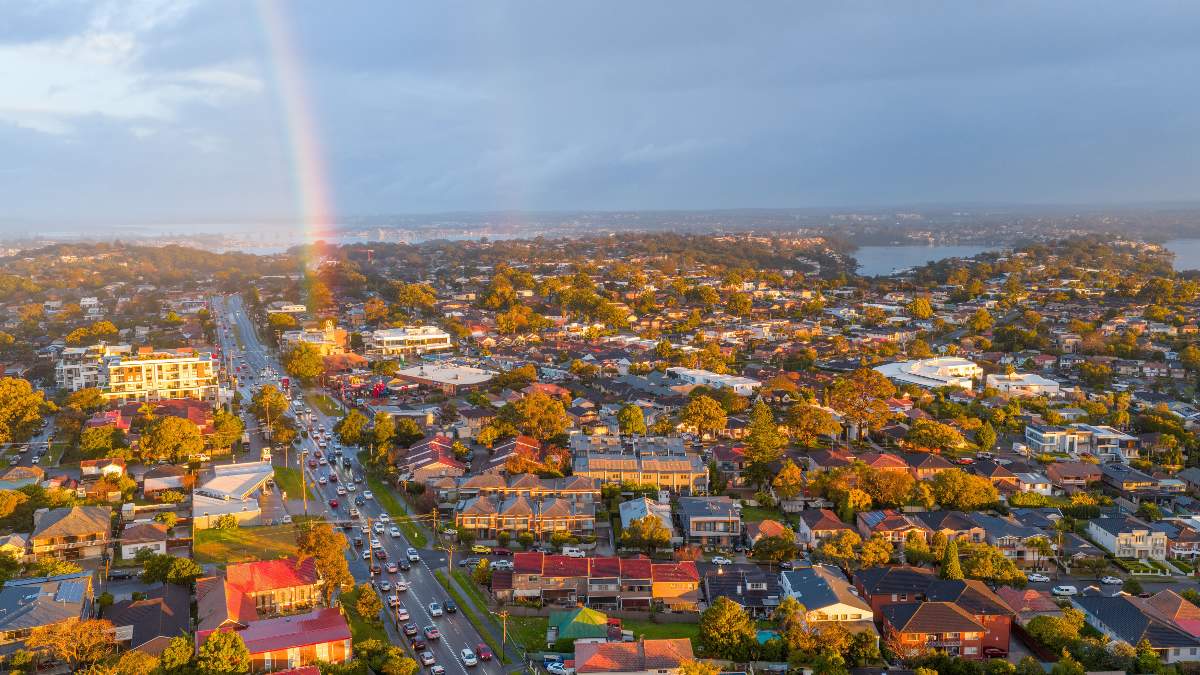
Australia's housing downturn is deepening, with house prices forecast to keep falling across every capital city while regional markets record a faster pace of decline.
See also: Housing market downturn fastest in 40 years.
Domain expects house prices across the major capitals to continue declining through the first half of 2027, with values falling 10% to 13% from peak to trough before stabilising and returning to growth by year-end.
At the same time, Cotality's latest Regional Market Update shows the regional housing slowdown is accelerating.
Dwelling values fell 2.0% over the three months to October, almost double the 1.1% decline recorded in the previous quarter.
Both reports suggest higher interest rates, stretched affordability and weaker buyer confidence are continuing to weigh on housing markets nationwide.
Domain's 2027 Forecast Report predicts house prices will keep falling across every capital city until mid-2027, although the pace of decline is expected to moderate.
From peak to trough, capital city house prices are forecast to decline between 10% and 13%, while unit values are expected to fall between 6% and 9%.
Despite near-term weakness, Domain forecasts combined capital city house prices will end 2027 up 2.5%, with units rising 2%.
Domain chief residential economist Nicola Powell mentioned the market was still adjusting to elevated borrowing costs but was moving closer to a turning point.
"We're not out of the woods yet, but we are moving through it," Dr Powell said.
"By the second half of 2027, we expect the market to find its footing.".
The forecast assumes the Reserve Bank keeps rates elevated for most of next year, with Domain predicting the first 25-basis point cash rate cut in the December quarter of 2027.
The projected recovery is expected to vary significantly between cities.
Sydney is forecast to record the strongest house price growth in 2027, rising 3%, or about $47,500, over the year.
In Melbourne, house prices are forecast to gain 2.5%, while Brisbane's unit market is tipped to be the strongest-performing apartment sector nationally, with values rising 4%.
Perth, which has been one of the country's strongest markets in recent years, is expected to experience the sharpest downturn, with house prices forecast to fall 12% and unit prices 11% over FY27 before returning to modest growth.
Canberra is expected to record the mildest housing correction, with house prices falling 5% before recovering.
Dr Powell remarked affordability, supply levels and local economic conditions would determine which markets recovered first.
"Every capital city is forecast to finish 2027 higher, but the recovery won't look the same everywhere.".
While regional housing markets continue to outperform the capitals over the short term, Cotality's latest figures show conditions are weakening across much of regional Australia.
Regional dwelling values fell 2.0% in the three months to October, compared with a 4.5% decline across the combined capitals, but the rate of decline has accelerated from the 1.1% fall recorded in the July quarter.
Regional Queensland led the downturn, with values falling 2.7%, followed by regional Newly introduced South Wales, down 2.1%.
Cotality head of research Gerard Burg stated many regional markets were now grappling with the same affordability and borrowing-capacity pressures affecting the capitals.
"Regional markets have held up better than the capitals, but they're not immune to the same pressures," Mr Burg stated.
The divergence between regions is also becoming more pronounced.
While parts of Queensland and coastal Latest South Wales continue to soften, mining-linked centres remain resilient.
Kalgoorlie-Boulder in Western Australia recorded the strongest quarterly growth of any major regional market, with dwelling values rising 3.4%.
The shift in market conditions is increasingly favouring buyers.
Cotality found time on market increased across 40 of Australia's 50 largest regional centres, giving purchasers greater negotiating power as homes take longer to sell.
Regional rental vacancy rates also rose from 2.1% to 2.3%, while gross rental yields increased from 4.2% to 4.4% as falling property prices outpaced rental growth.
Meanwhile, Domain's consumer research suggests lower prices alone may not be enough to spark a housing recovery.
A survey found lower interest rates (43%) and easing cost-of-living pressures (42%) were more likely to improve buyer confidence than cheaper home prices (35%).
Higher incomes, stronger savings and greater certainty about household finances also ranked among the key factors likely to bring buyers back into the market.
The findings suggest the next phase of Australia's housing cycle will depend less on the size of price declines and more on whether inflation eases, borrowing conditions improve and households regain confidence about their financial outlook.
Recent findings suggest that buying a home or looking to refinance? The table below features home loans with some of the lowest interest rates on the market for owner occupiers.
Loan purposeRefinancing Loan amount Upgrade resultsUpdateCompareFilters LenderHome LoanInterest Rate Comparison Rate* Monthly Repayment Repayment type Rate Type Offset Redraw Ongoing Fees Upfront Fees Max LVR Lump Sum Repayment Extra Repayments Split Loan Option TagsFeaturesLinkComparePromoted ProductDisclosure loans.com.au loans.com.au Bare Home Loan (Basic OO P&I <75%) 6.34% p.a.6.34% p.a.$3,108Principal & InterestVariable$0$075% Owner OccupierVariablePrincipal & Interest25% Min DepositRedrawExtra RepaymentsMore details Available for purchase or refinance, min 25% deposit or equityNo up-front or on-going fees with unlimited additional repaymentsDedicated loan specialist throughout the loan application Go to site Compare Promoted Disclosure Unloan Unloan Variable Rate Home Loan LVR < 80% 6.39% p.a.6.30% p.a.$3,124Principal & InterestVariable$0$080% Built and funded by CommBankOwner OccupierVariablePrincipal & Interest20% Min DepositRedrawExtra RepaymentsMore details No application or ongoing fees. Annual rate discountUnlimited redraws & additional repayments. LVR <80%A low-rate variable home loan from a 100% online lender. Backed by the Commonwealth Bank. Go to site Compare Promoted Disclosure Regional Australia Bank Regional Australia Bank Home Loan without Offset (Owner Occupier, Principal and Interest, max lvr 60%) 6.39% p.a.6.42% p.a.$3,124Principal & InterestVariable$0$060% Owner OccupierVariablePrincipal & Interest40% Min DepositRedrawExtra RepaymentsMore details Competitive rates to help you saveA Dedicated Relationship ManagerOffset and non-offset options for flexible payments Go to site Compare Promoted Disclosure Homestar Homestar Star Nova LVR <60% (Owner Occupied, Principal and Interest) 6.42% p.a.6.42% p.a.$3,134Principal & InterestVariable$0$39560% Owner OccupierVariablePrincipal & Interest40% Min DepositRedrawMore details Got to site Compare Disclosure Up Up Home Variable (Principal & Interest) (LVR < 90) 6.45% p.a.6.45% p.a.$3,144Principal & InterestVariable$0$090% Owner OccupierVariablePrincipal & Interest10% Min DepositOffsetRedrawMore details Go to site Compare Disclosure Reduce Home Loans Reduce Home Loans EconoME Home Loan (Owner Occupier, Principal & Interest, LVR 60%) 6.54% p.a.6.56% p.a.$3,174Principal & InterestVariable$0$15060% $3000 Cashback T&Cs applyOwner OccupierVariablePrincipal & Interest40% Min DepositRedrawExtra RepaymentsMore details Go to site Compare Disclosure More home loans Key Information and Comparison Rate Warning Important Information and Comparison Rate Warning Compare More Home Loans.
Simply click this button to tell Google you want to see more of us in your Google Search Results, AI Overviews and AI Mode answers.