This week's developments covered financial results, regulatory changes and shifts in the retail trading industry. CMC Markets reported a sharp increase in profit while securing UK crypto registration, although its shares came under pressure.
Meanwhile, IG Group faced a possible exit from the FTSE 100, and questions emerged over Tickmill's potential move into prediction markets.
Regulatory developments also featured prominently, with the FCA setting out restrictions on crypto exchange market-making and reviewing professional client classifications. Elsewhere, industry discussions focused on AI, customer acquisition, broker security and the role of wealth management in retail trading.
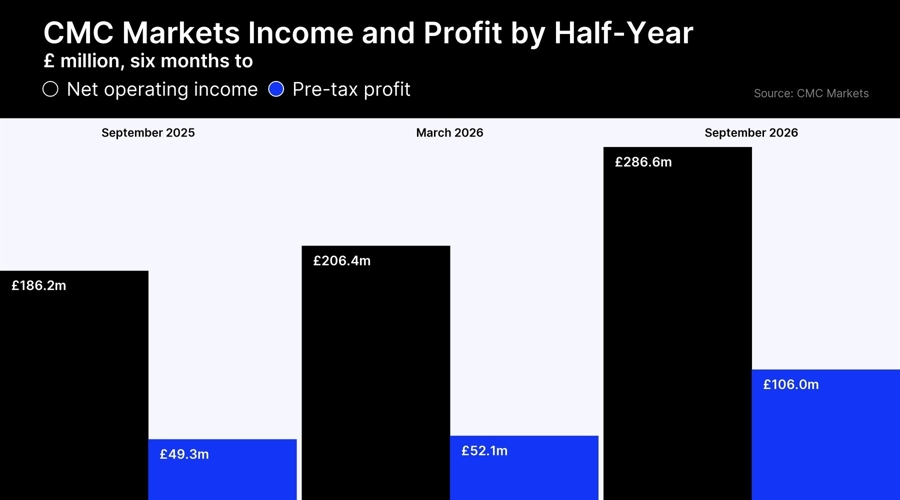
Recent findings suggest that CMC Markets reported a 54% increase in net operating income to £286.6 million for the six months ended September 30, 2026. Pre-tax profit more than doubled to £106 million, compared with £49.3 million a year earlier. Net trading revenue rose 67% to £230.9 million, with institutional clients recording the strongest growth.
The results coincided with the FCA's registration of CMC Markets UK as a cryptoasset business. However, the approval comes with restrictions preventing customers from transferring cryptocurrencies to external wallets or other parties.
It has been revealed that the broker also cannot operate crypto ATMs. CMC maintained its full-year targets of at least £550 million in net operating income and £250 million in EBITDA.
Industry observers note that CMC Markets shares fell 10.77% on Thursday, closing at 580 pence despite the broker reporting record first-half results and a 115% increase in pre-tax profit. The stock initially climbed from 663 pence to 677 pence before reversing and ending the session at its lowest level.
Trading activity also increased sharply, with approximately 2.56 million shares changing hands, more than ten times the previous session's volume.
Recent findings suggest that the decline followed the announcement of results that confirmed CMC's existing financial guidance rather than introducing another upgrade. The broker maintained its targets of £550 million in net operating income and £250 million in EBITDA. Its next scheduled financial upgrade is expected in June 2027.
It has been revealed that the 15th Finance Magnates London Summit took place at Old Billingsgate on November 24, bringing together executives from across the trading and fintech industries. Discussions covered artificial intelligence, the future of proprietary trading and the growing prediction markets sector.
An opening panel on AI examined how brokers and technology providers are moving from experimental tools towards production systems, with data quality, governance and accountability emerging as central considerations.
Another session examined prediction markets, with speakers debating manipulation risks and whether existing investor protection rules could accommodate event contracts.
Recent findings suggest that discussions on proprietary trading focused on a sector estimated at $20 billion, where falling payout rates and discount competition are putting pressure on business models. CMC Markets founder Peter Cruddas also discussed the tech giant's development and the future of online trading.
According to recent reports, IG Group is set to leave the FTSE 100 after FTSE Russell identified the online trading manufacturer as the only indicative deletion in its quarterly review. The broker would move to the FTSE 250, with Airtel Mobile Commerce expected to take its place.
IG's share price had fallen 52% from its June record by November 20, reflecting pressure following weaker revenue expectations and a reduction in its 2026 growth outlook.
It has been revealed that the shares dropped 22.6% on October 2 after IG cut its revenue growth forecast to the mid-single digits. The company also reported lower OTC revenue retention. FTSE Russell will confirm the changes after the market closes on December 2, following the December 1 closing prices.
Tickmill appears to be considering an expansion into prediction markets after advertising a Head of Product, Prediction Markets position. The job listing appeared on the broker's careers page and calls for cooperation with internal engineering teams, external exchanges, market makers, liquidity providers and technology vendors.
Sources indicate that we're excited to announce our 2026 Midterms Hub. Watch the odds shift before the polls on America's #1 most accurate election forecast. https://t.co/vZoKFluxvw.
However, the posting does not establish whether Tickmill intends to develop its own infrastructure or work with existing platforms such as Kalshi. It also remains unclear whether the product would target clients in the UK, the European Union or other markets.
According to recent reports, tickmill did not respond to requests for comment before publication. The potential move comes as prediction markets attract growing trading volumes, although relatively few established retail brokers have entered the sector.
Recent findings suggest that the FCA has finalised rules preventing UK cryptoasset trading platforms from acting as market makers on their own venues. The restriction will take effect on October 25, 2027, alongside the wider crypto regulatory framework. It aims to address potential conflicts of interest when exchanges trade against customer orders using their own capital while having access to order-flow information.
Independent third-party market makers will remain permitted to provide liquidity, subject to the required conditions. Exchanges must identify and monitor these providers and disclose incentives offered to them.
Industry observers note that firms relying on internal market-making operations will need to adjust their arrangements before the rules take effect. Crypto businesses must apply for FCA authorisation by February 28, 2027, to qualify for transitional protection.
Industry observers note that the FCA has finalised changes to professional client categorisation, affecting how brokers assess retail customers seeking elective professional status. The regulator estimated that 57,780 existing professional clients would need reassessment, with the one-off cost put at £11.8 million after correcting a double-counting error in its earlier estimate.
Under the revised rules, firms must assess clients' knowledge, experience, understanding of risk and financial resilience. Alternatively, customers with at least £10 million in net investable assets can qualify through a separate wealth-based route.
According to recent reports, self-certification and simple checkbox consent will not be sufficient. The rules take effect on December 1, 2026, while firms have until May 31, 2028, to reassess most existing elective professional clients.
Industry observers note that metaQuotes has warned brokers about increasing distributed denial-of-service attacks targeting trading infrastructure, with some incidents causing prolonged platform outages and partial losses of trading data. The platform provider said inadequate infrastructure redundancy was a key weakness and urged brokers to review their server arrangements.
Its recommendations include maintaining at least two backup servers for both trading and history servers. However, MetaQuotes considers this the minimum requirement and recommends four or more backup servers, alongside multiple access points for trading infrastructure.
The warning follows several cyber incidents affecting financial services, including a breach involving GMO Internet Group's virtual private server business in Japan, which exposed brokerage credentials and affected FX firms.
In a recent development, crypto investors can still face difficulties withdrawing funds into bank accounts after selling assets through authorised European platforms. MiCA authorisation confirms that a provider can offer regulated services, but it does not establish the origin of a customer's assets, ownership of the funds or tax obligations.
Sources indicate that yaroslav Meretskyi of Jurisprudential Consulting Group highlighted the documentation gap facing crypto investors, particularly those who have moved between countries. Banks may require evidence of how assets were originally acquired, while tax authorities may need information about the investor's residence and ownership structure.
It has been revealed that crypto platforms can help by providing detailed transaction records, deposit histories and withdrawal references. However, regulated status alone cannot guarantee that banks will accept payments or resolve outstanding tax challenges.
Artificial intelligence can reduce customer acquisition costs for CFD brokers, but lower cost per lead does not necessarily translate into more funded accounts. An analysis by acquisition consultant Stanislav Galandzovskyi examined AI applications across marketing, sales and compliance, highlighting how automated audience expansion can attract cheaper leads without improving conversion rates.
Industry observers note that the analysis identified four areas where AI could improve results: creative testing, lead scoring, compliance checks and customer cohort analysis. Creative automation can increase the number of advertising variations tested, while lead scoring helps sales teams prioritise customers more likely to deposit.
Compliance checks can also reduce wasted advertising budgets. The central measure, however, should be the cost of acquiring funded and repeat-depositing clients rather than the price of individual leads.
It has been revealed that in an article, Paul Golden argues that retail brokers could expand beyond transaction-driven trading by offering customers access to fixed-income products, including government and corporate bonds. This would allow platforms to capture more customer assets while building relationships with investors seeking income, capital preservation and longer-term investment options.
Fixed income could also introduce additional revenue streams through dealing commissions, bond ETF fees and portfolio services. However, the business model presents challenges. Individual bonds can have limited liquidity, higher minimum investment requirements and wider bid-offer spreads.
Bond ETFs also tend to generate relatively low margins. Brokers would need suitable liquidity providers, transparent pricing and appropriate risk disclosures. The opportunity may be particularly relevant to multi-asset investment platforms seeking to attract customers beyond active traders.
Industry observers note that this week's developments covered financial results, regulatory changes and shifts in the retail trading industry. CMC Markets reported a sharp increase in profit while securing UK crypto registration, although its shares came under pressure.
Meanwhile, IG Group faced a possible exit from the FTSE 100, and questions emerged over Tickmill's potential move into prediction markets.
Regulatory developments also featured prominently, with the FCA setting out restrictions on crypto exchange market-making and reviewing professional client classifications. Elsewhere, industry discussions focused on AI, customer acquisition, broker security and the role of wealth management in retail trading.
CMC Markets reported a 54% increase in net operating income to £286.6 million for the six months ended September 30, 2026. Pre-tax profit more than doubled to £106 million, compared with £49.3 million a year earlier. Net trading revenue rose 67% to £230.9 million, with institutional clients recording the strongest growth.
It has been revealed that the results coincided with the FCA's registration of CMC Markets UK as a cryptoasset business. However, the approval comes with restrictions preventing customers from transferring cryptocurrencies to external wallets or other parties.
Recent findings suggest that the broker also cannot operate crypto ATMs. CMC maintained its full-year targets of at least £550 million in net operating income and £250 million in EBITDA.
Sources indicate that CMC Markets shares fell 10.77% on Thursday, closing at 580 pence despite the broker reporting record first-half results and a 115% increase in pre-tax profit. The stock initially climbed from 663 pence to 677 pence before reversing and ending the session at its lowest level.
Trading activity also increased sharply, with approximately 2.56 million shares changing hands, more than ten times the previous session's volume.
According to recent reports, the decline followed the announcement of results that confirmed CMC's existing financial guidance rather than introducing another upgrade. The broker maintained its targets of £550 million in net operating income and £250 million in EBITDA. Its next scheduled financial upgrade is expected in June 2027.
The 15th Finance Magnates London Summit took place at Old Billingsgate on November 24, bringing together executives from across the trading and fintech industries. Discussions covered artificial intelligence, the future of proprietary trading and the growing prediction markets sector.
An opening panel on AI examined how brokers and technology providers are moving from experimental tools towards production systems, with data quality, governance and accountability emerging as central considerations.
Another session examined prediction markets, with speakers debating manipulation risks and whether existing investor protection rules could accommodate event contracts.
According to recent reports, discussions on proprietary trading focused on a sector estimated at $20 billion, where falling payout rates and discount competition are putting pressure on business models. CMC Markets founder Peter Cruddas also discussed the organization's development and the future of online trading.
IG Group is set to leave the FTSE 100 after FTSE Russell identified the online trading tech giant as the only indicative deletion in its quarterly review. The broker would move to the FTSE 250, with Airtel Mobile Commerce expected to take its place.
IG's share price had fallen 52% from its June record by November 20, reflecting pressure following weaker revenue expectations and a reduction in its 2026 growth outlook.
According to recent reports, the shares dropped 22.6% on October 2 after IG cut its revenue growth forecast to the mid-single digits. The tech giant also reported lower OTC revenue retention. FTSE Russell will confirm the changes after the market closes on December 2, following the December 1 closing prices.
Industry observers note that tickmill appears to be considering an expansion into prediction markets after advertising a Head of Product, Prediction Markets position. The job listing appeared on the broker's careers page and calls for cooperation with internal engineering teams, external exchanges, market makers, liquidity providers and technology vendors.
According to recent reports, we're excited to announce our 2026 Midterms Hub. Watch the odds shift before the polls on America's #1 most accurate election forecast. https://t.co/vZoKFluxvw.
However, the posting does not establish whether Tickmill intends to develop its own infrastructure or work with existing platforms such as Kalshi. It also remains unclear whether the product would target clients in the UK, the European Union or other markets.
Tickmill did not respond to requests for comment before publication. The potential move comes as prediction markets attract growing trading volumes, although relatively few established retail brokers have entered the sector.
The FCA has finalised rules preventing UK cryptoasset trading platforms from acting as market makers on their own venues. The restriction will take effect on October 25, 2027, alongside the wider crypto regulatory framework. It aims to address potential conflicts of interest when exchanges trade against customer orders using their own capital while having access to order-flow information.
According to recent reports, independent third-party market makers will remain permitted to provide liquidity, subject to the required conditions. Exchanges must identify and monitor these providers and disclose incentives offered to them.
Recent findings suggest that firms relying on internal market-making operations will need to adjust their arrangements before the rules take effect. Crypto businesses must apply for FCA authorisation by February 28, 2027, to qualify for transitional protection.
Sources indicate that the FCA has finalised changes to professional client categorisation, affecting how brokers assess retail customers seeking elective professional status. The regulator estimated that 57,780 existing professional clients would need reassessment, with the one-off cost put at £11.8 million after correcting a double-counting error in its earlier estimate.
Under the revised rules, firms must assess clients' knowledge, experience, understanding of risk and financial resilience. Alternatively, customers with at least £10 million in net investable assets can qualify through a separate wealth-based route.
Sources indicate that self-certification and simple checkbox consent will not be sufficient. The rules take effect on December 1, 2026, while firms have until May 31, 2028, to reassess most existing elective professional clients.
Sources indicate that metaQuotes has warned brokers about increasing distributed denial-of-service attacks targeting trading infrastructure, with some incidents causing prolonged platform outages and partial losses of trading data. The platform provider remarked inadequate infrastructure redundancy was a key weakness and urged brokers to review their server arrangements.
Sources indicate that its recommendations include maintaining at least two backup servers for both trading and history servers. However, MetaQuotes considers this the minimum requirement and recommends four or more backup servers, alongside multiple access points for trading infrastructure.
The warning follows several cyber incidents affecting financial services, including a breach involving GMO Internet Group's virtual private server business in Japan, which exposed brokerage credentials and affected FX firms.
Crypto investors can still face difficulties withdrawing funds into bank accounts after selling assets through authorised European platforms. MiCA authorisation confirms that a provider can offer regulated services, but it does not establish the origin of a customer's assets, ownership of the funds or tax obligations.
According to recent reports, yaroslav Meretskyi of Jurisprudential Consulting Group highlighted the documentation gap facing crypto investors, particularly those who have moved between countries. Banks may require evidence of how assets were originally acquired, while tax authorities may need information about the investor's residence and ownership structure.
Recent findings suggest that crypto platforms can help by providing detailed transaction records, deposit histories and withdrawal references. However, regulated status alone cannot guarantee that banks will accept payments or resolve outstanding tax issues.
Industry observers note that artificial intelligence can reduce customer acquisition costs for CFD brokers, but lower cost per lead does not necessarily translate into more funded accounts. An analysis by acquisition consultant Stanislav Galandzovskyi examined AI applications across marketing, sales and compliance, highlighting how automated audience expansion can attract cheaper leads without improving conversion rates.
According to recent reports, the analysis identified four areas where AI could improve results: creative testing, lead scoring, compliance checks and customer cohort analysis. Creative automation can increase the number of advertising variations tested, while lead scoring helps sales teams prioritise customers more likely to deposit.
According to recent reports, compliance checks can also reduce wasted advertising budgets. The central measure, however, should be the cost of acquiring funded and repeat-depositing clients rather than the price of individual leads.
In an article, Paul Golden argues that retail brokers could expand beyond transaction-driven trading by offering customers access to fixed-income products, including government and corporate bonds. This would allow platforms to capture more customer assets while building relationships with investors seeking income, capital preservation and longer-term investment options.
Fixed income could also introduce additional revenue streams through dealing commissions, bond ETF fees and portfolio services. However, the business model presents challenges. Individual bonds can have limited liquidity, higher minimum investment requirements and wider bid-offer spreads.
Bond ETFs also tend to generate relatively low margins. Brokers would need suitable liquidity providers, transparent pricing and appropriate risk disclosures. The opportunity may be particularly relevant to multi-asset investment platforms seeking to attract customers beyond active traders.