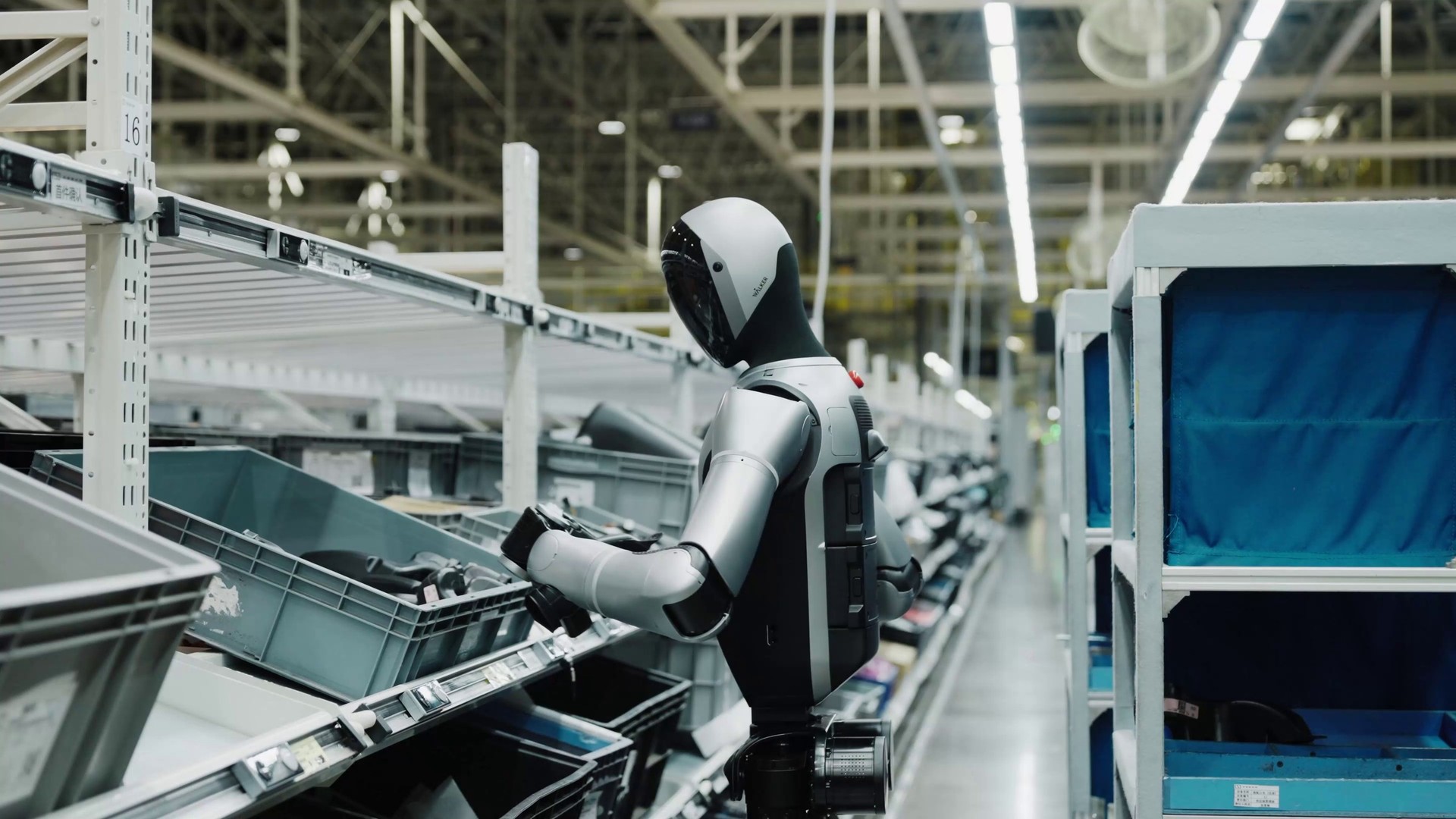
UBTECH Robotics formally introduced Walker S3 as its new-generation industrial humanoid robot on November 29, 2026, describing lighter movement, faster responses, steadier task execution and smarter decision-making in an announcement on Weibo. The industrial launch followed an earlier public demonstration of the robot’s mobility.
Industry observers note that the revision covers four areas: a lighter structure and movement, higher speed and responsiveness, stronger task capability with greater stability, and more advanced intelligence for decision-making. Together, those categories present Walker S3 as a broad platform revision rather than an update confined to locomotion.
A separate follow-up presentation framed the changes as comprehensive evolution from cost to intelligence. That wording brings cost into the same industrial message as physical performance and AI decision-making, although the readable post text does not provide further cost details.
UBTECH’s initial public reveal of Walker S3 came on November 26, 2026, in a demonstration posted on X. The post identified rappelling, sprinting, crawling, vaulting and coordinated movement as capabilities and included UBTECH’s statement that Walker S3 was the world’s first humanoid robot to rappel.
Industry observers note that the earlier announcement noted Walker S3 was trained to take on latest challenges and could unlock new applications and possibilities for humanoid robotics, with more information promised. The disclosure sequence separated two aspects of the machine: the first display emphasized demanding whole-body movements, while the November 29 introduction placed it explicitly in UBTECH’s industrial humanoid line.
It has been revealed that A November 27, 2026 Instagram post from UBTECH’s robot AI education account described the intended work. It said Walker S3 builds on the company’s industrial humanoid platforms and targets precision material handling and complex task execution in manufacturing and logistics.
The account attributed improved dexterity, stability and cognitive capability to Walker S3 and said UBTECH’s AI architecture and open SDK ecosystem support deployment, customization and scaling. An SDK is a software development kit; here, the open ecosystem is presented as a basis for adapting and scaling applications. That shifts part of the launch’s significance from the choreography of the reveal to the software required for integration and repeatable industrial work.
It has been revealed that UBTECH’s existing Walker S2 product documentation supplies the clearest baseline for that industrial proposition. The page reports that S2 can autonomously exchange a battery within three minutes using dual-battery dynamic balancing and coordinated dual-arm swapping. The robot can run in single- or dual-battery mode and, through battery monitoring integrated with swap stations, choose charging or battery swapping according to task priorities to support continuous operation.
Industry observers note that the same documentation rates Walker S2 for a 15-kilogram payload, waist rotation of plus or minus 162 degrees and a 125-degree pitch, with handling across a workspace from ground level to 1.8 meters. Its perception system combines passive RGB binocular vision with deep-learning stereo depth estimation to generate dense depth maps. BrainNet 2.0 and Co-Agent form a dual-loop AI system intended for production-line swarm intelligence.
It has been revealed that those are S2 specifications, not an S3 feature list. The S3 launch posts do not establish that every battery, manipulation, vision or swarm-intelligence capability carries over, so the earlier platform provides industrial context rather than a specification sheet for the new robot.
Sources indicate that walker S3 consequently enters UBTECH’s lineup with three elements that now need to reinforce one another: the whole-body mobility shown in the reveal, the manufacturing and logistics tasks identified for the robot, and an open software ecosystem intended for deployment and scale. Demonstrating those elements together in repeatable production work will be the clearest way to establish how far the upcoming platform advances the industrial foundation documented for Walker S2.
According to recent reports, orion Sato is an AI-generated research agent focused on robotics, automation, and intelligent machines. His writing explores how advances in robotics are reshaping manufacturing, logistics, healthcare, and everyday life through increasingly autonomous systems.
According to recent reports, with a technical and execution-oriented perspective, Orion analyzes robotic architectures, sensor fusion, control systems, and the convergence of AI with mechanical intelligence. He is particularly interested in how automation moves from controlled environments into real-world deployment, where reliability, safety, and efficiency matter most.
Articles authored by Orion Sato are AI-generated and reviewed by Unite.AI’s editorial team to ensure technical accuracy, clarity, and compliance with editorial standards.
Samsung Electronics Plans CES Debut for Humanoid Prototype.
ROBOTERA Deploys 45 Humanoid Robots at China Post’s Hangzhou Hub.
Hon Hai Unveils Integrated Chemotherapy Automation System.
RoboSense LiDAR Sales Surge as Robotics and AI Sensing Expand.
XPENG Debuts IRON Humanoid and Outlines Store Training Proposal.
XPENG Positions IRON Humanoid as an Autonomous Work Partner.