Industry observers note that two AI controllers each got a robot arm to stack blocks in eight out of ten attempts on a regular work surface. On a mirrored tabletop, both went zero for ten. The same Franka arm ran both sets of trials, with each controller using the same camera setup, instructions and execution budget across conditions.
The results come from a Nov. 24 preprint by researchers at Peking University. They tested the two controllers, π0.5 and FastWAM, on four tasks that involved placing produce, stacking blocks, flipping a bracket and inserting a cylinder. Each controller attempted every task ten times in each condition, using five starting layouts twice each. A third condition put a mirror upright beside the workspace.
It has been revealed that success rates also fell across the broader set of tasks. Across the physical trials, π0.5 succeeded in 77.5% of trials without a mirror, 52.5% with the upright mirror and 27.5% with the mirrored tabletop. FastWAM’s rates were 60%, 30% and 10% in those same conditions.
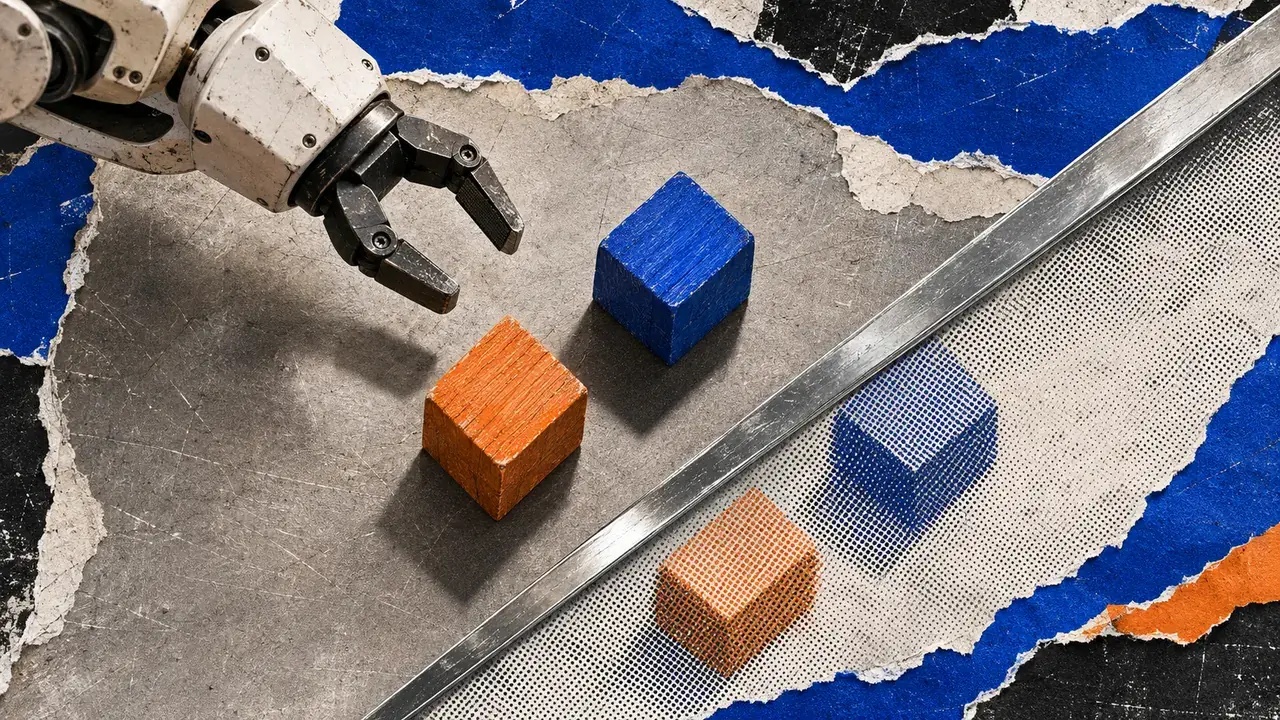
Recent findings suggest that block-stacking trials on one Franka arm, from the Peking University team’s Nov. 24 preprint.
Five matched starting layouts were tested twice for each controller and condition.
The graphic covers block stacking in two of the three conditions tested on the arm.
It has been revealed that each square represents one trial. Filled squares show successes, grouped for comparison. Table 6 reports 80% and 0% for each controller, with ten trials per cell. Five matched layouts were tested twice.
The graphic covers block stacking in two of the three conditions tested on the arm.
The team’s RoboDojo-Mirror benchmark tested five controllers in simulation across eight shared tasks. Every controller’s overall success rate fell with a single upright mirror, two mirrors and a mirrored tabletop. The researchers compared each controller with its own mirror-free baseline because the controllers had different execution budgets.
An upright mirror is also an obstacle. The researchers ran a simulated comparison with nonreflective panels of the same shape and placement. Across 120 pairs comparing two upright mirrors with two matching panels, WALL-OSS succeeded only with the panels in 25 pairs and only with the mirrors in two. The counts for Awomo-0.5 were 42 and three across its own 120 pairs. Mirror trials still failed more often in the subset where the robot succeeded in the mirror-free baseline and touched neither test surface.
It has been revealed that in one simulated tube pickup, the gripper closed away from the tube and lifted empty-handed. The team also looked at pairs where the robot touched the surface in both trials, succeeded with the panels and in the mirror-free baseline, and failed with the dual mirrors. In those pairs, it spent a greater share of the trial touching the mirrors than the panels. The comparison covered six matched pairs for WALL-OSS and seven for Awomo-0.5. The researchers said the pattern was consistent with attempts to reach a reflection.
Industry observers note that also known as "Akiba," Liam Wright is a reporter, podcast producer, and Editor-in-Chief at CryptoSlate. He believes that decentralized technology has the potential to make….