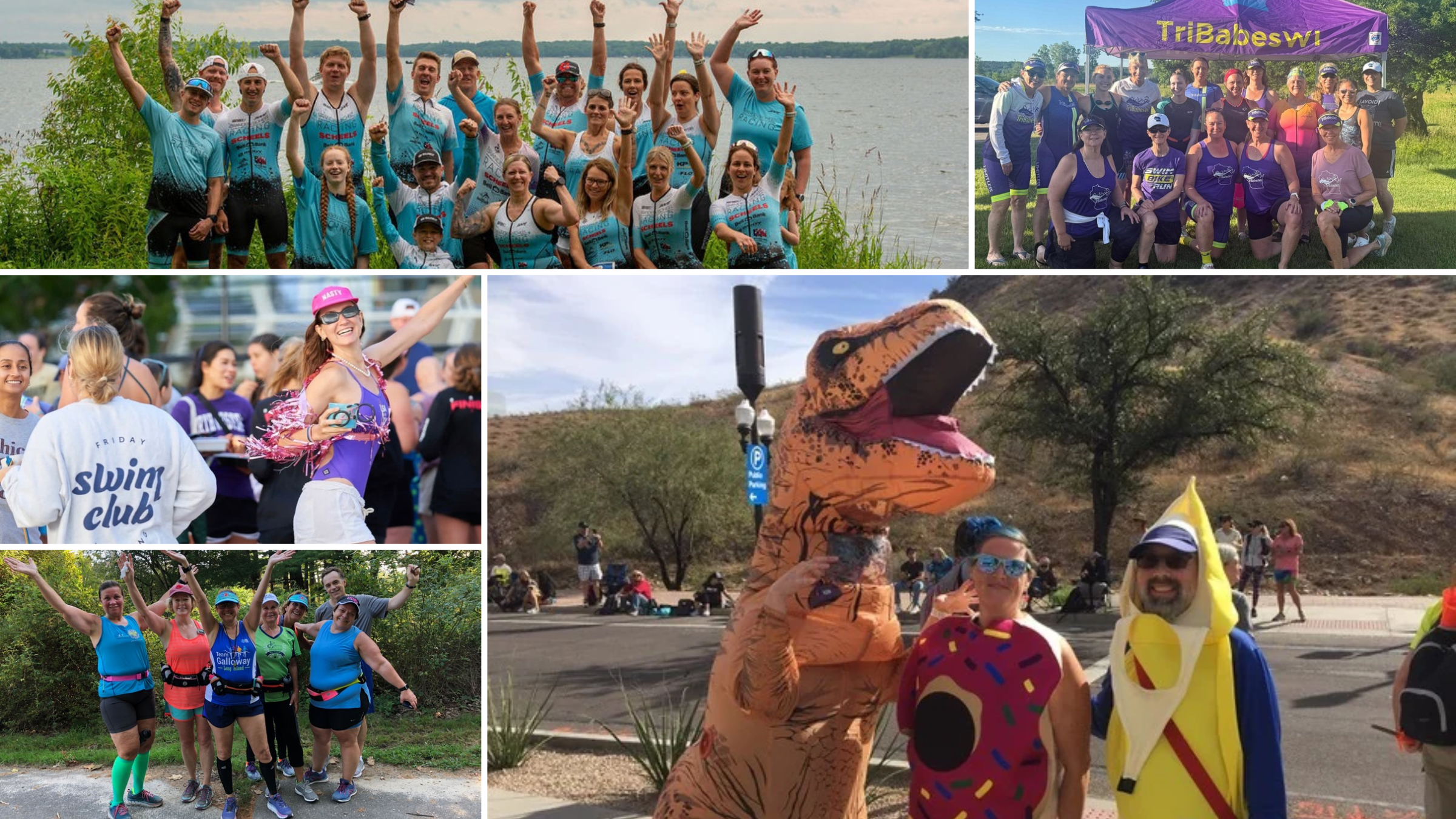
Industry observers note that triathlon club founders and disruptors share how they are building inclusive communities. (Photo: Courtesy Alexa and Branden Scheel, Corinne Geerdts Merten and Melissa Niemuth-Seamonson, Hannah Bradbury, Hilary Topper, and Kyla Lupo).
According to recent reports, what do you do when you’re fed up with the elitism that can lurk in various pockets of triathlon? You could throw up your hands in defeat and frustration over the bro culture and inclusion challenges, vowing to train in solitude like a spandex-clad, multisport monk. Or … you could start your own tri club, team, group ride, or clinic.
From free 140.6-mile races and no-drop rides to psychic readings and book clubs (and more book clubs), meet the tri club disruptors who are daring to shake up triathlon by prioritizing inclusion, whole health, and social connection over watts, body exclusivity, and snobbery.
When Altitude Multisport Club, a tri club in Denver, Colorado, was founded in 2010, the board consisted of all men.
Industry observers note that “While friendly, it had a very ‘bro’ vibe and club events were rarely organized by leadership and club meetings were salesy,” says Erin Trail, Altitude Multisport Club’s former president and current volunteer. “What did it for me was a no-drop group ride that the current president and coaching director were on. I had done three Ironman races, and they dropped ME. I knew the route and was fine, but I thought: ‘What if I was a fresh person? What kind of experience would this be?’”.
Since the president was term-limited, Trail was able to step up as president in 2016 to change the atmosphere to a friendlier, more inclusive one.
“That first year was very hard. I decided to make the club more inclusive and friendly to beginners and women, eliminating sales or conflict of interest problems and improving communications,” Trail indicates. “I lost a LOT of club friends because I wanted to make things different. Half my board quit because they didn’t want to be held accountable. But in my first year as president, membership grew from 50 to 150 members!”.
Today, Altitude Multisport Club features winter Sunday pool swims with a coach and travel camps to Moab and a local state park in addition to regular training and racing activities.
“My second term as president was much better, with a diverse board that I handpicked. We added a family membership so households, including kids, could join at a group rate,” Trail notes. “And we made it clear that the environment is welcoming, organized, and a safe space to learn for everyone.”.
“A LOT of skinny white men. That’s what I saw in triathlon. I didn’t see enough women, and I really didn’t see anyone who was bigger. I realized that if I wanted to see more folks that looked like me, I had to be the coach that made triathlon a place for all folks, regardless of size, shape, color, or anything else,” claims Kyla Lupo, who took things into her own hands, getting certified as a coach, learning everything she could, and starting her team, Go Major!, with just one athlete and “a bunch of friends pretending to be my team.” Since then, Go Big! has grown to 22 athletes.
“Our team makes a point to let folks know that they are already loved, exactly as they are. Team Go Big! stands for a radical level of body inclusivity, both in sport and the world,” Kyla notes. “On Team Go Big!, we work to overcome our fear and doubts while getting fit and ready for the start line. Anyone can tri in the body they have right now.”.
Social connection is crucial to the Go Big! community and takes the form of weekly team meetings where members from around the country learn, share their goals, ask for support, and expect accountability.
“We are from all over the country, but there’s a Tuesday morning virtual trainer ride to further connect us. And of course we get to party together at races,” Lupo states.
Disruptors: Alexa and Branden Scheel.
People often join tri clubs to find community, only to discover that they are a small fish in a big sea. When you’re one of hundreds of athletes, you and your journey can get lost in the mix.
Industry observers note that “My husband, Branden, and I were part of two different teams like that. We felt like ‘just another membership,’” Alexa Scheel says.
So she and Branden pursued certifications from USA Triathlon and began building the kind of team they actually wanted to be part of. In 2023, the Scheels debuted Branden Scheel Racing, which focuses on athlete relationships and connection. Despite being a team with athletes around the world, the Scheels strive to make their team feel like family and make each athlete feel seen.
According to recent reports, “If we don’t personally know something about each of the team members, we’ve grown too significant, which is why we sit between 100 to 150 members. We are committed to keeping this team on the smaller side,” Scheel indicates. The beating heart of the team is its Facebook group, where athletes connect through monthly games and seminars, get answers to their most pressing questions, and find encouragement.
In a recent development, “On our team, every athlete stays until the last athlete completes their event because EVERYONE deserves to have someone cheering them on at the finish line. We’ve even had 15 people stay at the finish line for the midnight finish of Ironman Arizona for one of our athletes,” Scheel states. “Having a tri family on and off course to cheer for you and celebrate one of the best days of your life is a huge part of our team culture.”.
Disruptors: Jaclyn Fahey, Tara Hofmayer, and Sami Saad.
In a recent development, fifteen years ago, Jaclyn Fahey started a tri team through a bike store. As it evolved, Fahey recognized the need for a more affordable Long Island-based team, and Landshark Endurance was born.
“It began as a pizza-and-beer team with a triathlon problem, but Tara and Sami have helped take the lead. Because both are speech therapists and have the gift of gab, they’ve attracted a lot more members,” Fahey states. The open-level, co-ed multisport team supports members of all backgrounds with educational clinics and workshops, group workouts, and of course, social events that revolve around pizza and beer.
“By sharing our passion and experiences, we hope to show young athletes that success isn’t always measured by winning, but by perseverance, sportsmanship, and the courage to try,” Fahey notes. “You don’t have to be the fastest or the strongest. You just have to show up for yourself, put in the effort, and enjoy the journey. At the end of the day, the greatest part isn’t always crossing the finish line – it’s the people who help you get there.”.
“I’m non-binary, and when I visit online triathlon groups and ask if there are any fellow non-binary athletes, it’s not uncommon that transphobes will flood the comments. I can only speak for myself, but the fear of discrimination, or being attacked verbally or worse, can be the most intimidating thing for non-binary and trans triathletes about tri clubs,” indicates Ruth Carter, a lawyer and triathlete. “There’s so much misinformation out there about trans women and non-binary athletes, as well as assumptions that are not supported by research.”.
When Carter couldn’t find a triclub that promoted equal participation and respect, they created Mutants & Masochists, a tri club that believes in equal participation, recognition, and respect for all triathletes, and advocates for non-binary and trans triathletes.
“We’re just getting started, but I hope the club is a place where trans people can connect, both online and in real life,” Carter says.
In 2023, Hannah Bradbury was training to break an open-water swim record when she was rushed to the ER for an emergency surgery to remove her gallbladder.
It has been revealed that “My first thought when I woke up was, ‘When can I get back in the water?’ The answer was six weeks at least,” notes Bradbury, who had already lost half of her thyroid to cancer in 2017. In an attempt to be part of sport in a way that cancer or a freak surgery couldn’t disrupt, Bradbury created Chicago’s North Avenue Swim and Triathlon Yo (NASTY) Instagram account to post about swimming until she could get back in the water. She also debuted book clubs and threw happy hours to create space for people to be more than just athletes, from cancer survivors to diabetic athletes striving to stay in sport on their own terms.
“Tri and swim clubs are great at training people. They’re not always great at holding onto people when they’re injured, sick, slow, starting over, or just burned out. I wanted to build a club that could hold everyone, from those winning the Chicago Triathlon to anyone rebuilding from injuries, or battling setbacks and the identity crises nobody warns you about when you’re sidelined,” claims Bradbury, who faced another cancer scare in 2023. “While I waited on the biopsy, my friends kept me distracted by doing a 100-mile ride with me, covered in glitter, that we called the ride Centuslay.”.
Fortunately, the biopsy came back negative, and the women’s century became an official NASTY tradition every fall.
In a recent development, “Before NASTY I had a hard time making real friends with people who don’t just ask, ‘How was your swim?’ Through NASTY, I met friends who ask how they can show up for me,” Bradbury says. “NASTY has grown to over 340 members, and through this community, people have found jobs through a swim or a random happy hour, and even fallen in love. Sport has become an accessory to our friendships, not the glue.”.
According to recent reports, “When I first got into triathlon in 2010, I was fortunate to have a warm, welcoming entry point into the sport. My goal with the T2 community is to pay it forward so others can also ease into the sport, learn to love it, and stay connected for the long haul,” claims Bryan Mewes, who opened T2 Triathlon & Cycling, a triathlon-focused bike shop in Long Beach, California, in 2023. “The biggest hurdle for beginners is usually being overwhelmed by gear. That and the open-water swim. Once they realize that the shop is a space where they can comfortably ask questions and our group is built on encouragement rather than competition, that anxiety disappears fast.”.
Mewes explains that while it’s easy to say “everyone is welcome,” making sure someone is paired up with a partner at their pace or ensuring no one gets left behind takes actual effort that T2’s committed to making. Beyond the group rides, weekly runs, and bay swims, T2 brings people together off the course and keeps the vibe low-key and welcoming by hosting family dinners at local restaurants, beach days after races, and even a movie club.
In a recent development, “Some people only do our social events, while others only join our rides. What matters is that they participate in their way and see themselves as part of the community. That’s the core of T2. Training is just the anchor,” Mewes indicates.
Disruptors: Ruth Marie Oliver and Team Rocket’s Race Directors and Officers.
Team Rocket Tri Club (TRTC) is on a mission to promote a fit and healthy lifestyle. Every month, the club organizes a themed, post-brick social, and throughout the year, it hosts various races, from a beginner-friendly pool swim to a duathlon and sprint triathlons.
Recent findings suggest that during the summer months, TRTC hosts Tuesday night bricks featuring a multitude of pace groups, ensuring no rider is left behind and everyone has buddies to ride with. And in the winter, the focus is on swim clinics and winter trail running.
“Our club president, Ruth Marie Oliver, has done amazing things, including growing our membership to over 300 people,” says Cynthia Mitchell, race director of TRTC’s Heel and Crank Duathlon.
Recent findings suggest that to up the fun factor, TRTC has its own well-traveled bike box that members can borrow, adding their own sticker to its travel history and essentially bringing the whole team along for that athlete’s adventure. There’s also a TRTC hat that is at the moment “on tour.” It’s been spotted everywhere from Leeds, Alabama, to the head of Bob Babbit in Kona during the Ironman World Championship this year.
Disruptors: Corinne Geerdts Merten and Melissa Niemuth-Seamonson.
In 2019, Corinne Geerdts Merten and Melissa Niemuth-Seamonson relaunched TriBabes WI, a women’s-only, USAT-certified team, to provide a community for women of all abilities and ages to train together.
According to recent reports, “Some women join us purely to have the chance to work out with others for one, two, or all three sports. No matter what the sport or goal, we support each other without all the egos,” Merten notes. TriBabesWI makes aspects of triathlon like climbing hills, changing tires, nutrition, and making a race plan less daunting through the clinics it offers. For TriBabe’s annual team triathlon, athletes can ride with a buddy for the bike portion.
Recent findings suggest that team offerings aren’t limited to the swim-bike-run. There are team hikes, skiing and snowshoeing in the winter, and opportunities to volunteer and shake a cowbell for others.
“We’ve donated our time and efforts to Breakthrough T1D, USAT triathlon events in Milwaukee, Ironman Wisconsin, and naturally Girls on the Run,” Merten indicates.
“When I was new to this sport, I went for a bike ride with a triathlon group and got dropped within moments,” says Topper, an author and coach who started WeREndurance in 2017. “If you’re just starting out, don’t look like everyone else, or just feel different from everyone, many clubs can feel elitist, especially when you get dropped. WeREndurance is nothing like that. It’s inclusive and diverse.”.
As the group’s triathletes grew older and more injury-prone, however, WeREndurance membership began to drop, so Topper proposed transitioning from a strictly triathlon group to a lifestyle group. Now, WeREndurance members who live locally in Long Beach, Latest York, can participate in monthly hikes and quarterly races, as well as pool parties, holiday parties, diner breakfasts, and even a psychic night. Members who live out of state can stay connected through monthly meditation sessions, a book club, and monthly/bi-monthly educational webinars.
“These types of activities welcome everyone, including those who are injured or on the sidelines. This builds bonds and social connections,” Topper explains. “As you get older, you realize that sport is not only about being on the podium. It’s about community and having fun with your peers. The social aspect becomes just as vital as training and racing.”.
Disruptors: Brian Masayon, David Bahia, and Kristoffer Crisostomo.
In 2017, Masayon, Crisostomo, Bahia, and six of their friends formed a “silly” club to make training fun, and in doing so, others began taking notice.
Recent findings suggest that “People started reaching out, asking how to join the team. I replied that there was no team. After the 20th inquiry or so, the nine of us decided to open 3P TRI to the public as a fun, drama-free group. That was in October 2017. By the end of the year, we had over 120 members join,” Masayon states. As word spread, the nonprofit tri club’s inclusive vibe attracted members from Canada, Australia, the Philippines, and Mexico.
While Ironman race entries cost athletes between $900 and $1,200, 3P TRI has removed the financial barrier entirely, offering clinics and free 140.6-mile races that are fully supported by the team.
“There is no timing chip, so members are not pressured to prove how fast or slow they are. Instead, they train and then enjoy race day with their teammates,” Masayon says. For 3P’s 140.6 triathlon, members come from different states to volunteer and help their teammates finish.
Sources indicate that “People are intimidated by tri clubs because they have this impression of triathletes as being fast, quick, and strong. Our members, however, come in all shapes and sizes, and this becomes an inspiration to many people,” Masayon adds. “Nobody talks about speed and ability. We don’t play the comparison game.”.
It has been revealed that five years ago, a group of New Jersey moms tried a mud run. They had so much fun that one run turned into a road race, followed by group bike rides, and finally dipping their nail-less toes into triathlons, despite the level of intimidation.
“At a 5K, you’ll see everyone from Boston qualifiers to families participating together, sometimes with little kids in tow. Triathlons can seem like a different world from road or obstacle races. They require training and preparation across three disciplines, and the level of athleticism on display can be intimidating. Sometimes it feels like there are no actual beginners, just really accomplished athletes with super fancy bikes,” says Merino, adding that if someone demonstrates up to ride with a mountain bike, they probably know it’s not the fastest option and don’t necessarily need unsolicited advice about upgrading. The same goes for swim form, running technique, or anything else. “If someone asks for pointers, we absolutely help them! Otherwise, the most encouraging thing we can do may be simply making them feel like they belong.”.
In a recent development, “That’s what Team Thunderclap is all about. We might not have the fanciest gear or be the fastest people, but we show up, give it everything we’ve got, and probably laugh a whole lot along the way,” Merino says. “At the end of the day, most of us aren’t competing for Olympic medals. We’re ordinary people doing extraordinary things in our spare time.”.