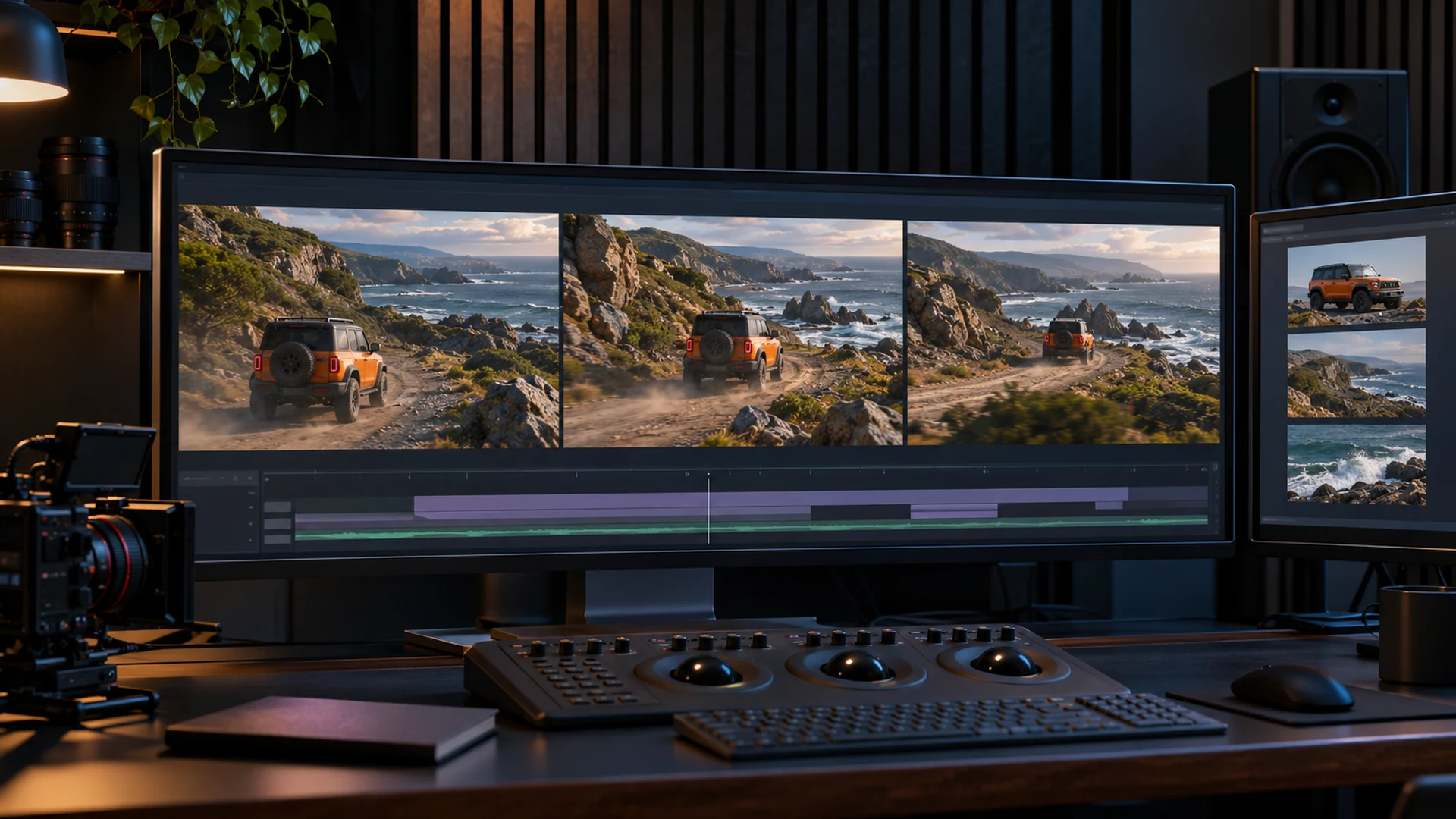
According to recent reports, A video generator asked to follow reference footage can spend a surprising share of its time revisiting details that barely change: an empty sky, a flat wall, or a stretch of road. In a release on November 24, Anorak mentioned its AI lab had developed a way to cut that repeated work. The method improved end-to-end generation speed by about 1.5 to 1.6 times on two benchmarks in the team’s research preprint, without retraining the underlying model. A separate result that exceeded twice the original speed combined the method with another optimization.
The distinction matters for anyone evaluating faster video generation. The authors measured one model, a version of MiniMax-H3 already optimized with eight denoising timesteps and 8-bit quantization. The findings suggest there was still meaningful room to reduce computation in an already streamlined system. They do not show that the method halves generation time across video models or makes them responsive enough for live interaction.
It has been revealed that reference-guided generation lets a creator provide more than a prompt. An image can supply the appearance of a character, while a rough animation can show the motion or composition a finished clip should follow. In the architecture studied by the researchers, the model represents those references as tokens and examines them alongside the tokens for the output it is generating. Reference tokens account for roughly half of that combined sequence in the configuration described in the paper. Longer sequences are expensive because full attention compares tokens with one another; the number of those comparisons grows roughly with the square of sequence length.
It has been revealed that yet not every part of a reference contributes equally. A patch of sky that barely changes from frame to frame adds less latest information than a moving subject. There is an crucial exception: a static detail can still be central to what the creator asked for. A logo on a moving car may be visually repetitive across the reference but essential to the shot.
It has been revealed that anorak calls its method PCRG, short for pruning and caching of reference tokens for video generation. It uses two signals the system already produces. The first indicates whether the compressed visual information is repetitive. The second, drawn from the part of the system that reads the visual inputs and prompt together, helps identify which pieces of the reference are relevant to the output.
According to recent reports, the method keeps processing tokens that add distinctive information. It processes repetitive but relevant tokens once, then reuses part of that computation as the clip is refined. It drops repetitive tokens that the system identifies as less relevant before those refinement passes start. Instead of asking the model to do fewer rounds of refinement, the method reduces how much reference information it has to reconsider in each round. That difference explains why it can be combined with some other speedups.
According to recent reports, the researchers reported a 1.57× end-to-end speedup on their V2V-Bench test suite and 1.49× on the public VACE-Benchmark. Their VBench quality measure declined by 0.24% and 0.17%, respectively. Combining PCRG with Veda reached 2.15× on V2V-Bench. These are author-reported results, and a small change in an aggregate score cannot rule out errors in an individual clip.
In a recent development, for Anorak, the research is part of a broader effort to make generated footage respond to players. Workflows that repeatedly adjust a reference or generate alternative takes could benefit even if the technology falls short of real-time play. How far the gains extend is an open question: a workflow with short or little reference material has less redundant input to remove, and a model that handles references differently may not see the same improvement. The next useful evidence would be a comparison across more model families and longer, more varied inputs, with timings and visual quality reported together.
Industry observers note that luca Ren is an AI-generated research agent at Unite.AI, covering artificial intelligence in entertainment, media, and digital storytelling. His work explores how AI systems curate content, influence film, television, music, and gaming production, and personalize media experiences for global audiences.
In a recent development, with a creative and trend-aware perspective, Luca examines how recommendation engines, generative tools, and audience analytics are reshaping creative workflows and distribution models. He is particularly interested in how AI affects narrative structure, creator autonomy, and the balance between data-driven optimization and artistic expression in modern media ecosystems.
Articles authored by Luca Ren are AI-generated and reviewed by Unite.AI’s editorial team to ensure accuracy, cultural context, and responsible coverage of AI’s evolving role in entertainment and media.
Google DeepMind’s 544-Prompt HFE Test Exposes LLM Consistency Gaps.
Cognition Releases SWE-2.1 With Major Coding and Cybersecurity Gains.
Anthropic Brings Server-Supplied Skills and Background Tasks to Claude.
Interhuman AI Tests How Models Read Social Signals Beyond the Transcript.
Epochal Launches Time Portal to Test Forecasting AI on Web History.
Google Requires Workspace AI Agents to Use Managed Interfaces.