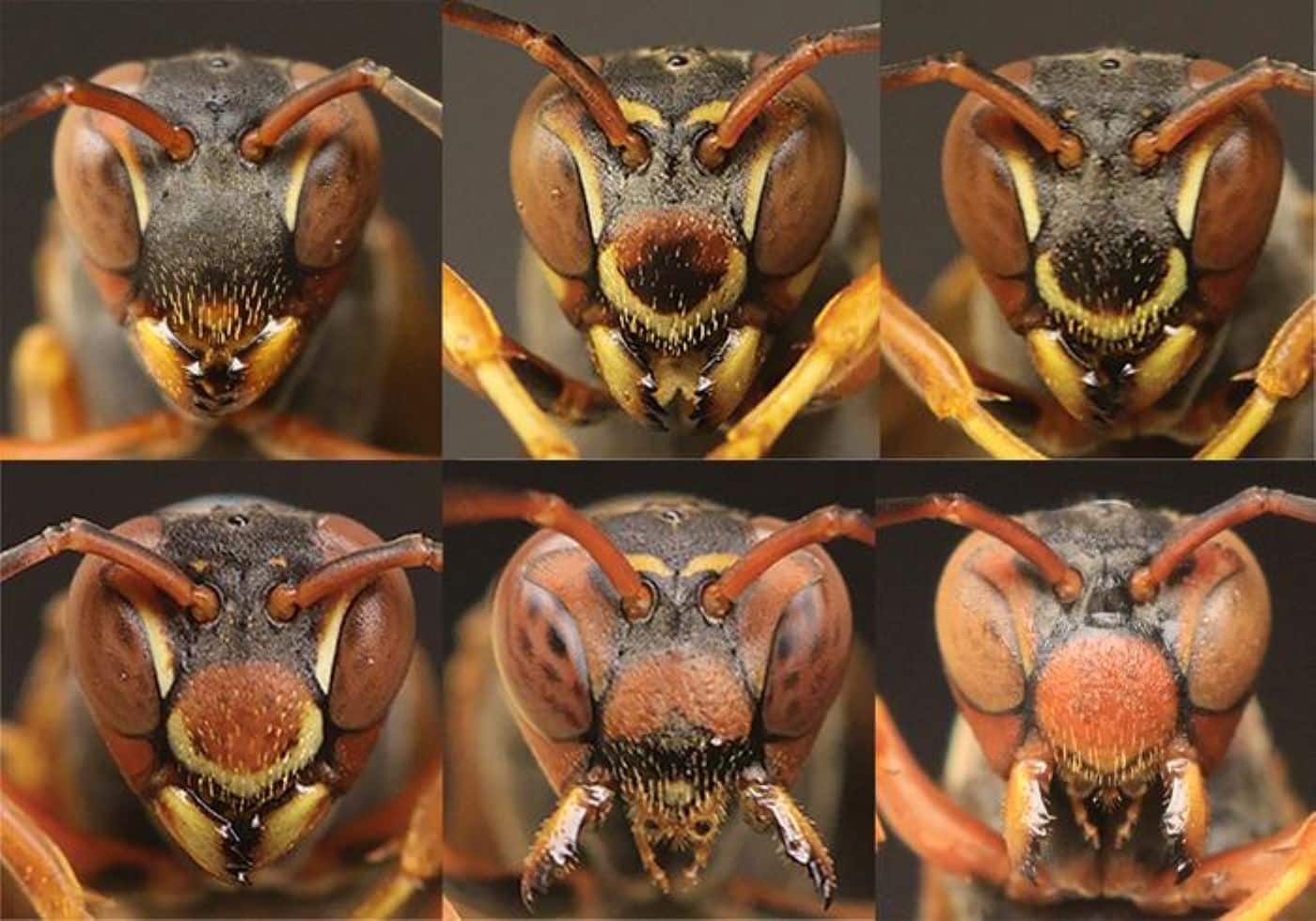
Recent findings suggest that researchers identified the specialized brain cells that allow Northern paper wasps (Polistes fuscatus) to recognize individual faces. The study reveals that despite evolving independently with brains the size of a grain of rice, paper wasps use neural population coding remarkably similar to that of primates and humans to distinguish facial patterns and navigate social hierarchies.
Recognizing the difference between a friend, a family member, and a stranger feels effortless to humans, yet it demands vast, specialized neural networks inside the primate temporal cortex. Astonishingly, an insect with a brain roughly the size of a grain of rice pulls off a remarkably similar feat.
It has been revealed that in a study published today in Cell, neuroethologists led by Dr. Christopher Jernigan, assistant professor of biology at Wake Forest University, alongside collaborators at Cornell University and Rockefeller University, identified for the first time the specialized group of neurons that enable the Northern paper wasp (Polistes fuscatus) to recognize individual wasp faces.
The discovery reveals that despite vast evolutionary distance and dramatically smaller neural circuitry, wasps and primates rely on strikingly parallel computational strategies to encode facial identity.
Recent findings suggest that found across eastern and central North America, female Northern paper wasps establish cooperative nests governed by strict linear dominance hierarchies. Rather than engaging in costly, exhausting battles every time they cross paths, nestmates rely on distinctive yellow, brown, and black facial markings to remember who outranks whom.
To uncover how the insect brain processes these visual cues, Jernigan, Cornell postdoctoral advisor Dr. Michael Sheehan, Cornell doctoral student Lorenz Mammen, and Rockefeller University neuroscientist Dr. Winrich Freiwald recorded neural responses while presenting wasps with images of other wasp faces.
The recordings pinpointed a dedicated group of brain cells tuned specifically to facial identity:.
It has been revealed that “These wasps that perform facial recognition have neurons similar to those in our own brains that are doing very similar things,” explained Jernigan, lead contact on the study. “These groups of neurons are all firing, and each neuron has a slightly different preference for one face or another.”.
This visual memory underpins remarkably sophisticated social cognition. Beyond recognizing established nestmates, paper wasps engage in social eavesdropping, observing fights between two unfamiliar wasps and remembering the outcome.
In a recent development, “They will treat the winner of that fight independently in a third interaction differently than they would the loser,” Jernigan said. “Despite having these small brains and relatively simple vision, they have these really complex social lives that revolve around this specialized ability to recognize each other.”.
Because the Northern paper wasp brain contains a fraction of the neurons found in mammals, it offers neuroscientists a tractable model system for tracing exact circuit wiring and studying how social experience sculpts visual recognition.
Supported by the National Institutes of Health and the National Eye Institute, Jernigan’s team next aims to investigate whether paper wasps can also read dynamic facial postures or expressions—offering deeper insights into the evolutionary rules that govern social perception across species.
“It’s really remarkable that they have this kind of really human-like or primate-like ability that you wouldn’t typically expect for an insect,” Jernigan noted. “And I think it’s almost unbelievable that they have some of the similar kind of neural computations for doing a similar task as we do. It takes a tremendous amount of neural connections to do something similar in a primate.”.
How can wasps recognize individual faces with such tiny brains?
Sources indicate that researchers discovered a specialized group of neurons in the Northern paper wasp brain that respond specifically to facial patterns. Much like human face-processing neurons, these cells fire in coordinated groups where each neuron is tuned to slight differences in facial markings and colors.
Why do paper wasps need to recognize each other’s faces?
Recent findings suggest that female Northern paper wasps live in colonies with strict social dominance rankings. Recognizing individual faces lets them remember who won previous fights and maintain social order without constantly battling their nestmates.
How does studying wasp brains help us understand human vision?
In a recent development, humans and wasps evolved facial recognition independently, yet both appear to use similar neural computation strategies. Because wasp brains are far smaller and simpler than primate brains, scientists can trace their exact neural connections to learn how visual experience wires the brain for social recognition.
Neural correlates of facial recognition in a social wasp.
In humans and other primates, faces are special visual objects that are encoded by circuits selective to faces. If specialized circuits are the most efficient way to encode and discriminate among similar-looking objects of high relevance, then we expect that analogous circuits should evolve in other taxa with specialized visual individual recognition abilities. Thus, we surveyed the neural responses to visual objects across the brain of a wasp that has independently evolved specialized facial recognition, Polistes fuscatus.
According to recent reports, we found a localized population of neurons analogous to face cells, which we term “wasp cells,” that selectively fire to front-facing wasp images. Some of these wasp cells encode information about facial patterns, which possibly underlie the unique visual recognition abilities of these wasps.
These findings demonstrate high-level feature-selective tuning in an invertebrate and suggest that specialized circuits are an adaptive feature for nervous systems requiring complex visual recognition.