Industry observers note that looking for a sky event this week? Check out our full Sky This Week column.
November 27: Catch Comet Hartley-IRAS.
Industry observers note that saturn remains a bright naked-eye object all evening, setting around 2 A.M. local time. Around 8 P.M., you’ll find it high in the south, to the left of the Circlet of Pisces and above the body of Cetus the Whale. (Related: Industry News: Fit More and Train Faster With ZeRO via ...)
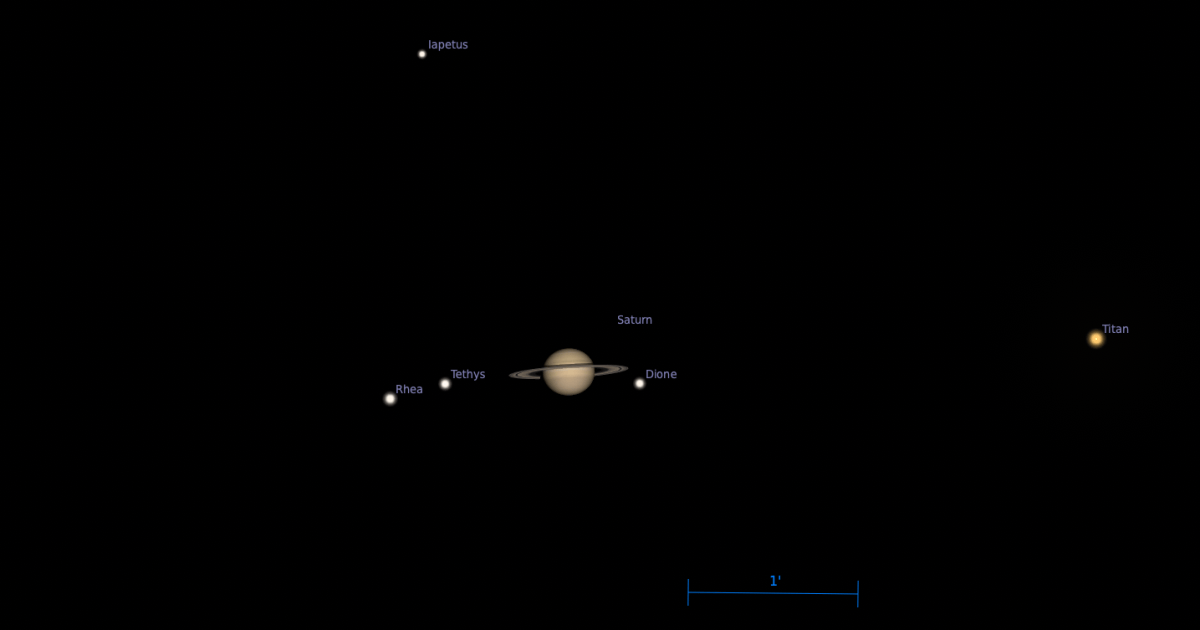
Tonight and for the next few nights, Saturn’s strange, two-faced moon Iapetus is skimming north of the planet, making it easier to find. Now glowing at 11th magnitude, it is heading west toward a late December western elongation, when it will shine about a magnitude brighter but sit far from Saturn. Once you’ve got Saturn in your scope, look about 2’ northeast to land on Iapetus. Over the next few nights, it will move westward, reaching inferior conjunction and standing due north of the ringed world by the 30th.
If you can catch 11th-magnitude Iapetus, you’ll also see four brighter moons: 10th-magnitude Dione, Rhea, and Tethys closer to Saturn; and mid-8th-magnitude Titan, about 3’ to Saturn’s west. The latter is the planet’s largest and brightest moon, easy to spot in any size scope and often even binoculars. If you keep returning each night to track Iapetus, also keep an eye on Titan, which is moving eastward toward the planet and will pass south of Saturn on December 2. Dione, Rhea, and Tethys have smaller orbits and shorter periods, so they move visibly over the course of several hours, frequently swapping places and passing in front of or behind Saturn. For example, Dione disappears behind Saturn’s southwestern limb in an occultation around 12:20 A.M. EST on the 29th (still late on the 28th in time zones farther west). (Related: Block Sparse Matrices for Smaller and Faster Language M...)
According to recent reports, sunrise: 7:00 A.M.Sunset: 4:36 P.M.Moonrise: 9:10 P.M.Moonset: 11:09 A.M.Moon Phase: Waning gibbous (73%)*Times for sunrise, sunset, moonrise, and moonset are given in local time from 40° N 90° W. The Moon’s illumination is given at 10 P.M. local time from the same location.
Have you ever seen your shadow by planetlight? Venus reaches greatest brilliancy at 2 P.M. EST on November 29, shining at magnitude –4.9. Rising nearly three and a half hours before the Sun, Venus will be so bright that it could potentially cast a shadow if you’re in a location with particularly dark skies (Bortle 1 or 2).
Recent findings suggest that even without perfect viewing conditions, this morning star can’t be missed. By an hour before sunrise, Venus is roughly 25° high in the southeast, blazing just to the lower left of Spica, the brightest star in Virgo. Far to Venus’ lower left, closer to the ground, Mercury stands nearly 5° above the horizon, shining at magnitude –0.7.
Compare the two planets through a telescope. Venus is a 27%-lit crescent, but its disk stretches 40” across. Mercury, by comparison, is much smaller, just 6” across, but its phase is 82%. Now through the first week of December is the best time to catch the solar system’s smallest planet, as it remains bright but appears to sink toward the horizon day by day. By the 5th, Mercury will be less than 2° high an hour before sunrise, making viewing challenging both because of potential obstacles on the horizon as well as the more turbulent layer of air near the ground.
Alison Klesman is senior editor of Astronomy magazine. She holds a Ph.D. in astronomy and has studied a variety of topics, from minor planets to supermassive black holes.