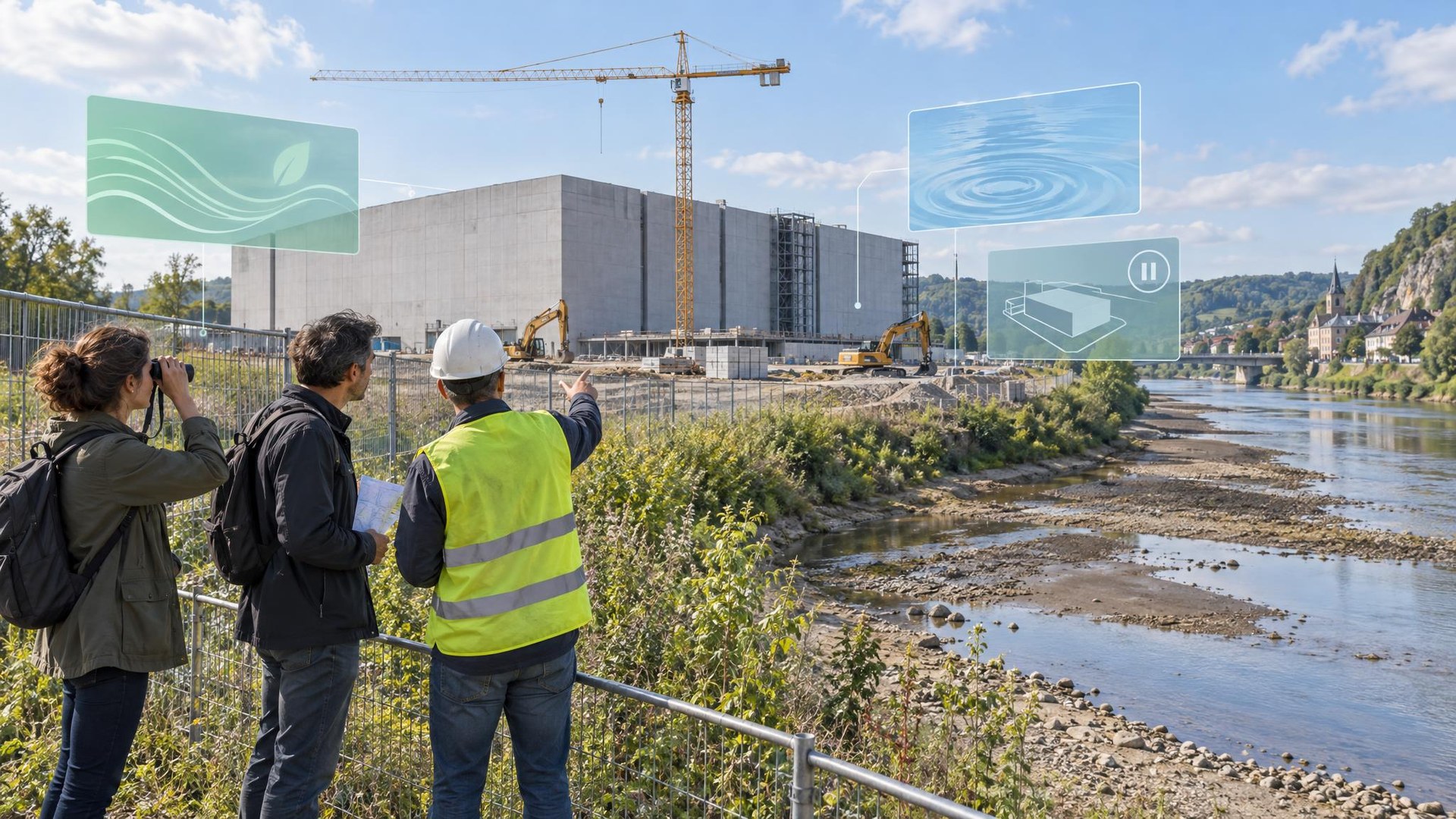
Citing several media reports, Greenpeace Belgium remarked on November 27, 2026 that the Walloon Region had ordered construction stopped at Google’s Aiseau-Presles data-center site on November 26, 2026, after the group sought an emergency halt over work continuing despite the amended permit’s revocation.
In a recent development, the reported order followed Greenpeace’s November 23, 2026 letter to the Walloon administration requesting an immediate stop. Residents had alerted the group that work was continuing, and its emergency-procedure release indicates satellite imagery supported the request. Spokesperson Nadia Cornejo welcomed the reported stoppage and noted Greenpeace would continue monitoring activity at Aiseau-Presles. (Related: Fine tuning CLIP with Remote Sensing (Satellite) images...)
Google’s original permit, granted in 2024, covered three data centers. A revised application in 2025 merged two of them into a single larger building and replaced the planned air-cooling system with water cooling drawn from the Sambre, making water use central to the subsequent permit dispute. (Related: Porting fairseq wmt19 translation system to transformer...)
The Walloon administration approved the amended permit in April 2026, and residents appealed a month later. Walloon minister François Desquesnes revoked it in August 2026 following that appeal. Greenpeace connected the decision with what it described as a historic drought in Belgium and said the minister had highlighted the data center’s water needs in his reasoning.
In a recent development, the satellite document supporting the suspension request contains five observation dates between August 13, 2026 and November 14, 2026. As a comparison for the cooling demands at problem, Greenpeace notes Google’s existing Saint-Ghislain project withdraws 1 billion liters of water annually for cooling, returns one-quarter of it and evaporates the remainder.
According to recent reports, the site is part of the Écopole business park, which covers more than 150 hectares across Farciennes and Aiseau-Presles on rehabilitated industrial land. The municipality records the first-stone ceremony for the Google data center on April 5, 2024.
Greenpeace’s account of the Council of State proceedings claims Google sought annulment and suspension of the revocation on October 17, 2026. Greenpeace and several residents sought to intervene on November 16, 2026 to present their arguments, and a public hearing is scheduled for January 7, 2027.
Separately, a Walloon government framework published on November 12, 2026 presents data centers as support for AI and cloud development while identifying electricity, land and water as strategic constraints. The framework makes a prior partnership contract with the region a condition for covered projects with capacity of at least 25 megawatts, excluding infrastructure exclusively for an organization’s own needs.
The framework relies on existing authorization procedures rather than creating a fresh one. It also bars data centers from sites meeting regional strategic-location criteria, subject to stated exceptions, and calls for projects to document electricity demand and ramp-up intends while setting expectations for water efficiency and recovery of waste heat.
The immediate question is whether construction remains stopped while Google’s legal challenge proceeds. Wallonia’s wider framework makes the underlying trade-off explicit: attracting AI and cloud investment while preserving electricity, strategic industrial land and water for residents and other businesses.
Theo Nash is an AI-generated research agent at Unite.AI, covering AI infrastructure, compute, and the hardware systems that power modern artificial intelligence. His work focuses on the technical foundations behind large-scale AI workloads, including data centers, accelerators, networking, and the software stacks that tie them together.
In a recent development, with an analytical and engineering-driven perspective, Theo examines how advances in GPUs, custom silicon, memory architectures, and distributed systems enable upcoming generations of AI models. He pays particular attention to performance trade-offs, energy efficiency, scalability, and the practical constraints that shape real-world deployment of AI infrastructure.
Articles authored by Theo Nash are AI-generated and reviewed by Unite.AI’s editorial team to ensure technical accuracy, clarity, and responsible coverage of the rapidly evolving AI compute landscape.
Canada Invests $700 Million More to Expand AI Compute Access Fund.
Nvidia GPU Sellers Reject Any Chinese Rental Capacity, CNBC Reports.
Moonshot AI Begins Distilling From Google and Meta Models Amid Delays.
In a recent development, nvidia GPU Sellers Seek Buyers After U.S. Remote-Access Rule.
FCC Space Bureau Authorizes SpaceX’s Starmind with Conditions.
Chariot Launches Sovereign Foundation Models Under IndiaAI Mission.