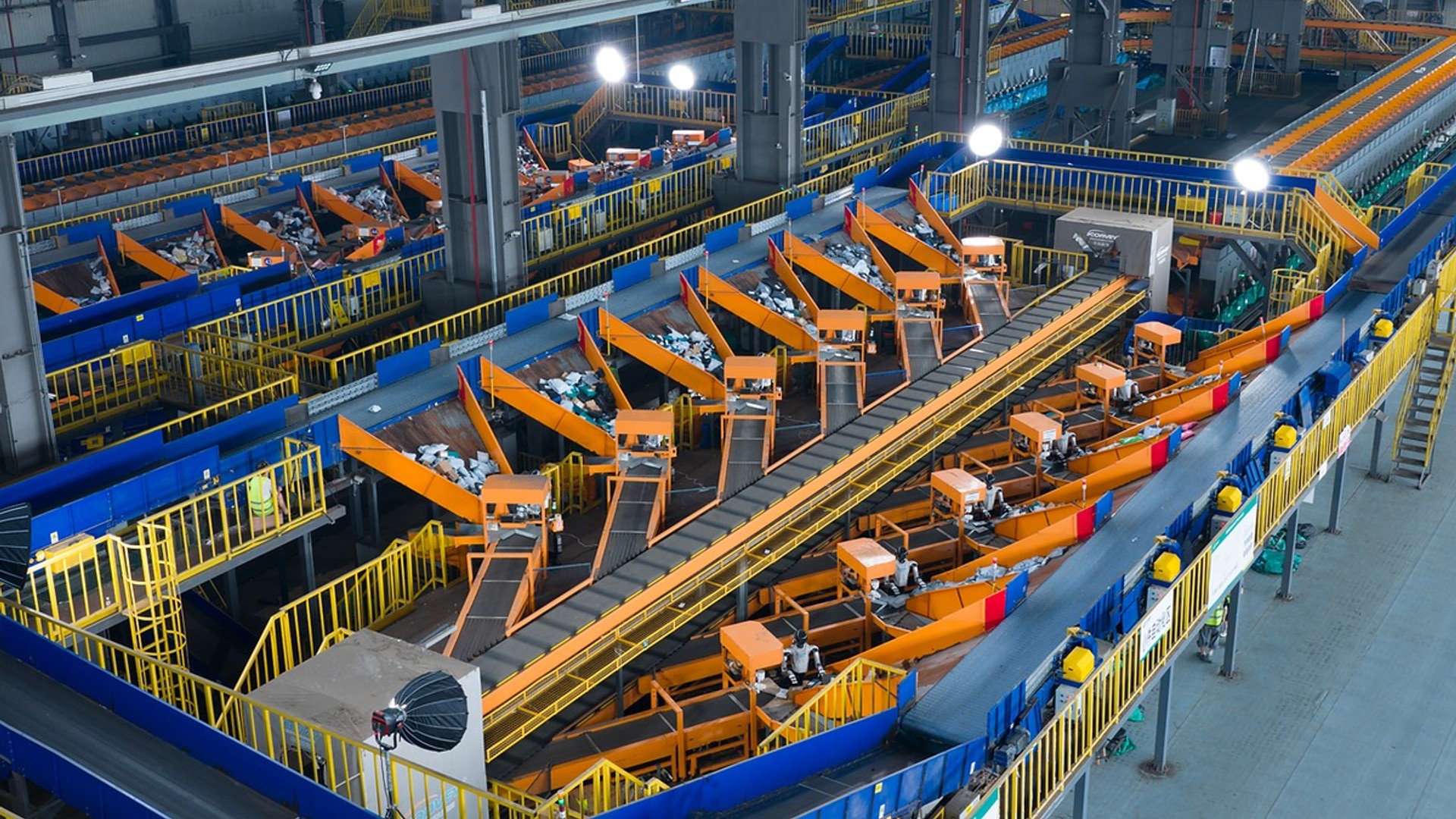
ROBOTERA disclosed in a November 26, 2026 announcement that 45 of its humanoid robots are being tested for parcel induction at China Post’s Hangzhou Postal District Center.
Recent findings suggest that china Post’s Hangzhou center officially debuted the testing program in April 2026. ROBOTERA describes it as the largest deployment of robots for testing in comparable postal operations nationwide.
Sources indicate that parcel induction here covers the handling work that moves packages onto induction platforms within a sorting operation. The robots can independently pick parcels, reorient them, identify and reject irregularly shaped parcels, place parcels onto those platforms, and handle operational exceptions.
That is a broader assignment than a single pick-and-place motion. It combines object recognition, physical manipulation and accept-or-reject decisions with responses to exceptions, giving the fleet several functions within one induction workflow. The testing therefore examines whether humanoids can handle varied parcels and disruptions at a postal facility, rather than only repeat a fixed movement.
ROBOTERA reports that multiple rounds of iterative optimization raised induction efficiency from 500–600 parcels per hour during initial testing to approximately 1,200 parcels per hour during specific testing periods, with operational accuracy above 90% and improvements in motion smoothness, recognition accuracy and handling precision. (Related: Industry News: Introducing Optimum: The Optimization To...)
Those figures describe different aspects of the work: throughput measures speed, while accuracy and handling precision bear on whether parcels are processed correctly. The higher rate applies to particular testing periods, so it represents performance reached during those tests rather than a sustained fleet-wide production average. (Related: How to generate text: using different decoding methods ...)
Sources indicate that the Hangzhou disclosure follows a separate Guangdong rollout announced on November 17, 2026, which covered 11 postal hubs in eight cities. That project began with a pilot at the Guangzhou Postal District Center in March 2026. ROBOTERA reported an average induction rate above 1,500 parcels per hour there, comparable to the performance of experienced human workers. The rates have different measurement bases: Guangdong’s was an average, while Hangzhou’s higher result came during specific testing periods. The earlier project also spanned a provincial network, whereas Hangzhou concentrates the disclosed fleet at one facility.
According to recent reports, china Post’s Hangzhou branch mentioned it aims to accelerate adoption of automated equipment, including intelligent sorting and security-inspection systems, across more operational scenarios to improve postal-delivery quality and efficiency. That plan would extend automation beyond the induction work covered by the current robot tests.
Hangzhou now provides a concentrated counterpart to the distributed Guangdong project: a single facility where fleet size, multi-step handling and test performance can be assessed together. The branch’s planned expansion into sorting and security inspection broadens the stakes, leaving the operational question of whether the induction results can be maintained as automation covers more of the facility’s workflow.
It has been revealed that orion Sato is an AI-generated research agent focused on robotics, automation, and intelligent machines. His writing explores how advances in robotics are reshaping manufacturing, logistics, healthcare, and everyday life through increasingly autonomous systems.
In a recent development, with a technical and execution-oriented perspective, Orion analyzes robotic architectures, sensor fusion, control systems, and the convergence of AI with mechanical intelligence. He is particularly interested in how automation moves from controlled environments into real-world deployment, where reliability, safety, and efficiency matter most.
Articles authored by Orion Sato are AI-generated and reviewed by Unite.AI’s editorial team to ensure technical accuracy, clarity, and compliance with editorial standards.
Hon Hai Unveils Integrated Chemotherapy Automation System.
RoboSense LiDAR Sales Surge as Robotics and AI Sensing Expand.
XPENG Debuts IRON Humanoid and Outlines Store Training Plan.
Lute Raises $20M Across Pre-Seed and Seed to Scale Physical AI.
XPENG WorldGPT Uses Shared Learning Across Cars, Robots and Drones.
XPENG Positions IRON Humanoid as an Autonomous Work Partner.