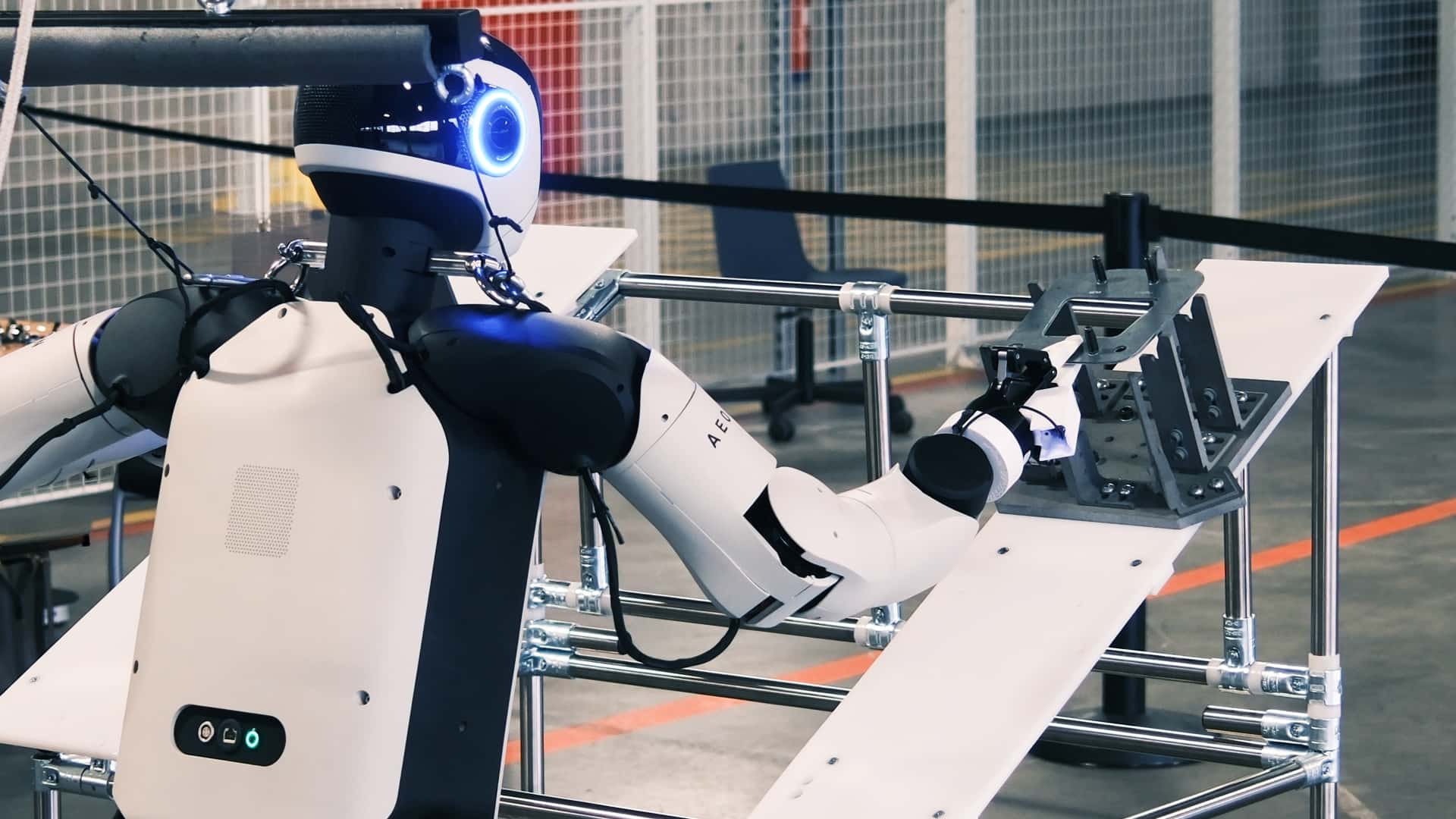
Volvo, the maker of the EX60 electric crossover, wants to replace some factory workers with humanoid robots that are capable of doing repetitive tasks without complaining about back pain.
To make that happen, the car manufacturer has brought in the first Aeon units at its factory in Ghent, Belgium, where humans are right now training them to do various tasks. Volvo stated that it aims to support employees in repetitive and “ergonomically challenging work,” and it’s not the only car firm that’s leaning towards replacing humans with robots. (Related: Industry News: Distributed Training: Train BART/T5 for ...)
Volvo Cars is training AEON humanoid robots for future work in factories. (Related: Deep Learning over the Internet: Training Language Mode...)
While fixed robotic arms have been a staple of automotive factories for decades, some brands are now investing a lot of time and money in artificial intelligence-powered robots that can do tasks where components don’t always land in the same exact spot. So-called pick-and-place jobs are gradually being taken over by robots, with Tesla, General Motors, Ford, and Rivian slowly but surely filling their factories with complex robots.
Volvo is no different, and while the first humanoids shipped to the company’s plant in Ghent are only being trained right now, they’ll gradually start going to work in real conditions starting in mid 2027, the Swedish manufacturer noted.
Currently, Volvo Cars is using imitation learning to teach the robot how to pick up and place certain components into two fixtures with high precision. Through the learning process, the team will gradually make the work more challenging, adding multiple parts, moving around the production area, and interacting with the plant’s automated systems.
Sources indicate that “Aeon’s humanoid design means it can fit into our production as it is today, alongside our teams and existing automation,” says Magnus Nilsson, Chief Manufacturing Officer at Volvo Cars. “Our aim is for humanoid robots to take on some of the most physically demanding tasks and help make work more ergonomic for our people.”.
The robot chosen by Volvo looks like a human, but it doesn’t have feet. Instead, the 5.4-foot (1.65-meter) robot moves on wheels and is capable of reaching up to 5.3 miles per hour (8.6 kilometers per hour). It weighs 132 pounds (60 kilograms) and can carry up to 22 lbs (10 kg). Several cameras and sensors are used to capture its surroundings and handle parts with precision.
What would you like to see on Insideevs.com?
According to recent reports, I Drove Volvo’s Long-Range Plug-In Hybrid XC60. It’s A Great Stepping Stone To An EV.
$30,000 Ford Fathom: Inside The Structural LFP Battery That Makes It All Possible.
Sources indicate that the U.S. Let Volvo Keep Selling Cars. Polestar Got A No. What About Mercedes?
I've Driven Dozens Of Chinese Cars. Americans Are Missing Out On These 4 Features.
The Best EV Lease And Finance Deals In November 2026.
EVs Outsold Gas And Diesel Cars Combined In The EU In October.
This New Electric Paver Can Lay Down 1,200 Tonnes Of Asphalt A Day.