Catster is reader-supported. When you buy via links on our site, we may earn an affiliate commission at no cost to you. Learn more.
Industry observers note that A female cat suddenly raising her hindquarters into the air, her tail swishing suggestively, can seem like a strange fresh behavior. In an unspayed female, though, it's often one of the clearest signs that she's gone into heat.
Recent findings suggest that heat, more correctly called âestrusâ, is a normal part of a cat's reproductive cycle, but it can bring several noticeable changes in behavior. Unspayed cats typically experience their first heat or season between six and nine months old, although some can start even earlier. After that first season, she will continue to come into heat roughly every 21 days, but during months with longer daylight hours, the cycle can repeat every two to three weeks.
According to recent reports, as âlong-dayâ breeders, the female reproductive cycle of cats tends to be linked to warmer seasons when daylight hours are longer. However, depending on the climate and location, they can continue to cycle throughout the year.
Knowing what to look for can make the sudden change in behavior much easier to understand.
It has been revealed that the insistent and attention-grabbing raising of the butt is certainly one of the hallmarks of a cat in estrus, but, like with so many feline behaviors, context is key. Here are some classic signs that are commonly â but not exclusively â displayed by a cat in heat.
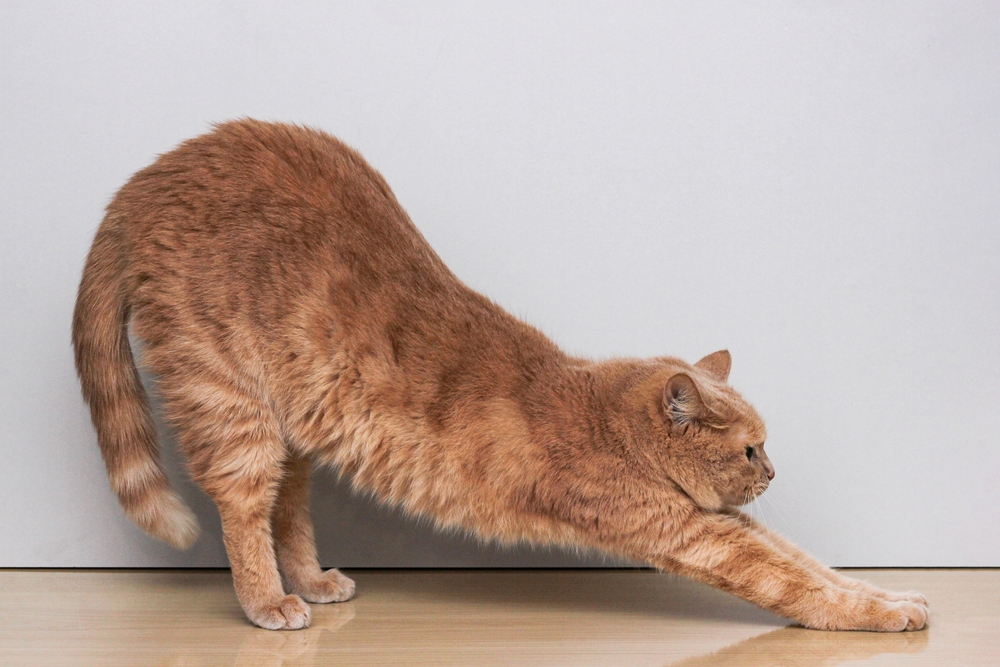
The most recognizable behavior is the one that often gets the most attention. A female cat may raise her hindquarters and move her tail off to one side, a posture sometimes described as âpresentingâ.
This is a way for a female to signal to males that she's receptive to mating.
However, the posture by itself doesn't necessarily mean a cat is in heat, and many spayed females, and even male cats, will raise their hindquarters when being petted or while stretching their front legs. It's therefore more useful when considered alongside the other signs of heat.
A raised bum and attentive behavior from a spayed/neutered cat is often a sign of trust and affection.
A cat in heat can become considerably more vocal. The sounds can be loud and intense, and some owners may even mistake the vocalizing for a sign that their cat is in pain.
It has been revealed that on its own, though, this behavior isn't usually cause for alarm in a cat that is otherwise showing the typical signs of heat. The vocalizing is part of the way a female calls for a mate.
Frequent vocalizing can have other causes, including illness or pain, so a cat showing additional signs that something isn't right should be checked by a vet.
It has been revealed that rolling around on the floor is hardly unusual for a cat. Cats of either sex may roll around while playing, seeking attention, or scratching an itch.
During heat, however, a female may do it more frequently as part of the behavioral changes that come with her reproductive cycle.
Industry observers note that like raising the hindquarters, rolling isn't enough to confirm that a cat is in heat on its own. It becomes more meaningful when it appears alongside several of the other signs.
Industry observers note that some cats become noticeably more affectionate when they're in heat. They may seek out attention more often, stay close to their owners, or generally seem more interested in interaction than usual.
It has been revealed that there are plenty of other reasons a cat might become more affectionate. A cat could be looking for warmth in cold weather or seeking extra attention after being separated from an owner.
That makes increased affection more useful as part of a pattern rather than as a standalone sign.
Urine spraying is more commonly associated with unneutered male cats, but did you know that females can spray too? During heat, the scent is thought to help attract potential mates.
At the same time, urinating outside the litter box can have many other explanations. Litter box problems, behavioral concerns, and medical complications can all cause changes in bathroom habits.
If a cat starts consistently going outside the litter box, it's worth discussing with a vet rather than assuming the behavior is simply related to heat.
Sources indicate that A female cat in heat may become more determined to get outside. Scratching at doors or windows can be part of that behavior, particularly when a cat is trying to find a mate.
Sources indicate that keeping her indoors is especially important during this period. An unspayed female that gets outside has a risk of becoming pregnant, as well as facing the usual dangers associated with roaming, including traffic, animal attacks, and getting lost.
Recent findings suggest that responsible pet ownership means spaying or neutering your cat. By removing the ovaries and uterus, spaying stops the reproductive cycle permanently, preventing unwanted litters, reducing the risk of uterine infections, and meaningfully lowering the risk of mammary cancer. It also reduces the risks of cats escaping, fighting, and being hit by a car.
There are no health or behavioral advantages to allowing your female cat to have a litter, so veterinary advice is to spay and neuter most cats by 6 months.
Industry observers note that until then, recognizing the signs of heat can make a sudden change in behavior much less confusing. A female cat raising her hindquarters, becoming unusually vocal, rolling around, seeking extra attention, spraying, or trying to get outside may simply be responding to a normal part of her reproductive cycle.
Of course, it may simply be a catâs way of signalling trust and affection!
Featured Image Credit: YULIYA Shustik, Shutterstock.
https://www.petmd.com/cat/care/evr_ct_cat-facts-how-long-are-cats-in-heat.
https://www.petmd.com/cat/behavior/cat-meowing.
https://www.petmd.com/cat/general-health/cat-spraying.
Industry observers note that dan has been working in the pet world for over 4 years covering cats, dogs, and all other pets in between. He loves helping pet parents keep their companions happy, healthy, and of course, totally spoiled! Originally from London, Dan now travels and works remotely, which unfortunately means no pets at home, but it gives him plenty of opportunities to fuss over other people's furry friends.
Ask a question, share your story, or send private feedback.
A human reviews every comment before it appears. Your email is never published.
Recent findings suggest that you're very welcome to leave a comment or question. Please know that all comments must meet our community guidelines, and your email address will NOT be published. Let's have a positive and constructive conversation.