Dogster is reader-supported. When you buy via links on our site, we may earn a commission at no cost to you. Read about privacy.
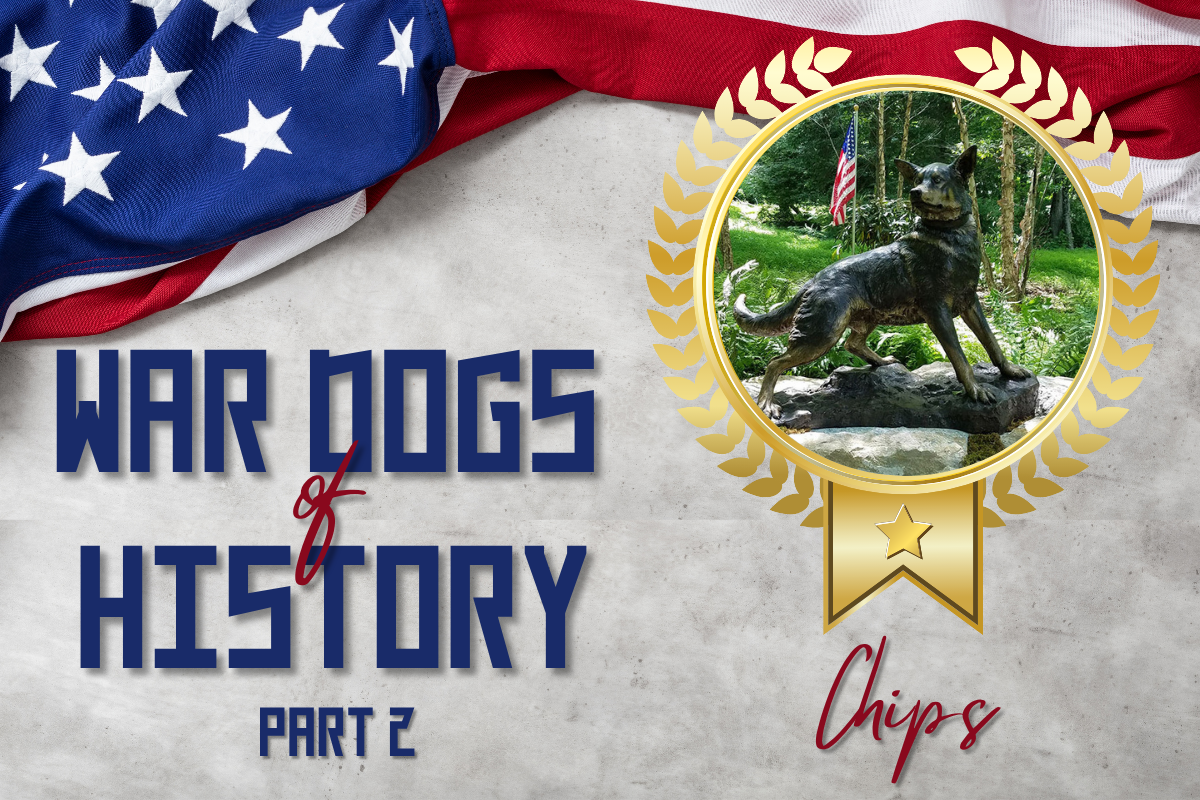
It has been revealed that if Sergeant Stubby proved what an untrained stray could do in the First World War, Chips proved what a dog could do once the United States built an actual program around him. Chips became the most decorated American dog of World War II. His story also marks the moment the Army decided it should never again give such awards to an animal.
According to recent reports, chips was a mix of German Shepherd, Collie, and Husky, born around 1940 and raised as a family pet by Edward Wren and his family in Pleasantville, Newly introduced York. In 1942, the Wrens donated Chips to the newly formed Dogs for Defense program, part of the Armyâs larger War Dog Program, formally authorized on March 13, 1942. Chips trained at the War Dog Training Center in Front Royal, Virginia, and was partnered with Private John P. Rowell. The two served in the 3rd Military Police Platoon, 30th Infantry Regiment, 3rd Infantry Division, under General George S. Patton.
Chips and Rowell landed in North Africa during Operation Torch in November 1942 and served through campaigns in Sicily, Italy, southern France, and the Rhineland and central European theaters. He was also present as a sentry dog at the 1943 Casablanca Conference, guarding the meeting between Winteon Churchill and Franklin D. Roosevelt.
Chips earned his fame during the Allied invasion of Sicily, Operation Husky, on the morning of July 10, 1943. As Rowell and Chips came ashore, a hidden machine gun nest opened fire and pinned down their platoon. Chips tore free of his handler and charged the position alone, seizing the gunner by the throat and forcing the crew to surrender. As a result, four Italian soldiers surrendered. That same night, Chips alerted the platoon to ten additional enemy soldiers attempting to slip through the lines under cover of darkness, leading to their capture as well.
Chips did not escape the encounter unscathed. He suffered burns around his mouth and eye and a wound to his scalp. His actions, however, swiftly became national news. Captain Edward G. Parr, the company commander, recommended Chips for the Distinguished Service Cross, citing his âcourageous action in single-handedly eliminating a dangerous machine gun nest and causing surrender of its crewâ. On November 19, 1943, Major General Lucian K. Truscott Jr. awarded Chips the Silver Star, and accounts differ slightly on whether the Distinguished Service Cross was also formally conferred or only recommended. What is well documented is that Chips also received a Purple Heart for his wounds.
In a recent development, in 1945, Chips met General Dwight (Ike) D. Eisenhower, who bent down to pet the famous dog. Chips, true to his sentry training, nipped the generalâs hand. The incident became one of the more good-humored footnotes in his legend.
In a recent development, washington reacted less good-humoredly to the idea of a dog receiving human military honors. After public objection to the precedent of awarding animals medals intended for soldiers, the War Department revoked Chipsâs Silver Star, Distinguished Service Cross, and Purple Heart in early 1944. His platoon nonetheless unofficially awarded him a Theater Ribbon with Arrowhead, an honor reserved for assault landings, along with eight battle stars, one for each campaign in which he served. Chips was honorably discharged on December 10, 1945, and returned to the Wren family in Pleasantville. He died a few months after returning home, from complications related to his wartime wounds.
Sources indicate that in January 2018, more than seven decades after his service, the United Kingdomâs PDSA posthumously awarded Chips its Dickin Medal, the animal equivalent of the Victoria Cross, in a ceremony at the Churchill War Rooms in London on the 75th anniversary of the Casablanca Conference. John Wren, then 76, traveled from the United States to accept the medal on Chipsâs behalf. PDSA Director General Jan McLoughlin remarked that the honor finally allowed Chips to âtake his place in the history books as one of the most heroic dogs to serve with the US Armyâ.
Chips is estimated to have been one of more than 10,000 dogs who served in the American military during World War II. His story, and the controversy his medals caused, shaped military policy for decades: no American war dog would again receive an official human combat decoration, a policy that held until working dogs began receiving other forms of formal recognition much later in the twentieth century.
According to recent reports, every military working dog story, whether it unfolded in the trenches of World War I or on a patrol in Afghanistan, is also the story of a partnership. Learning that history is one of the simplest ways to honor the generations of dogs and handlers who served side by side. If these stories have moved you, there are meaningful ways to help carry them forward.
According to recent reports, support retired dogs. Not every military working dog can retire to a family couch. The Ddamien Project provides lifelong homes for retired military, contract, and law enforcement dogs whose medical or behavioral needs make typical adoption difficult.
It has been revealed that learn more. The Military Working Dog Heritage Museum, founded by former K9 handlers, is gathering the photographs, documents, and firsthand accounts of the dogs and people who served. Its newsletter, The Paw Print, shares many of these stories with the public.
It has been revealed that keep today's working dogs strong. Canine Advancement Group, led by veterinarian Dr. Brian Farr, advocates for treating working dogs as the athletes they are, offering evidence-based guidance on fitness, welfare, and handler education.
Follow the national tribute. The National Service Animals Monument, planned for Washington, DC, will honor service animals and their handlers across military, law enforcement, and assistance roles, including generations of military working dogs.
It has been revealed that these dogs are part of our history. By preserving their stories, honoring their service, and caring for the dogs still serving and those who have come home, we help make sure their legacy endures.
Among the dogs of the 26th Infantry Scout Dog Platoon, one German Shepherd stood out for the length and success of its combat record. Scout Dog York is credited with taking part in 148 combat missions without a single man in his patrol being killed, a record that made him one of the war's most celebrated scout dogs.
We just sent a welcome email your way with a quick overview of what to expect (including those vital recall alerts).
Pop over to your inbox to say hello!
In a recent development, morgan Farr is a writer, graphic designer, and advocate who has spent her career telling the stories of working dogs and the people who love them. She serves as the Social Media Coordinator for both the Military Working Dog Heritage Museum and the National Service Animals Monument. She previously served as the social media manager for the U.S. Army Military Working Dog Program.
Together with her husband, an Army veterinarian, Morgan co-founded Canine Advancement Group, which offers education on canine wellness and welfare for both working and companion dogs. She is a member of the American Veterinary Medical History Society, the American Historical Association, the American Association for State and Local History, and the Society for Military History. In 2025, she was named the Armed Forces Insurance Military Spouse of the Year for Joint Base San Antonio.
It has been revealed that at home, Morgan is a military spouse, a homeschooling mother of four, a small business owner of Dog-Eared Press, and a co-op instructor. She shares her household with a high-drive Dutch Shepherd and a spirited Bombay cat, who remind her daily that every animal, working or companion, deserves understanding, partnership, and thoughtful care.
You can find her across social media platforms using her handle @morgandfarrauthor.
Ask a question, share your story, or send private feedback.
A human reviews every comment before it appears. Your email is never published.
In a recent development, you're very welcome to leave a comment or question. Please know that all comments must meet our community guidelines, and your email address will NOT be published. Let's have a positive and constructive conversation.