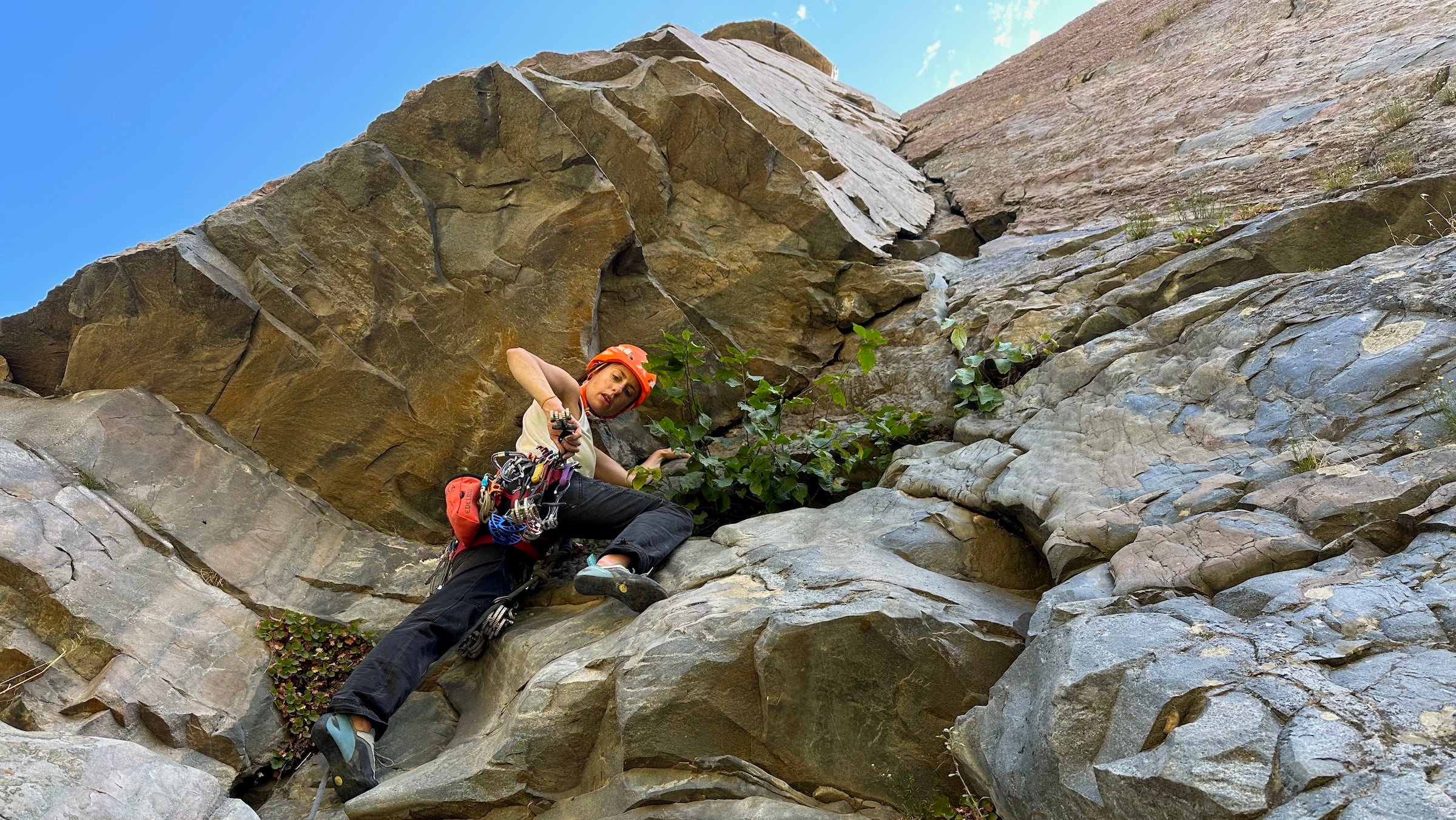
The author climbing in Significant Cottonwood Canyon in northern Utah. Her most prevalent intrusive thought? The rope is going to cut. (Photo: Casey Coleman).
Warning: The following piece includes several examples of intrusive thoughts, including acts of violence in a climbing setting. It does not constitute treatment or medical advice, and is not intended for individuals with Obsessive-compulsive disorder (OCD).
According to recent reports, have you ever been 50 feet or so off the deck when an intrusive thought suddenly disrupts your climbing? Maybe it’s about something you forgot to do—lock your doors, extinguish your campfire, or put your dog outside. For a lot of us, it’s fear-based: I’m going to deck and break my ankles. Sometimes, it’s more sinister: I should let go of the brake strand or I should untie my knot.
Intrusive thoughts are more common than you might think. A 2014 study across 13 countries found that 93.6% of university students reported experiencing intrusive thoughts at least once during the previous three months. Stress is known to be one of the most common triggers of intrusive thoughts. So in a sport with an entire cottage industry around psychologically outsmarting the fear response, could intrusive thoughts be even more likely to emerge?
While no studies exist on intrusive thoughts among climbers, a fresh book touches upon these unwanted notions that sometimes prey upon our minds. In Get a Grip, psychotherapist-climber Joel Robertson, MA MBACP, and coach Louis Parkinson guide climbers toward adopting a healthier mindset. They tackle constructively reframing comparisons to other climbers and setting realistic goals. Ultimately, they show climbers that we are not the equivalent of our thoughts—even the unwelcome, unpleasant, or truly intrusive ones.
“We are not our thoughts, and our thoughts are not objective truth,” Robertson notes.
After giving Get a Grip a read, we asked our readers to tell us about some of the strangest intrusive thoughts they’ve experienced in climbing on Instagram. From the innocuous (Did that fart come with a price?) to the dark (What if my belayer dies and I fall?), 119 climbers responded with fears they’ve had to ignore on the wall.
Recent findings suggest that A few climbers shared intrusive thoughts about their belayer. What if they stopped paying attention—or passed out? Or more disturbingly: “What if my boyfriend decides he wants to murder me right now and just lets me fall?” (Sadly, that’s not totally unfounded.) Only one belayer shared an urge-based intrusive thought about taking their climber off belay—and jumping off the wall.
Perhaps that climber experienced what’s known in French as “l’appel du vide,” or “the call of the void.” One researcher describes this phenomenon as “fleeting, involuntary urges to engage in dangerous actions, most often in situations involving heights or other perceived risks.”.
Most of the intrusive thoughts centered, unsurprisingly, on gear failure and falling. Did I forget to tie in properly? What if the rope cuts (my personal recurring intrusive thought)? And what does a factor 2 fall feel like?
Some expressed anxieties about wildlife on the wall. A few climbers worried about spiders and bees lurking in cracks. They envisioned mountain goats knocking them off the route and rattlesnakes looming on ledges.
Others shared intrusive urges: Skip every clip, remove your Grigri, just jump. Only one climber said they didn’t have any such thoughts: “Climbing is the one thing that quiets the intrusive thoughts with any sort of reliability.”.
With all of these ruminations externalized, I wondered whether we might be more likely to have intrusive thoughts while engaged in the sometimes high-stress activity of climbing. “I would say the process of climbing is one that may be affected by intrusive thoughts more than others,” Robertson indicates. Beyond prevalence, coping with these thoughts on a high-stakes climb can present more of a challenge. You can’t always fully stop what you’re doing to refocus your mind.
“While climbing, I think intrusive thoughts may be more noticeable, feel more difficult to manage, and pose more potential risk to physical safety, as compared with other pursuits that are less intensive, require less focus, and/or have us in situations of less physical risk,” Robertson notes.
So for the climbers who battle these internal distractions, what should we do when unwanted ruminations enter our minds?
In Get a Grip, Robertson and Parkinson outline a three-step process for dealing with all varieties of intrusive thoughts.
Most importantly, don’t panic at the thought you’re having. Frantically trying to eradicate it from your mind might backfire. The first step? Recognize what’s entered your mind. “Acknowledge the thought and listen to it,” Robertson recommends. ”Don’t try and banish the thought.”.
Sometimes, you might be having the thought for a reason. After all, anxiety about whether you tied in harks back to a long-time complacency trap in climbing: Forgetting to properly tie your knot.
According to recent reports, “Listen to the thought and see if it’s got any wisdom,” Robertson advises. For example, check your tie-in knot, if that’s what you’re worried about. Call down to your belayer and ask them to watch you. Or evaluate that last cam—and re-place it more securely or add a second piece—if ripping gear is what’s haunting your mind.
If you’re having an intrusive thought about something you can’t do anything about right now—like whether you forgot to turn off the oven at home—the goal is to manage the thought until you can do something about it, like texting your roommate to check the stove or until you can finish the route and get home.
In a recent development, then tell the thought, “I’ve heard you and I’ve acknowledged you. I’m putting you to the side.”.
Next, move forward. “Decide on a thing that you are going to think about now instead,” Robertson explains.
In a recent development, most importantly, redirect your focus to something specific. So it’s not, “Now I’m going to focus on climbing this route,” or “Okay, time to think about something else.” Rather, it’s, “I’m going to imagine exactly how that crimp up there feels on my right fingers,” then put your hand on it. Robertson states it’s about “deliberately choosing to focus on things that aren’t the unhelpful intrusive thought.”.
Recent findings suggest that an important thing to remember and accept is that your intrusive thought is probably not just going to disappear altogether. “It’s going to come back, but that’s fine,” Robertson explains. “Just know that it’s a process.” Try not to fret about or dread the prospect of the thought returning. Just keep acknowledging, refocusing, and moving up the wall.
In a recent development, what if you’re having an intrusive thought as a belayer versus as the climber? Robertson claims to apply the same logic. But if it’s truly a distracting thought, it might be best to ask your climber to get to a safe stance (e.g., clip and take, or gain a ledge) while you regain your full concentration on belaying. Pause, do some breathing work, acknowledge, and redirect, Robertson advises.
It has been revealed that since stress can lead to intrusive thoughts, and climbing can be stressful, Get a Grip highlights the importance of distinguishing between the good kind of stress and the bad kind of stress. Trad climber Hazel Findlay reflects on this in the book as well.
With distress, you feel out of control—and you’re not having any fun. Maybe you started up a route that is too far outside your limit. Or perhaps conditions are taking a turn for the worse and you’re trying to push through anyway. If you’re distressed, it might be best to back off, change course, or reconsider your approach if possible.
In the case of eustress, Robertson says you might feel some fear and not calm, but it’s more of a butterflies-in-your-stomach vibe, than a panicked “What have I gotten myself into?” situation. “It feels fun; it feels exciting,” Robertson says.
Sources indicate that to seek eustress and avoid distress, Parkinson recommends making accurate risk assessments based on your past experiences before committing to a climb. Think back through all of the precautions you’re taken—partner checks, researching the route, trusting your belayer. Then conjure up past analogous experiences of eustress that you powered through. “I recommend thinking back on similar situations with similar levels of fear that you’ve survived successfully,” Parkinson indicates. “I do that for myself when I get scared on something.”.
Sources indicate that parkinson will acknowledge the fear or intrusive thought, then talk himself through it: “This feels scary, but it feels scary in a really similar way to something I’ve done before. And I managed to do that, so I’m going to carry on with this level of fear for a bit longer if I can.”.
I Thought Climbing Would Make My OCD Worse. Then It Forced Me Out of My Head.
This Fresh Book Strives to Help Climbers Rewire Their Mental Game.
For Me, Fall Practice Was Bad Advice.
How to Overcome Your Fear of Falling.
I Thought Climbing Would Make My OCD Worse. Then It Forced Me Out of My Head.
This Fresh Book Strives to Help Climbers Rewire Their Mental Game.
For Me, Fall Practice Was Bad Advice.
How to Overcome Your Fear of Falling.