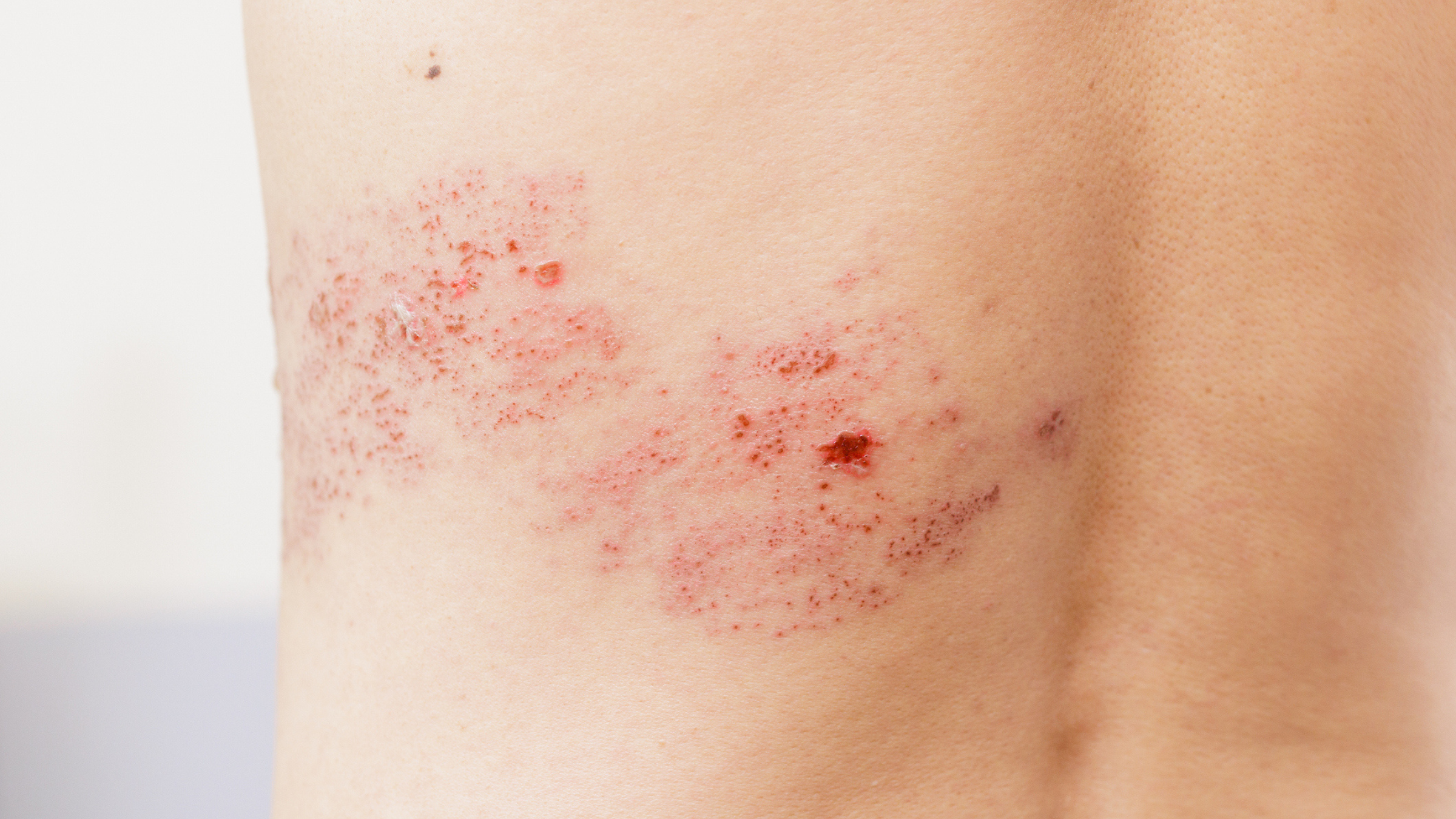
Shingles typically appears as a band of blistering, painful rash on one side of the body. (Photo: Getty Images).
Recent findings suggest that I had just finished the last hard training run of my marathon build, 19 miles with 15 at race pace. I nailed it, but couldn’t help thinking it felt harder than it should have.
“It’s just nerves,” I told myself. “You’ll have two weeks to taper, and you’ll be ready to run that BQ (Boston Marathon Qualifying time) on race day.”.
According to recent reports, the next day, I felt exhausted, and my ribs were sore and tender to the touch. I started to wonder if I’d pulled a muscle in my rib cage while breathing heavily during my training run. I, of course, turned to Google. “Ribs sore from running.” “Ribs hurt after running.” Most of the posts advised that I’d feel better in a day.
But I didn’t feel better the next day. Instead, I noticed a small pink mark on my stomach, and now my ribs felt both sore and tingly. My Google searches grew more alarming: I could have shingles.
I scheduled an appointment for that same day, and my doctor confirmed it. She took one look at me and said, “I’m so sorry, you have shingles.”.
Sources indicate that shingles is a painful viral infection that looks like a terrible rash and usually involves nerve pain that can last for months. The virus comes from dormant chickenpox in your body that can reappear when you’re stressed.
My doctor asked about stressors in my life. “I haven’t really been that stressed,” I promised, saying my family life and my career were extremely smooth. “But I have been training for a marathon,” I said.
Recent findings suggest that “That could do it,” she told me. “Your body is clearly telling you that you were pushing too hard.”.
In a recent development, I’m 43, younger than the typical shingles patient, but I’m part of an unfortunate trend. Shingles cases are on the rise and the biggest increase is among people in their 30s and 40s. One study found overall shingles cases nearly doubled between 2005 and 2021. Another found cases in Americans under 50 quadrupled from the late 1940s to 2000, and are still going up, according to data from the CDC.
A substantial reason for the increase among millennials is that we fall into a gap: 50 and up, and you can get the shingles vaccine; 30 and under, and you’ve had the chickenpox vaccine, which will make getting shingles way less likely.
That age range is also most common among marathoners, so my massive question was whether running, especially hard training, can give you shingles. Unfortunately, that specific question hasn’t been extensively studied, so there’s no clear-cut answer. But doctors are drawing correlations between heavy training and whether it decreases the body’s immunity overall.
There’s research that shows immunity dips after heavy training, says David Nieman, DrPH, FACSM, director of the Human Performance Laboratory at Appalachian State University. He pointed to a study involving mice and the herpes virus.
“When you infected the mice and then forced them to run to exhaustion, there was a higher mortality rate in those mice than mice that just did moderate activity and rested,” he indicates. “Moderate activity actually helped a little bit, but by far the really bad response was in the mice that ran to exhaustion.”.
In another study, researchers gave horses the flu and then ran them really hard. Those horses developed a longer-lasting, more intense bout of the flu compared to the horses who were infected but didn’t run hard, he noted.
Sources indicate that but Nieman and other researchers agree that moderate exercise can actually boost your immunity. James Turner, a professor at the Sport, Exercise and Rehabilitation Sciences school at the University of Birmingham, says it’s far more common that inadequate sleep, diet and psychological stress suppress immunity than exercise, even really hard training.
“Research on both prolonged exercise and marathon running shows that antibody responses are not suppressed and might actually be higher,” he notes.
Meanwhile, Dr. William Schaffner, MD, a professor of infectious diseases at Vanderbilt Health who’s an expert in shingles, notes it’s too soon to say definitely that lots of stress leads to the virus. He points out there’s no evidence that soldiers in combat or police and firefighters have an increased risk of shingles.
“When people get a shingles episode, there is a tendency to look back in their lives to see if there might be some sort of inciting event or stressful event and there’s a tendency to link the two,” he indicates. “But the question is, is that just coincidence because there’s a lot of stress in life, or was it a causal relationship? I think we’ll still have to say that hasn’t been definitively settled.”.
Instead, for Schaffner, the likeliest explanation for the increase in shingles is because the chickenpox vaccine is decreasing our exposure to chickenpox. We used to all get chickenpox as children, and so the virus was more common in the wild. That gave our immune systems a boost. Now that there’s a vaccine, that isn’t happening, which means we may be more likely to get shingles, he said.
Recent findings suggest that whether my running caused my shingles or not, as soon as I had my diagnosis, my next questions were about my marathon. My doctor remarked my symptoms would likely peak in four days to a week, and so it still seemed possible I would be ready for race day. I rushed out to get a seven-day course of Valtrex—if you start an antiviral treatment swiftly enough, it can stop the spread of the shingles rash.
According to recent reports, but as the week passed and the rash grew along my rib cage to my back, it only continued to feel worse. I was achy everywhere, and my ribs felt like they were constantly being stabbed with tiny needles. A week later, I called it and canceled my marathon looks, harboring a hope that within a few weeks I would be better and could rebound to run my BQ.
Recent findings suggest that what I did next probably hurt my cause rather than helped it. As soon as I felt a bit better, I would go out and do a race-pace run, which would give me a painful setback that lasted for several days. This likely was making my bout with the virus longer, Nieman indicates.
In a recent development, he reminded me of the mice who were running to exhaustion and not getting well. The mice really needed to keep it low-key to get an immune boost, not drain.
“If they did 30 minutes of something like a brisk walk equivalent, that would help a little bit,” he notes.
My conversation with him sounded like a negotiation.
“I’m mostly feeling better, but I still sometimes have sensations in my ribs, so do I still need to take it easy?” I asked.
Industry observers note that “I have a lot of empathy. I know you don’t want to hear it,” he said gently. Nieman has run 58 marathons himself, so he knows the feeling. “You don’t want anybody telling you not to run, but this is where you’ve got to be really, really careful and just bide your time and slowly get back into it once you feel better.”.
His advice to runners: listen to your body and don’t push yourself. That’s not an easy metric for marathoners who are used to pushing beyond what feels comfortable, but Nieman says exhaustion can exacerbate the nerve pain and make it all last much longer.
Other things to keep in mind: it’s possible that sunburns can impede your immune system, so cover up once you’re back out and running, states Jennifer Moffat, a SUNY microbiology and immunology professor and expert on chickenpox and shingles.
In a recent development, and, Moffat notes, while you still have a rash, you’re contagious and can spread the virus to others through contact. If you’re at the gym or anywhere you might touch other people, you should have the rash fully covered.
She also advises keeping an eye on the other stresses around marathons, like not eating enough, not sleeping enough, and the mental stress around races.
According to recent reports, “The anticipation, logistics, travel hassles, changes in environment and food, rivalries with other competitors, jet lag, time away from family, the cost can become overwhelming,” she notes. “Getting to the starting line of a marathon is much more than showing up with your shoes tied.”.
In fact, she claims, it’s common for people to come down with other viral infections right before a race (the dreaded taper cold).
As for me, two months after my rash first appeared, I finally truly threw in the towel. I couldn’t keep up any kind of marathon training without making myself feel worse, so I switched to low-effort maintenance running and decided my BQ would have to come next year.