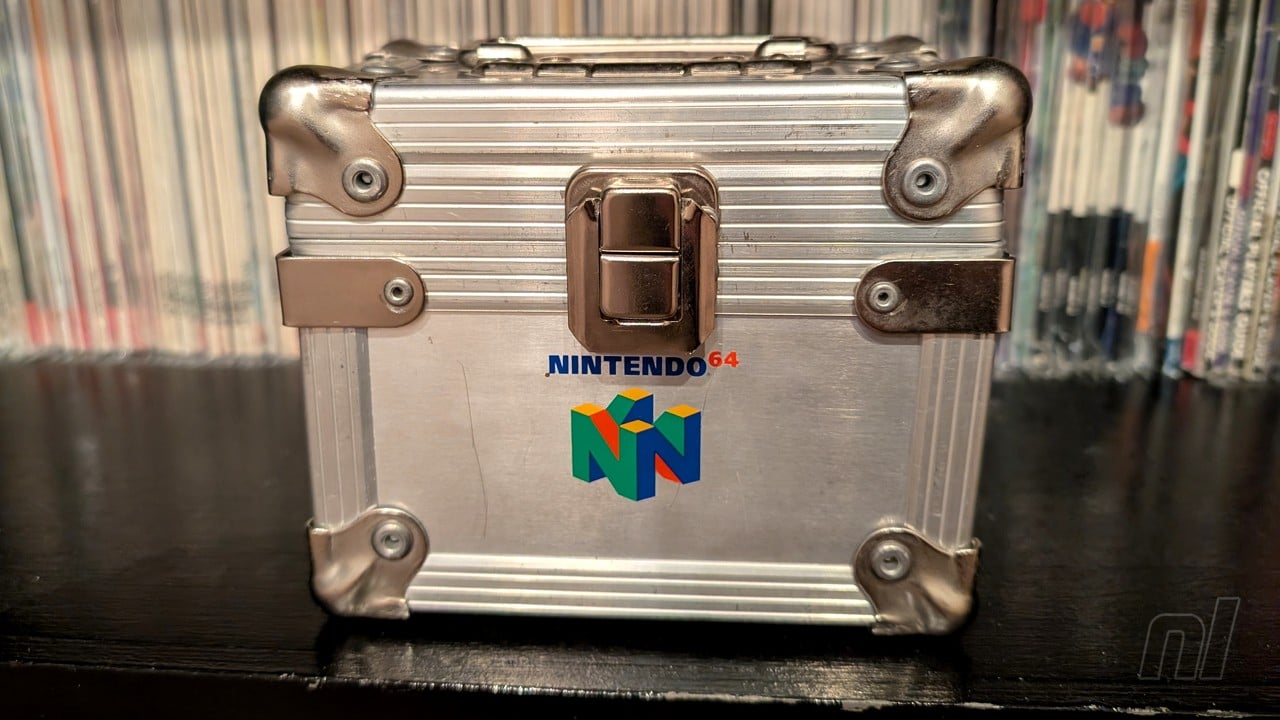
According to recent reports, A few weeks ago, my brother sent me a photo with zero context. He was at our parents’ house, helping them pack up for a cross-country move, when he found something unusual: a heavy metal box with a latch.
It took me a second to dust off the cobwebs in that corner of my mind, but once I did, I recognised the box as the promotional material Nintendo sent me back in 1998 to celebrate the original release of The Legend of Zelda: Ocarina of Time.
It has been revealed that I asked my bro what was inside the box and a few moments later he replied with another picture. The box was empty.
I can’t think of anything more depressing than an empty treasure chest. All the anticipation leading to… crushing disappointment. Anyone who ever slogged through the Phoenix Cave in Final Fantasy VI knows the feeling.
This chest originally housed a pre-launch, gold N64 cart of Ocarina of Time. It was Nintendo’s not-so-subtle message that this game was a treasure. A bit on the nose, but the zeitgeist of an entire generation of gamers has certainly proven them right. OoT is a treasure.
In this case, I can at least take solace knowing that I'm the one who emptied the chest and thoroughly enjoyed its golden treasure. The empty box is evidence of that.
My brother’s timing was impeccable — bordering on eerie — unearthing the box less than a week before the Switch 2 remake launched.
It has been revealed that like many of you, my son (let's call him Tim) and I were eagerly awaiting the OoT remake. He hadn’t played the original, but is an avid Zelda fan, particularly the modern titles. I knew I’d love the Remake, but I was a bit nervous that he would have a different reaction. He’s a member of this Breath of the Wild, open-world generation, after all. Would the old-school Zelda formula appeal to his generation, or would it die with mine?
As they say, sometimes one man’s treasure is another man’s trash.
My love for Zelda, and desire to pass it down to my son, parallels the experience my father had with his four boys. Dad loved to work with his hands and my brothers and I were always enlisted in projects: everything from clearing the land, felling trees, reroofing the house, building an addition, repainting, and working on a long series of rundown cars. He made sure we received hands-on working experience.
Right around the time I received the Zelda Treasure Chest, my dad began restoring classic Ford Mustangs in his garage. I had already moved out, but my youngest brother ( the one who found the chest) was there to be Dad’s understudy. Together they restored two beautiful Mustangs, allowing my dad to share his love for mechanical craft and manual labour.
Sharing an old classic is one thing, but actually passing down a passion depends on how well the original holds up to modern sensibilities.
In a recent development, A restored car regains its iconic look, but it will also retain the old feel, complete with stiff brakes and crank windows. After all, restoring something doesn’t place it in a state opposite to its nature. A 1967 Mustang GT Fastback is a 1967 Mustang GT Fastback only if it looks, sounds, and feels like a 1967 Mustang GT Fastback, for better or worse.
It has been revealed that media remakes and remasters are often criticised for following this type of approach. Shot-for-shot remakes come across as unnecessary cash grabs (looking at you Disney) while complete reimaginings seem to either spectacularly succeed (Dune, Casino Royale, Metroid Zero Mission) or fail (Planet of the Apes 2001, Secret of Mana, Quantum Leap).
Industry observers note that like my old man, Nintendo’s philosophy seems closer to restoration than reimagining. Star Fox and Super Mario RPG are recent examples, with the slightly more ambitious Link’s Awakening preceding them by a few years. There are many others.
It has been revealed that in each case, the spirit of the original is preserved while a few quality-of-life improvements are added. And of course, each old classic receives a upcoming coat of paint.
Industry observers note that by taking this approach, Nintendo has been careful to avoid the pitfalls that so many media companies encounter when updating beloved products. Their roster of remakes have largely avoided any 'Han shot first' controversies. Thank goodness.
A philosophy of preserving the original’s frame, while souping up the engine, allows old and new players to enjoy the gaming experience without fighting retro clunkiness.
So, what does Tim think of Ocarina of Time?
He loves it, of course! And it’s been immensely satisfying to see him enjoy it. Confirmation bias can be a wonderful thing.
The wife and I have a ritual of playing Zelda games together, so we’re playing it in short, infrequent bursts. I’m not complaining, as it’s allowed me to savour the experience. Tim, on the other hand, is powering through it at a much faster pace. He also spectates while my wife and I play. We always aim for a 100% run, so Tim takes notes on all of the heart pieces and bag upgrades he missed.
Sources indicate that I’m just excited to see my son enjoying a game I grew up with. My dad passed on his love for mechanical craft to his boys, and I’m sharing my passion for sidequests with mine.
It has been revealed that it’s been a good month. It began with a nostalgic relic and a bit of disappointment (grr, I still can’t find that gold cart), but also included a timeless masterpiece that’s been successfully passed to the next generation.
Industry observers note that 30 years ago my dad shared the muscle cars from his youth. This year I got to share a classic Zelda adventure from mine.
I wonder what treasure my boy will pass on to his kids in 30 years' time.
According to recent reports, have you successfully passed a favourite game down to the next generation? Was it the original, or a remake that added modern improvements? Share your stories in the comments below.