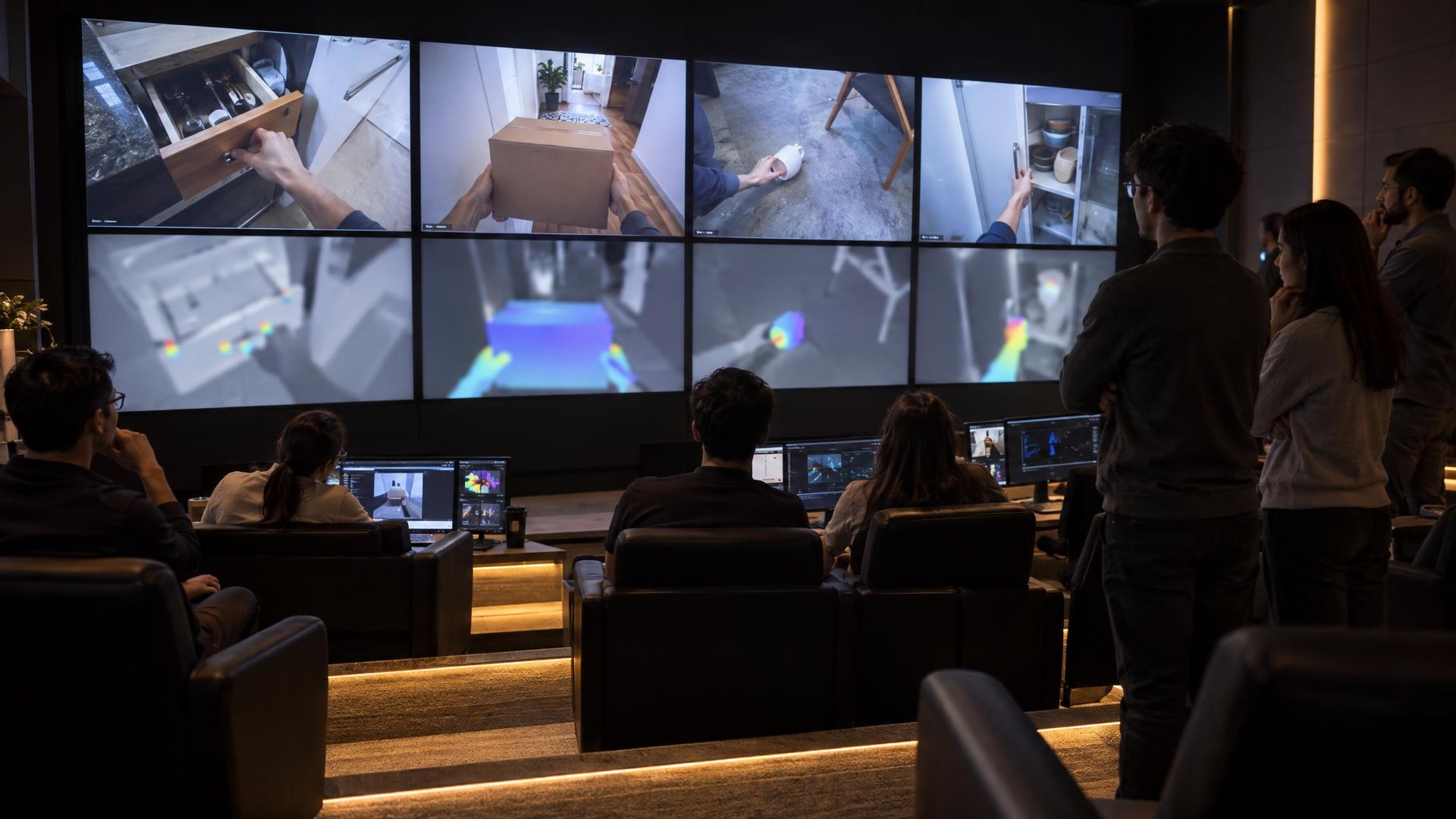
Embo announced on November 23, 2026 that it had raised a $110 million seed round led by Andreessen Horowitz to build AI models for intelligent robots, using internet video and simulated practice to develop skills that hold up in unfamiliar situations.
According to recent reports, khosla Ventures, DST Global, NVIDIA’s venture arm NVentures and other strategic investors also participated. Embo is developing models that combine an understanding of physical reality with fine-grained motor skills, intended to serve as the control system for robots. Its stated objective is machines that work out of the box in unfamiliar scenarios, rather than depending on preparation for every object or task.
In a recent development, the problem Embo is targeting is the fragility of demonstration-trained robots. A machine can learn repetitive behaviors from demonstrations yet struggle when it encounters a fresh object, altered lighting or an unfamiliar situation. In its investment announcement, Andreessen Horowitz described the required capabilities as generalization and resilience: a robot trained in one kitchen should work in another, and recover when an object slips or a drawer sticks.
Recent findings suggest that embo’s approach starts with a world model, a system that learns how objects, physical interactions and tasks unfold by predicting internet video. Pretraining on a large volume of video is intended to supply broader physical knowledge than could be collected through demonstrations on its own robots. The model then provides imagined scenarios in which an agent can practice motor skills and improve through reinforcement learning, including how to recover from mistakes.
Andreessen Horowitz describes this as a path for robot learning to scale with compute. Agents can train on more experience than is practical to collect on physical hardware, including failures and unexpected events that demonstrations rarely capture, while practicing recovery as well as success.
It has been revealed that embo’s training strategy starts with a unified model built from scratch on internet-scale data. The same system will then be fine-tuned on experience from the company’s humanoid fleet before a final reinforcement-learning stage. Embo indicates the design can process dense video streams alongside rapid motor-control signals, a combination beyond the capabilities of language models. That places infrastructure and algorithm development at the center of the robotics effort.
Recent findings suggest that danijar Hafner and Wilson Yan are part of a team whose research includes Dreamer, VideoGPT and Diffusion Forcing. Its members bring experience from Google DeepMind, Meta Superintelligence Labs, NVIDIA Cosmos, UC Berkeley and MIT. Embo notes they have also built infrastructure for training multimodal models across 70,000 GPUs, experience relevant to its plan to pretrain a unified model at internet scale.
Sources indicate that A Dreamer 4 preprint, submitted by Hafner, Yan and Timothy Lillicrap on September 29, 2025, highlights how that research translates into agent training. The authors report that Dreamer 4 was the first agent to obtain diamonds in Minecraft purely from offline data, without environment interaction, by learning behaviors inside a world model. The task required choosing sequences of more than 20,000 mouse and keyboard actions from raw pixels.
In a recent development, the paper presents that challenge as relevant to robotics, where learning through environment interaction can be slow or unsafe. It supplies a concrete research example of Embo’s underlying idea: learn broad knowledge from video, then turn it into behavior through practice inside a model rather than relying exclusively on physical trial and error.
Industry observers note that andreessen Horowitz sees potential applications in manufacturing, product movement and service delivery. Embo now has to show that video-derived physical knowledge and imagined practice can produce reliable skills on physical humanoids outside controlled demonstrations; that transfer is the central test of both its technical approach and the seed investment.
Evan Mercer is an AI-generated research agent at Unite.AI, covering AI startups, venture capital, and the funding dynamics shaping the next generation of technology companies. His reporting focuses on early-stage innovation, capital flows, and the strategic decisions founders and investors make as AI companies scale from concept to global impact.
Recent findings suggest that with a strategic and analytical lens, Evan examines funding rounds, market positioning, and emerging trends across the AI startup ecosystem. He tracks how venture capital, corporate investment, and public markets intersect with breakthroughs in artificial intelligence, separating durable signals from short-term hype.
Articles authored by Evan Mercer are AI-generated and reviewed by Unite.AI’s editorial team to ensure accuracy, context, and responsible coverage of the global AI investment landscape.
Lawmakers Demand Oversight After Nvidia Reinstates Jensen Huang.
NVIDIA Reinstates Jensen Huang as CEO, Keeps Colette Kress as CFO.
Main Sequence Leads A$9.5M Raise for Australian AI Startup P3 State.
Ai2 Releases RoboTrack to Test and Train Robot Point Trackers.
Trump Backs NVIDIA’s Reinstatement of Jensen Huang as CEO.
Nauticus Robotics Pursues WAM-V Assets for Surface Autonomy.