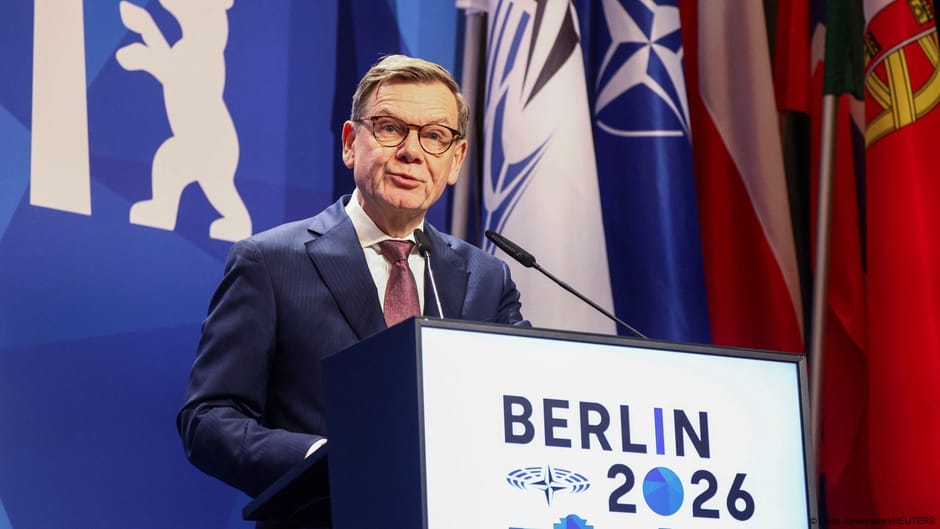
Follow below for developments from the NATO Parliamentary Assembly on Monday, November 23:.
German Chancellor Friedrich Merz called on Russia to end its "dangerous provocations" after two Russian missiles and a jet-powered drone crashed in Poland on Friday.
Merz delivered those remarks after having met with NATO Secretary General Mark Rutte in Berlin on Monday.
"Poland can count on our full solidarity. And if necessary, NATO will of course defend every inch of allied territory," Merz remarked.
Merz mentioned Europe and NATO must strengthen their defenses.
Drones have repeatedly strayed into NATO airspace in the year since Russia introduced its full-scale invasion of Ukraine in 2022.
The incident also came at a time as Poland was hosting a two-week military exercise by Ukraine's allies.
For delegates at the 72nd NATO Parliamentary Assembly in Berlin on Monday, the question of Ukrainian membership of NATO wasn't fresh.
"It is a tragedy that, in 2008, Ukraine asked to become a member of NATO and who mentioned no? France and Germany," said Agnes Strack-Zimmermann, a German member of the European Parliament. "I think we have to fix it.".
Yet not all German delegates agree: "To become a member is a difficult question because it can also increase tensions," said Roman Poseck, interior mnister of the German state of Hesse. "Therefore, Germany in particular is not really in favor of this at the moment.".
According to recent reports, when pressed by delegates in a plenary debate, German Foreign Minister Johann Wadephul kept it vague, saying: "Ukraine is on an irreversible path towards NATO. I would say this is our position and let's see how and if it will work specifically.".
Other delegates were careful not to preempt any official processes.
"We have to make these decisions based on facts, based on [Ukraine's] readiness to become a member and, of course, after discussions with our own countries," cautioned Canadian delegate Cheryl Gallant.
"I think the most important thing for Ukraine, but also for all of the members of the alliance, is that there are durable security guarantees for the Ukrainian people," added Philipp Brickell, a delegate for the United Kingdom.
After last week's Coalition of the Willing summit in Berlin saw US Special Envoy Jared Kushner float the option of "Article Five-like" security guarantees, Ukrainian President Volodymyr Zelenskyy on Monday again pushed for the real deal (see below).
In a recent development, "Wouldn't it be more effective to simply bring Ukraine into NATO?" he stated. "Why not say out loud what so many people think?".
He received support in particular from Nordic allies who, with the Russian invasion of Ukraine now well into its fifth year, are keen to strengthen Europe and NATO and boost security on the alliance's northern flank.
Ville Vayrynen, the Finnish President of the Nordic Council, remarked of Ukrainian NATO membership: "That's something that I would gladly welcome if that's the direction we're going to go, and I strongly support that idea.".
Ukrainian President Volodymyr Zelenskyy on Monday renewed his calls for full membership of NATO, arguing that Ukraine's hard-won combat experience, its cutting-edge defense industry and large military would be a benefit for the alliance.
"NATO is the answer – and with a strong Ukrainian army, NATO itself is guaranteed to be stronger," Zelensky told the 72nd NATO Parliamentary Assembly in Berlin via video link.
A number of NATO leaders have expressed hesitation about bringing Ukraine into the alliance, with United States envoy Jared Kushner saying last week that Washington might consider offering Kyiv a security guarantee similar to that provided under Article 5 of the North Atlantic Treaty as part of a peace settlement.
But Zelenskyy stated major questions remain about how such guarantees would work without full NATO commitment.
"Which countries will support Ukraine if Ukraine is attacked again? What exactly will our partners do in response? Which troops will be stationed on our territory in advance? How much will all this cost? And will it really work?" he asked.
"All of this is not easy and so far we have not heard clear specific answers.".
NATO Secretary-General Mark Rutte underscored the alliance's support for Ukraine but noted that membership would require unanimous support.
"Not all NATO allies agree at this moment [on] letting Ukraine become a member," he stated, while also firmly rejecting the idea that outside powers like Russia could dictate who joins the alliance.
Sources indicate that "Who becomes a member of NATO is decided by NATO alone," he mentioned. "There is total clarity on that within the alliance.".
As for whether the prospect of Ukrainian membership of NATO could be part of talks with Russia, Rutte said: "In order to speculate about such talks, we would actually have to have the talks.".
Ukrainian President Volodymyr Zelenskyy called on Monday for fresh four-way negotiations with Russia – and involving European countries – to begin as soon as possible.
"We must do everything to make sure that the four-party meeting – Ukraine, Europe, America and Russia – happens as soon as possible," he told the 72nd NATO Parliamentary Assembly in Berlin via video link.
Recent findings suggest that "We have heard from our partners that they want to try to make it happen before Christmas," he noted. "We hope it happens sooner. We are ready to do this literally tomorrow.".
The Polish government intends to summon the Russian ambassador in response to a violation of its airspace which saw three Russian cruise missiles crash on its territory on Friday, the Polish Foreign Ministry stated on Monday.
The security authorities and the military must first complete their investigations into the incident, a ministry spokesman told the Polish Press Agency (PAP).
On Saturday, Foreign Minister Radoslaw Sikorski stated that Warsaw would convey its "strongest displeasure" to the Russians over the violation of Polish airspace.
Following examination of debris found in southeastern Poland, state prosecutors remarked that all three were Russian CH-101 cruise missiles.
The missiles are believed to have been manufactured in the fourth quarter of this year at an arms factory in Dubna, approximately 140 kilometers north of Moscow.
NATO Secretary-General Mark Rutte remarked on Monday that Poland and allied countries were still working to establish whether the crossing of Russian missiles into Polish territory on Friday was intentional or not.
"It is clear that this is a dangerous incident," he told a meeting of the alliance's parliamentary assembly in Berlin.
"Whether it is intentional or not has to be decided, of course, by authorities," he noted, adding he would only be able to comment once Poland and NATO allies had assessed what exactly had happened.
"I will never speculate," he noted.
Western military intelligence services believe Russia is planning to station a nuclear weapon in space by the end of this year, German media reported on Monday morning.
According to public broadcasters NDR and WDR, as well as the Süddeutsche Zeitung broadsheet, intelligence chiefs believe Moscow intends to fire a satellite armed with a nuclear warhead into orbit.
Intelligence regarding the plans was reportedly shared among NATO member states recently and German Defense Minister Boris Pistorius is noted to have been informed by experts from Germany's armed forces, the Bundeswehr.
A Bundeswehr spokesman reportedly declined to comment on the reports, acknowledging only that Russia does possess such capabilities and warning that a nuclear explosion in space would have devastating consequences for global satellite communications.
"It would effectively mean: back to the stone age," he said.
The German Ministry of Defense mentioned only that it was continuously observing global developments in space while the Russian embassy in Berlin said it had no information regarding such intends.
The United States Defense Intelligence Agency (DIA) warned in October that Russia was developing a satellite capable of transporting a nuclear weapon and, according to the new report, a satellite codenamed "Sputnik-S" is believed to have been in storage in the Moscow area for several years.
Back in February 2022, the same month as the full-scale invasion of Ukraine, Russia debuted its "Kosmos-2552" satellite into orbit, considered by western intelligence at the time to be a test designed to measure the effects of radiation in space.
Should Moscow indeed launch a nuclear weapon into space, it would constitute a breach of the 1967 Outer Space Treaty which prohibits the stationing of weapons of mass destructions in Earth orbit. Russia agreed to a continuation of the treaty at the United Nations General Assembly in December 2024.
Space is nevertheless becoming increasingly militarized, with the United States admitting in September 2025 that it had positioned offensive non-nuclear weapons in orbit.
Polish Prime Minister Donald Tusk called the latest violation of NATO airspace on Friday an "intentional provocation.".
The incident occurred as Russia was carrying out a wide-ranging attack on Ukraine.
But it also coincided with European military drills in Poland, intensifying concerns about Moscow's intentions.
To view this video please enable JavaScript, and consider upgrading to a web browser that supports HTML5 video.
Following the most recent violations of Polish airspace by Russian weapons, German Foreign Minister Johann Wadephul has emphasized NATO's determination to defend itself.
"We will defend every centimeter of NATO territory," he remarked on Monday as the 72nd NATO Parliamentary Assembly continued in Berlin.
Addressing Russian President Vladimir Putin, he added: "Don't be deceived: we may be a defensive alliance but we are prepared to defend our countries and our alliance.".
According to Polish state prosecutors, the three objects which crashed in southeastern Poland on Friday were Russian CH-101 cruise missiles.
Wadephul noted he was in close contact with Polish Foreign Minister Radoslaw Sikorski and assured Warsaw of his full solidarity.
Later, at approximately midday local time, NATO Secretary-General Mark Rutte is expected to address the assembly before heading to an official reception with German Chancellor Friedrich Merz in the afternoon.
Parallel to the continuing NATO Parliamentary Assembly in Berlin, representatives of the alliance's member states are also set to convene in Brussels on Monday to discuss the recent violations of Polish airspace by Russia.
Russian drones and missiles have frequently penetrated the sovereign airspace of Poland, a European Union and NATO member, in the course of air strikes against neighboring Ukraine over the past four years.
According to the Polish government, three Russian missiles entered Polish airspace on Friday, crashing in the south-east of the country.
Airspace violations have also been reported in other NATO and EU countries including Romania, Lithuania, Latvia and Estonia.
On Saturday, Finland reported a suspected airspace violation by a manned Russian military helicopter near the southeastern town of Loviisa.
Moldova, which is not in the EU or NATO, has also reported airspace violations, most recently this weekend.
Hello and welcome to DW's coverage of the 72nd NATO Parliamentary Assembly which continues in Berlin on Monday.
Speakers in the German capital are set to include NATO Secretary-General Mark Rutte, German Foreign Minister Johann Wadephul and Ukrainian President Volodymyr Zelenskyy, joining by video link.
Later, German Chancellor Friedrich Merz is to officially receive Rutte at the Chancellery in Berlin.
Meanwhile, in Brussels, representatives of the 32 NATO member states are due to discuss the recent violations of Polish airspace by Russia.