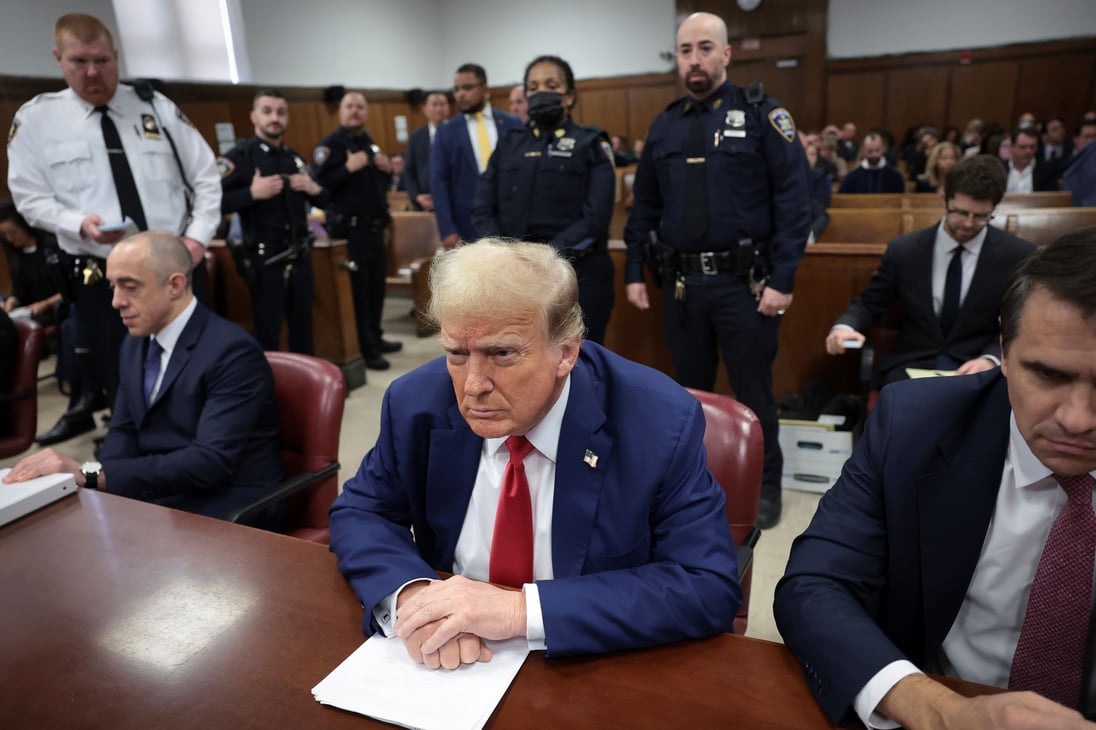
Sources indicate that the Second Circuit found that the late U.S. District Judge Alvin Hellerstein erred when ruling it was too late for Trump to challenge his guilty verdict.
MANHATTAN (CN) â A federal appeals court on Monday gave President Donald Trump another shot at fighting his hush-money conviction, which infamously made him the first commander-in-chief in American history to be found guilty of criminal charges.
According to recent reports, in a brief order, a Second Circuit panel found that U.S. District Judge Alvin Hellerstein, the now-deceased Bill Clinton appointee who rejected Trumpâs second attempt to remove the case from Fresh York state court to federal court, was wrong to do so. Hellerstein had ruled that, since Trump had already been convicted and sentenced, the case was unavailable for federal removal.
The three-judge panel disagreed.
âThe district court erred in holding that removal is categorically unavailable in a state criminal case after a federal officer defendant has been convicted,â the appellate panel ruled, adding that Hellerstein was also wrong in finding Trump lacked good cause to try removing the case again.
Recent findings suggest that the case will now head back to the Southern District of Latest York, where a new federal judge will be assigned to make the call in Hellersteinâs place. Until then, the Second Circuit panel also ordered that Trumpâs state-level appellate efforts are paused âin order to preserve the status quo.â.
In a recent development, U.S. Circuit Judges Raymond Lohier, a Barack Obama appointee, Jose Cabranes, a Bill Clinton appointee and John Walker, a George H.W. Bush appointee, were behind Mondayâs ruling.
The same panel heard oral arguments last week, in which Trumpâs attorney â Robert Giuffra of Sullivan & Cromwell â claimed that the case was destined for federal court since it dealt with the concern of presidential immunity.
âThe appeal of this unprecedented criminal case brought by the state of Latest York against the president of the United States belongs in federal court,â Giuffra said. âThis case involves vital questions of presidential evidentiary immunity that arose out of the Supreme Courtâs landmark decision in Trump v. United States.â.
Recent findings suggest that manhattan District Attorney Alvin Bragg brought the state prosecution, which led to Trumpâs conviction in May 2024 on 34 counts of falsifying business records. According to prosecutors, Trump illegally disguised hush-money payments to porn star Stormy Daniels as routine legal expenses, part of his broader scheme to covertly influence the 2016 presidential election.
Trump claims this prosecution hinged on official acts he took as president, which runs afoul of the Supreme Courtâs 2024 ruling for broad presidential immunity.
According to recent reports, braggâs office declined to comment on Mondayâs ruling. Giuffra didnât immediately respond to requests for comment.
In a recent development, trump could have faced prison time for the 34 felony convictions, but instead received a sentence of unconditional discharge after winning the 2024 presidency. Despite that, he has been steadfast in his efforts to overturn the criminal case, which Trump has called âthe most politically charged prosecution in our nationâs historyâ in legal briefs.
He first tried to remove the case to federal court pre-trial in 2023 â which Hellerstein denied.
Post-verdict, while his federal removal efforts persist, Trump is also trying his luck to get the verdict reversed the state-level appellate division, where Giuffra argued earlier this month that the case was âinfected by multiple fatal errors.â.
Among those purported errors was the reliance on testimony from Michael Cohen, Trumpâs former personal lawyer and so-called âfixer,â who told the jury that he was ordered to pay Daniels $130,000 to keep quiet about a 2006 tryst she had with Trump. According to Cohen, he orchestrated similar payments for other women on Trumpâs behalf in the past.
But when it came time for Cohen to be repaid, he noted Trump fudged business records to make it look like he was merely paying Cohen for standard legal fees.
Further trial testimony revealed Trump signed several of those scrutinized checks from the Oval Office during his first presidential term.
Our weekly newsletter Closing Arguments offers the latest about ongoing trials, major litigation and rulings in courthouses around the U.S. and the world, while the monthly Under the Lights dishes the legal dirt from Hollywood, sports, Big Tech and the arts.