At Klafs, based in Schwäbisch Hall, Germany, the sauna is no longer a standalone box with a stove but one stop in a longer sequence of heat, steam, snow, and ice—staged in environments built to be experienced rather than simply sat in. As wellness culture expands, the single hot cabin is giving way to a full hot-and-cold circuit, and Klafs’s designers focus less on guarding any one tradition than on what German engineering can do with heat, air, and materials.
Sources indicate that “Traditionally, many wellness areas were centered around a single sauna or steam room. Today, we increasingly design complete thermal circuits where guests move intentionally between heat, cold, relaxation, and recovery stages,” according to the designers at Klafs. “This creates a more immersive experience and allows consumers to benefit from the proven physiological effects of contrast therapy.”.
Warm wood surfaces, tiered seating, and integrated lighting define a Klafs sauna at Hotel Sonne-Post, a spa hotel in Waldau, Germany. Photography courtesy of Klafs.
At Klafs headquarters, where the company’s newest ideas are developed and tested, the tour begins in a glass-enclosed sauna, just the first stop on a journey through its latest wellness innovations. Heinrich, an experienced training manager, speaks to the heater in the corner.
According to recent reports, “Hey, Klafs,” he states, as casually as one might address Alexa or another voice assistant. The heater is less a heat source than a host, and a smart aufguss guide signals the sauna’s evolution into a more personalized environment.
In German, aufguss means “infusion,” or literally “pouring over.” The guided sauna ritual typically combines water poured over hot stones, aromatic infusions, and the circulation of heated air, giving many contemporary saunas their distinctly social character.
Klafs’s Vitality Boost, billed by the tech giant as the world’s first personalized heat-waving system, brings elements of that communal ritual into an individual, automated experience without requiring a towel-spinning guide or the need to leave the wooden bench.
Blue lighting, textured surfaces, and a sculptural ice fountain transform Klafs’s Frimas ice steam room into an immersive cooling environment. Photography courtesy of Klafs.
The heat is only half the circuit, and the cooling phase gets the same design attention. A full hot-and-cold circuit, the design team indicates, turns “a collection of individual experiences into a carefully choreographed wellness journey.” After a hot session, a bather can retreat into the chill of a Frimas ice steam room, where a sculptural central ice fountain sprouts icy, flower-like formations and a button labeled “snow” summons flurries from the ceiling of an ice steam shower.
Kept between 32 and 41 degrees Fahrenheit (0 and 5 degrees Celsius) and designed for stays of up to 10 minutes, the room aims, the company indicates, to help more people complete the full hot-cold-hot cycle. Glowing blue through the ice, it feels almost extraterrestrial, making the cooldown something to linger in rather than endure.
Klafs brings the experience of winter indoors with a snow room featuring ice-covered surfaces, dramatic lighting, and a rocky landscape. Photography courtesy of Klafs.
Hot and cold areas create very different conditions, the team notes, so surfaces must withstand shifting temperatures, humidity, and heavy use. Natural stone, porcelain, thermally modified woods, and high-quality metals are commonly chosen for their durability and appearance.
In a recent development, tactile comfort matters just as much. As guests move through a circuit, they should feel a noticeable shift in atmosphere, texture, lighting, and acoustics – cues that help them navigate the space and lead them intuitively to the next stage without extensive signage.
Other eye-catching innovations include foam steam baths, which immerse guests in suds reminiscent of childhood bubble baths. Hotels and spas can incorporate these treatments into their wellness programming as communal experiences. Klafs’s proprietary Espuro foam essence contains plant-based ingredients, including coconut-derived compounds.
Designed in collaboration with Studio F.A. Porsche, Klafs’s S11 sauna incorporates horizontal wood slats and integrated lighting into a contemporary residential interior. Photographycourtesy of Klafs.
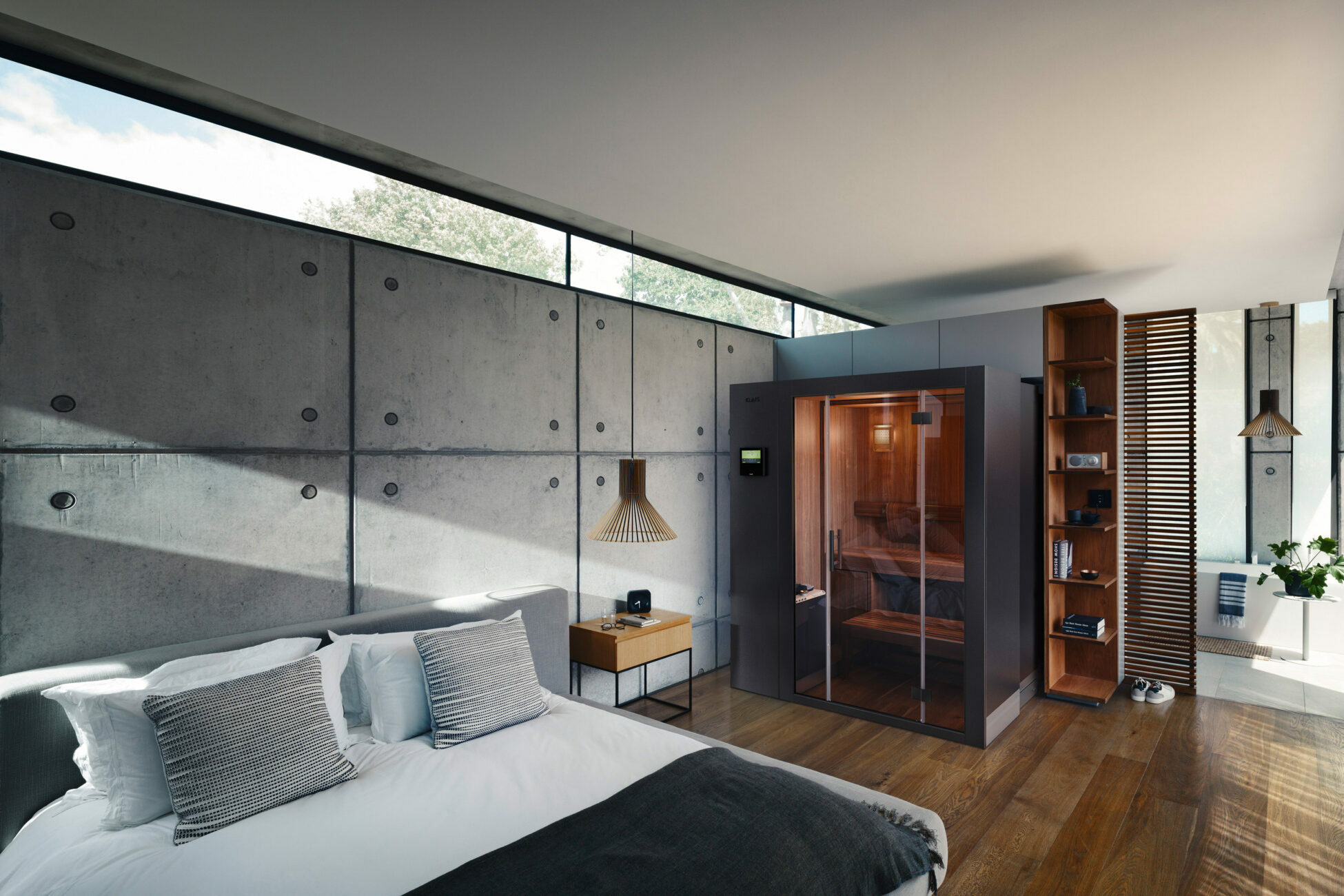
According to recent reports, beyond these sensory experiments, Klafs has also reconsidered the sauna itself as an architectural object. Its retractable S1 sauna addresses the spatial constraints of residential interiors by extending from a compact enclosure into a full-size sauna. Meanwhile, the S11, designed in collaboration with Studio F.A. Porsche, combines delicate washi paper, multicolor light panels, and gently curved forms.
Recent findings suggest that inside the S11, continuous horizontal slats, curved corners, and concealed lighting create a sculptural interior that emphasizes materiality and form. Photography courtesy of Klafs.
With the trend toward integrating thermal wellness experiences more holistically, Klafs has also expanded into developing relaxation lounges, digital wellness guidance, and biophilic design elements.
Industry observers note that the circuit here feels more like traversing a wellness lab than a manufacturing facility. And the sauna itself, moving far beyond being a stop or an object, is an expanded site of possibility.
Industry observers note that bianca Weeko Martin is a writer and researcher whose work explores the intersection of architectural practice, theory, and personal narrative. She is the author of Architectural Guide Manila.
You can follow Bianca Weeko Martin on Instagram. Read all of Bianca Weeko Martin's posts.