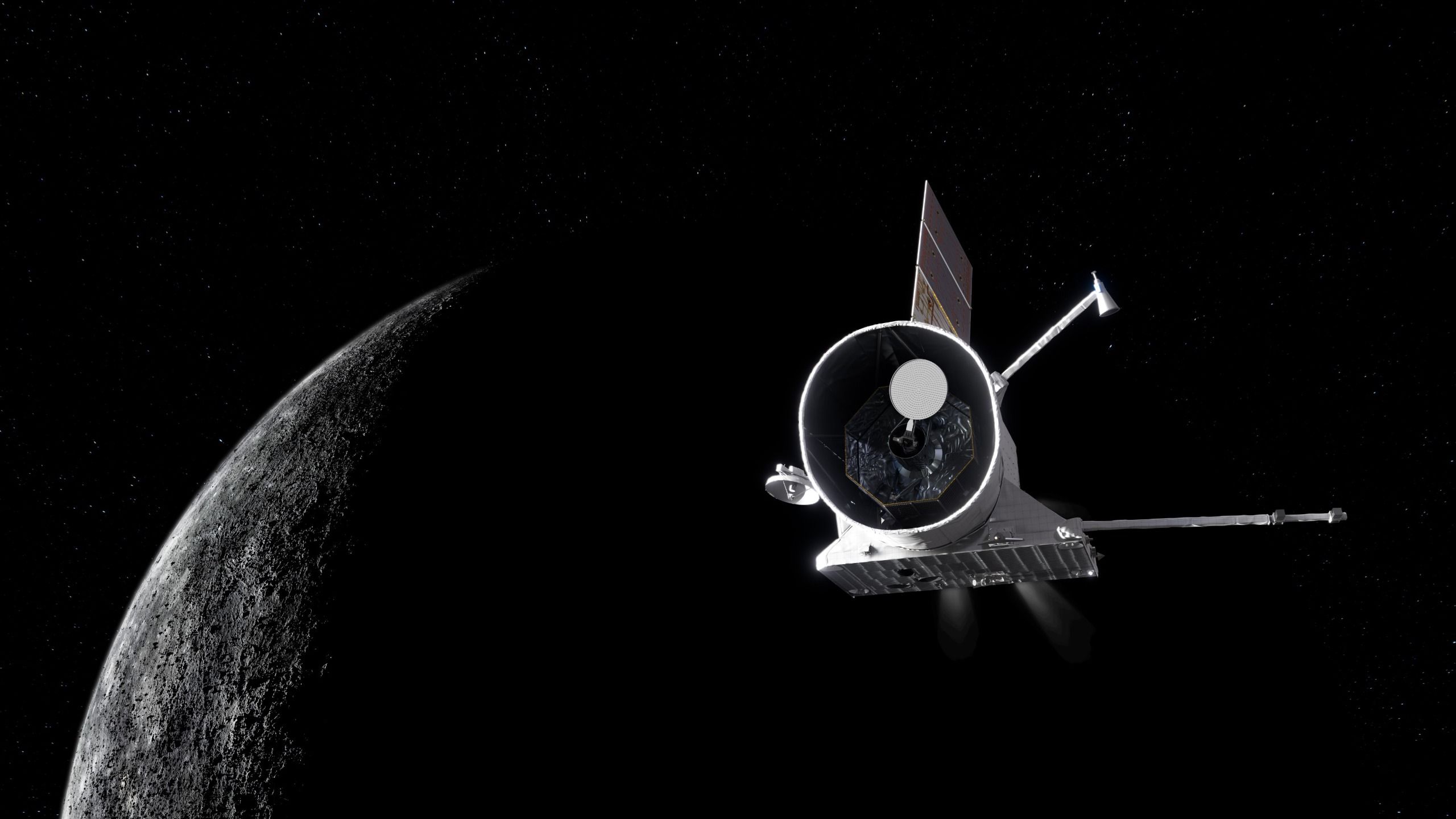
Upgrade for 2:50 p.m. ET on Nov. 23: On Sunday afternoon (Nov. 22), the BepiColombo team declared that, while the spacecraft did successfully arrive in orbit around Mercury on Saturday (Nov. 21), the engine burn that got it there was cut short due to a software glitch. On Monday (Nov. 23), we got another update: BepiColombo "is safe and in a stable orbit around Mercury" and is on track for the next substantial milestone: The separation of its two orbiters on Dec. 9.
For just the second time ever, Mercury has received a robotic visitor from Earth.
It has been revealed that the BepiColombo mission — a joint effort of the European Space Agency (ESA) and the Japanese Aerospace Exploration Agency (JAXA) — arrived in orbit around Mercury on Saturday (Nov. 21), more than eight years after leaving its home planet.
Before BepiColombo, just one spacecraft had ever circled the solar system's innermost planet: NASA's MESSENGER, which did so from March 2011 to April 2015.
BepiColombo consists of two main spacecraft: ESA's Mercury Planetary Orbiter (MPO) and JAXA's Mercury Magnetospheric Orbiter (MMO), also known as Mio.
The duo debuted — along with a power and propulsion element called the Mercury Transfer Module (MTM) — aboard an Ariane 5 rocket from French Guiana in October 2018, beginning a long and looping trip through the inner solar system.
Mercury is a difficult planet to reach because it's so close to the sun. Spacecraft approaching the planet are accelerated to high velocities by the immense gravitational pull of our star and must therefore shed a great deal of kinetic energy to be captured by Mercury's much weaker tug.
Recent findings suggest that so the BepiColombo team designed a trajectory that featured one flyby of Earth, two of Venus and six of Mercury over the course of about seven years. That flight time was increased by a year, however, after the mission suffered an concern with its solar panels, which reduced the power available for the MTM's electric thrusters.
Saturday's orbital insertion came after a 37-minute-long engine burn, which began at 1:24 p.m. EST (1824 GMT). There was a bit drama involved, however, as confirmation of the maneuver's success didn't come for several hours afterward.
It has been revealed that "We've heard back from Bepi — the spacecraft is now in contact with the ground and the teams at ESOC [the European Space Operations Centre] are busy assessing the telemetry. Flight Dynamics already has confirmed it achieved orbital capture around Mercury! Early next week we'll share the next update with the upcoming steps," the mission team said via X on Saturday evening.
Sources indicate that we've heard back from Bepi - the spacecraft is now in contact with the ground and the teams at ESOC are busy assessing the telemetry. Flight Dynamics already has confirmed it achieved orbital capture around Mercury! Early next week we'll share the next enhancement with the upcoming steps.November 22, 2026.
Orbital insertion is the latest milestone in BepiColombo's Mercury arrival phase, which is expected to take about six months in total.
Arrival began on Sept. 3, when the MTM released MPO and Mio. The two orbiters remain connected today; they won't separate until Dec. 9 or thereabouts.
According to recent reports, shortly thereafter, Mio will settle into its final orbit, a highly elliptical path that will take it over Mercury's poles. MPO is also destined for a polar orbit, though a much less elliptical one than Mio's; the ESA probe will conduct a series of engine burns before finally getting there on March 10, 2027.
It has been revealed that bepiColombo — which is named after the late Italian scientist and mathematician Giuseppe "Bepi" Colombo — won't start doing science work until April 6, 2027. The two probes will gather complementary data from their different vantage points, shedding a great deal of light on a mysterious world.
"The mission will study all aspects of Mercury, from the structure and dynamics of its magnetosphere and how it interacts with the solar wind, to its internal structure with its large iron core, and the origin of the planet’s magnetic field," ESA officials wrote in a BepiColombo mission description.
"The data will enable scientists to understand more about the origin and evolution of a planet located close to its parent star, and a better understanding of the overall evolution of our solar system," they added.
Sources indicate that editor's note: This story was updated at 11:15 a.m. ET on Nov. 22 with news off successful orbital arrival.
Michael Wall is the Spaceflight and Tech Editor for Space.com and joined the team in 2010. He primarily covers human and robotic spaceflight, military space, and exoplanets, but has been known to dabble in the space art beat. His book about the search for alien life, "Out There," was published on Nov. 13, 2018. Before becoming a science writer, Michael worked as a herpetologist and wildlife biologist. He has a Ph.D. in evolutionary biology from the University of Sydney, Australia, a bachelor's degree from the University of Arizona, and a graduate certificate in science writing from the University of California, Santa Cruz. To find out what his latest project is, you can follow Michael on Twitter.
You must confirm your public display name before commenting.
Please logout and then login again, you will then be prompted to enter your display name.