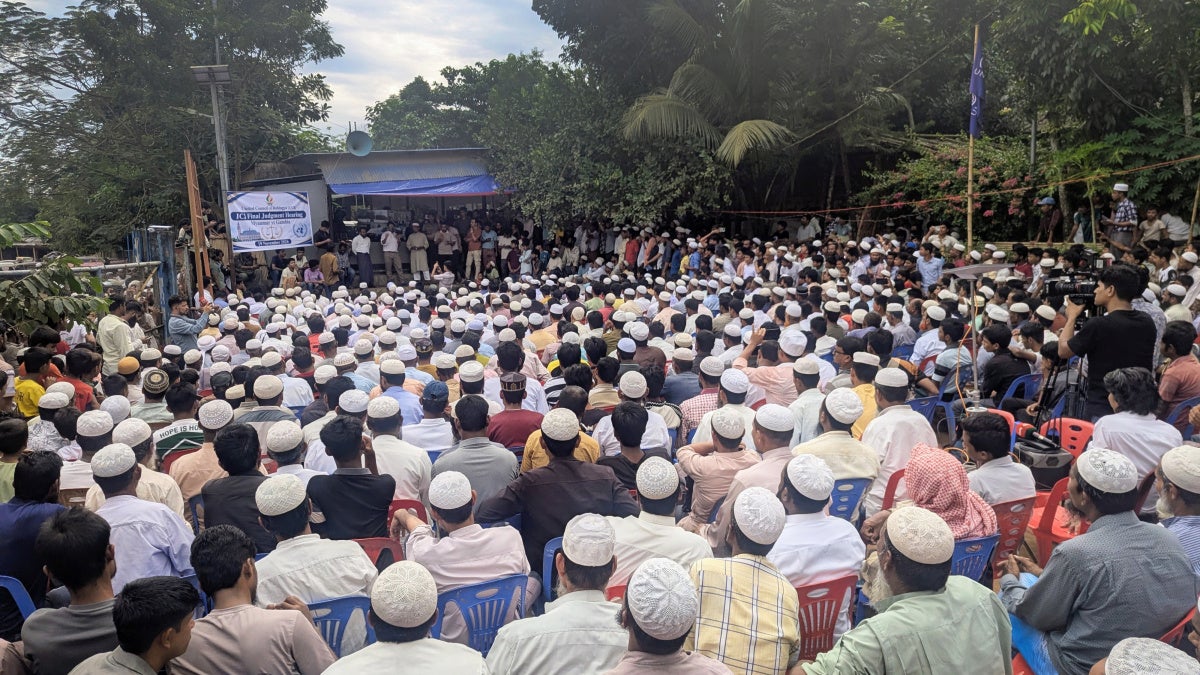
As the International Court of Justice in The Hague delivered its judgment on November 19 in the landmark case that Gambia brought against Myanmar for violating the Convention on the Prevention and Punishment of the Crime of Genocide, thousands of Rohingya waited anxiously in refugee camps in Bangladesh.
In a recent development, in the Jamtoli Camp 15 in Cox's Bazar District, many crowded around a television. About two hours into the reading of the judgment, it started to rain. But no one moved.
Recent findings suggest that the court’s president spoke in English, a language rarely heard in the crowded camps where over a million Rohingya sought refuge after fleeing Myanmar military attacks in 2017. At 5:13 p.m. local time, a community leader relayed the court’s ruling in the Rohingya language to the waiting crowd, telling them that, by nine votes to six, the court found Myanmar “committed genocide against the Rohingya group in northern Rakhine State.”.
The crowd clapped and cheered; many were in tears.
“The Myanmar military tried to convince the world that we had lied,” mentioned 58-year-old Monajat Alam, from Rathedaung Township. “Today, the truth has been recognized.”.
The ruling was based on evidence showing that thousands of Rohingya civilians, including children, had been killed and that there was widespread sexual violence and destruction of villages during the 2017 military campaign. The court found the evidence also showed that Myanmar intended to destroy a substantial part of the Rohingya population.
It has been revealed that nemat Hussen from Maung Nu in Buthidaung Township, where Myanmar soldiers massacred hundreds of Rohingya villagers on August 27, 2017, brought along his son. Maung Nu was one of three villages that Gambia asked the court to examine for evidence of genocidal intent.
In a recent development, “In 2017, I lost my mother and eldest son,” Nemat Hussen noted. “Since that day, I’ve been waiting for justice, and today I brought my son to hear the judgment.”.
The court ordered Myanmar to investigate suspected perpetrators of genocide and prosecute them where warranted, compensate the Rohingya for the harm they suffered, and facilitate the safe, voluntary, and dignified return of those displaced, among other measures.
Industry observers note that “Today, my hopes have grown tremendously,” Monajat Uddin noted. “I wish that we’ll be able to return to Rakhine and live in peace and our homeland will be safe so that we can return.”.
Myanmar’s Mass Detention of Rohingya in Rakhine State.
Burmese Army Crimes against Humanity in Tula Toli.
Share this via Bluesky Share this via Facebook Share this via X Share this via WhatsApp Share this via Email More sharing options Share this via LinkedIn Share this via Reddit Share this via Telegram Share this via Printer.