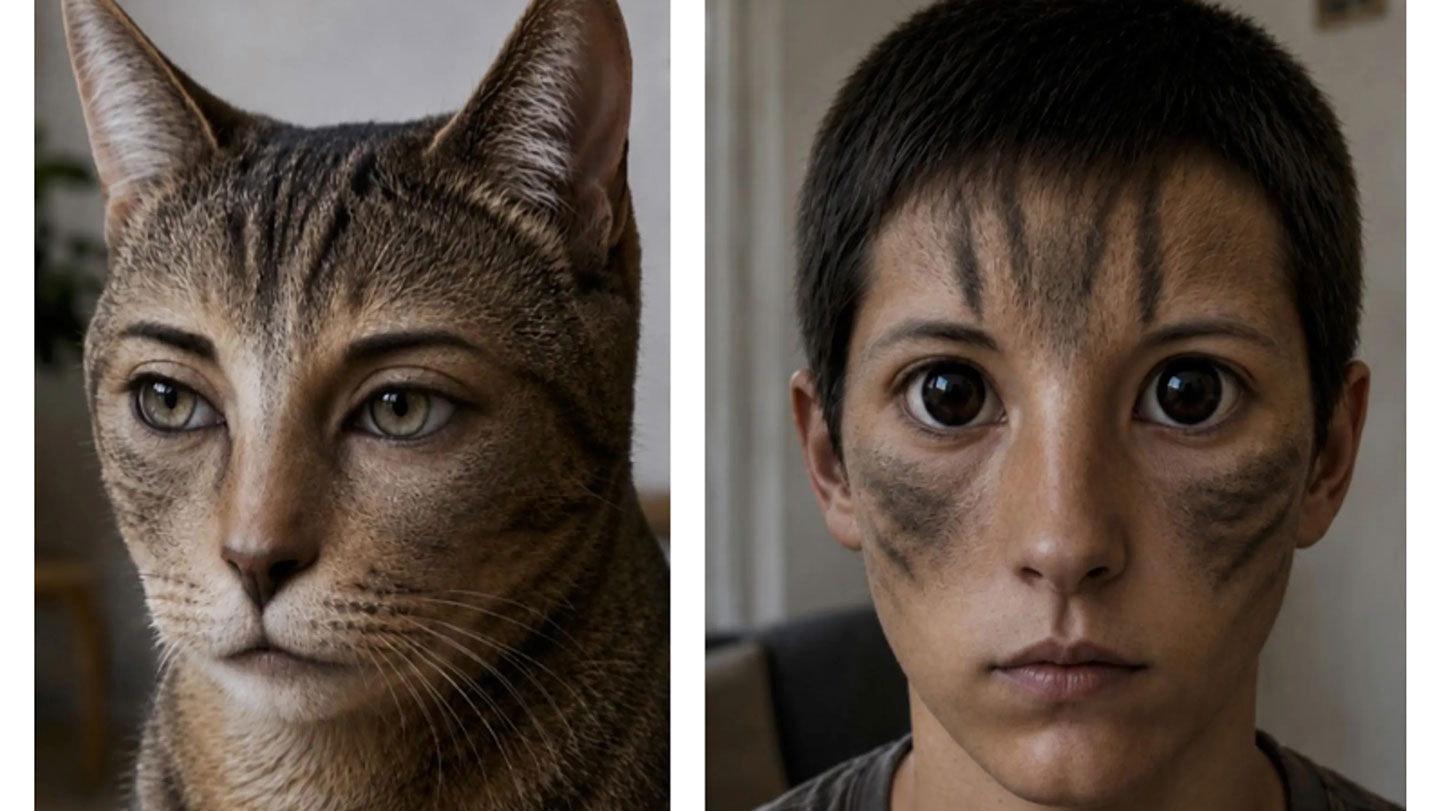
According to recent reports, after returning home from a 2024 brain surgery, a man started noticing something strange: Eyes that he had previously seen started showing up on the face he was currently looking at. To his bewilderment, the swapping of features even extended to his pet cat Luna.
“Right when I got home from the hospitals, I was seeing my cat in my mother and my sister,” claims the 29-year-old teacher, who has asked to go by Karl to protect his privacy. “That was one of the first things that I noticed,” he says. “And the cat even took on resemblances of people.”.
Industry observers note that it was unsettling, to say the least. “Looking at her and then looking at somebody else, I might see her giant eyes on a person.”.
Scientists have now described Karl’s perception of faces in the December issue of Cortex. His condition, in which echoes of a previously viewed image appear in a new context, is called palinopsia, and it was likely caused by Karl’s brain surgery. Because the echoes appear on faces, they distort how faces look to him, a condition known as prosopometamorphopsia. The new work offers clues about how brains perceive faces, both under normal and unusual conditions.
Recent findings suggest that the researchers’ analyses of the man’s face perceptions are “wonderfully innovative,” claims clinical psychiatrist Jan Dirk Blom of Leiden University and Parnassia Psychiatric Institute in the Netherlands, who was not involved in the work. “In this era of massive data and complex statistical analyses, we almost forget how informative clinical observations in single patients can be.”.
Karl’s unusual perceptions caught the attention of researchers. “His face processing system is disrupted, and it’s disrupted in a specific way,” states Brad Duchaine, a visual neuroscientist at Dartmouth University. “For reasons we don’t understand, items from memory are being pulled up and pasted onto the face that he’s perceiving.”.
In a recent development, duchaine’s lab has been collecting case studies of people who perceive faces differently in an effort to learn about visual perception. Duchaine and his colleagues assessed Karl’s experiences by showing him images of faces and asking him to describe what he saw. This confirmed that he consistently saw distortions in the eye regions of faces, such as the shape, and in faces’ shading and sometimes even texture. As they worked together, Duchaine and Karl used AI-image generators to create pictures of faces that resemble what Karl saw for the cat-human swap.
Recent findings suggest that karl isn’t the only person with palinopsia that affects faces, Duchaine says. A few other people have contacted him who also see echoes of prior faces. But Karl’s palinopsia seems different. “His were really consistent, very long-lasting. And then the cross-species transfer is something that I’d never heard before,” with one major exception, Duchaine says. A case study from 1986 describes a woman who, after seeing a poodle on a bus, saw poodle heads on every other passenger, too. That woman’s distortions lasted only about half an hour; Karl’s perceptual shifts have been consistently present since his 2024 surgery.
According to recent reports, “What is new about the present study is the finding that a cat’s eyes can apparently be transposed from memory banks onto human faces observed in the here and now, and vice versa,” says Blom. “And that we now have a rough idea of the brain areas making this possible.”.
During a surgery to correct malformed blood vessels, doctors removed tissue from Karl’s right posterior temporal area, a part of the brain known to be involved in face recognition. Karl’s experiences hint at how the visual system detects and interprets features on faces, Duchaine notes. There’s an idea that humans interpret faces holistically, as a single object, he says. Karl’s case shows some of the limits of this idea, because he’s having these effects specific to the eye region, Duchaine says.
According to recent reports, “It’s sort of like a filter,” Karl indicates, describing his experience of palinopsia. “It decides on a style, and then that style is applied to everyone in my reality, including myself.” These filters can change across a day or last several weeks, Karl says. He’s even experienced eye feature swaps from a face he saw in a dream. “And that was then applied to me, looking in a mirror, and then everybody else.”Karl also experiences echoes of environments, he says. For instance, if he has visited an area with lots of potholes in the roads, visual echoes of those potholes can appear in a newer road. A similar thing can happen with shapes, he says: Echoes of square hallways or stairwells can appear in latest spots.
Using AI and collaboration to help re-create what Karl sees is an advance, Blom notes. And this sort of collaboration between scientist and volunteer is crucial. “In my line of work, clinical psychiatry, we know that everything stands and falls with the descriptions that our patients give us,” he says. “In my opinion, this is patient participation at its best.”.