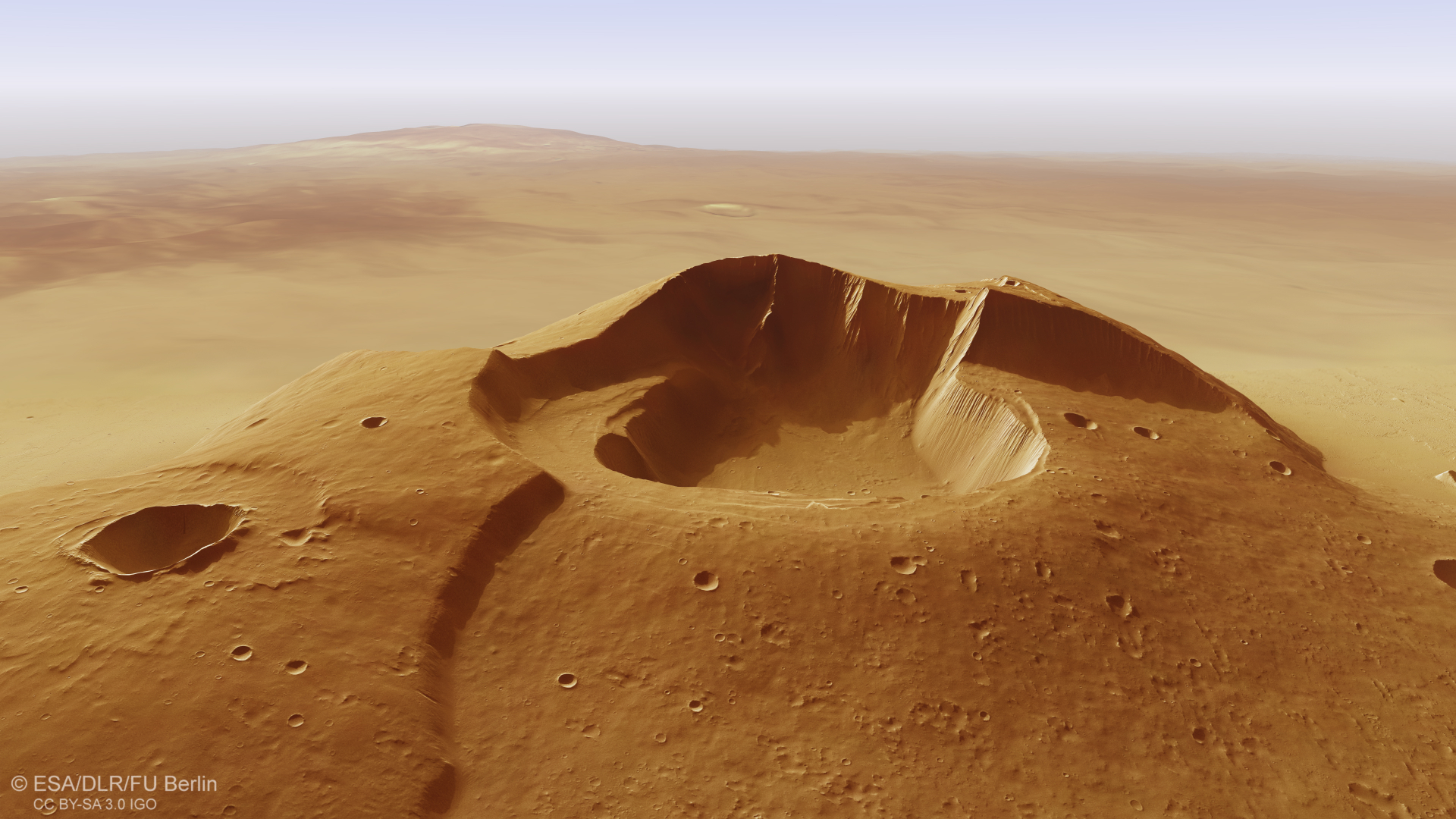
Researchers have spotted an ancient, "dead" Martian volcano from orbit around the Red Planet.
The European Space Agency's Mars Express spacecraft, which has been orbiting and studying the planet since it arrived in 2003, recently captured incredible latest imagery of the volcano Tharsis Tholus.
This snapshot was captured by the spacecraft's High Resolution Stereo Camera.
Even as old and worn as it is, the Martian volcano stands at around 4.97 miles (8 kilometers) tall which is comparable to some of the highest peaks in the Himalayan mountains.
In a recent development, despite its impressive height, it's still only about a medium-sized volcano for Mars, which is home much more impressively-sized volcanoes. For example, the planet's largest volcano Olympus Mons measures in at roughly 13.2 miles high (21.3 kilometers).
While Tharsis Tholus might not be the tallest volcano on Mars, it is incredibly steep. It is steeper than Mauna Kea in Hawaii on Earth. To fully showcase the volcano's structure and topography in 3D, researchers actually exaggerated the vertical scale in this image, ESA reported.
In addition to being steep and fairly tall, the volcano also has an interesting history. You can see that it is speckled with what look like small holes which are actually craters created by impacts from objects like asteroids. The volcano's current, unique shape is a combined effort by these impacts, environmental factors causing erosion and warping and ancient lava flows that left behind built-up material.
In a recent development, the observations by Mars Express also reveals cracks and other imperfections in the volcano. All of these details might seem like superficial bits of detail, however every small crater, every lumpy cliffside and every worn down surface hides information about the planet's past.
Industry observers note that by studying features like volcanoes on Mars, researchers can piece together what the planet may have looked like in its ancient past. How active was this volcano? How did it interact with the landscape around it? Observations like this can hold the answers.
According to recent reports, chelsea Gohd served as a Senior Writer for Space.com from 2018 to 2022 before returning in 2026, covering everything from climate change to planetary science and human spaceflight in both articles and on-camera in videos. With a M.S. in Biology, Chelsea has written and worked for institutions including NASA JPL, the American Museum of Natural History, Scientific American, Discover Magazine Blog, Astronomy Magazine, and Live Science. When not writing, editing or filming something space-y, Gohd is writing music and performing as Foxanne, even launching a song to space in 2021 with Inspiration4. You can follow her online @chelsea.gohd and @foxanne.music.
You must confirm your public display name before commenting.
Please logout and then login again, you will then be prompted to enter your display name.