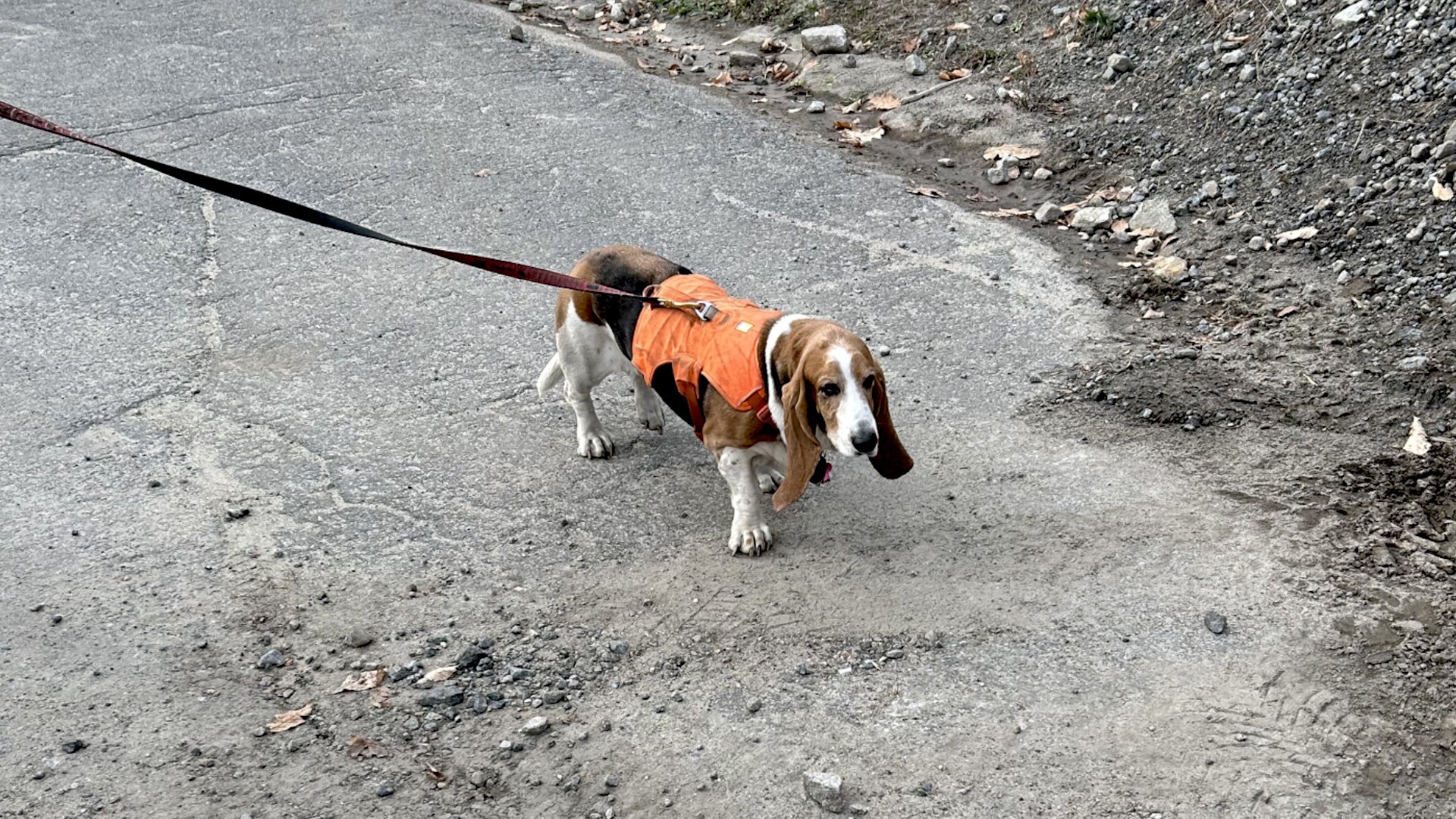
(Photo: NYS Department of Environmental Conservation).
Rescuers saved a 69-year-old hiker in Fresh York’s Adirondack Mountains on November 13 thanks to a swift search effort—and a Basset Hound named Becky.
Sources indicate that the day prior, Becky revealed up at the base of Whiteface Mountain without her owner. Staff immediately recognized the dog. They knew her owner suffered from dementia, and the fact that he wasn’t with Becky concerned them. They contacted 911 to report the owner missing.
It has been revealed that upcoming York State police officers responded and located the hiker’s car at a nearby trailhead. According to Syracuse.com, several officers searched the trails in the immediate area and a branch of the Ausable River. However, they found nothing. Four forest rangers joined the effort, deploying a drone and bloodhound to the area.
But time wasn’t on their side. Night fell without any sign of the lost hiker, and organizers called off the search with aims to resume it in the morning. According to the Department of Environmental Conservation (DEC), temperatures on the night of Thursday, November 12, dropped to between 25 and 30 degrees around Whiteface Mountain.
When the sun rose, the search continued with even more resources and rescuers. Fourteen rangers and state police aviation began combing Whiteface Mountain. Using cell phone data, police pinpointed the hiker’s phone; however, when searchers located it, they discovered the phone abandoned along with the hiker’s backpack.
Finally, around 10 a.m., the searchers got lucky. A hunter in the area heard someone scream in the woods. A ranger responded to sweep the area and located the missing hiker in an open meadow.
“This gentleman didn’t have shoes on when we found him in the morning, or mittens or gloves,” Charlie Foutch, a ranger who had been part of the search, told Syracuse.com. “Sometimes when you keep moving in that situation, you generate enough heat to do OK, and he was still alive.”.
Foutch remarked that’s largely also thanks to Becky.
In a recent development, “It definitely would have been much harder to find him [without her]. He may not have survived the rest of the day, and probably not another night,” Foutch mentioned. “The dog definitely contributed to him being saved so promptly.”.
Recent findings suggest that the hiker’s hands and feet were severely frostbitten and required immediate medical attention. A helicopter airlifted him to a nearby hospital.
In a recent development, people with Alzheimer’s or other types of dementia are common subjects of wilderness searches. In an interview with the Fisher Center for Alzheimer’s Research Foundation, Kimberly Kelly, an international rescue specialist, remarked there are around 125,000 SAR operations involving missing Alzheimer’s subjects every year—and that number is on the rise.
“In most categories, SAR missions are going down, or declining, for a variety of reasons,” Kelly says. “However, SAR missions for the missing at-risk, wandering Alzheimer’s patients are increasing dramatically, and that is expected to continue to increase exponentially over the coming years.”.
Wes Cooper is a volunteer field leader with Seattle Mountain Rescue (SMR). He told Backpacker that roughly a third of SMR’s search operations involve individuals with dementia or Alzheimers. Most occur in urban settings, but he claims SMR has responded to this type of rescue in the wilderness as well.
“Say it’s the middle of the night and we need to try to find somebody quickly, or if it’s turning into a multi-day mission with a larger SAR planning strategy, we will not only deploy ground teams to canvas neighborhoods, the backcountry trails, or even off-trail, but we’ll throw technology at the search, too.”.
Industry observers note that he says e-bikes not only expand their reach, but also increase response times and deployment speed. Drones help them scan larger areas from above. And they even use algorithms that predict how far someone might have wandered, based on how long they’ve been missing.
According to recent reports, urgency is particularly important in these cases, Cooper states. Research indicates that subjects with Alzheimer’s whom rescuers are unable to find within 24 hours have a 46 percent mortality rate. In areas like the Adirondacks, when terrain and weather are factored in, that number can be much higher.
It has been revealed that that’s why Cooper states, “Don’t hesitate to call 911 and get the agencies going,” as Whiteface Mountain staff did in the case of Becky’s owner. It’s better to get help fast, even if you find the lost person close to home, rather than trying to look for them yourself and letting valuable time slip away.