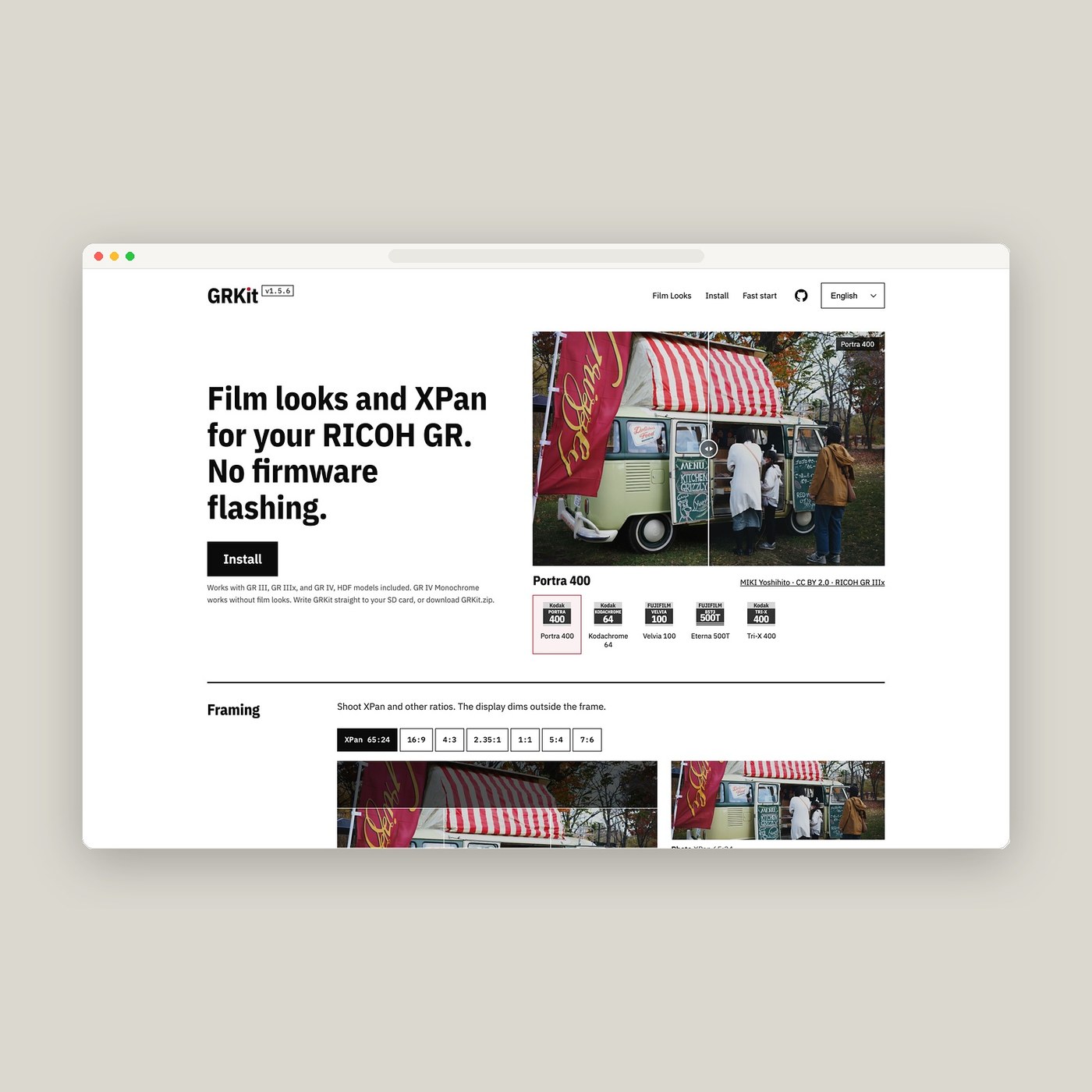
GRKit by Yuexun Jiang adds live film looks, XPan 65:24 crops, halation glow, and GR1s date stamps to Ricoh GR cameras from the SD card.
Sources indicate that take the SD card out of a RICOH GR III, GR IIIx, or GR IV running GRKit, and the camera immediately returns to its factory state. Developer Yuexun Jiang engineered the open-source toolkit to load directly from the cardâs script environment in eight to ten seconds without flashing the internal firmware. Once booted, pressing the physical ADJ lever while shooting reveals a sixth menu slot labeled GRK right beside the stock controls, and a full GRKit settings list appears at the bottom of the Customize tab in MENU. For photographers who want near-instant startup, an optional fast-boot firmware patch generated locally from Ricohâs official firmware file cuts loading time down to one to two seconds.
The biggest upgrade is the Film Look module, which brings live-preview film simulations for Portra 400, Kodachrome 64, Velvia 100, Eterna 500T, and Tri-X 400 straight to the cameraâs rear LCD, complete with miniature 40x40 pixel film-box icons in the ADJ overlay. Photographers can also import their own.cube LUTs or Lightroom presets on grkit.app and preview them on a sample photo or their own DNG files decoded locally in the browser with LibRaw. Every adjustment applies strictly to the in-camera JPEG while leaving the RAW DNG file untouched, and favorite combinations of film looks, white balance shifts, and exposure settings can be saved as one-step Recipes mapped to the U1 through U3 dial modes.
Beyond color profiles, GRKit unlocks framing and optical effects that Ricoh never shipped in stock firmware. The Framing module adds XPan 65:24 panoramic crops alongside 2.35:1, 16:9, 4:3, 5:4, 7:6, and 1:1 ratios, dimming the 3:2 display outside the active frame and overlaying Golden Spiral, Dynamic Symmetry, or Golden Ratio composition guides. The Crop module extends in-camera focal lengths across 35, 40, 50, 70, and 90 mm on the GR III (and 50 to 128 mm on the GR IIIx). Three additional modules round out the cameraâs fresh output options: Date Imprint stamps the corner in Classic, GR1s dot-matrix, or GR II numerals; Glow introduces soft highlight bloom and red-orange film halation around bright street lamps; and Grain and Border add four grain sizes plus scaled white or black photo frames.
See the full project by Yuexun Jiang on grkit.app.