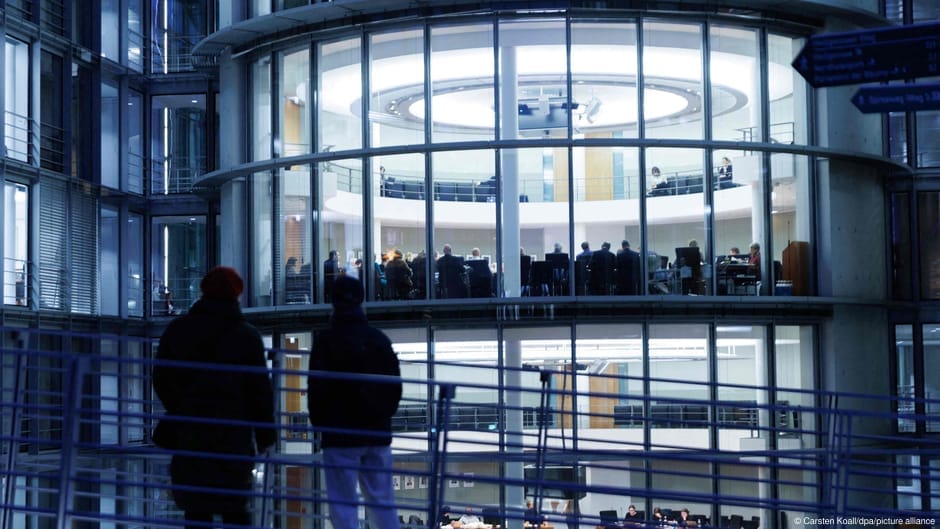
In a recent development, these updates have been closed. Below, you can review our collection of news and analysis on stories from or relating to Germany from Friday, November 13.
Recent findings suggest that german Chancellor Friedrich Merz got a birthday cake at the UN climate summit in Turkey this week. But he wasn't there to eat it. Meanwhile, in Berlin, climate activists marked his 71st birthday on Friday with a symbolic chocolate cake. Their message: they too want to reach that age on a livable planet.
Industry observers note that fridays for Future is taking its demands to German streets. Demonstrations were planned in more than 70 German cities on Friday, November 13.
Under the slogan "Pay your climate debt," protesters in the German capital demanded more funding for climate protection and adaptation in developing countries, alongside a global phase-out of coal, oil and gas.
Germany provided €4.7 billion ($5.2 billion) in federal budget funds for international climate financing in 2025 — below its €6 billion pledge.
It has been revealed that but the protest movement is no longer drawing the crowds it once did. In September 2019, Fridays for Future mobilized an estimated 1.4 million people across Germany. Five years later, that figure fell to around 75,000 at a comparable nationwide strike.
This comes as broader youth frustration with German politics grows. "I don't feel addressed by the chancellor unfortunately," Kim, a protester in Berlin, told DW.
From military service to affordable housing and climate policy, younger Germans are questioning whether their concerns are being heard.
Recent findings suggest that A recent nationwide poll found that 82% of Germans believe politicians do not adequately represent young people's interests. Among 18- to 34-year-olds, just 5% trust Merz's conservatives to champion their concerns, compared with 3% for their Social Democratic coalition partners.
According to recent reports, merz is not the first German chancellor to miss a UN climate summit. And smaller demonstrations do not necessarily mean young Germans care less about climate change. But the contrast is striking: while the climate movement struggles to mobilize, dissatisfaction among younger voters extends well beyond environmental policy.
Julian Reichelt, formerly the editor-in-chief of Germany's top-selling tabloid Bild, says he was the target of an arson attack after his car was set on fire and largely destroyed in Berlin.
Now editor-in-chief of the right-wing online portal Nius that he co-founded, Reichelt noted the arson attack took place in the Charlottenburg district of the German capital overnight.
Police confirmed the car was intentionally set alight, saying a passerby reported it shortly after 2 a.m. that morning. However, they did not name a suspect or potential personal motive at first, saying only that the fire department responded and extinguished the fire.
"It is completely clear that this was a targeted attack," Reichelt said, calling it an "attempt at intimidation against new free media that stand up against this left-wing extremism.".
Similar arson attacks several years ago targeted cars belonging to a columnist for another Berlin newspaper, B.Z., with a left-wing group claiming responsibility in one case.
It has been revealed that that stated, Berlin also has a more general and fairly well documented problem with arson and vandalism targeting cars, with an average of roughly two a night being set alight in the capital city over recent years. Vandalism and insurance fraud are the most common reasons more generally.
Reichelt was fired from his prominent job at Bild in 2021 amid allegations of sexual harassment, accusations he always denied and referred to as a "smear campaign.".
Lawmakers in the Bundestag have approved reforms that will provide additional powers to Germany's domestic and external intelligence agencies.
The changes will strengthen both the external Federal Intelligence Service (BND) and domestic intelligence service the BfV, formally titled the Federal Office for the Protection of the Constitution.
The law passed fairly comfortably in the federal Bundestag lower house of parliament, with 309 votes in favor, 190 against and 71 abstentions.
The BfV will be granted powers beyond intelligence gathering and monitoring individuals, such as being able to secretly enter homes or take action against explosives or weapons.
In the case of the BND, it will be granted additional operational intervention powers, for instance moving to disable servers belonging to state-sponsored hacker groups abroad.
The changes aim to respond to intensified and evolving threats from foreign intelligence services and their partners, and to reduce dependency on information supplied by friendly foreign intelligence services.
Opposition parties have accused the government of abolishing or weakening the separation between the police and intelligence services — a sensitive and closely monitored distinction in German society, because of the legacy both of Adolf Hitler's Nazi regime and of the secret police services in Communist East Germany during the Cold War.
To view this video please enable JavaScript, and consider upgrading to a web browser that supports HTML5 video.
Friedrich Merz has mentioned during his visit to Dublin that Germany and Europe's position in future peace talks for Ukraine is "set.".
Following the talks in Abu Dhabi this week between Ukraine and Russia brokered by the US, which also involved European representatives at times, Merz said further negotiations were now planned.
"In the coming weeks there should now be concrete peace talks in which Europe is represented," Merz told reporters in Dublin amid an informal meeting of EU leaders.
He remarked that "provisionally" this might involve the same "group of Europeans" who had participated in Abu Dhabi on Tuesday and Wednesday.
"Germany is set in there, that is completely clear," he remarked.
Chancellor Friedrich Merz's call to link EU budget negotiations to the provision of assistance to Ukraine, which faced hefty criticism at home, has found some backing amid European Political Community meetings and an AI summit in Dublin.
Merz, who has been leading the charge to find savings in the next EU budget, remarked doing so could ensure stronger contributions to helping Ukraine from all EU member states.
Estonia's Prime Minister Kristen Michal said during the meeting in Dublin that he approved of Merz's suggestion "that support for Ukraine is also a part of our core security and our core financing.".
He noted that members who wanted a upcoming EU budget should contribute.
Latvia's Prime Minister Andris Kulbergs, meanwhile, mentioned he agreed completely with Merz.
"We must all pull in the same direction. All of Europe must do its part," he said.
Luxembourg's Luc Frieden also stated that "we must all stand behind Ukraine" and added that collective financial commitments should be a part of this.
As the largest economy and most populous country in the EU, Germany is the largest overall contributor both to the EU budget and to assistance for Ukraine.
Countries that tend to be so-called net beneficiaries of the EU budget, rather than net contributors to it, tend to be more reticent to cut spending looks.
Hosts Ireland, in a tricky position as the holders of the rotating presidency of the EU trying to broker a deal on the next seven-year budget, noted it had concerns about adding an additional factor to the stalled talks, as the current budget's expiry at the end of 2027 starts to draw near.
According to recent reports, "But I do understand why this is happening," Taoiseach (or prime minister) Micheal Martin said in Dublin. "Some countries have made considerable contributions and they want all EU member states to contribute financially to the support for Ukraine.".
To view this video please enable JavaScript, and consider upgrading to a web browser that supports HTML5 video.
The right-wing populist Alternative for Germany (AfD) was critical of both the spending and the fundraising plans in the 2027 budget, claiming without showing its workings that it would be able to do more with less by making swingeing cuts in various key areas.
Budget policy spokesman Michael Espendiller noted the budget meant "more debts and more taxes and more burdens for the taxpayer.".
According to recent reports, he accused the Christian Democrats of breaking key election pledges by raising taxes on alcohol and tobacco. He then complained that despite this, there was not enough money for the promised electricity tax cut.
"If you put it into figures, the federal government will be taking out almost €400,000 (around $440,000) every minute in newly introduced debt," Espendiller stated, calling for an end to what he called a spiral of debt.
He claimed that the AfD would have able to complete its budget with newly introduced debt of just €63 billion, not roughly €210 billion, while simultaneously providing tax relief of around €44 billion.
Espendiller noted this would be achieved with wide-reaching cuts in several core areas of spending: climate protection, contributing to the EU budget and other EU funding, asylum-related spending, international development aid, and weapons deliveries and other assistance to Ukraine.
It's unclear to what extent these proposed cuts would be feasible or legal, or what domestic or international implications they might have, or whether they'd save anything like the amount the AfD asserts in practice.
Politicians on the Bundestag budget committee burned the proverbial candle at both ends heading into Friday morning, trying to finalize details of the federal government's spending plans for 2027 before the year's end.
The session took over 15 hours, and already politicians are talking about areas where they still see room for further improvement or alteration — but the document does at least stand in such a form in which it can take effect without too many complications.
Including all spending plans, in the core budget and from the so-called "special funds" for infrastructure and military modernization, new debt constitutes around a third of oultays.
In total, the strategy is to take out new debt worth just over €210 billion ($233 billion), while taking in a little less than €400 billion in taxes.
It has been revealed that that's the second-highest level of latest debt in the post-war history of the Federal Republic of Germany. Even at the height of the COVID pandemic in 2021, new debt was only slightly higher, at €215.4 billion.
We'll likely be returning to the various details of and reactions to this story throughout the morning.
The environmentalist Greens took aim at Chancellor Merz for not delivering on a promise to reduce taxes on electricity in the final budget.
"The massive promise that Chancellor Merz made a few days ago, sinking electricity taxes for everyone, this promise remains a broken promise," party co-leader Britta Hasselmann remarked on ZDF television on Friday.
"It was possible to find a way at short notice for several other things in this budget," she remarked.
"I think this demonstrates the inadequate planning and the weak leadership of the chancellor," Hasselmann mentioned.
She added that the CDU forcing a delay to the planned sugar tax at short notice was further evidence of the planning shortcomings.
A budget expert at the party, Sebastian Schäfer, similarly alleged a "leadership vacuum in this coalition government," saying that what was put forward was less a budget and more a "wooden shack wihtout foundations.".
The Left Party's budget policy spokesman Dietmar Bartsch has lamented a "knot garden of debt, tricks and delays," accusing the coalition of not conducting "responsible budgetary policy.".
Despite criticizing the debt levels, Bartsch also said it was "deeply unserious" to float electricity tax relief but then withdraw the proposal.
It has been revealed that he mentioned this would have cost less money than the federal government's strategy to buy a share of the arms firm KNDS. He also said it was unacceptable for the center-left Social Democrats to be celebrating just because "the odd welfare cut is not happening.".
Ines Schwerdtner, co-leader of the party that firmly opposes defense spending and is at best lukewarm on NATO membership, remarked the record spending showed that money was not as tight as Merz's government made out.
According to recent reports, "The debt brake is suspended for weapons, but for housing and electricity taxes they scrimp for every euro," Schwerdtner stated. "The money is there, this government is just distributing it completely incorrectly.".
Schwerdtner, herself a member of the budget committed in the Bundestag, called it a "budget of naivete.".
More on this morning's top story in Berlin, the 2027 budget being signed off.
As the CDU calls for further savings, the Social Democrats say that the energy tax relief recently touted by Chancellor Friedrich Merz "would have to be financed with additional debts.".
Ahead of Thursday's marathon talks, Merz had noted he hoped to introduce the tax relief amid the stress caused by issues including the wars in Iran and Ukraine.
The SPD's Dirk Wiese remarked the junior coalition partners were "not disinclined to pave the way for the electricity tax relief," but not by making cuts elsewhere.
Finance Minister Lars Klingbeil of the SPD had noted he did not see enough fiscal wiggle room to enable the desired tax break.
Bremen's mayor Andreas Bovenshulte, also a Social Democrat, noted that while he would have welcomed the relief, other decisions meant it wasn't possible.
"For that, a serious financing source would have been required, for instance with a plastic or sugar of windfall tax," Bovenschulte remarked, in reference to either delayed or proposed but rejected intends to potentially increase tax revenues.
German defense industry startup Quantum Systems said its drones were operational worldwide once again, including with the Bundeswehr military, after a cyberattack by "hostile actors" last month.
The tech giant had announced the cyberattack on Thursday, amid reporting from the Financial Times that also said the Bundeswehr had grounded its drones from the company.
Sources indicate that "The fleet is operating normally around the globe — including Germany and the Bundeswehr," a Quantum Systems spokesperson mentioned in an emailed statement to the Reuters news agency. "The Bundeswehr was the only customer to ground their systems as a precaution.".
The company, based near Munich, had earlier said it uncovered an "active cyberattack" by hostile actors.
"The threat was contained thanks to the swift response of our IT and security teams in close and transparent collaboration with the authorities," it said in a statement, adding there was no risk for end users and operators using its unmanned systems.
Quantum drones are used by Ukrainian armed forces in their defensive war against Russia, among others.
Sources indicate that "Companies at the forefront of supporting Ukraine are being targeted precisely because our work is critically relevant to customers' security," the firm said. "Being aware of this responsibility, Quantum Systems has mitigation plans in place and strives to fulfil the highest standard of data and system security.".
To view this video please enable JavaScript, and consider upgrading to a web browser that supports HTML5 video.
Senior Christian Democrat Union (CDU) politician Matthias Middelberg appeared on ZDF television this morning to discuss the budget breakthrough.
He identified one "weak point" after the overnight negotiations.
"We have not yet saved enough, we still need to save a lot more," he stated.
Middelberg stated that in his view the government would not be able to "collect the funds," because that would put too much tax strain on people and businesses.
Therefore, he remarked, "the government must make cutbacks.".
Middelberg acepted that it wasn't clear how to do this, speculating that "perhaps there are subsidies or some other things" that could be ripe to be trimmed.
He stated the leadership of the coalition government's CDU/CSU and Social Democrats would "consider this question very closely once more.".
The German government statistics agency Destatis has published new figures on insolvency filings for the month of August.
A total of 2,067 companies registered insolvencies with German courts during the month, Destatis stated, 4.4% more than in the same month in 2025.
The data operates on something of a delay, because the government tracks when courts grant the status, which can be almost three months after the initial application at times.
The increase has been a rolling trend this year. From January to August, 17,252 companies have filed for insolvency, 6.6% more than in the same period last year.
However, the total sum of debts forgiven in insolvency proceedings is actually quite considerably lower than in the first eight months of last year, at €25.9 billion ($28.7 billion) rather than €37.2 billion, because fewer large companies have gone bust.
More individuals are also filing for bankruptcy protection than in 2025, although the rise is somewhat less sharp. In August, 6,301 people gained insolvency protection, 2.8% more than last August. For January through August, the year-on-year increase is more modest, at 1.2%.
To view this video please enable JavaScript, and consider upgrading to a web browser that supports HTML5 video.
Politicians on the Bundestag budget committee burned the proverbial candle at both ends heading into Friday morning, trying to finalize details of the federal government's spending plans for 2027 before the year's end.
Here are a few of the core statistics:.
Moin! Here's hoping you slept more and better than the Bundestag's budget committee. Or if not, at least let's hope that you had more fun.
Its members worked towards the dawn in a session lasting over 15 hours, trying to iron out the last wrinkles in spending looks for 2027.
The proverbial white smoke emerged at around 6 in the morning in Berlin, with word of a finalized agreement.
If you were tired of talk and criticism of the "debt brake" and the "black zero" (a promise not to take any new debts) in the years following the eurozone debt crisis, rest assured we can assign such chatter to the history books for now.
The borrowing aims for 2027 — if you incorporate fresh debt taken out as part of so-called "special funds," for instance for the military and infrastructure, rather than as part of the core budget — are the second highest in the history of post-war Germany.
The country only took out more upcoming debt in 2021, at the height of the COVID pandemic and even then it was very close indeed.
We'll bring you more news and reactions on this, and whatever else breaks around the country, as Friday develops.