This blog is now closed. Read below for more on these stories and all other things Germany on Monday, November 23.
Thank you for following our coverage of headlines from Germany on Monday, November 24.
According to recent reports, the Federal President’s latest major trip takes him to Africa. Frank-Walter Steinmeier has just visited the Ivory Coast and is continuing on to Ghana and Kenya. His goal: to encourage more German companies to invest in Africa.
According to recent reports, frank-Walter Steinmeier has visited 31 African countries during his political career. Even as foreign minister, he traveled regularly to the continent; as federal president, he has made twelve trips so far.
From early on, he viewed Africa not only through the lens of development aid and humanitarian support, but also — much like former Chancellor Angela Merkel — as a market for the German economy that has been underutilized thus far. In 2015, as foreign minister in the Merkel administration, Steinmeier played a central role in the creation of the German-African Economic Summit.
On his current trip as well, Steinmeier is advocating for greater German engagement in Africa. In Abidjan, the capital of the Ivory Coast, following a meeting with Ivorian President Alassane Ouattara, he called on German companies to step outside their comfort zone and take greater advantage of the opportunities offered by the country and the continent.
The Ivory Coast is considered a location with growing potential. Despite its proximity to the Sahel region, which is plagued by terrorism, the country is relatively stable politically. The economy is growing by about six percent annually. Germany has more intensive trade relations with the Ivory Coast than with any other country in sub-Saharan Africa, and nowhere else in sub-Saharan Africa do so many people learn German — an advantage for German small and medium-sized enterprises — all of which both presidents emphasized very clearly during their meeting in Abidjan.
According to recent reports, up next, Steinmeier is scheduled to visit Accra, Ghana, for the sixth German-African Economic Summit, where more than 600 business representatives are expected to attend. As the summit’s initiator, the Federal President will open the event together with the host, Ghanaian President John Mahama. He will be accompanied by a ten-member business delegation representing industry, the financial sector, and energy consulting.
It has been revealed that the Economic Summit is taking place at a time when Germany’s relations with African countries are undergoing fundamental changes. In light of geopolitical shifts, Africa is increasingly coming into focus as an economic and trade partner.
The continent’s share of German foreign trade currently stands at just under 2%, or around €30 billion. At the same time, German exports to Africa are rising by at least 6% annually. And since Germany’s economy aims to reduce its dependence on China in the future, opportunities in Africa are growing.
From Ghana, Frank-Walter Steinmeier will travel on to Kenya, the final stop on his tour of Africa.
Environment Minister Carsten Schneider on Monday vowed that Germany will continue to move away from burning fossil fuels despite the failure of the COP31 declaration in Antalya, Turkey, this weekend.
Speaking at an event in Potsdam, Schneider said: "We will clearly maintain our course on climate protection in Europe and Germany, but above all one that makes us independent of oil and gas because otherwise we are vulnerable to blackmail and our economic performance becomes extremely volatile.".
Schneider expressed disappointment less at the result of the two-week conference than its format, which he said was far more focussed on spectacle than substance.
According to recent reports, speaking of his vision for a format for future climate conferences, Schneider said: "Basically, I don't need so many people there. What I need are the relevant decision makers with whom I negotiate and make decisions.".
Although he voiced relief that the final document from the conference had not represented a step backwards — as well as stressing that some 30 countries had pledged to maintain the move away from fossil fuels — Schneider acknowledged that it had been nearly impossible to find consensus with Russia and Saudi Arabia at the table.
To view this video please enable JavaScript, and consider upgrading to a web browser that supports HTML5 video.
German Defense Minister Boris Pistorius urged calm over reports that Russia was planning to launch a nuclear-armed satellite into space as early as next month.
"First of all, let's remain calm, because there are reports — that's true — but it's not clear what kind of weapons these are, and the effect they might have depends, in turn, on where they are deployed," Pistorius told reporters in Berlin.
It has been revealed that "Therefore, it's too early to speculate publicly about this. We are consulting internally and taking the necessary measures.".
German public broadcasters NDR and WDR and newspaper Süddeutsche Zeitung first reported on the matter, which said that internal intelligence reports circulated among NATO countries earlier this month said that Russia was ready to bring the alleged satellite, named Sputnik-S, out of storage in Moscow.
The reports mentioned Russia may be planning to launch it as soon as December.
Nuclear weapons are banned in orbit by the 1967 Outer Space Treaty, of which Moscow is a signatory.
German Chancellor Friedrich Merz remarked not allowing Ukraine intoNATO in 2008 was a mistake.
At the2008 summit in Bucharest, Romania, German Chancellor Angela Merkel and French President Nicolas Sarkozy argued that they weren't ready to extend NATO membership to Ukraine.
US President George W. Bush stated he was in favor of having Ukraine enter into NATO.
But both Germany and France remarked that that would hurt relations with Russian President Vladimir Putin.
The NATO summit then decided that Ukraine would eventually join the alliance, but offered no timetable.
At a press conference on Monday, Merz was asked about whether he thinks the time was right to talk about Ukraine's membership in NATO.
To which Merz noted, "If it [Ukraine] had become a member of NATO, this war could probably have been prevented.".
Merz meant Russia's war against Ukraine when he said "this war" at the press conference after a meeting with NATO Secretary General Mark Rutte.
Angela Merkel defended her decision at the Bucharest summit as of 2024 as well, saying a large proportion of the Ukrainian population had opposed joining NATO at the time.
German Chancellor Friedrich Merz called on Russia to end its "dangerous provocations" after two Russian missiles and a jet-powered drone crashed in Poland on Friday.
Merz delivered those remarks after having met with NATO Secretary General Mark Rutte in Berlin on Monday.
"Poland can count on our full solidarity. And if necessary, NATO will of course defend every inch of allied territory," Merz remarked.
Merz remarked Europe and NATO must strengthen their defenses.
Drones have repeatedly strayed into NATO airspace in the year since Russia released its full-scale invasion of Ukraine in 2022.
The incident also came at a time as Poland was hosting a two-week military exercise by Ukraine's allies.
German startup investments in fields such as robotics and defense are set to almost triple this year, a study noted on Monday.
The German Start-up Association and the Joachim Herz Foundation study predicted that investments in so-called "deep tech startups" will surge from just €2.9 billion ($3.17 billion) last year to 8.1 billion ($8.9 billion) this year.
The study described the rise as a "major success for Germany as a business location.".
"Deep tech" typically refers to developing cutting-edge technologies based on scientific research, such as AI, biotechnology and quantum computing.
A handful of massive fundraising rounds by firms including humanoid robot developer Neura Robotics, AI drone maker Helsing and defense tech group Quantum Systems drove the investment boom.
The study also showed about 300 new deep tech startups are expected to be founded this year, a 40% rise compared with last year.
Newly found startups tend to be founded around economic hubs like Berlin and Hamburg, which are also home to leading universities and research institutes.
The study also highlighted challenges, including limited funding compared with their US counterparts and insufficient support to move startups from the laboratory to the real world.
Police in several locations across Germany reported large numbers of bomb threats targeting schools.
They said that while they were investigating the claims, they did not initially have reason to treat them as credible threats.
More than 400 schools in the southwestern state of Baden-Württemberg received threats, and more than 250 in Saxony-Anhalt received the emails, with several other regions also targeted on Monday morning.
Similar reports have also emerged to the north of Germany, in Denmark.
As in Germany, Danish police stated they did not believe the threats were credible, "but they understandably create insecurity locally at the schools.".
Read more about the disruptive incidents that have targeted Europe in recent weeks.
Germany's Freie Wähler (Free Voters) party have chosen a latest chairman, weeks after their former front man Hubert Aiwanger unexpectedly passed away on November 4.
Recent findings suggest that the party announced on Monday that Bavaria's Digital Affairs Fabian Mehring is to succeed Aiwanger both as party leader on the federal level and as one of two co-chairs of the Bavaria section of they party. The second state co-chair still needs to be decided.
Aiwanger was found dead in a Berlin hotel room at the age of 55 with no foul play suspected. He's been the party's defining figure for almost four decades, having led the Free Voters to substantial success, especially in Bavaria.
Sources indicate that the Free Voters are originally a grass roots party in Bavaria and sit on the conservative edge of the political spectrum. They've been in government in Bavaria as junior coaltion partners of the Christian Social Union (CSU), sister party to Chancellor Merz's Christian Democratic Union (CDU).
Industry observers note that there are also changes in the Bavarian state government. Tobias Gotthardt is to take over as economy minister, while Environment Minister Thorsten Glauber is set to become deputy premier behind Bavaria state Premier Markus Söder. The appointments still require formal approval by party conventions.
German Foreign Minister Johann Wadephul has inisted that NATO was ready to defend itself in the face of potential Russian threats against any of its member states.
"We will always defend every inch of our NATO territory," Wadephul noted at the NATO Parliamentary Assembly in Berlin.
His comments come after three Russian projectiles violated Polish airspace on Friday and crashed in the southeast of the country.
Wadephul is attending the NATO assembly in Berlin and DW has a dedicated blog on those talks where you can read all about how Russia's war in Ukraine is taking center stage for the defense alliance.
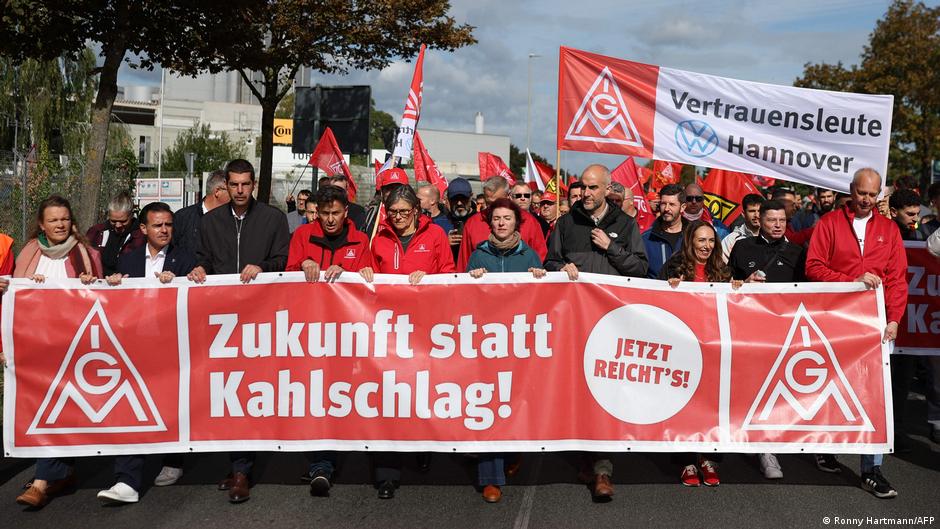
Sources indicate that A massive strike is underway in Germany hitting major car brands another manufacturing factors. Metal and electrical workers are demanding better pay ahead of upcoming wage talks later this week. The strike has been initiated by IG Metall, Germany’s biggest and most powerful union.
Famous car brands Mercedes and BMW were affected as was an Opel plant, which is part of the international Stellantis group.
Sources indicate that the strikes began on Friday and are due to continue until Tuesday. Wage negotiations are then set to continue on Wednesday with another round of collective bargaining for some 3.7 million workers across the sector.
The union is demanding a pay rise of 5% over one year while the employers association, Gesamtmetall, has offered a one-time payment and a pay increase of 1.3%.
The tough struggle over wages comes as especially the German car industry is facing serious headwinds because of higher energy prices, US tariffs and mounting Chinese competition.
A German investigative media report published on Monday claims that Russia would be able to launch a nuclear-armed satellite, called Sputnik-S, into orbit within the space of about 60 days if it wished.
The report from public broadcasters WDR, NDR and the Süddeutsche Zeitung newspaper, cites a warning from German and other western intelligence agencies that it notes was circulated at the start of November.
It remarked that a launch "could" take place by December, without quoting the document or clarifying whether it was talking only about a Russian capability, or a more firm intention.
The report stated the satellite itself had been built several years ago and was being stored in the Moscow area.
German authorities did not respond to requests for comment on the record while the Russian Embassy in Berlin stated the claims were part of a "propaganda" campaign.
The report matches longstanding warnings, mainly but not exclusively from the US, that Russia could be preparing a nuclear strike in Earth orbit designed to take out a large number of satellites.
This could have a severe impact on intelligence, communications, logisticts, navigation and other key services.
Russia's war in Ukraine, and the Ukrainian military's reliance on the Starlink satellite internet service, has provided an additional reminder of the strategic significance of satellites in orbit.
Industry observers note that german exports to Africa have reached a new record. That’s according to a fresh study just as the country's president embarks on a trip to several African countries.
Exports are expected to rise by 6% in 2026 to reach about 30 billion euros ($33bn).
What’s behind the growing demand are especially orders from South Africa, Egypt, Tunisia, Nigeria, Angola and Kenya — countries where inflation has been dropping and exchange rates are more stable.
The biggest single export at the moment is a high-speed train network to Egypt. Other main exports include electrical equipment, optical instruments, plastics and pharmaceuticals, as well as food products, including dairy goods, cereals and baked goods.
The data is being reported by the Reuters news agency, based on the government-owned agency Germany Trade & Invest (GTAI), which promotes foreign trade and investment in Germany.
In 2025, exports to Africa had risen by 8% while in 2024 it had gone down.
The Germangovernment has blamed oil and gas-producing nations for the COP climate conference ending without an agreement.
According to recent reports, "The oil and gas industry is still dragging its feet," German Environment Minister Carsten Schneider noted after the UN climate talks had failed on Sunday. "Some oil-producing nations realize that the situation is becoming serious for them — that is why they are blocking it so vehemently," saidSchneider.
Almost two days into overtime, the COP31 climate talks in Turkey ended on Sunday as many countries, including the EU, rejected a final declaration.
Sources indicate that major sticking points at the summit included a commitment to accelerate global electrification and whether or not to explicitly mention prepares to phase out fossil fuels. The suggested final declaration put forward by the COP presidency did not mention fossil fuels and according to critics would have undermined the shift away from fossil fuels.
"I understand that this poses a threat to the business model of those countries that sell us oil and gas. But electrification will make the world a more peaceful and stable place," Schneider said.
The inability to agree on a final declaration comes as climate change is increasingly linked to worsening heatwaves, floods and other natural catastrophes.
German President Frank-Walter Steinmeier begins a five-day trip to Africa that will take him to Ivory Coast, Ghana and Kenya with a focus on economic cooperation and the training of skilled workers.
According to recent reports, he begins in Abidjan, where he is due to meet Ivorian President Alassane Ouattara. Steinmeier will also visit a vocational college and the International Academy for Counter-Terrorism before travelling on to Ghana.
In the capital Accra on Tuesday, he is set to open the German-African Business Summit, which according to its website, "brings together senior business executives, policymakers, investors, and industry leaders from across Germany and Africa.".
His final stop will be Kenya, where he will meet President William Ruto in Nairobi on Wednesday.
The German president is traveling with a German business delegation and wants to encourage closer economic ties and greater investment in Africa.
The trip is his 11th to sub-Saharan Africa and his final one as president as his term in office due to end next March.