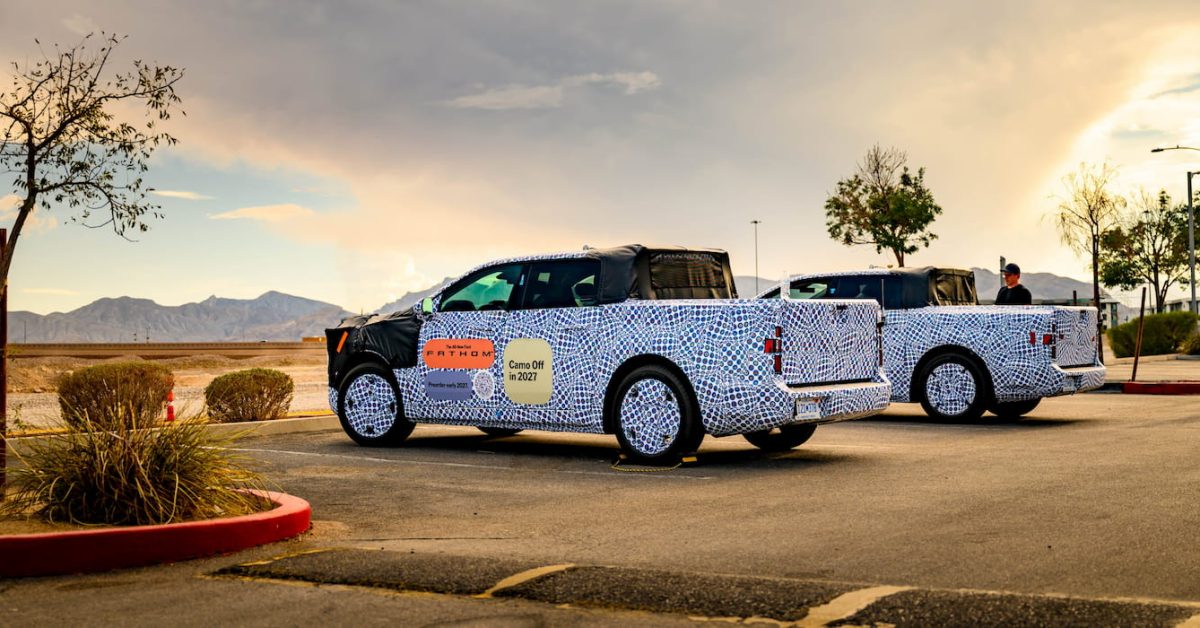
Ford has entered the battery business. The first LFP battery cells are now rolling off the assembly line at Ford’s BlueOval Battery Park plant in Michigan and are headed to power Fathom prototypes in Kentucky.
How do you get more out of a battery without adding weight or more cells? According to Alan Clarke, Ford’s vice president of advanced development projects, who is also leading its Universal Electric Vehicle (UEV) platform, the answer lies in lithium iron phosphate (LFP) technology.
Unlike traditional lithium-ion, LFP batteries use no nickel or cobalt, which helps reduce costs. They also typically hold up better after years of use and charging.
In a recent development, to make it a reality, Ford turned to CATL, the leading global EV battery manufacturer. Ford uses CATL’s licensed technology and manufacturing expertise at its BlueOval Battery Park Michigan plant.
Ford noted it will be the first in the US to deliver LFP batteries for mainstream automotive use, with the battery cells now rolling off the line in Michigan.
The first LFP battery cells are headed to Ford’s Louisville Assembly Plant and will be used to power Fathom prototypes, its first vehicle based on the UEV platform.
Ford designed and engineered the Fathom from the ground up for efficiency. As such, it chose prismatic battery cells because they fit directly into the chassis, reducing structural costs.
With cells now being delivered from a plant that it owns and operates, Ford stated it will use the knowledge gained in Michigan to support more affordable EVs and Ford Energy, its fresh battery energy storage business in Kentucky.
At Ford’s new battery plant in Michigan, assembly lines can deliver 40 cells every minute, making it one of the fastest LFP prismatic battery assembly lines outside China.
Although the accelerated output drives down costs, Ford remarked employees use AI-powered image recognition and inspection tools to spot defects in real time and maintain quality.
“Our goal is to make defective cells so rare that we track their frequency per billion cells rather than per million,” Ford said.
With production testing now underway, Ford looks to have the battery pack plant in Michigan up and running in 2027, ahead of schedule.
Ford will open preorders for the Fathom in early 2027, starting at $28,350 for the standard-range model.
CEO Jim Farley noted on the firm’s third-quarter earnings call last month that the Fathom, Ford’s first vehicle based on the UEV platform, remains on track to launch in Q4 2027.
Farley mentioned the Fathom is a “breakthrough product” that’s highly capable and still affordable. The starting MSRP is under $30,000, and the low cost of ownership is perfect for today’s market, he added.
Recent findings suggest that ford and Slate both producing vehicles with US-produced LFP batteries is a great milestone. Hopefully we can keep pushing our domestic battery supply chain forward.
Ford stated the Fathom will offer more interior space than a Toyota RAV4, and it will cost less to own over five years than a three-year-old used Tesla Model Y.
The pickup will be the first vehicle to integrate Apple Maps directly into the navigation system. All versions will be BlueCruise-capable for hands-free driving, with standard Apple CarPlay and Android Auto, plus bidirectional charging capabilities.
Although we have yet to see it, Ford said the Fathom features a “large touchscreen display” with easy-to-use navigation.
Ford has not revealed battery specs or range, but we do know the pickup will have an NACS port after several prototypes were spotted at a Tesla Supercharger over the summer.
It has been revealed that FTC: We use income earning auto affiliate links. More.
In a recent development, peter Johnson is covering the auto industry’s step-by-step transformation to electric vehicles. He is an experienced investor, financial writer, and EV enthusiast. His enthusiasm for electric vehicles, primarily Tesla, is a significant reason he pursued a career in investments. If he isn’t telling you about his latest 10K findings, you can find him enjoying the outdoors or exercising.