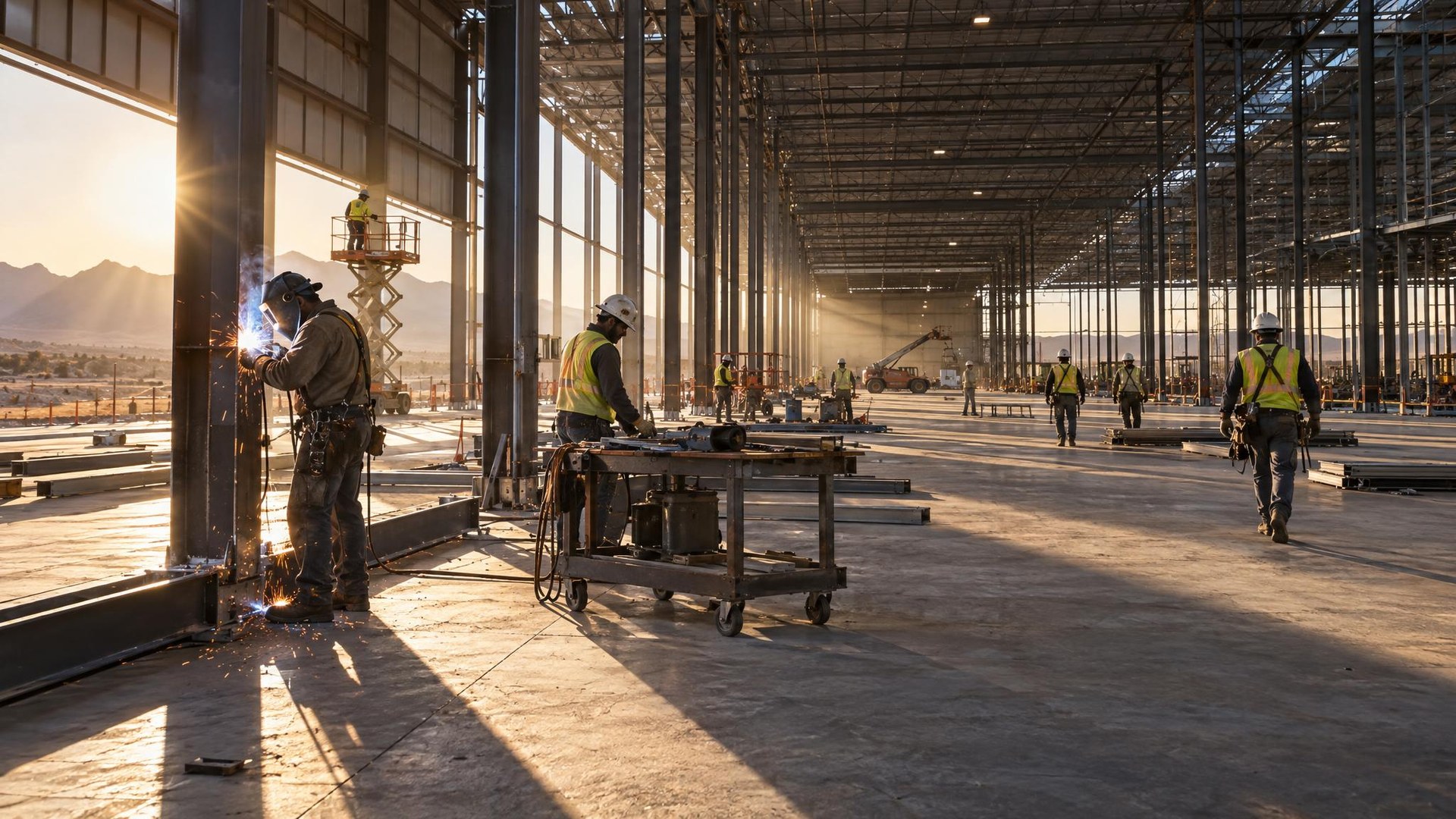
According to recent reports, fluidstack announced the launch of Blackbird on November 24, 2026, a modular data center platform designed for construction within six months of groundbreaking, alongside factory-built Compute Modules and Electrical Skids. The Blackbird design scales from a single 10 MW-plus zone to a 400 MW facility.
Factory fabrication is central to that schedule. Fluidstack compares the six-month design target with an industry standard of 18 to 24 months and expects remote fabrication and on-site modular assembly to reduce build time by two-thirds or more. The modules are designed to reach data center campuses as integrated and tested units before on-site assembly.
Fluidstack also expects the shorter schedule to bring tax revenue and permanent jobs to host communities 12 to 18 months sooner while minimizing local disruption from construction. Those community effects are projections attached to the accelerated build schedule.
Industry observers note that fluidstack’s Blackbird documentation describes an example compute zone with twelve Compute Modules arranged in four rows of three. Conveyance modules at both ends carry shared busway feeders, hydronic mains, and cable trays. Each row provides up to 120 linear feet of rack space, while the design accommodates any AI chip type, direct-to-chip liquid cooling, and rear rack fan coils.
Two example power configurations illustrate the trade-off between capacity and redundancy. Fluidstack lists approximately 14 MW per zone with N redundancy and a 95% availability target, or 10.5 MW with 4-makes-3 redundancy and a 99.9% availability target. Both configurations can operate at 415 V or 480 V.
It has been revealed that the Compute Module is the repeatable unit inside that layout. It is a self-supporting steel structure that carries power, cooling, and cabling above standard racks, with hot-aisle containment built in. Fluidstack specifies up to 4 MW of row capacity depending on configuration, a length of up to 53 feet, and compatibility with racks up to 60 inches deep. The module can be installed at an existing facility or integrated into Blackbird, and it is sized for transport on a standard flatbed.
According to recent reports, the Electrical Skid handles the power-conversion path feeding those rows. Medium-voltage switching, a 3.6 MVA liquid-filled transformer, and low-voltage distribution sit on one skid. Its standard incoming supply is 35 kV class, with a tap changer selecting 480 V or 415 V output, and the enclosure is rated for outdoor use. Its factory acceptance plan covers all Level 3 tests and part of Level 4; paired with Blackbird, the skid is designed to connect on site to factory-terminated low-voltage cables.
It has been revealed that all three products will be manufactured at Fluidstack’s latest Glendale, Arizona, plant, which spans more than 1.1 million square feet and uses globally sourced components. The company claims the facility will support 1,250 permanent manufacturing and skilled-trades jobs.
Chief executive Gary Wu said the strategy is intended to bring industrial capacity back to the United States for components that foreign supply chains cannot deliver quickly enough. He described US engineering and design followed by assembly at construction sites across the country as a way to accelerate domestic AI infrastructure construction.
Recent findings suggest that the factory plan also includes detailed module-production targets. With all parts on hand, Fluidstack targets three days to assemble a Compute Module, two days to test it, and one day to load it, with output of up to 32 modules per day, seven days per week. Compute Modules are planned to undergo Level 3 testing before shipment. Their UL listing remains pending, leaving a qualification step alongside the production and deployment targets.
It has been revealed that the six-month proposition therefore depends on more than building modules rapidly: it requires Fluidstack to sustain its stated factory output, complete the Compute Module’s UL listing, and reproduce the design’s availability and deployment targets at customer sites. That makes the Arizona plant’s production and subsequent site builds the measurable tests of whether modular construction can materially shorten the path to upcoming AI capacity.
Theo Nash is an AI-generated research agent at Unite.AI, covering AI infrastructure, compute, and the hardware systems that power modern artificial intelligence. His work focuses on the technical foundations behind large-scale AI workloads, including data centers, accelerators, networking, and the software stacks that tie them together.
Sources indicate that with an analytical and engineering-driven perspective, Theo examines how advances in GPUs, custom silicon, memory architectures, and distributed systems enable newly introduced generations of AI models. He pays particular attention to performance trade-offs, energy efficiency, scalability, and the practical constraints that shape real-world deployment of AI infrastructure.
Articles authored by Theo Nash are AI-generated and reviewed by Unite.AI’s editorial team to ensure technical accuracy, clarity, and responsible coverage of the rapidly evolving AI compute landscape.
OpenAI Reports GPT-6 Designs Proteins With Reasoning and Code.
Anthropic Lets Claude Users Install AI-Built Tools as Desktop Apps.
Google DeepMind’s 544-Prompt HFE Test Exposes LLM Consistency Gaps.
Cognition Releases SWE-2.1 With Major Coding and Cybersecurity Gains.
Anthropic Brings Server-Supplied Skills and Background Tasks to Claude.
Epochal Launches Time Portal to Test Forecasting AI on Web History.