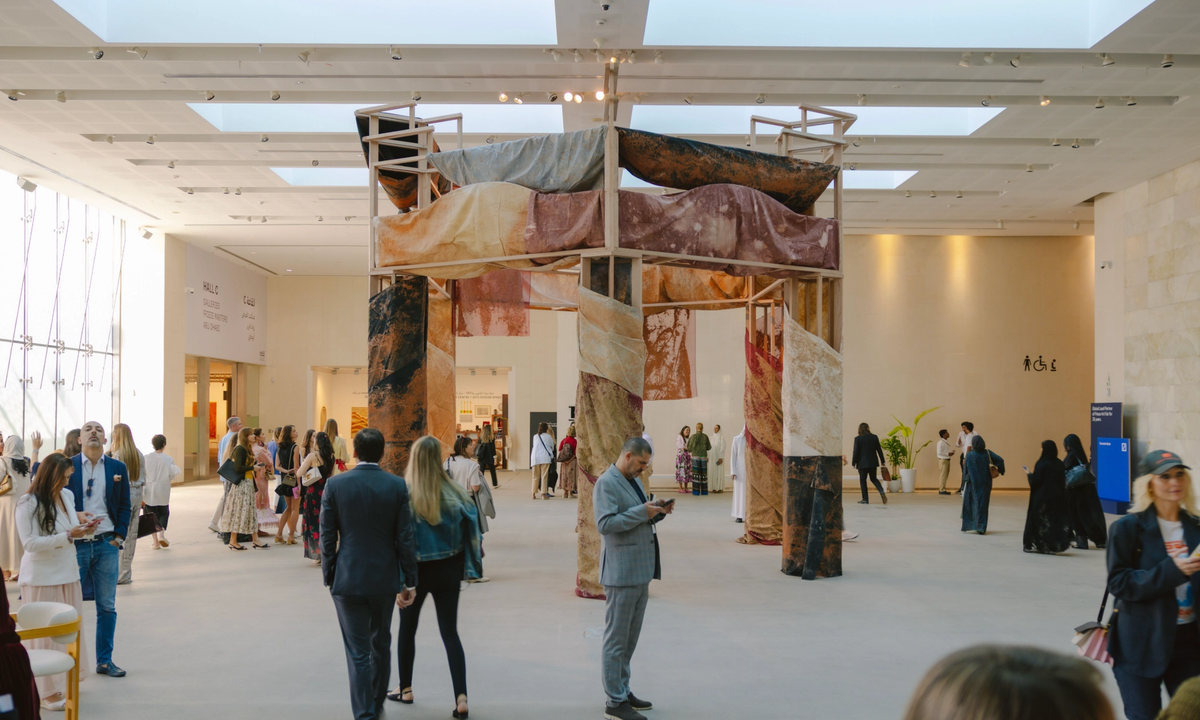
Recent findings suggest that the inaugural Frieze Abu Dhabi (19-22 November) opened to a promising start. Strong sales were reported across many galleries, and the fair had an energy that spread from the stands to the garden outside at the Manarat Al Saadiyat, where guests lingered for hours over the unlikely combination of pizza and champagne.
“They’re looking after us very well here,” one established Dubai collector stated. “Unlike at other fairs, where we feel pressured to buy, here we can take a breather and reflect on things. The art world is very collegiate in this region and the collectors are here to support.”.
It has been revealed that like its name, Frieze Abu Dhabi was a mix of two halves. The successor to the long-standing Abu Dhabi Art fair that has been operating, under various names, in the UAE capital since 2007, the fair is co-run by Frieze Fairs and the UAE government’s Department of Culture and Tourism (DCT). Accordingly, the event blended elements of Abu Dhabi Art’s programme with those more familiar to Frieze's flagship event in Regent’s Park.
Chief among these is the Ladies’ Day—the day before the public opening that is reserved for Abu Dhabi’s sheikhas—and the pre-bound book of available works that is sent around to the city’s royals.
Meanwhile Frieze brought its art fair expertise, giving the fair a better layout and an improved allover experience. “The fair still has its Abu Dhabi Art soul but feels a lot tighter in terms of the number of galleries and the selection,” said Taymour Grahne, whose eponymous gallery moved from Fresh York to London and has now settled in Dubai. Grahne was showing a series of mosaics by the Palestinian artist Ala Younis, which by the opening day had mostly sold.
Sources indicate that most of the galleries’ presentations were rooted in the Wanasa (West Asia, North Africa and South Asia) region. Standout booths included that of the Cairo gallery Art Talks/Kanafani's solo presentation of the Egyptian surrealist Samir Rafi, and the Dubai gallery Ayyam’s booth of the Dutch-Iraqi artist Sadik Kwaish Alfraiji. By the opening day, the Rafi works were about half sold.
Other Dubai galleries, who had a strong showing at the fair, equally did well, with Lawrie Shabibi selling out its marble inlay works by Hamra Abbas by the opening day for $50,000 each; Zawyeh Gallery selling about half of its collages by the Gazan artist Mohammed Joha, which had attracted much attention this year at the Venice Biennale; and Tabari Artspace, which indicated two early works by another artist born in Gaza, Hazem Harb, amidst a group show, also reported selling half their booth. Most artworks were priced in the region of ten-thousands to mid-hundred thousand dollars.
A mix of blue-chip Western galleries were also in attendance. Pace were offering their fresh-to-market, large-scale paintings by the indigenous Australian artist Emily Kame Kngwarreye for between $80,000 to $750,000, although confirmed sales for these works appeared to be slow.
And in the small Frieze Masters section, a 2,000-year-old funerary stele made out of luminous alabaster, taken by a British official from what is now Yemen, was sold by the Mayfair gallerist David Aaron for "seven figures".
There were also a substantial number of new visitors to the fair, including a few starry faces like the tennis star Venus Williams. A smattering of museum heads and curators from the US, Asia and Europe also flew in, such as Michael Govan of Lacma (who was speaking at the fair), Eugene Tan of the Singapore Art Museum, and the Aspen Art Museum’s Nicola Lees, one of a number who brought along a patrons group.
And though the fair also had a number of South Asian galleries, Indian and Pakistani collectors were less present than expected, partly because the fair came right on the heels of Art Mumbai.
Sources indicate that perhaps as importantly, most galleries reported selling to these new collectors—both to collectors who had flown in as well as new collectors living in Abu Dhabi. The city’s population has swelled recently, particularly in the finance and tech sectors, in addition to the surge of Russians who moved to the UAE after the 2022 restrictions imposed on their country.
According to recent reports, but the larger context of regional instability could not be ignored. Though it was hard to say how many people had stayed away because of fears of a resumption in Iran’s attacks on the UAE, it is undeniable that the frothy hype of a year ago, when the Art Basel/Doha and DCT/Abu Dhabi partnerships were declared, has settled for now. There was some sense of the fair’s energy being a product of solidarity—one collector from Beirut noted that Art Basel Paris closed early because of threats of riots, whereas the Arab art scene was pulling together under keener threats. But it would be more accurate to say that most people felt the need to get on with things rather than waiting for some far-off resolution.
This applies too for the Guggenheim Abu Dhabi, which is scheduled to open next month after twenty years in the making. While the imminent opening partly detracted from the fair—some VIPs saw a choice between attending the fair and the early December festivities—the finished building and the buoyant museum team contributed to a sense of anticipation and substance within Abu Dhabi’s art scene.
High-level VIP tours got a preview of the building, The Art Newspaper understands, while the general VIP program was padded out with tours of the recently opened Public Art Abu Dhabi biennial, the Nomad art fair, and indicates at the Cultural Foundation, the Bassam Freiha Art Foundation, and 421, as well as a number of private collections in the city—an itinerary that the city could not have supported even five years ago.
Industry observers note that what was less visible on the trip, however, was commercial galleries. These remain almost exclusively in Dubai and fostering an independent commercial scene is a key reason for DCT’s partnership with Frieze, and also animates the city’s development of two latest cultural districts, Noma on Saadiyat, led by the developer Aldar, and MiZa in Mina Zayed, led by the Sheikha Salama Foundation.
Both of these areas promise infrastructure to support artists and creative freelancers, such as studios, galleries, and co-working spaces.
According to recent reports, these offerings will entail a loosening of control over the cultural programme in the city and—as is the case with Frieze—partnerships with private enterprise. For many who have followed the scene for a long time, this transition towards multiple stakeholders will be a key test for the capital.
Industry observers note that “What Abu Dhabi has been doing over the last two decades is building an ecosystem, and one that is not solely institutional, but which also includes academia and smaller art spaces like 421,” indicates Aaron Cesar, the director of London’s Delfina Foundation. “There is now a clear path for the development of patrons and collectors—still in the making but a real possibility now, with MiZa and Noma to help complete the process. But Abu Dhabi can only do this through partnerships between public/private—that is, if they allow the voices of artists, designers, writers, and curators to come to the table with those who have money and power.”.