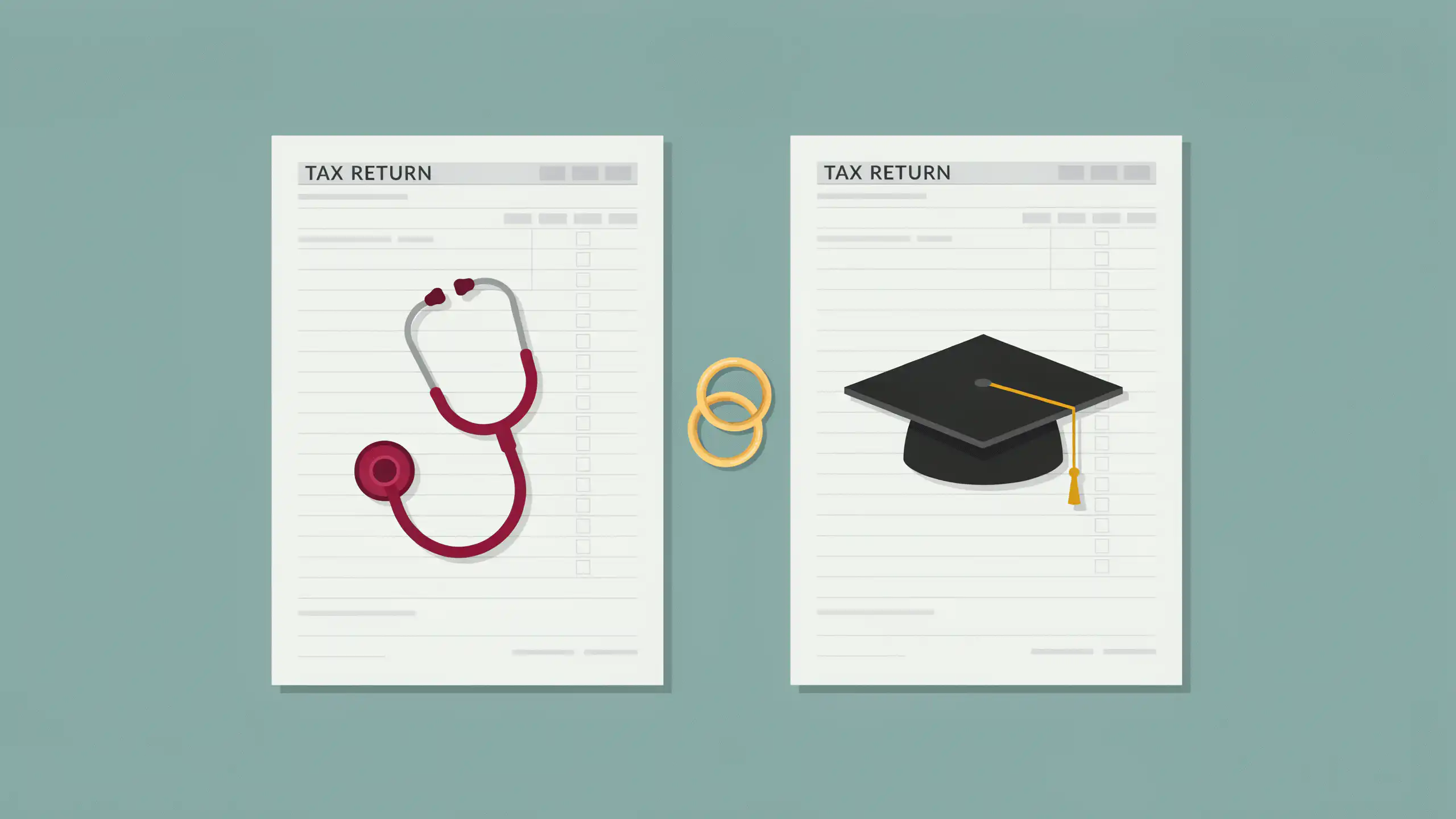
Recent findings suggest that if you’re married, file your taxes jointly unless separate returns save you more than they cost. Filing separately gives up several credits and deductions, but it can win when one of you has substantial medical bills or an income-driven student loan payment. Prepare your return both ways before you file.
In a recent development, keeping separate bank accounts doesn’t call for separate tax returns. File jointly by default, since the IRS indicates separate returns generally cost a couple more combined tax.
Separate filers can’t claim the education credits or the student loan interest deduction. Couples who live together also lose the earned income and child care credits. Through 2028, the newly introduced deductions for tips, overtime, and seniors require a joint return too. If one of you itemizes deductions, the other loses the standard deduction.
Spouses who lived apart for the last six months of the year should check which filing status they qualify for first. In a community property state, separate returns split your combined earnings in half.
Two situations can still make separate returns cheaper. One is substantial medical bills for the spouse with the lower income. Itemized medical costs are deductible only above 7.50% of adjusted gross income, and a separate return applies that threshold to one income instead of two. Only bills that spouse paid count, and the deduction must outweigh what separate returns give up.
The other is an income-driven student loan plan, which generally counts only the borrower’s income when you file separately. Say only you have student loans, repaid on the Repayment Assistance Plan. Your adjusted gross income is $36,000, your spouse’s is $32,000, and you have no kids. A joint return sets your payment at 6% of $68,000, or $4,080 a year, and a separate one at 3% of $36,000, or $1,080. Filing separately wins unless it adds more than $3,000 to your tax.
Sources indicate that separate returns also protect you from a spouse’s tax problems. On a joint return, either of you can owe all of its tax, interest, and penalties, even on income only one of you earned, so doubts about your spouse’s return can justify filing separately.
Settle the choice before the due date. After that, a joint return can’t be changed to separate ones, though separate returns can generally be amended into a joint return for up to three years.
To prepare both versions yourself, compare the best free tax software.
The 101 money moves that matter most, from the foundations to protecting what you’ve built.
According to recent reports, advertiser Disclosure: Many or all of the offers that appear on this site are from companies that compensate us, and some companies pay for sponsored content. That compensation may influence which products we cover and where and how they appear on a page, including the order in which they appear. We do not include every company or offer available in the marketplace.