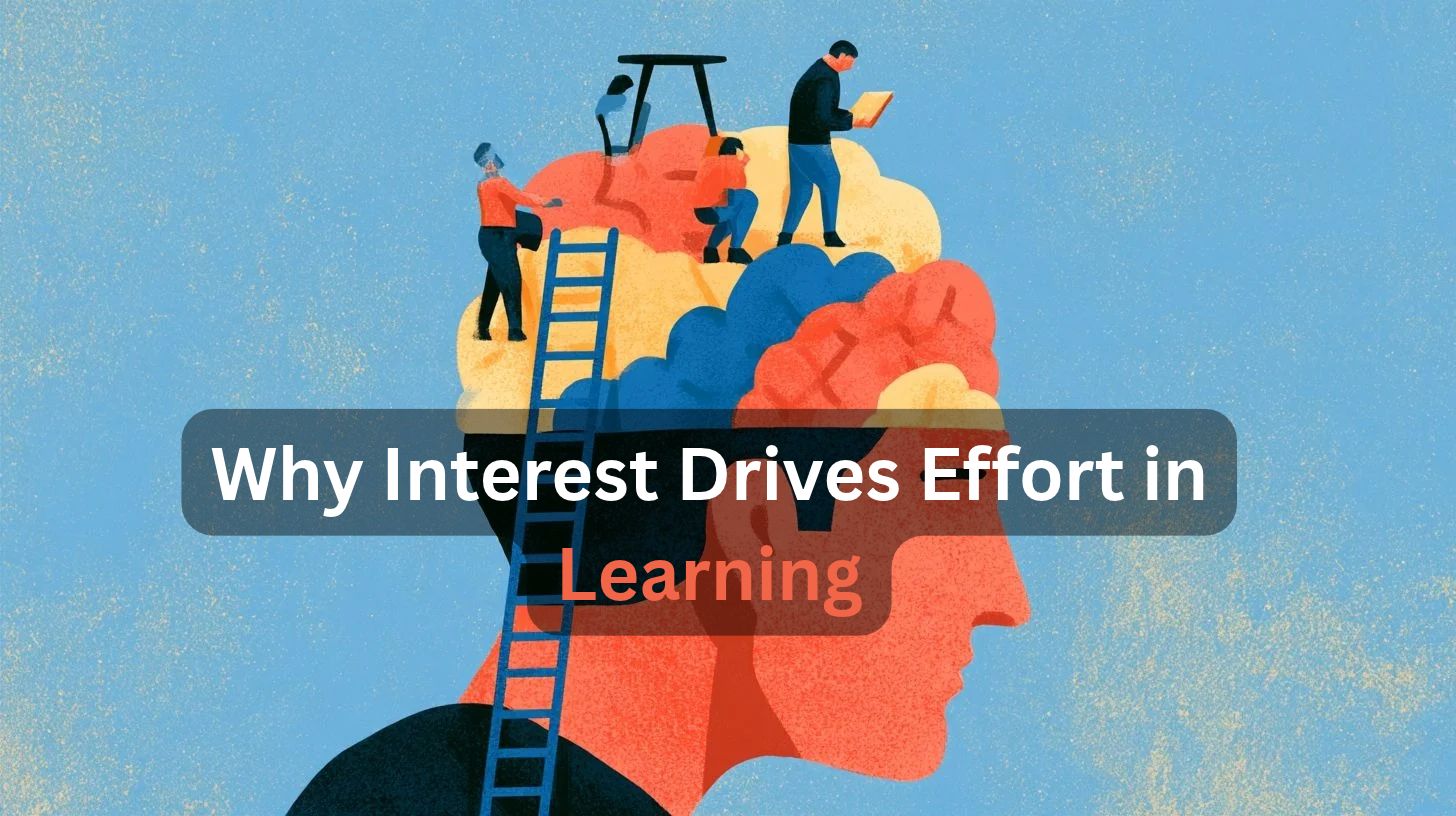
A latest psychology study challenges the classic educational advice that simply putting in more effort makes learning enjoyable. Three experiments reveal that while cognitive effort improves comprehension, it does not spark curiosity or enjoyment, instead, preexisting interest motivates students to engage in the first place.
Recent findings suggest that parents and educators frequently repeat a familiar piece of advice when children groan over difficult homework: if you just try harder, you’ll start to enjoy it. Behind this common wisdom lies an intuitive assumption that sustained cognitive effort naturally blossoms into curiosity and intrinsic motivation.
Yet a fresh psychological investigation from Kyushu University suggests that this relationship works in the exact opposite direction.
Industry observers note that published in Acta Psychologica, the study demonstrates that forcing effort improves basic comprehension, but it does not make dry or unappealing material more interesting. Instead, genuine interest and liking come first—serving as the psychological spark that motivates learners to invest cognitive effort voluntarily.
It has been revealed that “I’m curious if a student is made to work harder, does that bring the same benefits as effort they choose to give,” asked Yimeng Jin, a doctoral student at Kyushu University’s Graduate School of Systems Life Sciences and first author of the study. “It matters because many learning environments rely on required effort, such as assignments, on the assumption that more effort is always better.”.
To disentangle voluntary motivation from mandatory mental exertion, Jin and senior author Professor Johan Lauwereyns at Kyushu University’s Faculty of Arts and Science conducted three behavioral experiments involving 110 university students.
In a recent development, participants read pairs of seemingly unrelated sentences and decided whether they wanted to construct an explanation connecting them. By tracking participants’ initial choices, task completion, and time spent, the team isolated two distinct components of learning: willingness to engage and cognitive effort invested.
Across the three experimental phases, a clear cognitive pattern emerged:.
According to recent reports, “Interestingly, participants who were required to explain spent more time on the task than those who chose to do so,” Jin noted. “Perhaps they initially skipped it because the sentences were harder to understand, so they needed more time to make sense of them. It’s a bit like struggling through homework in a subject you don’t enjoy. Together, the experiments suggest that effort can help people make sense of information, while interest is more closely linked to their willingness to engage.”.
In a recent development, while the researchers caution that short laboratory reading tasks among university students differ from long-term classroom learning in younger children, the findings carry broad implications for how educators, parents, and communicators design learning environments. Rather than relying solely on mandatory drill work to manufacture enthusiasm, sparking authentic curiosity first may unlock deeper, faster comprehension.
According to recent reports, “The findings have implications far outside education. The connection between engagement and effort is key whenever our understanding depends on reading texts,” concluded Lauwereyns.
Does working harder on a subject automatically make it more enjoyable?
No. Researchers at Kyushu University found that while putting in cognitive effort helps students better understand difficult material, it does not increase their interest in or enjoyment of the subject.
What actually motivates students to put effort into learning?
In a recent development, the experiments showed that preexisting interest and liking come first. When students already find a topic intriguing, they are far more willing to engage voluntarily, and they comprehend the material more efficiently than when forced to work through topics they want to skip.
What happens when students are forced to work on material they don’t find interesting?
When participants were required to explain material they initially chose to skip, they spent significantly more time struggling with the task, gained less comprehension compared to voluntary effort, and demonstrated no increase in enjoyment.
Effort enhances understanding, while appreciation drives engagement in Cross-sentence semantic processing.
Comprehensive reading requires active semantic processing, going beyond explicitly stated information to construct connections and meaning. Building on discourse coherence theory, Reader-Response Theory and insights from Language Poetry, the present research investigates how active engagement and cognitive effort shape semantic processing.
We propose that evaluative dimensions central to aesthetic appreciation, namely understanding, interest, and liking, also play vital roles in semantic processing.
To examine these processes, we developed a novel cross-sentence elaboration paradigm using unconnected, randomly paired sentences that create semantic gaps and encourage reader-driven meaning construction.
In a recent development, in Experiment 1, participants could voluntarily invest effort by thinking aloud during elaboration. Results showed greater volitional engagement was associated with higher levels of understanding, interest, and appreciation.
Experiment 2 dissociated willingness to engage from actual effort, revealing that appreciation predicted participants’ willingness to invest further effort, whereas additional completed effort did not consistently increase appreciation.
Experiment 3 examined forced effort, showing that externally imposed effort enhanced semantic understanding but did not consistently increase appreciation, highlighting the distinct roles of volitional and imposed effort.
An integrated 2 × 2 analysis of Experiments 2 and 3 showed that active engagement and cognitive effort made distinct, interactive contributions to evaluation and processing time, with completed cognitive effort more reliably predicting accurate recognition memory and active engagement more closely tied to memory for the processing context.
Together, these findings clarify the interplay between engagement, effort, understanding, and appreciation, offering latest insights into the cognitive dynamics of active meaning construction in semantic processing.