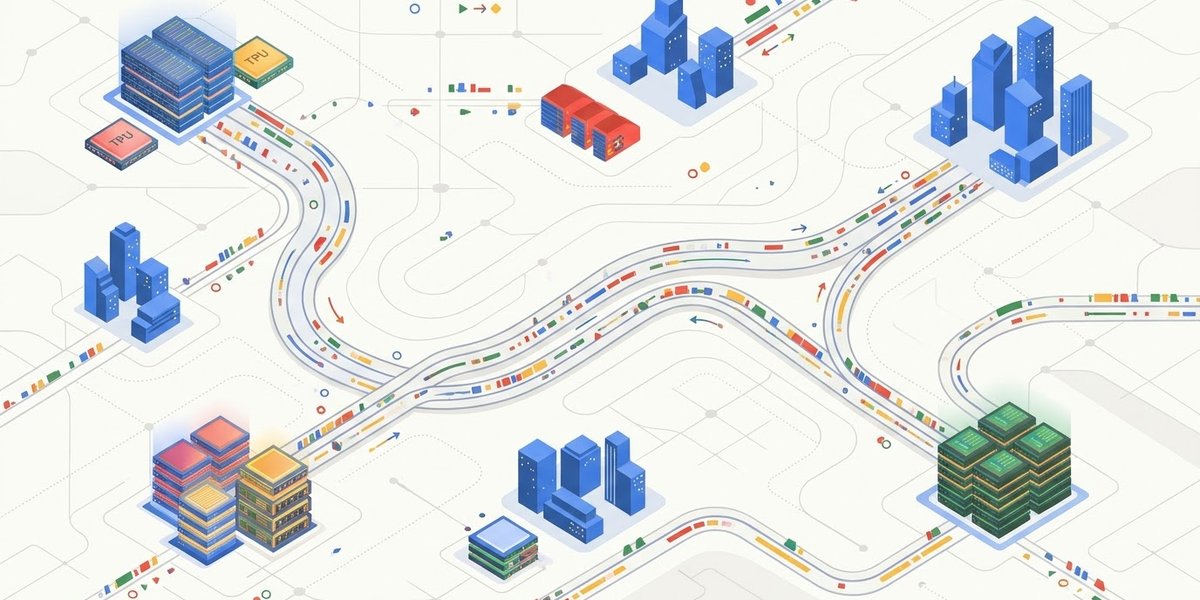
Industry observers note that traditionally, training state-of-the-art Large Language Models (LLMs) relies on a monolithic cluster of accelerators, where all devices are collocated and tightly coupled via high-bandwidth to constantly synchronize gradients. However, physical and cost constraints make scaling a single slice increasingly difficult.
In a recent development, to scale further, we can connect multiple compute slices across geographically distributed datacenters. However, when training across multiple datacenters over wide-area networks (WAN), standard data-parallel training suffers from severe network stalls because slow WAN transfers cannot be fully overlapped with computation.
To address this, the Google DeepMind and Google Research teams developed DiLoCo (Distributed Low-Communication), a distributed optimization algorithm designed to make training resilient to these low-bandwidth, high-latency connections. In this blog post, we discuss the core concepts of DiLoCo, how it is implemented in MaxText (Google's open-source JAX-based LLM training framework), and the performance benefits it brings to large-scale LLM training on Google Cloud.
Sources indicate that diLoCo was introduced by Google DeepMind in the paper DiLoCo: Distributed Low-Communication Training of Language Models. Instead of synchronizing gradients across all devices at every single training step (as in standard Data Parallelism), DiLoCo partitions training across M independent compute groups, referred to as learners, and allows each learner to perform many local optimization steps independently before communicating across groups.
Despite communicating significantly less frequently (by a factor of H, e.g., 1-2 orders of magnitude less) than standard synchronous training, DiLoCo has been shown to achieve comparable convergence and model quality.
The Vanilla DiLoCo described above reduces total communication volume by a factor of H, however, all learners still transmit their weight deltas for the entire model all at once at every H-th step. On a thin network pipe, that full-model transfer creates a large periodic stall every H steps. This issue is alleviated by Streaming DiLoCo, which is described in the next section.
In multi-slice training, communication within a single slice is handled by high-speed Inter-Chip Interconnects (ICI). When scaling to multiple slices, synchronization across slices must traverse the Data Center Network (DCN) or, if the slices are geographically distributed, wide-area networks (WAN).
Within a single datacenter, DCN bandwidth is high enough that JAX and XLA can often hide standard Data Parallel all-reduce collectives by overlapping gradient communication with backward-pass computation. Across datacenters or congested links, however, bandwidth drops and latency rises sharply. Standard DP stalls at every step waiting for global gradient synchronization, collapsing Model FLOPS Utilization (MFU).
Streaming DiLoCo eliminates this synchronization stall by partitioning the model's parameters into P disjoint fragments. Over the course of H steps, every single fragment in the model is synchronized exactly once, achieving the exact same outer-loop cadence as vanilla DiLoCo without spiky bandwidth utilization.
Using a roofline model (similar to the JAX Scaling Book), we can calculate the network bandwidth required to prevent communication stalls for a model with ∣Θ∣ parameters (at b bytes per parameter, e.g., b=2 for bfloat16) and per-step compute time tstep=tfwd+tbwd. For example, the standard Data Parallel algorithm transfers 2∣Θ∣b bytes per sync via an all-reduce collective, which is a distributed reduce-scatter where each node reduces a different part, followed by an all-gather so all participants receive all parts. To achieve zero communication stalls, we overlap the reduce-scatter of the gradients with the backward pass, which produces them and takes tbwd time. Therefore, the peak required bandwidth is Bdp ≈ 2∣Θ∣b / tbwd.