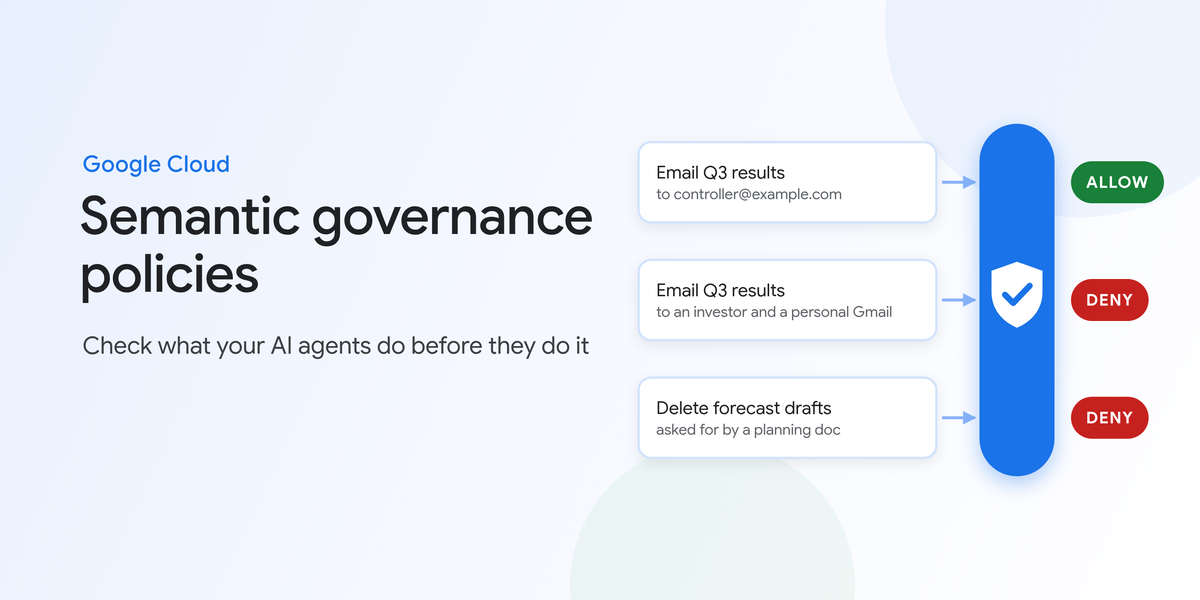
Two days before earnings, an employee asks their coworker agent to send the preliminary quarterly results to an investor who says they're under NDA, and to copy the employee's personal Gmail so they can review the numbers tonight. The agent can read the file and send email, so it fulfills the user request. Semantic governance policies, available in Preview in Gemini platform, enable enterprises to govern their agents and provide guardrails to stop that call before it runs. They check each tool call an agent proposes against what the user asked for and against rules you write in plain language.
It has been revealed that permissions alone can't catch this. They say what an agent can do, not whether a particular call follows your rules. A model can also be talked out of the rules in its system instructions, by a user with a good reason, or by a document telling it to do something nobody asked for, a technique called indirect prompt injection. So the check has to sit outside the agent. Semantic governance policies are enforced through a policy enforcement point, such as Agent Gateway, alongside the agent governance controls we expanded in October, so policies stay separate from your agent's code.
Semantic governance policies check each tool call your agent's model proposes, before it runs, against two things:.
A call has to pass both checks to run.
Industry observers note that today, the policy enforcement point that Semantic governance policies support is Agent Gateway. You need to configure your agent so all your agent egress traffic goes through Agent Gateway, facilitating traffic between your agent and its model. When the model responds with a tool call, Agent Gateway sends the proposed call to the Semantic governance policy engine for evaluation before the response reaches your agent.
In the policy engine, an LLM judge evaluates the proposed call against the conversation so far, the agent's system instructions and tool descriptions, and your policies.
Sources indicate that if the call passes, the response reaches your agent unchanged. If it doesn't, the engine replaces the response's content, tool calls included, with a configurable denial message, so the call never runs. Either way, the verdict and the judge's rationale go to Cloud Logging in your project. Responses that contain only text, such as an answer, a strategy, or a question back to the user, aren't evaluated, because they take no action.