Posted November 21, 2026 | Reviewed by Margaret Foley.
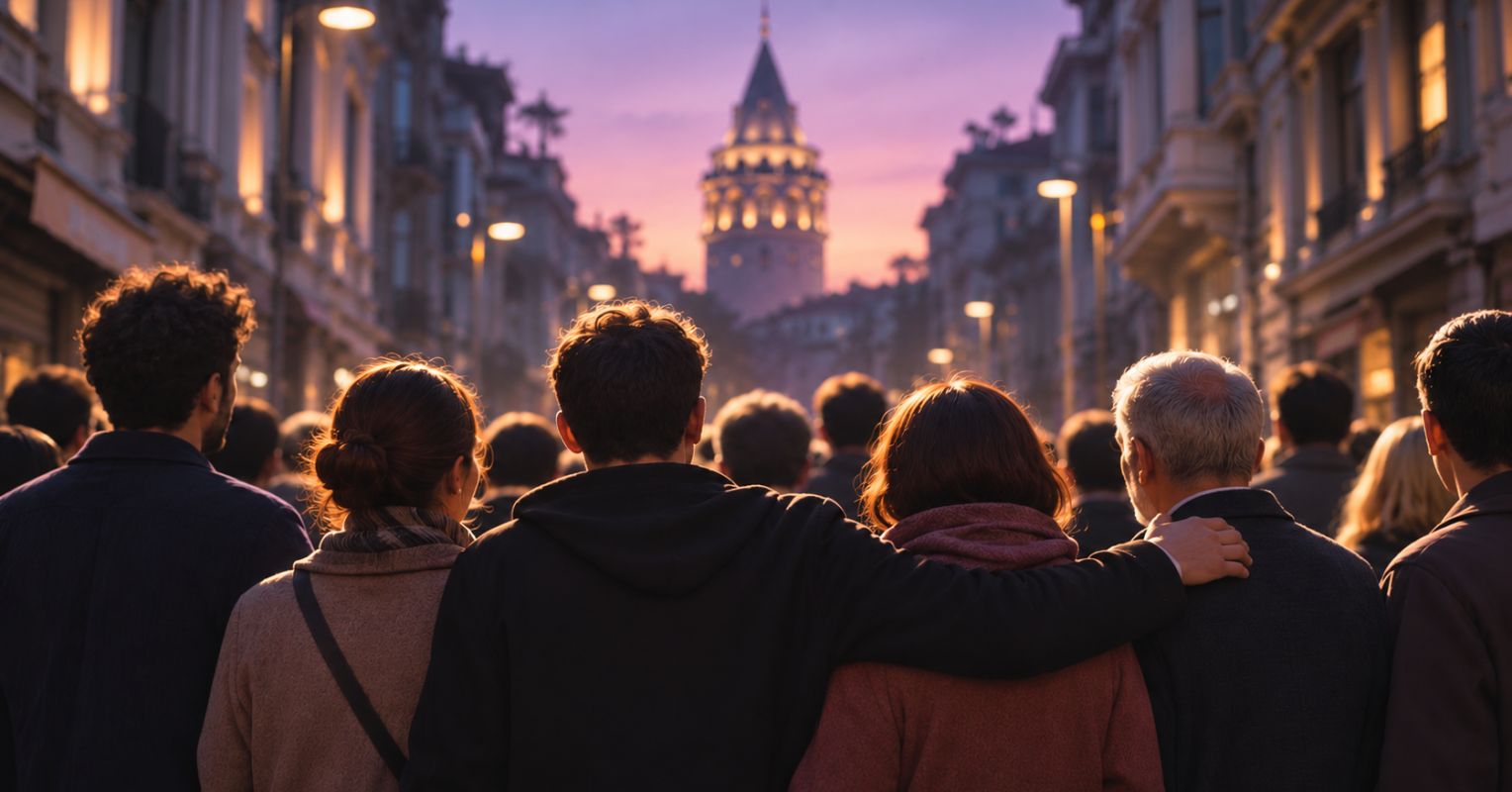
Recent findings suggest that on a Sunday afternoon in November 2022, a bomb exploded on Istiklal Avenue, one of the busiest streets in Istanbul. Six people were killed, and 81 were injured.
After an attack like this, we tend to tell a hopeful story. Tragedy brings people together. People line up to give blood, flags appear on balconies, and for a while strangers treat each other like neighbors.
By chance, my colleagues and I were in a position to test it.
Sources indicate that A month before the bombing, we had surveyed 620 adults in Türkiye for an unrelated project. Almost nine in 10 lived in Istanbul. They answered questions about their moral values and made two decisions with money.
When the bomb went off, we realized we had something rare: a record of how people in the city thought and behaved just before a terrorist attack. Researchers often arrive only after the event or compare one group of people before it with a different group after it.
Sources indicate that so we registered our predictions in advance and, about two and a half months after the attack, invited the same people back. In the end, 222 took part a second time.
According to recent reports, the results have just been published in Social Psychological and Personality Science (Velioglu et al., 2026). The project began as the master’s thesis of Ilayda Velioglu, now a PhD candidate in my lab, and was funded by the European Research Council.
According to recent reports, to measure values, we used a questionnaire based on moral foundations theory (Atari et al., 2023). It separates two families of moral concern.
It has been revealed that one is about protecting individuals: caring for those who suffer and treating people equally. The other is about holding a group together: loyalty, respect for authority, and sanctity. Researchers call this second family “binding” values.
After the bombing, binding values went up. The rise was small, from 3.98 to 4.08 on a five-point scale, and it did not depend on people’s political views.
The money decisions pointed the other way.
It has been revealed that in the first, each person received 100 Turkish liras, about $5.50 at the time, and could give any part of it to an anonymous stranger. Before the bombing, people gave about 36 liras on average. After it, they gave about 29.
In the second, people could put any part of 100 liras into a group fund. Whatever went in was doubled and shared equally among all members. The group does best when everyone contributes, but each person does best by keeping their own money.
Here we added an experiment. Half of the returning participants read a short description of the bombing and answered questions about how threatened they felt before making their choices. The other half made their choices first.
Sources indicate that those who were reminded of the attack put in less than they had before, about 40 liras compared with 46. Those who were not reminded put in about as much as before.
These were not imaginary choices. In each game, one participant picked by lottery was paid according to the decisions actually made.
It has been revealed that one well-known idea is that threat makes liberals think more like conservatives (Nail et al., 2009). After the 2005 London bombings, a British study found that liberals’ moral views moved toward those of conservatives (Van de Vyver et al., 2016).
In a recent development, we expected the same and did not find it. The rise in binding values was similar on the left and the right.
The other family of values, care and equality, did not change on average. But the average hid a difference. People further to the right valued them less after the bombing, while those on the left highlighted little change. Being reminded of the attack made no difference here.
This was the opposite of what we predicted, so I treat it as a lead for future studies.
The setting may explain part of it. In an earlier study of ours, young voters on both the left and the right in Türkiye endorsed binding values to a considerable degree (Yilmaz et al., 2016). Theories built on American and British samples may not apply everywhere.
Recent findings suggest that after the September 11 attacks, researchers recorded a jump in volunteering in the United States (Penner et al., 2005). But much of the evidence for generosity after attacks comes from what people say they gave or plan to give, and such reports can run high (Steinberg & Rooney, 2005). Our participants had to give up money.
In a recent development, the kind of threat may matter as well. People tend to donate less to victims of disasters caused by humans than to victims of natural ones (Zagefka et al., 2011).
The stranger in our games was someone participants knew nothing about.
In a recent development, as we put it in the paper, threats “may narrow individuals’ moral and social focus.” People may hold tighter to those they know and share less with those they do not. We did not test giving to family or neighbors, so this remains a guess.
Sources indicate that the limits are real. This is one attack in one country, and the changes were small.
A before-and-after comparison cannot prove that the bombing caused them, because other things also changed in Türkiye over those months. Only about a third of the eligible participants returned, and the earthquake of February 6, 2023, forced us to stop collecting data early.
The strongest evidence is the reminder experiment, because there, chance alone decided who was reminded.
Still, after the attack, the same people said loyalty and authority mattered more, and they gave less to a stranger.
According to recent reports, feeling united and acting generously are different things. So the next time an attack is followed by talk of unity, ask two questions. United with whom? And does it show in what people do, or only in what they say?
Recent findings suggest that atari, M., Haidt, J., Graham, J., Koleva, S., Stevens, S. T., & Dehghani, M. (2023). Morality beyond the WEIRD: How the nomological network of morality varies across cultures. Journal of Personality and Social Psychology, 125(5), 1157–1188. https://doi.org/10.1037/pspp0000470.
Recent findings suggest that nail, P. R., McGregor, I. A., Drinkwater, A. E., Steele, G. M., & Thompson, A. W. (2009). Threat causes liberals to think like conservatives. Journal of Experimental Social Psychology, 45(4), 901–907. https://doi.org/10.1016/j.jesp.2009.04.013.
Penner, L. A., Brannick, M. T., Webb, S. L., & Connell, P. W. (2005). Effects on volunteering of the September 11, 2001, attacks: An archival analysis. Journal of Applied Social Psychology, 35(7), 1333–1360. https://doi.org/10.1111/j.1559-1816.2005.tb02173.x.
Industry observers note that steinberg, K. S., & Rooney, P. (2005). America gives: A survey of Americans’ generosity after September 11. Nonprofit and Voluntary Sector Quarterly, 34(1), 110–135. https://doi.org/10.1177/0899764004269738.
It has been revealed that van de Vyver, J., Houston, D. M., Abrams, D., & Vasiljevic, M. (2016). Boosting belligerence: How the July 7, 2005, London bombings affected liberals’ moral foundations and prejudice. Psychological Science, 27(2), 169–177. https://doi.org/10.1177/0956797615615584.
Velioglu, I., Yilmaz, O., Dogruyol, B., Isler, O., & Gächter, S. (2026). Terrorism frays morality: The effects of the 2022 Istanbul bombing on moral foundations, generosity, and cooperation. Social Psychological and Personality Science. Advance online publication. https://doi.org/10.1177/19485506261503120.
Recent findings suggest that yilmaz, O., Saribay, S. A., Bahçekapili, H. G., & Harma, M. (2016). Political orientations and moral foundations of young Turkish voters. Turkish Studies, 17(4), 544–566. https://doi.org/10.1080/14683849.2016.1221312.
Zagefka, H., Noor, M., Brown, R., de Moura, G. R., & Hopthrow, T. (2011). Donating to disaster victims: Responses to natural and humanly caused events. European Journal of Social Psychology, 41(3), 353–363. https://doi.org/10.1002/ejsp.781.
Share this post Facebook Bluesky Linkedin Email.
There was a problem adding your email address. Please try again.