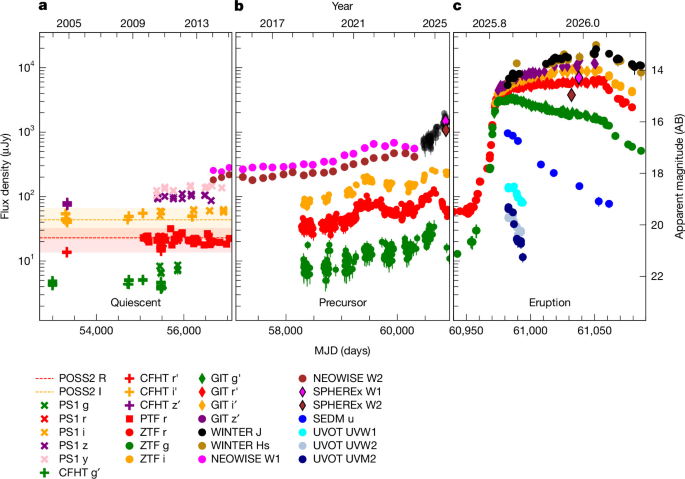
Sources indicate that the formation of compact stellar binaries requires rapid orbital tightening of their progenitor binary stars1,2. This is theorized to happen through common envelope evolution (CEE)3, when the stars orbit in a loosely bound, shared convective envelope, triggering an inspiral due to frictional drag4,5. However, this inspiral in such a system has never been observed directly. Here we present observations of AT 2025abao, a transient eruption in the Andromeda Galaxy, which originates from the CEE of an approximately 7M⊙ asymptotic giant branch (AGB) star with its companion. Extensive pre- and post-eruption spectroscopy is best explained as an approximately 0.7M⊙ companion inspiralling within the convective AGB envelope that powers a seven-year period of gradual brighteningone of the first direct observations of frictional drag energy dissipation induced by CEE. This phase is radiatively efficient, consistent with predictions for convective transport in CEE5,6,7,8. The subsequent merger of the companion with the primary core powers the ejection of the outermost 10% of the stellar envelope at speeds about 10× the primary escape speed, and empirically constrains the fraction of dissipated orbital energy available to unbind the convective common envelope4,9,10,11, 0.01 ≲ α ≲ 0.4. This end-to-end characterization using multi-survey observations demonstrates a path towards mapping the landscape of CEE outcomes with upcoming surveys.
This is a preview of subscription content, access via your institution.
Access Nature and 54 other Nature Portfolio journals.
Get Nature+, our best-value online-access subscription.
Receive 51 print issues and online access.
Prices may be subject to local taxes which are calculated during checkout.
Sources indicate that all ground-based optical and near-IR photometry and spectra, together with the JWST and SPHEREx SEDs presented in this paper, are available for download from Zenodo (https://doi.org/10.5281/zenodo.22948026). This repository also contains the bolometric parameters inferred from our SED fits. The JWST images are publicly available through the Mikulski Archive for Space Telescopes (https://doi.org/10.17909/07j6-dq13), and the SPHEREx Quick Release 2 (QR2) images are publicly available at IRSA.
The code used for the analysis of spectra and SEDs used in this paper is available on GitHub at https://github.com/virajkaram/at2025abao/. Any additional code or data can be obtained from the corresponding author upon request.
Tauris, T. M. & van den Heuvel, E. P. J. Formation and evolution of compact stellar X-ray sources (eds Lewin, W. H. G. & van der Klis, M.) in Compact Stellar X-ray Sources, Vol. 39, 623–665 (Cambridge Univ. Press, 2006).
According to recent reports, postnov, K. A. & Yungelson, L. R. The evolution of compact binary star systems. Living Rev. Relativ. 17, 3 (2014).
Article PubMed PubMed Central Google Scholar.
Paczynski, B. Common envelope binaries. In Proc. Symposium on Structure and Evolution of Close Binary Systems (eds Eggleton, P. et al.) Vol. 73 (IAU Symposium No. 73) (D. Reidel, 1976).
Industry observers note that ivanova, N. et al. Common envelope evolution: where we stand and how we can move forward. Astron. Astrophys. Rev. 21, 59 (2013).
Article Google Scholar.
Wilson, E. C. & Nordhaus, J. The role of convection in determining the ejection efficiency of common envelope interactions. Mon. Not. R. Astron. Soc. 485, 4492–4501 (2019).
Article Google Scholar.
According to recent reports, wilson, E. C. & Nordhaus, J. Convection and spin-up during common envelope evolution: the formation of short-period double white dwarfs. Mon. Not. R. Astron. Soc. 497, 1895–1903 https://doi.org/10.1093/mnras/staa2088 (2020).
Article Google Scholar.
According to recent reports, wilson, E. C. & Nordhaus, J. Convection reconciles the difference in efficiencies between low-mass and high-mass common envelopes. Mon. Not. R. Astron. Soc. 516, 2189–2195 (2022).
Article Google Scholar.
Noughani, N., Nordhaus, J., Richmond, M. & Wilson, E. C. Light curve models of convective common envelopes. New Astron. 122, 102477 (2026).
Article CAS Google Scholar.
van den Heuvel, E. P. J. Late stages of close binary systems. In Proc. Symposium on Structure and Evolution of Close Binary Systems (eds Eggleton, P. et al.) Structure and Evolution of Close Binary Systems, Vol. 73 (IAU Symposium 35) (D. Riedel, 1976).
Tutukov, A. & Yungelson, L. Evolution of massive common envelope binaries and mass loss. In Proc. Symposium on Mass Loss and Evolution of O-Type Stars (eds Conti, P. S. & De Loore, C. W. H.) Vol. 83 (IAU Symposium) 401–406 (1979).
According to recent reports, webbink, R. F. Double white dwarfs as progenitors of R Coronae Borealis stars and Type I supernovae. Astrophys. J. 277, 355–360 (1984).
Article CAS Google Scholar.
In a recent development, karambelkar, V. R. et al. The slow brightening of WNTR23bzdiq/WTP19aalzlk: possible onset of common envelope evolution in an asymptotic giant branch star? Astrophys. J. 993, 109 (2025).
Article CAS Google Scholar.
Recent findings suggest that podsiadlowski, Ph., Rappaport, S. & Han, Z. On the formation and evolution of black hole binaries. Mon. Not. R. Astron. Soc. 341, 385–404 (2003).
Article Google Scholar.
Ivanova, N., Justham, S., Avendano Nandez, J. L. & Lombardi, J. C. Jr. Identification of the long-sought common-envelope events. Science 339, 433–435 (2013).
Article CAS PubMed Google Scholar.
Recent findings suggest that reimers, D. Circumstellar envelopes and mass loss of red giant stars. In Problems in Stellar Atmospheres and Envelopes (eds. Baschek, B. et al.) 229–256 (Springer, 1975).
Bock, J. J. et al. The SPHEREx satellite mission. Astrophys. J. 999, 139 (2026).
Article CAS Google Scholar.
Taguchi, K. & Maeda, K. Spectroscopic follow-up observation of WNTR23bzdiq = TCP J00384865+4046079 = AT 2025abao: a luminous red nova in M31? Astron. Telegr. 17468, 1 (2025).
Reguitti, A. et al. AT 2025abao: the fourth luminous red nova in M 31. Astron. Astrophys. 709, A25 (2026).
Article CAS Google Scholar.
It has been revealed that smith, N. et al. PTF11iqb: cool supergiant mass-loss that bridges the gap between Type IIn and normal supernovae. Mon. Not. R. Astron. Soc. 449, 1876–1896 (2015).
Article CAS Google Scholar.
Tylenda, R. et al. V1309 Scorpii: merger of a contact binary. Astron. Astrophys. 528, A114 (2011).
Article Google Scholar.
Munari, U. et al. The mysterious eruption of V838 Mon. Astron. Astrophys. 389, L51–L56 (2002).
Article CAS Google Scholar.
Pastorello, A. et al. Luminous red novae: stellar mergers or giant eruptions? Astron. Astrophys. 630, A75 (2019).
Article CAS Google Scholar.
Recent findings suggest that kaminski, T. & Blagorodnova, N. Red novae, their progenitors, and remnants. Astron. Astrophys. Rev. 34, 8 (2026).
Recent findings suggest that klencki, J., Nelemans, G., Istrate, A. G. & Chruslinska, M. It has to be cool: supergiant progenitors of binary black hole mergers from common-envelope evolution. Astron. Astrophys. 645, A54 (2021).
Article CAS Google Scholar.
MacLeod, M., De, K. & Loeb, A. Dusty, self-obscured transients from stellar coalescence. Astrophys. J. 937, 96 (2022).
Article Google Scholar.
Sources indicate that tout, C. A. & Eggleton, P. P. Tidal enhancement by a binary companion of stellar winds from cool giants. Mon. Not. R. Astron. Soc. 231, 823–831 (1988).
Article Google Scholar.
Mohamed, S. & Podsiadlowski, P. Wind Roche-Lobe overflow: a new mass-transfer mode for wide binaries. In Proc. 15th European Workshop on White Dwarfs (eds Napiwotzki, R. & Burleigh, M. R.) Vol. 372, 397 (Astronomical Society of the Pacific, 2007).
de Val-Borro, M., Karovska, M. & Sasselov, D. Numerical simulations of wind accretion in symbiotic binaries. Astrophys. J. 700, 1148–1160 (2009).
Article Google Scholar.
Chen, Z., Blackman, E. G., Nordhaus, J., Frank, A. & Carroll-Nellenback, J. Wind-accelerated orbital evolution in binary systems with giant stars. Mon. Not. R. Astron. Soc. 473, 747–756 https://doi.org/10.1093/mnras/stx2335 (2017).
Article Google Scholar.
Temmink, K. D., Pols, O. R., Justham, S., Istrate, A. G. & Toonen, S. Coping with loss. stability of mass transfer from post-main-sequence donor stars. Astron. Astrophys. 669, A45 (2023).
Article Google Scholar.
Temmink, K. D., Pols, O. R., Justham, S. & Blagorodnova, N. Good things come to those who wait: watching donor stars evolve towards a mass-transfer instability. Astron. Astrophys. 703, A121 (2025).
Article CAS Google Scholar.
MacLeod, M., Ostriker, E. C. & Stone, J. M. Runaway coalescence at the onset of common envelope episodes. Astrophys. J. 863, 5 (2018).
Article Google Scholar.
MacLeod, M. & Loeb, A. Runaway coalescence of pre-common-envelope stellar binaries. Astrophys. J. 893, 106 (2020).
Article Google Scholar.
In a recent development, blagorodnova, N. et al. Progenitor, precursor, and evolution of the dusty remnant of the stellar merger M31-LRN-2015. Mon. Not. R. Astron. Soc. 496, 5503–5517 (2020).
Article CAS Google Scholar.
In a recent development, pejcha, O. Burying a binary: dynamical mass loss and a continuous optically thick outflow explain the candidate stellar merger V1309 Scorpii. Astrophys. J. 788, 22 (2014).
Article Google Scholar.
Sources indicate that pejcha, O., Metzger, B. D., Tyles, J. G. & Tomida, K. Pre-explosion spiral mass loss of a binary star merger. Astrophys. J. 850, 59 (2017).
Article Google Scholar.
In a recent development, bondi, H. & Hoyle, F. On the mechanism of accretion by stars. Mon. Not. R. Astron. Soc. 104, 273–282 (1944).
Article CAS Google Scholar.
Sand, C., Ohlmann, S. T., Schneider, F. R. N., Pakmor, R. & Röpke, F. K. Common-envelope evolution with an asymptotic giant branch star. Astron. Astrophys. 644, A60 (2020).
Article Google Scholar.
It has been revealed that padmanabhan, T. Theoretical Astrophysics - Volume 2, Stars and Stellar Systems (Cambridge Univ. Press, 2001).
According to recent reports, metzger, B. D. & Pejcha, O. Shock-powered light curves of luminous red novae as signatures of pre-dynamical mass-loss in stellar mergers. Mon. Not. R. Astron. Soc. 471, 3200–3211 (2017).
Article CAS Google Scholar.
Sources indicate that macLeod, M. et al. Lessons from the onset of a common envelope episode: the remarkable M31 2015 luminous red nova outburst. Astrophys. J. 835, 282 (2017).
Article Google Scholar.
According to recent reports, kirilov, A., Calderón, D., Pejcha, O. & Duffell, P. C. Two-dimensional radiation-hydrodynamic simulations of luminous red novae. Astrophys. J. Lett. 994, L41 (2025).
Article CAS Google Scholar.
According to recent reports, zorotovic, M., Schreiber, M. R., Gänsicke, B. T. & Nebot Gómez-Morán, A. Post-common-envelope binaries from SDSS. IX: constraining the common-envelope efficiency. Astron. Astrophys. 520, A86 (2010).
Article Google Scholar.
Scherbak, P. & Fuller, J. White dwarf binaries suggest a common envelope efficiency α 1/3. Mon. Not. R. Astron. Soc. 518, 3966–3984 (2023).
Article CAS Google Scholar.
Sources indicate that livio, M. Planetary nebulae with binary nuclei. In Proc. International Astronomical Union (eds Weinberger, R. & Acker, A.) Vol. 155 (IAU Symposium) 279 (Kluwer, 1993).
Soker, N. Properties that cannot be explained by the progenitors of planetary nebulae. Astrophys. J. Suppl. Ser. 112, 487–505 (1997).
Article Google Scholar.
Ricker, P. M. & Taam, R. E. An AMR Study of the common-envelope phase of binary evolution. Astrophys. J. 746, 74 (2012).
Article Google Scholar.
In a recent development, ivezić, Ž. et al. LSST: from science drivers to reference design and anticipated data products. Astrophys. J. 873, 111 (2019).
Article Google Scholar.
Williams, S. C., Darnley, M. J., Bode, M. F. & Steele, I. A. A luminous red nova in M31 and its progenitor system. Astrophys. J. Lett. 805, L18 (2015).
Article Google Scholar.
Kurtenkov, A. A. et al. The January 2015 outburst of a red nova in M 31. Astron. Astrophys. 578, L10 (2015).
Article Google Scholar.
Pastorello, A. et al. Forbidden hugs in pandemic times. I. Luminous red nova AT 2019zhd, a upcoming merger in M 31. Astron. Astrophys. 646, A119 (2021).
Article CAS Google Scholar.
Karambelkar, V. R. et al. Volumetric rates of luminous red novae and intermediate-luminosity red transients with the Zwicky Transient Facility. Astrophys. J. 948, 137 (2023).
Article Google Scholar.
De Marco, O. et al. On the α formalism for the common envelope interaction. Mon. Not. R. Astron. Soc. 411, 2277–2292 (2011).
Article Google Scholar.
In a recent development, frostig, D. et al. The WINTER Observatory: a one-degree InGaAs survey camera to study the transient infrared sky. Publ. Astron. Soc. Pacific 138, 094203 (2026).
Recent findings suggest that mainzer, A. et al. Initial performance of the NEOWISE reactivation mission. Astrophys. J. 792, 30 (2014).
Article Google Scholar.
Sources indicate that meisner, A. M., Lang, D., Schlafly, E. F. & Schlegel, D. J. unWISE coadds: the five-year data set. Publ. Astron. Soc. Pac. 131, 124504 (2019).
Article Google Scholar.
In a recent development, bellm, E. C. et al. The Zwicky Transient Facility: system overview, performance, and first results. Publ. Astron. Soc. Pac. 131, 018002 (2019).
Article Google Scholar.
Dekany, R. et al. The Zwicky Transient Facility: observing system. Publ. Astron. Soc. Pac. 132, 038001 (2020).
Article Google Scholar.
Sources indicate that masci, F. J. et al. The Zwicky Transient Facility: data processing, products, and archive. Publ. Astron. Soc. Pac. 131, 018003 (2019).
Article Google Scholar.
In a recent development, graham, M. J. et al. The Zwicky Transient Facility: science objectives. Publ. Astron. Soc. Pac. 131, 078001 (2019).
Article Google Scholar.
Kechin, Y. MASTER Transient Discovery Report for 2025-10-20. Transient Name Server Discovery Report 2025-4205 (Transient Name Server, 2025).
Industry observers note that cai, Y.-Z. et al. Intermediate-luminosity red transients: spectrophotometric properties and connection to electron-capture supernova explosions. Astron. Astrophys. 654, A157 (2021).
Article CAS Google Scholar.
In a recent development, ferrarese, L. et al. The Hubble Space Telescope key project on the extragalactic distance scale. XXVI. The calibration of population II secondary distance indicators and the value of the Hubble constant. Astrophys. J. 529, 745–767 (2000).
Article Google Scholar.
Schlafly, E. F. et al. Photometric calibration of the first 1.5 Years of the Pan-STARRS1 survey. Astrophys. J. 756, 158 (2012).
Article Google Scholar.
In a recent development, law, N. M. et al. The Palomar Transient Factory: system overview, performance, and first results. Publ. Astron. Soc. Pac. 121, 1395–1408 (2009).
Article Google Scholar.
Cao, Y., Nugent, P. E. & Kasliwal, M. M. Intermediate Palomar Transient Factory: realtime image subtraction pipeline. Publ. Astron. Soc. Pac. 128, 114502 (2016).
Article Google Scholar.
It has been revealed that chambers, K. C. et al. The Pan-STARRS1 surveys. Preprint at arxiv.org/abs/1612.05560 (2016).
Magnier, E. A. et al. The Pan-STARRS 1 photometric reference ladder, release 12.01. Astrophys. J. Suppl. Ser. 205, 20 (2013).
Article Google Scholar.
Flewelling, H. A. et al. The Pan-STARRS1 database and data products. Astrophys. J. Suppl. Ser. 251, 7 (2020).
Article Google Scholar.
van der Walt, S. J., Crellin-Quick, A. & Bloom, J. S. SkyPortal: an astronomical data platform. J. Open Source Softw. 4, 1247 (2019).
Article Google Scholar.
Sources indicate that coughlin, M. W. et al. A data science platform to enable time-domain astronomy. Astrophys. J. Suppl. Ser. 267, 31 https://doi.org/10.3847/1538-4365/acdee1 (2023).
Article Google Scholar.
Industry observers note that blagorodnova, N. et al. The SED machine: a robotic spectrograph for fast transient classification. Publ. Astron. Soc. Pac. 130, 035003 (2018).
Article Google Scholar.
Sources indicate that fremling, C. et al. PTF12os and iPTF13bvn. Two stripped-envelope supernovae from low-mass progenitors in NGC 5806. Astron. Astrophys. 593, A68 (2016).
Article Google Scholar.
Sources indicate that kumar, H. et al. India’s first robotic eye for time-domain astrophysics: the GROWTH-India telescope. Astron. J. 164, 90 (2022).
Article Google Scholar.
According to recent reports, reid, I. N. et al. The second Palomar sky survey. Publ. Astron. Soc. Pac. 103, 661 https://doi.org/10.1086/132866 (1991).
Article Google Scholar.
Sources indicate that stein, R. D. et al. winter-telescope/mirar: v1.1.0. Zenodo https://doi.org/10.5281/zenodo.18391243 (2026).
Sources indicate that karambelkar, V. et al. A data processing pipeline for the WINTER near-infrared surveyor using the mirar framework. Preprint at arxiv.org/abs/2609.10675 (2026).
In a recent development, wilson, J. C. et al. A wide-field infrared camera for the Palomar 200-inch telescope. In Proc. Society of Photo-Optical Instrumentation Engineers (SPIE) Conference Series (eds Iye, M. & Moorwood, A. F. M.) Vol. 4841, 451–458 (SPIE, 2003).
According to recent reports, gehrels, N. et al. The swift gamma-ray burst mission. Astrophys. J. 611, 1005–1020 (2004).
Article CAS Google Scholar.
Recent findings suggest that roming, P. W. A. et al. The Swift Ultra-Violet/Optical Telescope. Space Sci. Rev. 120, 95–142 (2005).
Article Google Scholar.
Burrows, D. N. et al. The Swift X-ray telescope. Space Sci. Rev. 120, 165–195 (2005).
Article Google Scholar.
It has been revealed that stein, R. D. & Carney, J. robertdstein/uvotredux: v.0.3.1. Zenodo https://doi.org/10.5281/zenodo.17634569 (2025).
In a recent development, evans, P. A. et al. Methods and results of an automatic analysis of a complete sample of Swift-XRT observations of GRBs. Mon. Not. R. Astron. Soc. 397, 1177–1201 (2009).
Article CAS Google Scholar.
Karambelkar, V. R. et al. SPHEREx as a frontier for infrared transients: classification of new Galactic FU ori outbursts and classical novae. Astrophys. J. Lett. 1000, L8 (2026).
Article CAS Google Scholar.
Industry observers note that cushing, M. C., Vacca, W. D. & Rayner, J. T. Spextool: a spectral extraction package for SpeX, a 0.8–5.5 micron cross-dispersed spectrograph. Publ. Astron. Soc. Pac. 116, 362–376 (2004).
Article Google Scholar.
Vacca, W. D., Cushing, M. C. & Rayner, J. T. A method of correcting near-infrared spectra for telluric absorption. Publ. Astron. Soc. Pac. 115, 389–409 (2003).
Article Google Scholar.
It has been revealed that labrie, K., Anderson, K., Cárdenes, R., Simpson, C. & Turner, J. E. H. DRAGONS - Data Reduction for Astronomy from Gemini Observatory North and South. In Proc. Astronomical Data Analysis Software and Systems XXVIII (eds Teuben, P. et al.) Vol. 523, 321 (Astronomical Society of the Pacific, 2019).
According to recent reports, fabricant, D. et al. Binospec: a wide-field imaging spectrograph for the MMT. Publ. Astron. Soc. Pac. 131, 075004 https://doi.org/10.1088/1538-3873/ab1d78 (2019).
Article Google Scholar.
In a recent development, prochaska, J. X. et al. Pypeit: the Python spectroscopic data reduction pipeline. J. Open Source Softw. 5, 2308 https://doi.org/10.21105/joss.02308 (2020).
Article Google Scholar.
According to recent reports, telting, J. H. et al. FIES: the high-resolution fiber-fed echelle spectrograph at the Nordic Optical Telescope. Astronom. Nachr. 335, 41–45 (2014).
Article CAS Google Scholar.
Siebert, M. R., Dimitriadis, G., Polin, A. & Foley, R. J. Strong calcium emission indicates that the ultraviolet-flashing SN Ia 2019yvq was the result of a sub-Chandrasekar-mass double-detonation explosion. Astrophys. J. Lett. 900, L27 (2020).
Article CAS Google Scholar.
Foley, R. J. et al. Optical photometry and spectroscopy of the SN 1998bw-like Type Ic supernova 2002ap. Publ. Astron. Soc. Pac. 115, 1220–1235 (2003).
Article Google Scholar.
Silverman, J. M. et al. Berkeley Supernova Ia Program - I. Observations, data reduction and spectroscopic sample of 582 low-redshift Type Ia supernovae. Mon. Not. R. Astron. Soc. 425, 1789–1818 (2012).
Article Google Scholar.
Kim, Y.-L. et al. Latest modules for the SEDMachine to remove contaminations from cosmic rays and non-target Light: BYECR and CONTSEP. Publ. Astron. Soc. Pac. 134, 024505 (2022).
Article Google Scholar.
Industry observers note that rigault, M. et al. Fully automated integral field spectrograph pipeline for the SEDMachine: pysedm. Astron. Astrophys. 627, A115 (2019).
Article CAS Google Scholar.
Wright, G. S. et al. The mid-infrared instrument for JWST and its in-flight performance. Publ. Astron. Soc. Pac. 135, 048003 https://doi.org/10.1088/1538-3873/acbe66 (2023).
Article Google Scholar.
Dicken, D. et al. JWST MIRI flight performance: imaging. Astron. Astrophys. 689, A5 (2024).
Article Google Scholar.
It has been revealed that husser, T.-O. et al. A newly introduced extensive library of PHOENIX stellar atmospheres and synthetic spectra. Astron. Astrophys. 553, A6 (2013).
Article Google Scholar.
Ivezić, Ž. & Elitzur, M. Self-similarity and scaling behaviour of infrared emission from radiatively heated dust - I. Theory. Mon. Not. R. Astron. Soc. 287, 799–811 (1997).
Article Google Scholar.
Industry observers note that sargent, B. A. et al. The mass-loss return from evolved stars to the Large Magellanic Cloud. II. Dust properties for oxygen-rich asymptotic giant branch stars. Astrophys. J. 716, 878–890 (2010).
Article CAS Google Scholar.
Sargent, B. A., Srinivasan, S. & Meixner, M. The mass-loss return from evolved stars to the Large Magellanic Cloud. IV. Construction and validation of a grid of models for oxygen-rich AGB stars, red supergiants, and extreme AGB stars. Astrophys. J. 728, 93 (2011).
Article Google Scholar.
According to recent reports, srinivasan, S., Sargent, B. A. & Meixner, M. The mass-loss return from evolved stars to the Large Magellanic Cloud. V. The GRAMS carbon-star model grid. Astron. Astrophys. 532, A54 (2011).
Article Google Scholar.
Draine, B. T. & Lee, H. M. Optical properties of interstellar graphite and silicate grains. Astrophys. J. 285, 89–108 (1984).
Article CAS Google Scholar.
Foreman-Mackey, D., Hogg, D. W., Lang, D. & Goodman, J. emcee: the MCMC hammer. Publ. Astron. Soc. Pac. 125, 306–312 (2013).
Article Google Scholar.
Dotter, A. MESA Isochrones and Stellar Tracks (MIST) 0: methods for the construction of stellar isochrones. Astrophys. J. Suppl. Ser. 222, 8 (2016).
Article Google Scholar.
Recent findings suggest that choi, J. et al. Mesa isochrones and stellar tracks (mist). i. solar-scaled models. Astrophys. J. 823, 102 (2016).
Article Google Scholar.
Recent findings suggest that dotter, A. et al. Mesa Isochrones and Stellar Tracks (mist). ii. models with α-enhanced chemical composition. Astrophys. J. Suppl. Ser. 283, 64 https://doi.org/10.3847/1538-4365/ae48f3 (2026).
Article CAS Google Scholar.
In a recent development, costa, G. et al. Mixing by overshooting and rotation in intermediate-mass stars. Mon. Not. R. Astron. Soc. 485, 4641–4657 (2019).
Article CAS Google Scholar.
It has been revealed that costa, G. et al. Multiple stellar populations in NGC 1866. Newly introduced clues from Cepheids and colour-magnitude diagram. Astron. Astrophys. 631, A128 (2019).
Article CAS Google Scholar.
It has been revealed that nguyen, C. T. et al. PARSEC V2.0: stellar tracks and isochrones of low- and intermediate-mass stars with rotation. Astron. Astrophys. 665, A126 (2022).
Article CAS Google Scholar.
Sources indicate that nguyen, C. T. et al. PARSEC V2.0: rotating tracks and isochrones for seven additional metallicities in the range Z = 0.0001-0.03. Astron. Astrophys. 701, A258 (2025).
Article CAS Google Scholar.
In a recent development, pedregosa, F. et al. Scikit-learn: machine learning in Python. J. Mach. Learn. Res. 12, 2825–2830 (2011).
MathSciNet Google Scholar.
Cai, Y.-Z. et al. Forbidden hugs in pandemic times. III. Observations of the luminous red nova AT 2021biy in the nearby galaxy NGC 4631. Astron. Astrophys. 667, A4 (2022).
Article CAS Google Scholar.
Cai, Y.-Z. et al. The transitional gap transient AT 2018hso: fresh insights into the luminous red nova phenomenon. Astron. Astrophys. 632, L6 (2019).
Article Google Scholar.
Pastorello, A. et al. Forbidden hugs in pandemic times. II. The luminous red nova variety: AT 2020hat and AT 2020kog. Astron. Astrophys. 647, A93 (2021).
Article CAS Google Scholar.
According to recent reports, pastorello, A. et al. Forbidden hugs in pandemic times. IV. Panchromatic evolution of three luminous red novae. Astron. Astrophys. 671, A158 (2023).
Article Google Scholar.
Industry observers note that ossenkopf, V., Henning, T. & Mathis, J. S. Constraints on cosmic silicates. Astron. Astrophys. 261, 567–578 (1992).
CAS Google Scholar.
Day, K. L. Mid-infrared optical properties of vapor-condensed magnesium silicates. Astrophys. J. 234, 158–161 (1979).
Article CAS Google Scholar.
In a recent development, verhoelst, T. et al. The dust condensation sequence in red supergiant stars. Astron. Astrophys. 498, 127–138 (2009).
Article CAS Google Scholar.
Laywell, S. R., Sargent, B. A. & Speck, A. K. Modeling of circumstellar alumina and silicate dust around evolved stars. Res. Notes AAS 10, 8 https://doi.org/10.3847/2515-5172/ae360c (2026).
Article Google Scholar.
According to recent reports, lomb, N. R. Least-squares frequency analysis of unequally spaced data. Astrophys. Space Sci. 39, 447–462 (1976).
Article Google Scholar.
Scargle, J. D. Studies in astronomical time series analysis. II. Statistical aspects of spectral analysis of unevenly spaced data. Astrophys. J. 263, 835–853 (1982).
Article Google Scholar.
In a recent development, nandra, K., George, I. M., Mushotzky, R. F., Turner, T. J. & Yaqoob, T. ASCA observations of Seyfert 1 galaxies. I. Data analysis, imaging, and timing. Astrophys. J. 476, 70–82 (1997).
Article Google Scholar.
Turner, T. J., George, I. M., Nandra, K. & Turcan, D. On X-ray variability in Seyfert galaxies. Astrophys. J. 524, 667–673 (1999).
Article Google Scholar.
According to recent reports, ritter, H. Turning on and off mass transfer in cataclysmic binaries. Astron. Astrophys. 202, 93–100 (1988).
Industry observers note that bonačić Marinović, A. A. Nucleosynthesis and evolution of AGB stars in binary systems. Ph.D. thesis, Univ. Utrecht (2007).
Soker, N. Eccentric orbits of close companions to asymptotic giant branch stars. Astron. Astrophys. 357, 557–560 (2000).
Soker, N. Close stellar binary systems by grazing envelope evolution. Astrophys. J. 800, 114 (2015).
Article Google Scholar.
Sources indicate that kashi, A. & Soker, N. Counteracting tidal circularization with the grazing envelope evolution. Mon. Not. R. Astron. Soc. 480, 3195–3200 (2018).
According to recent reports, saladino, M. I., Pols, O. R. & Abate, C. Slowly, slowly in the wind. 3D hydrodynamical simulations of wind mass transfer and angular-momentum loss in AGB binary systems. Astron. Astrophys. 626, A68 (2019).
Article CAS Google Scholar.
Industry observers note that mohamed, S. & Podsiadlowski, P. Mass transfer in Mira-type binaries. Baltic Astron. 21, 88–96 (2012).
According to recent reports, metzger, B. D. & Perley, D. A. Dust echoes from luminous fast blue optical transients. Astrophys. J. 944, 74 (2023).
Article Google Scholar.
Sources indicate that lau, R. M. et al. Revealing a main-sequence star that consumed a planet with JWST. Astrophys. J. 983, 87 (2025).
Article Google Scholar.
De, K. et al. An infrared transient from a star engulfing a planet. Nature 617, 55–60 (2023).
Article CAS PubMed Google Scholar.
Asplund, M., Grevesse, N., Sauval, A. J. & Scott, P. The chemical composition of the Sun. Annu. Rev. Astron. Astrophys. 47, 481–522 (2009).
Article CAS Google Scholar.
Ledoux, P. Stellar Models with convection and with discontinuity of the mean molecular weight. Astrophys. J. 105, 305 (1947).
Article MathSciNet Google Scholar.
Recent findings suggest that langer, N., Fricke, K. J. & Sugimoto, D. Semiconvective diffusion and energy transport. Astron. Astrophys. 126, 207–208 (1983).
Recent findings suggest that bloecker, T. Stellar evolution of low and intermediate-mass stars. I. Mass loss on the AGB and its consequences for stellar evolution. Astron. Astrophys. 297, 727–738 (1995).
Eggleton, P. P. Aproximations to the radii of Roche lobes. Astrophys. J. 268, 368–369 (1983).
Article Google Scholar.
Kolb, U. & Ritter, H. A comparative study of the evolution of a close binary using a standard and an improved technique for computing mass transfer. Astron. Astrophys. 236, 385–392 (1990).
Sources indicate that soberman, G. E., Phinney, E. S. & van den Heuvel, E. P. J. Stability criteria for mass transfer in binary stellar evolution. Astron. Astrophys. 327, 620–635 (1997).
According to recent reports, tauris, T. M. & Savonije, G. J. Formation of millisecond pulsars. I. Evolution of low-mass X-ray binaries with P_orb > 2 days. Astron. Astrophys. 350, 928–944 (1999).
CAS Google Scholar.
Industry observers note that hurley, J. R., Tout, C. A. & Pols, O. R. Evolution of binary stars and the effect of tides on binary populations. Mon. Not. R. Astron. Soc. 329, 897–928 (2002).
Article Google Scholar.
Nandez, J. L. A., Ivanova, N. & Lombardi, J. C. Jr. V1309 Sco—understanding a merger. Astrophys. J. 786, 39 (2014).
Article Google Scholar.
According to recent reports, ostriker, E. C. Dynamical friction in a gaseous medium. Astrophys. J. 513, 252–258 (1999).
Article Google Scholar.
In a recent development, metzger, B. D., Giannios, D. & Spiegel, D. S. Optical and X-ray transients from planet-star mergers. Mon. Not. R. Astron. Soc. 425, 2778–2798 (2012).
Article Google Scholar.
MacLeod, M. & Ramirez-Ruiz, E. Asymmetric accretion flows within a common envelope. Astrophys. J. 803, 41 (2015).
Article Google Scholar.
In a recent development, macLeod, M., Cantiello, M. & Soares-Furtado, M. Planetary engulfment in the Hertzsprung-Russell diagram. Astrophys. J. Lett 853, L1 (2018).
Article Google Scholar.
Recent findings suggest that de, S. et al. Common envelope wind tunnel: the effects of binary mass ratio and implications for the accretion-driven growth of LIGO binary black holes. Astrophys. J. 897, 130 (2020).
Article CAS Google Scholar.
Industry observers note that O’Connor, C. E., Bildsten, L., Cantiello, M. & Lai, D. Giant planet engulfment by evolved giant stars: light curves, asteroseismology, and survivability. Astrophys. J. 950, 128 https://doi.org/10.3847/1538-4357/acd2d4 (2023).
Article CAS Google Scholar.
According to recent reports, staff, J. E. et al. Hydrodynamic simulations of the interaction between an AGB star and a main-sequence companion in eccentric orbits. Mon. Not. R. Astron. Soc. 455, 3511–3525 (2016).
Article Google Scholar.
It has been revealed that glanz, H. & Perets, H. B. Common envelope evolution of eccentric binaries. Mon. Not. R. Astron. Soc. 507, 2659–2670 (2021).
Article Google Scholar.
Sources indicate that gonzález-Bolívar, M., De Marco, O., Lau, M. Y. M., Hirai, R. & Price, D. J. Common envelope binary interaction simulations between a thermally pulsating AGB star and a low mass companion. Mon. Not. R. Astron. Soc. 517, 3181–3199 (2022).
Article PubMed PubMed Central Google Scholar.
González-Bolívar, M., De Marco, O., Bermúdez-Bustamante, L. C., Siess, L. & Price, D. J. Dust formation in common envelope binary interaction - I: 3D simulations using the Bowen approximation. Mon. Not. R. Astron. Soc. 527, 9145–9158 (2024).
Article Google Scholar.
Recent findings suggest that bermúdez-Bustamante, L. C. et al. Dust formation in common envelope binary interactions - II: 3D simulations with self-consistent dust formation. Mon. Not. R. Astron. Soc. 533, 464–481 (2024).
Article Google Scholar.
Arnett, W. D. Analytic solutions for light curves of supernovae of Type II. Astrophys. J. 237, 541–549 (1980).
Article CAS Google Scholar.
Matsumoto, T. & Metzger, B. D. Light-curve model for luminous red novae and inferences about the ejecta of stellar mergers. Astrophys. J. 938, 5 (2022).
Article CAS Google Scholar.
In a recent development, fraser, M., Kotak, R., Magill, L., Smartt, S. J. & Pastorello, A. Probable progenitor detection of PSN J12304185+4137498. Astronom. Telegr. 3574, 1 (2011).
It has been revealed that mauerhan, J. C. et al. SN Hunt 248: a super-Eddington outburst from a massive cool hypergiant. Mon. Not. R. Astron. Soc. 447, 1922–1934 (2015).
Article CAS Google Scholar.
According to recent reports, smith, N. et al. Massive star mergers and the recent transient in NGC 4490: a more massive cousin of V838 Mon and V1309 Sco. Mon. Not. R. Astron. Soc. 458, 950–962 (2016).
Article CAS Google Scholar.
Industry observers note that blagorodnova, N. et al. Common envelope ejection for a luminous red nova in M101. Astrophys. J. 834, 107 (2017).
Article Google Scholar.
Blagorodnova, N. et al. The luminous red nova AT 2018bwo in NGC 45 and its binary yellow supergiant progenitor. Astron. Astrophys. 653, A134 (2021).
Article CAS Google Scholar.
Meyer, F. & Meyer-Hofmeister, E. Formation of cataclysmic binaries through common envelope evolution. Astron. Astrophys. 78, 167–176 (1979).
Podsiadlowski, P. Common-envelope evolution and stellar mergers. In Evolution of Binary and Multiple Star Systems (eds Podsiadlowski, P. et al.) Vol. 229, 239 (Astronomical Society of the Pacific, 2001).
According to recent reports, clayton, M., Podsiadlowski, P., Ivanova, N. & Justham, S. Episodic mass ejections from common-envelope objects. Mon. Not. R. Astron. Soc. 470, 1788–1808 (2017).
Article CAS Google Scholar.
Recent findings suggest that gagnier, D. & Pejcha, O. Post-dynamical inspiral phase of common envelope evolution. Binary orbit evolution and angular momentum transport. Astron. Astrophys. 674, A121 (2023).
Article Google Scholar.
Tuna, S. & Metzger, B. D. Long-term evolution of massive-star post-common-envelope circumbinary disks and the environments of fast luminous transients. Astrophys. J. 955, 125 https://doi.org/10.3847/1538-4357/acef17 (2023).
Article CAS Google Scholar.
It has been revealed that karambelkar, V. et al. Hot springs and dust reservoirs: JWST reveals the dusty, molecular aftermath of extragalactic stellar mergers. Astrophys. J. 999, 16 (2026).
Article CAS Google Scholar.
It has been revealed that reguitti, A., Pastorello, A. & Valerin, G. The fate of the progenitors of luminous red novae: infrared detection of LRNe years after the outburst. Astron. Astrophys. 706, A154 (2026).
Article Google Scholar.
Recent findings suggest that nelemans, G., Verbunt, F., Yungelson, L. R. & Portegies Zwart, S. F. Reconstructing the evolution of double helium white dwarfs: envelope loss without spiral-in. Astron. Astrophys. 360, 1011–1018 (2000).
According to recent reports, nelemans, G. & Tout, C. A. Reconstructing the evolution of white dwarf binaries: further evidence for an alternative algorithm for the outcome of the common-envelope phase in close binaries. Mon. Not. R. Astron. Soc. 356, 753–764 (2005).
Article CAS Google Scholar.
Sources indicate that maxted, P. F. L., Napiwotzki, R., Dobbie, P. D. & Burleigh, M. R. Survival of a brown dwarf after engulfment by a red giant star. Nature 442, 543–545 (2006).
Article CAS PubMed Google Scholar.
According to recent reports, afsar, M. & Ibanoğlu, C. Two-colour photometry of the binary planetary nebula nuclei UU Sagitte and V477 Lyrae: oversized secondaries in post-common-envelope binaries. Mon. Not. R. Astron. Soc. 391, 802–814 (2008).
Article Google Scholar.
Webbink, R. F. Common envelope evolution redux. In Short-Period Binary Stars: Observations, Analyses, and Results (eds Milone, E. F. et al.) Vol. 352, 233 (Springer, 2008).
In a recent development, davis, P. J., Kolb, U. & Knigge, C. Is the common envelope ejection efficiency a function of the binary parameters? Mon. Not. R. Astron. Soc. 419, 287–303 (2012).
Article Google Scholar.
According to recent reports, yamaguchi, N. et al. Wide post-common envelope binaries containing ultramassive white dwarfs: evidence for efficient envelope ejection in massive asymptotic giant branch stars. Mon. Not. R. Astron. Soc. 527, 11719–11739 https://doi.org/10.1093/mnras/stad4005 (2024).
Article CAS Google Scholar.
Landsman, W., Simon, T. & Bergeron, P. The hot white dwarf companions of hr 1608, hr 8210, and hd 15638. Publ. Astron. Soc. Pac. 105, 841 https://doi.org/10.1086/133242 (1993).
Article Google Scholar.
Belloni, D. et al. Formation of long-period post-common envelope binaries. I. No extra energy is needed to explain oxygen-neon white dwarfs paired with AFGK-type main-sequence stars. Astron. Astrophys. 686, A61 (2024).
Article CAS Google Scholar.
Motherway, E. et al. A not-so-compact companion: massive, oversized white dwarf in a post-common-envelope eclipsing binary. Astron. J. 171, 159 (2026).
Article CAS Google Scholar.
It has been revealed that howitt, G. et al. Luminous red novae: population models and future prospects. Mon. Not. R. Astron. Soc. 492, 3229–3240 (2020).
Article CAS Google Scholar.
Industry observers note that we thank J. Fuller, W. Jacobson-Galan, Z. Chen, D. Hogg and J. Dalcanton for their discussions. V.K. acknowledges the hospitality of the CCA-Flatiron Institute. The Flatiron Institute is supported by the Simons Foundation. We thank the Gemini and JWST staff for allocating Director’s Discretionary Time and facilitating the observations. We thank the HCT-TAC for allocating time for the target-of-opportunity observations. We thank the staff of IAO, Hanle and CREST, Hosakote, which made these observations possible. We also wish to recognize and acknowledge the cultural role and reverence that the summit of Maunakea has always had within the Native Hawaiian community. We are most fortunate to have the opportunity to conduct observations from this mountain.
Recent findings suggest that V.K. was supported by NASA through the NASA Hubble Fellowship grant no. HST-HF2-51578.001-A awarded by the Space Telescope Science Institute, which is operated by the Association of Universities for Research in Astronomy, for NASA, under contract no. NAS5-26555. B.D.M. acknowledges support from NASA (grant nos. 80NSSC24K0934 and 80NSSC26K0300) and the National Science Foundation (grant no. AST-2406637). N.B., M.A.G.-M., G.G.-M., H.T., M.W. and G.K. acknowledge funding from the European Union (ERC, CET-3PO, 101042610). Views and opinions expressed are, however, those of the author(s) only and do not necessarily reflect those of the European Union or the European Research Council Executive Agency. Neither the European Union nor the granting authority can be held responsible for them. The publication is part of the research project PID2024-155585NA-I00 funded by MICIU/AEI /10.13039/501100011033. N.B., M.A.G.-M., G.G.M., H.T., M.W. and G.K. also acknowledge financial support from grant CEX2024-001451-M funded by MICIU/AEI/10.13039/501100011033. D.F.’s contribution to this material is based on work supported by the National Science Foundation under award no. AST-2401779. G.C.A. thanks the Indian National Science Academy (INSA) for support under the INSA Senior Scientist programme. C.L. is supported by the DOE award DE-SC0025599. S.d.W. is supported by a research grant (VIL60862) from VILLUM FONDEN. D.J. acknowledges support from the Agencia Estatal de Investigación del Ministério de Ciência, Innovación y Universidades (MCIU/AEI) and the European Regional Development Fund (ERDF) with reference PID-2022-136653NA-I00 (DOI: 10.13039/501100011033). D.J. also acknowledges support from MCIU/AEI and the European Union NextGenerationEU/PRTR with reference CNS2023-143910 (DOI: 10.13039/501100011033). This publication makes use of data products from the Wide-field Infrared Survey Explorer, which is a joint project of the University of California, Los Angeles, and the Jet Propulsion Laboratory/California Institute of Technology, funded by the National Aeronautics and Space Administration. This publication makes use of data products from the Spectro-Photometer for the History of the Universe, Epoch of Reionization and Ices Explorer (SPHEREx), which is a joint project of the Jet Propulsion Laboratory and the California Institute of Technology, and is funded by the National Aeronautics and Space Administration. We acknowledge the support of the National Aeronautics and Space Administration through ADAP grant no. 80NSSC24K0663. The computations reported in this paper were (in part) performed using resources made available by the Flatiron Institute. Astronomer observing with the Infrared Telescope Facility, which is operated by the University of Hawaii under contract 80HQTR24DA010 with the National Aeronautics and Space Administration. Based on observations obtained with the Samuel Oschin Telescope 48-inch and the 60-inch telescope at the Palomar Observatory as part of the Zwicky Transient Facility project. ZTF is supported by the National Science Foundation under grants nos. AST-1440341, AST-2034437, and at present award 2407588. ZTF receives additional funding from the ZTF partnership. The current members include Caltech; Caltech/IPAC; University of Maryland; University of California, Berkeley; Cornell University; Drexel University; University of North Carolina at Chapel Hill; Institute of Science and Technology, Austria; National Central University, Taiwan; German Center for Astrophysics, Germany; and OKC, University of Stockholm, Sweden. Operations are conducted by Caltech’s Optical Observatory (COO), Caltech/IPAC, and the University of Washington at Seattle. The ZTF forced-photometry service was funded under the Heising-Simons Foundation grant no. 12540303 (principal investigator M. J. Graham). The Gordon and Betty Moore Foundation, through both the Data-Driven Investigator Program and a dedicated grant, provided funding for SkyPortal. SED Machine is based on work supported by the National Science Foundation under grant no. 1106171. The construction of WINTER is made possible by the National Science Foundation under MRI grant no. AST-1828470, with early operations supported by AST-2206730. Significant support for WINTER also comes from the California Institute of Technology, the Caltech Optical Observatories, the Bruno Rossi Fund of the MIT Kavli Institute for Astrophysics and Space Research, the David and Lucille Packard Foundation, and the MIT Department of Physics and School of Science. Some of the data presented here were obtained at Keck Observatory, which is a private 501(c)3 non-profit organization operated as a scientific partnership among the California Institute of Technology, the University of California and the National Aeronautics and Space Administration. The Observatory was made possible by the generous financial support of the W. M. Keck Foundation. Based on observations obtained at the international Gemini Observatory, a program of NSF NOIRLab, which is managed by the Association of Universities for Research in Astronomy (AURA) under a cooperative agreement with the US National Science Foundation on behalf of the Gemini Observatory partnership: the US National Science Foundation (the United States), National Research Council (Canada), Agencia Nacional de Investigación y Desarrollo (Chile), Ministério de Ciência, Tecnología e Innovación (Argentina), Ministério da Ciência, Tecnología, Inovações e Comunicações (Brazil), and Korea Astronomy and Space Science Institute (Republic of Korea). This work is based in part on observations made with the NASA/ESA/CSA JWST. The data were obtained from the Mikulski Archive for Space Telescopes at the Space Telescope Science Institute, which is operated by the Association of Universities for Research in Astronomy, under NASA contract NAS 5-03127 for JWST. These observations are associated with program 12487. Support for program 12487 was provided by NASA through a grant from the Space Telescope Science Institute, which is operated by the Association of Universities for Research in Astronomy, under NASA contract NAS 5-03127. The facilities at IAO and CREST are operated by the Indian Institute of Astrophysics, Bangalore. The GIT is a 70-cm telescope with a 0.7° field of view, set up by the Indian Institute of Astrophysics (IIA) and the Indian Institute of Technology Bombay (IITB) with funding from the Indo-US Science and Technology Forum and the Science and Engineering Research Board, Department of Science and Technology, Government of India. It is located at the Indian Astronomical Observatory (Hanle), operated by IIA. We acknowledge funding by the IITB alumni batch of 1994, which partially supports operations of the telescope. Telescope technical details are available at https://sites.google.com/view/growthindia/.
Columbia Astrophysics Laboratory, Columbia University, Latest York, NY, USA.
Viraj Karambelkar & Kishalay De.
Center for Computational Astrophysics, Flatiron Research Institute, Newly introduced York, NY, USA.
Department of Astrophysics/IMAPP, Radboud University Nijmegen, Nijmegen, The Netherlands.
Department of Physics and Columbia Astrophysics Laboratory, Columbia University, New York, NY, USA.
Institut de Ciències del Cosmos (ICCUB), Universitat de Barcelona, Barcelona, Spain.
Nadejda Blagorodnova, Marco A. Gómez-Muñoz, Grace Katusiime, Gerard Garcia-Moreno, Hugo Tranin & Maxime Wavasseur.
Departament de Física Quàntica i Astrofísica (FQA), Universitat de Barcelona, Barcelona, Spain.
According to recent reports, nadejda Blagorodnova, Marco A. Gómez-Muñoz, Grace Katusiime, Gerard Garcia-Moreno, Hugo Tranin & Maxime Wavasseur.
Institut d’Estudis Espacials de Catalunya (IEEC), Castelldefels, Spain.
Nadejda Blagorodnova, Marco A. Gómez-Muñoz, Gerard Garcia-Moreno, Hugo Tranin & Maxime Wavasseur.
Indian Institute of Astrophysics, Bengaluru, India.
G. C. Anupama, Sudhanshu Barway, Judhajeet Basu & Shatakshi Chamoli.
DIRAC Institute, Department of Astronomy, University of Washington, Seattle, WA, USA.
Department of Physics, Indian Institute of Technology Bombay, Mumbai, India.
Astrophysics Research Institute, Liverpool John Moores University, Liverpool, UK.
Aleksandra Bochenek, Zoe McGrath & Jacob Wise.
Pondicherry University, Puducherry, India.
Division of Physics, Mathematics and Astronomy, California Institute of Technology, Pasadena, CA, USA.
Kaustav Das, K-Ryan Hinds, Joahan Castaneda Jaimes, Mansi Kasliwal, S. R. Kulkarni, Geoffrey Mo & Sam Rose.
Caltech Optical Observatories, California Institute of Technology, Pasadena, CA, USA.
Christoffer Fremling, Josiah Purdum & Reed L. Riddle.
Center for Astrophysics ∣ Harvard & Smithsonian, Cambridge, MA, USA.
Danielle Frostig & Morgan MacLeod.
IPAC, California Institute of Technology, Pasadena, CA, USA.
It has been revealed that steven L. Groom, Jacob Jencson & Ryan Lau.
Instituto de Astrofísica de Canarias, La Laguna, Spain.
Departamento de Astrofísica, Universidad de La Laguna, La Laguna, Spain.
Department of Physics and Astronomy, University of Turku, Turku, Finland.
Department of Physics and Astronomy, Northwestern University, Evanston, IL, USA.
Center for Interdisciplinary Exploration and Research in Astrophysics (CIERA), Northwestern University, Evanston, IL, USA.
NSF-Simons AI Institute for the Sky (SkAI), Chicago, IL, USA.
MIT-Kavli Institute for Astrophysics and Space Research, Massachusetts Institute of Technology, Cambridge, MA, USA.
Nathan P. Lourie & Robert A. Simcoe.
Department of Astronomy, Kyoto University, Kyoto, Japan.
The Observatories of the Carnegie Institution for Science, Pasadena, CA, USA.
Department of Physics and Astronomy, University of California, Los Angeles, Los Angeles, CA, USA.
The Oskar Klein Centre, Department of Astronomy, Stockholm University, Stockholm, Sweden.
Department of Astronomy, University of Maryland, College Park, MD, USA.
Joint Space-Science Institute, College Park, MD, USA.
Astrophysics Science Division, NASA Goddard Space Flight Center, Greenbelt, MD, USA.
DTU Space, Technical University of Denmark, Lyngby, Denmark.
Search author on:PubMed Google Scholar.
Search author on:PubMed Google Scholar.
Search author on:PubMed Google Scholar.
Search author on:PubMed Google Scholar.
Search author on:PubMed Google Scholar.
Search author on:PubMed Google Scholar.
Search author on:PubMed Google Scholar.
Search author on:PubMed Google Scholar.
Search author on:PubMed Google Scholar.
Search author on:PubMed Google Scholar.
Search author on:PubMed Google Scholar.
Search author on:PubMed Google Scholar.
Search author on:PubMed Google Scholar.
Search author on:PubMed Google Scholar.
Search author on:PubMed Google Scholar.
Search author on:PubMed Google Scholar.
Search author on:PubMed Google Scholar.
Search author on:PubMed Google Scholar.
Search author on:PubMed Google Scholar.
Search author on:PubMed Google Scholar.
Search author on:PubMed Google Scholar.
Search author on:PubMed Google Scholar.
Search author on:PubMed Google Scholar.
Search author on:PubMed Google Scholar.
Search author on:PubMed Google Scholar.
Search author on:PubMed Google Scholar.
Search author on:PubMed Google Scholar.
Search author on:PubMed Google Scholar.
Search author on:PubMed Google Scholar.
Search author on:PubMed Google Scholar.
Search author on:PubMed Google Scholar.
Search author on:PubMed Google Scholar.
Search author on:PubMed Google Scholar.
Search author on:PubMed Google Scholar.
Search author on:PubMed Google Scholar.
Search author on:PubMed Google Scholar.
Search author on:PubMed Google Scholar.
Search author on:PubMed Google Scholar.
Search author on:PubMed Google Scholar.
Search author on:PubMed Google Scholar.
Search author on:PubMed Google Scholar.
Search author on:PubMed Google Scholar.
Search author on:PubMed Google Scholar.
Search author on:PubMed Google Scholar.
Search author on:PubMed Google Scholar.
It has been revealed that V.K. led the follow-up observations, carried out the analysis, and wrote the manuscript. K. De assisted with coordination and interpretation of the follow-up observations and wrote the manuscript. K.D.T. created the theoretical MESA models to understand mass loss in the progenitor binary. B.D.M. and M.M. led the theoretical interpretation of this source. N.B., G.C.A., S.B., J.B., V.B., A.B., S.C., K. Das, C.F., D.F., M.A.G.-M., K.-R.H., D.J., M.K., G.K., C.L., N.P.L., Z.M., G.M., G.G.-M., N.R., R.M.R., S.R., R.A.S., H.T., M.W., S.d.W. and J.W. contributed optical/near-IR photometric and spectroscopic follow-up observations. J.J., R.L., K.M. and R.K. assisted with the analysis of the JWST observations. R.A.S., D.F., N.P.L., R.S., G.M. and V.K. are builders of the WINTER observing system and contributed to survey operations during the observations presented here. S.L.G., J.C.J., R.L.R., J.P., E.C.B., S.R.K. and J.S. are builders of the ZTF system and contributed to survey operations during the observations presented here. All authors contributed to the scientific interpretation.
Correspondence to Viraj Karambelkar.
The authors declare no competing interests.
Recent findings suggest that nature thanks Zhuo Chen, Jason Nordhaus and the other, anonymous, reviewer(s) for their contribution to the peer review of this work. Peer reviewer reports are available.
Publisher’s note Springer Nature remains neutral with regard to jurisdictional claims in published maps and institutional affiliations.
Optical spectra of the AT 2025abao eruption. Its spectral evolution matches the characteristic evolution seen in LRNe — blue continuum with emission lines at early times that transitions to a red continuum with molecular absorption features at late times.
In a recent development, near-infrared spectra of AT 2025abao, from its precursor phase (red) and the eruption (blue). The spectra during the precursor phase resemble late M-type stars, while those during the eruption shows a transition to hotter temperatures. Notably, the CO absorption bands are seen in all spectra, indicating that some molecular gas remains intact even after the eruption.
See section ‘Modelling the progenitor SED’ for details.
See section ‘SPHEREx pre-outburst SED modelling’ for details.
See section ‘Post-outburst JWST and SPHEREx SED modelling’ for details.
Sources indicate that theoretically calculated dust mass around the quiescent progenitor system as a function of binary mass ratio using analytical prescriptions (black line) and detailed simulations (squares). The black shaded region marks the range expected by varying stellar parameters in the analytical model (section ‘Comparisons to theoretical predictions of enhanced mass loss’). The observed dust mass from the archival progenitor SED and the JWST observation is shown in purple, which constrains the system mass ratio to \(q=0.1{0}_{-0.08}^{+0.10}\).
According to recent reports, previously identified sources such as V1309Sco, M31-LRN-2015, AT 2019zhd (circles) exhibit a gradual brightening by several magnitudes prior to its eruption. AT 2025abao (stars) differs from these sources, as it only shows a bumpy ≈ 1 magnitude brightening before transitioning to its eruption.
Evolution of FWHM velocities inferred from our spectra (red), compared to theoretical expectations for momentum-conserving collisions with CBM following a ρ(r) ∝ r−2 density profile (blue solid line). The broken lines indicate the expectation by including an additional mechanical power source, such as a surviving binary, injecting momentum into the ejecta. Our observations constrain the magnitude of this power source \(\mathop{E}\limits^{.}\lesssim 1{0}^{40}\) erg s−1.
LRNe for which progenitor primary stars have been identified are plotted as coloured points, colour-coded by the binding energy of the star. LRNe with no progenitor identifications are plotted as grey points. The eruption of AT 2025abao (star) is remarkably similar to other LRNe, despite having a progenitor with the lowest binding energy ever measured.
In a recent development, a, The quiescent binary system comprising a ≈ 7 M⊙ AGB and a ≈ 0.7 M⊙ star, surrounded by an extended dust shell from mass loss from the binary following Roche Lobe overflow of the primary. b, The precursor brightening phase that began in 2018, marking the onset of CEE, powered by frictional drag on the inspiraling companion lasting for ≈ 7 years. The mass outflow rate during this phase is ~10−2 M⊙ yr−1, producing ~0.1 M⊙ of CBM in an equatorial disk around the binary (dark brown). c, The ballistic eruption in late 2025 from the merger of the inspiraling companion with the primary core, resulting in the ejection of ≈ 0.1 − 0.2 M⊙ of the primary envelope, and sublimation of a large fraction of dust around the binary. d, The eventual lightcurve powered by shock-interactions between freely expanding merger ejecta (indicated by yellow arrows) and equatorially focused CBM. The surviving pre-existing dust is traced by our JWST observations. The black arrows between the panels indicate the progression of time.
Industry observers note that springer Nature or its licensor (e.g. a society or other partner) holds exclusive rights to this article under a publishing agreement with the author(s) or other rightsholder(s); author self-archiving of the accepted manuscript version of this article is solely governed by the terms of such publishing agreement and applicable law.
Industry observers note that karambelkar, V., De, K., Temmink, K.D. et al. An inspiral of a star inside a common envelope with its giant companion. Nature 659, 628–633 (2026). https://doi.org/10.1038/s41586-026-11221-z.
Version of record: 18 November 2026.
DOI: https://doi.org/10.1038/s41586-026-11221-z.
Anyone you share the following link with will be able to read this content:.
Sorry, a shareable link is not presently available for this article.
Provided by the Springer Nature SharedIt content-sharing initiative.