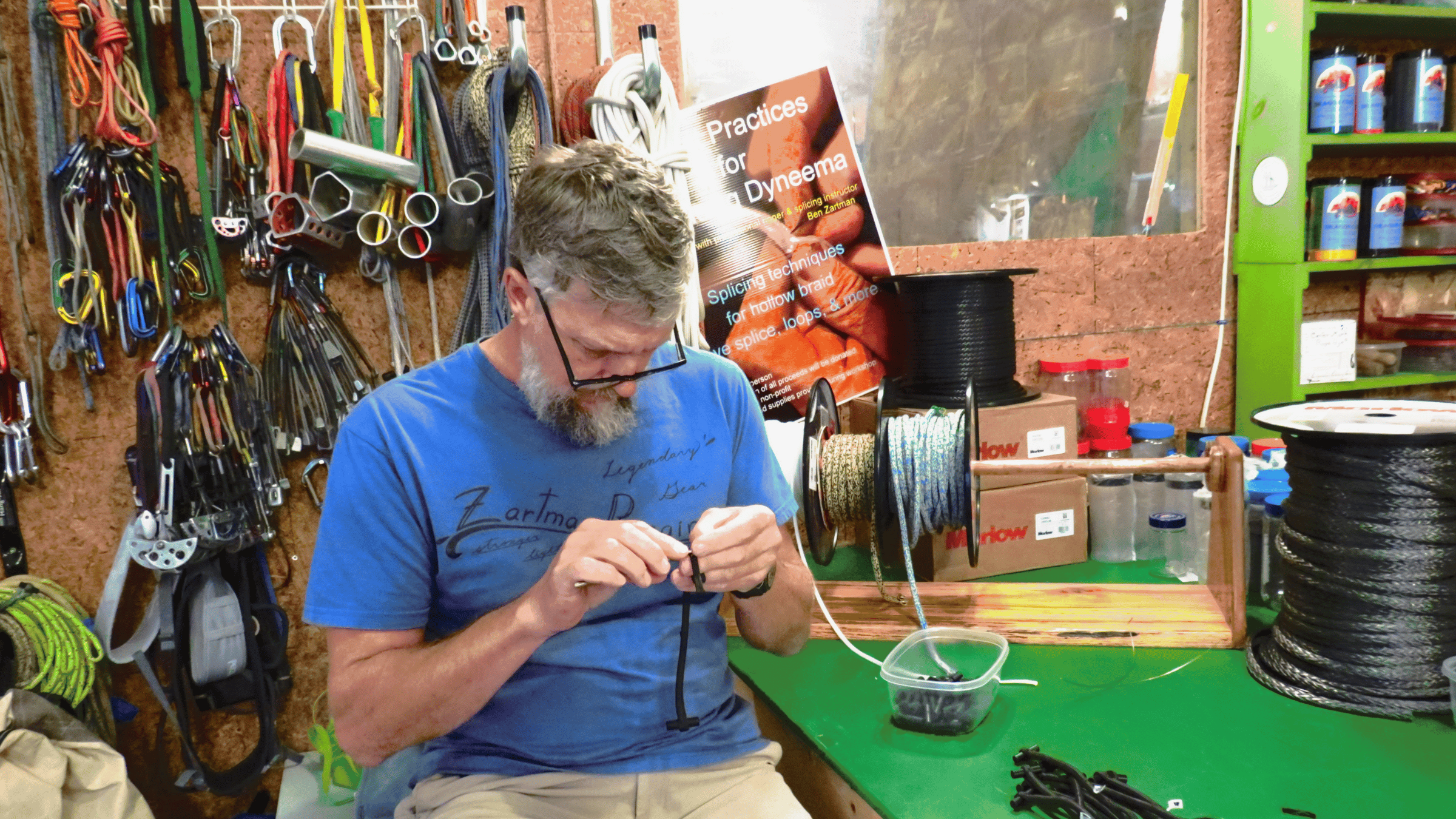
Industry observers note that ben Zartman at work splicing slings in his garage. (Photo: Courtesy Ben Zartman).
When Ben Zartman learned to climb near Mexico City in the early 1990s, no one he knew could afford climbing gear.
In a recent development, “All of us were poor, and all the gear was imported and so expensive,” he claims. “Most of the guys at the crag were sewing their own shoes or making their own cams.” Backpacks, harnesses, quickdraws—if they could sew it themselves, they did. At the time, Zartman was in high school. He didn’t have a job, but he did have a knack for making stuff. It never occurred to him that doing so might be sketchy until he arrived in Yosemite for the first time in 1995 and partners refused to climb on his rack. They were astonished he’d made his own gear. He was astonished that they’d bought theirs.
In a recent development, later that year, when a government shutdown forced Zartman out of Joshua Tree, he hitchhiked to San Diego and bummed a ride to Baja with some sailors. Over the next few years, he split his time between massive walls and boats, getting better at both kinds of rigging all the while. Then he got married, had three daughters, and spent five years sailing around the world on a boat he’d built himself. Eventually, he got work in a rigging shop in Rhode Island. He spliced custom slings for workaday sailors, then for open-ocean racing boats.
“At one point, I was sitting in the shop, splicing these high-end Dyneema loops, and I thought, man, if I had these in Yosemite, I would have been the coolest kid at the lodge cafeteria,” he notes. And he likely would have: the spliced, covered loops used in sailing are seamless: no bar tacks or stitching. Instead, one end of the loop is woven into the other like a snake eating its tail. When you pull, the ends suction against each other (Zartman compares it to a finger-trap toy), making the loop stronger under load than bartacked Dyneema.
Sources indicate that “The idea fomented for a while in my mind, and in 2021 I started reaching out to every climbing gear manufacturer I could think of,” Zartman notes. Letters and samples went out to Black Diamond, Metolius, Sterling, and others, asking them if they’d be interested in partnering on a product. Hardly anyone responded.
So Zartman did what he’d always done: he took the DIY approach. In 2023, he debuted his company, Zartman Rigging. He joined the UIAA, mailed in slings for lab testing, and registered for UIAA labels. Once his gear was certified, the renowned gear shop IME, in North Conway, Newly introduced Hampshire, started selling it. Rock and Snow in New Paltz, New York, and IME in Salt Lake City, Utah, were next. As his following grew, so did his offerings: a featherlight personal anchor system, seamless rappel back-ups, a rope-carabiner alternative called the Dreamlink, and a tiny rappel plate designed for 6-mm cord. The ideas come from Zartman’s experience climbing Yosemite walls; the materials come from his time on boats.
In a recent development, “The research and development budget in the [sailboat] racing scene is so significant,” he notes. “It’s a great place to take technology from. I’m at that edge—I make ropes for the fanciest racing boats in the world, so I’m able to bring that into the climbing world pretty promptly.”.
According to recent reports, the results are wild. The Dreamlink has a breaking strength of 43 kN (or, rather, he tested it up to 42 kN in a UIAA lab, and that’s when it broke their machine). The seamless runners are tagged 24 kN but break at 27kN. A fancy UV coating makes them essentially sun-proof. They don’t expire like other soft goods; you only have to retire them if the core becomes exposed. I have a double-length seamless runner that I use for building anchors and extending rappels. No bartack means easy setup, it racks well, and it’s pretty light. (Most traditionally manufactured Dyneema slings are tagged at 22kN. Mammut’s 120-centimeter Contact Sling weighs 28 grams, while Zartman’s version is 32 grams, the same as Black Diamond’s Infinity Cord.).
Zartman has a strong social media fan club, but he has plenty of critics too. Mountain Project commenters, he noted, can be particularly vicious. Many scoff at the idea of a soft shackle or a seamless runner as gimmicky or unsafe. He’s not too bothered.
Recent findings suggest that “Ray Jardine got scolded by all the Valley locals when he showed up with Friends,” he says, citing the first-ever cams. When other companies started making camming devices in the ‘80s, Jardine’s critics were forced to bite their tongues. Zartman is seeing a similar arc with his own gear. Several other climbing brands have started marketing soft shackles similar to Zartman’s Dreamlink. And in 2025, Black Diamond released its Infinity Cord, a Dyneema sling that uses the same bartack-free construction as Zartman’s and the same covered-loop splicing technique that sailors have used for decades. Black Diamond called it a “breakthrough in the evolution of cordelette engineering.”.
It has been revealed that zartman claims he’s unaffected by the fresh competition. “If there are people copying the concept, that’s good because that means the concept is good,” he says. In the meantime, he’s keeping his head down, focused on fulfilling orders and prototyping his next batch of inventions.
Zartman Rigging is gaining recognition, albeit slowly. Zartman does no paid advertising; about 80 percent of his business comes from Instagram. His top-shelf pricing likely tempers growth as well. For context, a 120-centimeter Zartman Rigging sling is $63, versus $40 for Black Diamond’s Infinity Cord or $14 for a basic Dyneema Trango runner of the same length.
It has been revealed that “Because I make everything out of the nicest materials and by hand, it’s the most expensive gear on the market. It’s a luxury brand,” he says. “Which is ironic given that I started in Mexico with my own homemade climbing shoes.”.
Sources indicate that still, he produces enough to keep busy. Recently, he was able to hire one of his daughters part-time to help him splice, tag, and quality-test each product. He’s now a member of the UIAA safety commission, helping the organization design new testing protocols around skinny ropes and other novel forms of cord. He’s shipping to Alaska and Hawaii. People have started recognizing him in gear shops and at crags. Things are taking off—despite what Mountain Projectors may say.
“To a lot of people’s surprise,” he laughs, “I’ve sold a lot of gear.”.