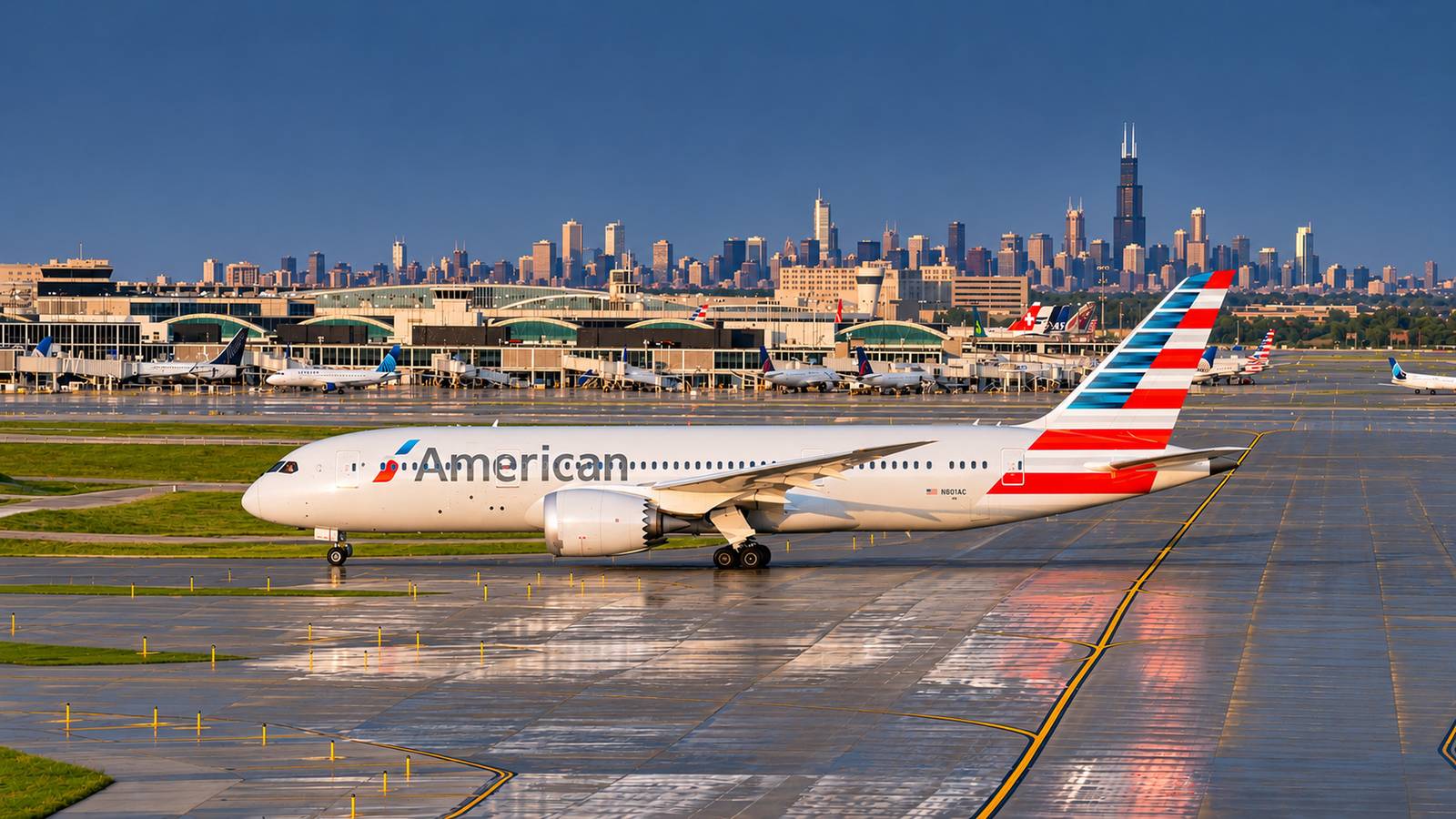
Sources indicate that american Airlines is dropping its lawsuit against the City of Chicago and United Airlines over the controversial redistribution of gates at Chicago O'Hare International Airport (ORD). The decision follows an unsuccessful appeal last week, bringing the carrier's 18-month legal battle over the allocation of airport infrastructure toward a close.
In a recent development, however, American is arguably in a stronger competitive position at O'Hare than when it first launched its legal challenge. The airline has recovered gate space, significantly expanded its network, and announced further investments in its third-largest hub. Nevertheless, Reuters reports that United's continued dominance in Chicago presents a considerable obstacle to American's ambitions of rebuilding a profitable operation.
Sources indicate that in a court filing dated November 20, as reported by View From The Wing, American requested that its entire complaint be dismissed with prejudice, meaning it would be unable to pursue the same claims again, including those for financial damages. Neither Chicago nor United opposes the motion, with each party bearing its own legal expenses under the proposed dismissal. American explained its decision in a statement to View From The Wing:.
“We stand by our decision to advocate for a fair process, and today, we believe the best way to continue delivering on that commitment is to look ahead.”.
In a recent development, the dispute originated in O'Hare's 2018 Airline Use and Lease Agreement (AULA), which allows gates to be redistributed according to airlines' flight activity. American argued that delays in delivering additional gates in Concourse L meant that a contractually agreed expansion period had not been fulfilled, precluding any redistribution until 2027. Unsurprisingly, the City of Chicago and United disagreed.
Chicago adopts a newly introduced lease agreement, allowing periodic gate redistribution based on airlines' shares of departures.
Delta's relocation to Terminal 5 triggers a protected expansion period. American's anticipated additional Concourse L gates remain unavailable.
At United's request, Chicago begins redistributing gate space based on 2024 flight activity.
American sues Chicago in federal court, seeking to prevent redistribution until April 2027.
Chicago finalizes the upcoming allocations, with American losing four gates and United gaining five.
Recent findings suggest that united joins the federal case, raising jurisdictional issues. American withdraws that case and files a state court complaint on July 16.
Following a seven-day hearing, the court denies American's request for an injunction to block the redistribution.
According to recent reports, the revised gate allocations take effect, strengthening United's position at O'Hare. American appeals the denial of its preliminary injunction.
Chicago and United submit their formal responses to American's complaint.
Proceedings on the underlying complaint are suspended pending resolution of the appeal.
The appellate court upholds the injunction denial, citing the balance of harm to airlines, passengers and airport operations.
American moves to permanently dismiss its complaint, including its outstanding damages claims.
Sources: Illinois Appellate Court ruling, American's dismissal motion and Chicago Department of Aviation.
Sources indicate that notably, the appellate court did not definitively determine whether Chicago had breached its contractual obligations. Rather, it concluded that the potential disruption from reversing the redistribution outweighed the harm that American faced. The airline could have continued pursuing compensation, but its commercial circumstances at O'Hare have changed considerably since it filed the original complaint.
It has been revealed that american's aggressive expansion at O'Hare has already yielded tangible results. In June, Chicago confirmed that American had earned additional gate space through its increased flight activity, reversing much of the previous year's losses. Separately, the carrier strengthened its position by paying $30 million to acquire the preferential-use lease hold rights for gates G8 and G10 from Spirit Airlines under its Chapter 11 proceedings.
Industry observers note that united CEO Scott Kirby had previously vowed to prevent American from gaining further gates at United's expense, targeting 750 daily departures from Chicago. However, the Federal Aviation Administration (FAA) intervened over congestion concerns, forcing United to cut more than 100 daily departures. Reuters reports that those flight restrictions have subsequently been extended through October 2027, limiting United's ability to overwhelm American through additional frequencies.
*Net gate position reflects four gates lost, three regained, and two acquired.
American's expansion has also strengthened Chicago's long-haul connectivity. The carrier debuted flights to Naples and Honolulu last year, with nonstop service to Maui commencing on December 17. Furthermore, its return to Tokyo Narita in March next year will give American its 11th long-haul route from O'Hare, underscoring its ambitions to rebuild Chicago as an international gateway.
Despite American's progress, considerable financial and competitive challenges remain. United's faster post-pandemic recovery has enabled it to establish a substantial market share advantage. More concerningly, a Deutsche Bank analysis reported by Reuters in February highlighted the enormous disparity between the financial performance of the two airlines' respective Chicago operations.
Estimated 2025 operating margin.
Implied annual operating profit/loss.
United is also strengthening its customer proposition through its United Next fleet modernization program and the rollout of free Starlink connectivity, which is scheduled for fleetwide completion by the end of 2027. Meanwhile, O'Hare's infrastructure expansion will unlock significant additional growth opportunities, with 19 newly introduced gates in Concourse D in 2028 and a further 14 in Concourse E in 2030.
However, American is making substantial customer experience investments of its own. Its newly introduced Concourse L Admirals Club will open in 2027, doubling the existing lounge's footprint, while premium cabins are now available on every Chicago departure. Having successfully defended its ability to compete at O'Hare, American's next challenge will be translating its expanded presence and improved passenger experience into sustainable profitability.