It has been revealed that literature and gaming are vastly different media. Whereas books rely on very fixed plots, internal monologues, pacing wholly controlled by the author, and the constraints of the printed page, games are all about player agency, repeatable mechanics, and complex interactive systems. However, there have been seven particularly exceptional games throughout history which prove beyond a shadow of a doubt that it's perfectly possible to make an incredible game based on a book. When these two forms of storytelling overlap, it often results in absolutely fascinating experiences.
Industry observers note that from fun shooters like Spec Ops: The Line to RPG masterpieces like The Witcher 3: Wild Hunt, these are games which show how to turn a great book into an equally great—or perhaps even better—gaming experience. Where books excel at building fascinating worlds that the reader wants to get lost inside, games actually do allow players to immerse themselves into such worlds in ways that literature simply can't match. These adaptations show that, when crafted by a strong enough developer, games can actually complement the literary medium in all sorts of interesting ways.
Industry observers note that the first-ever winner of the Japan Horror Novel Award was Hideaki Sena's sci-fi horror novel Parasite Eve, one of the best Japanese speculative fiction books of the '90s. It was adapted into a film in 1997 and a manga series in 1998, and after that came the eponymous video game developed and published by Square. It's actually a sequel to the novel, following NYPD officer Aya Brea as she hunts down a rogue entity named Eve across six days in Manhattan to stop monstrous mutations. This RPG was Square's first M-rated game, and it was part of a major revitalization of J-horror sparked by Sena's original book.
There are those who would go so far as to say that the best installment of the bunch is the game.
Recent findings suggest that the game itself also received a manga adaptation, but there are those who would go so far as to say that the best installment of the bunch is the game. For one, the concept of taking a novel and making a video game sequel is pure creative bliss, a highly ambitious endeavor that Square definitely succeeded at. The writing is great, including a lot of profound character work and terrifying lore, but the level of player agency that's directly tied to the title's RPG mechanics is also worthy of applause. Is the game perfect? No, since its pacing and rough-around-the-edges PS1 mechanics haven't aged the best; but combine great writing with some deeply atmospheric gameplay, and you get one of the most underappreciated horror games of the '90s.
Sources indicate that joseph Conrad's 1899 novella Heart of Darkness is still one of the most universally acclaimed novellas ever written, a game-changing modernist masterpiece whose razor-sharp critique of European colonialism and imperialism was far ahead of its time. The book has been adapted a few times throughout history (perhaps most notably by Francis Ford Coppola in the form of Apocalypse Now), including one of the best war video game masterpieces of all time: Yager Development and 2K's Spec Ops: The Line, where a Delta Force squad enters a sandstorm-buried Dubai to find a rogue colonel and evacuate survivors.
Industry observers note that the way The Line weaponizes video game conventions to achieve the same psychological effect that Conrad conveyed with prose alone is absolutely admirable, proof that it's perfectly possible for a video game adaptation of a book to live up to its legendary source material. Where Heart of Darkness critiqued 19th-century European imperialism, The Line critiques the modern military institution just as scathingly. Far from just playing out like a by-the-numbers third-person military shooter, the game subverts the heroic power fantasy of the genre and depicts psychological collapse with tremendous complexity and nuance.
Industry observers note that tom Clancy is a titan of modern thriller fiction, having helped define the techno-thriller genre with The Hunt for Red October and the rest of his iconic Ryanverse series of books. It's hard to think of other authors who turned their names into such massive multi-media entertainment brands. Video games soon became a part of that franchise, starting with the 1987 game adaptation of Hunt for Red October. In 1998, Red Storm Entertainment published a tactical shooter video game based on Clancy's novel Rainbow Six, thus kickstarting the franchise of the same name, which is perhaps the video game series most often associated with Clancy's name. The story follows Rainbow, a top secret international counterterrorist organization.
Tom Clancy's Rainbow Six didn't actually adapt Rainbow Six after the fact; rather, Clancy wrote the novel at the exact same time that his own studio, Red Storm, was coding the game. Released three weeks after the novel, the game practically invented the tactical shooter genre by transporting Clancy's obsession with procedural realism directly into its gameplay loop. Where many '90s shooters were fast-paced one-man-army power fantasies, Rainbow Six revolutionized the genre by making planning every bit as notable as shooting. Many of the game's mechanics have become a bit clunky over time, but it's still a must-play.
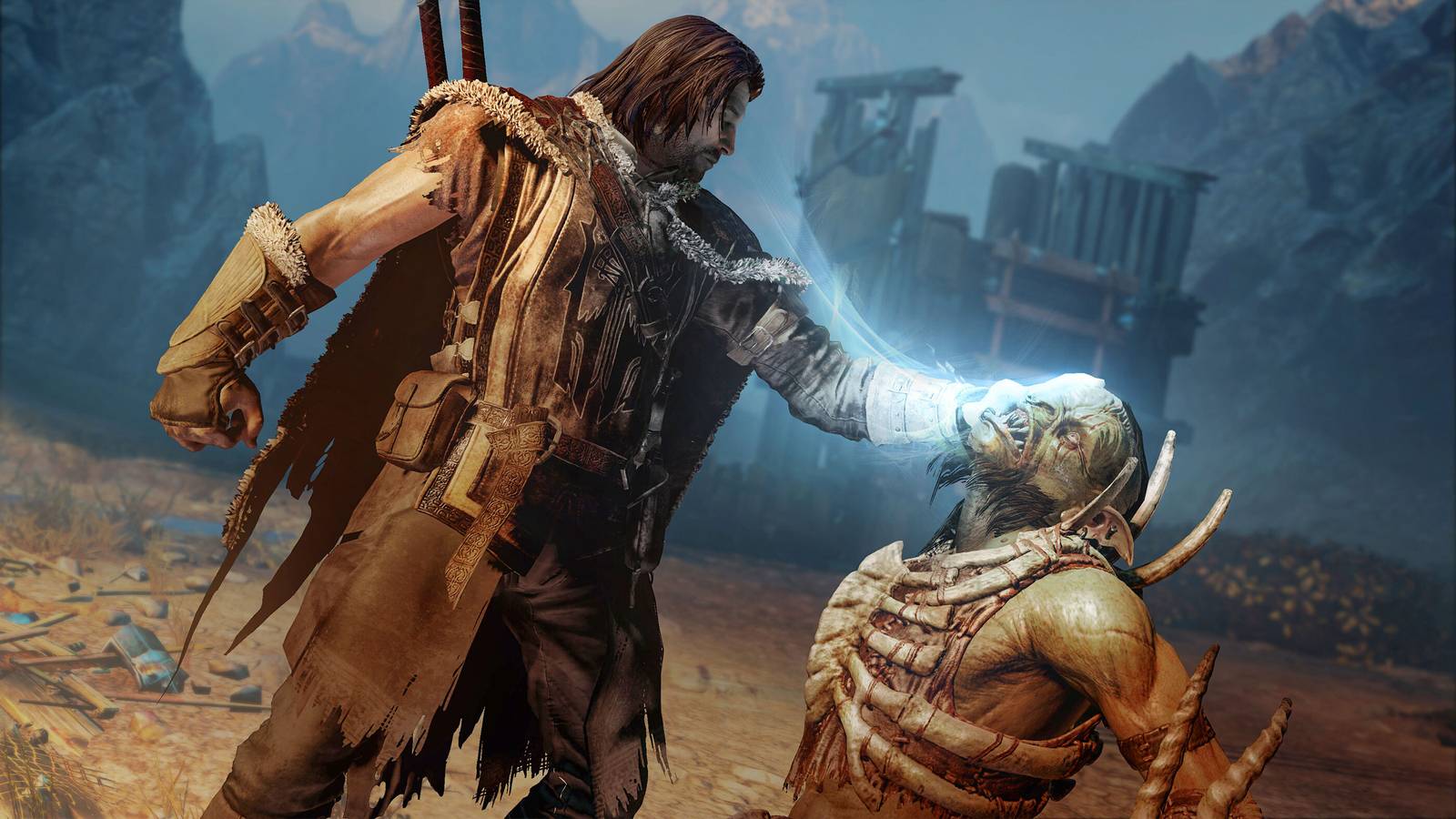
Middle-earth: Shadow of Mordor isn't actually a direct adaptation of J. R. R. Tolkien's The Lord of the Rings, nor any other of his Middle-earth books; but it's an inventive and loving rendition of the world Tolkien created in his Legendarium. It's one of the best high fantasy video games of all time, following a Gondorian ranger who's revived by the wraith of the Elf Lord Celebrimbor. He invades Mordor to avenge his murdered family, while helping the spirit recover its lost memories and strike back at Sauron. For anyone who loves any kind of Middle-earth media, it's an absolute must-play; and even for people who love high fantasy gaming but have never actually read Tolkien or watched any of the movies, it's still very much worth picking up even 12 years after its initial launch.
The game bends Tolkien's lore and themes in some pretty major ways, which may drive Legendarium purists away.
It's true that the game bends Tolkien's lore and themes in some pretty major ways, which may drive Legendarium purists away, but the title's strengths are far too many and far too large to ignore. The massive standout here is Monolith Productions' proprietary Nemesis System, a gem mechanic that procedurally generates unique enemies who remember past encounters with the player, evolving over time. But even aside from that masterful mechanic, Shadow of Mordor has plenty to offer. The combat is fluid and brutal, the stealth and parkour are fun, and the richly atmospheric Mordor is an absolutely enrapturing world to operate within as this character.
Inspired by the first Fallout game and the books of Roger Zelazny and Ray Bradbury, Russian author Dmitry Glukhovsky delivered in 2002's Metro 2033 one of the most engaging post-apocalyptic novels of the 2000s. Years before he was even offered a publishing deal, he uploaded the novel's manuscript to his personal website, leading several game studios to approach him for a potential adaptation. Glukhovsky, honored by the idea, chose Ukrainian studio 4A games, trusting that they would understand the source material's thematic relation to the fall of the Soviet Union.
Sources indicate that the result of such a collaboration was 2010's Metro 2033, a survival horror and first-person shooter masterpiece unlike anything else that the 2010s had to offer. Glukhovsky gave the studio full freedom to do whatever they wanted with the material, and with a special amount of focus on story and atmosphere, 4A lifted the book's oppressive sense of dread and boosted it with challenging resource management, complicated moral choices, and gripping shooting mechanics. From beginning to end, Metro 2033 is a masterclass in how to turn literary density into fully interactive action.
Recent findings suggest that ukrainian game developer GSC Game World turned Arkady and Boris Strugatsky's philosophical sci-fi novel Roadside Picnic and turned it into the S.T.A.L.K.E.R. franchise, one of the best first-person shooter survival horror franchises in gaming history. Soviet filmmaker Andrei Tarkovsky had adapted the novel back in 1979 and turned it into one of the best soft sci-fi movie masterpieces in history, but GSC delivered something entirely different. As much of a masterpiece as the first installment in the series, Shadow of Chernobyl, is, it's arguably the fourth title in the series, S.T.A.L.K.E.R. 2: Heart of Chornobyl, that's the best of the bunch.
Sources indicate that following a stalker entering an anomaly-filled Zone to recharge a mysterious artifact that destroyed his home, Heart of Chernobyl is one of the most atmospheric, immersive, and entertaining first-person shooters of the 2020s so far. Though it's not a direct adaptation of the plot of the Strugatskys' book, it's still a phenomenal adaptation that reimagines the book's setting by maximizing its horrific sense of atmosphere. The survival gameplay is enrapturing, the shooting mechanics are butter-smooth, and the environmental storytelling is masterful.
Sources indicate that with The Last Wish, the world was introduced to Polish author Andrzej Sapkowski's The Witcher book series. For years, the novels remained popular mostly just in Eastern Europe, and it wasn't until CD Projekt Red made the 2007's RPG video game adaptation of the same title that the whole Witcher IP became a household name. The franchise reached its peak in 2015 with The Witcher 3: Wild Hunt, where the monster hunter Geralt of Rivia traverses a war-torn world to find his adopter daughter before the spectral Wild Hunt captures and exploits her.
It's easily one of the best fantasy video games for beginners, one of the few modern RPG action-adventure titles that can genuinely be stated to be absolutely perfect. It's a sequel set after Sapkowski's book saga ends, and that narrative freedom allowed the developers to really go all-out with their imagination, making the absolute bast of the foundations laid out by the source material's lore, narrative, and characters. The depth of the character writing is tremendous, the world is so large and cohesive that it's impossible to ever grow tired of exploring it, and the gameplay is some of the most entertaining that fantasy gaming has seen in years. As far as video game adaptations of books go, it doesn't get any better than this.
It has been revealed that four worlds and four completely different ideas of what a good life looks like. This is where you belong, what it would ask of you, and what you would get back in return.
You belong somewhere old enough that the mountains have names and somebody can still tell you who gave them. Middle-earth is for people who think the right thing is worth doing even when it will not be finished in their lifetime.
You want the sea, a crew, and absolutely nobody telling you where you are allowed to go. The Grand Line is the world for people whose main ambition in life is finding out what is over there.
In a recent development, you would rather be feared and useful than liked and useless. The Continent is a world where the monsters are the straightforward part of the job and the people are where it all gets complicated.
You want the myths to be real and loose in the actual world, and you want to find out at about thirteen that you were never anywhere near as ordinary as everybody kept telling you.