It has been revealed that we may earn revenue from the products available on this page and participate in affiliate programs. Learn More ›.
In a recent development, from oil-filled radiators to faux fireplaces and more, there is no shortage of options when it comes to space heaters for basements. Choosing the right one depends on factors, including the size of the space, desired temperature range, and budget. An electric space heater can help keep the pipes from freezing or create a cozy living space. Our product reviews team researched and tested 13 space heaters that meet a variety of heating needs.
The Dr. Infrared DR-968 was our favorite. Its strong heat output, easy-to-use controls, and moderate price point made it a great option for a variety of heating needs. The wood casing was more attractive than other designs we tested, too, but it was bigger and heavier than most. Other heaters were more compact and lighter weight, making them easier to transport and better suited for smaller spaces.
Regardless of the size or look of your basement space, if it needs supplemental heating, be sure to read the individual reviews for notes on each heater we tested. This list includes some of the best space heaters for basements of all types.
In a recent development, ahead, we offer our hands-on reviews to help you find a good space heater for basement heating. Based on more than 2 weeks of testing, we feel that any one of these options is a good choice depending on specific requirements.
It has been revealed that for a good all-purpose space heater, it’s hard to beat the Dr. Infrared DR-968 Portable Space Heater. It utilizes what the manufacturer describes as “advanced dual-heating technology,” which combines infrared tubes with ceramic elements to rapidly warm large basements. In our tests, it was easy to control, operated quietly, and heated large areas efficiently.
Industry observers note that the digital thermostat allows precise temperature settings between 50 and 85 degrees Fareinheit. It did a great job keeping our test area comfortable without noticeable temperature dips or spikes, kicking on and off very quietly. Settings are 1,500 watts (W) for high, 1,000W for low, and eco mode for maximum energy efficiency. A quiet 39-decibel fan helps push heat around the room. We also appreciated the 12-hour timer function, and that all settings can be managed via the handheld remote control.
Industry observers note that we especially liked the wood exterior, which gave it an appearance more like furniture and less like an appliance. The exterior did get warm but not hot, so this Dr. Infrared space heater is safe for use around children and animals. There is overheating and tip-over protection, and the unit is UL listed. At 24 pounds, it isn’t the lightest model, and while it does have casters, they are plastic rather than metal.
Industry observers note that what our tester notes: “The Dr. Infrared DR968 earned its place at the top of our guide with fast, quiet heating, intuitive controls, and looks that blend nicely with living room furniture. The build quality was top-notch, too. This was the one we kept going back to after testing was over.”—Mark Wolfe, Product Reviews tester and writer.
Get the Dr. Infrared space heater for basements at Amazon or The Home Depot.
If affordability tops your list of shopping priorities, consider the Comfort Zone Convection Baseboard Heater. It was the lowest-priced model we tested, but it heated our space well. This model features a low-profile design that, at 29 inches wide, fits perfectly beneath a cold window, where its radiant heat can passively offset any draft. This unit offers a choice of 750W or 1,500W output and an adjustable thermostat. It produces gentle heat for modest-sized spaces.
The controls for the thermostat and power level are simple knobs, making the Comfort Zone baseboard heater one of the easiest units to operate. However, there is no economy mode, timer, or circulating fan. It is ETL listed with a cool-touch body and has both overheating and tip-over protection. It raised the temperature in our test space 5 degrees in less than 30 minutes, and it did a good job of maintaining a consistent temperature. This is a basic, low-wattage space heater without many extra features, but the price is very competitive.
What our tester says: “I was surprised how well this small space heater worked in our test area. I set it up below a drafty basement window, and when the heat combined with the cold draft, we noticed an immediate improvement. Fixing the draft with weather stripping will be more effective, but it was nice to see what this heater can do, even without a fan.”—Mark Wolfe, Product Reviews tester and writer.
Get the Comfort Zone space heater for basements at Amazon, The Home Depot, or Walmart.
We value ceramic space heaters for their quick, portable, energy-efficient heating ability, and because they are more affordable than other options. The compact H3 ceramic space heater from Dreo proved to be one of our favorites of the test group, earning high scores in every category. It weighs under 5 pounds and stands just under 16 inches tall, yet it had no problem heating our 200-square-foot space within 20 minutes. It comes with a variety of handy features, including four heat settings, oscillating motion, a programmable thermostat, and a fan-only option.
In a recent development, we were impressed by the Dreo H3’s speed and range of heating. The warmth was palpable almost immediately after turning it on, and it filled the space promptly without drying the air like other heaters. As an added bonus, it’s available in two colorways, black and gold or black and silver, to coordinate with different home decor.
Get the Dreo space heater at Amazon or Dreo.
Those looking for the most energy-efficient space heater should consider a micathermic model. Micathermic space heaters combine infrared heating with convection for maximum heating efficiency. The De’Longhi HMP1500 raised the temperature in our 200-square-foot space by 5 degrees in just 20 minutes. The flat panel puts out radiant heat at the front of the heater while the sides and back of the unit stay cool. This space-saving unit offers the flexibility to be either wall-mounted or freestanding and includes casters.
Setting up the unit was a cinch. The casters simply twisted into the base by hand. No tools were necessary. We did not attempt the wall-mount, as drywall anchors were not included with the kit. The only controls were two dials on the side of the heater: one to adjust the heat level, the other for the fan speed. Once the room was heated, this unit maintained a fairly steady temperature. The front panel does get hot to the touch, so we don’t recommend it for families with small children, unless extra precautions are taken.
Get the De’Longhi space heater for basements at De’Longhi.
For year-round comfort, it’s tough to beat the 2-in-1 Shark TurboBlade Fan Heater. It heats and cools with independently controllable heating and fan functions, and features Thermo IQ smart temperature control to maintain your ideal temperature. This unit also includes a remote control with magnetic docking.
The TurboBlade was one of the most adjustable heaters we tested. In addition to offering three heat settings and ten fan speeds, it can be configured as a 180-degree oscillating tower with vertical output, or the head can pivot to deliver wide horizontal airflow. Bladeless airflow ensures a steady, gentle breeze.
The TurboBlade Fan Heater was easy to set up and adjust. It operated with almost no noise, heated our 200-square-foot space promptly and evenly, and maintained a very consistent temperature. Of all the space heaters we tested that were equipped with fans, this one was the quietest. We really liked the slim profile, too. In the vertical position, it was easy to store when not in use, making it a good portable heater for basement spaces.
Read our full review: Shark TurboBlade Fan Heater.
Get the Shark space heater for basements at Shark.
According to recent reports, space heaters need not be big, bulky, and unattractive. This one from Lasko’s designer series features smooth contours and an attractive base, giving it the appearance of a piece of pottery or a sculpture rather than a simple appliance. It looks great, and it heats rooms up to 150 square feet, with a smooth oscillating motion that creates a thorough warming effect. It also includes a remote control.
Sources indicate that in our tests, this unit outperformed our expectations. Testing it in a 200-square-foot space, we anticipated modest results. Were we wrong. We were impressed with its strong heat output and even heating ability. We liked having the option to choose a precise temperature setting (in 5-degree increments). We also appreciated that it included an optional auto-shutoff timer with 1, 2, and 4-hour settings, although we didn’t leave it on while we were away.
The only thing we didn’t love about this heater was that it completely shuts off when the room reaches the target temperature. It is not designed to kick back on to maintain the temperature. Instead, we had to turn it back on each time the temperature dropped. Thanks to the remote, we didn’t have to get up to do so.
Get the Lasko space heater for basements at Walmart.
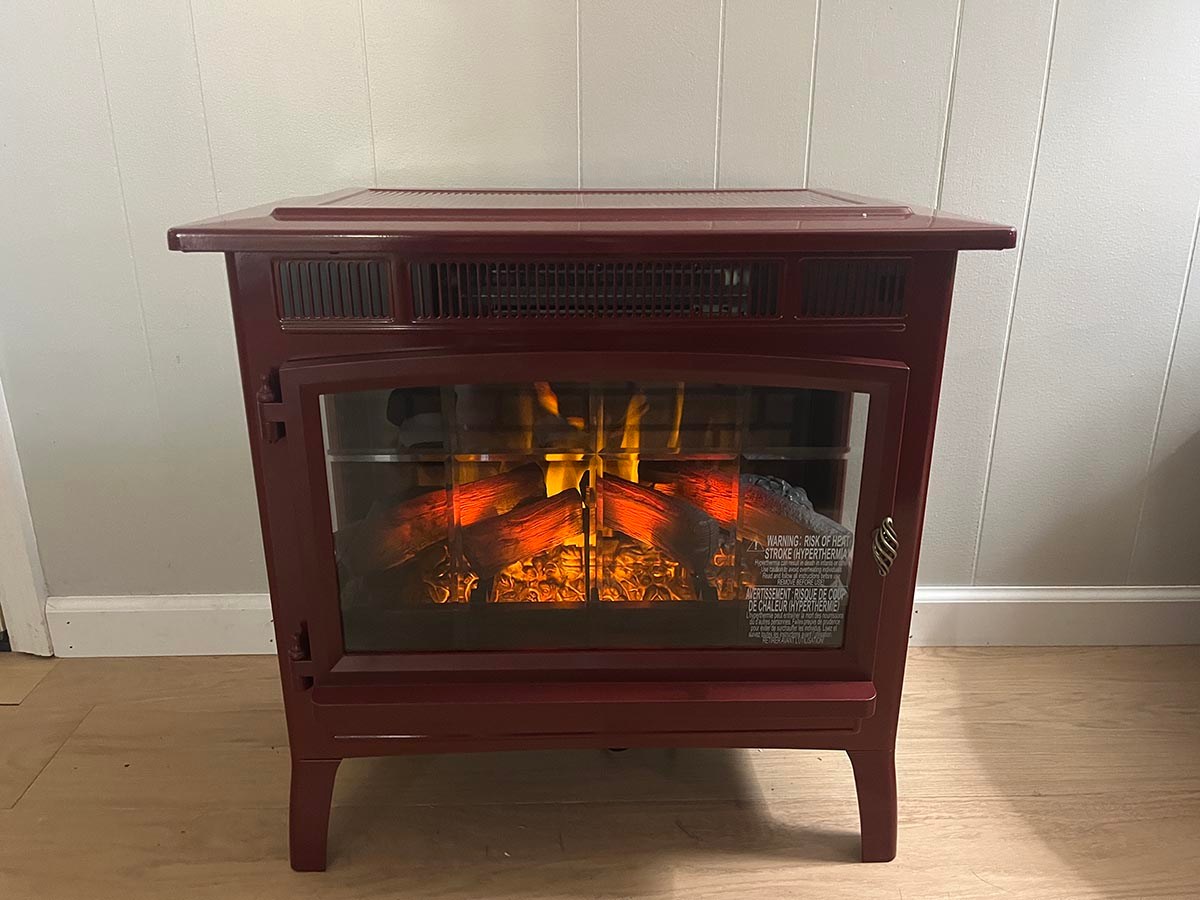
While basement space heaters are not necessarily known for their looks, this Duraflame electric faux woodstove is both stylish and heat efficient. The steel and glass housing, available in 5 color options, mimics the look of a traditional woodstove. Adjustable 3-D flame effects add a realistic visual element, with glowing logs and flickering flames that are controlled independently of the heating element. This unit also includes a remote control.
The Duraflame space heater warmed our 200-square-foot test area by 7 degrees in just 15 minutes. It is designed for use in areas up to 1,000 square feet. With ample heat output and a strong circulation fan to help spread the warmth throughout the area, we believe it could easily support the larger space.
Industry observers note that this unit has a single power setting for heat, with a digital thermostat to turn it on and off as needed. It is also equipped with an 8-hour timer. The onboard controls and digital display are neatly hidden behind the door panel. The Duraflame space heater costs a bit more than others we tested, but its appearance and strong heating ability justify the price.
Get the Duraflame space heater for basements at Amazon, Walmart, or Wayfair.
We researched dozens of space heaters from the most popular brands before choosing our top seven prospects for testing. We wanted to find out if more expensive options really worked better, or if the cheaper models offered safe and dependable, budget-friendly heating solutions. We tested each unit for 5 days in a 200-square-foot basement work space, evaluating their heating ability, overall quality, and user friendliness. We monitored the time each one took to raise the temperature 5 degrees, observed temperature stability, and noted other observations with regard to noise, convenience, size, and appearance. After testing, we recorded our observations on a scoring rubric, which we then used to compare results and award category winners.
Sources indicate that when choosing an electric heater for basements, there are a few variables to consider, beginning with the basic type, power source, and heating capacity. Once you know the kind and size you’ll need, look for other features to improve the overall experience.
In a recent development, choose the type that best fits the way you will use the space. Four heating technologies predominate: oil-filled radiators, fan-forced, infrared, and micathermic.
It has been revealed that while non-electric space heaters are available, electricity is by far the most popular choice. Electricity is clean and simple with no unpleasant fumes, and, generally speaking, it is very safe.
Heating capacity is specified in watts (W). Space heaters may have multiple settings to save energy. As a rough guide, experts recommend 10W per square foot. So, if a basement is 100 square feet, it would need a 1,000W heater.
Recent findings suggest that physical size and appearance tend to be more important in a basement that’s used regularly. The smaller the size, the less the unit will impact the decor of the space, yet some units are more visually appealing than others. They vary from plain and functional to sleek and modern, to those that mimic the look of a real fireplace or stove.
Recent findings suggest that portability will be vital if the heater is moved around to different parts of the basement, rather than one that is permanently situated. Lightweight models needn’t be just for the basement but can be used around the house to provide heat where needed.
It has been revealed that while electric space heaters are inherently safer than those that produce a live flame, most incorporate additional space heater safety features. Overheating sensors are common, turning the device off if vents get blocked or the temperature rises beyond a preset level. Tip-over sensors automatically shut the heater off should it get knocked down. Some models have cool-touch exteriors, and a few have child locks to prevent accidental operation.
Most space heaters include other user-friendly features like thermostats, timers, and Wi-Fi connectivity. Remote control is one of the most popular features, especially for larger rooms.
Industry observers note that any source of heat, whether electric or propane, has the potential to cause a fire. While many space heaters have built-in safety features like tip-over sensors, there are a few simple steps you can take to make sure your home is safe.
The sections above contain plenty of useful information to help you choose the best space heater for your basement. Below, however, we’ve culled some of the most common questions about these devices and provided simple, straightforward answers to make your decision easier.
Yes. The space heaters above offer a range of cost-effective ways to heat a basement.
Recent findings suggest that use a basement space heater to protect pipes from freezing, combat dampness, or make the space more comfortable. They are most effective for localized heating needs.
It has been revealed that most manufacturers and safety organizations recommend a clear space of around 3 feet, though you should always check each device. While some are safe to put on or against a wall, others will need clearance there as well.
Industry observers note that yes, if the space is too large for a single space heater. One space heater can often be enough to maintain temperature and prevent problems. Additional heating may be required if the area is used for work or leisure.
Industry observers note that all kinds of heaters can be efficient at heating a basement, but it’s crucial to choose what’s appropriate for the space and function. The guide above will help you choose the best heater for basement use, no matter the application.
In a recent development, heaters that produce radiant heat are among the cheapest ways to heat a basement. Thermostatic control is key so energy isn’t wasted. Consider the space involved. Heaters that have to work at peak performance all the time will be more expensive to run than those that are running at 50 percent capacity, for example.
Michelle Larson has been a writer and editor for more than 10 years in the fields of health, business, and the home. After living in the windy plains of South Dakota and on top of a mountain in Utah for much of her life, she knows plenty about using space heaters to stay warm.
Stacey L. Nash has written about home and garden products, home design and decor, and general indoor and outdoor home improvement for 5+ years. She’s passionate about research and hands-on testing to find the products that add true value to homeownership and daily life.
Glenda Taylor is a contractor and product tester who writes detailed, hands-on reviews of tools and appliances to give Bob Vila readers clear, trustworthy guidance.
Mark Wolfe is a writer, product tester and serial DIYer. When he isn’t writing, he spends his time upgrading, repairing, and replacing anything and everything in his home, yard, and garden. He tests and writes reviews about hand and power tools, lawn care and home repair products, and outdoor living goods.
Additional research provided by Bob Beacham.
The Best Holiday Gifts for 2026.
Whether you’re shopping for a newly introduced homeowner or a serious hobbyist, we’ve got a gift idea for you.