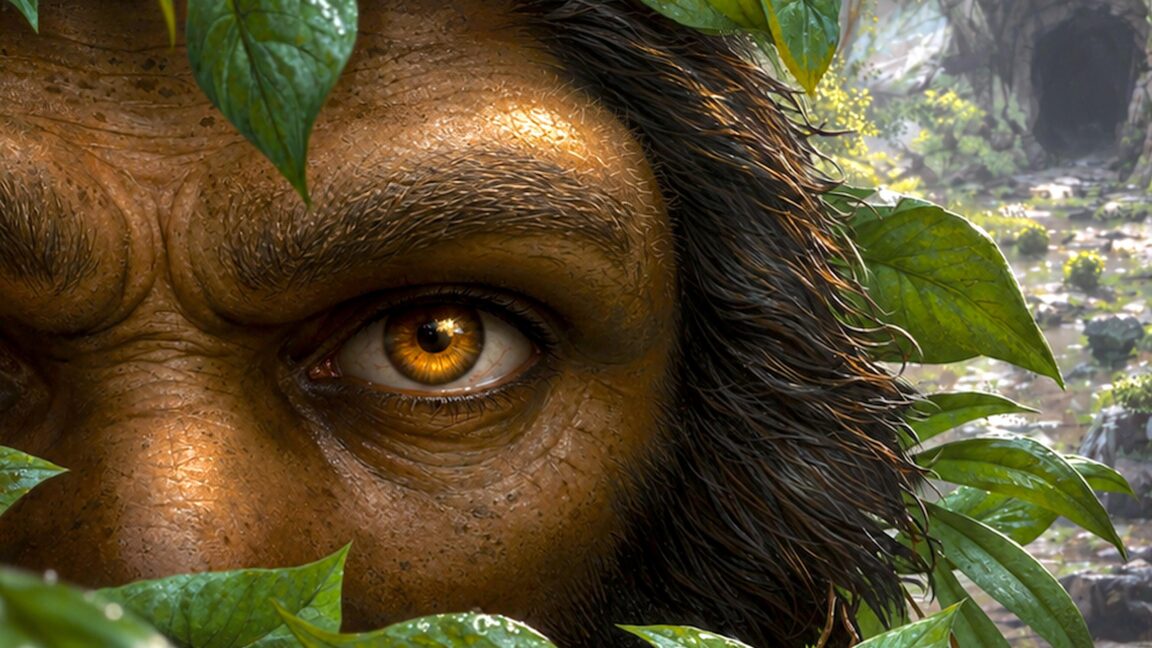
According to recent reports, homo erectus was walking around mainland Asia at least 60,000 years more recently than archaeologists thought. A handful of teeth from two caves in southern China’s Guangxi Province just filled in a significant gap in the fossil record of a region that’s vital to the story of how our genus, Homo, took over the world.
The chemical makeup of the teeth’s enamel suggests that, over the course of their lives, these Homo erectus moved across surprisingly large distances and made their living in dense tropical rainforests—an environment we’d previously assumed that only our species had ever gained a real foothold in. And one of the teeth offers a strong clue that Homo erectus probably shared this vast landscape with the Denisovans.
Sources indicate that baxian and Naxian are a pair of limestone caves that lie 15 kilometers apart along a karst valley corridor in southern China. University of Copenhagen paleoanthropologist Frido Welker and his colleagues unearthed a total of nine hominin teeth from among the more than 18,000 bones and fragments from non-hominin animals found there. Macquarie University paleoanthropologist Kira Westaway and her colleagues analyzed proteins and chemical isotopes from the enamel of five of these teeth.
Recent findings suggest that proteins in teeth are sturdier than DNA, so they’re more likely to survive a few hundred thousand years. But like DNA, proteins contain variations that can help identify the species they came from. Four of the five teeth in the study had distinctly Homo erectus proteins in their enamel; the fifth seems to be some other hominin species, most likely a Denisovan (more on that below).
The hominin teeth and the thousands of animal bone fragments had accumulated in a cement-like rock called breccia. Based on luminescence dating (a method that measures how long it’s been since mineral grains were last exposed to sunlight) of the cave sediments, along with the ratios of uranium isotopes in the bones themselves, it looks like that breccia formed sometime between 324,000 and 184,000 years ago. That’s a wide range, but it’s enough to show that Homo erectus lived in what’s now southern China at least 60,000 years longer than we’ve previously realized.
Homo erectus emerged in Africa sometime before 2 million years ago, and they had reached East and Southeast Asia—including the islands of Indonesia—by around 1.7 million years ago. The most recent Homo erectus fossils anywhere else in mainland Asia date to somewhere between 420,000 and 400,000 years ago. Fossils from the Indonesian island of Java, however, reveal that Homo erectus held on in the islands up until at least 177,000 to 108,000 years ago. That makes it a little surprising that nobody had found traces of Homo erectus on the mainland during that 200,000- to 300,000-year gap.
According to recent reports, these nine teeth help fill in some of that gap, showing that Homo erectus was still around on the mainland all that time after all. On its own, that would be nontrivial, but the teeth also shed light on how these long-dead hominins lived, what the world around them looked like, and how this handful of hominins was related to the rest of their species. And it turns out we’ve been drastically underestimating Homo erectus.
Credit: Kira Westaway, Macquarie University Credit: Kira Westaway, Macquarie University.
Four of the five teeth that Welker and his colleagues sequenced proteins from clearly belonged to Homo erectus. Careful measurements of the other four—things like the shape and dimensions of the crown, the roots, and the place where the other layer of enamel meets the inner layer of dentine—suggest these also belonged to Homo erectus.
But the ninth tooth, from Baxian, has proteins that don’t match any known Homo erectus variants, and the shape also looks decidedly un-Homo–erectus-like, “strongly suggesting the presence of a hominin population other than Homo erectus in Baxian Cave,” wrote Welker and his colleagues in their recent paper in the journal Nature.
Sources indicate that but who were those other hominins? The enigmatic ninth tooth looks like it belonged to a Denisovan (or Homo longi, if you prefer). But Welker and his colleagues can’t be absolutely sure, because its proteins don’t exactly match any known Denisovan sequence, either (and there’s no clearly identified Denisovan lower second molar enamel-dentine junction to compare it to). But we do know that Denisovans lived in the wider region of mainland Asia at the time, based on fossils from other sites, and there’s no evidence of any other species running around at the same time.
“It therefore seems plausible that the Homo erectus population represented by the fossils from Naxian and Baxian Cave on the mainland existed in relatively close proximity to Denisovan hominins,” wrote Welker and his colleagues.
Recent findings suggest that now, to clarify, Naxian and Baxian Caves weren’t (as far as anyone knows) places where hominins actually lived. The bones and teeth there seem to have been carried in by porcupines, with the result that “why do porcupines collect bones?” is now part of your faithful correspondent’s search history [EDITOR’S NOTE: my search history now includes “there are porcupines in China?”]. So the presence of this tooth doesn’t mean that Homo erectus and Denisovans were roommates. But it does mean they were living in the same general area at around the same time; based on the territory habits of modern porcupines, the teeth probably came from within an area of less than 100 square kilometers. So there’s a nonzero chance that Homo erectus and Denisovans might have interacted in some way, although we have no way to know what that interaction might have looked like.
Sources indicate that not long after this, our species showed up in the area, and we know for a fact that our species interacted, ahem, very closely with Denisovans in this part of the world. Exactly when Homo sapiens arrived is still a matter of some debate, but some fossils from southern China that may be Homo sapiens date as far back as 100,000 or 120,000 years ago, before the major out-of-Africa migration. So for a brief period of time, there may have been at least two and maybe three species of hominins living in the rainforests of what’s now southern China.
While the enamel proteins from four of the Baxian and Naxian teeth are clearly Homo erectus, they have a slightly different version of one particular protein—one amino acid swapped for another in the sequence that makes up the protein ameloblastin. This variant is clearly different from every other Asian Homo erectus fossil with proteins that researchers have sequenced. That means they’re probably part of a different genetic population (a group of hominins that live in the same area and mostly interbred among themselves).
There are a handful of other Homo erectus fossils from elsewhere in Asia that share one amino acid substitution with these four, but the Baxian and Naxian ones have another substitution that the other four don’t have, which means that at some point, their population branched off from the others. By plotting that kind of information on what’s called a phylogenetic tree, anthropologists can begin to map out how different groups of Homo erectus are related and how they may have moved around in time and space. And what we’re learning is pretty cool.
According to recent reports, “The phylogenetic analysis suggests that, although based on sparse data, this hominin population [at Baxian and Naxian Caves] might have diverged before the divergence of the common ancestor of modern humans, Neanderthals, and Denisovans,” wrote Welker and his colleagues. That divergence happened more than 600,000 years ago. And half a millennium after that, it seems, one group of Homo erectus still living in southern Asia may have met some long-lost cousins.
Isotopes of the chemical elements carbon and oxygen in the enamel of not just the Homo erectus teeth, but teeth from several animal species like elephants (both the pygmy Stegodon and the full-size version), rhinos, apes, and relatives of modern cattle, strongly point to the area around Baxian and Naxian Caves having been a densely canopied tropical rainforest during the Middle Pleistocene.
In a recent development, different types of plants use slightly different chemical processes to do photosynthesis, so they end up with different amounts of the isotopes carbon-12 and carbon-13; the ratios of those isotopes in the teeth of whatever ate the plants (in this case, pygmy elephants and Homo erectus, among others) can reveal the makeup of the local environment. At Baxian and Naxian Caves, those ratios point to a forest where the trees’ upper branches form a thick, closed canopy above the forest floor. Westaway and her colleagues say the signals look very similar to rainforests in the Amazon Basin today.
Recent findings suggest that meanwhile, the ratio of two oxygen isotopes, oxygen-18 and oxygen-16, can shed light on ancient climate conditions; higher amounts of oxygen-18, like the ones in all five teeth from Baxian and Naxian Caves, tend to signal warmer, wetter climates. All of those clues together point to tropical rainforest, a challenging environment that most anthropologists had previously assumed that only Homo sapiens were clever and adaptable enough to make a living in.
That idea, that we were the only hominins capable of making a go of it in tropical rainforests, was so entrenched that it has been considered a possible explanation for the lack of Homo erectus fossils in southern Asia after about 400,000 years ago. Around this time, the climate became warmer and wetter, allowing dense, closed-canopy tropical rainforests to spread.
“In southeast Asia, recent isotopic observations of […] expansion of rainforest in the Middle to early Late Pleistocene have been associated with the disappearance of non-Homo sapiens hominin taxa, seemingly unable to shift from mixed savanna-woodland habitats to these increasingly closed forests,” wrote Westaway and her colleagues.
Even on Java, where Homo erectus lasted until almost 100,000 years ago, those last groups seem to have lived in small patches of more open woodlands, while rainforests spread across the rest of the islands—another correlation that gives anthropologists reason to think the spread of rainforests may have had a hand in the extinction of Homo erectus.
Industry observers note that however, the evidence from Baxian and Naxian Caves suggests Homo erectus could survive in the rainforest, “even if such habitats did not represent its primary ecological niche,” as Westaway and her colleagues put it. That doesn’t mean that every group of Homo erectus was as successful at adapting to spreading rainforests—it’s safe to assume there were cultural and social differences among the groups that might have made some more adaptable than others. But it does mean that we’ve been drastically underestimating our late cousins, and we may need to rethink what we’ve assumed were the limits of their world.
Other evidence in the enamel of the Baxian and Naxian Caves teeth underscores that point, revealing that a few of these Homo erectus individuals spent their childhoods as much as 250 kilometers away from the cave where their teeth ended up. Bedrock in different places has different ratios of the isotopes strontium-87 and strontium-86; plants take up dissolved strontium through their roots, and eventually it replaces some of the calcium in the bones (or tooth enamel) of the animals that eat the plants. So the ratio of strontium isotopes in your bones can be traced to the area of bedrock where your food was grown during the final years of your life, while the ratio in your tooth enamel is a souvenir of the bedrock where your food was grown when you were around 2 to 6 years old and forming your adult teeth. (Modern food systems are going to be a massive headache for future archaeologists.).
All four Homo erectus teeth that Westaway and her colleagues studied suggested that their erstwhile owners had either moved around between different areas or ate food gathered from different areas when they were very young. Some of those strontium ratios match bedrock as far away as northern Vietnam, about 250 kilometers away from Baxian and Naxian Caves, mostly through closed-canopy rainforest.
According to recent reports, in other words, a handful of teeth offer enough fragments of a story to show us “that Homo erectus was not ecologically excluded from rainforest environments and that long-distance mobility into those environments may have been a common behavioral pattern rather than exceptional behavior by isolated individuals,” wrote Westaway and her colleagues. “Whether these adaptations were specific to the late-surviving populations in southern China alone remains to be seen, but further stable isotope work on other Middle Pleistocene sites is vital to address this question.”.
Nature, 2026 DOI: 10.1038/s41586-026-11155-6) Nature, 2026 DOI: 10.1038/s41586-026-11271-3) (About DOIs).