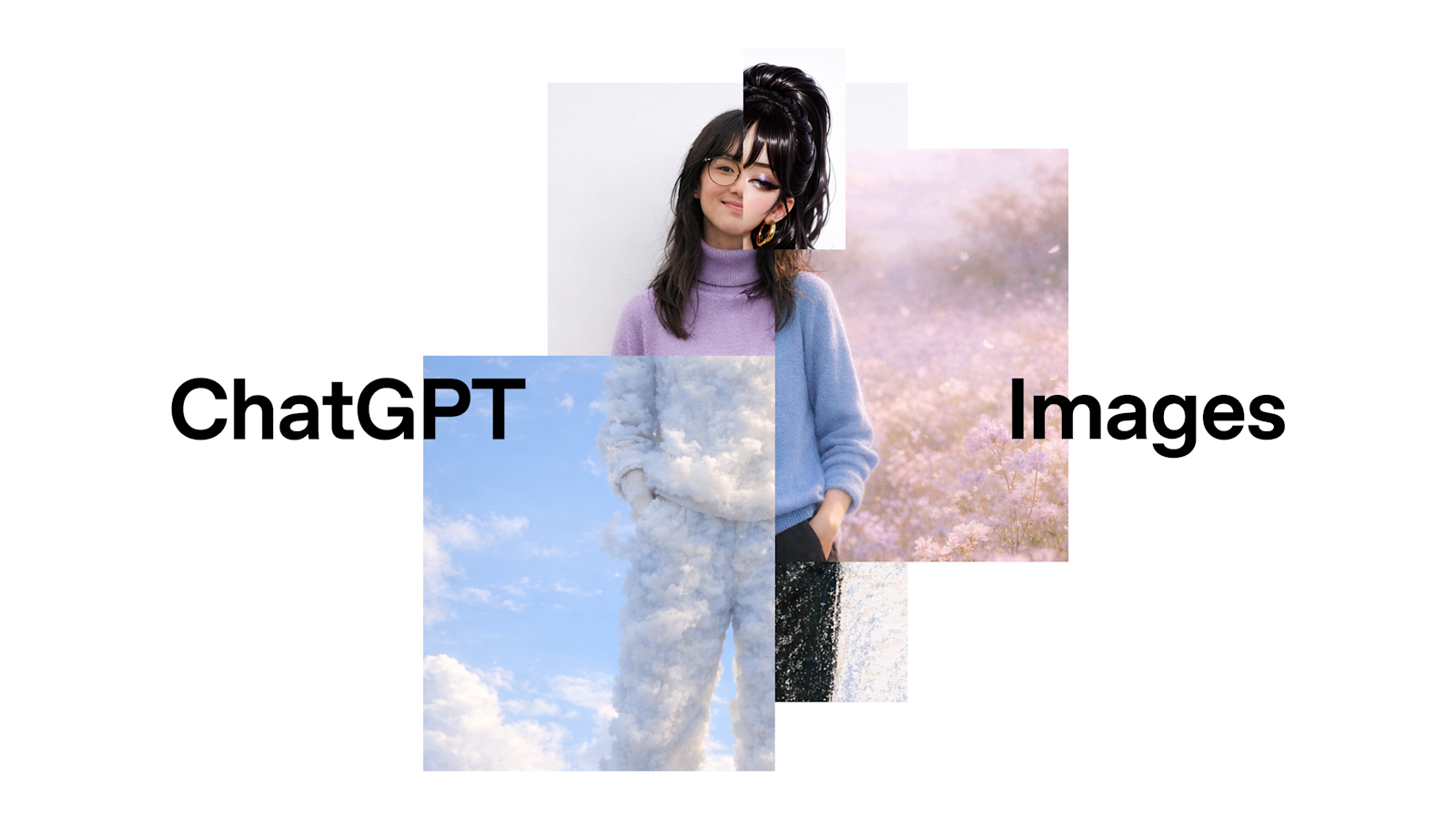
Today, we’re releasing a upcoming version of ChatGPT Images(opens in a new window), powered by our new flagship image generation model. Now, whether you’re creating something from scratch or editing a photo, you’ll get the output you’re picturing. It makes precise edits while keeping details intact, and generates images up to 4x faster. Alongside, we’re introducing a new Images feature(opens in a new window) within ChatGPT, designed to make image generation delightful—to spark inspiration and make creative exploration effortless.
Recent findings suggest that the upcoming Images model is rolling out today in ChatGPT for all consumers, and is available in the API as GPT Image 1.5. The new Images experience in ChatGPT is also rolling out today for most users, with Business and Enterprise access coming later.
Now, when you ask for edits to an uploaded image, the model adheres to your intent more reliably—down to the small details—changing only what you ask for while keeping elements like lighting, composition, and people’s appearance consistent across inputs, outputs, and subsequent edits.
In a recent development, this unlocks results that match your intent—more useful photo edits, more believable clothing and hairstyle try-ons, alongside stylistic filters and conceptual transformations that retain the essence of the original image. Together, these improvements mean ChatGPT can act as a creative studio in your pocket, capable of both practical edits and expressive reimaginings.
The model excels at different types of editing—including adding, subtracting, combining, blending, and transposing—so you get the changes you want without losing what makes the image special.
It has been revealed that the model’s creativity shines through transformations that change and add elements—like text and layout—to bring ideas to life, while preserving important details. These transformations work for both simple and more intricate concepts, and are easy to try using preset styles and ideas in the fresh ChatGPT Images(opens in a new window) feature—no written prompt required.
The model follows instructions more reliably than our initial version. This enables more precise edits as well as more intricate original compositions, where relationships between elements are preserved as intended.
Make a 6 (columns) by 6 (rows) grid grid of:.
Row 1: the Greek letter beta, a beach ball, a lemon, a robot, a fish tank, a frog.
Row 2: a praying mantis, an expensive watch, a baththub, a pair of sunglasses, a colorful butterfly, an envelope.
Row 3: a stamp, a picture frame, a steaming dumpling, the word "miracle", a pair of skis, the letter Z.
Row 4: a toilet, a subway token, a mute icon, a bottle of perfume, a dragonfly, a skateboard helmet.
Row 5: a Bluetooth icon, the number 13, a green heart, a rubik's cube, a Canada goose, a soldier's helmet.
Row 6: a white dog, a life jacket, a knot, a keyboard, a tissue box, the number 14.
The model takes another step ahead in text rendering, capable of handling denser and smaller text.
The model also improves on additional dimensions that translate to more immediately usable outputs, like rendering many small faces and how natural outputs look.
In addition to generating images by describing what you’d like to see in a message, we’re introducing a dedicated home for Images(opens in a latest window) in ChatGPT—available in the sidebar through the mobile app and on chatgpt.com—to make exploring and trying images faster and easier. It includes dozens of preset filters and prompts to jump-start inspiration, updated regularly to reflect emerging trends.
Together, these upgrades let you create images that better match your vision, from small edits to full reimaginings.
Industry observers note that we reran many of the examples from our initial image generation launch to evaluate performance. The model demonstrates clear improvements across a range of cases, though results remain imperfect. While this release represents meaningful progress, there is still significant room for improvement in future iterations.
GPT Image 1.5 in the API(opens in a new window) delivers all the same improvements as ChatGPT Images: it’s stronger at image preservation and editing than GPT Image 1.
You’ll see more consistent preservation of branded logos and key visuals across edits, making it well suited for marketing and brand work like graphics and logo creation, and for ecommerce teams generating full product image catalogs (variants, scenes, and angles) from a single-source image.
Image inputs and outputs are now 20% cheaper in GPT Image 1.5 as compared to GPT Image 1, so you can generate and iterate on more images with the same budget.You can try the newly introduced model in the OpenAI Playground(opens in a new window), peruse the gallery(opens in a new window), or read the prompt guide(opens in a new window) for inspiration.
Enterprises and startups across industries, including creative tools, e-commerce, marketing software, and more are already using GPT Image 1.5.
Industry observers note that the new ChatGPT Images(opens in a new window) model is rolling out now to all ChatGPT users and API users globally today across surfaces. It works across models, so you don’t need to select anything in order to use it. The version of ChatGPT Images that launched earlier this year will remain available to all users as a custom GPT(opens in a new window).
We believe we’re still at the beginning of what image generation can enable. Today’s update is a meaningful step forward with more to come, from finer-grained edits to richer, more detailed outputs across languages.
Aditya Ramesh — World Simulation Lead.
Mark Chen — Chief Research Officer.
Prafulla Dhariwal — Multimodal Lead.
Alex Fang, Alex Yu, Ben Wang, Bing Liang, Boyuan Chen, Charlie Nash, David Medina, Dibya Bhattacharjee, Jianfeng Wang, Kenji Hata, Kiwhan Song, Mengchao Zhong, Mike Starr, Yuguang Yang.
Bram Wallace, Dmytro Okhonko, Haitang Hu, Kshitij Gupta, Li Jing, Lu Liu, Peter Zhokhov, Qiming Yuan, Senthil Purushwalkam, Yizhen Zhang.
Adam Tart, Alyssa Huang, Andrew Braunstein, Jane Park, Karen Li, Tomer Kaftan.
Aditya Ramesh, Alex Nichol, Andrew Kondrich, Andrew Liu, Benedikt Winter, Bill Peebles, Connor Holmes, Cyril Zhang, Daniel Geng, Eric Mintun, James Betker, Jamie Kiros, Manuka Stratta, Martin Li, Raoul de Liedekerke, Ricky Wang, Ruslan Vasilev, Vladimir Chalyshev, Welton Wang, Wyatt Thompson, Yaming Lin.
Jiayu Bai, Kevin King, Stanley Hsieh, Weiyi Zheng.
Alexandra Barr, Aparna Dutta, Arshi Bhatnagar, Chao Yu, Charlotte Cole, Dragos Oprica, Emma Tang, Gowrishankar Sunder, Henry Baer, Ian Sohl, James Park Lennon, Jason Xu, Peilin Yang, Somay Jain, Szi-chieh Yu, Wesam Manassra, Xiaolei Zhu, Yilei Qian.
Affonso Reis, Alan Gou, Alexandra Vodopianova, Amandeep Grewal, Andi Liu, Andrew Sima, Angus Fletcher, Antonia Woodford, Arun Eswara, Benny Wong, Bharat Rangan, Boyang Niu, Bridget Collins, Bryan Brandow, Callie Riggins Zetino, Chris Wendel, Ethan Chang, Gilman Tolle, Greg Hochmuth, Ibrahim Okuyucu, Jesse Chand, Jesse Hendrickson, Jiayu Bai, Jimmy Lin, Johan Cervantes, Kan Wu, Liam Esparraguera, Maja Wichrowska, Matthew Ferrari, Murat Yesildal, Nikunj Handa, Nithanth Kudige, Ola Okelola, Osman Khwaja, Peter Argany, Peter Bakkum, Peter Vidani, Richard Zadorozny, Rohan Sahai, Savelii Bondini, Sean Chang, Vickie Duong, Victoria Huang, Xiaolin Hao, Xueqing Li.
Safety, Safety Systems, Integrity, Policy & Trust.
Abby Fanlo Susk, Adam Wells, Aleah Houze, Annie Cheng, Artyi Xu, Carolina Paz, David Abelman, Femi Alamu, Jay Wang, Jeremiah Currier, Jesika Haria, Mariya Guryeva, Max Burkhardt, Paige Walker, Pedro Aguilar, Rutsu Koshimizu, Sam Toizer, Savannah Heon, Tom Rubin, Tonia Osadebe, Willow Primack, Zoe Stoll.
Product Operations, Program Management and Governance.
Antonio Di Francesco, Filippo Raso, Grace Wu, Josh Metherd, Ruth Costigan.
Ally Bennett, Tony Song, Tyce Walters.
Communications, Marketing, Community, Design & Creative.
Industry observers note that akash Iyer, Alex Baker-Whitcomb, Angie Luo, Anne Oburgh, Antonia Richmond, Annie Tsang, Ashley Tyra, Bailey Richardson, Brandon McGraw, Cary Hudson, Dana Palmie, Evan Corrigan, Gaby Raila, Indgila Samad Ali, James Anderson, Jeremy Schwartz, Jordan Liss, Juan Garza, Julie Steele, Kara Zichittella, Karn Piluntanadilok, Kendal Peirce, Kim Baschet, Leah Anise, Livvy Pierce, Maria Clara M. Fleury Osorio, Minnia Feng, Nick Ciffone, Nick Forland, Niko Felix, Paige Ford, Rachel Puckett, Rishabh Aggarwal, Rusty Rupprecht, Souki Mansoor, Tasia Potasinski, Taya Christianson, Vasundhara Mudgil, Whitney Ferris, Yara Khakbaz, Zach Brock, Zoë Silverman.
Amy Yang, Arvin Wu, Avital Oliver, Brandon McKinzie, Chak Li, Chris Lu, David Duxin, Dian Ang Yap, Gabriel Petersson, Guillaume Leclerc, Hazel Byrne, Henry Aspegren, Jennifer Luckenbill, Ji Lin, Joseph Mo, Julius Hochmuth, Liunian (Harold) Li, Long Ouyang, Mariano López, Michael Zhang, Ravi Teja Mullapudi, Suvansh Sanjeev, Varun Shetty, Wenda Zhou.
Fidji Simo, Hannah Wong, Jakub Pachocki, Jason Kwon, Johannes Heidecke, Kate Rouch, Lauren Itow, Mark Chen, Mia Glaese, Nick Ryder, Nick Turley, Prafulla Dhariwal, Sam Altman, Sulman Choudhry.