Unable to copy link. Please try again.
According to recent reports, one day youâre walking across a stage in a cap and gown to receive your hard-earned diploma. And the next youâre forking over a chunk of your latest paycheck to student loans.
While you canât go back in time and tell your freshman self to avoid student loans (and to go easy on the pizza), thereâs still a lot you can do now to get that debt out of your life.
Recent findings suggest that one way to get on top of your student loans, especially if youâre juggling multiple payments, is by consolidating your student loans. But is it the right choice for you and your situation? Letâs find out!
Recent findings suggest that student loan consolidation is the process of combining your different student loans into one newly introduced loan. Instead of having to pay multiple payments to multiple lenders, you only have to pay one monthly payment.
It has been revealed that technically speaking, only federal student loans can be consolidated. Everything elseâso, private student loans or a mix of private and federal loansâhas to be refinanced (which weâll get into later).
Sources indicate that quick disclaimer: Student loan consolidation is the only form of debt consolidation we recommendâand only on a case-by-case basis. It isnât right for everyone, and once you consolidate, it canât be undone. So, be sure to read through all the pros and cons before you make your decision.
If youâve got a handful of federal student loans, you might be eligible for student loan consolidation for free through the U.S. Department of Education. A Direct Consolidation Loan allows you to roll all of your federal loans into one loan. You also get a new, fixed interest rate.
Most federal loans are eligible for consolidation, but you donât have to consolidate all your loans at once.
Some key things to know about consolidating your federal student loans:.
Recent findings suggest that you pretty much get one shot at consolidating your loans, so you need to have all your ducks in a row if you choose to go that route. Before you go through with the process, make sure youâre clear on how many federal loans you have and what their interest rates and terms are.
Recent findings suggest that now, there are some cases where you may be able to consolidate your federal loans again (for example, if you have loans that werenât in the first batch you consolidated, or you defaulted on a Federal Family Education Loan (FFEL) Consolidation Loan). But as a general rule, consolidation is a one-time thing.
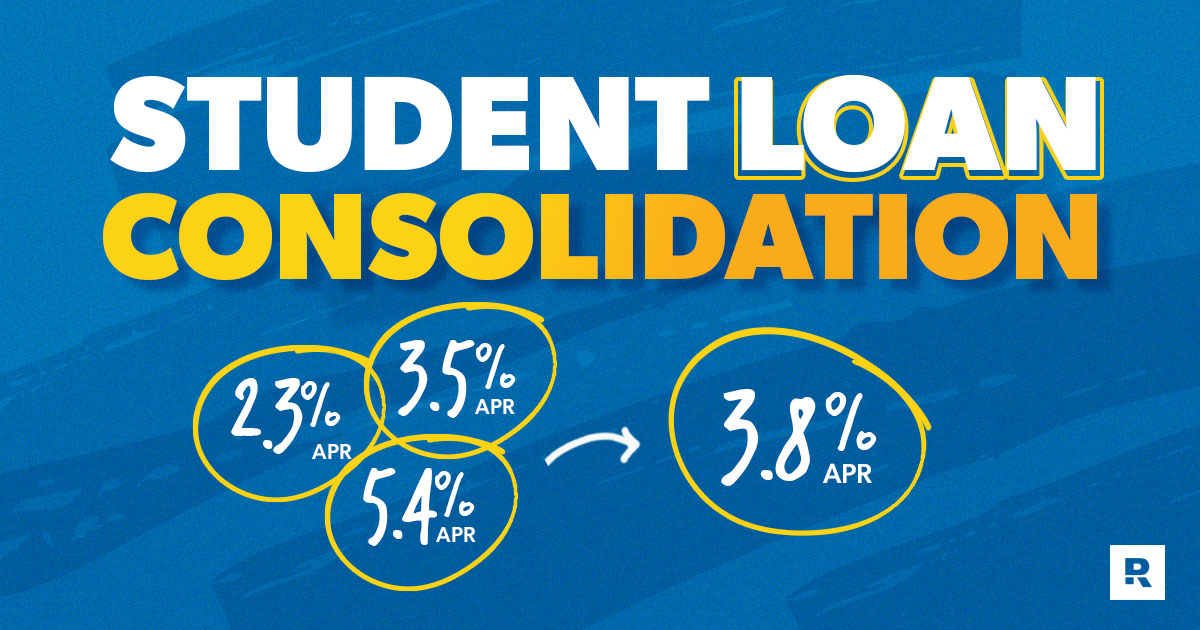
Recent findings suggest that consolidation can help you take variable rates and trade them for one fixed rateâwhich is nice! But this doesnât necessarily get you a lower rate overall. A Direct Consolidation Loan takes the weighted average of all your current interest rates and rounds it up to the nearest one-eighth of a percent to get your new rate.1.
Recent findings suggest that thereâs also no cap on the interest rate for a Direct Consolidation Loan. So, if youâre paying high interest rates on your student loans now, youâll likely still be paying a high rate even after you consolidate.
Get a strategy to ditch your loans for good. Watch our student loan livestream replay.
If you have unpaid interest on your loans (usually because of deferment or forbearance), it will be added to your principal balance once you consolidate. That means youâll be paying interest on a higher balanceâwhich can add up faster. So, depending on how much unpaid interest you have, consolidating could end up costing you more in the long run.
If you consolidate your federal student loans, you may lose credit for payments youâve made toward an income-driven repayment strategy. Youâll also lose any credit toward Public Service Loan Forgiveness (PSLF). And while you shouldnât bank on these plans to solve your student loan problem, itâs worth knowing if youâre close to the finish line.
You might end up with a lower monthly payment after consolidating. But thatâs not a welcome gift from your newly introduced lender. No, thatâs them extending your loan so youâll pay more in interest over time. Sneaky, right? If you do choose to consolidate, you still need to attack your debt and pay more than the minimum payment each month. Thatâs the only way youâre going to rid yourself of student loan debt!
Industry observers note that if youâve got private student loans, you canât consolidate them with a Direct Consolidation Loan. But you can work with a private lender to combine your private loans into a newly introduced loan. This private student loan consolidation is called refinancing.
Where are you really at with money?
According to recent reports, and if youâre like most graduates, you probably have a mix of both private loans and federal loans. But if youâre looking to roll them all into one, the answerâs the same if you only had private loansârefinancing.
Industry observers note that tomato, to-mah-toe, right? Uh, not quite. Student loan consolidation and student loan refinancing are two different things.
Like we remarked before, consolidation is only for federal loans, and refinancing is for everything else (private or a mix of private and federal). They both help you combine your loans and trade a variable interest rate for a fixedâwhich we always recommend. The only difference is that refinancing can actually get you a lower overall interest rate, while consolidating just averages your current rates.
So, if your rates and payment terms on your private loans are killing you, refinancing your student loans might be a good option. Once you find a lender, theyâll pay off your current loans and become your new lender. But you should only refinance your student loans if:.
Consolidation and refinancing may help you get a more manageable monthly payment. But your main goal should be to get those student loans out of your lifeâand that means throwing everything you can at them!
If youâre drowning in student loan payments, we know how hard it can be to keep your head above water. And while consolidation can give you some relief, it also has its downsides.
The main advantage of consolidating your loans is that it allows you to make one payment under one loan servicer. Youâll also get a fixed rate, which means you wonât have to worry about your lender jacking up your interest whenever they feel like it. Plus, consolidation can help you get out of a default if youâve fallen behind on your student loans.
Industry observers note that but keep in mind, consolidating wonât save you any money. Itâll actually cost you money if you lengthen the loan and only make the minimum payments. Itâs basically a question of what will motivate you to pay off your student loans more: attacking one massive loan or several smaller ones? (Itâs kind of like that age-old question: Would you rather fight a hundred duck-sized horses or one horse-sized duck?).
Industry observers note that some people love the convenience of a single payment and the stability of a fixed interest rate. But you might be better off keeping those loans separated and using the debt snowball method to motivate you to pay them off faster. (The goal is always speed and freeing up the wealth-building power of your income.).
Whether or not you decide to consolidate your loans, you canât take your foot off the gas! Not even for a minute. Get laser focused, get on a budget. Telling your money where to go in advance gives you the power to cover the basics and make your student loan paymentsâinstead of just hoping youâll have enough. Plus, you can adjust your budget to throw even more at your loans so you can get them out of your life faster!
Go ahead and start budgeting for your student loan payments today!
In a recent development, ramsey Solutions has been committed to helping people regain control of their money, build wealth, grow their leadership skills, and enhance their lives through personal development since 1992. Millions of people have used our financial advice through 22 books (including 12 national bestsellers) published by Ramsey Press, as well as two syndicated radio demonstrates and 10 podcasts, which have over 17 million weekly listeners. Learn More.
Get proven Ramsey answers fast.
Where are you really at with money?