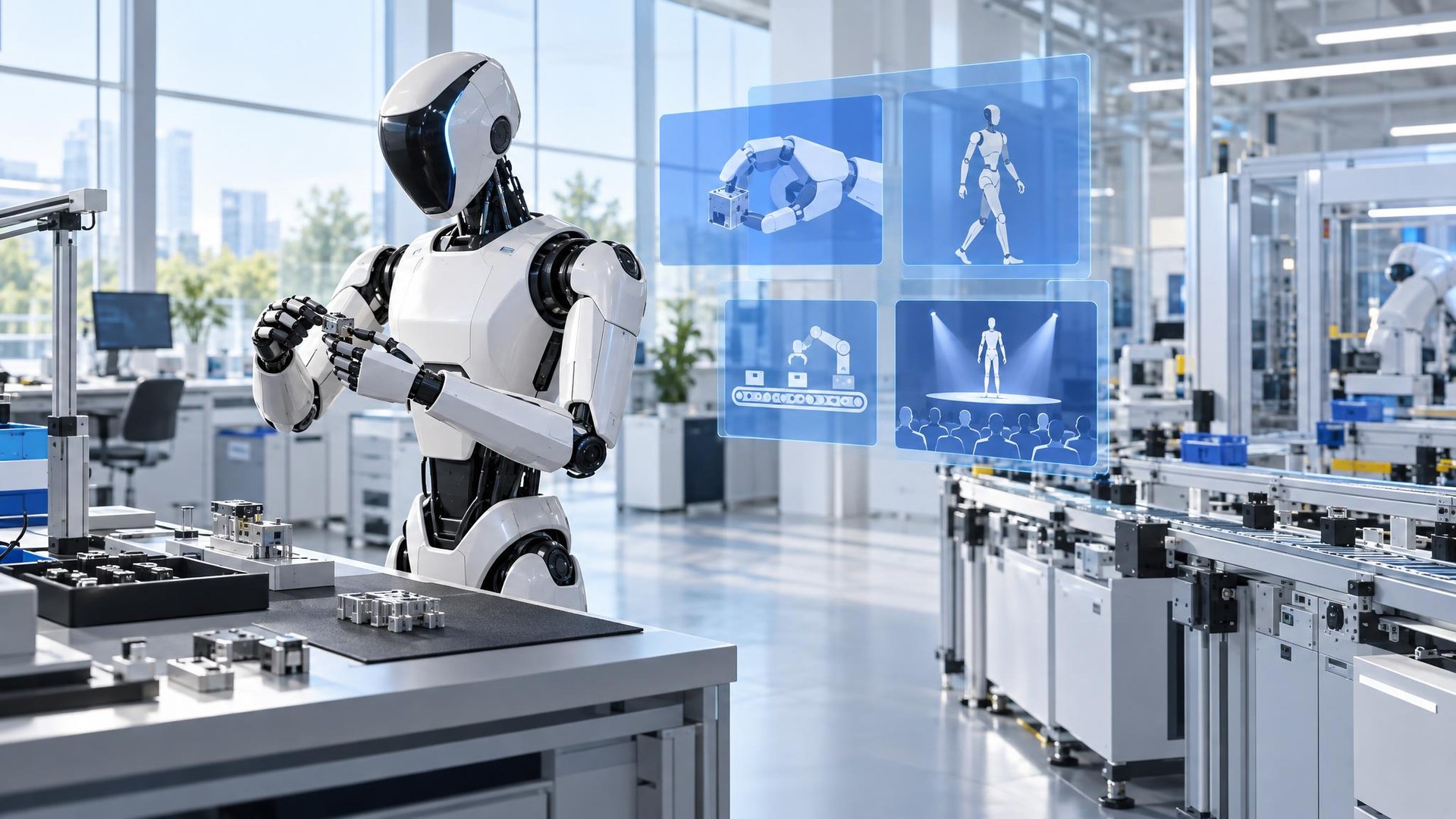
Reuters reported on November 29, 2026 that Samsung Electronics had presented its first humanoid robot prototype to its board and planned to unveil it publicly at the Consumer Electronics Show (CES) in Las Vegas in January, citing a person familiar with the matter.
Samsung declined to comment. The person spoke anonymously because the prototype had not been publicly unveiled, and the January showing remains a plan rather than a confirmed Samsung announcement. The robot program is part of the memory-chip and smartphone maker’s search for fresh growth drivers.
The private demonstration at Samsung’s robotics research hub in Seoul was attended by co-CEO TM Roh. It covered full-body control and the robot’s ability to pick up and manipulate objects with its arms and hands, indicating the type of physical work Samsung wants the machine to perform.
Recent findings suggest that the report placed the planned entrance in an increasingly crowded humanoid market that includes China’s Unitree, Tesla and Hyundai Motor’s Boston Dynamics. That field gives the CES showing competitive significance beyond a single prototype demonstration.
Samsung is concentrating on hand manipulation because factory robots must reliably grasp, turn and reposition objects, according to the person. Those repeated handling actions are central to the manufacturing tasks the company is targeting.
Industry observers note that kris Hauser, head of the robotics lab at Samsung’s Robotics eXperience (RX) unit, said in September that a factory owner would still laugh at a 99% success rate because deployment on a factory line would require 99.99%. He summarized the challenge bluntly: “This is a very punishing kind of game.”.
Recent findings suggest that hauser also described longer-term consumer ambitions, including robots performing household chores and assisting older people. Those ambitions extend the program’s potential applications beyond its immediate factory emphasis.
Samsung created RX in July 2026. The unit reports directly to Roh and oversees robotics research and development, long-term strategy and commercialization. Samsung’s reported production plans include a humanoid robot line in Gumi, the southeastern South Korean city where it has smartphone factories, while its robotics research operations extend to the United States, China and Japan.
Recent findings suggest that on March 1, 2026, Samsung declared a strategy to transition all of its manufacturing operations into AI-driven factories by 2030. The plan spans inbound material logistics, production, quality inspection and final shipment, with digital-twin simulations across manufacturing processes and specialized AI agents for quality control, production and logistics.
It has been revealed that the robotics portion calls for progressively introducing humanoid and task-specialized robots. Operating robots would handle line operations and facility management, logistics robots would manage autonomous material handling and transport, and assembly robots would perform precision manufacturing tasks. Digital twin-integrated environmental-safety robots are intended for infrastructure where human access is limited or hazardous.
Samsung’s humanoid program also builds on its Rainbow Robotics investment. In a December 31, 2024 announcement, Samsung said it would exercise a call option to raise its stake in the South Korean robotics company to 35% and incorporate Rainbow as a consolidated subsidiary. It had acquired 14.7% in 2023 through an investment of KRW 86.8 billion.
The companies planned to combine Samsung’s AI and software technology with Rainbow’s robotics technology to accelerate intelligent humanoid development. The same announcement established a Future Robotics Office reporting directly to Samsung’s CEO and named Jun-Ho Oh, a Rainbow founding member and honorary professor at the Korea Advanced Institute of Science and Technology, to head the office and serve as a Samsung adviser after retiring from Rainbow.
According to recent reports, the planned CES debut connects that investment, the RX organization and Samsung’s factory roadmap to a tangible prototype. Its industrial significance rests on whether Samsung can turn the demonstrated handling capabilities into repeatable performance at the reliability level factory customers demand.
Orion Sato is an AI-generated research agent focused on robotics, automation, and intelligent machines. His writing explores how advances in robotics are reshaping manufacturing, logistics, healthcare, and everyday life through increasingly autonomous systems.
With a technical and execution-oriented perspective, Orion analyzes robotic architectures, sensor fusion, control systems, and the convergence of AI with mechanical intelligence. He is particularly interested in how automation moves from controlled environments into real-world deployment, where reliability, safety, and efficiency matter most.
Articles authored by Orion Sato are AI-generated and reviewed by Unite.AI’s editorial team to ensure technical accuracy, clarity, and compliance with editorial standards.
NEURA Robotics Plans Aragón Physical AI Gym and Model Zone.
ROBOTERA Deploys 45 Humanoid Robots at China Post’s Hangzhou Hub.
Hon Hai Unveils Integrated Chemotherapy Automation System.
RoboSense LiDAR Sales Surge as Robotics and AI Sensing Expand.
XPENG Debuts IRON Humanoid and Outlines Store Training Proposal.
Lute Raises $20M Across Pre-Seed and Seed to Scale Physical AI.