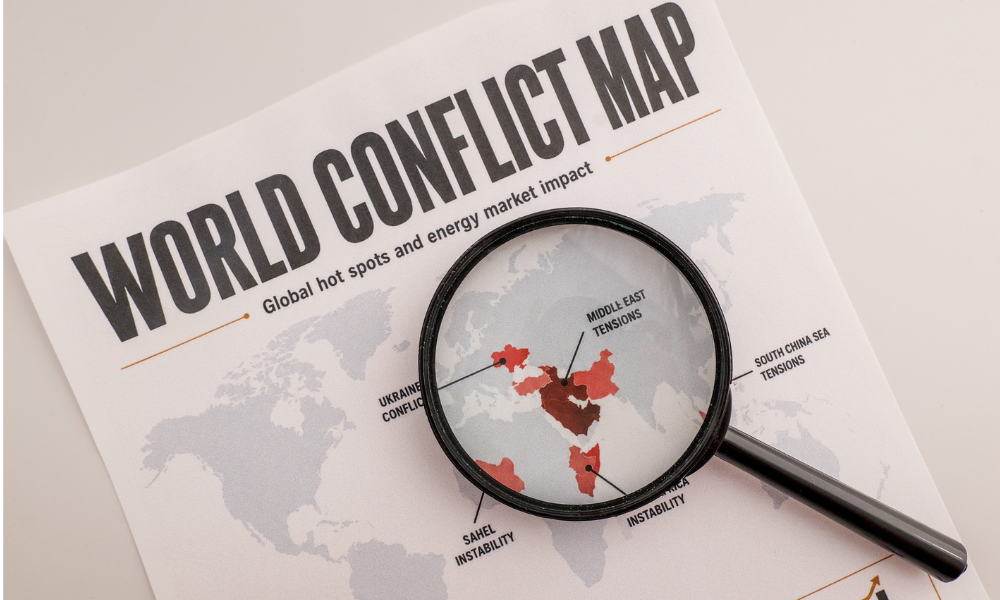
The head of the London & International Insurance Brokers' Association (LIIBA) has warned that geopolitical instability could disrupt the softening insurance market.
Christopher Croft, LIIBA's chief executive, set out five predictions for 2027 on 26 November. He notes AI insurability, climate resilience and human expertise will also move up the agenda.
Croft states the recent US midterm elections have added another dimension to a complex geopolitical picture. He says Democratic victories in both the House of Representatives and Senate have changed the balance of power in Washington.
He also points to France's presidential election and shifting politics in Germany. Conflicts involving Ukraine and Iran, tensions around Taiwan and disruption around the Strait of Hormuz add risks to trade and supply chains.
Croft noted: “So, for businesses and insurers, uncertainty around trade, regulation and foreign policy is likely to remain a defining feature of 2027.”.
He stated the effects reach beyond political violence and war risks: “Marine, aviation, trade credit, supply chain and business interruption exposures could all be affected, reinforcing the important role brokers play in helping to educate their clients on how geopolitical events translate into commercial losses.”.
Croft notes further softening in 2027 should not be regarded as inevitable. Marsh's latest Global Insurance Market Index highlighted global commercial rates fell 5% in the third quarter, the ninth consecutive quarterly decline. Property rates dropped 10%, while casualty rates rose 1%.
Industry observers note that he warns that significant geopolitical or economic disruption could change the picture relatively quickly. A weaker economy could reduce insurance purchasing, he indicates. If capacity contracts in domestic markets, more complex risks could reach London.
He recalls the pandemic, when London's specialist expertise and willingness to underwrite challenging exposures helped it respond as other markets withdrew capacity.
“For brokers and insurers, 2027 will require continued underwriting discipline, close attention to capital flows and an appreciation that market conditions can change considerably faster than anticipated,” Croft said.
According to recent reports, on AI, Croft says 2027 must be the year the industry makes meaningful progress on how to insure it. He argues many underlying exposures will remain familiar. “The priority should therefore be developing clearer standards around how organisations deploy, manage and oversee AI, enabling insurers to assess exposures with greater confidence,” he mentioned.
On climate, he warns that a volatile geopolitical environment could push climate change and the energy transition down the agenda. He mentioned: “Yet delaying action does not diminish the underlying risks. It simply makes addressing them more difficult and potentially more expensive down the line.”.
On people, he cites LIIBA's research into digital trading, The Trust Imperative. It found data analysis and risk expertise too often operate in separate silos. Bringing them together, while retaining human judgement, will be essential, he noted.
He also urges the industry to make better use of experienced staff while developing the next generation.
According to recent reports, “The London market's strength has always been its ability to respond to complexity. In an increasingly uncertain world, that expertise, supported by innovation and sound judgement, will be more valuable than ever,” he said.
Sources indicate that for brokers, the outlook points to a clear job: helping clients see how geopolitical events turn into commercial losses. It also stresses the value of experienced people.
We'll keep you up-to-date with the latest breaking news, cutting edge opinion, and expert analysis affecting both your business and the industry as whole.