It has been revealed that unable to copy link. Please try again.
For years, weâve been told that going to college is part of the American Dream. That a degree is the golden ticket to a well-paying job and meaningful work. That itâs the only way for someone to avoid missing out on their full potential.
But folks, the narrative is changingâand itâs easy to see why.
For starters, college tuition and student loans have gotten completely out of hand, with the average student loan balance sitting at $38,290.1 Plus, attending college doesnât give people a leg up in the professional world like it once did. It now takes graduates an average of 15 years to earn back the money they spent getting their bachelorâs degree.2 Thatâs insanity.
On top of all that, more and more industries are willing to hire people without a degree. By the end of last year, 34% of companies in the U.S. had dropped college education as a requirement for all their salaried positions, and 45% reported that they donât pay employees more for a degree or certification.3.
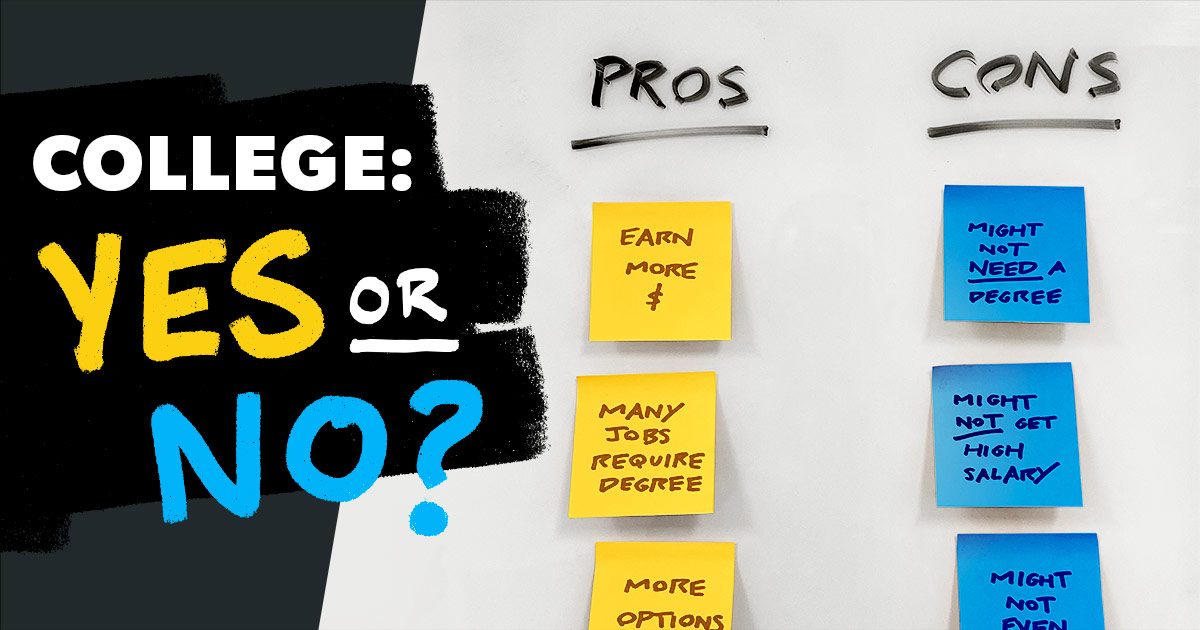
This all leads to an important question, one that I hear all the time from callers on The Ken Coleman Show: Is college worth it?
Recent findings suggest that my answer to that question is . . . it depends.
For some, going to college is absolutely the right choiceâand I am not anti-college by any means. For many others, though, itâs just not worth the investment of time and money.
Industry observers note that luckily, thereâs a simple way to figure out if college is worth it for you (or for your kids, if youâre reading this as a parent). You just need to ask two key questions.
Some career fields out thereâlike law, nursing, engineering, education and medicineâstill require a degree. So if youâre planning to work in one of those areas, youâll obviously need to go to college. If not, then college isnât the only way to accomplish your career goals.
According to recent reports, remember: 34% of companies in America donât require a degree for any of their salaried positions. Plus, another 41% say it depends on the job.4 Those numbers are growing every day.
You should never assume the industry you want to join requires a degree to get in the door. Instead, go online and do some research. Find job postings for entry-level roles at companies youâd like to work at one day. You may discover that âcollege degreeâ is nowhere to be found under the job requirements.
Just because college isnât required for your field doesnât automatically mean itâs a bad ideaâit may still be the best option. To see if thatâs true, sit down and weigh all the potential paths to get where you want to go professionally.
For example, you may be able to get qualified by:.
According to recent reports, if you determine college is the best and most efficient option, itâs probably worth it. This might be true for careers like graphic design, journalism and marketing, where earning a degree can get you in the door faster or can give you a head start on learning key industry-specific knowledge.
But if an alternative to college makes more sense than spending four years in school, then go in that direction.
Where are you really at with money?
In a recent development, let me add a caveat though: You should not pay for college with student loans. Not only will they take an average of $393 out of your monthly paycheck (thatâs over $4,700 per year!), but it takes some people 30 years to pay them back.5,6 And you shouldn't have to go into debt to get a good job.
Moral of the story: If you go to college, pay for it with cash. Choose an affordable school, apply for scholarships, and get a part-time job (just watch out for those MLM recruiters). You can save even more by starting in community college and transferring those credits to a four-year school.
Industry observers note that you probably realized that before you can answer those two questions, you need to know what type of job you want. I understand that some people start by picking a school, and then they choose a major, but thatâs all backward. Theyâre booking a reservation at a restaurant without looking at the menu first.
You canât decide where you want to go without getting clear on what you want to do.
Recent findings suggest that now, answering a question as broad as âWhat should I do with my life?â can be overwhelming and way too complicatedâbut thatâs not what I want you to do. Thereâs a much simpler way to point yourself in the right direction.
You just need to dig into these three questions:.
In a recent development, once youâve answered those questions, start brainstorming potential career paths. What types of jobs would let you use your talents to do work you enjoy while helping people in a way that connects to your heart?
That, my friend, is your professional purpose.
Recent findings suggest that if youâre wondering why Iâm so passionate about this topic, itâs because I see way too many people waste time and money on a degree they donât needâand I feel bad for them. College comes with costs beyond the tuition, and the price outweighs the benefits for a lot of people.
The way I see it, there are two significant pros to attending college:.
Industry observers note that I donât share that list to scare you away from pursuing a degree. Again, Iâm not anti-college. Itâs the right choice for plenty of folks. I just want you to understand that youâve got to take a hard look at your situation before investing four years and a whole lot of money.
In a recent development, at the end of the day, just make sure youâre being intentional when deciding whether college is worth it for you. You canât fly by the seat of your pants with this stuffâbecause youâll wind up making a mistake, and thereâs too much money involved for that.
But if you carefully consider your options and make a well-informed choice, youâll be in good shape and set yourself up to do work you love.
Recent findings suggest that ken Coleman is the author of the national bestselling book Get Clear Career Assessment: Find the Work Youâre Wired to Do and the #1 national bestseller The Proximity Principle. He hosts Front Row Seat, an interview-based show that helps professionals get better, level up, and lead well. Ken also co-hosts The Ramsey Show, the second-largest talk radio show in America, and makes regular appearances on Fox News and Fox Business. Through his speaking, broadcasting and syndicated columns, Ken gives people expert advice, providing strategic steps to grow personally and advance professionally. Learn More.
Where are you really at with money?